KitGuru KitGuru.net – Tech News | Hardware News | Hardware Reviews | IOS | Mobile | Gaming | Graphics Cards


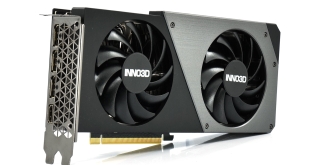
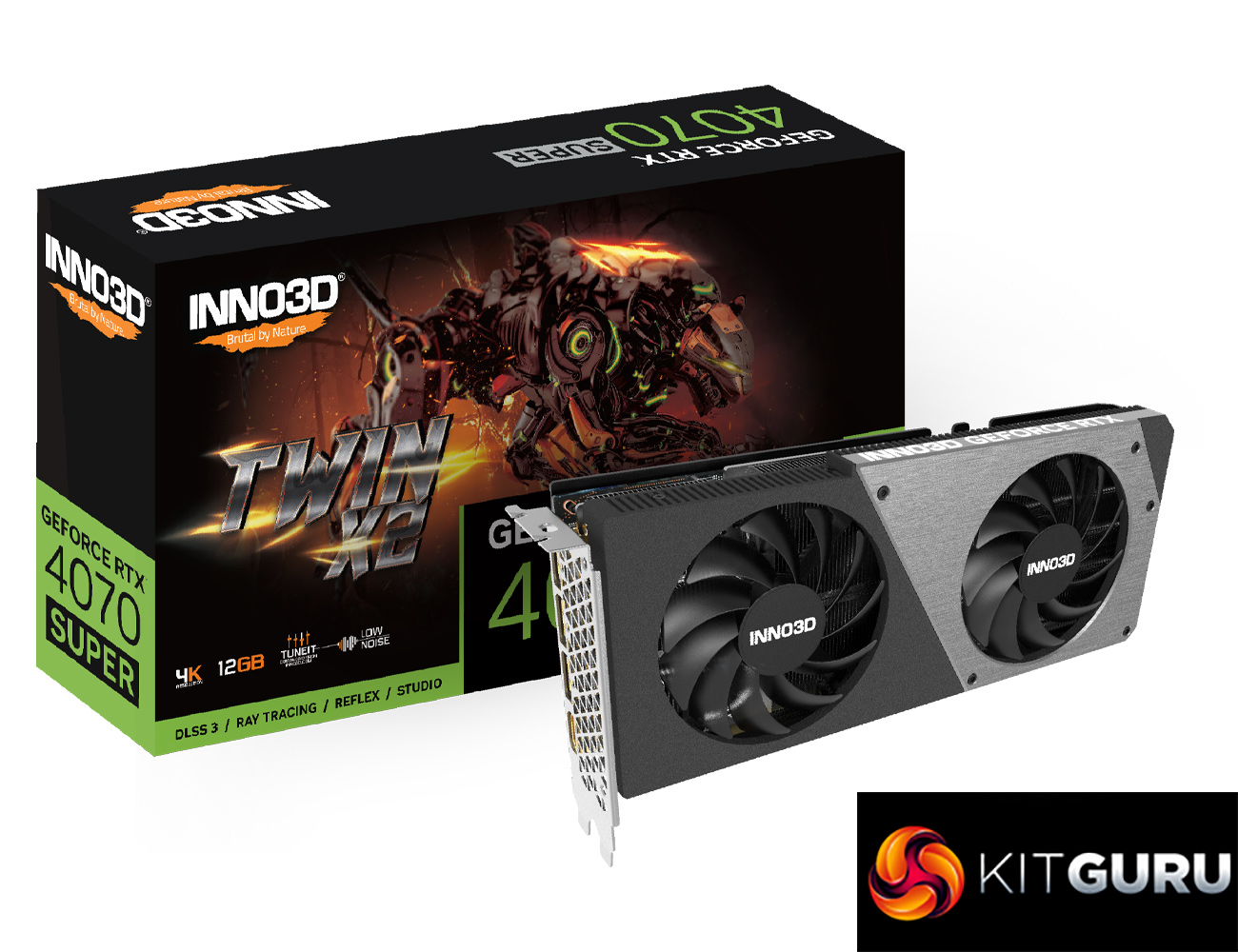
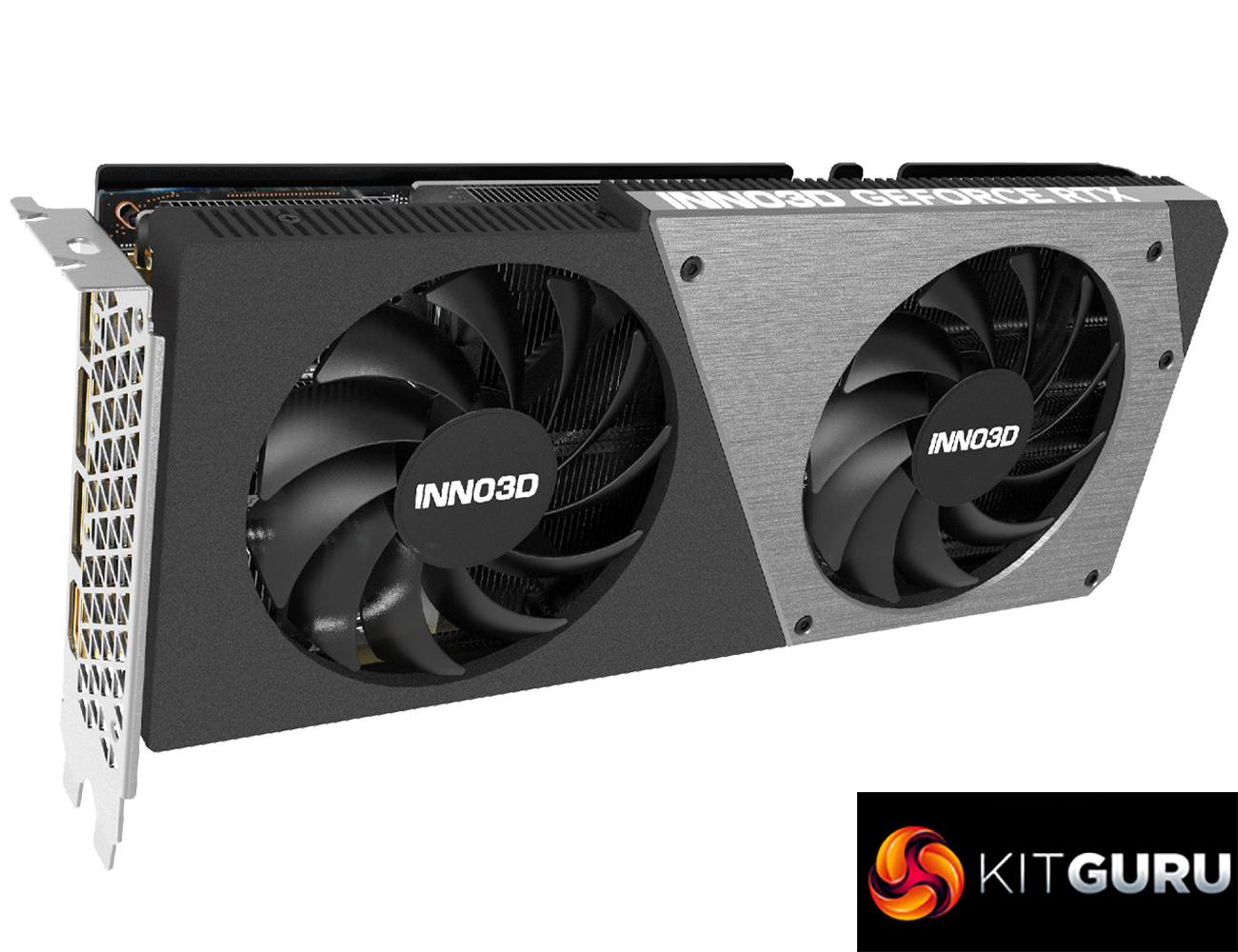
Today we're back with another look at Nvidia's RTX 4070 Super, perhaps the most well-received of the three 40-series Super refreshes that launched at the start of the year. Specifically we are reviewing the Inno3D Twin X2 model, a compact graphics card that aims to deliver a ‘no frills' experience, targeting those who want a quiet and cool-running GPU without added bells and whistles to drive up the price.
You could say that the Inno3D RTX 4070 Super Twin X2 is most notable for the features it lacks, rather than what it offers – there's no RGB for instance, no dual-BIOS, no factory overclock or even the ability to raise the power limit beyond stock figures. Instead, it is very much a ‘throwback' graphics card, prioritising low noise and temperatures while retaining a compact footprint. Coming in at £589.99 here in the UK it is one of the cheapest 4070 Supers on offer, so let's see how it performs.
| RTX 4080 | RTX 4070 Ti Super | RTX 4070 Ti | RTX 4070 Super | RTX 4070 | |
| Process | TSMC N4 | TSMC N4 | TSMC N4 | TSMC N4 | TSMC N4 |
| SMs | 76 | 66 | 60 | 56 | 46 |
| CUDA Cores | 9728 | 8448 | 7680 | 7168 | 5888 |
| Tensor Cores | 304 | 264 | 240 | 224 | 184 |
| RT Cores | 76 | 66 | 60 | 56 | 46 |
| Texture Units | 304 | 264 | 240 | 224 | 184 |
| ROPs | 112 | 96 | 80 | 80 | 64 |
| GPU Boost Clock | 2505 MHz | 2610 MHz | 2610 MHz | 2475 MHz | 2475 MHz |
| Memory Data Rate | 22.4 Gbps | 21 Gbps | 21 Gbps | 21 Gbps | 21 Gbps |
| L2 Cache | 65536 KB | 49152 KB | 49152 KB | 36864 KB | 36864 KB |
| Total Video Memory | 16GB GDDR6X | 16GB GDDR6X | 12GB GDDR6X | 12GB GDDR6X | 12GB GDDR6X |
| Memory Interface | 256-bit | 256-bit | 192-bit | 192-bit | 192-bit |
| Memory Bandwidth | 716.8 GB/Sec | 672 GB/Sec | 504 GB/Sec | 504 GB/Sec | 504 GB/Sec |
| TGP | 320W | 285W | 285W | 220W | 200W |
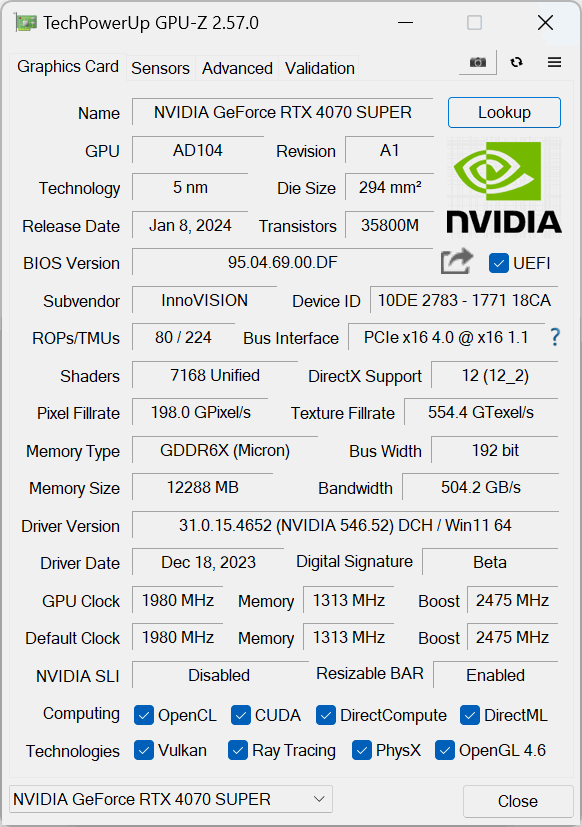
First, a quick spec recap. Just like the RTX 4070 Ti and RTX 4070, the new 4070 Super uses a cut-down AD104 die, measuring 295mm2. The fundamental building blocks are still the same of course, with the RTX 4070 Super offering a total of 56 Streaming Multiprocessors (SMs), each housing 256 CUDA Cores, for a total of 7168. We also find 56 RT cores, 224 Tensor cores, 224 Texture Units, and 80 ROPs.
TSMC's N4 node has Nvidia cranking up the clock speed significantly this generation, with the RTX 4070 Super sporting the same 2475MHz rated boost clock as the original model. Inno3D's Twin X2 model we are reviewing does not come factory overclocked.
The memory configuration also remains the same as both the 4070 and 4070 Ti. That means a relatively narrow 192-bit memory interface, so even with 12GB GDDR6X running at 21Gbps, total memory bandwidth comes in at 504 GB/s, lower than the RTX 3070 Ti. That said, there has been a substantial upgrade to the L2 cache with the Ada architecture, with the RTX 4070 now offering 49.1MB, compared to just 6MB for GA102.
Considering the increased core-count, power draw is naturally a touch higher than the RTX 4070, with the 4070 Super boasting a 220W TGP. Inno3D has not increased this out of the box for the Twin X2, and the power limit cannot be manually increased beyond 220W.
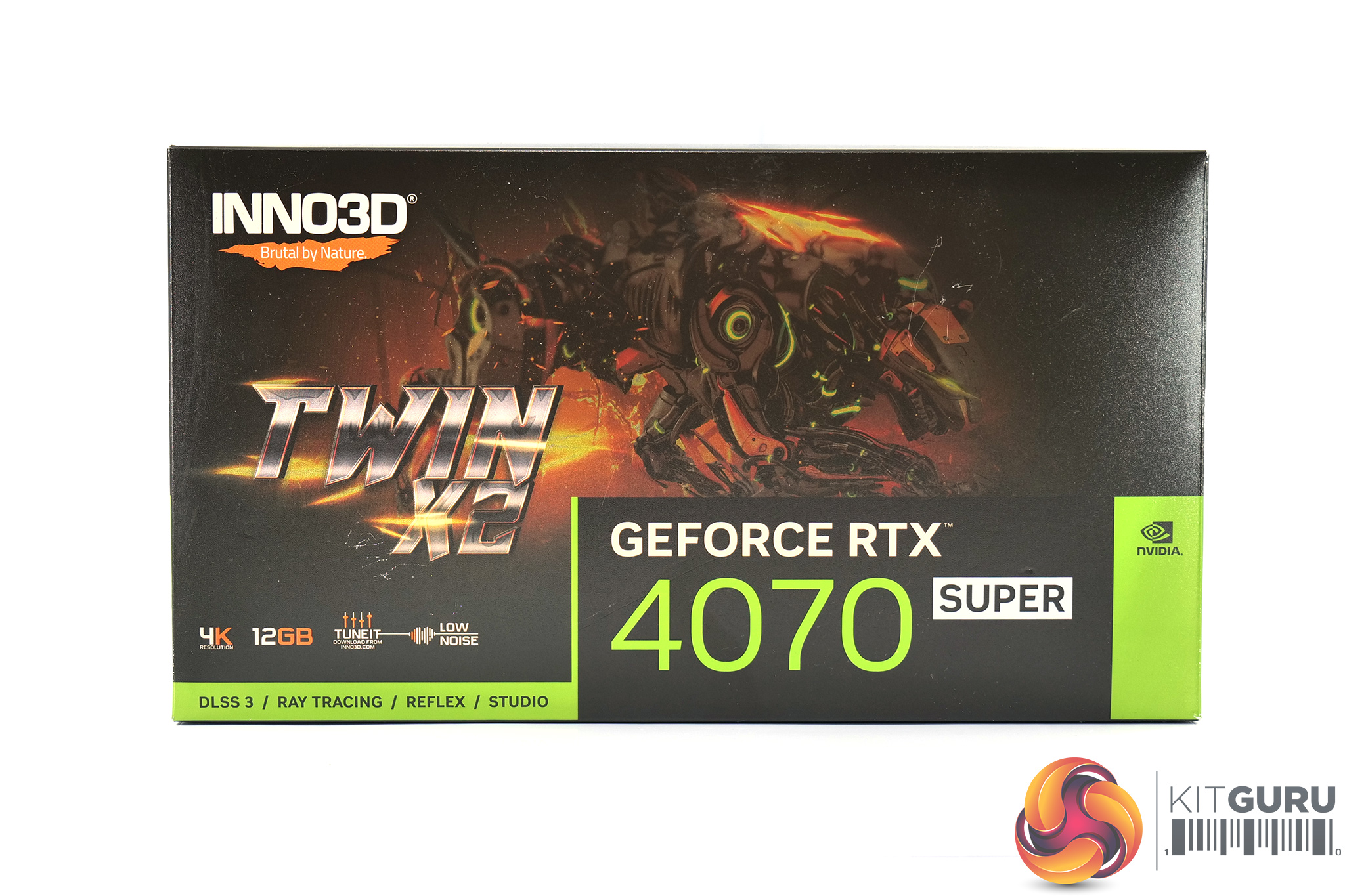
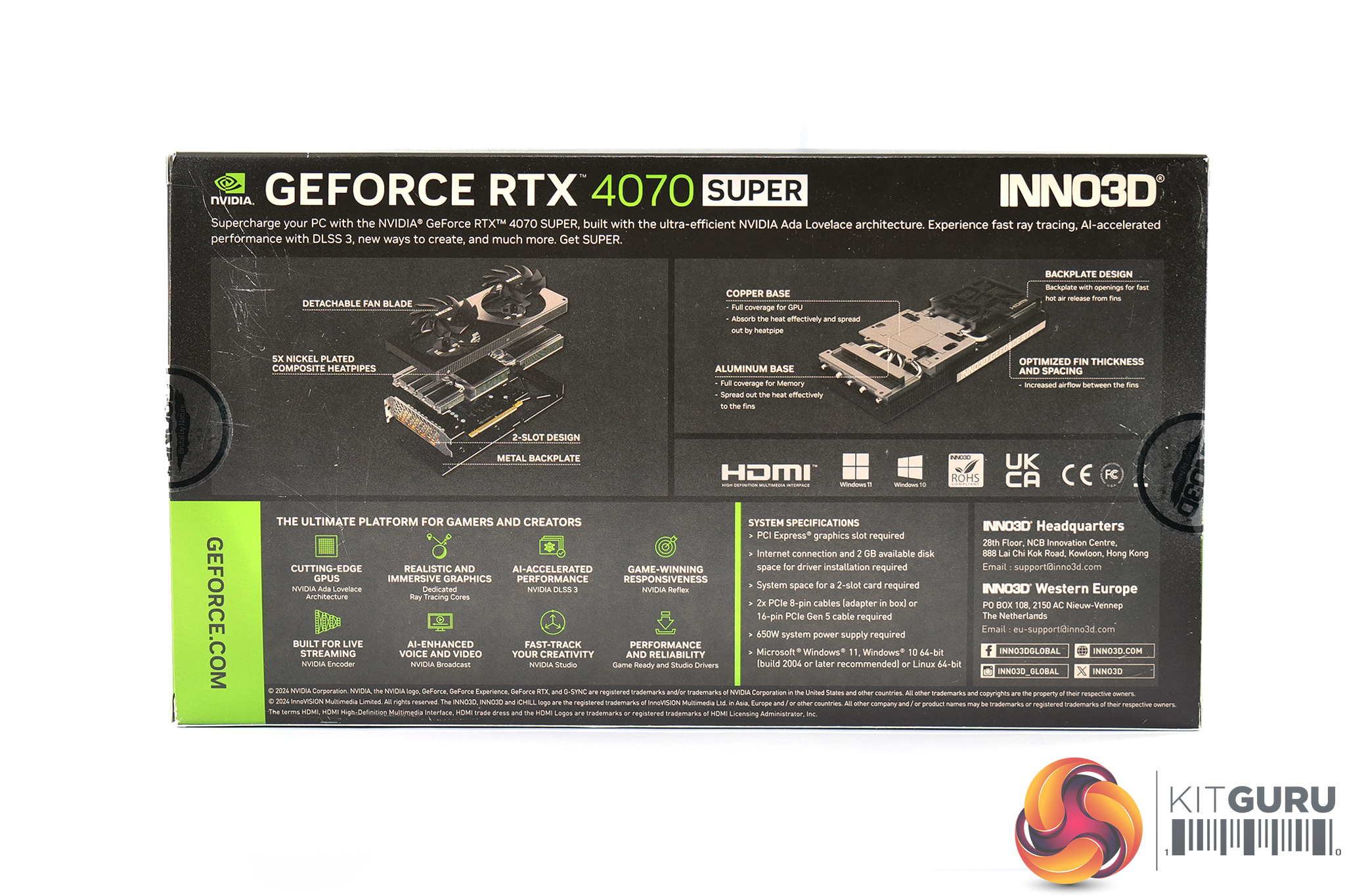
The Inno3D RTX 4070 Super Twin X2 ships in a dark box, with the Twin X2 logo positioned next to a robotic-style character. On the back, the company highlights key features of the card and its cooler.
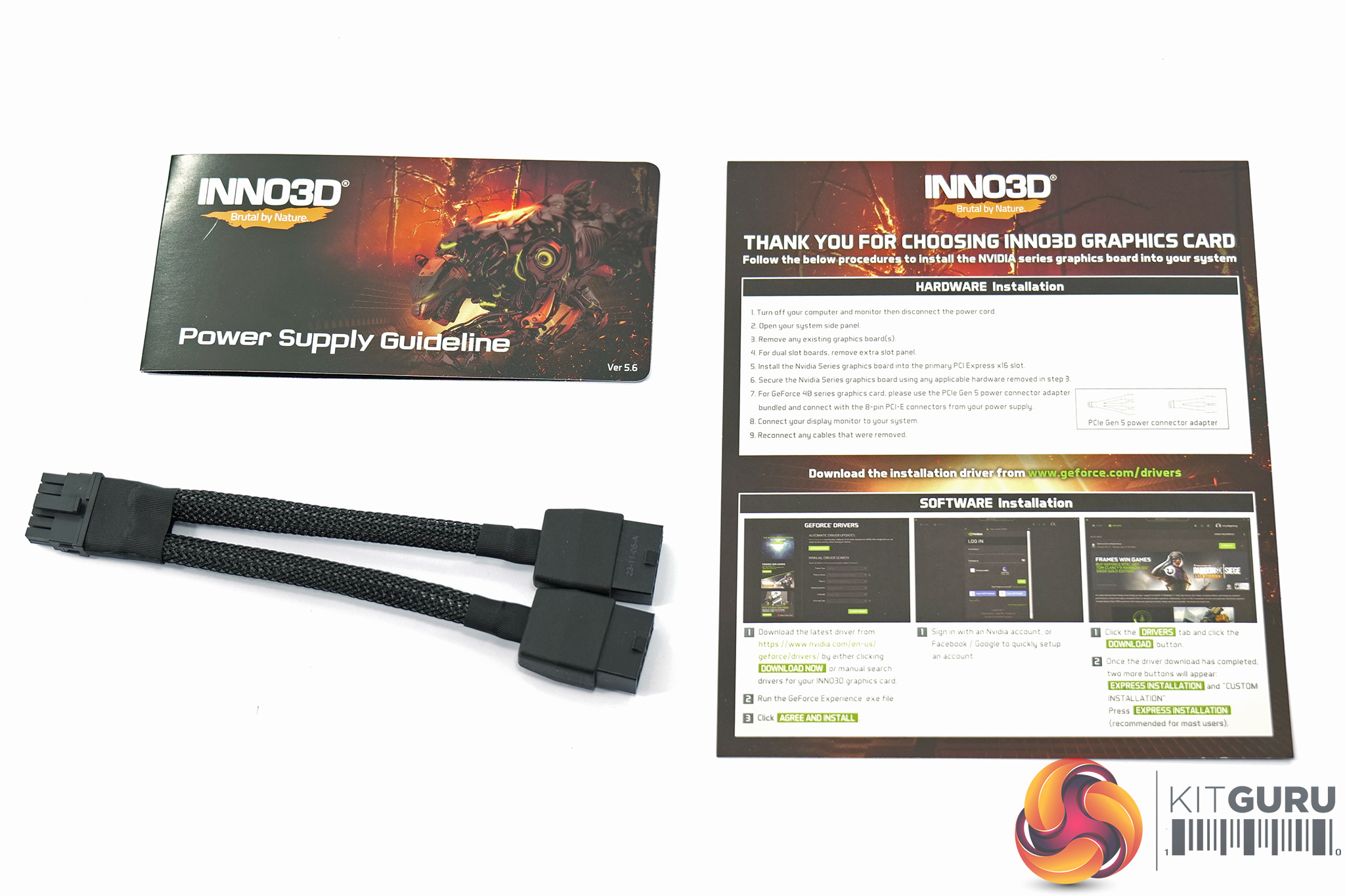
Inside, we find a power supply guideline, as well as a quick-start guide. A dual 8-pin to 12VHPWR adapter is also included.
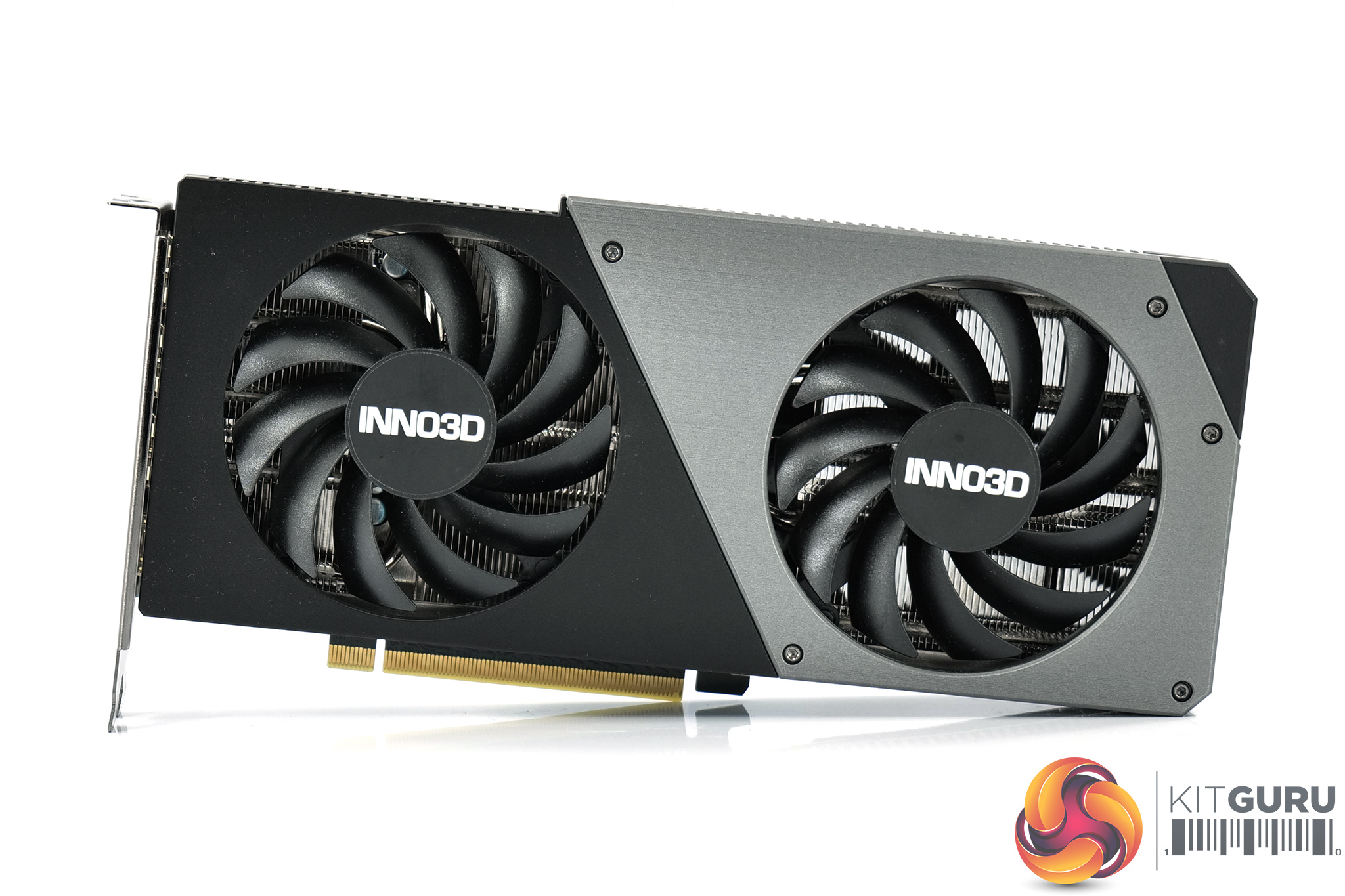
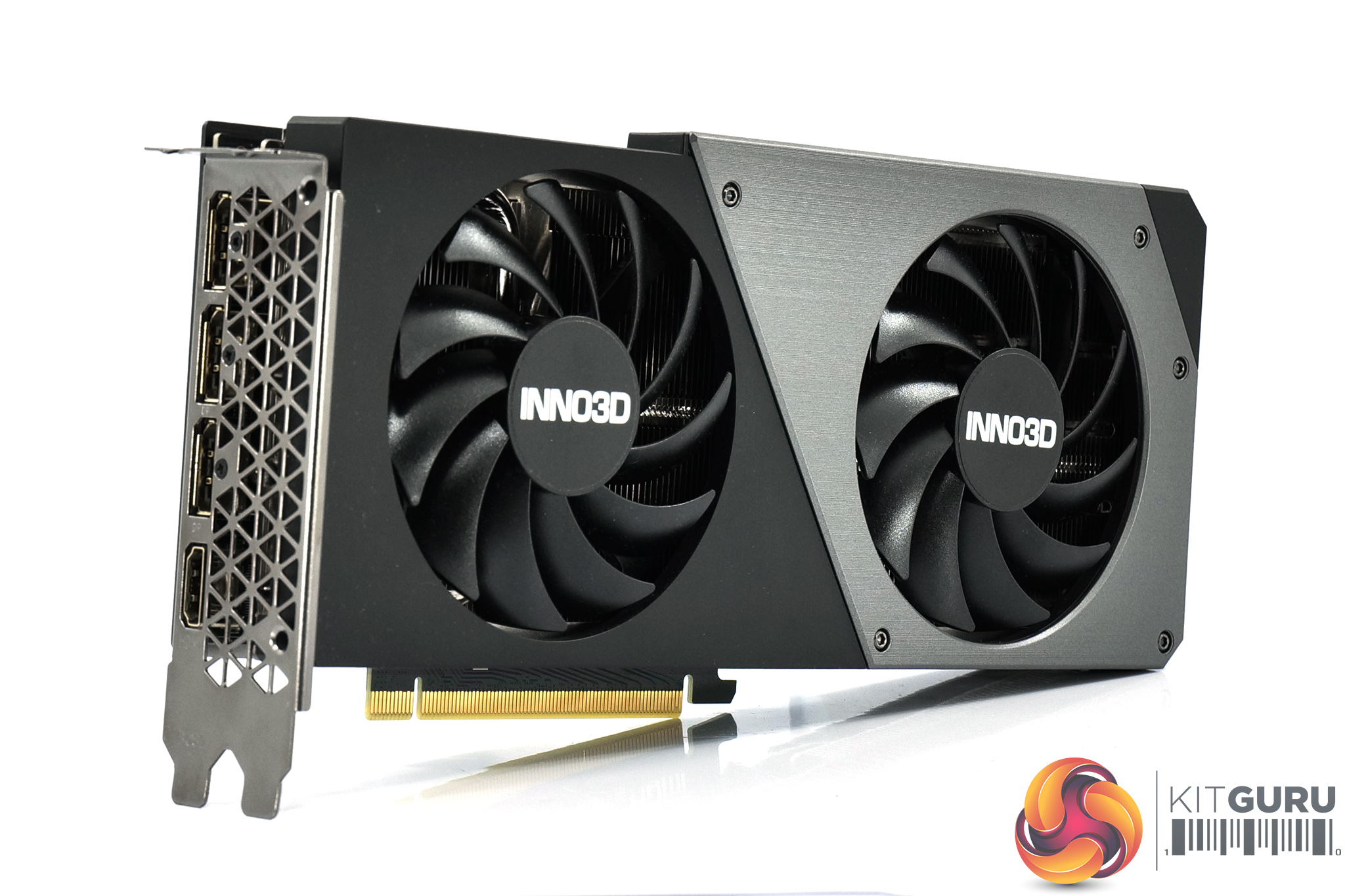
In terms of the design of the card, we last looked at a Twin X2 model from Inno3D back in June last year, and it's no surprise to see the overall aesthetic is exactly the same.
That means we find a two-tone shroud, with one half being matte black and the other half a brushed grey finish. It's made entirely from plastic, so the brushed section isn't made of metal, but it feels solid enough in the hand, though of course the all-metal shroud of the Founders Edition is significantly more robust.
As for the two fans, Inno3D is using what it calls ‘scythe' fan blades, with a total of 11 per fan, and each fan measures 88mm in diameter.
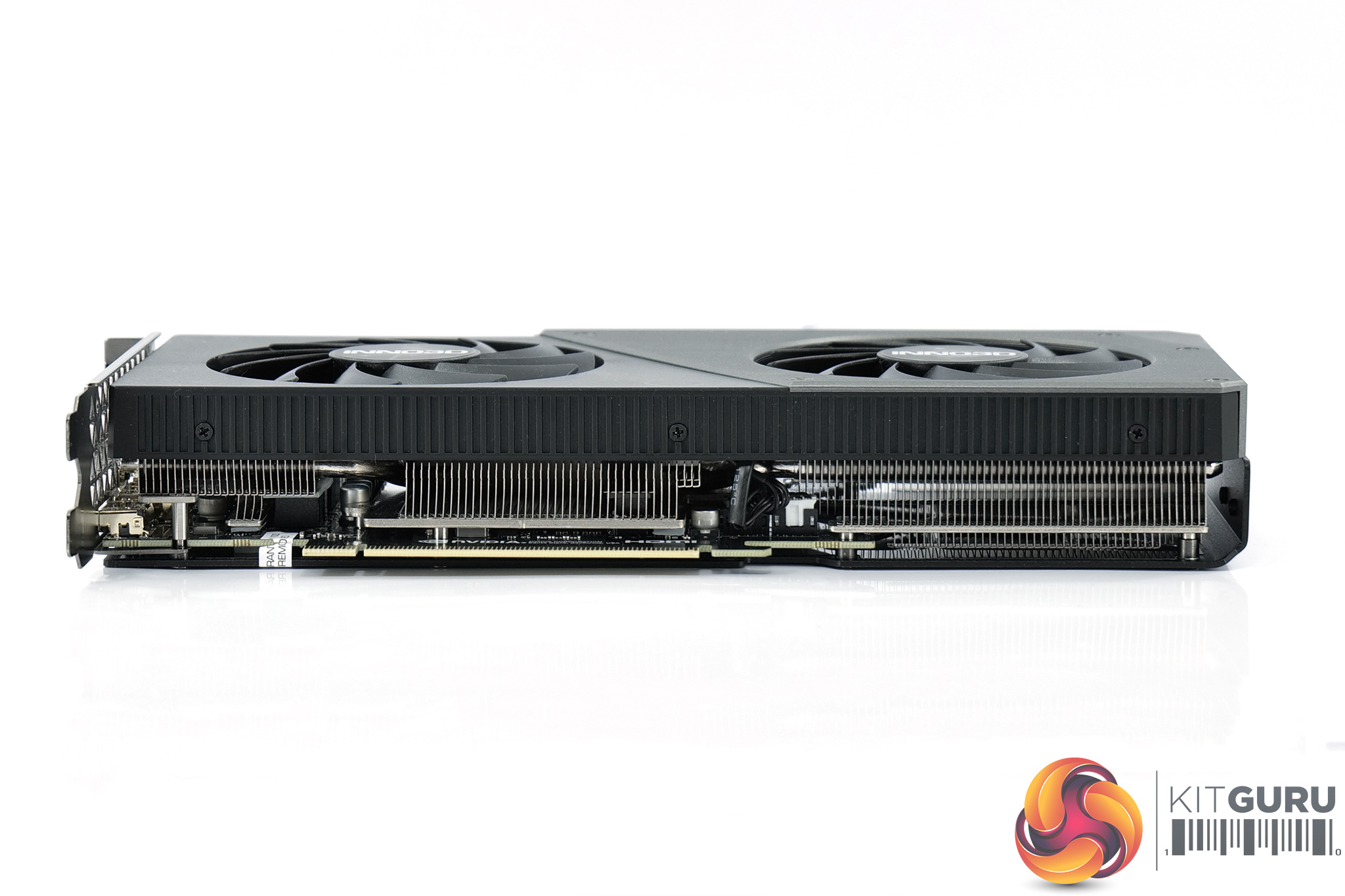
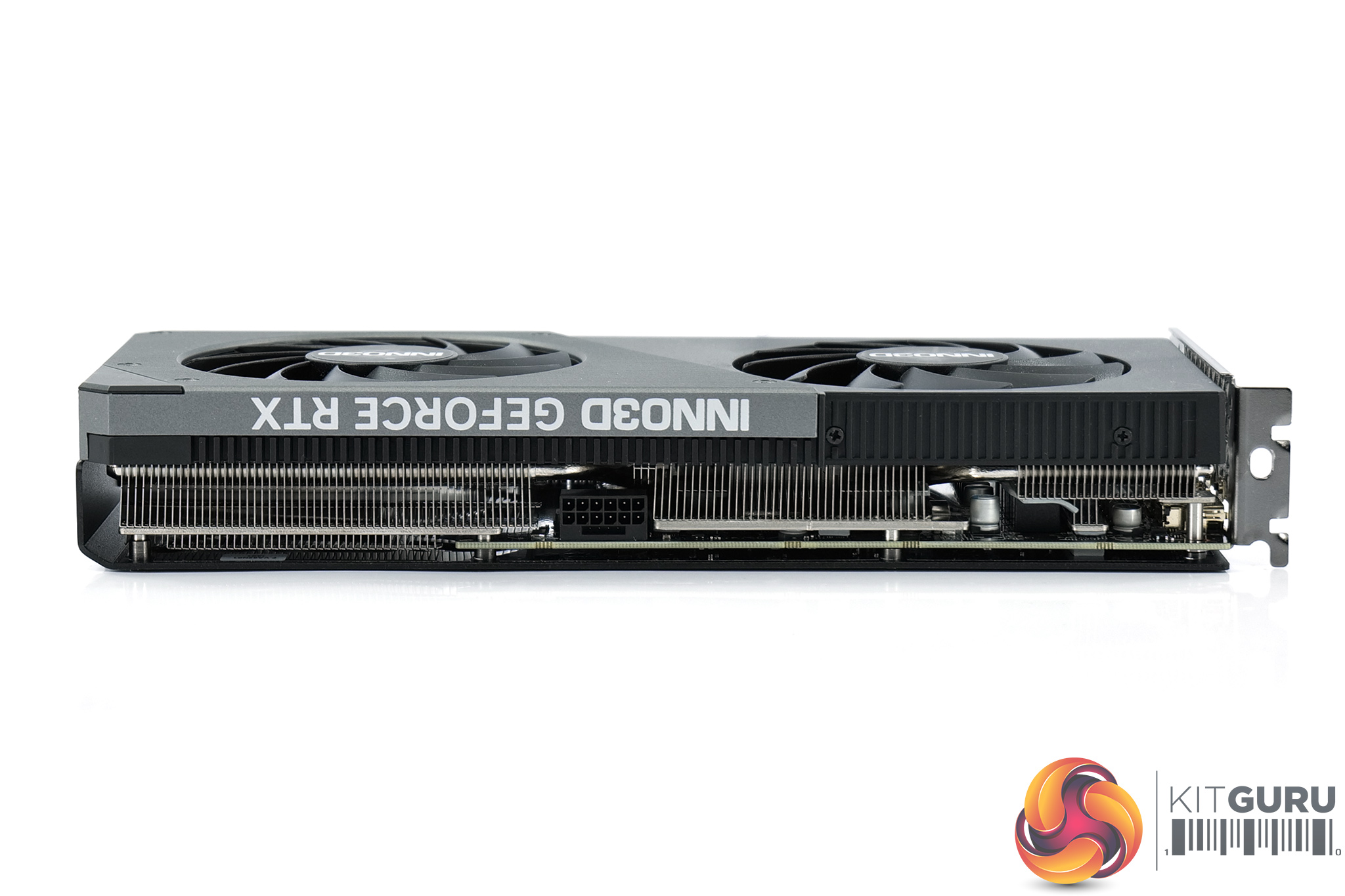
Unlikely many other 40-series products, the Twin X2 is impressively compact, measuring 250x118x42mm, so it's nice and short while its only a dual-slot thickness. That alone could make it worth considering if you need something to fit in particularly diminutive chassis. It also weighed in at 845g on my scales.
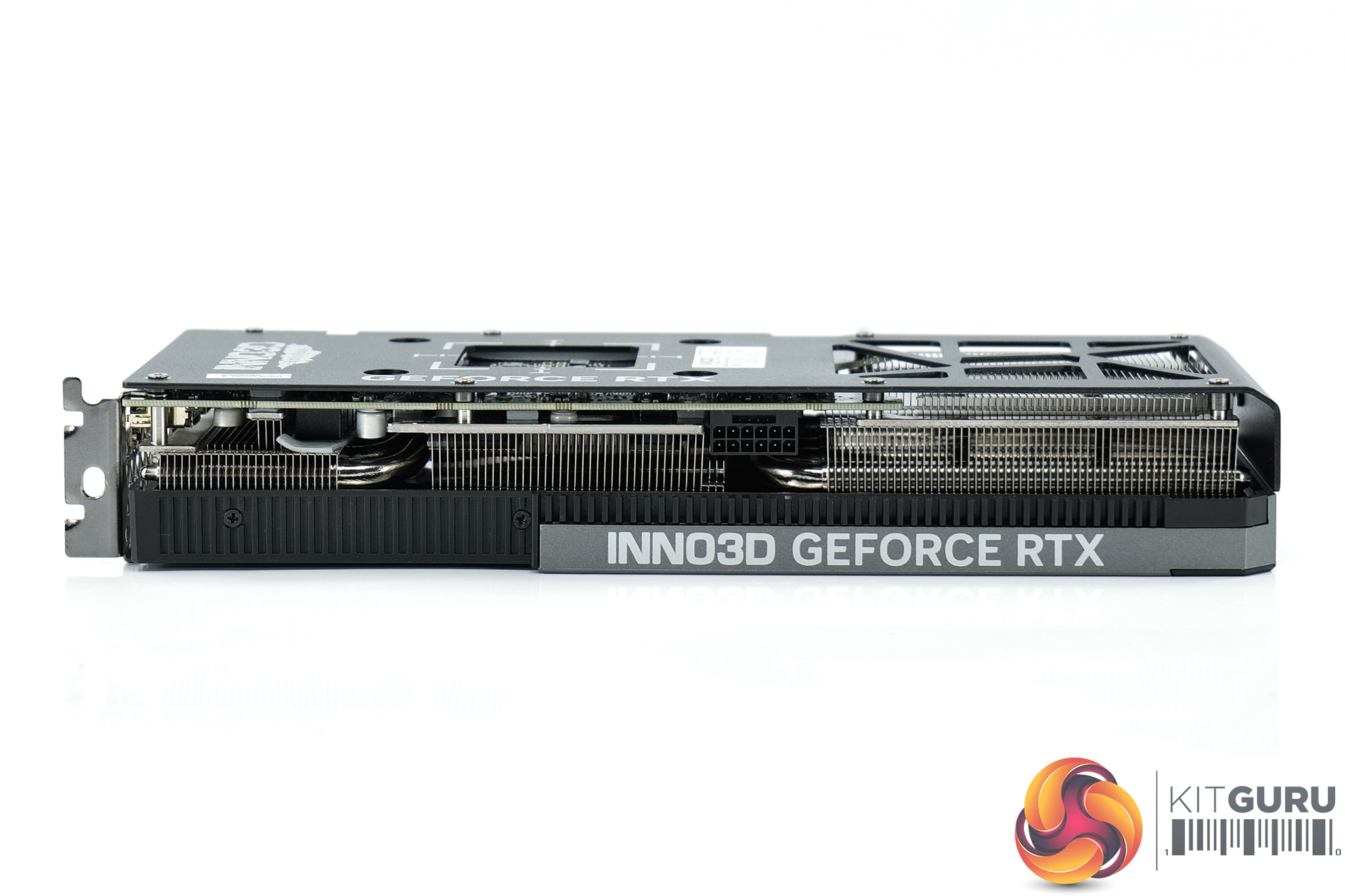
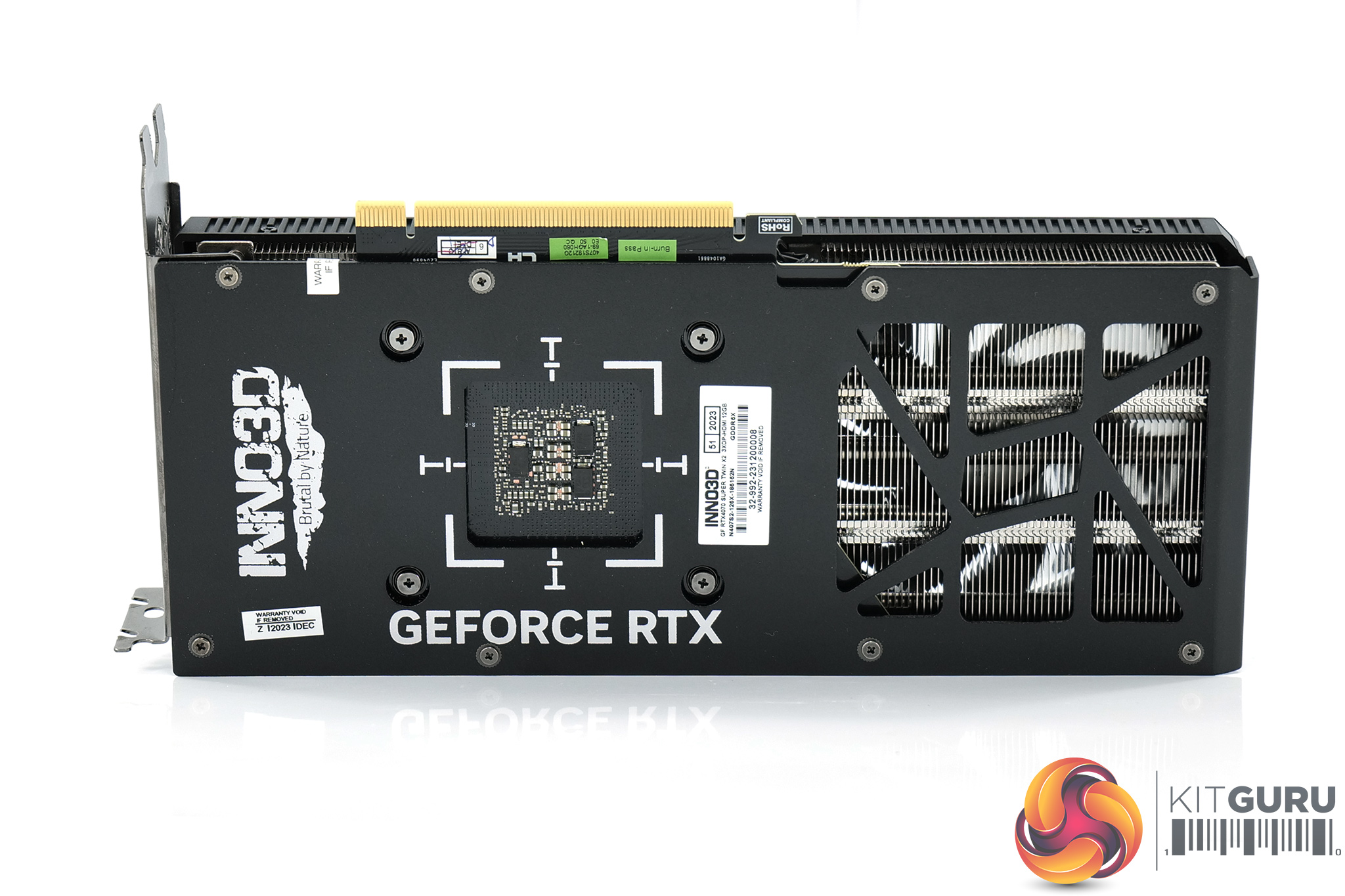
The front side of the card is home to the Inno3D and GeForce RTX logos, but it's worth noting there is no lighting of any kind on the Twin X2.
Meanwhile, we can see a full length metal backplate is utilised, with a cut-out behind the GPU core and several cut-outs towards the end of the card to allow air to pass directly through the heatsink and out into the chassis.
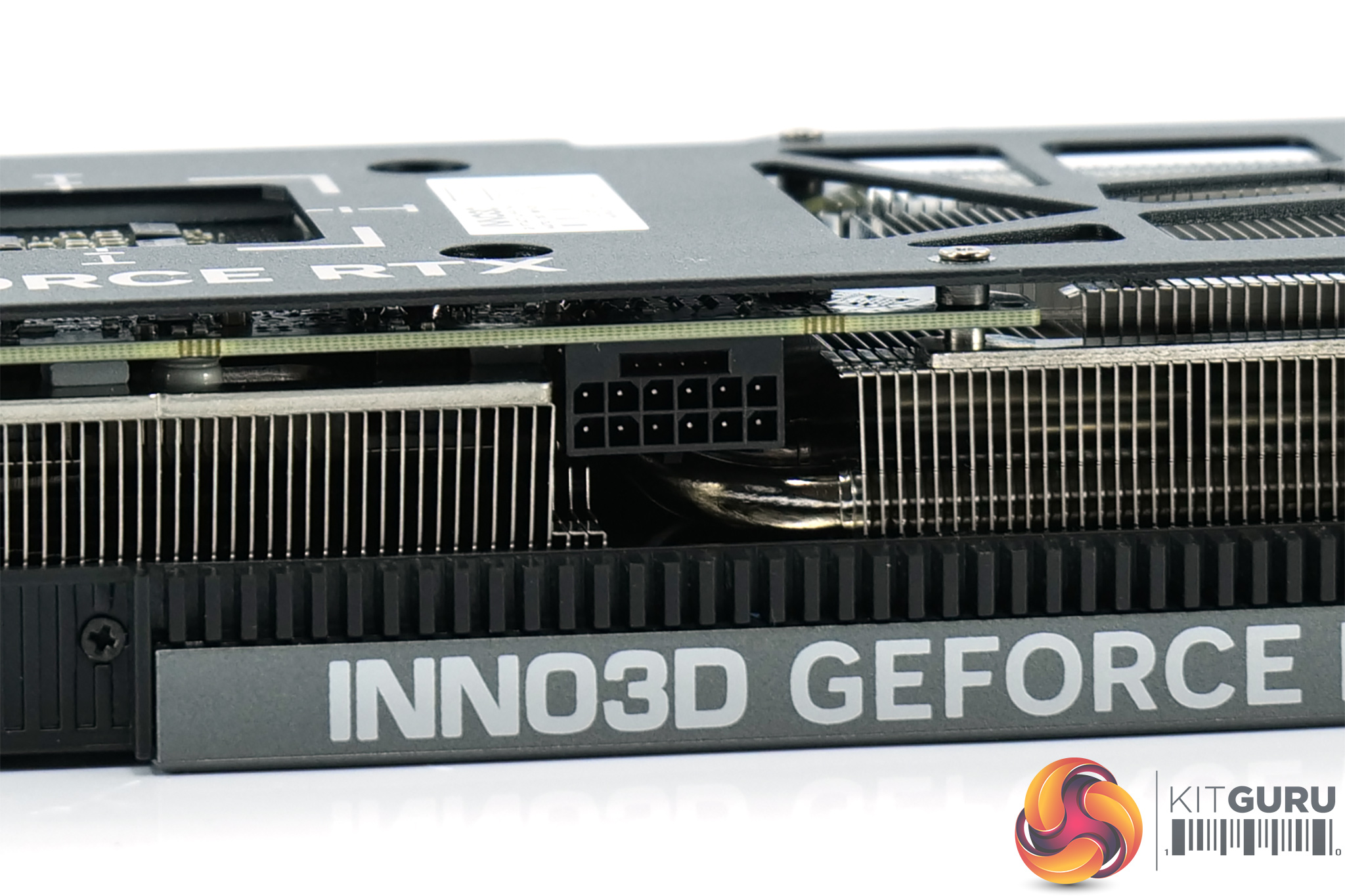
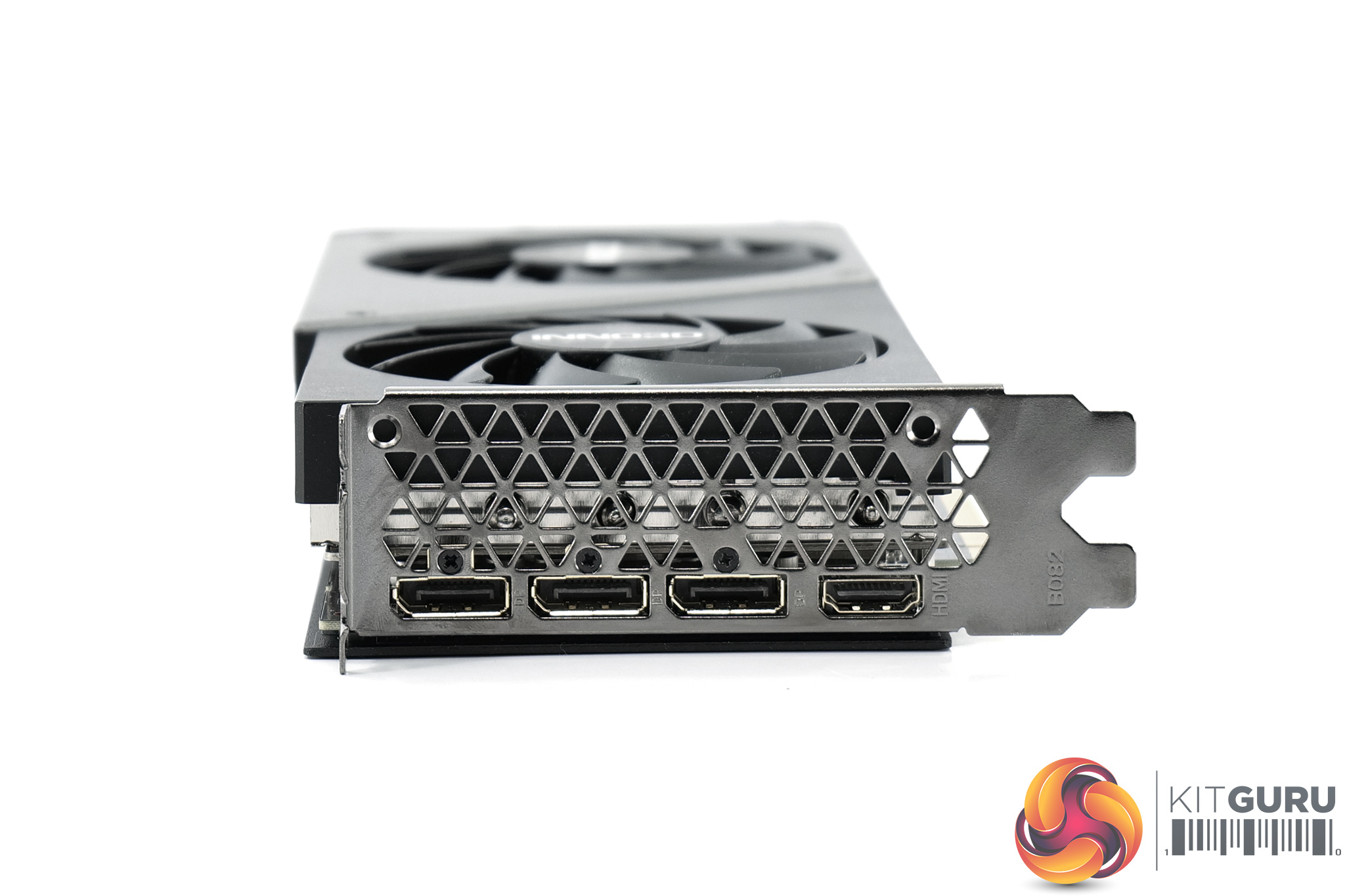
Power is supplied by a single 12VHPWR/PCIe Gen5 power connector, though a dual 8-pin adapter is included in the box. Display outputs are standard, with 3x DisplayPort 1.4 and 1x HDMI 2.1 connectors.
Driver Notes
- AMD GPUs were benchmarked with the Adrenalin 23.12.1 driver.
- Nvidia GPUs (except RTX 4070 Super/RTX 4070 Ti Super) were benchmarked with the 546.33 driver.
- RTX 4070 Super was benchmarked with the 546.52 driver supplied to press.
- RTX 4070 Ti Super was benchmarked with the 551.15 driver supplied to press.
- RTX 4080 Super was benchmarked with the 551.22 driver supplied to press.
Results are only directly comparable where this exact configuration has been used.
Test System:
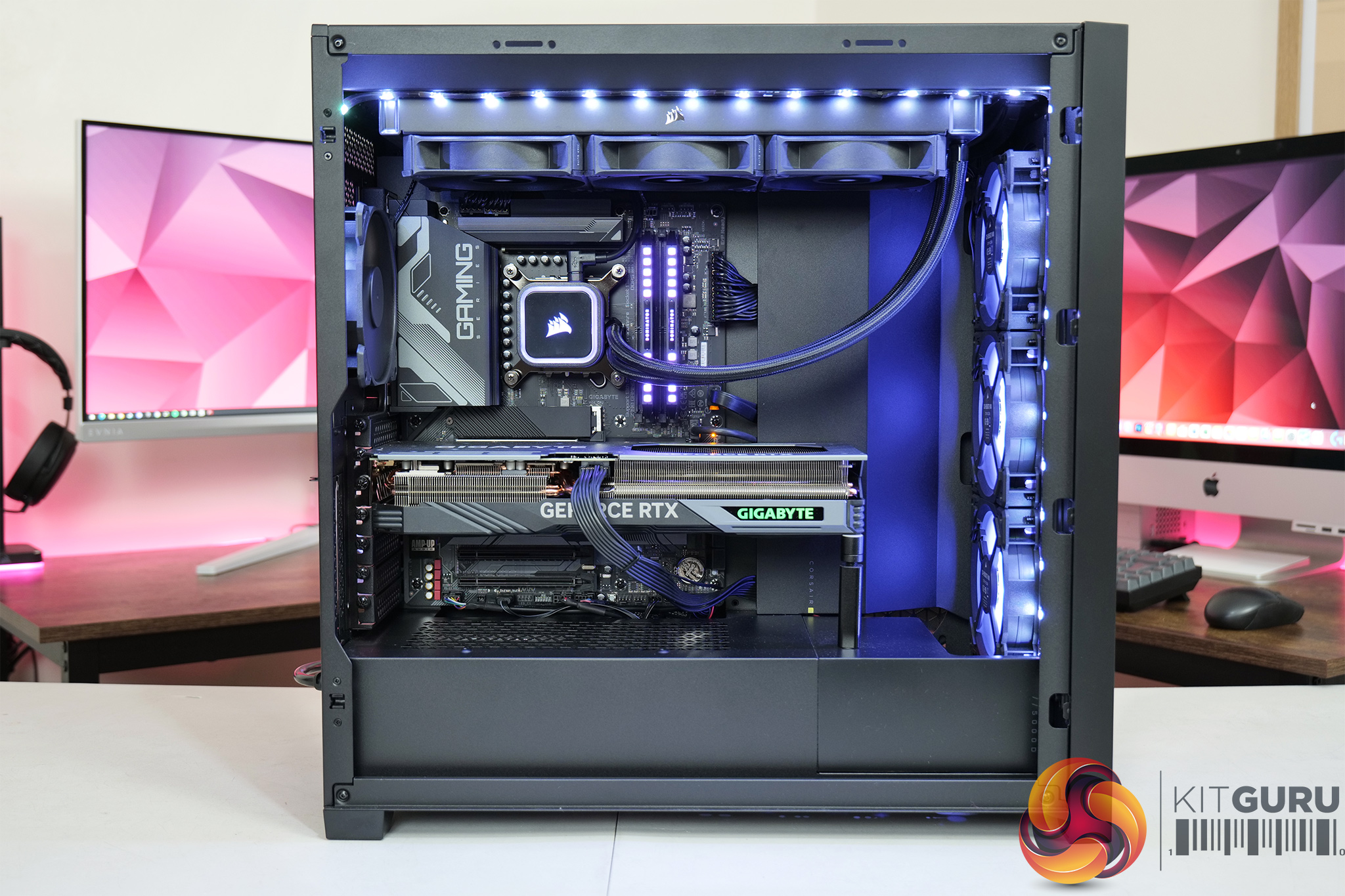
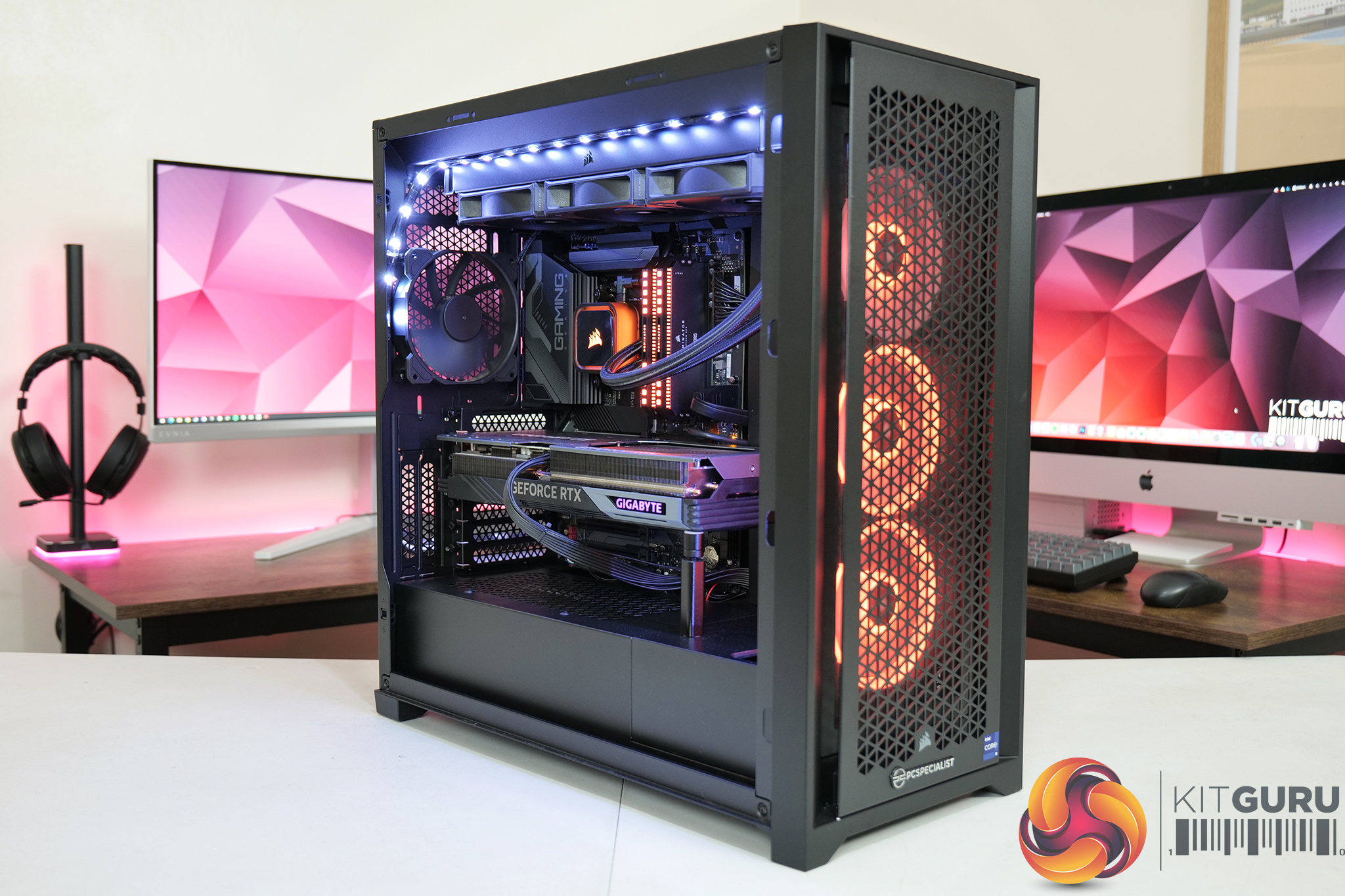
We test using a custom built system from PCSpecialist, based on Intel’s Rocket Lake platform. You can read more about this system HERE and configure your own PCSpecialist system HERE.
| CPU |
Intel Core i9-13900KS
|
| Motherboard |
Gigabyte Z790 Gaming X AX
|
| Memory |
32GB (2x16GB) Corsair Dominator Platinum RGB DDR5 6000MHz
|
| Graphics Card |
Varies
|
| SSD |
4TB Seagate Firecuda 530 Gen 4 PCIe NVMe
|
| Chassis | Corsair 5000D Airflow Tempered Glass Gaming Case |
| CPU Cooler |
Corsair iCUE H150i Elite RGB High Performance CPU Cooler
|
| Power Supply |
Corsair 1600W Pro Series Titanium AX1600i Digital Modular PSU
|
| Operating System |
Windows 11 23H2
|
| Monitor |
MSI Optix MPG321UR-QD
|
| Resizable BAR |
Enabled for all supported GPUs
|
Comparison Graphics Cards List
- AMD RX 7900 XTX 24GB
- AMD RX 7900 XT 20GB
- AMD RX 7900 GRE 16GB
- AMD RX 7800 XT 16GB
- Sapphire RX 7700 XT Pulse 12GB
- AMD RX 6700 XT 12GB
- Nvidia RTX 4090 FE 24GB
- Nvidia RTX 4080 Super FE 16GB
- Nvidia RTX 4080 FE 16GB
- MSI RTX 4070 Ti Super Ventus 3X 16GB
- Gigabyte RTX 4070 Ti Gaming 12GB
- Nvidia RTX 4070 FE 12GB
- Nvidia RTX 4060 Ti FE 8GB
- Gigabyte RTX 3080 Eagle 10GB
- Nvidia RTX 3070 FE 8GB
All cards were tested at reference specifications.
Software and Games List
- 3DMark Fire Strike & Fire Strike Ultra (DX11 Synthetic)
- 3DMark Time Spy (DX12 Synthetic)
- 3DMark DirectX Raytracing feature test (DXR Synthetic)
- Alan Wake II (DX12)
- Assassin's Creed Mirage (DX12)
- Avatar: Frontiers of Pandora (DX12)
- Cyberpunk 2077 (DX12)
- F1 23 (DX12)
- Forza Horizon 5 (DX12)
- Hitman 3 (DX12)
- The Last of Us Part 1 (DX12)
- Marvel's Spider-Man Remastered (DX12)
- A Plague Tale: Requiem (DX12)
- Ratchet and Clank: Rift Apart (DX12)
- Red Dead Redemption 2 (DX12)
- Resident Evil 4 (DX12)
- Returnal (DX12)
- Shadow of the Tomb Raider (DX12)
- Starfield (DX12)
- Total War: Pharaoh (DX11)
We run each benchmark/game three times, and present mean averages in our graphs. We use FrameView to measure average frame rates as well as 1% low values (99th percentile) across our three runs.
Here we test five games, all at 2560×1440 resolution using maximum image quality settings.
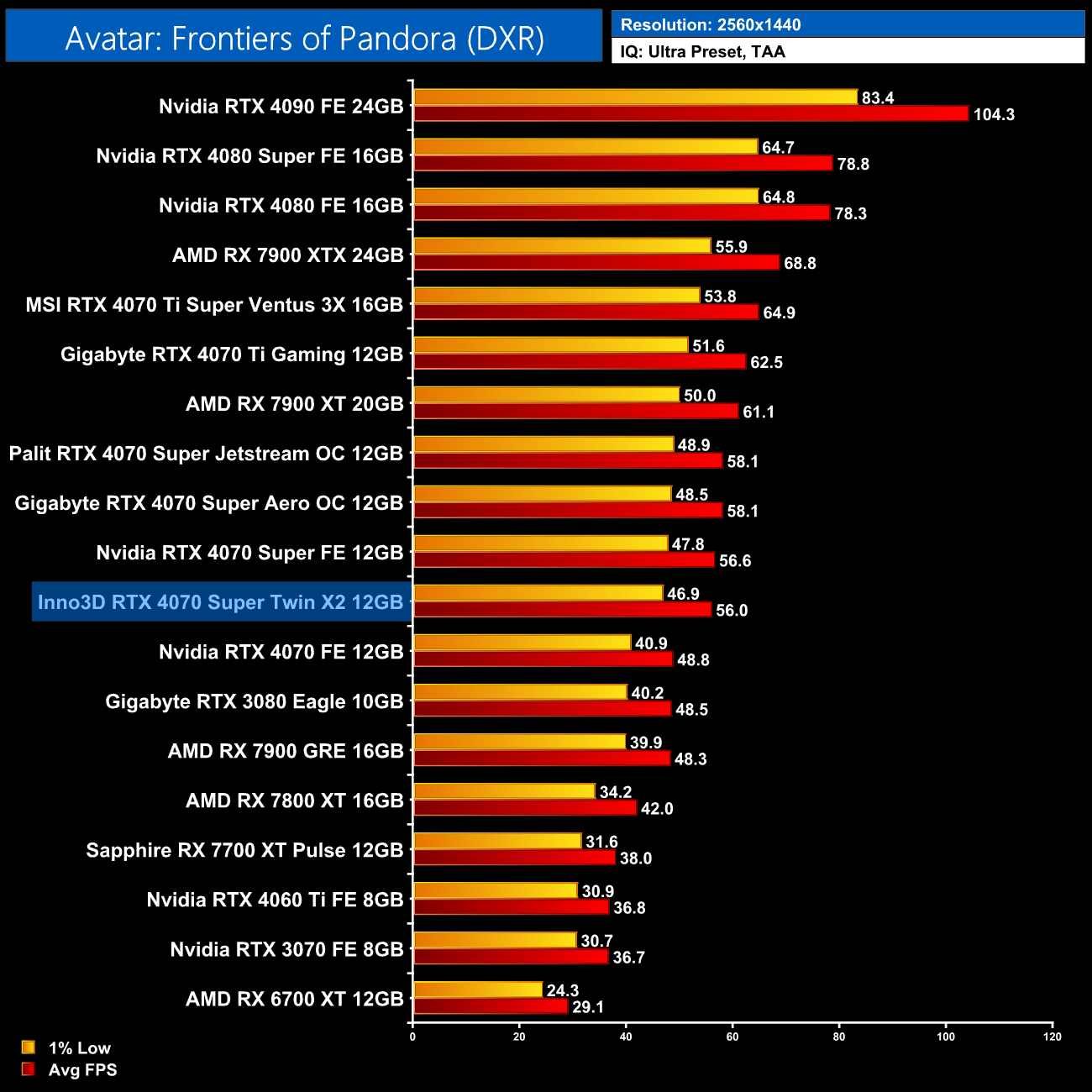
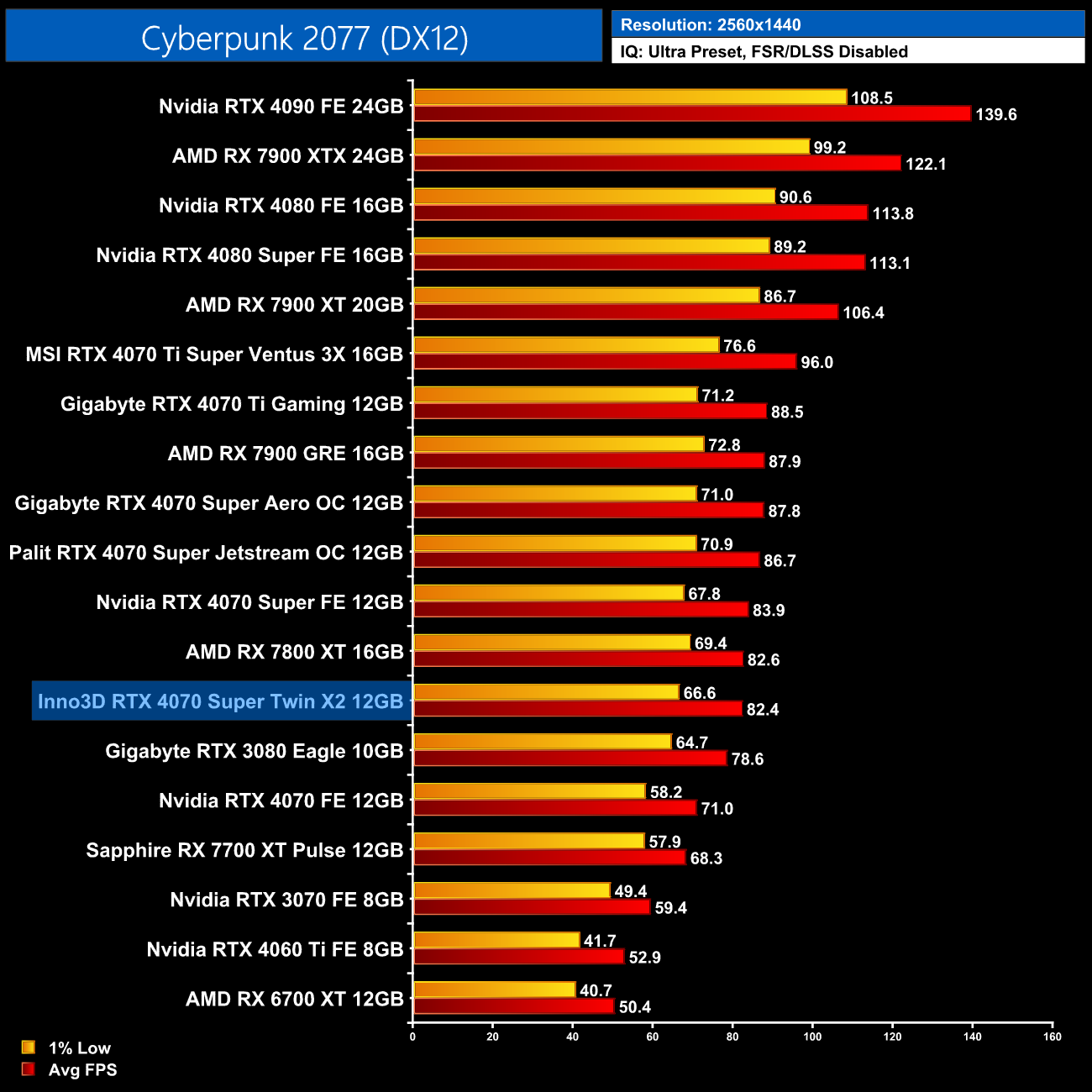
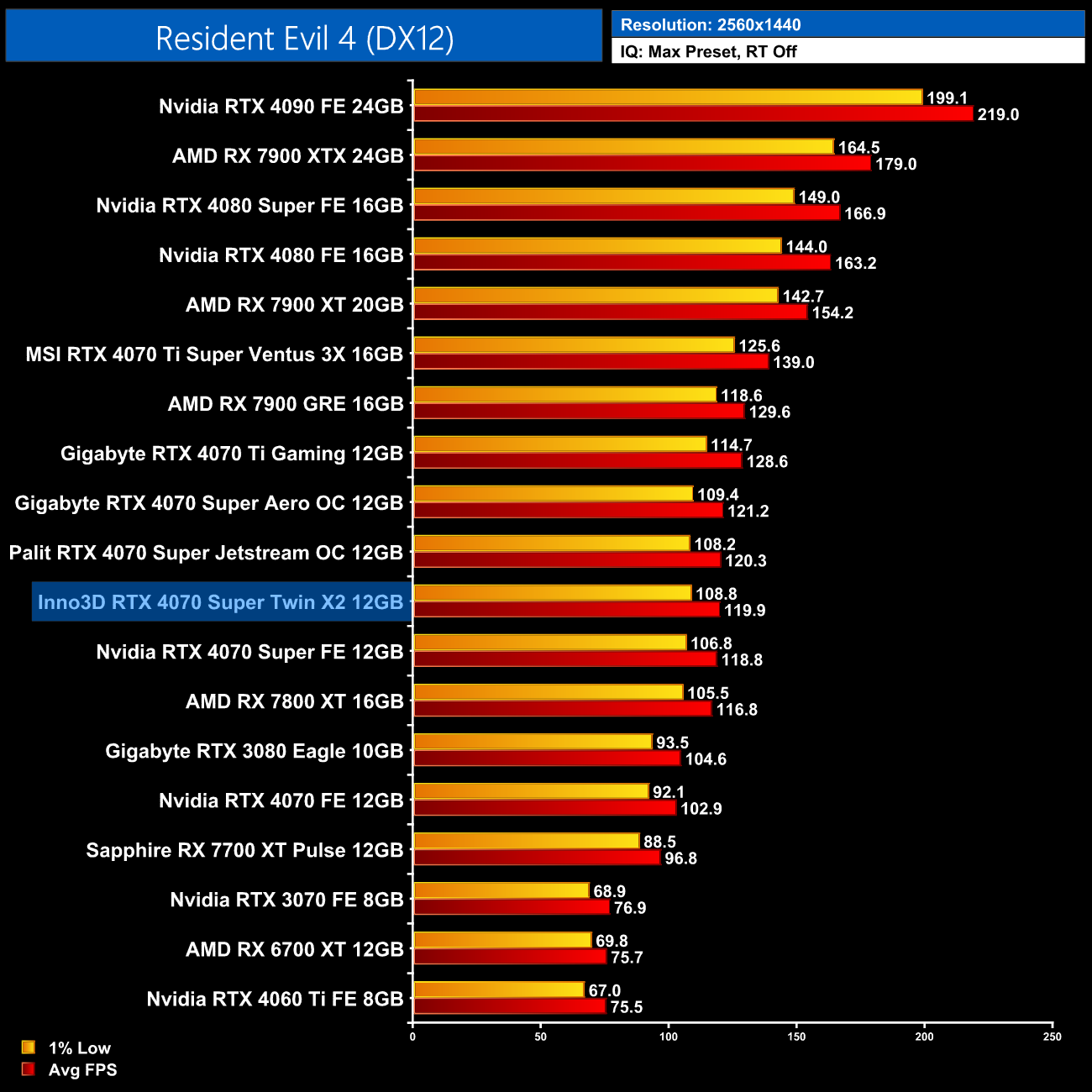
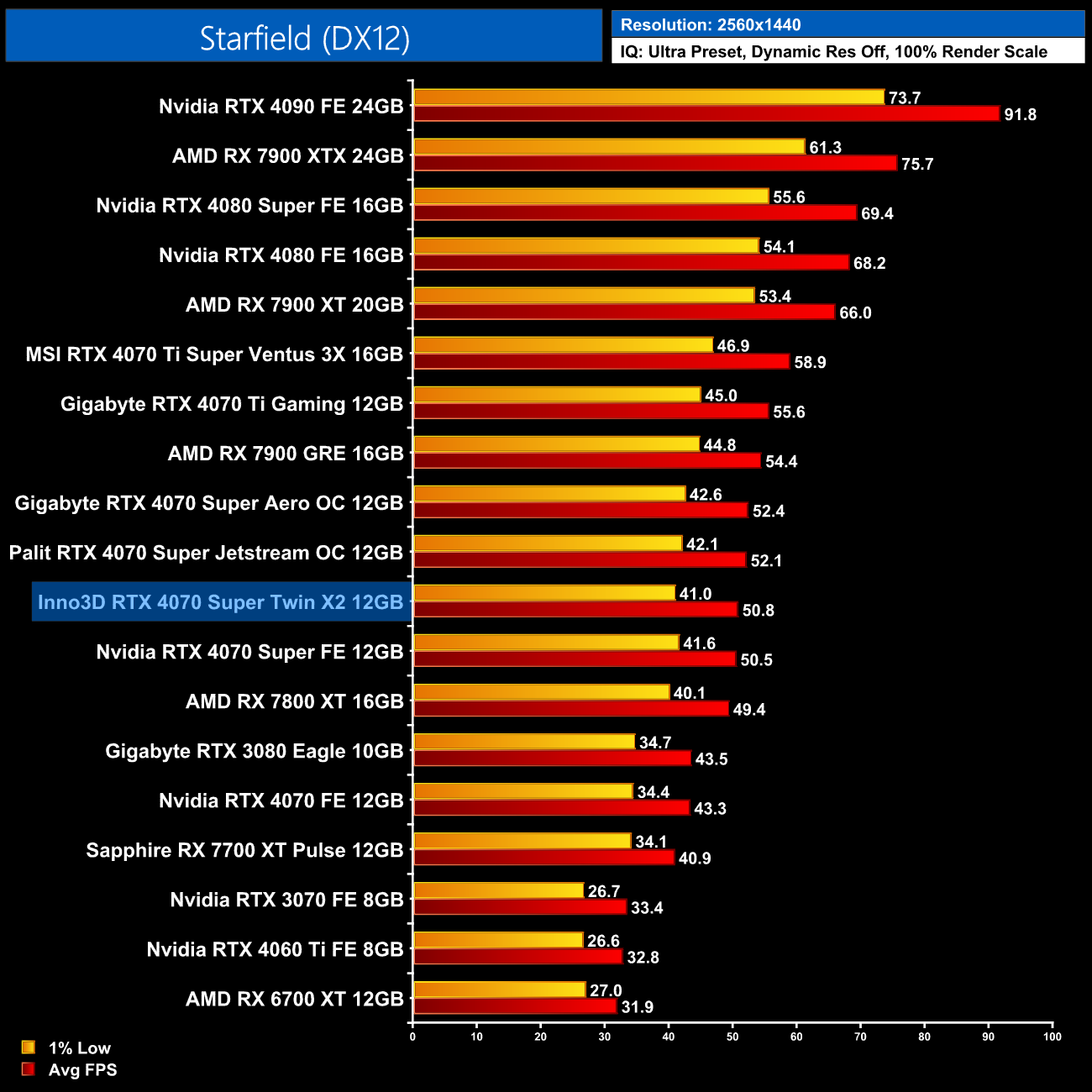
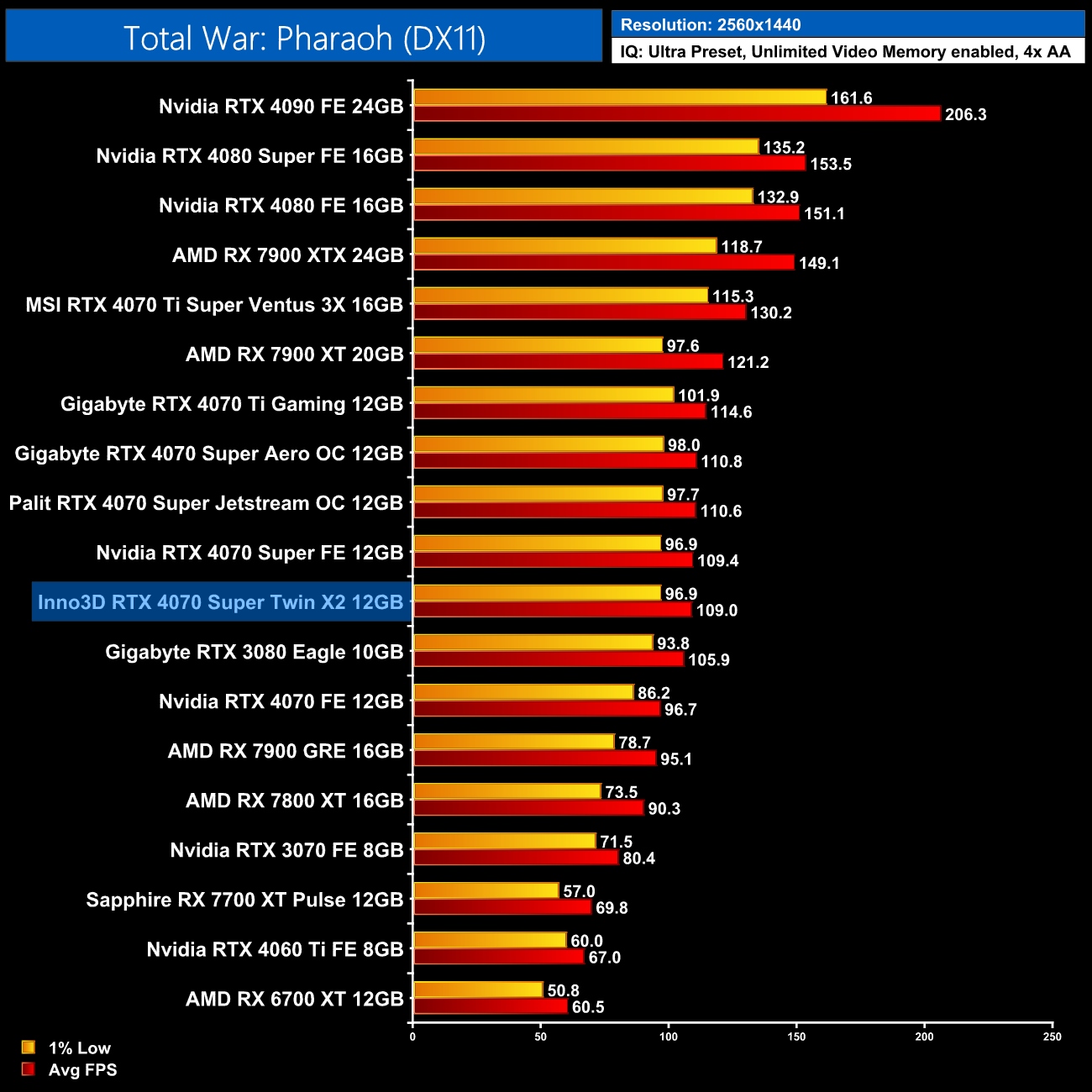
We don't focus heavily on gaming performance in these AIB card reviews, for the simple reason that the small clock speed differences don't translate to much at all in the real world. Given the Twin X2 does not come factory overclocked, performance is neck-and-neck with the Nvidia Founders Edition across the 5 games we tested, and only 1-2FPS behind the likes of the Gigabyte Aero OC. If you do want to see how the 4070 Super performs in a much wider array of games, check out our day 1 review.
Here we present the average clock speed for each graphics card while running Cyberpunk 2077 for 30 minutes. We use GPU-Z to record the GPU core frequency during gameplay. We calculate the average core frequency during the 30 minute run to present here.
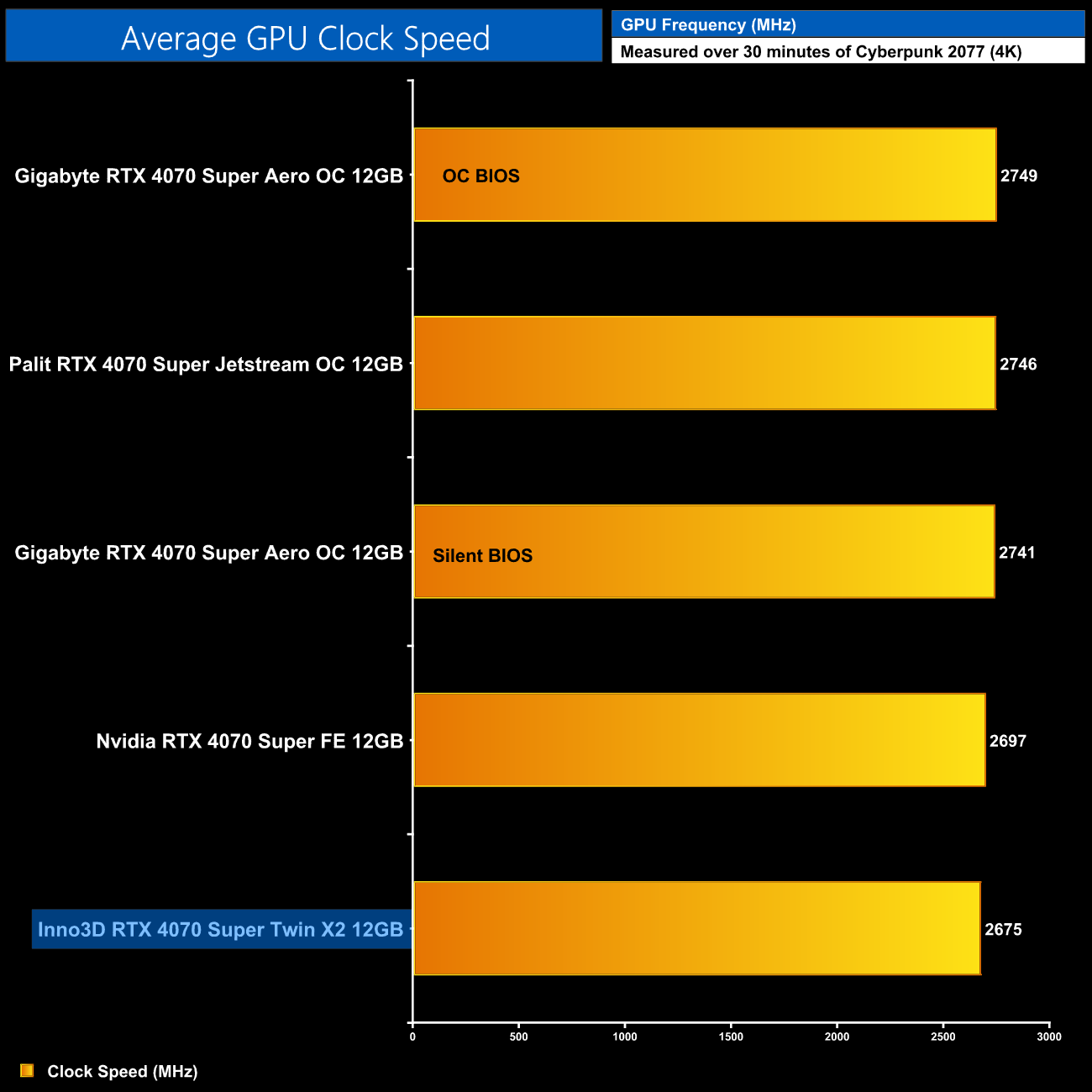
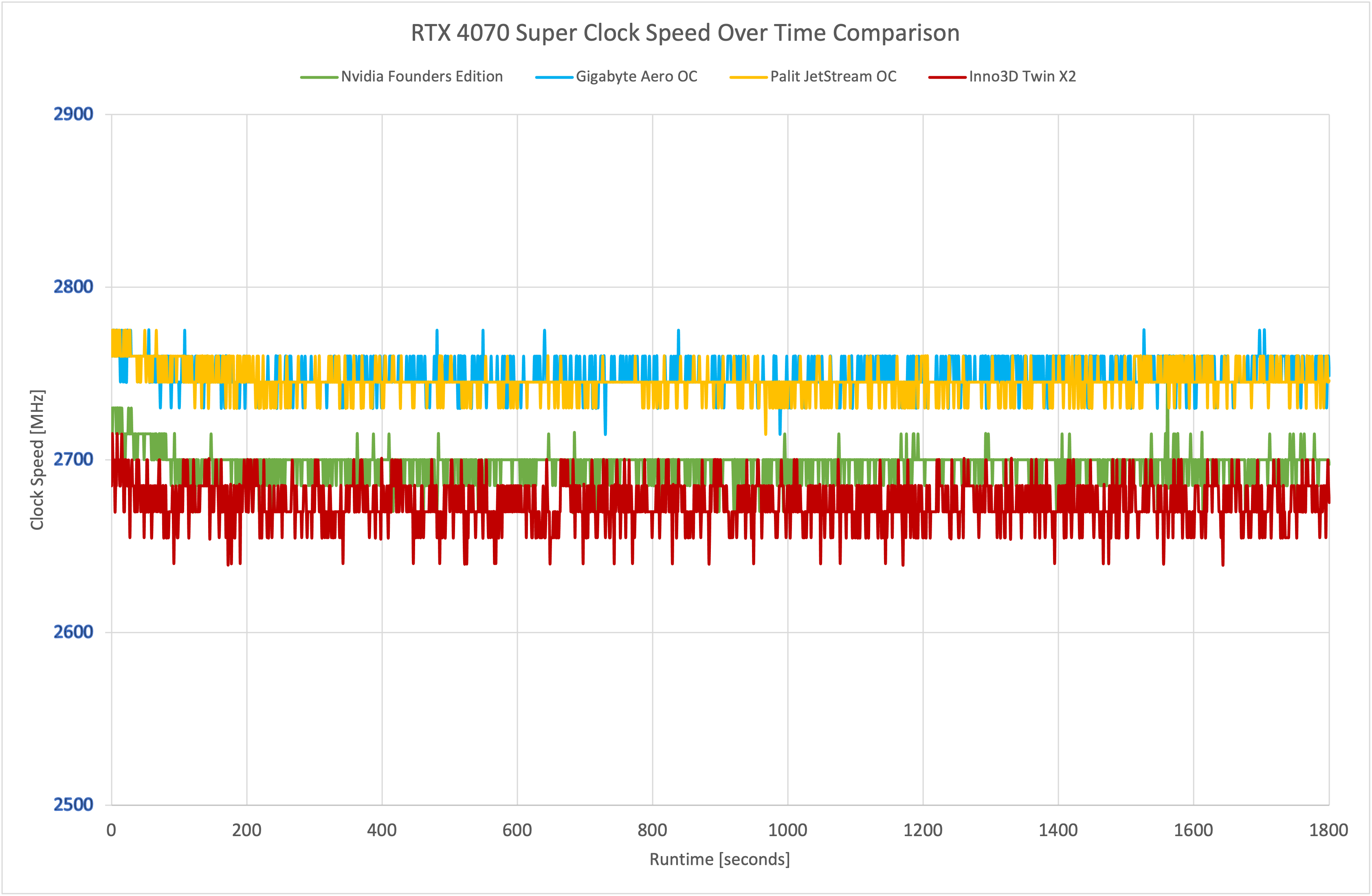
As expected based on our game benchmarks, there is only a negligible 22MHz clock speed difference between the Twin X2 and the Founders Edition, while the Inno3D is about 65-75MHz slower than the likes of the Aero OC or Palit JetStream OC.
For our temperature testing, we measure the peak GPU core temperature under load. A reading under load comes from running Cyberpunk 2077 for 30 minutes.
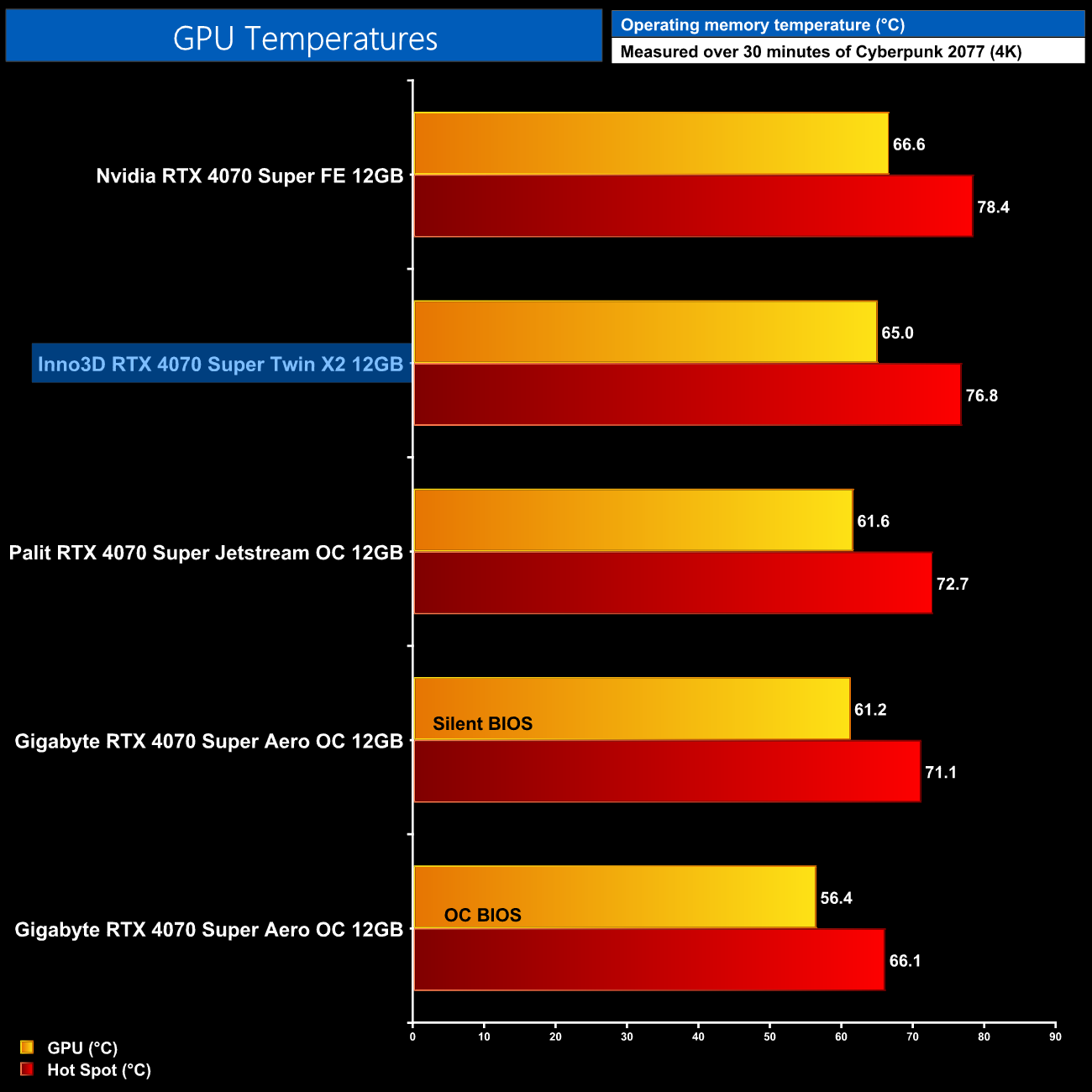
Out of the box thermal performance is no problem for the Twin X2 either, it runs slightly cooler than the Founders Edition – we're talking less than 2C difference – though it is a few degrees hotter than the JetStream OC. Of course, the Twin X2 is also a fair bit smaller, so that will have to be taken into account, but there's nothing to worry about here.
For our memory temperature testing, we measure the peak memory temperature under load. A reading under load comes from running Cyberpunk 2077 for 30 minutes.
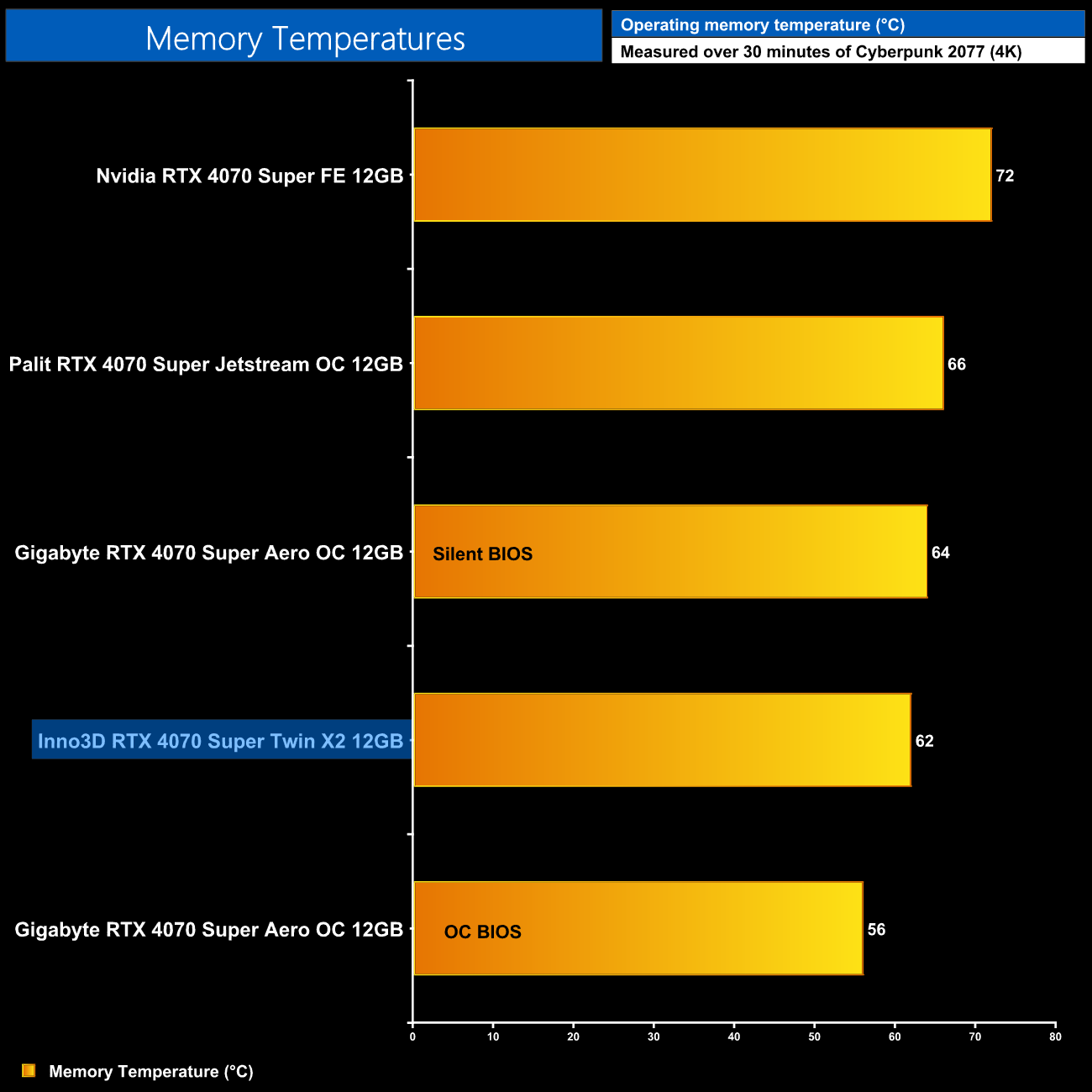
In fact, memory thermals are surprisingly good, second only to the Aero OC when using its OC BIOS, making it 4C cooler than the JetStream OC and 10C better than Nvidia's Founders Edition.
We take our noise measurements with the sound meter positioned 1 foot from the graphics card. I measured the noise floor to be 32 dBA, thus anything above this level can be attributed to the graphics cards. The power supply is passive for the entire power output range we tested all graphics cards in, while all CPU and system fans were disabled. A reading under load comes from running Cyberpunk 2077 for 30 minutes.
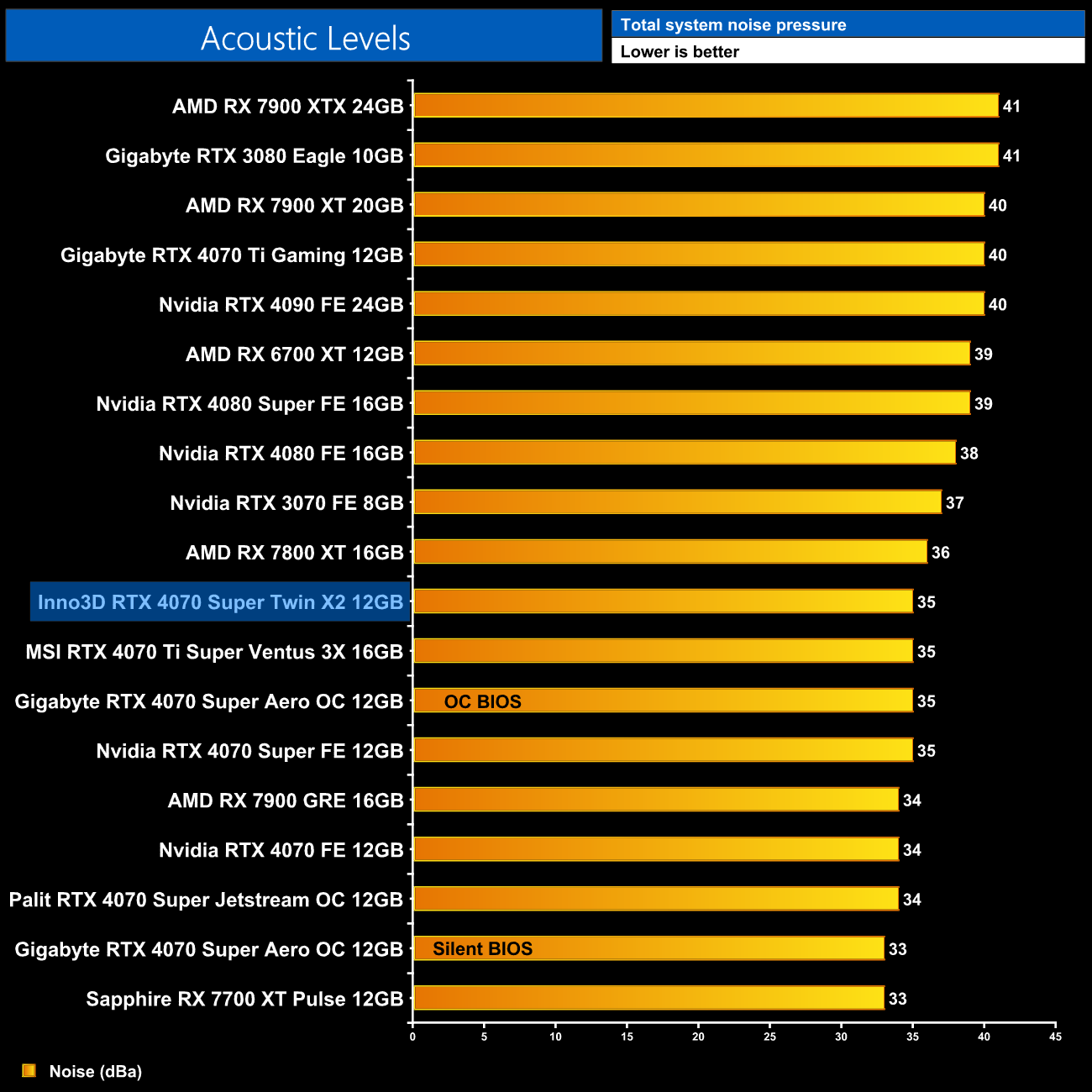
Noise levels are also nothing to worry about. The Twin X2 may not be the outright quietest card we've ever tested, but it is still very easy on the ears with the two fans spinning at 46%/1575rpm in my testing. Noise output was level with the Aero OC using the OC BIOS, as well as the Founders Edition.
Following on from our stock thermal and acoustic testing, here we re-test the operating temperature of the GPU, but with noise levels normalised to 40dBa. This allows us to measure the efficiency of the overall cooling solution as varying noise levels as a result of more aggressive fan curves are no longer a factor.
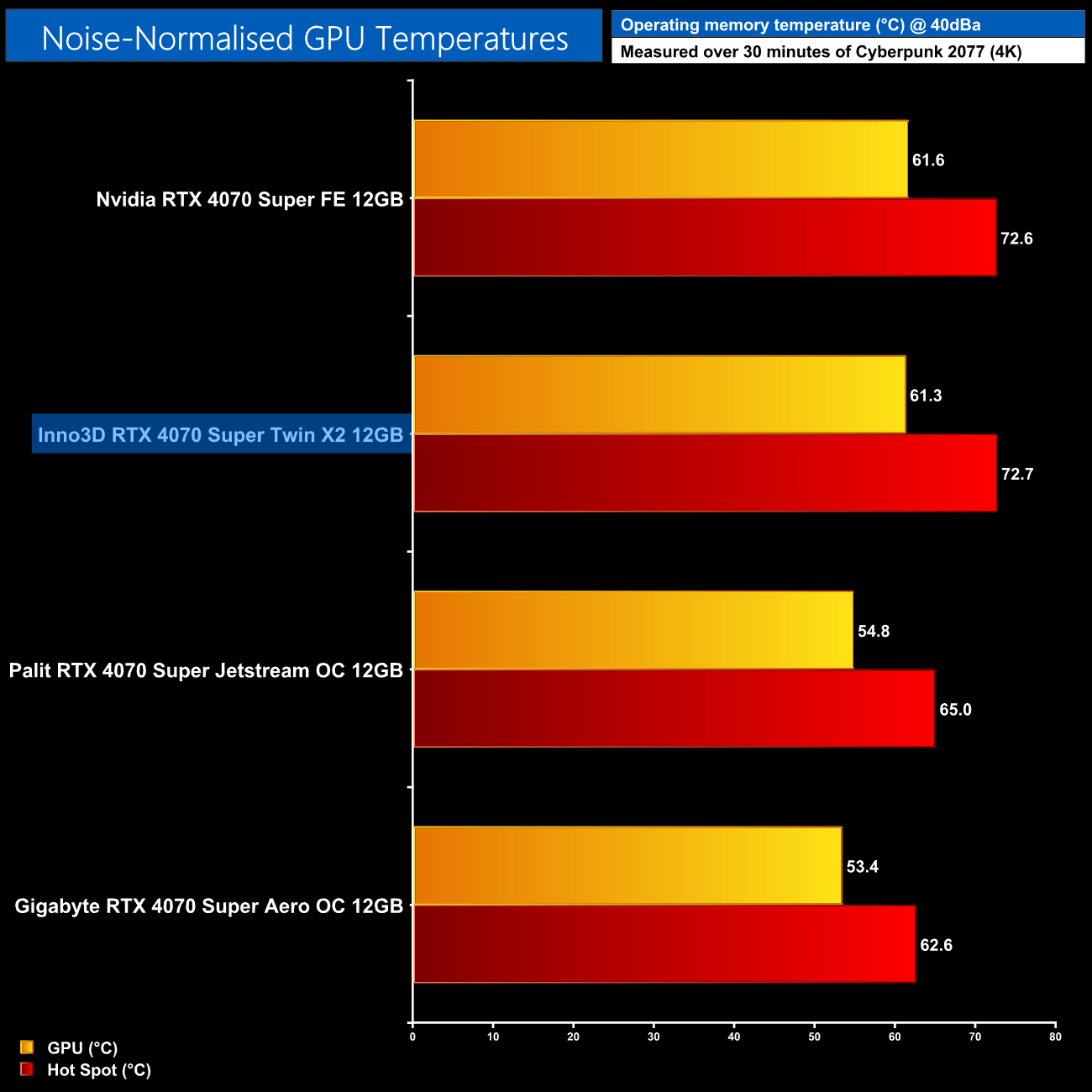
After normalising noise to 40dBa and re-running our thermal tests, we do see a bigger difference between the Twin X2 and the Aero OC and JetStream OC, but this is to be expected considering the size difference, and the fact the Twin X2 has one fewer fan than those triple-fan models. It's on-par with the Founders Edition though, so that's indicative of a good-quality cooler for the size.
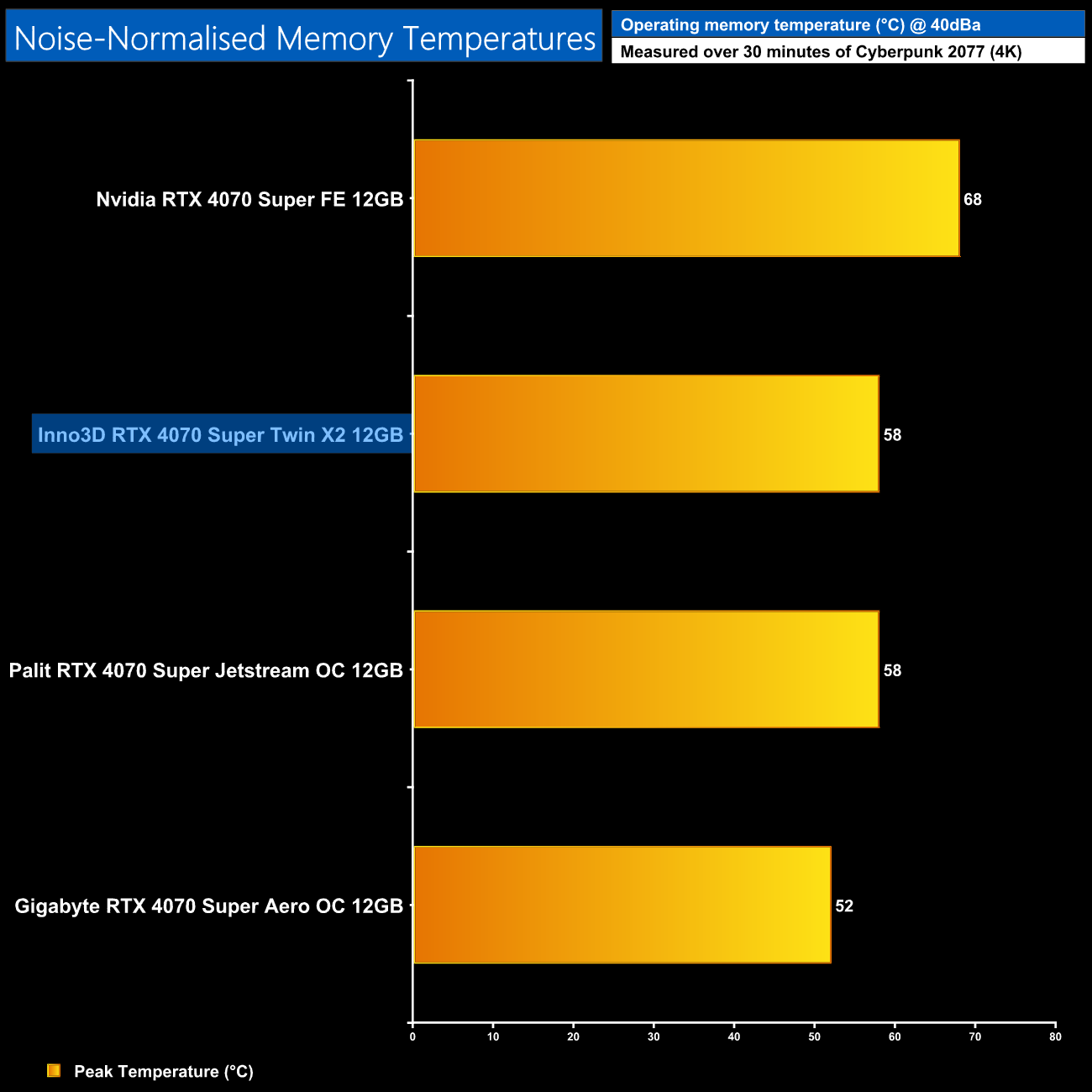
Noise-normalised memory thermals are better still, coming in 10C cooler than the Founders Edition and on-par with the JetStream OC, not bad at all considering the size differences.
We use Nvidia PCAT to measure power draw of the graphics card only, with readings from both the PCIe slot and the PCIe power cables combined into a single figure. We use Cyberpunk 2077 (1440p) for this testing.
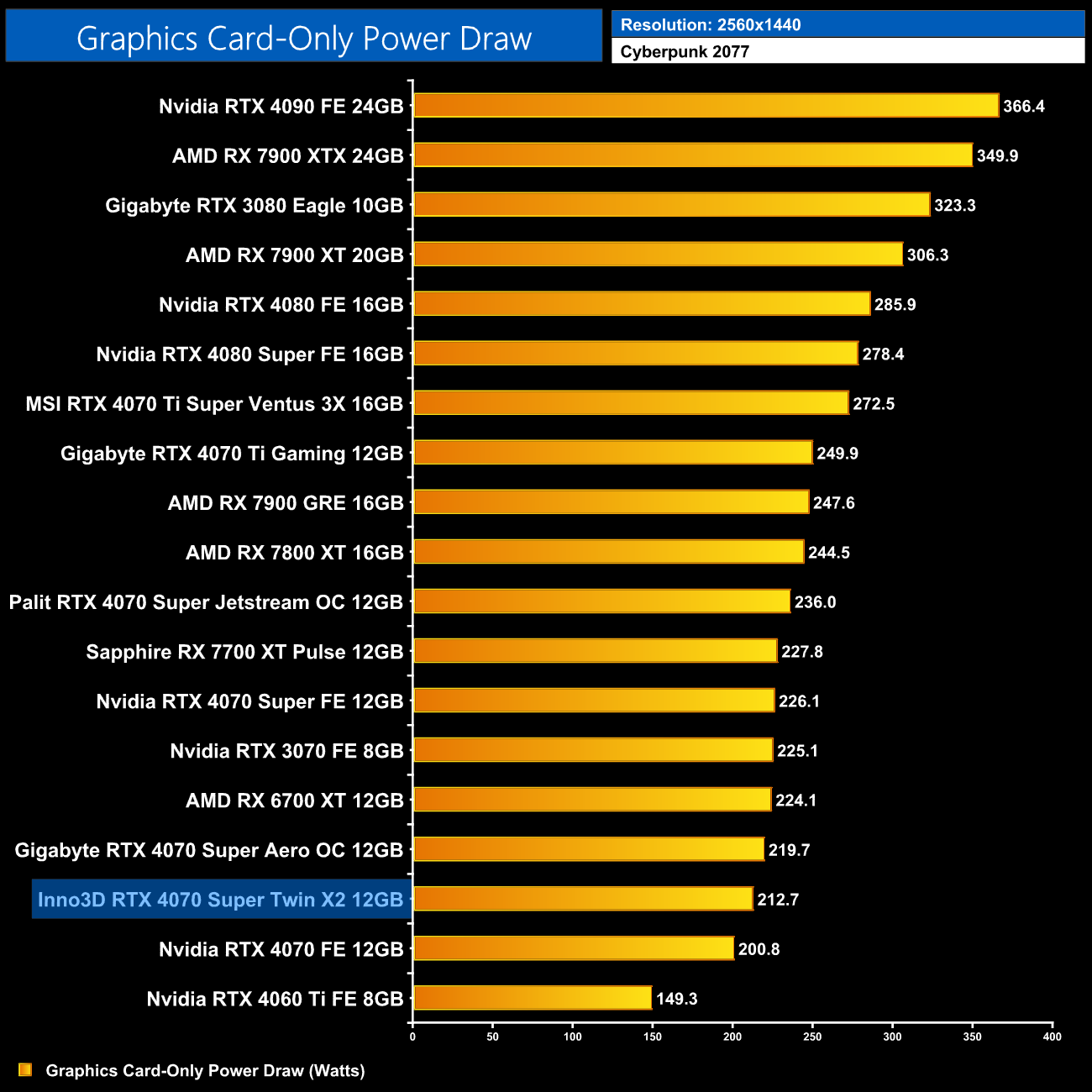
Interestingly, power draw is slightly lower than the rated TGP in Cyberpunk 2077, as it hit 212.7W, compared to the Founders Edition which drew 226W.
Combining the power draw values shown above with the performance data, we present performance per Watt for each graphics card tested:
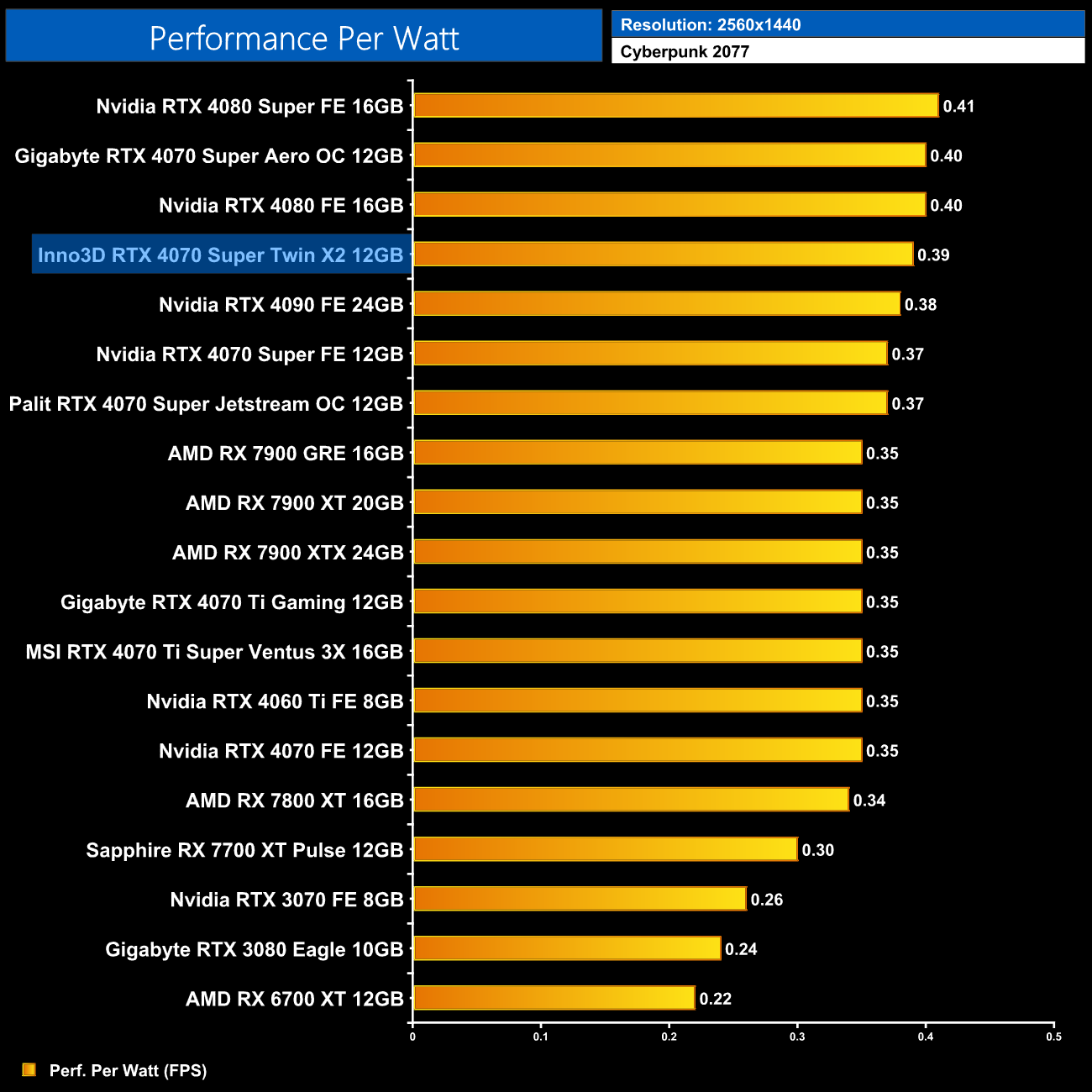
That does mean overall efficiency is slightly increased compared to the Founders, but not in a overly significant way.
For our manual overclocking tests, we used MSI Afterburner. Our best results are as below.
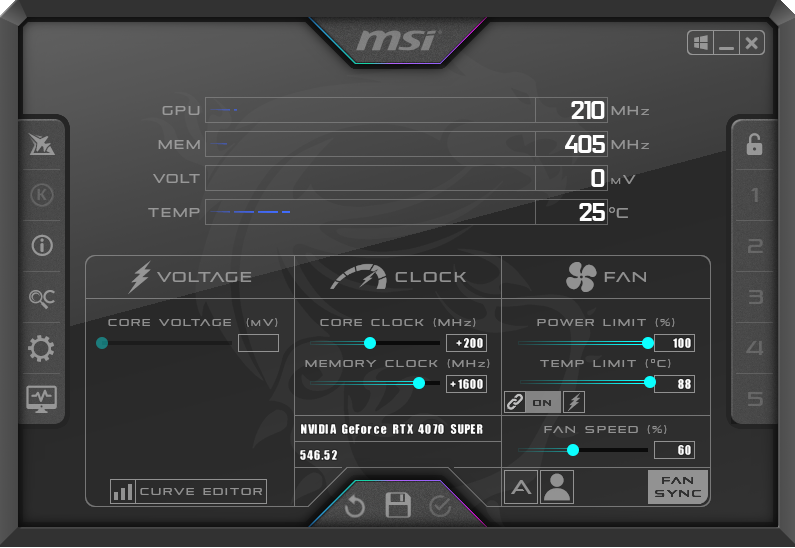
We already mentioned how Inno3D does not allow users to increase the power limit, it cannot go beyond 100% (220W). Despite that, we added 200MHz to the GPU and 1600MHz to the memory.
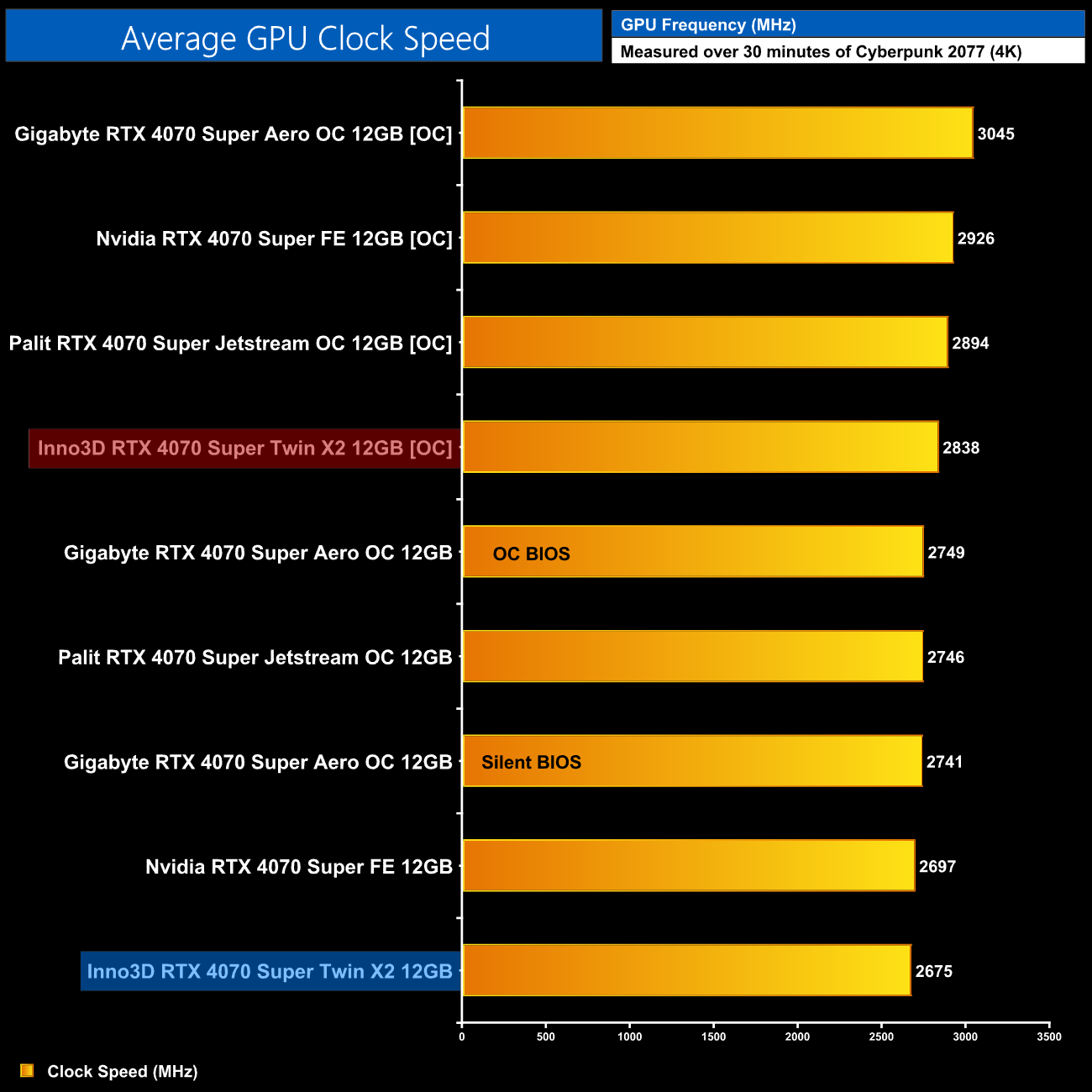
This saw our real-world operating clock speed increase from 2675MHz to 2838MHz when overclocked.
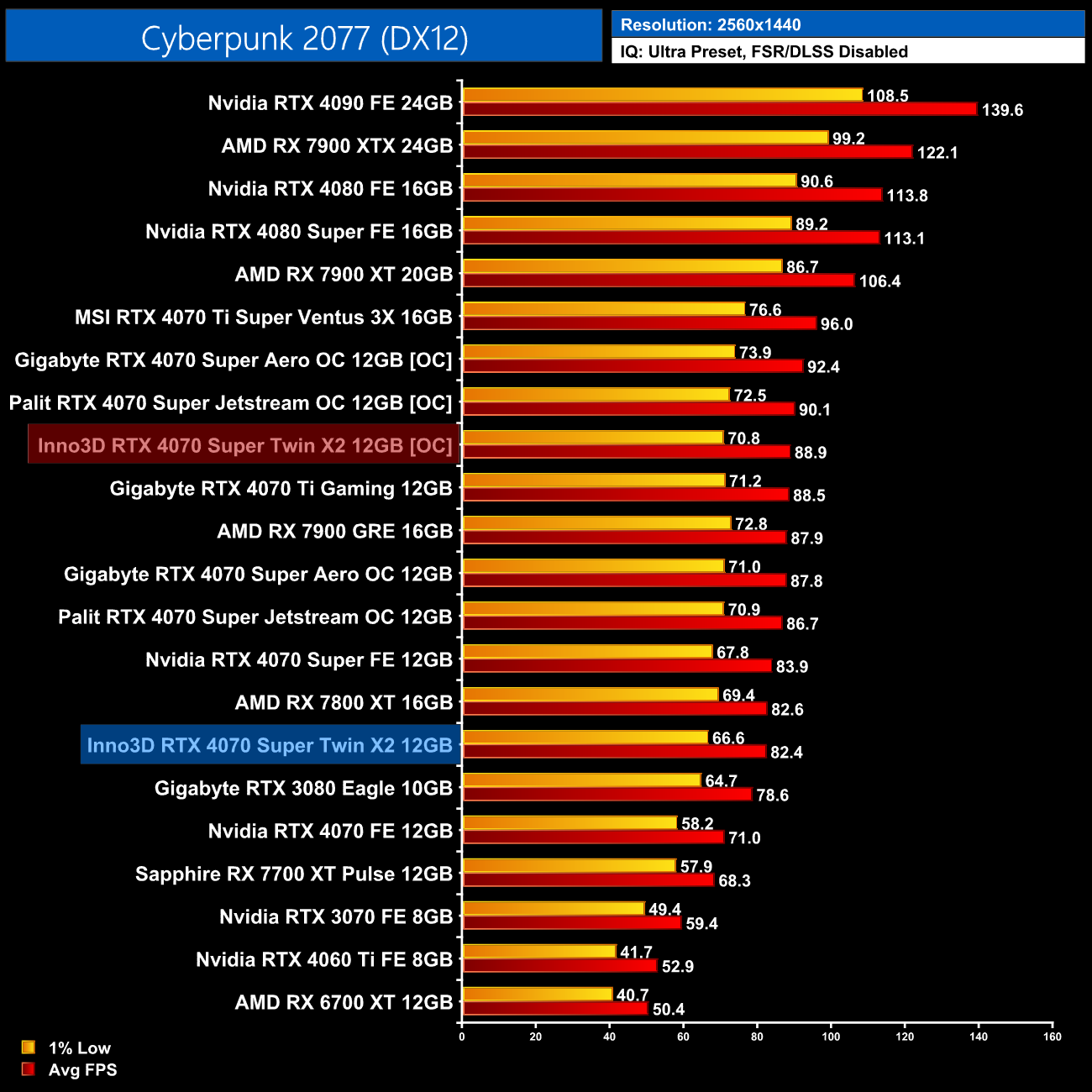
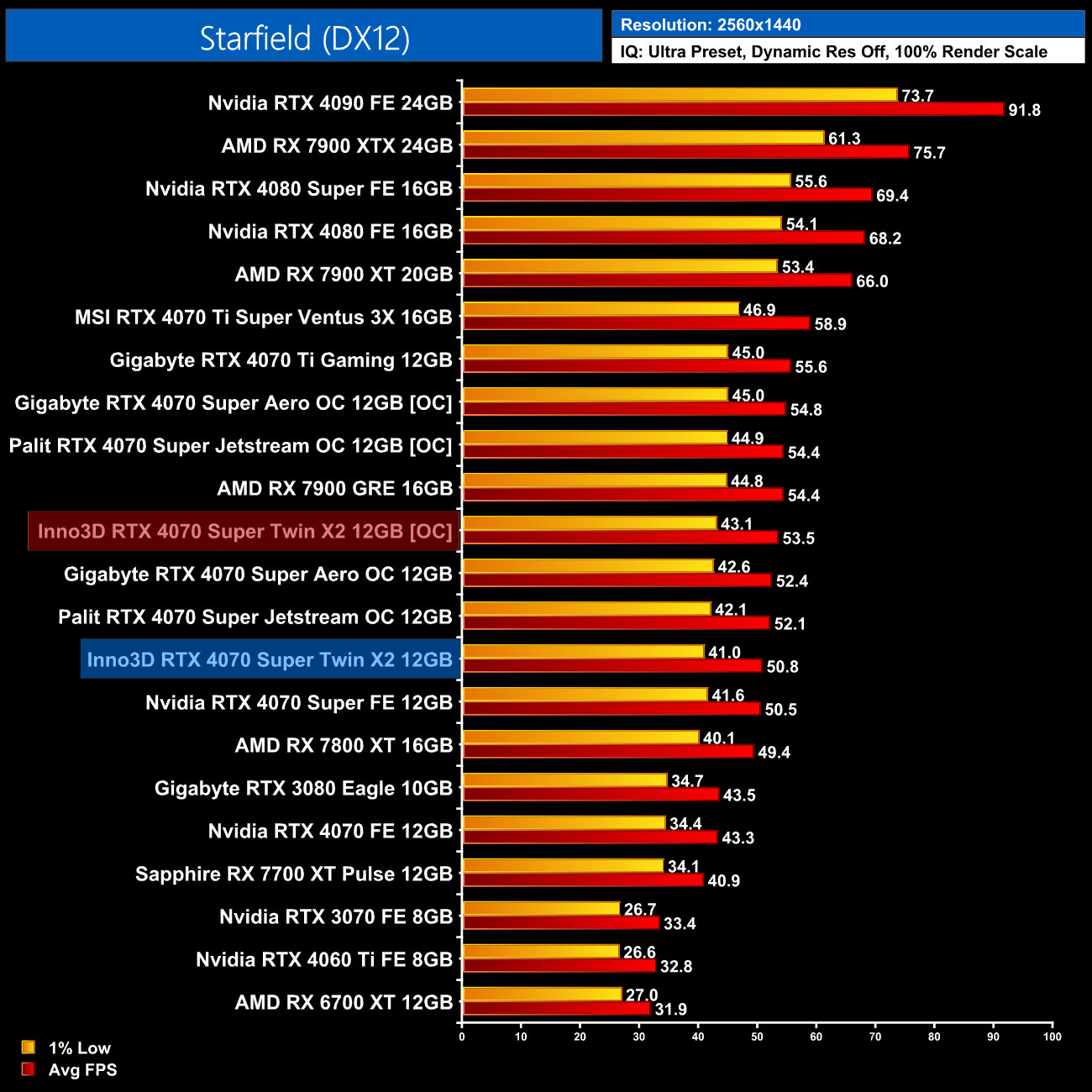
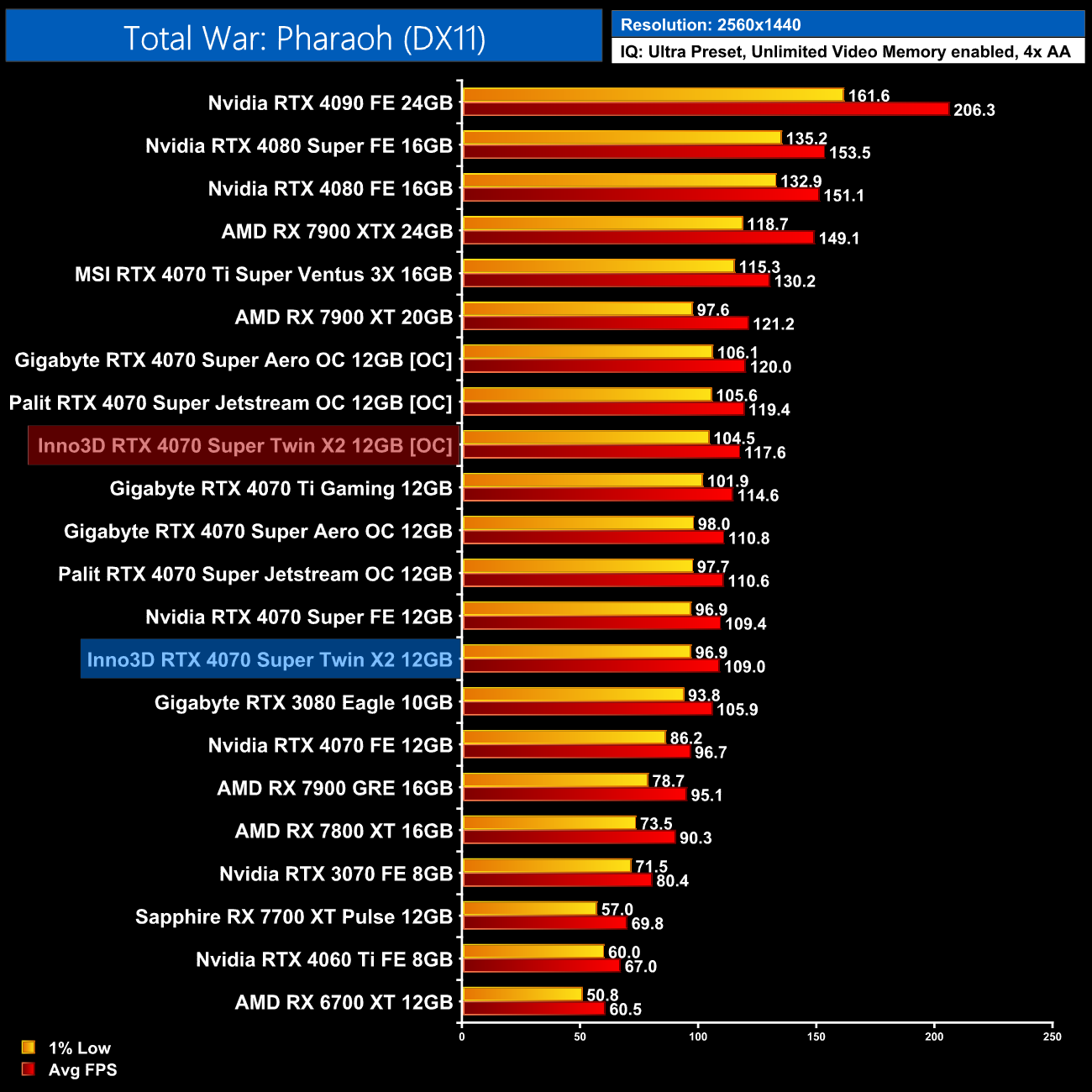
That overclock resulted in performance gains of around 5-7%, which is very typical of the Ada Lovelace architecture.
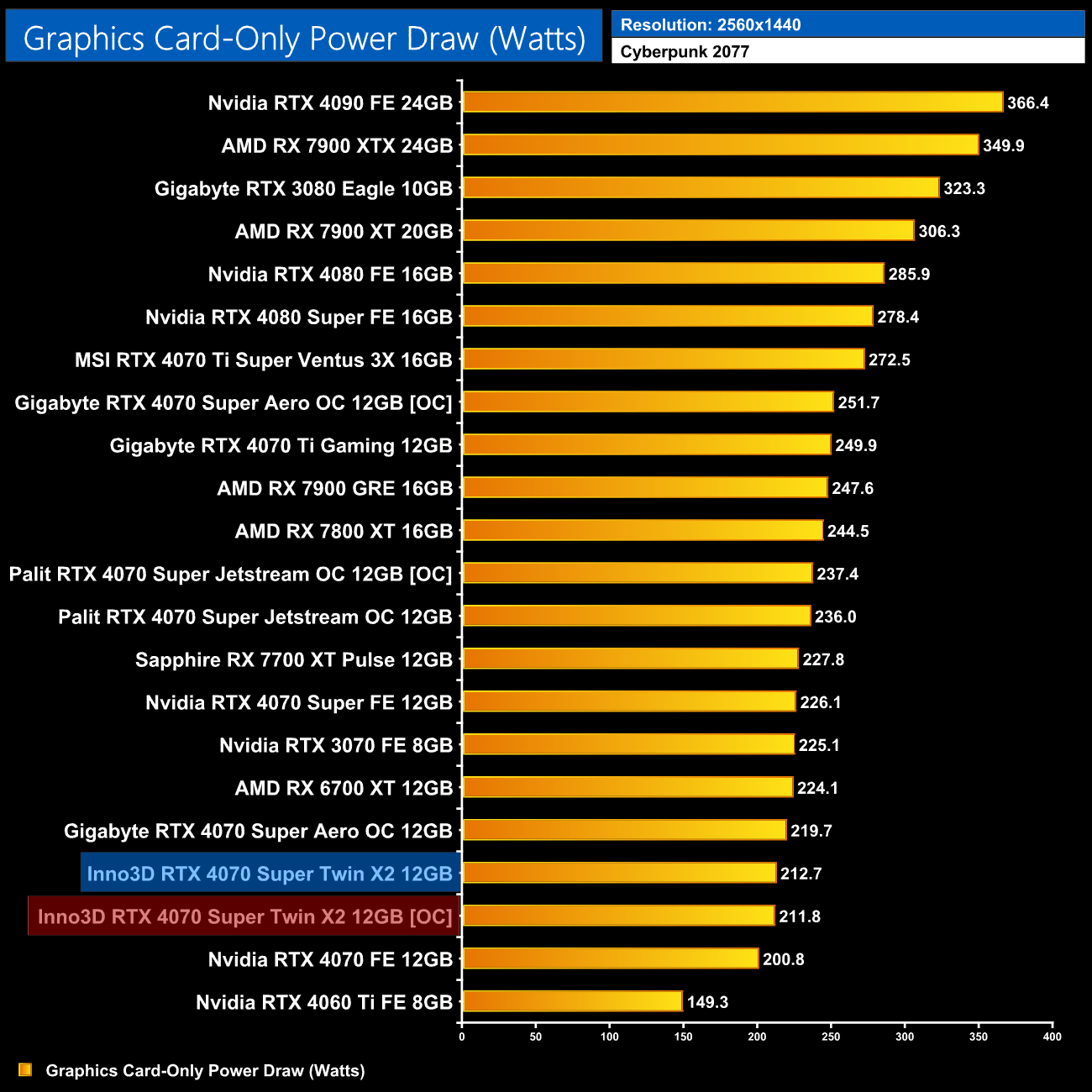
Power draw didn't increase, as we cannot adjust the power limit, so you may as well net the extra few frames considering it won't result in higher power draw.
After reviewing several high-end RTX 4070 Super models at the beginning of the year, it has been interesting to assess the Inno3D Twin X2 model, given the fact it is very much a ‘back to basics' product.
Instead of delivering flashy RGB lighting, multiple BIOS modes, on-board fan headers or anything else, Inno3D has deliberately stripped things back with the Twin X2 – it doesn't even come factory overclocked!
That's not necessarily a bad approach though, as the cooler is still more than good enough to handle the 220W heat output of the AD104 silicon. Of course, it can't deliver temperatures as low as the Gigabyte Aero OC or the Palit JetStream OC, but that's because the Twin X2 is significantly more compact (a selling point in its own right) while it has one fewer fan. It's still more than a match for the cooling capabilities of the Founders Edition, while also delivering memory thermals that are 10C better.
It runs at a similar noise level to the Founders Edition, while gaming performance is pretty much identical between the two as we'd expect. The Founders Edition does benefit from the ability to increase the power limit, however, something which the Twin X2 lacks, so we weren't able to push frequencies as high when overclocking – but the real-world difference is only a couple of percent. If this was a premium-grade AIB card, that would be more of an issue to me, but as this is Inno3D's entry-level 4070 Super, I think it can be forgiven.
Of course, the price also factors in here, as the Twin X2 is listed for £589.99 here in the UK. That makes it just £10 more expensive than the £579 MSRP, so it is significantly cheaper than the likes of the Aero OC we mentioned earlier. At that price, I think it's a solid enough card. It won't blow your socks off, but if you want a cool, quiet graphics card that just works, with no fancy features or added complications, the Inno3D RTX 4070 Super Twin X2 will get the job done.

You can buy one from Overclockers UK HERE.
Discuss on our Facebook page HERE.
Pros
- Impressively compact.
- Solid thermal performance despite the diminutive dimensions.
- Runs nice and quiet under load.
- As fast as the 4070 Super Founders Edition.
- Only £10 more expensive than the 4070 Super's £579 MSRP.
- Support for the full RTX feature set including DLSS, ray tracing etc.
Cons
- Lacking more premium features, such as RGB lighting or dual-BIOS.
- Power limit cannot be increased.
- Design may be too bland for some.
KitGuru says: It won't blow you away, but if you want a compact graphics card that performs well, the Inno3D Twin X2 is a solid choice.