KitGuru KitGuru.net – Tech News | Hardware News | Hardware Reviews | IOS | Mobile | Gaming | Graphics Cards


When Lisa Graff, Intel VP for the Desktop Client Platforms Group, recently told KitGuru about her plans for 2014/2015, the focus was clearly on reinventing the desktop. As KitGuru reported a while back, there will be a resurgence on desktop for Intel going forward, which we believe will peak around 2017. To get a different take on this information, we caught up with Intel’s Gaming Guru, Richard Huddy who was just eyeing up the hotel’s perfectly rendered breakfast fruit when we spoke.
“It’s all about delivering credibility with the game developers”, Richard told us. “With CPU and GPU performance increasing dramatically over recent years, there has also been pressure to reduce power consumption, to create a much better mobile experience”. This drive toward better graphics on the go seems to have spurred a lot of innovation at Intel.
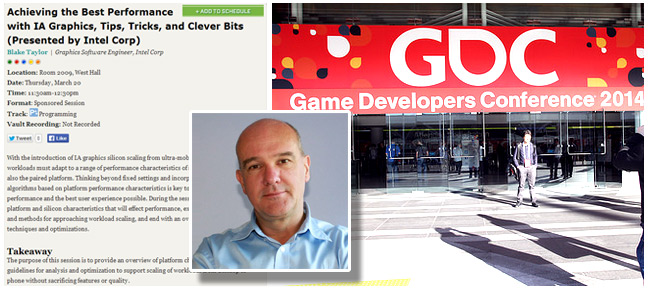
That part of the market is becoming increasingly important for game developers. According to the latest system shipment data from research organisation IDC, notebooks now account for around 57% of total PCs sold.
This news has been confirmed by Intel’s new CEO, Brian Krzanich, who told the industry “Over the whole of 2013, Intel has hit an all-time record for the shipment of Core i5 and Core i7 processors”.
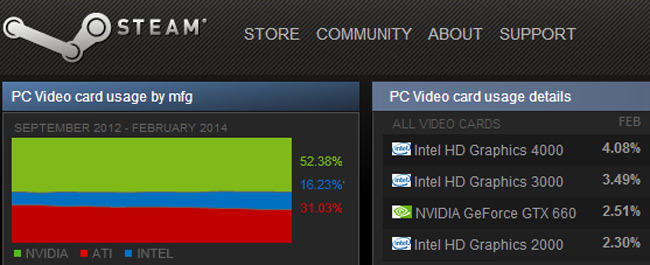
“You can see the impact that we’re having on the gaming community when you look at Steam’s online hardware survey”, explained Huddy. “Not only are Intel products in positions 1, 2 and 4 in terms of popularity, but overall more than 16% of Steam’s community are now gaming with Intel graphics”.
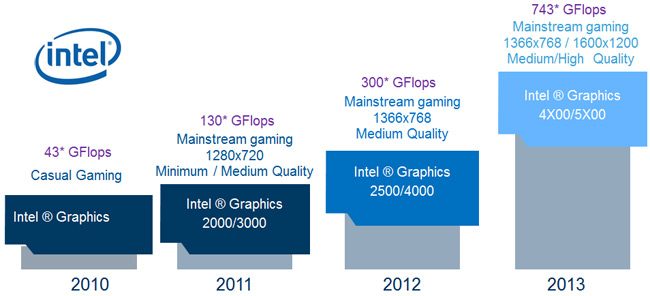
The increase in performance is tied in with the increase in hardware being allocated to graphics by Intel.
Although no major silicon manufacturer is going to hand out detailed schematics for their processors, experts believe that just under 20% of the Sandybridge Core series was dedicated to graphics and that this figure has almost doubled by the time you get to Haswell.
According to an Intel slide that we got eyes-on at the end of 2013, the growth in processing capability for the chip giant has been nothing short of astounding. It's not easy to extrapolate forward for the next generation, but it's clear that you will be able to game properly (i.e. without having to set everything to ‘Low/No') with Intel in the very near future.
.
But how does this increase in GFlops manifest itself inside the processors themselves and where do the performance bumps come from?
The initial HD2500 and HD4000 products were 6 core and 16 core respectively, although as Huddy was quick to point out “Not all cores are equal and they all operate in a very different way”.
So you can't put 40 of these ‘Intel Execution Units' in a line up against 40 CUDA cores and say that you're comparing like with like.
With Haswell, the entry level (referred to as GT1 or Intel HD) is still a 6 core part, but by the time you reach the upper echelons of the GT3e part (which Intel calls HD5200 or Iris Pro), you have 40 cores linked in with a special 128MB ‘level 4 cache' called Crystalwell that has a 50GB/sec, bi-directional connection to the main processor.
It’s a bit chunk of silicon, so we asked Huddy why it's there, “If you’re running at HD resolutions of 1920 x 1080 with 4 bytes a pixel and the additional amount needed for Z, then a quick calculation shows that the entire render can fit into the 128MB that Crystalwell offers, easily ”. He added, “That gives you a huge advantage, because you can complete a huge rendering operation in one go”.
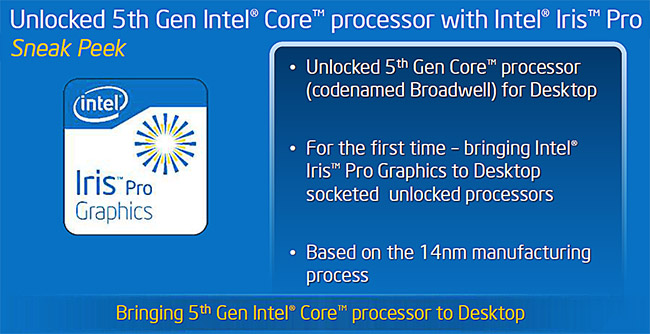
“With our 5th generation Core processors, codenamed Broadwell, the unlocked desktop versions will all come with Intel Iris Pro”, said Huddy.
Interesting.
One thing that Huddy would not be drawn on was the relationship between Intel Core processor clock speeds and the corresponding increase in graphics power.
There’s no doubt that the launch of Haswell left the overclocking community with a distinctly lacklustre feel toward the processor. Unlike previous generations, there was no clear ‘People’s Champion’ – a Q6600 D0 type processor which could be severely clocked and stil stand up.
KitGuru believes that Broadwell ‘K’ chips have been designed to counter that feeling and put Intel chips firmly back into the hearts and minds of the enthusiast. Specifically, we believe that they will clock past 5GHz without special kung-fu or exotic cooling.
If that’s the case, then the graphics performance of Broadwell K processors with Iris Pro graphics could well rival what we see from the low to mid-range cards from AMD and nVidia. That could affect cashflow around the graphics industry.
So what about the developers who have flocked to GDC, what does this revolution in Intel graphics hold in store for them?
“Back in 2007, retail packaged games were a significant part of the market”, said Huddy. “The latest data we're seeing shows that half the new game installations in North America and close to 85% of those in the Far East now fall into the Free to Play, Subscription, Advertising Supported type categories. In other words, there is no initial large purchase price”.
“Then you look at the active gamer market and you can see that Windows gaming on desktops and notebooks is far from dead”, he explained. “In fact, if you add together all of the consoles, tablets and Mac OSX devices together, they still only form a fraction of the number of active/monitised gamers that you will see on a Windows platform product”.
So Huddy's message seems clear: The money is being spent in the Windows/PC space and the ‘new activations' are going to games where they are free to play or, at least, very cheap to get started with – and this is where Intel is focusing.
Discuss on our Facebook page, over HERE.

KitGuru says: Big thank you to Richard for taking time out from his waffles at GDEC to speak with us. While we don’t see Iris Pro destroying the need for high end Radeon and GeForce cards, it will help Intel take another chunk of the ‘Good enough’ market by delivering playable HD without the need for an add in card.
Comment below, in the KitGuru forums or join us online over at Facebook.