KitGuru KitGuru.net – Tech News | Hardware News | Hardware Reviews | IOS | Mobile | Gaming | Graphics Cards


Gigabyte's Watch Dogs Legion redeeming form has listed multiple unannounced GeForce RTX graphics cards from the company. Some of these graphic cards weren't even announced by Nvidia, namely the 306S, 307S, and 308S ones, leading us to believe that Nvidia is already working on the Super/Ti RTX 30 series variants.
The listed unannounced graphics cards should be the Nvidia Geforce RTX 3060 Super/Ti, 3070 Super/Ti, and 3080 Super/Ti. The product model also tells us how much VRAM each one has: the RTX 3060 Super/Ti comes with 8GB, while the RTX 3070 Super/Ti features 16GB, and the RTX 3080 Super/Ti has 20GB of VRAM.
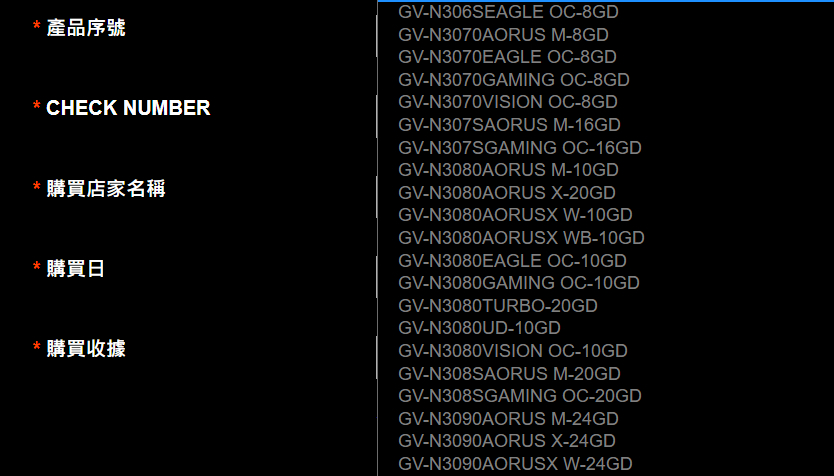
Image credit: VideoCardz
These specifications fit with the latest rumours regarding the yet-to-come RTX 30 series SKUs with 16GB and 20GB of VRAM, and the alleged 3060 Ti that will be shown in October. As per Gigabyte's website (via VideoCardz), the unannounced set of SKUs should be the Super or TI variants. The naming scheme isn't clear, as some sources claim that the new variants will be called Ti, while Gigabyte's product list shows a product code with the letter S (Super).
For now, we know for sure that Nvidia scheduled the launch of the RTX 3090 for September 24th and the launch of the RTX 3070 for October 15th. All other SKUs will probably be known after AMD officially reveals their Big Navi GPUs, scheduled for October 28th.
KitGuru says: Will you wait for Nvidia's next batch of RTX 30 series graphics cards before upgrading your GPU? Do you think AMD will be able to fight a possible wave of new products coming from Nvidia?