KitGuru KitGuru.net – Tech News | Hardware News | Hardware Reviews | IOS | Mobile | Gaming | Graphics Cards


Today we look at the new be quiet! System Power U9 supply in a 700w capacity. The price tag isn't too bad, but for only $15 extra we can get a fully modular unit with the same or even higher efficiency levels. Is it a good idea to pay $75 for a non-modular power supply with 80 PLUS Bronze and ETA-A- certifications in 2019?
The entry level power supply line from be quiet! is the System Power U9, which consists of four models with capacities ranging from 400W to 700W. All are 80 PLUS Bronze certified and also feature ETA-Standard to ETA-A- certifications in the Cybenetics scale.
It is worth stating right from the off that we were sent the System Power U9 700W which is available in the US and Taiwan as it is aimed at the 110V market. UK and European buyers (230V) will be able to buy the System Power 9 700W – no ‘U' in the name – though the two power supplies are based on different platforms, so they are not identical units just with different names.
According to be quiet! the SU9 models are destined for office and multimedia systems, and their strong advantage compared to similar offerings are the DC-DC converters that they utilise for the generation of the minor rails. Thanks to those converters there is support for Intel's C6 and C7 sleep states and the performance in cross-load (highly unbalanced loads among the rails) scenarios is generally very good.
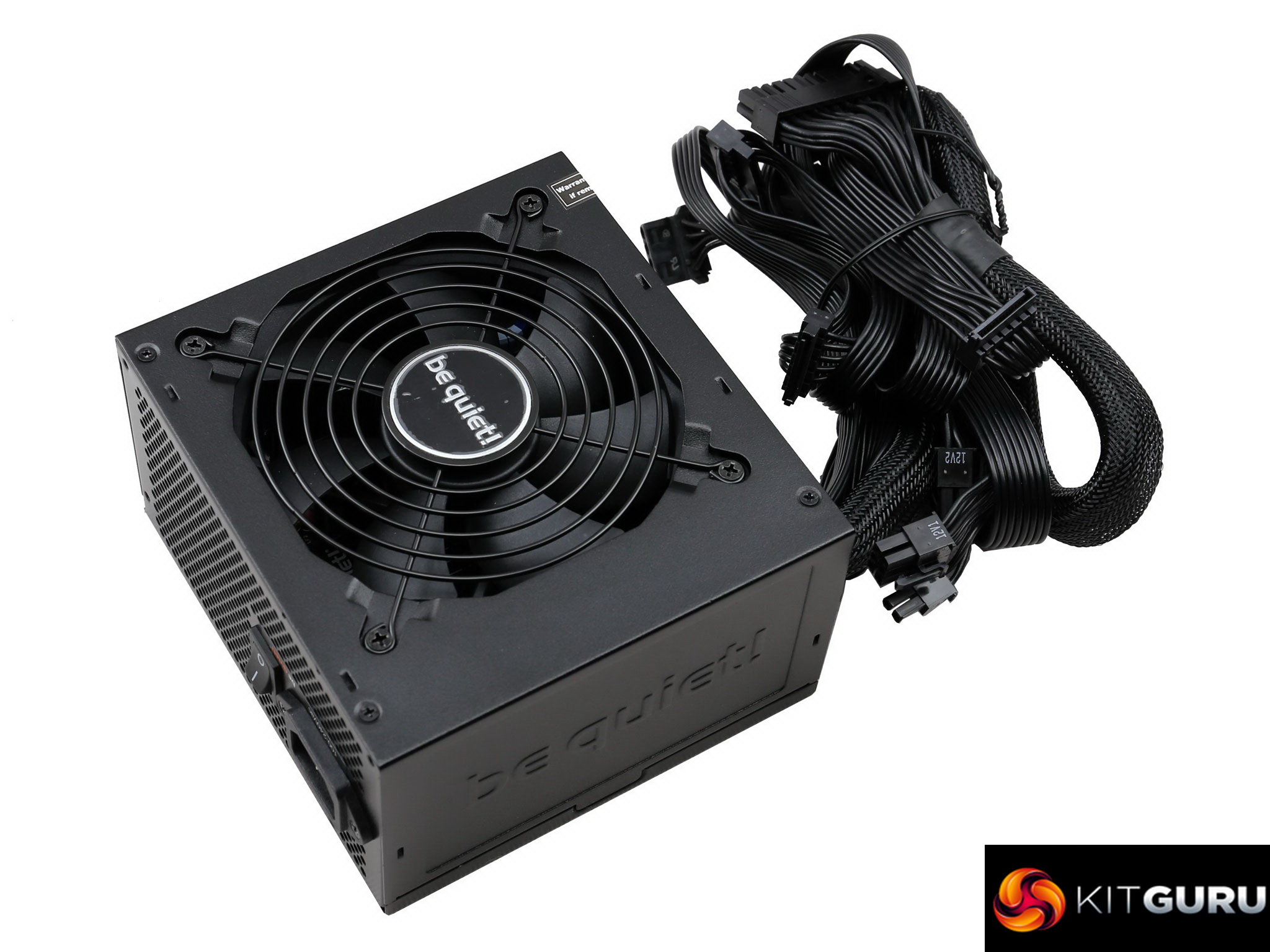
The SU9-700 is the strongest model in this lineup, with 700W max power and two +12V rails. It is ideal for powering a decent gaming system since it can easily handle a single high-end GPU along with a powerful processor. The only downside is the non-modular cable interface, however modular cables would increase the cost. If you don't mind the fixed cables, the lower resistance that they provide offers better load regulation and increased efficiency, compared to similar platforms with modular cables.
Inevitably there are losses in all modular connections, especially at high loads.
Read our How We Test Power Supplies HERE
Specifications
| Manufacturer (OEM) | Channel Well Technology |
| Max. DC Output | 700W |
| Efficiency | 80 PLUS Bronze, ETA-A- (85-88%) |
| Noise | LAMBDA-A (20-25 dB[A]) |
| Modular | ✗ |
| Intel C6/C7 Power State Support | ✓ |
| Operating Temperature (Continuous Full Load) | 0 – 40°C |
| Over Voltage Protection | ✓ |
| Under Voltage Protection | ✓ |
| Over Power Protection | ✓ |
| Over Current (+12V) Protection | ✓ |
| Over Temperature Protection | ✓ |
| Short Circuit Protection | ✓ |
| Surge Protection | ✓ |
| Inrush Current Protection | ✓ |
| Fan Failure Protection | ✗ |
| No Load Operation | ✓ |
| Cooling | 120mm Rifle Bearing Fan (D12SM-12) |
| Semi-Passive Operation | ✗ |
| Dimensions (W x H x D) | 152 x 87 x 142mm |
| Weight | 1.74 kg (3.84 lb) |
| Form Factor | ATX12V v2.4, EPS 2.92 |
| Warranty | 3 Years |
The efficiency certifications are not impressive, however this is not the case for the LAMBDA-A noise certification which proves that this is a very silent power supply. Moreover, according to its maker, which is Channel Well Technology – all necessary protection features are present.
The cooling duties are handled by a 120mm sleeve bearing fan. It would be nice if a rifle bearing fan was used instead, providing a longer lifetime. Since the dimensions of the chassis are compact, a larger fan, with 135-140mm diameter, was out of the question, however from the moment the noise output is kept low, this is totally fine with us.
Finally, the provided warranty looks low at three years however in this price range usually this period is the typical.
Power Specifications
| Rail | 3.3V | 5V | 12V1 | 12V2 | 5VSB | -12V | |
| Max. Power | Amps | 24 | 18 | 33 | 25 | 3 | 0.3 |
| 56 | |||||||
| Watts | 130 | 672 | 15 | 3.6 | |||
| Total Max. Power (W) | 700 | ||||||
There are two +12V rails with 56 Amps max current output. The minor rails are too strong with 130 Watts max combined power, however the 5V rail is rated notably lower than the 3.3V one. As for the 5VSB rail, its capacity is higher than the typical, which is 12.5W.
Cables & Connectors
| Captive Cables | ||||
| Description | Cable Count | Connector Count (Total) | Gauge | In Cable Capacitors |
|---|---|---|---|---|
| ATX connector 20+4 pin (550mm) | 1 | 1 | 18-22AWG | No |
| 4+4 pin EPS12V (610mm) | 1 | 1 | 18AWG | No |
| 6+2 pin PCIe (500mm+150mm) | 2 | 4 | 18AWG | No |
| SATA (540mm+120mm+120mm) / 4 pin Molex (+120mm) | 1 | 3 / 1 | 18AWG | No |
| SATA (330mm+120mm+120mm) / 4 pin Molex (+120mm) | 1 | 3 / 1 | 18AWG | No |
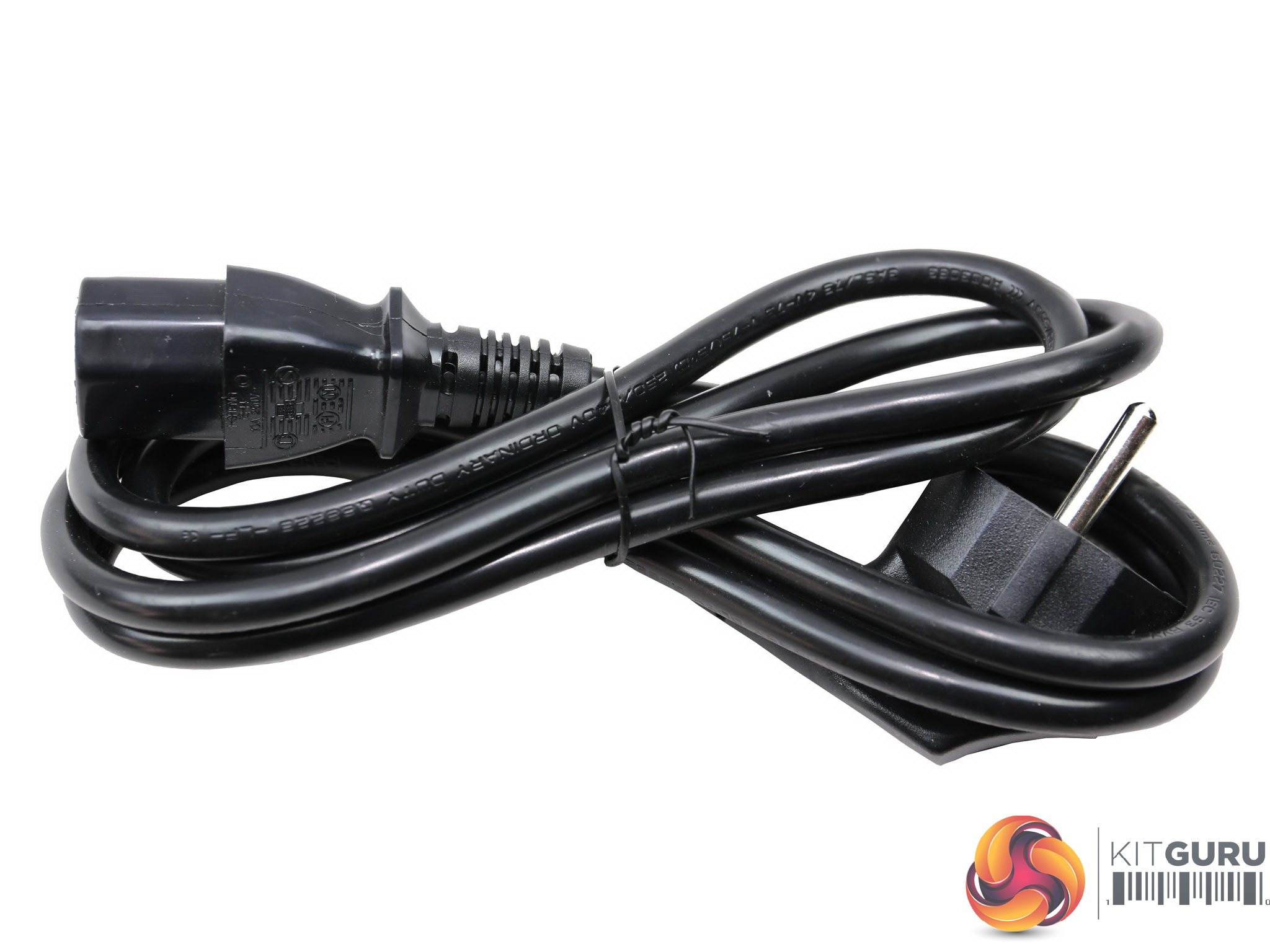
| AC Power Cord (1400mm) – C13 coupler | 1 | 1 | 18AWG | – |
It would be great if there were two EPS connectors, but most likely we ask for a lot given the standards in this category. The four PCIe connectors are an advantage of course, while the number of SATA connectors is adequate.
On the contrary, the number of 4-pin Molex connectors might create some compatibility problems, since still there is a number of parts that use those connectors – with the case fans being the most common. In our opinion the unit should have at least three 4-pin Molex however given that it is mostly destined for office PCs, two of them could be enough.
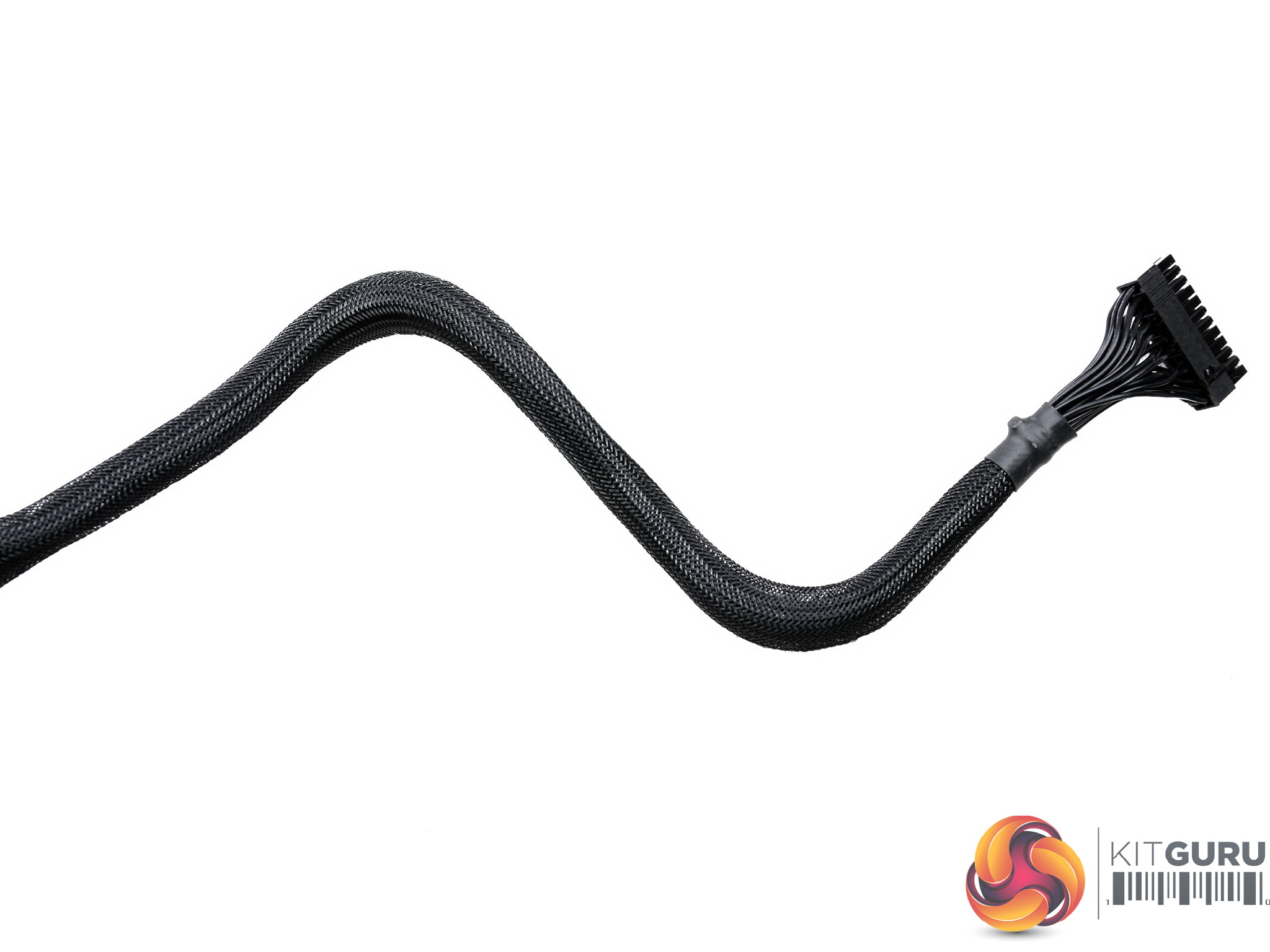
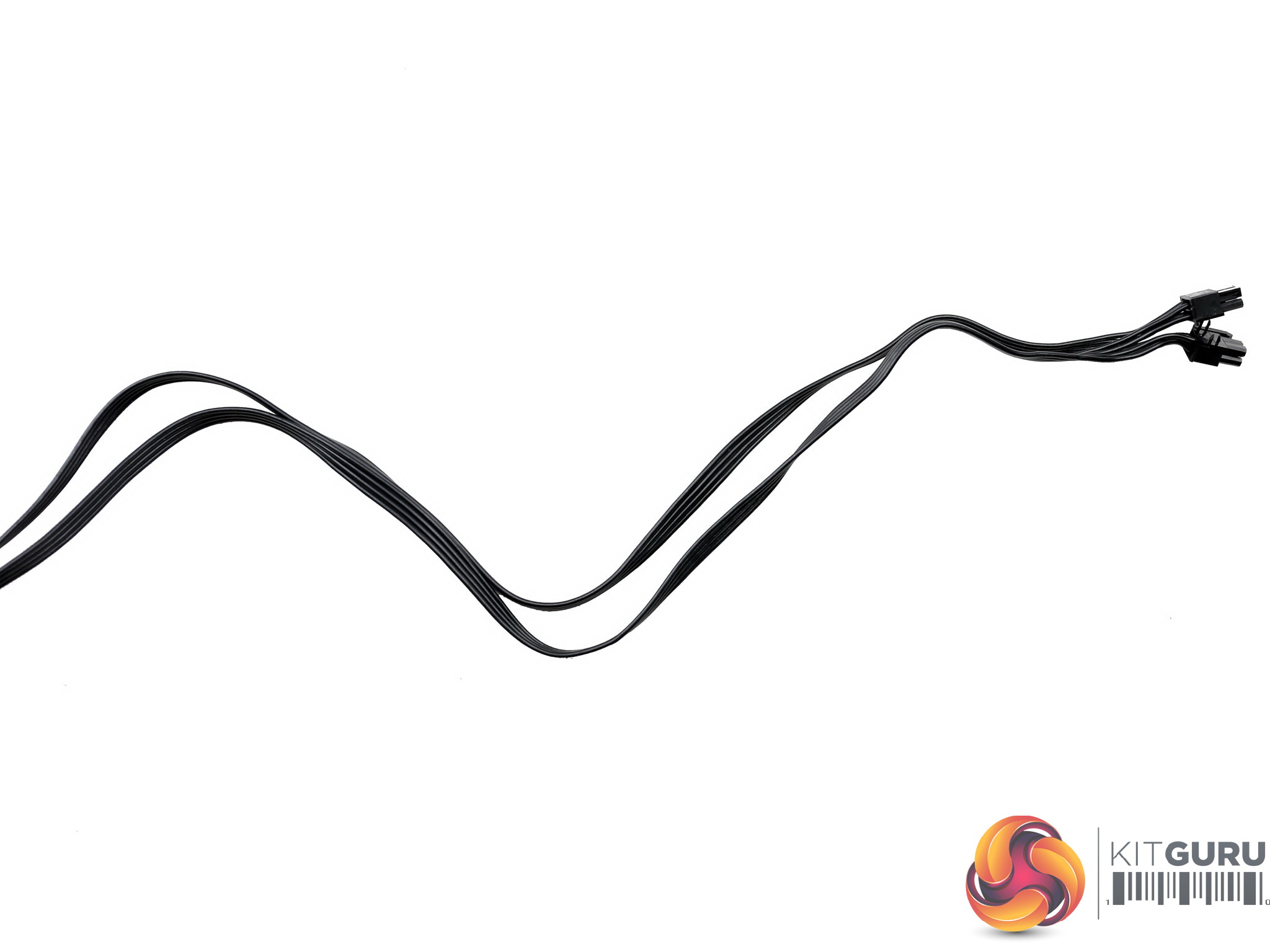
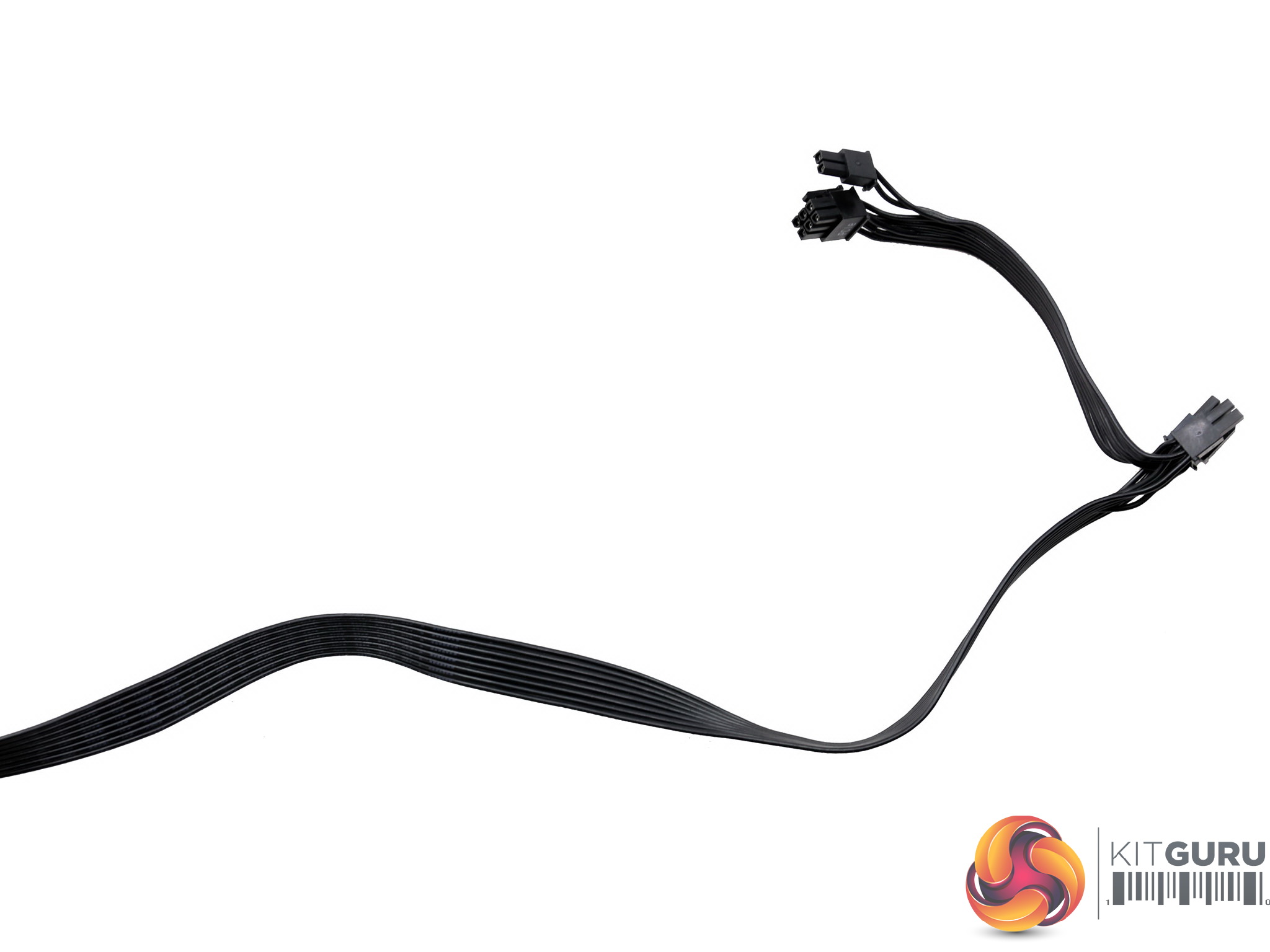
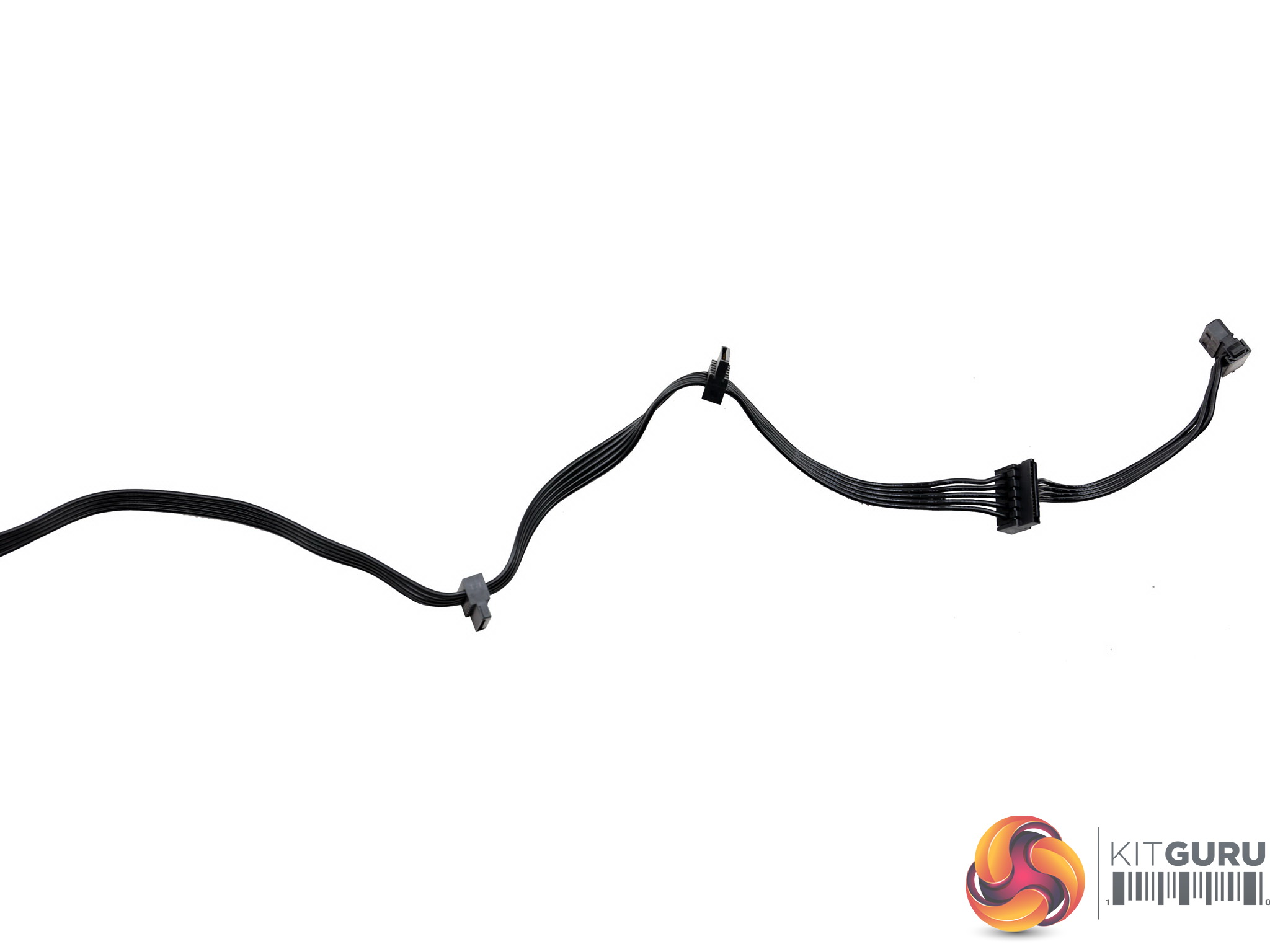
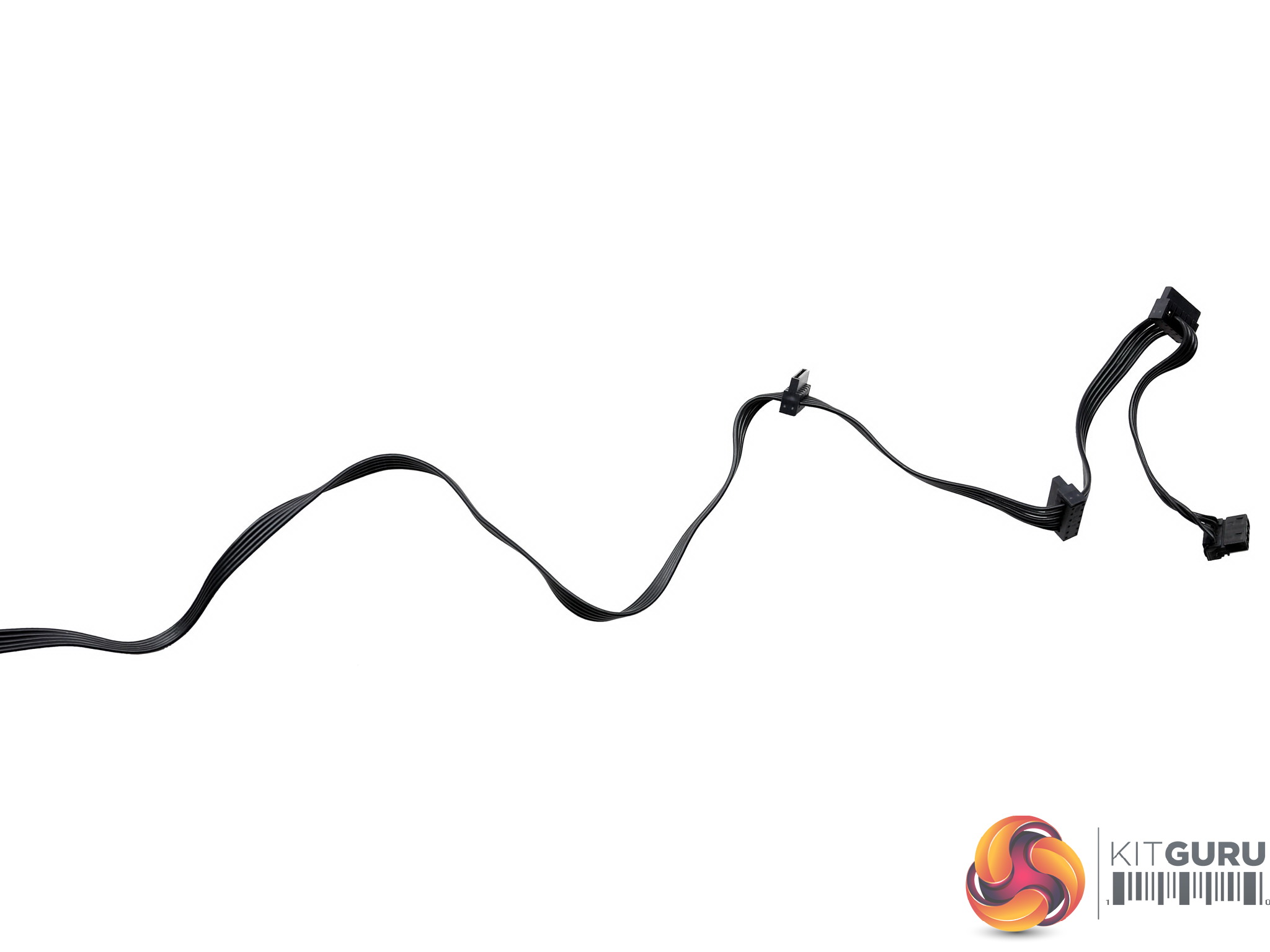
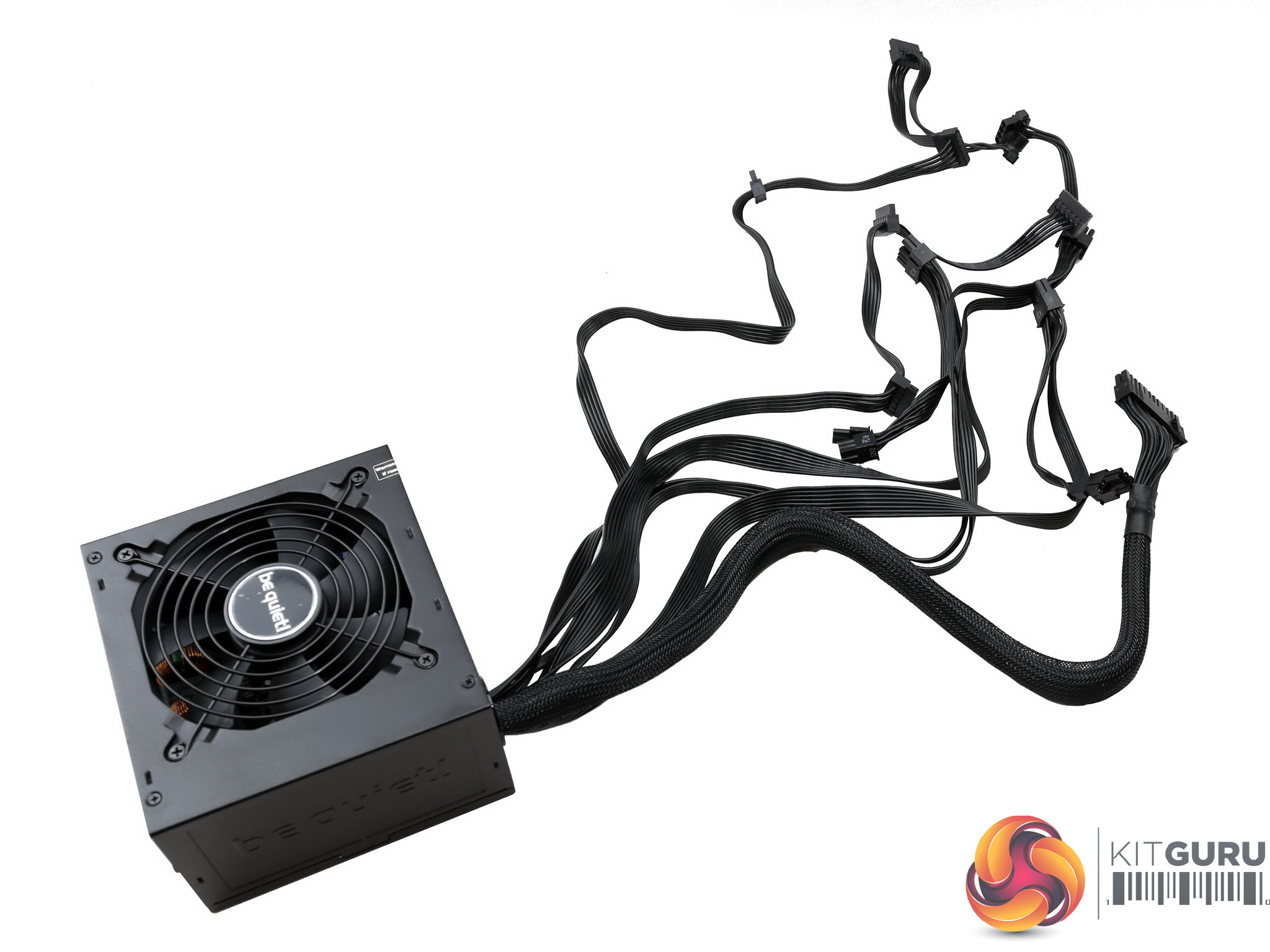
Power Distribution
| Power Distribution | |
| 12V1 | ATX, Peripheral, SATA, PCIe |
| 12V2 | EPS |
There are two +12V rails with the second used exclusively by the EPS connector. With only two rails this is the optimal power distribution, since the PCIe and EPS connectors are not mixed together.
Packaging
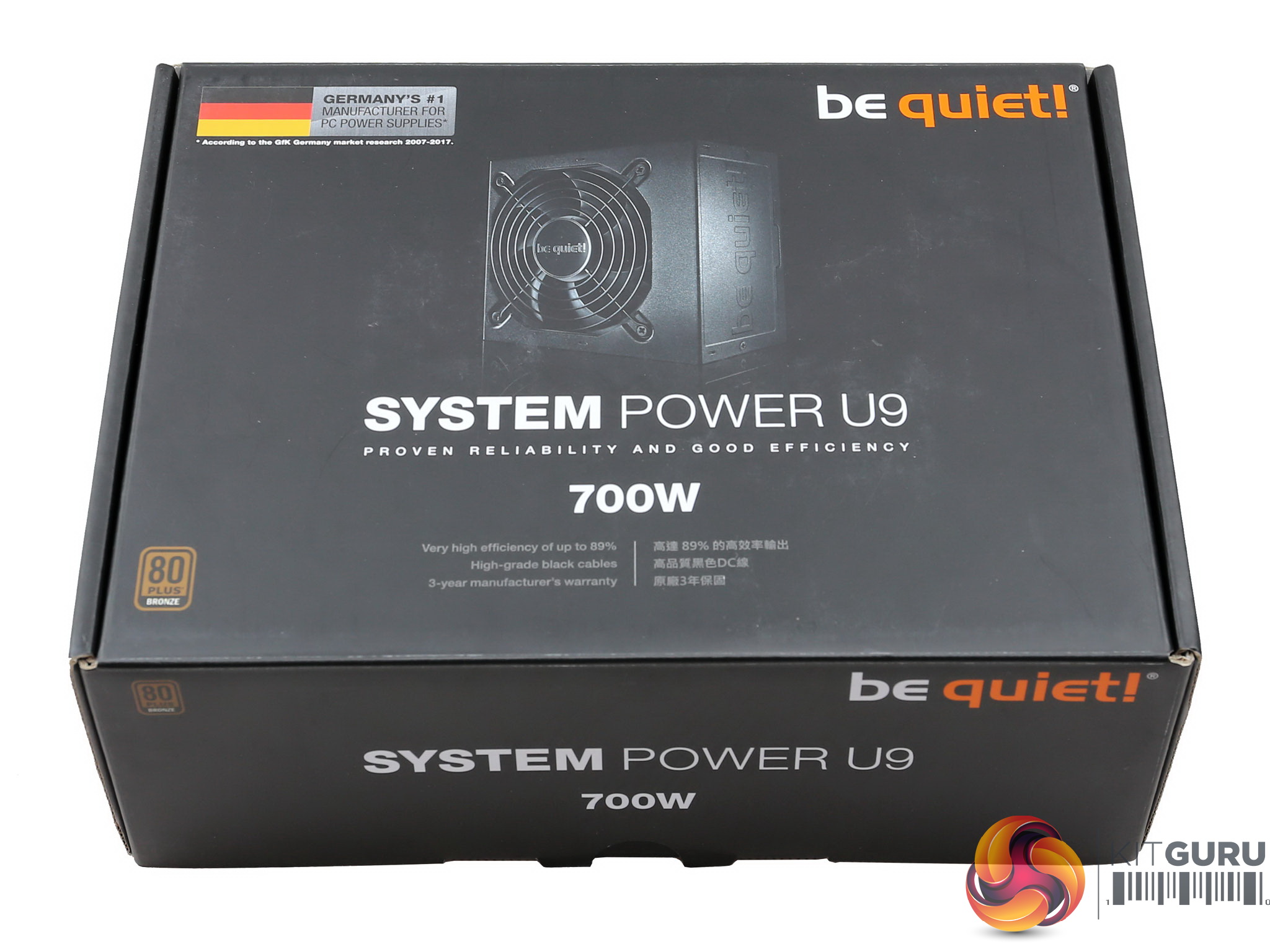
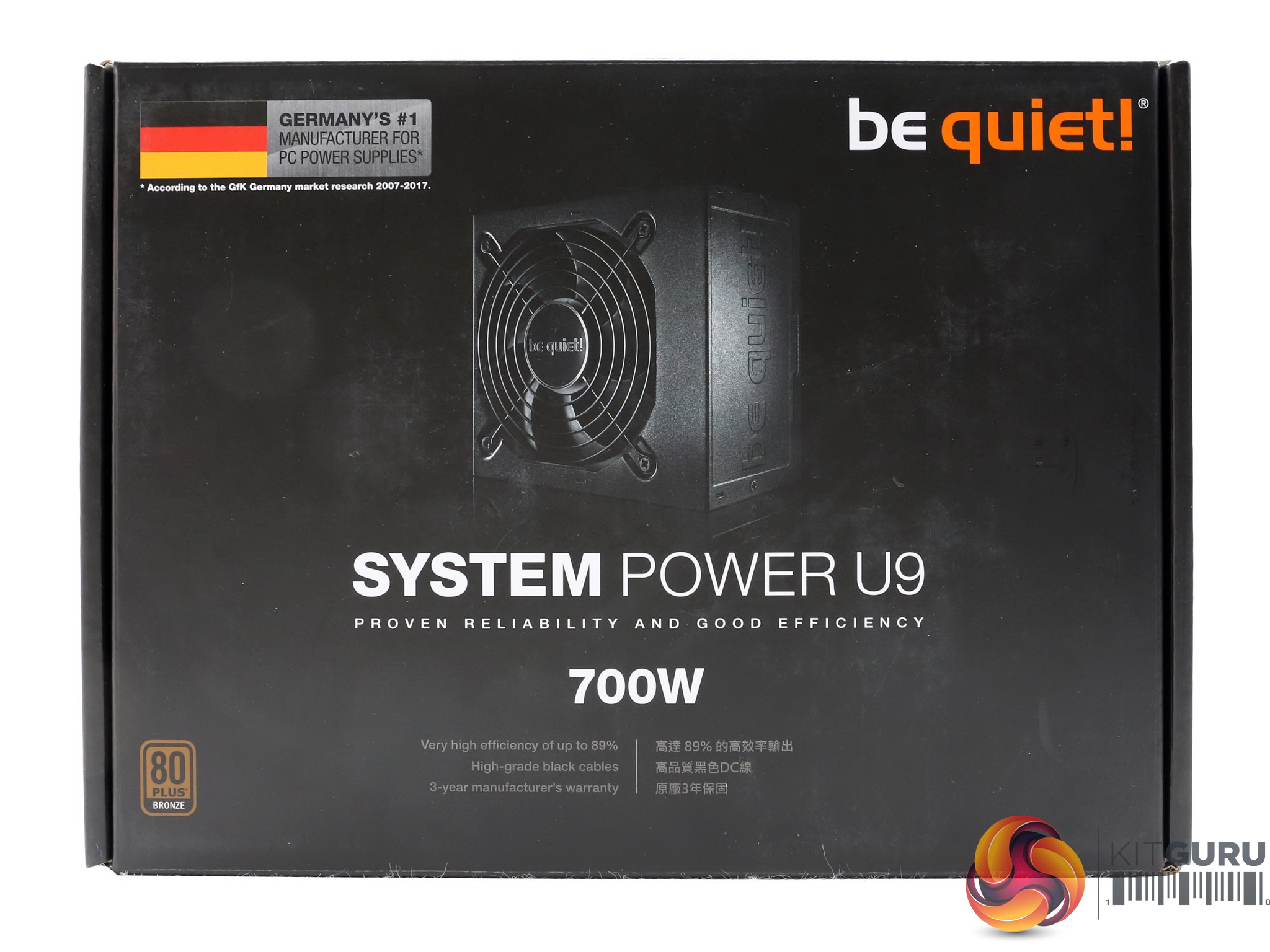
At the front of the box there is a photo of the power supply along with the model number and the capacity. We also notice a German flag in the top-left corner, since be quiet! is a German brand.
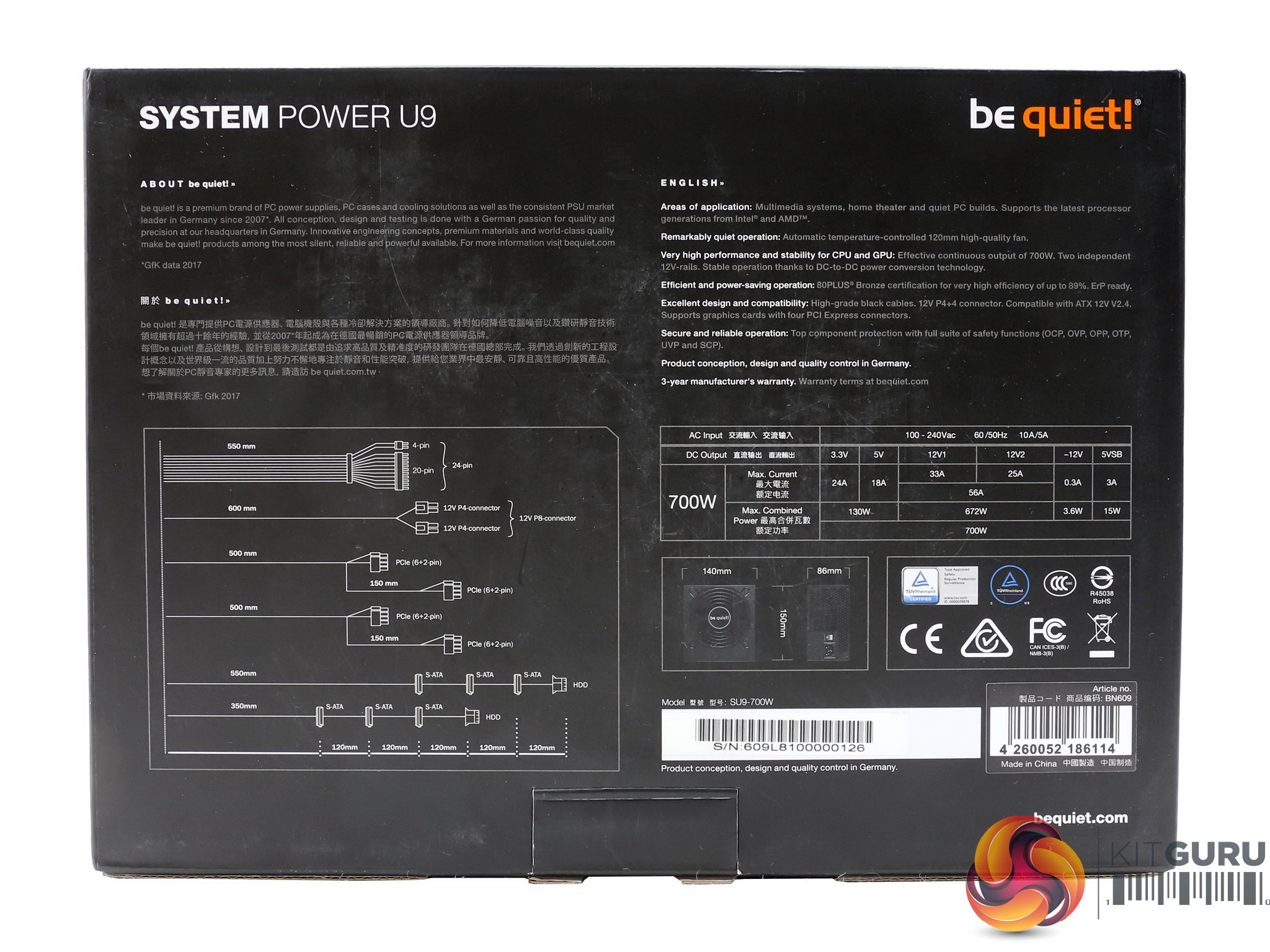
At the rear there is a diagram showing the cable length and the number of available connectors. You will also find the power specifications table along with the unit's dimensions and a number of badges, depicting the various certifications that this product meets.
Contents
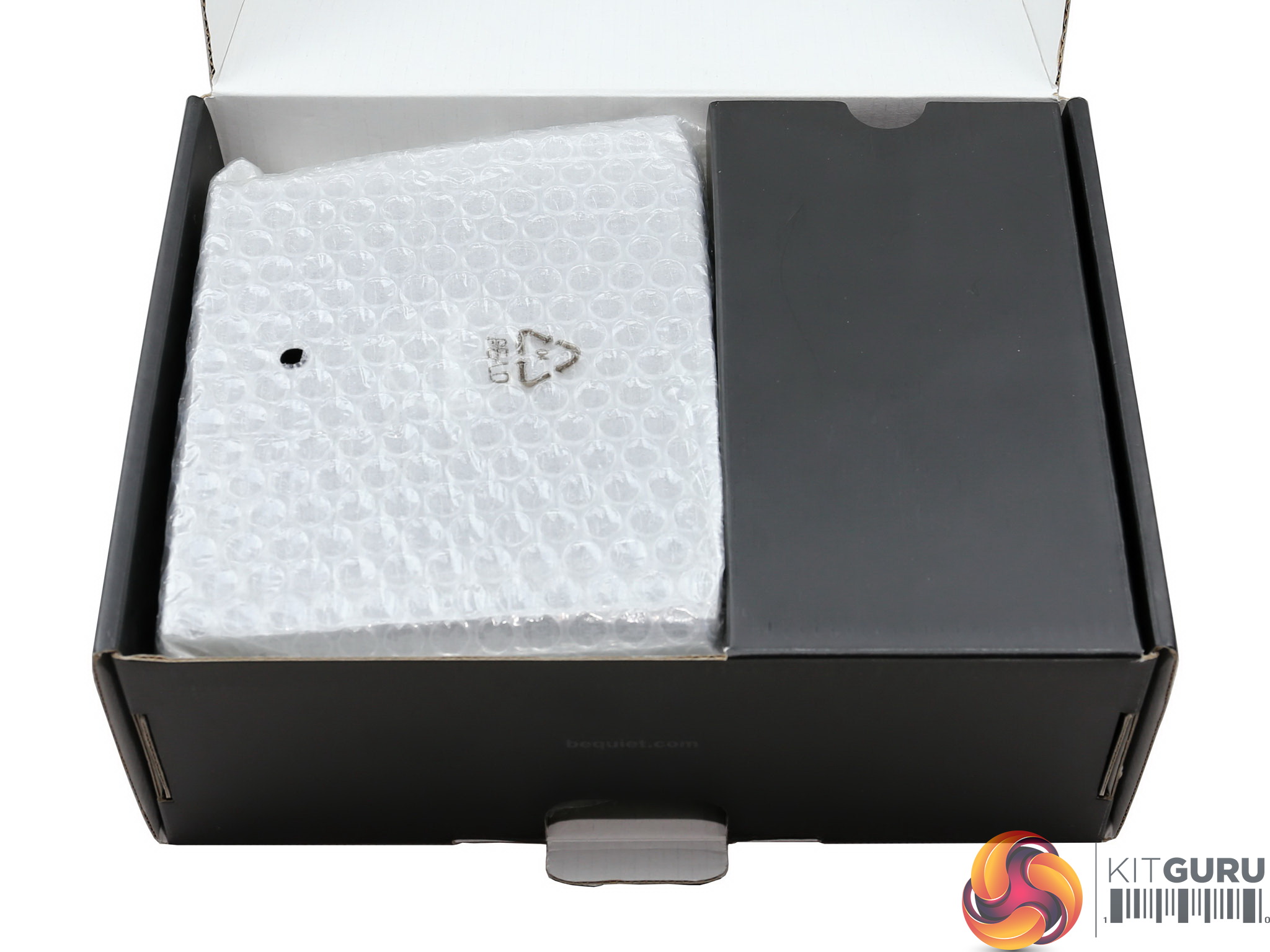
Only a bubble-wrap protects the unit inside the box. It would be far better if packing foam sheets were also used.
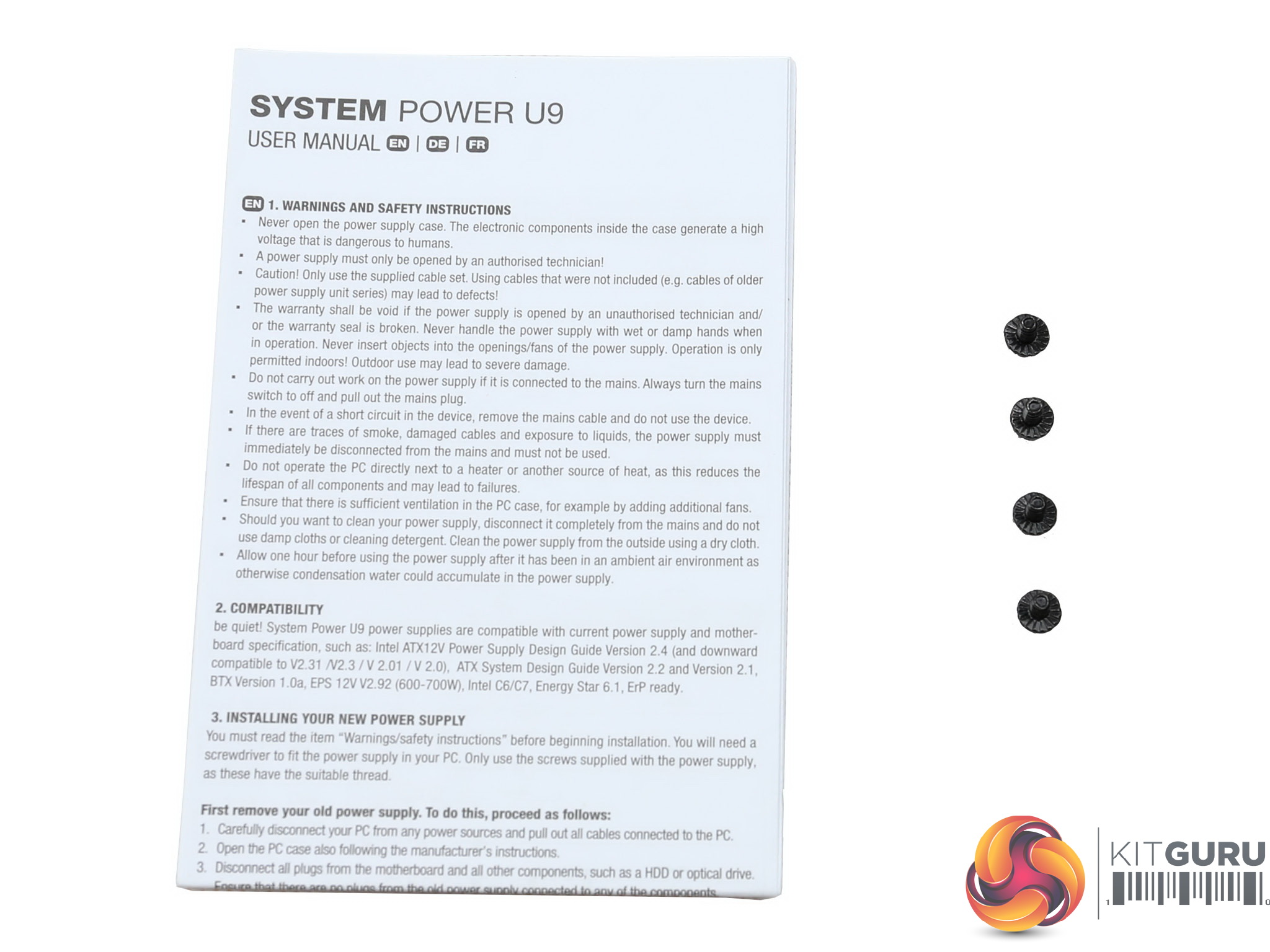
You will only find a user's manual and four fixing bolts, besides the power supply, in the box. be quiet! tried to keep the cost as low as possible, and this means no zip ties or Velcro straps in the bundle.
Exterior
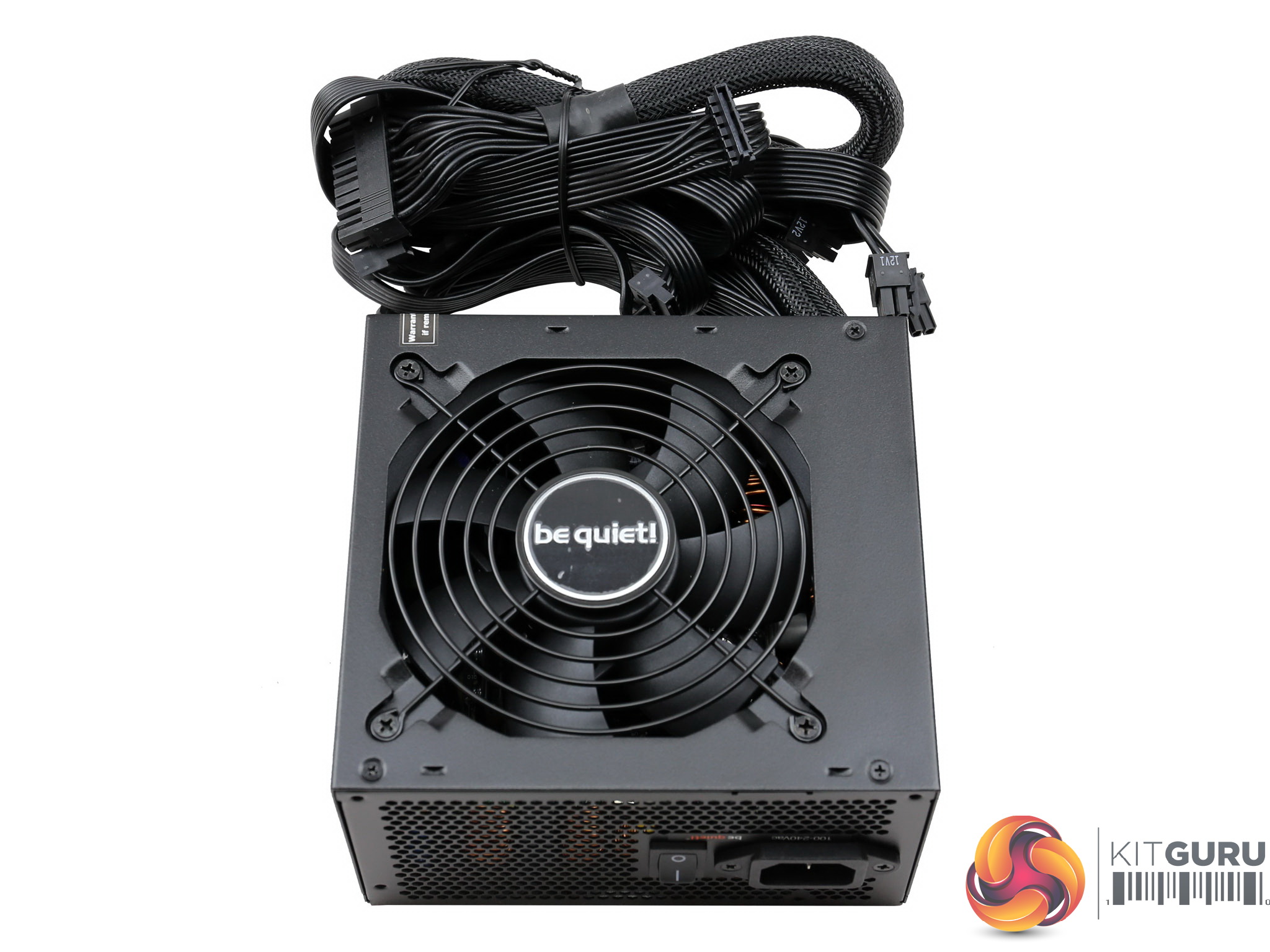
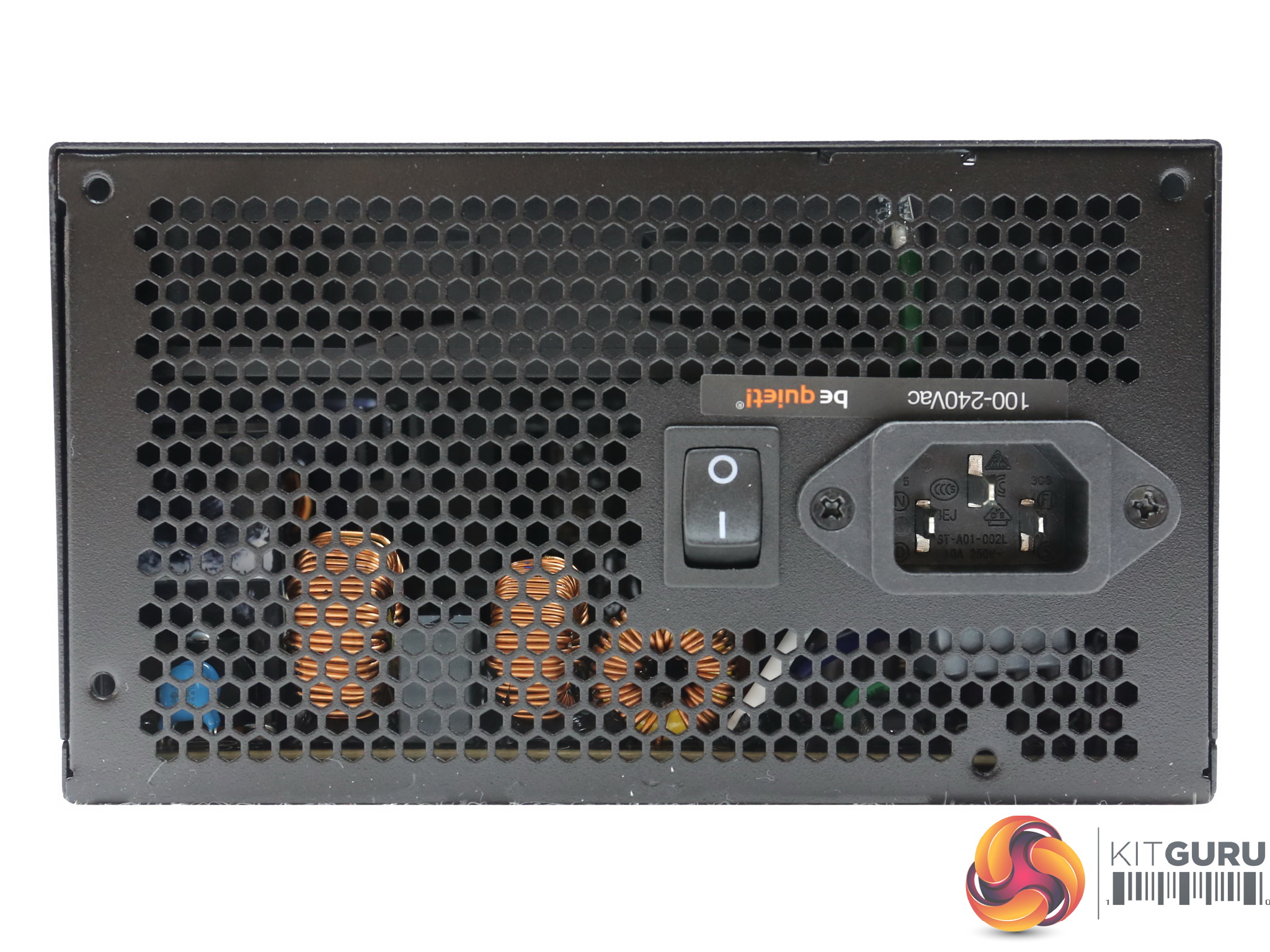
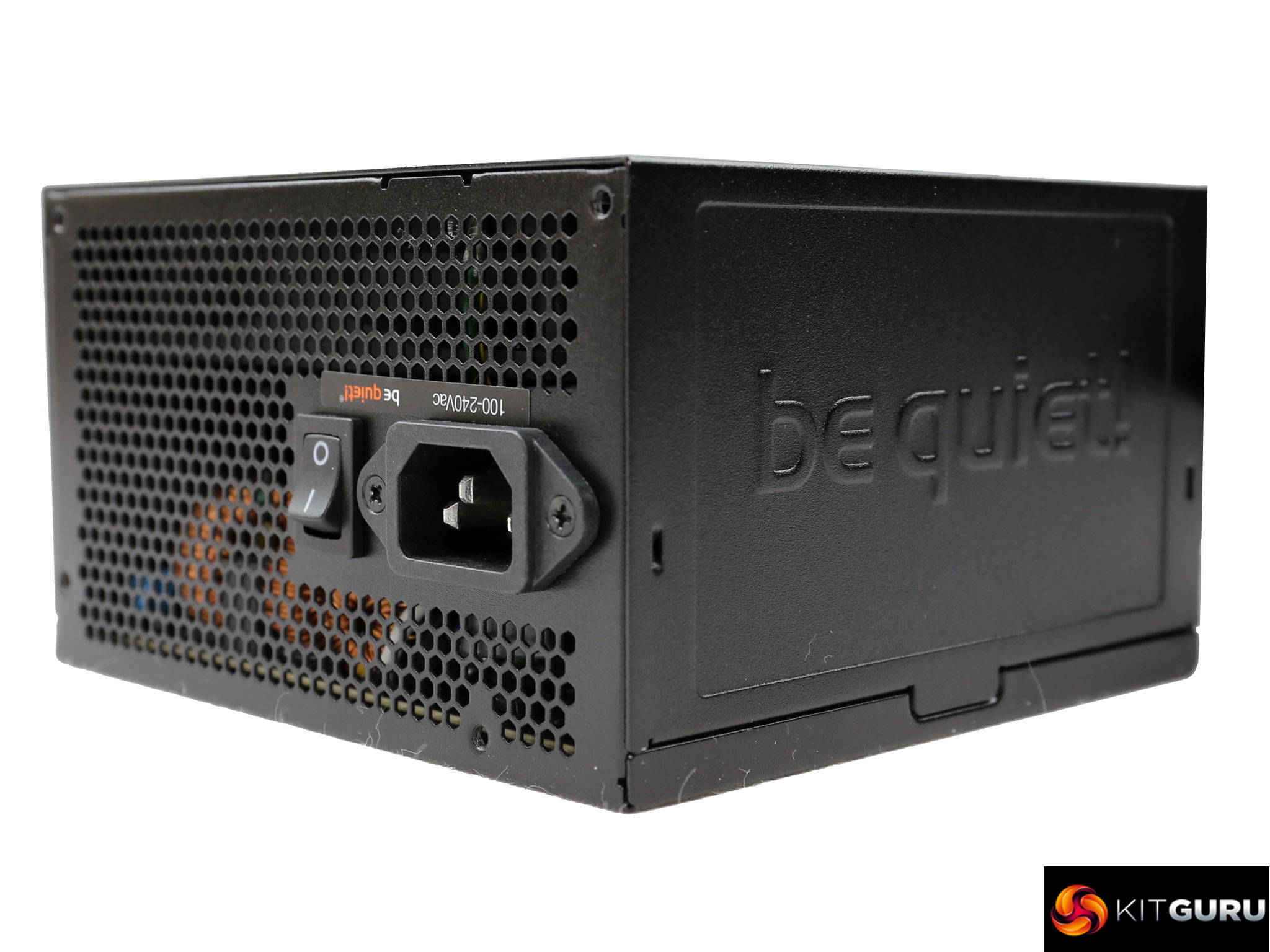
At the front side the power switch is installed right next to the AC receptacle. The typical honeycomb-style exhaust grille is used here.
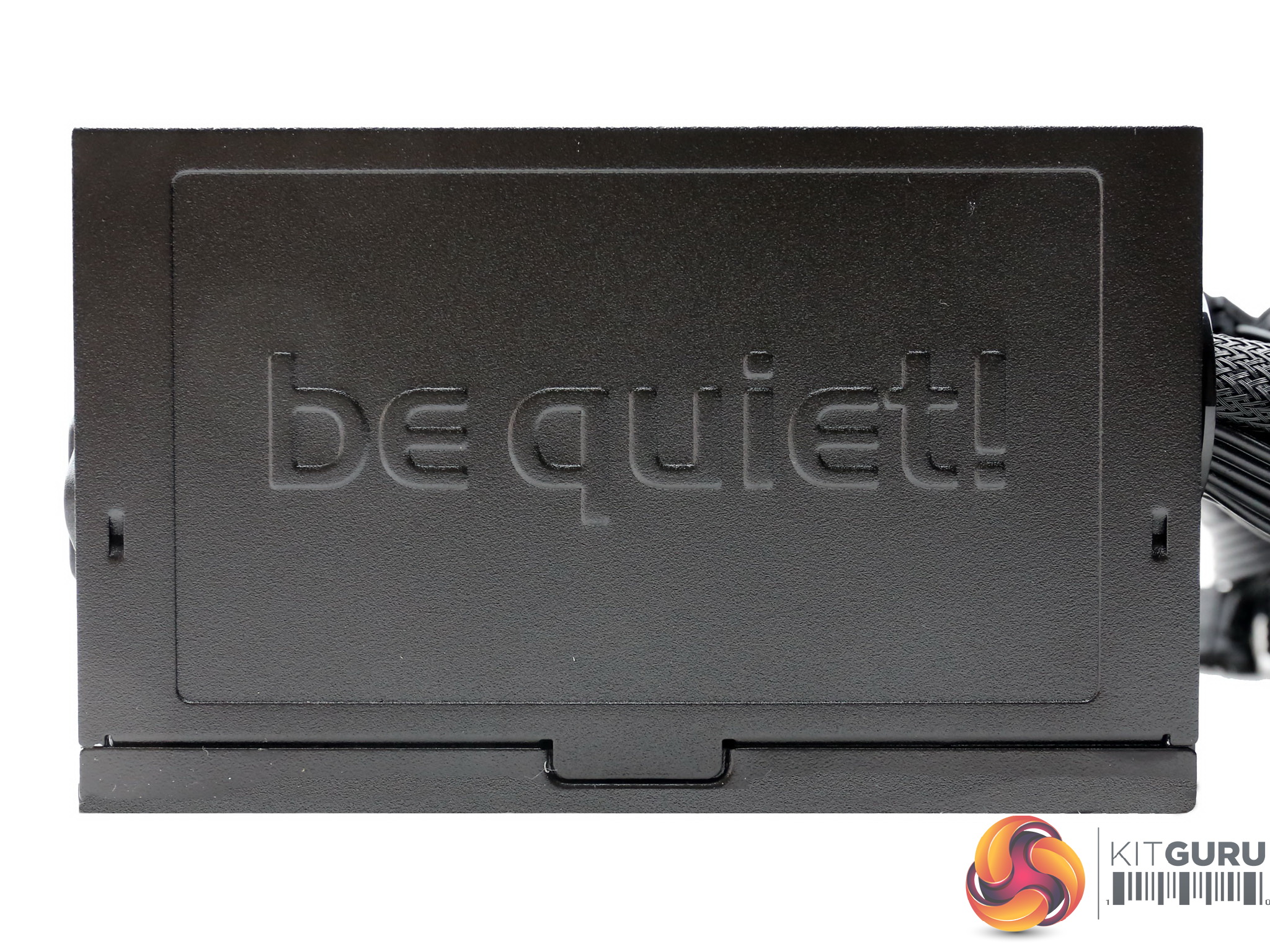
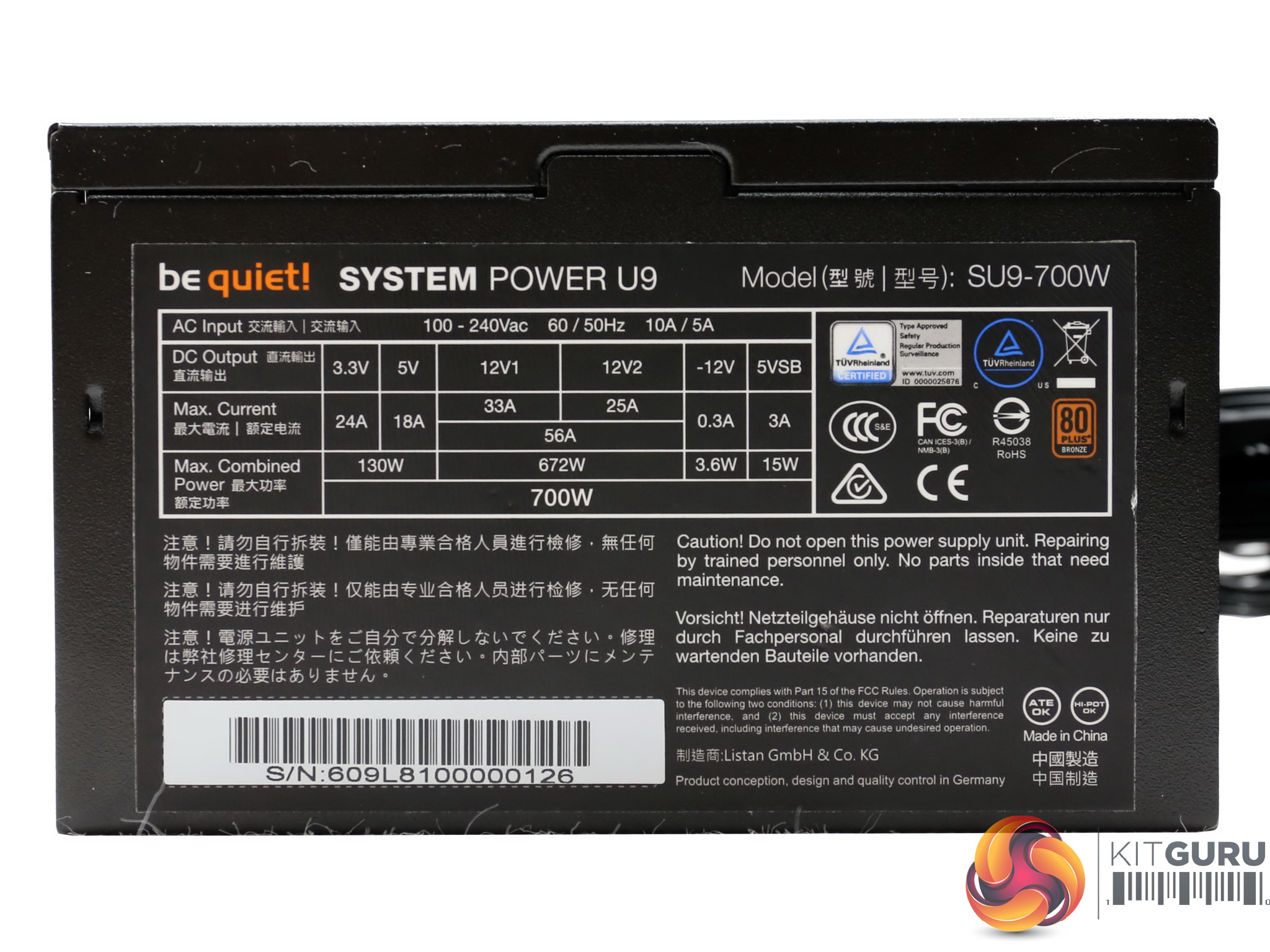
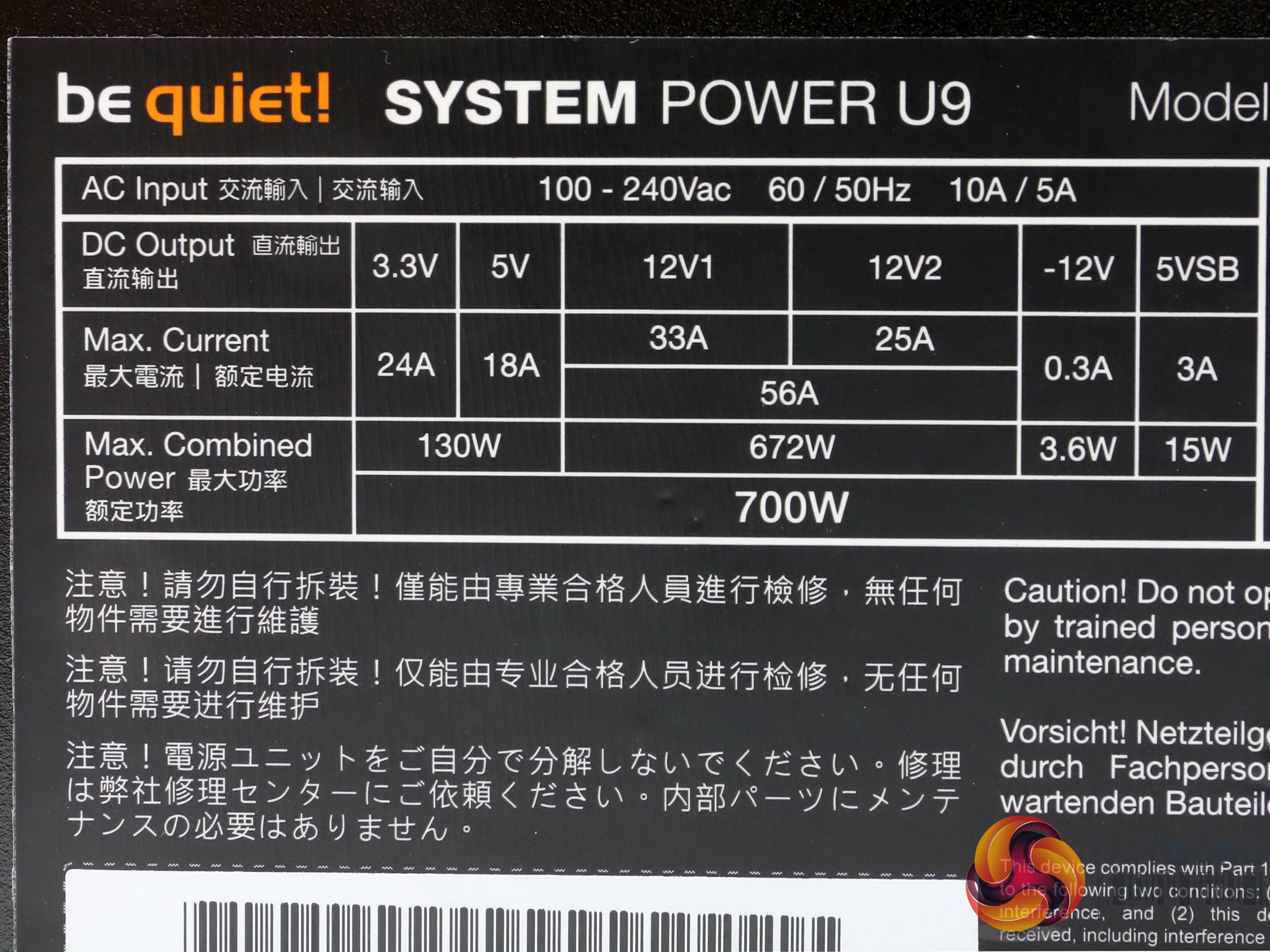
The be quiet! logo is stamped onto one of the sides, while on the other is a large power specifications label.
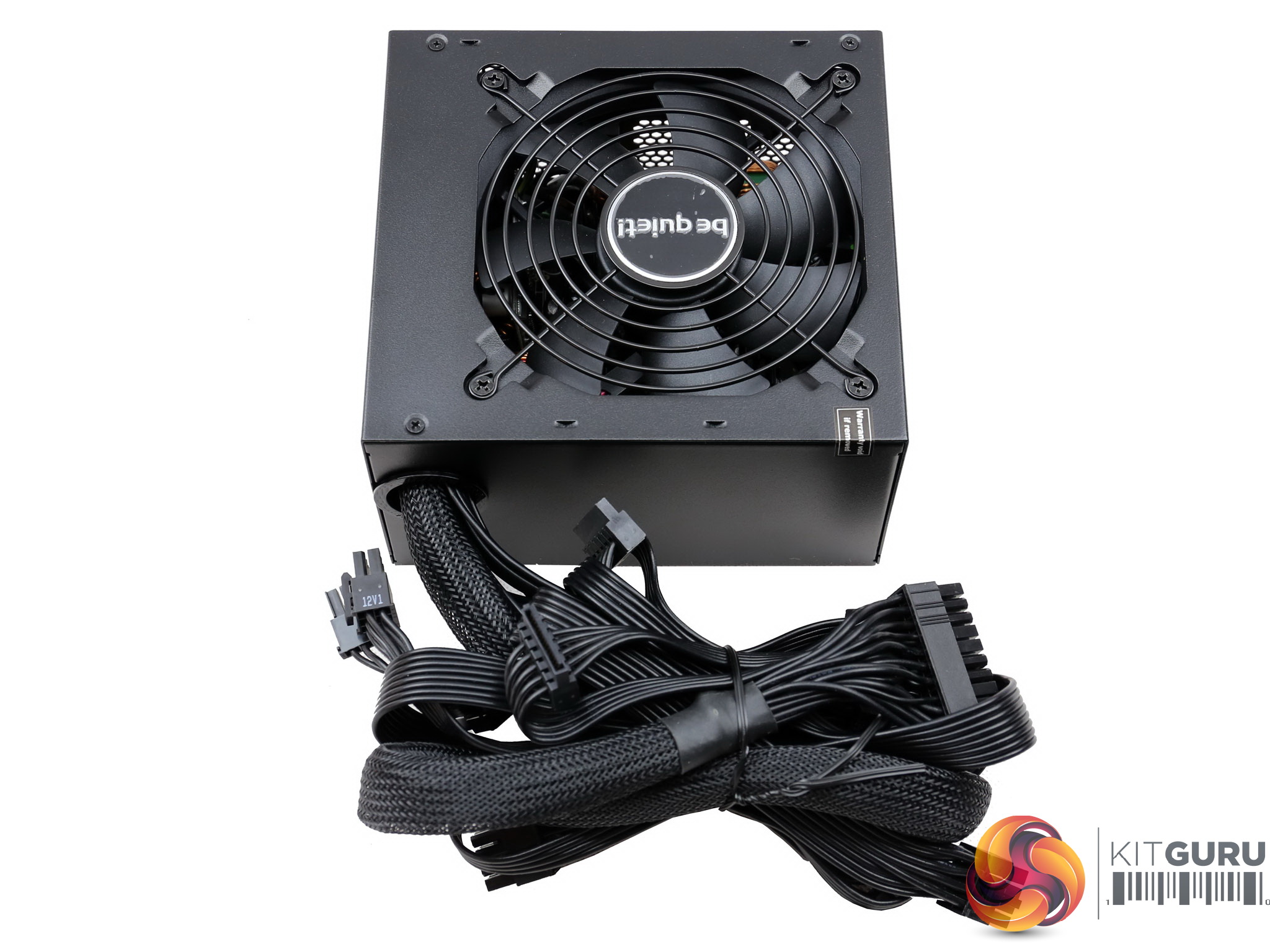
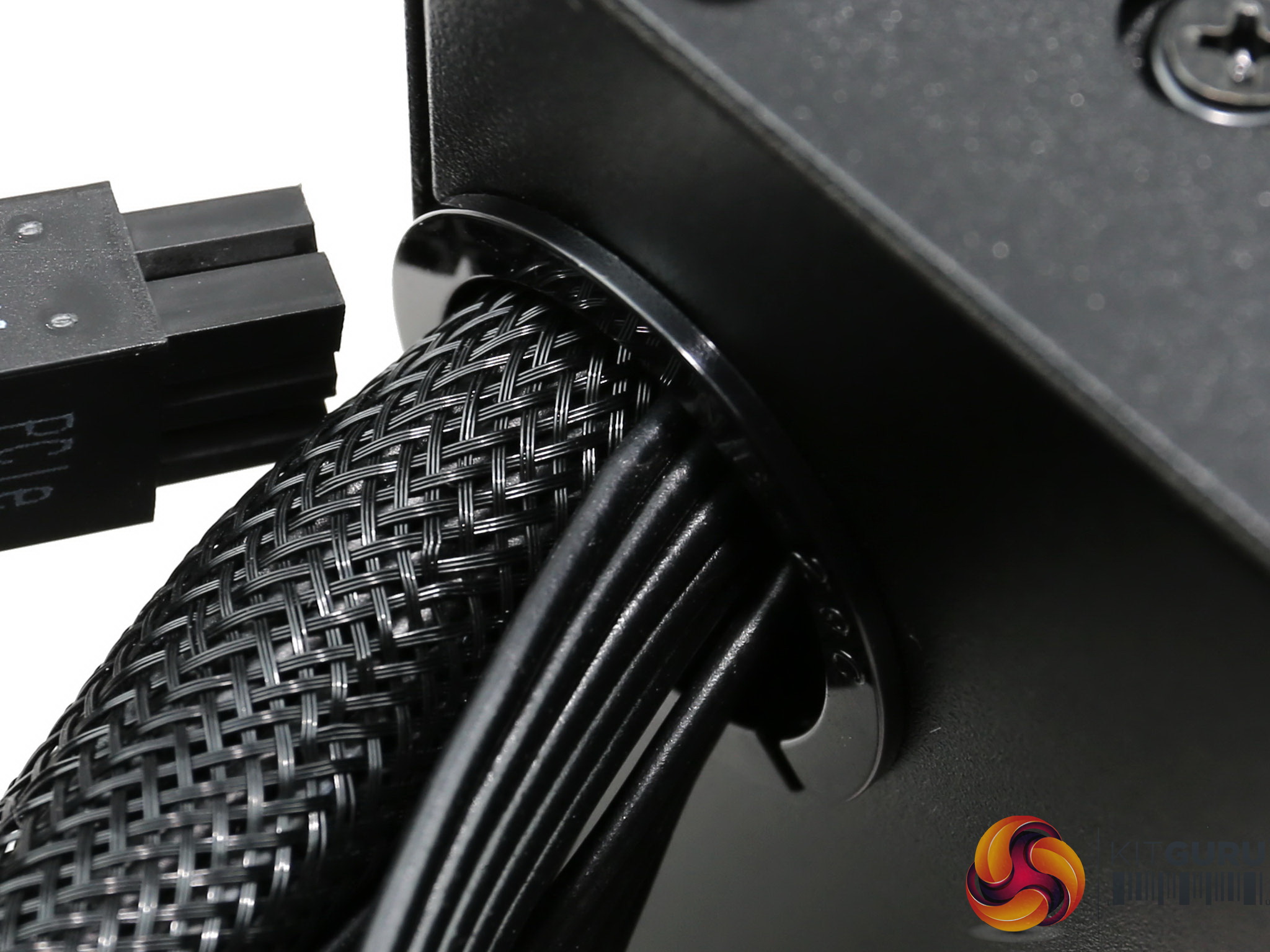
There is a plastic grommet around the cable exit hole, protecting the cables from the cases edges. Speaking of the cables, the main ATX is fully sleeved back into the housing while the rest are flat.
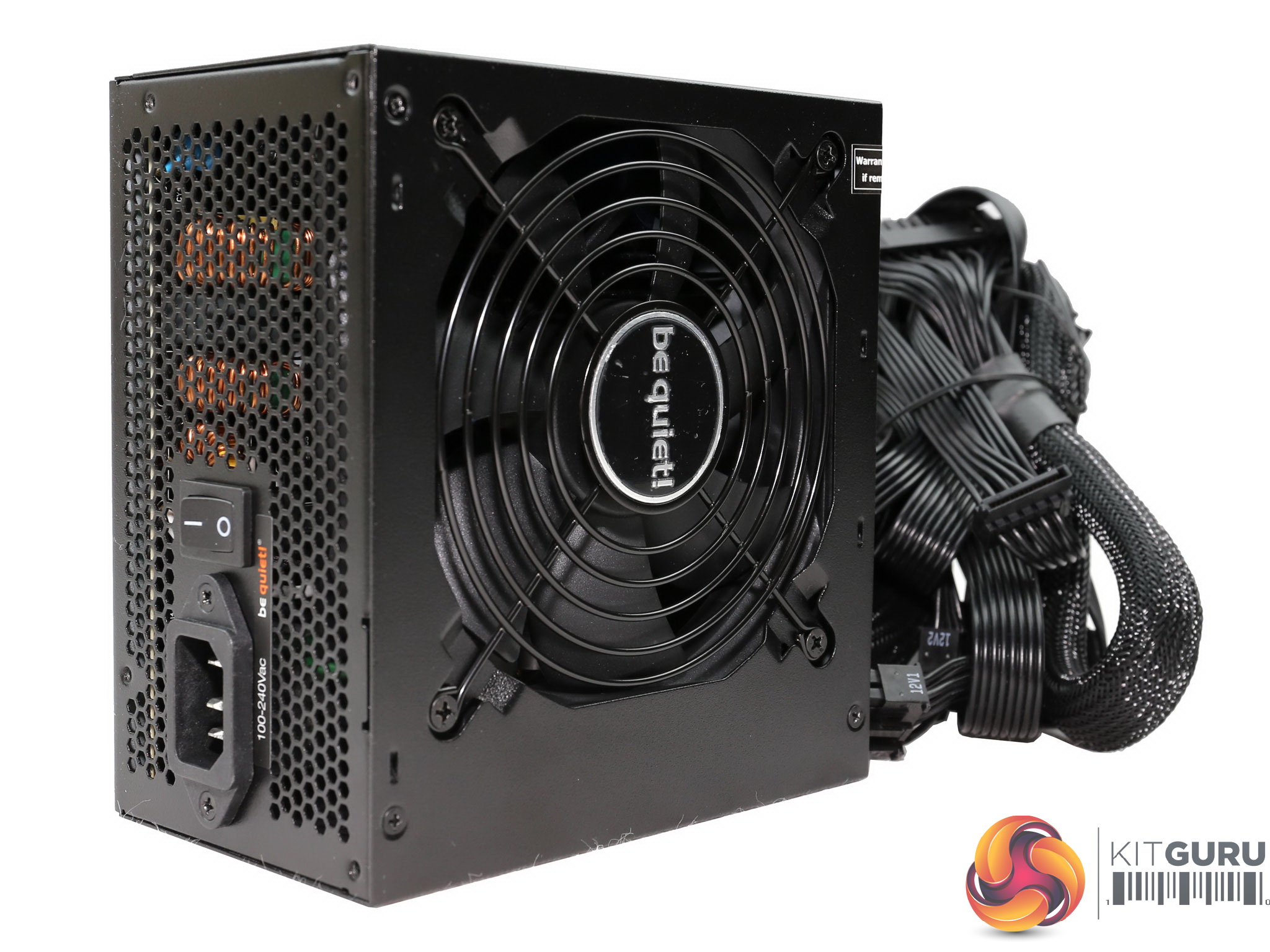
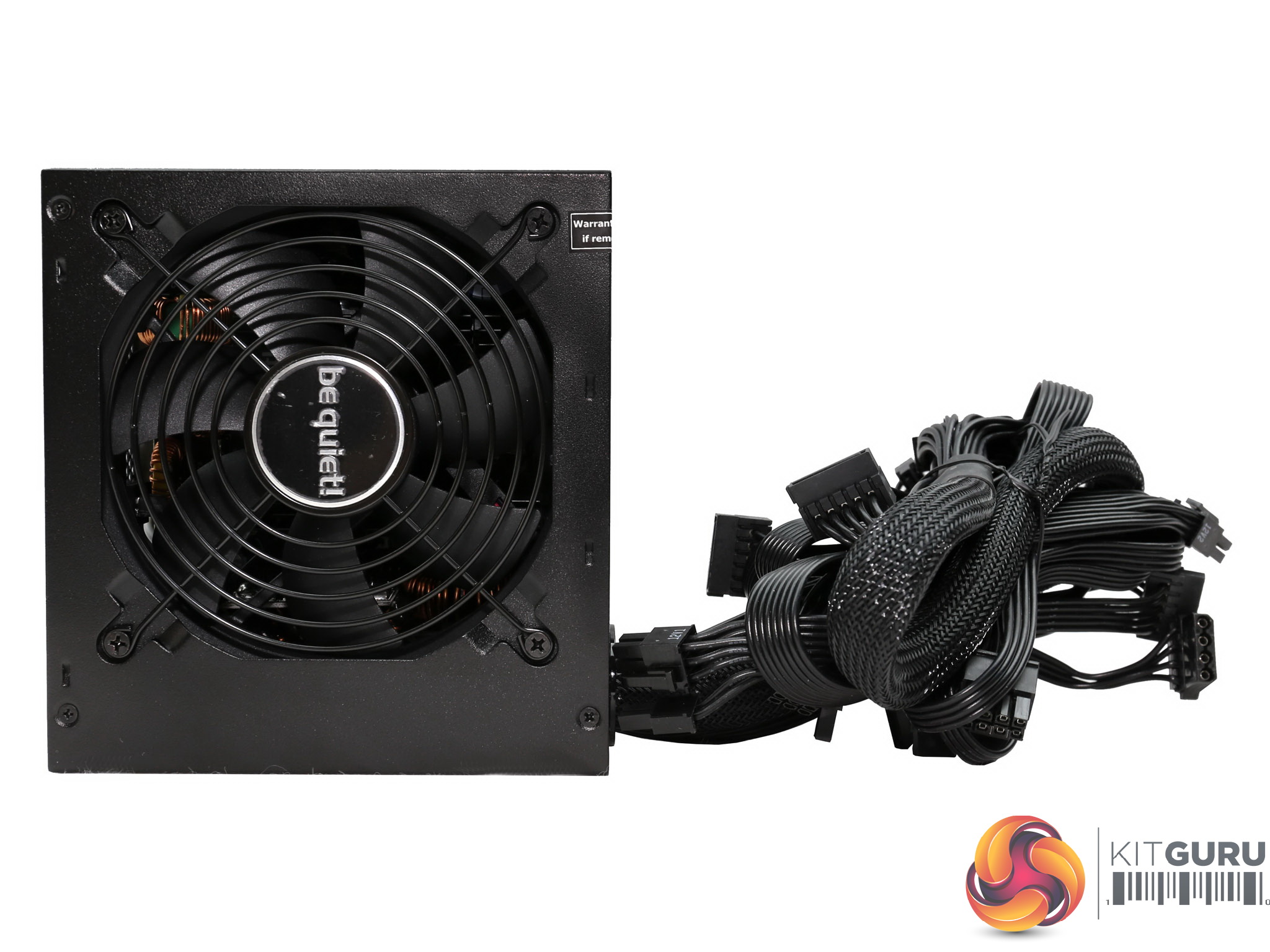
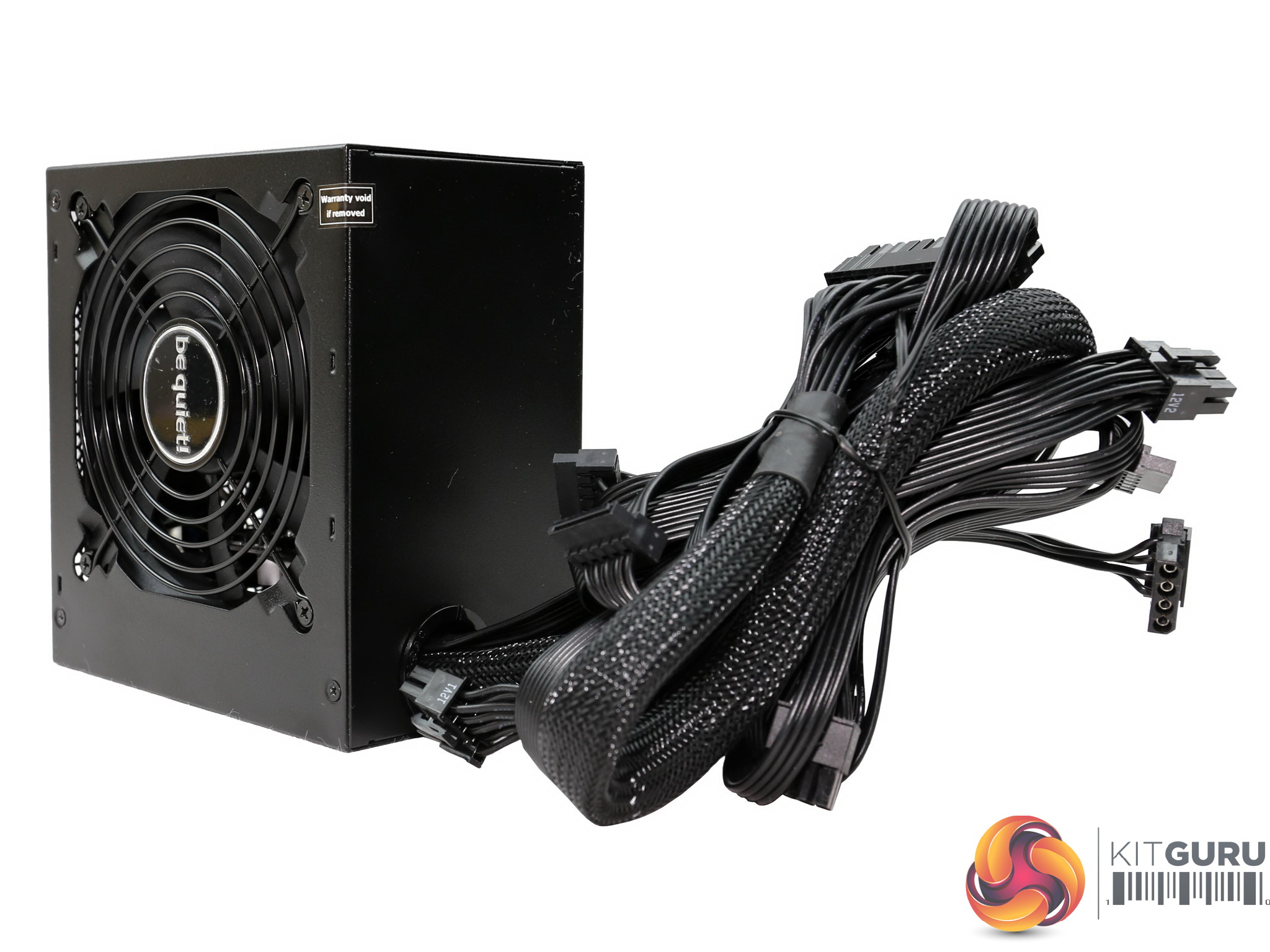
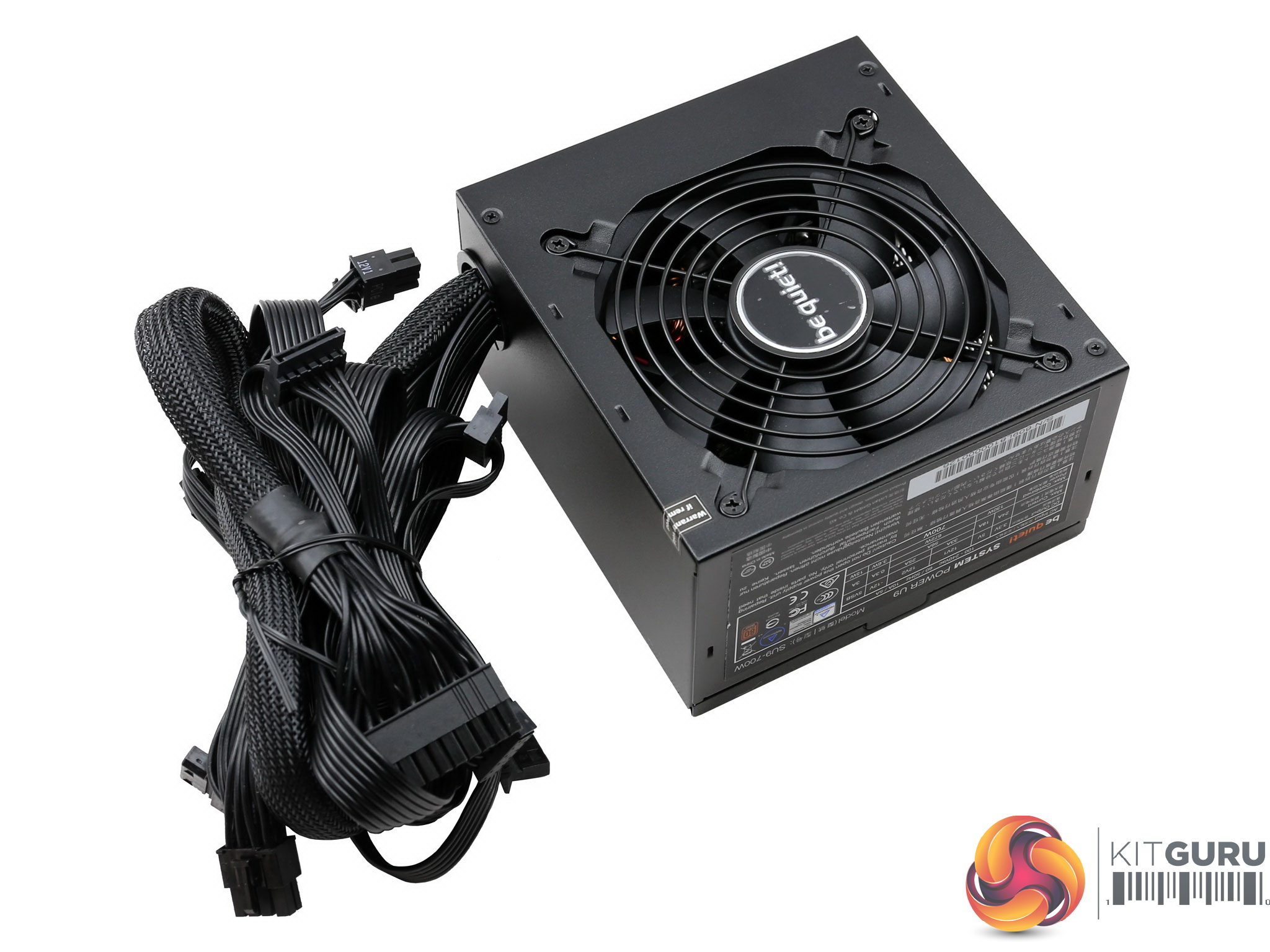
The dimensions are small and the cooling fan is not installed in the exact center – which looks odd. Most likely it provides better airflow to the areas of interest as it is.
The external design is plain, as expected in a budget-oriented product – and the finish is semi-matte so it doesn't attract fingerprints like flies. Usually matte coatings are also more scratch-resistant compared with a glossy finish.
| General Data | |
| Manufacturer (OEM) | CWT |
| Primary Side | |
| Transient Filter | 4x Y caps, 2x X caps, 2x CM & 1x DM chokes, 1x MOV, 1x CAP004DG Discharge IC |
| Inrush Protection | NTC Thermistor |
| Bridge Rectifier(s) |
1x
|
| APFC MOSFETS |
2x Champion GP28S50G (500 V, 28 A @ 150°C, 0.125 Ohm)
|
| APFC Boost Diode |
1x CREE C3D06060A (600V, 6A @ 154°C)
|
| Hold-up Cap(s) |
1x Elite (400V, 390uF, 2000h @ 85°C, GM)
|
| Main Switchers |
2x Champion GP28S50G (500 V, 28 A @ 150°C, 0.125 Ohm)
|
| Combo APFC/PWM Controller | Champion CM6800TX & CM03X Green PFC controller |
| Topology |
Primary side: Double-Forward topology
Secondary side: Semi-synchronous Rectification & DC-DC converters |
| Secondary Side | |
| +12V Rectifiers | 2x Sync Power SPN125T06 FETs (60V, 88A @ 70°C, 4.3mOhm) 2x PFC PFR40V60CT SBRs (60V, 20 x 2A) |
| +12V Driver IC | 1x Sync Power SP6019 |
| 5V & 3.3V | DC-DC Converters: 2x UBIQ QM3006D (30V, 57A @ 100°C, 5.5mOhm) 2x UBIQ QM3016D (30V, 68A @ 100°C, 4mOhm) PWM Controller: APW7159C |
| Filtering Capacitors | Electrolytics: Elite (3-6,000 @ 105°C, EV), 2x Rubycon (3-6,000h @ 105°C, YXG) |
| Supervisor IC | Sytronix ST9S429-PG14 (OCP [2x 12V channels, OVP, UVP, PG) & Weltrend WD7518D (OCP [2x 12V channels], SCP) |
| Fan Model | Yate Loon D12SM-12 (120mm, 12V, 0.30A, 70.5 CFM, 33 dBA, 1650 RPM, Sleeve Bearing) |
| 5VSB Circuit | |
| Standby PWM Controller | TinySwitch-LT TNY289PG (25W @ 85-265VAC) |
The platform is outdated, with the only modern touch being the DC-DC converters that generate the minor rails. Since it is a budget-oriented product, be quiet! avoided using expensive Japanese caps, even Taiwanese (Teapo).
Nonetheless, Elite caps are the best alternative when you want something way better than generic Chinese caps but you have a restricted budget.
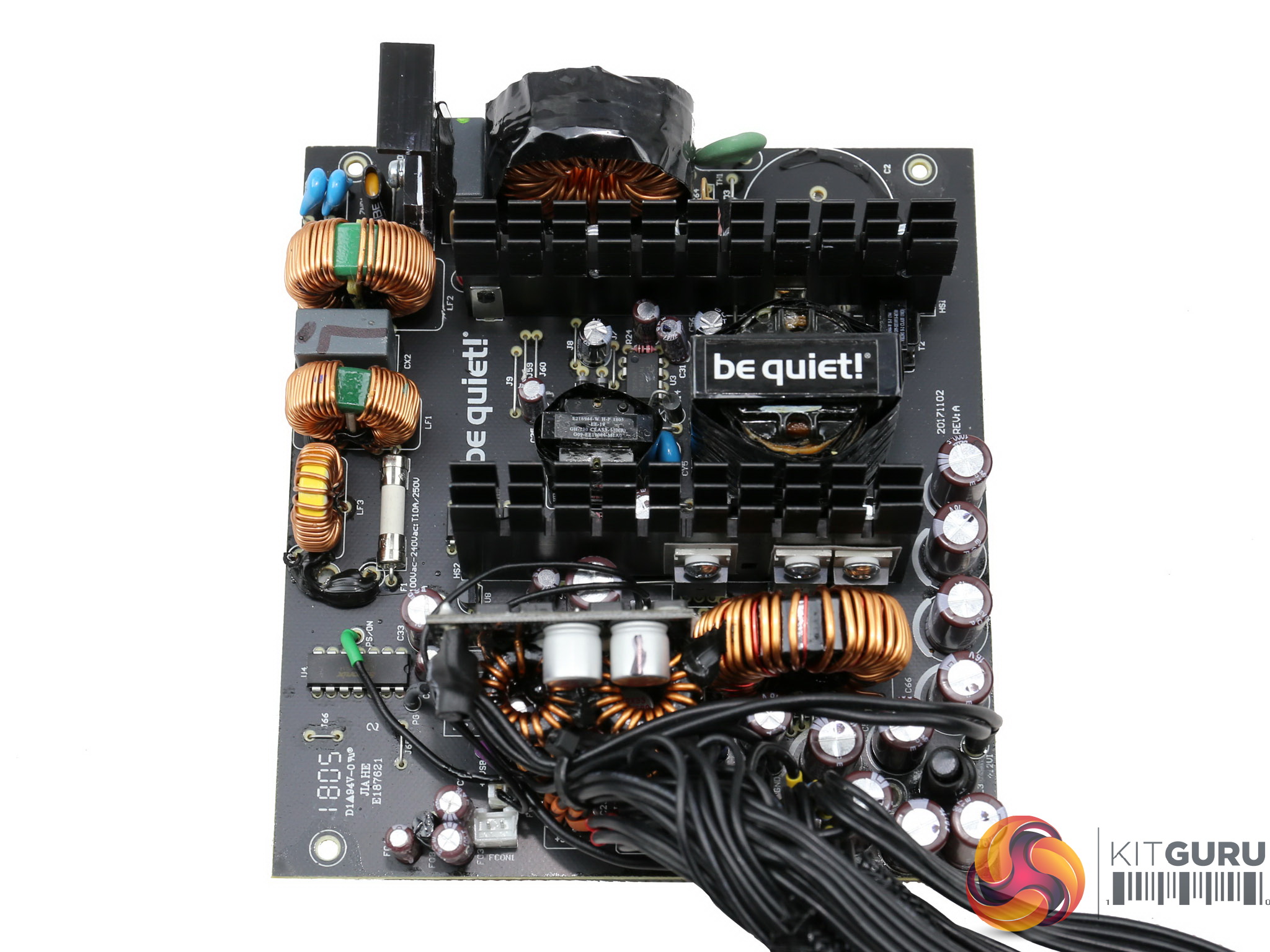
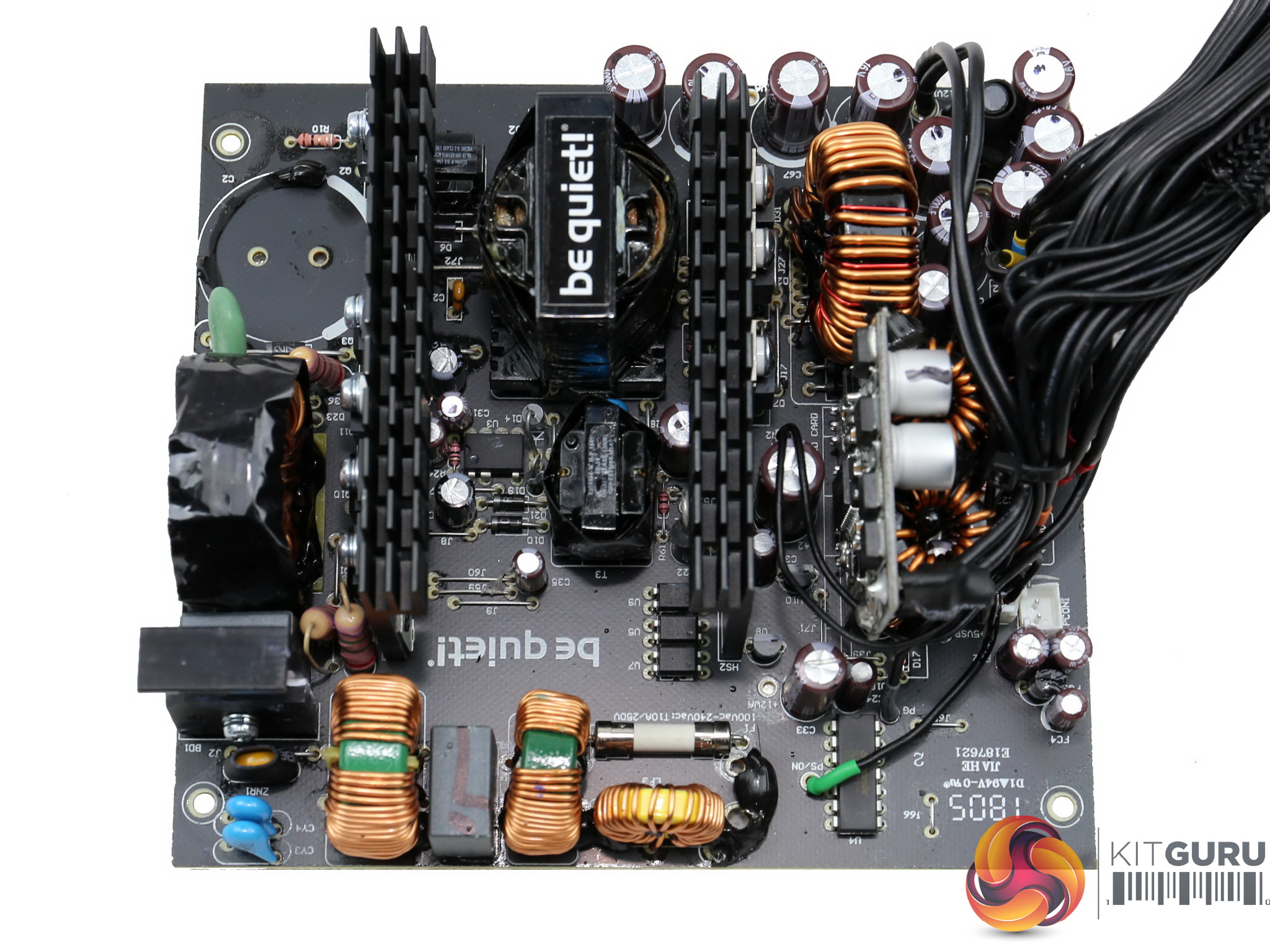
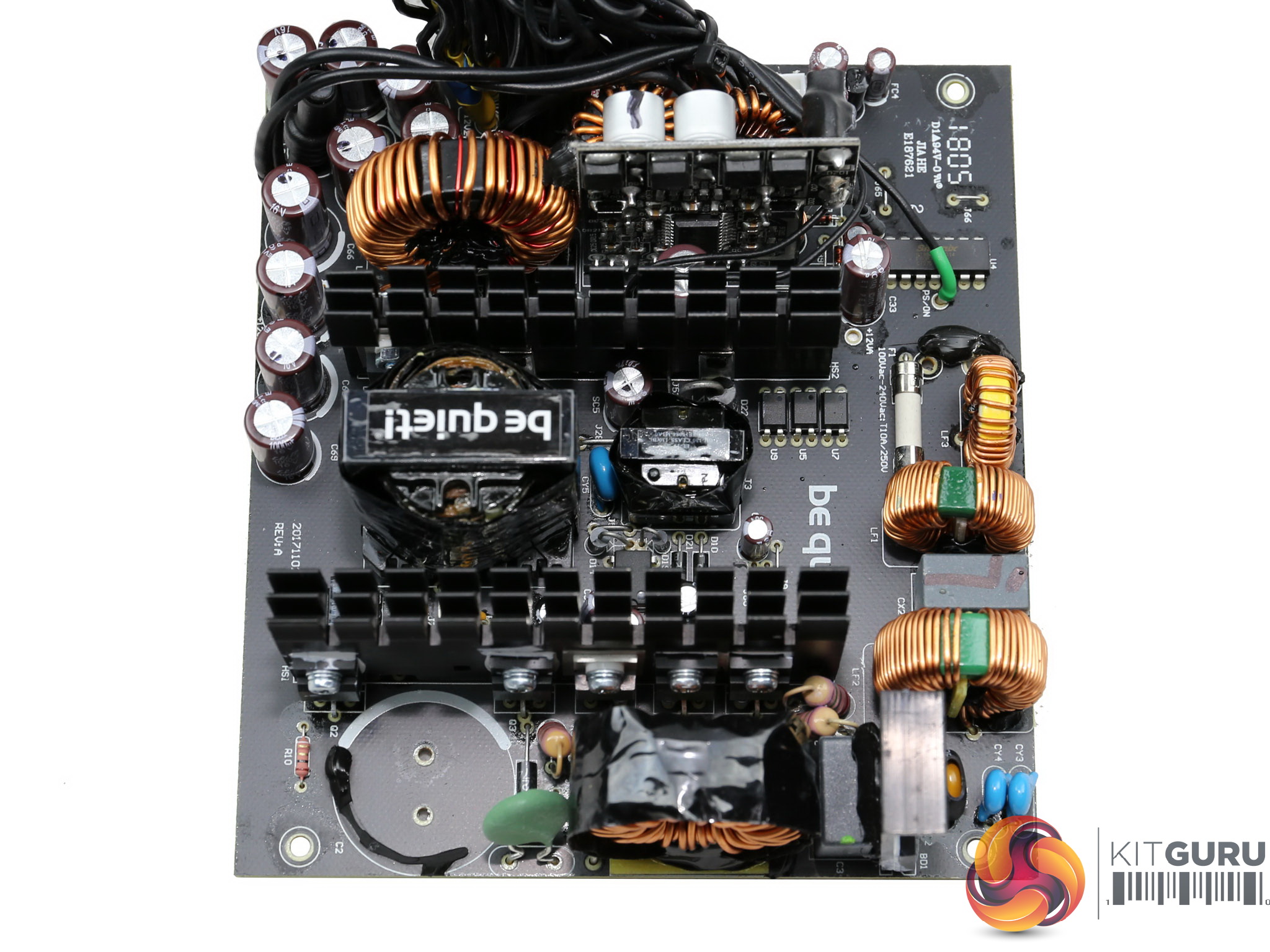
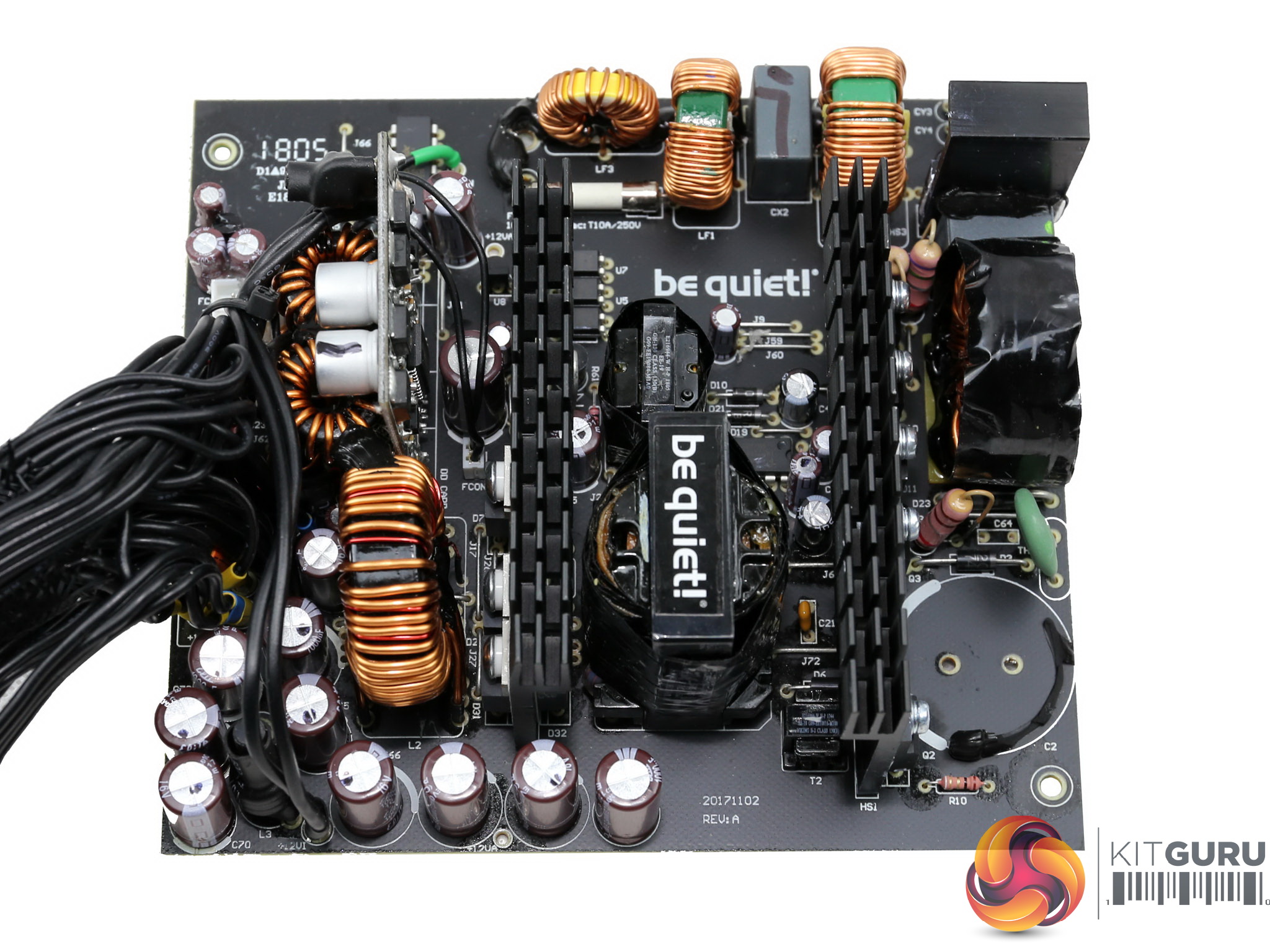
In the primary side a double-forward topology is used. We had quite some time to meet this topology since the majority of modern platforms utilize half-bridge and full-bridge topologies along with LLC resonant converters, a combination offering increased efficiency compared to the older double-forward configurations.
In the secondary side a semi-synchronous design is used with two FETs and two SBRs handling the +12V rail.
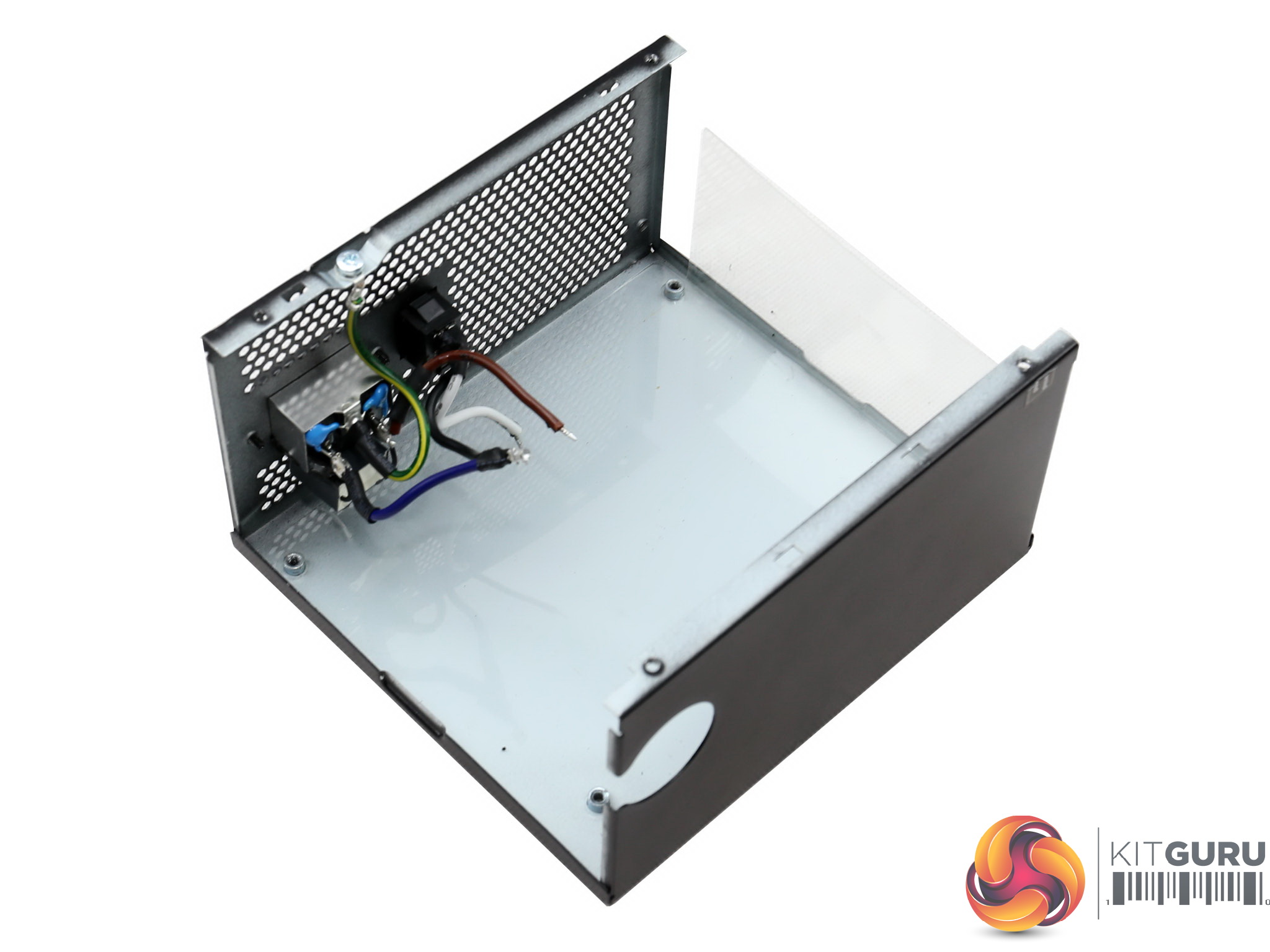
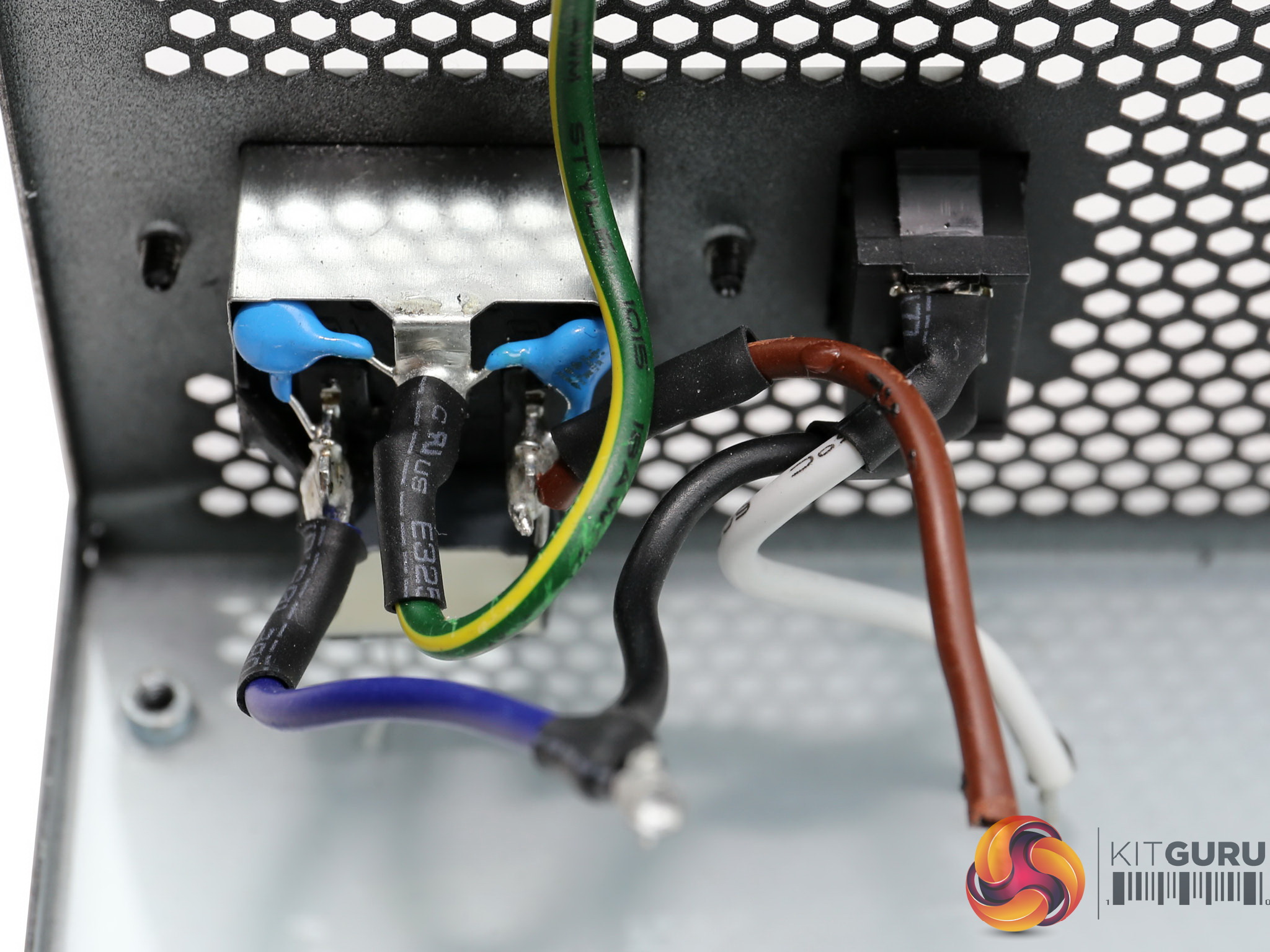
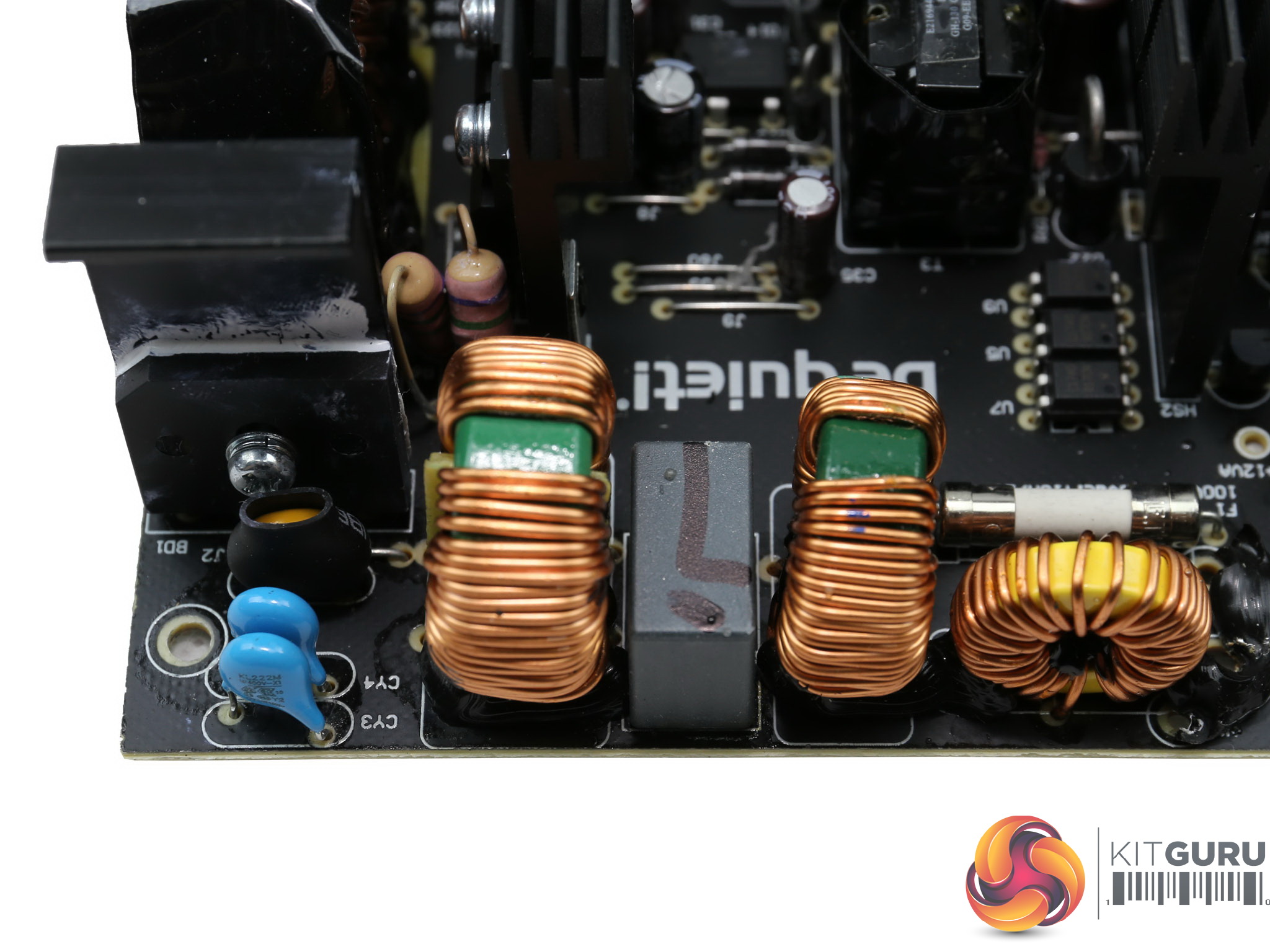
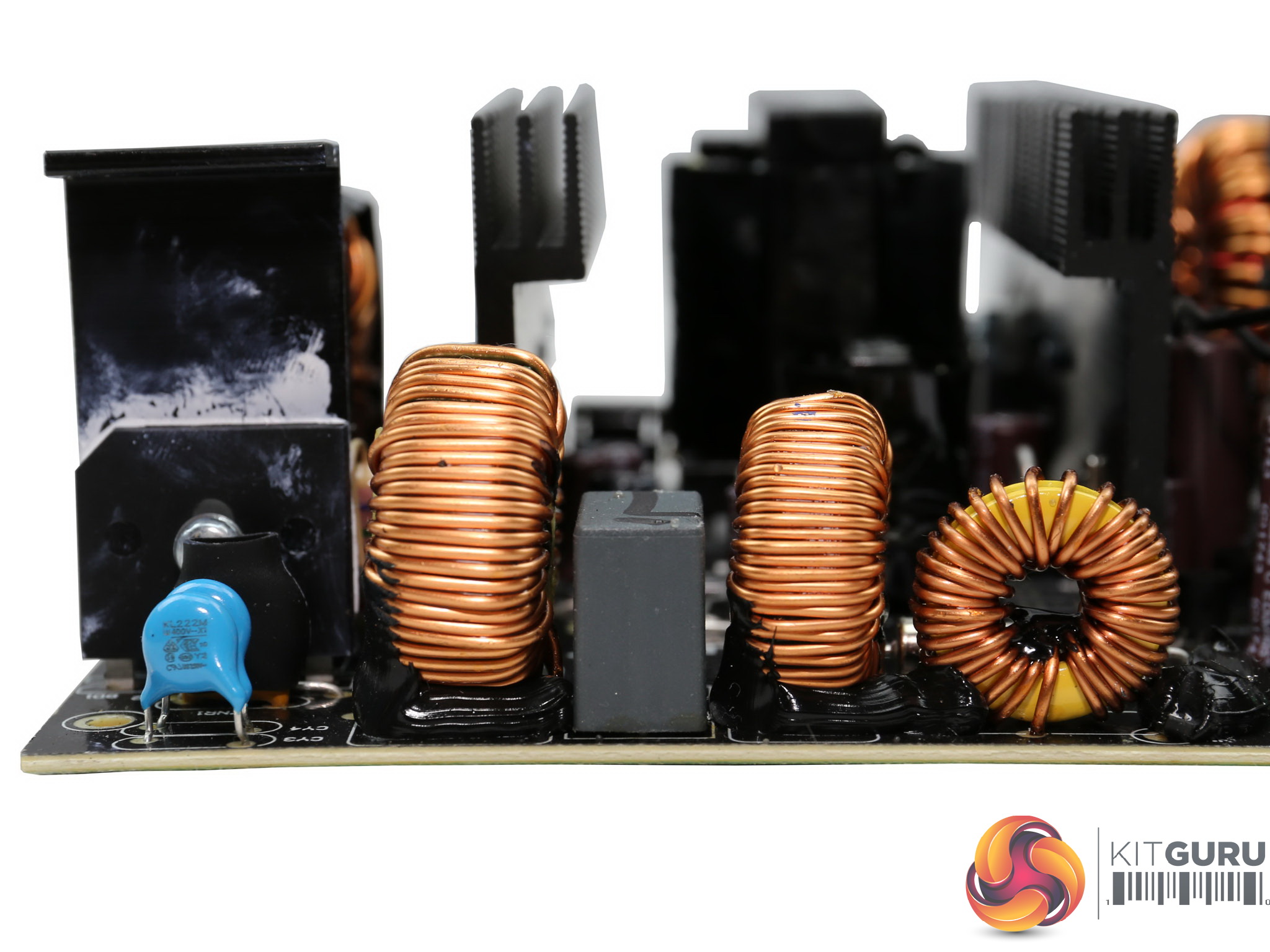
The first part of the EMI filter is on the AC receptacle and includes two Y caps and a single X one. The same filter continues on the main PCB with the same amount of Y and X caps, two CM and one DM chokes, and an MOV.
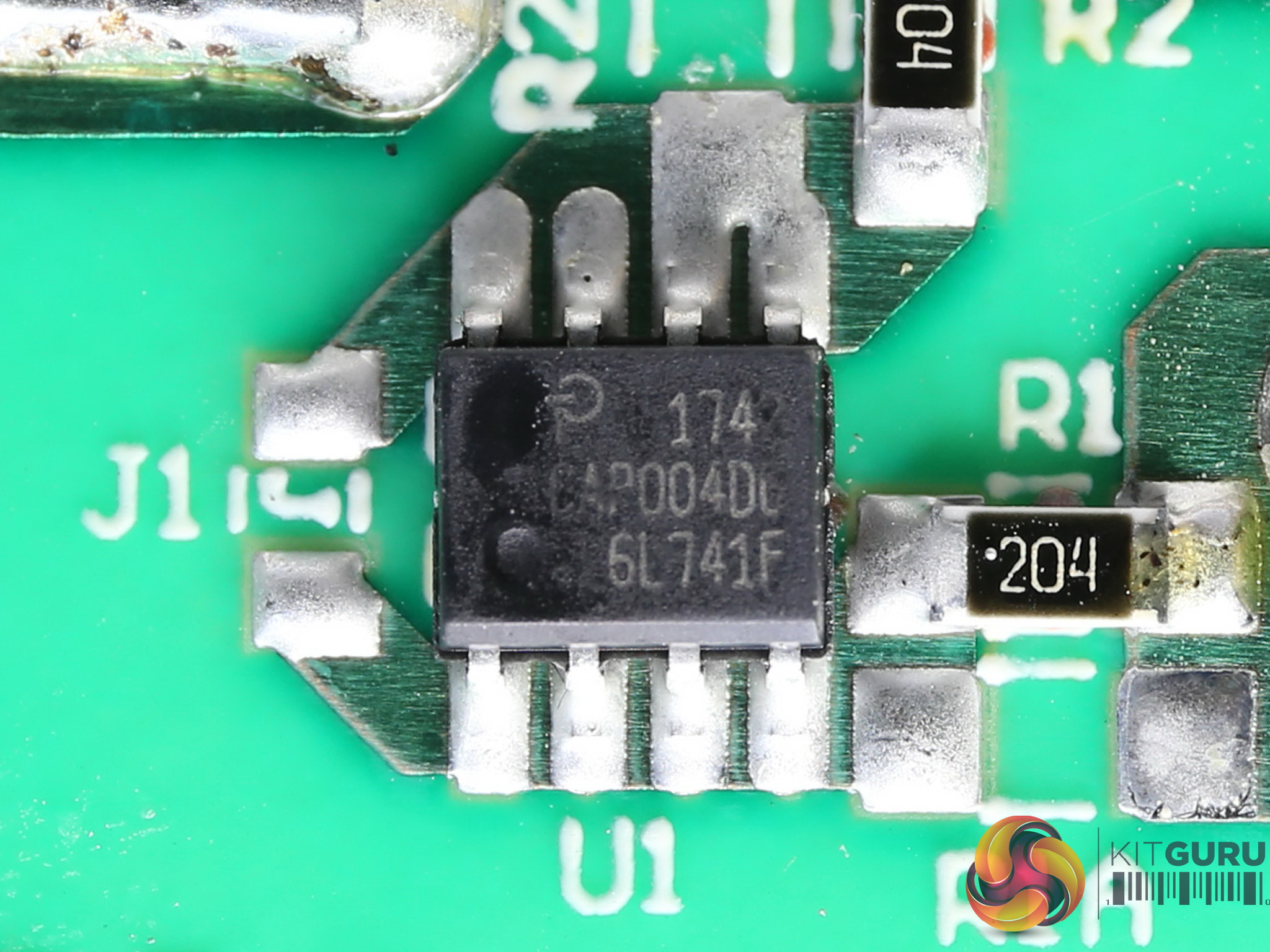
There is also a CAP004DG discharge IC on the solder side of the PCB, which isolates the bleeding resistors of the X cap once the power supply is in normal operation, saving energy.
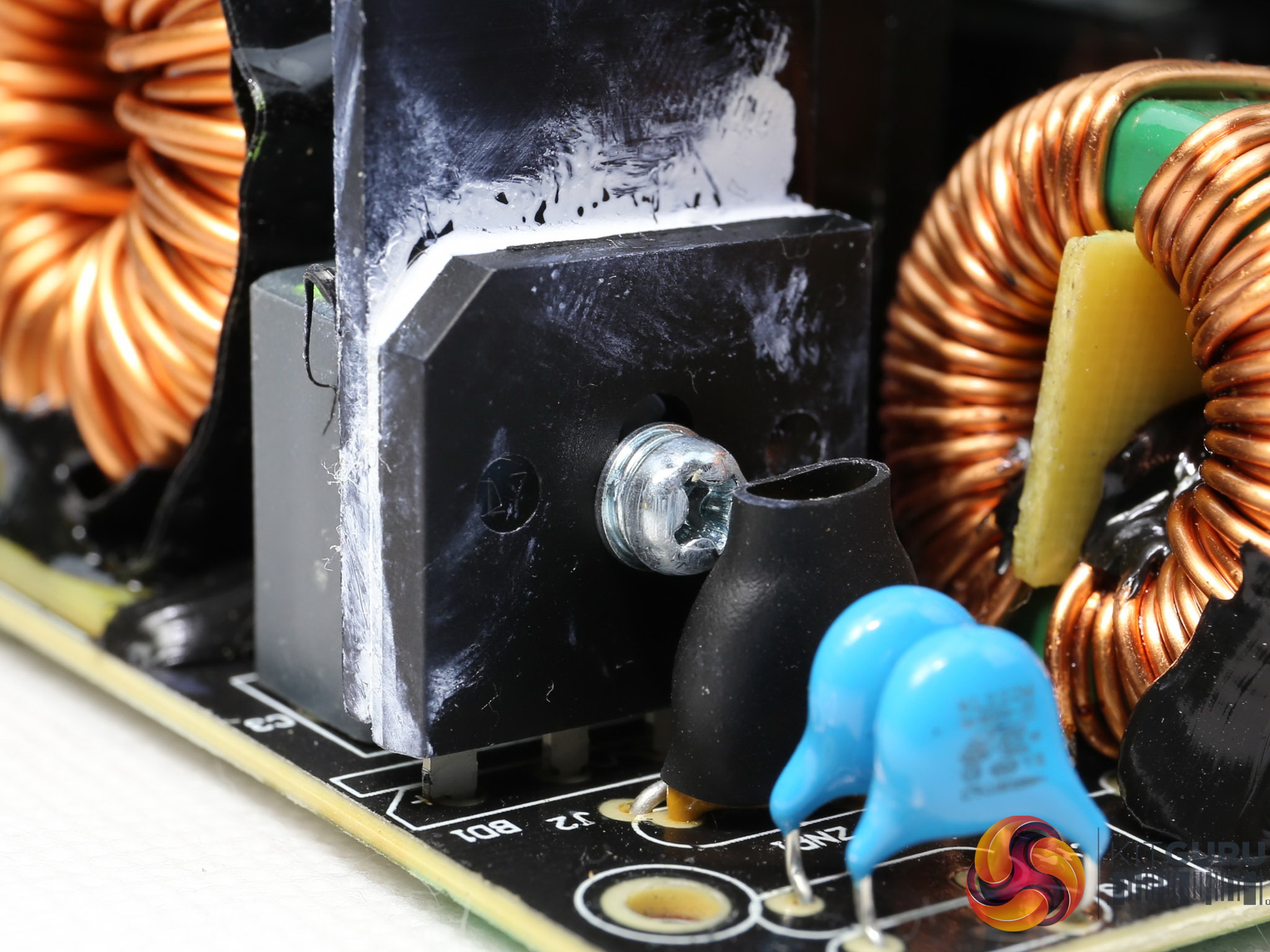
The single bridge rectifier is bolted on a dedicated heatsink. There is enough thermal paste as you can see in the photo above, between the rectifier and the heatsink.
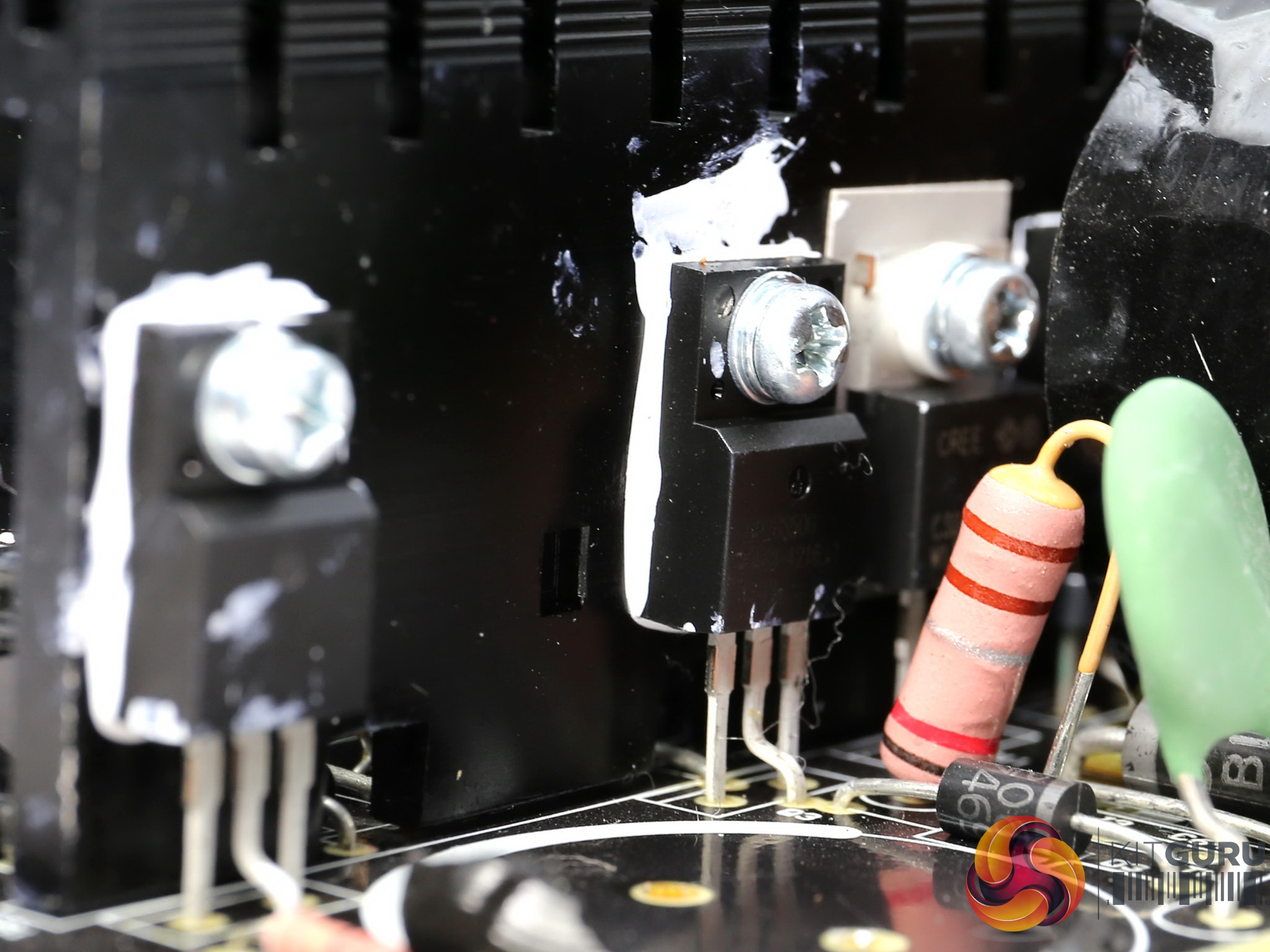
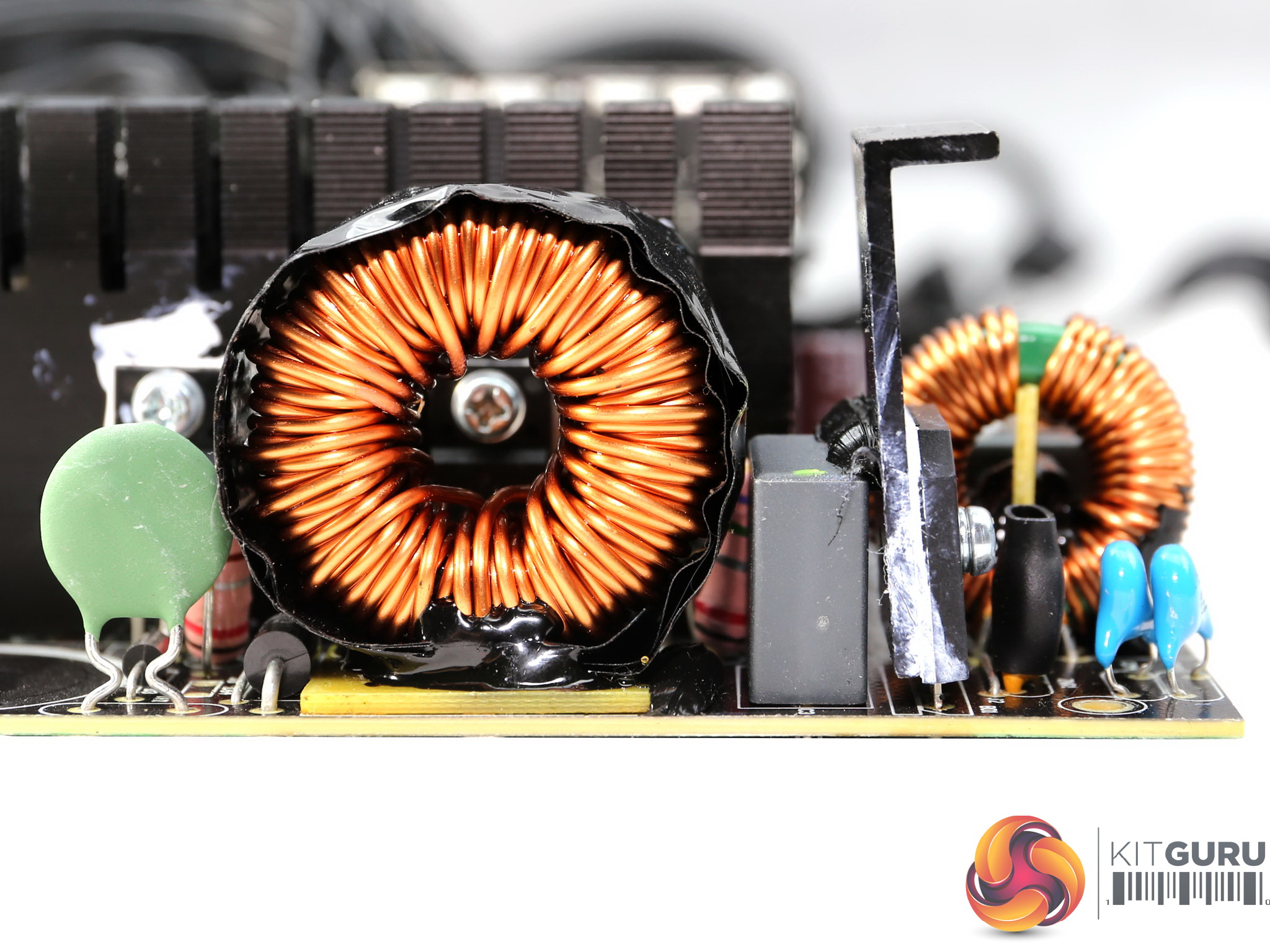
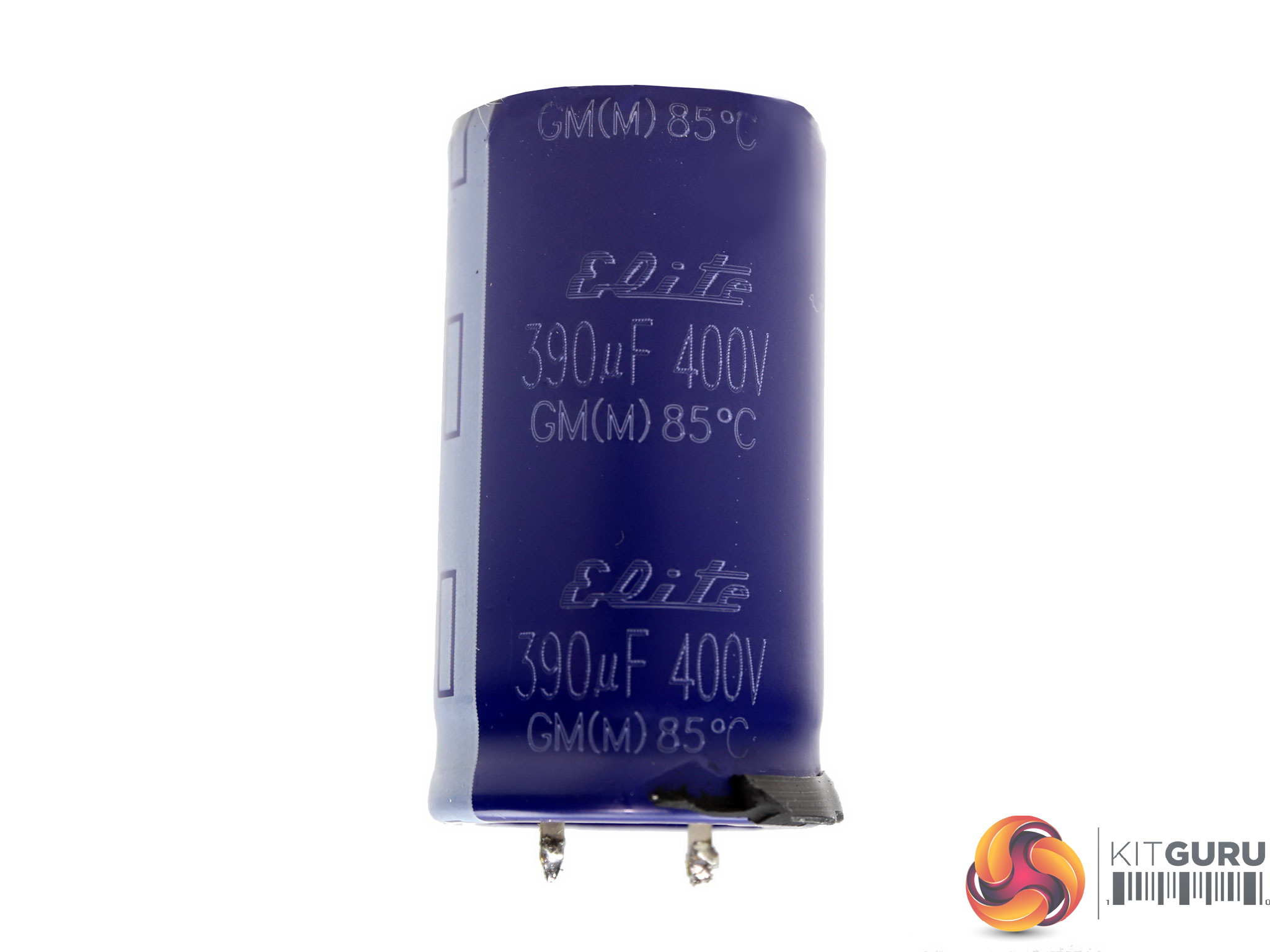
The APFC converter uses two Champion GP28S50G FETs and a single CREE C3D06060A boost diode. The bulk cap is by Elite and unfortunately it is only rated at 85°C. A Japanese cap with 105°C rating should be used instead since the cost would be slightly affected (less than a dollar difference).
With a higher quality cap in this stage the reliability through time would be way better, especially in regions with 100-115V voltage and difficult conditions (heat and unstable mains grid).
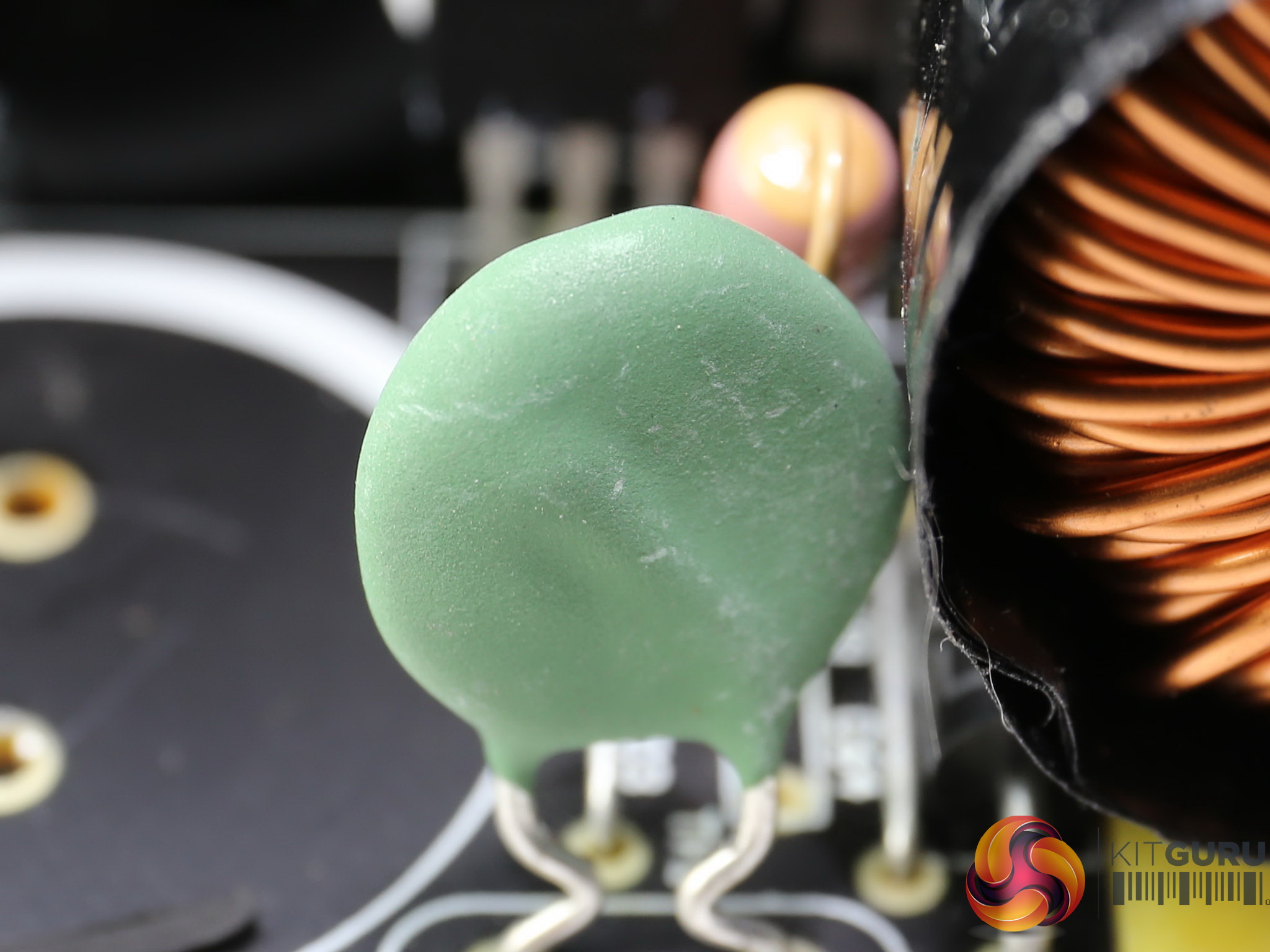
The NTC thermistor which is responsible for protection against large inrush currents. It isn't supported by a bypass relay, unfortunately.
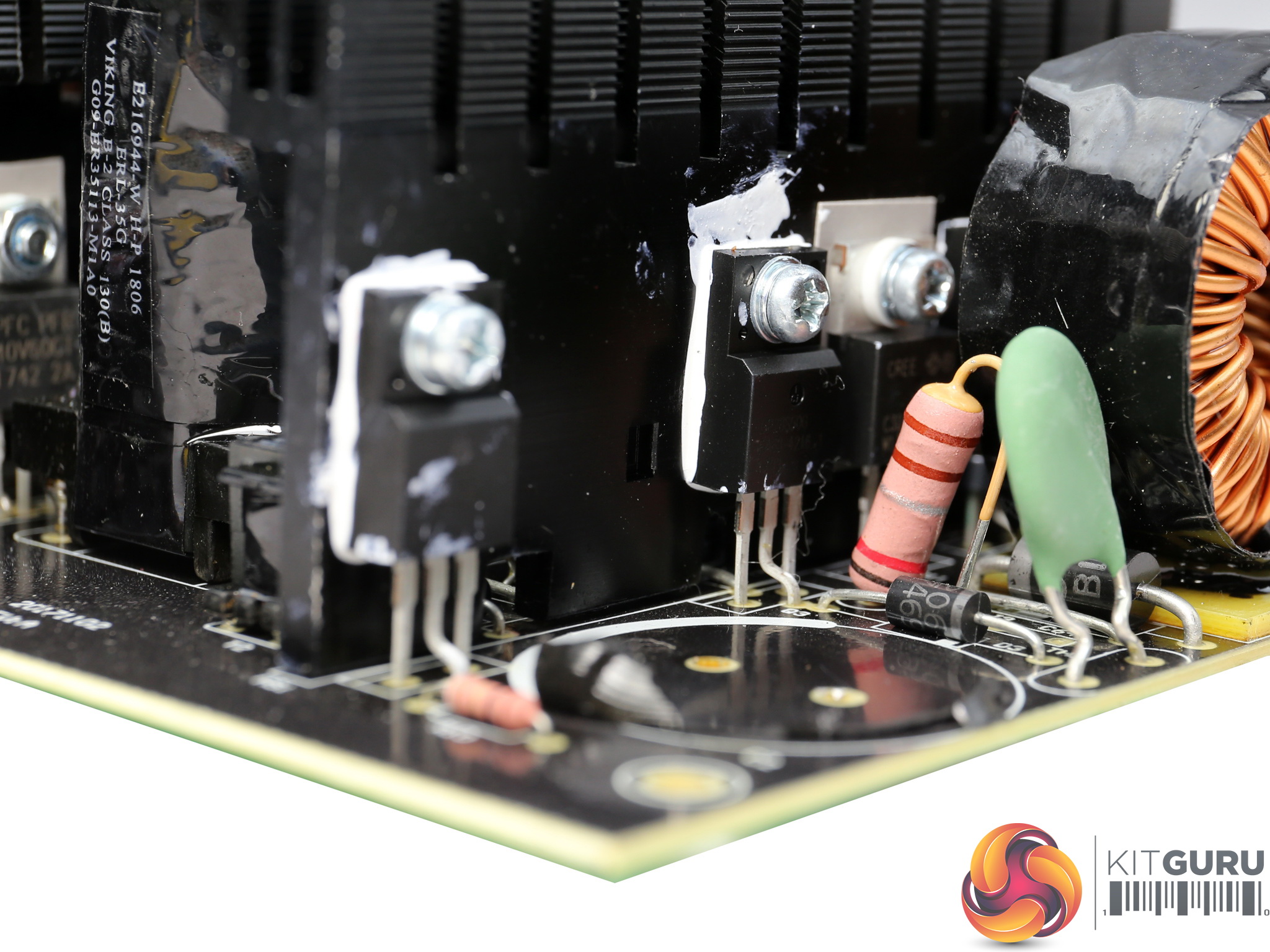
The main switching FETs are two Champion GP28S50G, arranged into a double-forward topology.
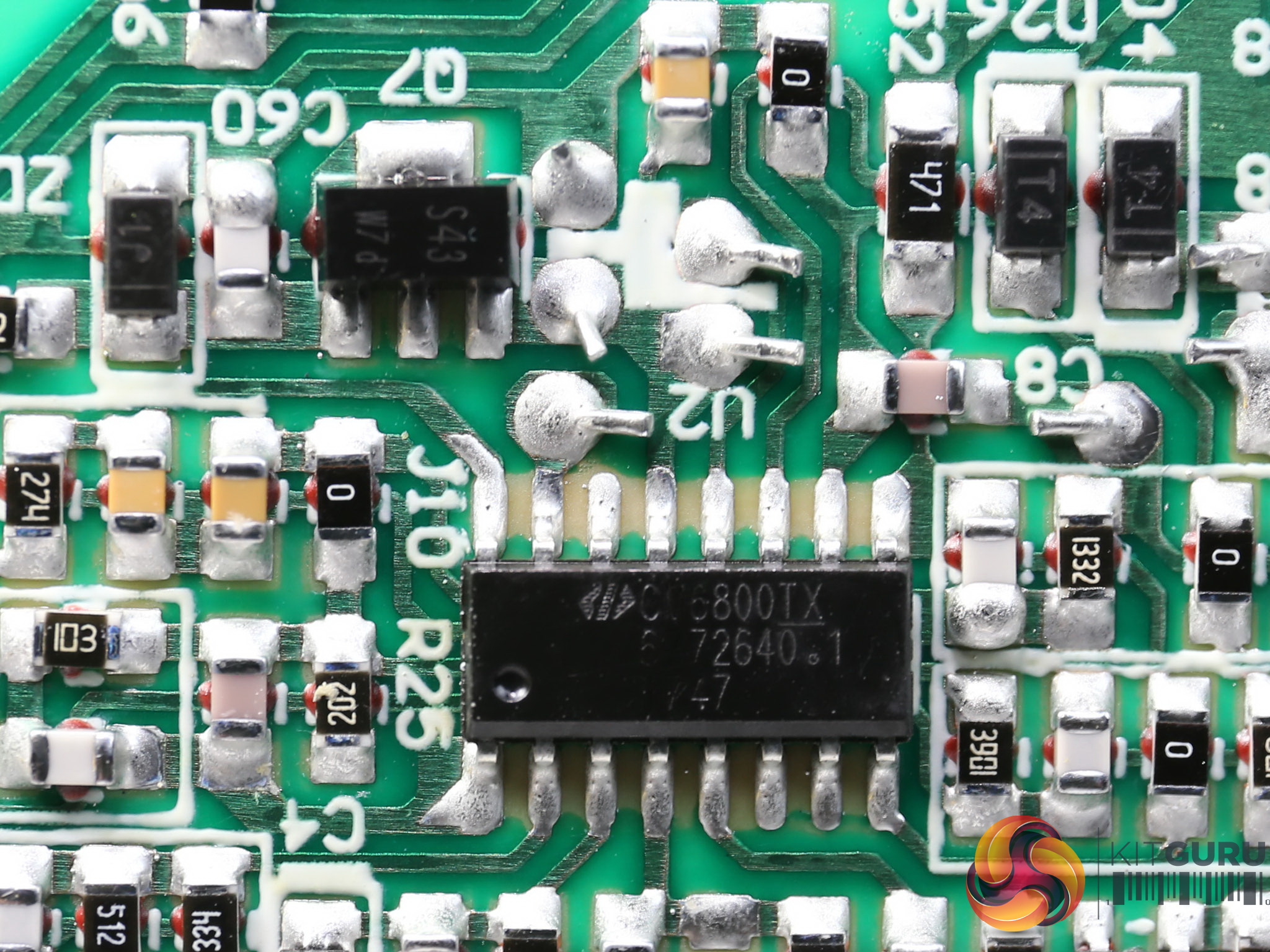
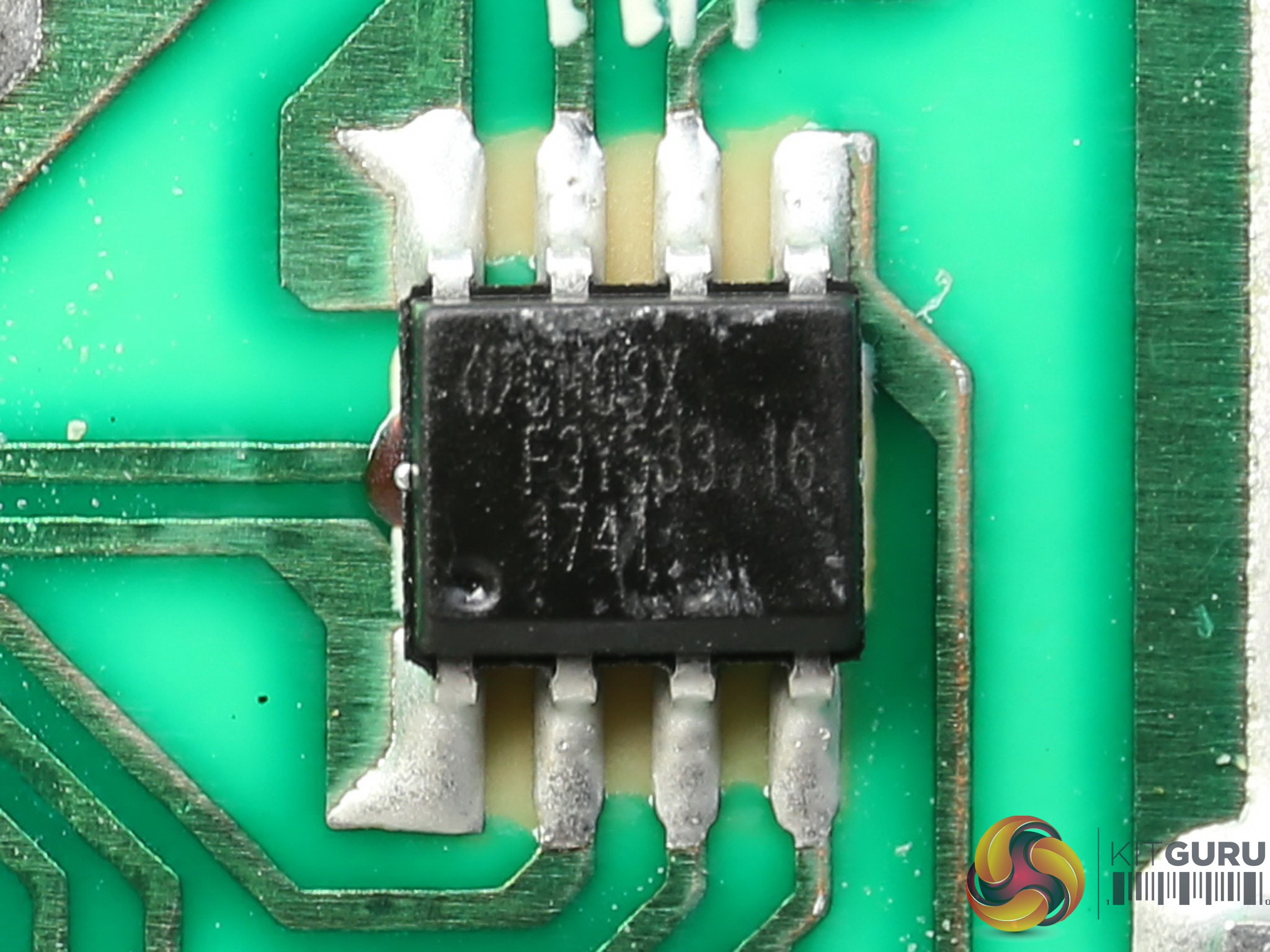
The combo PFC/PWM controller is a CM6800TX IC, which was widely used a few years ago in Bronze, Silver, even in some 80 PLUS Gold platforms. It is supported by a CM03X Green PFC controller.
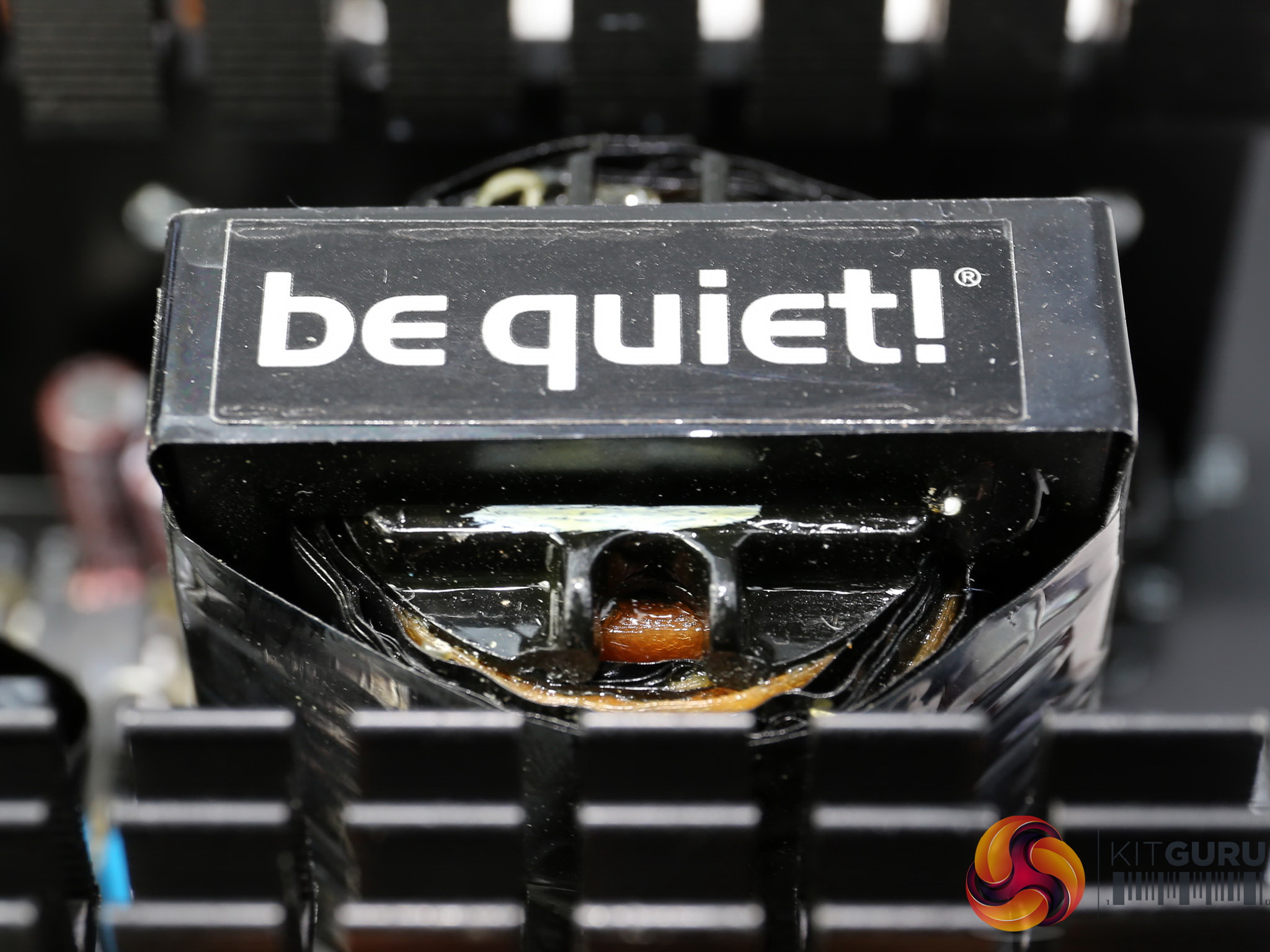
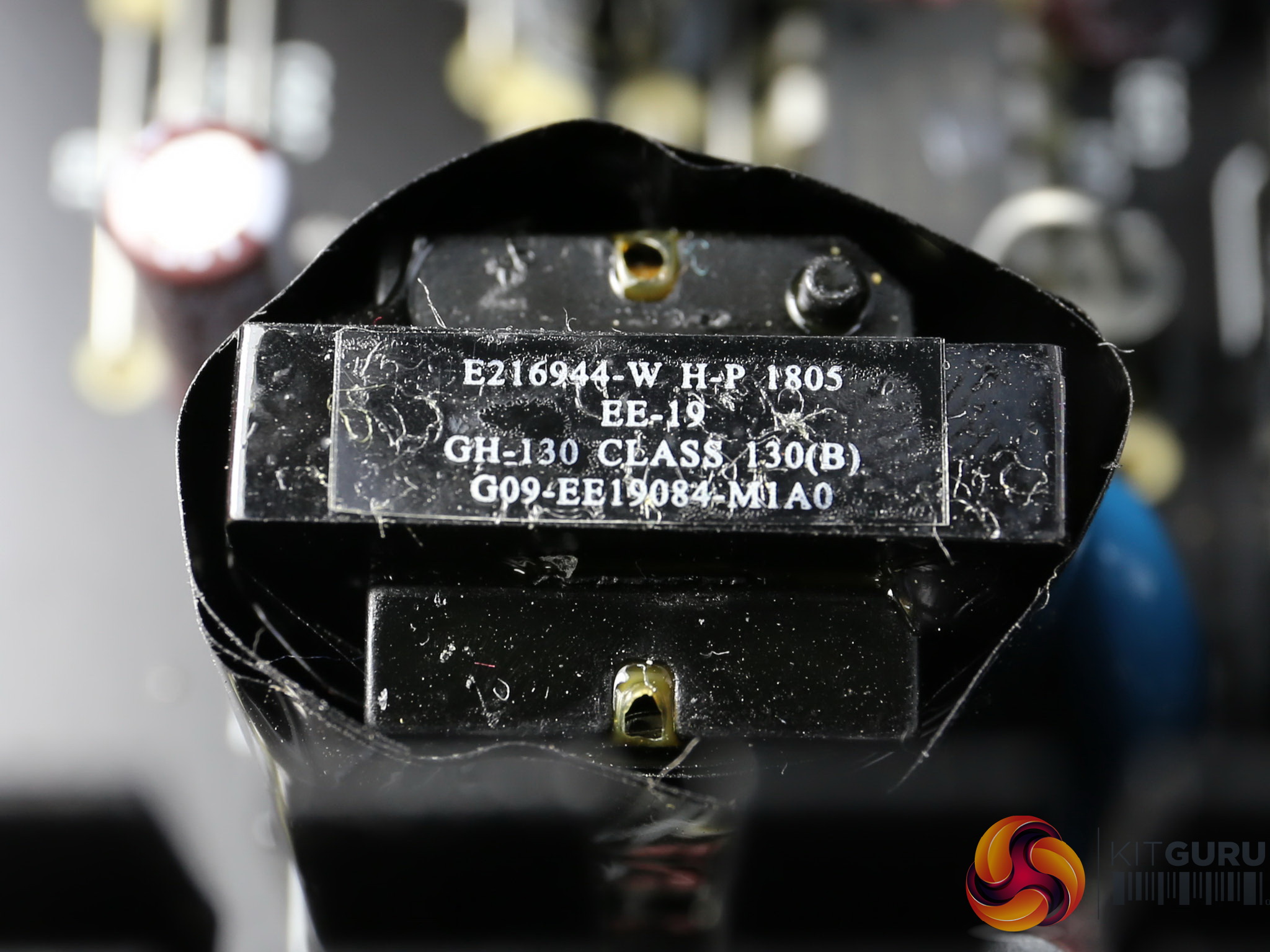
The unit's main transformer, which besides lowering the voltage also provides electrical isolation between the primary and the secondary sides.
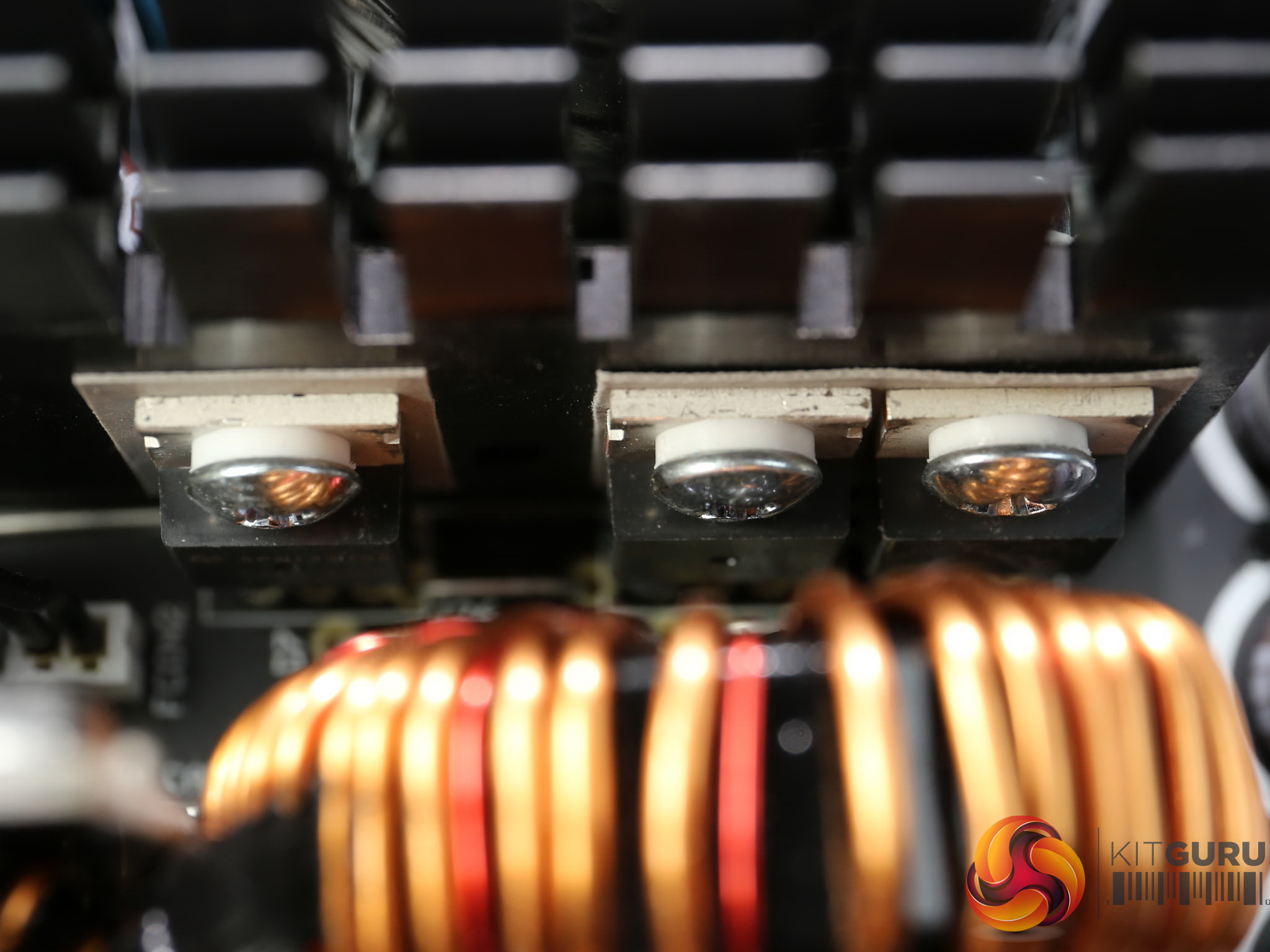
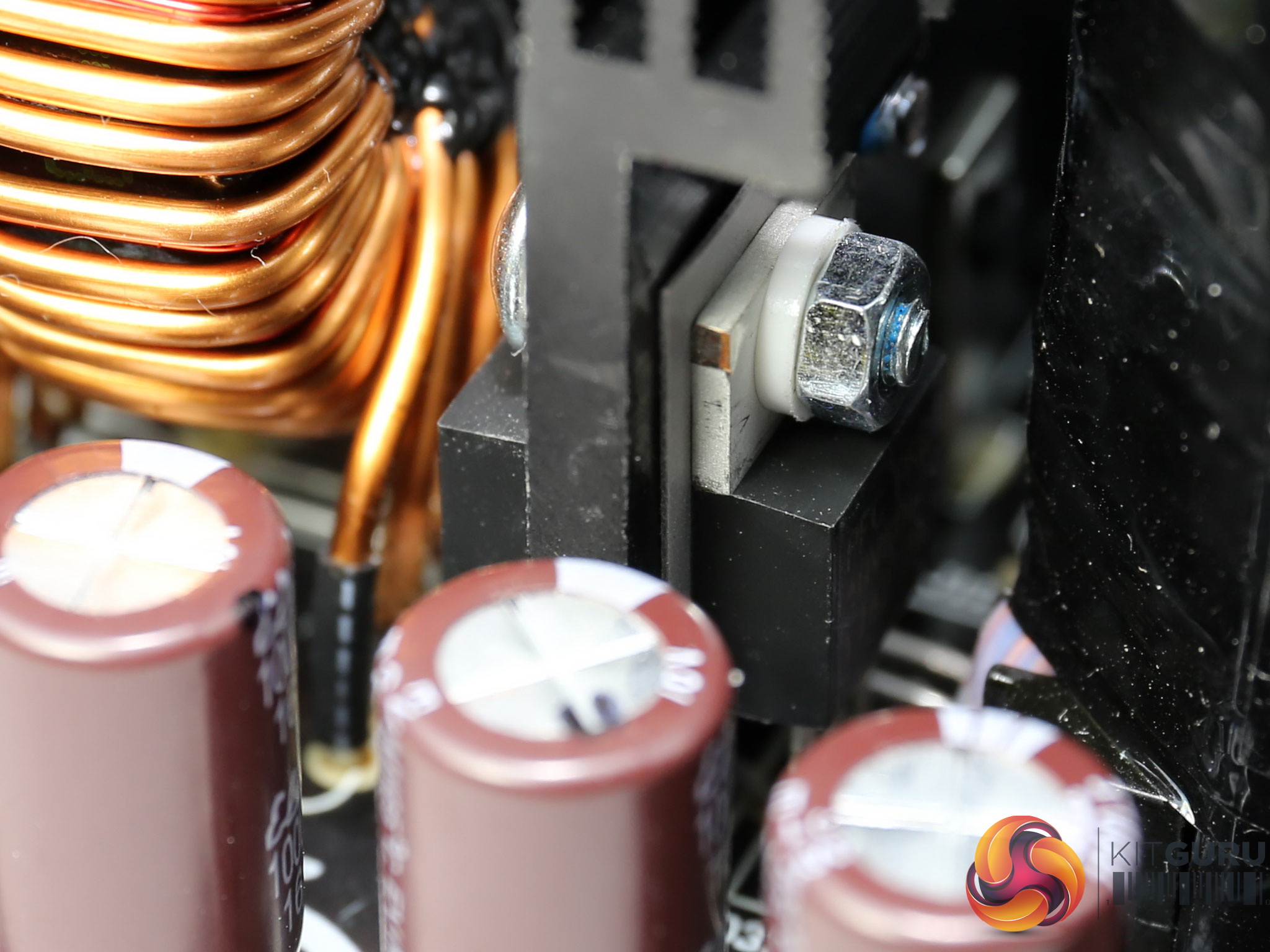
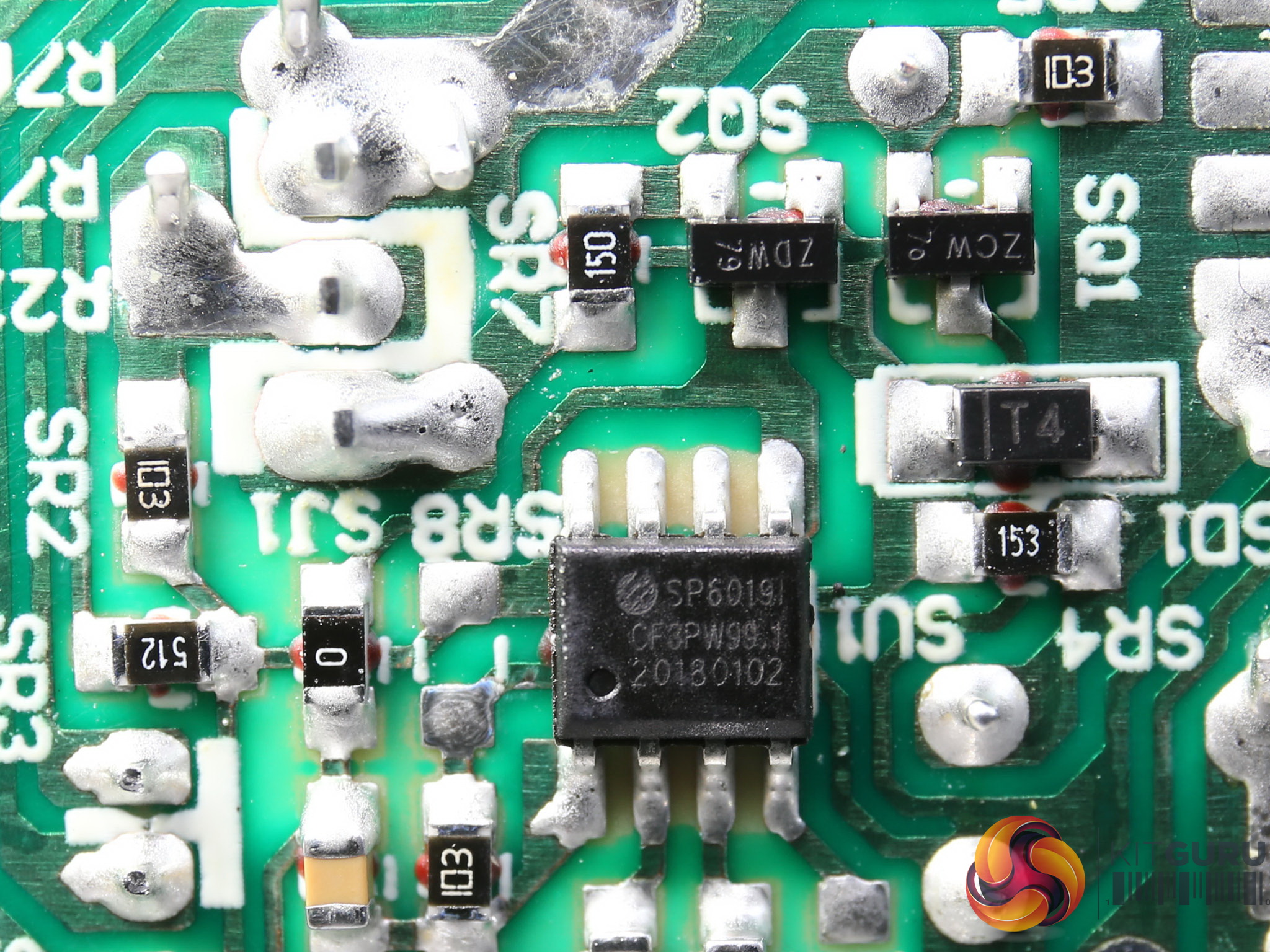
The +12V rail is rectified by two Sync Power SPN125T06 FETs and two PFC PFR40V60CT SBRs. The driver IC for the aforementioned FETs is a Sync Power SP6019.
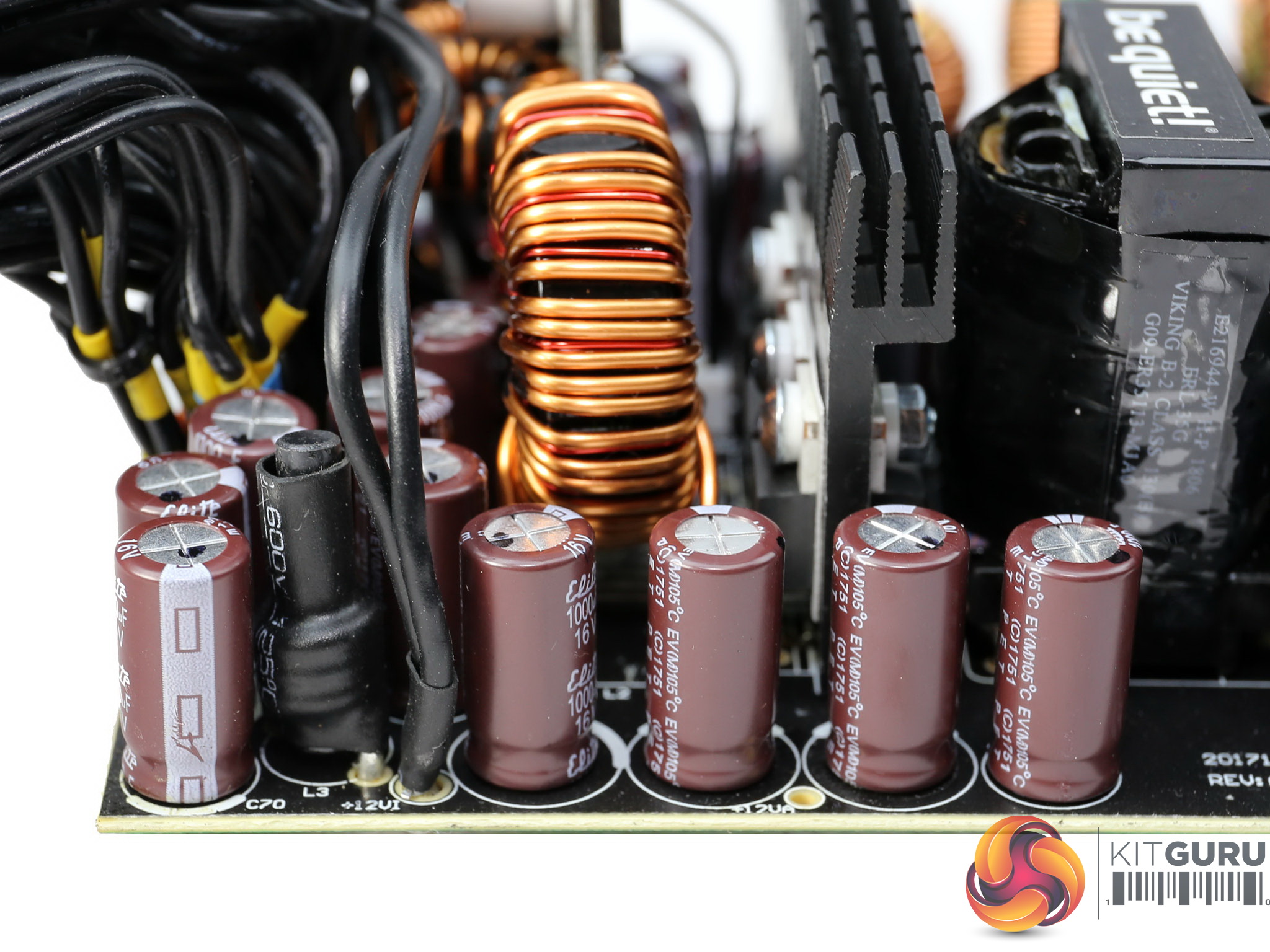
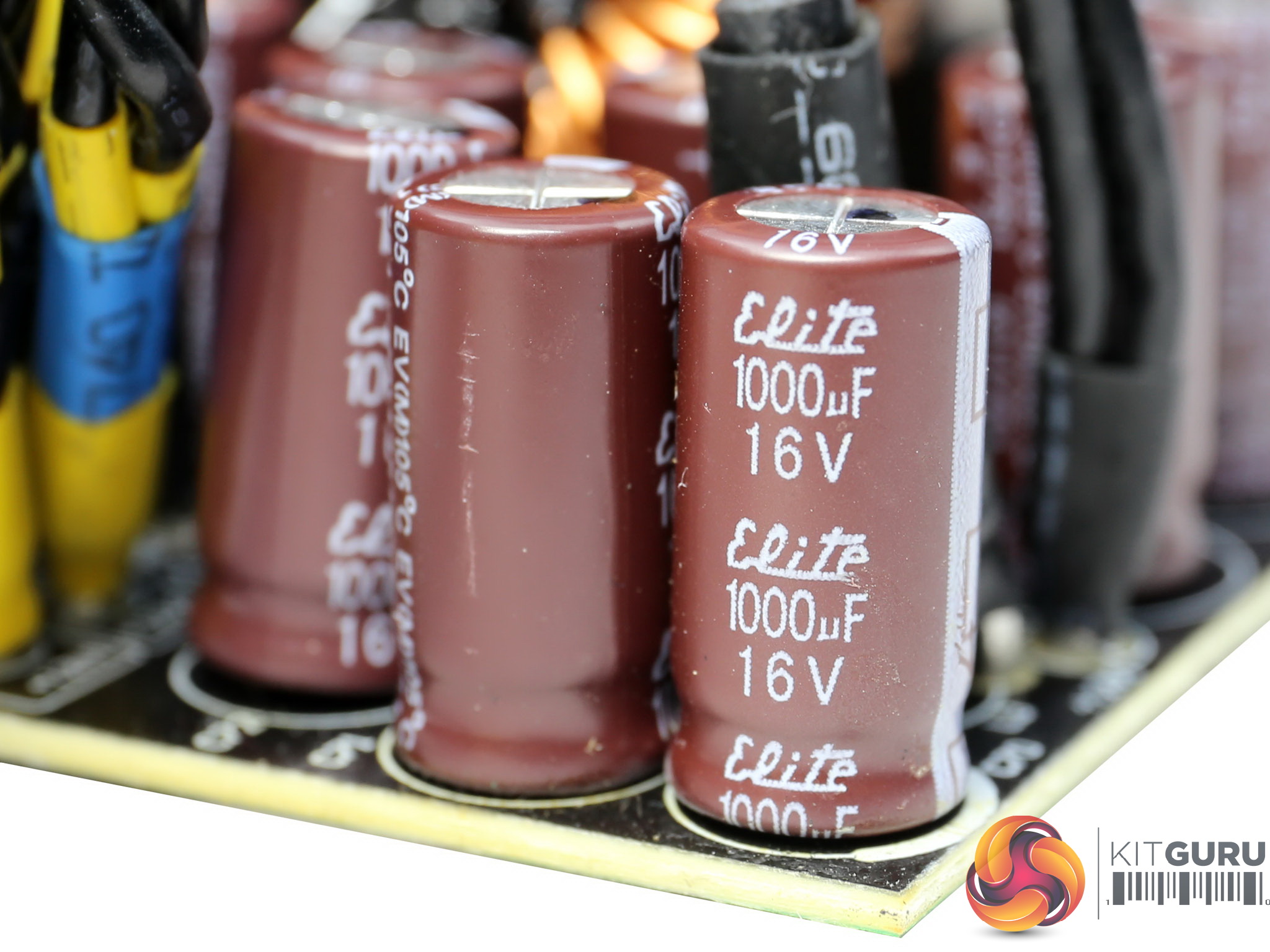
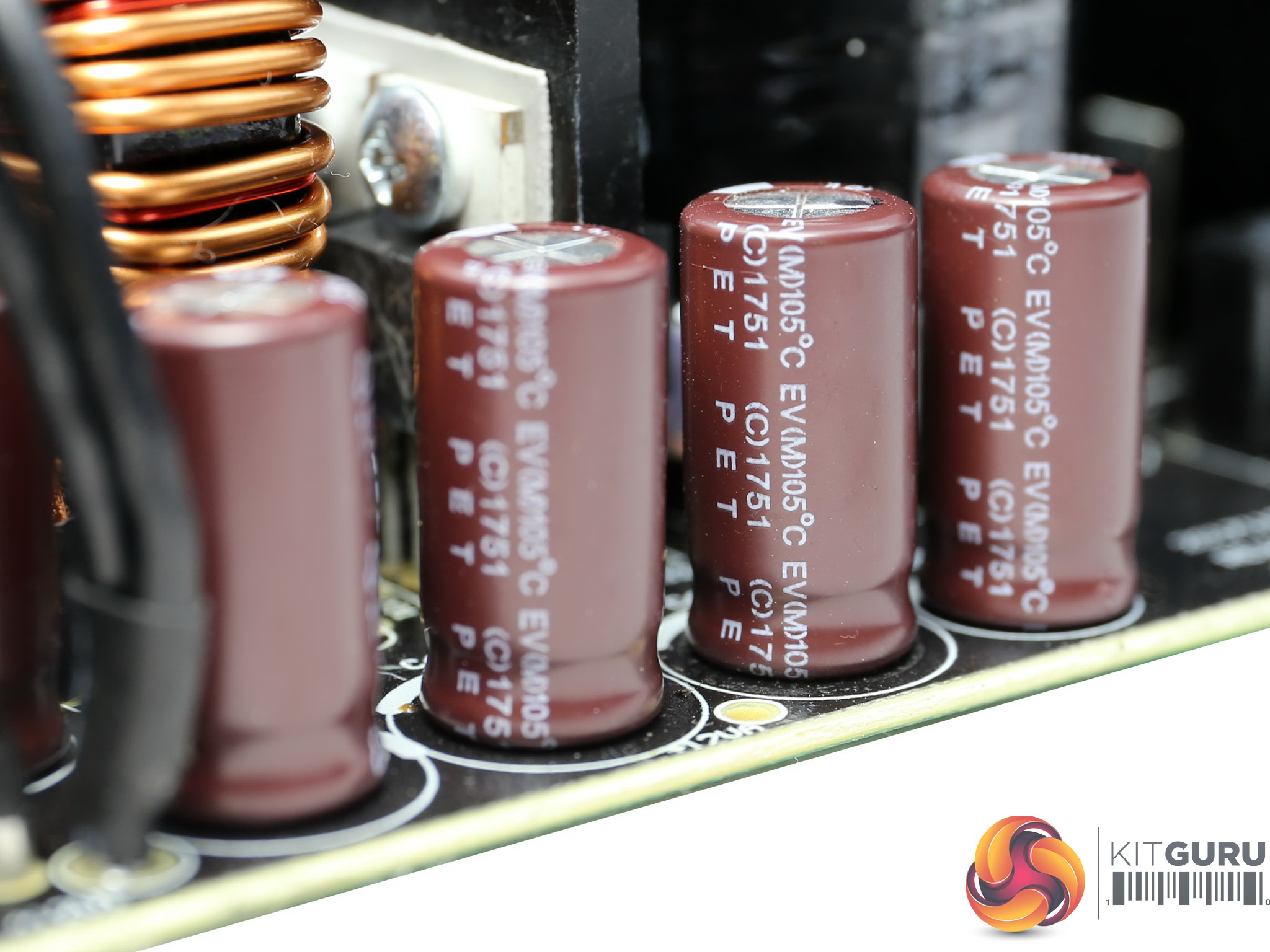
The filtering caps are mostly provided by Elite and they are of good quality, although they are not made in Japan but in China. The specifications are higher compared to Chemi-Con's KZE caps, which are omnipresent in more expensive power supplies.
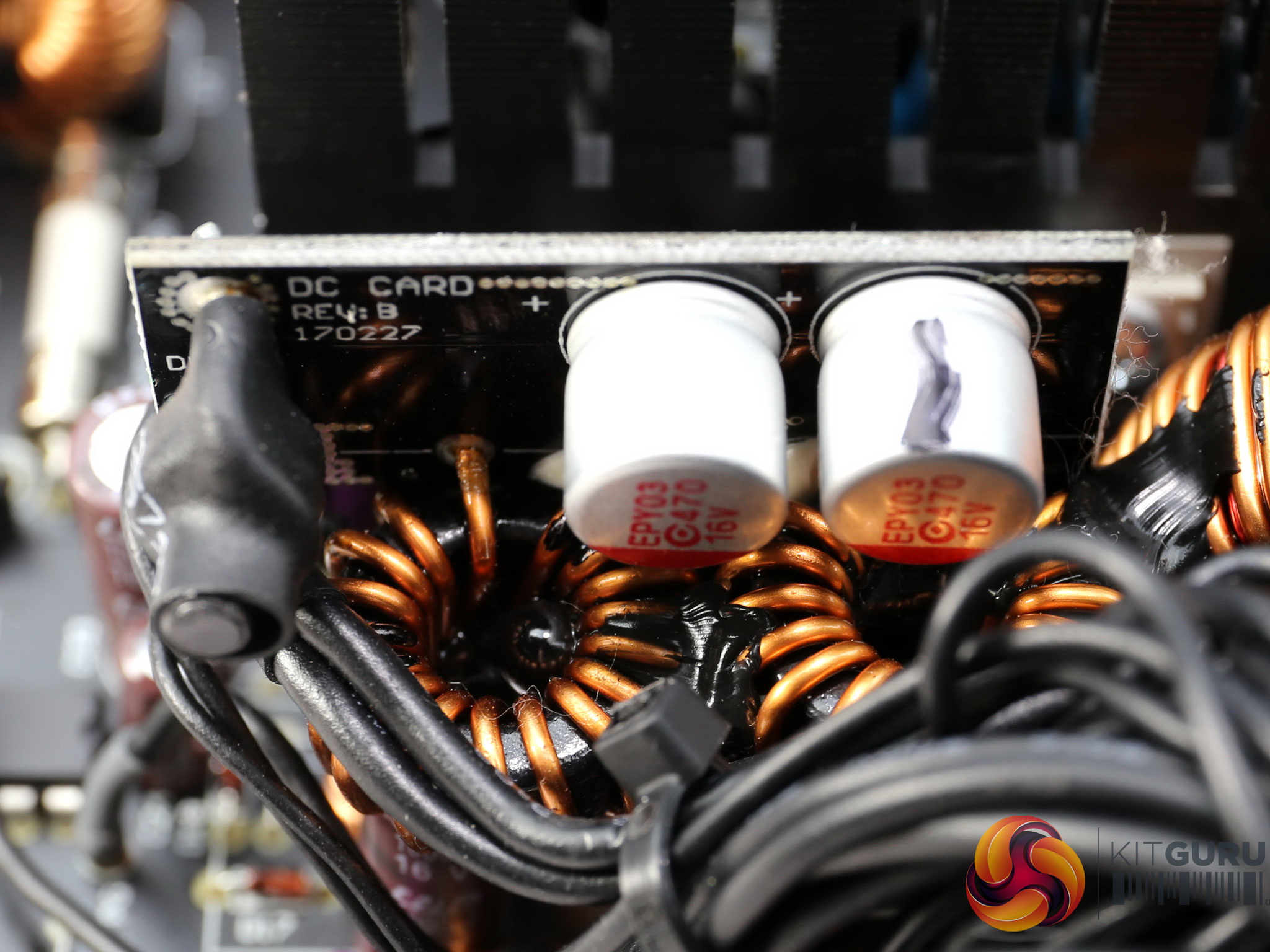
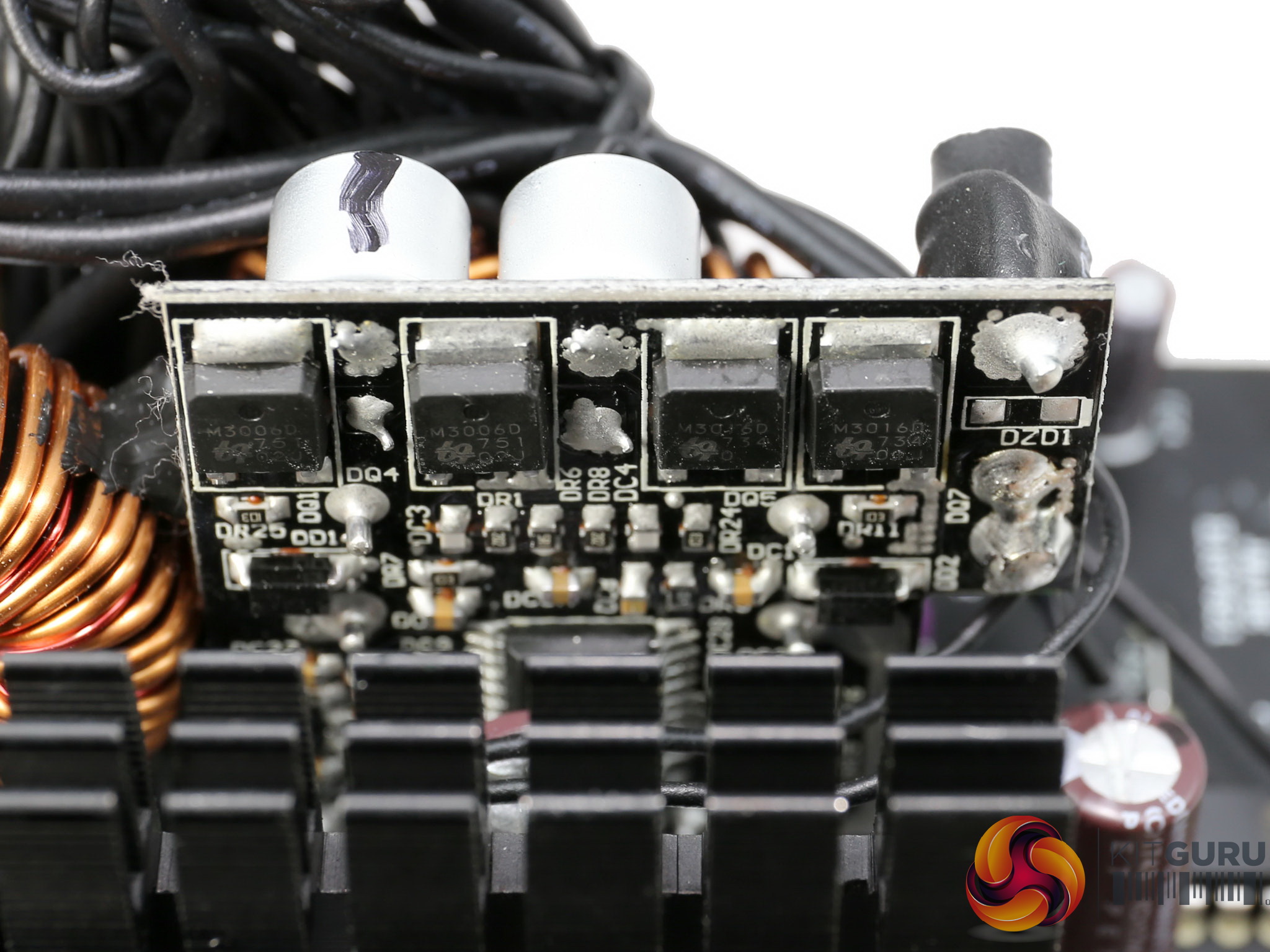
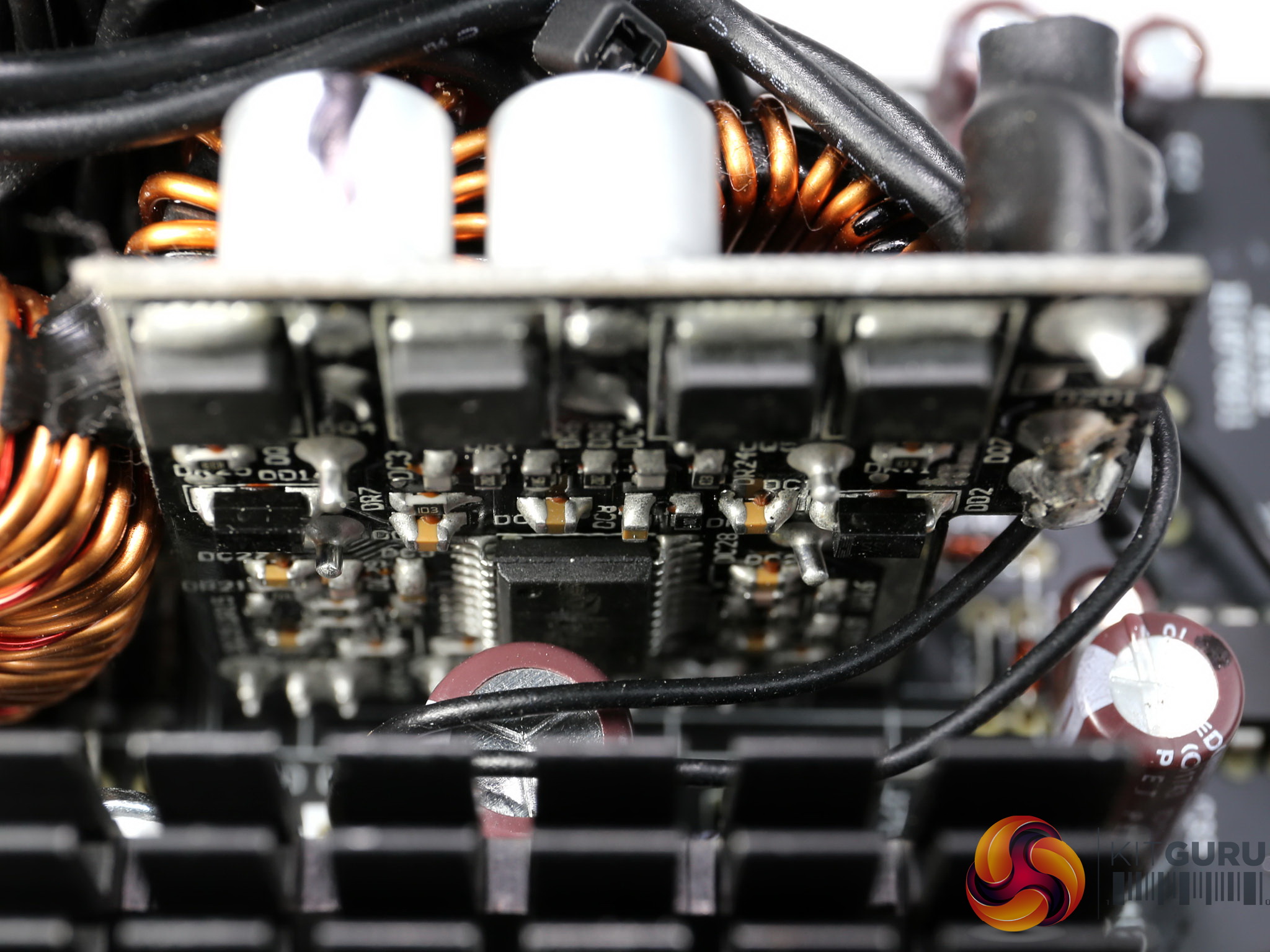
Both minor rails are generated through a pair of DC-DC converters, installed onto a small daughter-board. The switching FETs are two UBIQ QM3006D and two UBIQ QM3016D and the common PWM controller is a APW7159C.
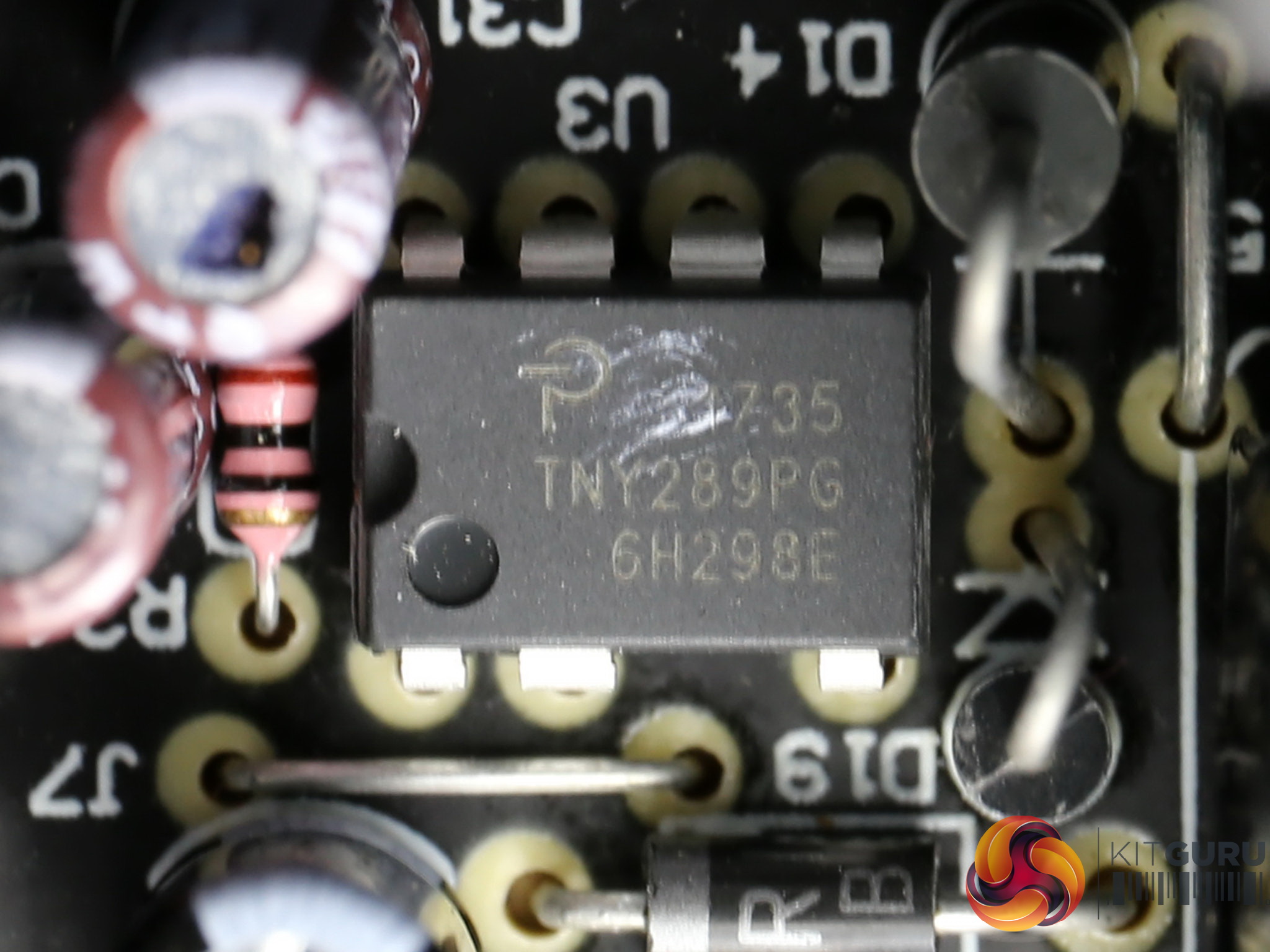
The standby rail's PWM controller is a TinySwitch-LT TNY289PG. This is a modern controller, usually found in higher-end platforms.
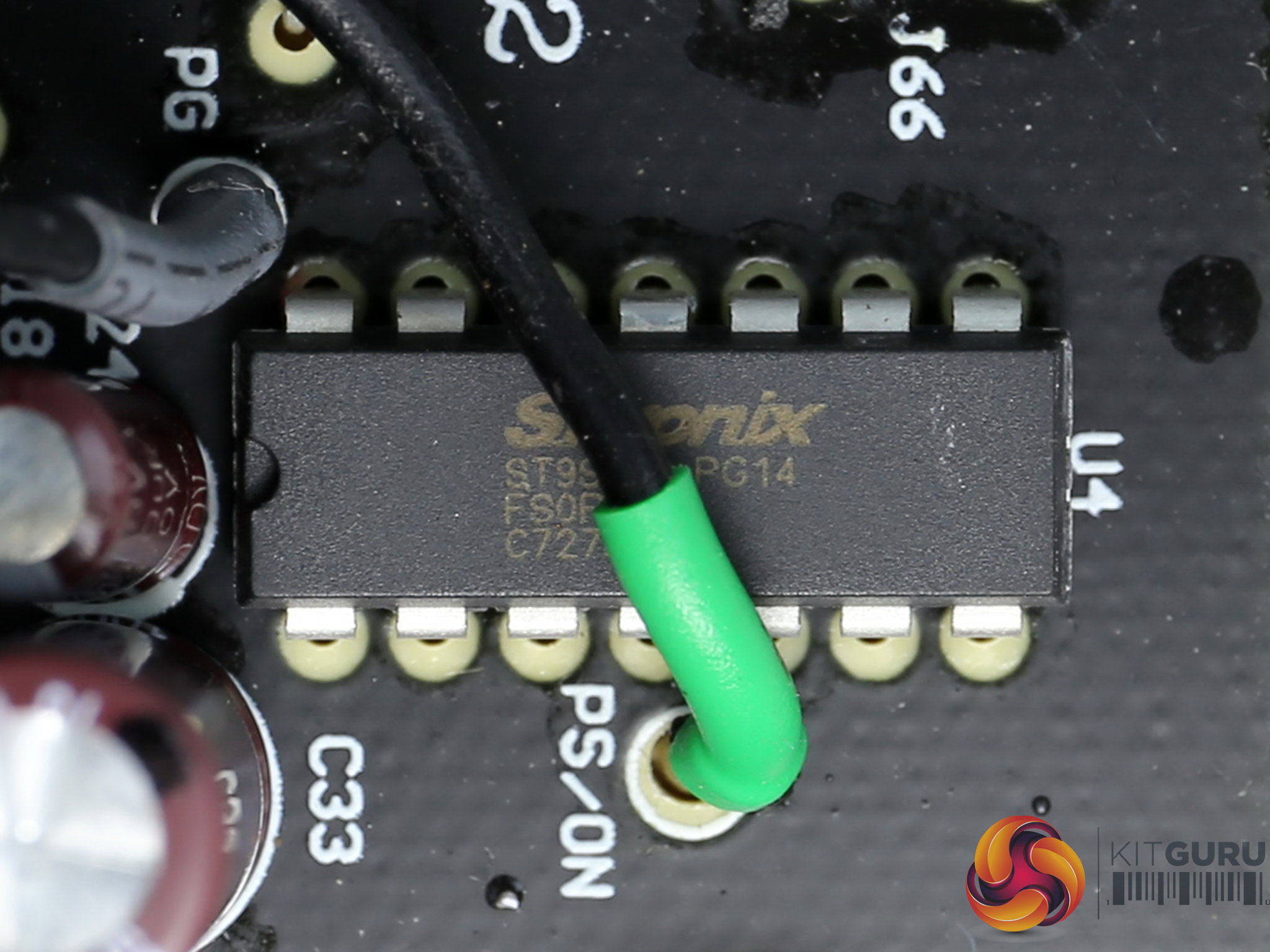
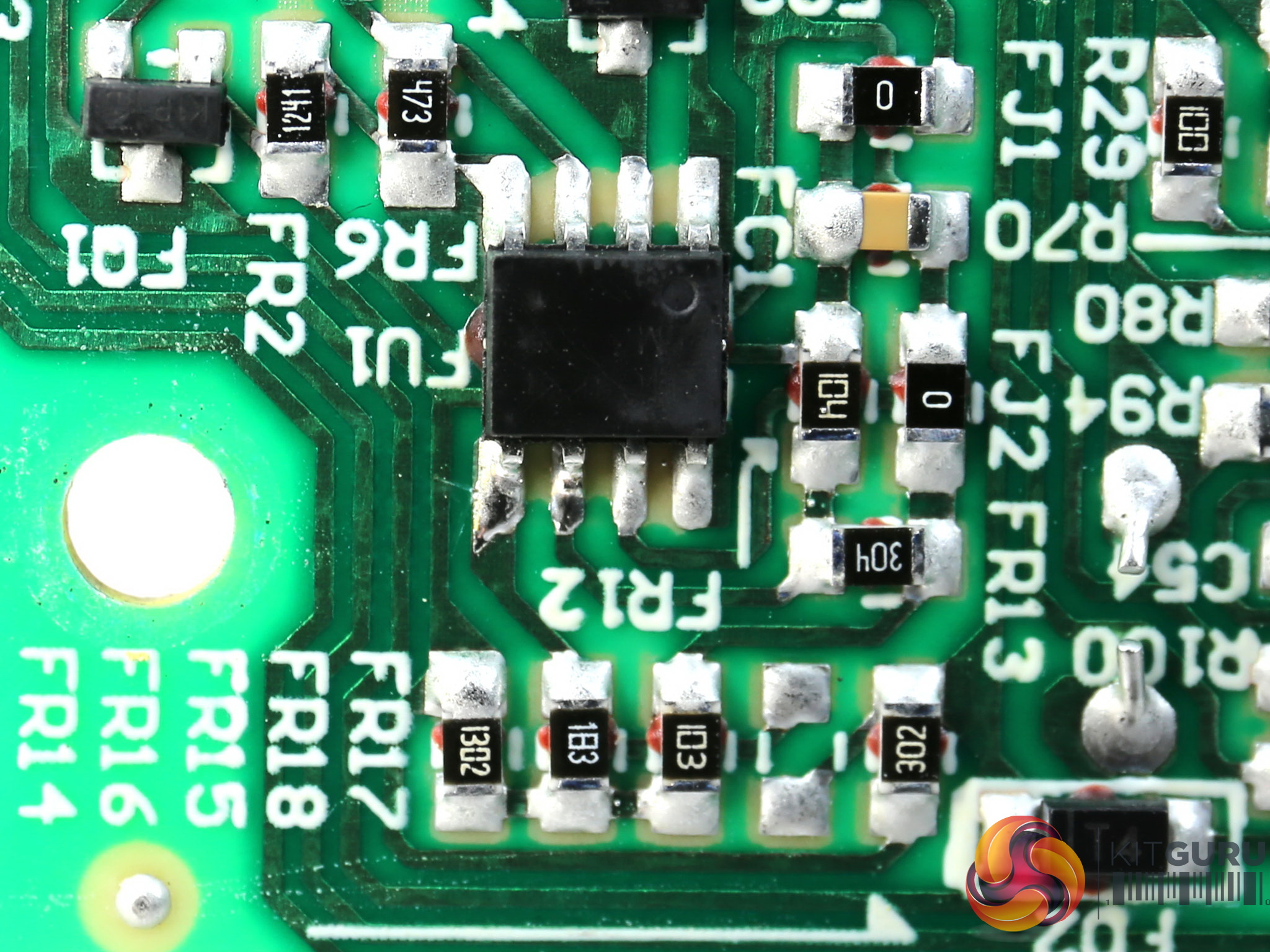
There are two supervisor ICs, a Sytronix ST9S429-PG14 and a Weltrend WD7518D. Since this unit only has two virtual +12V rails, most likely there was no need for the Weltrend IC.
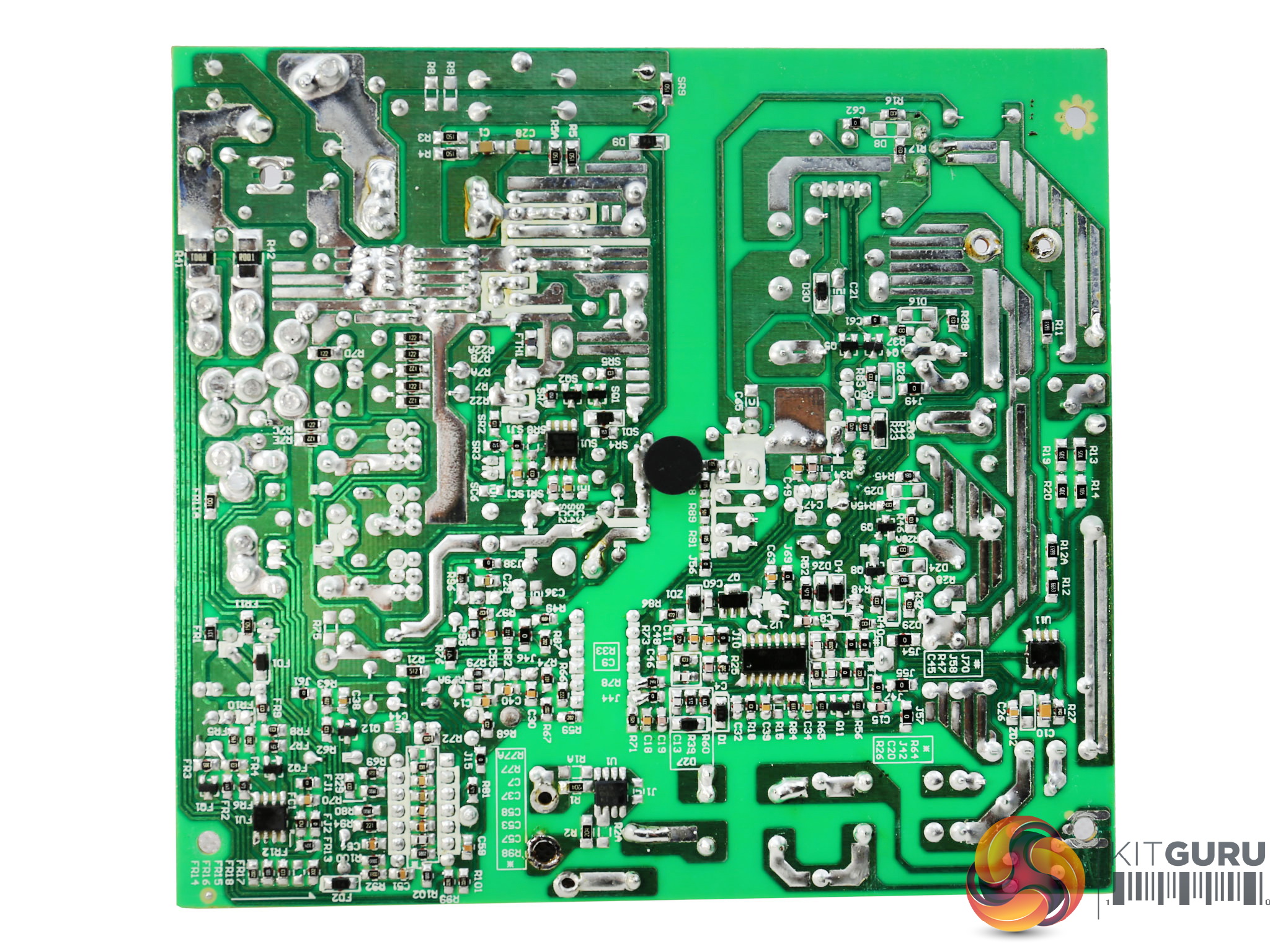
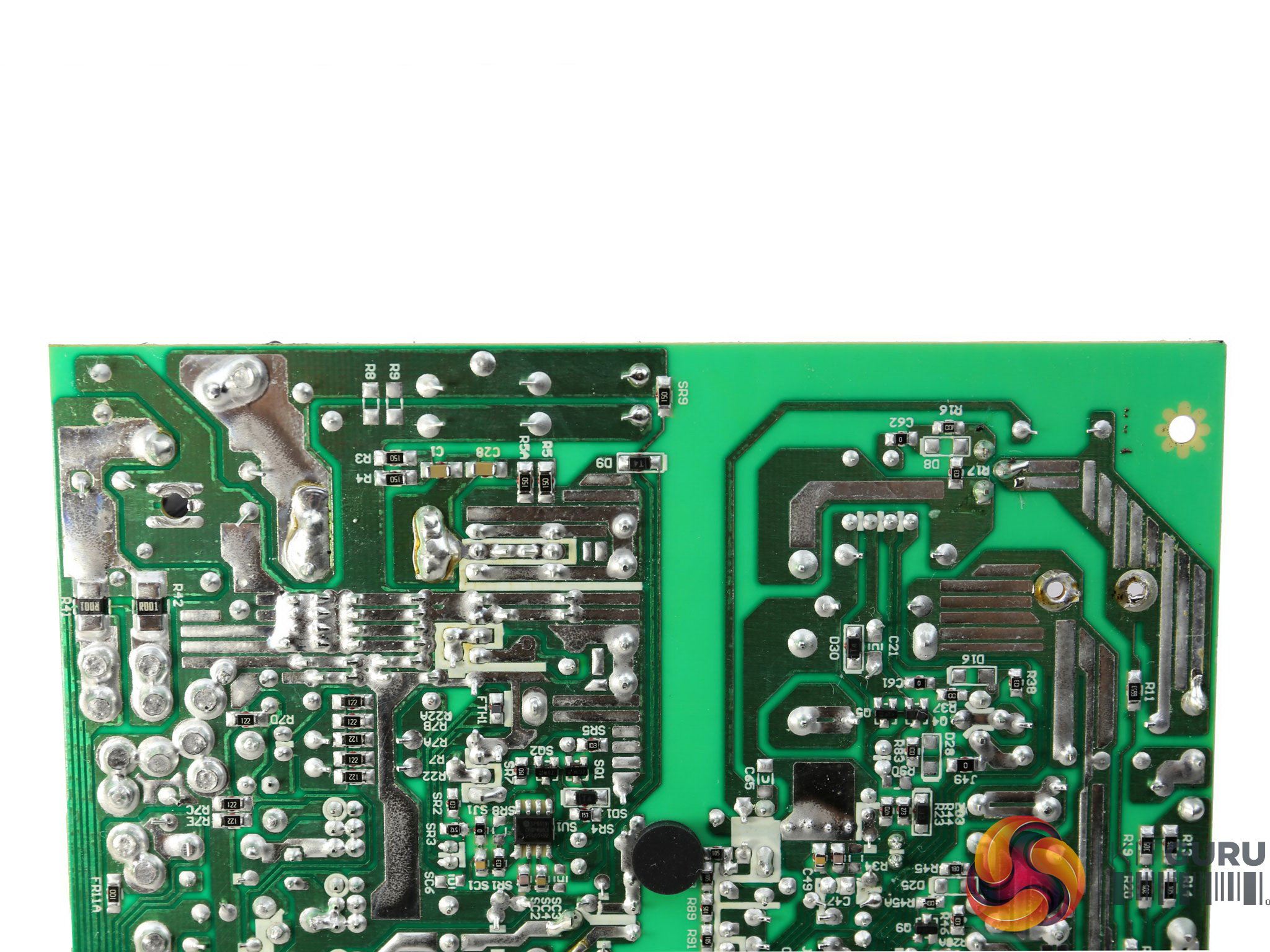
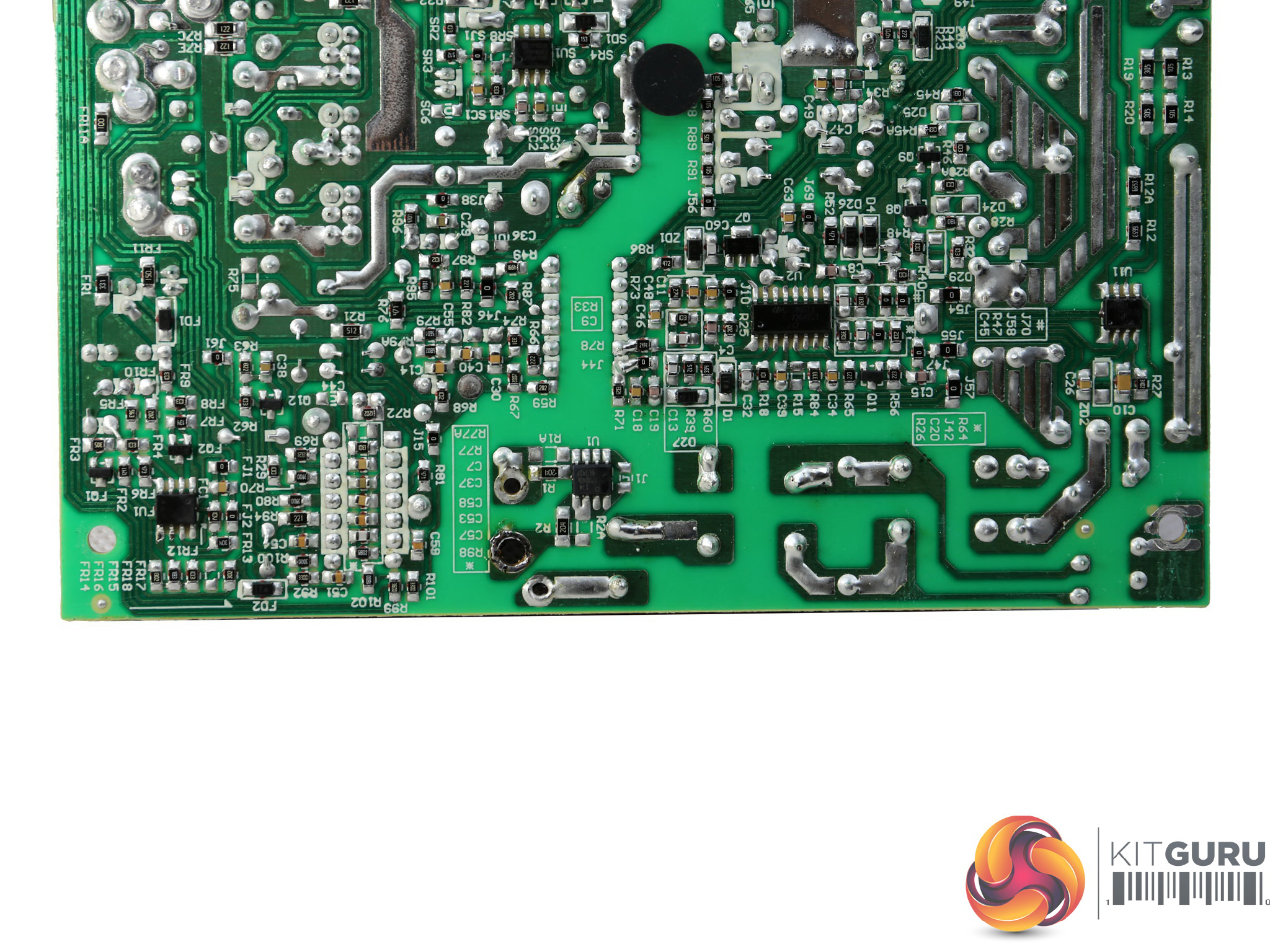
The soldering quality is not the best we have seen from CWT, but it is good enough for a budget platform.
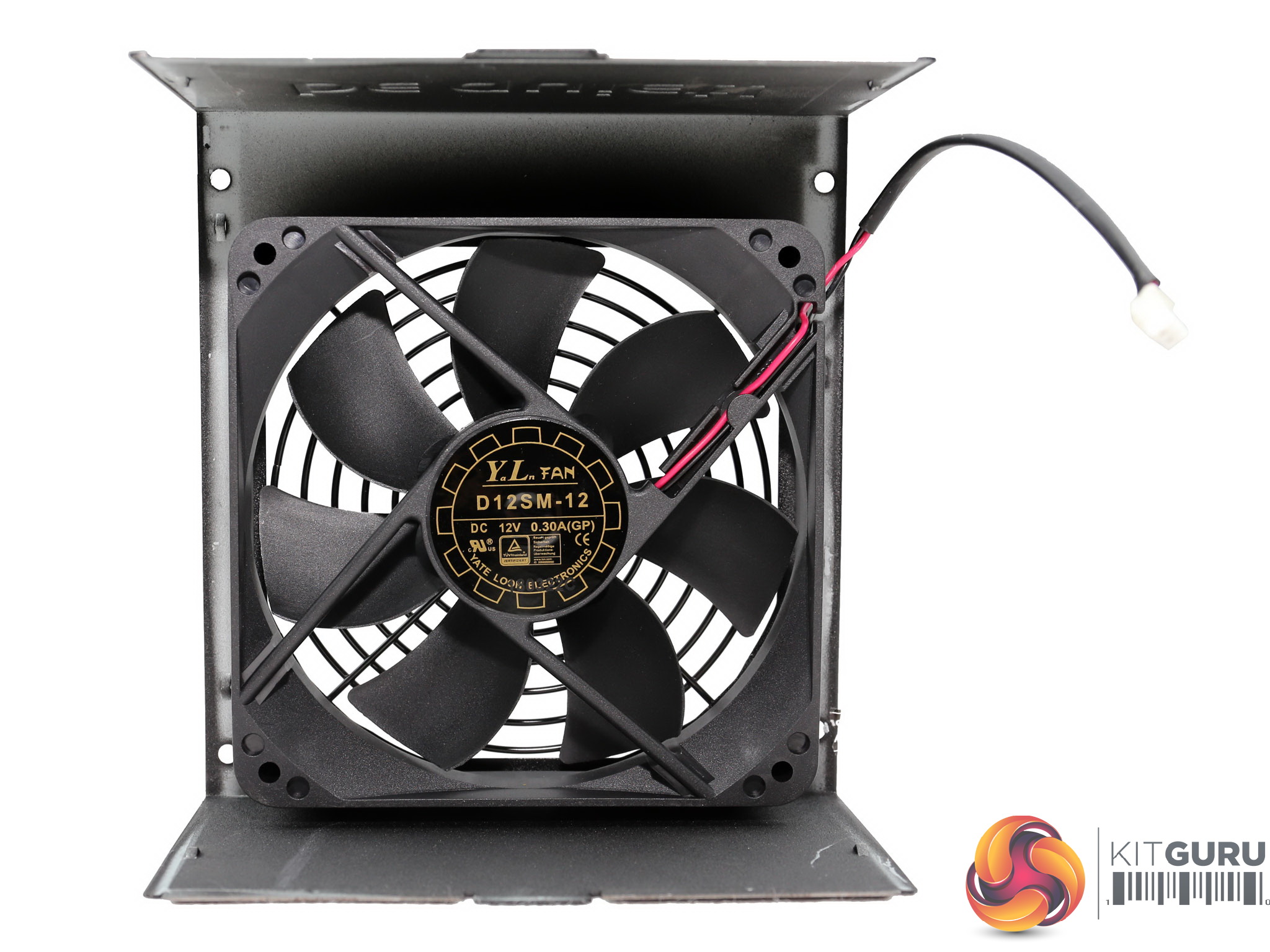
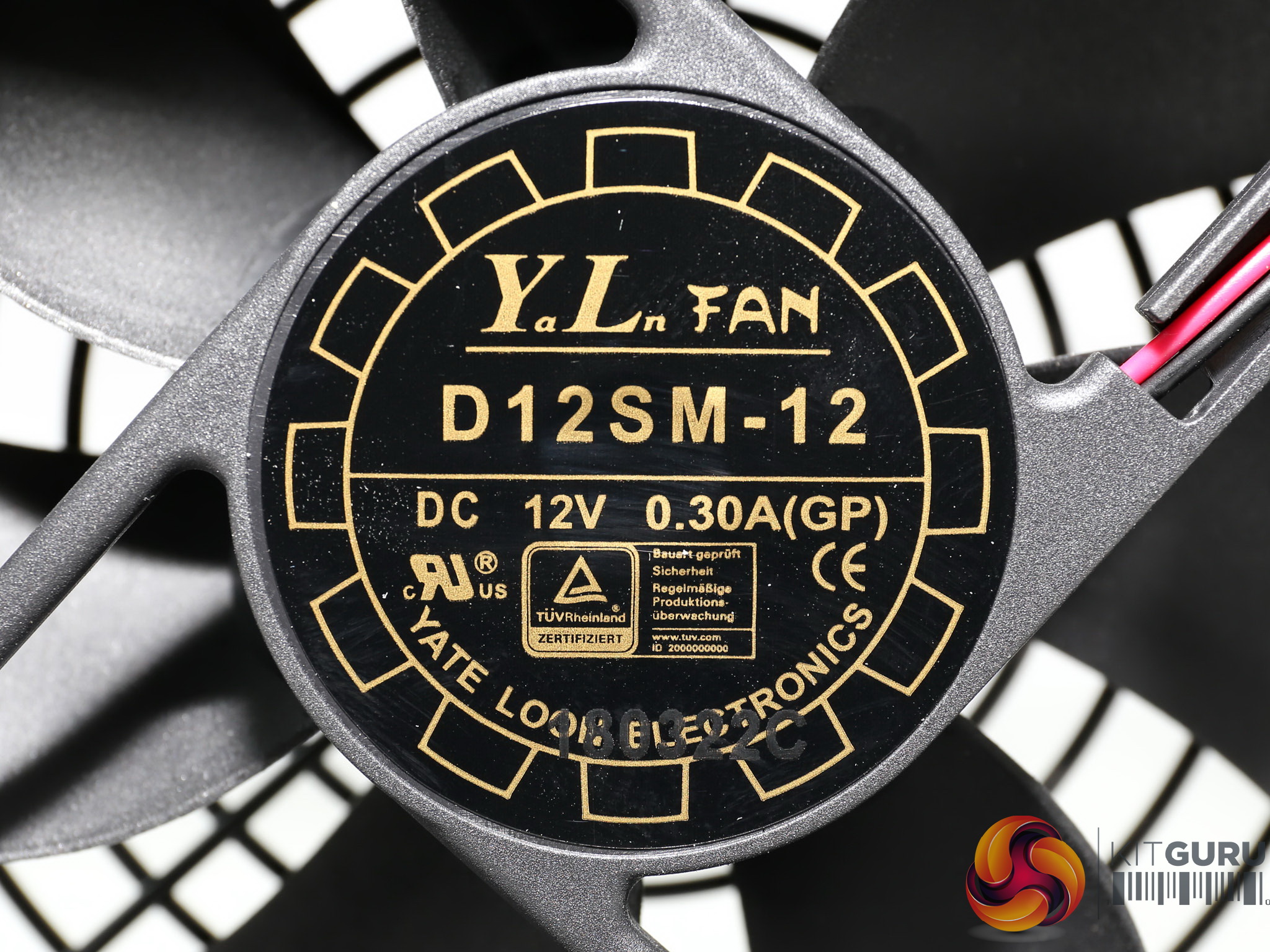
The cooling fan is by Yate Loon and it uses a sleeve bearing. We would like to see a rifle bearing used, instead. It measures 120mm across and it is controlled by a highly relaxed speed profile.
To learn more about our PSU tests and methodology, please check out How We Test Power Supply Units.
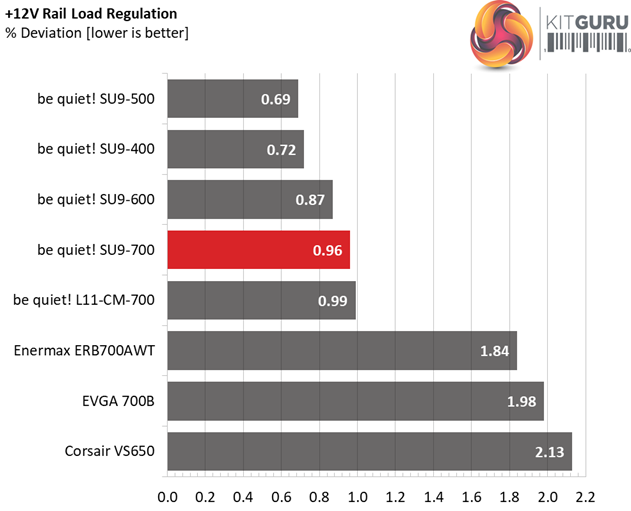
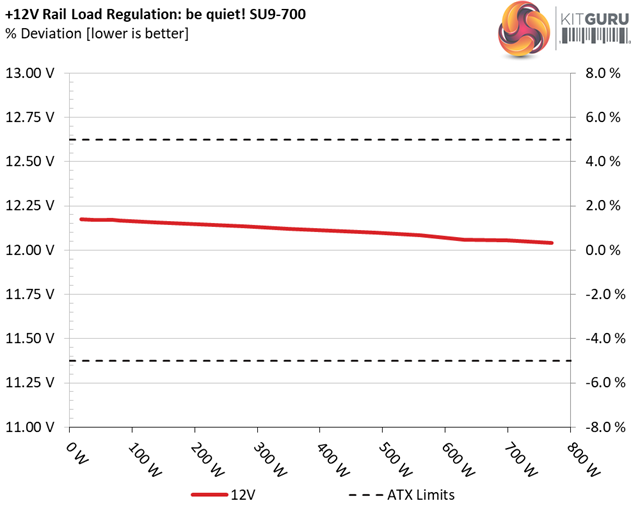
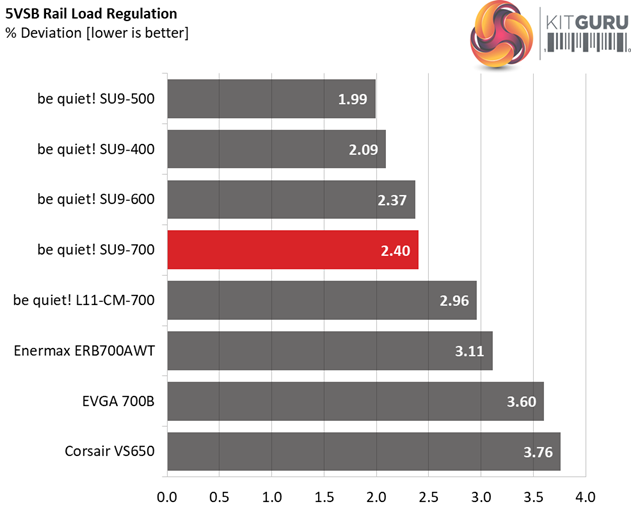
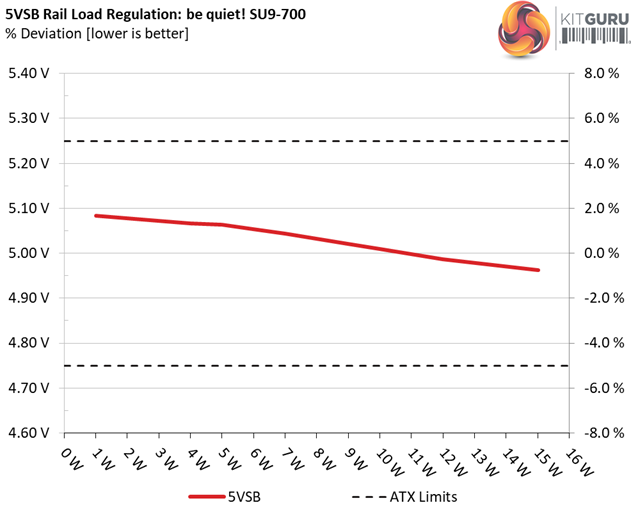
Primary Rails And 5VSB Load Regulation
Load Regulation testing is detailed here.
Hold-Up Time
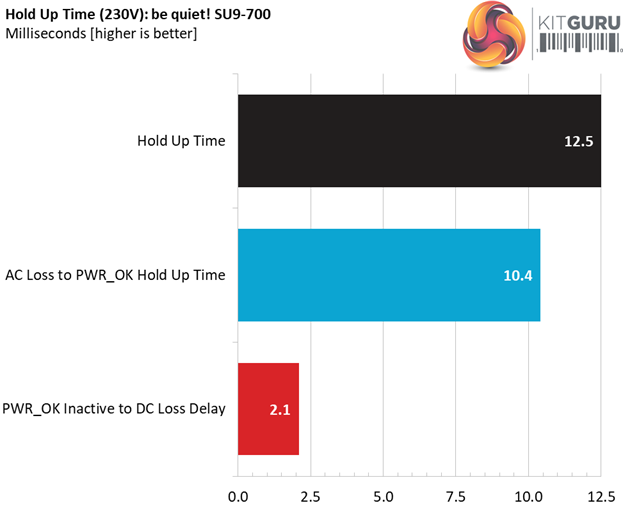
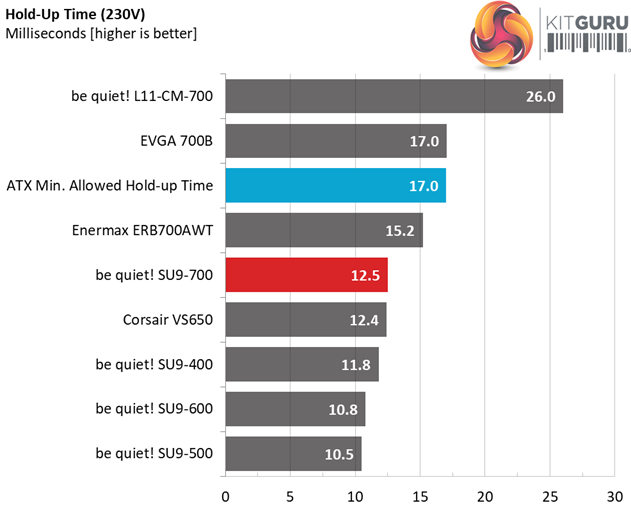
Our hold-up time tests are described in detail here.

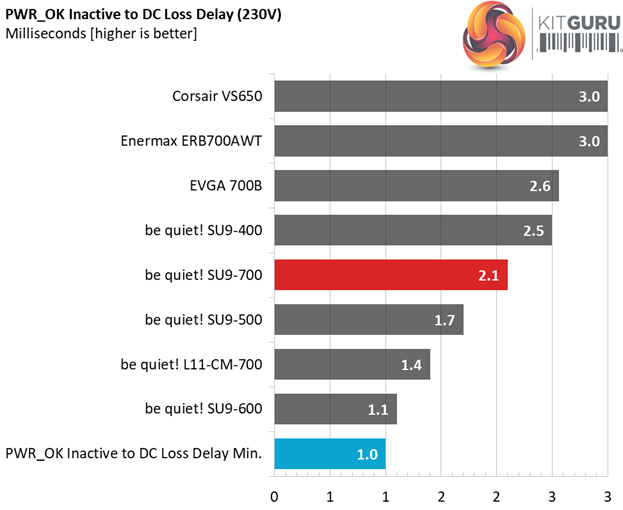
The oscilloscope screenshots that we took during the hold-up time measurements:
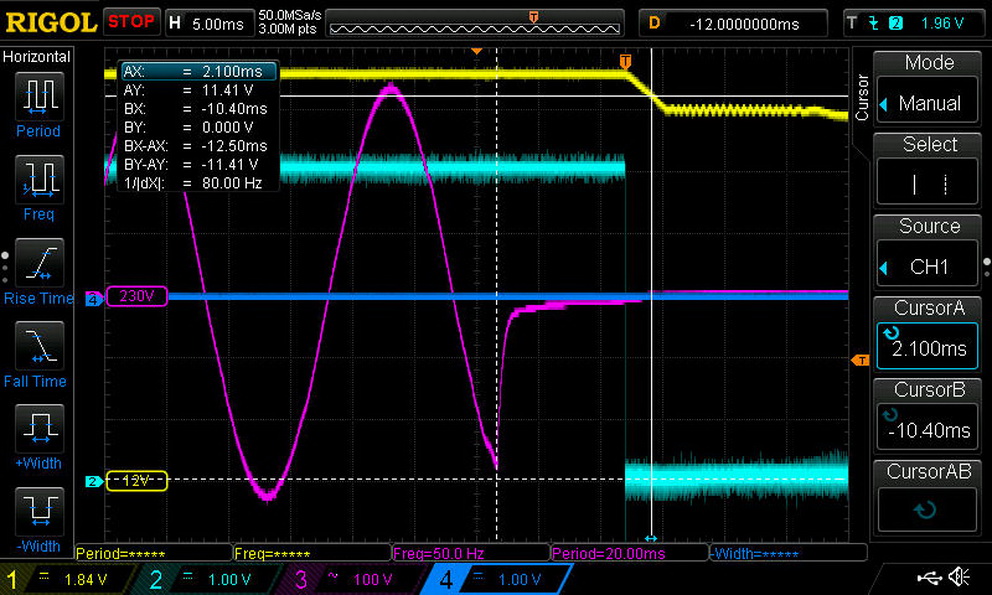
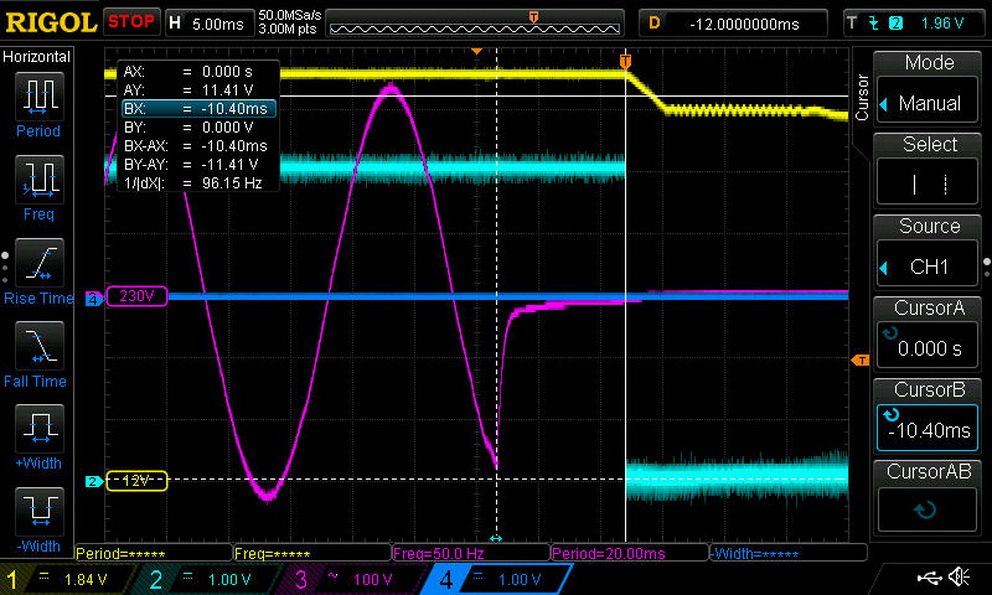
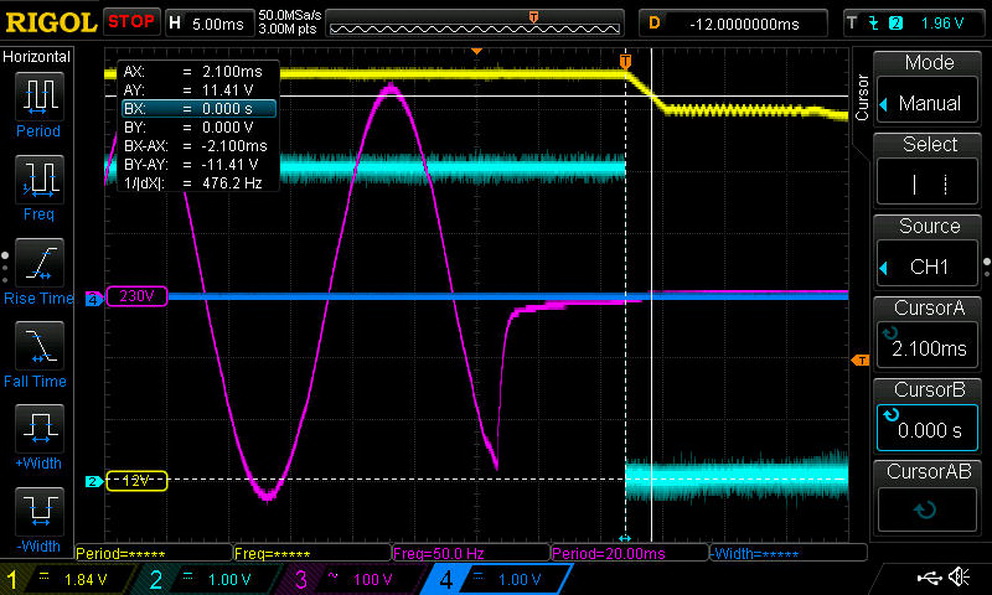
The hold-up time is much lower than 17ms. This was expected since the bulk cap is small. At least the power ok signal is accurate.
Inrush Current
For details on our inrush current testing, please click here.
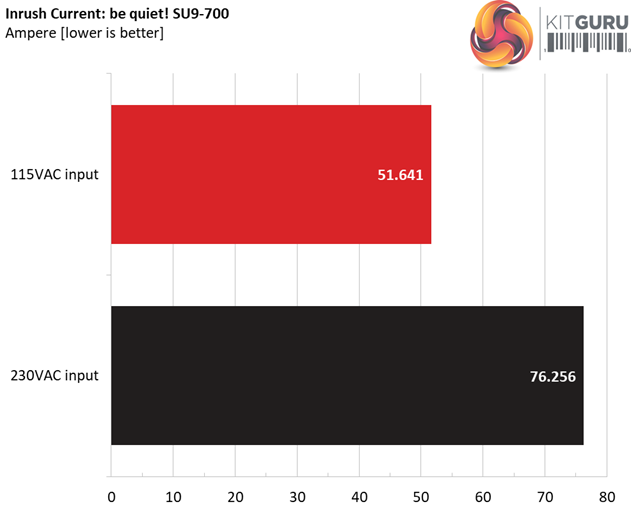
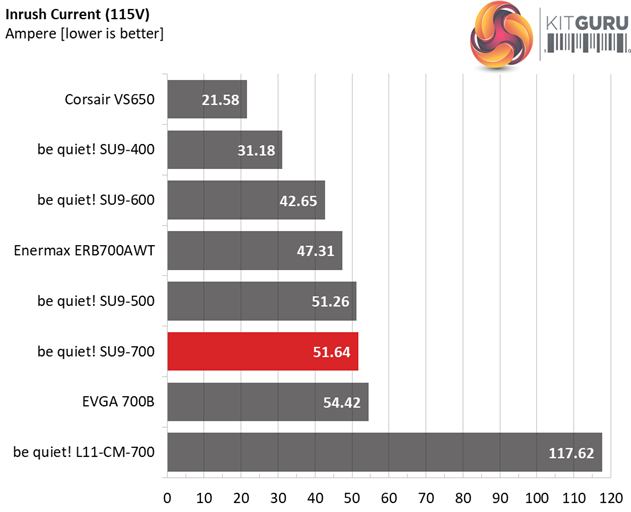
The inrush current is high, with both voltage inputs.
Load Regulation And Efficiency Measurements
The first set of tests reveals the stability of the voltage rails and the SU9-700’s efficiency. The applied load equals (approximately) 10 to 110 percent of the power supplies maximum load in increments of 10 percentage points.
We conducted two additional tests.
During the first, we stressed the two minor rails (5V and 3.3V) with a high load, while the load at +12V was only 0.1A. This test reveals whether a power supply is compatible with Intel’s C6/C7 sleep states or not. In the second test, we determined the maximum load the +12V rail could handle with minimal load on the minor rails.
| Test # | 12V | 5V | 3.3V | 5VSB | DC/AC (Watts) | Efficiency | Fan Speed (RPM) | PSU Noise (dB[A]) | Temps (In/Out) | PF/AC Volts |
| 1 | 3.950A | 1.995A | 1.992A | 0.988A | 69.671 | 82.690% | 633 | 10.0 | 36.53°C | 0.963 |
| 12.170V | 5.014V | 3.311V | 5.063V | 84.256 | 39.66°C | 115.26V | ||||
| 2 | 8.955A | 2.994A | 2.992A | 1.188A | 139.782 | 87.420% | 630 | 10.0 | 36.82°C | 0.970 |
| 12.158V | 5.012V | 3.308V | 5.053V | 159.897 | 40.68°C | 115.18V | ||||
| 3 | 14.303A | 3.492A | 3.479A | 1.388A | 209.703 | 88.568% | 628 | 9.9 | 37.23°C | 0.979 |
| 12.145V | 5.010V | 3.305V | 5.043V | 236.770 | 41.96°C | 115.18V | ||||
| 4 | 19.658A | 3.998A | 3.999A | 1.590A | 279.738 | 88.671% | 635 | 10.1 | 37.46°C | 0.984 |
| 12.133V | 5.007V | 3.303V | 5.032V | 315.478 | 42.75°C | 115.07V | ||||
| 5 | 24.697A | 4.999A | 4.999A | 1.793A | 349.866 | 88.248% | 628 | 9.9 | 37.87°C | 0.988 |
| 12.121V | 5.004V | 3.300V | 5.021V | 396.458 | 44.07°C | 114.97V | ||||
| 6 | 29.742A | 6.001A | 6.008A | 1.997A | 419.977 | 87.487% | 630 | 10.0 | 38.09°C | 0.990 |
| 12.109V | 5.002V | 3.297V | 5.010V | 480.045 | 45.86°C | 114.97V | ||||
| 7 | 34.794A | 7.005A | 7.012A | 2.202A | 490.129 | 86.354% | 656 | 10.7 | 38.70°C | 0.992 |
| 12.100V | 4.998V | 3.295V | 4.998V | 567.579 | 47.30°C | 114.84V | ||||
| 8 | 39.863A | 8.009A | 8.020A | 2.407A | 560.201 | 85.146% | 948 | 20.0 | 39.27°C | 0.993 |
| 12.086V | 4.996V | 3.292V | 4.986V | 657.928 | 48.49°C | 114.73V | ||||
| 9 | 45.371A | 8.505A | 8.505A | 2.409A | 629.666 | 84.062% | 988 | 21.1 | 39.93°C | 0.994 |
| 12.060V | 4.997V | 3.291V | 4.982V | 749.046 | 49.86°C | 114.65V | ||||
| 10 | 50.603A | 9.013A | 9.032A | 3.024A | 699.733 | 82.687% | 1530 | 34.8 | 40.53°C | 0.995 |
| 12.055V | 4.994V | 3.288V | 4.962V | 846.238 | 50.79°C | 114.60V | ||||
| 11 | 56.481A | 9.013A | 9.038A | 3.028A | 769.783 | 81.321% | 1812 | 39.2 | 40.90°C | 0.995 |
| 12.041V | 4.992V | 3.286V | 4.955V | 946.599 | 51.94°C | 114.46V | ||||
| CL1 | 0.134A | 16.002A | 16.000A | 0.000A | 134.392 | 79.577% | 644 | 10.4 | 37.76°C | 0.973 |
| 12.165V | 4.997V | 3.300V | 5.056V | 168.884 | 44.31°C | 115.15V | ||||
| CL2 | 55.997A | 1.000A | 0.999A | 1.000A | 688.785 | 83.455% | 1445 | 32.8 | 40.48°C | 0.994 |
| 12.063V | 4.996V | 3.291V | 5.009V | 825.340 | 50.52°C | 114.63V |
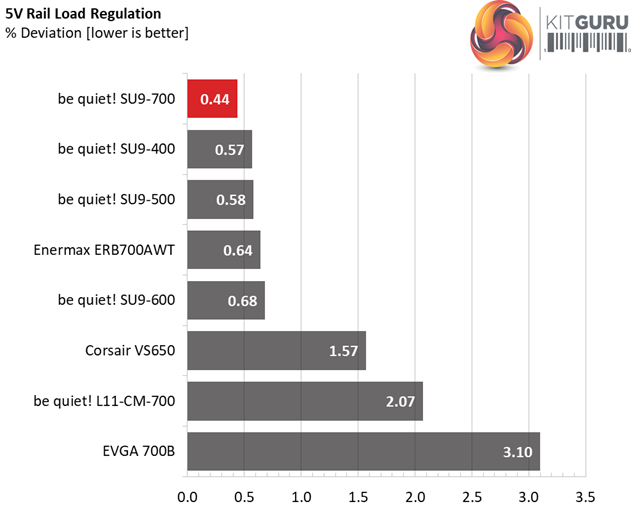
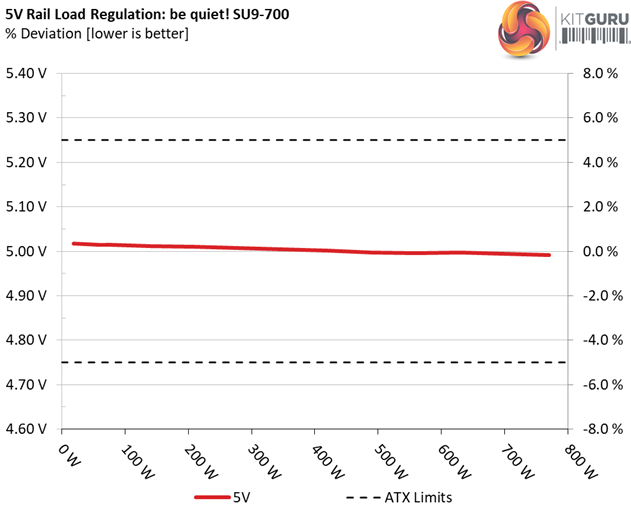
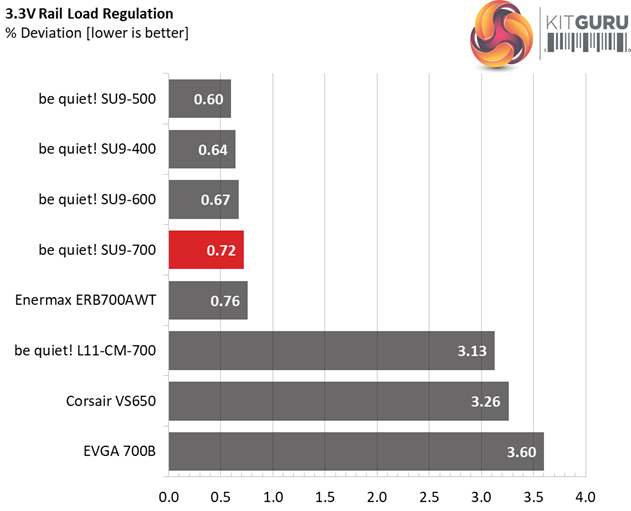
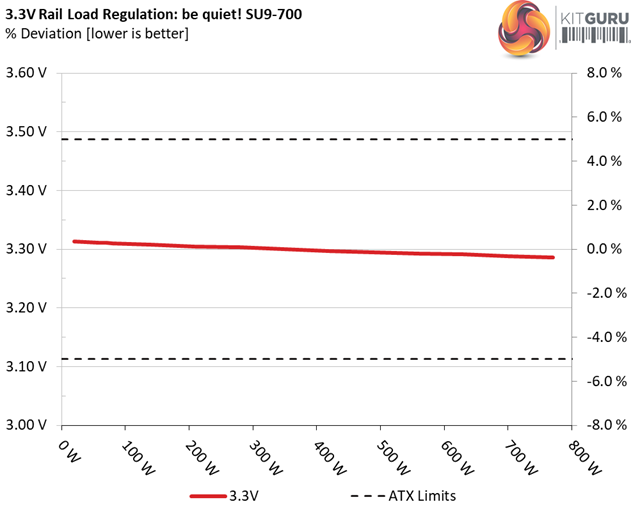
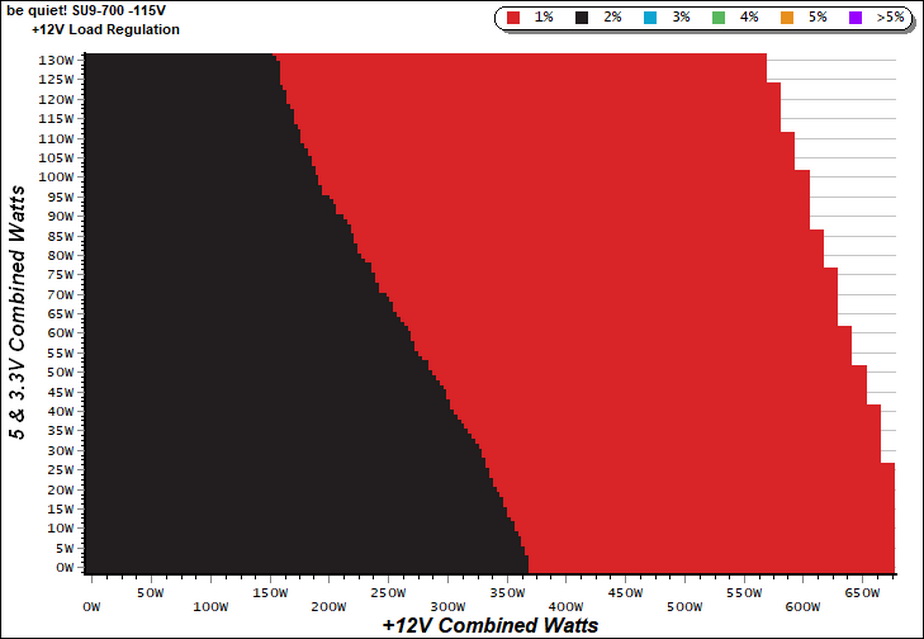
For a budget-oriented product, the load regulation performance is amazing! The +12V, 5V and 3.3V rails stay within 1% and the platform doesn't have a problem delivering more than its nominal capacity at over 40°C ambient. Moreover, we have to push it really hard in order to make the fan spin at high speeds and still only in the overload scenario the acoustics noise reached close to 40 dB(A).
The performance with highly unbalanced loads among the rails is very good, since DC-DC converters are used for the generation of the minor rails. Moreover, the PF readings look good as well.
The 80 PLUS Bronze requirements are easily met in all three load scenarios (20%, 50% and 100%), even at high operating temperatures.
Efficiency
Our efficiency testing procedure is detailed here.
Using results from the previous page, we plotted a chart showing the SU9-700’’s efficiency at low loads, and loads from 10 to 110 percent of its maximum-rated capacity.
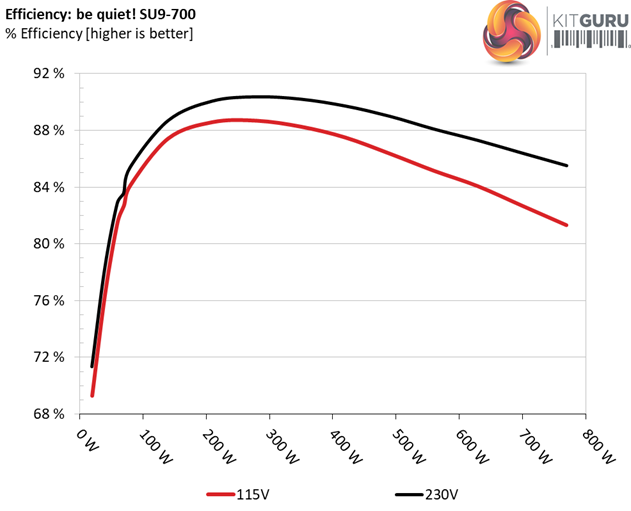
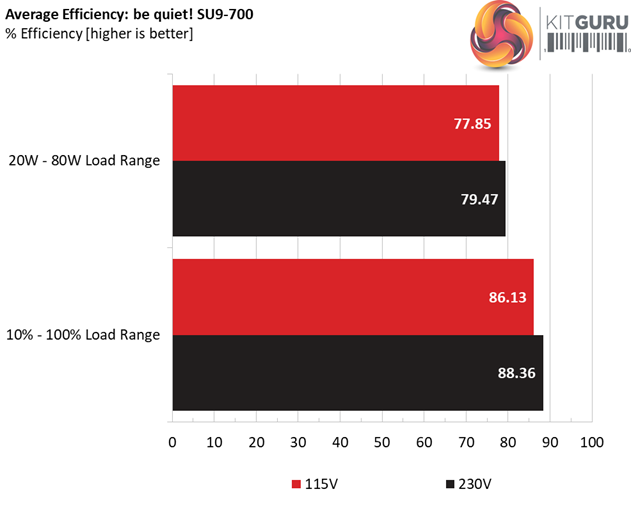
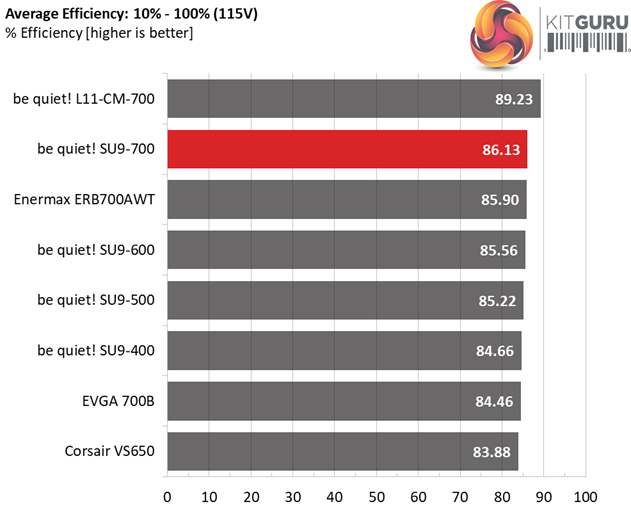
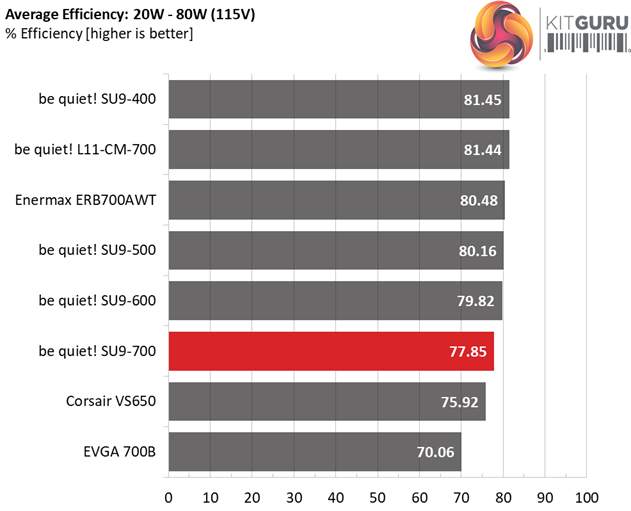
The efficiency under normal loads is high enough, always for the standards of this category, while with light loads it isn't so competitive.
Efficiency At Low Loads
In the following tests, we measure the SU9-700’'s efficiency at loads significantly lower than 10 percent of its maximum capacity (the lowest load the 80 PLUS standard measures). The loads we dial are 20, 40, 60, and 80W. This is important for representing when a PC is idle, with power-saving features turned on.
| Test # | 12V | 5V | 3.3V | 5VSB | DC/AC (Watts) | Efficiency | Fan Speed (RPM) | PSU Noise (dB[A]) | PF/AC Volts |
| 1 | 1.179A | 0.498A | 0.482A | 0.197A | 19.452 | 69.313% | 622 | 9.8 | 0.871 |
| 12.175V | 5.018V | 3.313V | 5.084V | 28.064 | 115.34V | ||||
| 2 | 2.429A | 0.997A | 0.994A | 0.394A | 39.860 | 76.474% | 618 | 9.7 | 0.926 |
| 12.172V | 5.016V | 3.312V | 5.078V | 52.122 | 115.31V | ||||
| 3 | 3.615A | 1.495A | 1.479A | 5.072A | 59.391 | 81.484% | 618 | 9.7 | 0.962 |
| 12.170V | 5.015V | 3.311V | 5.072V | 72.887 | 115.28V | ||||
| 4 | 4.869A | 1.994A | 1.995A | 0.790A | 79.850 | 84.122% | 638 | 10.2 | 0.962 |
| 12.168V | 5.014V | 3.310V | 5.066V | 94.922 | 115.25V |
The fan's speed is kept low under light loads while the efficiency levels are not that high. But this is an older generation design destined for users on a tight budget, so we shouldn't expect for wonders here.
5VSB Efficiency
The ATX specification (revision 1.4), along with CEC, ErP Lot 3 2014 and ErP Lot 6 2010/2013, states that the 5VSB standby supply efficiency should be as high as possible, recommending 75 percent or higher with 550mA, 1A, and 1.5A of load.
The supply should also achieve higher than 75% efficiency at 5VSB under full load, or with 3A if its max current output on this rail is higher than 3A.
We take six measurements: one each at 100, 250, 550, 1000, and 1500mA, and one with the full load the 5VSB rail can handle.
| Test # | 5VSB | DC/AC (Watts) |
Efficiency | PF/AC Volts |
| 1 | 0.100A | 0.509 | 77.356% | 0.051 |
| 5.088V | 0.658 | 115.37V | ||
| 2 | 0.250A | 1.272 | 79.649% | 0.117 |
| 5.085V | 1.597 | 115.37V | ||
| 3 | 0.550A | 2.794 | 80.380% | 0.221 |
| 5.080V | 3.476 | 115.37V | ||
| 4 | 1.000A | 5.072 | 81.126% | 0.315 |
| 5.072V | 6.252 | 115.37V | ||
| 5 | 1.500A | 7.595 | 79.570% | 0.377 |
| 5.063V | 9.545 | 115.36V | ||
| 6 | 3.000A | 15.111 | 78.662% | 0.453 |
| 5.037V | 19.210 | 115.35V |
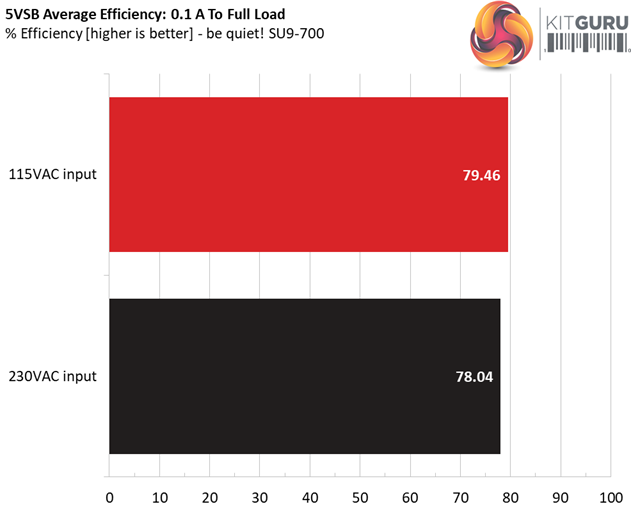
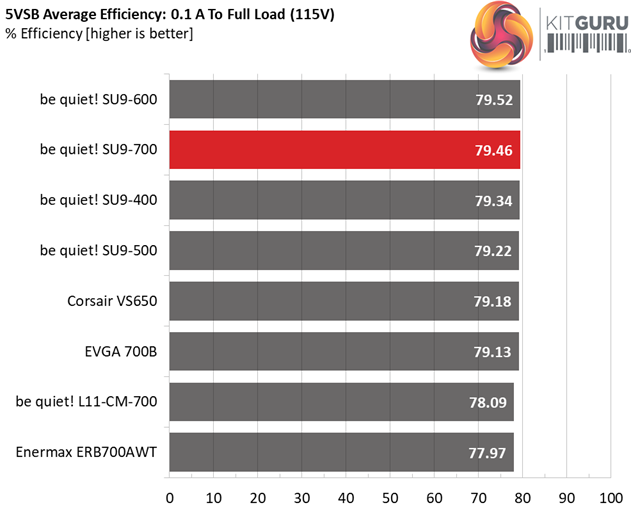
The 5VSB rail registers high efficiency even under very light loads. It is nice to see a budget-oriented platform with a good standby circuit.
Power Consumption In Idle And Standby
In the table below, you’ll find the power consumption and voltage values of all rails (except -12V) when the PSU is idle (powered on, but without any load on its rails), and the power consumption when the unit is in standby mode (without any load, at 5VSB).
| Mode | 12V | 5V | 3.3V | 5VSB | Watts | PF/AC Volts |
| Idle | 12.168V | 5.022V | 3.316V | 5.088V | 5.213 | 0.359 |
| 115.4V | ||||||
| Standby | 0.044 | 0.003 | ||||
| 115.4V | ||||||
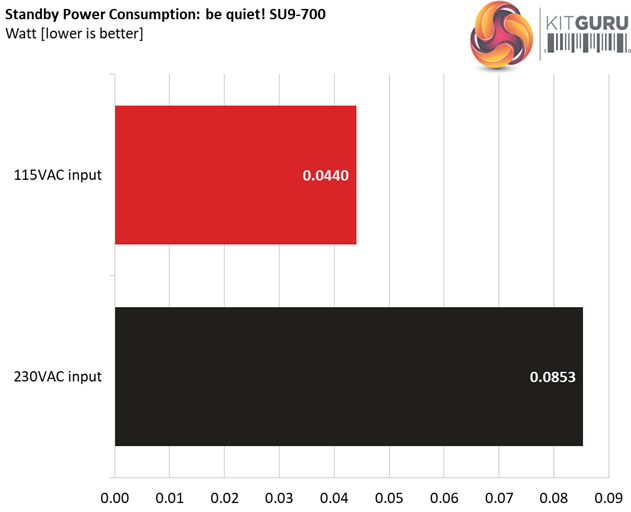
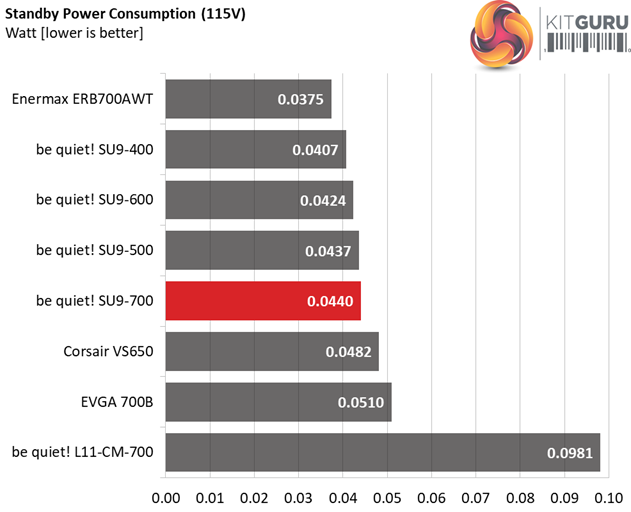
The vampire power is kept low with both voltage inputs. This is why the 5VSB rail achieves high efficiency under super light loads.
Fan RPM, Delta Temperature, And Output Noise
Our mixed noise testing is described in detail here.
The first chart below illustrates the cooling fan's speed (in RPM), and the delta between input and output temperature. The results were obtained at 35°C (95°F) to 41°C (105.8°F) ambient temperature.

The next chart shows the cooling fan's speed (again, in RPM) and output noise. We measure acoustics from one meter away, inside a hemi-anechoic chamber. Background noise inside the chamber is below 6 dB(A) during testing (it's actually much lower, but our sound meter’s microphone hits its floor), and the results are obtained with the PSU operating at 35°C (95°F) to 41°C (105.8°F) ambient temperature.
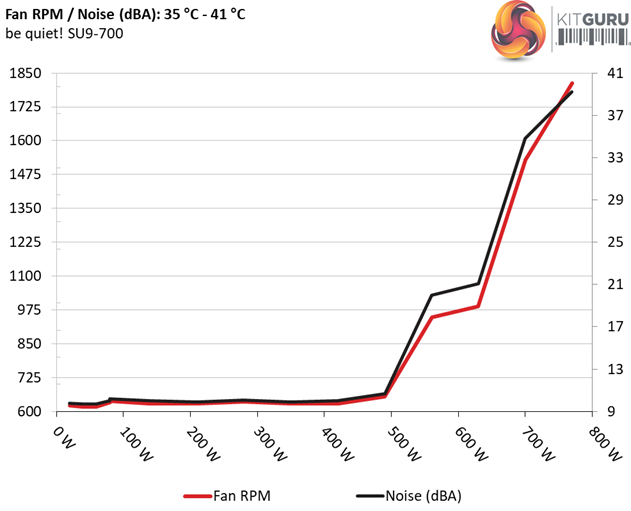
The following graph illustrates the fan's output noise over the PSU's operating range. The same conditions of the above graph apply to our measurements, though the ambient temperature is between 30°C (86°F) to 32°C (89.6°F).
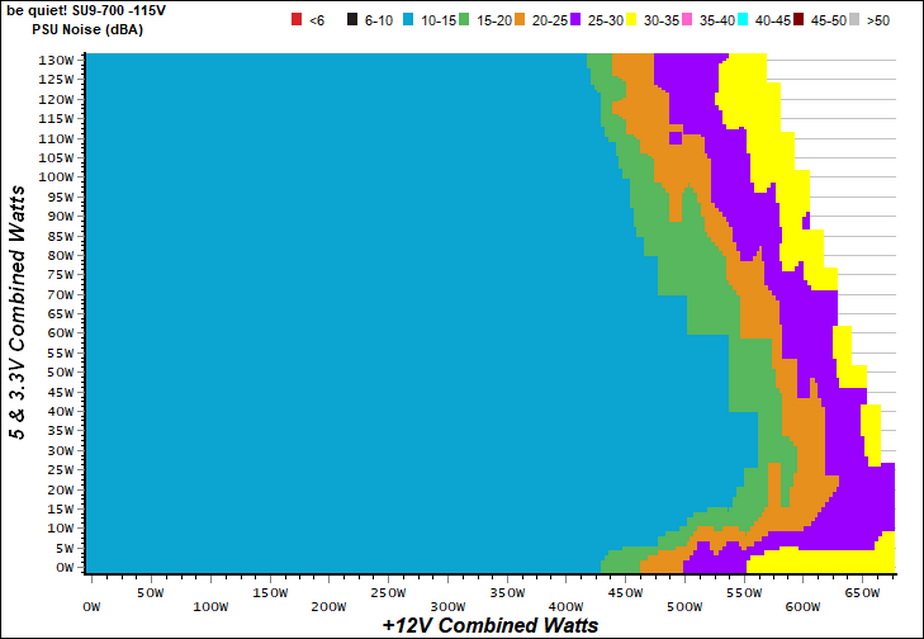
For the majority of its operational range the unit's output noise remains at very low levels, thanks to the highly relaxed fan profile.
Protection Features
Our protection features evaluation methodology is described in detail here.
|
Protection Features |
|
|
OCP |
12V1: >38.5A (>116.67%), <11.65V |
|
OPP |
878.21W (125.46%) |
|
OTP |
✓ (155°C @ 12V Heatsink) |
|
SCP |
12V: ✓ |
|
PWR_OK |
Accurate but less than 16ms |
|
NLO |
✓ |
|
SIP |
Surge: MOV |
The pair of +12V rails have a high enough OCP threshold, to cope with power spikes. The rest rails are ideally set at close to 130% for 5V and 3.3V and 120% for 5VSB. Lastly, the over power protection triggering point is set at 878W, which is the normal level for a 700W unit.
The over temperature protection is present and it kicks in once the heatsink that hosts the +12V rectifiers reaches 155°C.
There is short circuit protection, as expected, on all rails and the power ok signal is accurate but much lower than 16ms. Finally, we found an MOV in the transient filter and the inrush current protection is handled by a NTC thermistor, which isn't supported by a bypass relay though.
DC Power Sequencing
According to Intel’s most recent Power Supply Design Guide (revision 1.4) the +12V and 5V voltages must be equal or greater than the 3.3V rail’s output at all times, during the power-up and normal operation. For our first measurement, we turn the unit off and switch it back on without any load in any of the rails.
In the second test, we set the PSU to standby mode, dial full load and start it afterwards. In the last test, while the power supply is completely switched off (we cut off the power or switch the supply off through its power switch), we dial full load before restoring power.
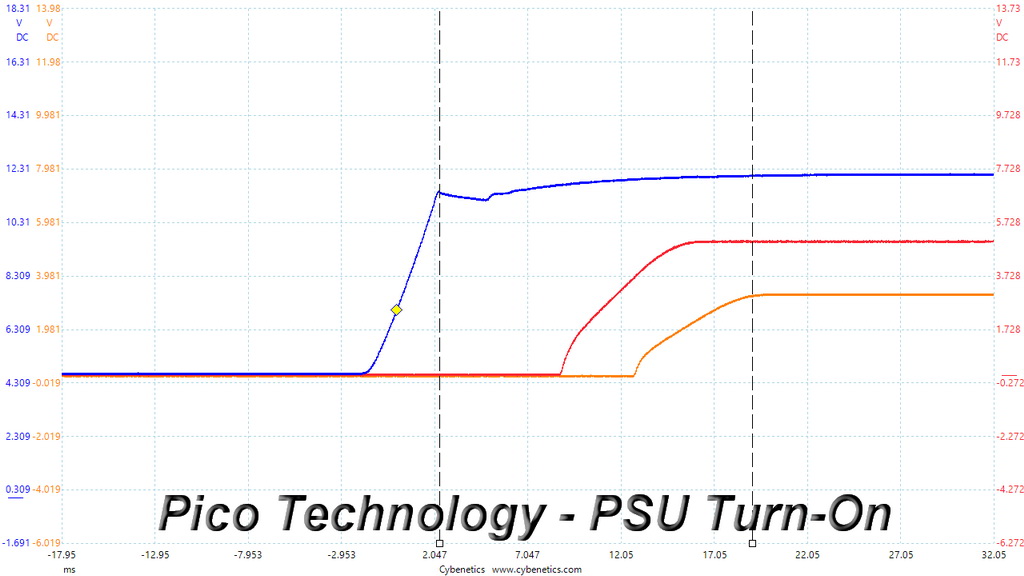
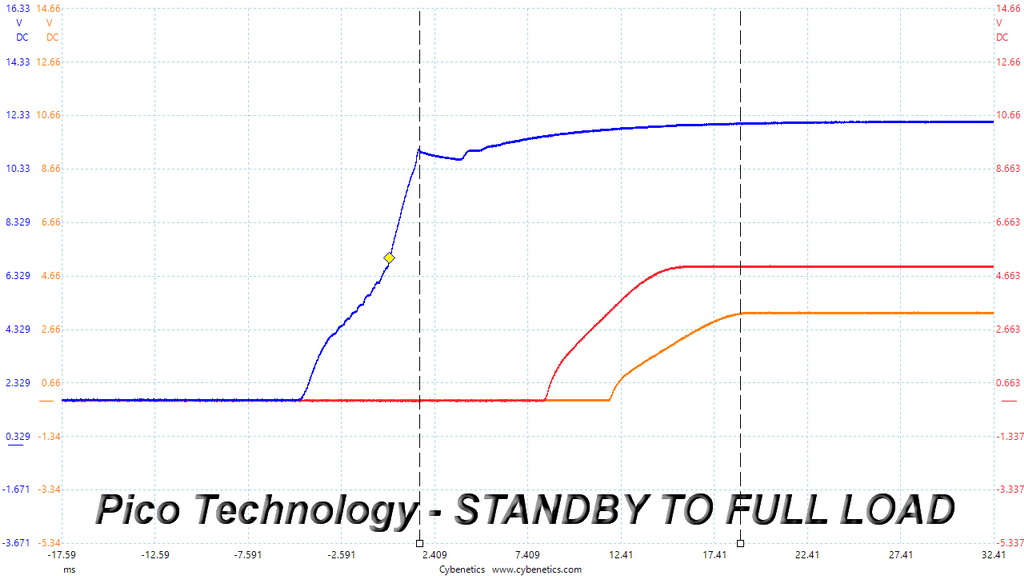
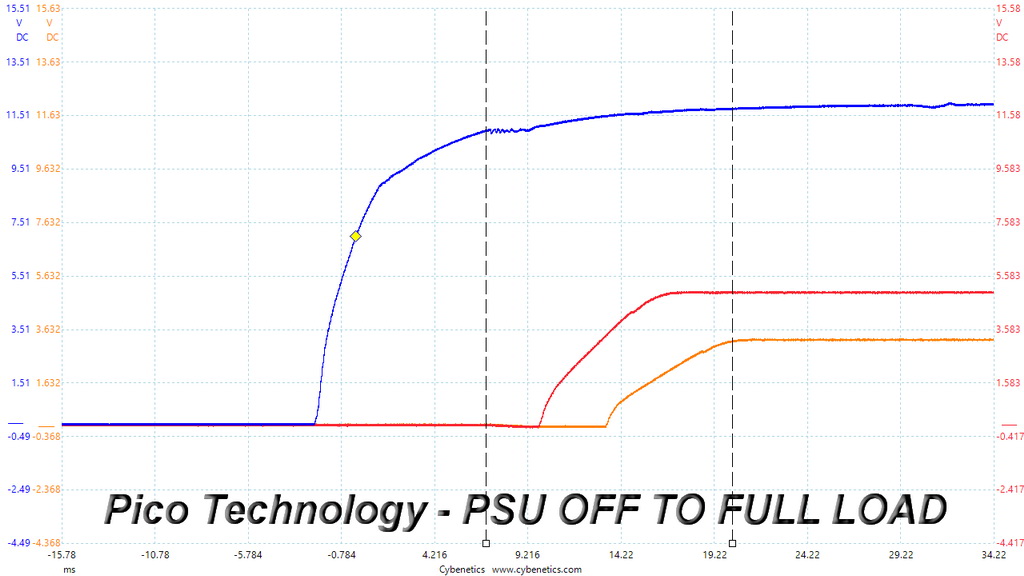
There are no problems in these tests, as you can see from the scope's shots above. The 3.3V rail is always at a lower level than the 5V and +12V ones.
Our cross-load tests are described in detail here.
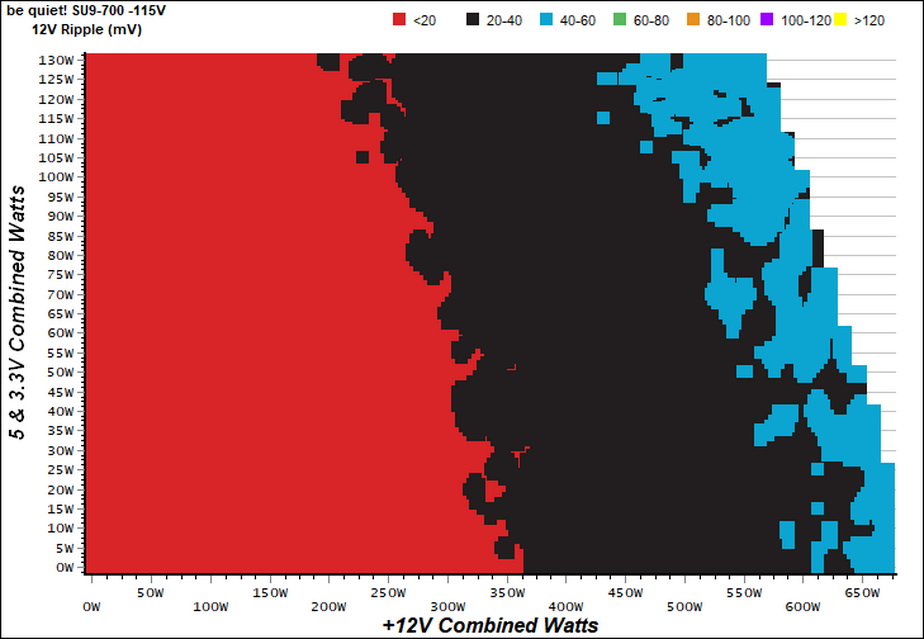
To generate the following charts, we set our loaders to auto mode through our custom-made software before trying more than 1500 possible load combinations with the +12V, 5V, and 3.3V rails. The load regulation deviations in each of the charts below are calculated by taking the nominal values of the rails (12V, 5V, and 3.3V) as point zero. The ambient temperature is between at 30°C (86°F) to 32°C (89.6°F).
Load Regulation Charts
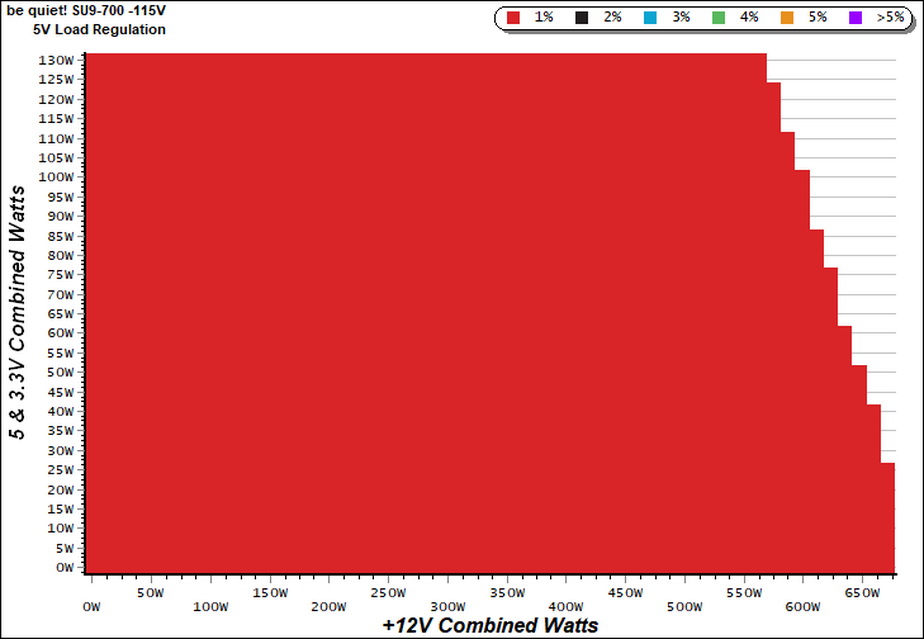
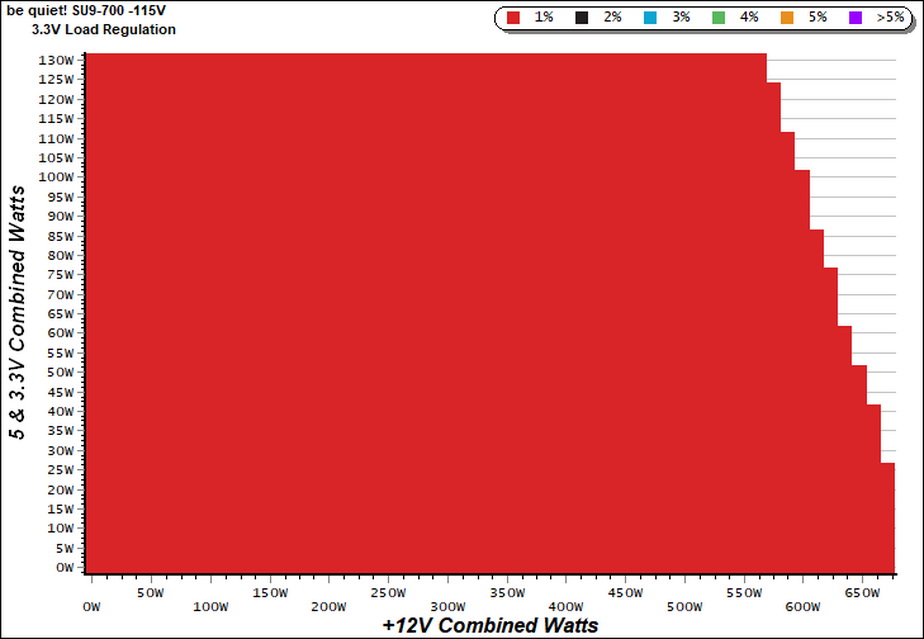
Efficiency Chart
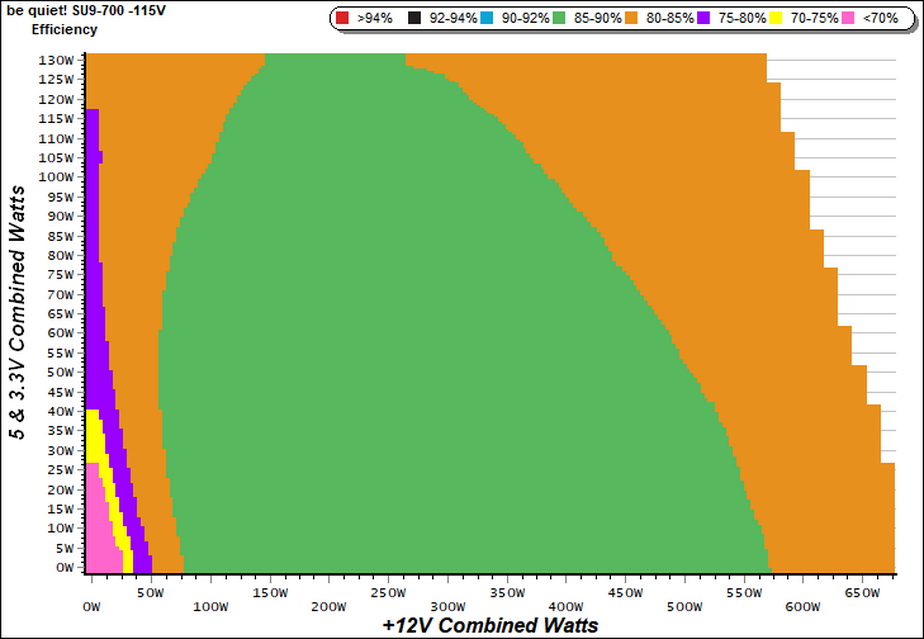
For the majority of its operation range, the unit delivers within 85-90% efficiency. This is a satisfactory performance, for the standards of the Bronze and ETA-A- efficiency standards.
Ripple Charts
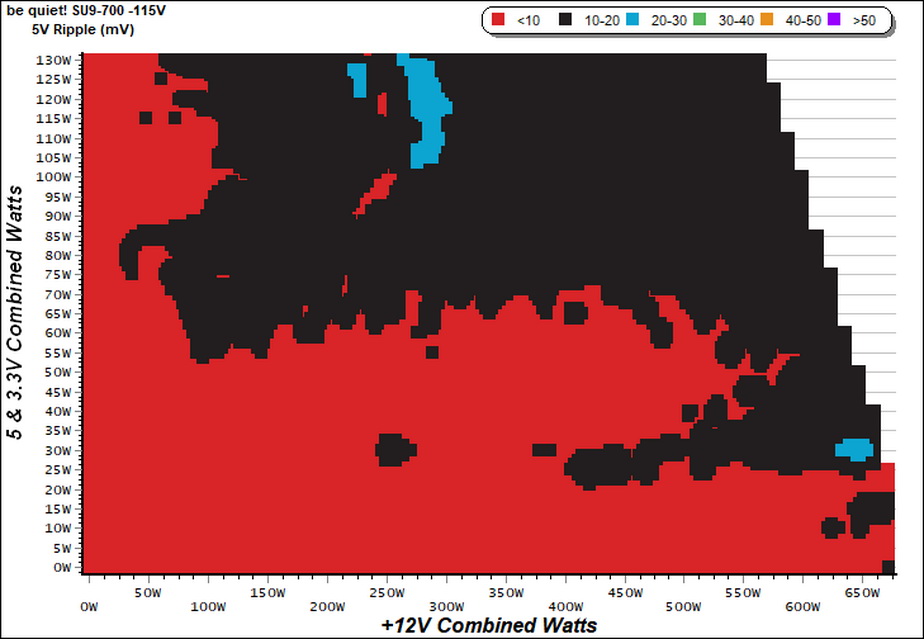
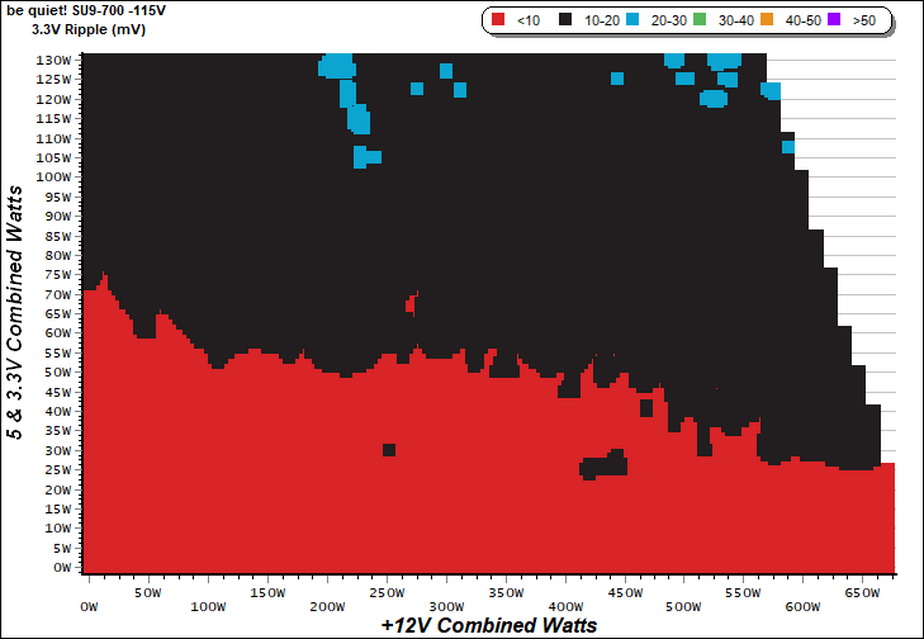
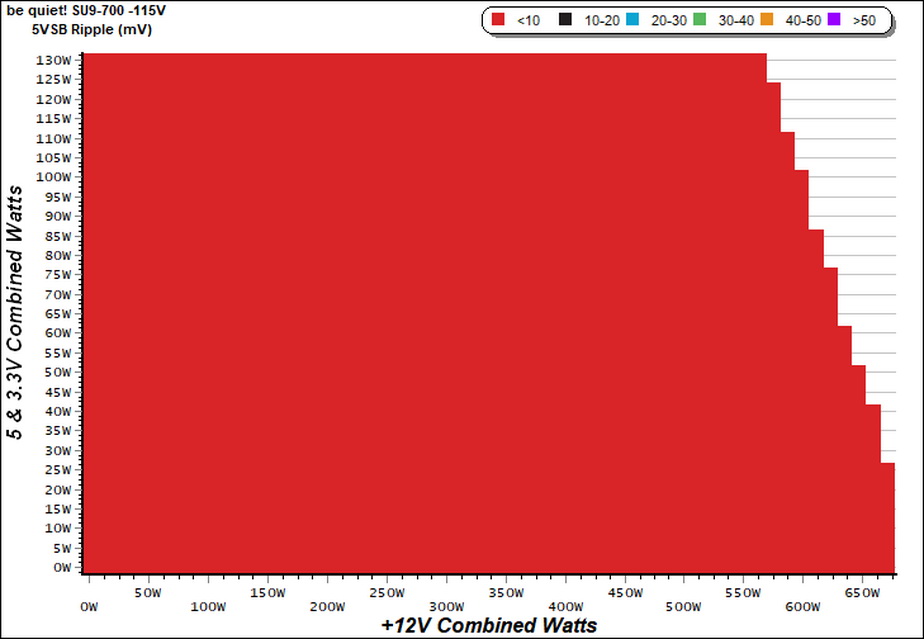
Infrared Images
We apply half-load for 10 minutes with the PSU’s top cover and cooling fan removed before taking photos with our modified FLIR E4 camera that delivers 320×240 IR resolution (76,800 pixels).
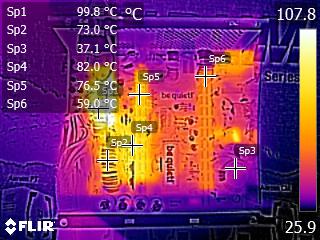
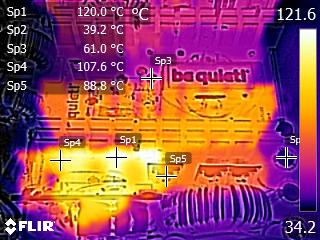
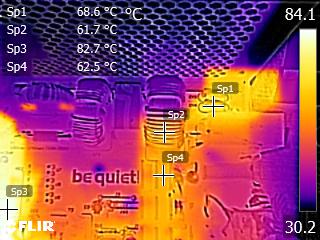
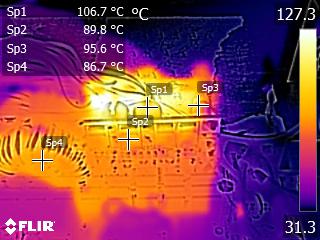
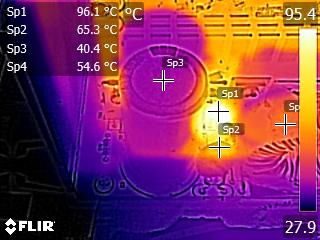
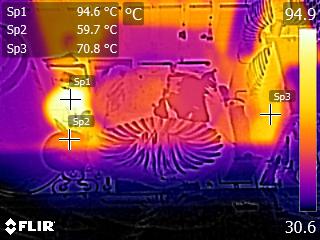
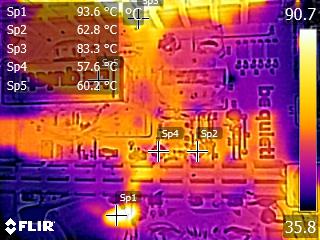
The temperatures on the DC-DC converters are high, because we stress those pretty hard with 12 Amperes of load on each of the minor rails. A resistor right behind the NTC thermistor also has high temperature, a clear indication that energy is lost on it.
Speaking of the NTC thermistor, its operating temperature is around 60°C, since it isn't supported by a bypass relay. This means that in a hot restart and with the bulk cap empty, the inrush current will go through the roof.
Advanced Transient Response Tests
For details on our transient response testing, please click here.
These tests are crucial because they simulate the transient loads a PSU is likely to handle (such as booting a RAID array or an instant 100 percent load of CPU/GPUs). We call these “Advanced Transient Response Tests” and they are designed to be very tough to master, especially for a PSU with a capacity of less than 500W.
In all of the tests, we use an oscilloscope to measure the voltage drops caused by the transient load. The voltages should remain within the ATX specifications regulation limits.
We should note that the ATX spec requires for capacitive loading during the transient rests, but in our methodology we chose to apply the worst case scenario with no extra capacitance on the rails.
Advanced Transient Response at 20 Percent – 200ms
| Voltage | Before | After | Change | Pass/Fail |
|---|---|---|---|---|
| 12V | 12.147V | 11.921V | 1.86% | Pass |
| 5V | 5.012V | 4.862V | 2.99% | Pass |
| 3.3V | 3.308V | 3.135V | 5.23% | Fail |
| 5VSB | 5.051V | 4.986V | 1.29% | Pass |
Advanced Transient Response at 20 Percent – 20ms
| Voltage | Before | After | Change | Pass/Fail |
|---|---|---|---|---|
| 12V | 12.147V | 11.862V | 2.35% | Pass |
| 5V | 5.012V | 4.842V | 3.39% | Pass |
| 3.3V | 3.308V | 3.104V | 6.17% | Fail |
| 5VSB | 5.052V | 4.996V | 1.11% | Pass |
Advanced Transient Response at 20 Percent – 1ms
| Voltage | Before | After | Change | Pass/Fail |
|---|---|---|---|---|
| 12V | 12.148V | 11.899V | 2.05% | Pass |
| 5V | 5.012V | 4.844V | 3.35% | Pass |
| 3.3V | 3.308V | 3.107V | 6.08% | Fail |
| 5VSB | 5.051V | 4.963V | 1.74% | Pass |
Advanced Transient Response at 50 Percent – 200ms
| Voltage | Before | After | Change | Pass/Fail |
|---|---|---|---|---|
| 12V | 12.106V | 11.883V | 1.84% | Pass |
| 5V | 5.005V | 4.847V | 3.16% | Pass |
| 3.3V | 3.299V | 3.116V | 5.55% | Fail |
| 5VSB | 5.021V | 4.955V | 1.31% | Pass |
Advanced Transient Response at 50 Percent – 20ms
| Voltage | Before | After | Change | Pass/Fail |
|---|---|---|---|---|
| 12V | 12.106V | 11.825V | 2.32% | Pass |
| 5V | 5.005V | 4.823V | 3.64% | Pass |
| 3.3V | 3.299V | 3.086V | 6.46% | Fail |
| 5VSB | 5.021V | 4.956V | 1.29% | Pass |
Advanced Transient Response at 50 Percent – 1ms
| Voltage | Before | After | Change | Pass/Fail |
|---|---|---|---|---|
| 12V | 12.106V | 11.829V | 2.29% | Pass |
| 5V | 5.005V | 4.809V | 3.92% | Pass |
| 3.3V | 3.299V | 3.104V | 5.91% | Fail |
| 5VSB | 5.021V | 4.950V | 1.41% | Pass |
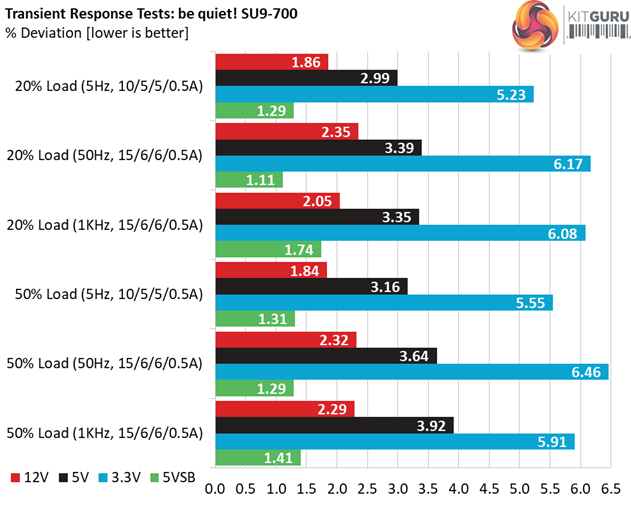
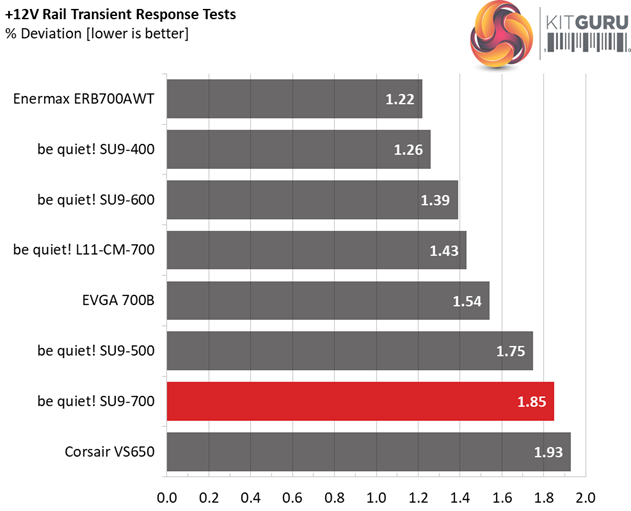
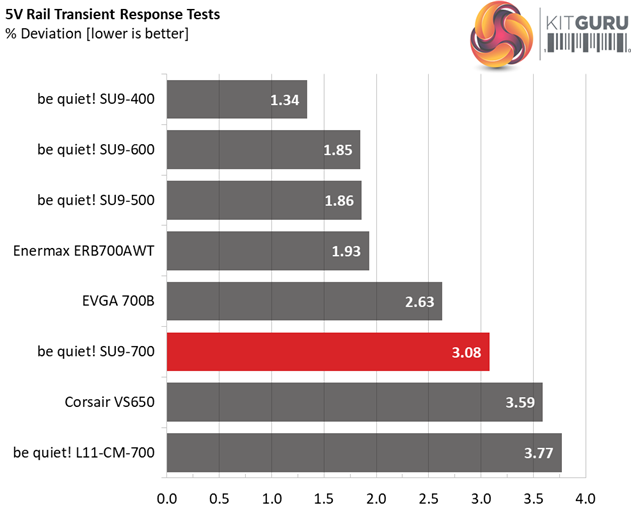
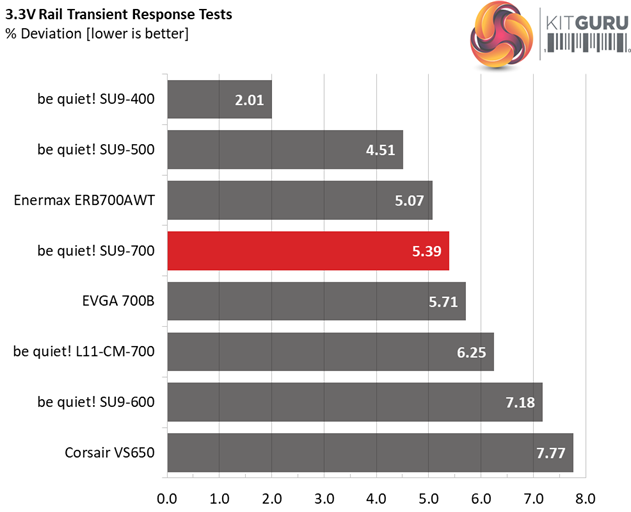
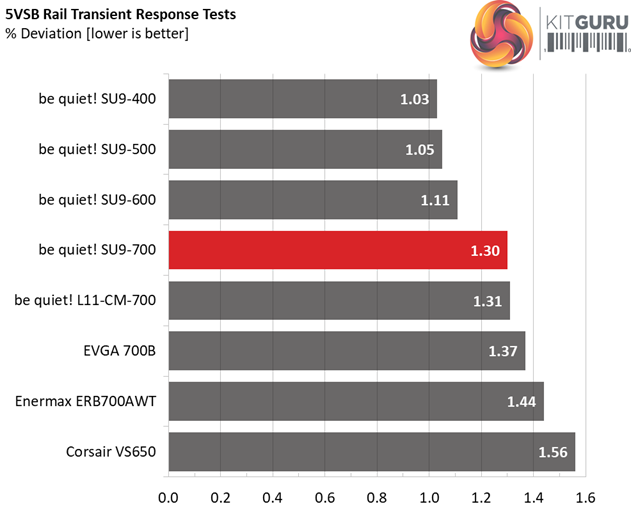
The results above are quite disappointing to see. The transient response tests are the most important since they provide with great accuracy, the PSU's response under real life scenarios where the load is not steady but it constantly changes. The +12V rail's deviation is close to 2% and the 5V exceeds 3%. The 3.3V rail is the worst of all though, and it fails in all of our tests.
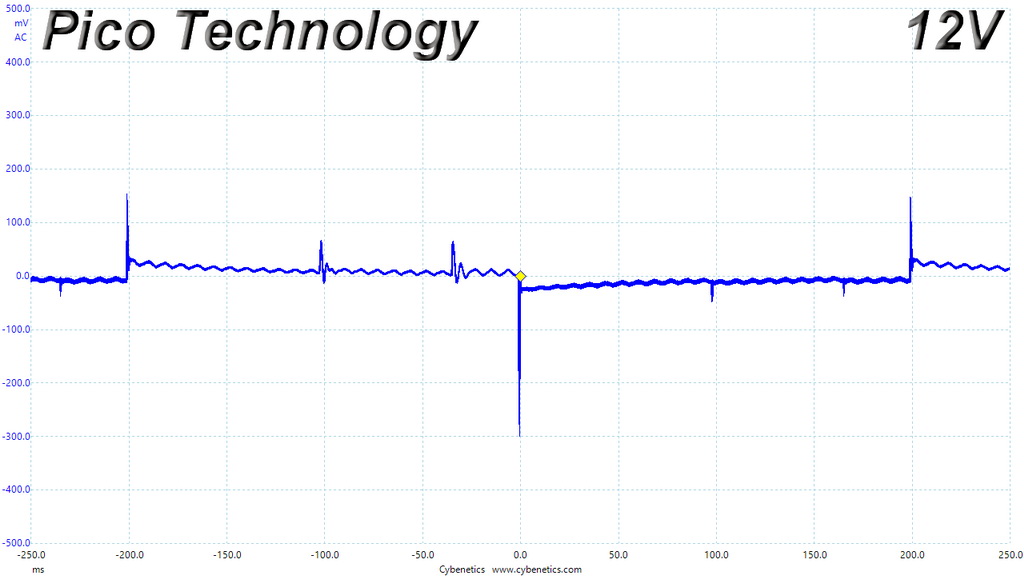
Here are the oscilloscope screenshots we took during Advanced Transient Response Testing:
Transient Response At 20 Percent Load – 200ms
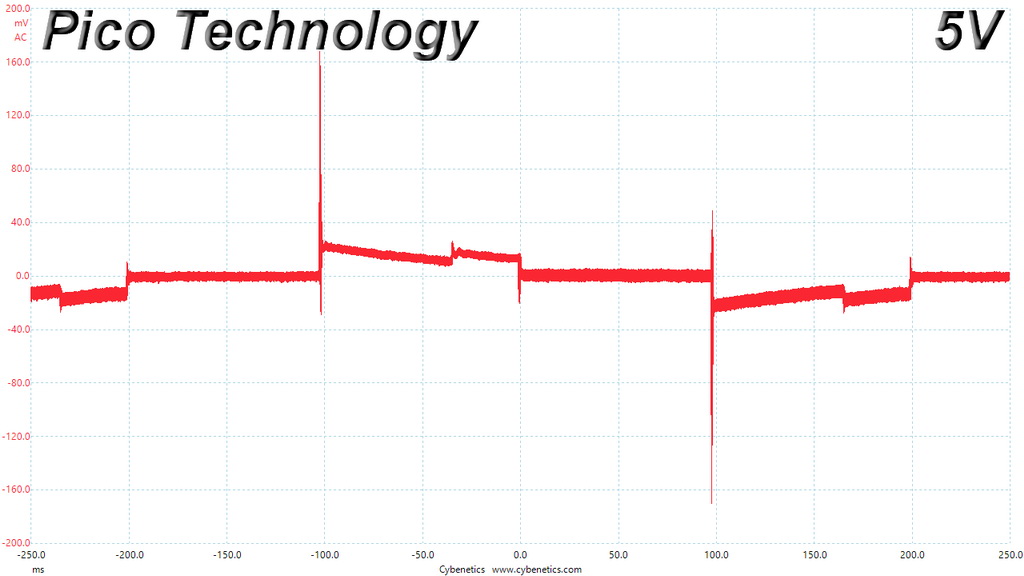
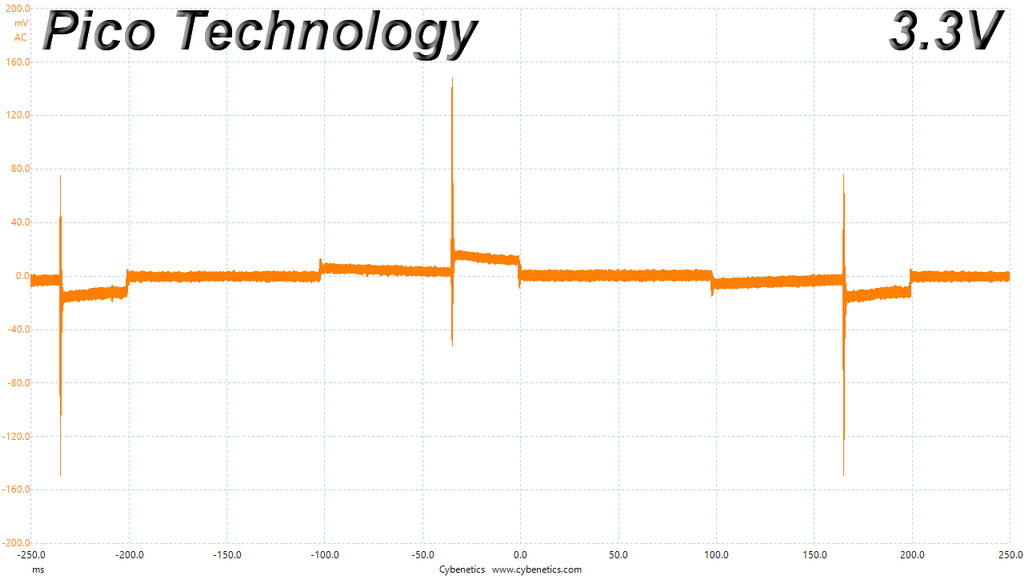
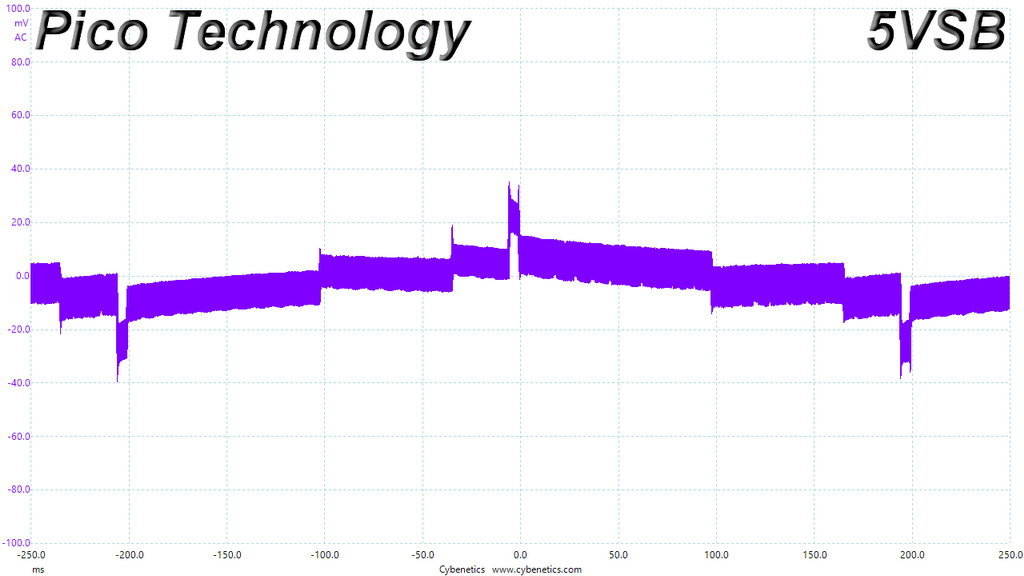
Transient Response At 20 Percent Load – 20ms
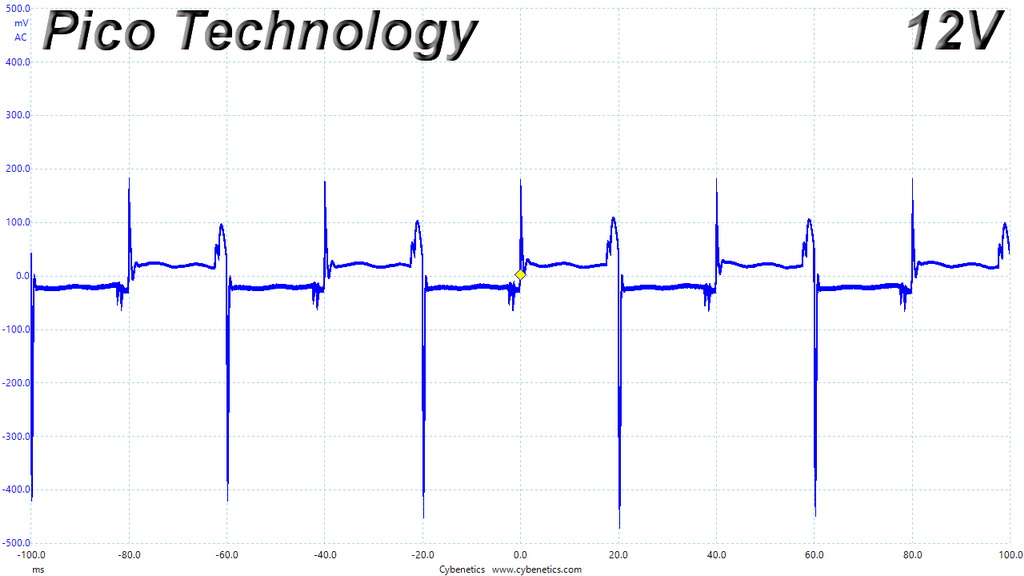
Transient Response At 20 Percent Load – 1ms
Transient Response At 50 Percent Load – 200ms
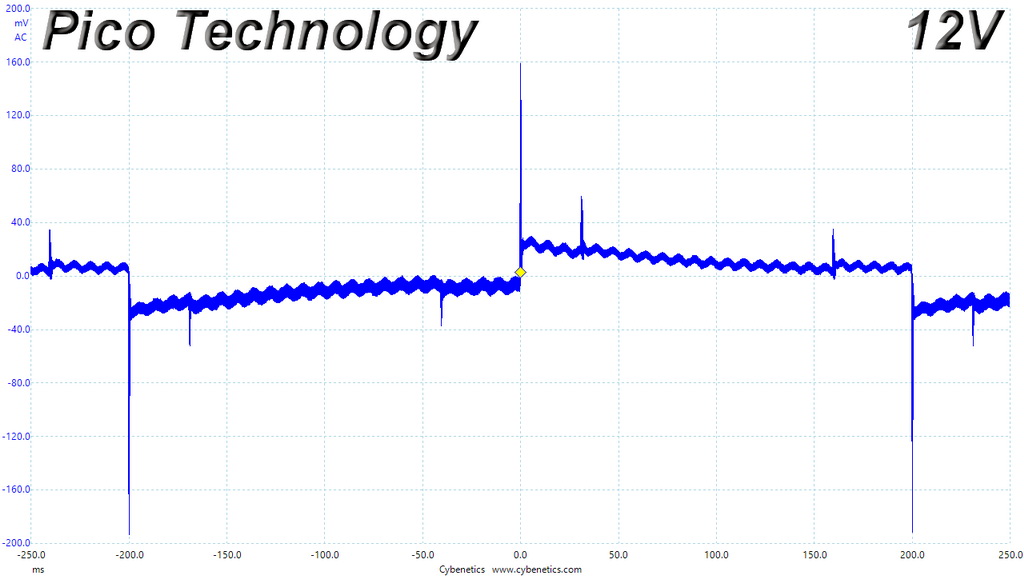
Transient Response At 50 Percent Load – 20ms
Transient Response At 50 Percent Load – 1ms
Turn-On Transient Tests
In the next set of tests, we measure the SU9-700’’s response in simpler transient load scenarios—during its power-on phase.
For our first measurement, we turn the PSU off, dial in the maximum current the 5VSB rail can handle, and switch the PSU back on.
In the second test, we dial the maximum load the +12V rail can handle and start the PSU while it is in standby mode. In the last test, while the PSU is completely switched off (we cut off the power or switch the PSU off through its power switch), we dial the maximum load the +12V rail can handle before restoring power.
The ATX specification states that recorded spikes on all rails should not exceed 10 percent of their nominal values (+10 percent for 12V is 13.2V, and 5.5V for 5V).
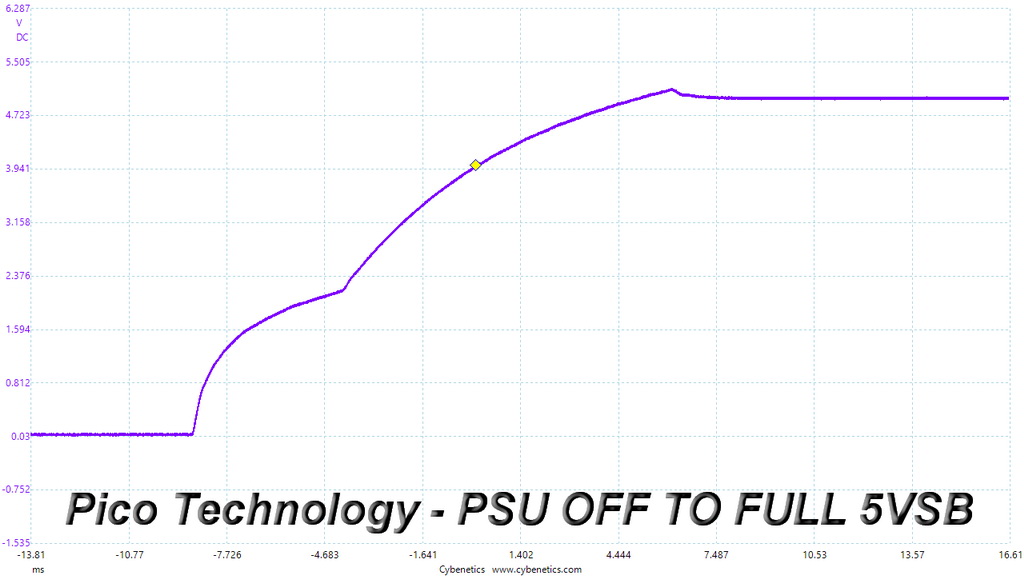
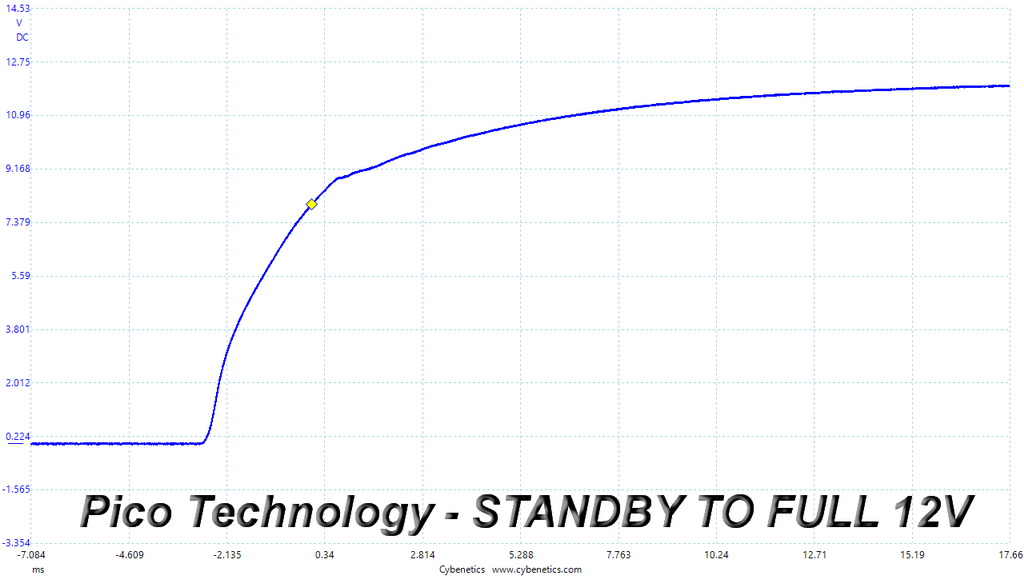
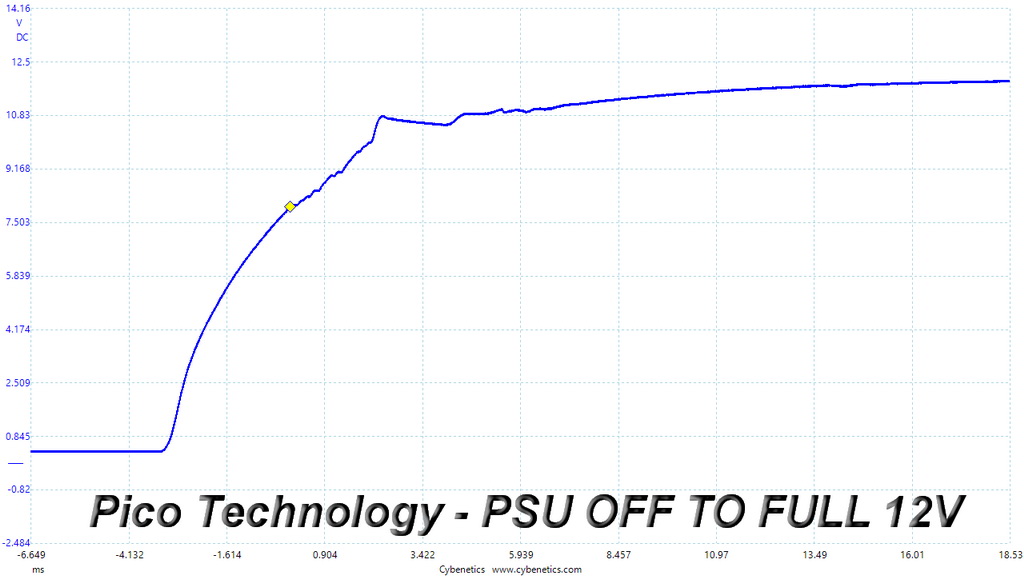
We see two small overshoots here, one at 5VSB and the second during the last test. Overall satisfactory performance.
To learn how we measure ripple, please click here.
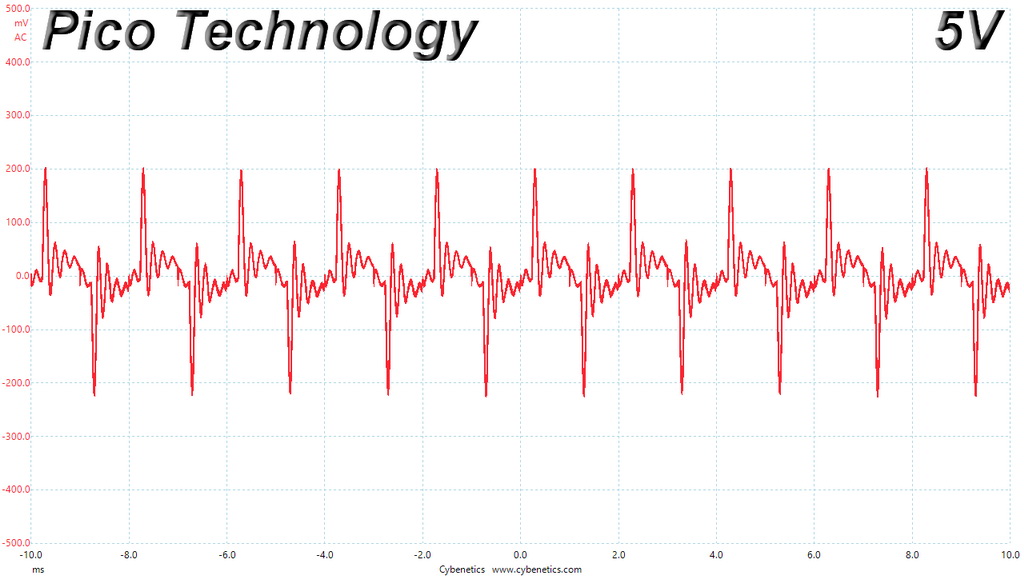
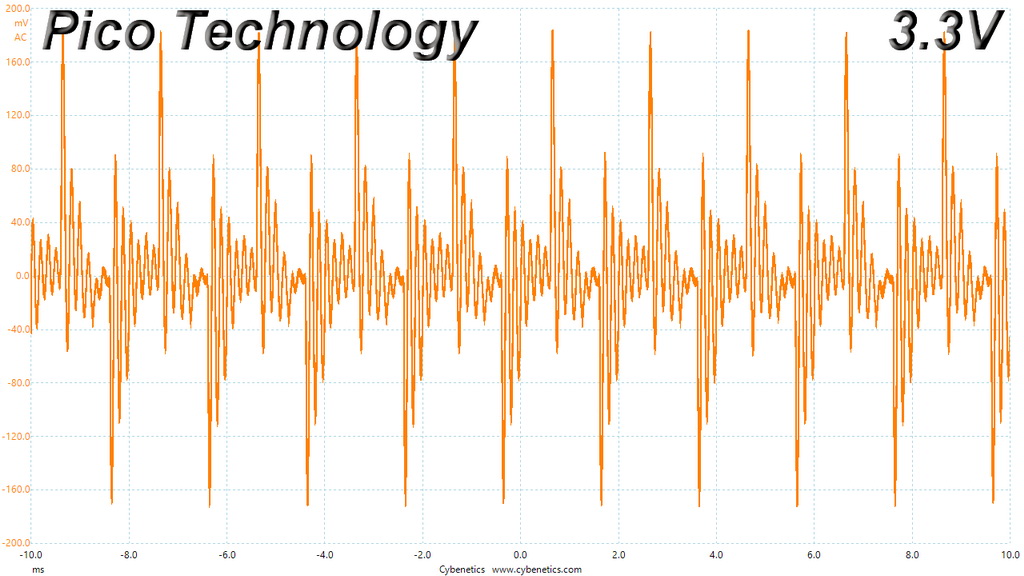
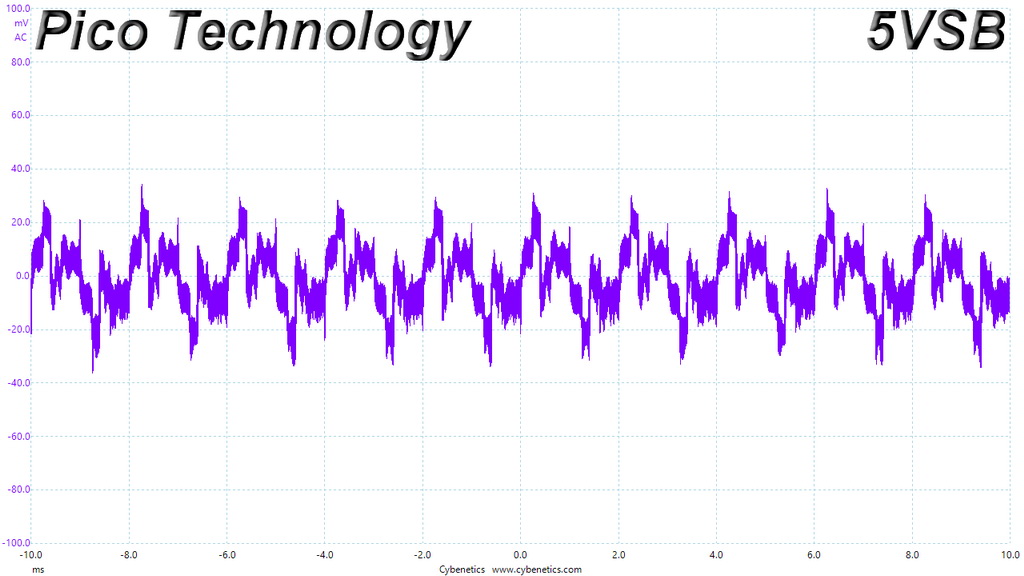
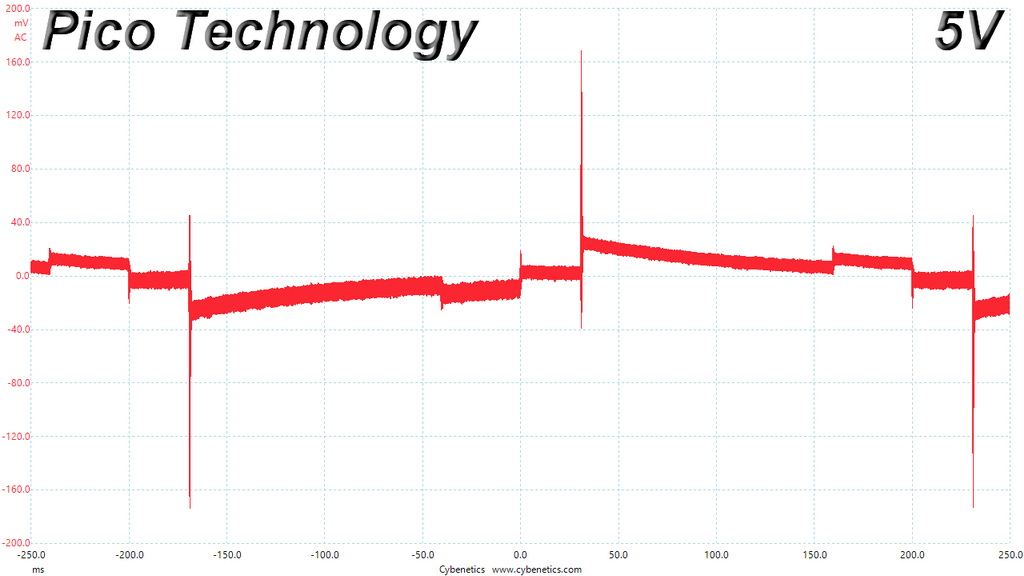
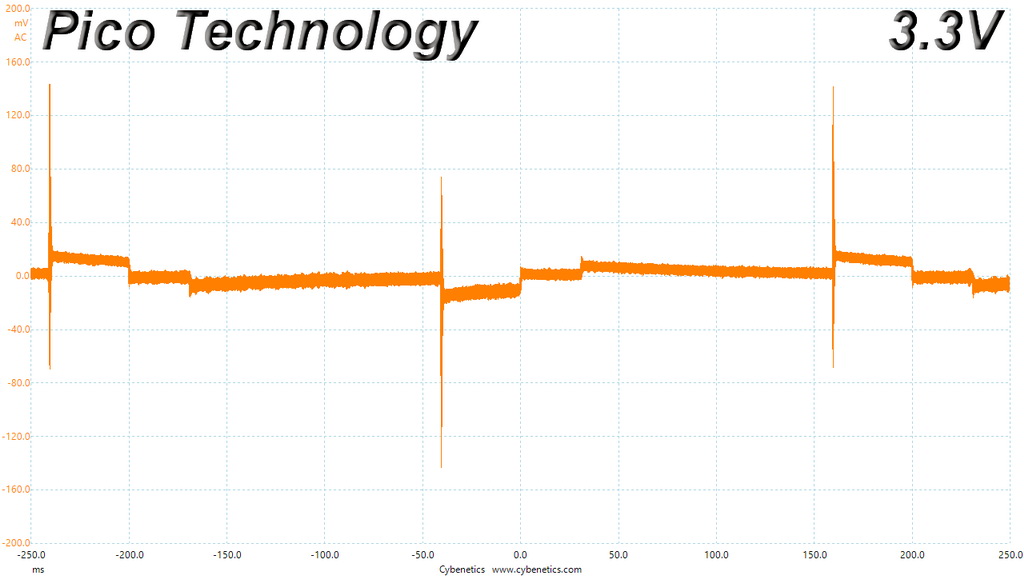
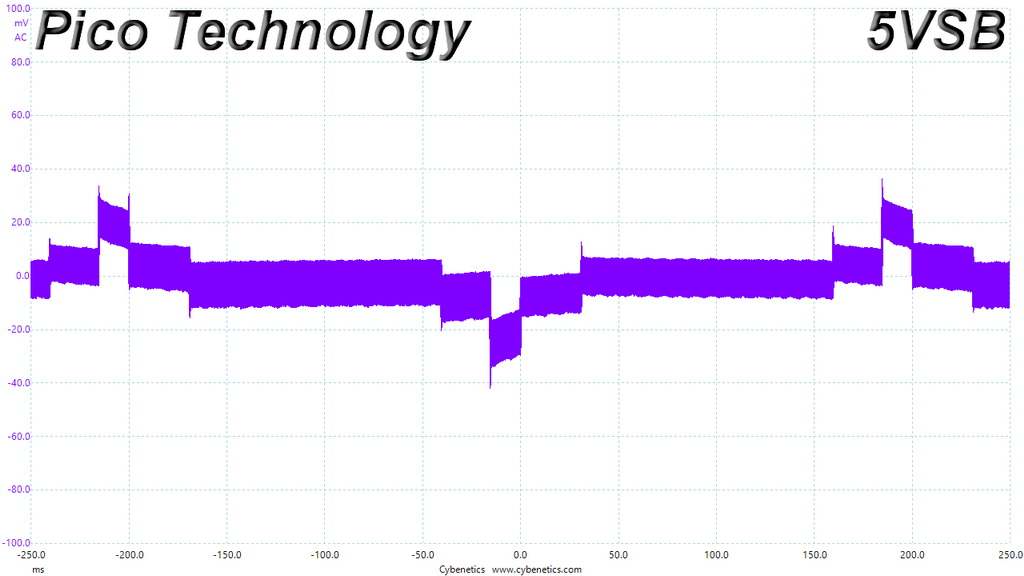
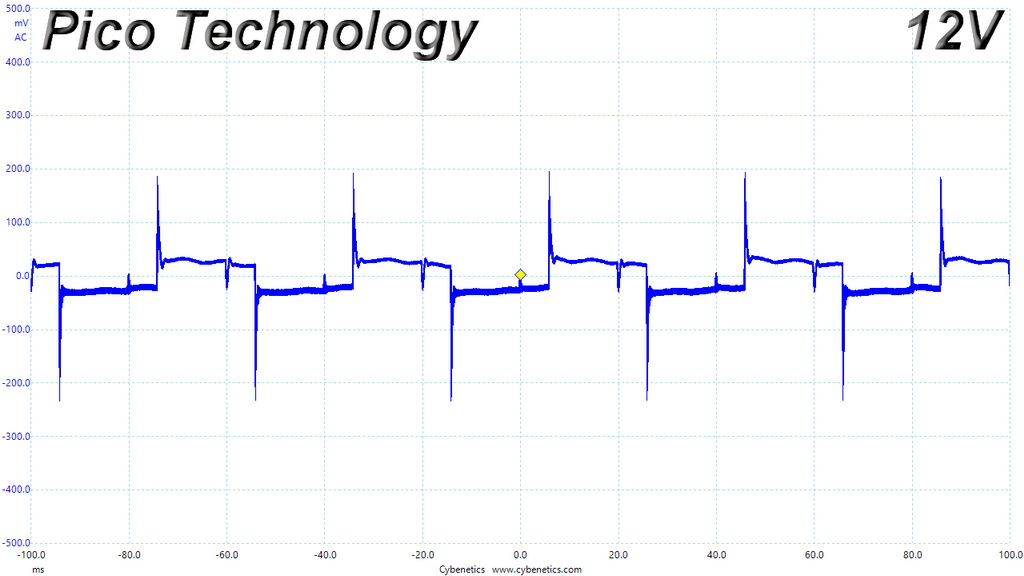
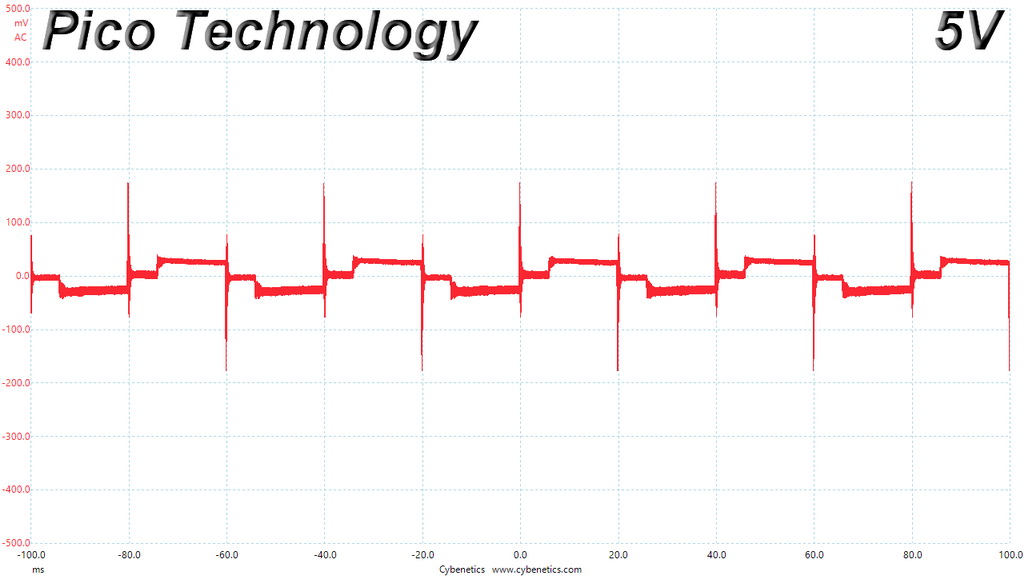
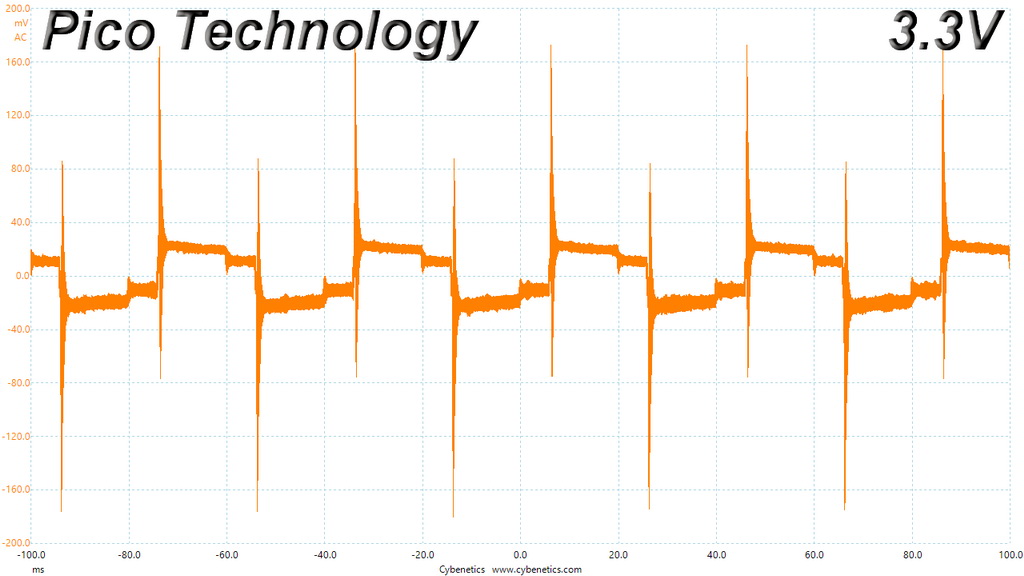
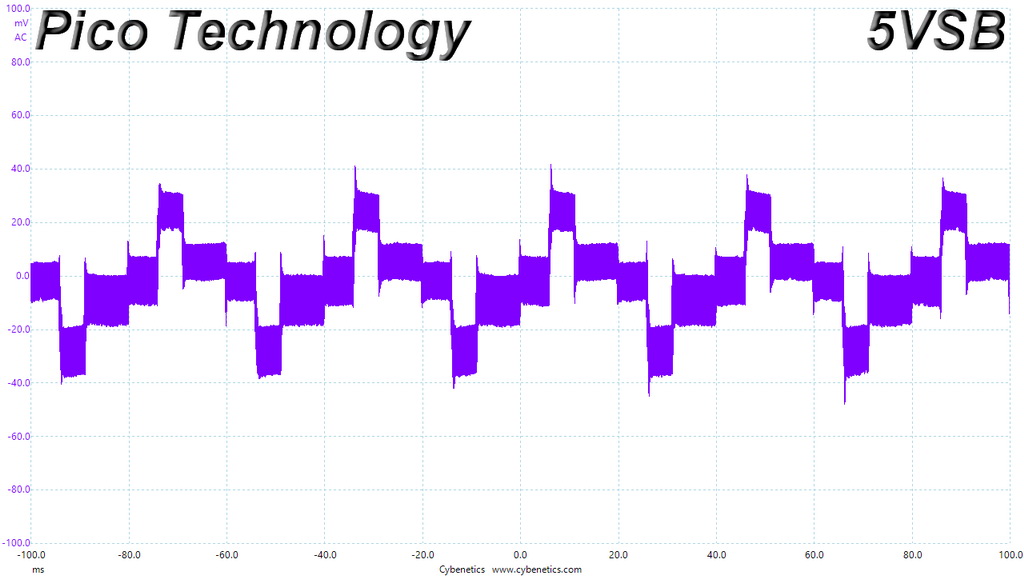
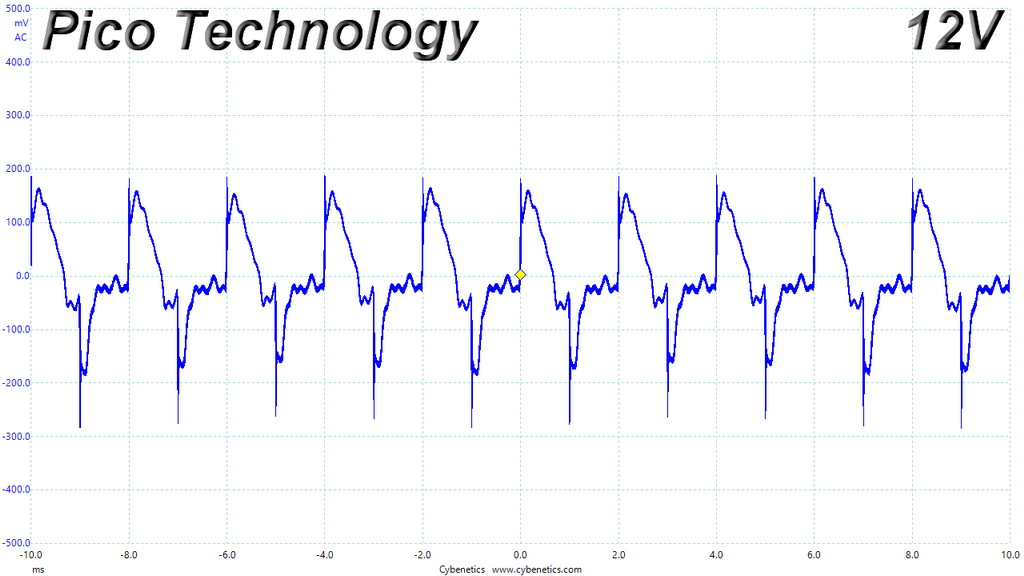
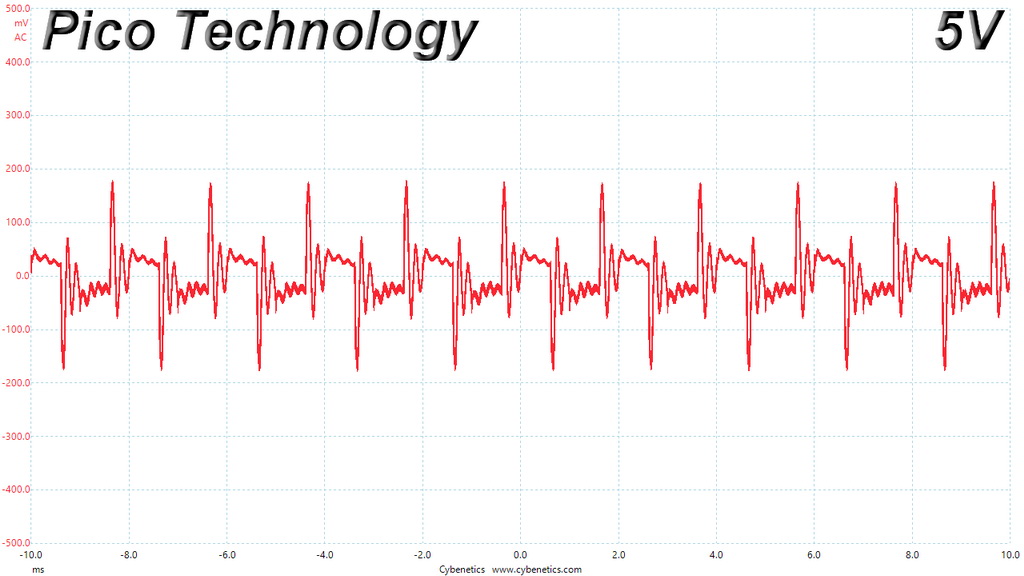
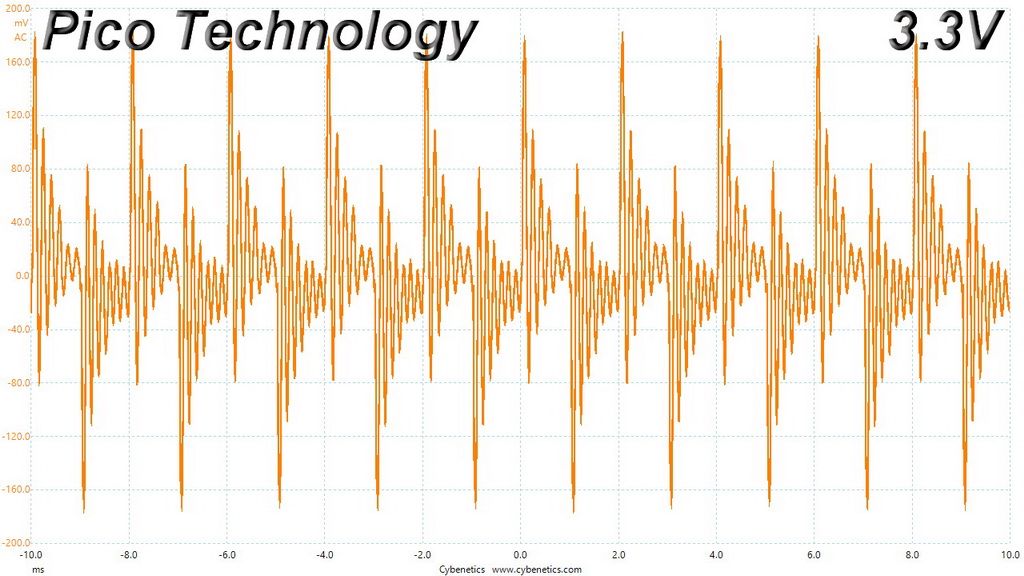
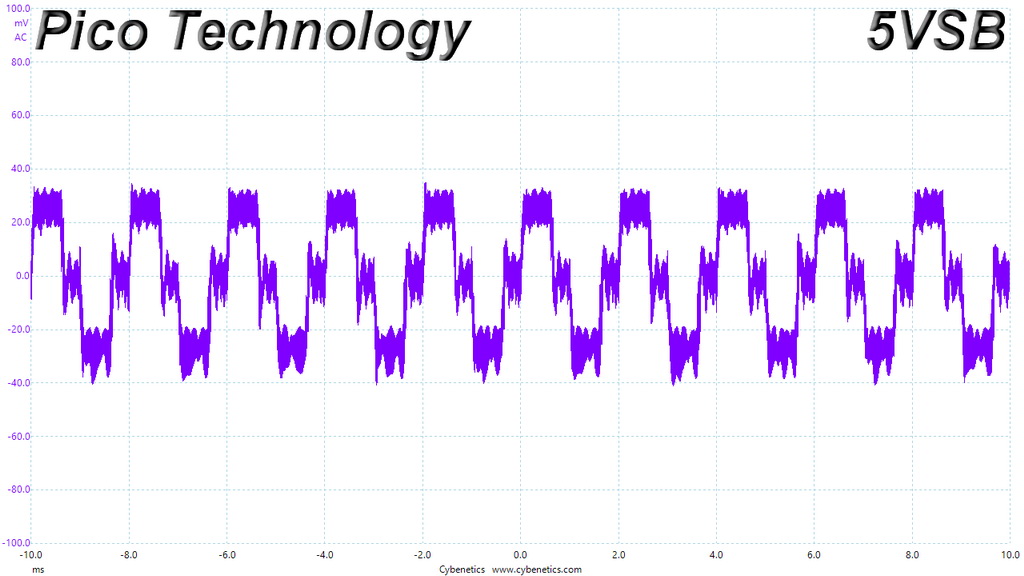
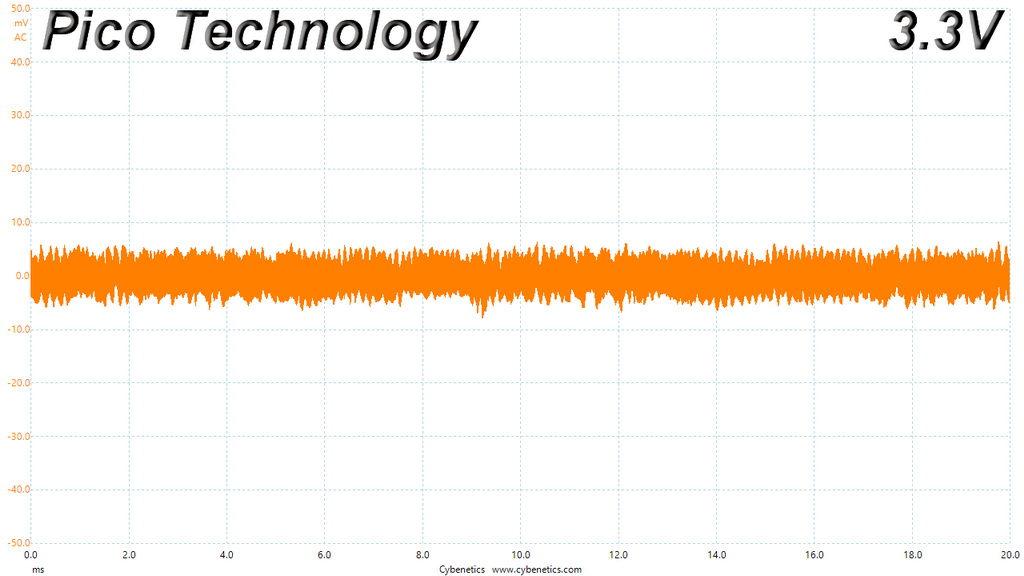
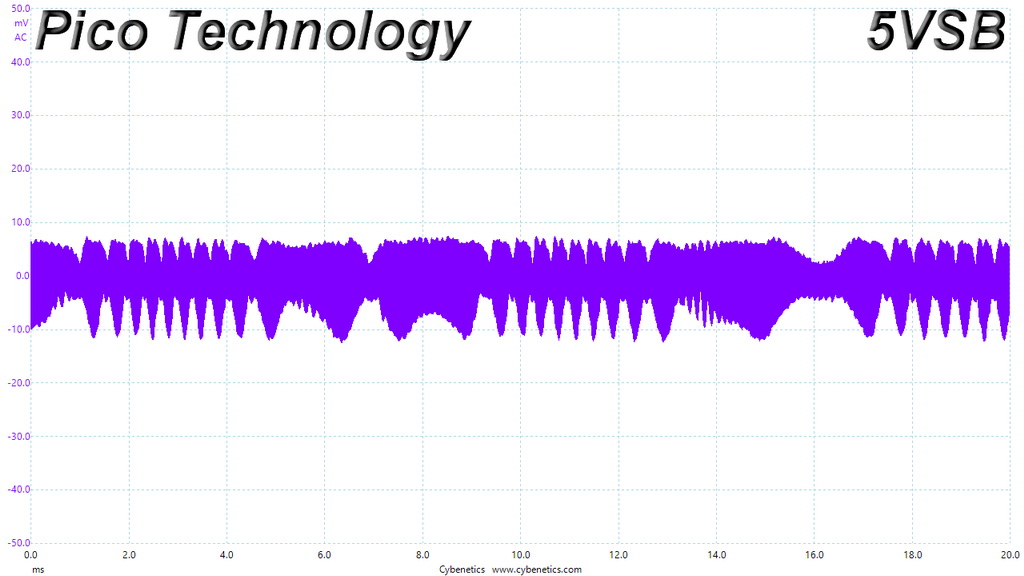
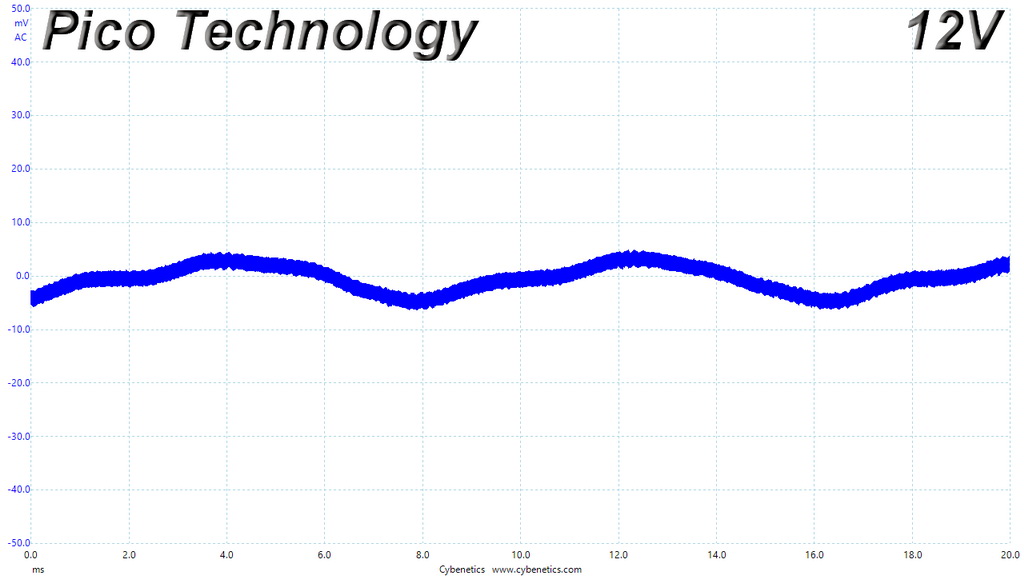
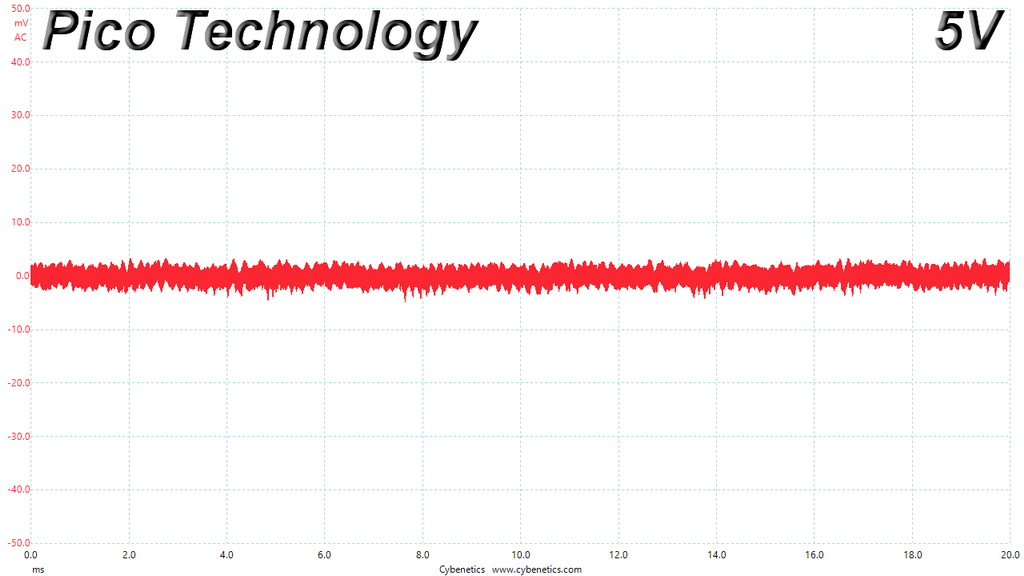
The following table includes the ripple levels we measured on the SU9-700’’s rails. The limits, according to the ATX specification, are 120mV (+12V) and 50mV (5V, 3.3V, and 5VSB).
| Test | 12V | 5V | 3.3V | 5VSB | Pass/Fail |
| 10% Load | 9.6 mV | 6.1 mV | 5.8 mV | 5.2 mV | Pass |
| 20% Load | 13.4 mV | 7.1 mV | 7.1 mV | 6.7 mV | Pass |
| 30% Load | 15.3 mV | 7.6 mV | 7.6 mV | 6.1 mV | Pass |
| 40% Load | 20.5 mV | 8.3 mV | 8.5 mV | 7.3 mV | Pass |
| 50% Load | 25.2 mV | 29.1 mV | 15.5 mV | 9.7 mV | Pass |
| 60% Load | 30.6 mV | 11.7 mV | 11.4 mV | 11.4 mV | Pass |
| 70% Load | 37.3 mV | 12.3 mV | 12.7 mV | 10.0 mV | Pass |
| 80% Load | 43.3 mV | 12.8 mV | 15.5 mV | 10.8 mV | Pass |
| 90% Load | 47.3 mV | 31.6 mV | 24.2 mV | 11.8 mV | Pass |
| 100% Load | 55.2 mV | 22.8 mV | 24.9 mV | 11.0 mV | Pass |
| 110% Load | 65.4 mV | 30.0 mV | 34.1 mV | 13.3 mV | Pass |
| Crossload 1 | 11.4 mV | 11.8 mV | 16.6 mV | 5.7 mV | Pass |
| Crossload 2 | 53.0 mV | 12.5 mV | 11.0 mV | 9.2 mV | Pass |
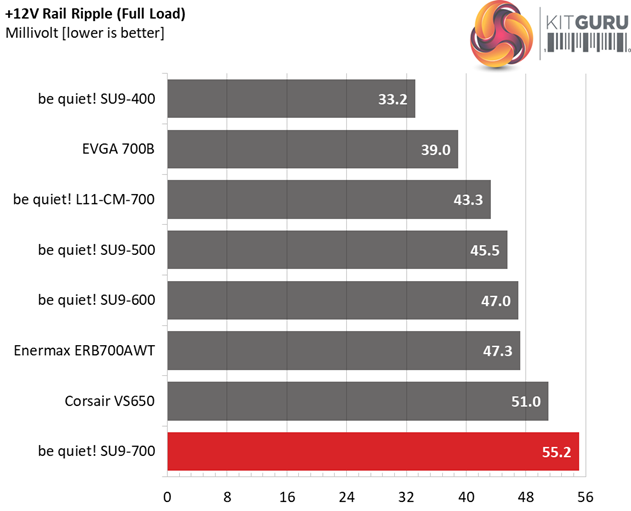
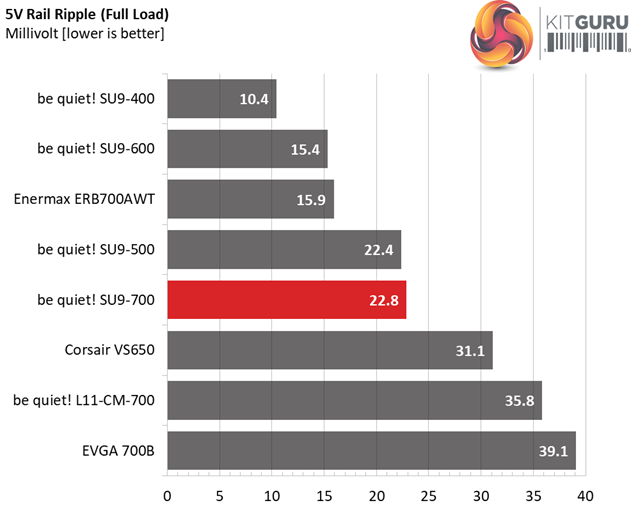
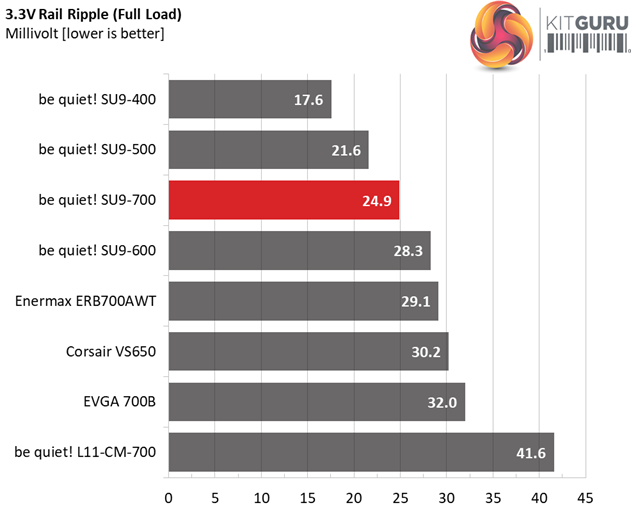
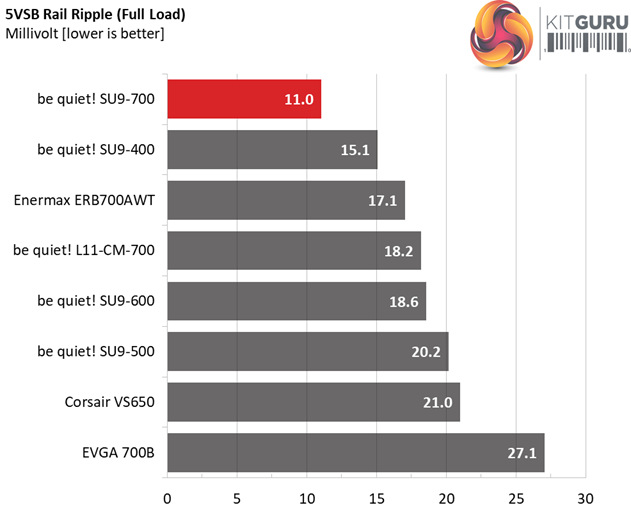
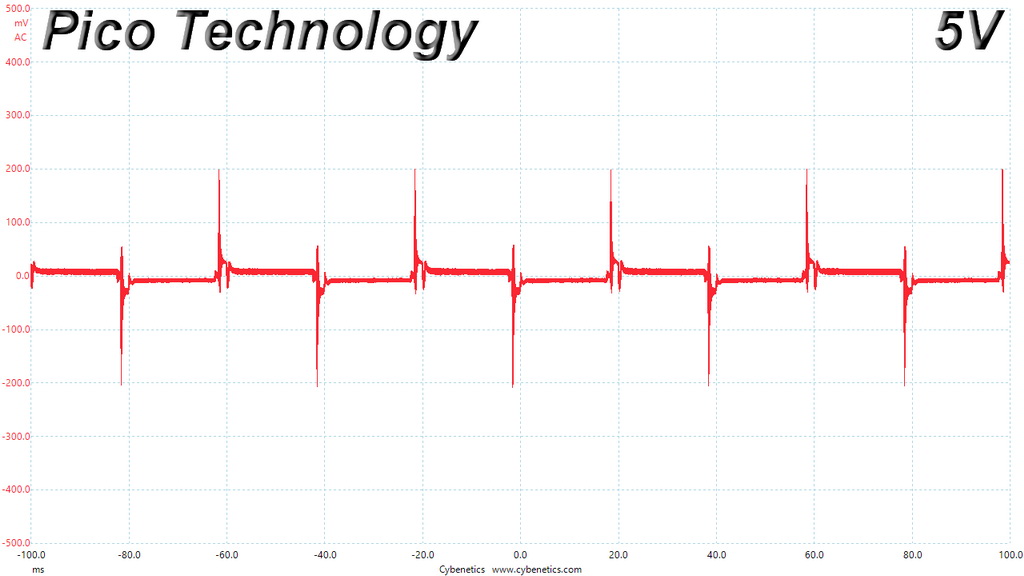
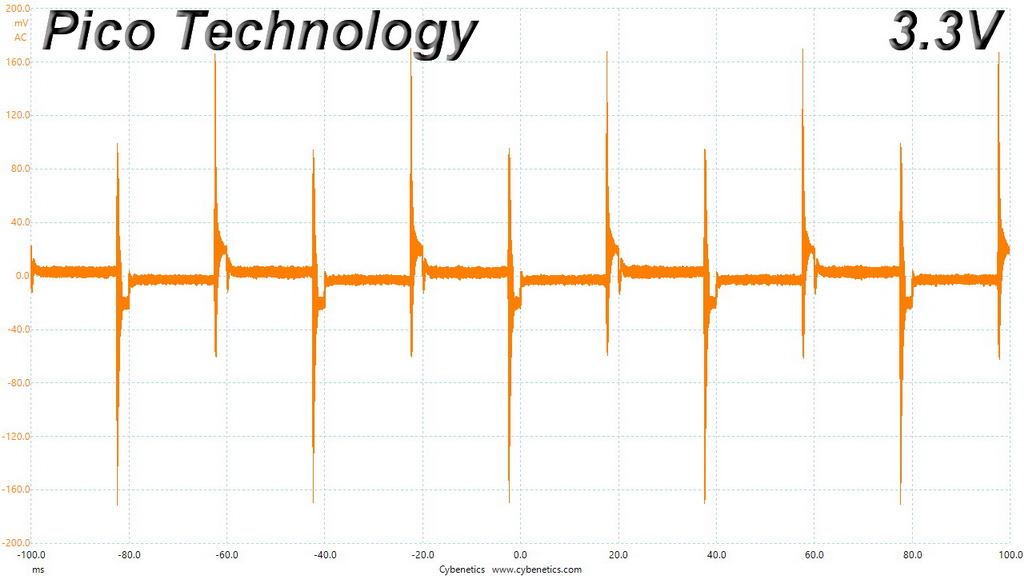
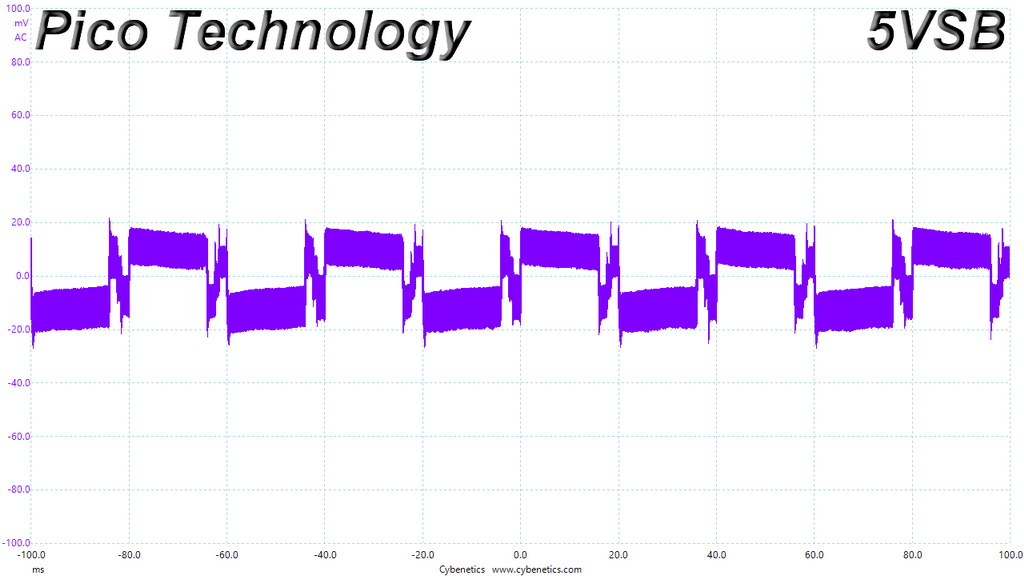
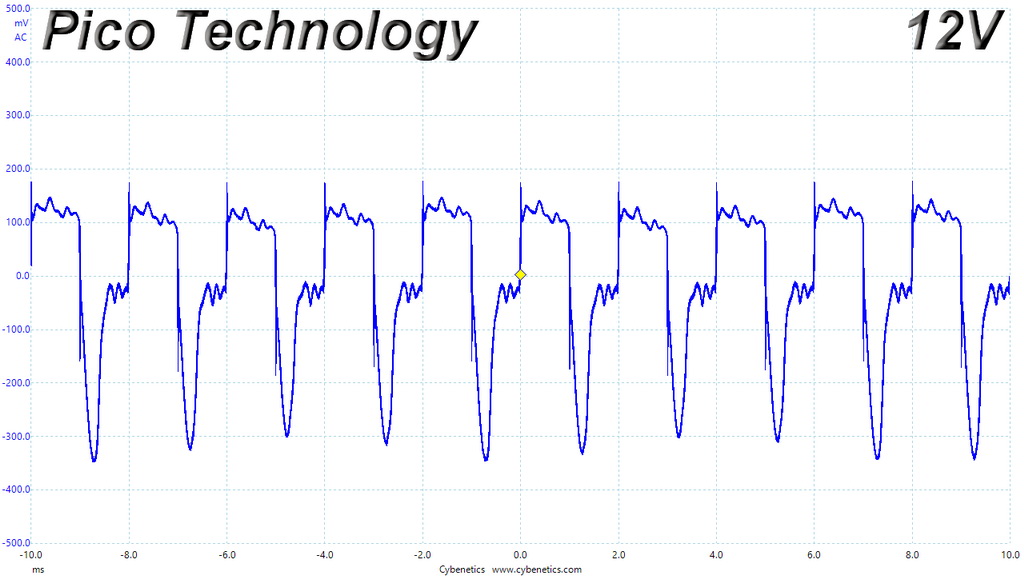
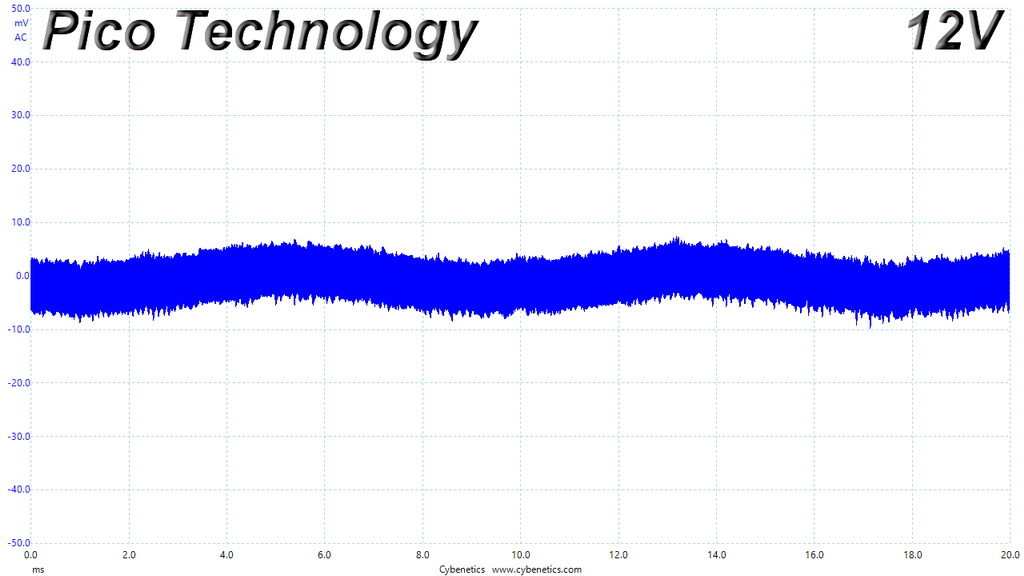
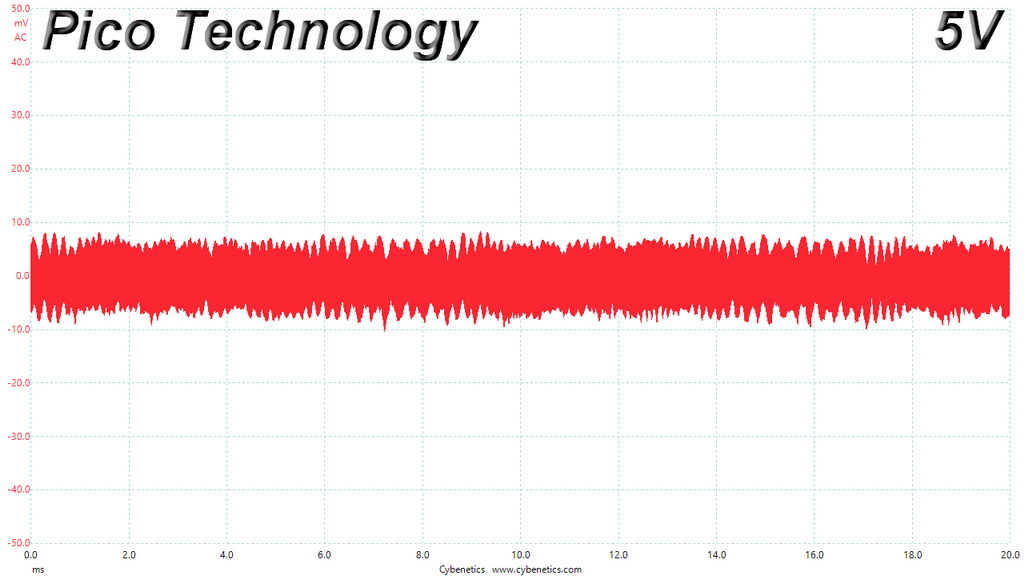
The ripple suppression is not that good at +12V. We would like to see below 50mV on this rail and ideally less than 40mV. On the minor rails the performance is better.
Ripple Oscilloscope Screenshots
The following oscilloscope screenshots illustrate the AC ripple and noise registered on the main rails (+12V, 5V, 3.3V and 5VSB). The bigger the fluctuations on the screen, the bigger the ripple/noise. We set 0.01 V/Div (each vertical division/box equals 0.01V) as the standard for all measurements.
Ripple At Full Load
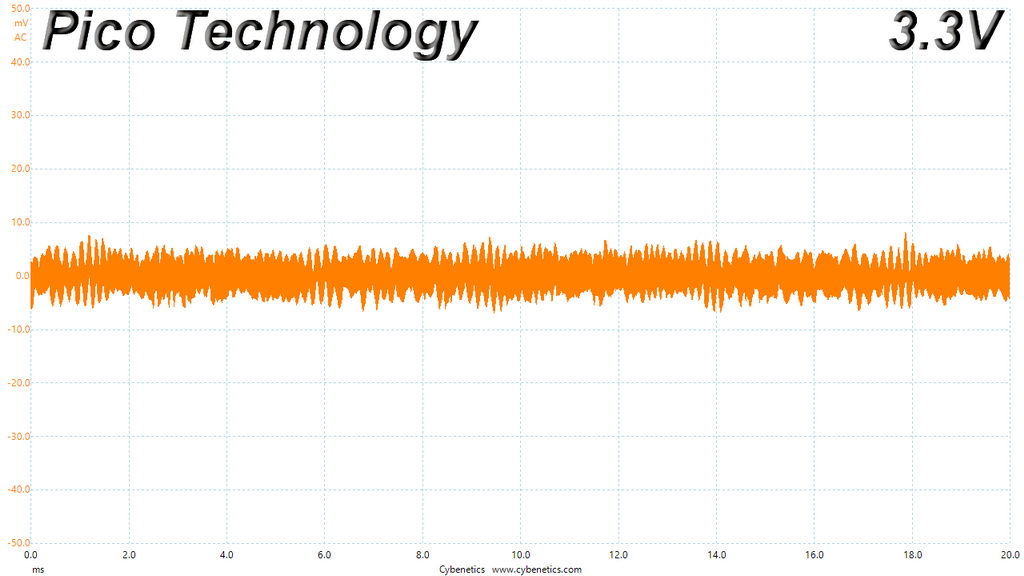
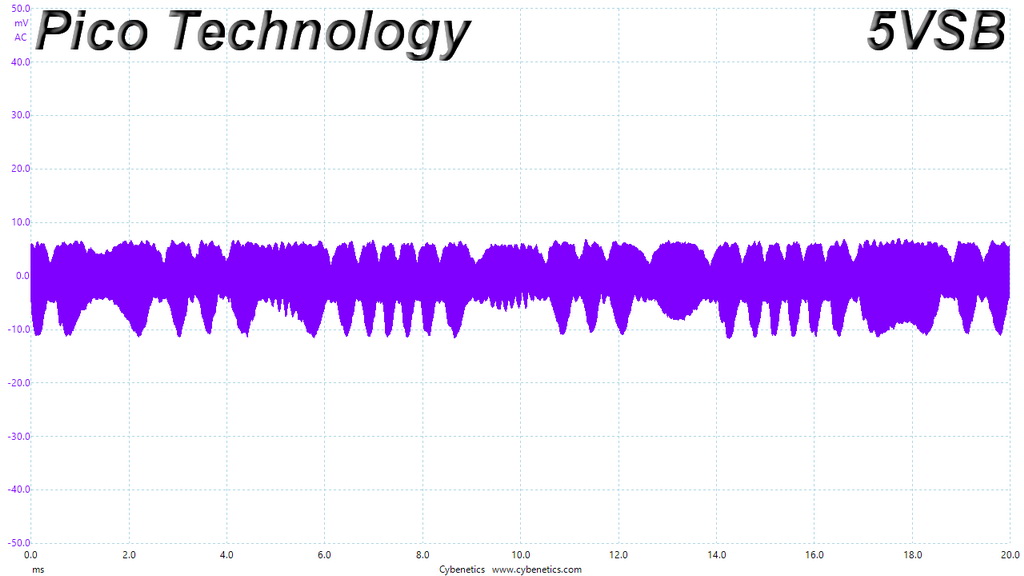
Ripple At 110-Percent Load
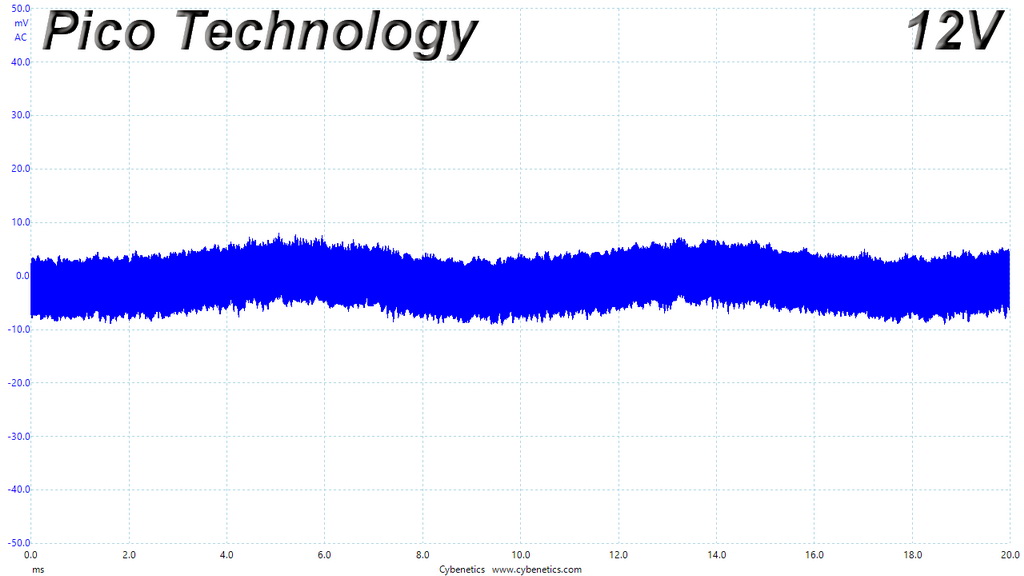
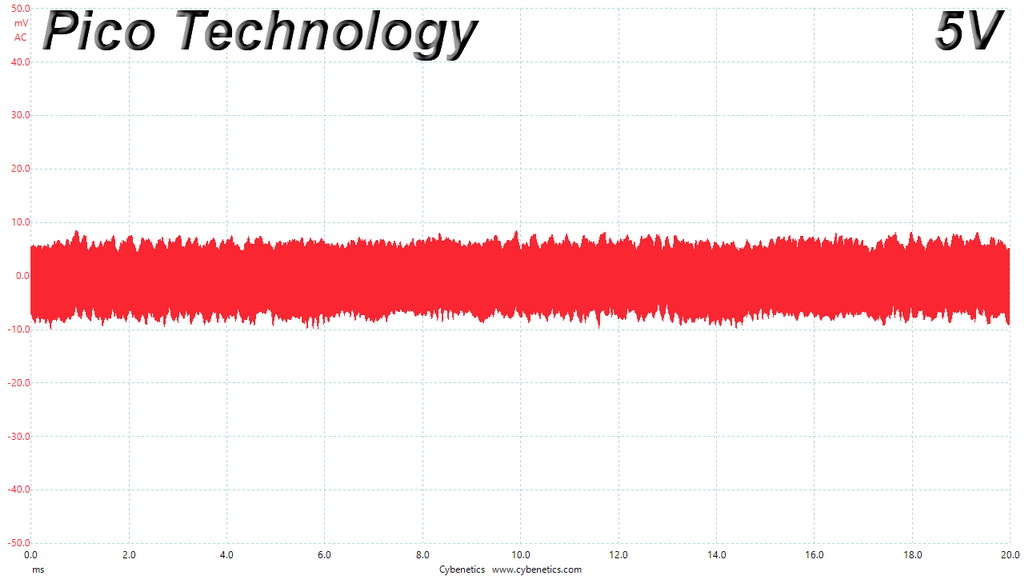
Ripple At Cross-Load 1
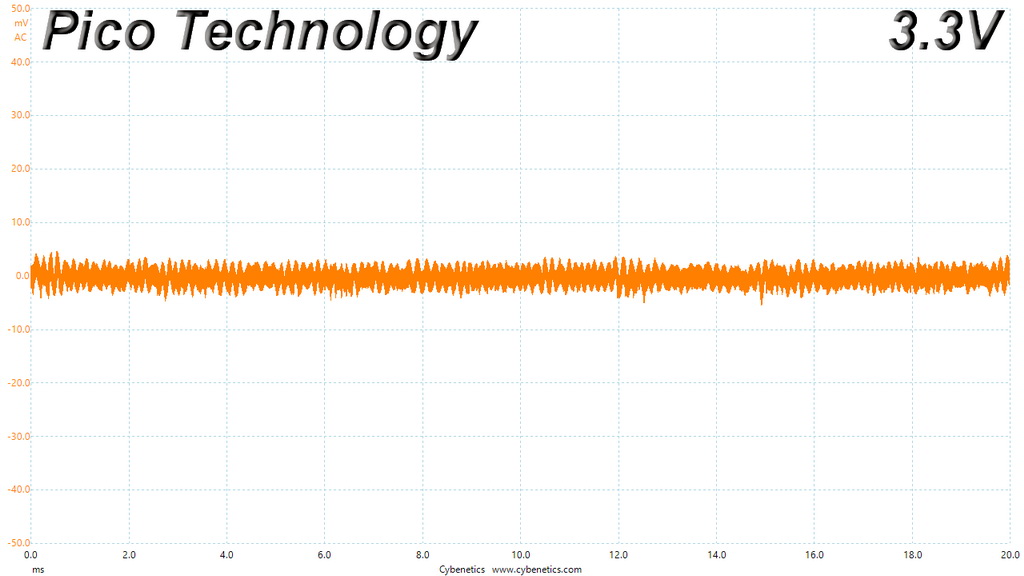
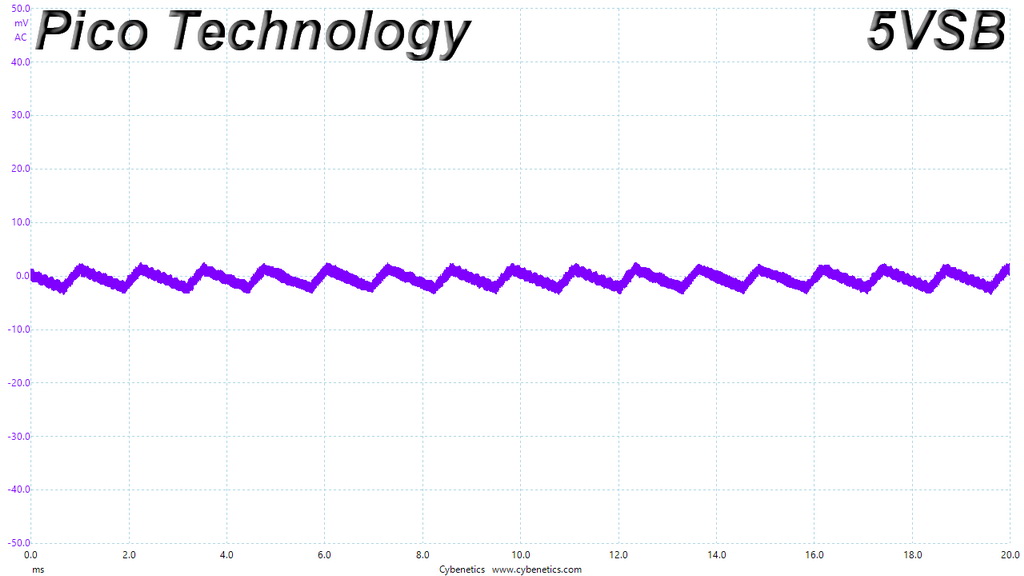
Ripple At Cross-Load 2
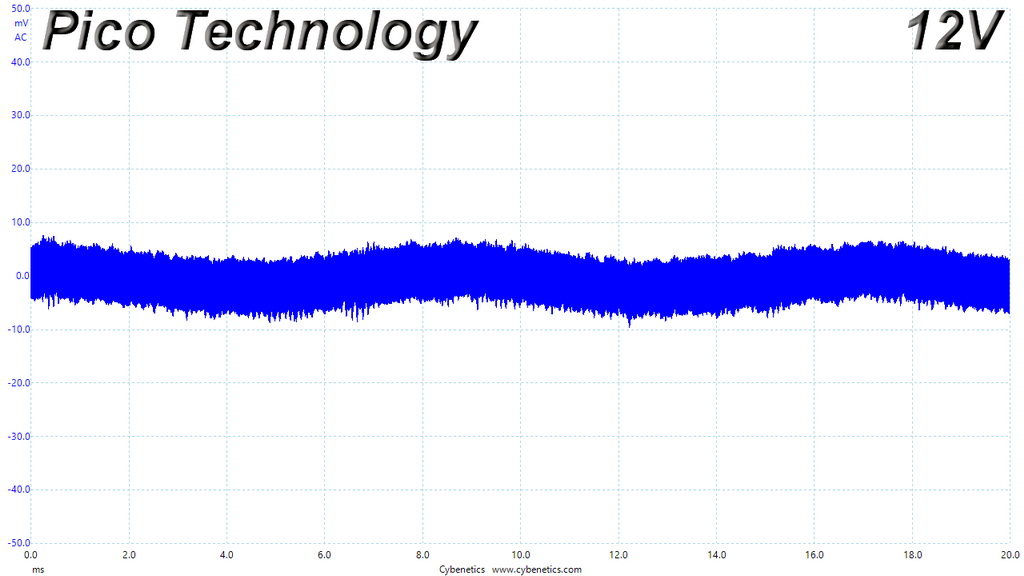
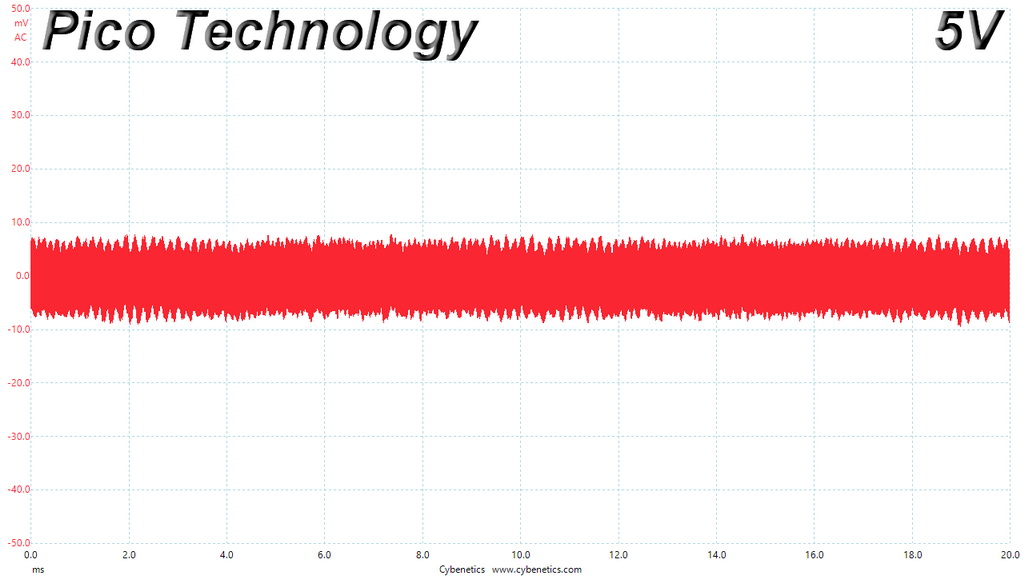
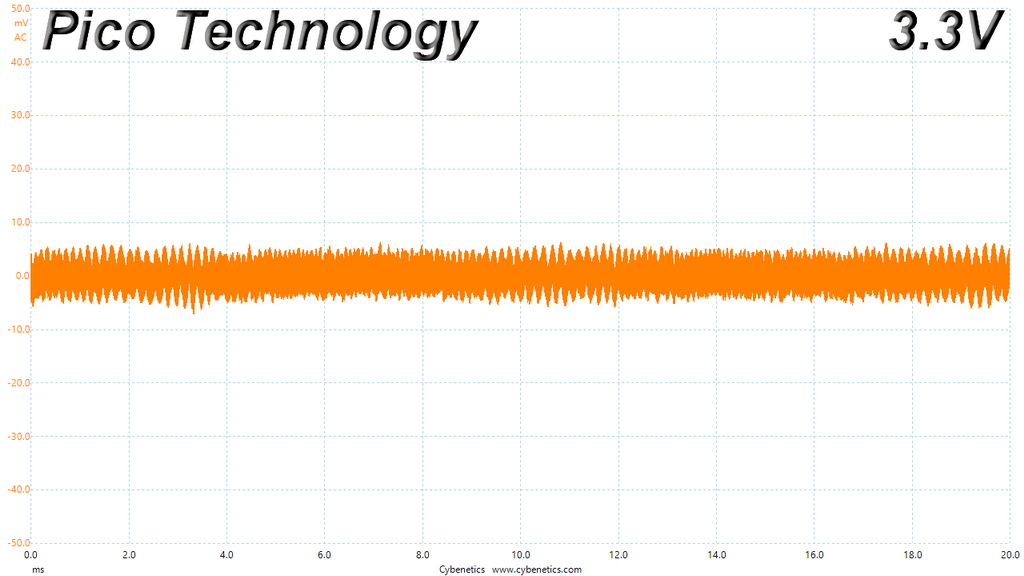
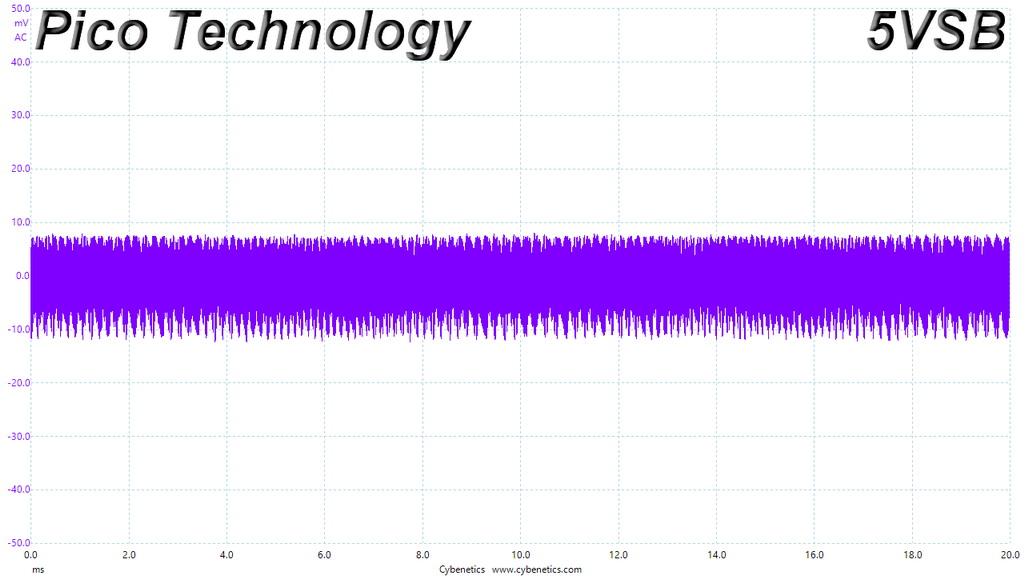
To learn more about our EMI testing equipment, please check out How We Test Power Supply Units.
EMI Results – Average & Peak Detector
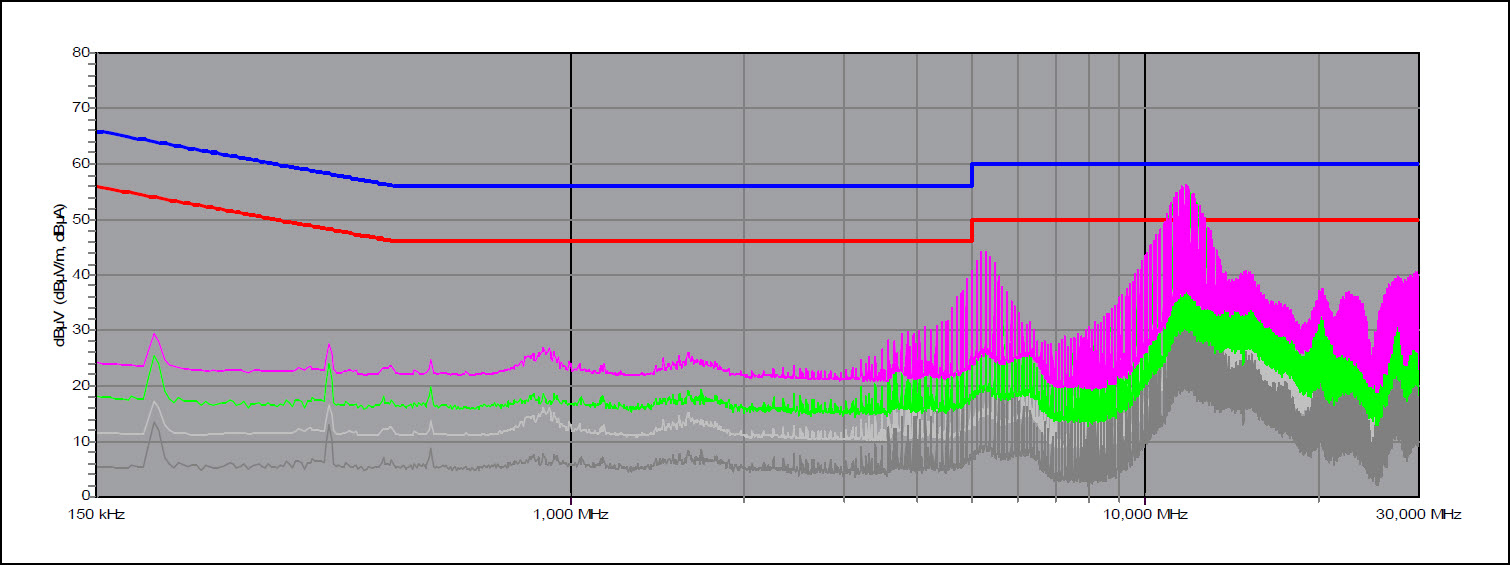
The conducted EMI emissions are quite low up to 11 MHz, however there are some spurs in the 11244 to 12375 KHz range, which exceed the limits with the AVG detector.
Performance Rating
The following graph shows the SU9-700’’s total performance rating, comparing it to other units we have tested. To be more specific, the tested unit is shown as 100 percent, and every other unit's performance is shown relative to it.
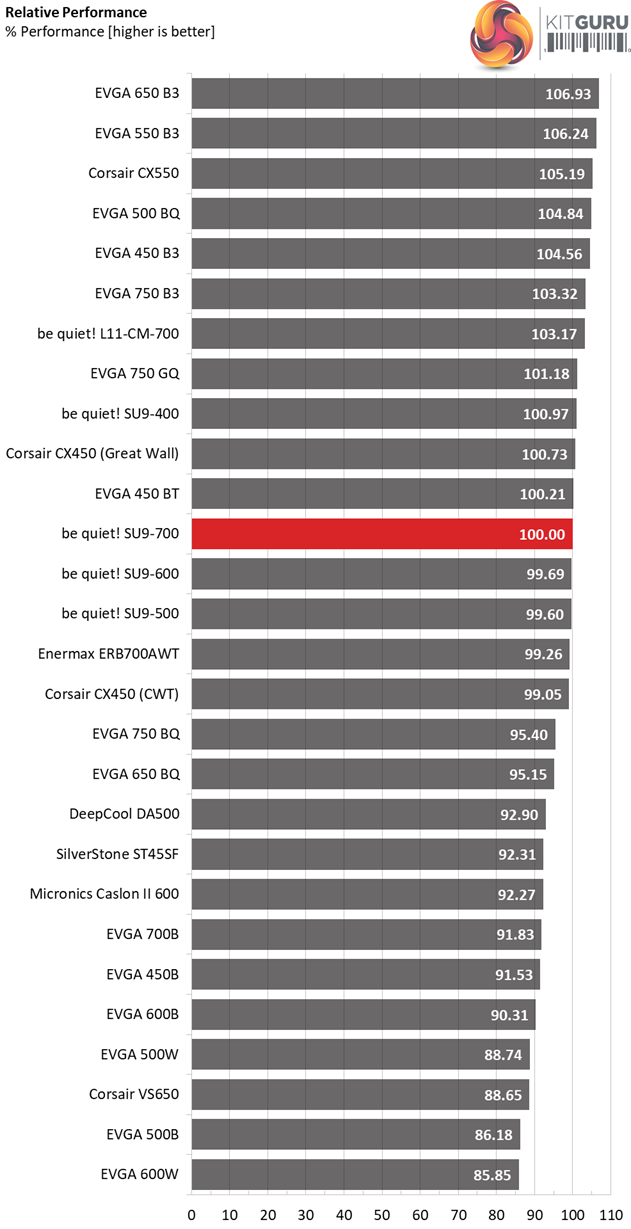
Compared to similar spec units, the SU9-700 fares pretty well as you can see since it leaves many other models behind. Only the more expensive EVGA B3 units perform notably better, but those belong to a higher category.
Performance Per Dollar
The following chart may be the most interesting to many of you because it depicts the product’s performance-per-dollar score. We looked up the current price of each power supply on popular online shops and used those prices and all relative performance numbers to calculate the index. Note that all of the numbers in the following graphs are normalized by the rated power of each unit.
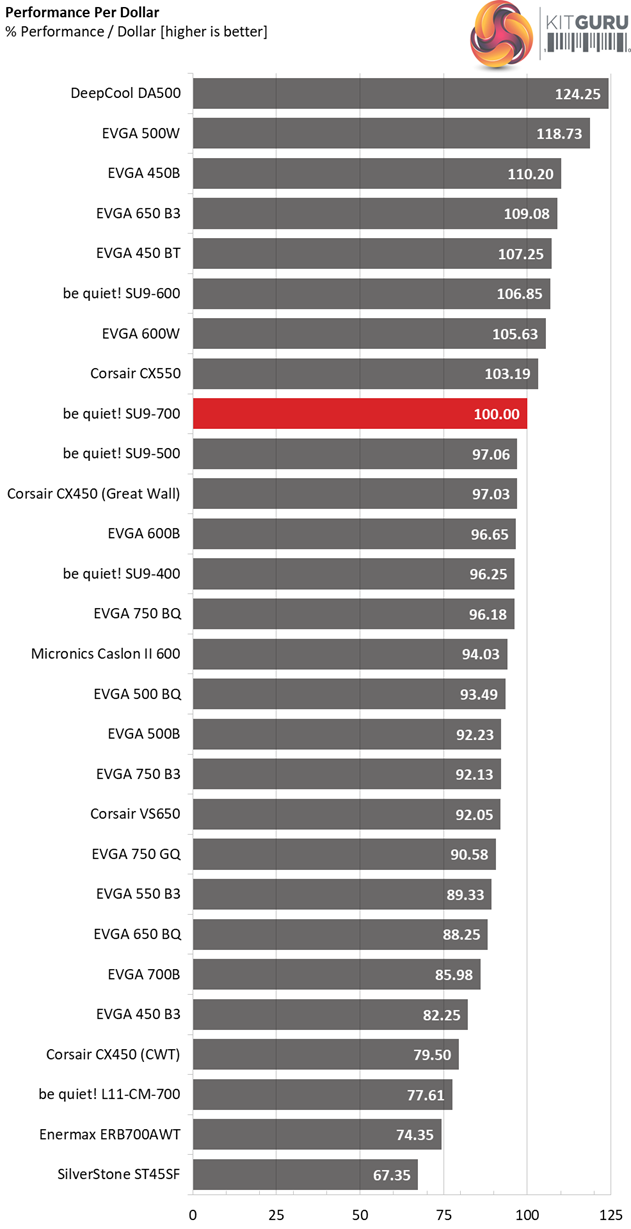
Thanks to the good performance and the normal price, the be quiet! offering achieves a high performance per buck score.
Noise Rating
The graph below depicts the cooling fan's average noise over the PSU's operating range, with an ambient temperature between 30°C and 32°C (86°F to 89.6°F).
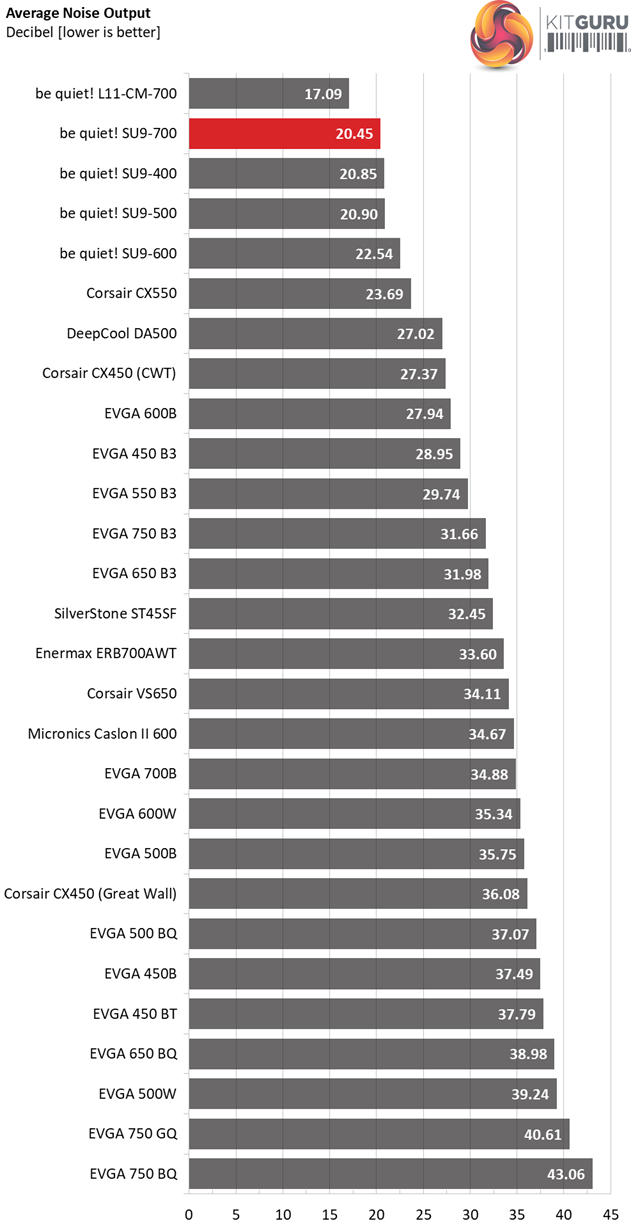
Usually Bronze efficiency and low output noise doesn't go together, but the SU9 models seems to be an exception in this rule.
Efficiency Rating
The following graph shows the PSU's average efficiency throughout its operating range, with an ambient temperature close to 30°C.
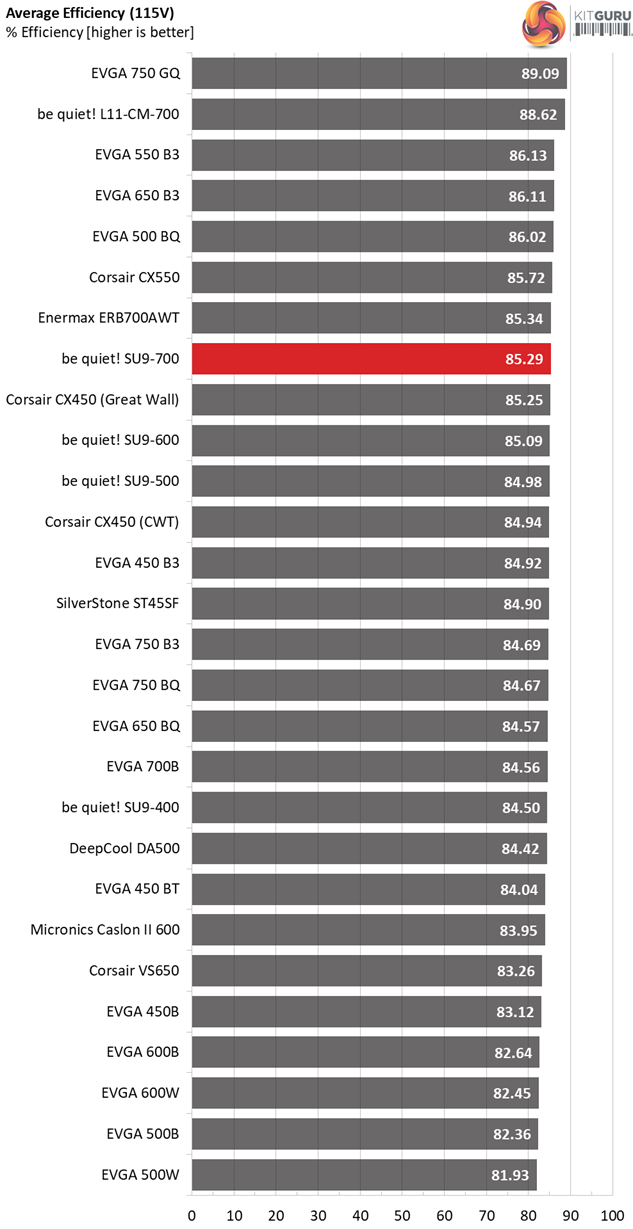
The overall efficiency is on par with the rest 80 PLUS Bronze and ETA-A- units. The only two Gold and ETA-A units that we have included in the charts, for reference purposes, have a significant lead over the rest.
Today we have reviewed the be quiet! SU9-700. It is worth emphasising again that this is the System Power U9 700W – a unit only available in the US and Taiwan as it is aimed at the 110V market. UK and European buyers (230V) will be able to buy the System Power 9 700W – no ‘U' in the name – though the two power supplies are based on different platforms, so they are not identical units just with different names.
Still, the be quiet! SU9-700 might be a budget oriented unit but the performance is quite good and in terms of load regulation it managed to impress us. The non-modular cables provide it with a head start of course, since they have lower voltage drops compared to modular ones … especially at high loads.
The cherry on the cake is the ultra quiet operation, something that it is really difficult to find at this price and efficiency range. The lower the efficiency the higher the energy losses so the cooling system has more work to do, and in the majority of cases this means increased airflow – so noise emissions can get higher.
I believe that the price of this product is fair, given its features and the registered performance, however I would like to see a better cap in the APFC converter. A similar capacity Nippon Chemi-Con bulk cap with an 105°C rating wouldn't notably raise the cost (less than £1 difference) but it would offer a much longer lifetime.
On the other hand, the caps in the secondary side are of acceptable quality since Elite caps are the best that money can buy today from the Chinese market. Using Chemi-Con or Rubycon would greatly affect the cost and the Elite VE caps have a pretty long lifetime — technically longer than the lifetime of the popular NCC KZE caps used in many high-end power supplies today.
The non-modular cable design might be a deal breaker for many of you, since today the majority of power supplies are equipped with fully modular cables. Nevertheless, in a budget unit the first thing that usually has to go are the modular cables – which is acceptable if the performance is high enough. Thankfully this unit is a solid all round performer.
The list of changes that I would like to see in the next revision of this platform are as follows:
- Higher capacity and 105°C temperature rating bulk cap (preferably a Japanese model).
- Improve the transient response, especially at 3.3V.
- Equip the unit with a rifle bearing fan which will last for much longer.
- Install a bypass relay for the NTC thermistor, to enhance the inrush current protection.
US customers can buy the the be quiet! System Power U9 700W from Newegg for $74.90 HERE.
Pros:
- Fair price given what it offers.
- Delivered full power at over 40°C.
- Easily meets the 80 PLUS Bronze and ETA-A- efficiency requirements.
- Silent operation (LAMBDA-A).
- Tight load regulation.
- Accurate power ok signal (but lower than 16ms).
- Efficient 5VSB rail.
- Compact dimensions.
Cons:
- 85°C bulk cap (and of low capacity).
- Sleeve bearing fan.
- Low hold-up time.
- The non-modular cable design can be a deal breaker for some.
- Not so good transient response (especially at 3.3V).
KitGuru says: The be quiet! System Power U9 700W is a very quiet power supply that performs at a high level considering the asking price. If you don't mind the non-modular cable design and you are working with a tight budget then the SU9-700 is definitely worth considering.