KitGuru KitGuru.net – Tech News | Hardware News | Hardware Reviews | IOS | Mobile | Gaming | Graphics Cards


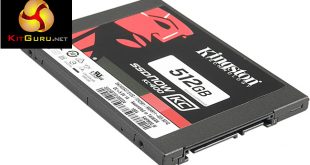
Kingston's SSDNow KC400 family is part of the company's business-oriented SSD product line which features end-to-end data path protection, technologies to protect data in the NAND and guard against read errors, as well as good endurance.
The SSDNow KC400 uses a combination of an 8-channel Phison PS3110-S10 controller and 15nm MLC NAND. There are four capacities in the product line; 128GB, 256GB, 512GB and the flagship 1TB drive. Kingston quote performance figures for the 512GB version of up to 550MB/s for sequential reads and up to 530MB/s for sequential writes. Random 4K performance is quoted as up to 86,000 IOPS for reads and 88,000 IOPS writes.
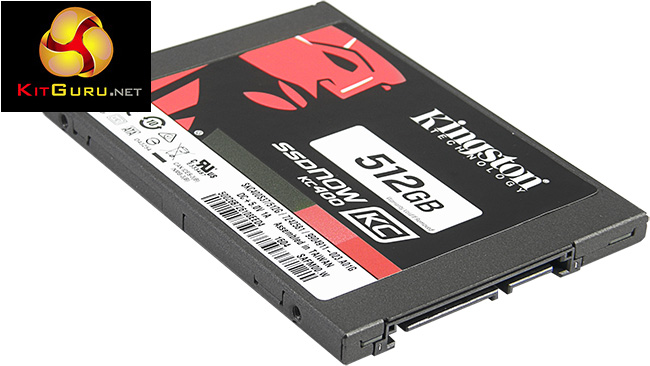
To underline its suitability for the business sector, the KC400 has end-to-end data path protection and a couple of other data protection technologies; SmartECC protects data from being corrupted, while SmartRefresh protects against read errors – the data is rebuilt should an error occur. If the system experiences an unexpected power loss then there is power loss management built into the firmware.
Endurance for the 512GB drive is quoted as 800TB TBW and Kingston back the KC400 line with a five-year warranty.
Physical Specifications:
Usable Capacities: 128GB, 256GB, 512GB, 1TB
NAND Components: 15nm MLC
Interface: Serial ATA (SATA) 6Gb/s (SATA III)
Form Factor: 2.5in 7mm
NAND Controller: Phison PS3110-S10
Dimensions: 69.9 x 100.1 x 7.0mm
Drive Weight: 60g
Firmware Version SAFM00.W
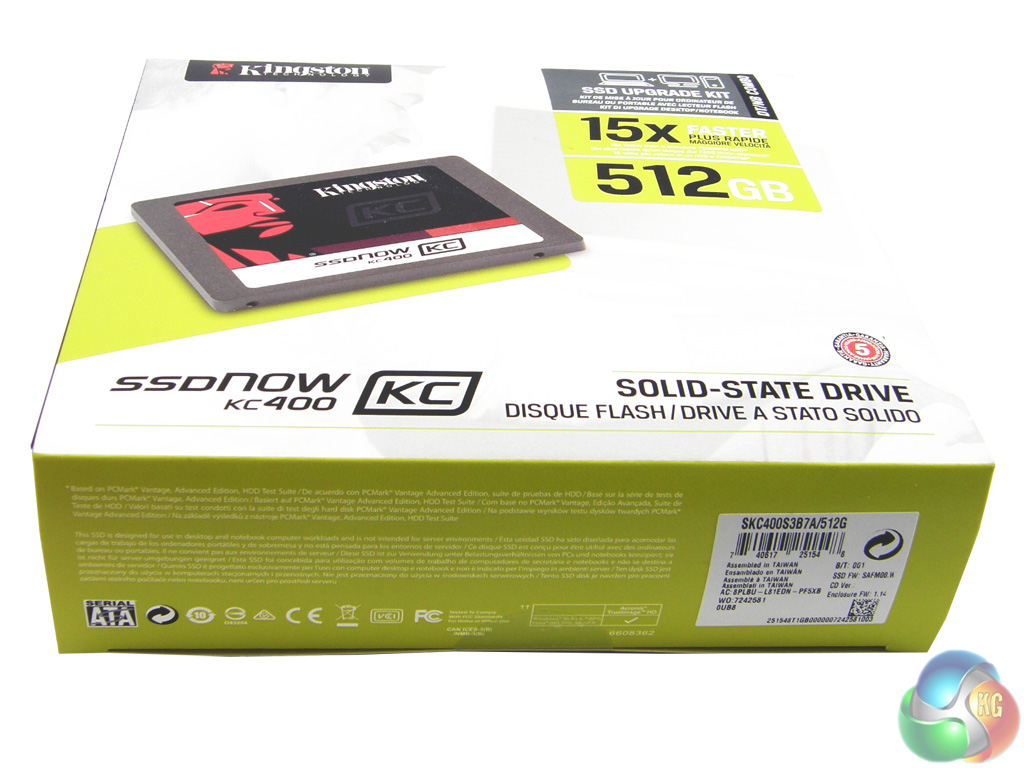
The SSDNow KC400 is available as a bare drive or as part of a full-blown upgrade kit, which is what we were sent for review. The upgrade kit comes in a rather large box with an image of the drive and a clear label of the drive's capacity.
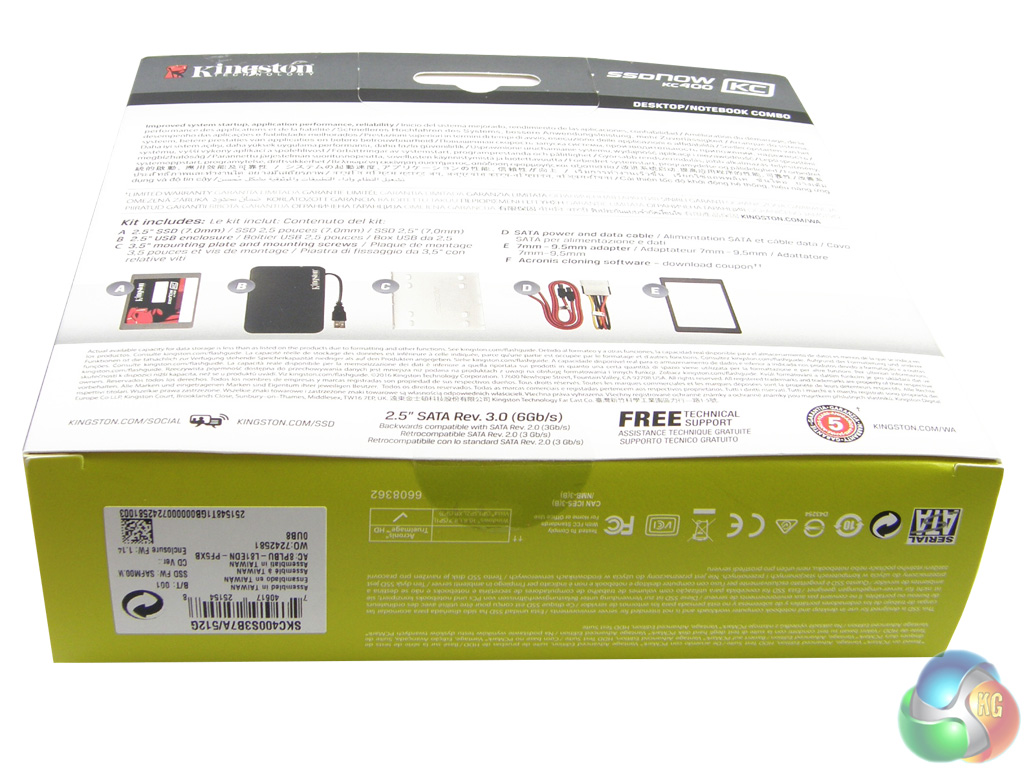
The rear of the box has some multi-lingual marketing text and more importantly, what's in the box.
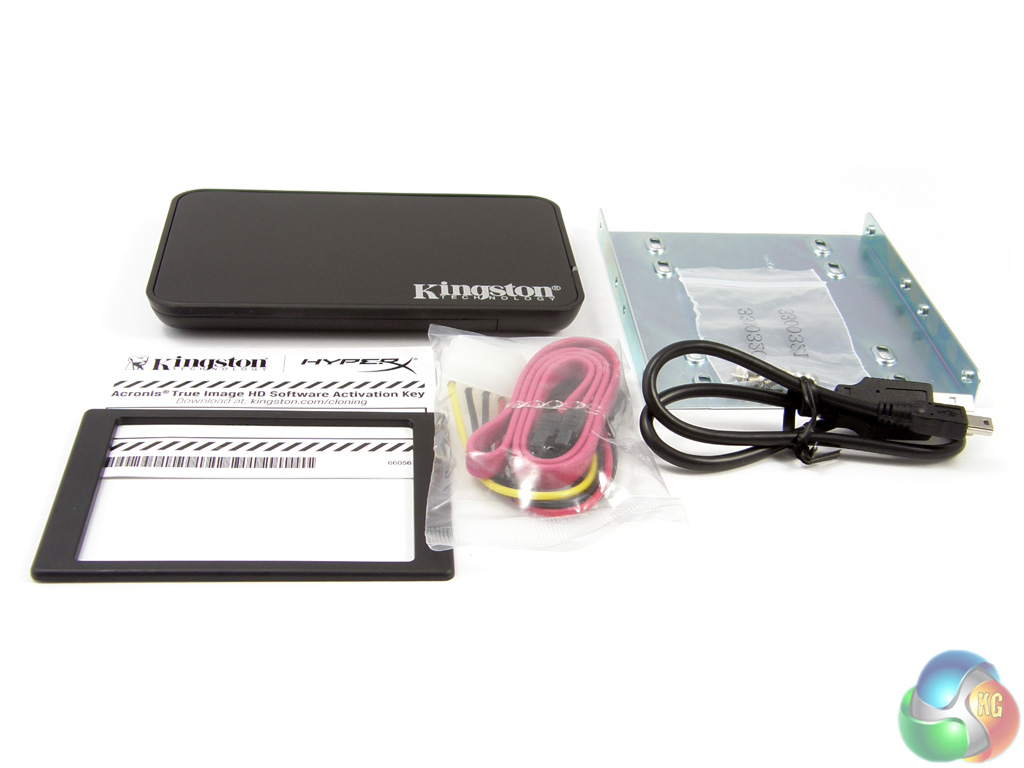
What's actually in the box is pretty impressive. Apart from the drive, there is a 2.5in USB (USB2.0) external drive enclosure, a 3.5in bay converter complete with screws, SATA data and power cables, a 7mm – 9mm spacer (to help mount the drive in larger format laptops with higher drive bays) and a coupon for downloading Acronis disk cloning software.
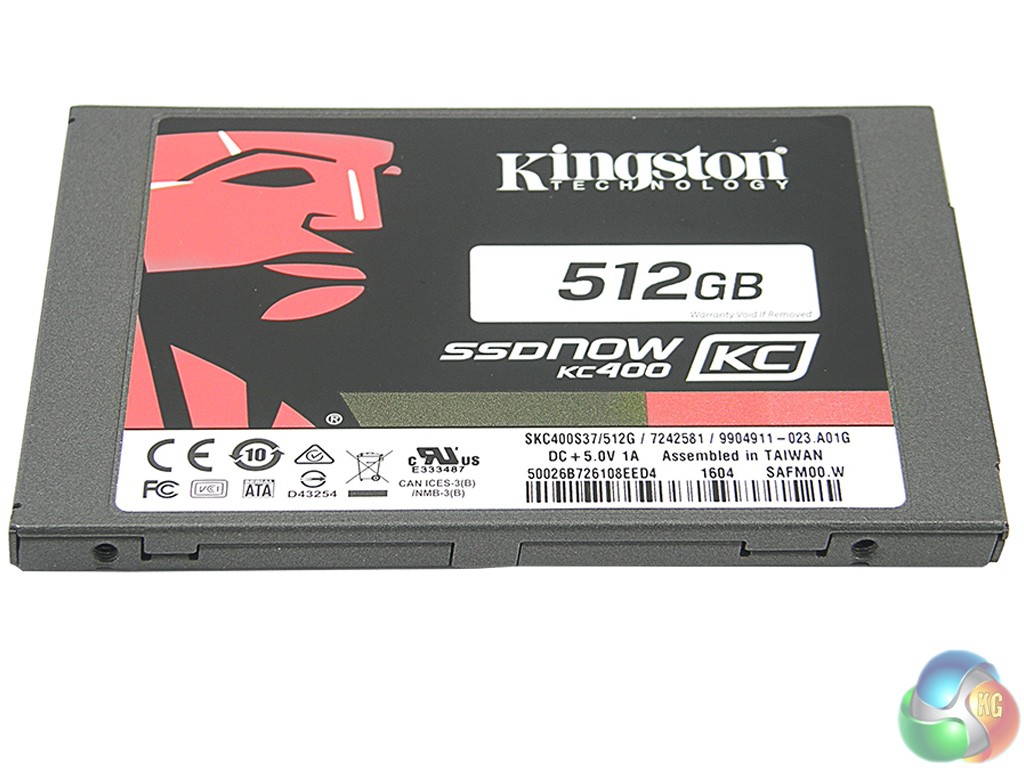
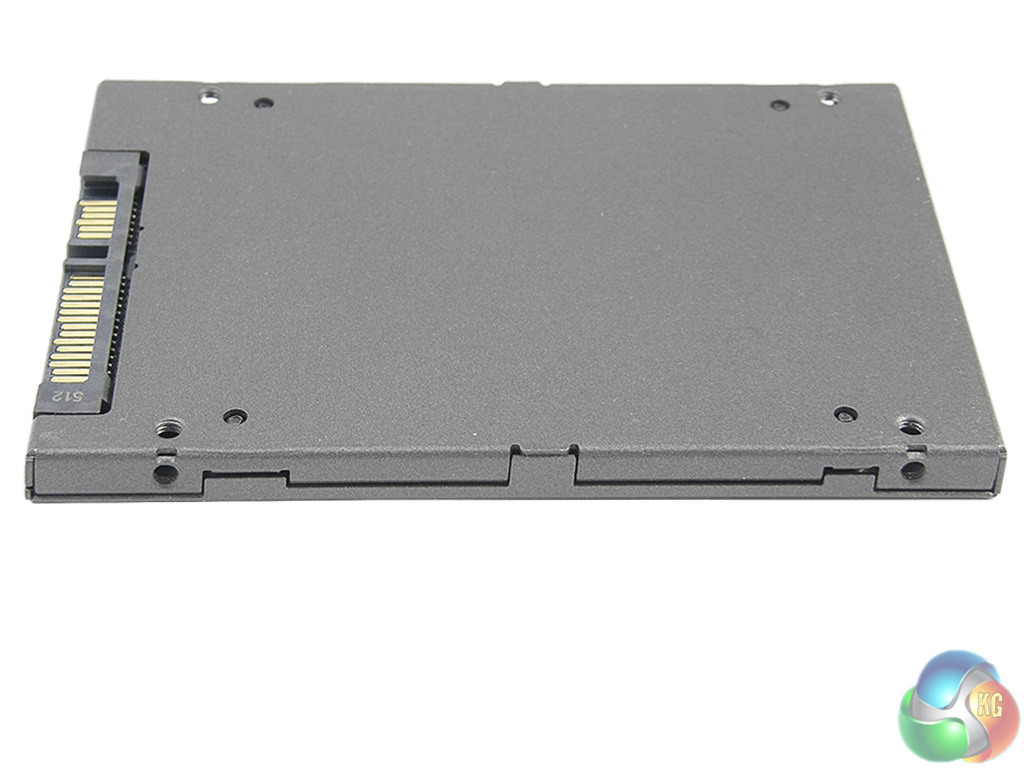
Kingston's SSDNow KC400 is built on a standard 2.5in 7mm format using a good quaily metal enclosure.
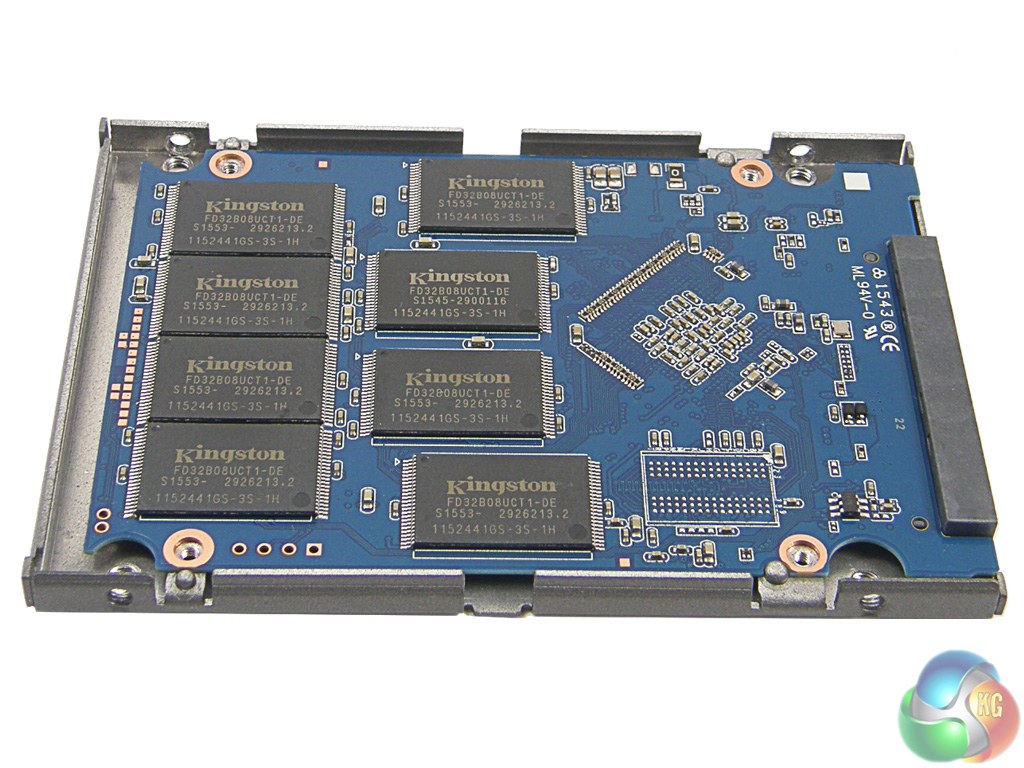
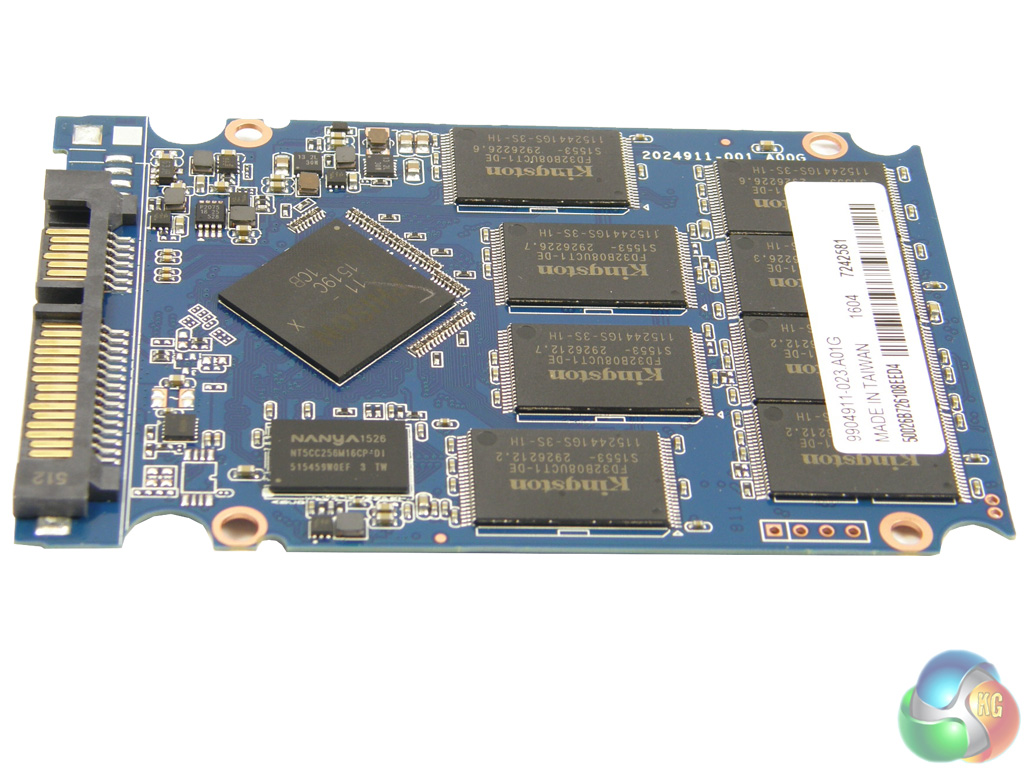
At the heart of the KC400 lies a Phison PS3110-S10 8-channel, quad core controller which, in the case of the 512GB version of the drive, looks after sixteen 32GB 15nm MLC NAND packages (labelled Kingston FD32B08UCT1-DE).
Eight of these packages join the controller and the single 256MB DDR3L-1600 cache IC (Nanya NT5CC256M16CP-D1) on one side of the PCB, with the remaining eight housed on the flip side of the board.
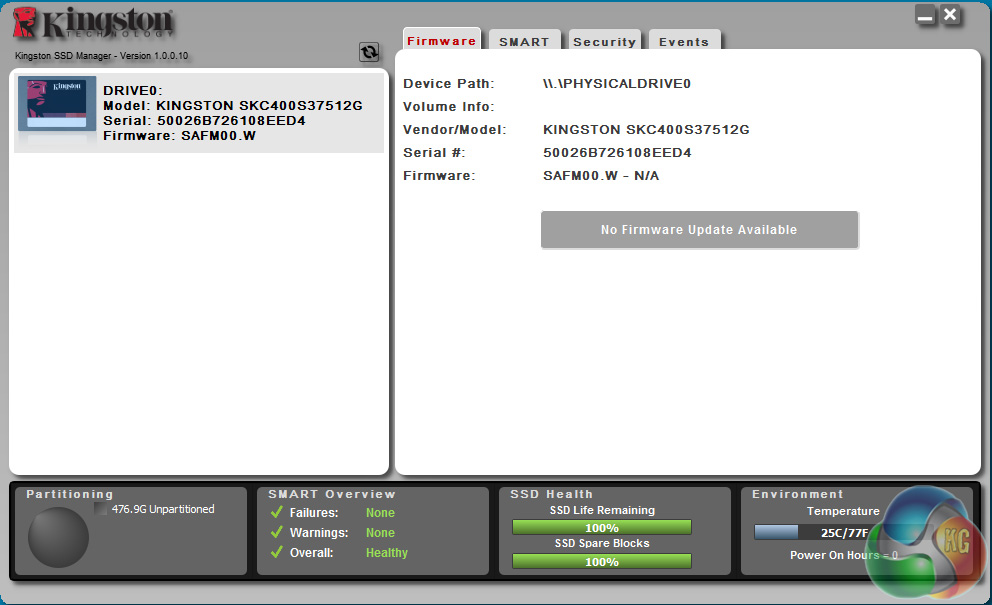
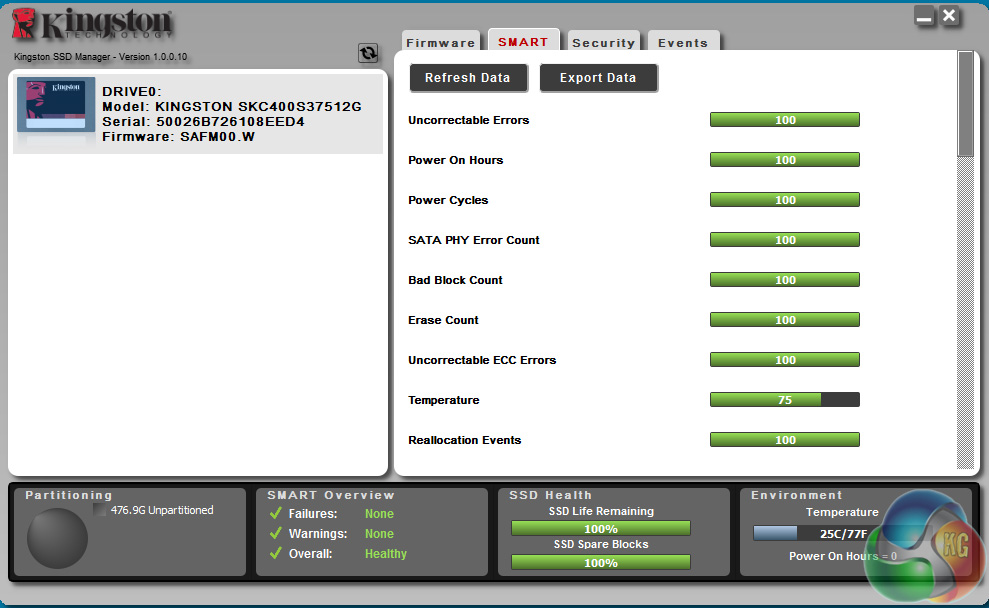

Kingston's SSD management software is called SSD Manager and while at first glance it doesn't look as intricate as Samsung's Magician software, for example, it does cover most of the basics. It displays drive partition information, a SMART overview, SSD Health (including how many spare blocks there are) and the temperature of the drive.
There's a dedicated SMART page showing much more detailed SMART information. The SSD Manager also makes it easier to perform any firmware upgrades and also securely erase the drive.
For testing, the drives are all wiped and reset to factory settings by HDDerase V4. We try to use free or easily available programs and some real world testing so you can compare our findings against your own system.
This is a good way to measure potential upgrade benefits.
Main system:
Intel Core i7 4790K with 16GB of DDR3-2133 RAM, Sapphire R9 390 Nitro and an ASRock Extreme 6 motherboard.
Other drives
Corsair Neutron XTi 480GB
Crucial BX100 500GB
Crucial MX100 512GB
Crucial MX200 500GB
Intel SSD730 480GB
Kingston HyperX 3K 480GB
OCZ Trion 100 480GB
OCZ Trion 150 480GB
Patriot Ignite 480GB
PNY CS2111 XLR8 480GB
Samsung 830 512GB
Samsung 840DC EVO 480GB
Samsung 840DC PRO 400GB
SanDisk Extreme Pro 480GB
Seagate 600 480GB
SK Hynix Canvas SL300 512GB
SK Hynix Canvas SL301 500GB
SK Hynix Canvas SL308 500GB
Toshiba THNSNF512GCSS 512GB
Transcend SSD220S 480GB
Transcend SSD370S 512GB
Software:
Atto Disk Benchmark.
CrystalMark 3.0.3.
AS SSD.
IOMeter
All our results were achieved by running each test five times with every configuration this ensures that any glitches are removed from the results. Trim is confirmed as running by typing fsutil behavior query disabledeletenotify into the command line. A response of disabledeletenotify =0 confirms TRIM is active.
Crystalmark is a useful benchmark to measure theoretical performance levels of hard drives and SSD’s. We are using V3.0.3.
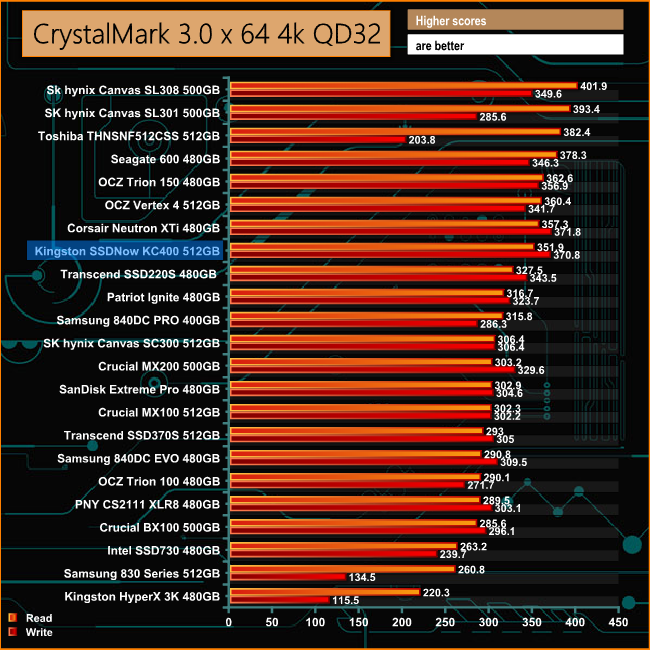
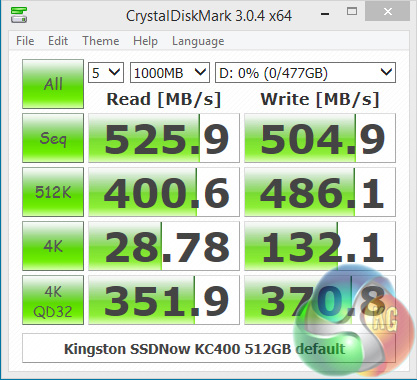
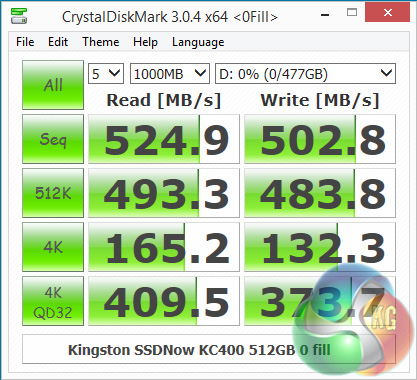
The KC400 handles reasonable deep queues of 4K data pretty well, especially with respect to writes. It also performs well with 4K writes at shallow depths too. The controller much prefers reading compressed data, especially when dealing with small 4K transactions, as shown by the difference in the two benchmark screens.
The ATTO Disk Benchmark performance measurement tool is compatible with Microsoft Windows. Measure your storage systems performance with various transfer sizes and test lengths for reads and writes. Several options are available to customize your performance measurement including queue depth, overlapped I/O and even a comparison mode with the option to run continuously.
Use ATTO Disk Benchmark to test any manufacturers RAID controllers, storage controllers, host adapters, hard drives and SSD drives and notice that ATTO products will consistently provide the highest level of performance to your storage.
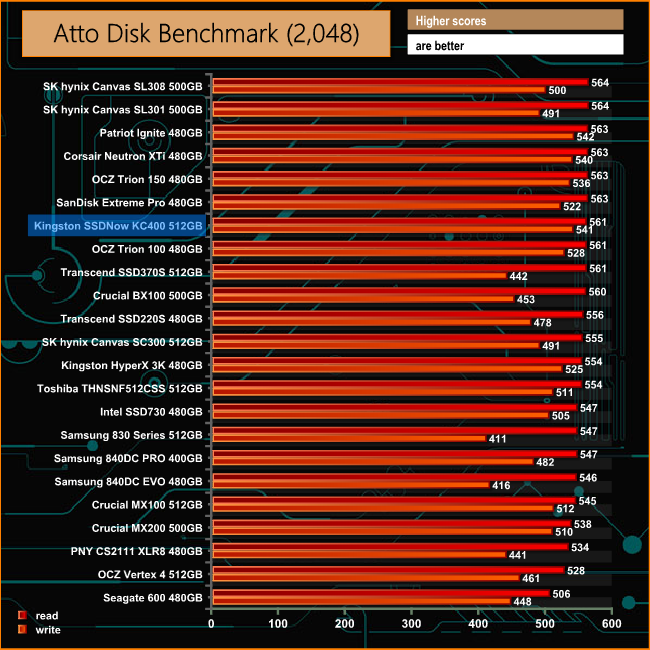
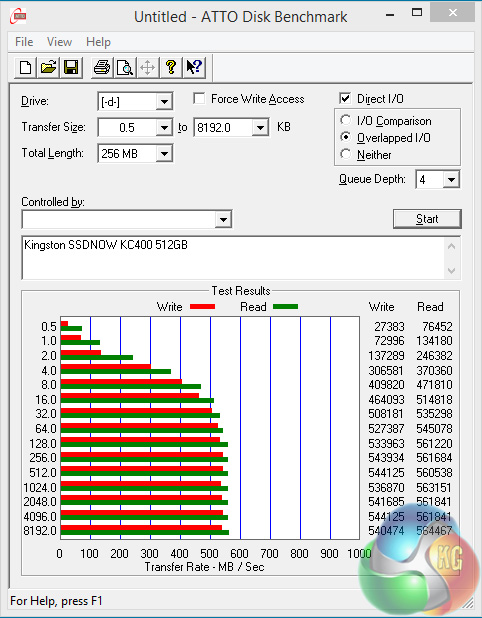
Kingston quote sequential performance figures for the 512GB KC400 at up to 550MB/s for reads and up to 530MB/s for writes. Both figures were exceeded by the drive under review in the ATTO benchmark, producing figures of 561MB/s and 541MB/s for reads and writes respectively.
AS SSD is a great free tool designed just for benching Solid State Drives. It performs an array of sequential read and write tests, as well as random read and write tests with sequential access times over a portion of the drive. AS SSD includes a sub suite of benchmarks with various file pattern algorithms but this is difficult in trying to judge accurate performance figures.
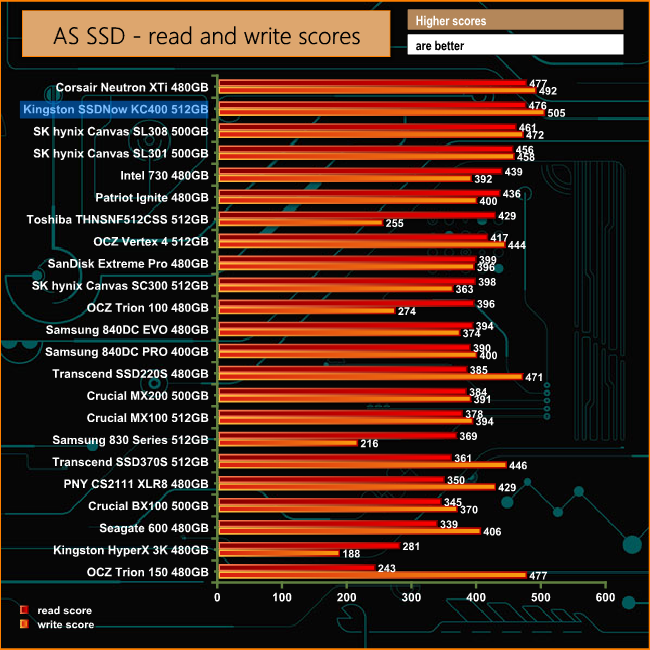
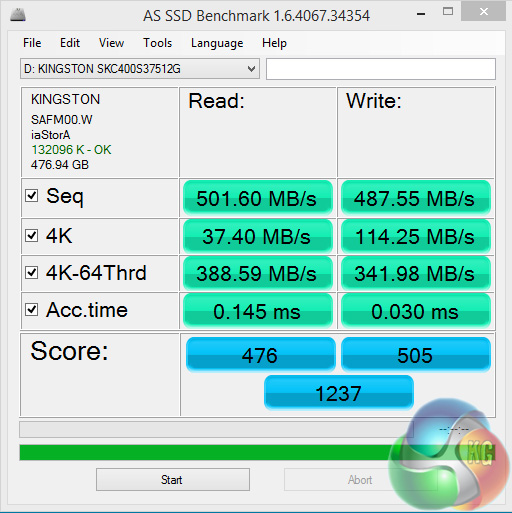
The KC400 512GB scores very highly in the AS SSD test, with the second highest read score our of our tested drives. But more impressive still is the write score of 505, the highest in this capacity segment we have seen to date.
IOMeter is another open source synthetic benchmarking tool which is able to simulate the various loads placed on hard drive and solid state drive technology.
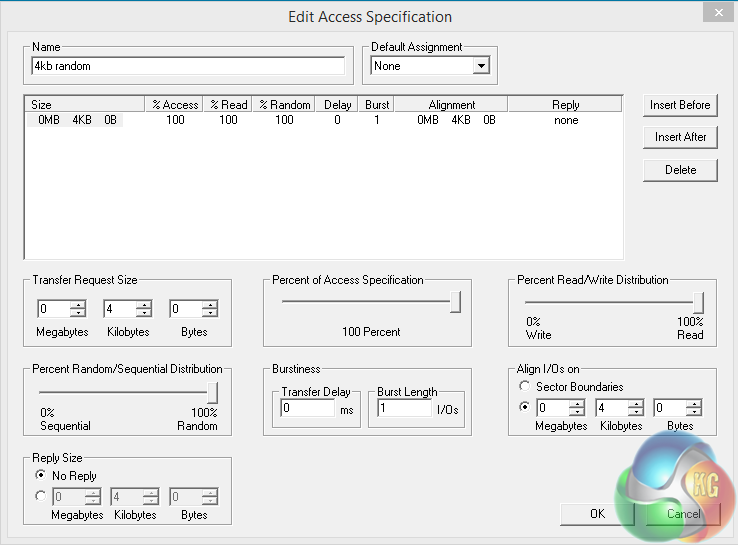
We test with both random read and write 4k tests, as shown above. There are many ways to measure the IOPS performance of a Solid State Drive, so our results will sometimes differ from manufacturer’s quoted ratings. We do test all drives in exactly the same way, so the results are directly comparable.
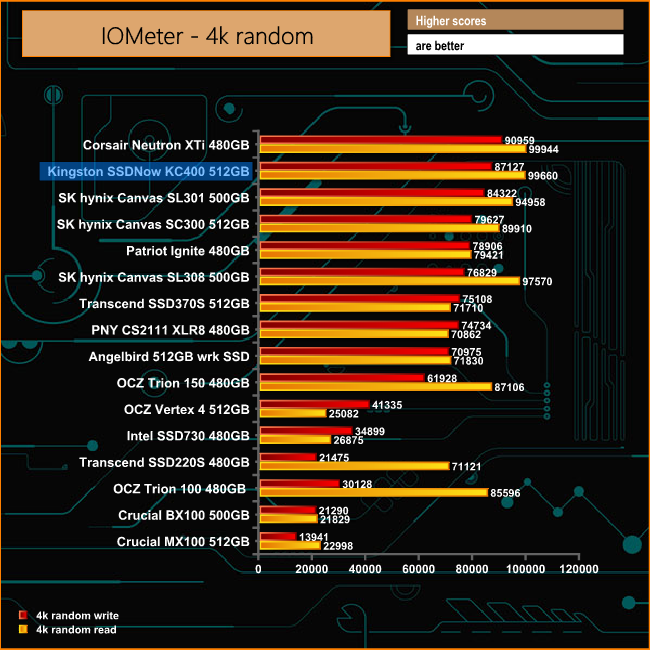
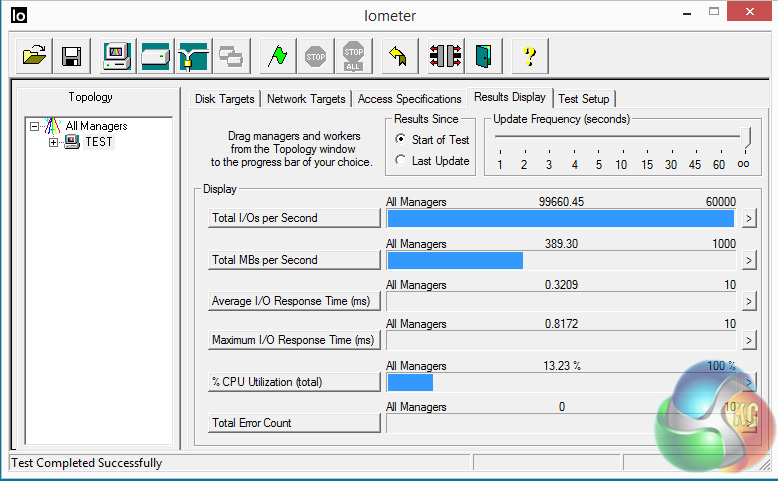
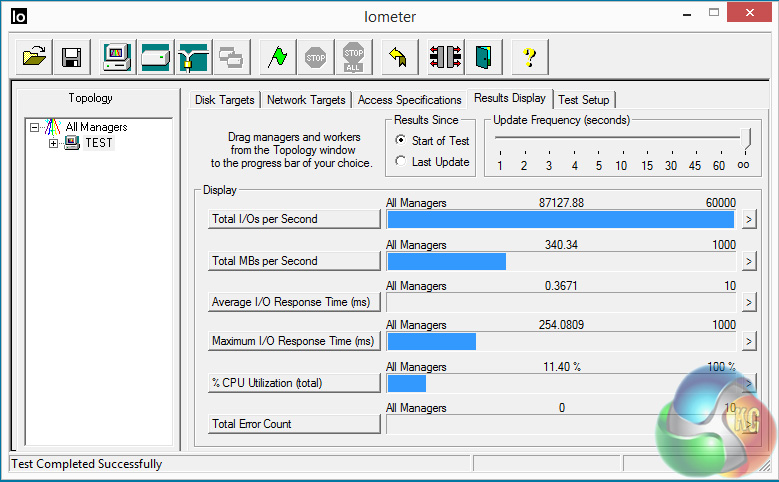
The up to 86,000 IOPS random 4K read performance figures that Kingston quote for the drive seem a little conservative when you consider that the test drive produced a figure of 99,660 IOPS. But the writes were pretty much spot on with the quoted up to 88,000 IOPS figure, at 87,127 IOPS.
To test real life performance of a drive we use a mix of folder/file types and by using the FastCopy utility (which gives a time as well as MB/s result) we record the performance of drive reading from & writing to a 256GB Samsung SSD850 PRO.
60GB Steam folder – 29,521 files.
50GB File folder – 28,523 files.
12GB Movie folder – 24 files (mix of Blu-ray and 4K files).
10GB Photo folder – 621 files (mix of .png, raw and .jpeg images).
10GB Audio folder – 1,483 files (mix of mp3 and .flac files).
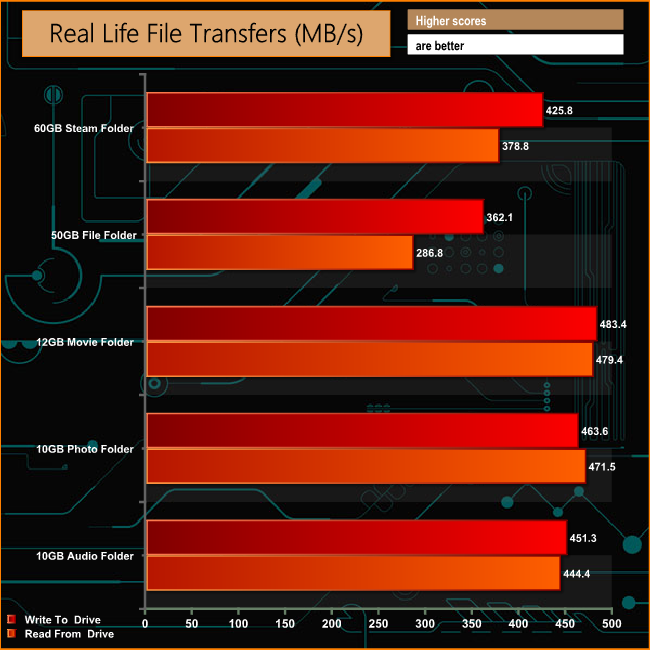
The KC400 dealt with the real life folders without any problems, averaging out across the five folders at 437MB/s for writes and 408MB/s for reads. The performance did fall dramatically, however, when reading back the small bity files contained in the 50GB File folder.
The KC400 sits firmly in Kingston‘s Business lineup of SSDs. But these days, the line between what constitutes a consumer drive or a drive for business use gets blurred as features that were once the domain of business/enterprise drives can be found in a number of drives aimed at the consumer space.
Those features include: data protection, hardware encryption, high endurance, and power loss protection. Indeed the upgrade kit version of the KC400 that we were supplied for review has more in keeping with consumer needs rather than business.
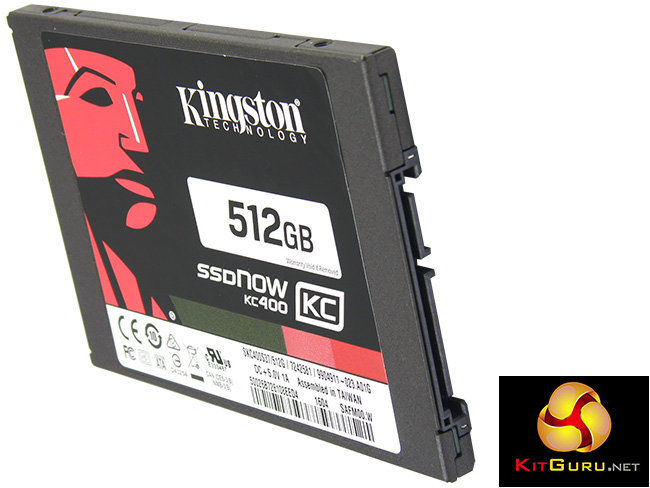
As is befitting for its business credentials, the KC400 has some data protection technologies built in – end-to-end data path protection which guards against data errors at the bit level, along the whole of the data path. For data corruption at the NAND level there is SmartECC, and read errors are handled by SmartRefresh, which rebuilds the data should an error occur.
There is also a degree of power loss protection built into the firmware, but this isn't as efficient as those drives that carry capacitors on the PCB to do the same job. The one thing that does appear to be missing is any form of hardware encryption, which is a bit odd for a business-oriented drive.
Kingston quote a TBW endurance figure for the drive of 800TB which is very impressive, working out at almost 450GB host writes a day over the drive's 5-year warranty.
The quoted sequential read/write performance figures for the drive at 550MB/s and 530MB/s were confirmed and even a little bettered under testing with the ATTO benchmark. The tested drive produced a read rate of 561MB/s and 541MB/s for writes. The quoted random read figure of up to 86,000 IOPS seems a little on the conservative side when you consider that the drive produced 99,660 IOPS under test. The test score of 87,127 IOPS for random write performance is in the ballpark of the official 88,000 IOPS figure.
The KC400 512GB upgrade kit costs around £150, while the bare drive is around £10-15 cheaper at around £135. Looking at it as a pure business drive, that is a strong, competitive price. In the consumer space, it's also a pretty competitive price amongst its MLC-equipped brethren in the 480GB -512GB segment. But once you start comparing it against TLC-equipped drives of the same capacity, that price tag looks expensive.
We found the Kingston SSDNow KC400 512GB upgrade kit on Amazon for just over £150. The standalone drive is currently available for just under £135.
Discuss on our Facebook page HERE.
Pros
- Overall performance
- Endurance
- 5 year warranty
Cons
- No hardware encryption
Kitguru says: Kingston's KC400 is a aimed at the business sector and combines good all-round performance with strong endurance and some useful data protection.