KitGuru KitGuru.net – Tech News | Hardware News | Hardware Reviews | IOS | Mobile | Gaming | Graphics Cards


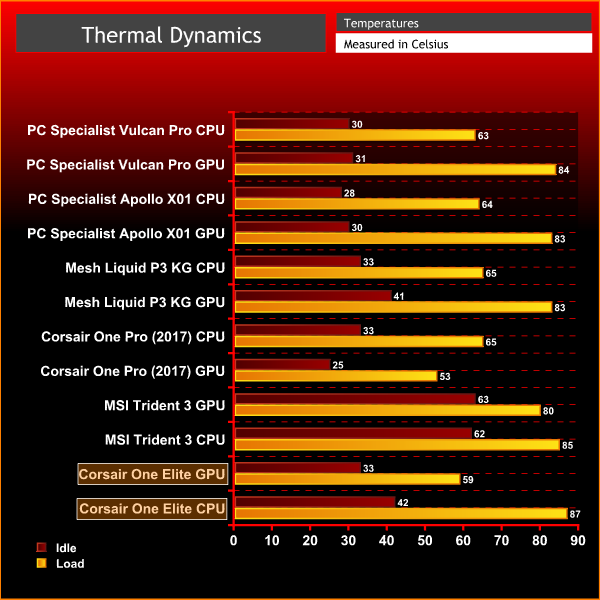
To measure idle temperatures, a reading was taken after having Windows open on the desktop for 30 minutes. A reading under load was taken with Prime 95’s SmallFFt test running alongside 3DMark Fire Strike.
Corsair makes plenty of boasts about this machine's quiet operation, and we’re pleased that this beefed-up version of the system doesn’t struggle with any of these tests.
When the One Elite is running low-intensity tasks then it may as well be silent. Its 31db noise rating is stellar, and we had to press our ears up to the case to hear anything at all – and, even then, we could only make out some subtle fan noise.
A gaming test saw the fan noise rise to around 46db. That’s still quieter than most gaming systems ever manage, and it’s still extremely subtle: if it’s beyond a monitor, beneath a desk or across the living room, its unlikely to be audible. Similarly, speakers or a headset will easily drown out the low rumble of the fan.
A full-system stress-test saw the noise output rise to 50db. That’s still impressive, and still better than almost every other PC out there.
The Corsair is one of the quietest high-end PCs we’ve ever tested, and we have no problem with the graphics card’s peak temperature of 59°C.
The processor hit a top temperature of 89°C. That’s higher than most of its rivals, but hardly unexpected when the Coffee Lake chip is serving up six fast cores. Importantly, while that figure is high, it’s not dangerous and is within TJMax.