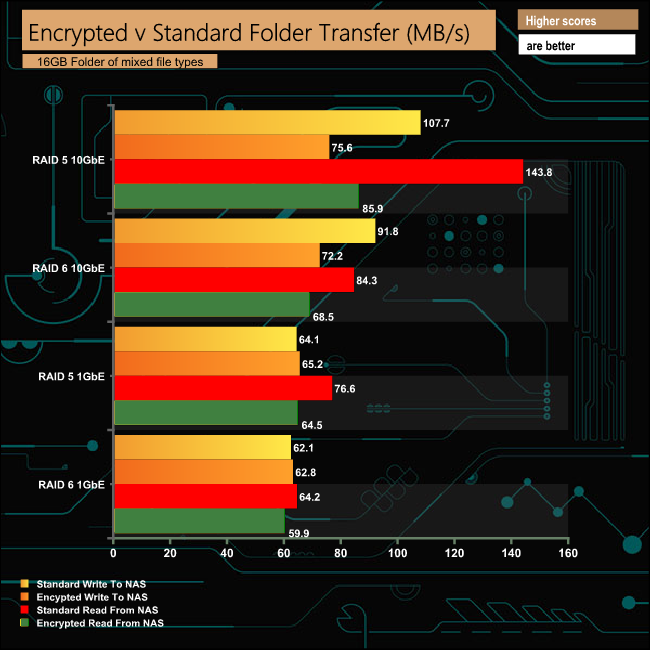
Asustor's AS4004T is a compact 4-bay NAS that sits under the company's 'Home to Power User' banner and features a 1.6GHz processor, DDR4 memory and a 10GbE RJ45 port. It also sports Asustor's latest diamond cut exterior finish. Is it worth the £340 asking price? There are just two models in the AS40**T family, the 2-bay AS4002T and the drive we are looking at here, the 4-bay AS4004T. Both use the same processor and memory combination. Sitting at the heart of the AS4004T is a dual-core Marvell ARMADA-7020 64-bit processor, using ARM Cortex A72 architecture, which is clocked at 1.6GHz. Backing this up is 2GB of DDR4 memory and if you feel the need to upgrade the memory then unfortunately you are out of luck as the memory modules are soldered directly the motherboard. The AS4004T also has a dedicated hardware AES 256-bit encryption engine. Physical Specifications Processor: Marvell ARMADA-7020 1.6GHz (Dual-Core). Memory: 2GB DDR4. Gigabit Ethernet Ports: 2 x 1GbE, 1 x 10GbE Rear panel connectors: 1 x USB 3.1 Front panel connectors: 1 x USB 3.1 RAID support: 0,1,5,6,10 Cooling: Active 1 x 120mm. Drive Bays Supported: 4. Maximum hard drive size supported: 14TB. Maximum Capacity: 56TB Maximum single volume size: 16TB Internal File System support: EXT4. Dimensions (D x W x H): 230 x 174 x 170mm. Weight: 2.2 kg. The AS4004T comes in a compact box. The front of the box displays an image of the drive in a panel on the right hand side. Next to the image are various icons describing some of the hardware features of the NAS. Under this is a list of hardware specifications and what's in the box. The back of the box is covered in multi-lingual descriptions of the services supported by the AS4004T. One side panel of the box carries images of the diamond cut exterior, magnetic front cover and how the hard drives are fitted. The other side panel displays information on how you can connect to the AS4004T and the fact you can create a dedicated cloud system. The box bundle gives you everything you need to get started. Apart from the Delta Electronics DPS-09AB-3 90W power adapter there are a pair of Cat5e (1GbE) and a single Cat6e (10GbE) cables, a driver CD and manual and fixing screws for 2.5in HDD/SSD drives should you want to go down that route. The AS4004T is pretty compact for a 4-bay NAS, measuring 230 x 174 x 170mm (D x W x H). Being cloaked in the latest Asustor diamond-cut exterior design, it's also a stylish looking little black box. Most of the front bezel is the cover for the four vertically mounted drive bays. This cover is held on by four small magnets making very quick and easy to access the drives. To the left of the cover sits the power button and the LED indicators. From top to bottom these are; power, system status, network (glows blue for 1GbE, purple for 10GbE), USB and finally four displaying hard drive activity/status. Below these sits the One Touch copy button for the front USB 3.1 port that sits towards the bottom of this front side of the NAS. The rear panel of the NAS is dominated by the grill for the 120mm cooling fan. To the right of this are all the ports; dual 1GbE, single 10GbE and a single USB 3.1 port. The drive trays are tool free but there are no physical locks on the drive tray doors. The AS4004T supports hot swapping drives. The AS4004T uses a tool free system to hold the hard drives in place. Two plastic strips with built-in pins fit into the sides of the drive tray with the pins pushing through a vibration deadening grommet into the hard drive sides. It's simple but very effective. Asustor’s ADM (Asustor Data Master) OS is a constantly evolving GUI (version 3.2 at the time of writing) and is easy to install, navigate through and is one of the most feature rich around particularly when it comes to add-on apps. After you’ve logged in for the first time, a welcome to ADM guide window pops up. The main ADM page shows the major sections of the OS, although for speed it might be handier to have some form of side menu on this main page as all the other section pages have to help you get to what you are looking for a little quicker. At the top of the main menu window are three icons; admin, tools and search. The admin drop down has five options; personal, sleep, restart, power off and sign out. The personal section is where you can configure the account password, E-mail address, description and ADM language. The search icon links to Searchlight, Asustor’s own search tool, designed for running fast and precise searches for files on the NAS. To the left of the search icon is the tools icon. This drops down a number of widgets that display various NAS functions for easy monitoring. With ADM 3.2 these can be individually tailored to a user’s needs, including the ability to monitor system status in real time without having to open an app. As with any NAS, disk management, RAID and volume creation are at the heart of things. Storage Manager looks after all things disk related. ADM provides the AS4004T with a pretty comprehensive set of backup options. Data can be backed up remotely (either as backup source or destination), via FTP, internally, externally and to the cloud. The front USB port is used for one touch backups. It can be configured to transfer data from a USB device to the NAS or back the other way. You can setup backup methods (copy or synchronisation) and folder paths from within the settings page. With File Explorer, you can browse photos and play music straight from within it, either single or multiple songs. It also supports video playback of files while searching. App support has always been one of ADM’s strong points, as one glance at the App Central menu confirms. App Central is the control centre for app management and shows installed apps, all available apps and updates. The current list of apps for the AS4004T is very extensive. The Activity Monitor supports real-time monitoring of the NAS system and resources. The ADM Help Page has five links to various parts of the Asustor web site where you can find help and advice if you have problems with the NAS. The Forum button takes you to the Asustor online forum and Downloads is a direct link to the download pages. Compatibility is a useful addition as it takes you to the Asustor Compatibility page, a very handy selection of hardware compatibility tables. Another useful link is to the Asustor College. Here you will find a collection of easy to follow online courses to learn all aspects of the NAS and its functions. The final link takes you direct to the Asustor online Support Center. MyArchive One very clever backup solution that ADM brings to the table is called MyArchive. This allows hard drives to be used as removable drives so you can swap between different collections of data as and when you need it. Recently upgraded, MyArchive now supports EX4, NTFS and HFS+ file systems. Data security, particularly in an office environment, is paramount and MyArchive drives have AES 256-bit encryption support (EXT4 file system only at present) and to add another layer of protection a USB device can be used as a physical encryption key. Asustor Portal With Asustor Portal there’s no need to turn on your computer when you want to play videos or browse the internet. You need only to connect your NAS to any HDMI ready display. It comes preloaded with YouTube and Netflix and by loading the additional URL-Pack, even more streaming sites become available including Plex, Vimeo and Youku. Adding the URL-Pack-Social brings support for Facebook, Google+, Hangouts, Pinterest, Twitter, Linkedin, WhatsApp and Instagram. Setting up the AS4004T is a pretty straightforward and painless task; it only takes around 10 minutes to load the OS and get the unit ready for use, although waiting for the disks to fully synchronise obviously takes a great deal longer, e.g. around 20 hours for a RAID 5 array. First job is to download the Asustor Control Center from the Asustor website. This app will search your network to find any Asustor NAS units on the network. Actually, you can do a lot more with the ACC than just find the NAS to install ADM. There are six menu buttons on the top of the GUI; Scan, Open, Connect, ADM Update, Service, and Action. The first two are pretty self-explanatory, Scan for the NAS and Open, opens a web browser and connects to ADM. Clicking on the connect button gives you three options to connect to the data on the NAS; map a shared folder, create a remote file folder (via WebDAV or FTP) or connect via FTP. The ADM Update button checks for ADM updates and if there are any starts the upgrading as soon as you’ve logged into the NAS. The Service button provides a shortcut to Photo Gallery and/or Surveillance Center if you have either of them installed. The final Action button provides access to power controls; Wake-on-LAN, Find Me, Night Mode, Sleep Mode, Restart, and Shut Down but only after logging in administrator details. Once the ACC has located the NAS and you select it, the welcome screen appears. There are two ways to setup the device; 1-Click Setup and Custom. With the 1-Click method you simply enter name for your NAS, choose a password and then select how you want the storage to be set up and that’s about it. The Custom method gives you more detailed choices as can be seen from the screens below. Whichever method you choose to set the NAS up, each stage along the install process is checked off on the initialisation page so you always know what’s happening during the install procedure. You can also setup the AS4004T without using a PC. With Asustor's AiMaster app on your smartphone (Android and iOS), you can find the NAS on a network, configure it and initialise it. The last job is the register the NAS. Registering it provides an Asustor ID which you will need to download apps from App Central. It will also be needed if you should require the technical support center. To test the AS4004T we used four 6TB Red drives (WD60EFRX, 5,400rpm class, 64MB cache), built into RAID arrays RAID 0,5,6 and 10 and then tested both with a 1GbE and 10GbE connection. To connect to the unit’s built-in 10GbE port we used an 10GbE card and a Cat7 cable. Thanks to Asus for their support with this. You can see more information on this card on the ASUS site, over HERE. Software: Atto Disk Benchmark. IOMeter. Intel NASPT. The ATTO Disk Benchmark performance measurement tool is compatible with Microsoft Windows. Measure your storage systems performance with various transfer sizes and test lengths for reads and writes. Several options are available to customize your performance measurement including queue depth, overlapped I/O and even a comparison mode with the option to run continuously. Use ATTO Disk Benchmark to test any manufacturers RAID controllers, storage controllers, host adapters, hard drives and SSD drives and notice that ATTO products will consistently provide the highest level of performance to your storage. The AS4004T performs well considering it only has a dual-core processor. The fastest speed we got from the NAS was 611MB/s read speed with a 10GbE connection with the disks built into a RAID 5 array. While the RAID 5 read speed was good, the write speed at 225MB/s was a bit disappointing - as was the RAID 6 write speed. With a 1GbE connection the NAS performed as you might expect although once again there was a drop in the write speeds of RAIDs 5 and 6. Intel’s NASPT (NAS Performance Toolkit ) is a benchmark tool designed to enable direct measurement of home network attached storage (NAS) performance. NASPT uses a set of real world workload traces (high definition video playback and recording, video rendering/content creation and office productivity) gathered from typical digital home applications to emulate the behaviour of an actual application. We’ve used some of the video and office apps results to highlight a NAS device’s performance. HD Video Playback This trace represents the playback of a 1.3GB HD video file at 720p using Windows Media Player. The files are accessed sequentially with 256kB user level reads. 4x HD Playback This trace is built from four copies of the Video Playback test with around 11% sequential accesses. HD Video Record Trace writes an 720p MPEG-2 video file to the NAS. The single 1.6GB file is written sequentially using 256kB accesses. HD Playback and Record Tests the NAS with simultaneous reads and writes of a 1GB HD Video file in the 720p format. Content Creation This trace simulates the creation of a video file using both video and photo editing software using a mix of file types and sizes. 90% of the operations are writes to the NAS with around 40% of these being sequential. Office Productivity A trace of typical workday operations. 2.8GB of data made up of 600 files of varying lengths is divided equally between read and writes. 80% of the accesses are sequential. Photo Album This simulates the opening and viewing of 169 photos (aprrox 1.2GB). It tests how the NAS deals with a multitude of small files. NASPT Video Benchmarks. The AS4004T performs reasonably well in the video traces of Intel's test. The best performance came in the HD Video Playback test using a 10GB/s connection with 300MB/s and over speeds in RAID's 0,5 and 10. Once again the RAID 6 performance lagged behind. NASPT Office Benchmarks. The AS4004T struggled with the rigours with all three Office parts of the NASPT benchmark. The best performance from both connection speeds was in the Office Productivity test. IOMeter is another open source synthetic benchmarking tool which is able to simulate the various loads placed on hard drive and solid state drive technology. We set IOmeter up (as shown above) to test both backup and restore performance on a 100GB partition. The AS4004T had no real problems dealing with our restore/backup tests, although the write performance in RAID 6 with a 10GbE connection lagged behind all the other arrays using the fast network connection. With a 1GbE connection it was while the disks were in a RAID 5 array that the slowest write speed occurred. The integrated hardware encryption engine in the AS4004T seems to be more efficient dealing with encrypted data at a slower connection speed than at higher speeds. To test real life file/folder performance we use a number of different file/folder combinations to test the read and write performance of the NAS device. Using the FastCopy utility to get a MB/s and time taken for each transfer, the data is written from and read back to a 240GB SSD. We use the following file/folder types: 100GB data file. 60GB iso image. 60GB Steam folder: 29,521 files. 50GB Files folder: 28,523 files. 12GB Movie folder: 24 files – mix of Blu-ray and 4K files. 10GB Photo folder: 621 files – mix of .png, .raw and .jpeg images. 10GB Audio folder: 1,483 files – mix of .mp3 and .flac files. 5GB (1.5m pixel) image. BluRay Movie. Click to enlarge. The AS4004T had no trouble dealing with our real life file transfers, although the write performance in RAID 6 was the slowest in most of the tests at both connection speeds. We tested the peak power consumption of a NAS at the wall during a run of CrystalDiskMark 5.0.2 as this version of the benchmark runs the read and write benchmark suites separately so it is easier to monitor what power the device is using during each function. Asustor quote power figures for the AS4004T as 31.5W in operation and 17.1W with the disks in hibernation. These figures are from the unit having 3TB WD Red drives installed. We used WD Red 6TB disks to test with. While fast networking 10GbE-supporting NAS units have been slowly, very slowly, making their way into the business sectors, there has been an even slower creep to seed the consumer market with NAS units that support the fast networking technology. Asustor has taken the plunge and brought two 10GbE equipped models into this market sector, the two bay AS4002T and the four bay AS4002T. Both use the same combination of a dual-core Marvell ARMADA-7020 64-bit CPU and 2GB of DDR4 memory. Asustor's NAS OS, ADM (Asustor Data Master) is one of the best NAS OS around. Quick and easy to install, it is straight forward enough to navigate around and it is constantly kept updated with more advanced main features and even more additions to an already impressive list of apps in App Central. When it comes to backing up your data (remembering that RAID is no substitute for properly backing up your data) you are almost spoilt for choice with the AS4004T, providing well over 12 different backup options is pretty impressive. Want to back data to the cloud? Then no problem as Amazon S3, WonderBox, xCloud, CrashPlan, Box.net, HiDrive, Ralus, ASUSWebStorage, Dropbox, Google Drive and OneDrive are all supported. If not the cloud, then there are remote options using FTP Explorer as well USB external drives (via the front USB One Touch button) and local backup. You can backup to another NAS and if you are a Mac user, Time Machine is also supported. Then there is the MyArchive technology that allows NAS hard drives to be saved as archive disks. Should you find yourself running out of storage space, no problem, the AS4004T supports the AS6004U 4-bay expansion unit via a USB 3.0 connection. At the time of writing this review the AS6004U supports drives up to 14TB. The AS4004T can support two AS6004U units via its two USB connections. It's a very quiet NAS in operation (Asustor quote figures of 19dB standby and 32dB in operation), and we could barely hear the NAS itself - all you can really hear is the good old hard drives rattling away when they are being accessed. To bring a 10GbE equipped NAS to the consumer space, Asustor have made a few compromises with the AS4004T. The choice of a dual-core processor meant that it did struggle with some of our intensive write tests (although the read performance is good) and you don't get an HDMI port or any super-fast USB ports either. Still, for under £350, the Asustor AS4004T does provide that 10GbE networking, which alongside the excellent ADM OS, makes this unit worth buying. We found the Asustor AS4004T on Overclockers UK for £339.95 (inc VAT) HERE. Alternatively, the NAS is also available from Amazon UK for £339.00 HERE. Pros Good read performance. 10GbE network support. ADM OS. Cons Dual core CPU struggled with some of our write tests. Not much in the way of external ports. KitGuru says: By using a low-cost ARM processor and cutting back on popular port options like HDMI and USB 3.1 Type C, Asustor has managed to bring 10GbE connectivity to the consumer market at a reasonable price point.