KitGuru KitGuru.net – Tech News | Hardware News | Hardware Reviews | IOS | Mobile | Gaming | Graphics Cards



QNAP's TS-453B is the 4-bay member of QNAP's latest TS-x53B family of NAS units which sit under the companies SMB product line. The TS-x53B series are the first of their class to feature a PCIe slot for supporting fast networking cards or SSD caching.
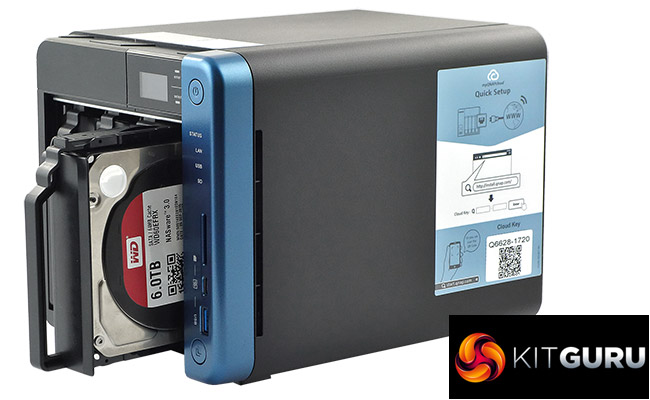
For a 4-bay NAS, the TS-435B is a really compact design measuring just 226 x 170 x 168mm. With the TS-x53B lineup, QNAP has introduced a new design styling.
The TS-453B is available in two memory versions, the base 4GB model (TS-453B-4G) and the 8GB version (TS-453B-8G) that QNAP submitted for review. All three models in the range (2, 4, and 6-bay) are powered by an Intel Celeron J3455 (Apollo Lake) quad core J3455 CPU which has a base speed of 1.5GHz with a burst speed of up to 2.3GHz.
QNAP quote transfer speeds for the TS-453B of up to 225MB/s for both read and writes with both LAN ports in Link Aggregation mode.
Although the TS-453B sits under the SMB banner it would make a powerful central hub of a home entertainment network with its 4K hardware decoding support and its ability to transcode 4K H.264 videos either on-the-fly or offline. Added to this is the wide range of media apps in the QTS Apps center including HD Station. By using the HD Station app with either a USB Mouse/keyboard plugged into the NAS or the bundled remote control and connecting an HDMI monitor or TV, you don't even have to fire up a PC to use the TS-453B.
Specifications
Intel Celeron 1.5GHz CPU.
8GB Memory.
AES-NI hardware-accelerated encryption.
PCIe slot.
USB-C QuickAccess port
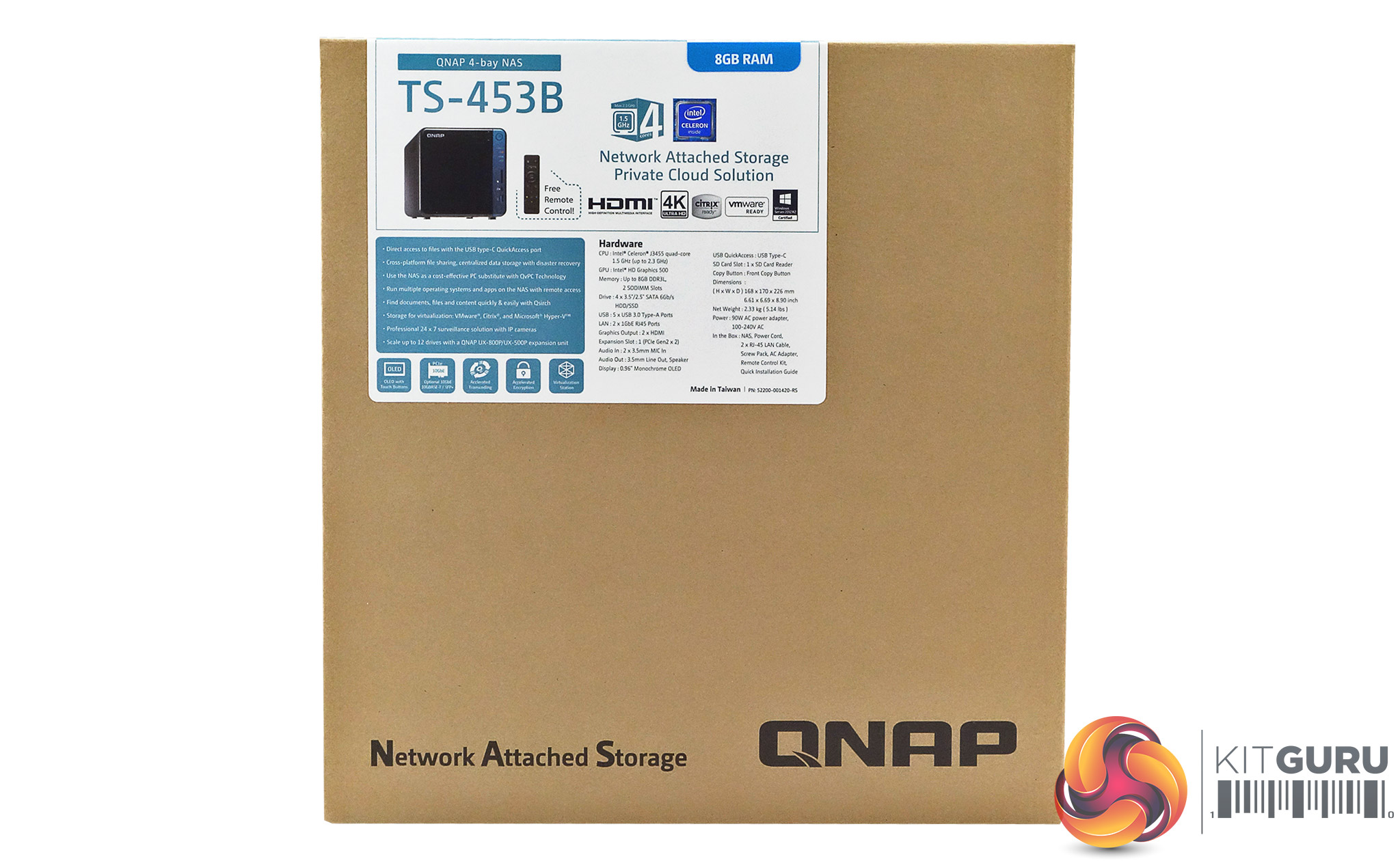
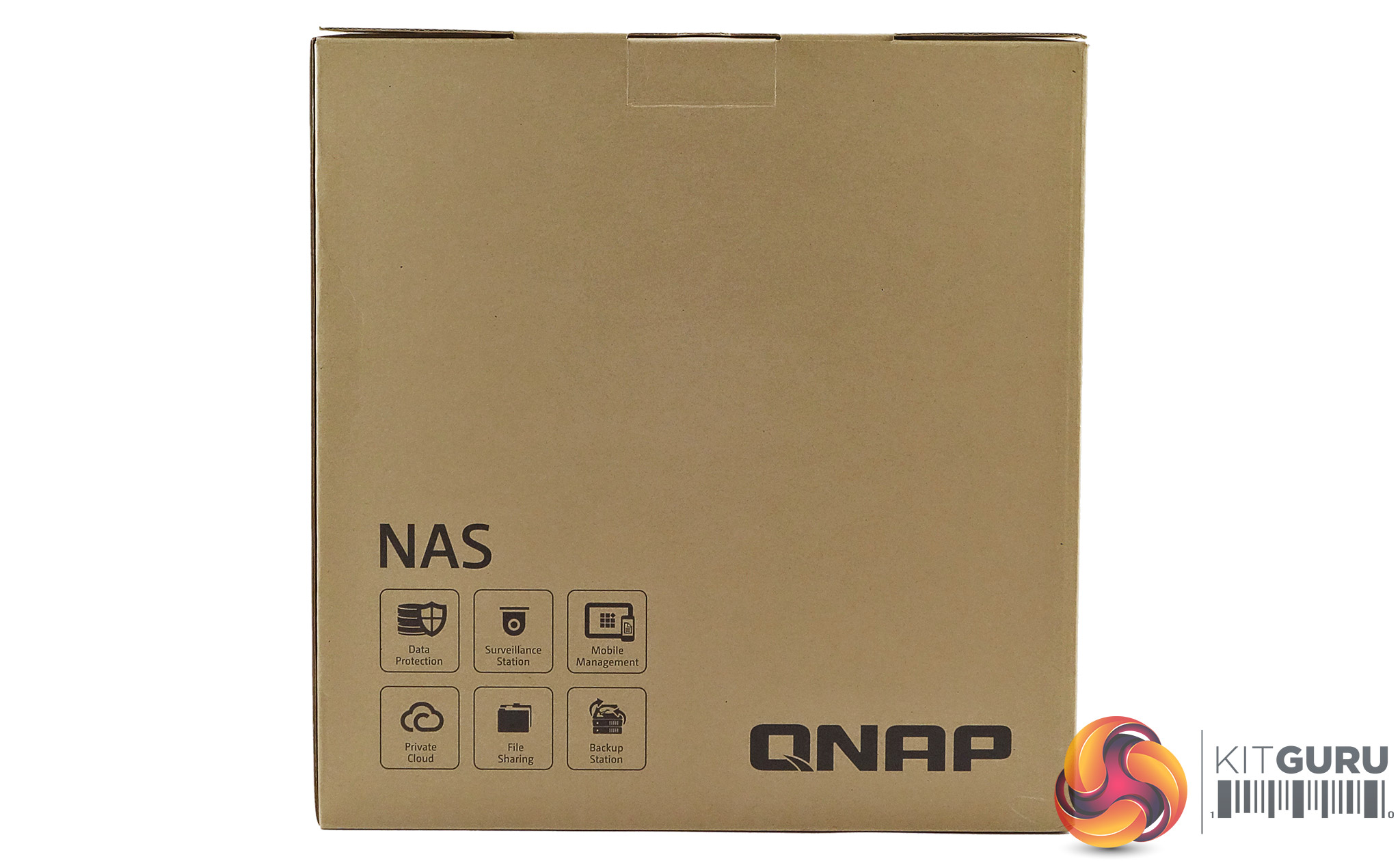
The compact TS-453B comes in an equally compact box. The front of the box has a label on which displays which memory version it is, a detailed list of the device's hardware and a list of its features. The rear of the box has a panel in the bottom left-hand side that suggests what the TS-453B can be used for; Data Protection, Surveillance Station, Mobile Management, Private Cloud, File Sharing and Backup Station.
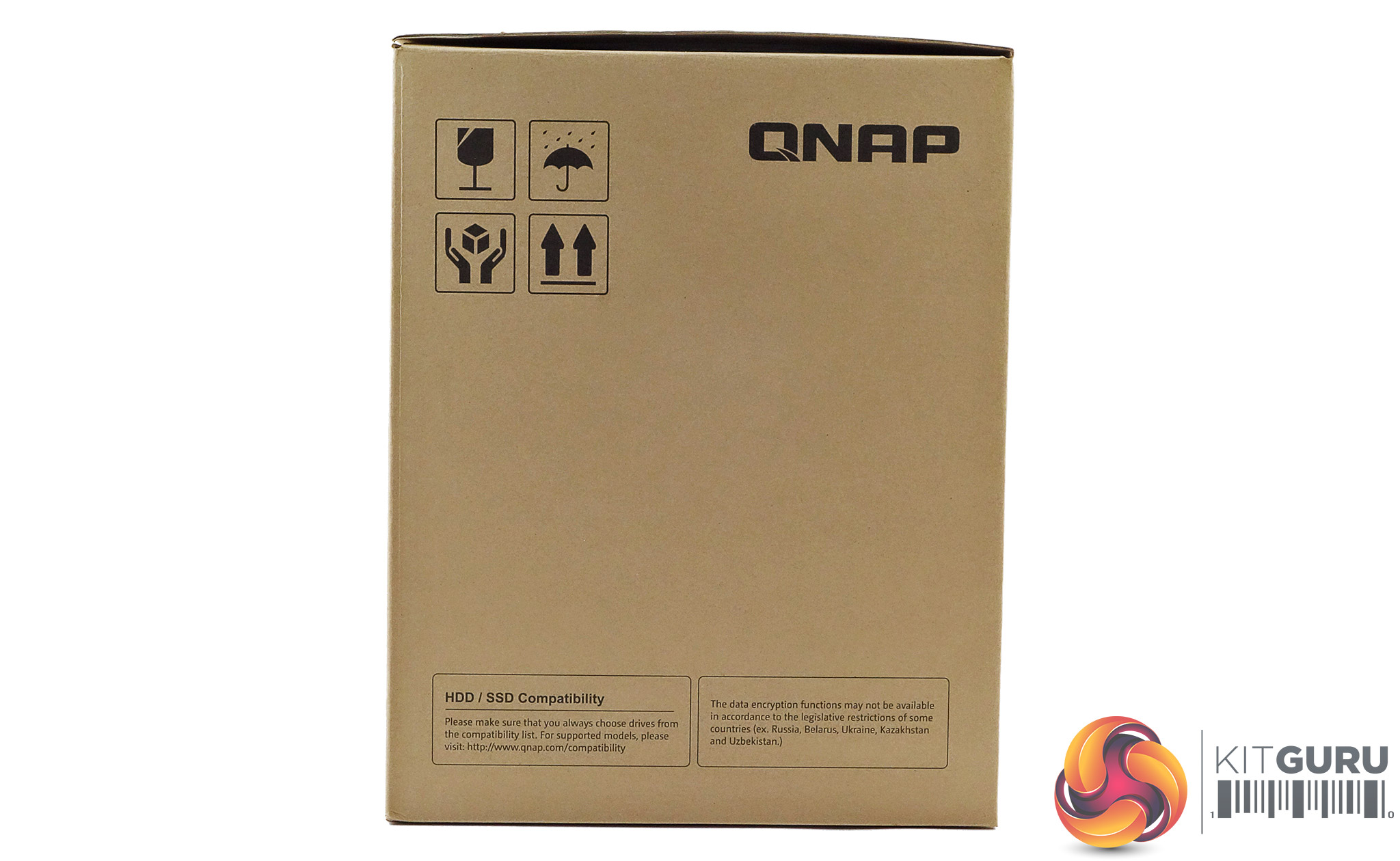
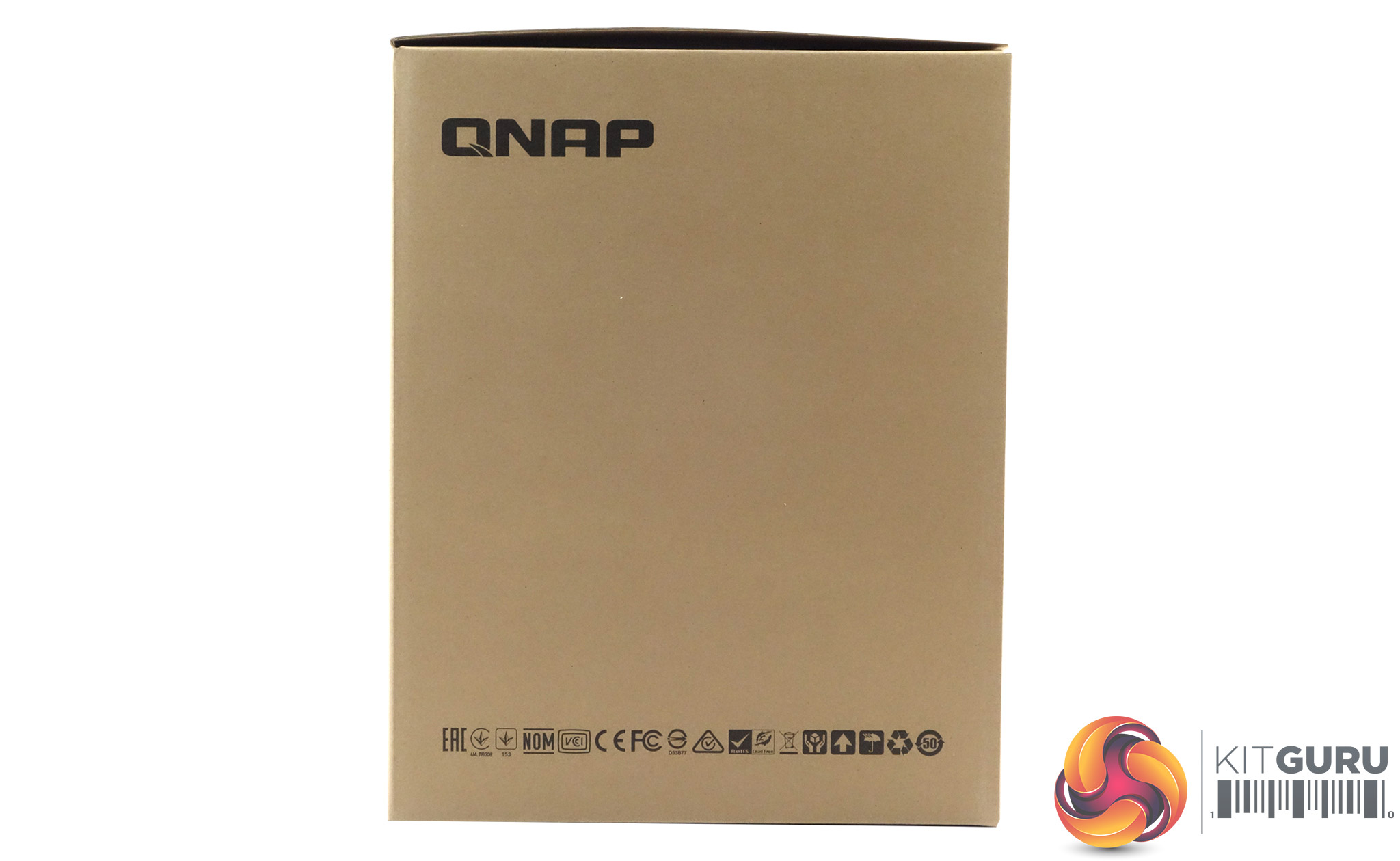
One side of the box has carriage icons on the top left and an HDD/SSD compatibility panel on the bottom. The other side just has a row of carriage and storage icons and marks of the various standards the NAS passes.
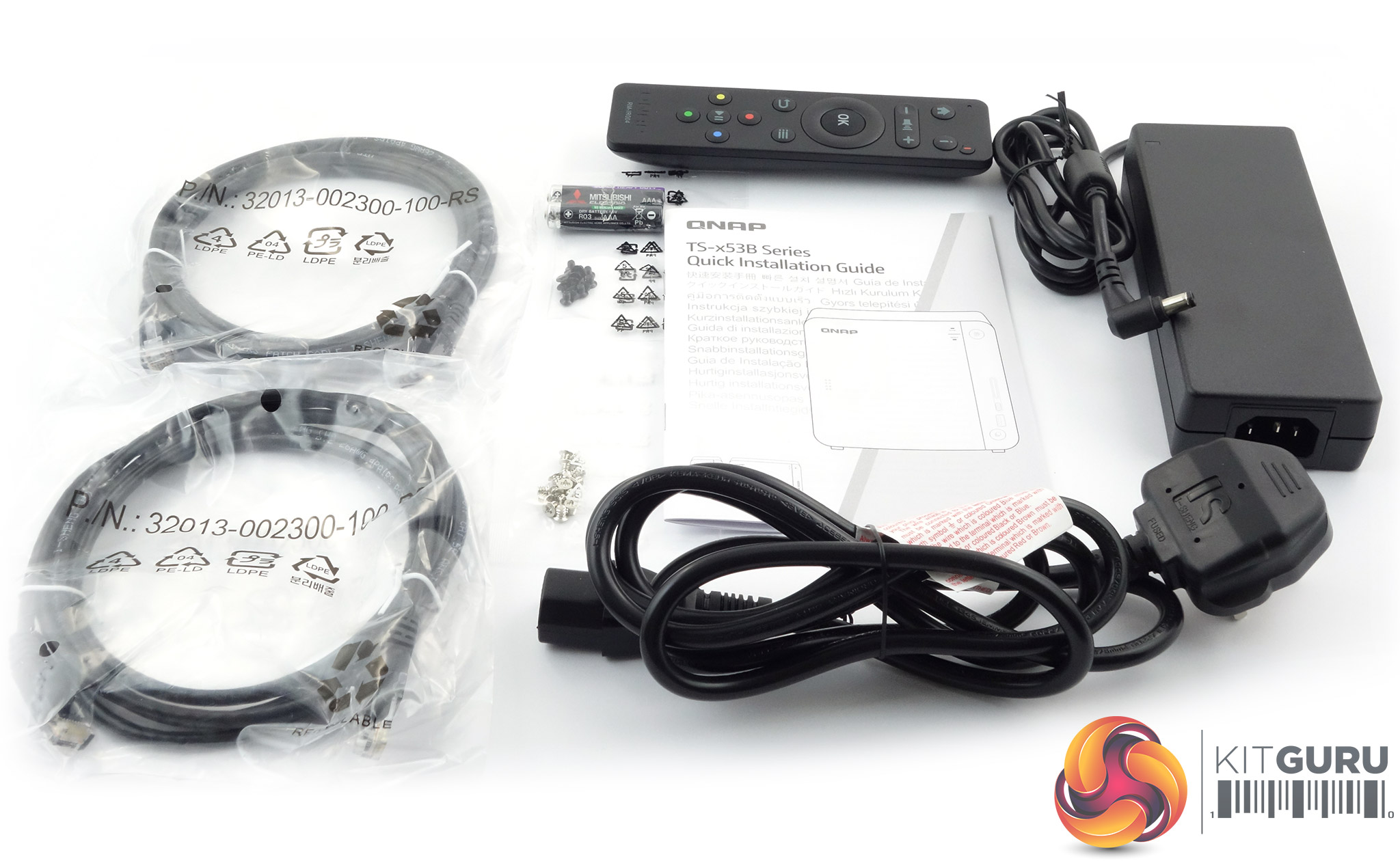
The box bundle contains a pair of Ethernet cables, enough screws to fix 4 2.5in drives, the Delta Electronics DPS-90SB-3 power adapter, an RM-IR004 IR remote and a Quick Installation guide.
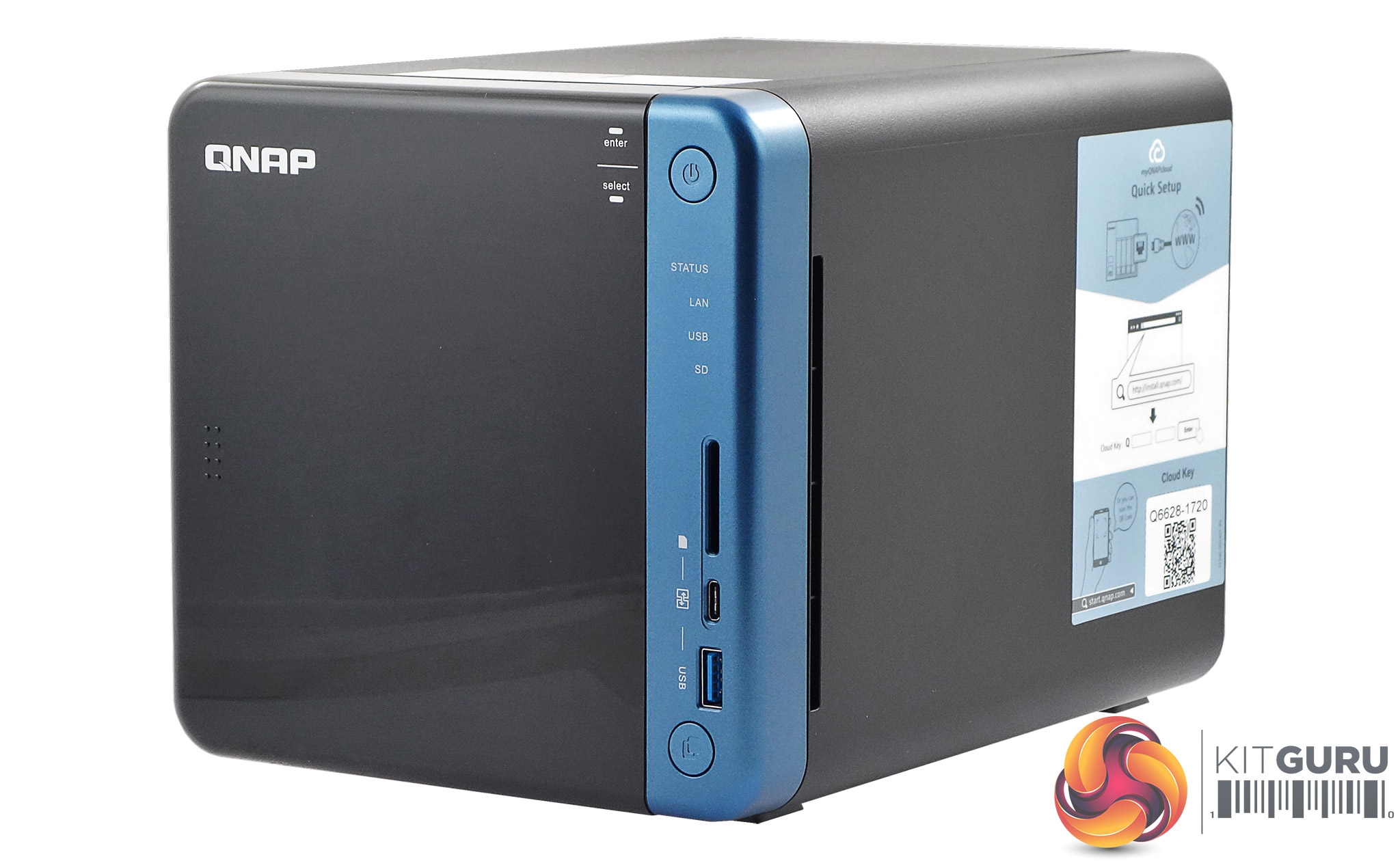
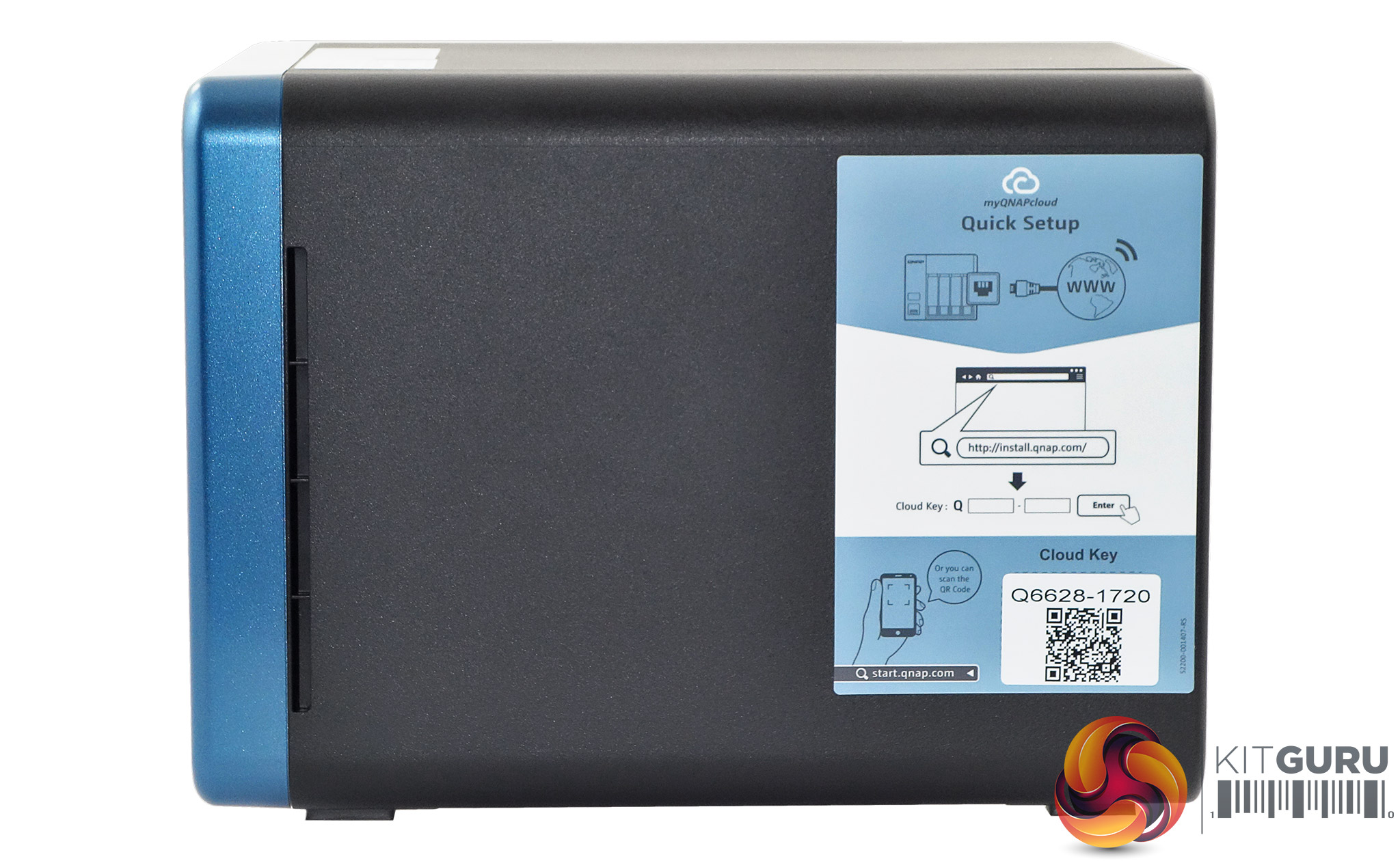
QNAP's TS- x53B series has a new distinctive design finished in black with a metallic blue-gray front bezel strip housing the power button, indicator LEDs and the front ports.
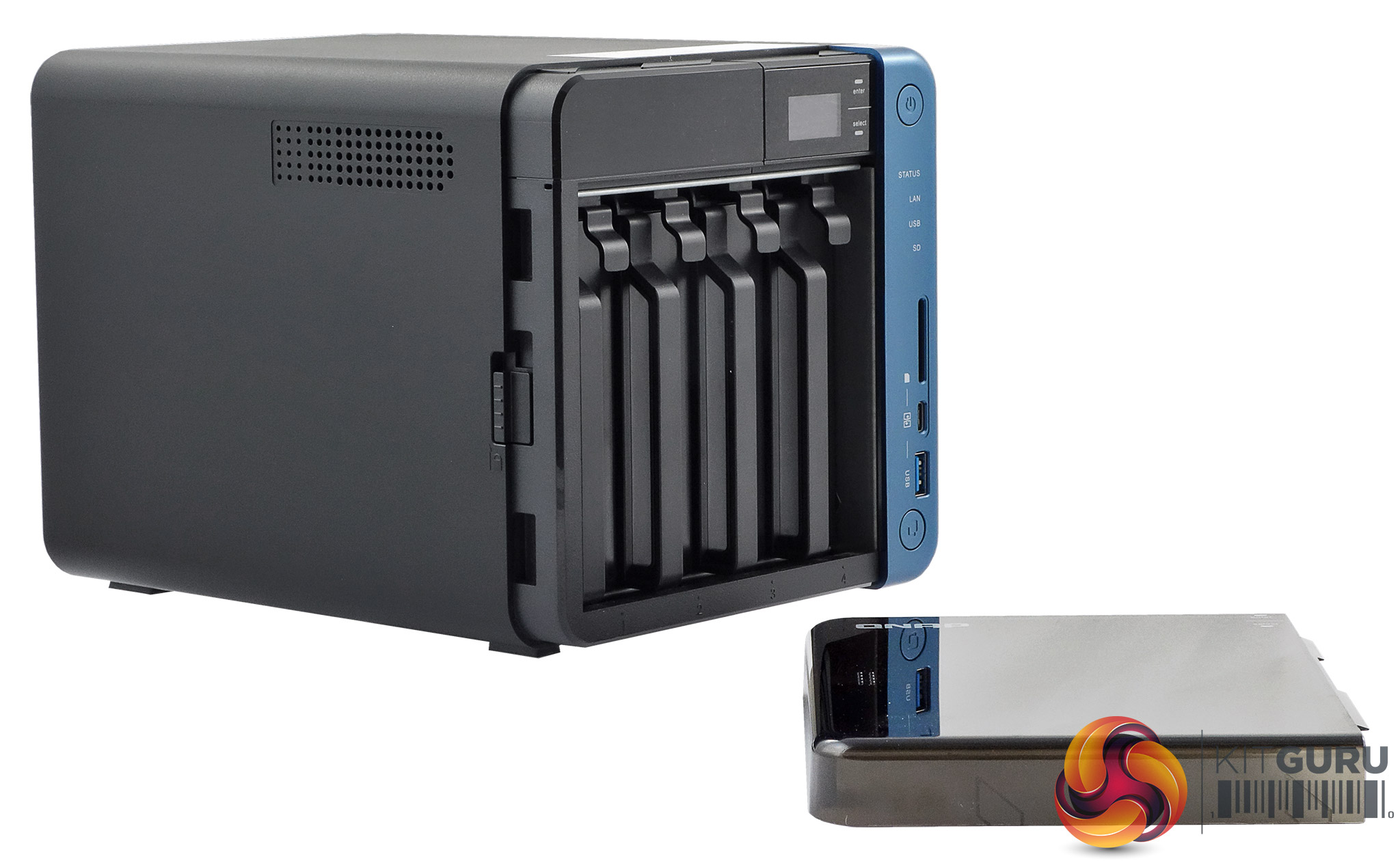
The drive bays are protected by a high gloss Piano Back panel which slides on an off and has a slide lock to hold it in place. There are no locks on the drive trays themselves.
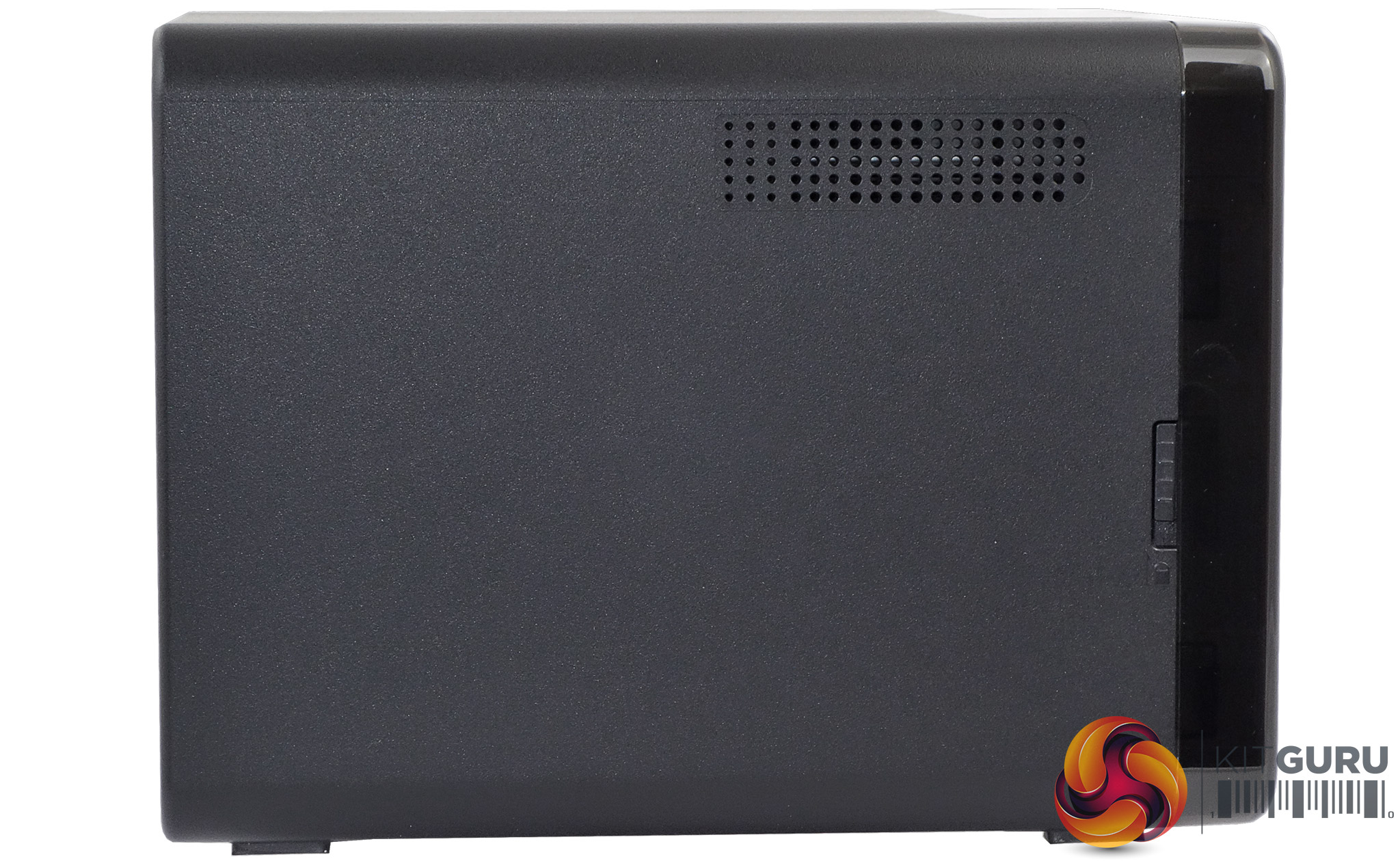
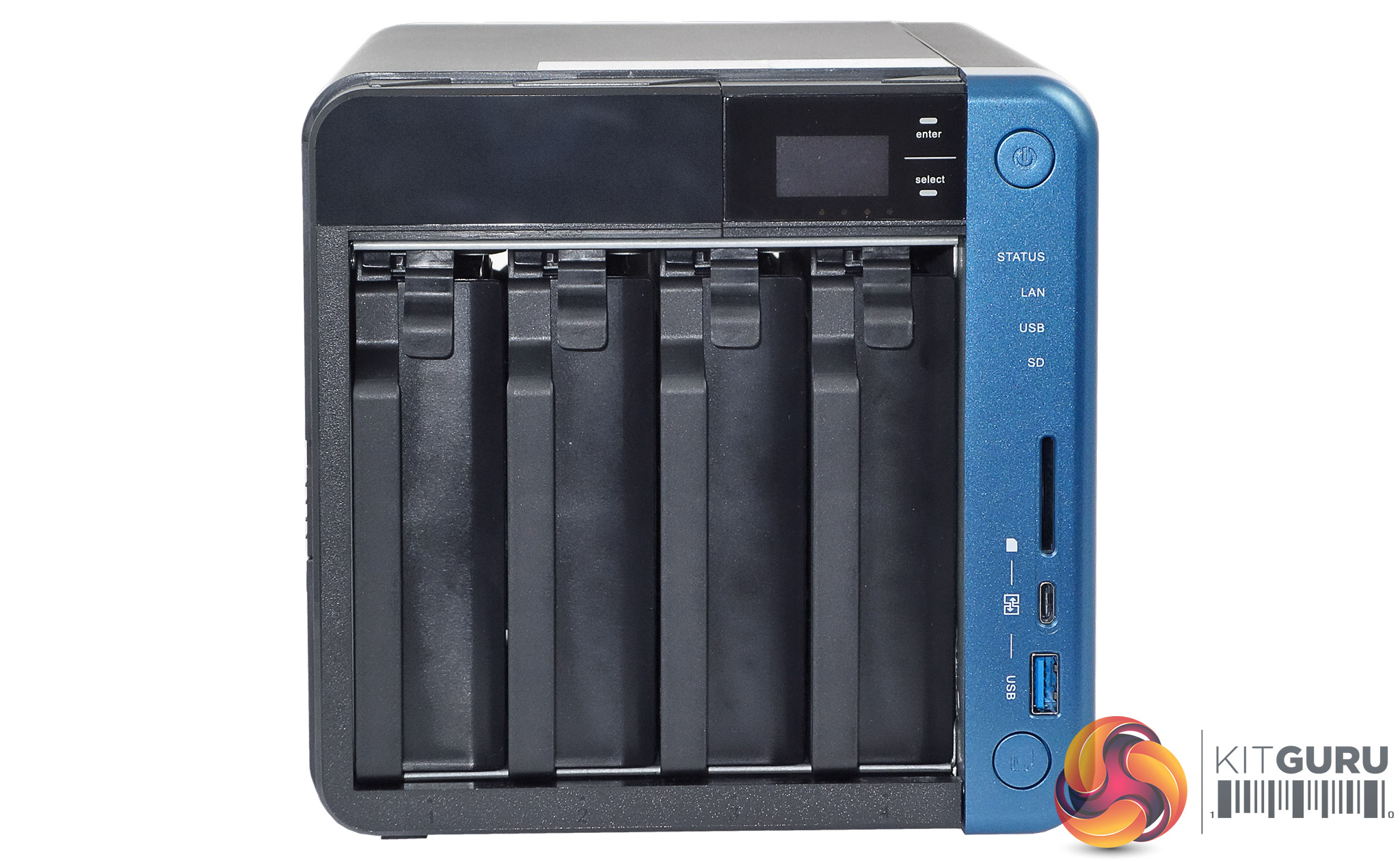
On the front panel above the drive cage is a very small OLED display that displays information on the network, system, disks and volumes and by using the two (enter and select ) buttons it also enables changes to be made to network settings. Under this screen sit four tiny drive activity LEDs.
Under the power button sit four indicator LEDs. Reading from to bottom these are Status, LAN activity, USB and SD Card activity. The SD Card slot sits directly under the indicators and under this sits the USB QuickConnect port and a USB 3.0 port for the One Touch Copy button that sits under it. The USB QuickConnect port is Type C but annoyingly QNAP don't bundle a cable with the NAS so you have to buy it elsewhere.
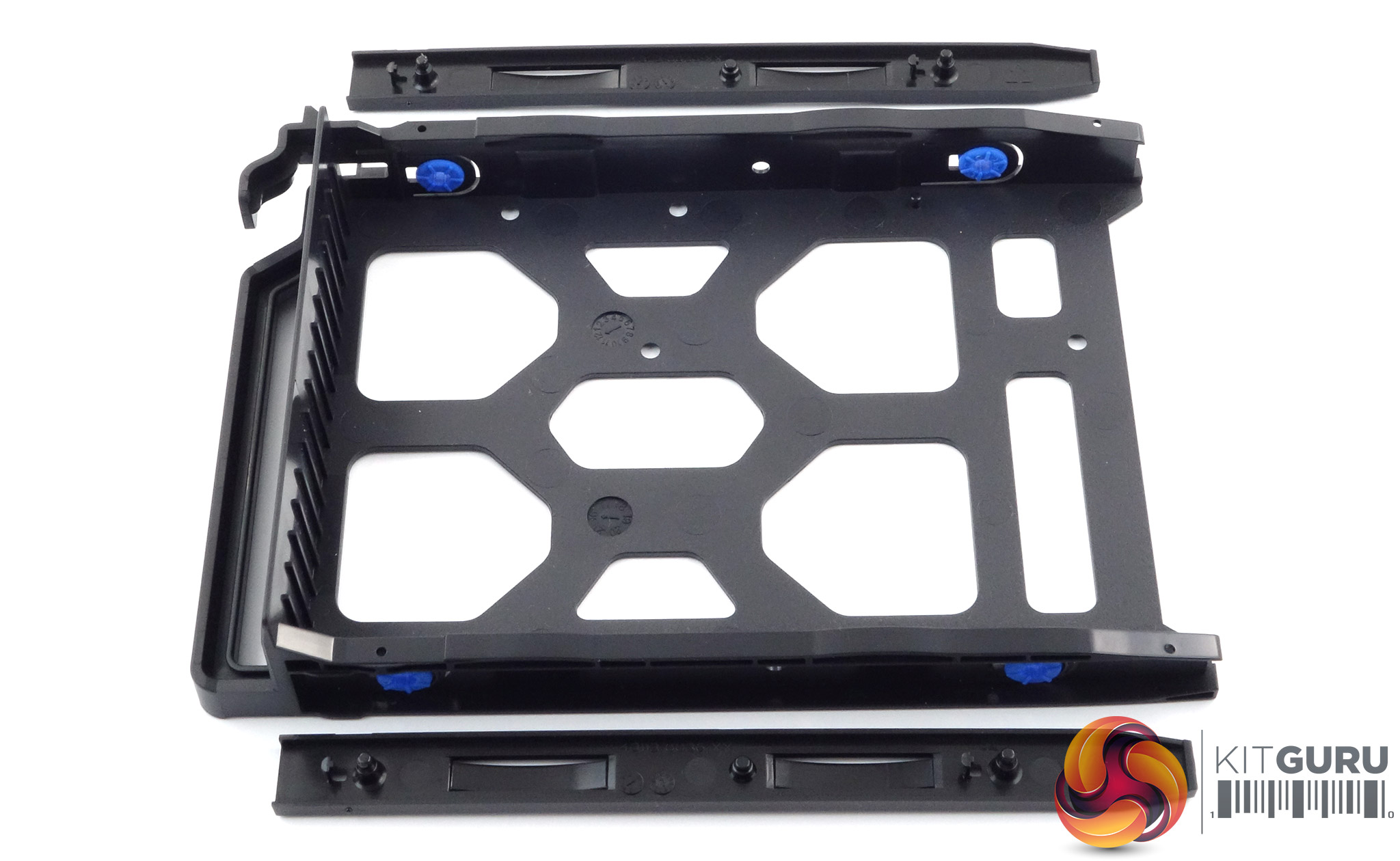
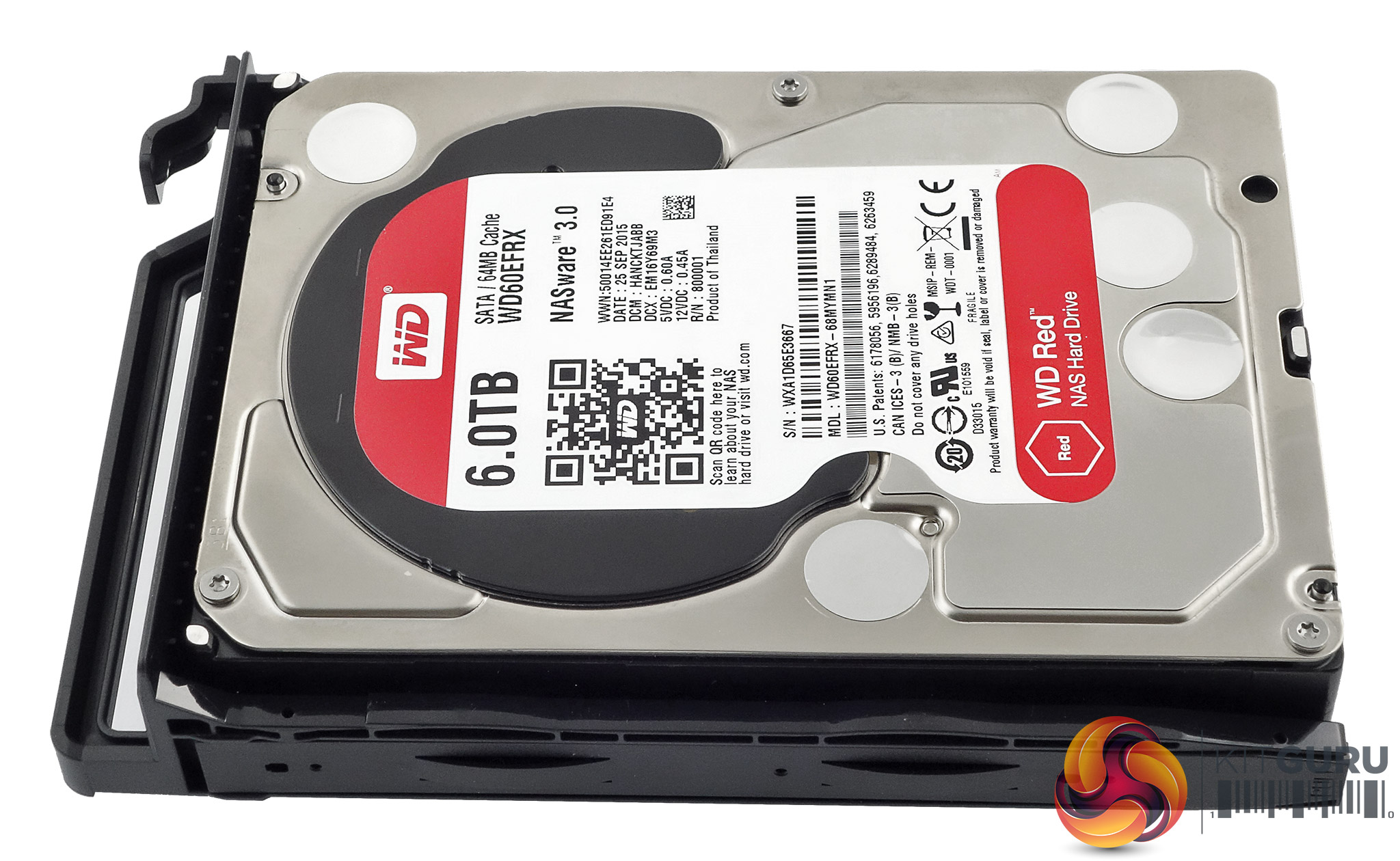
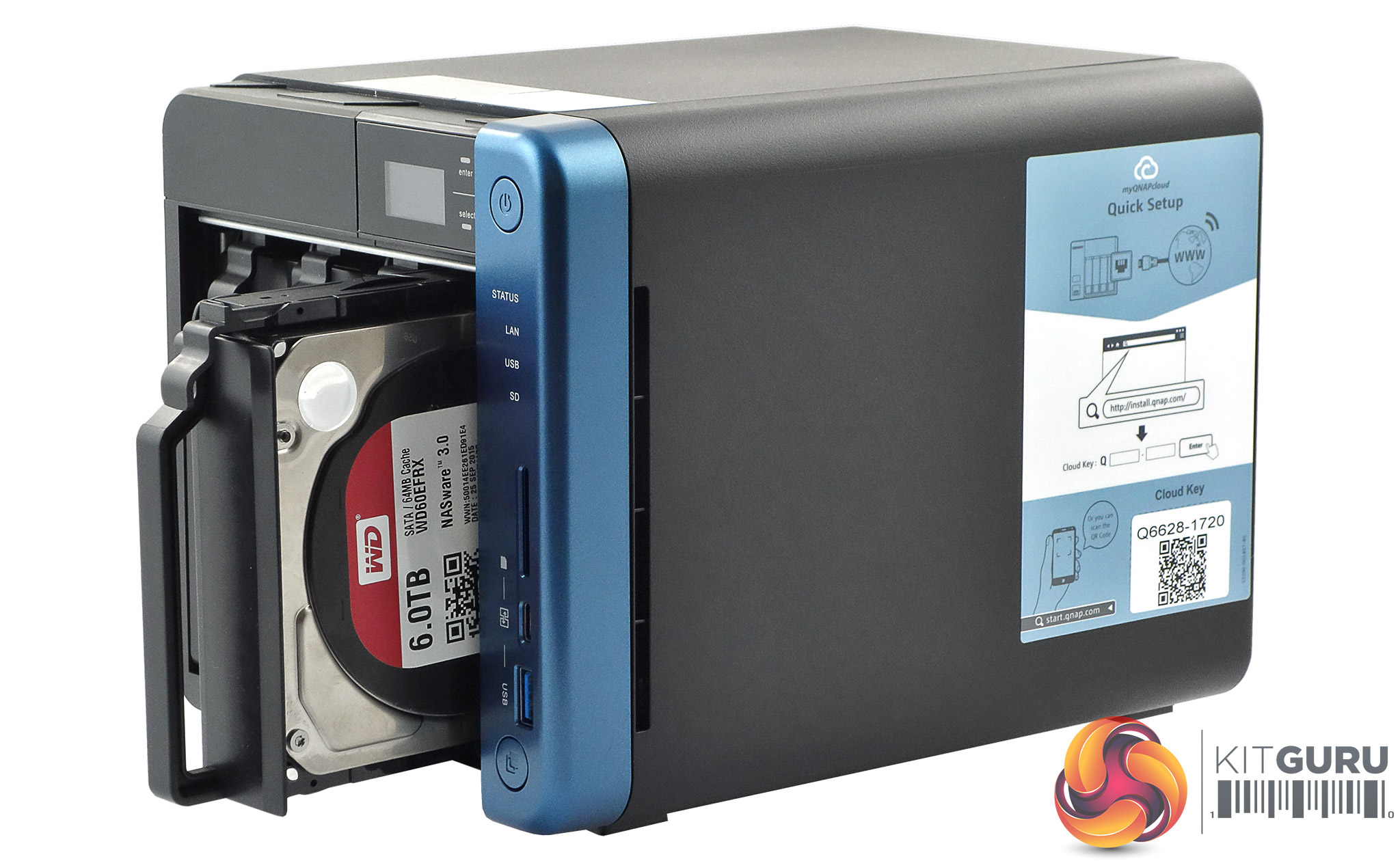
The drive trays are made of plastic and have grab handles moulded into them. The trays are held in place with small latches. Supporting both 3.5in and 2.5in drives, the larger drives are held in place by plastic strips that fit into grooves in the drive trays sides with pins that fit through the tray side and into the drives side mounting holes.
These mounting holes in the tray sides have anti-vibration grommets fitted. If you want to make sure the drives are installed firmly, you can use the screws provided to fix the drive via holes in the tray base. 2.5in drives can only be fixed via these holes in the tray base.
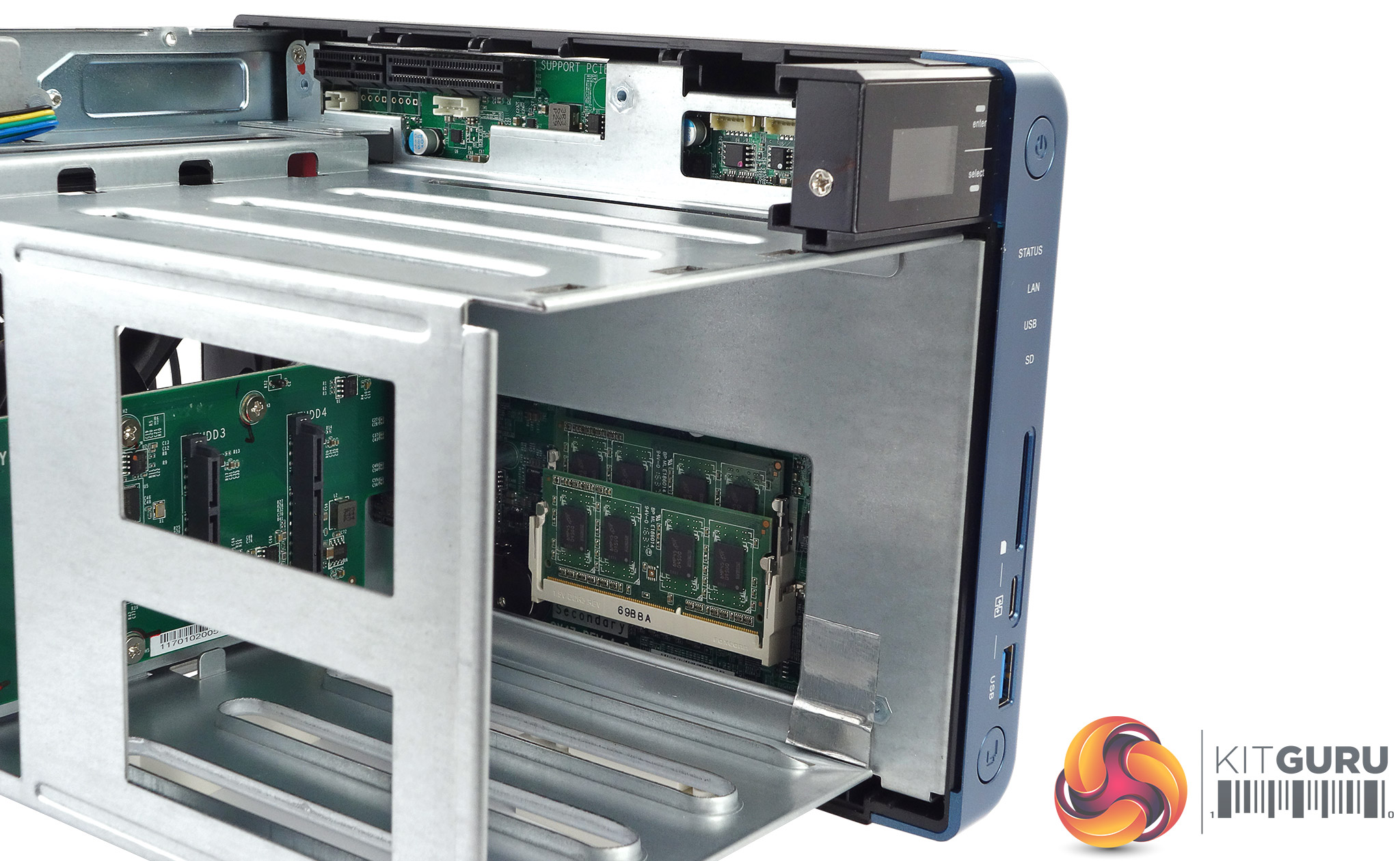
The PCIe slot sits at the top rear edge of the motherboard and can be accessed with the cover removed. The slot can be used to house a 10GbE network, WiFi or USB 3.1 cards. QNAP's QM2 card, a card that features dual M.2 slots and 10GbE connectivity supporting SSD caching and QNAP's Qtier auto-tiering technology for improved NAS performance is another option for the slot.
To access the two SO-DIMM slots, all hard drives need to be removed as well as the cover. Access to these slots is via an open panel in the drive cage, it's a little fiddly to access but doesn't present any major problems.
Physical Specifications
Processor: Intel Celeron J3455 quad-core 1.5 GHz (2.3 GHz burst frequency).
Memory: 8GB.
Gigabit Ethernet Ports: 2.
Rear panel connectors: 4 x USB 3.0, 3 x audio, 2 x HDMI 1.4b.
Front panel connectors: 1 x USB-C QuickAccess, 1 x USB 3.0
RAID support: 0,1, 5, 6, 10.
Cooling: 1x 120mm.
Maximum hard drive size supported: 10TB.
Maximum Capacity: 40TB.
Dimensions (D x W x H): 226 x 170 x 168mm.
Weight: 2.33kg.
To test the TS-453B we used the latest 4.3.3 version of QNAP's QTS OS. QTS is a graphically-rich OS with links to the major functions appearing as icons on the main page.
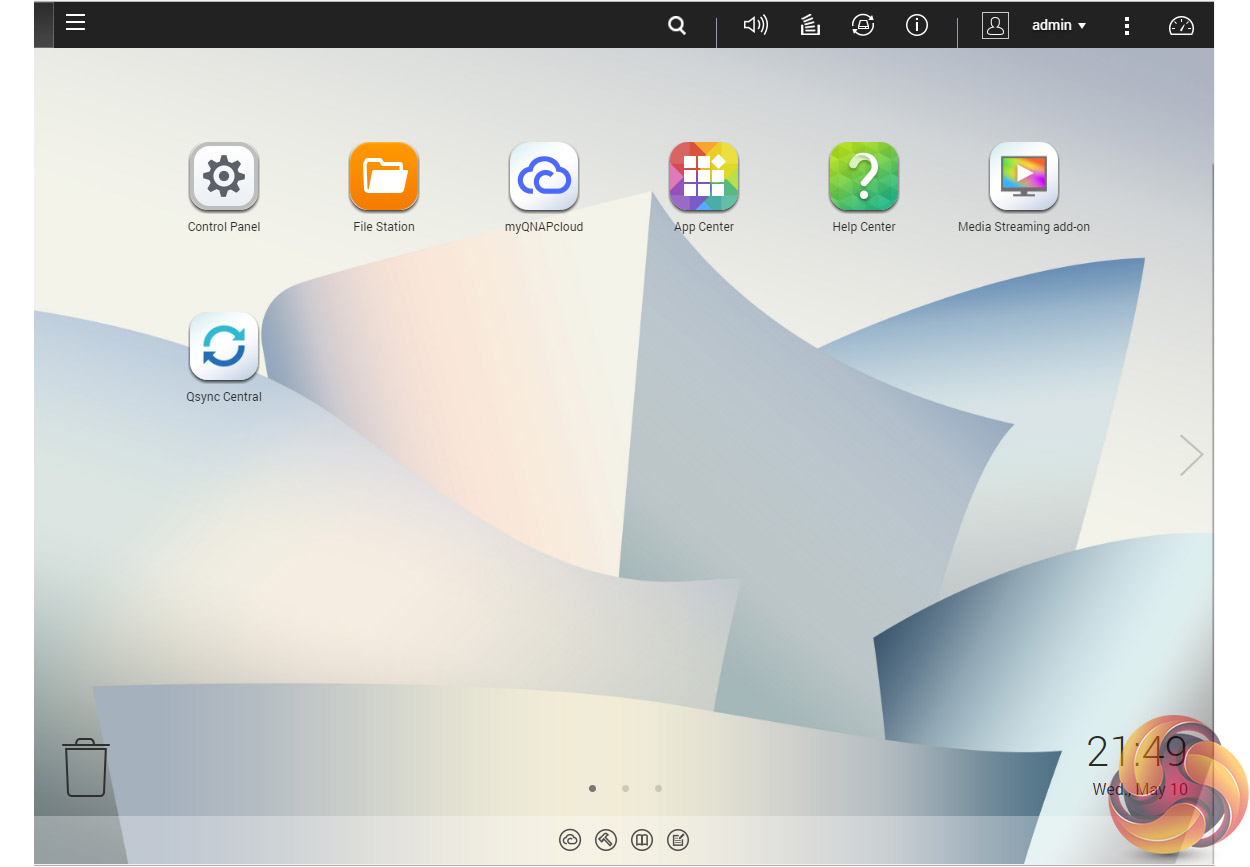
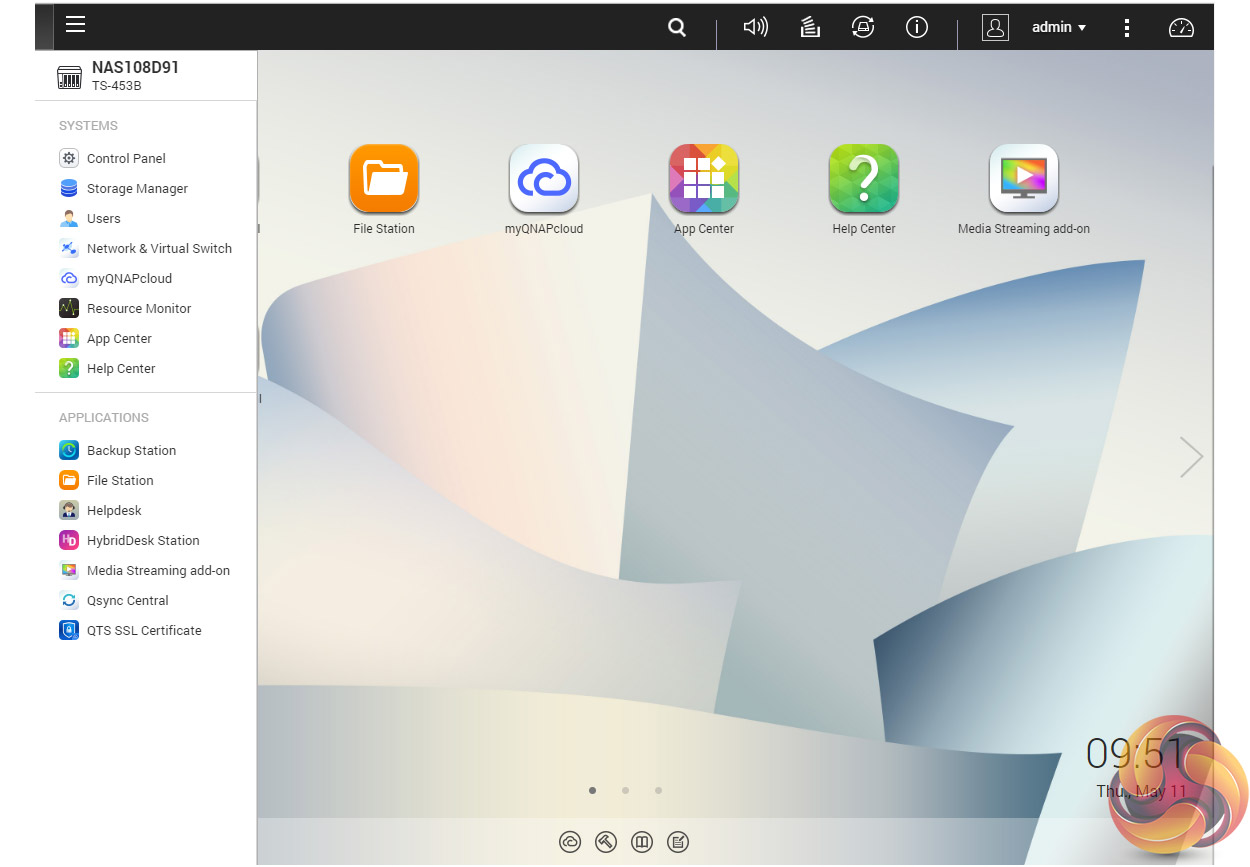
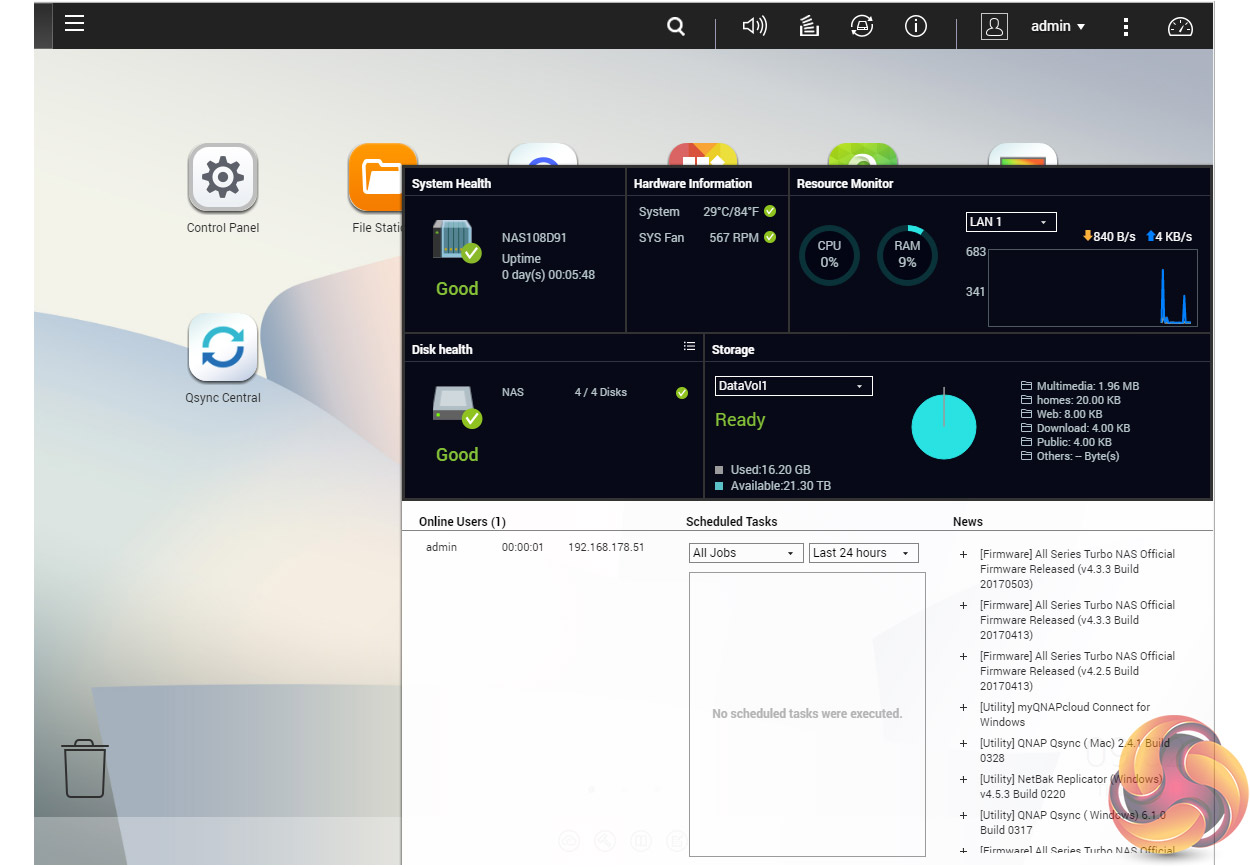
Amongst the updates version 4.3.3 brings are new graphics for the background of the main QTS page. Clicking on the ‘hamburger‘ menu icon at the top left-hand side of the screen drops down a very useful side menu. Clicking the icon on the top right of the screen activates the Dashboard page which gives a snapshot of what’s happening with the NAS.
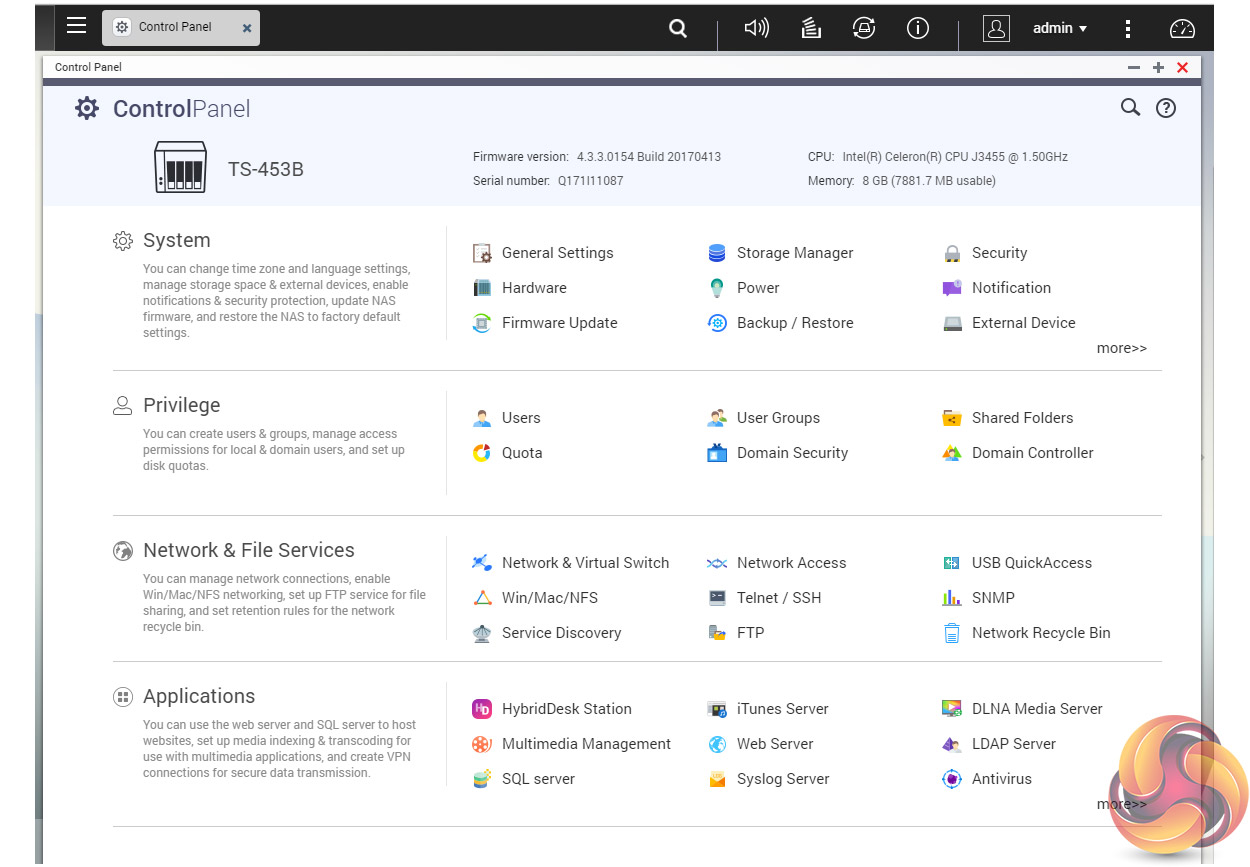
The Control panel overview has all the various functions of the NAS neatly divided into groups; System Settings, Privilege Settings, Network Services etc.
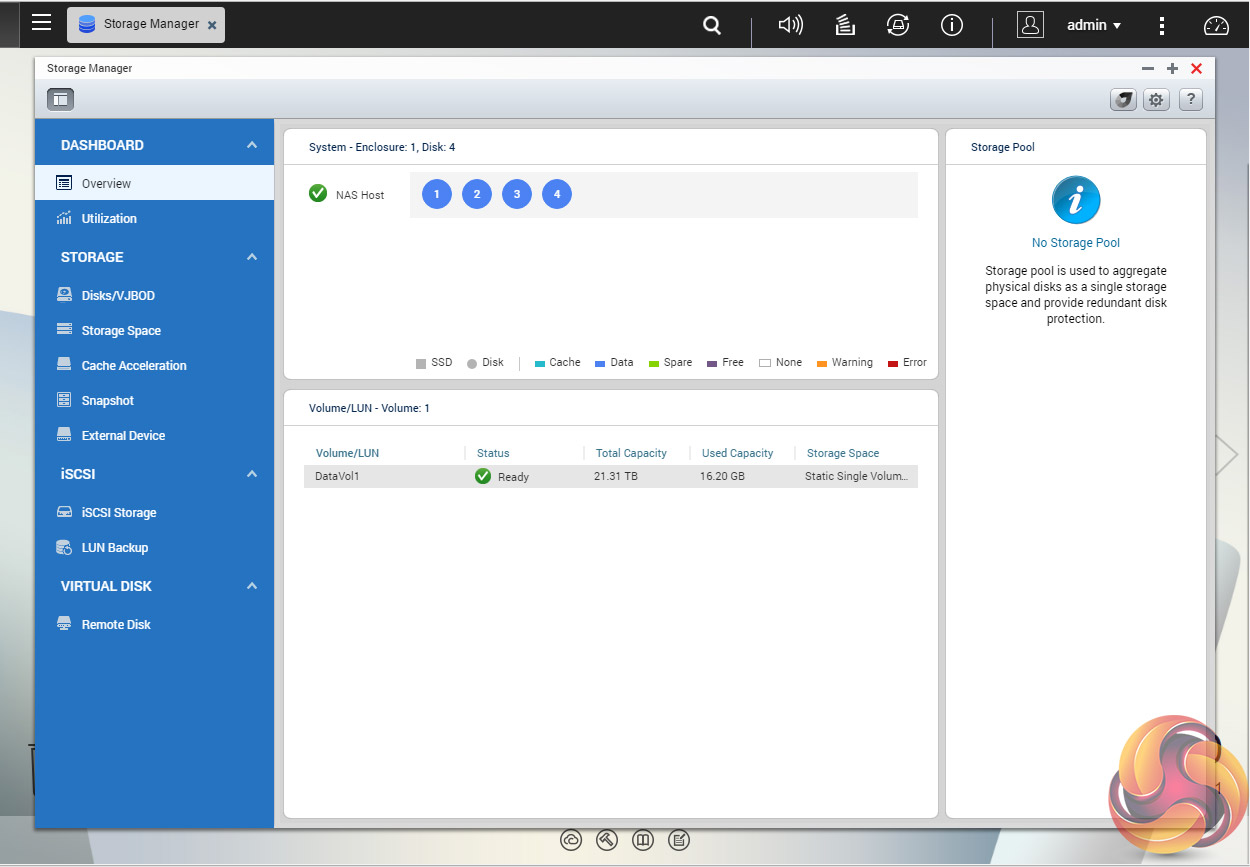
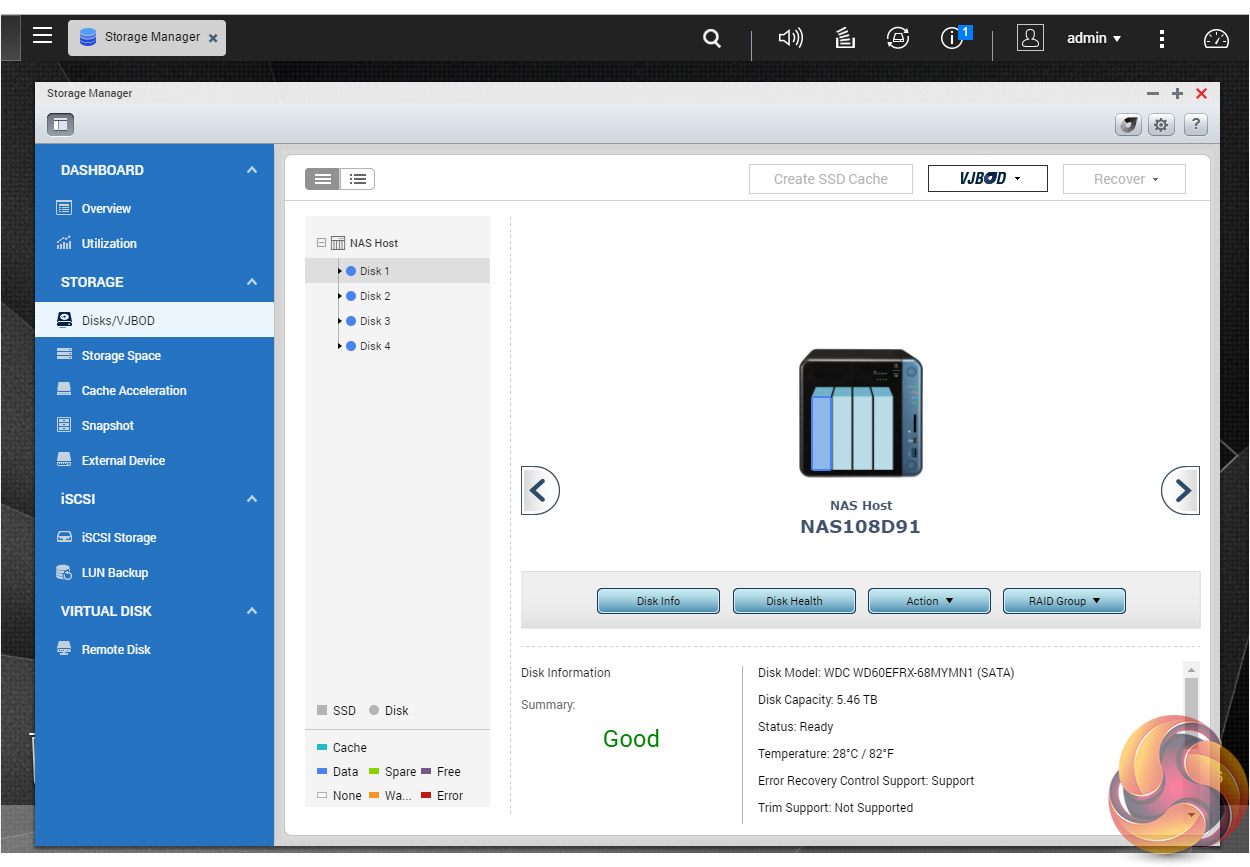
Storage Manager gives you complete control over setting up drives and volumes, in addition to showing how the capacity of the NAS is being used and warnings of potential failures. The Storage/Disks/VJBOD sub-menu displays individual drive information and health with a handy graphical display showing which drive is being interrogated.

File Station has been refreshed with a new interface and improvements to the remote connections, public cloud services, and file management. It now supports browsing and transfer of files from the NAS to public cloud services including Dropbox, Box, Google Drive, Microsoft OneDrive and OneDrive for Business, Yandex Disk, Amazon Drive and HiDrive. It also allows the mounting of shared folders from a remote NAS to a local one via FTP and CIFS/SMB.
Qfiling makes the job of archiving and organising large numbers of files less of a pain by allowing the setting of various filing conditions and schedules to enable the automation large filing jobs.
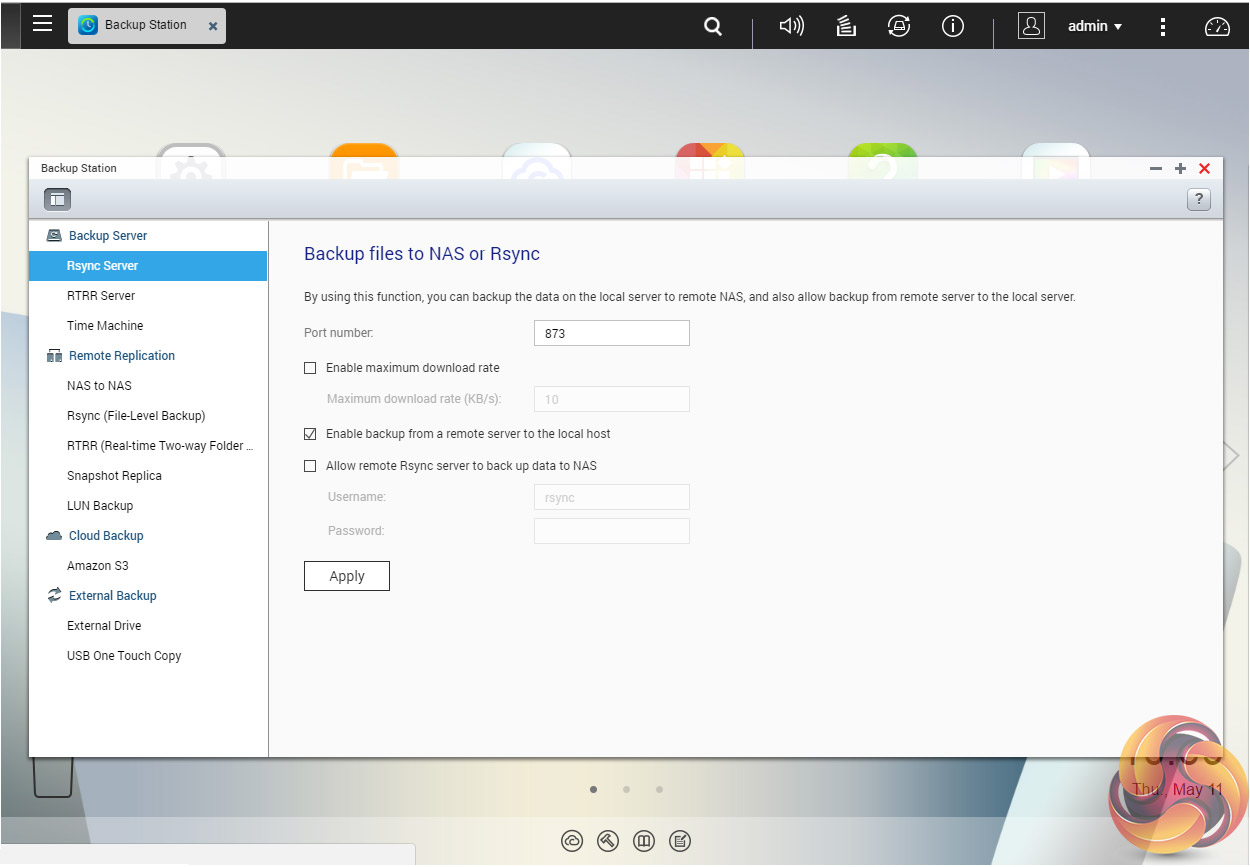
Backup station allows backing up data to a wide range of options, including backup servers, cloud storage, and external devices. The One Touch button on the front bezel can be set up to either upload or download files/folders or backup the NAS to an external USB drive. In the Backup Station pages in the QTS you can set up exactly what you want the One Touch system to do.
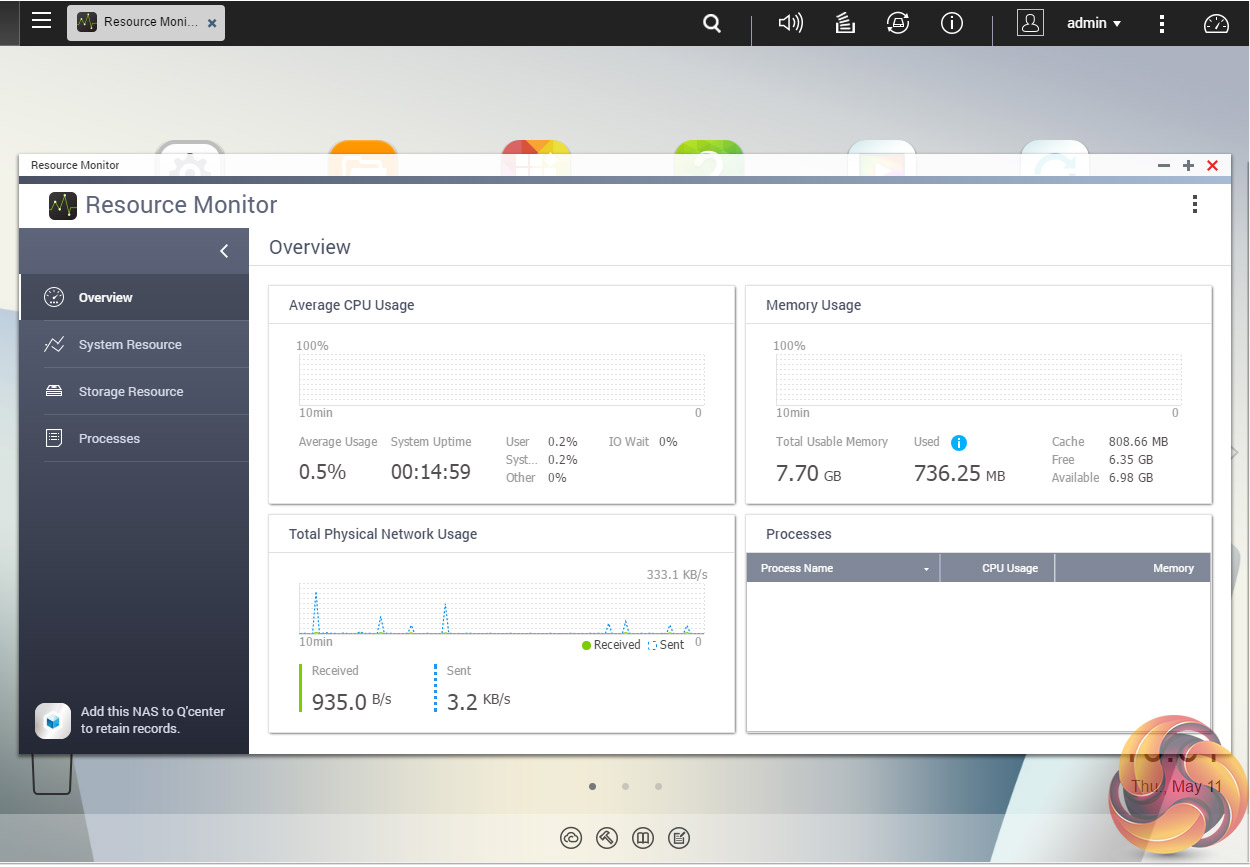
The Resource Monitor has had an upgrade so that all the monitoring elements are more easily identified and now includes more detailed information on how the storage of the NAS is being used.
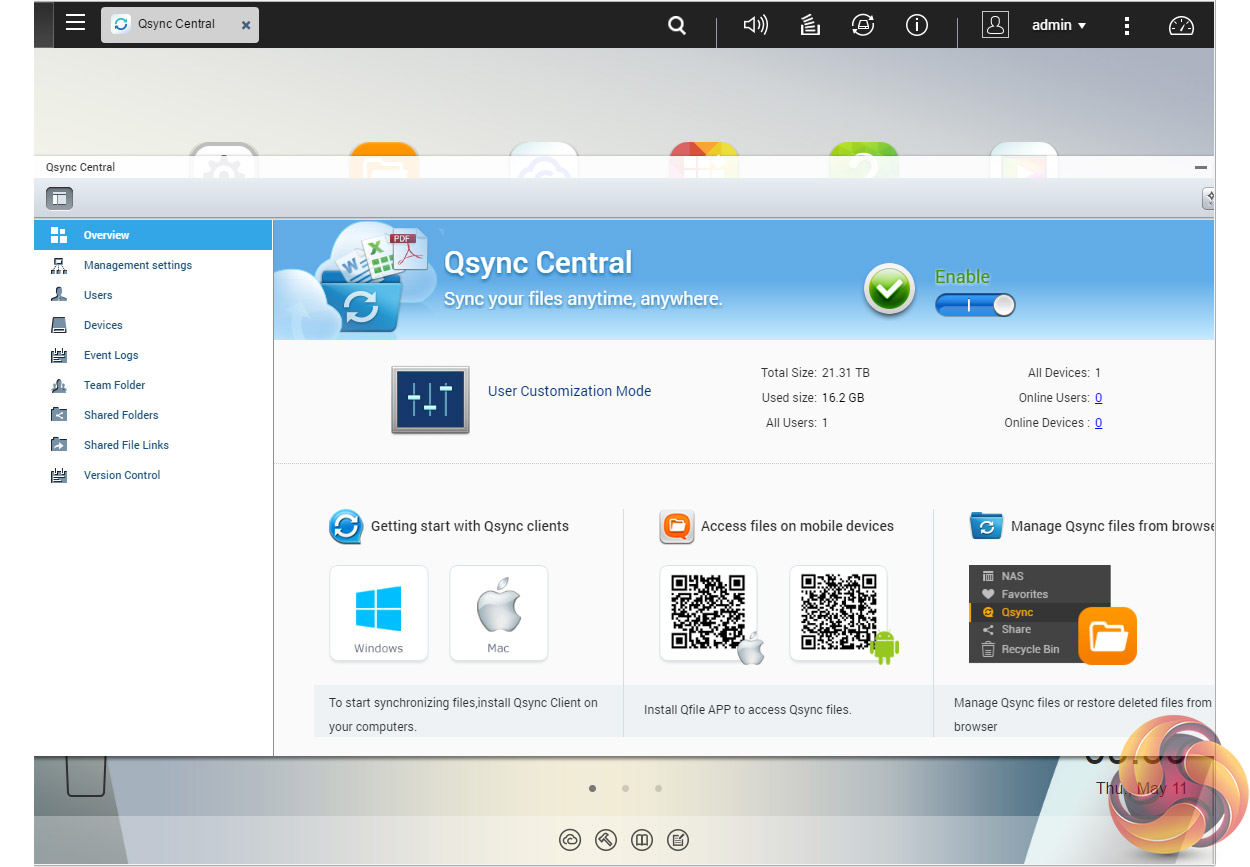
To access files from anywhere there is Qsync Central. Files added to the Qsync folder are available to the local NAS and all devices that are connected to it, including mobile ones.
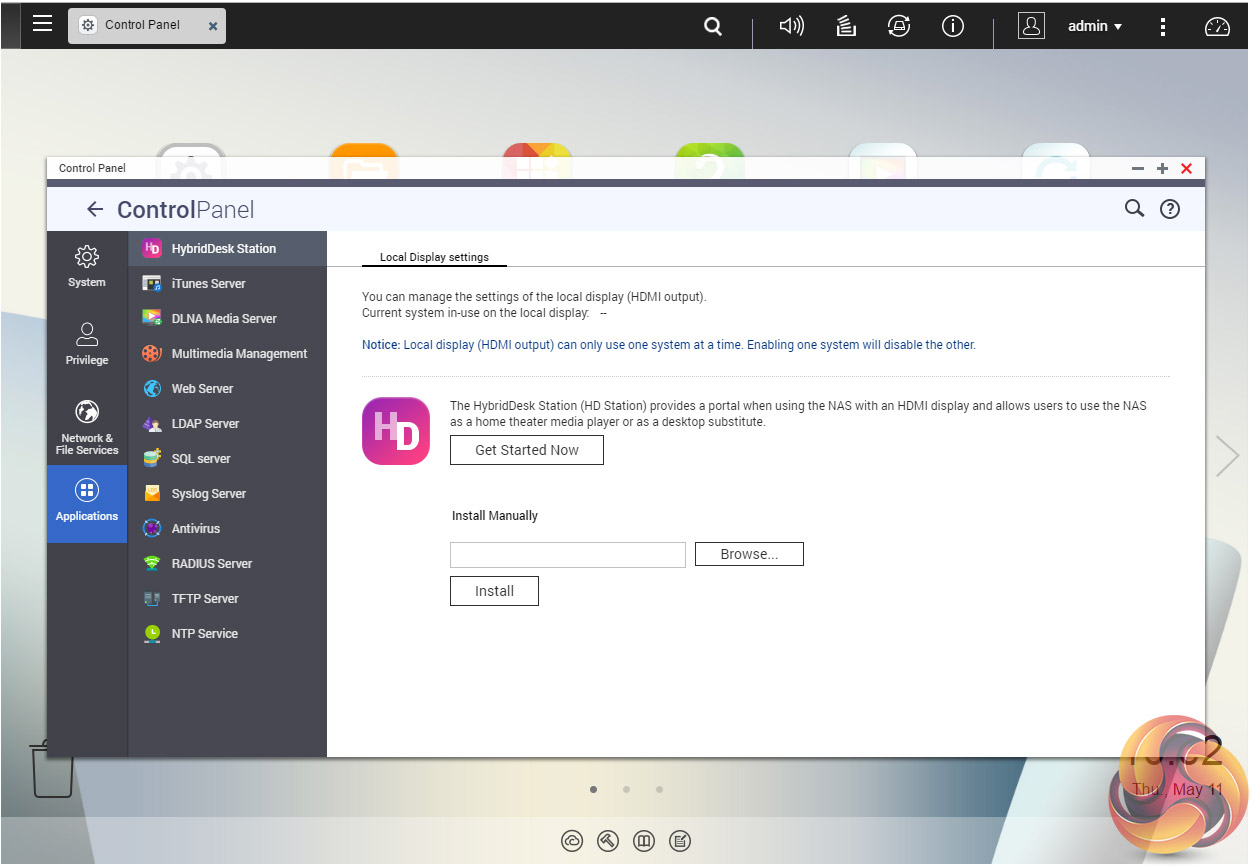
By installing HD Station and then connecting a USB keyboard and mouse together with an HDMI equipped display the TS-453B can be used as a 4K output HTPC with the bonus of not needing a PC to use it. If you don't have a keyboard or mouse, no problem, as QNAP bundle a remote control with the TS-453B or by using the Qremote App you can control it with a mobile device.
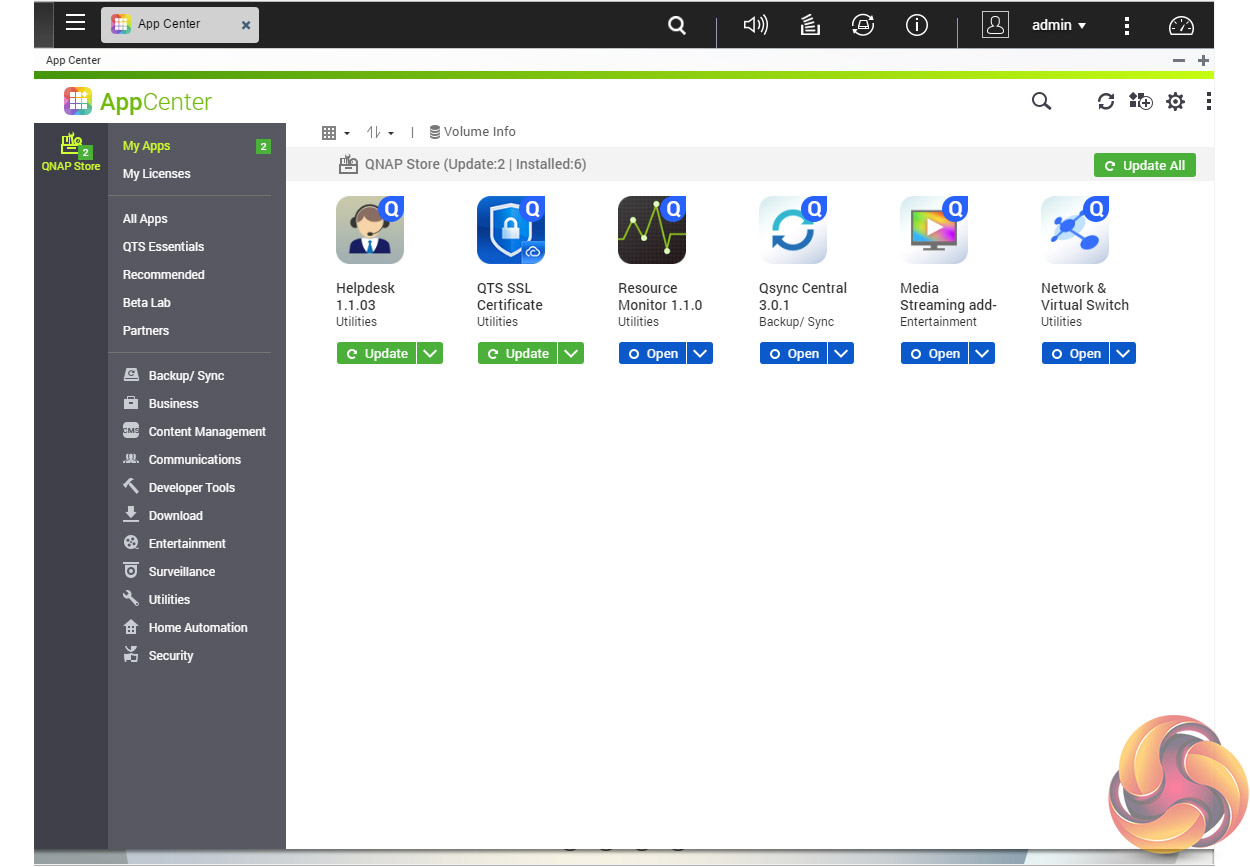
App Center has over 160 apps to choose from covering everything from backups to home automation and pretty much everything in between.
QTS 4.3.3 Highlights
Backup Station
Photo Station 5.3
Video Station 5.0
Music Station 5.0
Notes Station 3.0
File Station 4.3
Download Station 5.0
Resource Monitor 1.0
App Center
HD Station – Use a QNAP NAS as a home theater center
Storage Manager 4.3
QNAP Snapshot Agent
QNAP QvPC – use the NAS as a PC
QUSBCam2 – Surveillance tool
Plex Media Server
Qmedia
Qfiling – automated file archiving and organisation
myQNAPcloud 2.6
Network and Virtual Switch 1.4
QNAP Mobile Apps including
Qremote – Control HD Station with your mobile phone
Vmobile – Professional mobile surveillance app
Vcam – Turn your mobile device into an IP cam
Qmanager – Remote management for NAS
Qfile – Remote file access
Qphoto – Photo sharing
Qget – Remotely manage download tasks
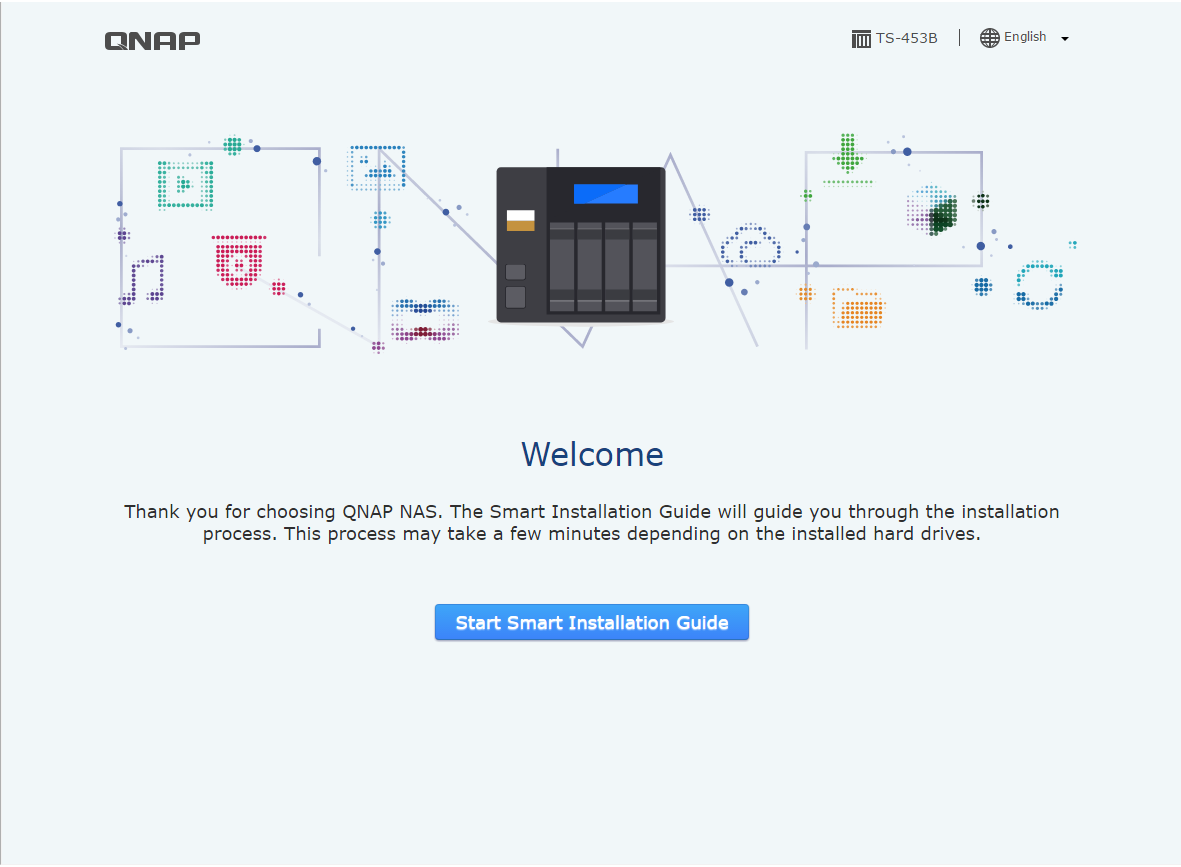
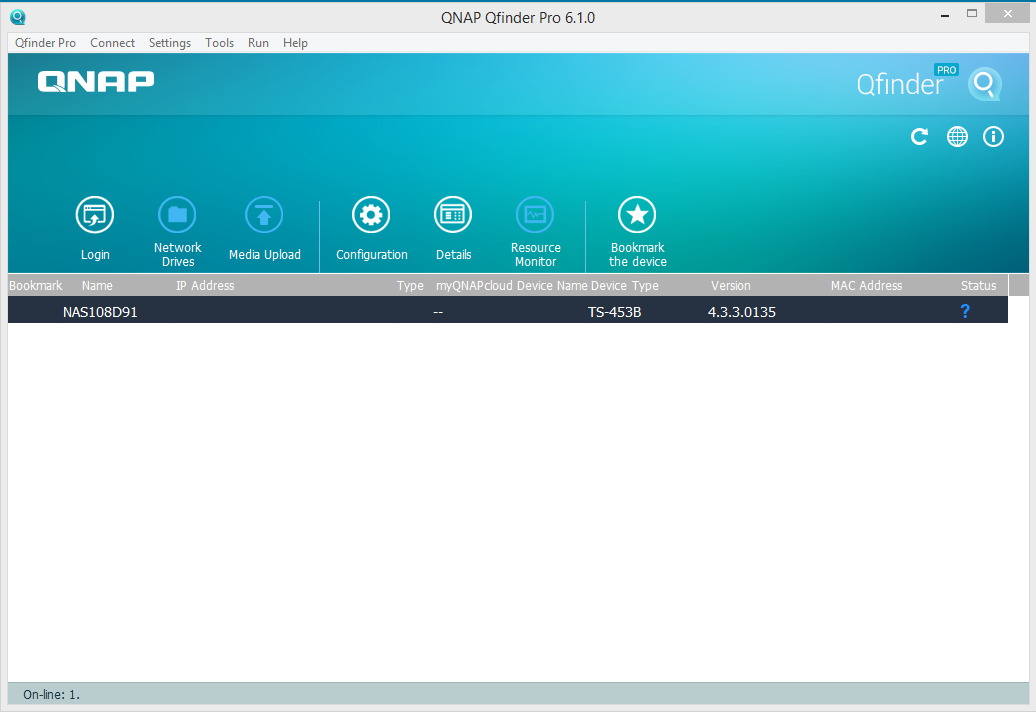
There are two ways of setting up the TS-453B , either online by entering the Cloud key which is on the side of the unit or by using QNAP’s Qfinder Pro utility which can be downloaded from the QNAP website. Qfinder Pro searches for QNAP devices on the network.
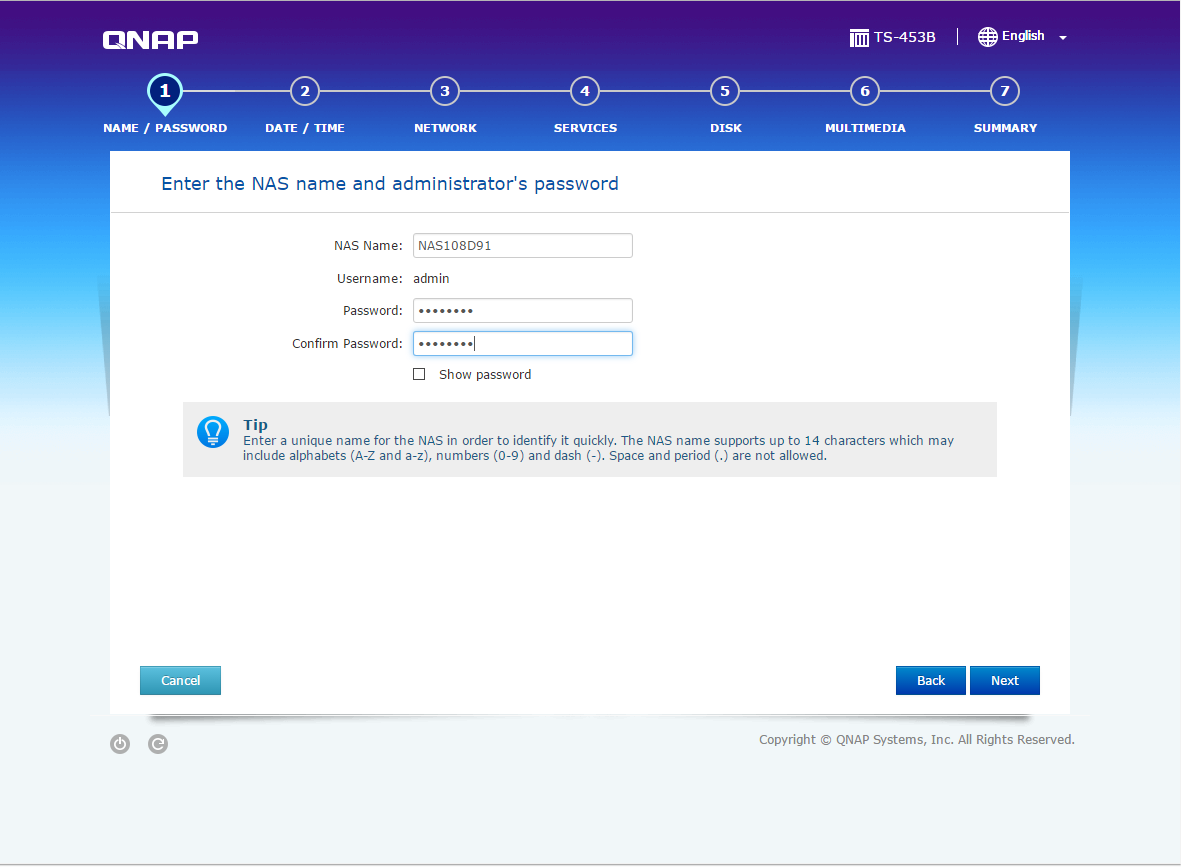
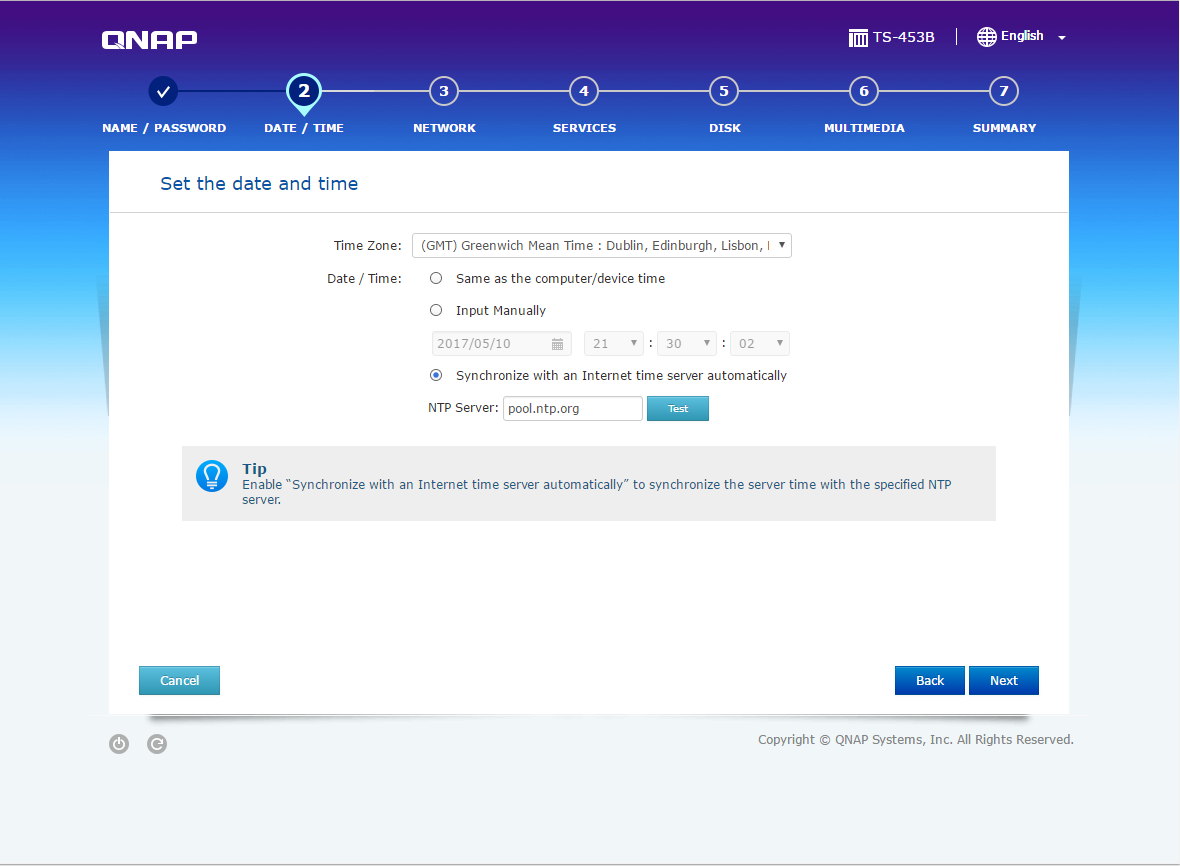
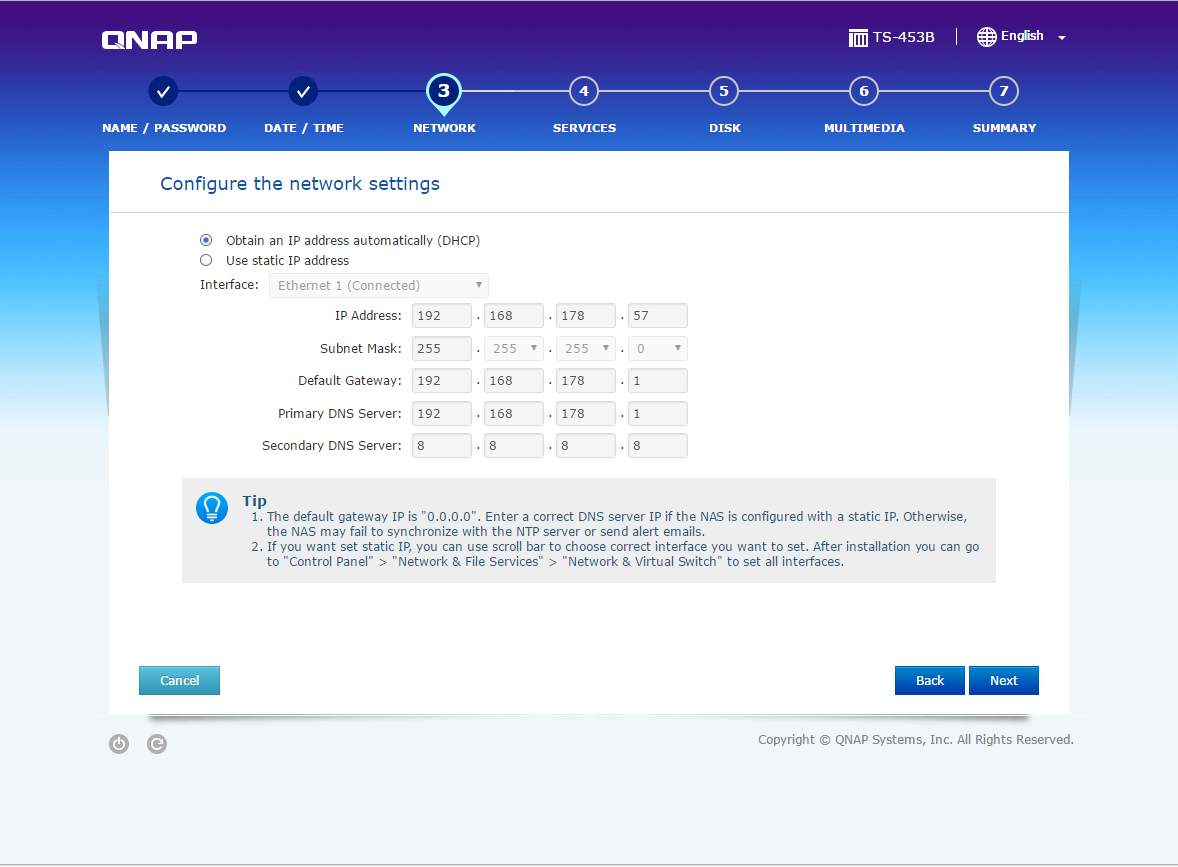
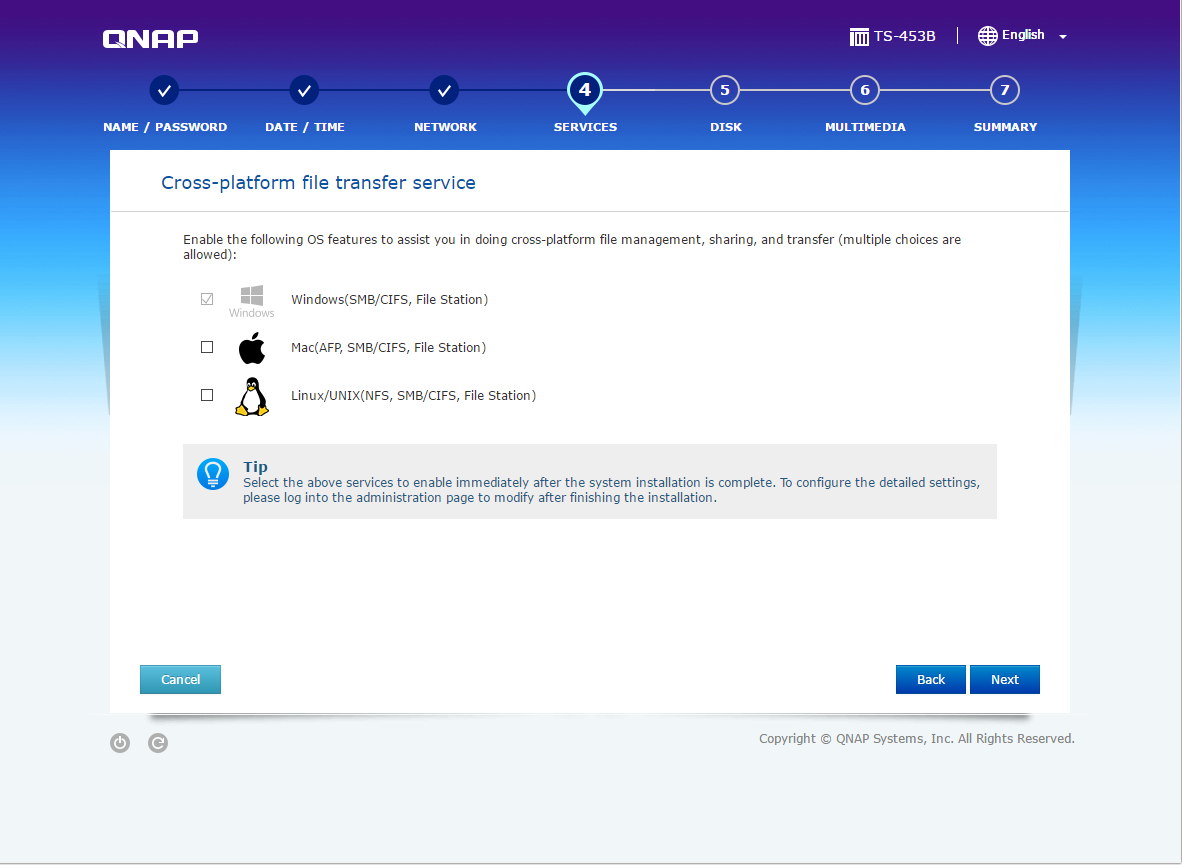
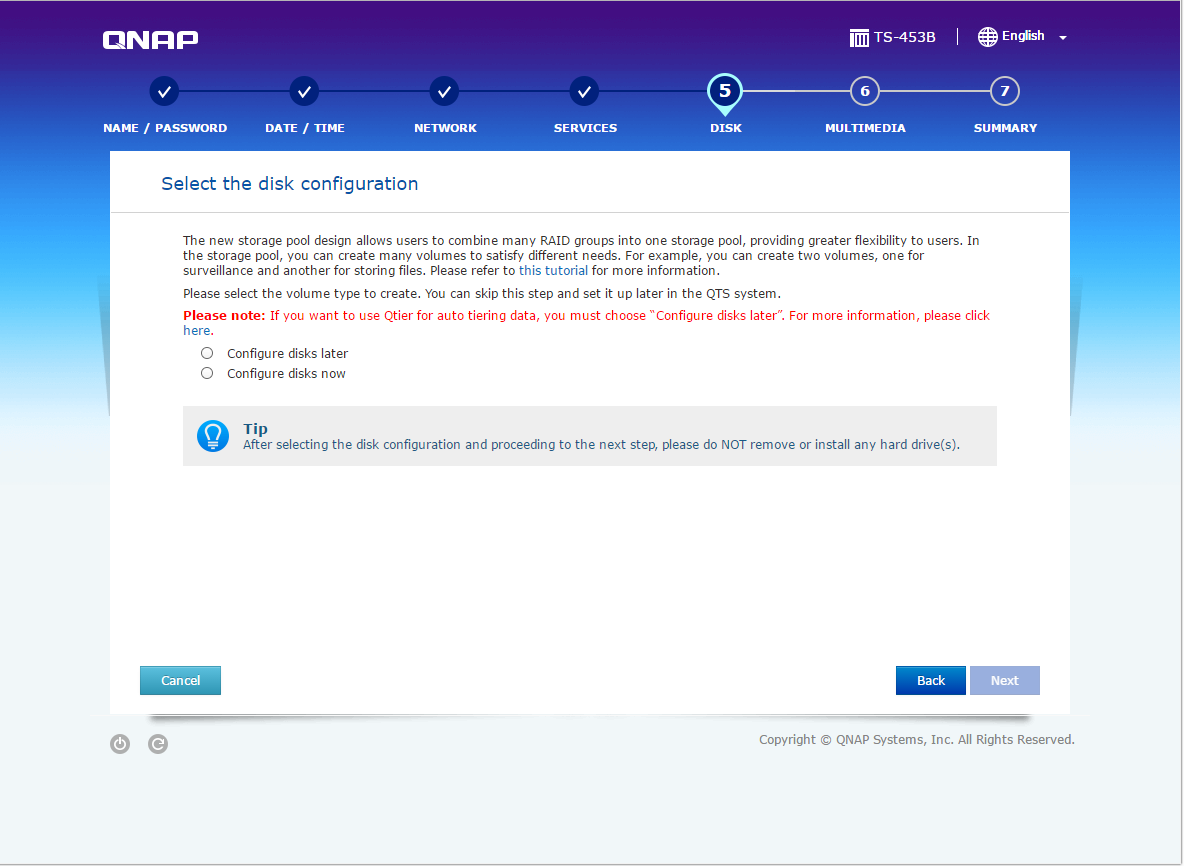
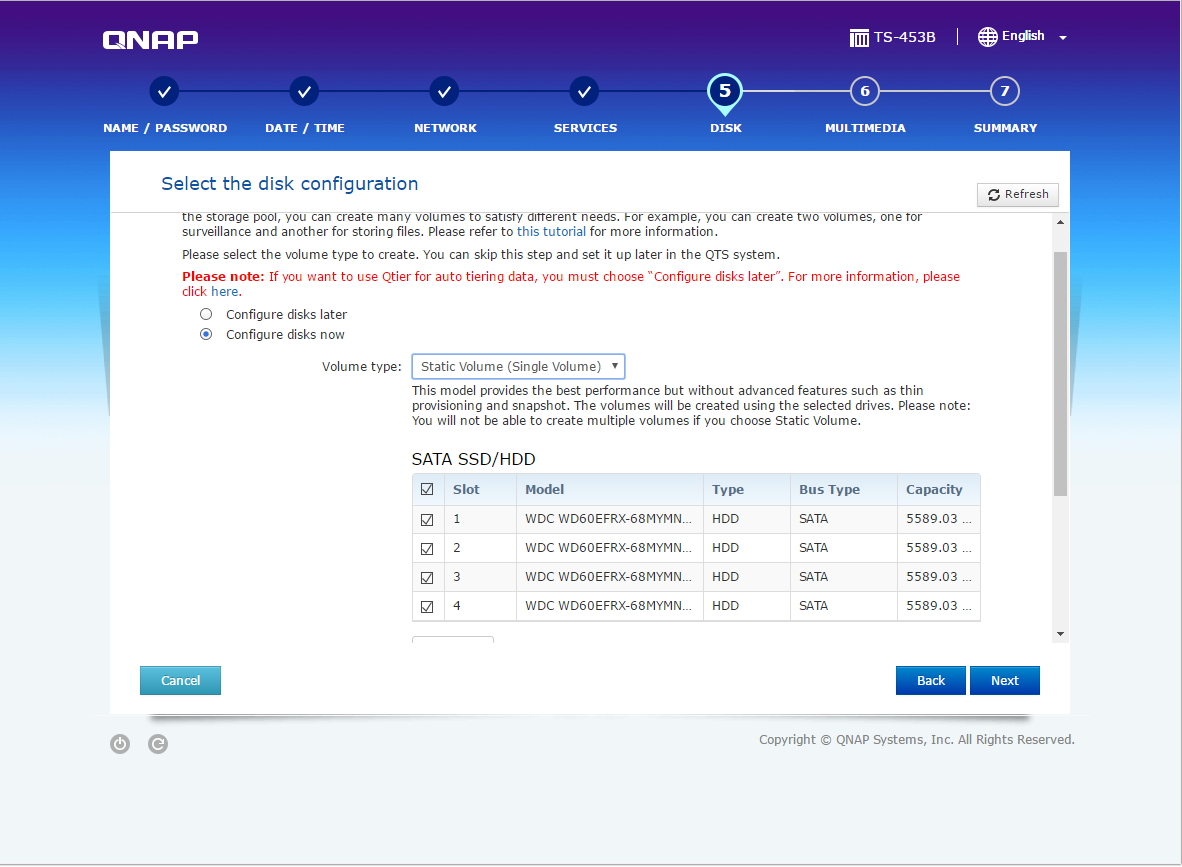
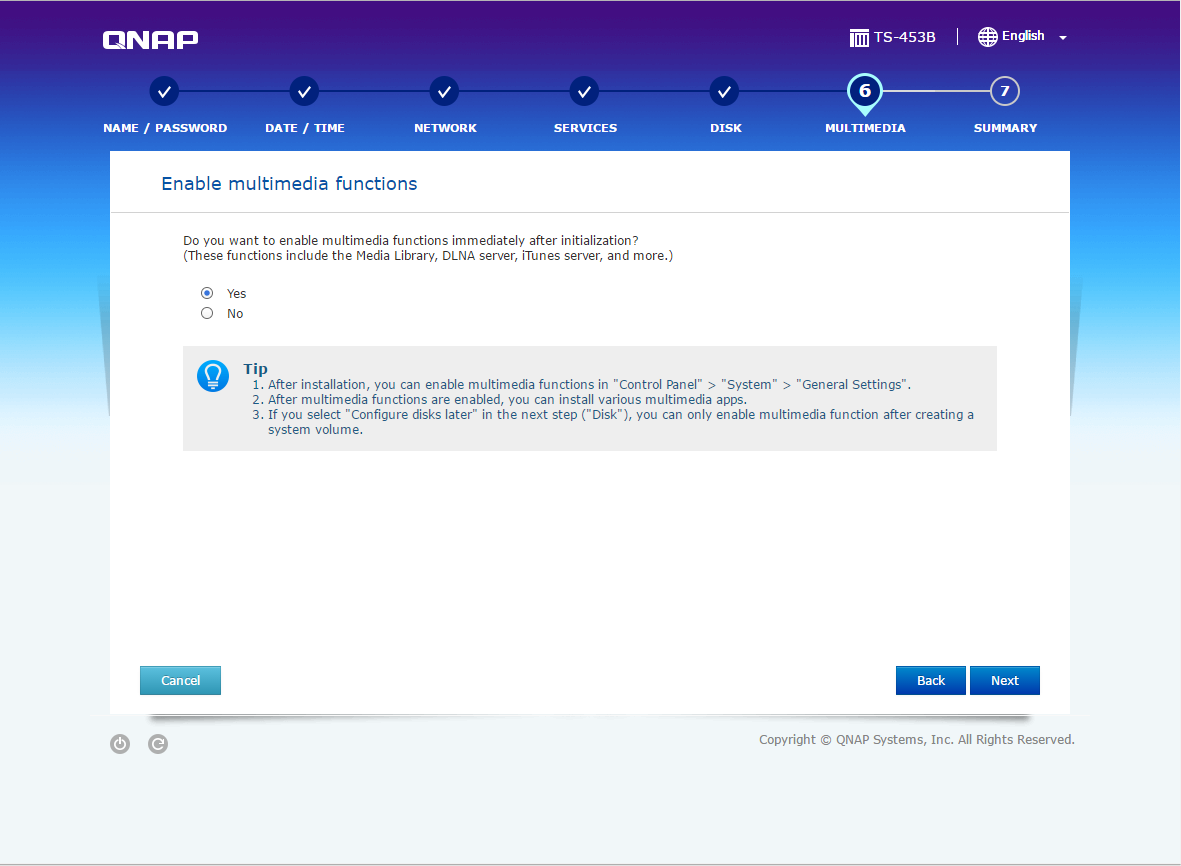
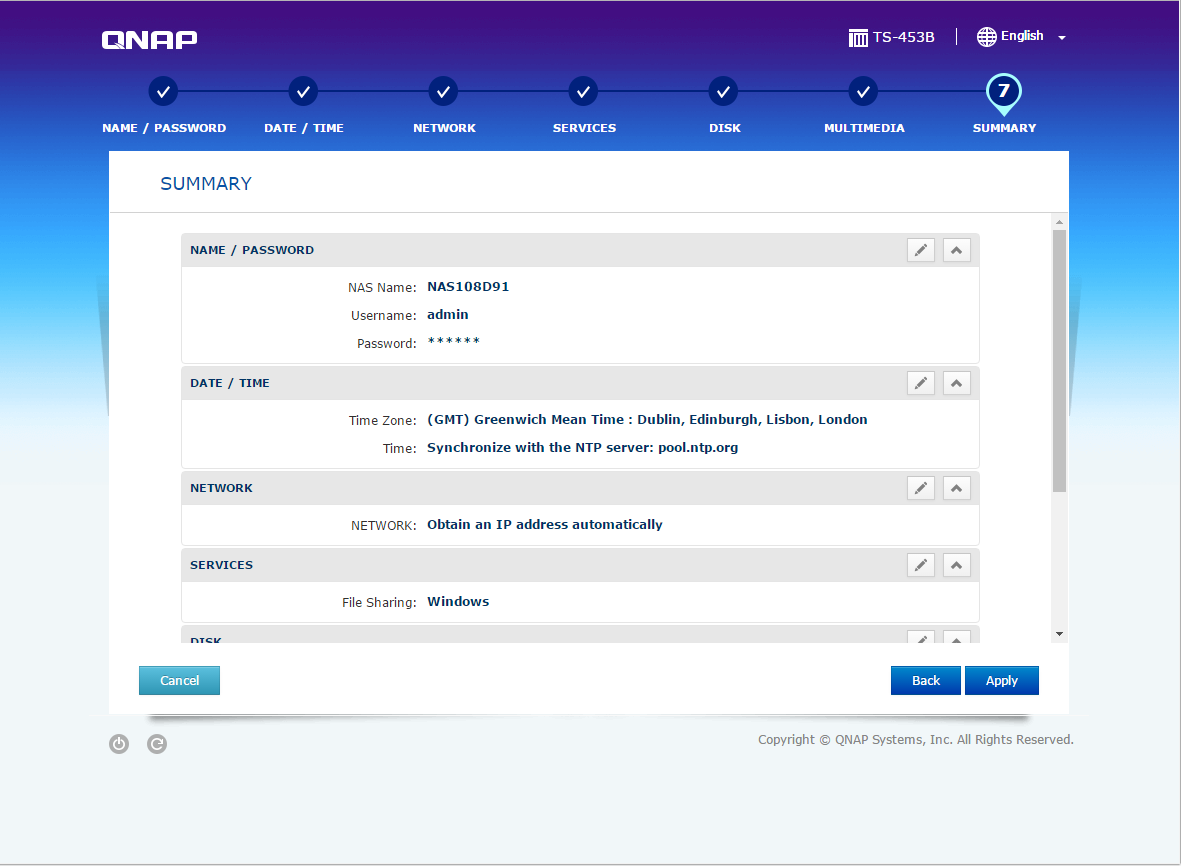
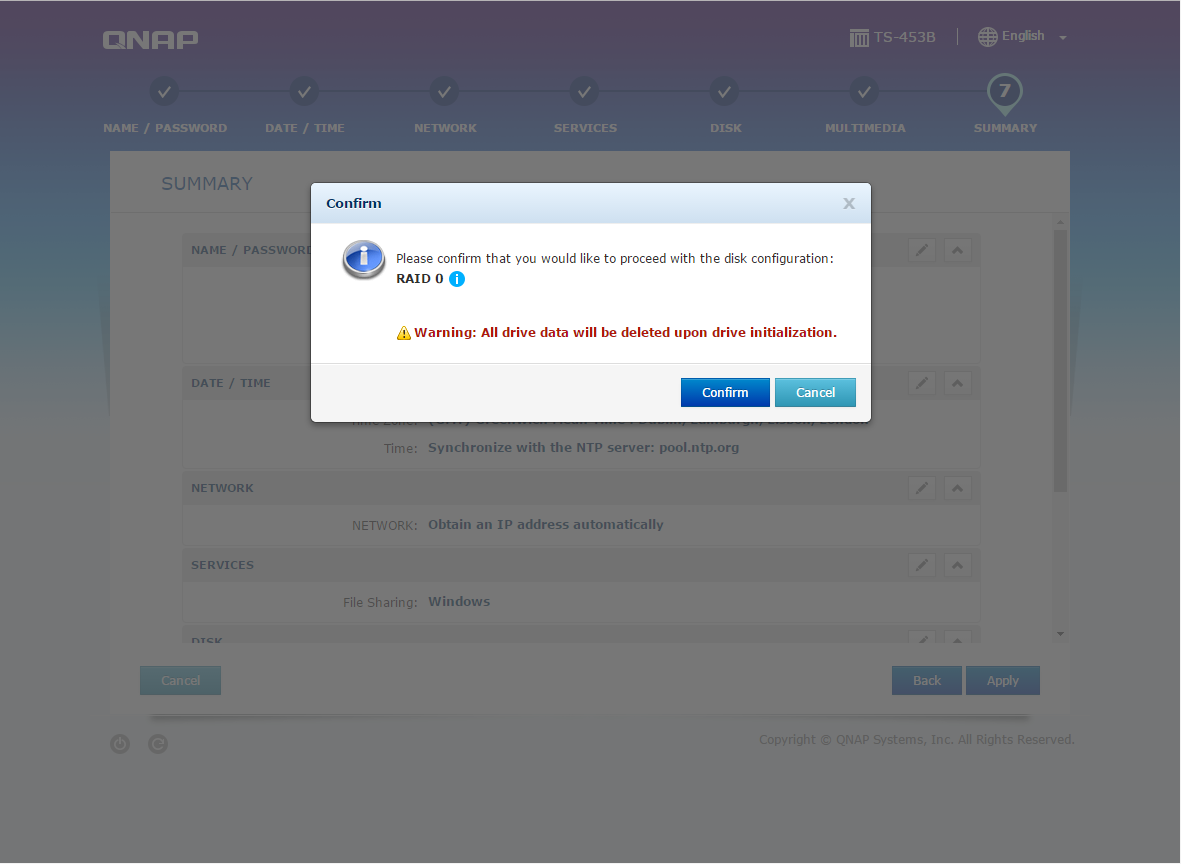
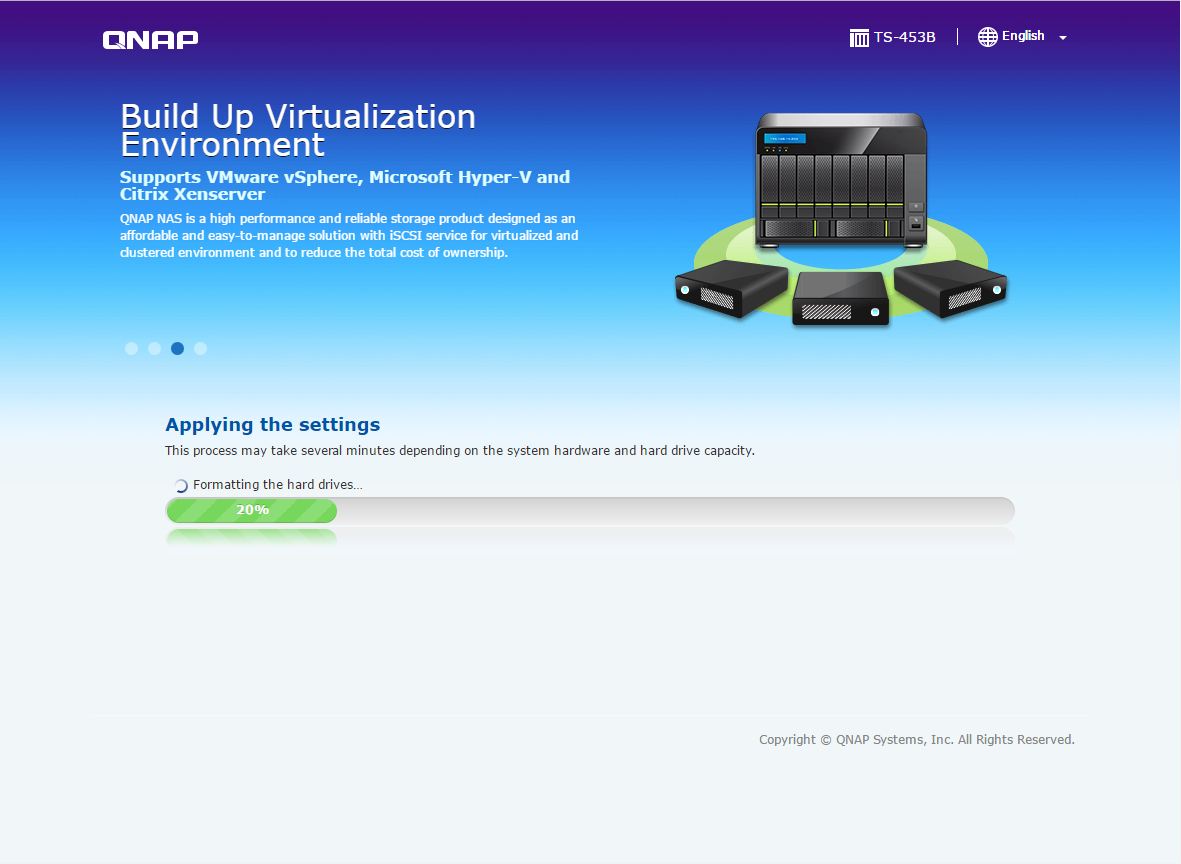

Whichever way you choose to start, it’s just a simple matter of following the install wizard. During the setup you can enable which OS cross-platform file management service you require; Windows (SMB/CIFS, File Station, FTP), Mac (SMB/CIFS, File Station, FTP) and Linux (NFS, SMB/CIFS, File Station, FTP). At this stage you can also load a few basic apps; Photo Station, Music Station, iTunes Server, DLNA Media Server and Download Station.

Once the TS-231P has finished setting up, you can then get access to the colourful log in screen. The login page can be customised to add your own photographs to the photo wall and messages can be added to the page as well.
To test the TS-453B we used four 6TB Red drives (WD60EFRX, 5,400rpm class, 64MB cache), built into all the RAID arrays supported by the device; RAID 0,1, 5.6 and 10 and then tested.
Software:
Atto Disk Benchmark.
CrystalMark 3.0.3.
IOMeter.
Intel NASPT.
To test real life file/folder performance we use a number of different file/folder combinations to test the read and write performance of the NAS device. Using the FastCopy utility to get an MB/s and time taken for each transfer, the data is written from and read back to a 240GB SSD.
60GB Steam folder: 29,521 files.
50GB Files folder: 28,523 files.
12GB Movie folder: 24 files – mix of Blu-ray and 4K files.
10GB Photo folder: 621 files – mix of .png, .raw and .jpeg images.
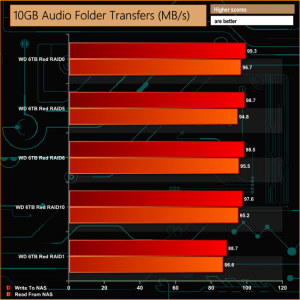
10GB Audio folder: 1,483 files – mix of .mp3 and .flac files.
Crystalmark is a useful benchmark to measure theoretical performance levels of hard drives, SSD’s and other storage devices.We are using V3.0.3.
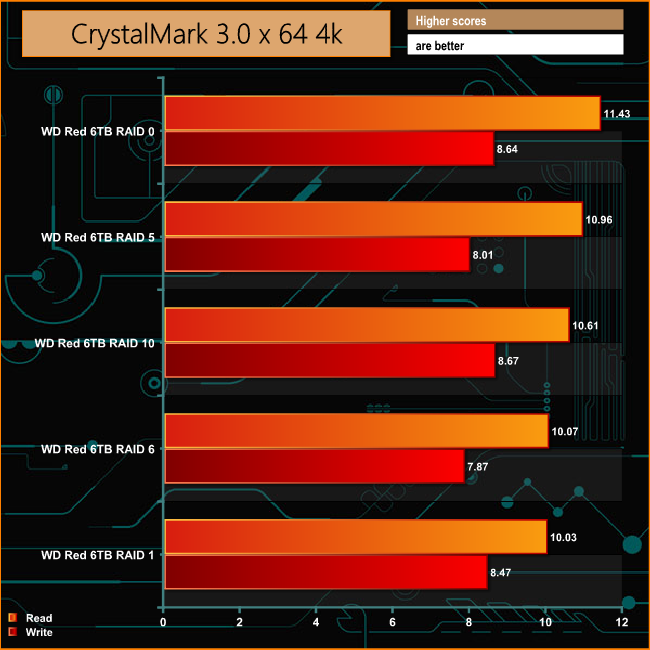
The average 4K read performance of the TS-453B is marginally faster at 10.62MB/s than the write at 8.33MB/s.
The ATTO Disk Benchmark performance measurement tool is compatible with Microsoft Windows. Measure your storage systems performance with various transfer sizes and test lengths for reads and writes. Several options are available to customize your performance measurement including queue depth, overlapped I/O and even a comparison mode with the option to run continuously.
Use ATTO Disk Benchmark to test any manufacturers RAID controllers, storage controllers, host adapters, hard drives and SSD drives and notice that ATTO products will consistently provide the highest level of performance to your storage.
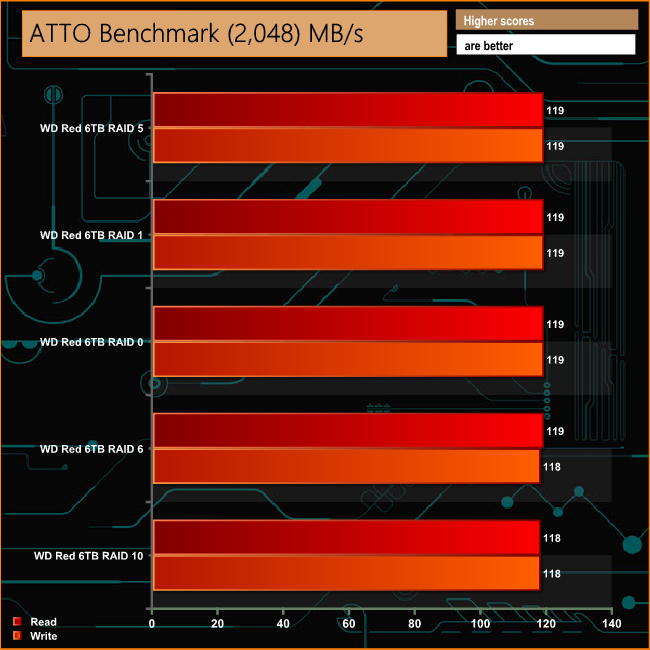
The combination of a quad-core processor and 8GB of memory gives the TS-453B an excellent level of Sequential performance with an average speed of 118MB/s across all the arrays for both reads and writes using a single Ethernet connection.
Intel’s NASPT (NAS Performance Toolkit ) is a benchmark tool designed to enable direct measurement of home network attached storage (NAS) performance. NASPT uses a set of real world workload traces (high definition video playback and recording, video rendering/content creation and office productivity) gathered from typical digital home applications to emulate the behaviour of an actual application.
We’ve used some of the video and office apps results to highlight a NAS device’s performance.
HD Video Playback
This trace represents the playback of a 1.3GB HD video file at 720p using Windows Media Player. The files are accessed sequentially with 256kB user level reads.
4x HD Playback
This trace is built from four copies of the Video Playback test with around 11% sequential accesses.
HD Video Record
Trace writes a 720p MPEG-2 video file to the NAS. The single 1.6GB file is written sequentially using 256kB accesses.
HD Playback and Record
Tests the NAS with simultaneous reads and writes of a 1GB HD Video file in the 720p format.
Content Creation
This trace simulates the creation of a video file using both video and photo editing software using a mix of file types and sizes. 90% of the operations are writes to the NAS with around 40% of these being sequential.
Office Productivity
A trace of typical workday operations. 2.8GB of data made up of 600 files of varying lengths is divided equally between read and writes. 80% of the accesses are sequential.
Photo Album
This simulates the opening and viewing of 169 photos (approx 1.2GB). It tests how the NAS deals with a multitude of small files.
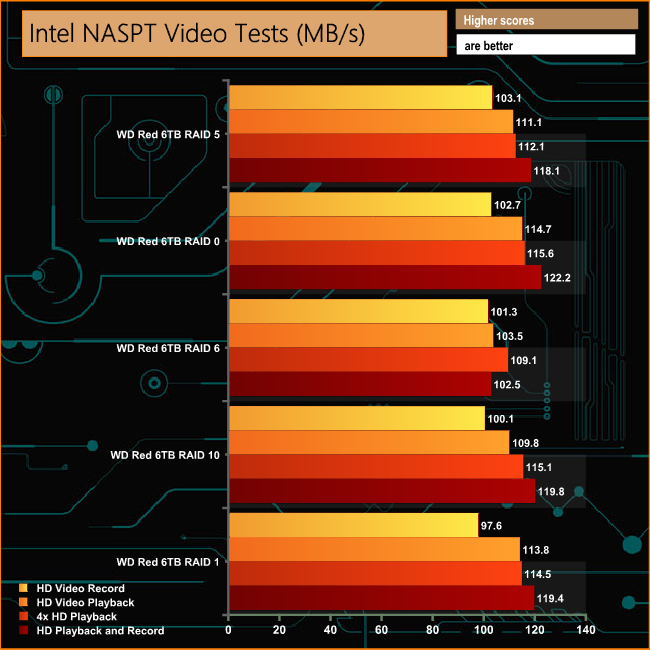
The TS-453B shows good performance across all the tested arrays in the video tests section of Intel's NASPT benchmark. With the exception of the HD Video record test in RAID 1 (97.6MB/s), the NAS produces 100MB/s or over in all the tests.

Taking the RAID 0 performance out of the equation, the TS-453B averages 57.6MB/s for the typical everyday operations of the Office test. The NAS shows a good deal of consistency across the arrays for the Content Creation and Photo Album tests.
IOMeter is another open source synthetic benchmarking tool which is able to simulate the various loads placed on hard drive and solid state drive technology.
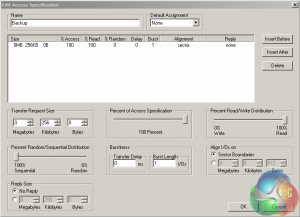
We set IOmeter up (as shown above) to test both backup and restore performance on a 100GB partition.
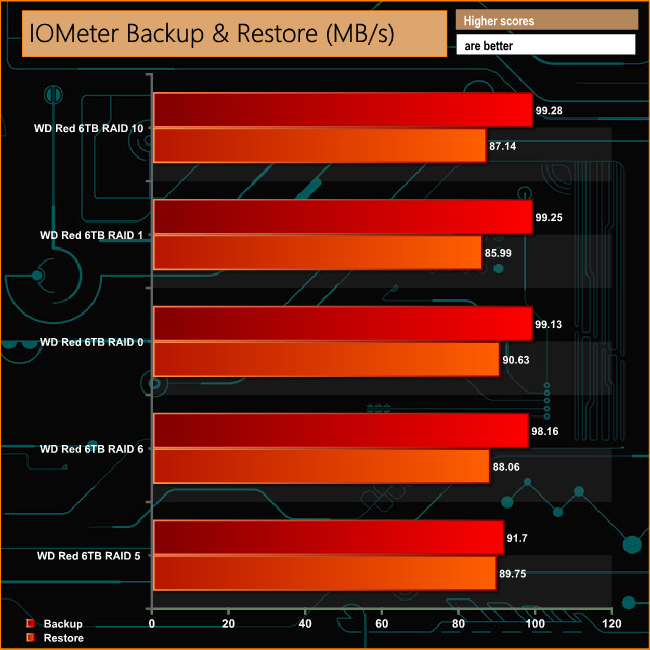
The TS-453B didn't crack the 100MB/s mark for either reads or writes in our backup/restore tests although it got mighty close when it came to reads in all arrays bar RAID 5.
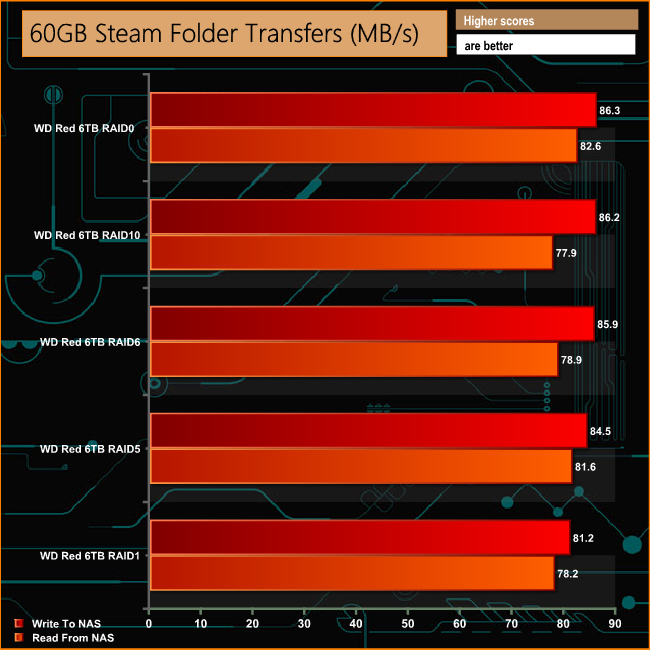
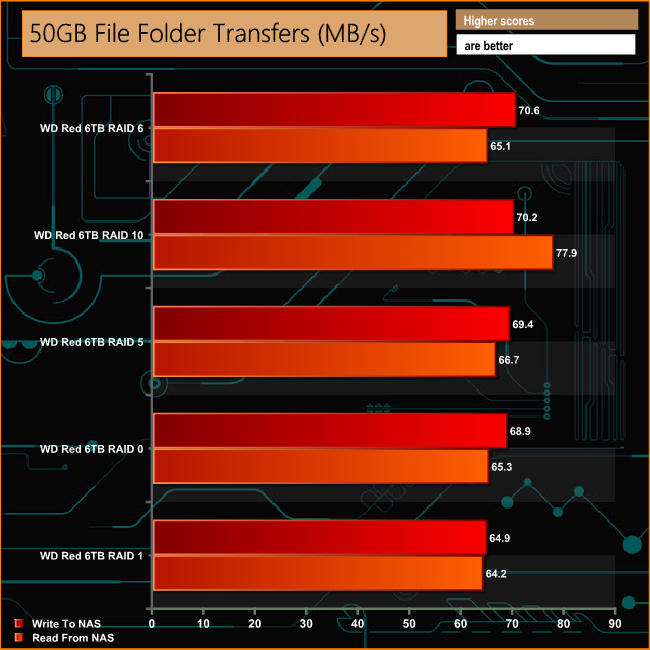
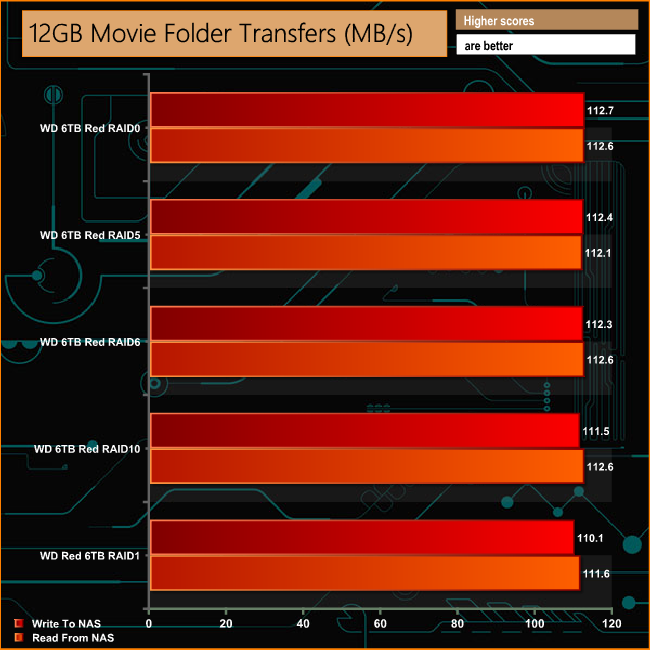
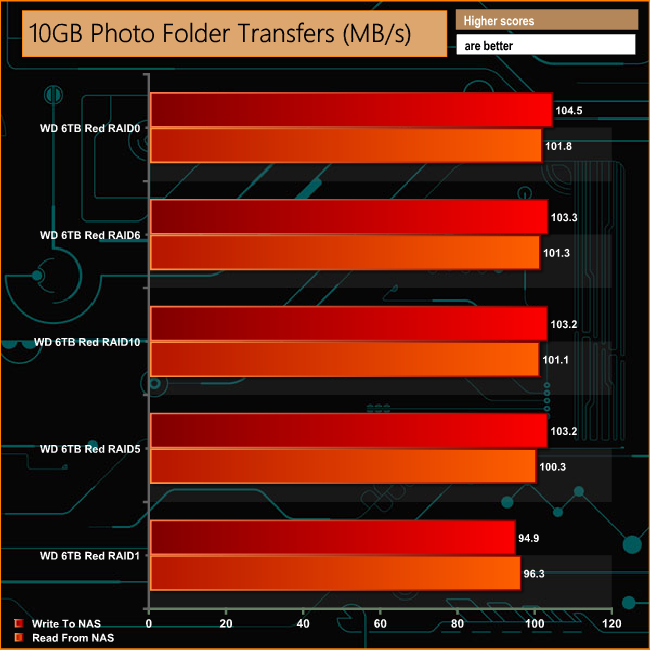
During our real-life folder transfer tests, the TS-453B shows pretty good consistency across all the arrays particularly when came to dealing with the contents of the media folders. When dealing with the 50GB file folder it averaged 68.8MB/s writing to the device and 67.84MB/s reading the data back. Both the Movie and Photo folder transfers delivered over 100MB/s performance for both reads and writes.
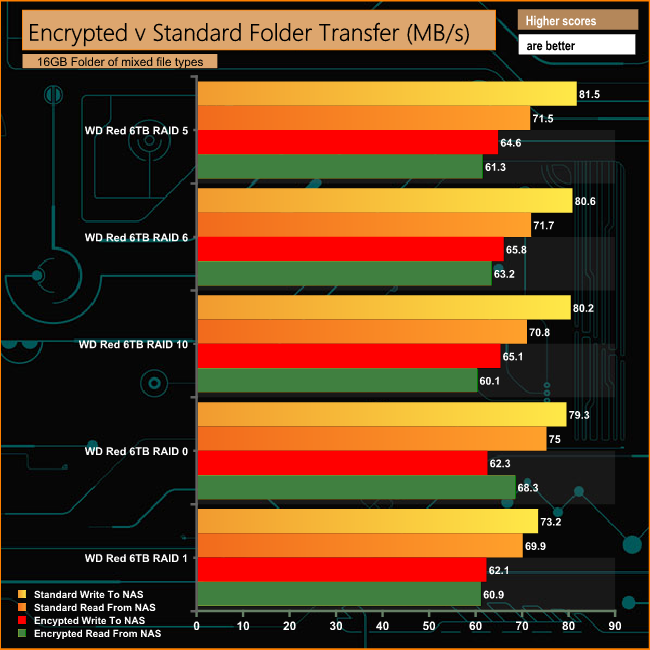
The integrated encryption engine in the TS-453B boosts the read/write performance when dealing with encrypted files. In RAID 5 the performance drops just 17MB/s when writing to the NAS with just 10MB/s dropped when reading the data back.
We tested the peak power consumption of a NAS at the wall during a run of CrystalDiskMark 5.0.2 as this version of the benchmark runs the read and write benchmark suites separately so it's easier to monitor what power the device is using during each function.

The TS-453B uses an Intel Celeron J3455 which has a TDP of just 10W. Using four drives that only use 5.3W peak power for reads and writes keeps the power demands of the NAS to a reasonable average of 40.6W for writes and 35W for reads.
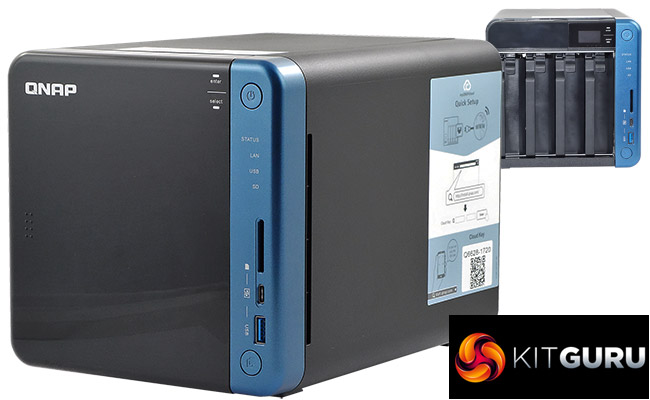
The QNAP TS-453B sits in the middle of a three device range and features a new QNAP styling design with the basic black finish relieved by a blue finish to the one side of the front bezel that holds the power button, front ports, and indicator LED's.
At the time of writing, the drive trays of the TS-453B support drives up to 10TB capacity, giving the device a total capacity of 40TB but should more space be needed, one option would be to use QNAP's Expansion enclosures. The NAS supports the UX-500P (5-bay) and UX-800P (8-bay) enclosures which connect to the TS-453B via one of the rear USB ports.
Already a feature rich NAS, the TS-453B has a trick up its sleeve to add performance and a degree of futureproofing in the shape of a PCIe slot, the first NAS of its class to do so. This PCIe slot can house a 10GbE network, WiFi or USB 3.1 card for better connectivity or for the best of both worlds one of QNAP's QM2 cards.
The QM2 combines dual M.2 slots supporting SSD caching with 10GbE connectivity and together with QNAP's Qtier auto-tiering technology gives much improved NAS performance to meet business demands.
QNAP's QTS is one of the better NAS OS around, quick and easy to install, graphically rich and updated on a regular basis. The latest 4.3.3 version adds more features and apps, particularly aimed at business users.
Qnap's Qtier's technology has been re-vamped. It now learns from NAS usage and together with system performance and usage times analysis, determines the best time for auto tiering for better data efficiency across a range of storage options that a business might employ including SSD, SAS and NL-SAS/SATA drives.
Network and Virtual Switch, a network management tool which allows virtual machines, containers and NAS to share the same LAN port has been enhanced to add support for data transfers between virtual machines and containers. Also new is support for both T2E (Thunderbolt To Ethernet) Converters and Thunderbolt Residential Gateway (NAT) services.
Also new to QTS 4.3.3 is the ability to backup files and data directly from compatible USB optical drives such as DVD and Blu-ray devices.
The Resource Monitor has been re-built to provide more in-depth information on various processes and usage modes but displays the information in a much easier to understand format for home and business users alike.
The one thing that is a bit hard to understand with the TS-453B is that while QNAP bundle a remote control with the NAS, they don't bother adding a USB Type-C cable for the Quick Connect port -a bit annoying that.
Pros.
- Compact Design.
- PCIe expansion slot.
- QTS OS
- Tool-free drive trays.
Cons.
- No drive tray locks.
- No cable bundled for the Quick Connect port.

QNAP's TS-453B can be found on Overclockers UK for £729.95 (inc VAT) HERE
Discuss on our Facebook page, over HERE.
Kitguru says: A compact and powerful 4-bay NAS and although it sits under an SMB banner it would be as equally effective as the central hub in a home entertainment network.