 KitGuru KitGuru.net – Tech News | Hardware News | Hardware Reviews | IOS | Mobile | Gaming | Graphics Cards


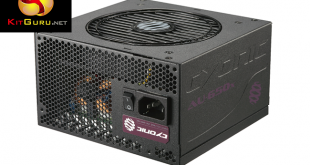
‘Cyonic' is a company name not many of our readers will recognise. They are a new brand who claim to target the enthusiast audience with competitively priced, high quality power supplies. Today we look at their AU-650x – a fully modular DC to DC converter design featuring premium quality Japanese Electrolytic Capacitors. At £85 inc vat at Scan in the UK – should this new power supply be making a final shortlist?
Information on Cyonic is quite limited online however according to their ‘about us' webpage – ‘The establishment of Cyonic is the result of a long time wish of a few computer enthusiast, tech geeks and gamers to build on the foundations of strong friendship and comradery to establish a company that is able to provide the highest level of equipment for users that want to take their computer experience to the extremes.'
Features:
- 80 PLUS Gold Certified
80 PLUS Gold certification guarantees greater than 87 %, 90 %, and 87 % efficiency at 20 %, 50 %, and 100 % operating loads, respectively. - FDB (Fluid Dynamic Fan Bearing) – 120 mm
It greatly reduces fan noise during operation. As there is less friction inside, the fan will have a longer life. - Compact ATX Size
The power supply is only 140 mm in depth, which makes it an excellent choice for smaller sized cases. - DC to DC Converter Design
Excellent dynamic response and maximized 12 V DC rail output increase system stability. - Fully Modular Cable Design
Fully customizable cables not only simplify the installation process but also reduce the clutter inside the computer case. Reduced number of components allow for better ventilation and enhanced cooling. - Gold Coated Connector Contacts
The connectors do not tarnish over time and increase the efficiency of current transmission. - 105 °C Japanese Electrolytic Capacitors
Japanese CapPremium quality Japanese capacitors with 105 °C rating increase reliability and extend product life. - Silence Guard System
Silence GuardIt is an innovative design with high quality silent fan, strategically placed heat sinks and the interactive fan control system, which make the power supply run silently and efficiently.
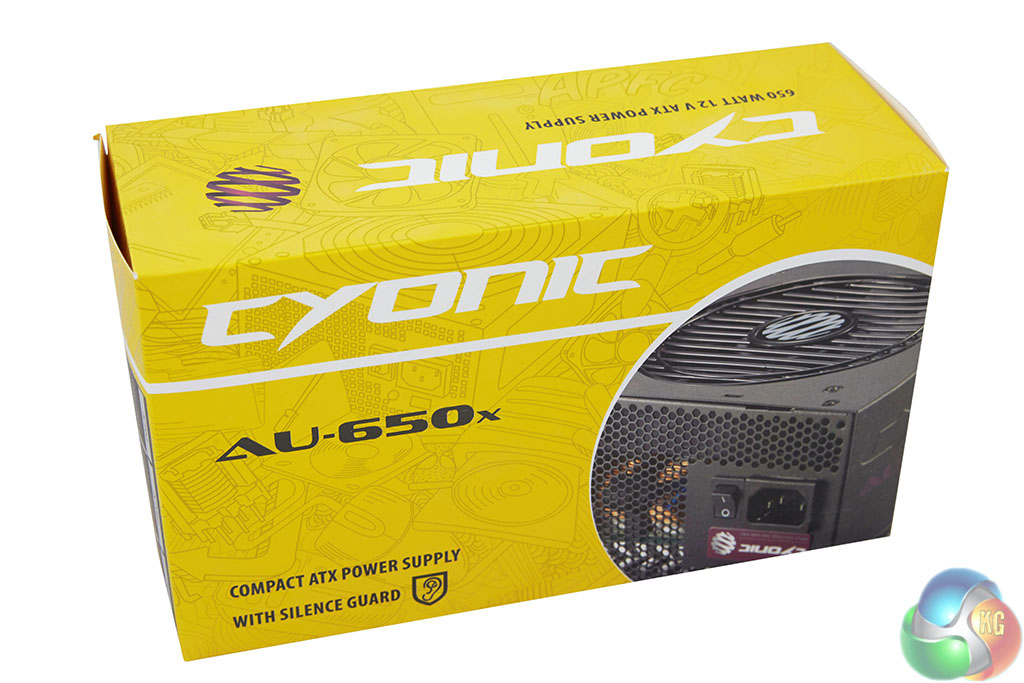
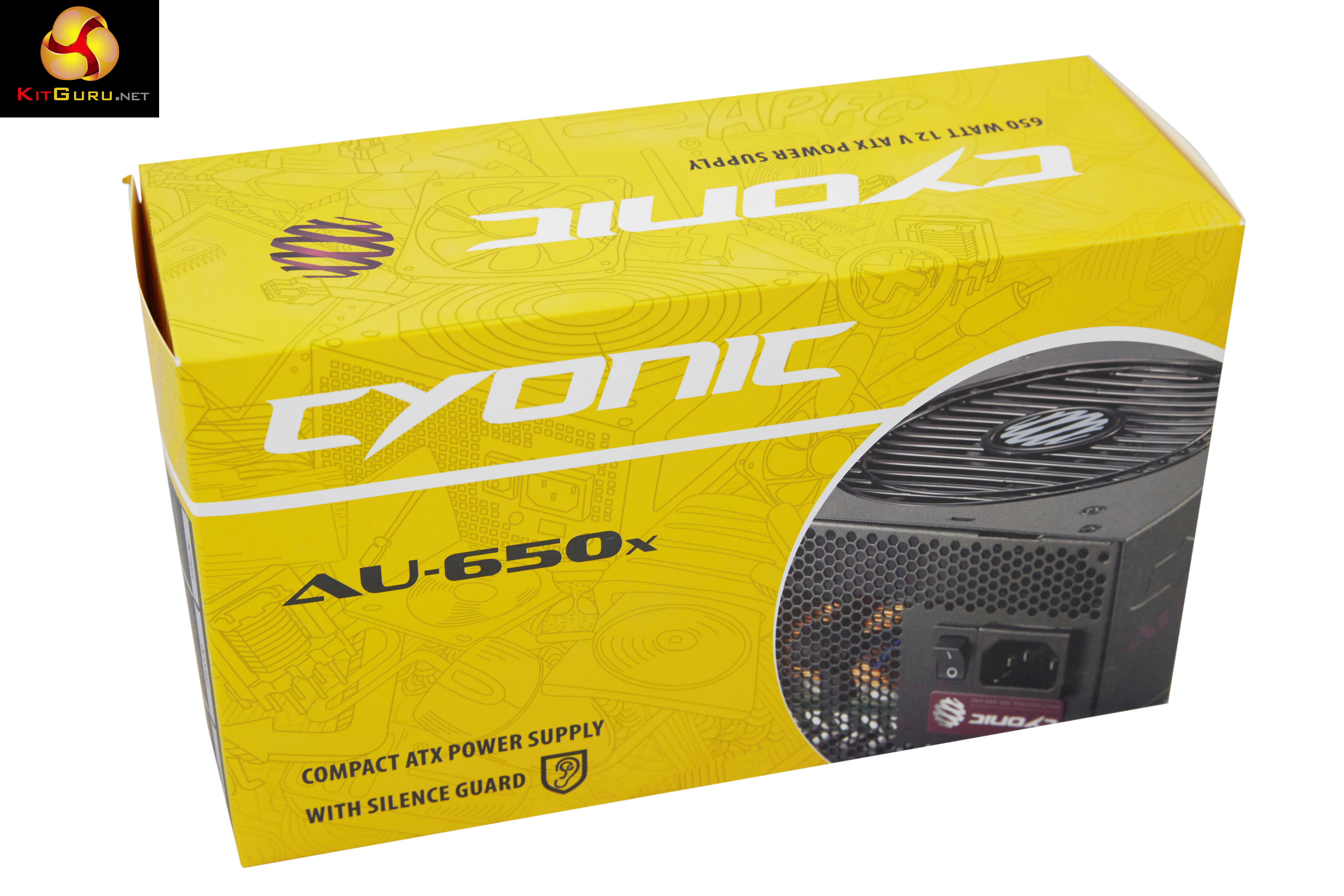
The Cyonic box is bright yellow with a circular image of the product seen in the corner. The model is clearly listed underneath the brand name at the top.
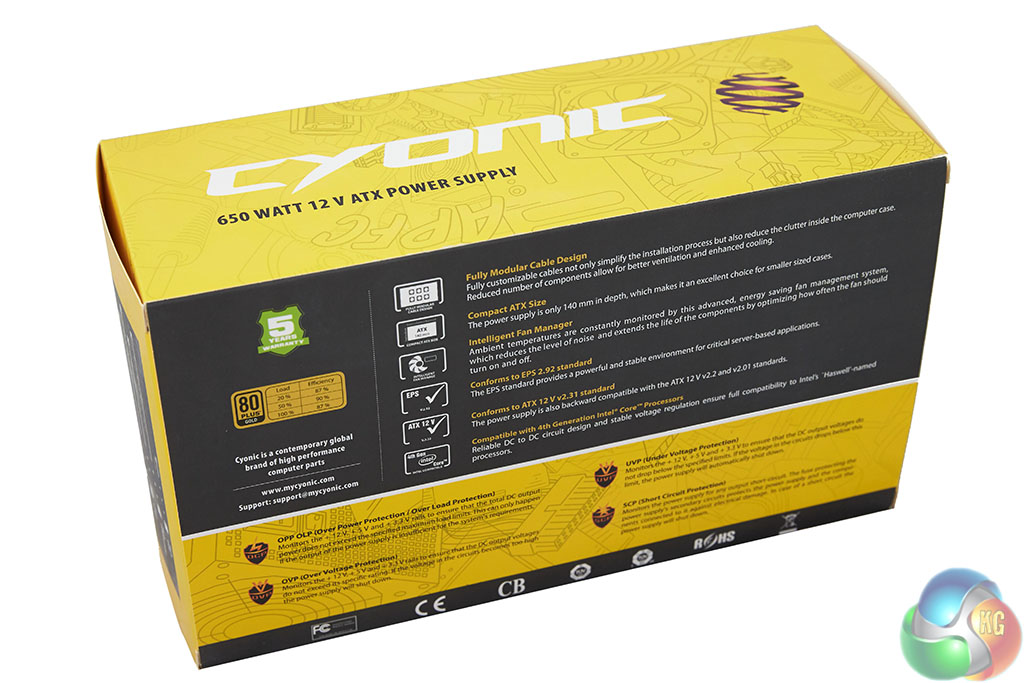
Some details are listed on the back of the box including the fully modular cable design and ‘Intelligent Fan Manager'.
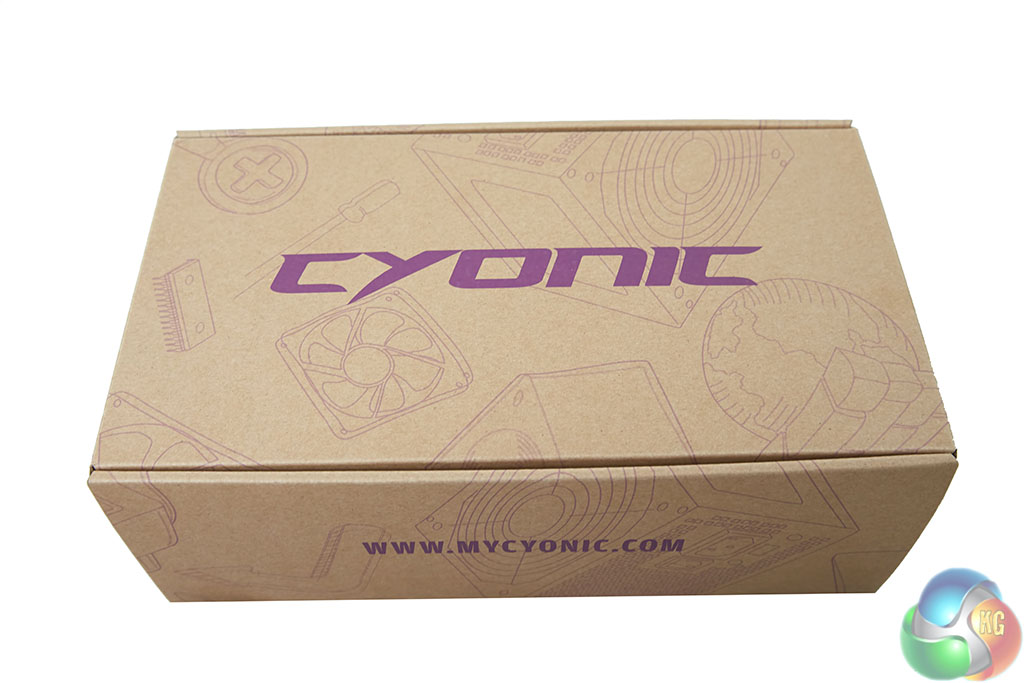
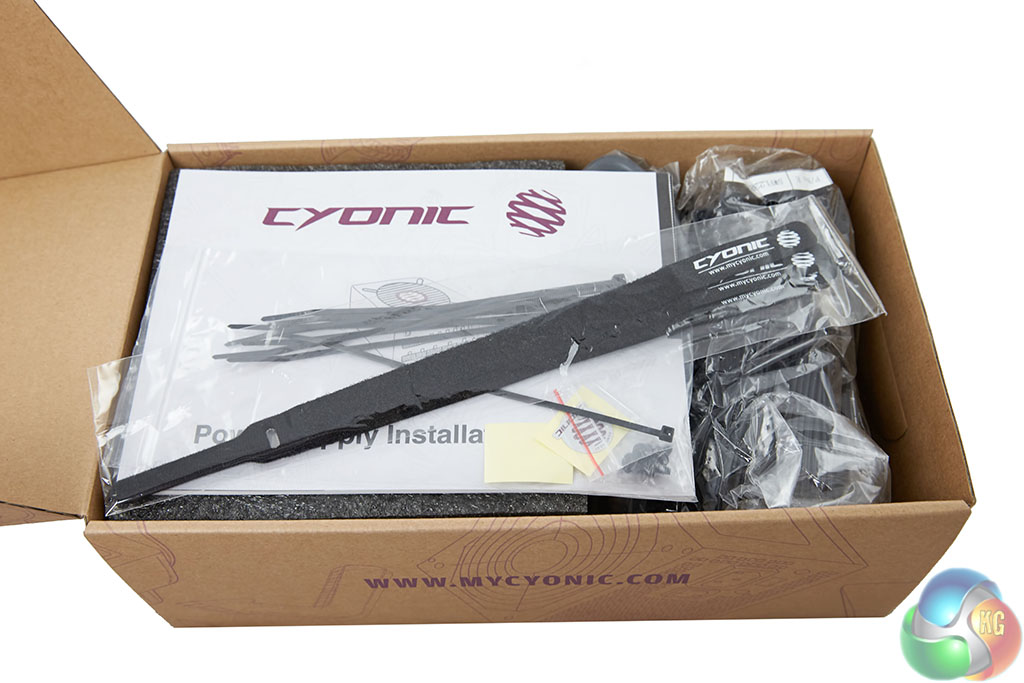
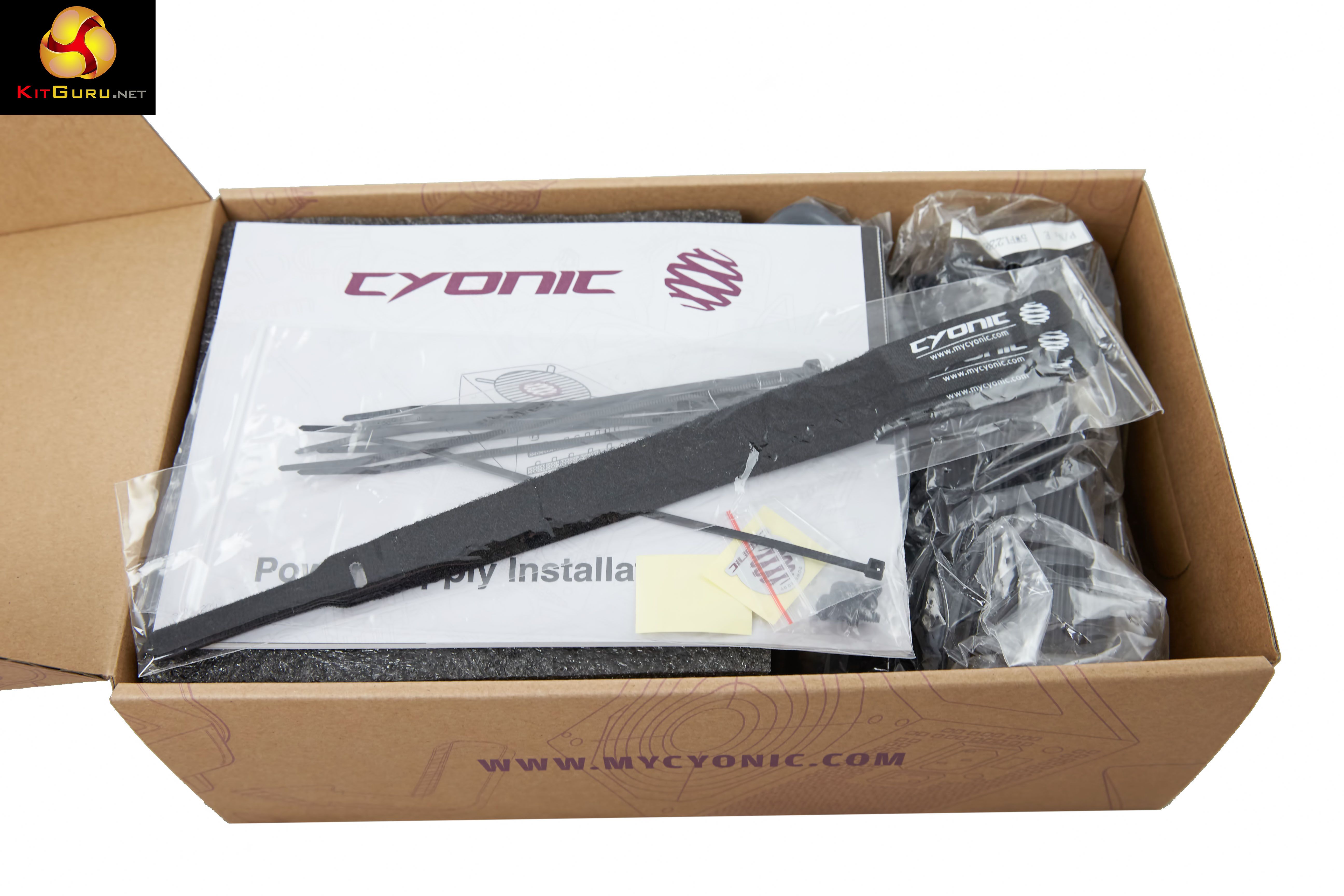
The box contains the power supply and all the accessories.
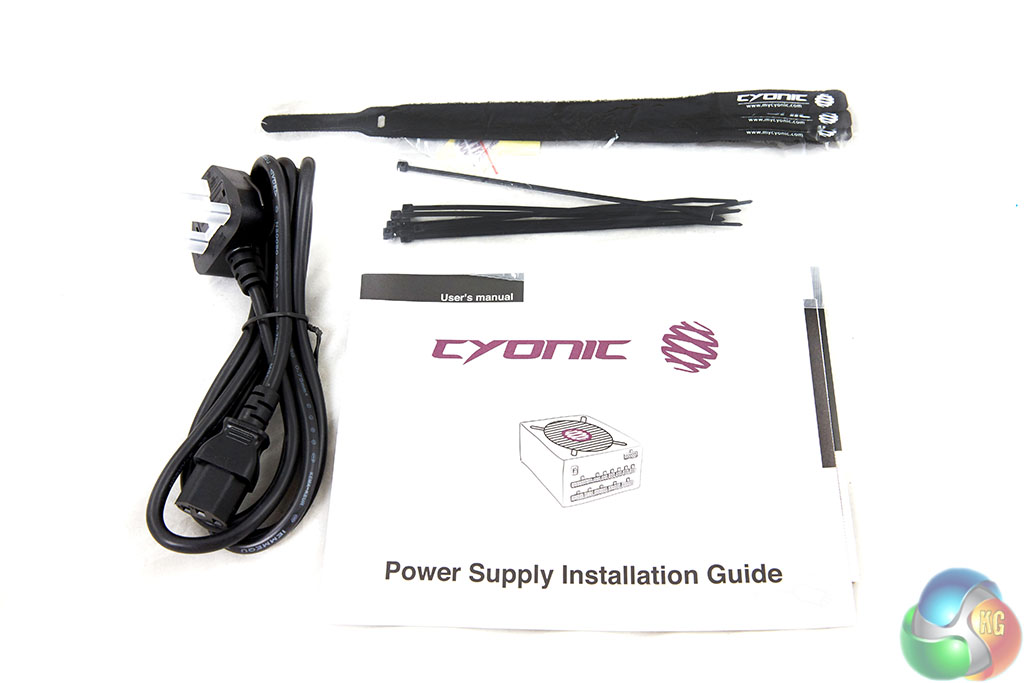
Sadly no storage pouch is supplied, but you get a regional specific power cable, literature on the product and some cable ties.
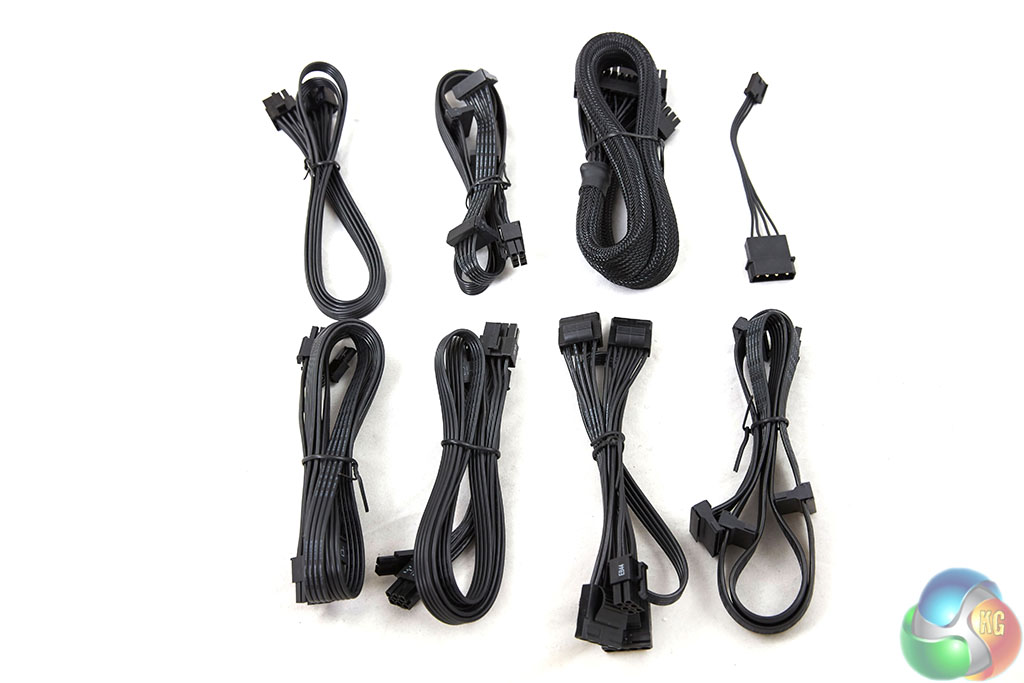
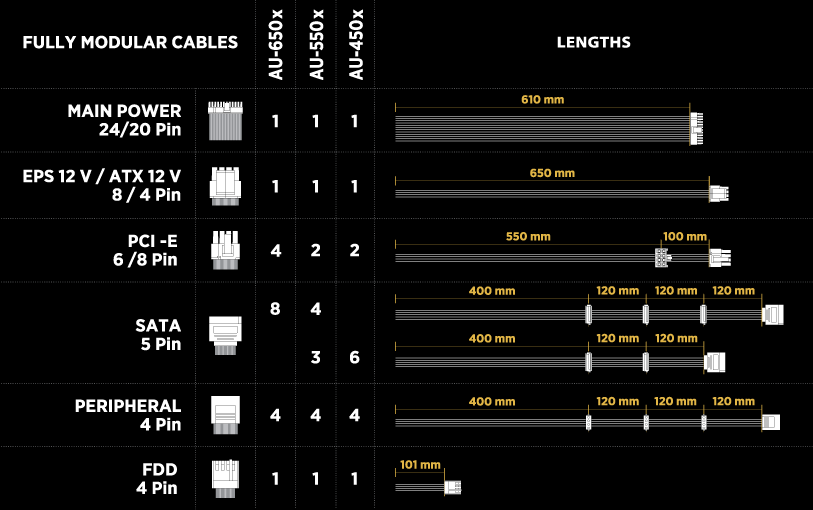
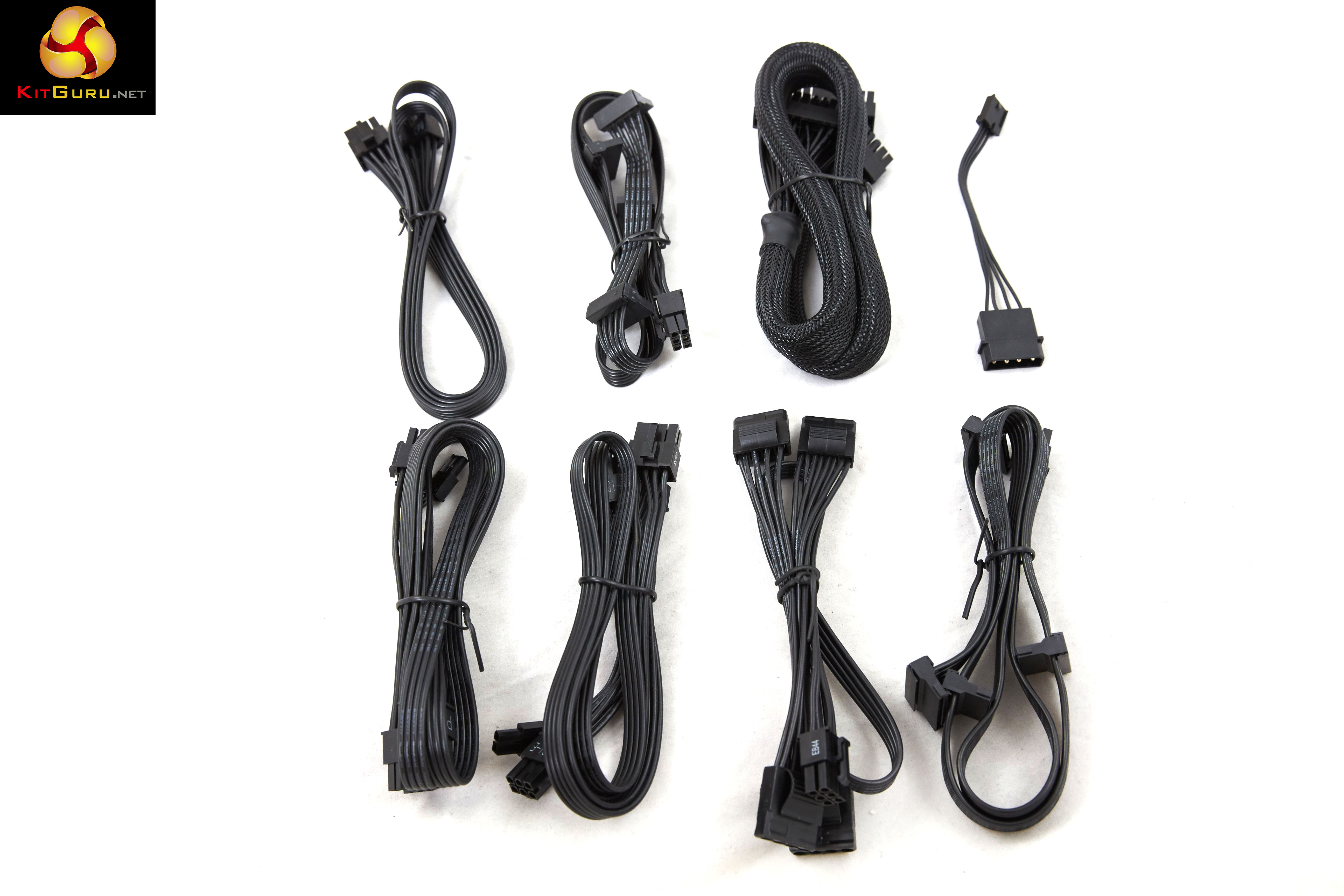
The main ATX cable is sleeved, although all others are flat ‘ribbon' style for ease of routing during a system build. Cyonic include 4x PCIe power cables to fully support a modest dual SLI or Crossfire graphics configuration.
Be aware that the AU-550x (550w) model has only 2x PCIe 6+2 pin cables. A high quality 550 watt power supply is technically capable of supporting dual graphics, as long as the 12V+ demands placed on the unit are within reason (no R9 295X2 for instance). The new 550 watt be quiet! Dark Power Pro 11 which we reviewed recently has four PCIe cables for example and in our tests was able to handle a Core i5 system with dual GTX970 graphics. This is one of the benefits you can get from spending more money on a higher specified unit.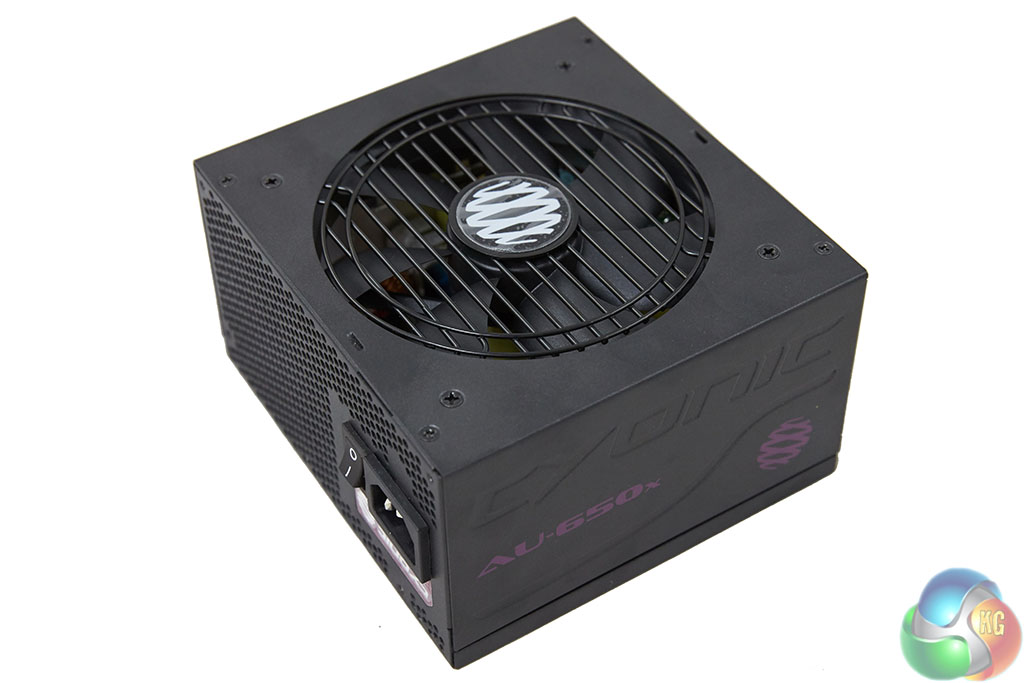
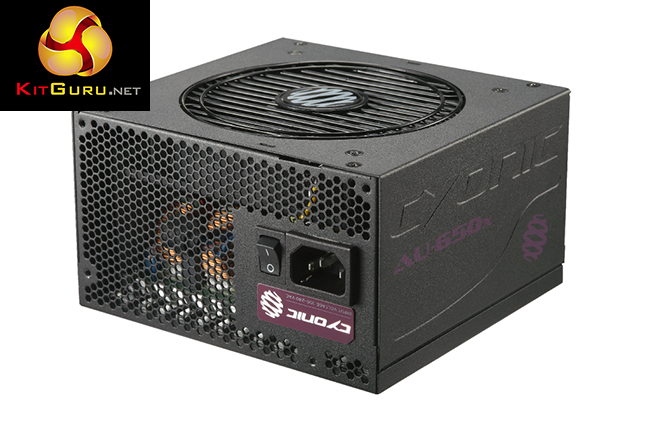
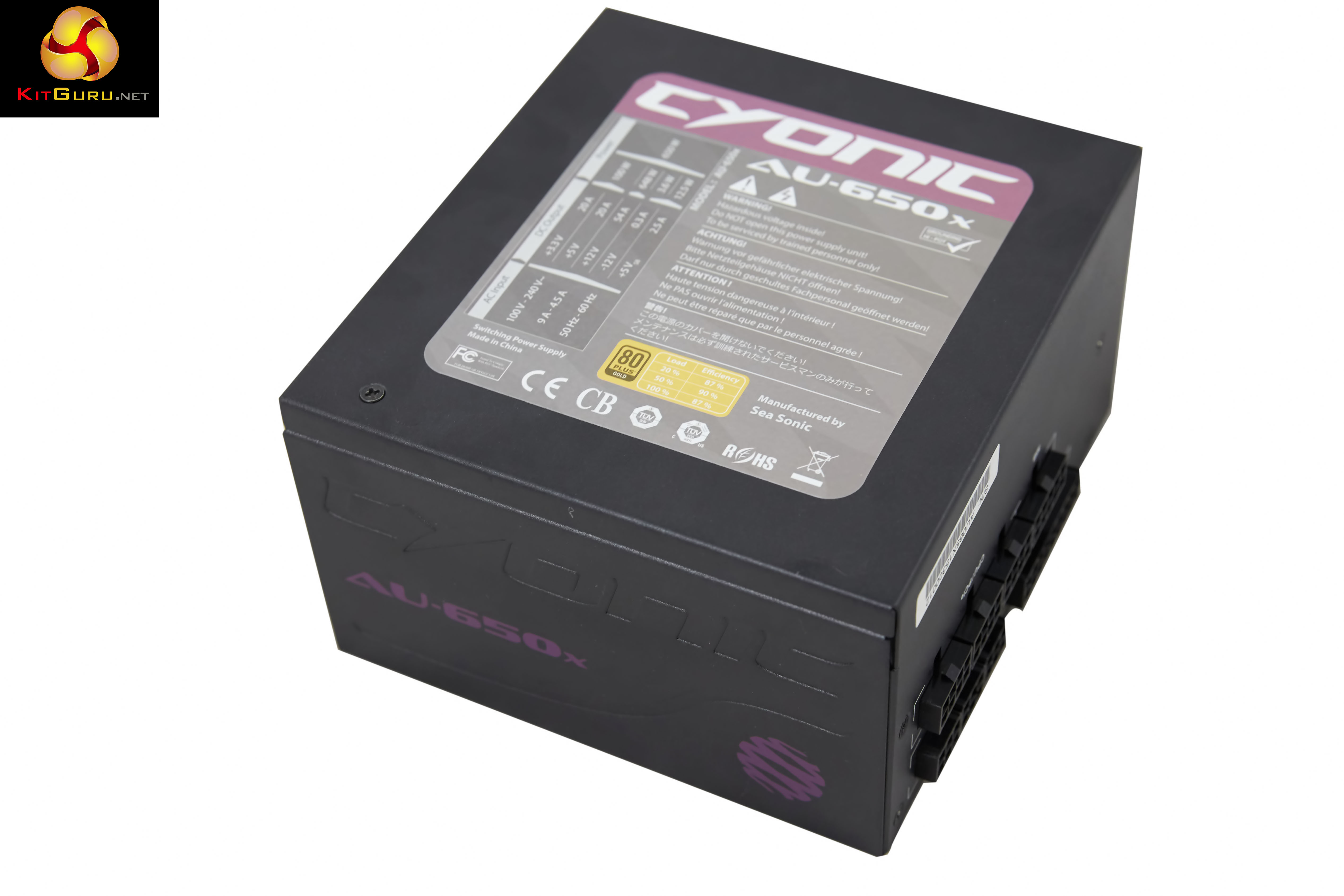
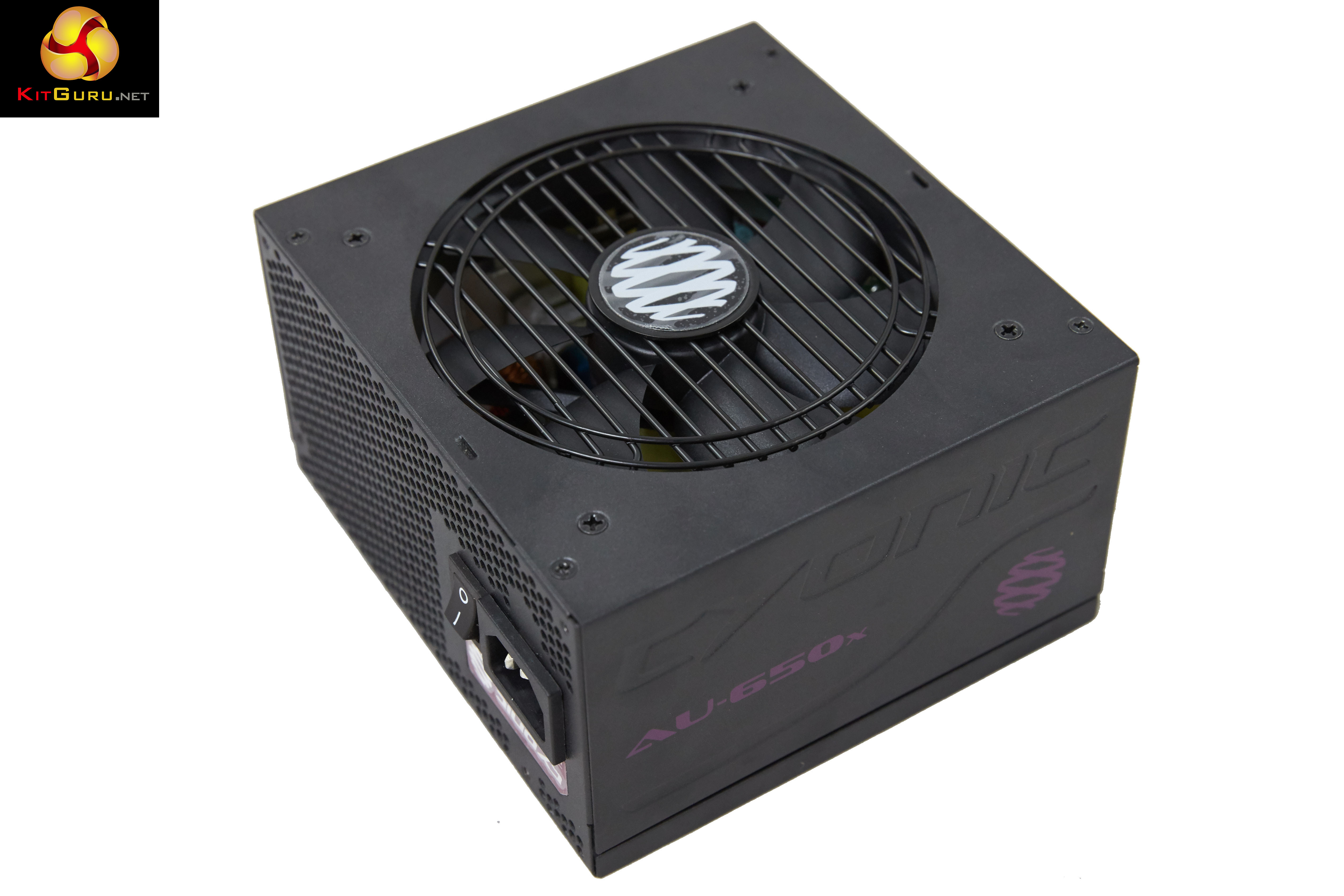
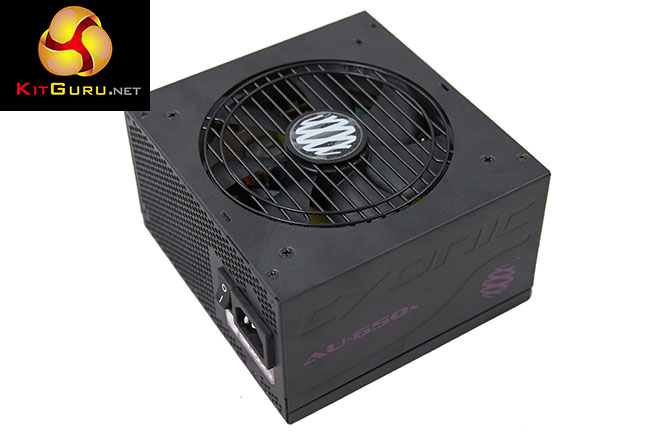
The Cyonic AU-650x isn't really what we would class as a particularly attractive looking product, but the build quality is actually quite good – all the panels feel solid under general handling. I do have to point out however that the finish is a fingerprint magnet – even with freshly washed hands it was almost impossible to keep it pristine looking for the photographs today. This is not really a massive concern as cleaning it carefully with a cloth once it is installed in a system is straightforward enough.
On a more positive note, the unit passed our ‘screwdriver’ stress test, which involves running a Philip’s head driver down the side of the chassis with weak to modest pressure. How often have you accidentally hit a power supply with some tools during a system build phase?
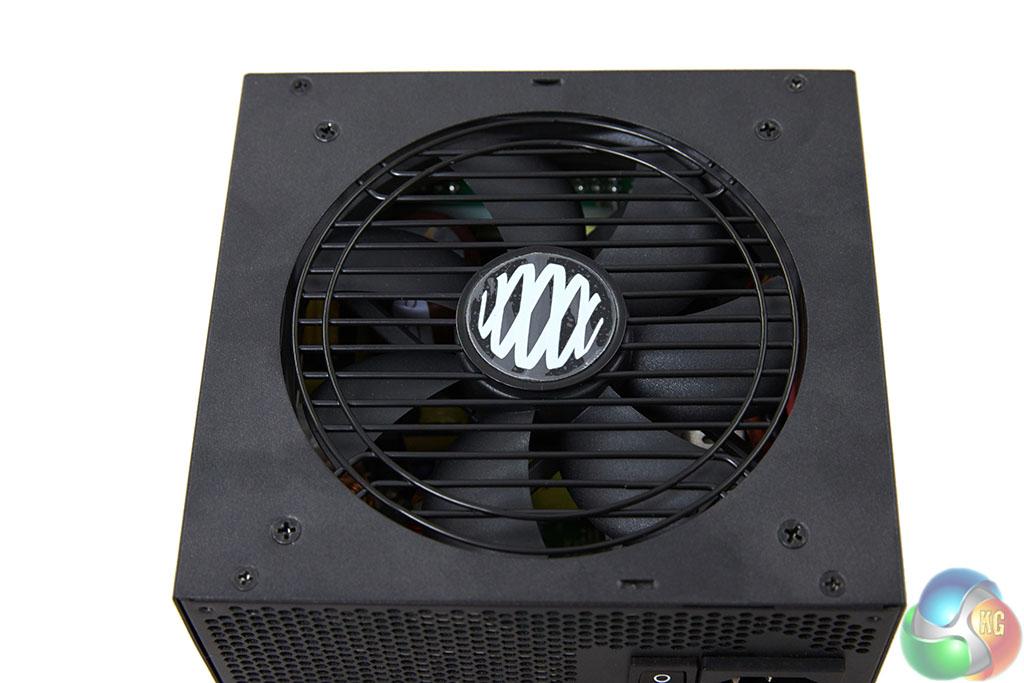
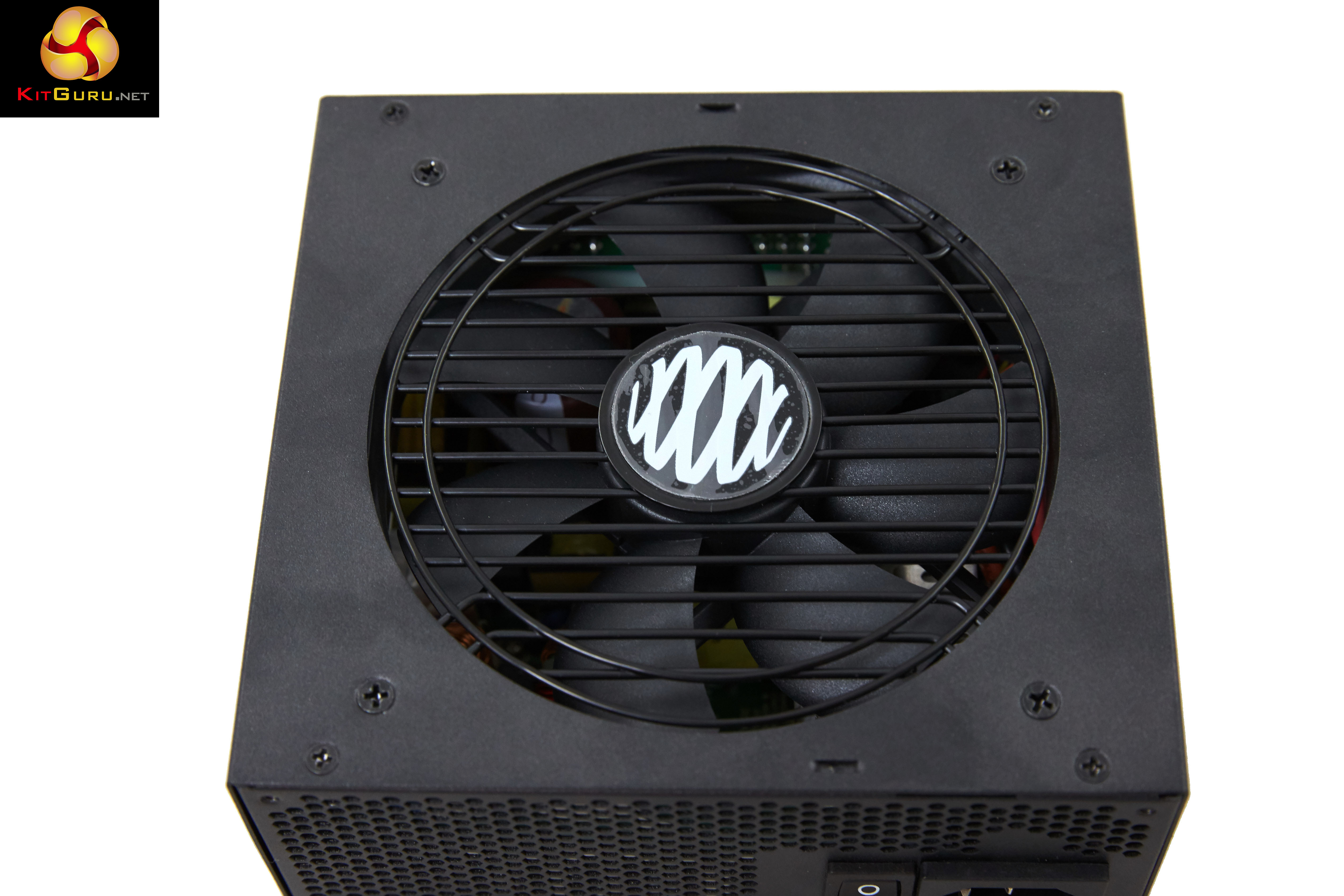
A 120mm fan resides behind the cooling grill – with the Cyonic logo proudly on display in the center. You can see what I mean now about the fingerprints!
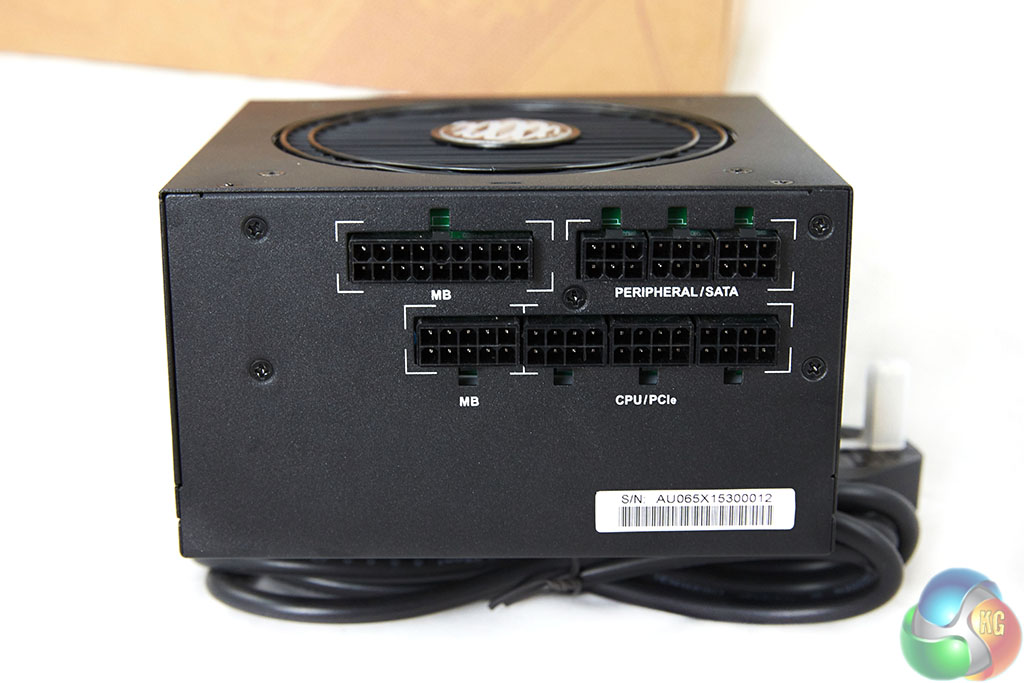
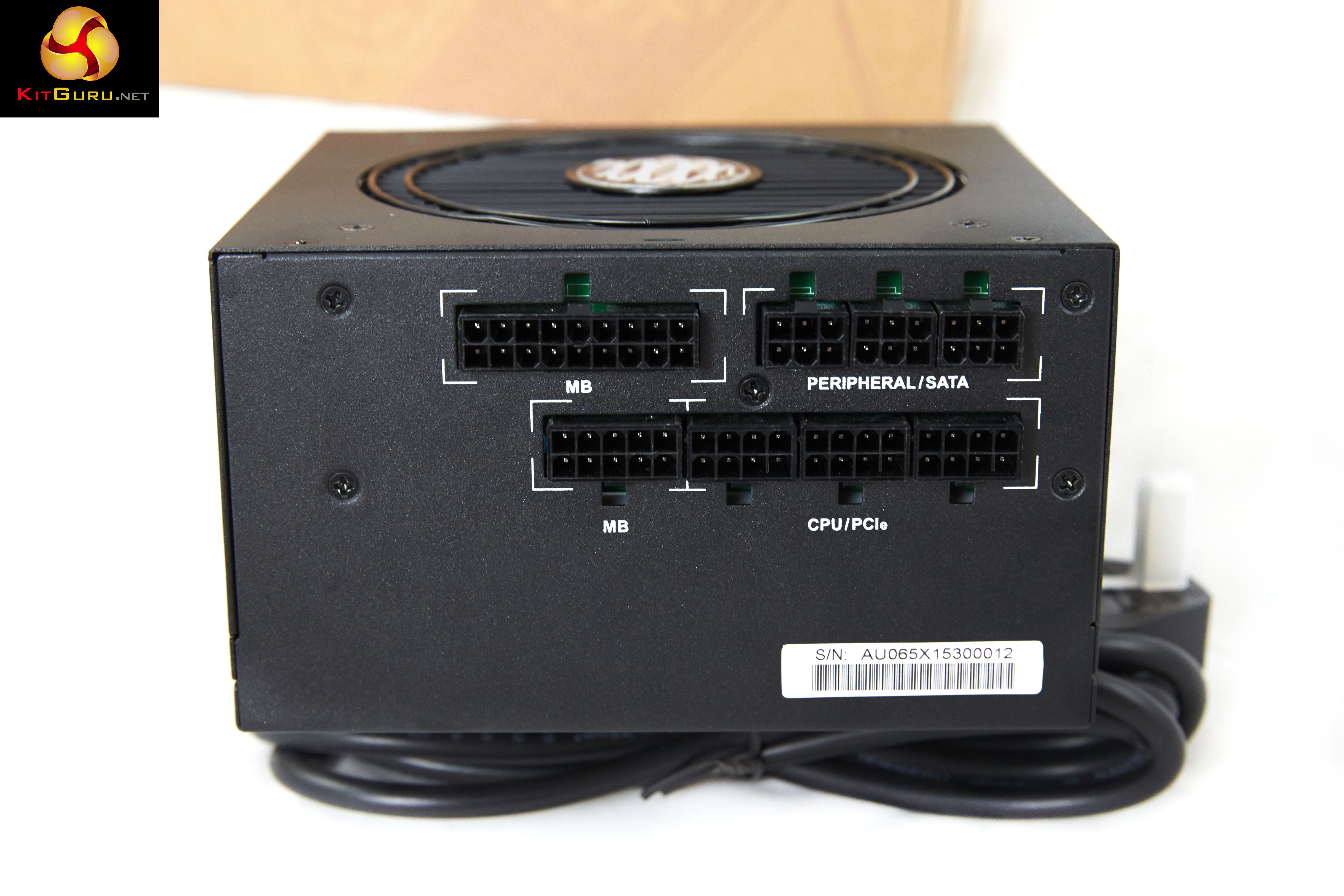
One end of the chassis is home to the modest modular bay – all clearly labeled for ease of use during the build phase.
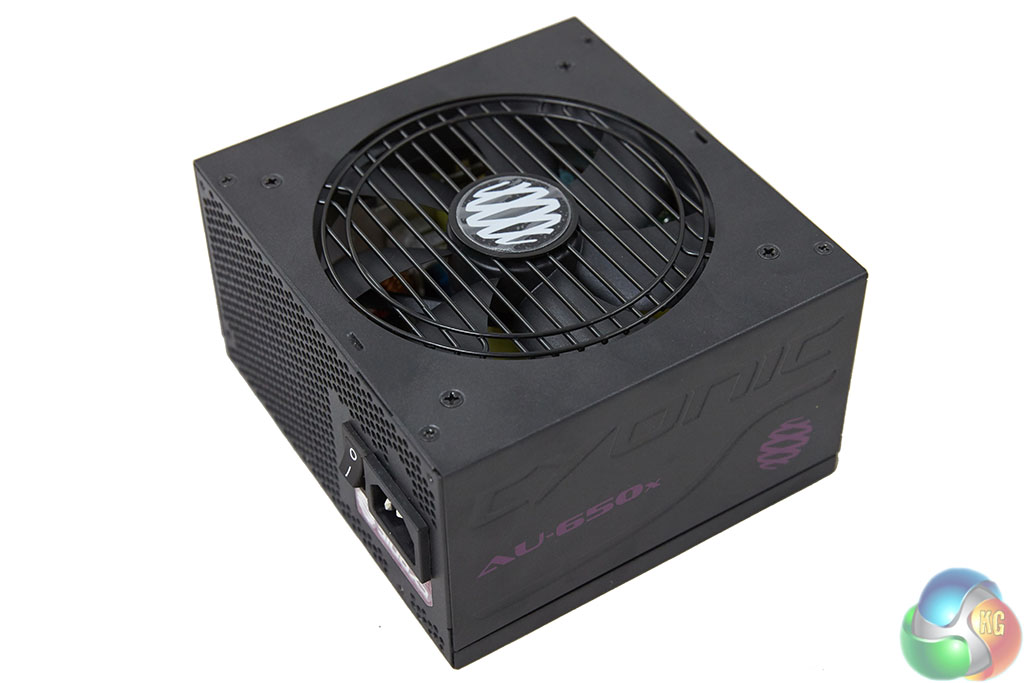
The other end of the power supply is vented with a power connector and switch at the side.
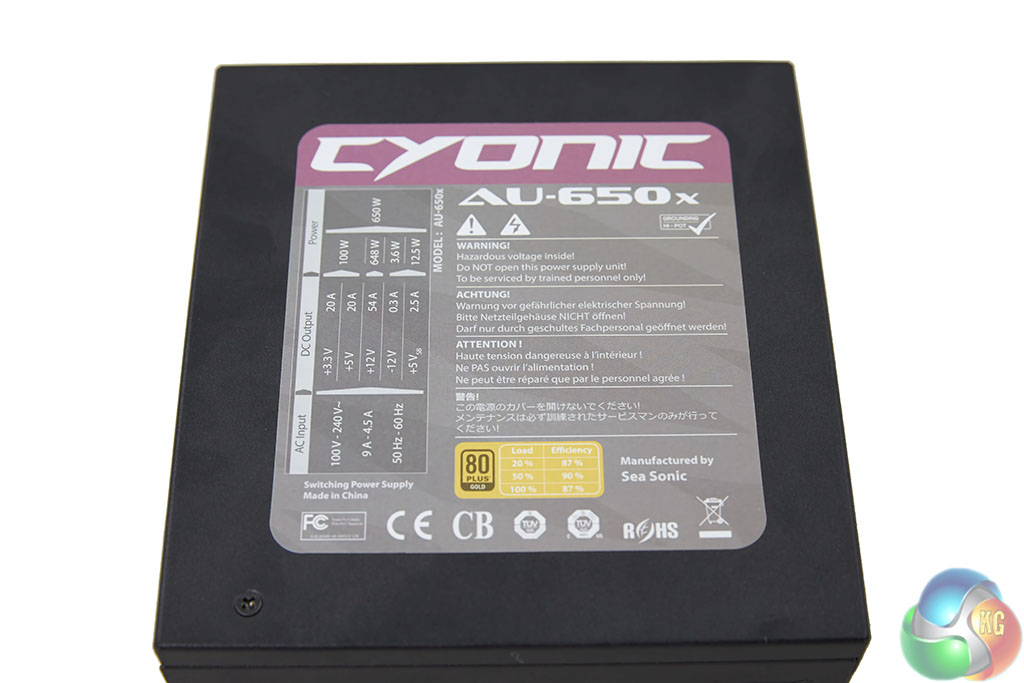
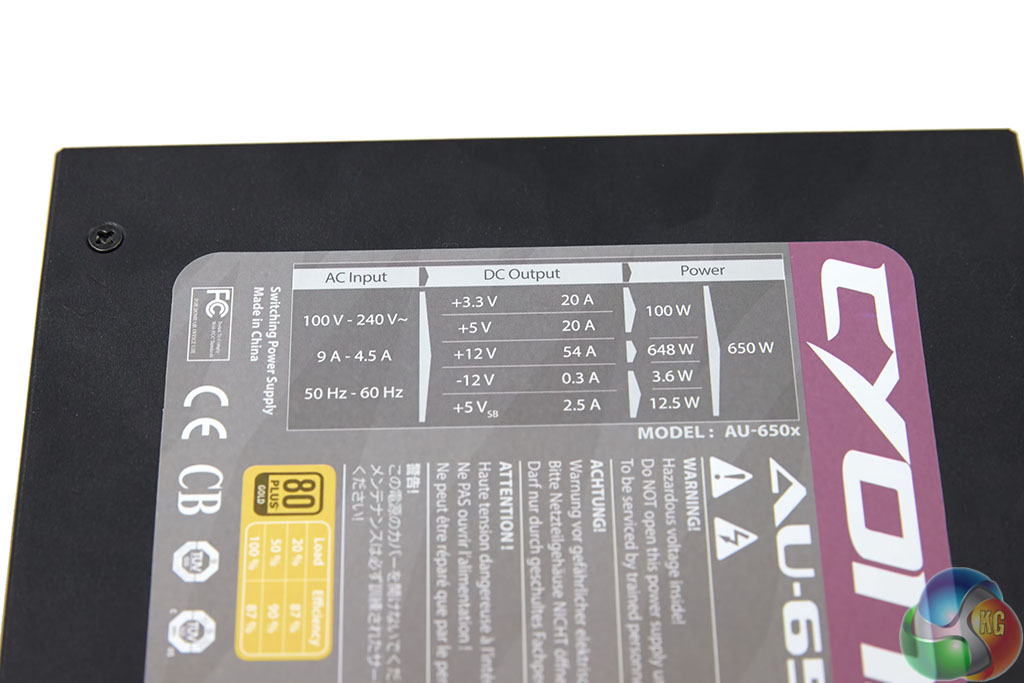
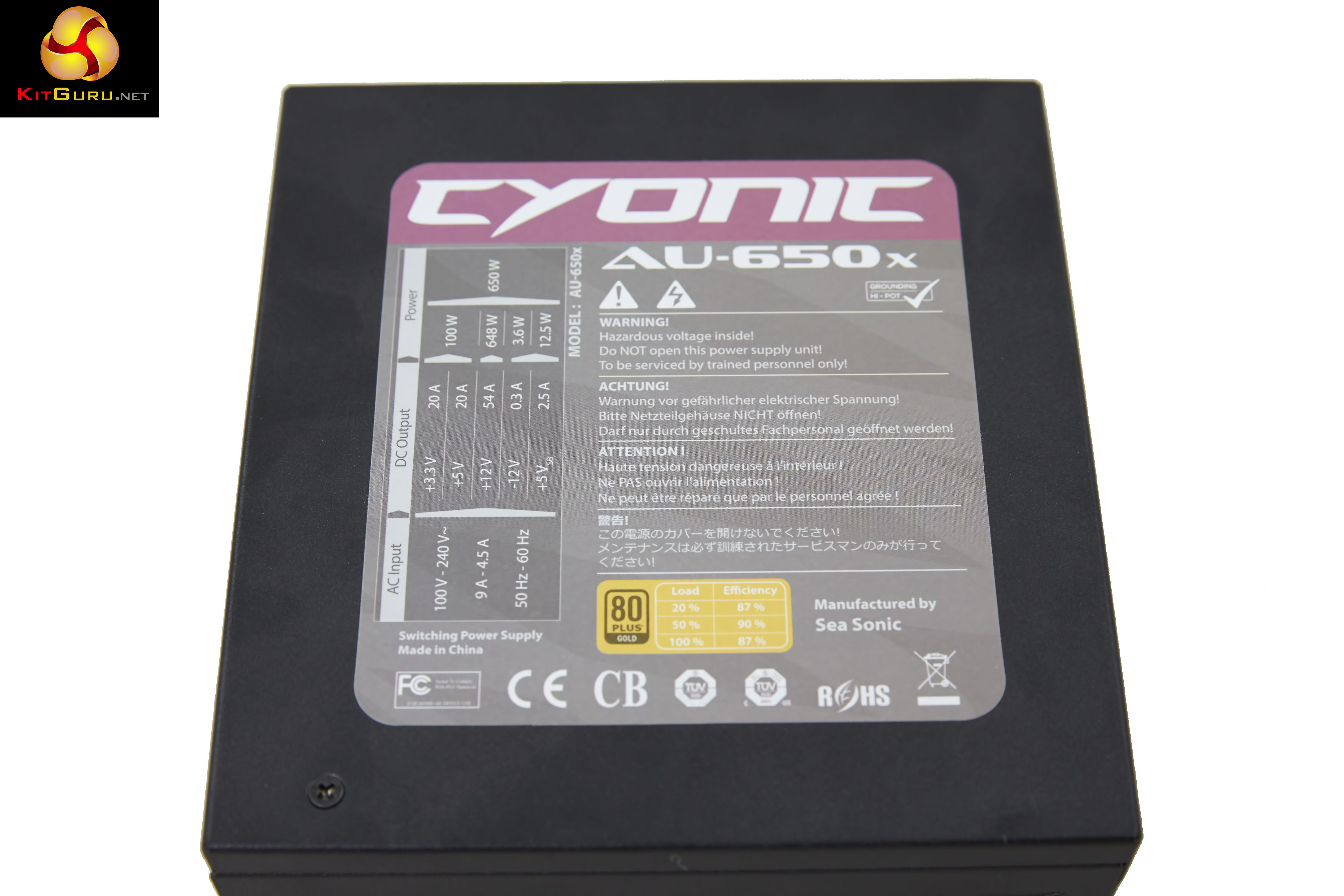
We can see above that the sticker on the unit shows ‘manufactured by Seasonic'. Not a bad thing to see at all.
| Cyonic AU-650x | |||||
|
DC Output
|
+3.3V
|
+5V
|
+12V |
-12V
|
+5Vsb
|
|
Max Output
|
20A
|
20A
|
54A |
0.3A
|
2.5A
|
| Total Power | 100W | 648W | 3.6W | 12.5W | |
| 650W | |||||
The power distribution above is exactly the same as the Seasonic G Series 650W power supply that we reviewed some time ago. 54A available on the +12V rail is good.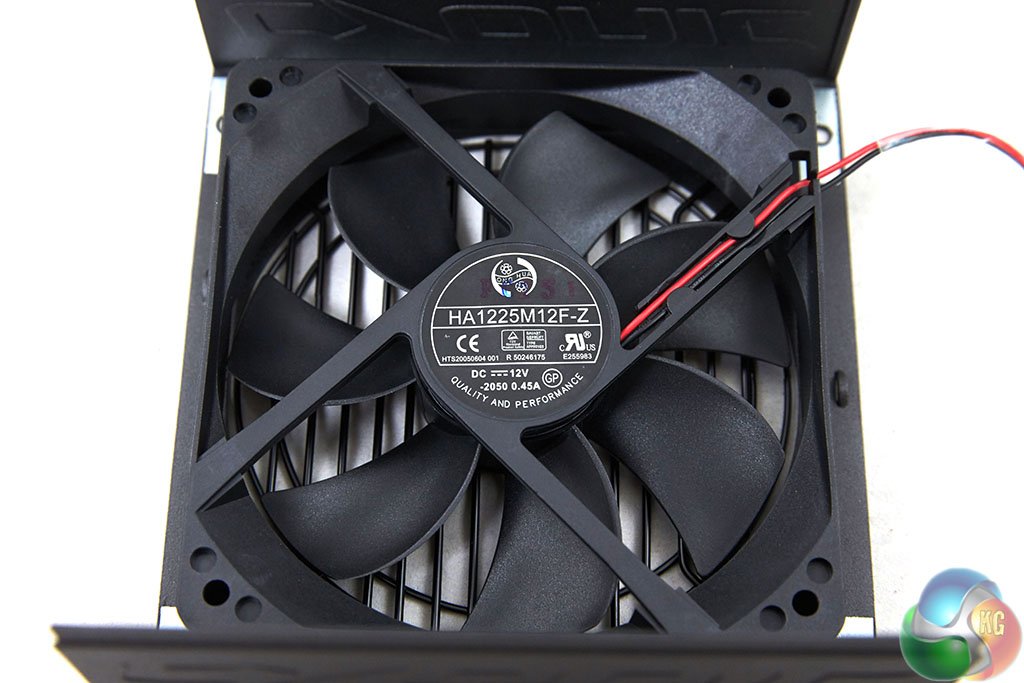
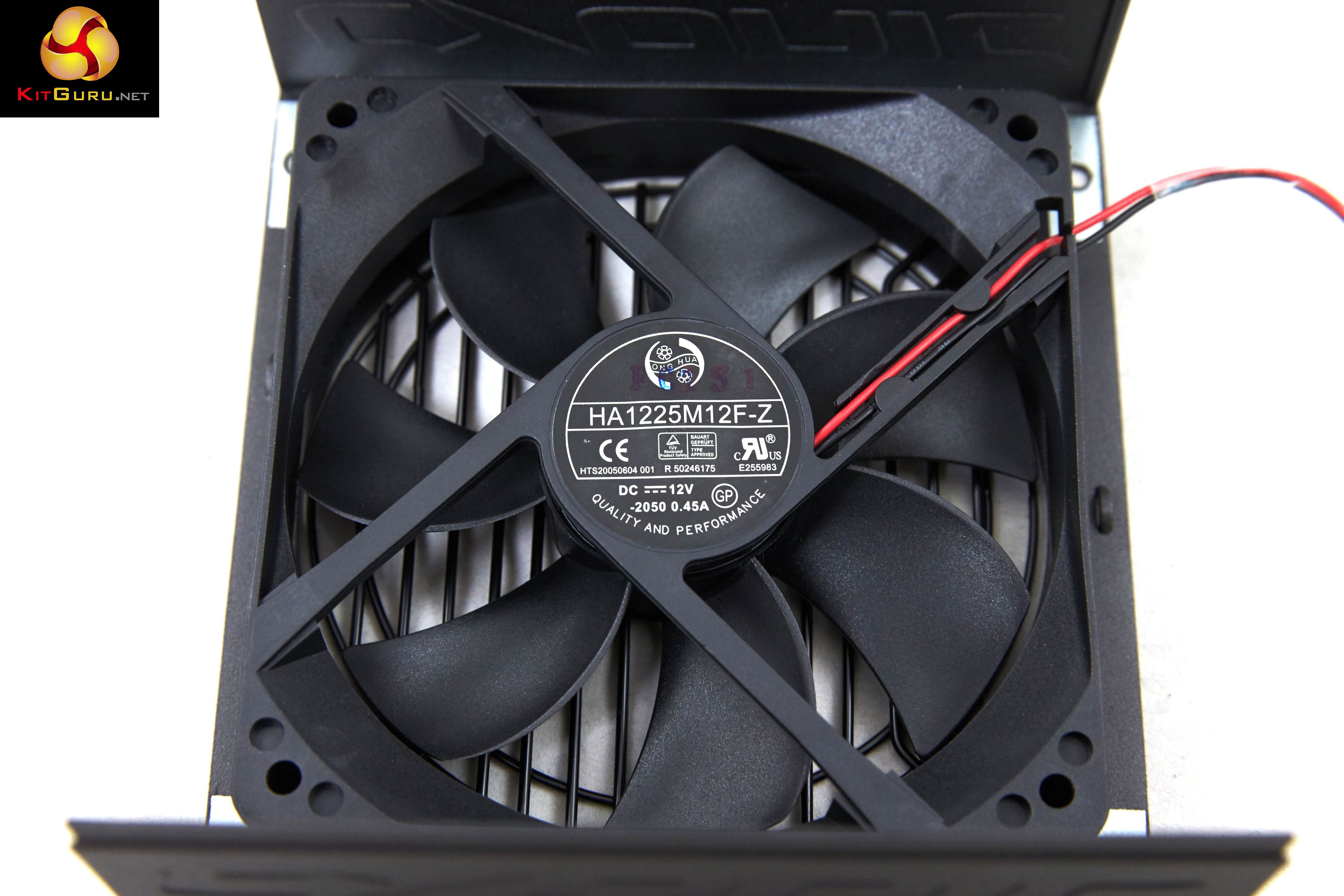
Cyonic are using a Hong Hua 120mm fan (HA1225M12F-Z). This is a Fluid Dynamic Bearing (FDB) fan. We have seen this fan used in some Seasonic power supplies recently, including the Snow Silent 750 w model which we reviewed earlier this year.
These fans not only tend to emit lower noise levels, but they are rated to last longer as well due to the lubrication of the bearing itself.
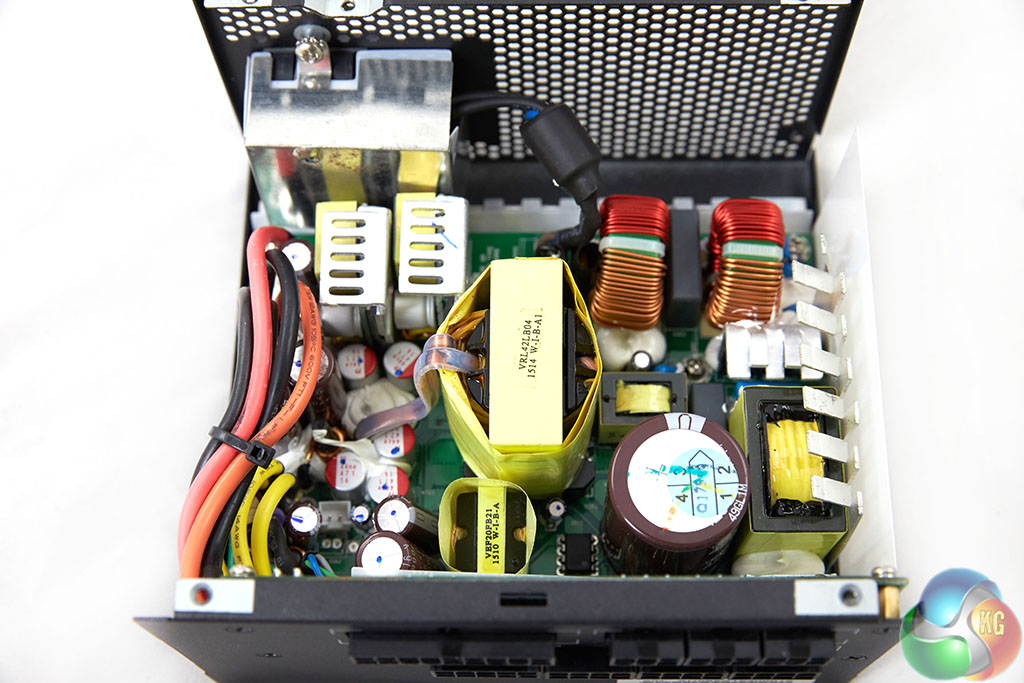
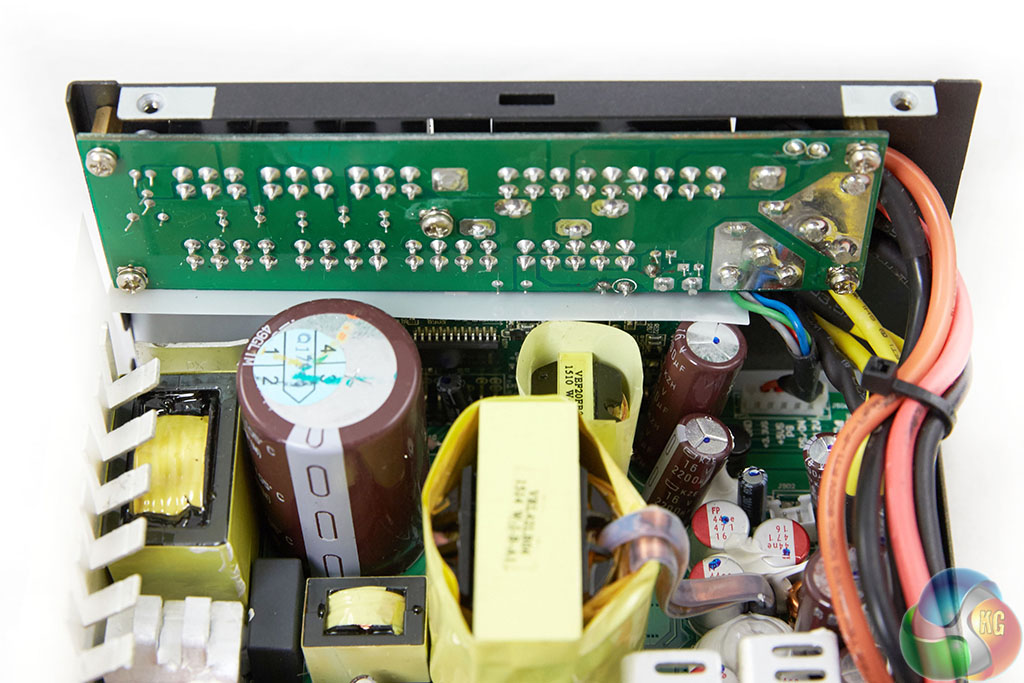
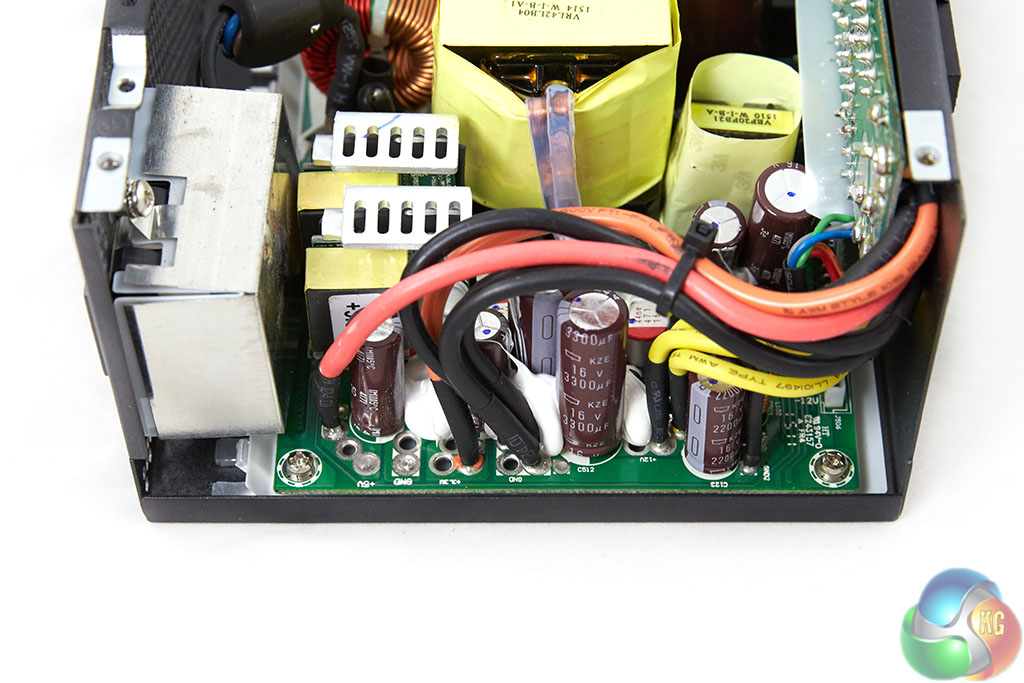
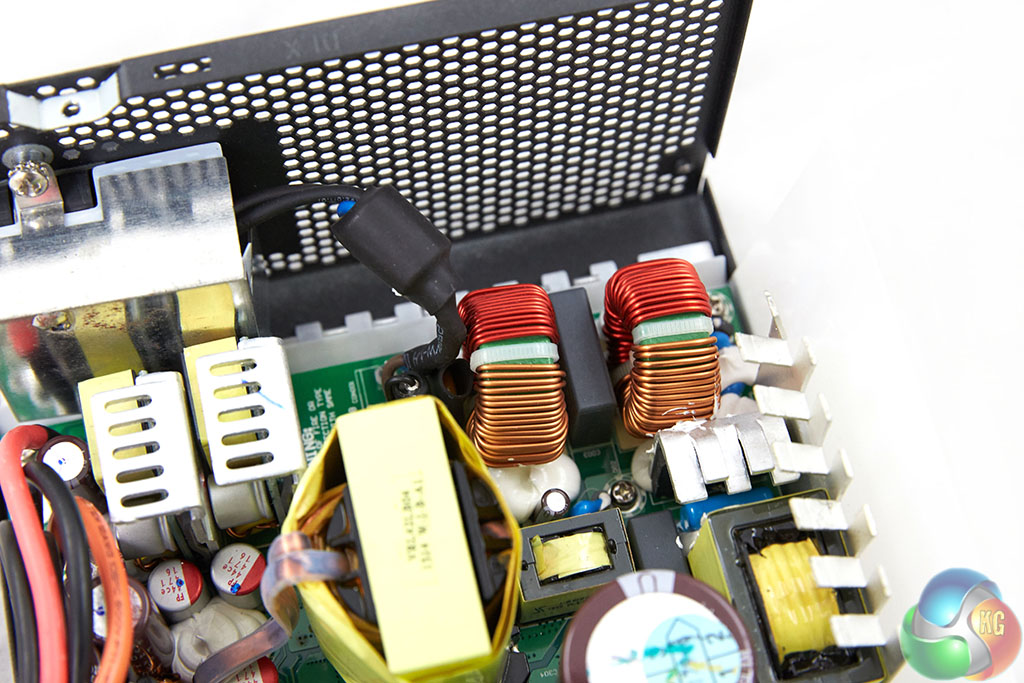
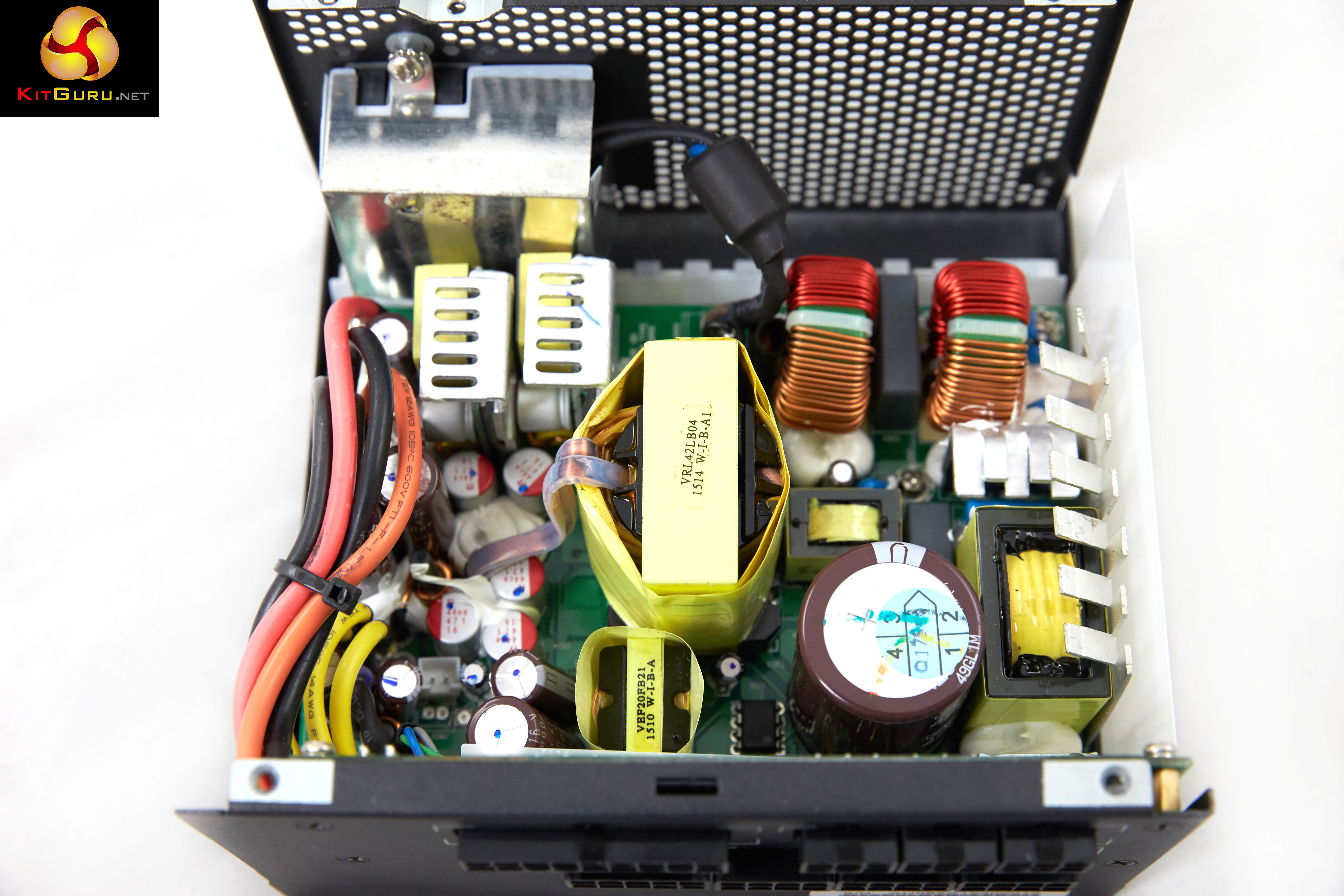
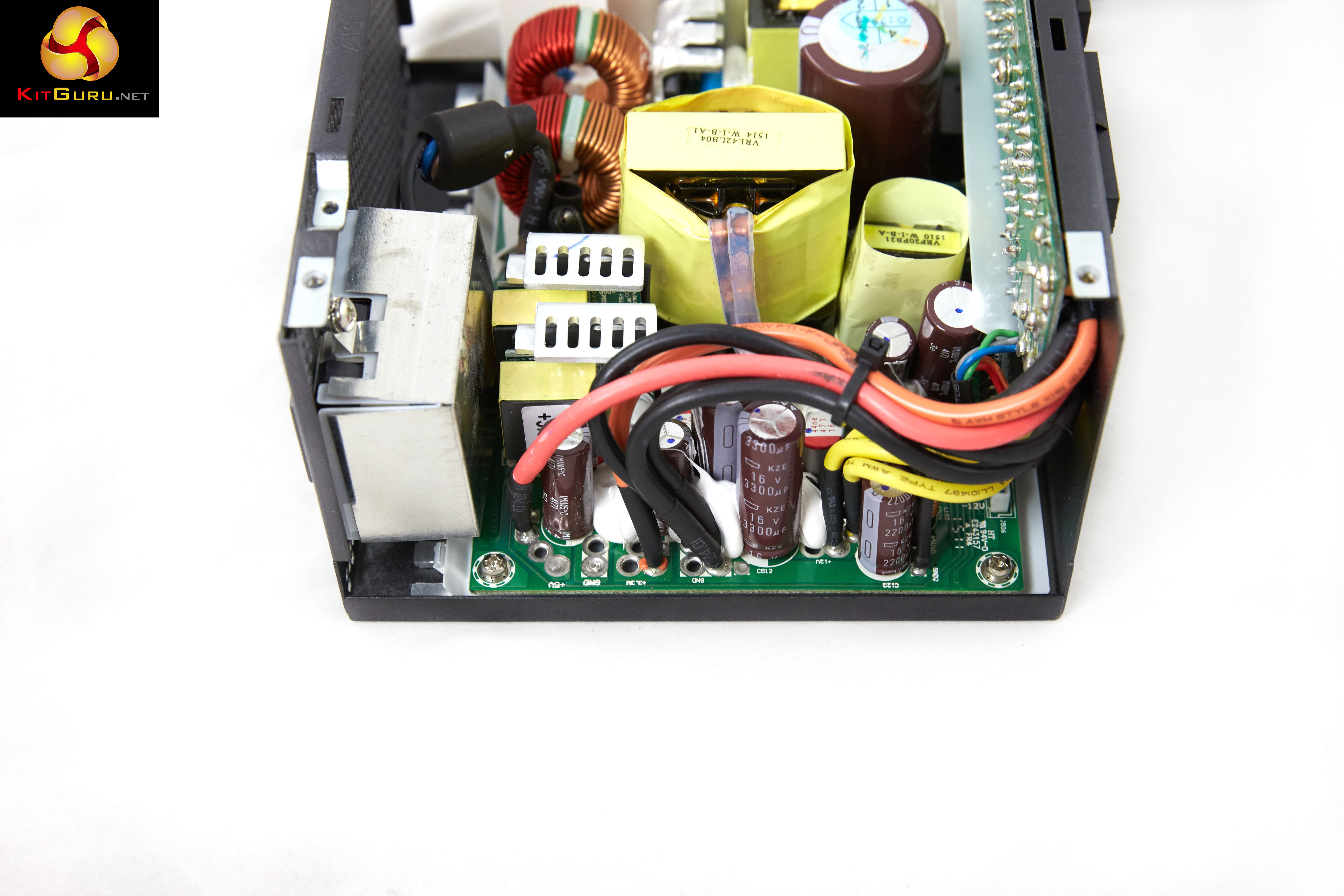
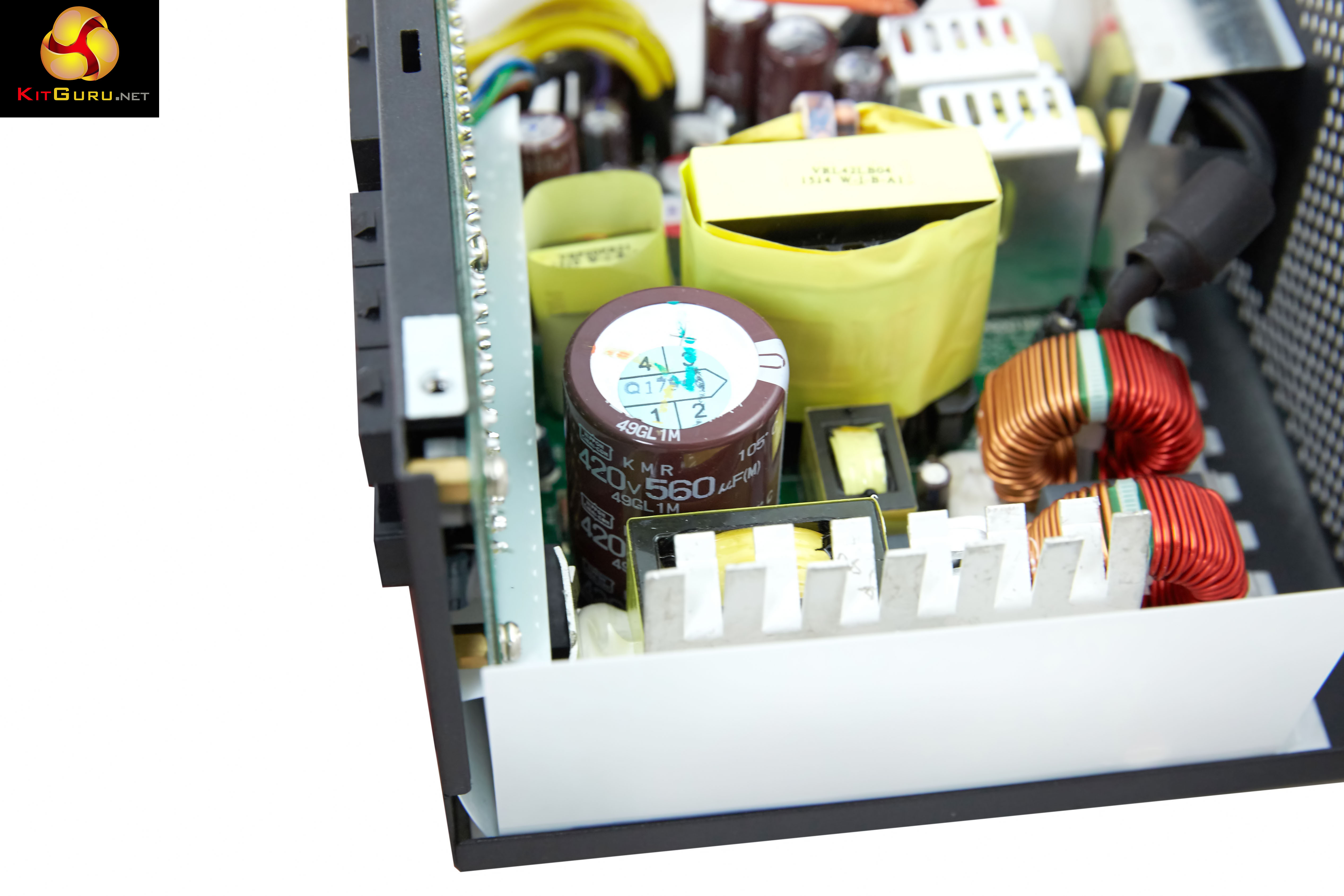
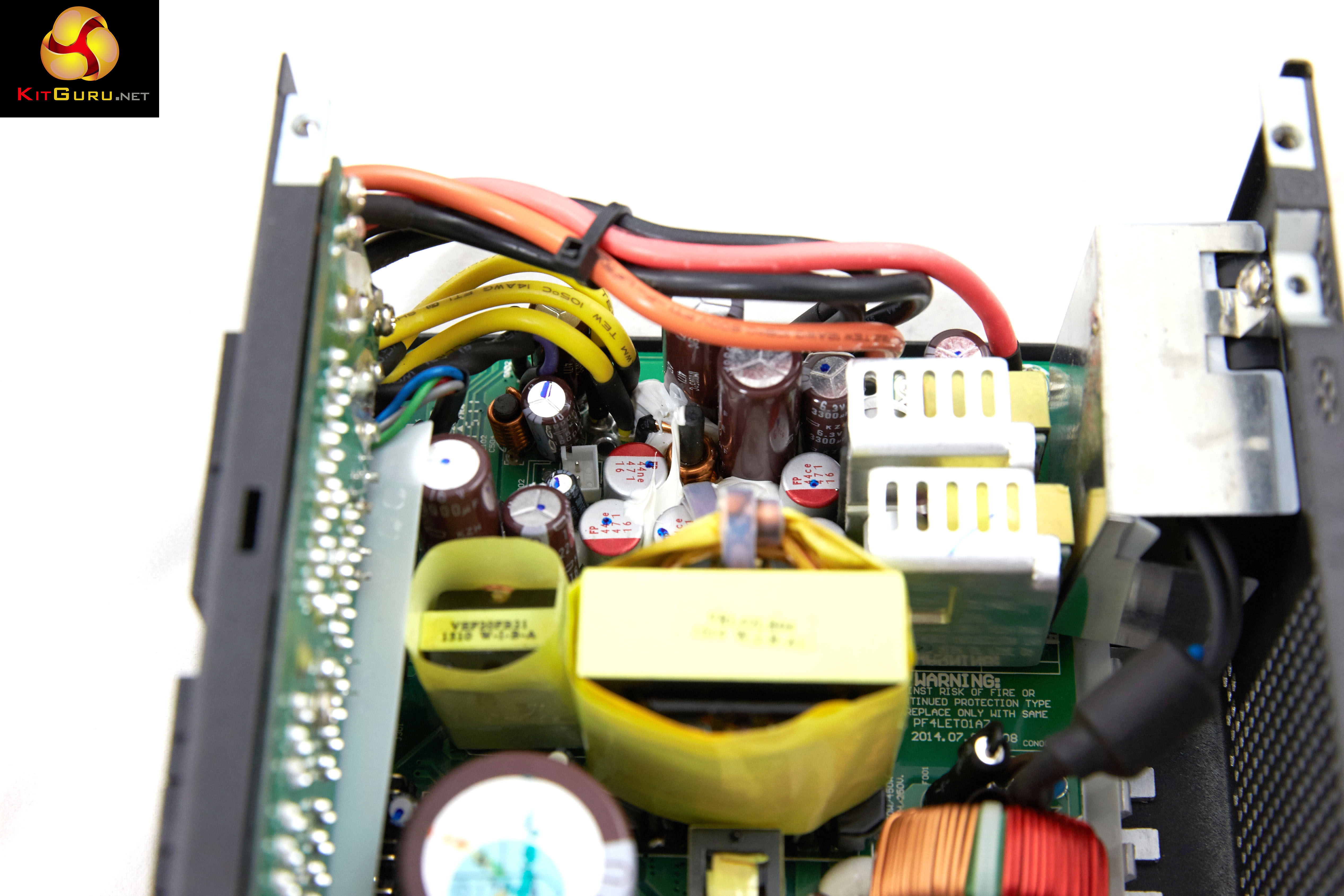
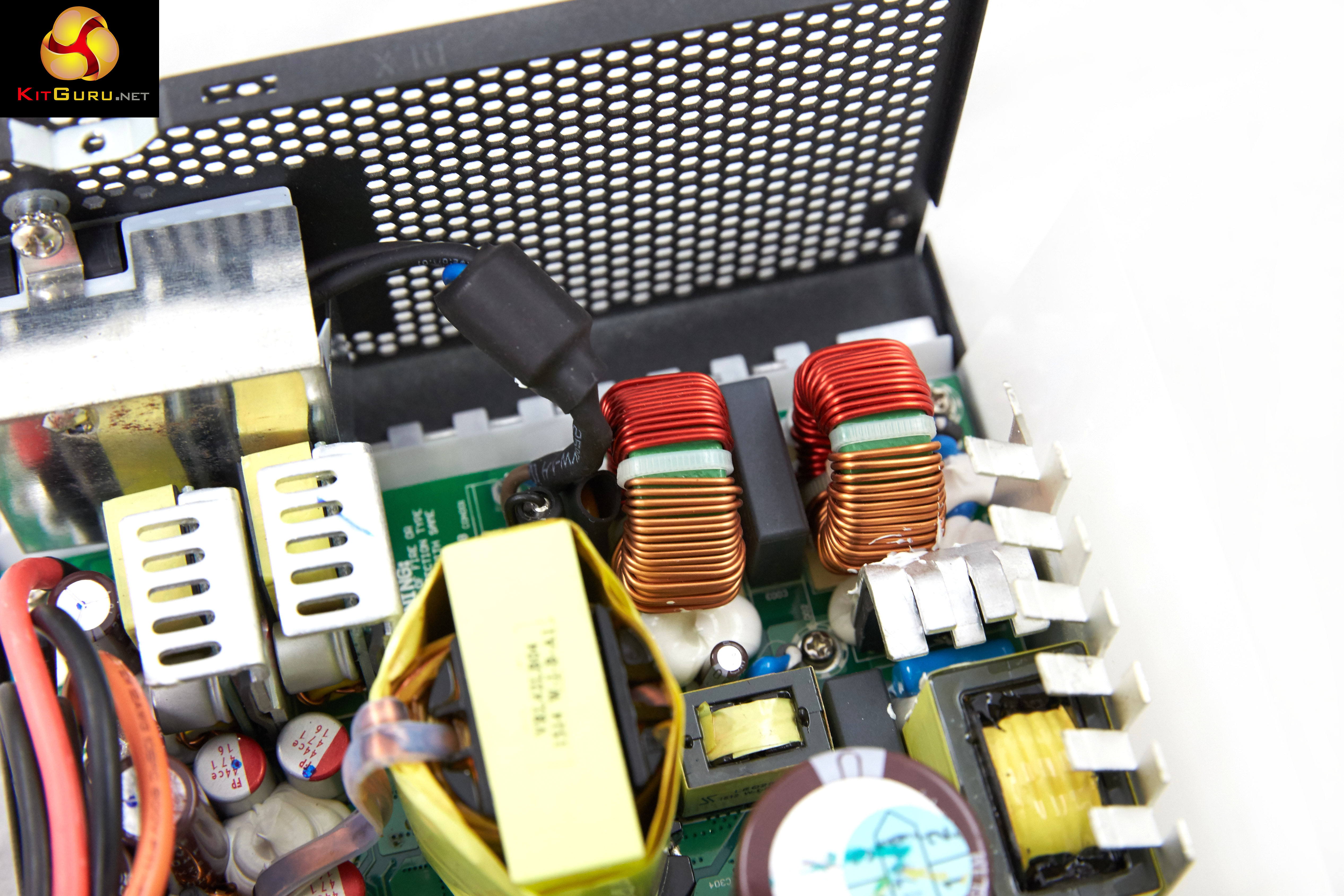
This power supply is designed by Seasonic and looks like a heavily revised version of one of their G Series units – the layout is resonant LLC primary with a synchronous rectification on the secondary – with DC-DC VRMs for the minor rails.
Soldering quality is very good, as we would expect from Seasonic. Filtering starts on the housing and features Y capacitors and X capacitors which are shielded behind a metal casing. The filtering continues onto the main PCB – and is different than the Seasonic G Series 650 watt model we analysed some time ago.
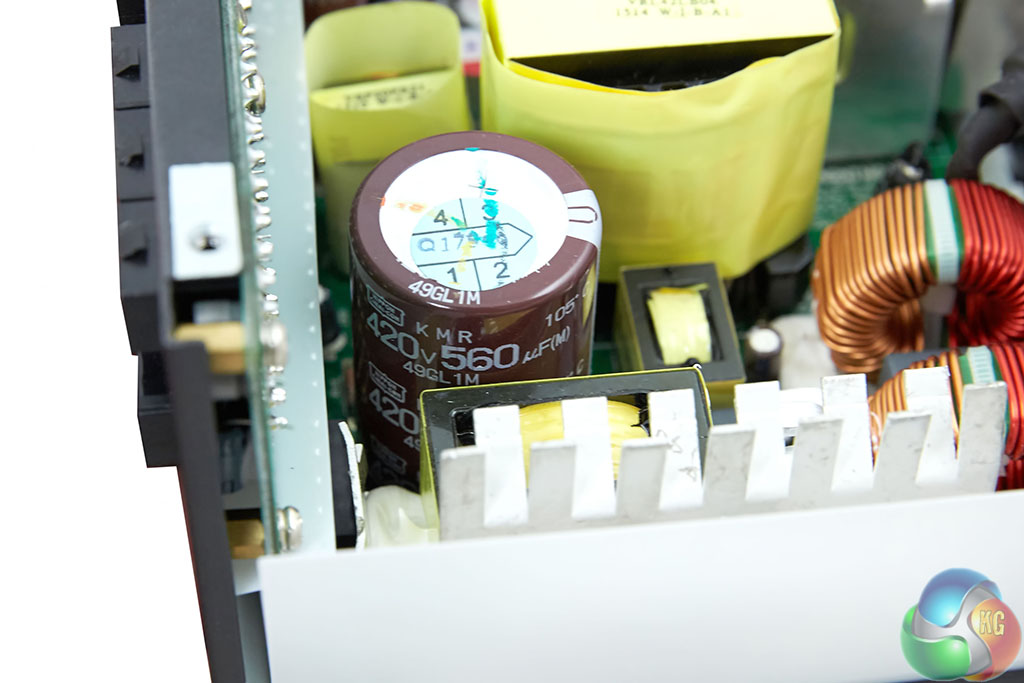
Almost hidden in a corner is the primary capacitor, a 420v 560uF 105c rated Japanese Nippon Chemi Con KMR model. High grade capacitors and able to deal with a lot of heat over extended periods of time.
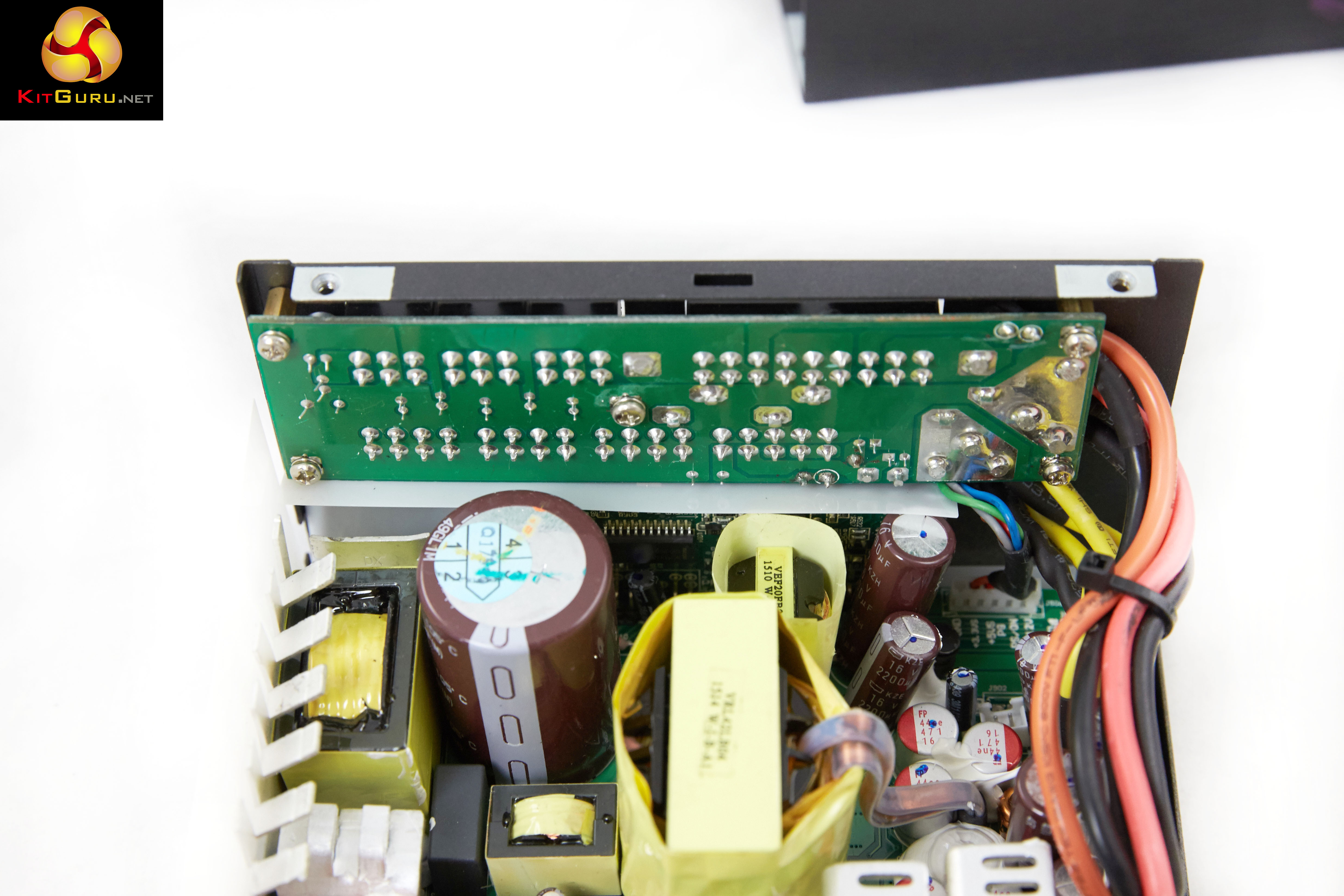
The secondary side is different to the G Series models also, some of the VRMs change location on the PCB and are contained in separate PCBs with dedicated heatsinks. Other solid and standard capacitors in the unit are supplied by FPCap, Enesol and Nippon Chemi Con. On this page we present some super high resolution images of the product taken with the Canon 1DX camera and Canon F2.8 24-70mm lens. These will take much longer to open due to the dimensions, especially on slower connections. If you use these pictures on another site or publication, please credit Kitguru.net as the owner/source. You can right click and ‘save as’ to your computer to view later.
Additional technical assistance: Peter McFarland and Jeremy Price.
Correctly testing power supplies is a complex procedure and KitGuru have configured a test bench which can deliver up to a 2,000 watt DC load. Due to public requests we have changed our temperature settings recently – previously we rated with ambient temperatures at 25C, we have increased ambient temperatures by 10c (to 35c) in our environment to greater reflect warmer internal chassis conditions.
We use combinations of the following hardware:
• SunMoon SM-268
• CSI3710A Programmable DC load (+3.3V and +5V outputs)
• CSI3711A Programmable DC load (+12V1, +12V2, +12V3, and +12V4)
• Extech Power Analyzer
• Extech MultiMaster MM570 digital multimeter
• SkyTronic DSL 2 Digital Sound Level Meter (6-130dBa)
• Digital oscilloscope (20M S/s with 12 Bit ADC)
• Variable Autotransformer, 1.4 KVA
We combine all +12V output for the results below.
|
DC Output Load Regulation
|
||||||||||
|
Combined DC Load |
+3.3V
|
+5V
|
+12V
|
+5VSB
|
-12V | |||||
|
A
|
V
|
A
|
V
|
A
|
V
|
A
|
V
|
A | V | |
|
152W
|
2.05
|
3.35
|
2.04
|
5.04
|
10.12
|
12.12
|
0.50
|
4.99
|
0.20
|
-12.04
|
|
270W
|
3.03
|
3.35
|
3.05
|
5.04
|
19.14
|
12.09
|
0.50
|
4.98
|
0.30
|
-12.05
|
|
400W
|
4.05
|
3.34
|
5.02
|
5.02
|
29.18
|
12.06 |
1.00
|
4.98
|
0.30
|
-12.05
|
| 523W |
6.09
|
3.34
|
7.04
|
4.98
|
38.18
|
12.04
|
1.50
|
4.98 |
0.30
|
-12.06
|
|
650W
|
8.00
|
3.33
|
9.00
|
4.96
|
48.00
|
12.02
|
2.50
|
4.98
|
0.30
|
-12.08
|
Load regulation is good across the output range. No concerns here.
Next we want to try Cross Loading. This basically means loads which are not balanced. If a PC for instance needs 500W on the +12V outputs but something like 30W via the combined 3.3V and +5V outputs then the voltage regulation can fluctuate badly.
| Cross Load Testing | +3.3V | +5V | +12V | -12V | +5VSB | |||||
| A | V | A | V | A | V | A | V | A | V | |
| 590W | 1.0 | 3.35 | 1.0 | 5.04 | 48.0 | 12.01 | 0.2 | -12.04 | 0.50 | 4.98 |
| 145W | 12.0 | 3.31 | 15.0 | 4.95 | 2.0 | 12.11 | 0.2 | -12.03 | 0.50 | 4.97 |
The unit passed our cross load test without a problem.
We then used an oscilloscope to measure AC ripple and noise present on the DC outputs. We set the oscilloscope time base to check for AC ripple at both high and low ends of the spectrum. ATX12V V2.2 specification for DC output ripple and noise is defined in the ATX 12V power supply design guide.
|
ATX12V Ver 2.2 Noise/Ripple Tolerance
|
|
|
Output
|
Ripple (mV p-p)
|
|
+3.3V
|
50
|
|
+5V
|
50
|
|
+12V1
|
120
|
|
+12V2
|
120
|
|
-12V
|
120
|
|
+5VSB
|
50
|
Obviously when measuring AC noise and ripple on the DC outputs the cleaner (less recorded) means we have a better end result. We measured this AC signal amplitude to see how closely the unit complied with the ATX standard.
| AC Ripple (mV p-p) | ||||
| DC Load | +3.3V | +5V | +12V | 5VSB |
| 152W | 10 | 10 | 15 | 10 |
| 270W | 10 | 15 | 15 | 10 |
| 400W | 15 | 15 | 20 | 15 |
| 523W | 15 | 20 | 30 | 15 |
| 650W | 15 | 20 | 35 | 20 |
Ripple suppression falls within the rated tolerance guidelines. The +3.3V and +5V output peak at 15mV and 20mV respectively. The +12V output hits 35mV at full load which is well within the rated guidelines.
|
Efficiency (%)
|
|
|
152W
|
87.39
|
|
270W
|
91.83
|
|
400W
|
90.87
|
|
523W
|
89.11
|
|
650W
|
88.82
|
Efficiency is good – peaking just under 91 percent at 50 percent load. At full load this drops to around 89 percent efficiency.
We take the issue of noise very seriously at KitGuru and this is why we have built a special home brew system as a reference point when we test noise levels of various components. Why do this? Well this means we can eliminate secondary noise pollution in the test room and concentrate on components we are testing. It also brings us slightly closer to industry standards, such as DIN 45635.
Today to test the Power Supply we have taken it into our acoustics room environment and have set our SkyTronic DSL 2 Digital Sound Level Meter (6-130dBa) one meter away from the unit. We have no other fans running so we can effectively measure just the noise from the unit itself.
As this can be a little confusing for people, here are various dBa ratings in with real world situations to help describe the various levels.
KitGuru noise guide
10dBA – Normal Breathing/Rustling Leaves
20-25dBA – Whisper
30dBA – High Quality Computer fan
40dBA – A Bubbling Brook, or a Refrigerator
50dBA – Normal Conversation
60dBA – Laughter
70dBA – Vacuum Cleaner or Hairdryer
80dBA – City Traffic or a Garbage Disposal
90dBA – Motorcycle or Lawnmower
100dBA – MP3 Player at maximum output
110dBA – Orchestra
120dBA – Front row rock concert/Jet Engine
130dBA – Threshold of Pain
140dBA – Military Jet takeoff/Gunshot (close range)
160dBA – Instant Perforation of eardrum
|
Noise (dBA)
|
|
|
152W
|
<28.0
|
|
270W
|
<28.0
|
|
400W
|
30.5
|
|
523W
|
32.9
|
| 650W | 34.2 |
The fan inside the AU-650x is quiet throughout most of the range, hitting around 34dBa at full load. This is exactly what we want to see from a quality FDB fan.
|
Temperature (c)
|
||
|
Intake
|
Exhaust
|
|
|
152W
|
36
|
39
|
|
270W
|
39
|
42
|
|
400W
|
42
|
45
|
|
523W
|
43
|
54
|
|
650W
|
45
|
59
|
The fan doesn't work too hard until around the last 20% of power output. Temperatures are well controlled throughout.
This is our first look at a power supply from new company Cyonic and the analysis has been positive. I can't say this is actually that much of a shock however as Seasonic are the manufacturer. We have tested dozens of Seasonic power supplies in the last four years and they have been the most consistent of any brand featured in our labs.
The Cyonic AU-650x produces stable load regulation and it handled the cross load test without issue. Noise suppression is good, if not class leading and well within the industry rated tolerance range. +3.3V and +5V held at 15mV and 20mV respectively under full load conditions. +12V peaked at 35mV when the supply was under full load – again well within the 120mV limit guidelines.
The adoption of a quality Fluid Dynamic Bearing fan means that the unit is quiet under even heavy load and the noise of the 120mm Hong Hua fan is likely to be masked completely by a couple of case fans.
Technically the unit is very solid and it doesn't exhibit any concerning flaws, my main concerns are actually more related to the appearance, rather than anything technical. The case finish seems to attract fingerprints extremely easily and it would be fair to say it is one of the most bland looking power supplies we have seen – almost as if the company are hiding their name with a simple no colour chassis cut out. For those people without a windowed case panel this may not be an issue, but there are some rather attractively finished competitor power supplies just under £100.
On a more positive note, the pure modular design will prove popular with OCD suffering PC builders as you can completely control the routing without battling against hard wired cables you will never use.
You can pick up the Cyonic AU-650x from Scan in the UK for £84.98 inc vat HERE. There are other alternatives at the same price, such as the Seasonic SS-650RM which is available from Scan for £84.78 inc vat HERE. This is the biggest challenge that Cyonic are going to face – taking on well known market leaders at the exact same price point.
Discuss on our Facebook page, over HERE.
Pros:
- Technically capable Seasonic design.
- low noise emissions.
- ripple suppression is good.
Cons:
- a very bland looking power supply.
- fingerprint magnet.
- serious competition at the same price point.
Kitguru says: The Cyonic AU-650X faces stiff competition but technically it is a very capable power supply.

I need to show excellent online freelancing opportunity… 3 to 5 h of work /a day… Weekly paycheck… Extra bonus for job well done…Earnings of $6k-$9k /for month… Just few h of spare time, a pc, elementary knowledge of internet and dependable internet-connection# needed…Click on my disqus~~~~page to learn more