KitGuru KitGuru.net – Tech News | Hardware News | Hardware Reviews | IOS | Mobile | Gaming | Graphics Cards


To test real life performance of a drive we use a mix of folder/file types and by using the FastCopy utility (which gives a time as well as MB/s result) we record the performance of drive reading from & writing to a 256GB Samsung SSD850 PRO.
100GB data file.
60GB iso image.
60GB Steam folder – 29,521 files.
50GB File folder – 28,523 files.
21GB 8K Movie demos.
11GB 4K Raw Movie Clips (8 MP4V files).
4.25GB 3D Printer File Folder (mostly .STL).
1GB AutoCAD File Folder (.dwg and .dxf).
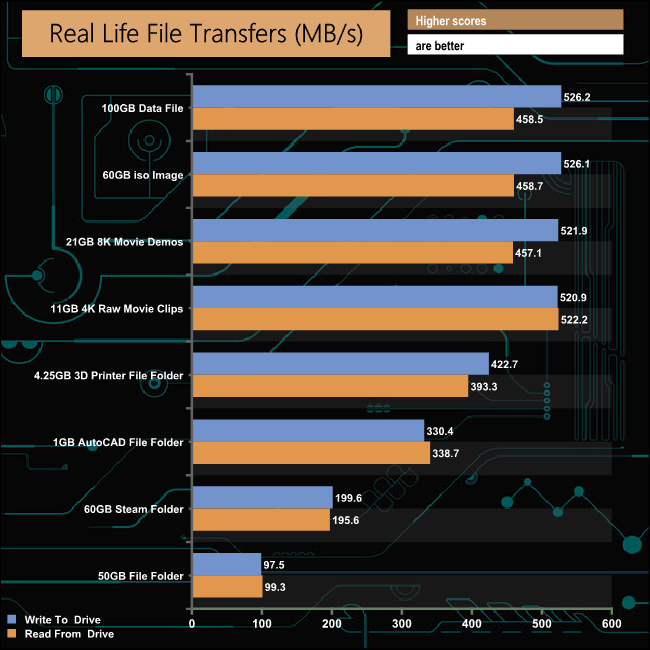
The Kingston DC1000B had no problems dealing with our real-life file transfer tests. The drive is much more efficient at handling larger file sizes than the smaller files found in the 60GB Steam and 50GB file folders as can be seen by the large difference in transfer rates.
To get a measure of how much faster PCIe NVMe drives are than standard SATA SSD's we use the same files but transfer to and from a 512GB Toshiba OCZ RD400.
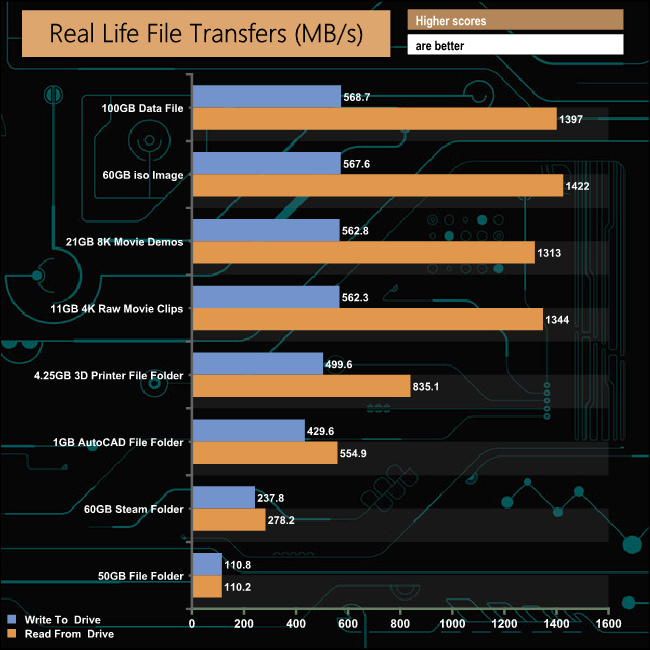
Taking the SATA SSD out of the picture and switching over to transfer the files to and from the NVMe drive shows a huge leap in read performance with a much smaller gain in writes when dealing with larger file sizes.