KitGuru KitGuru.net – Tech News | Hardware News | Hardware Reviews | IOS | Mobile | Gaming | Graphics Cards


Although Kingston's DC1000B drive is has been optimised to operate as a low-cost boot drive for servers it can also be used in a data logging role or as a local cache drive. As more and more server motherboards come into the market equipped with NVMe M.2 slots it makes sense to use them to house the boot drive rather than take away one of the main storage drives to perform the boot function.
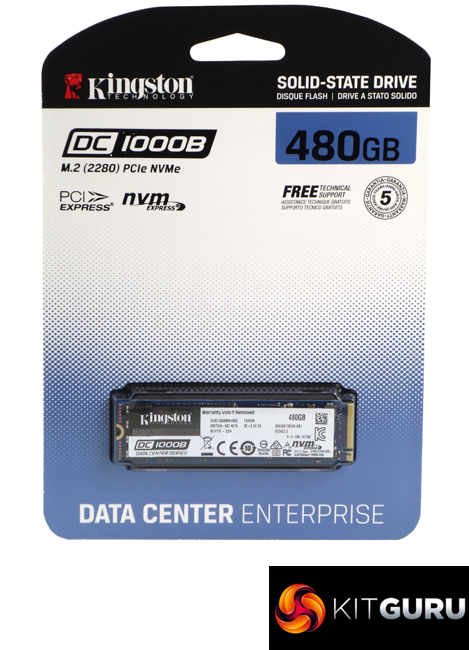
For the DC1000B, Kingston has gone down the Phison/3D TLC controller and NAND combination route. The controller is the 8-channel PS5012-E12, Phison’s second-generation PCIe Gen3 x4 NVMe IC while the NAND is 64-layer 3D TLC. The 480GB drive uses four NAND packages, two on each side of the PCB.
The DC1000B is heavily focused on read performance which becomes obvious when looking at the official performance ratings for the drive. When it comes to Sequential performance, Kingston rate the 480GB drive at up to 3,200MB/s for Sequential reads with writes down at up to 565MB/s. Using the ATTO benchmark we could confirm those official ratings with the tested drive producing a read figure of 3,190MB/s with writes at 571MB/s.
Random performance is quoted as up to 205,000 IOPS for reads and 20,000 IOPS for writes, both figures are from a drive in a Steady State. Tested fresh out of the box with our four threaded tests, we got a read figure of 211,074 IOPS (at a QD of 32). Peak tested write performance came at a QD of 1 at 138,223 IOPS.
It comes as no surprise to find that a drive aimed at the data centre/enterprise market segment should come with onboard power loss protection (PLP) but what is surprising is to find it on an M.2 2280 format drive. Usually, PLP is found on longer M.2 format drives for servers, but Kingston has found a way to add to a shorter PCB.
We found the 480GB Kingston DC1000B on Span.com for £168 (inc VAT) HERE
Discuss on our Facebook page HERE.
Pros
- Sequential read performance.
- Endurance.
- Power loss protection.
Cons
- Pricey.
KitGuru says: Kingston's latest NVMe SSD is aimed at a rapidly growing segment, namely server boot drives. With more server motherboards entering the market space with one or more M.2 NVMe slots, it means that you no longer have to use up one of the servers storage drives to perform boot duties.