KitGuru KitGuru.net – Tech News | Hardware News | Hardware Reviews | IOS | Mobile | Gaming | Graphics Cards


To measure idle temperatures, a reading was taken after having Windows open on the desktop for 30 minutes. A reading under load was taken with Prime 95’s SmallFFt test running alongside 3DMark Fire Strike.
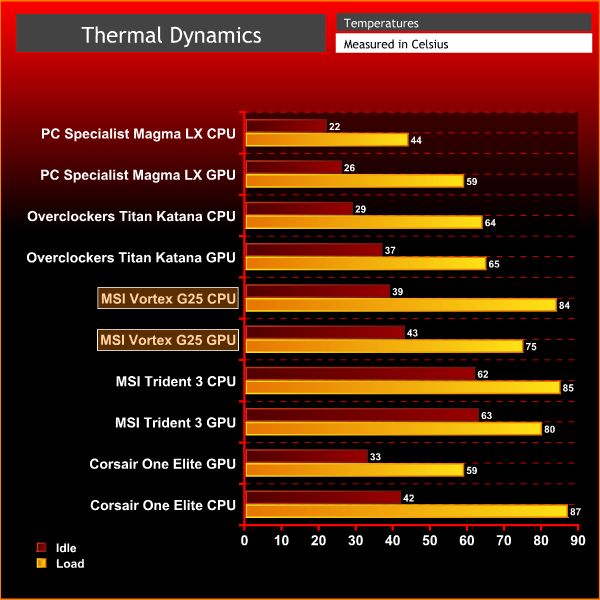
Thermal performance is vital inside a small machine like this, but the Vortex proved inconsistent in our tests.
It made hardly any noise when idling and running low-intensity tasks – its noise level of 27db is superb, and the temperatures were fine across the board – the CPU and GPU peak figures of 84°C and 75°C are nothing to worry about.
During gaming, though, the fan speed increased to around 38db – and, fittingly, the high-pitched noise was on par with most gaming laptops, and certainly louder than the Corsair One Elite and many other full-sized gaming machines. It’s easy enough to drown the noise out with a headset or speakers, but it’s certainly irritating.
Both fans spun up to around 45db during a system-wide stress-test, which produced a lower-pitched sound that was just as noisy.
The GPU ran at a solid 1,650MHz during our gaming tests, which is absolutely fine – consistent with the overclocked chip’s Turbo speeds. However, the GPU did throttle back to around 1,570MHz during the system-wide stress-test.