KitGuru KitGuru.net – Tech News | Hardware News | Hardware Reviews | IOS | Mobile | Gaming | Graphics Cards


Intel’s NUC 9 Extreme is a sub-5 litre small form factor system based around the new Compute Element card. Housing a sixteen-thread Core i9-9980HK, up to 64GB of DDR4, and a graphics card as powerful as an RTX 2070, does the NUC 9 Extreme usher in a new era of SFF computing?
There are two fundamentally new areas to review with the Intel NUC 9 Extreme.
First is the Compute Element card. This is Intel’s PC-on-a-card approach whereby a soldered laptop-style Core CPU is housed on a motherboard with two SODIMM slots and a couple of M.2 connectors. The entire card is connected to a PCIe slot daughterboard and can then be used as the base of an entire functioning system.
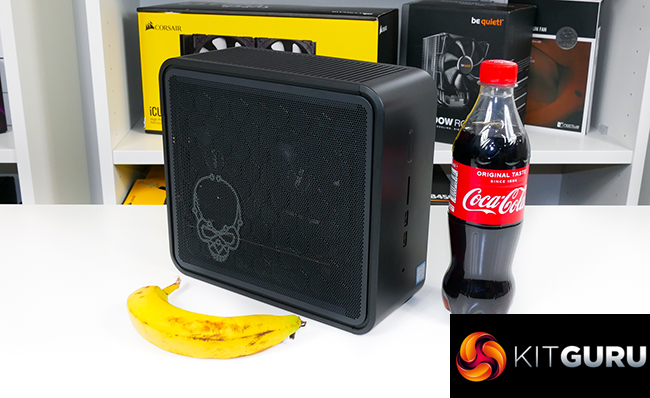
Next up is the NUC 9 Extreme itself. Built around the aforementioned Compute Element card, Intel also deploys a PCIe baseboard, a miniature chassis, and the relevant partnering hardware such as a Flex-ATX power supply and cooling.
Intel’s NUC 9 Extreme chassis measures in at 238 x 216 x 96 mm – a volume of just under 5 litres. Two cooling fans are deployed in an innovative cable-free approach and power is provided by a 500W 80-Plus Platinum PSU. The baseboard houses the Compute Element card and offers up PCIe x16 and x4 expansion slots in addition to a 4-lane M.2 connection.
Importantly, and this is where the NUC 9 Extreme differs to previous NUC systems, the chassis and underlying design allows for a discrete PCIe graphics card to be installed and used with the system. Currently, the most powerful graphics card that can be used in the 8-inch space is the ASUS Dual RTX 2070 Mini. That’s certainly a sizeable improvement over previous NUC systems’ graphics capability, though you can get comparable power from gaming laptops.
Let’s take a closer look at the Intel NUC 9 Extreme and the configuration as supplied to us.