KitGuru KitGuru.net – Tech News | Hardware News | Hardware Reviews | IOS | Mobile | Gaming | Graphics Cards


Nvidia is continuing to release new products at quite a pace. Last month saw the arrival of RTX 2060 to generally favourable reviews, and today marks the official launch of GTX 1660 Ti. Long rumoured, this card is perhaps most notable for its distinct lack of any Tensor or RT cores – features which define the RTX series of graphics cards by giving them the ability to play ray traced games and use DLSS. With those features not supported here, we return to GTX nomenclature with the 1660 Ti.
Interestingly, Nvidia has not manufactured a Founders Edition for its new GTX 1660 Ti, instead it is relying on its board partners like ASUS, MSI and Gigabyte to produce a variety of cards. The MSI GTX 1660 Ti Gaming X 6G we are looking at today is definitely positioned as a high-end 1660 Ti, with a factory overclocked core and £50 price premium over the 1660 Ti's baseline MSRP of £259.
| GPU | RTX 2070 (FE) | GTX 1070 | RTX 2060 (FE) | GTX 1660 Ti | GTX 1060 |
| SMs | 36 | 15 | 30 | 24 | 10 |
| CUDA Cores | 2304 | 1920 | 1920 | 1536 | 1280 |
| Tensor Cores | 288 | N/A | 240 | N/A | N/A |
| Tensor FLOPS | 63 | N/A | 51.6 | N/A | N/A |
| RT Cores | 36 | N/A | 30 | N/A | N/A |
| Texture Units | 144 | 120 | 120 | 96 | 80 |
| ROPs | 64 | 64 | 48 | 48 | 48 |
| Rays Cast | 6 Giga Rays/sec | 0.65 Giga Rays/sec | 5 Giga Rays/sec | – | 0.44 Giga Rays/sec |
| RTX Performance | 45 Trillion RTX-OPS | 6.5 Trillion RTX-OPS | 37 Trillion RTX-OPS | – | N/A |
| GPU Boost Clock | 1710 MHz | 1683 MHz | 1680 MHz | 1770 MHz | 1708 MHz |
| Memory Data Rate | 14 Gbps | 8 Gbps | 14 Gbps | 12 Gbps | 8 Gbps |
| Total Video Memory | 8GB GDDR6 | 8GB GDDR5 | 6GB GDDR6 | 6GB GDDR6 | 6GB GDRR5 |
| Memory Interface | 256-bit | 256-bit | 192-bit | 192-bit | 192-bit |
| Memory Bandwidth | 448 GB/sec | 256 GB/sec | 336.1 GB/sec | 288.1 GB/sec | 192 GB/sec |
| TDP | 185W | 150W | 160W | 120W | 120W |
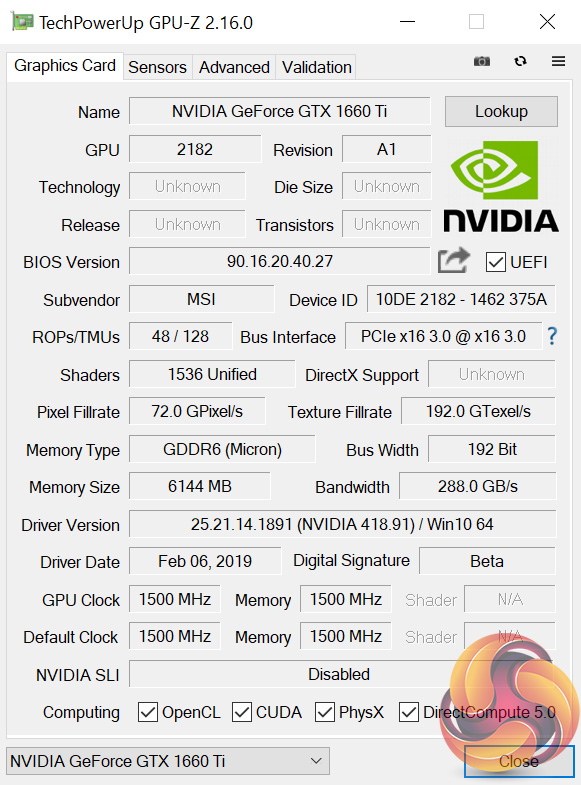
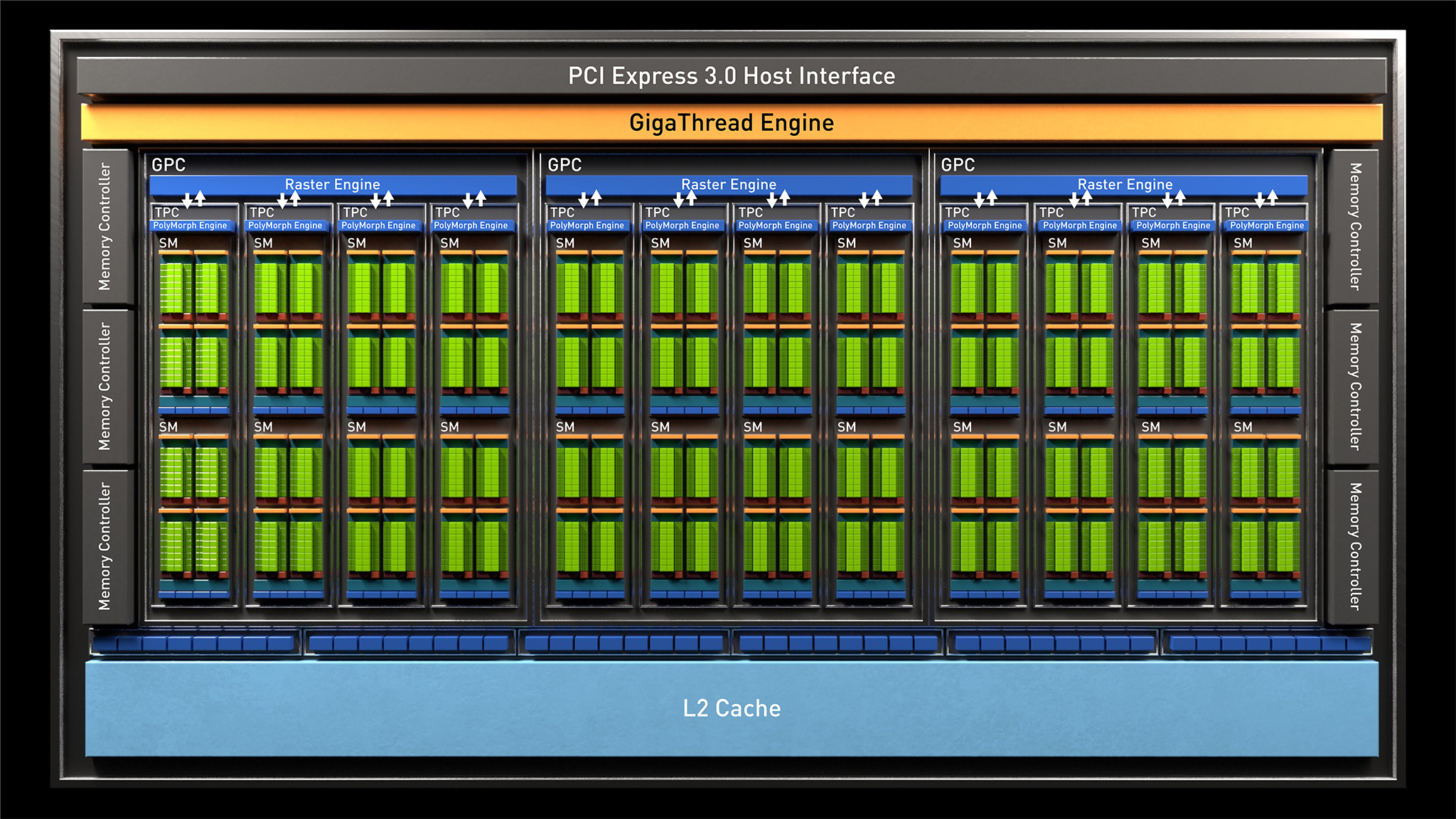
GPU-Z screenshot (left), TU116 GPU block diagram (right)
GTX 1660 Ti is still based on the same Turing architecture as all of the RTX 20-series cards we have reviewed over the past 6 months. We have detailed some key features of the Turing architecture in our initial reviews of the RTX 2080 and RTX 2080 Ti from September 2018.
The primary difference here is that GTX 1660 Ti does not have any Tensor or RT cores. Rather than using the TU106 GPU (used for RTX 2060/2070) with disabled SMs and Tensor/RT cores, Nvidia created a new GPU for the GTX 1660 Ti, dubbed TU116 (as seen above).
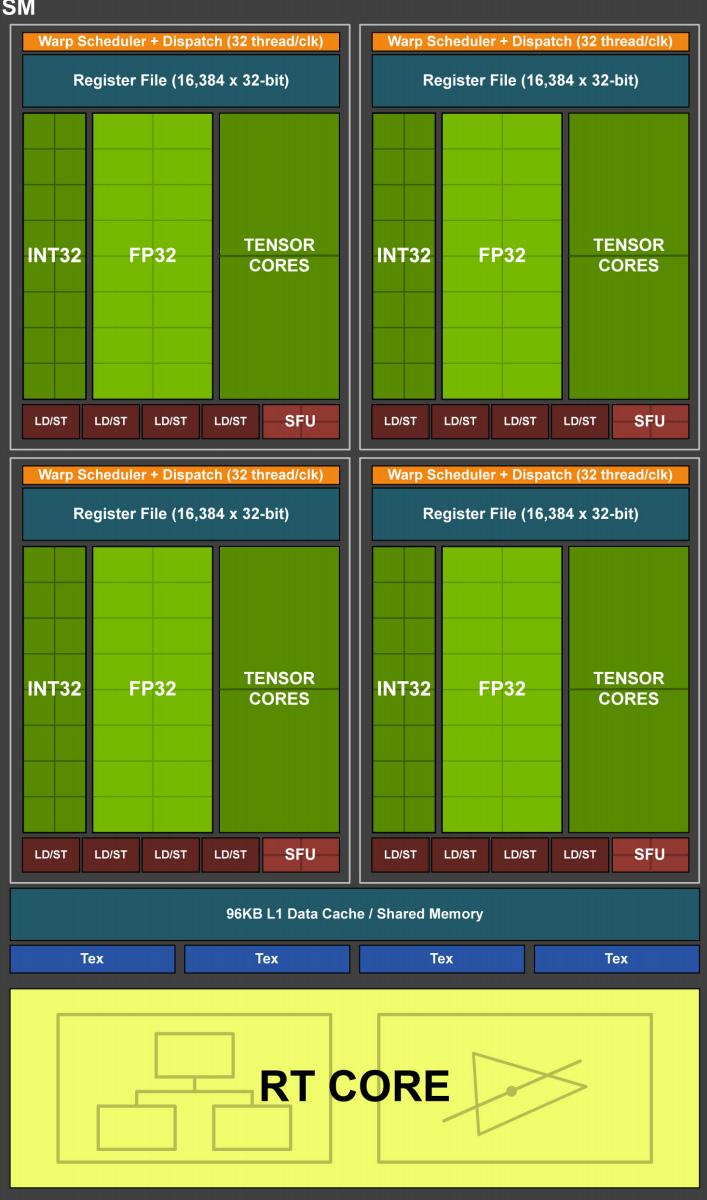
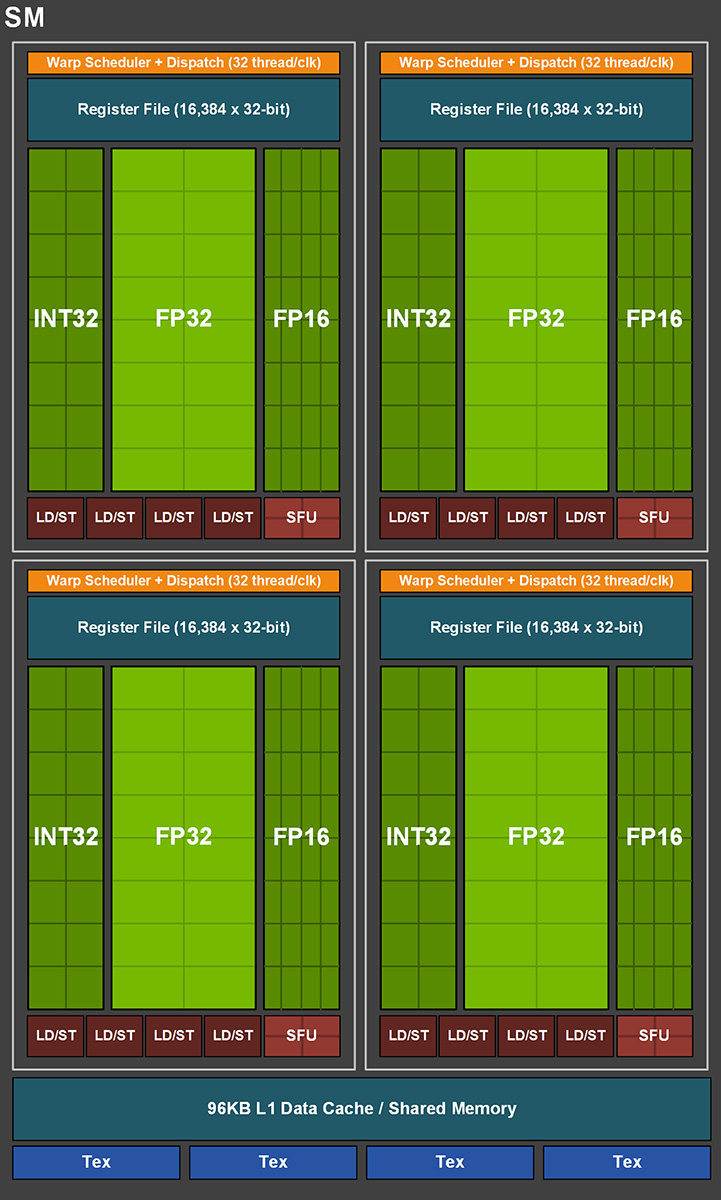
TU102/104/106 SM (left), TU116 SM (right)
This is a consequence of Nvidia deciding that ‘adding dedicated cores to accelerate Ray Tracing and Al doesn't make sense unless you can first achieve a certain level of rendering performance', something it did not deem possible while also aiming the card at the ‘sub-$300 market.'
This has led to a slight revamp of the Turing SM design for TU116, primarily with the addition of the dedicated FP16 cores. Nvidia claims modern games are ‘increasingly using FP16 to create effects that don't require a high level of precision', and where this is handled by the Tensor cores on the RTX cards, there are now dedicated FP16 cores within TU116 which can process at double the rate of FP32 operations.
In total, TU116 sports 24 SMs, each with 64 CUDA cores – giving a total of 1536. It is also worth making clear, if not already, that GTX 1660 Ti still supports other Turing technologies we have already detailed – including variable rate shading and concurrent execution of FP/INT instructions, for example. The major difference between 1660 Ti and the RTX cards is, as mentioned, no support for ray traced games or DLSS.
Other changes to note with the GTX 1660 Ti include the 6GB GDDR6 memory. Where we have previously seen GDDR6 operating at 14 Gbps, with the 1660 Ti this is slightly slower, with a 12 Gbps data rate. Also on the topic of speeds, reference GTX 1660 Ti has a boost clock of 1770 MHz, though this factory overclocked MSI Gaming X model has increased that to 1875 MHz.
Lastly, reference TDP is rated at 120W, the same as GTX 1060. Our MSI Gaming X ups this to 130W thanks to its increased out of the box clock speed.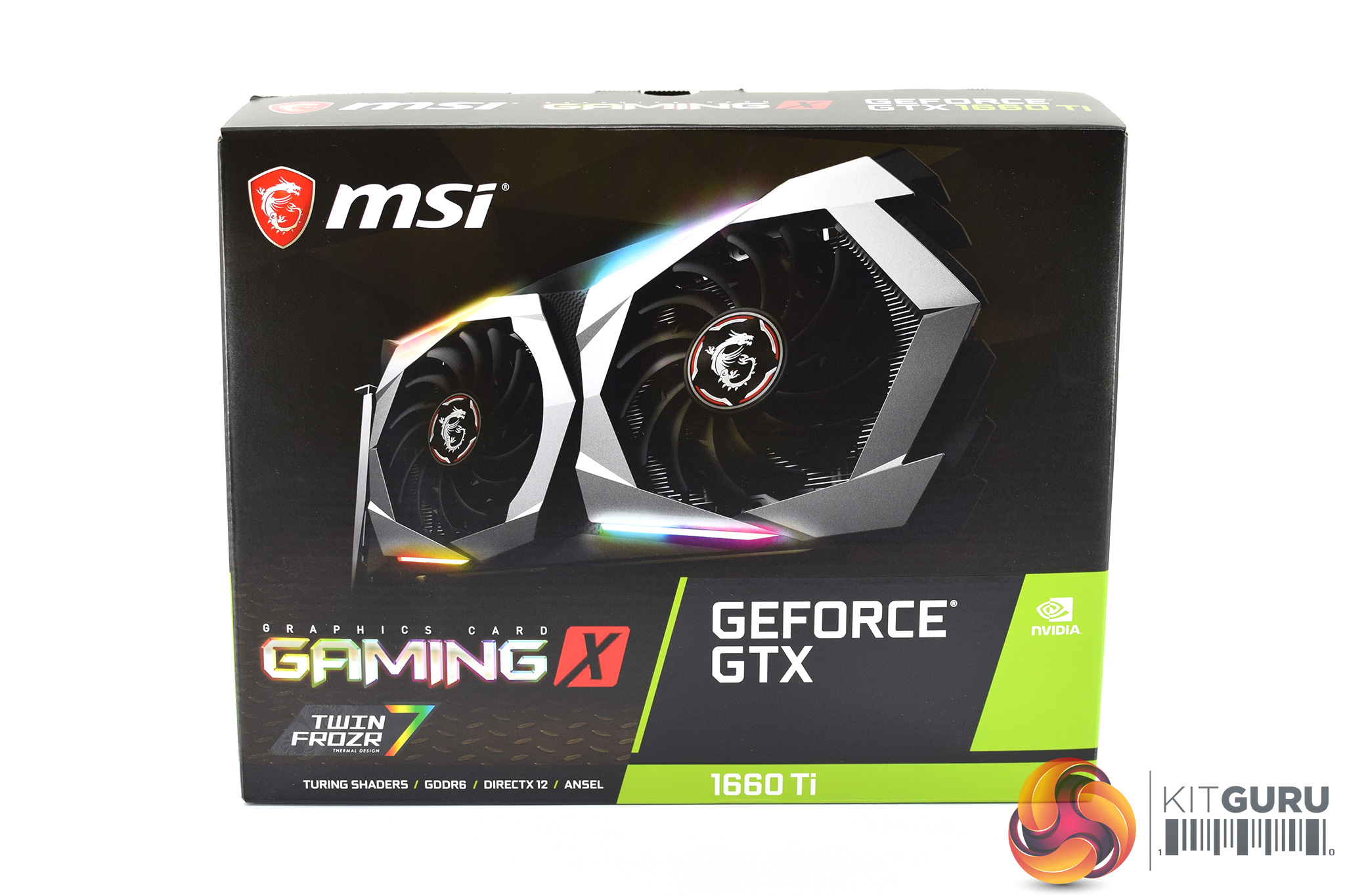
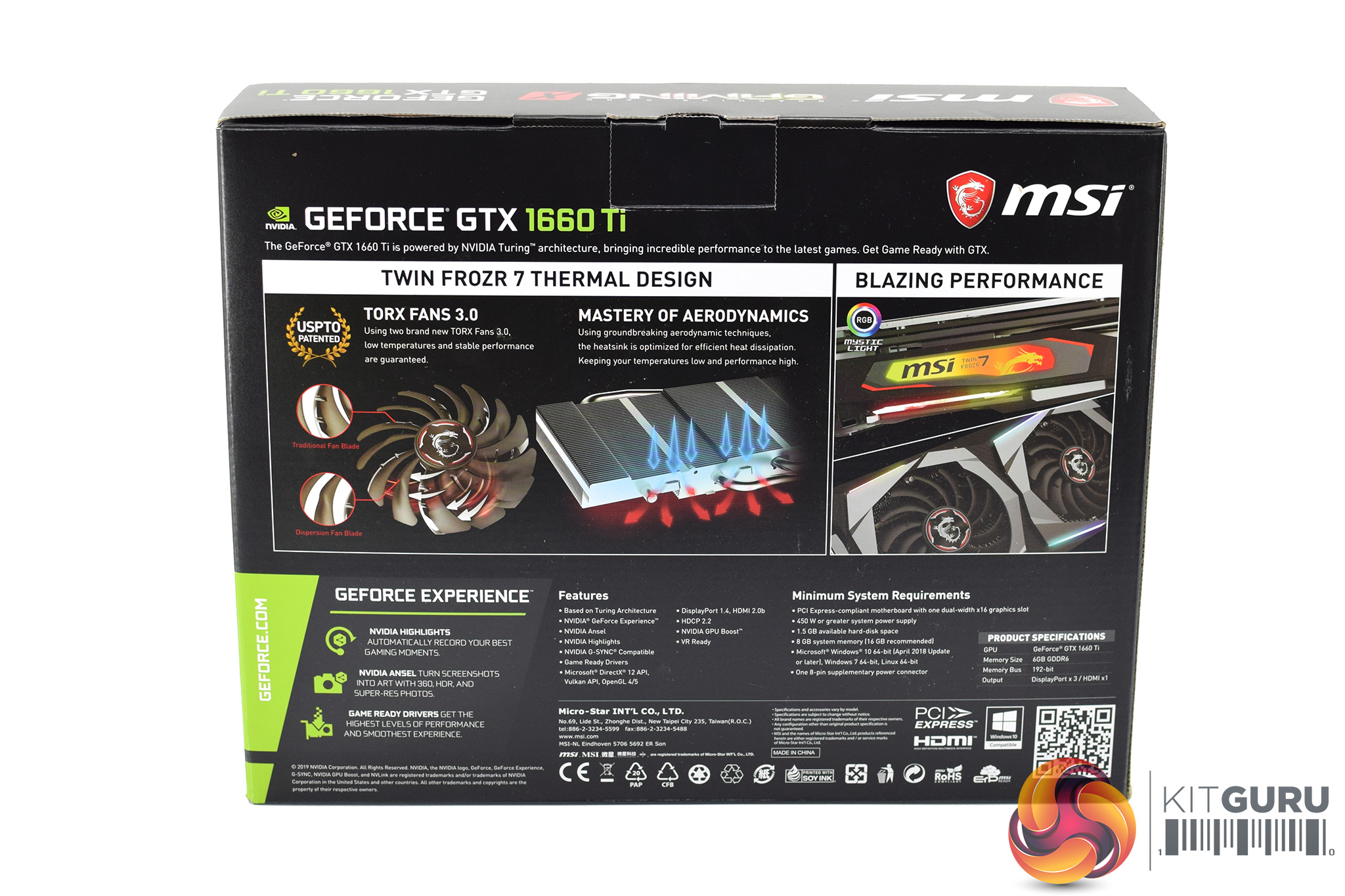
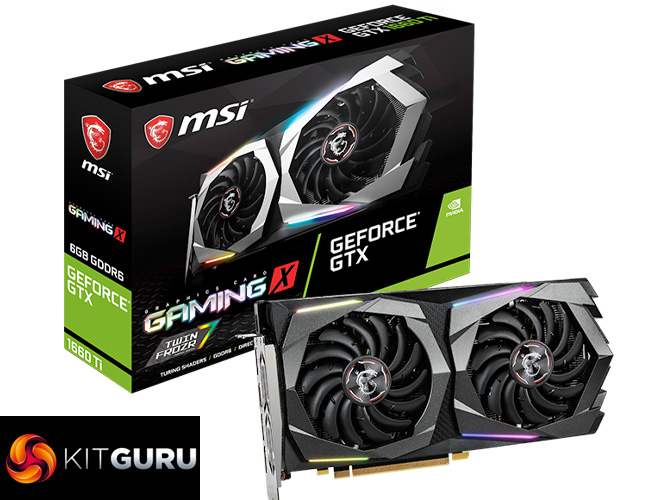
In a very similar fashion to other cards we have seen from MSI, the GTX 1660 Ti Gaming X 6G ships in a dark box, with a large image of the card itself visible on the front.
On the back of the box, MSI highlights key features of the card and the 7th generation Twin Frozr cooler.
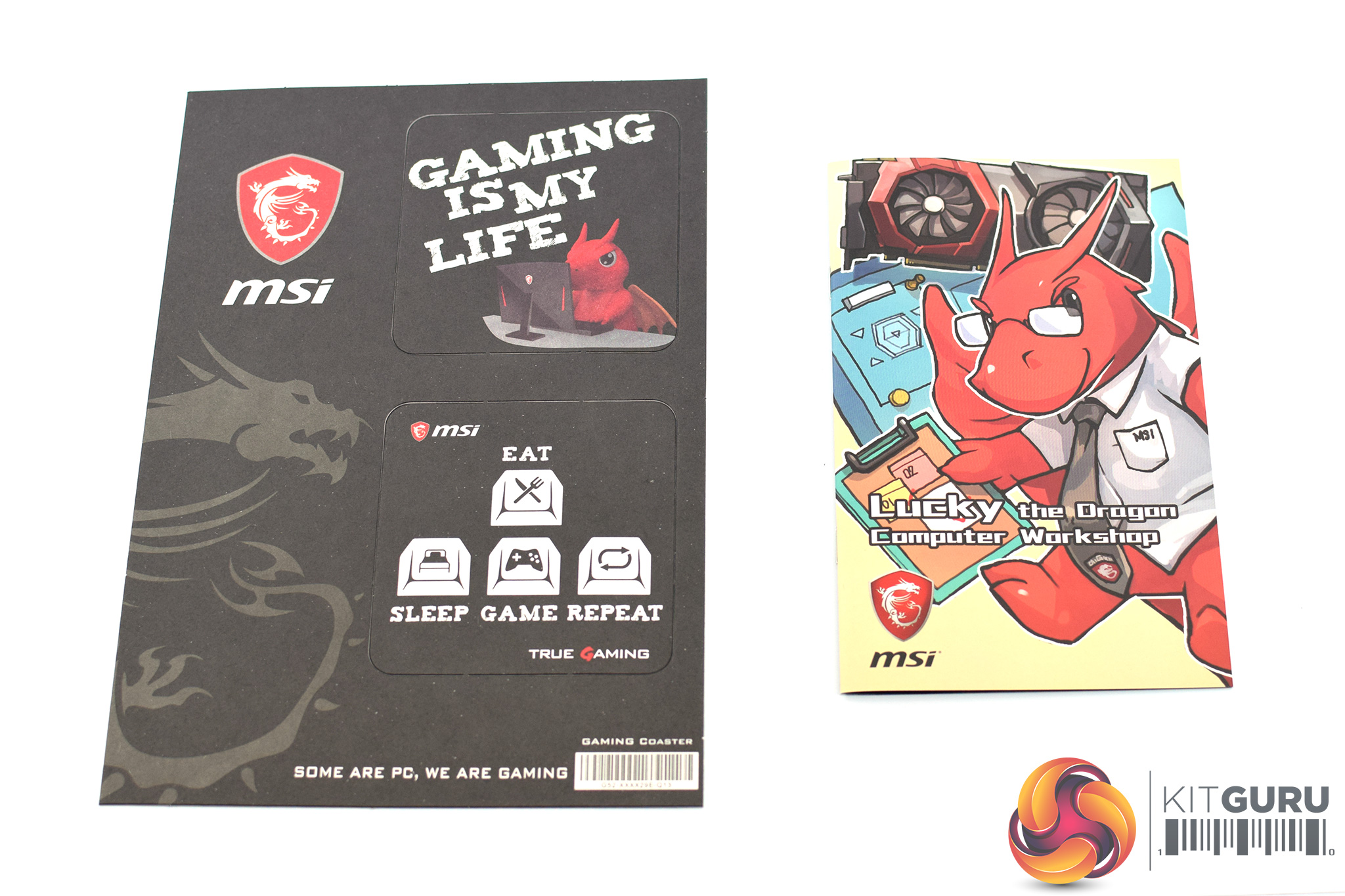
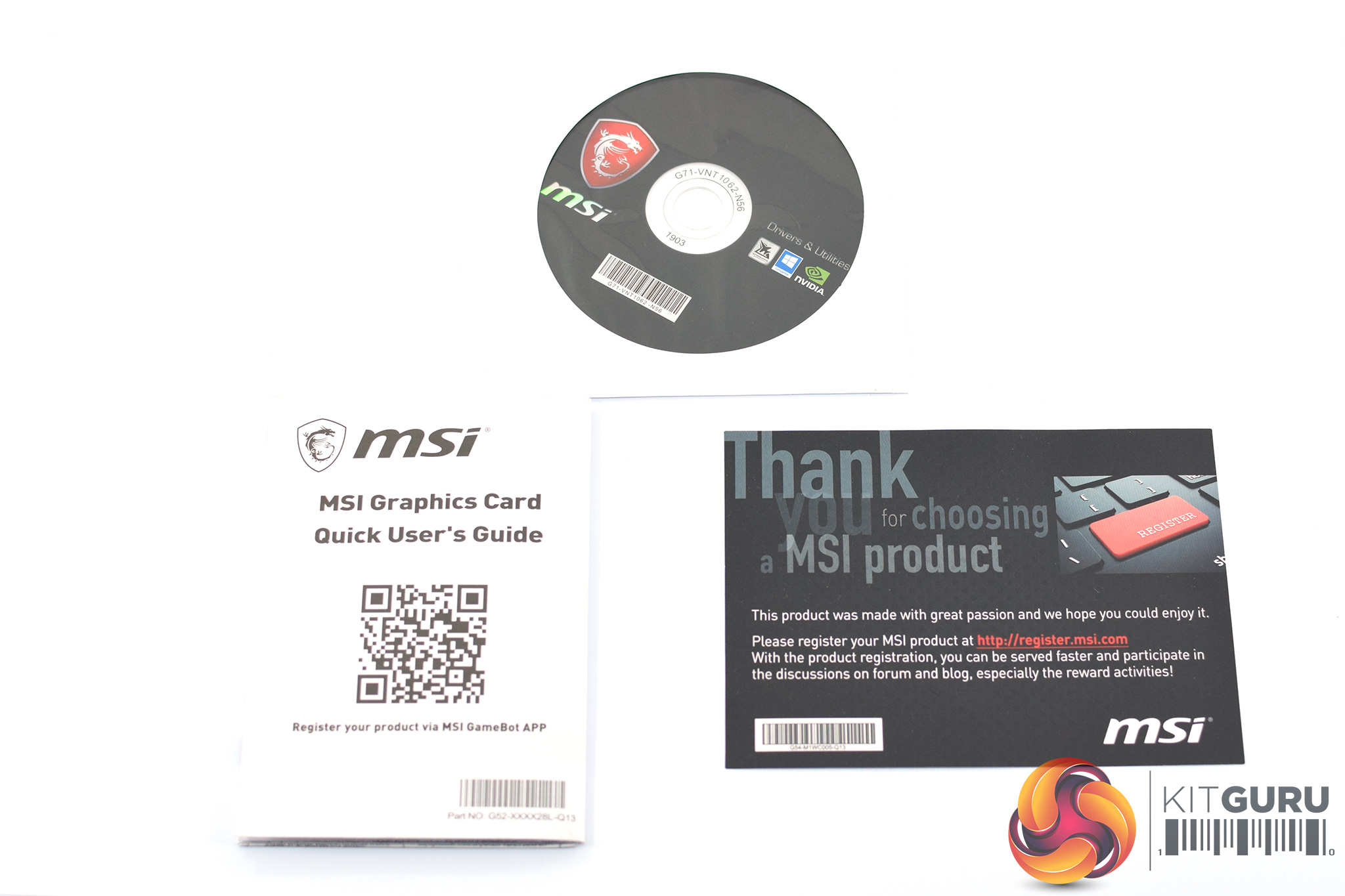
As for the accessory bundle, MSI continues to bundle two coasters and a Lucky the Dragon cartoon with its graphics cards, while we also find a quick start guide, driver disk and ‘thank you' note in the box.
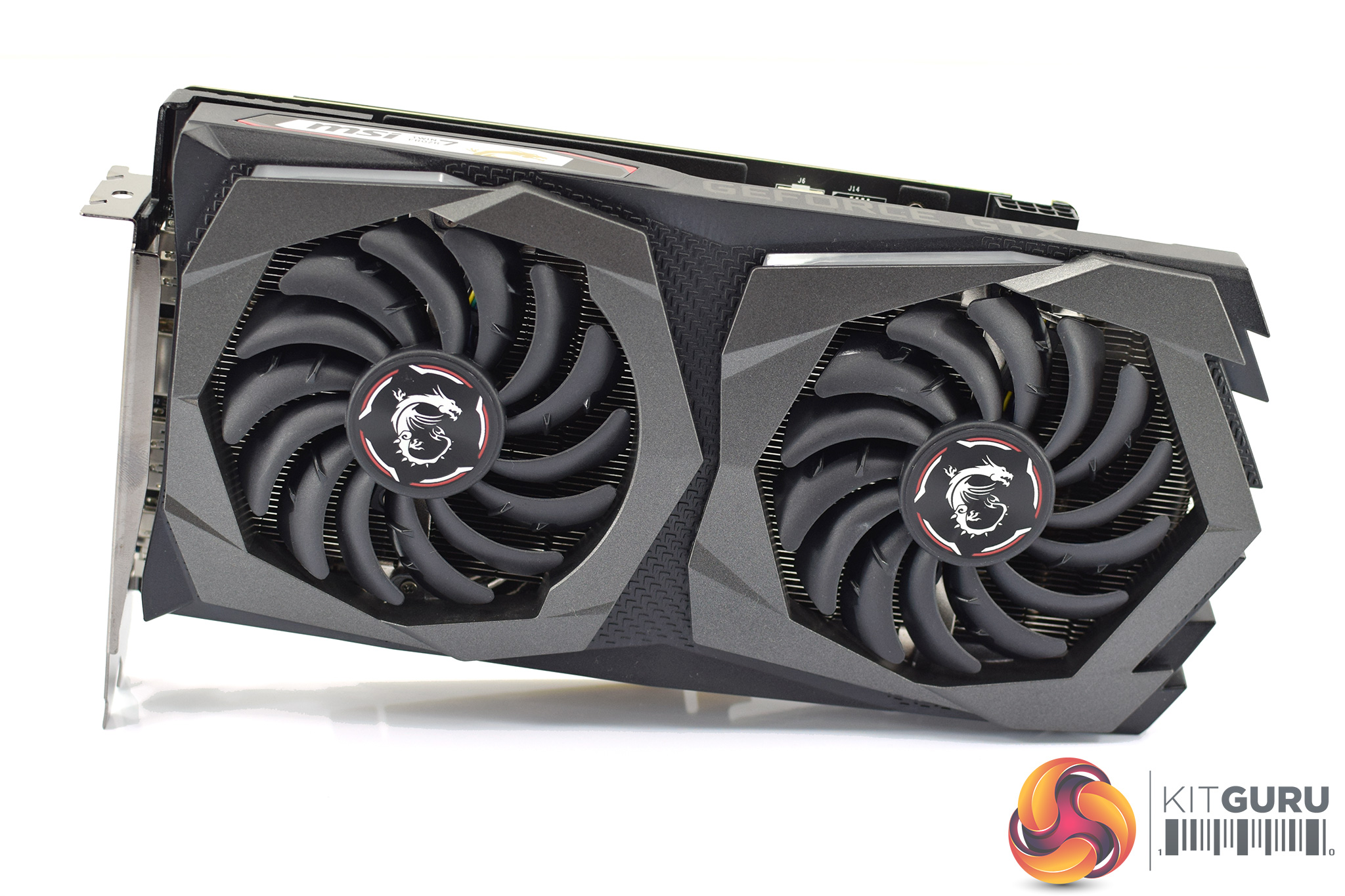
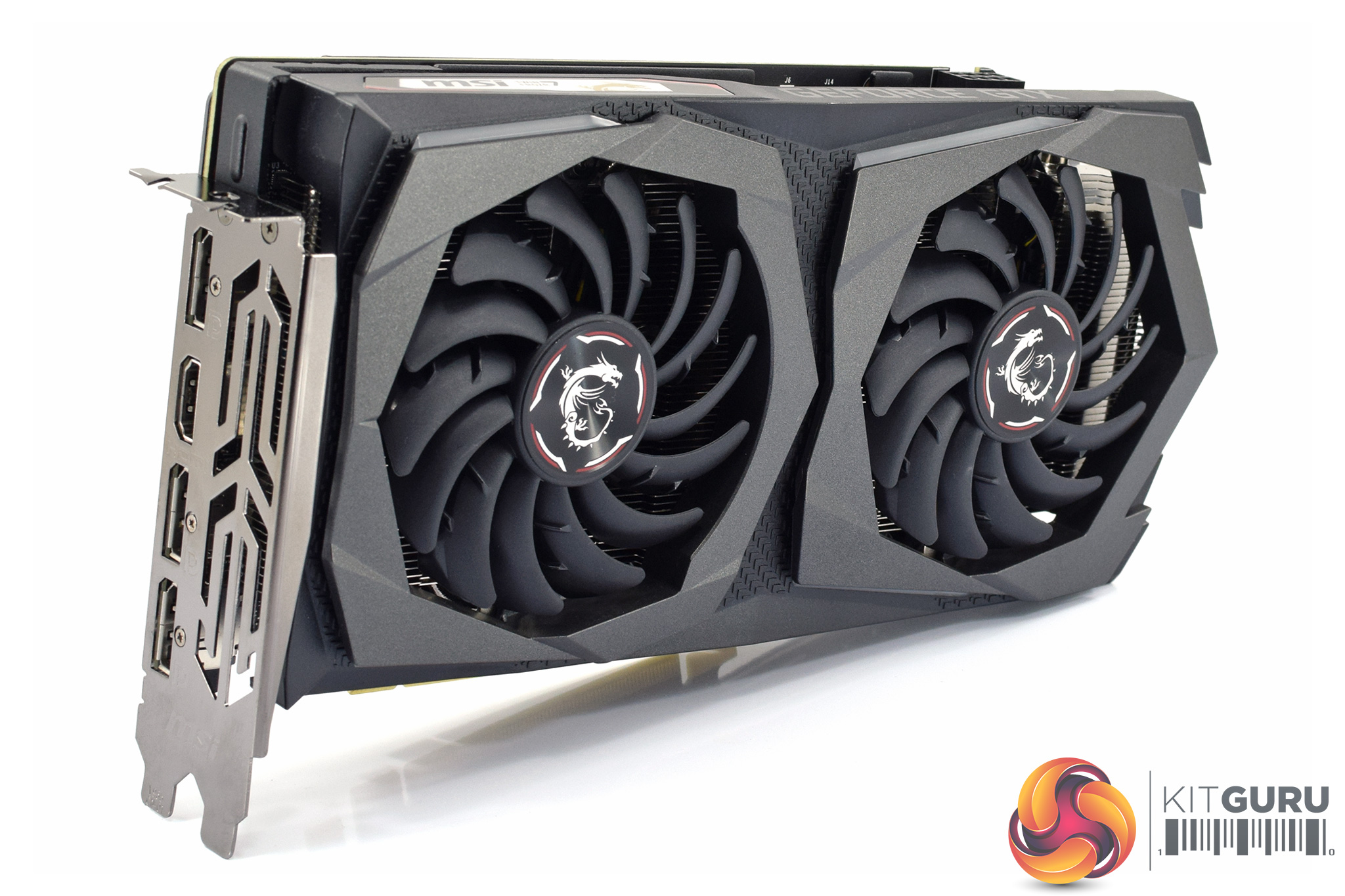
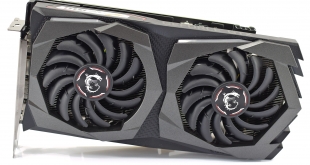
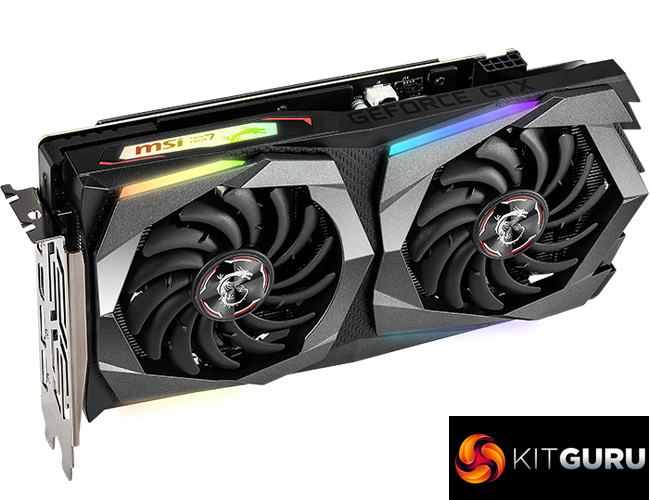
Moving onto the card itself, if you saw our recent review of MSI's RTX 2060 Gaming Z then you will instantly recognise this GTX 1660 Ti Gaming X. That's because the plastic shroud of the card appears to be identical to the RTX 2060 model, with the same black and gunmetal grey colour scheme and the same angular sections around the fans. It's certainly not ugly, and the colour neutral design also means this won't clash in a colour coordinated build.
The two fans are MSI's Torx 3.0 models, the same we have seen on all of MSI's latest cards – including the 2080 Ti Lightning Z. These measure 85mm (blade-to-blade) and have a fan-stop mode where the fans stop spinning during low loads.
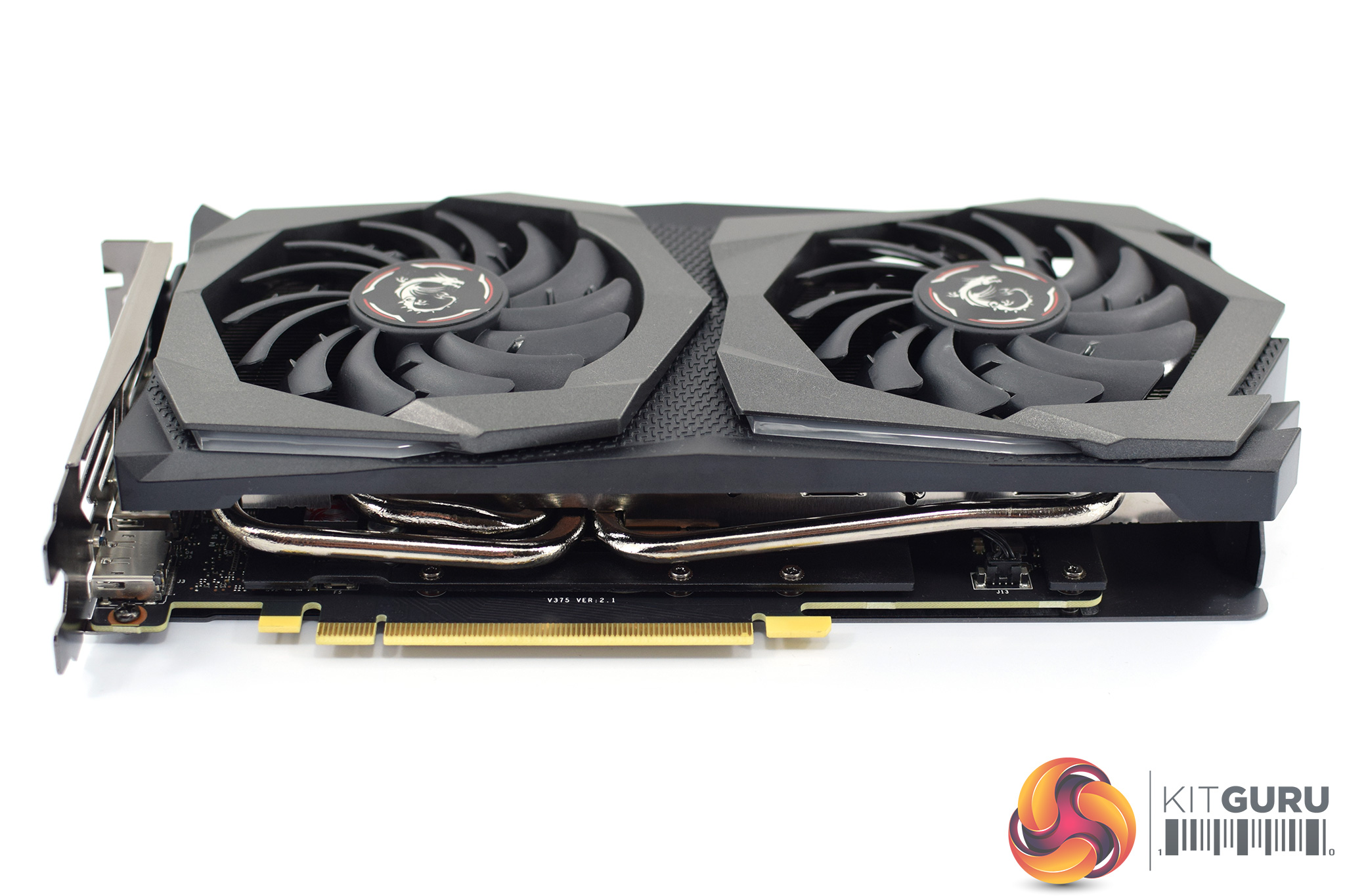
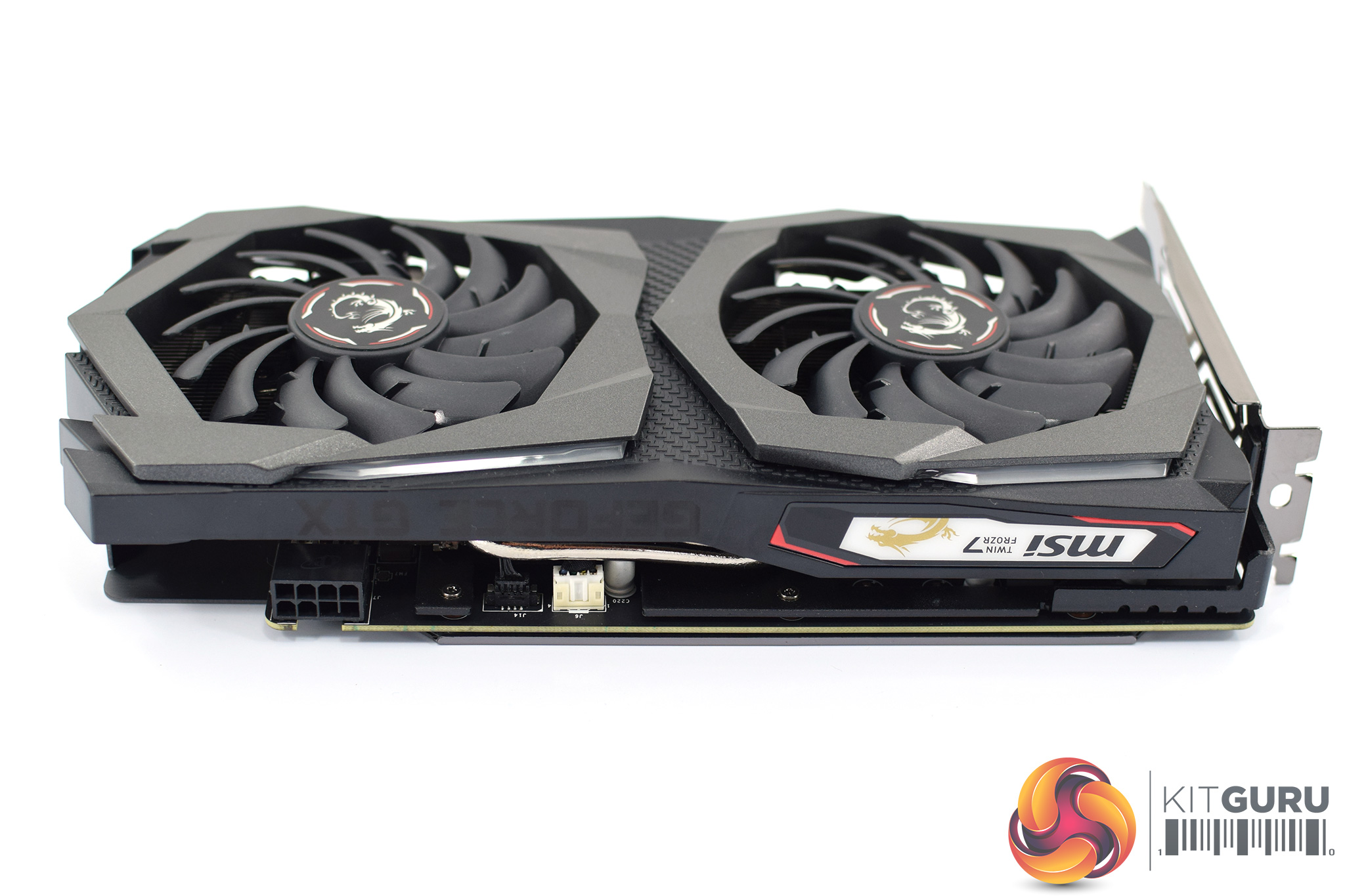
The card is also quite compact, measuring in at 247 x 127 x 46 mm. That means it is only slightly thicker than a standard dual-slot card, while being less than 25cm long makes it smaller than average by 2019 standards.
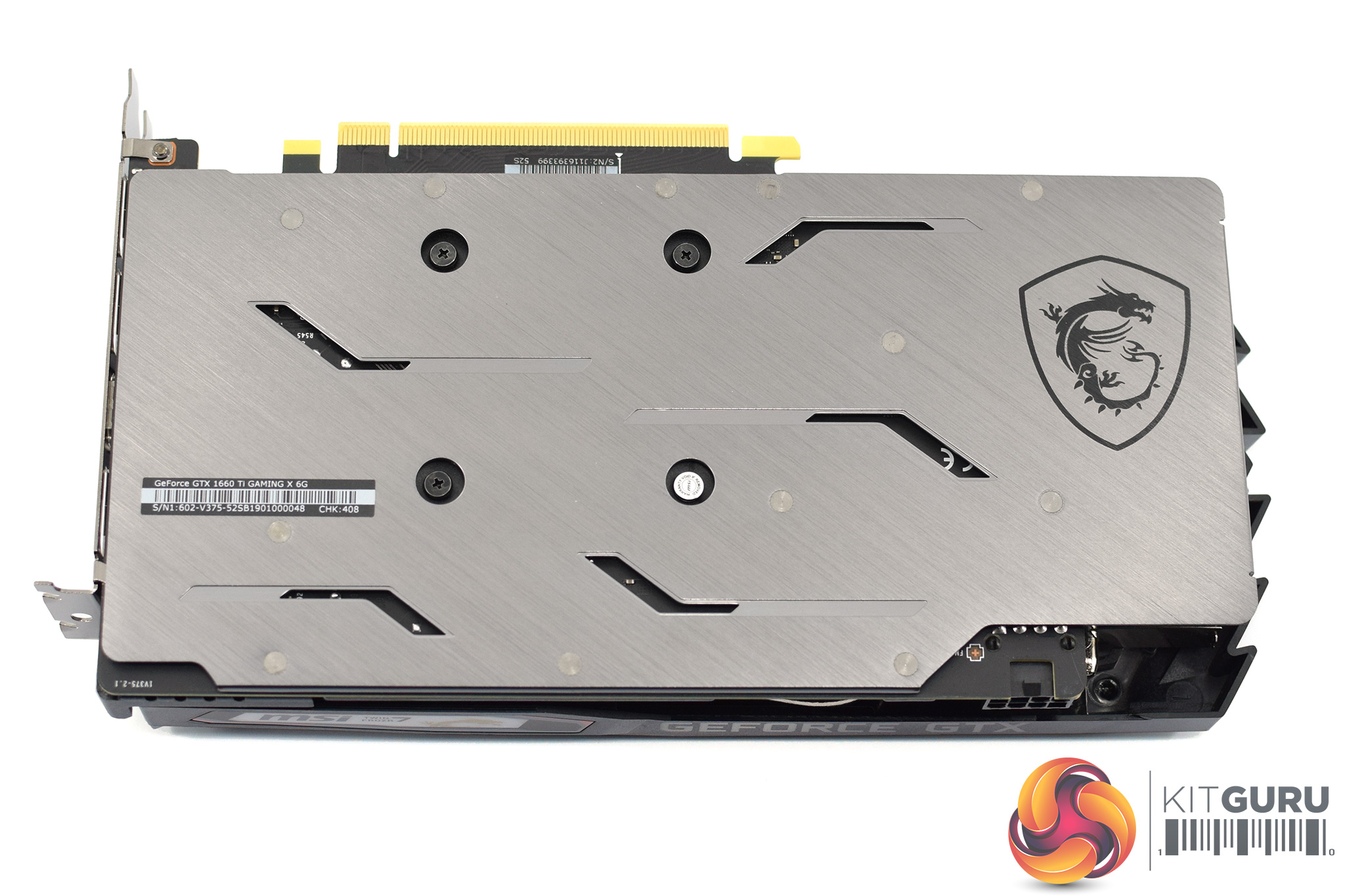
The front side of the card is home to the MSI logo, and this is also one of the RGB zones on the card. The ‘GeForce GTX' branding is also printed on the side of the card's shroud, just to the right of the MSI logo.
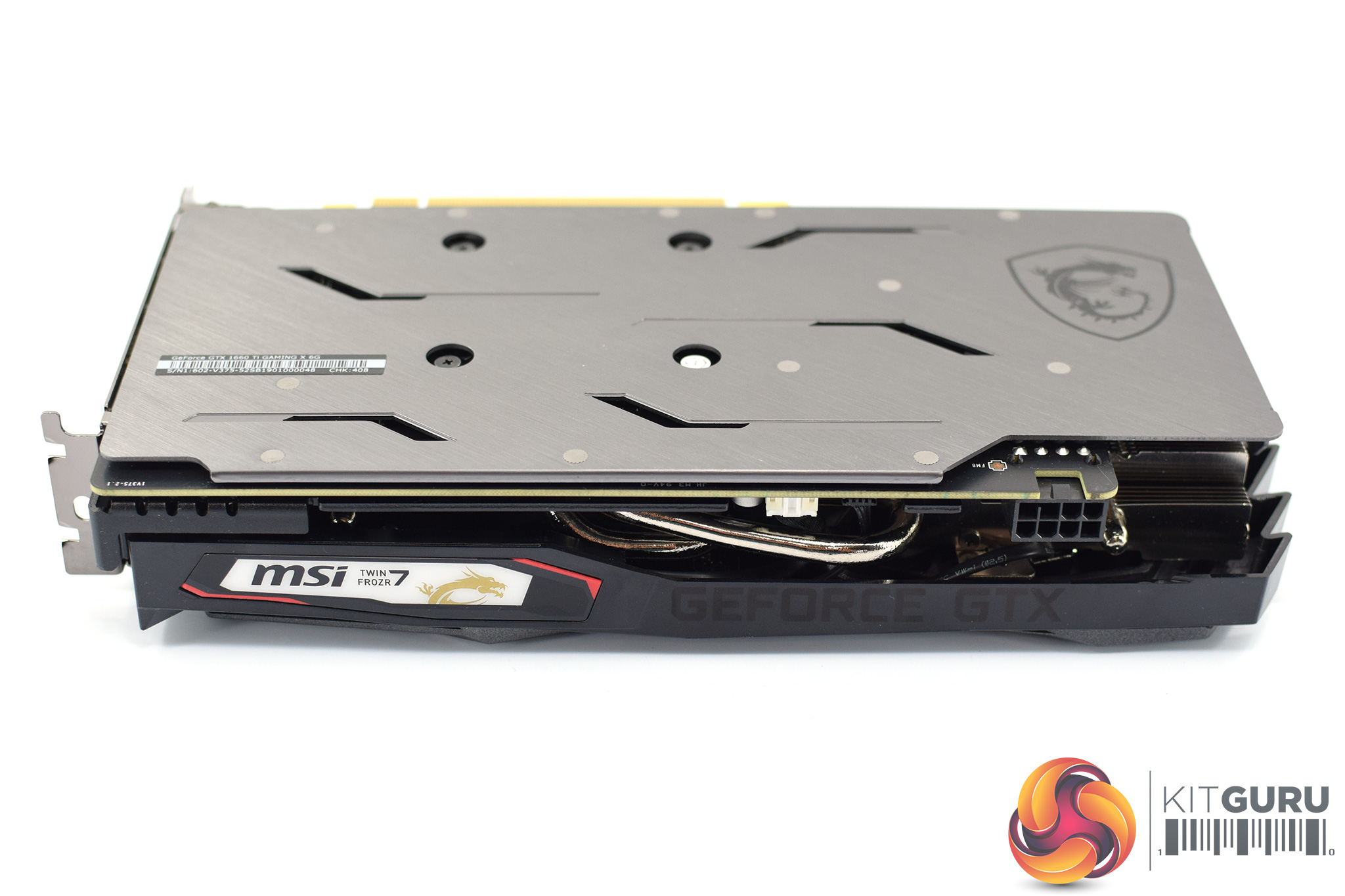
As for the backplate, this carries over the same brushed metal finish we have seen from MSI's other Gaming-series cards. It's a lovely silver look and I think it just looks very classy. There's no RGB on the backplate, with just the MSI logo printed on the right hand side.
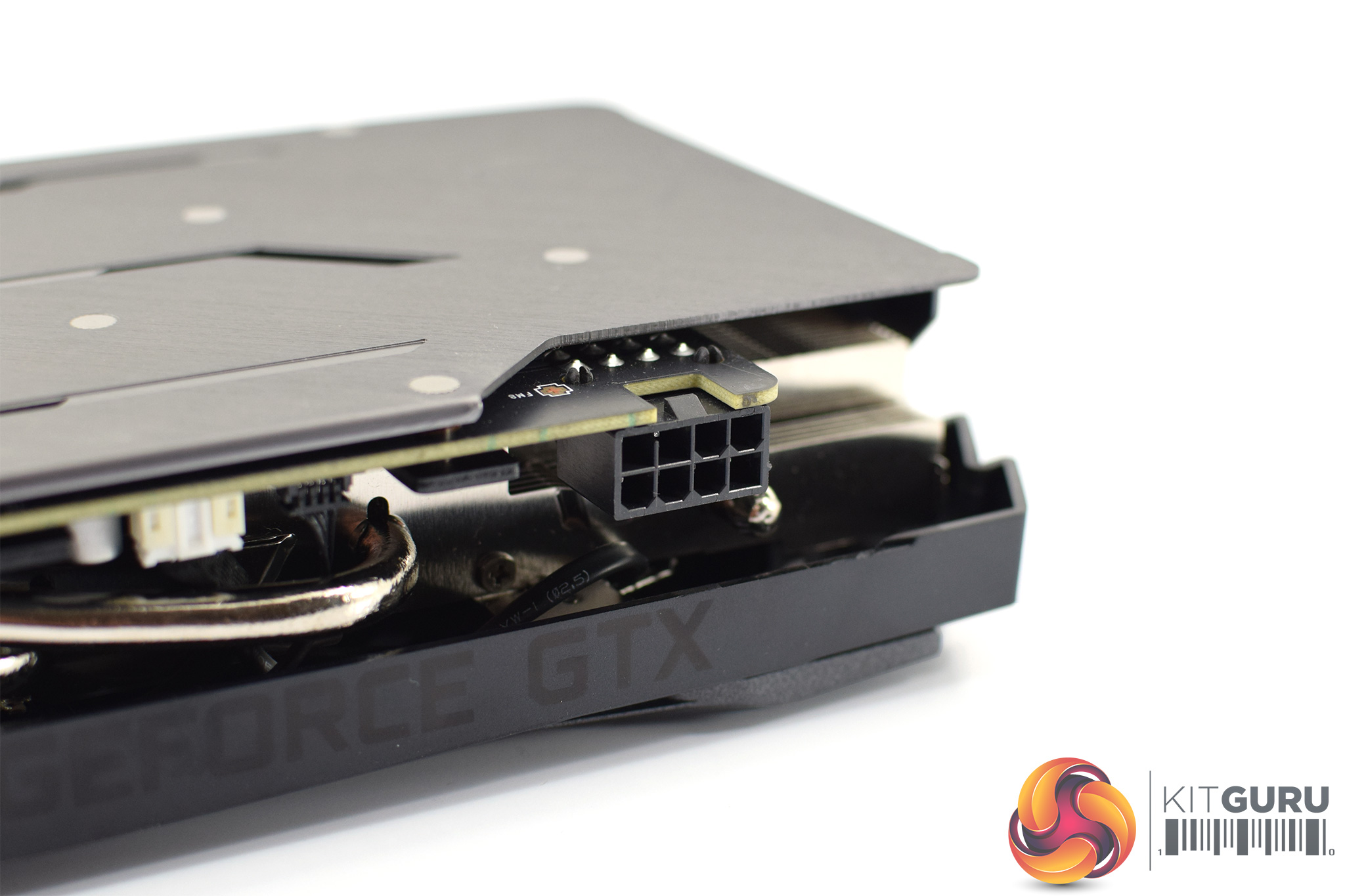
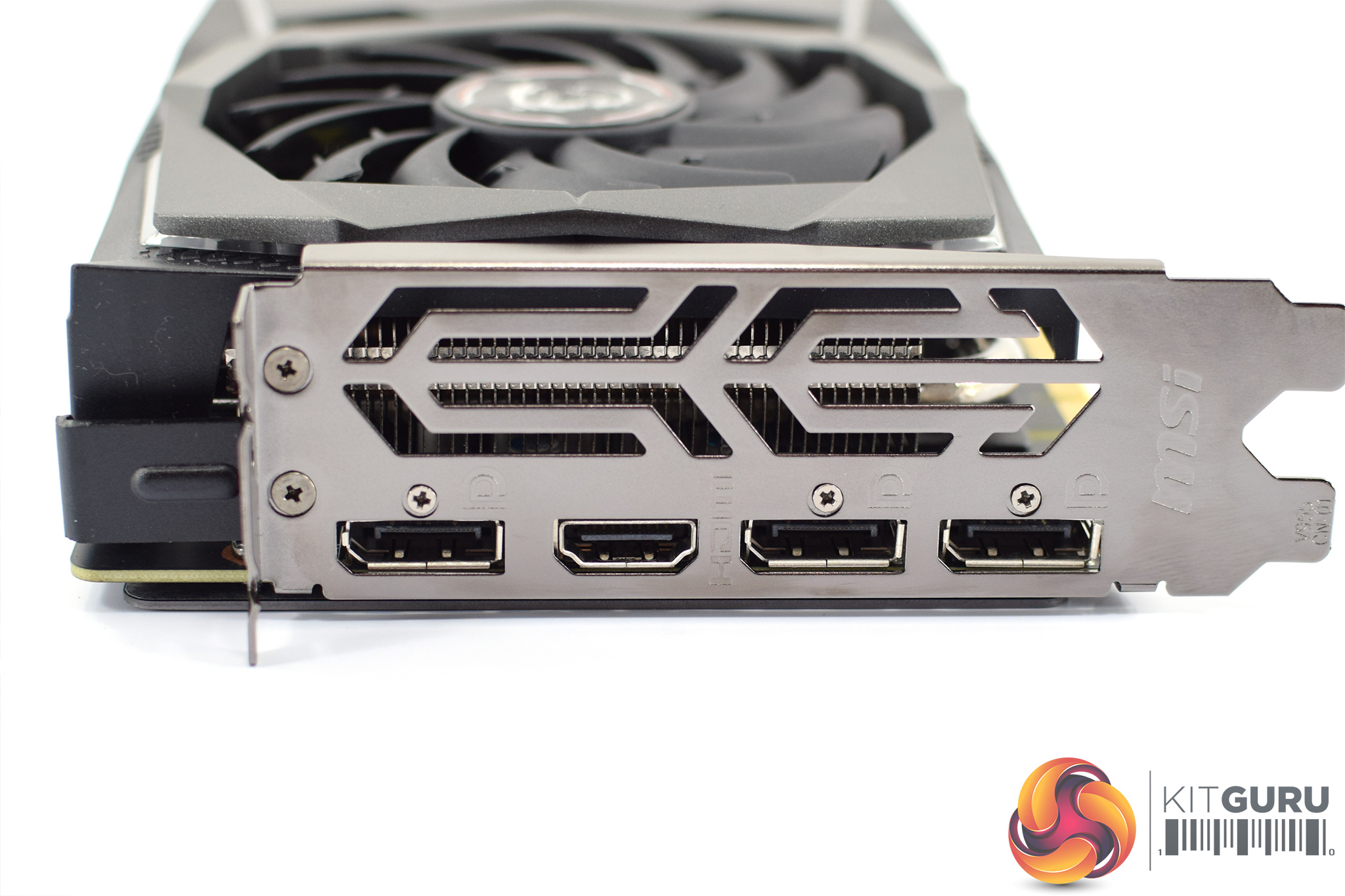
The card only requires a single 8-pin PCIe connector for power, while display outputs are pretty standard with 3x DisplayPort 1.4, and 1x HDMI 2.0b.
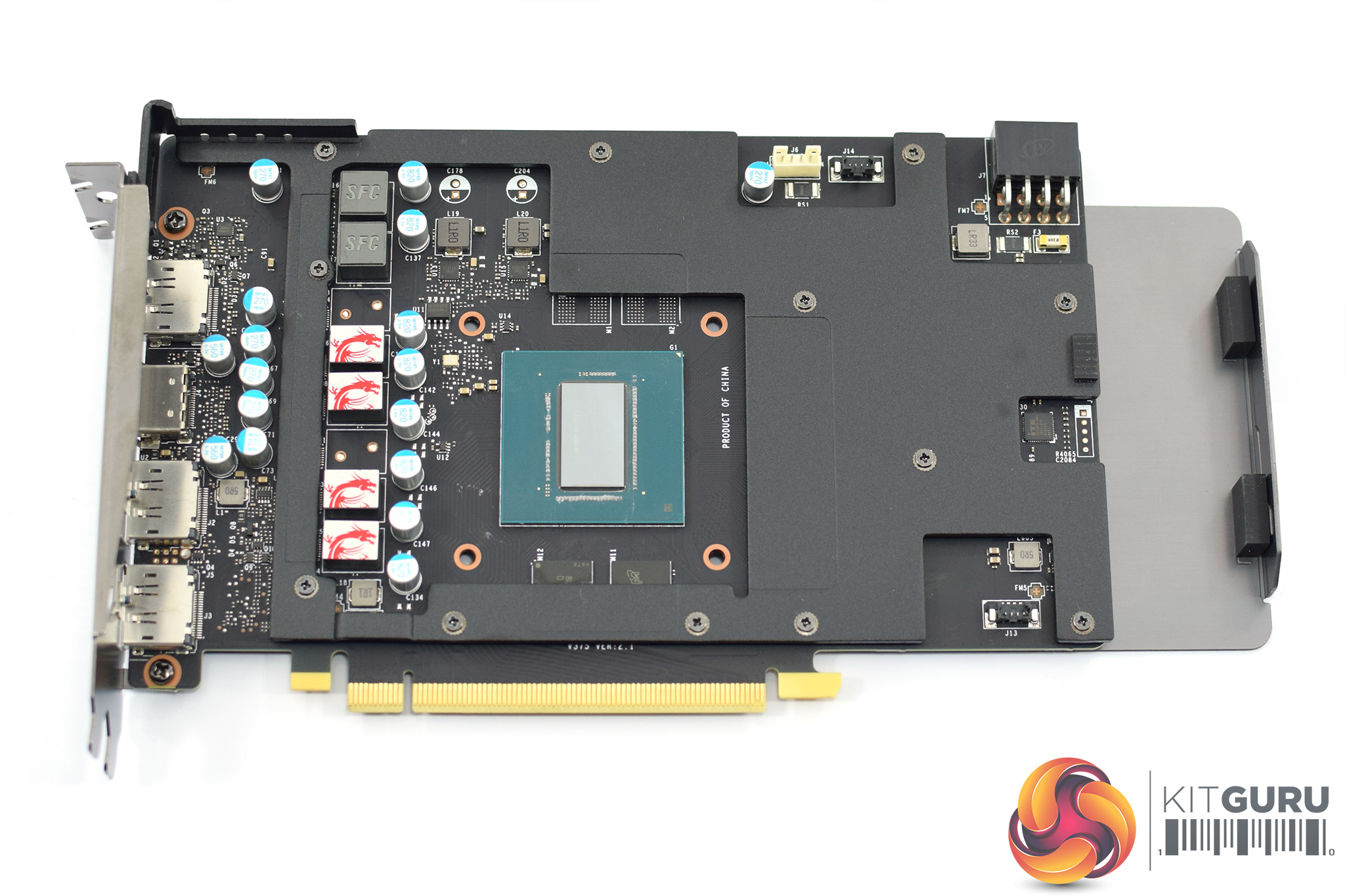

Taking the card apart is very easy – it's just four screws that need to be removed from the backplate. After that, the heatsink will come free and we get a look at the PCB. It is mostly covered by a die-cast metal frame that acts as a heatsink for the VRAM chips and the VRM, while also providing some structural rigidity to the card as a whole.
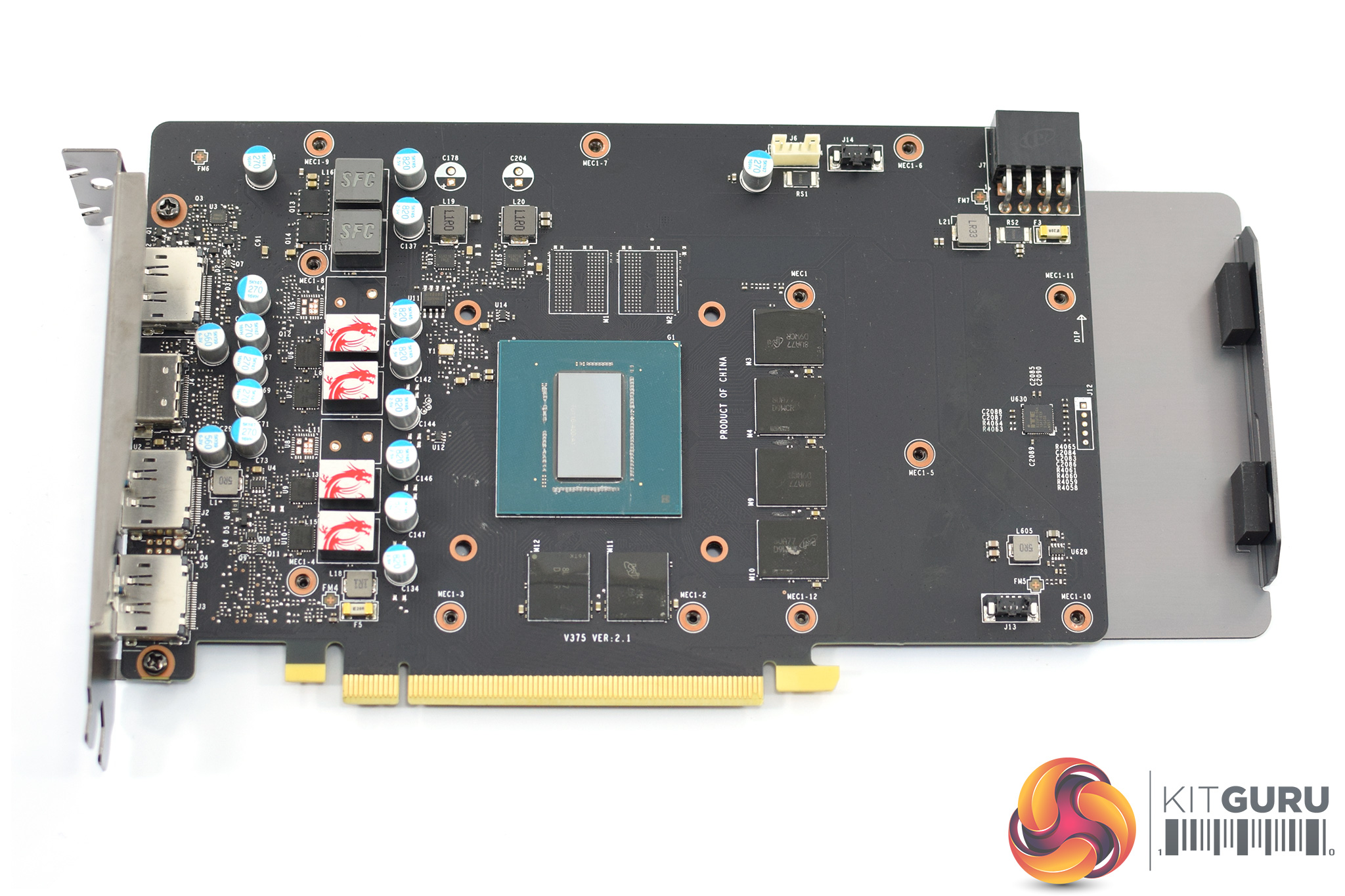
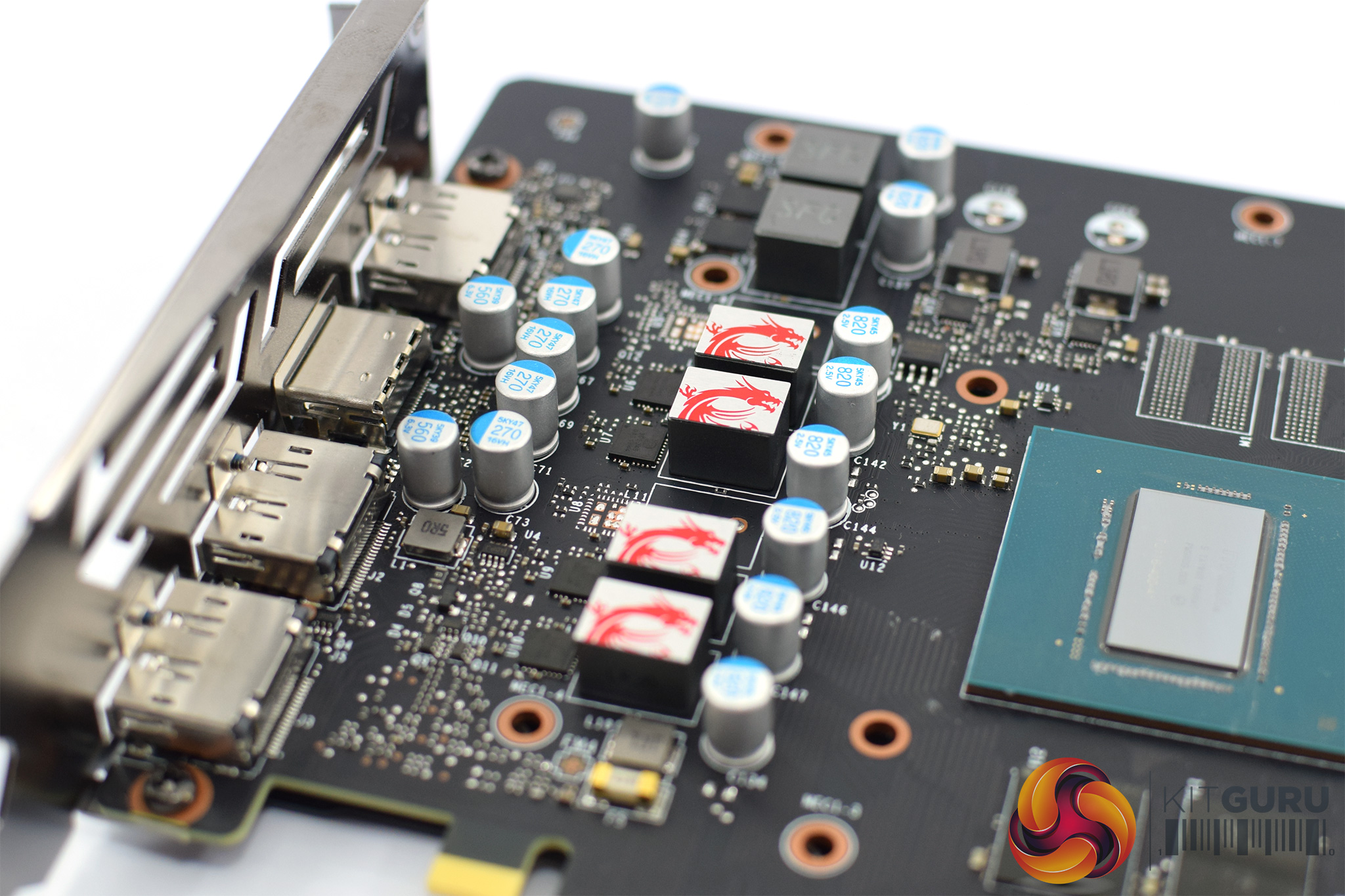
Once that is removed, we get a look at the bare PCB. Bear in mind that there is no Founders Edition GTX 1660 Ti so we don't have a point of comparison with a reference design, but MSI has used 4+2 phases for the power delivery and I would guess that will be pretty standard for GTX 1660 Ti cards – but we will have to see.
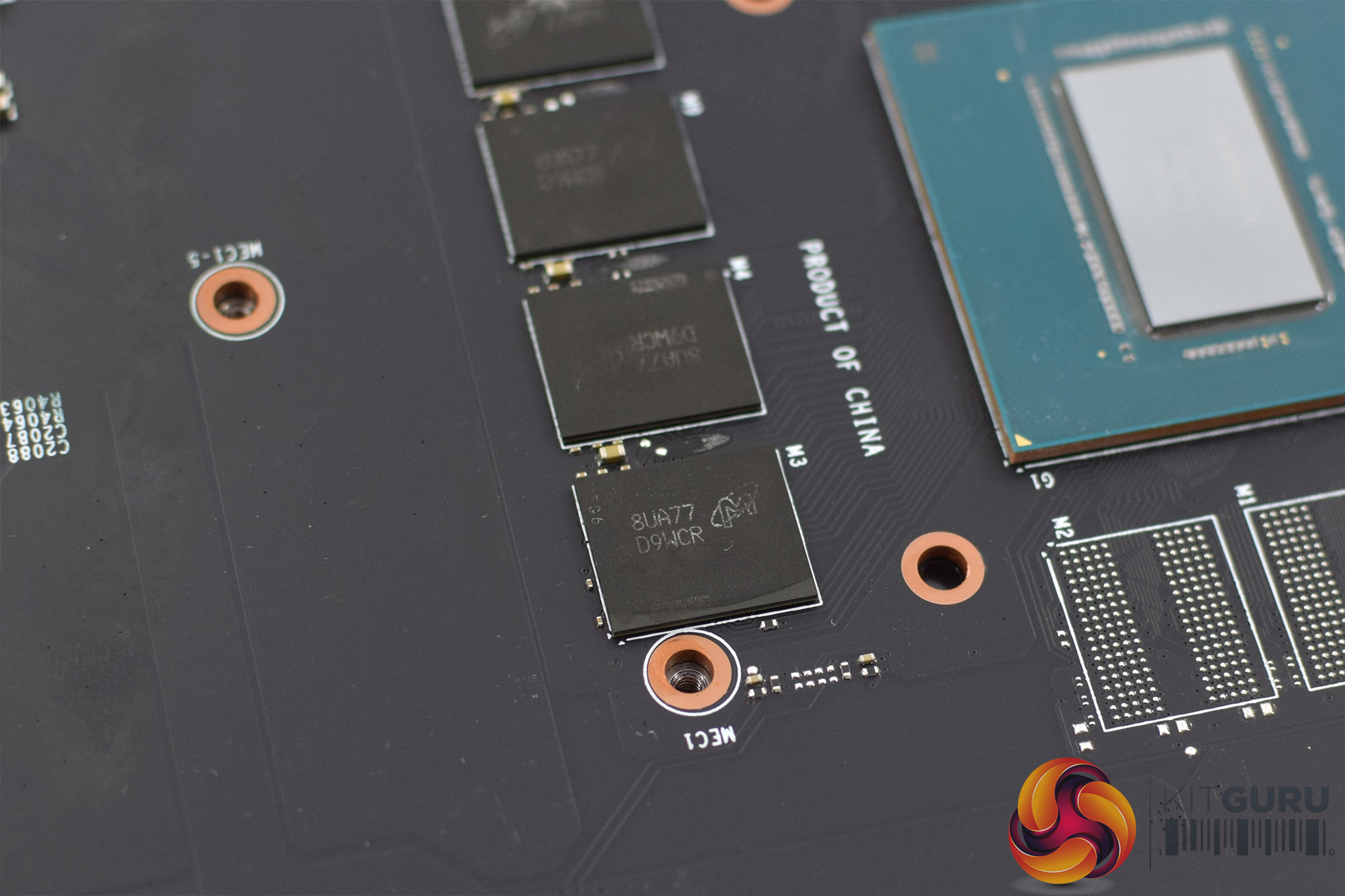
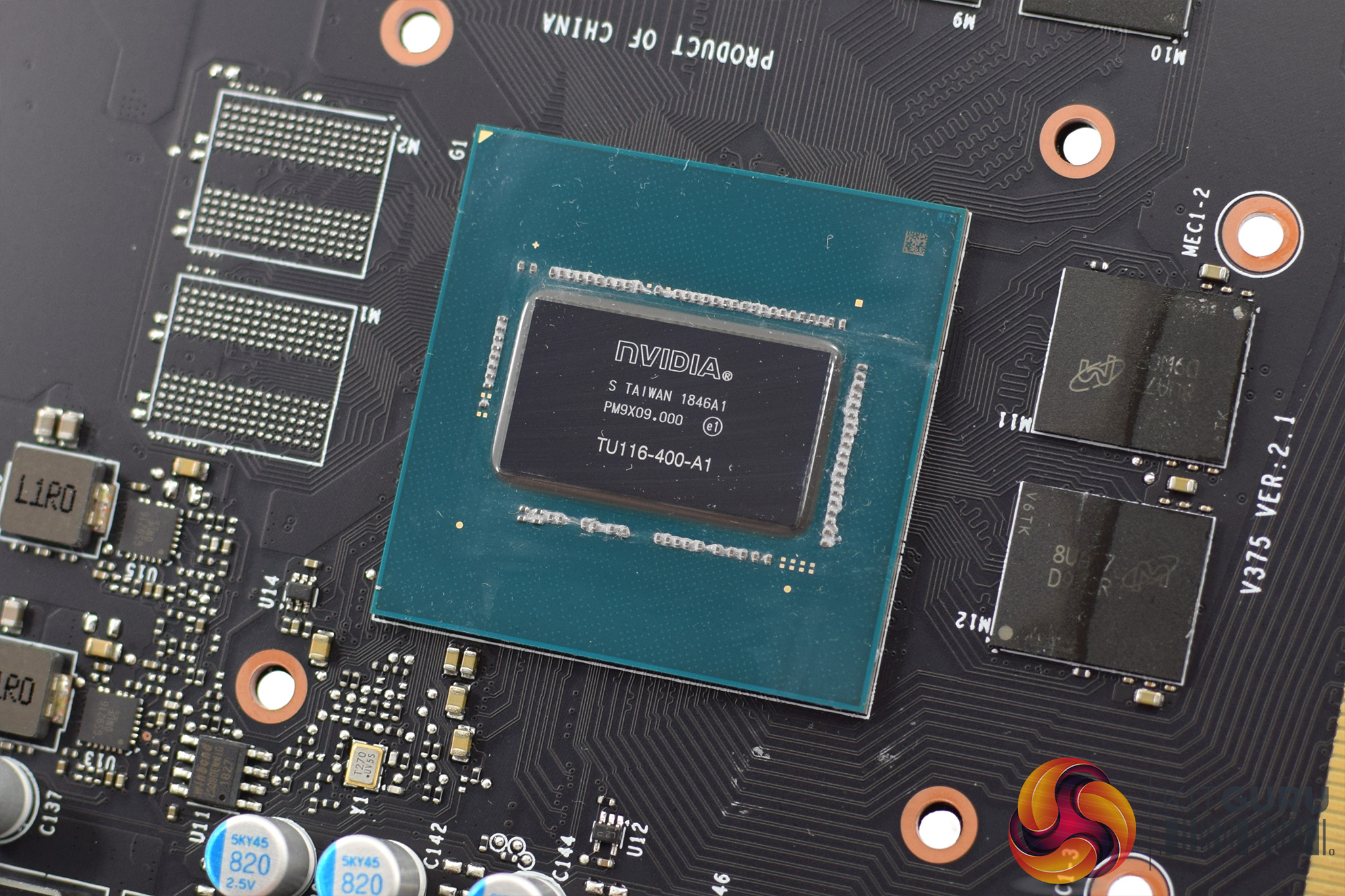
Elsewhere, the GDDR6 memory comes from Micron, labelled ‘8UA77D9WCR'. The new TU116 GPU is also visible, with the die measuring 284 mm². Interestingly, Nvidia has said there are no ‘A' and ‘non-A' versions of TU116 – meaning there are no restrictions on what GPUs can be sold with a factory overclock. It will be interesting to see if this has any affect on the overclocking capabilities of other cards we get for review.
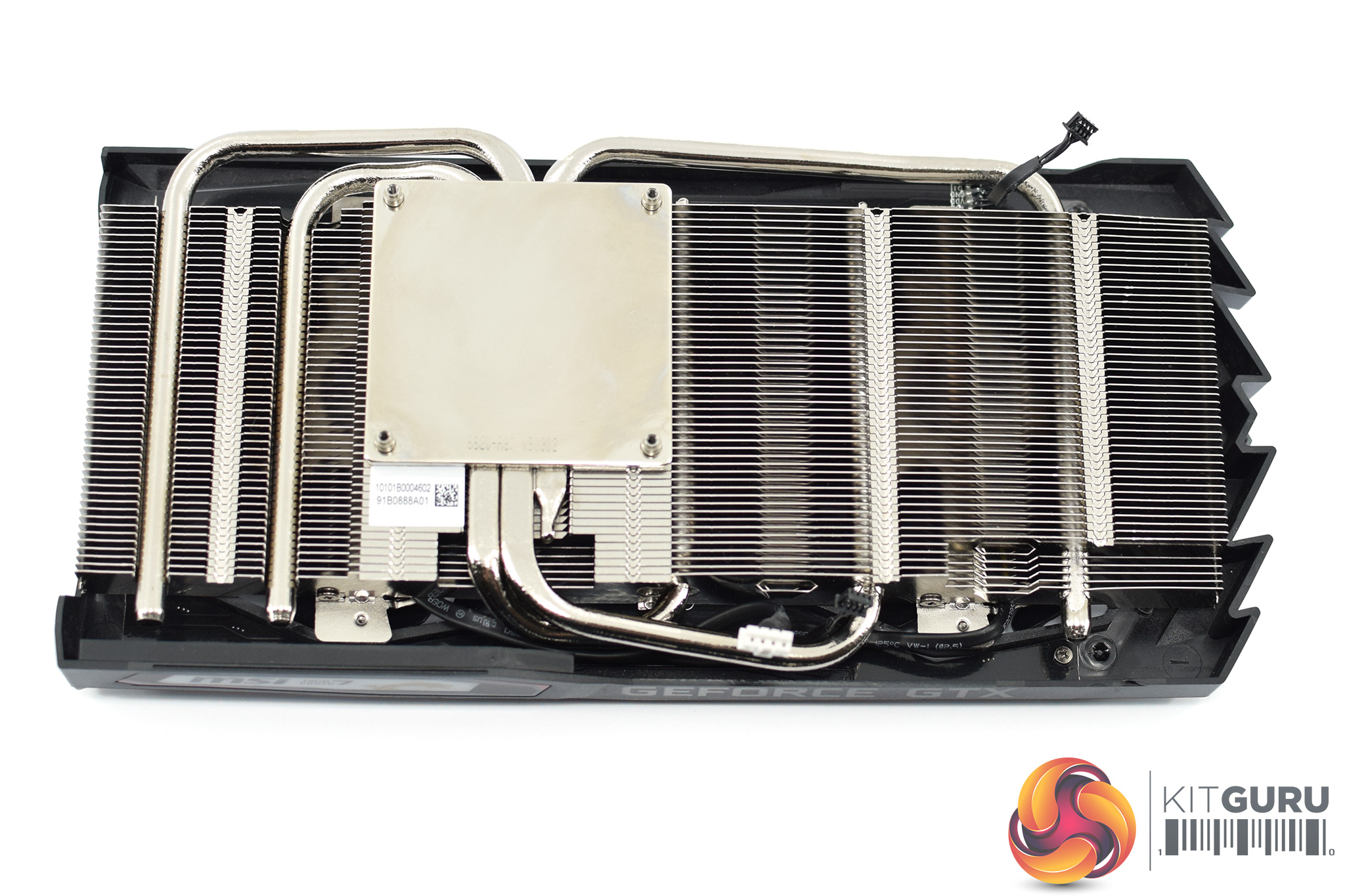
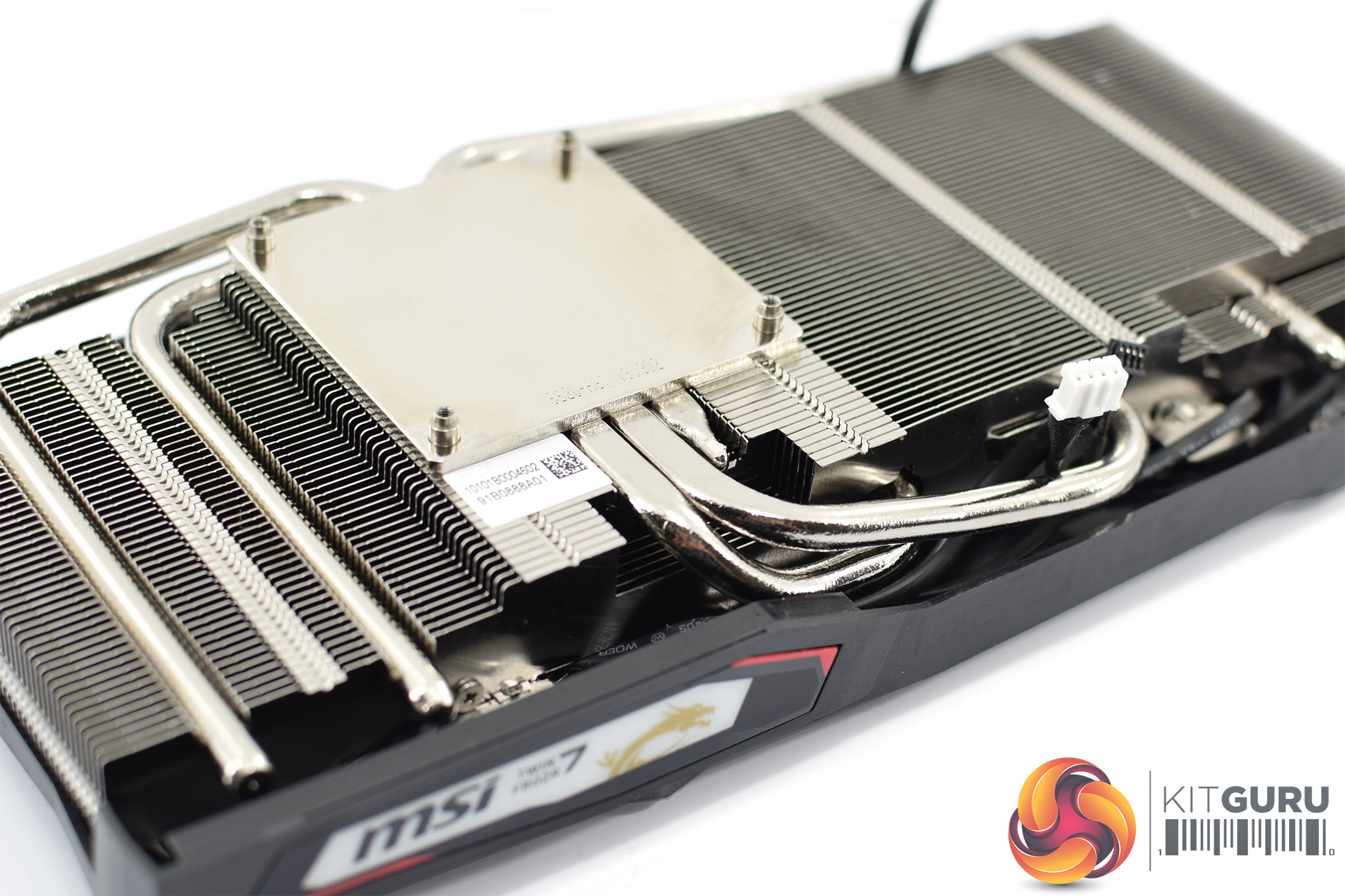
Lastly, the heatsink is a compact unit with a single aluminium fin stack. It uses three nickel-plated copper heatpipes, each measuring 6mm – so it's clearly not a high-end cooling solution. That being said, this 1660 Ti only has a 130W TDP anyway, so the cooler doesn't need to be that sophisticated. In any case, we will reserve judgement until we get to temperature testing later in the review.
Our newest GPU test procedure has been built with the intention of benchmarking high-end graphics cards. We test at 1920×1080 (1080p), 2560×1440 (1440p), and 3840×2160 (4K UHD) resolutions.
We try to test using the DX12 API if titles offer support. This gives us an interpretation into the graphics card performance hierarchy in the present time and the near future, when DX12 becomes more prevalent. After all, graphics cards of this expense may stay in a gamer’s system for a number of product generations/years before being upgraded.
We tested the RX Vega64 and Vega56 using the ‘Turbo‘ power mode in AMD’s WattMan software. This prioritises all-out performance over power efficiency, noise output, and lower thermals.
MSI's GTX 1660 Ti increases the boost clock from 1770MHz (reference speed) to 1875MHz.
Driver Notes
- All AMD graphics cards (except Radeon VII) were benchmarked with the Adrenalin 19.1.1 driver.
- Radeon VII was benchmarked with a pre-released press driver supplied by AMD.
- All Nvidia graphics cards (except GTX 1660 Ti) were benchmarked with the Nvidia 417.71 driver.
- GTX 1660 Ti was benchmarked with the Nvidia 418.91 driver supplied to press.
Test System
We test using the Overclockers UK Germanium pre-built system, though it has been re-housed into an open-air test bench. You can read more about it over HERE.
| CPU |
Intel Core i7-8700K
Overclocked to 4.8GHz |
| Motherboard |
ASUS ROG Strix Z370-F Gaming
|
| Memory |
Team Group Dark Hawk RGB
16GB (2x8GB) @ 3200MHz 16-18-18-38 |
| Graphics Card |
Varies
|
| System Drive |
Patriot Wildfire 240GB
|
| Games Drive | Crucial M4 512GB |
| Chassis | Streacom ST-BC1 Bench |
| CPU Cooler |
OCUK TechLabs 240mm AIO
|
| Power Supply |
SuperFlower Leadex II 850W 80Plus Gold
|
| Operating System |
Windows 10 Professional
|
Comparison Graphics Cards List
- MSI RTX 2080 Ti Lightning Z 11GB
- Nvidia RTX 2080 Ti Founders Edition (FE) 11GB
- Nvidia RTX 2080 Founders Edition (FE) 8GB
- Gigabyte Aorus RTX 2070 Xtreme 8GB
- Nvidia RTX 2060 Founders Edition (FE) 6GB
- Nvidia GTX 1080 Ti Founders Edition (FE) 11GB
- Gigabyte GTX 1080 G1 Gaming 8GB
- Palit GTX 1070 Ti Super JetStream 8GB
- Nvidia GTX 1070 Founders Edition (FE) 8GB
- Nvidia GTX 1060 Founders Edition (FE) 6GB
- AMD Radeon VII 16GB
- AMD RX Vega 64 Air 8GB
- AMD RX Vega 56 8GB
- ASRock RX 590 Phantom Gaming X OC 8GB
- Sapphire RX 580 Pulse 8GB
- ASUS RX 570 ROG Strix Gaming OC 4GB
Software and Games List
- 3DMark Fire Strike & Fire Strike Ultra (DX11 Synthetic)
- 3DMark Time Spy (DX12 Synthetic)
- Battlefield V (DX12)
- Deus Ex: Mankind Divided (DX12)
- Far Cry 5 (DX11)
- Tom Clancy’s Ghost Recon: Wildlands (DX11)
- Middle Earth: Shadow of War (DX11)
- Shadow of the Tomb Raider (DX12)
We run each benchmark/game three times, and present averages in our graphs.
3DMark Fire Strike is a showcase DirectX 11 benchmark designed for today’s high-performance gaming PCs. It is our [FutureMark’s] most ambitious and technical benchmark ever, featuring real-time graphics rendered with detail and complexity far beyond what is found in other benchmarks and games today.
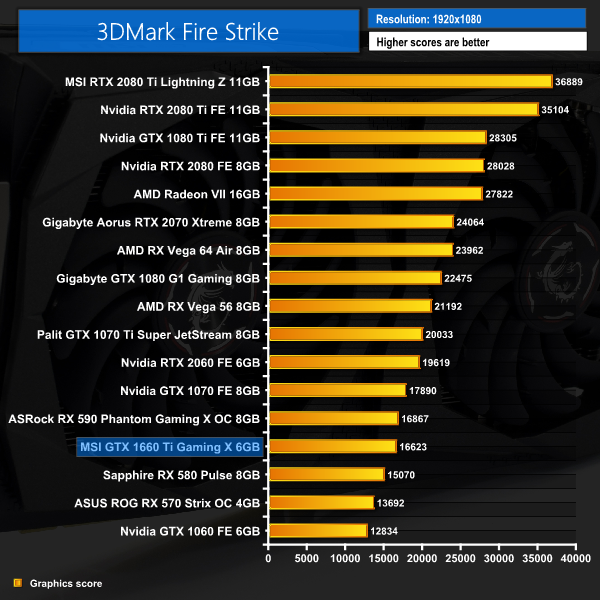
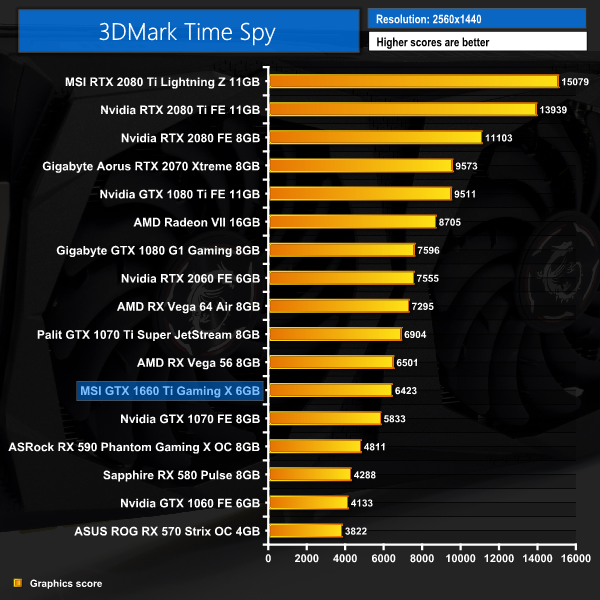
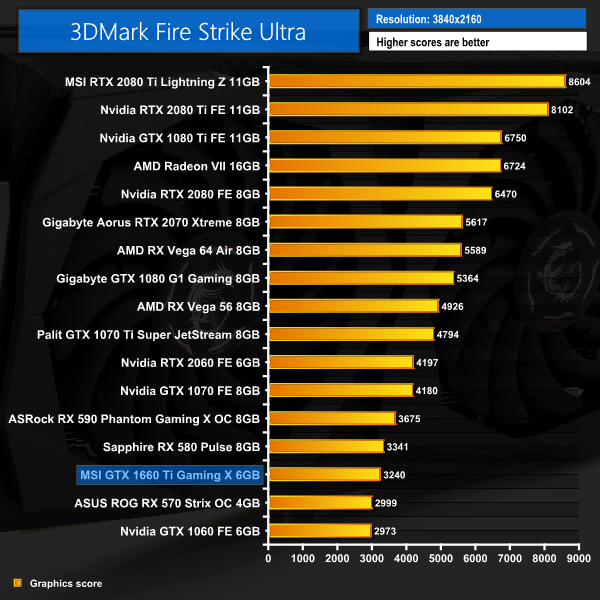
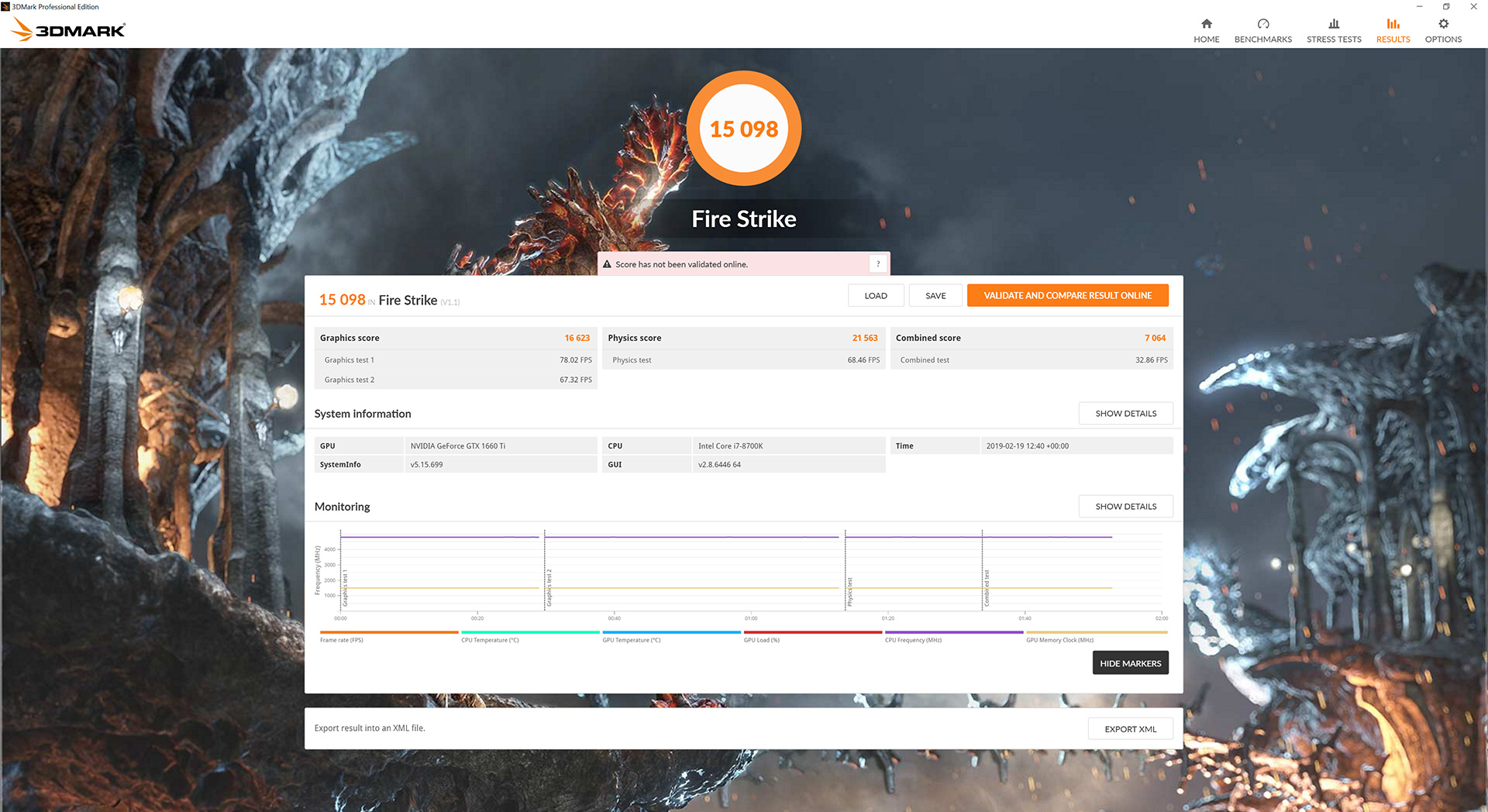
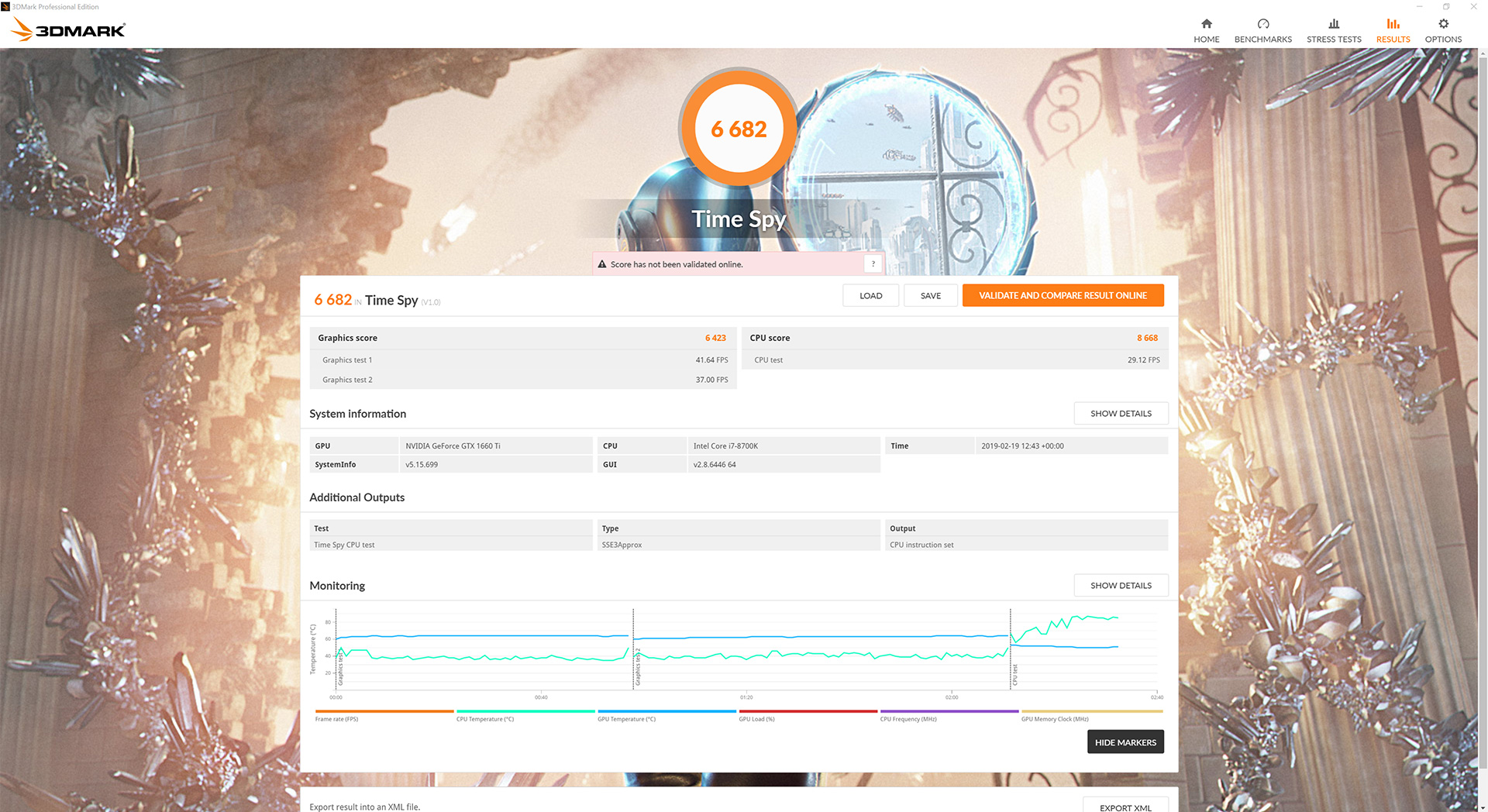
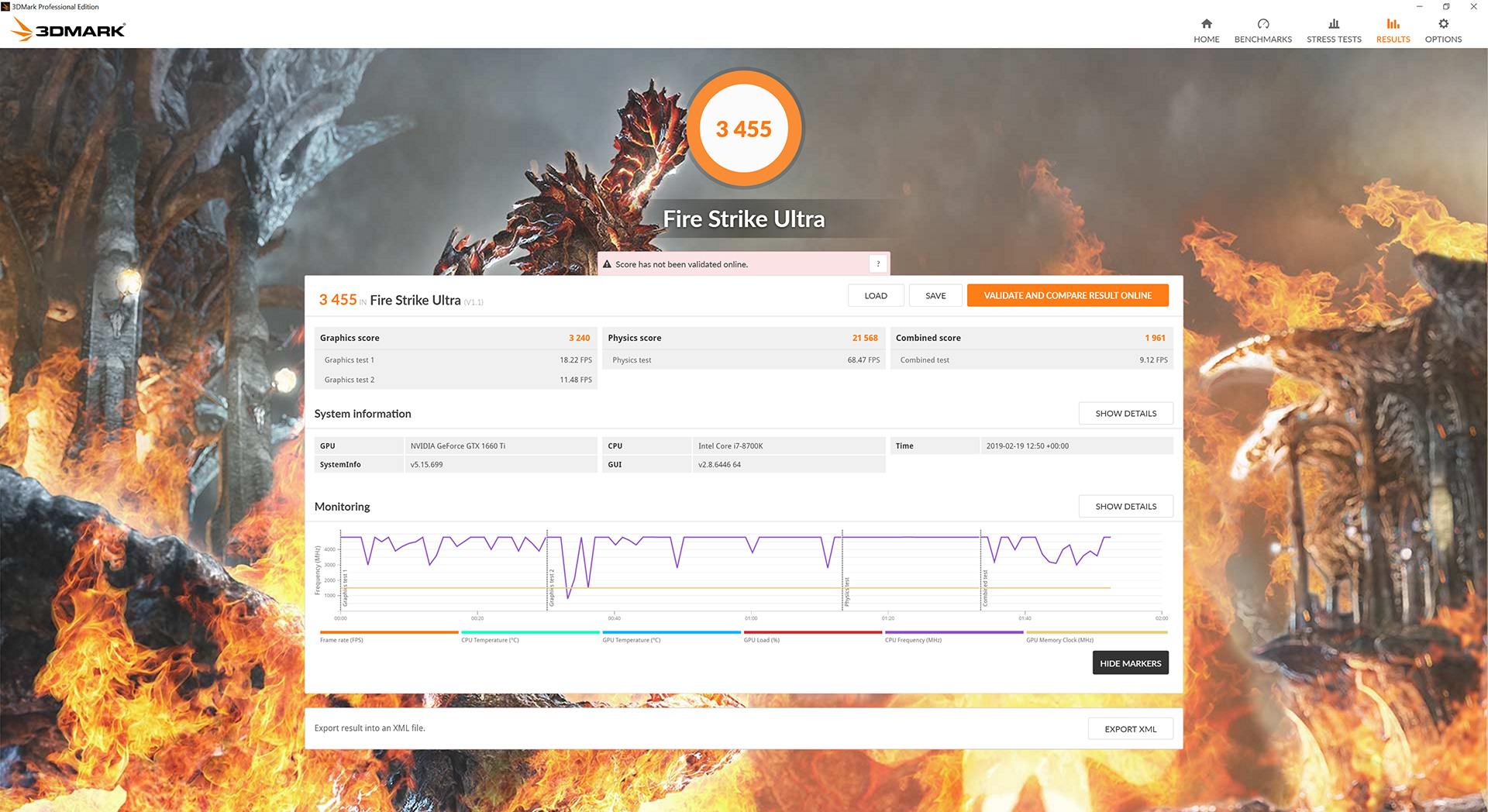
It's a bit of an ‘up and down' start for the MSI GTX 1660 Ti in our 3DMark benchmarks. It's roughly on par with the RX 590 in the Fire Strike test, before outperforming GTX 1070 in Time Spy. In the 4K Fire Strike Ultra test, however, it falls behind even the RX 580.Battlefield V is a first-person shooter video game developed by EA DICE and published by Electronic Arts. Battlefield V is the sixteenth instalment in the Battlefield series. It was released worldwide for Microsoft Windows, PlayStation 4, and Xbox One on November 20, 2018. (Wikipedia).
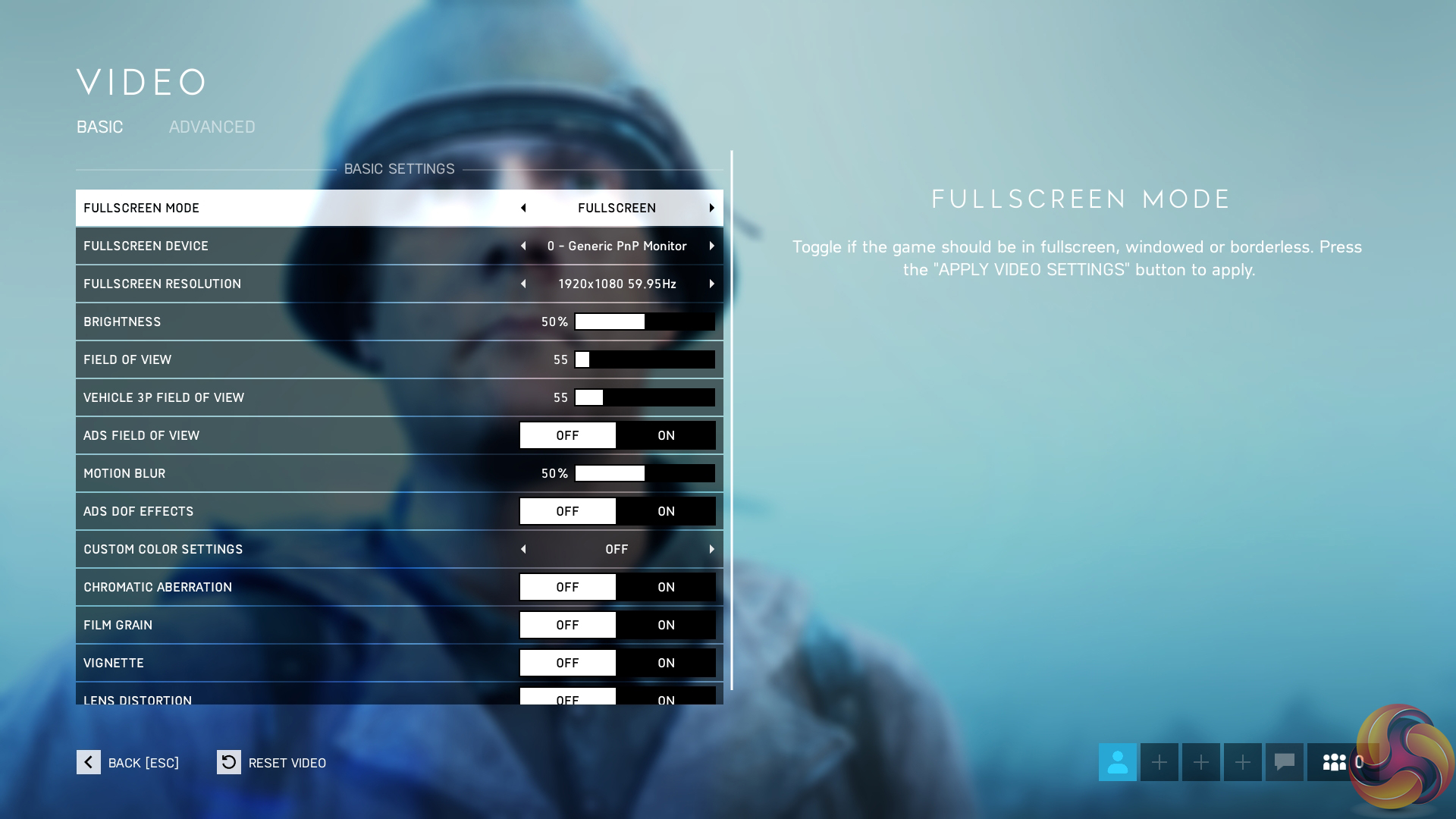
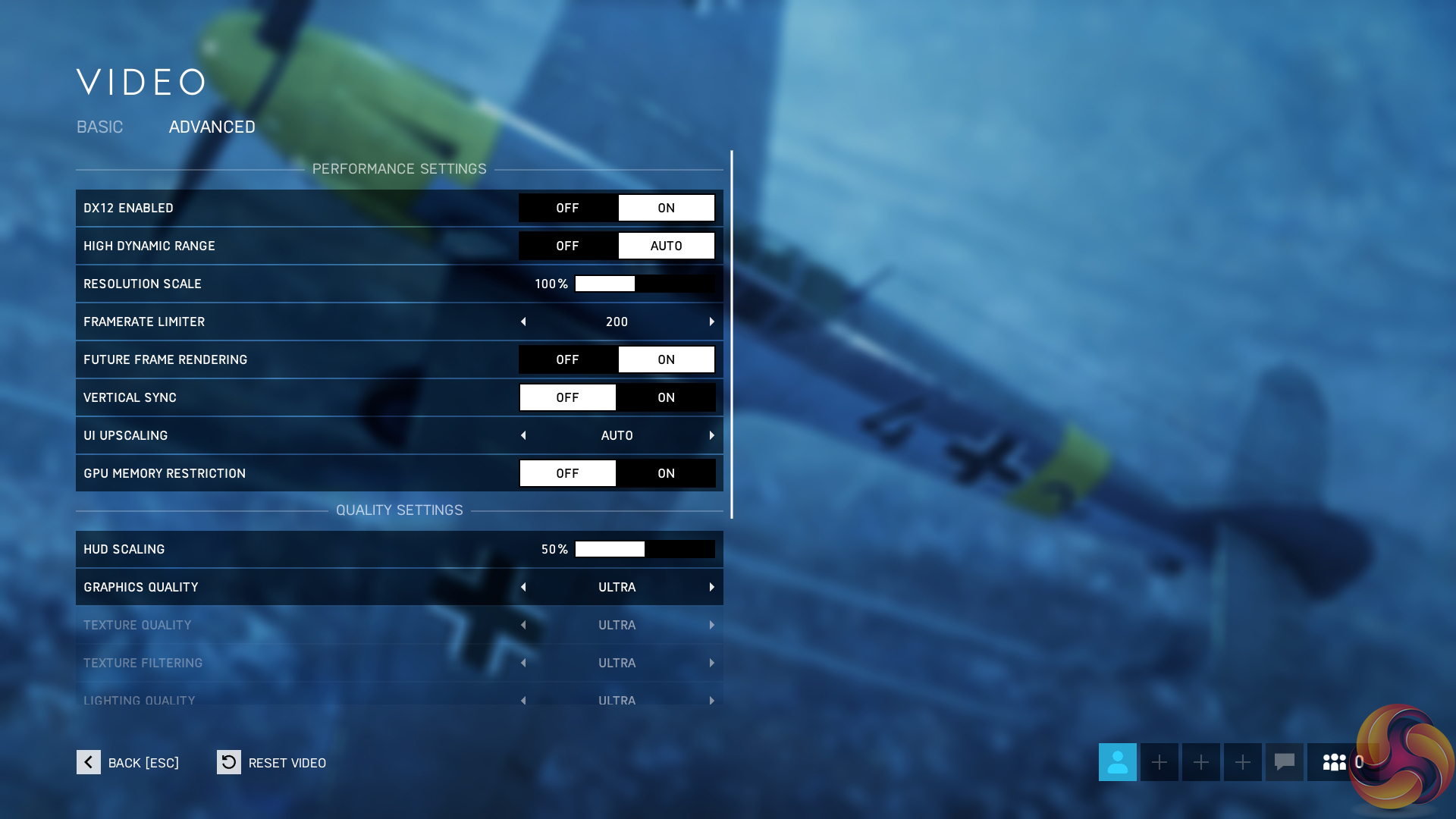
We test using the Ultra preset with the DX12 API. We usually include ray tracing results with BFV, but we have excluded those here as DXR is not a feature applicable to the Radeon VII.
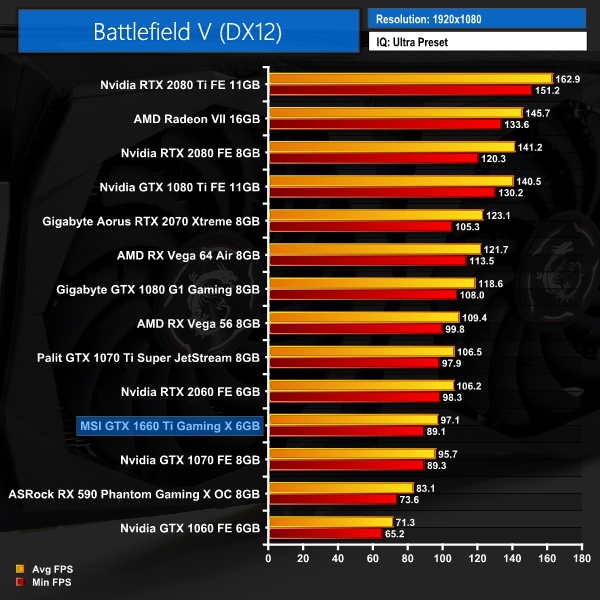
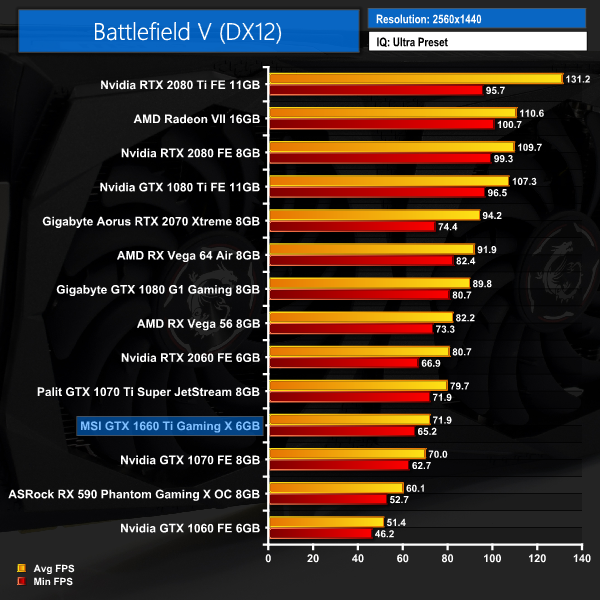
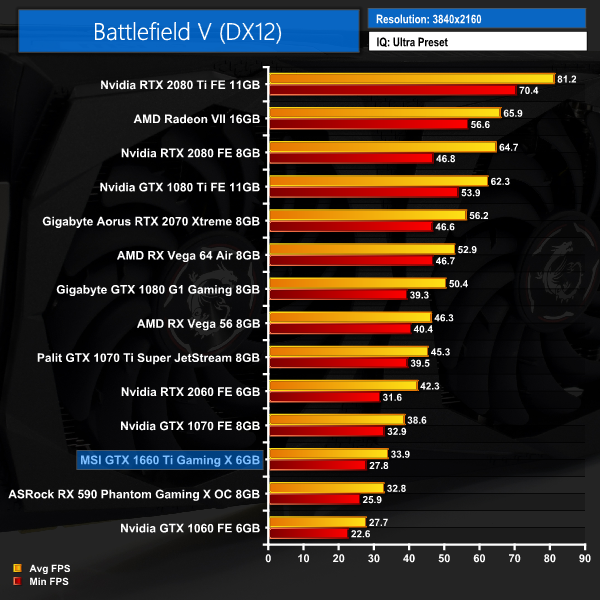
Battlefield V shows much more consistent performance for the GTX 1660 Ti, with the card edging ahead of the GTX 1070 at both 1080p and 1440p. The margins are small – 2FPS at best – but it does do better at those resolutions. At 4K, however, the GTX 1070 is able to pull ahead by almost 5FPS.Deus Ex: Mankind Divided is set in the year 2029, two years after the events of Human Revolution and the “Aug Incident”—an event in which mechanically augmented humans became uncontrollable and lethally violent. Unbeknownst to the public, the affected augmented received implanted technology designed to control them by the shadowy Illuminati, which is abused by a rogue member of the group to discredit augmentations completely. (Wikipedia).
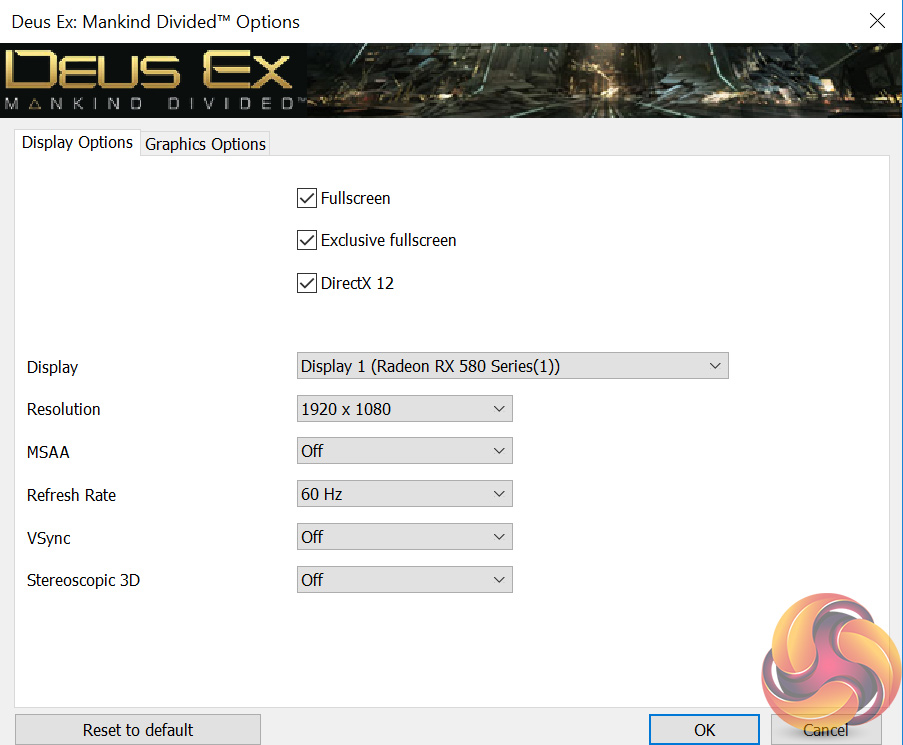
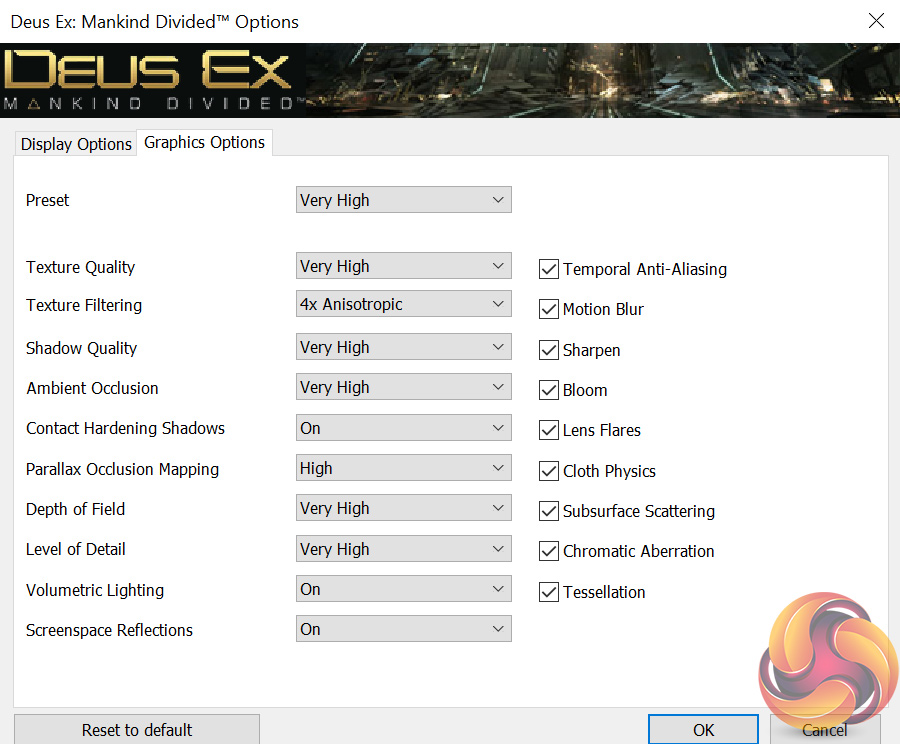
We test using the Very High preset, with MSAA disabled. We use the DirectX 12 API.
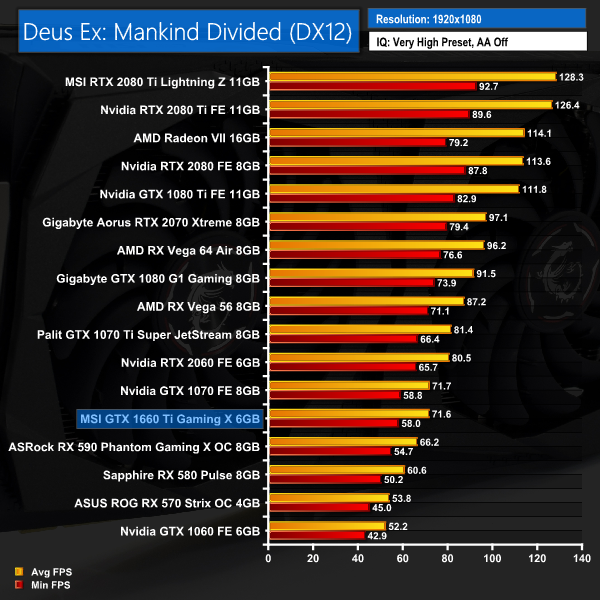
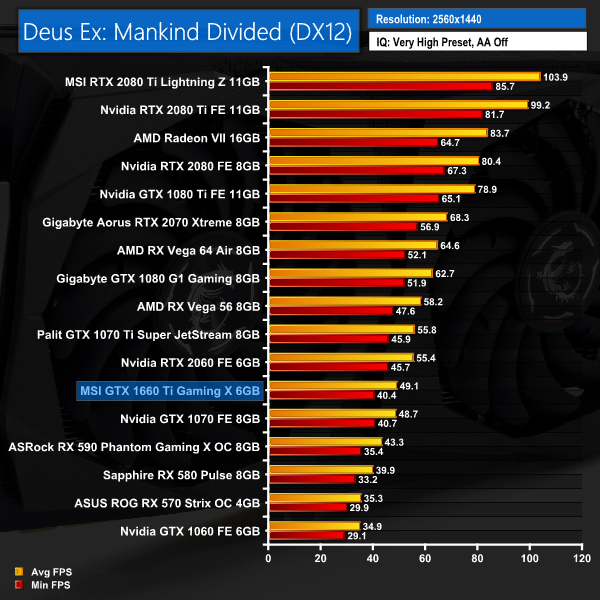
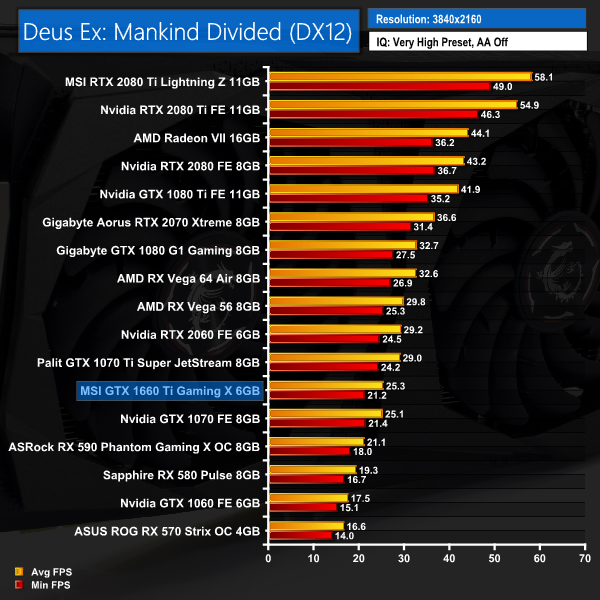
Deus Ex: Mankind Divided has both the GTX 1660 Ti and GTX 1070 essentially on par with each other – across all three resolutions tested, the cards perform within 1FPS of each other. More interesting, I would argue, is how close that puts the 1660 Ti to the RTX 2060 – the gap at 1440p is just 6FPS, for instance, which isn't much at all.Far Cry 5 is an action-adventure first-person shooter game developed by Ubisoft Montreal and Ubisoft Toronto and published by Ubisoft for Microsoft Windows, PlayStation 4 and Xbox One. It is the eleventh entry and the fifth main title in the Far Cry series, and was released on March 27, 2018.
The game takes place in the fictional Hope County, Montana, where charismatic preacher Joseph Seed and his cult Project at Eden’s Gate holds a dictatorial rule over the area. The story follows an unnamed junior deputy sheriff, who becomes trapped in Hope County and works alongside factions of a resistance to liberate the county from Eden’s Gate. (Wikipedia).
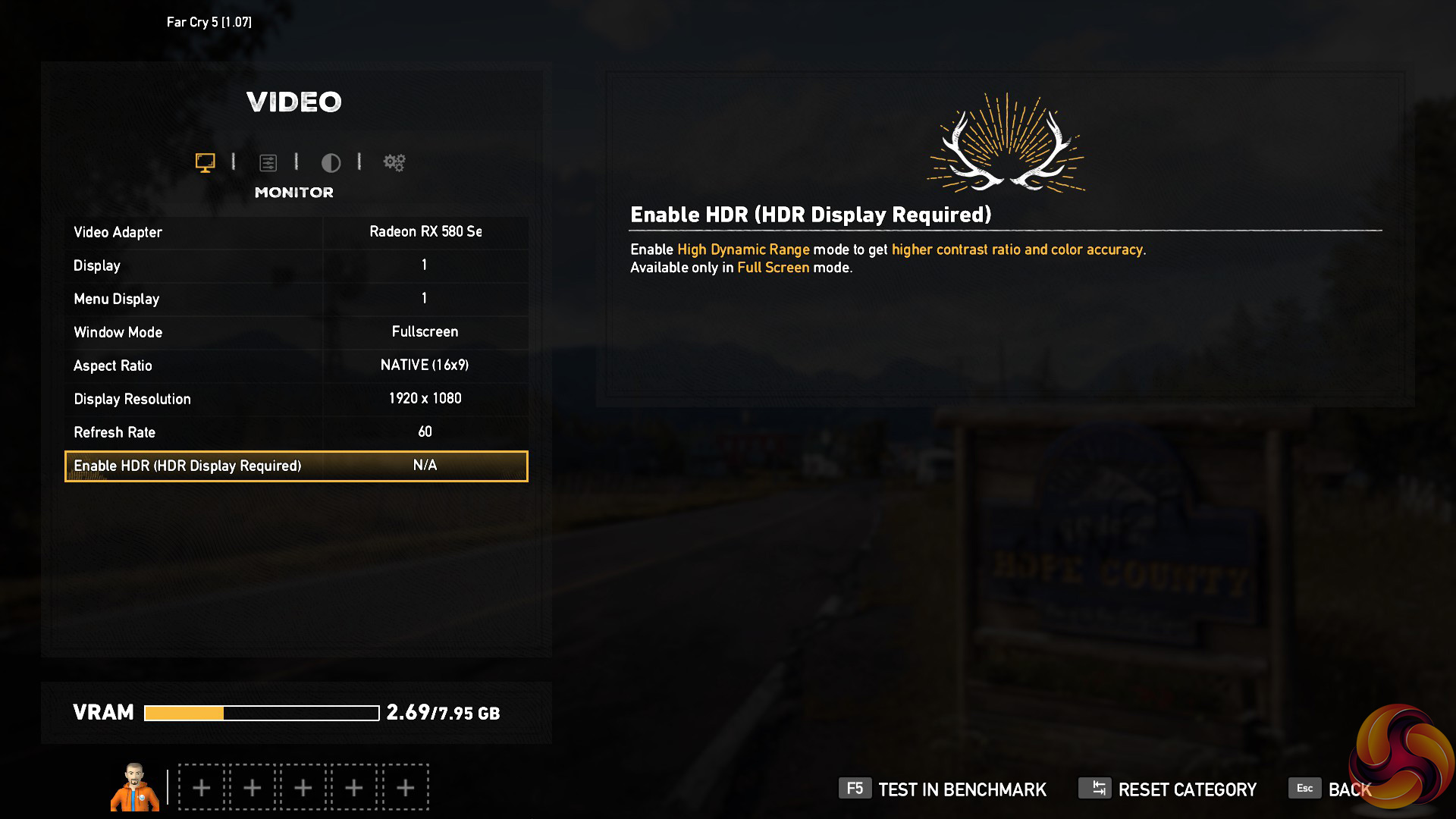
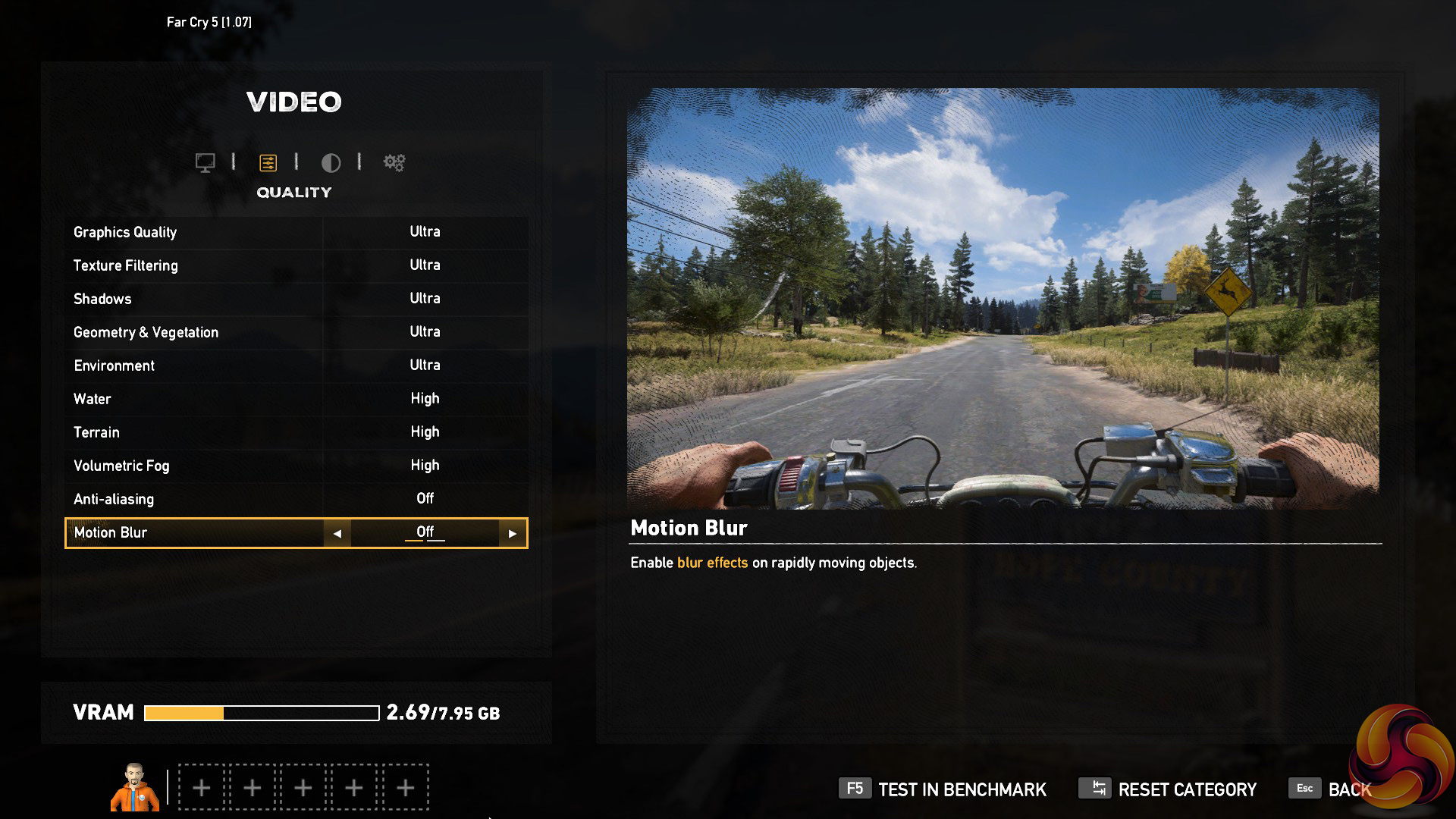
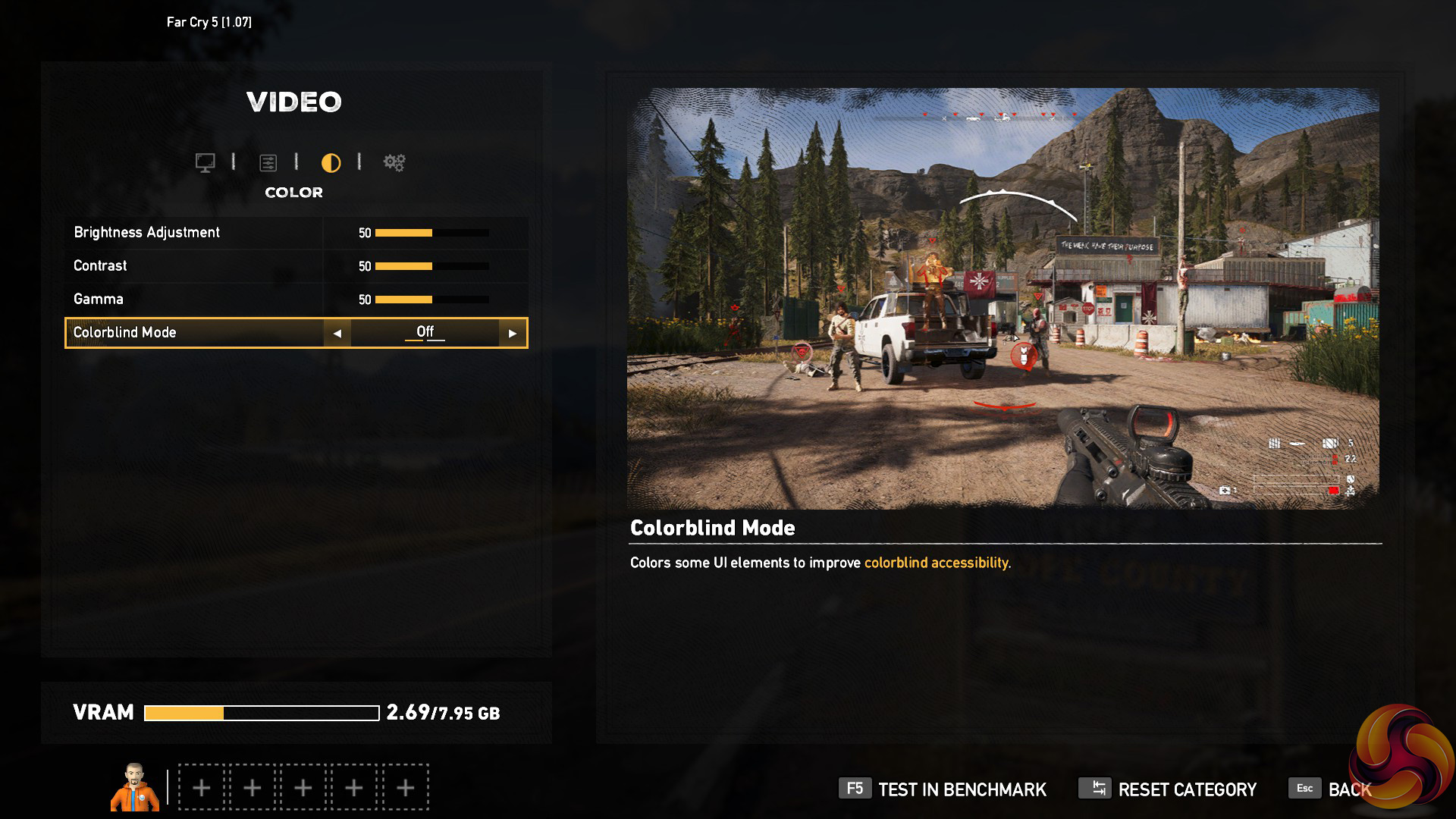
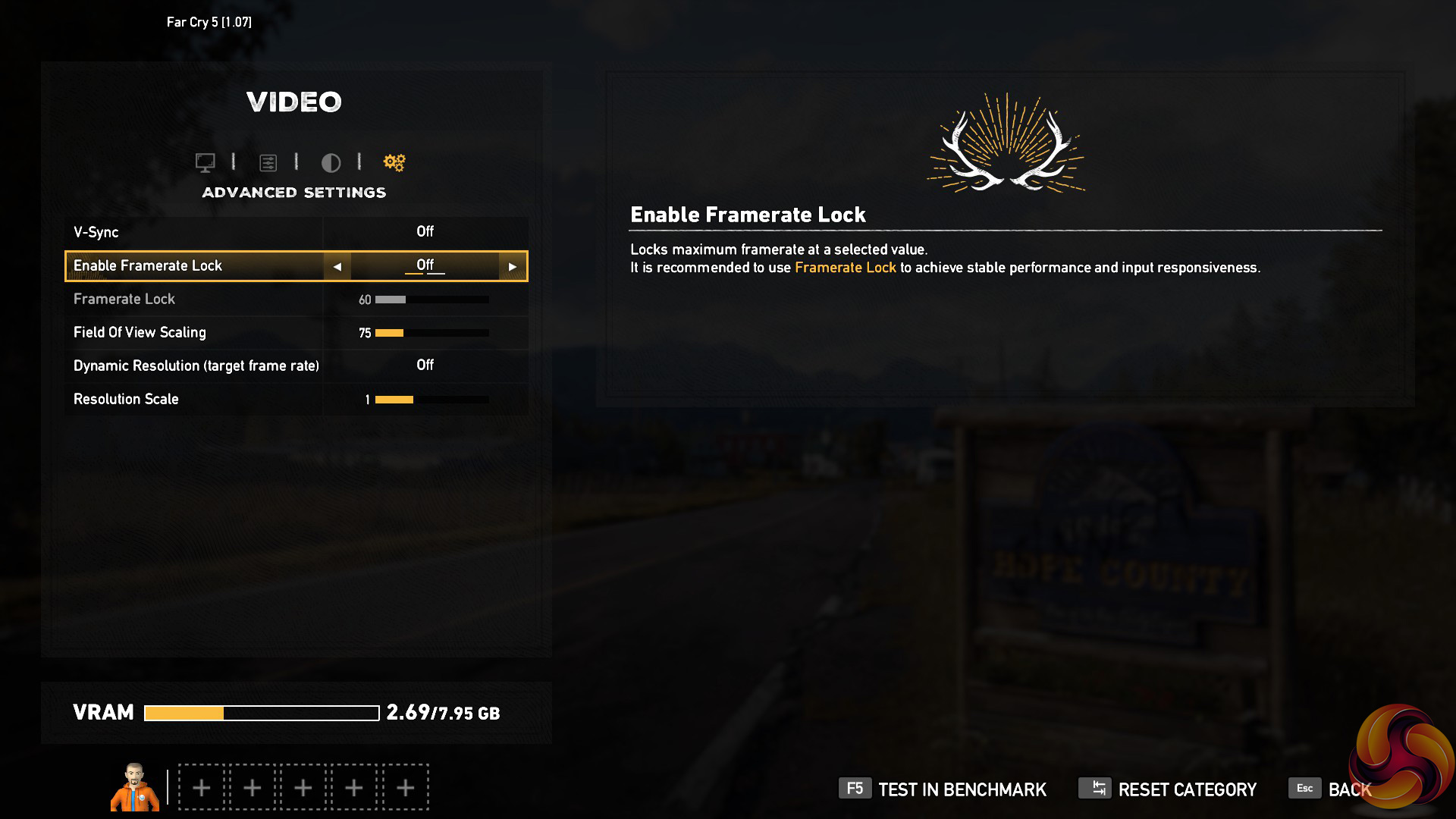
We test using the Ultra preset, with AA and motion blur disabled.
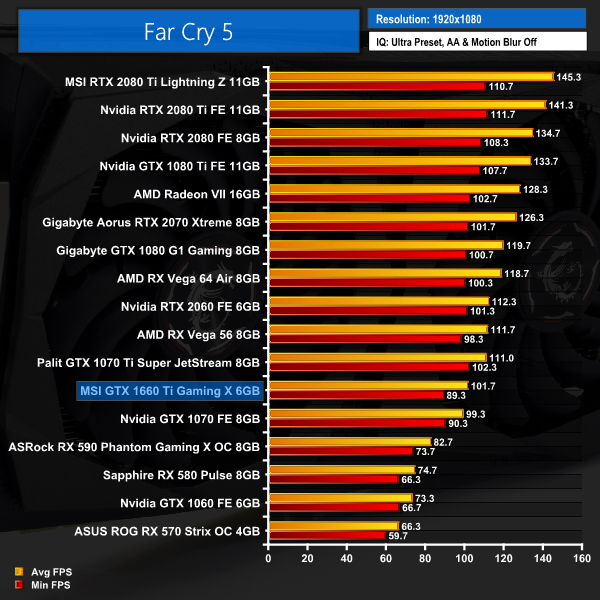
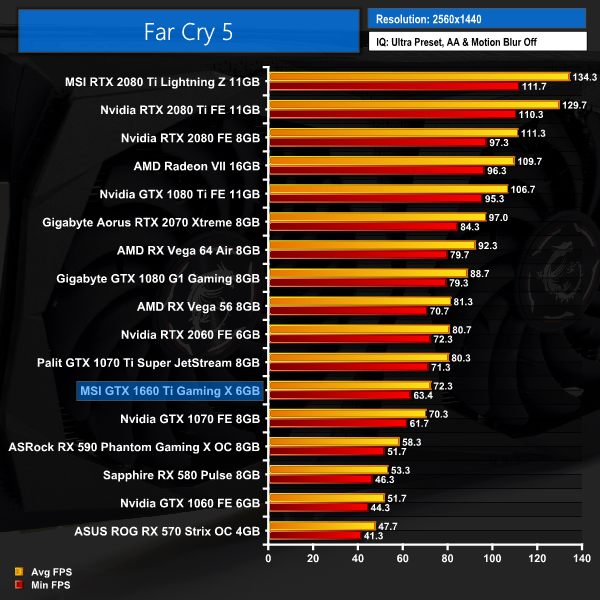
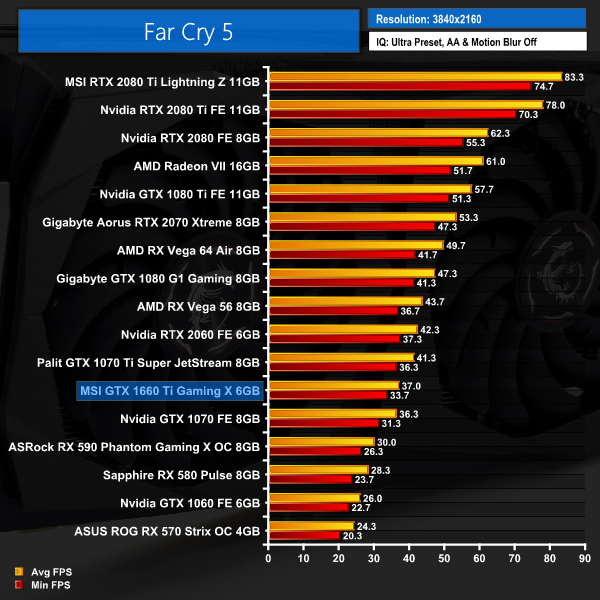
Far Cry 5 again has GTX 1660 Ti just ahead of the GTX 1070 across all three resolutions – but again, the margins are very small. Both RTX 2060 and Vega 56 maintain about a 10% lead over the GTX 1660 Ti.Tom Clancy’s Ghost Recon Wildlands is a tactical shooter video game developed by Ubisoft Paris and published by Ubisoft. It was released worldwide on March 7, 2017, for Microsoft Windows, PlayStation 4 and Xbox One, as the tenth installment in the Tom Clancy’s Ghost Recon franchise and is the first game in the Ghost Recon series to feature an open world environment. (Wikipedia).
We test using the Very High preset.
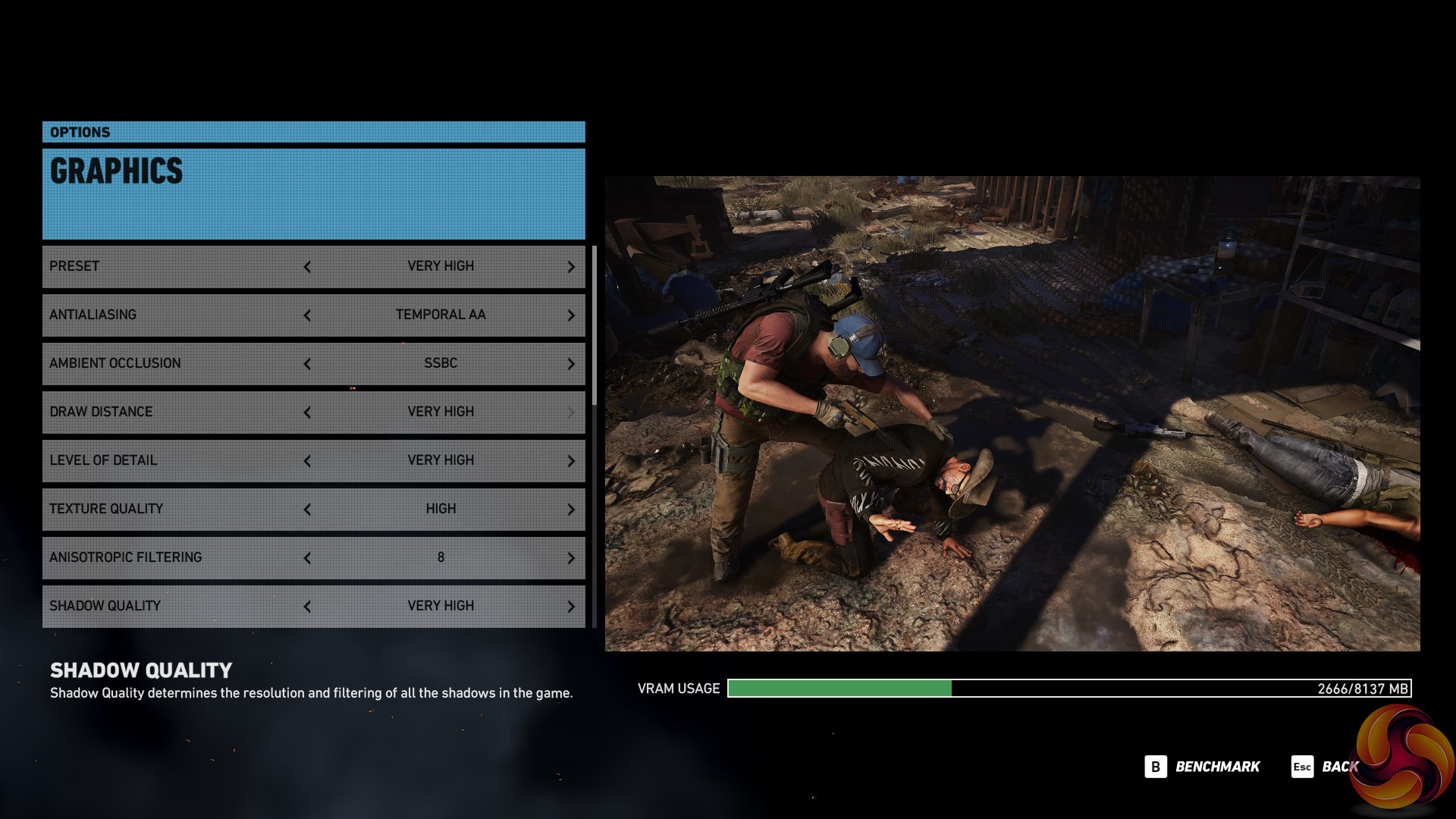
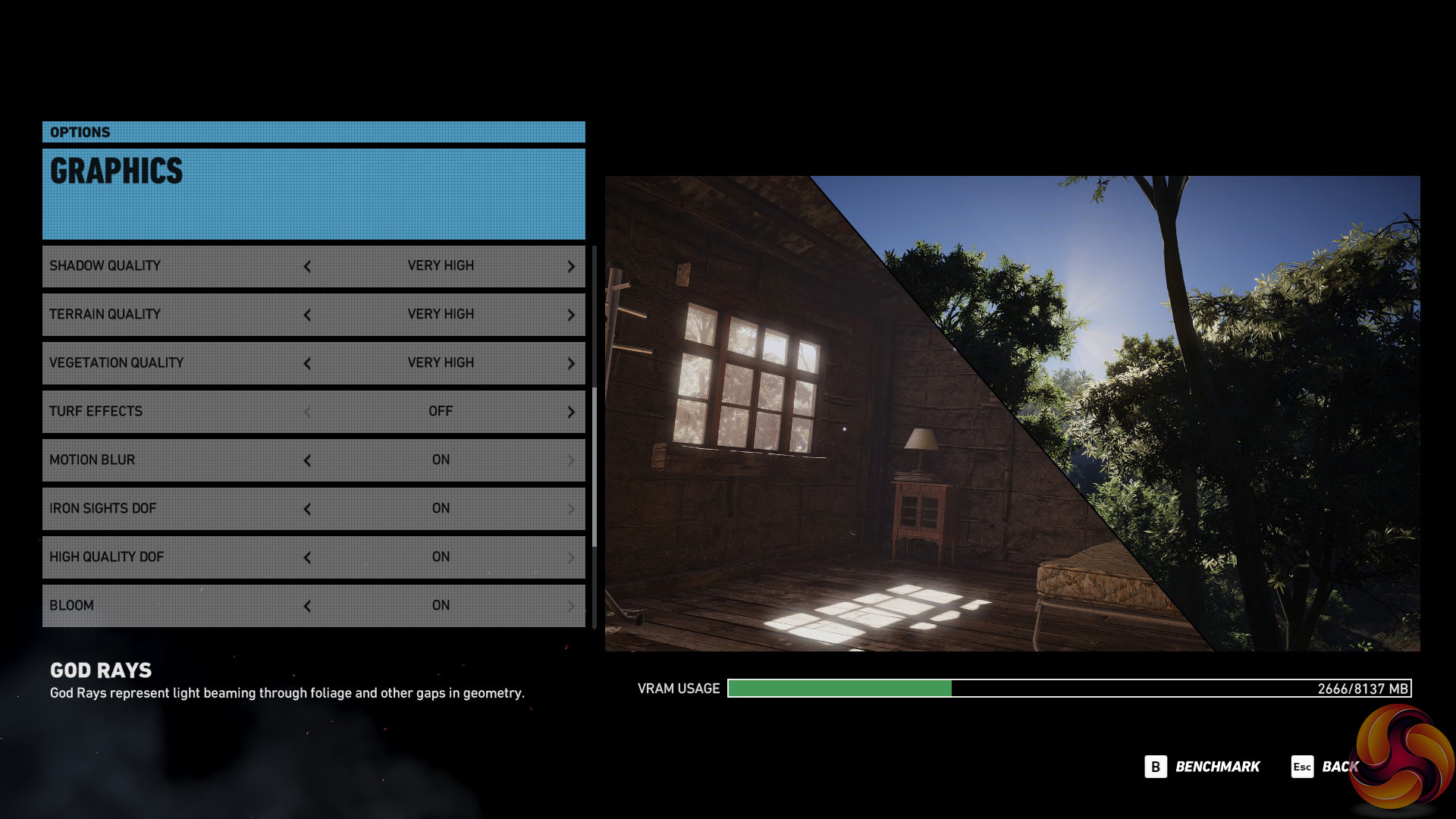
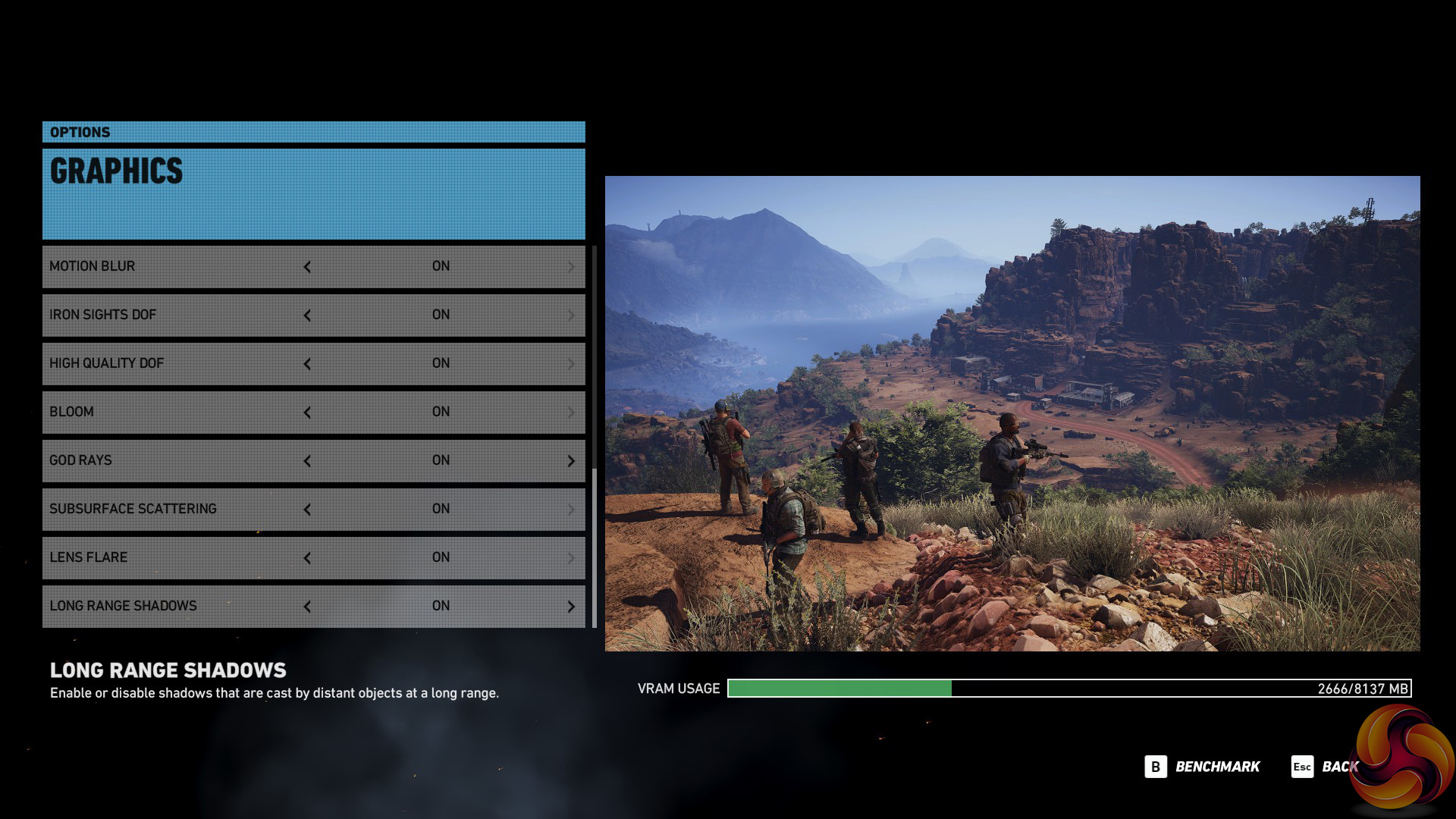
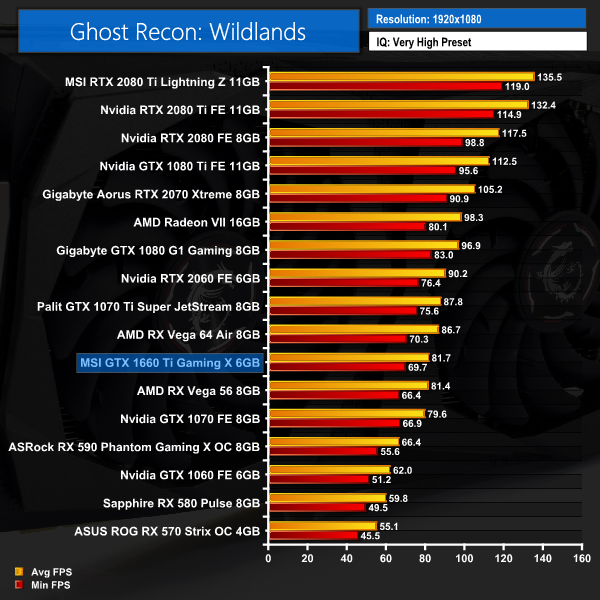
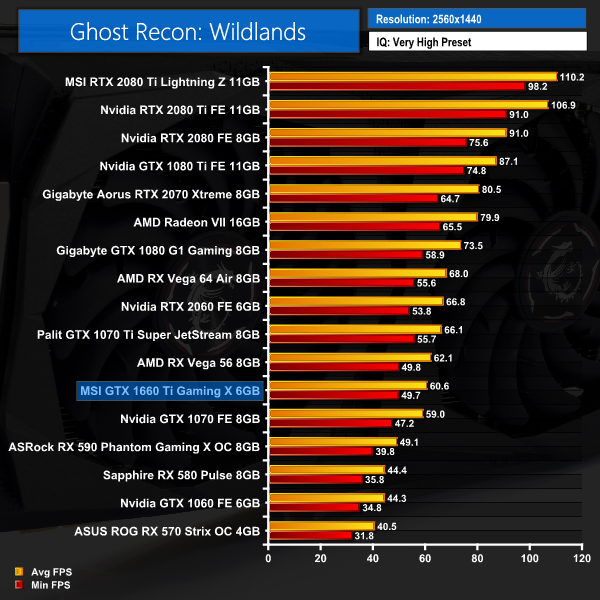
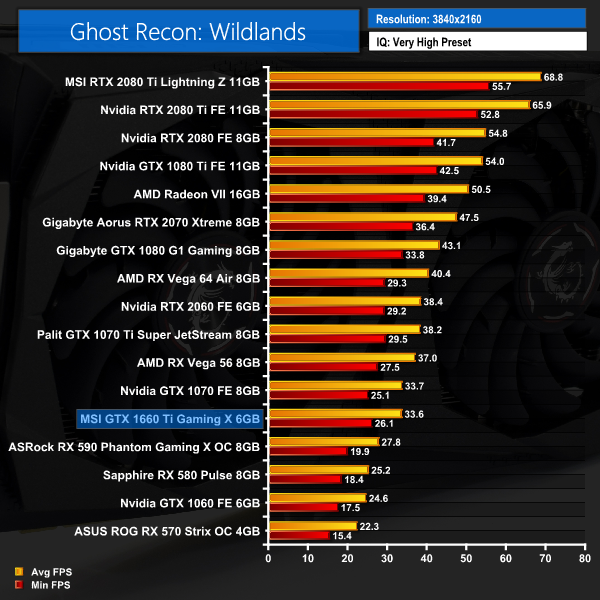
Ghost Recon: Wildlands definitely favours Nvidia hardware over AMD, and we can see that in the 1080p and 1440p results where GTX 1660 Ti is effectively tied with Vega 56. That in turn puts 1660 Ti performance at pretty much the same level as GTX 1070 in this title.Middle-earth: Shadow of War is an action role-playing video game developed by Monolith Productions and published by Warner Bros. Interactive Entertainment. It is the sequel to 2014’s Middle-earth: Shadow of Mordor, and was released worldwide for Microsoft Windows, PlayStation 4, and Xbox One on October 10, 2017. (Wikipedia).
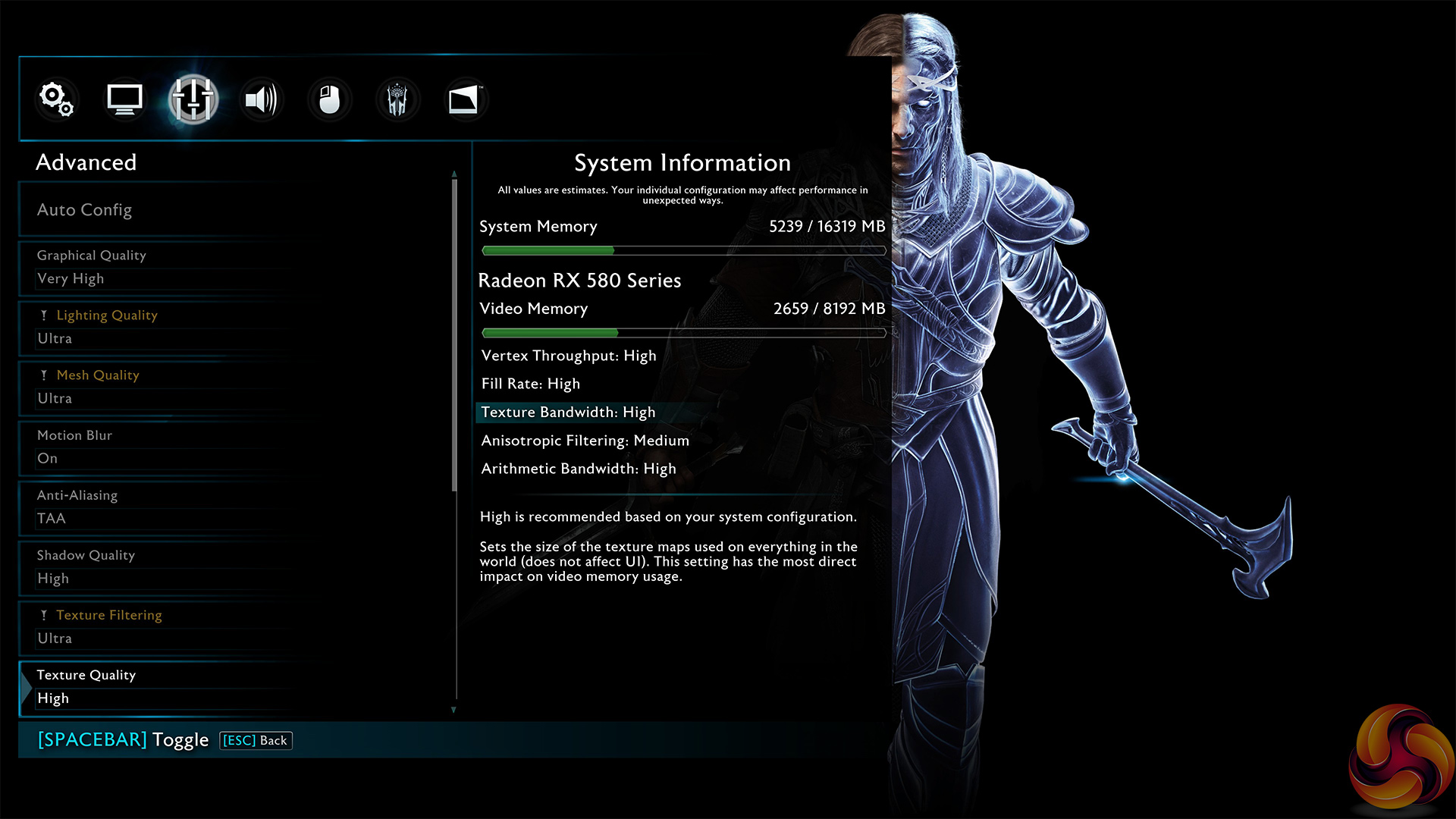
We test using the Very High preset.

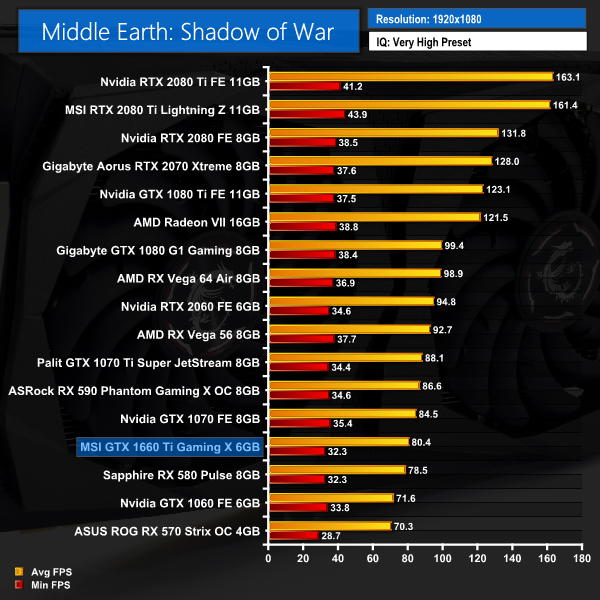
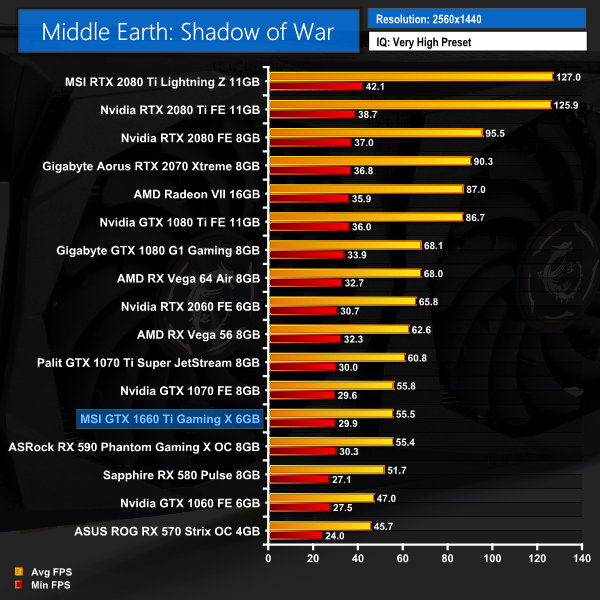
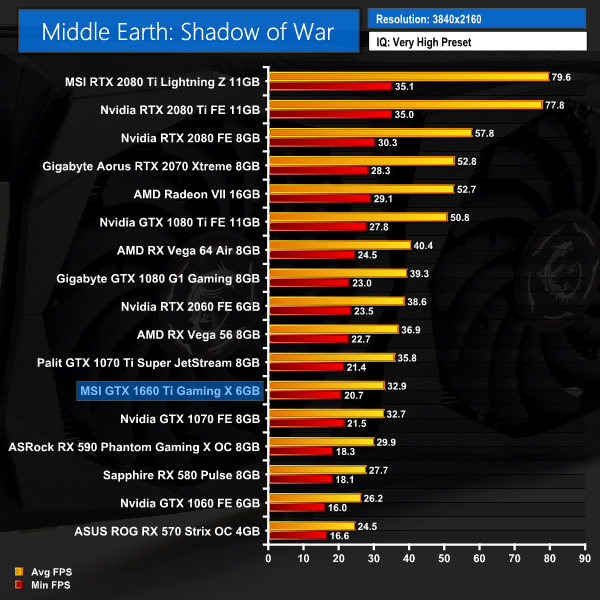
GTX 1070 holds a 4FPS lead over GTX 1660 Ti when playing Middle Earth: Shadow of War at 1080p, though this shrinks to a mere 0.3FPS at 1440p. RTX 2060 maintains a performance lead of around 17% over 1660 Ti at both of those resolutions.Shadow of the Tomb Raider is an action-adventure video game developed by Eidos Montréal in conjunction with Crystal Dynamics and published by Square Enix. It continues the narrative from the 2013 game Tomb Raider and its sequel Rise of the Tomb Raider, and is the twelfth mainline entry in the Tomb Raider series. The game released worldwide on 14 September 2018 for Microsoft Windows, PlayStation 4 and Xbox One. (Wikipedia).
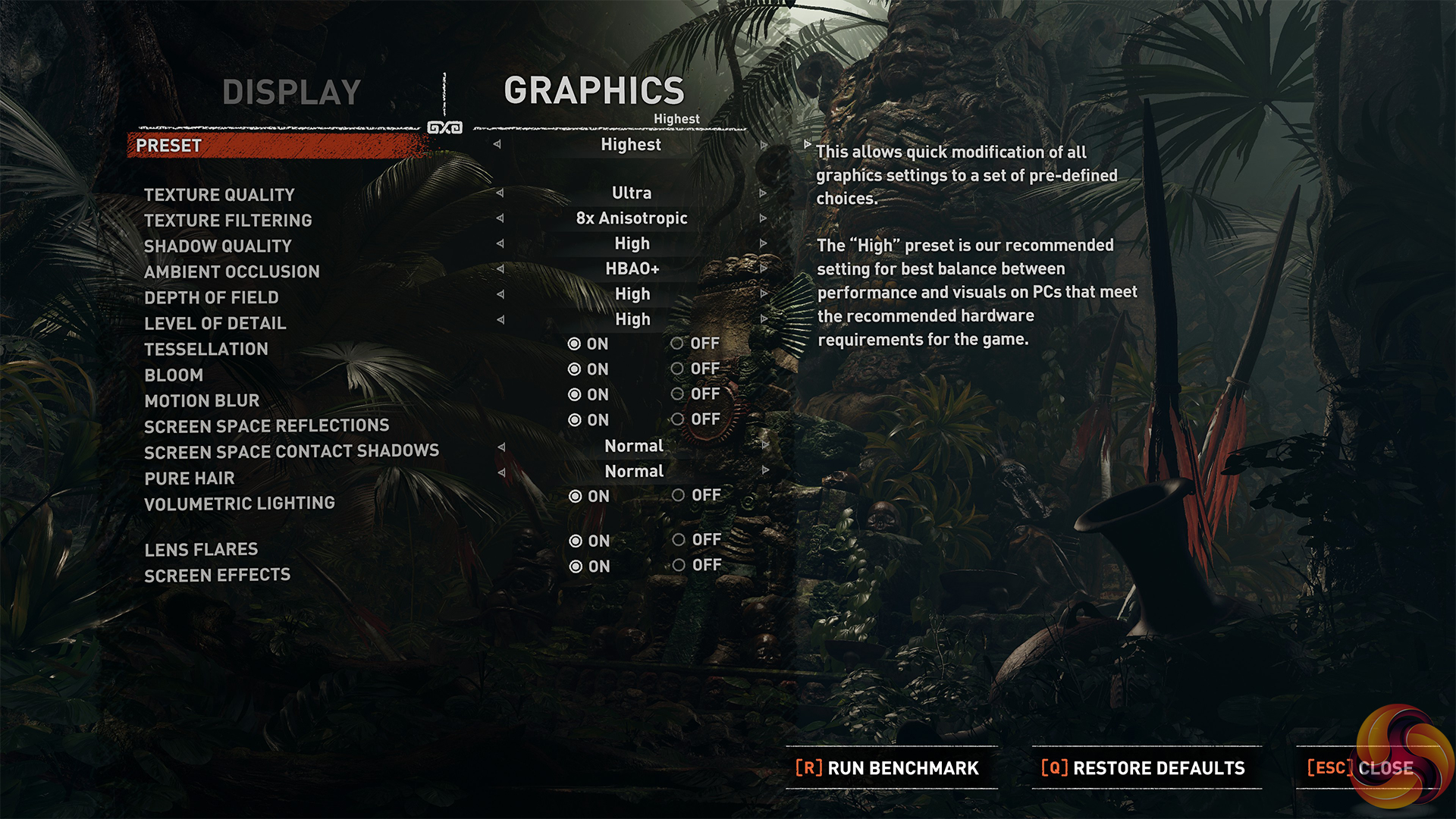
We test using the Highest preset, with AA disabled. We test using the DX12 API.
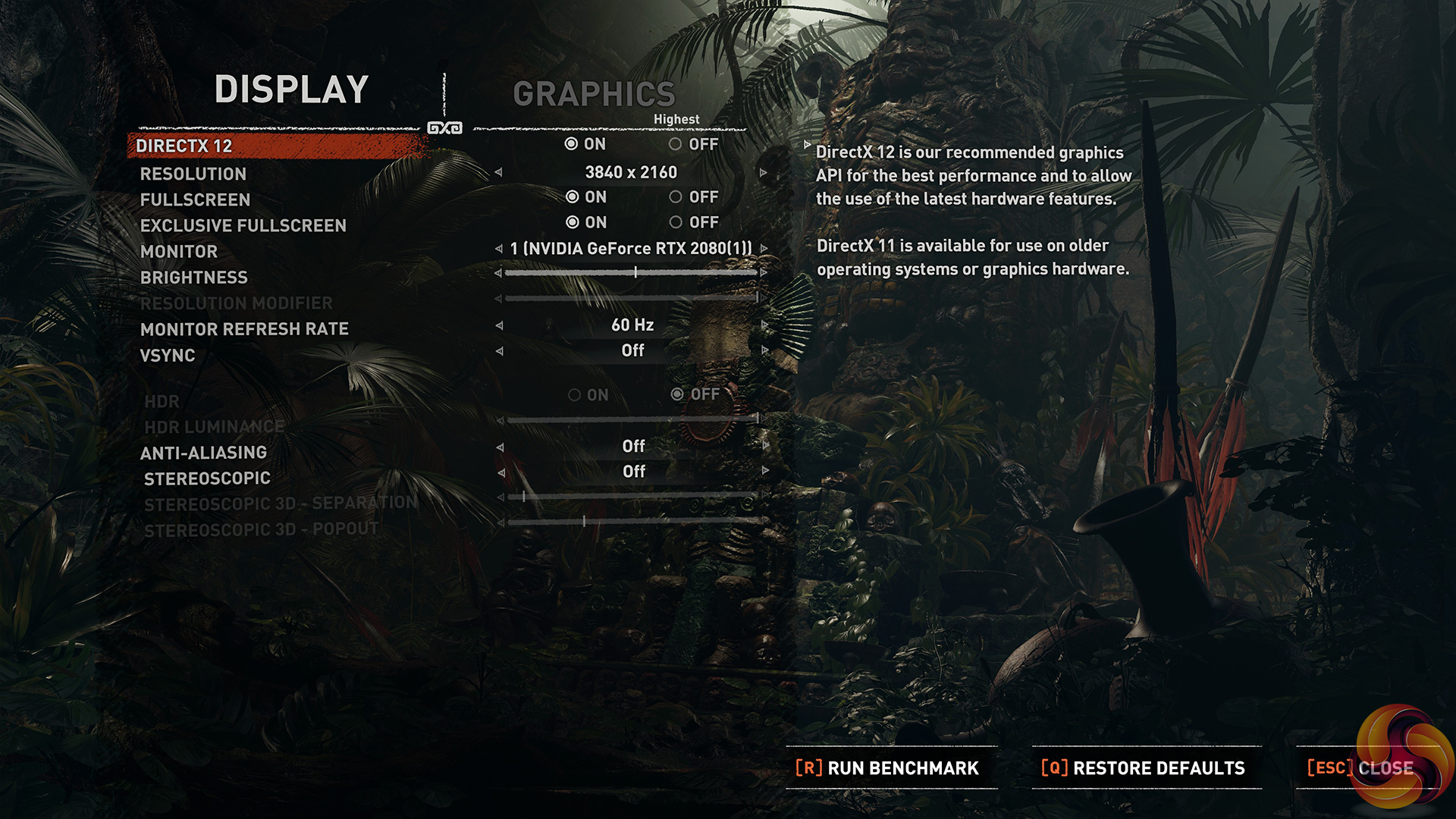
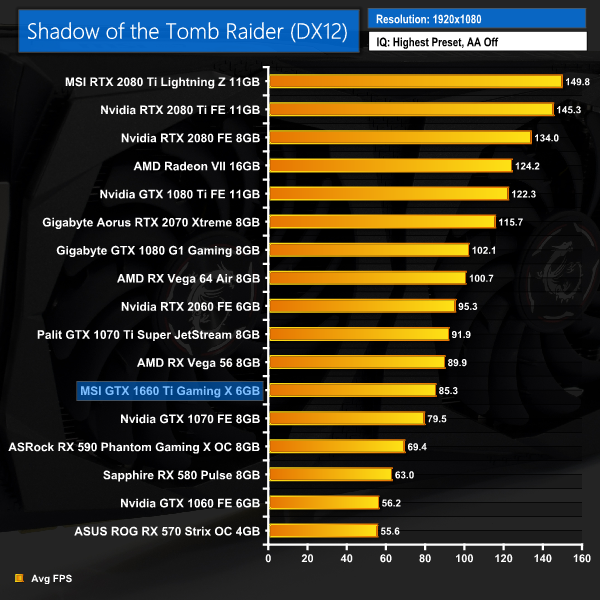
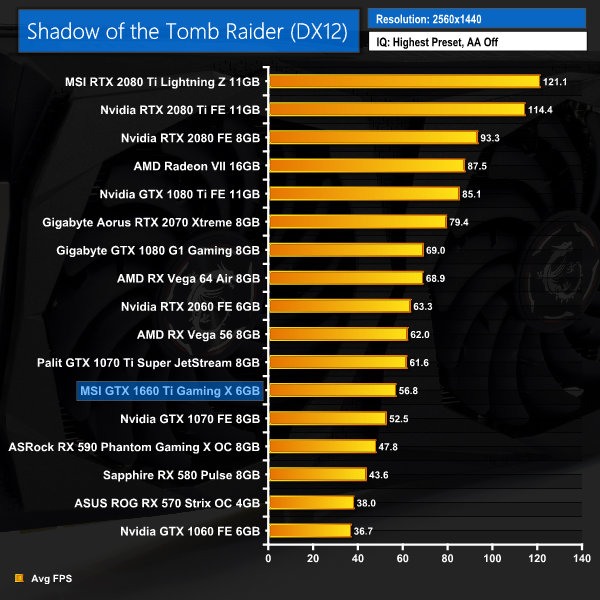
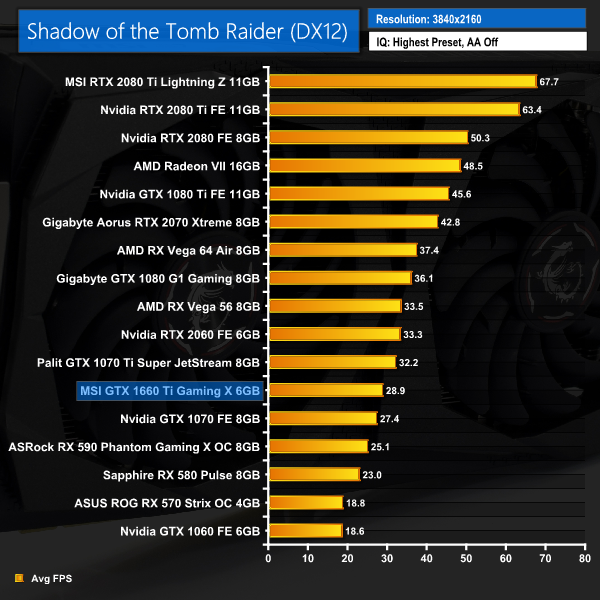
Shadow of the Tomb Raider rounds out our games testing, and demonstrates the biggest performance difference between GTX 1660 Ti and GTX 1070 that we have seen. At 1080p, for instance, the 1660 Ti is almost 6FPS faster, while even at 1440p it is 4FPS faster. It's still not a massive performance gain, but it is the biggest margin of difference between 1660 Ti and 1070 we have seen from our testing today.Here we present the average clock speed for each graphics card while running the 3DMark Fire Strike Ultra stress test 20 times. We use GPU-Z to record the GPU core frequency during the Fire Strike Ultra runs. We calculate the average core frequency during the entire 20-run test to present here.
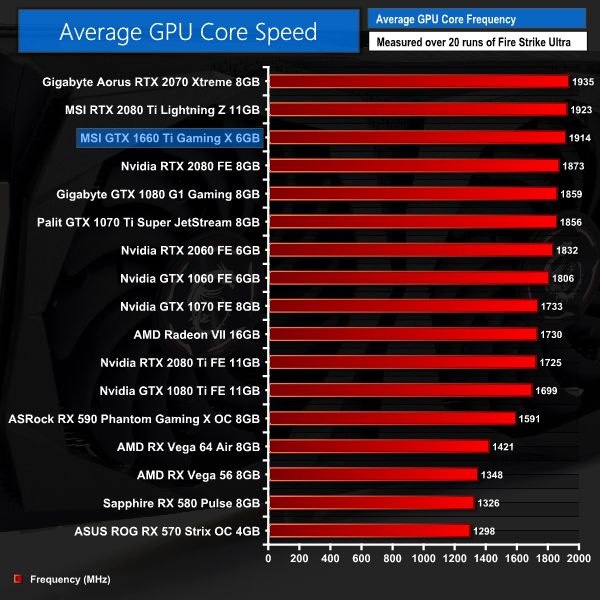
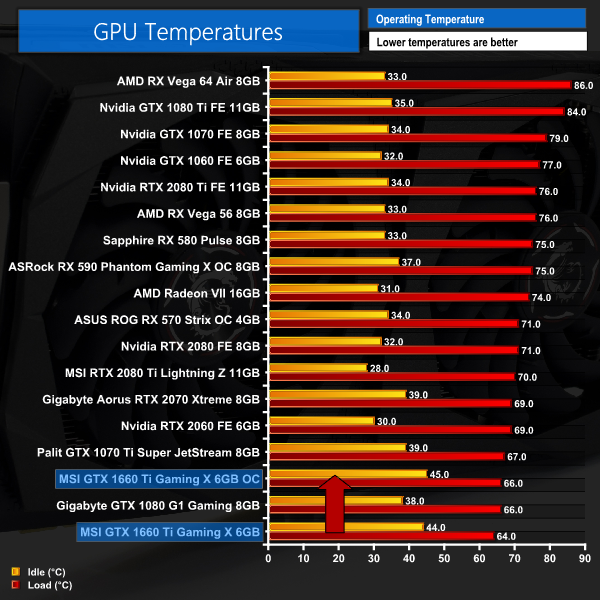
MSI's GTX 1660 Ti Gaming X is a factory overclocked model – its rated boost clock of 1875MHz is 105MHz faster than reference speeds. Even then, thanks to GPU Boost, we saw this card exceed that rated boost clock as its frequency averaged 1914MHz throughout 20 runs of Fire Strike Ultra. This is likely to be one of the fastest-running 1660 Ti cards, and thus essentially represents the best case scenario for a 1660 Ti's out of the box performance.For our temperature testing, we measure the peak GPU core temperature under load, as well as the GPU temperature with the card idling on the desktop. A reading under load comes from running the 3DMark Fire Strike Ultra stress test 20 times. An idle reading comes after leaving the system on the Windows desktop for 30 minutes.
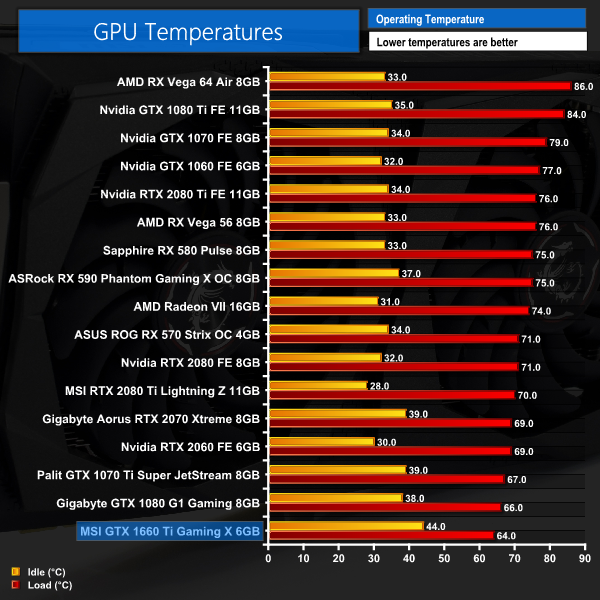
MSI has done a good job with its 7th generation Twin Frozr cooler – as we mentioned, it is not a big card, but clearly the TU116 GPU doesn't need extensive cooling, as it peaked at just 64C under full load. The idle temperature is a little higher than other results, but that is only due to MSI's ‘Zero Frozr' fan-stop mode, which will completely stop the fans spinning almost immediately once the GPU is no longer being stressed.
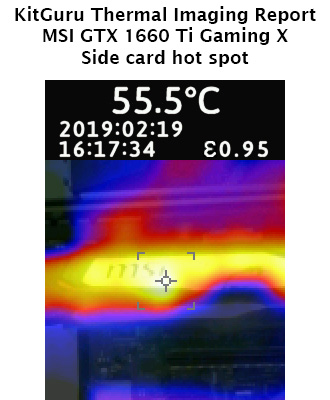
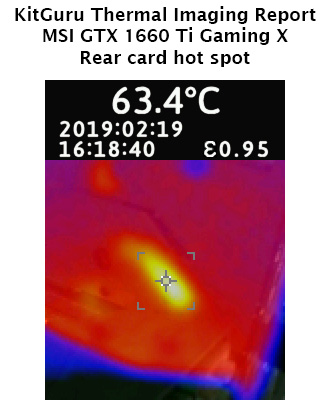
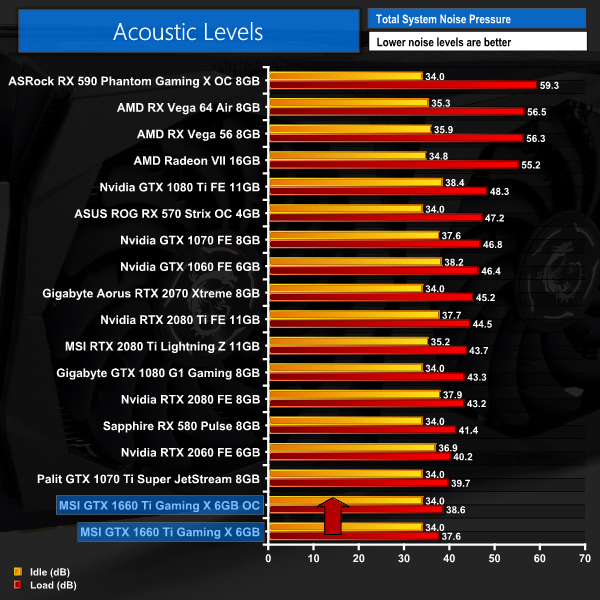
Our thermal gun testing only confirms what we already knew – this cooler is very capable of taming the TU116 GPU, and we didn't see a point hotter than 64C on the card itself. The hot spot on the side of the card, at under 56C, is again a very impressive result.We take our noise measurements with the sound meter positioned 1 foot from the graphics card. I measured the sound floor to be 34 dBA, thus anything above this level can be attributed to the graphics cards. The power supply is passive for the entire power output range we tested all graphics cards in, while all CPU and system fans were disabled.
A reading under load comes from running the 3DMark Fire Strike Ultra stress test 20 times. An idle reading comes after leaving the system on the Windows desktop for 30 minutes.
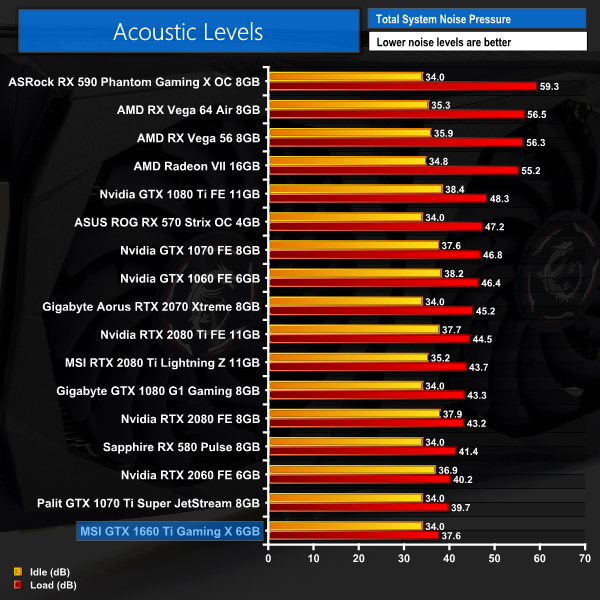
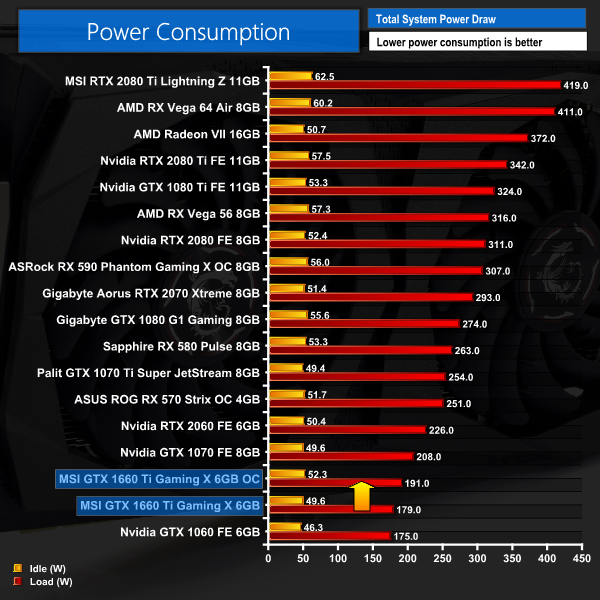
Despite being the coolest-running card on test today, MSI's GTX 1660 Ti is also the quietest – and by a decent margin, too. This is mightily impressive, as even under full load it is really very hard to tell that the fans are actually spinning. Bear in mind this is with the card on an open test bench, so once this card is installed in a case I think it is almost certain you just would not be able to hear it at all.We measure system-wide power draw from the wall while the card is sat idling at the Windows 10 desktop for 30 minutes. A reading under load comes from running the 3DMark Fire Strike Ultra stress test 20 times.
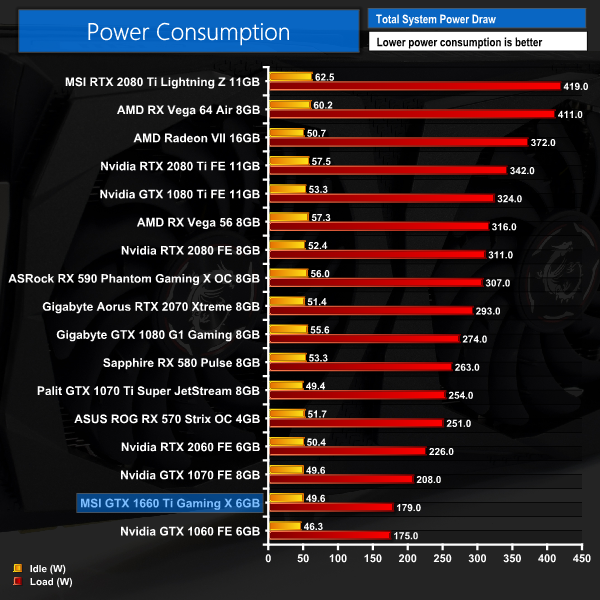
Being a factory overclocked model, the MSI Gaming X will draw slightly more power than a reference-clocked GTX 1660 Ti – probably in the region of 10W or so. Even then, power consumption is still not high – just 4W more at the wall than GTX 1060, which clearly shows very impressive power efficiency given how much faster this card is compared to GTX 1060. It will be interesting to analyse a reference-clocked 1660 Ti to see how fast one of those cards would run out of the box, and how much power it would draw.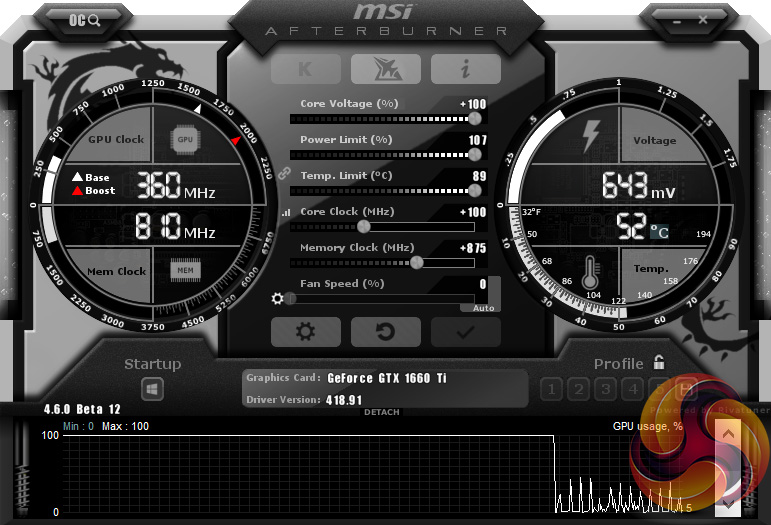
We of course turned to MSI Afterburner for our overclocking exploits with the Gaming X 1660 Ti. Our best result came with +100MHz to the GPU core, and +875MHz to the Micron GDDR6 memory. I did actually have +145MHz stable during 3DMark testing, but any higher than +100MHz caused Deus Ex: Mankind Divided to insta-crash.
3DMark and games testing
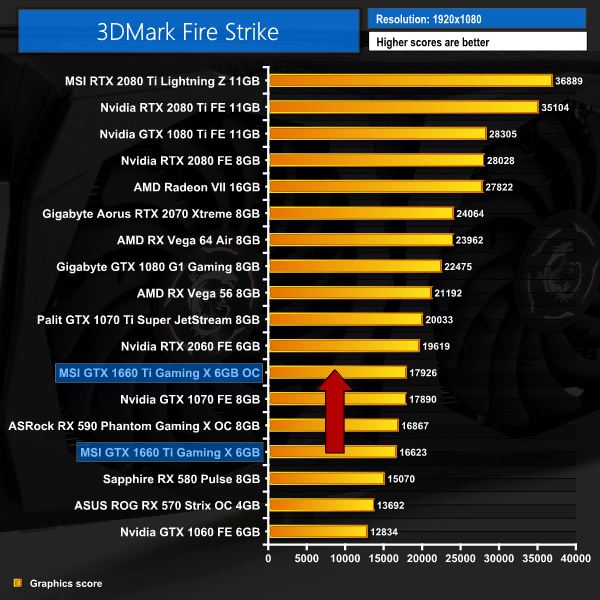
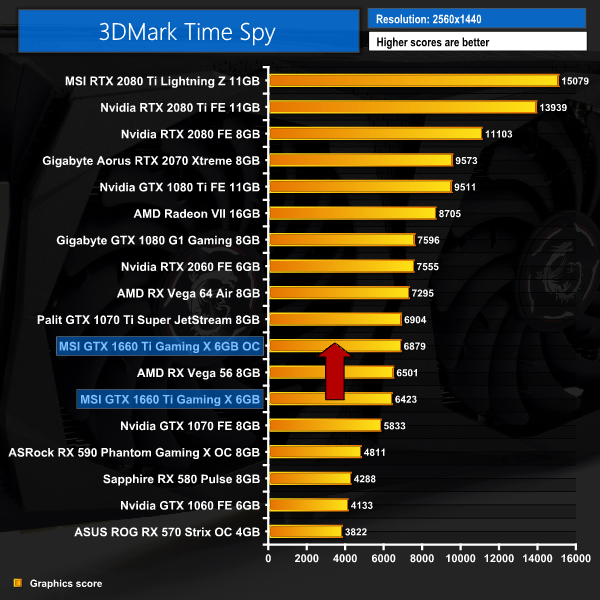
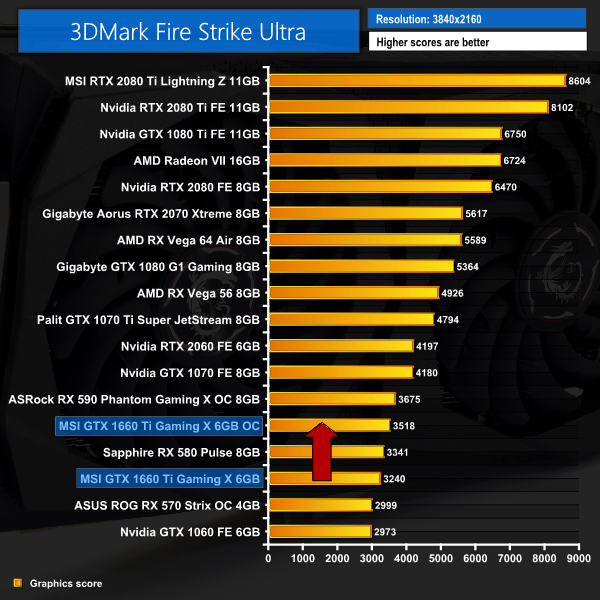
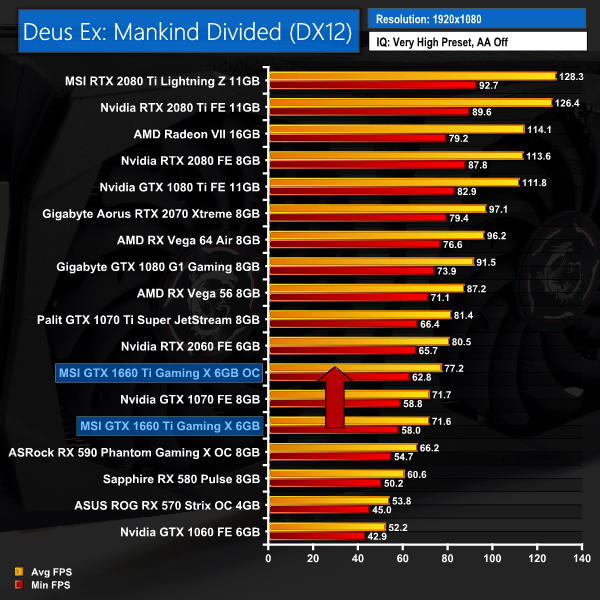
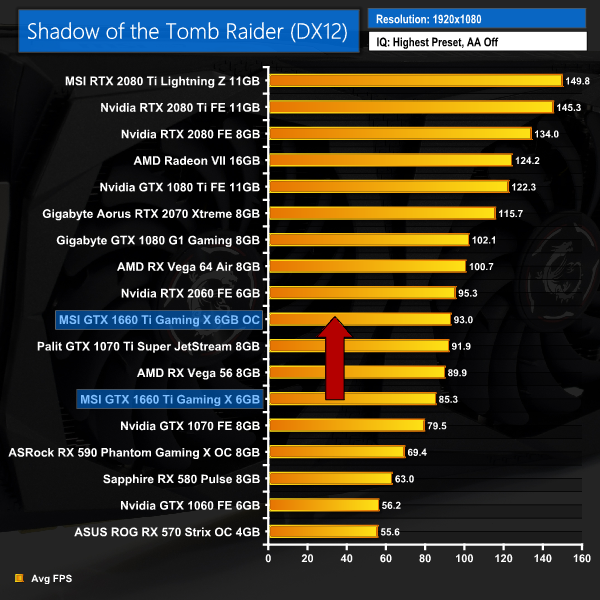
This overclock brought some impressive gains, with an 8% performance bump to our Fire Strike score, and almost another 8FPS when playing Shadow of the Tomb Raider at 1080p. Interestingly, both our games tested with the card overclocked has performance right around RTX 2060 level – 2FPS or so behind, but still very close.
Average clock speed under load
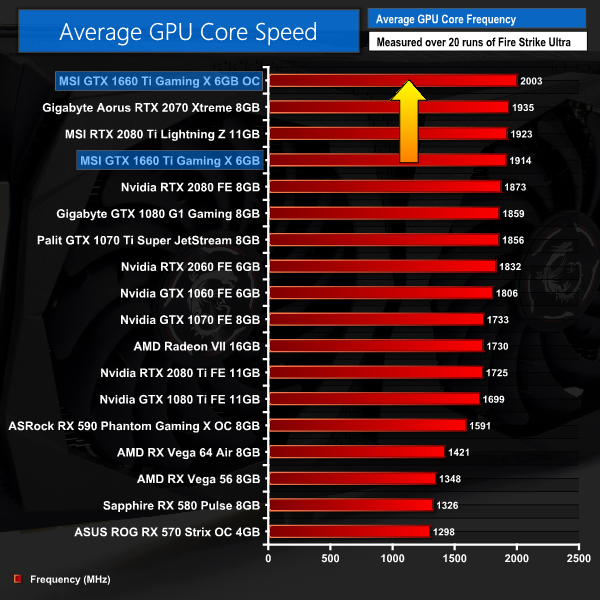
Just to confirm the real-world benefit of our overclock, we saw average clock speed under load increase from 1914MHz to 2003MHz – so we just moved beyond that 2GHz figure which is always good to see.Here, we take a further look at the impact of our overclock, looking at the increased temperatures, acoustics and power draw.
Temperatures
Acoustics
Power consumption
Overview
Despite the impressive real-world gains we saw from overclocking the Gaming X, the card hardly suffered as a result. The core only ran 2C hotter at 66C – still an excellent temperature – and noise levels increased by a single decibel. Bearing in mind how quiet the Gaming X is in the first place, you can still hardly tell that the card is actually running.
Lastly, power consumption did rise – but only by 11W, bringing total power draw up to 191W at the wall. This is still less than GTX 1070 and RTX 2060, despite this card performing almost on par with the 2060 when overclocked.With Nvidia not manufacturing a GTX 1660 Ti Founders Edition card, for launch day we have analysed the MSI GTX 1660 Ti Gaming X 6G. The 1660 Ti uses a new GPU from Nvidia, named TU116, and this is definitely most notable for its distinct lack of any Ray Tracing or Tensor cores – meaning this is very much a GTX card, not RTX as there is no scope for ray tracing or the AI-driven DLSS.
That very much puts the emphasis on traditional rasterised game performance, and it is actually very easy summarise just how well this GTX 1660 Ti performs, as it is essentially on par with stock GTX 1070. At 1080p and 1440p, for instance, the MSI 1660 Ti is 2% faster than the GTX 1070 Founders Edition that launched back in 2016. We do have to mention that the Gaming X model is indeed a factory overclocked card – with a 105MHz clock speed advantage over reference 1660 Ti speeds, so we can expect reference cards to perform a little slower, but I'd suggest not by more than 5% at worst.
To give you a bit more context for this 1660 Ti's performance, it is on average 11% slower than RTX 2060, and 10% slower than Vega 56. That shows there is not much of a gap between 1660 Ti and RTX 2060, and as we will get to below, this shrinks even more when manually overclocking. For one final comparison, this Gaming X is on average 36% faster than a GTX 1060 Founders Edition.
That means, overall, 1660 Ti does perform well at 1080p and 1440p resolutions. At 1080p, for instance, it would be well suited for gaming on a high refresh-rate monitor, with frame rates pushing as high as 100FPS playing Far Cry 5. 1440p gamers won't always get a steady 60FPS – with some more demanding titles' minimum frame rates dropping down into the 40FPS zone – but Battlefield V averaged over 70FPS at 1440p, so it does depend on what games you play.
In terms of MSI's Gaming X card itself, I have to say it is an all-round excellent performer. Not only did it peak at just 64C under full load – making it one of the coolest running cards we have tested over the past six months – but it is just whisper-quiet. In fact, noise levels are so low that you'd have to have your head just inches away to actually hear the fans spinning. With this card in a case, under your desk? There's no chance you'd be able to hear it.
Power consumption is also very low, with our system drawing 179W from the wall. That's only 4W more than the GTX 1060 pulls, and almost 30W less than the GTX 1070, despite the Gaming X actually being the (very marginally) faster card. There's no denying Nvidia is leading the market when it comes to power efficiency.
We already mentioned the Gaming X 1660 Ti is a factory overclocked model, so I was pretty happy when I could manually add an extra 100MHz to the GPU core, with the GDDR6 memory taking an extra 875MHz. This improved 1080p frame rates to the point where our manually overclocked 1660 Ti was within touching distance of the RTX 2060 – just a couple of frames behind. I think this is likely to really help the 1660 Ti's appeal, as anyone happy to spend to a bit of time manually tuning a 1660 Ti could end up getting more-or-less RTX 2060 level performance, but without the added cost of the RTX features.
Speaking of cost, however, that does prove to be the main stumbling block to recommending the MSI Gaming X GTX 1660 Ti. That's because, at £309, this card is priced £50 higher than the baseline MSRP of £259 for GTX 1660 Ti cards. That's almost a 20% price hike, and as good as this card is, when you get to the more value-oriented end of the market it does become hard to justify the added premium that a top-end factory overclocked card demands.
Putting that price into a wider perspective, too, custom RTX 2060s like MSI's own Ventus model can be found for £329. Overclockers UK is also running a great deal at the moment, with a Sapphire Pulse Vega 56 at £279. That's only a temporary deal, but at £30 less than this GTX 1660 Ti and for about 10% better performance, it will definitely make you think twice.
To be clear, I am not saying this is a bad card – not at all. It is actually an all-round fantastic performer in terms of its noise levels, average clock speed and thermal performance. The trouble is, when GTX 1660 Ti is pushing £310, it does become hard to recommend in the face of lower-end RTX 2060s available for £329, and especially with Vega 56 well under £300 as well.
I wouldn't take that thinking and apply it to all GTX 1660 Ti models, though. It's hard to say without testing any yet, but I would think cards available at the £259 MSRP are likely to offer much better overall value, especially if you can find one that overclocks to around 2GHz to effectively match the RTX 2060 in terms of rasterised performance.
For now, though, what we can say about the MSI GTX 1660 Ti Gaming X 6G, is that is probably one of the fastest, coolest and quietest GTX 1660 Tis we will test this year. Unfortunately, its added price premium puts it at a significant disadvantage compared to 1660 Tis priced at £259, especially with the deals that can now be had with RTX 2060 and Vega 56.
We don't yet have a buy-link for this card, but will update the review when we have one. MSI told us the MSRP is £309.99.

Update: The Gaming X is now available from Overclockers UK for £299.99 HERE.
You can also browse a variety of 1660 Ti models on Overclockers UK HERE.
Pros
- Ran at over 1900MHz out of the box.
- Dead quiet.
- GPU temperatures peaked at just 64C.
- Draws almost 30W less than GTX 1070, despite being faster.
- Manually overclocked, we effectively matched RTX 2060 performance.
Cons
- £50 more expensive than baseline GTX 1660 Tis.
- Aftermarket RTX 2060s start at £329, Vega 56 is currently on offer for £279.
KitGuru says: GTX 1660 Ti definitely has scope to be worth buying at its baseline MSRP of £259. This MSI Gaming X card, at £310, is much harder to justify in the face of entry-level RTX 2060 and current deals running for Vega 56.