KitGuru KitGuru.net – Tech News | Hardware News | Hardware Reviews | IOS | Mobile | Gaming | Graphics Cards


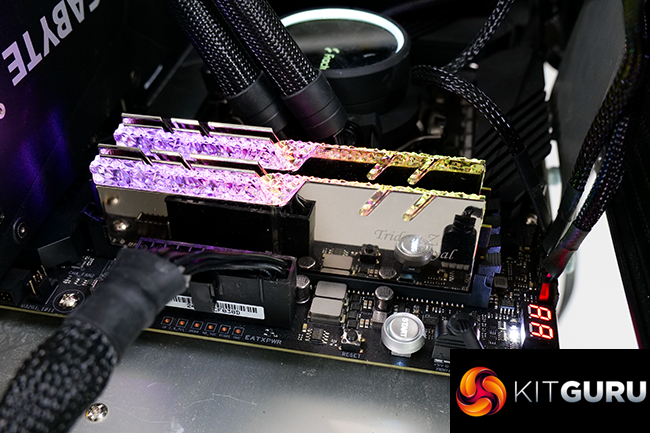
G.SKILL's Trident Z Royal memory brings 4000MHz C17 operating frequency in a 32GB dual-channel, dual-rank form using Samsung B-die ICs. What more could you ask for? Great aesthetics and a mirror-finish aluminium heatspreader sound good? Let's take a closer look at this ultra-premium set of DDR4 memory.
Video Timestamps:
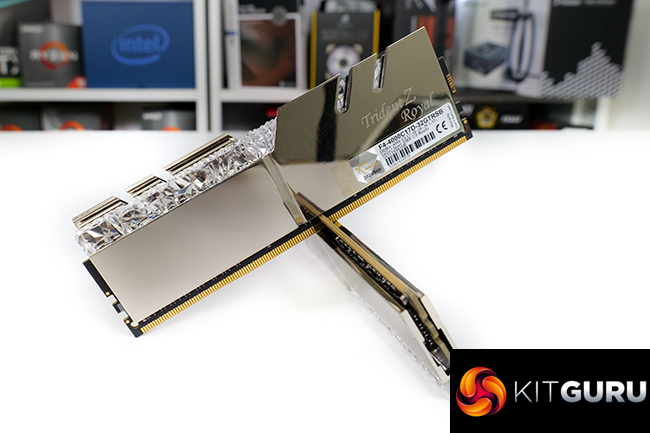
As we already mentioned, the specs are impressive! DDR4 4000MHz operating frequency supporting XMP, dual-channel 2x16GB 32GB kits using dual-rank modules, 17-18-18-38 rated timings at 1.4V operating voltage. These are impressive numbers, even for a high-end memory kit.
And under the heatspreader, you get Samsung B-die memory ICs which we know are still loved and highly regarded for both Intel and AMD setups.
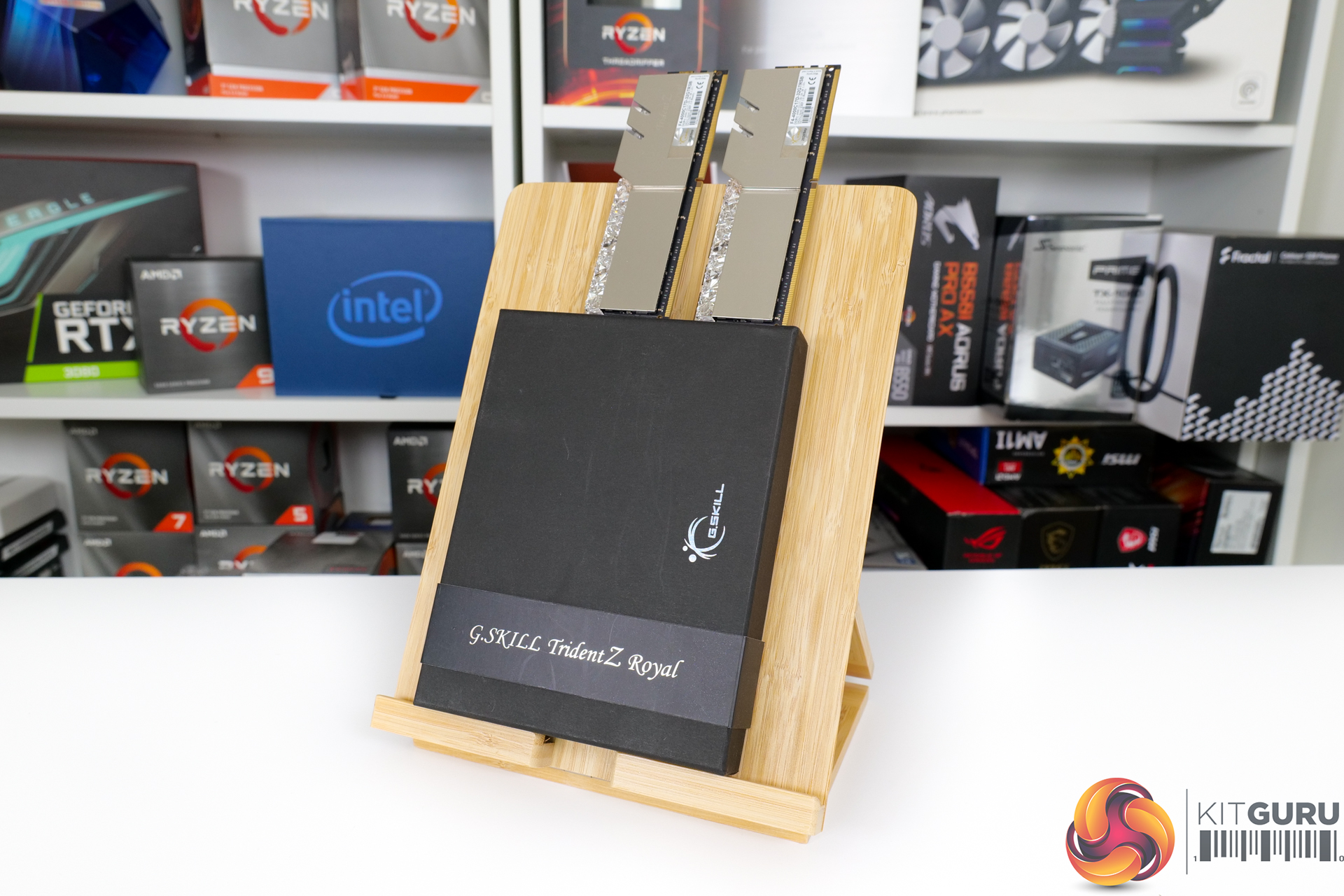
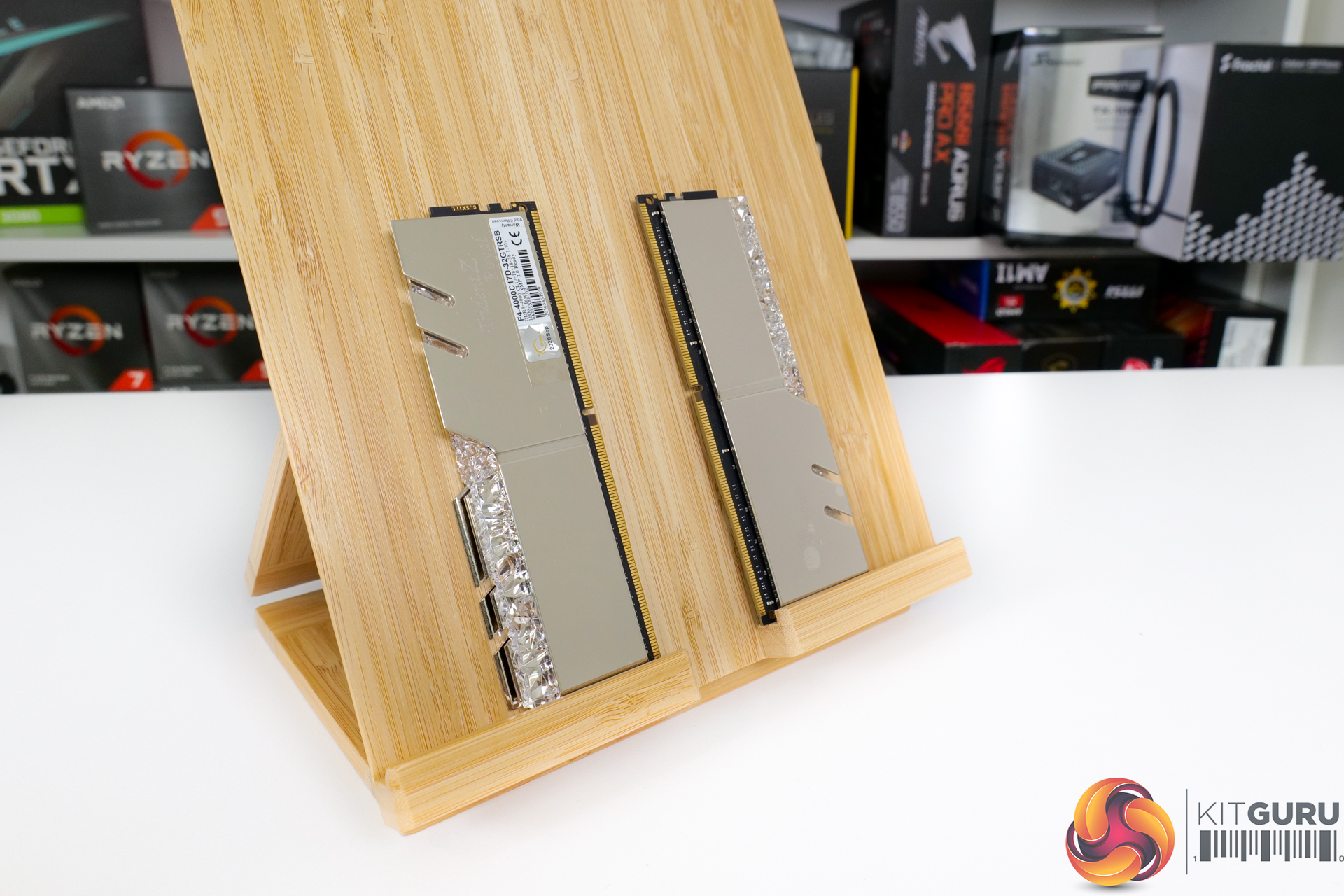
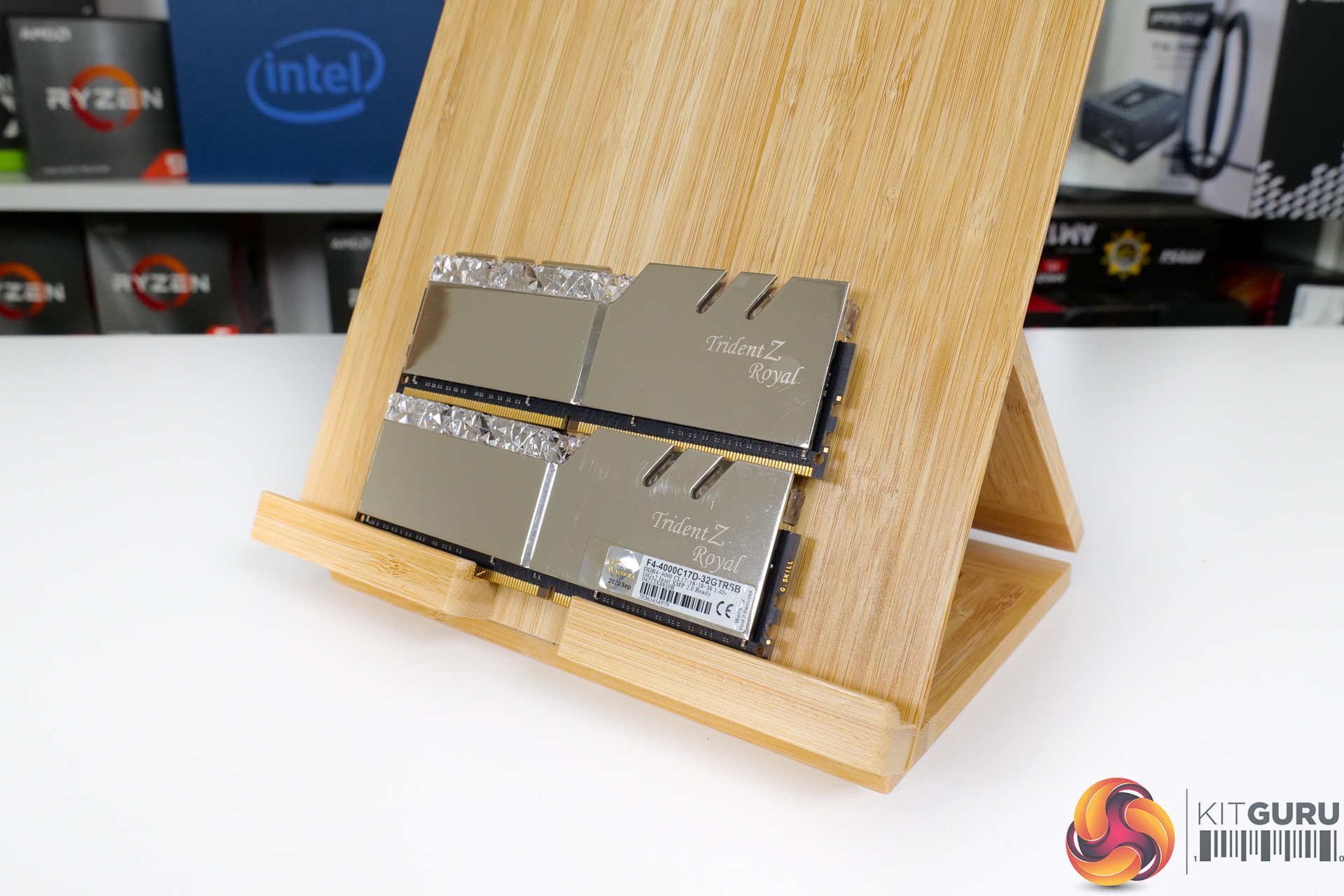
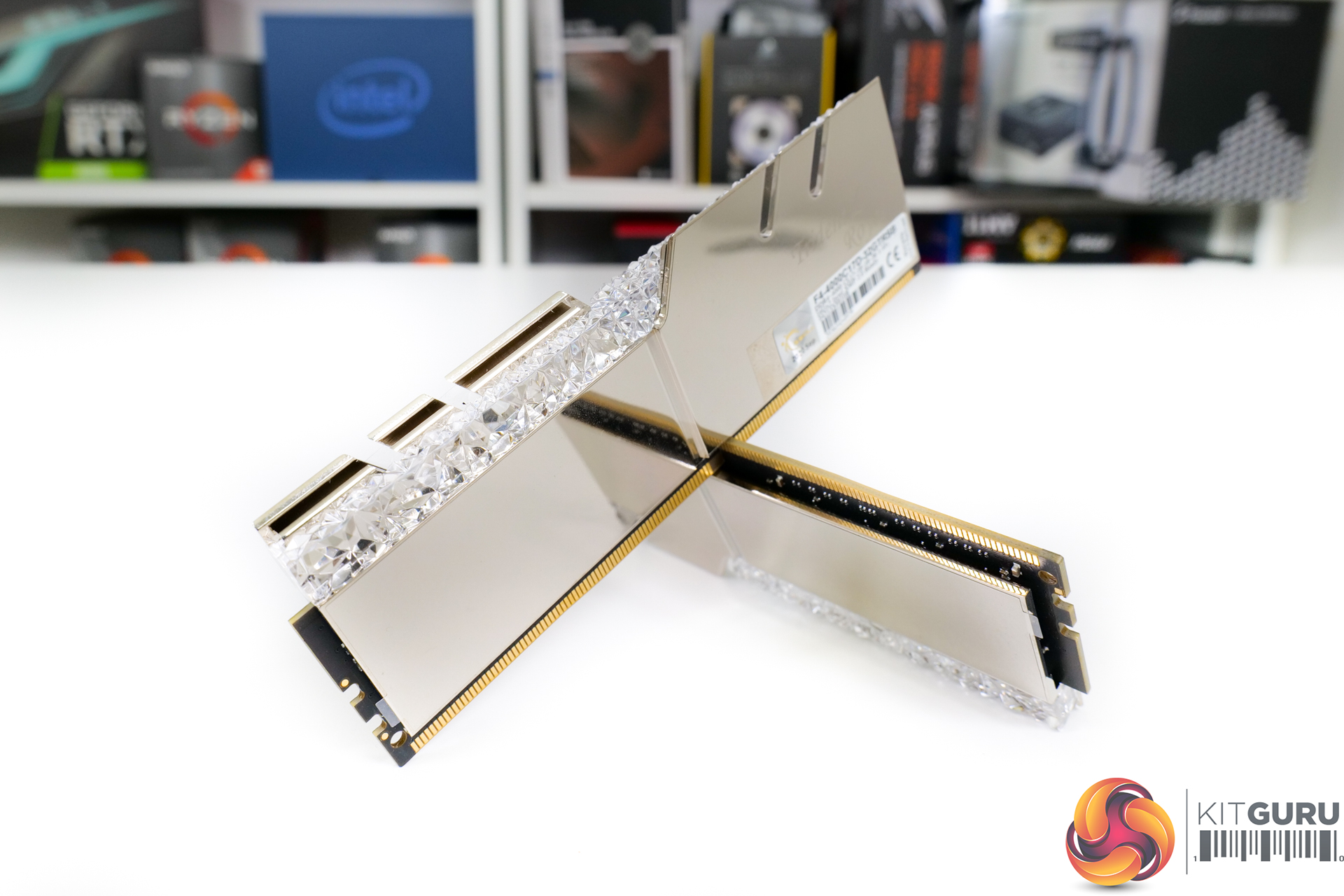
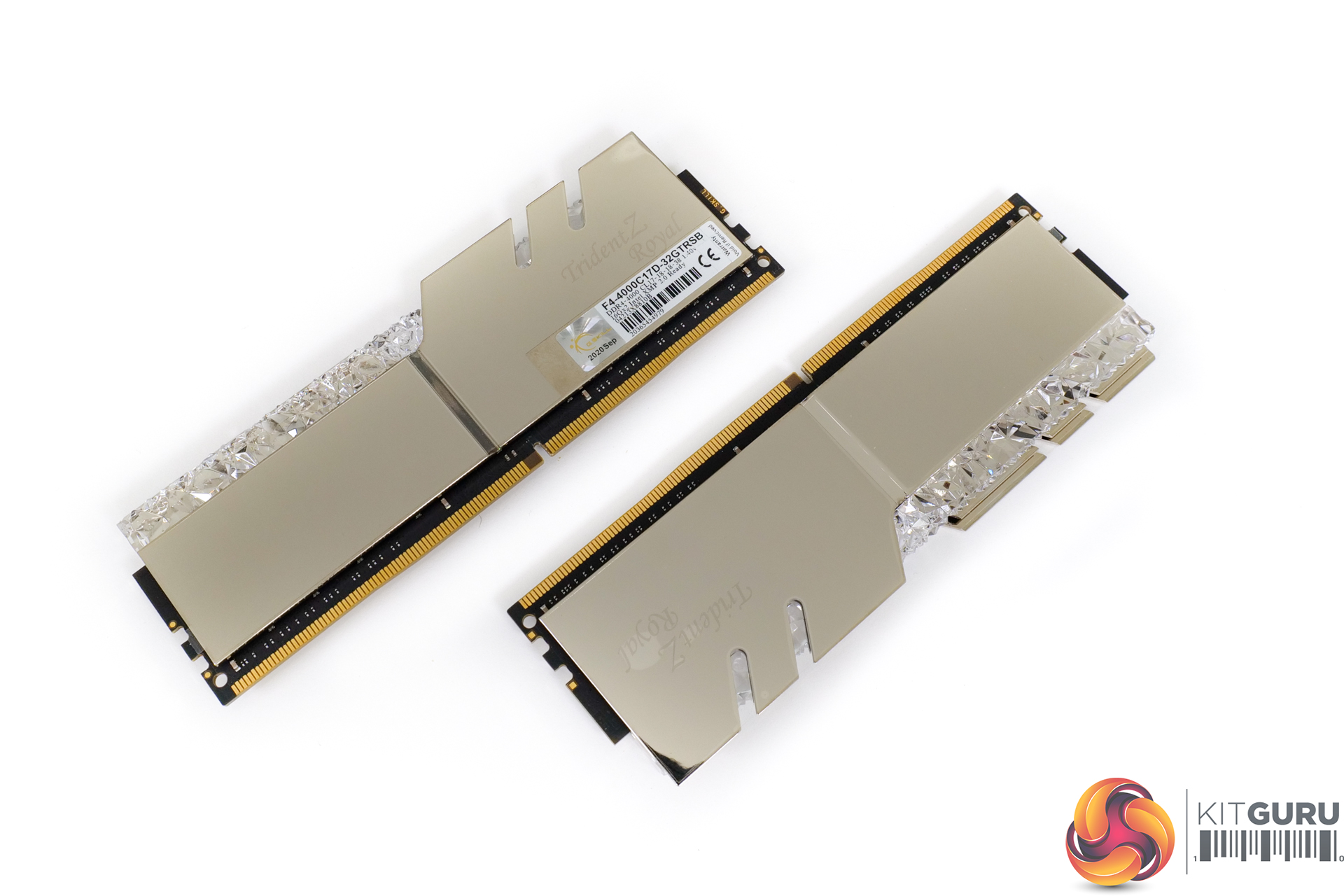
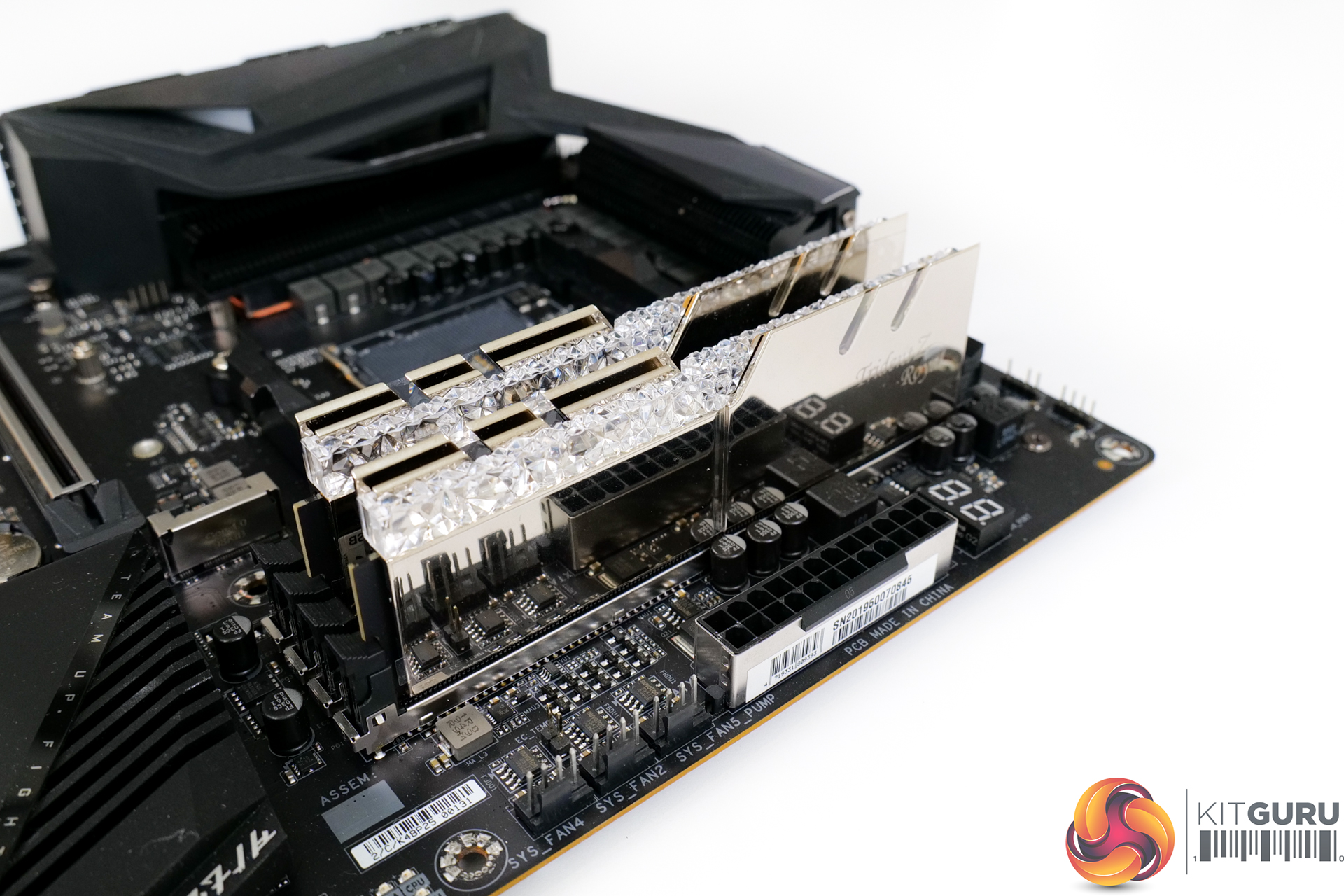
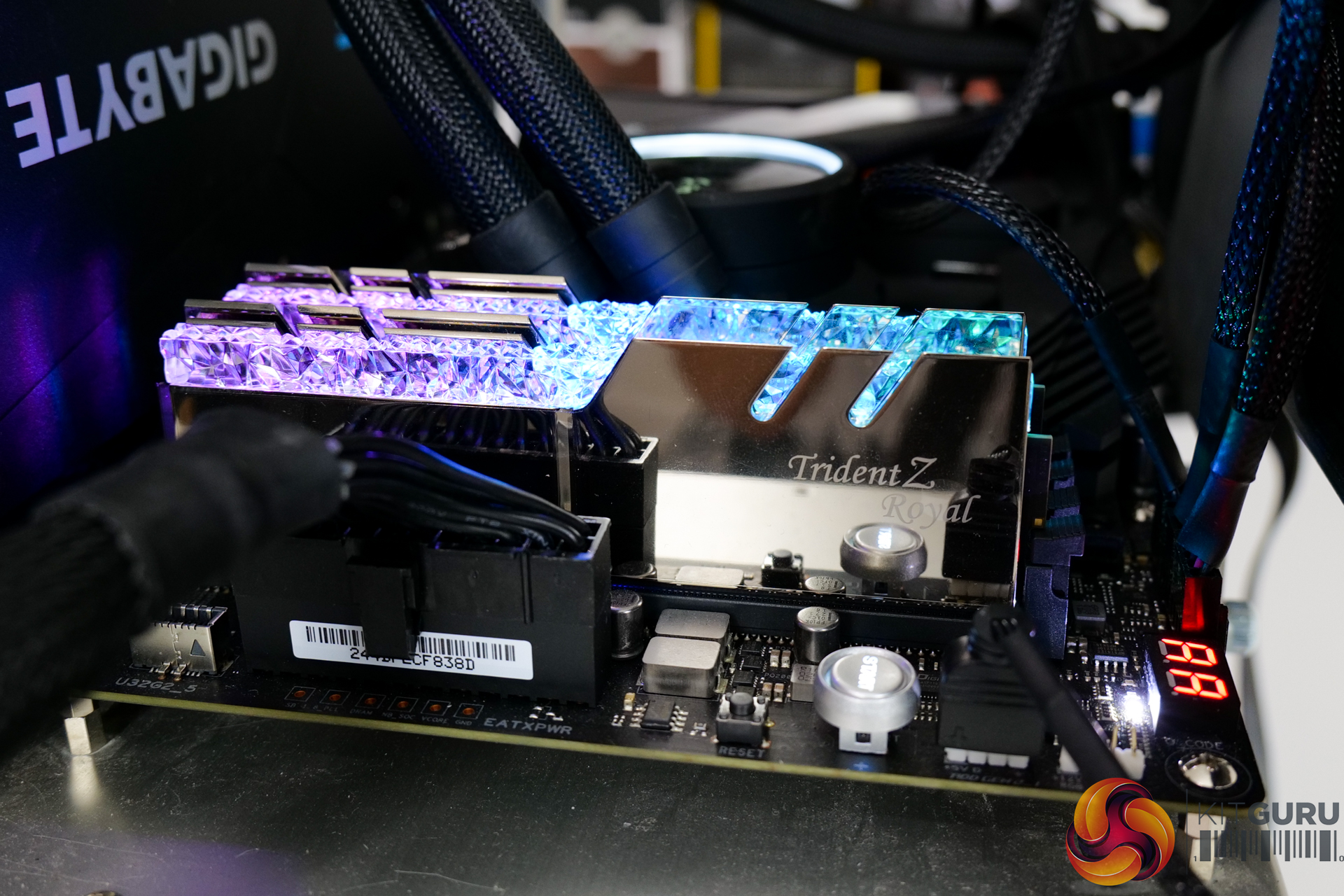
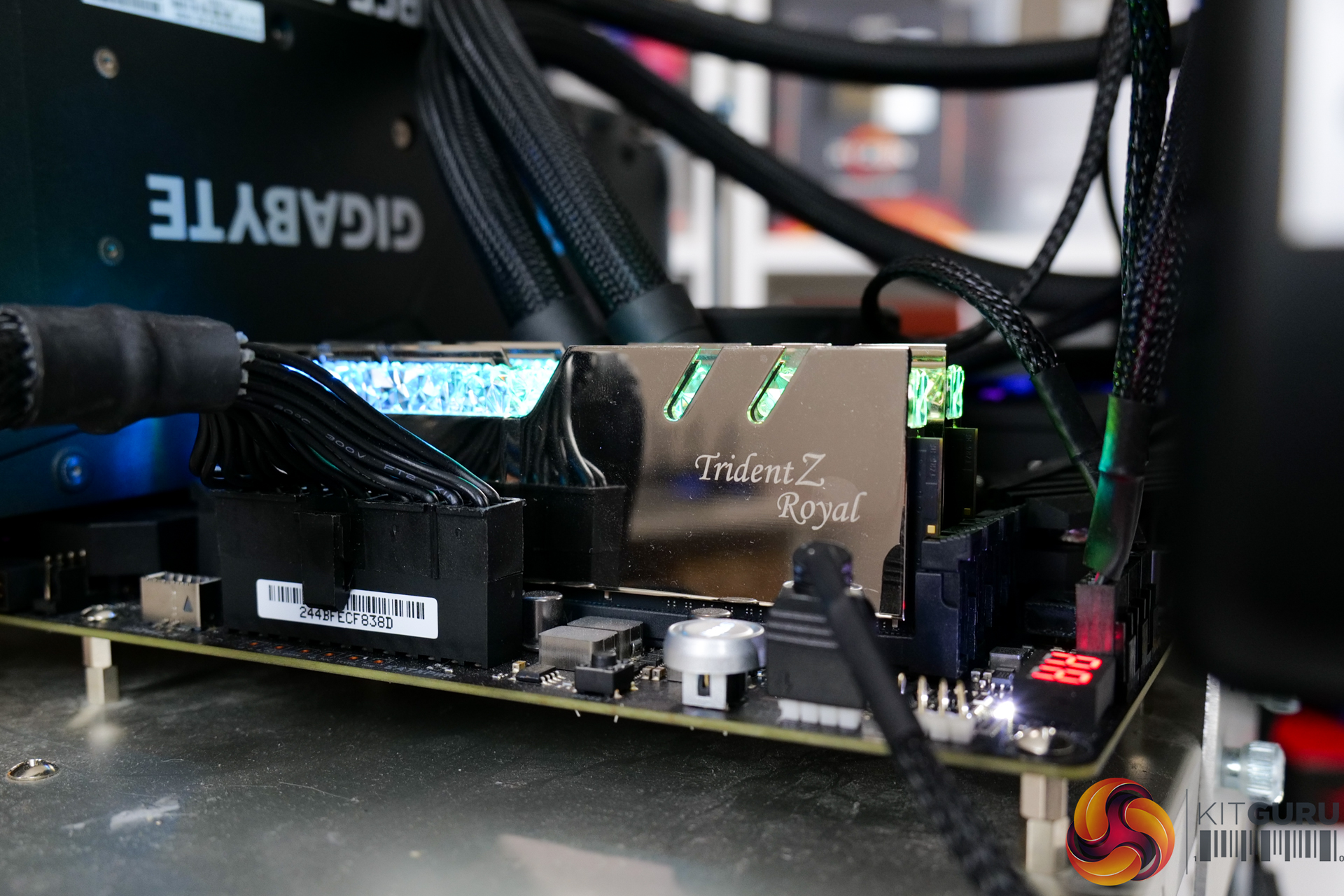
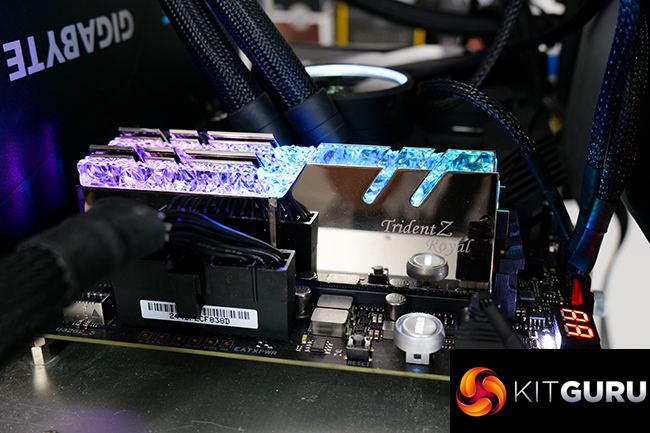
In terms of styling, it is the usual Trident Z aesthetic but with the Royal flair added. That tri-fin heatspreader design continues to look absolutely fantastic in my opinion, and it feels sturdy and well built. At 44mm tall, the overall module height is very reasonable by today's standards.
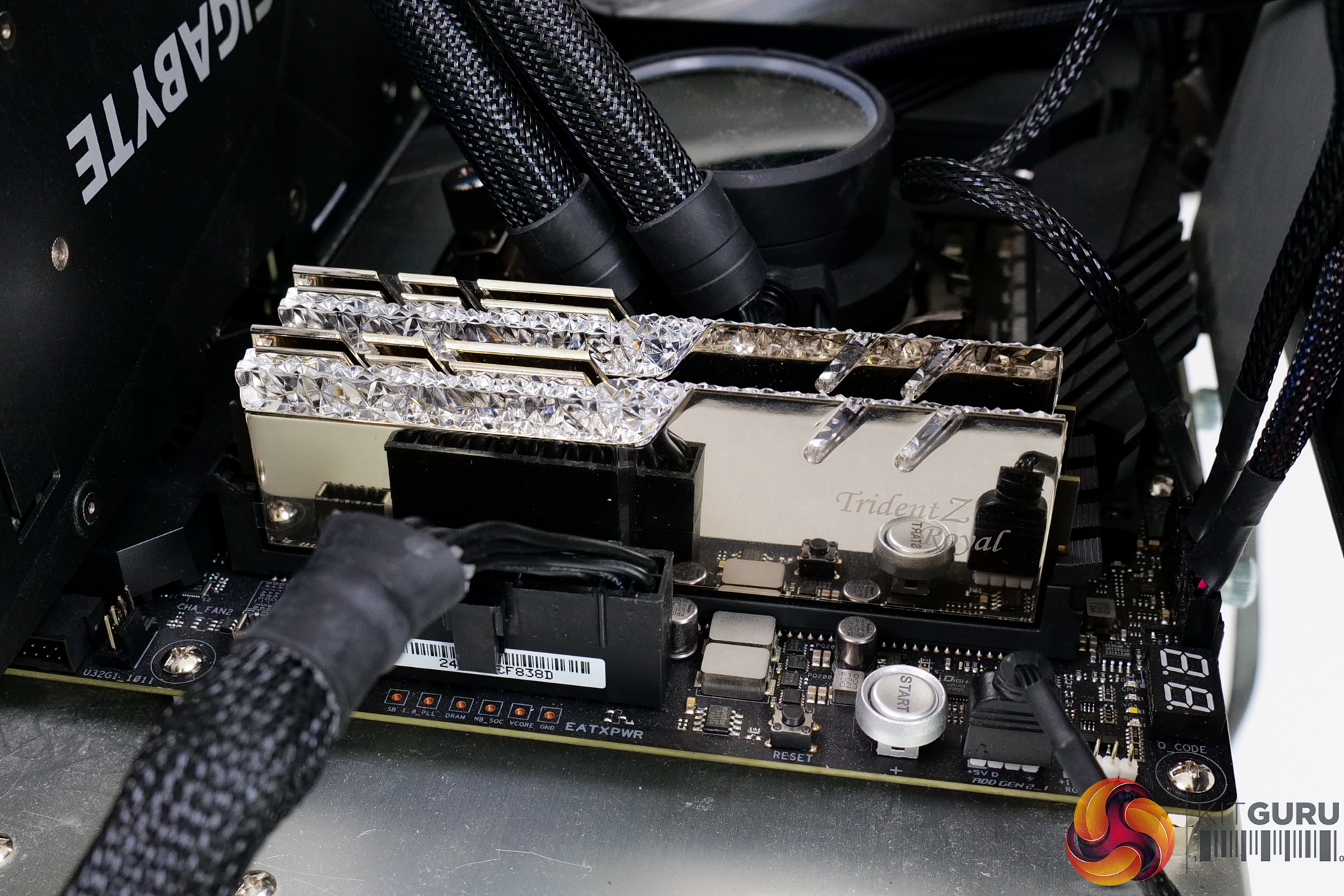
Looking at the physical modules, G.SKILL uses a heavily polished, electroplated aluminium heatspreader that is silver in colour for our specific test kit. The sheet of metal is so heavily polished and so reflective that G.SKILL actually includes a cleaning cloth as part of the bundle. Touch these modules bare-handed at your own peril!
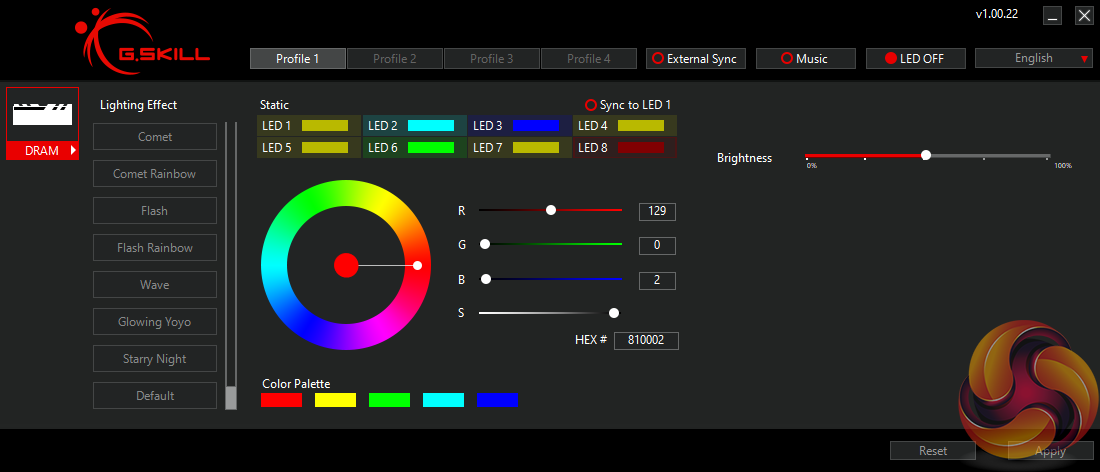
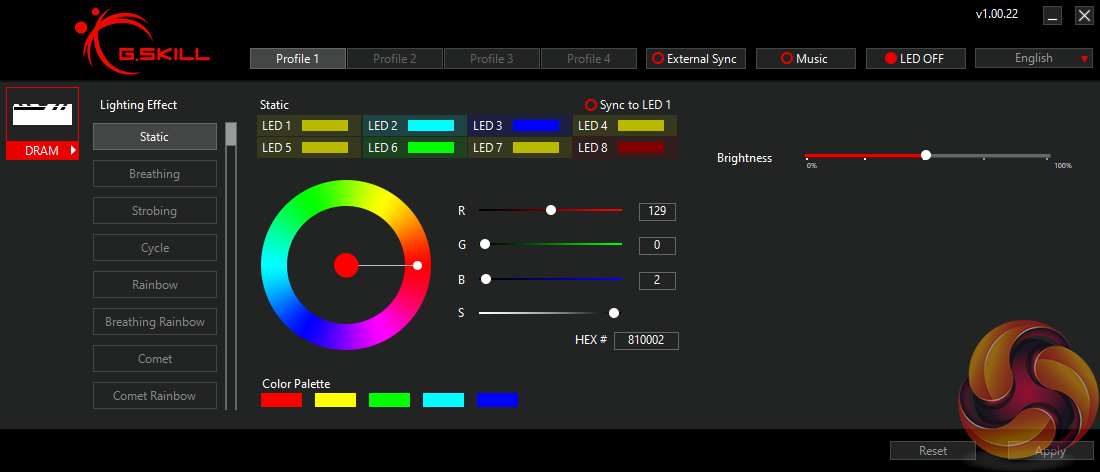
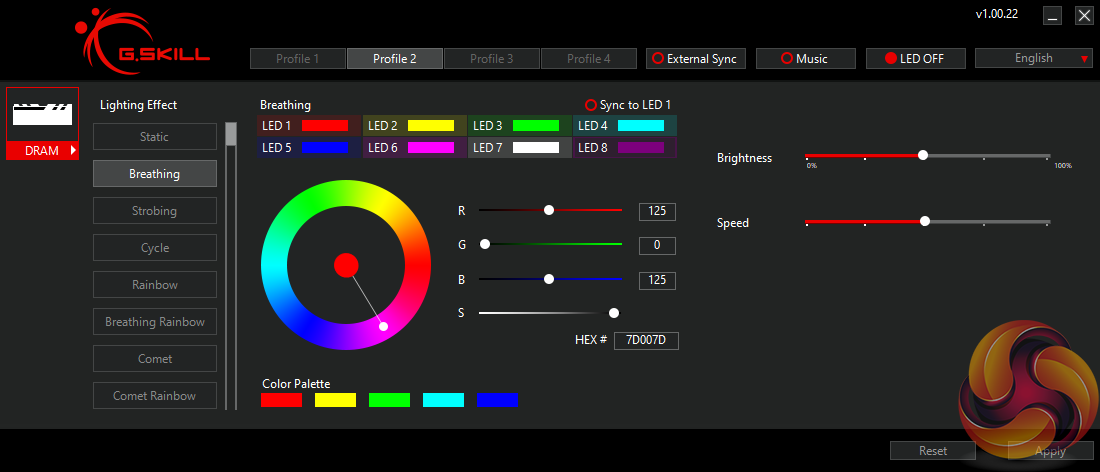
LED lighting is handled via 8 controllable RGB zones atop the module. G.SKILL uses a ‘crown jewel’ design crystalline light bar that is certainly unique in terms of appearance. Without colour applied, the jewel-type appearance works well with our kit’s shiny silver heatspreader.
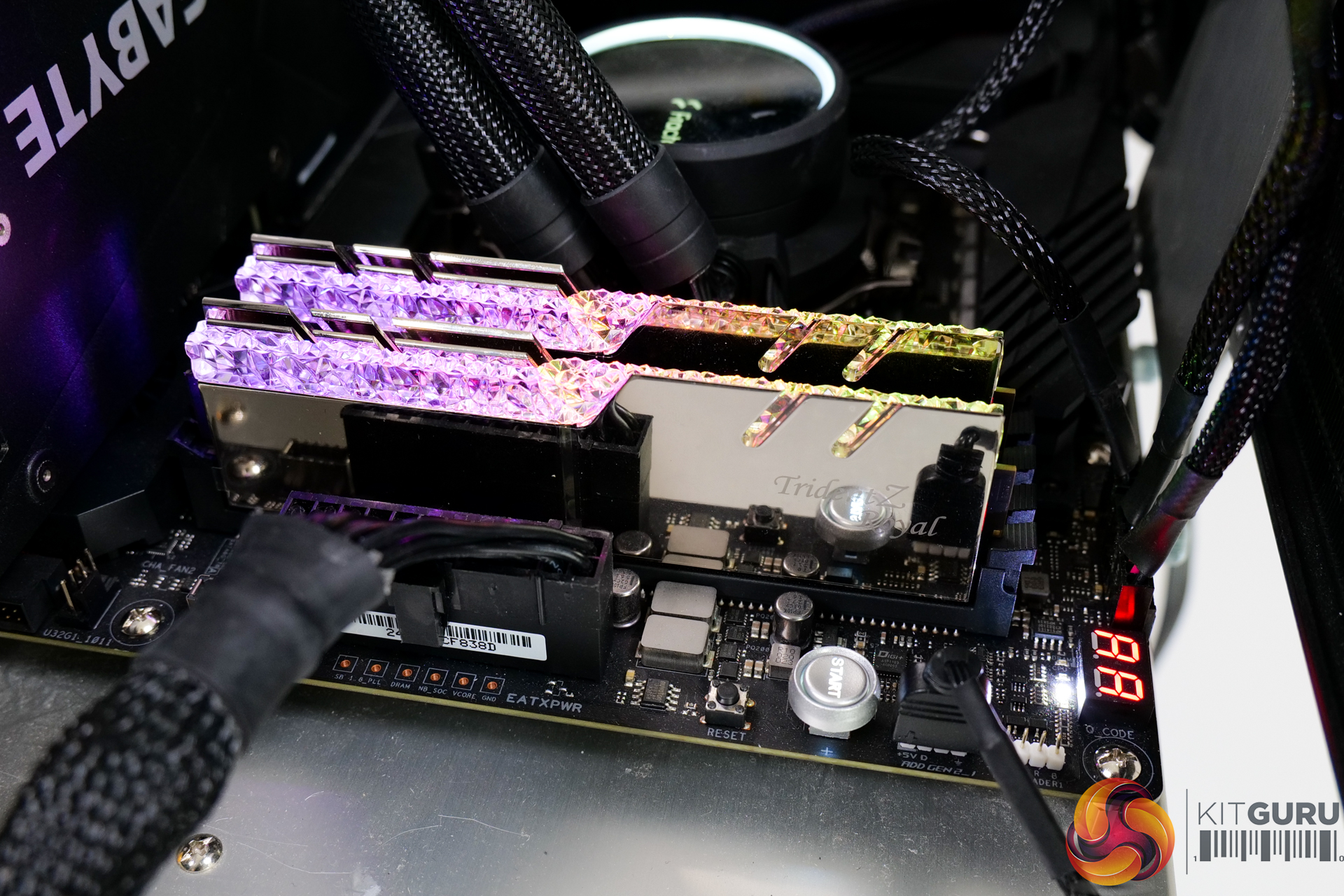
With RGB lighting applied, the aesthetics are taken a whole different level, in our opinion. Diffusion is excellent, brightness is superb, and the overall appearance really does tick pretty much all of the boxes for high-end, eye-catching memory sticks.

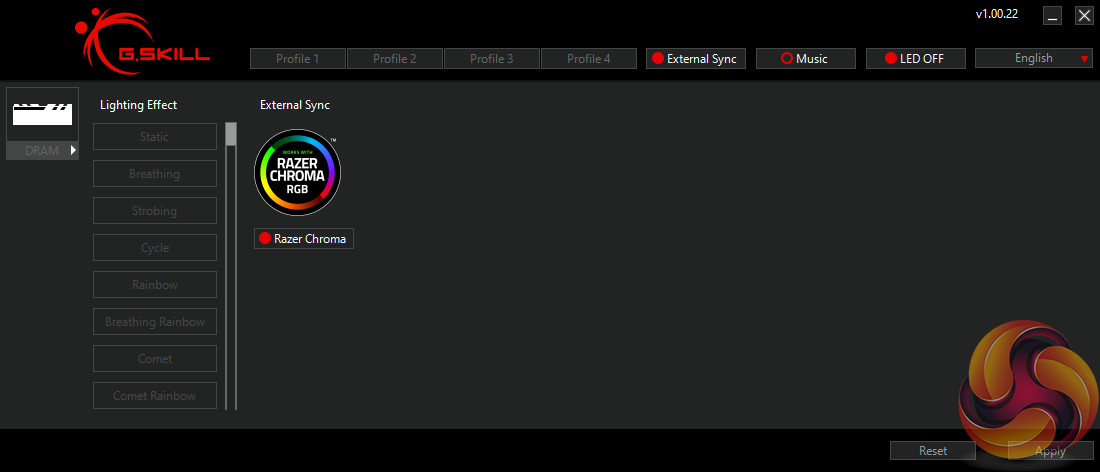
In terms of RGB synchronisation, G.SKILL does offer their own tool. It is actually reasonably comprehensive and allows individual control of the 8 LED zones. You can select a few different modes and then settings such as speed and brightness. And there is also support for Razer Chrome RGB sync.
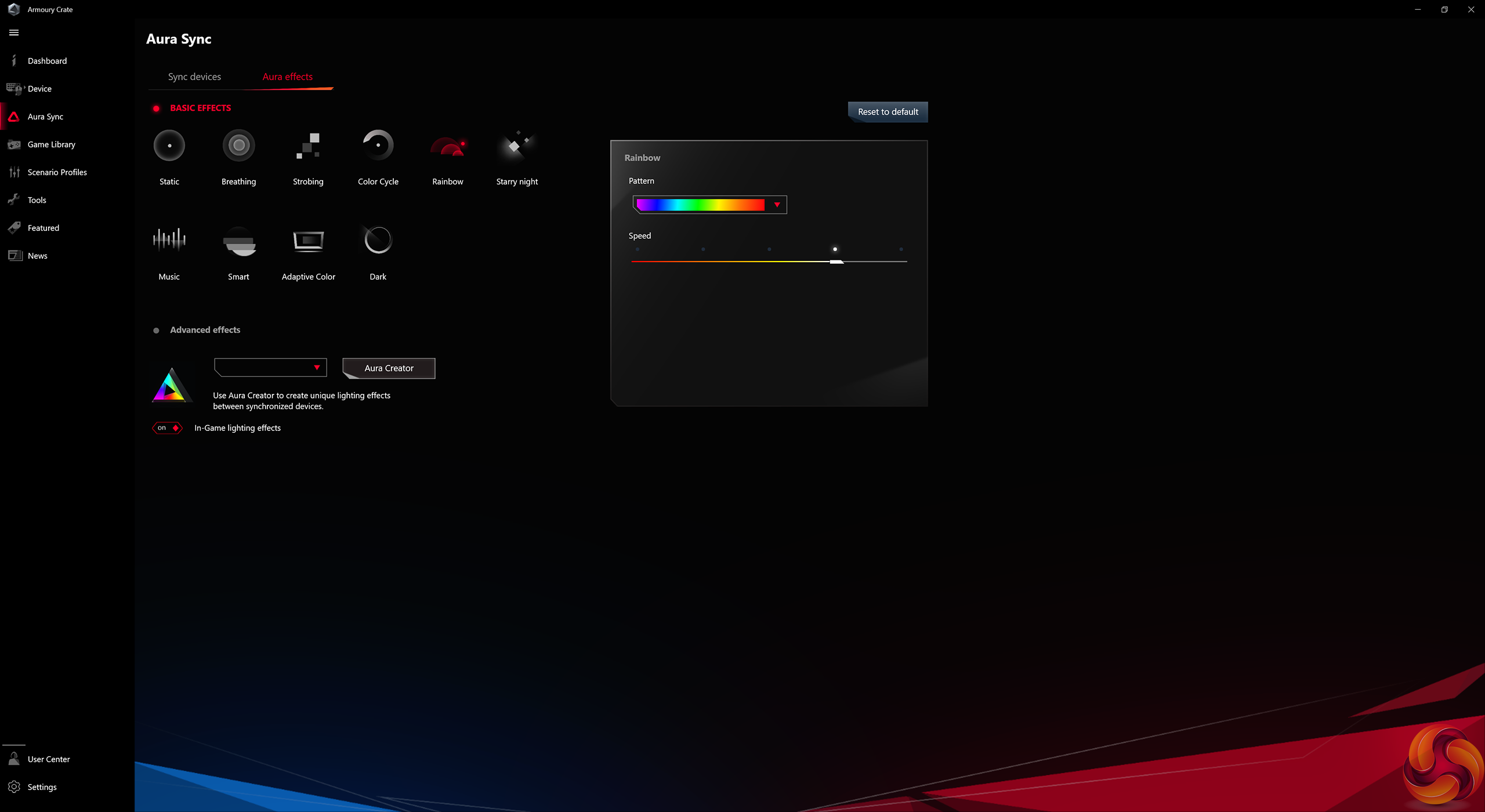
You will probably want to use motherboard vendor software for control and sync to match other components. That can be done through the individual tools which are ASUS Aura Sync, Gigabyte RGB Fusion 2.0, MSI Mystic Light Sync, and ASRock Polychrome Sync.
As is typical for G.SKILL memory in recent times, pricing and availability are pretty much non-existent in the UK. We can’t even speculate UK pricing as G.SKILL’s product line is so fractured and availability basically boils down to Amazon third-party sellers.
In the US, Newegg has the kit listed at $329.99. That is expensive but doesn’t actually seem outrageous versus comparable premium kits such as Corsair Dominator Platinum and Crucial Ballistix MAX.
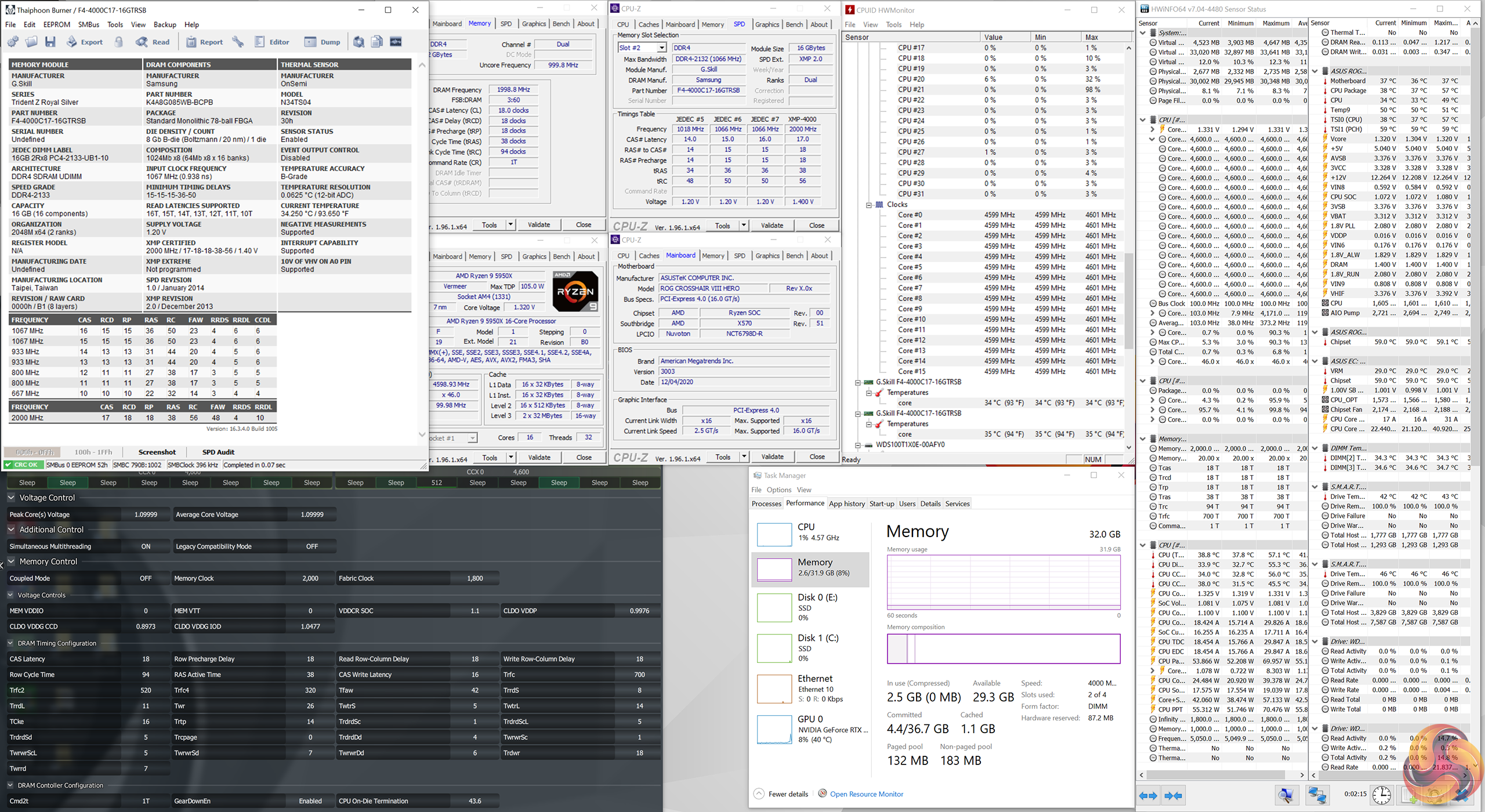
Thaiphoon burner also shows the presence of a temperature sensor from the OnSemi stable.
- Model Number: F4-4000C17D-32GTRSB
- Capacity: 32GB (2x 16GB)
- Rated Frequency: DDR4-4000MHz
- Rated Timings: 17-18-18-38
- Voltage: 1.4V
- Format: Non-ECC Unbuffered 288-pin DIMM
We will be outlining the G.SKILL Trident Z Royal DDR4 memory kit's performance with the AMD Ryzen 9 5950X CPU, ASUS ROG Crosshair VIII Hero motherboard, and a Gigabyte RTX 3080 Eagle OC graphics card.
The processor is overclocked to a static 4.6GHz to take any clock speed variability from Precision Boost 2 out of the performance equation.
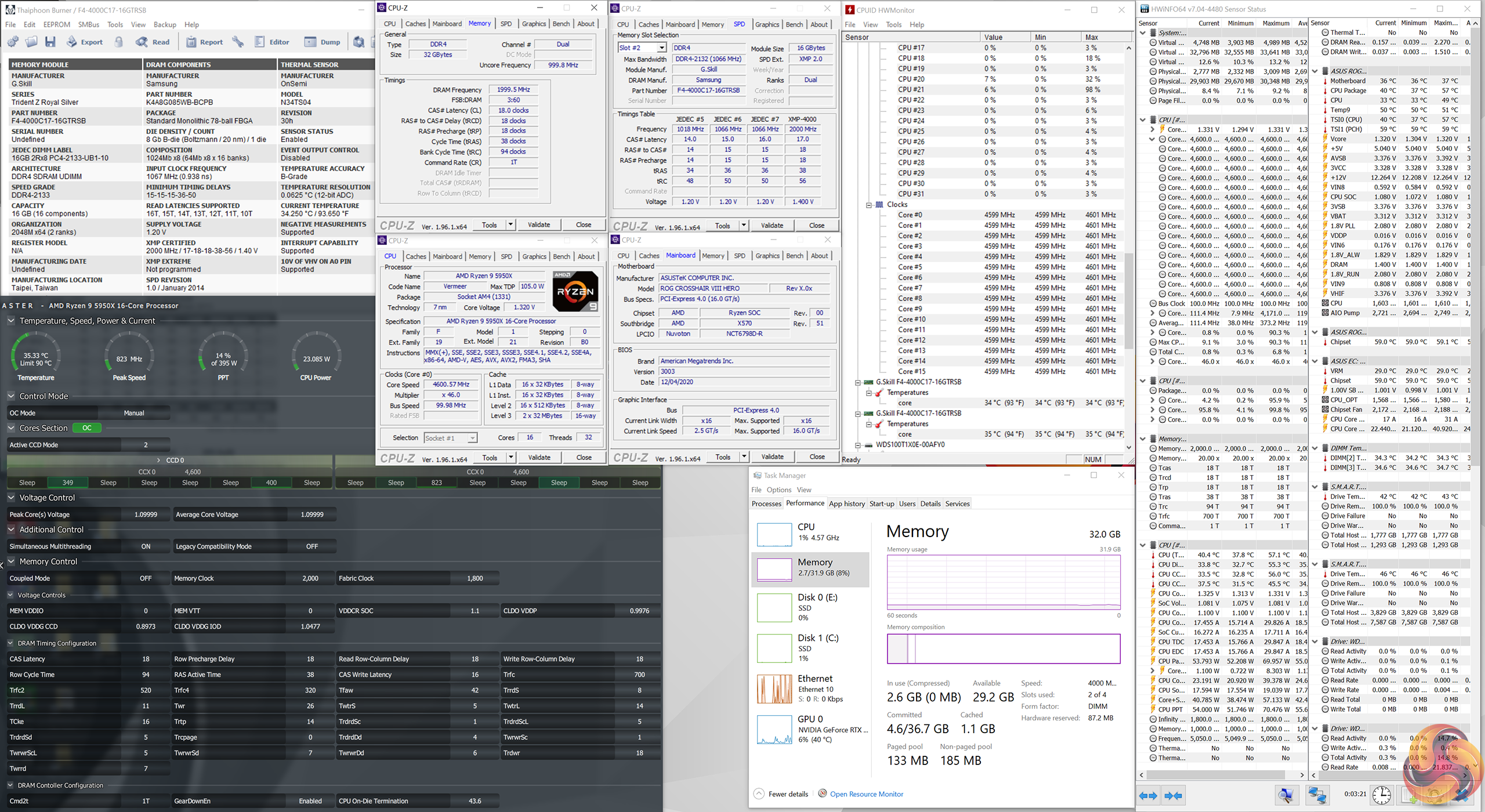
By default on AMD, 4000MHz memory will deliver a 2000MHz memory clock and therefore a 1000MHz memory controller clock due to the 2:1 divider.
If, however, we can get the Infinity Fabric clock to match the memory clock, we can also run the memory controller clock at the same speed and remove the 2:1 divider latency penalty. Unfortunately, our 5950X doesn’t want to seem to go higher than 1900 MHz for the Fabric Clock.
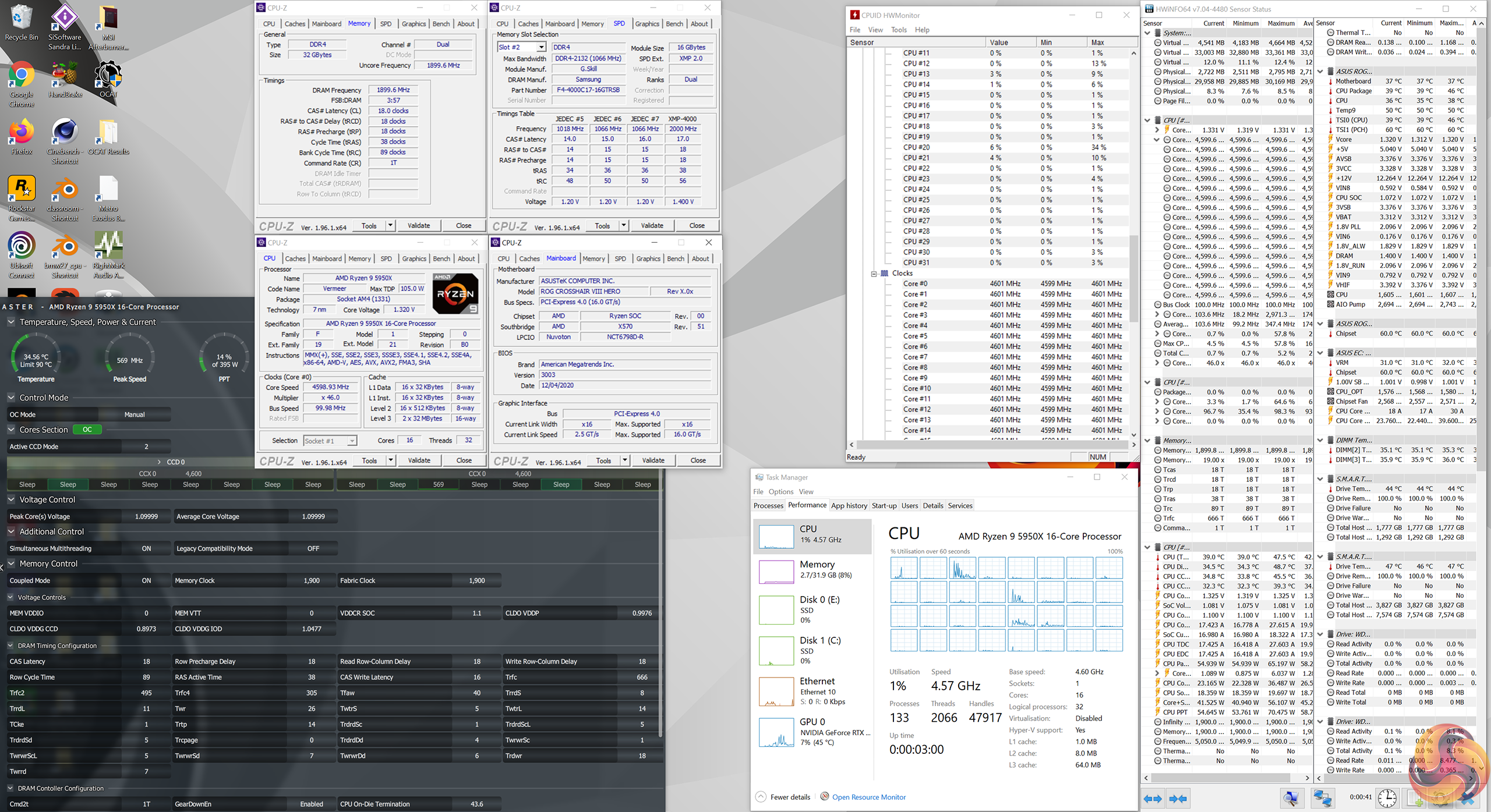
This means that we have two test procedures:
- We test the kit at stock 4000MHz XMP with the Ryzen system running without adjustment beyond a 4.6GHz CPU OC. This results in 1800MHz Fabric clock, 2000MHz memory clock, and 1000MHz memory controller clock.
- We also test with the memory running alongside a CPU configuration better tuned for high speed memory. This is 1900MHz Fabric clock, 1900MHz memory clock, and 1900MHz memory controller clock. Here, the memory was running at DDR4-3800MHz speeds.
Another minor point is that high-speed memory runs at an even numbered CAS Latency on our AMD test system. As such, the kit runs at CL18 by default under XMP conditions.
Test System:
- Processor: AMD Ryzen 9 5950X overclocked to 4.6GHz all core.
- Motherboard: ASUS ROG Crosshair VIII Hero.
- Graphics Card: Gigabyte RTX 3080 Eagle OC.
- System Drive: WD_Black SN750 SSD.
- CPU Cooler: Fractal Celsius+ S28 Prisma 280mm AIO.
- Power Supply: Seasonic Prime TX-1000 1000W.
- Case: Lian Li Open-air Test Bench.
- Operating System: Windows 10 Pro 64-bit.
Comparison Memory Kits (1:1:1 FCLK:UCLK:MCLK where applicable):
- 2x16GB Corsair Vengeance LPX 3600MHz 16-18-18-36 (Samsung B-Die ICs, dual rank configuration)
- 2x8GB Klevv Bolt XR & Cras XR RGB 4000MHz 18-25-25-45 (Hynix DJR ICs, single rank configuration)
- 2x16GB Patriot Viper Steel RGB 3600MHz 20-26-26-46 (Hynix AFR ICs, dual rank configuration)
- 4x8GB Corsair Dominator Platinum RGB (White) 3600MHz 18-19-19-39 (Micron E-die ICs, effective dual rank configuration)
- 2x32GB Patriot Viper Steel 3600MHz 18-22-22-42 (SpecTek MT40 ICs, dual rank configuration)
- 2x16GB Corsair Vengeance RGB Pro SL 3600MHz 18-22-22-42 (Micron D9XPF B-die ICs, single rank configuration)
Tests:
- 7-Zip – Built-in 7-Zip benchmark test (CPU & Memory)
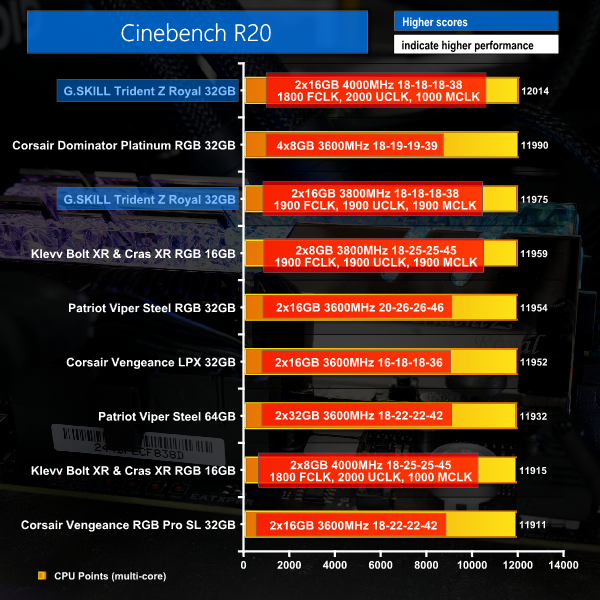
- Cinebench R20 – All-core & single-core CPU benchmark (CPU & Memory)
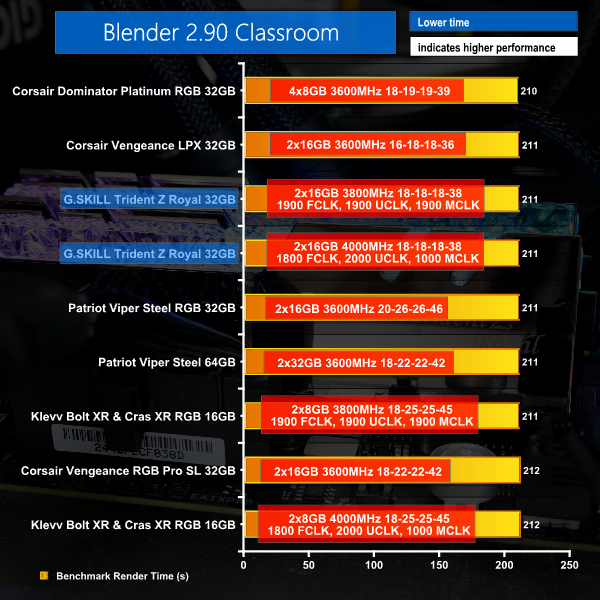
- Blender 2.90 – All-core rendering of the Classroom benchmark (CPU & Memory)
- SiSoft Sandra – Memory bandwidth (Memory)
- AIDA64 – Memory bandwidth, memory latency (Memory)
- 3DMark TimeSpy – Time Spy (1440p) test (Gaming)
- Shadow of the Tomb Raider – 1920 x 1080, Highest quality preset, no AA, DX12 version (Gaming)
Compute and Productivity Tests
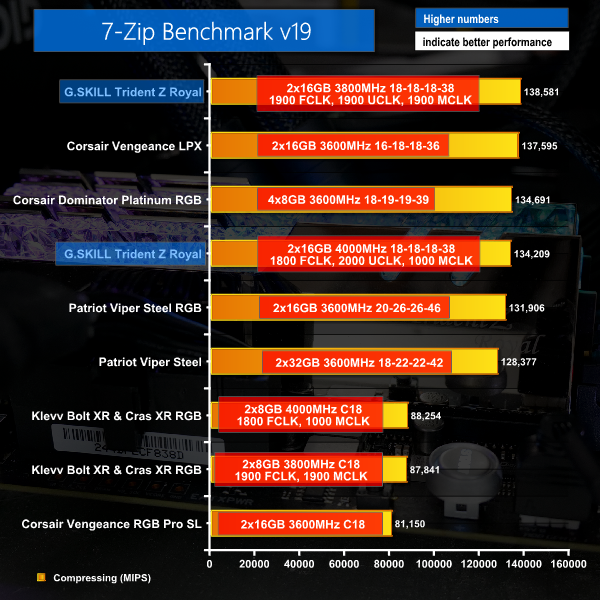
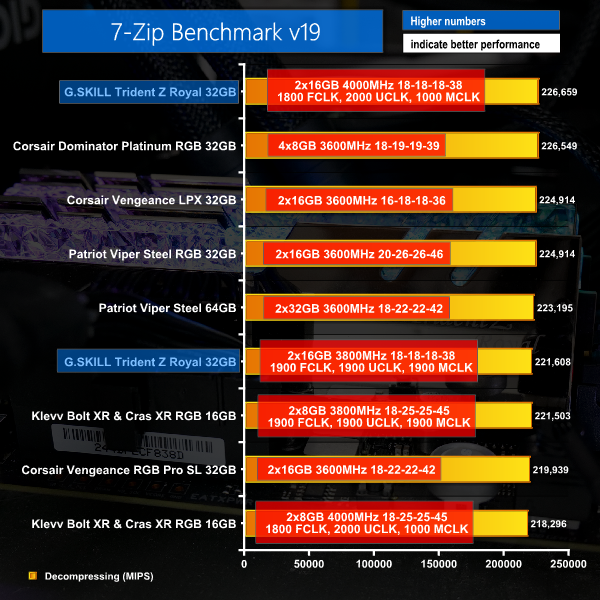
7-Zip compression performance absolutely flies with the dual-rank G.SKILL kit running at 3800MHz C18. Even a reduced CPU memory controller clock, the 4GHz performance is still strong. Focusing on decompression, the 4GHz set enjoys a chart-topping result here, beating out Corsair’s fast 3600MHz kits in our data set.
Blender is very CPU heavy and shows basically no performance difference between these high-speed kits of memory. Similar can be said for Cinebench R20 nT, though G.SKILL does manage impressive first and third place finishes.
Memory Benchmarks
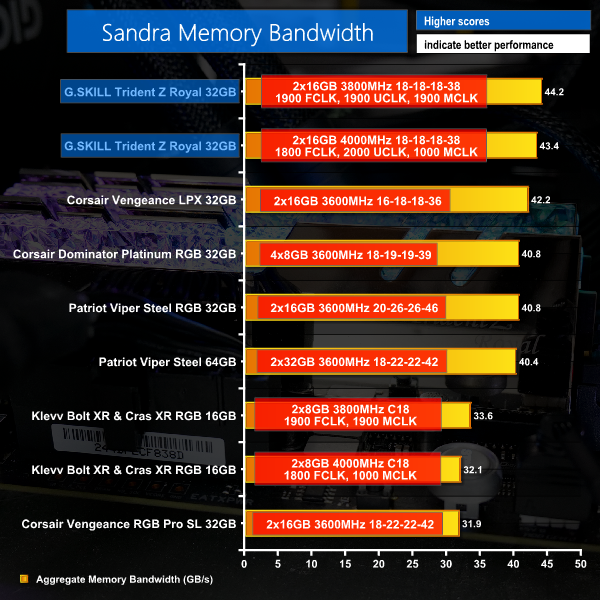
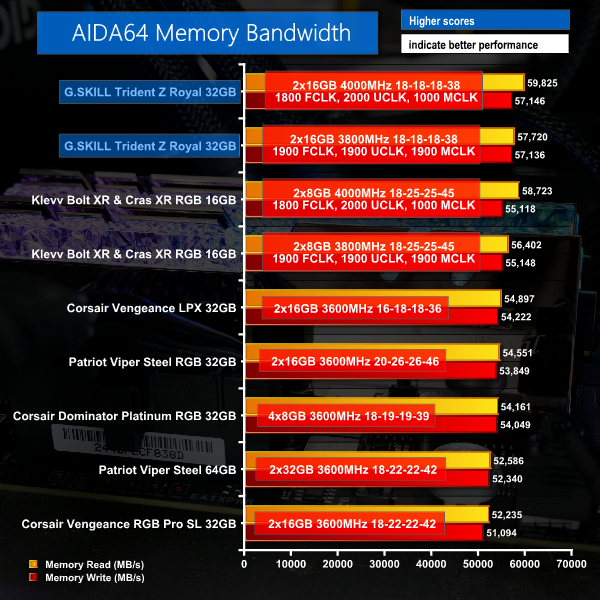
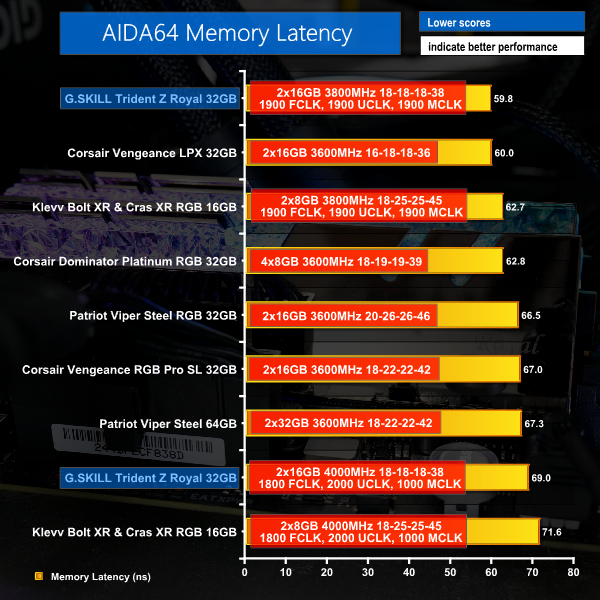
Memory bandwidth is where high-speed, dual-rank DDR4 does well, especially if the AMD CPU Memory Controller clock is running at a solid frequency.
And the latency performance from the 3800MHz C18 test runs is heavily impressive; Corsair’s slick 3600MHz C16 kit is effectively matched at the top of the chart by G.SKILL’s Trident Z Royal.
Gaming Tests
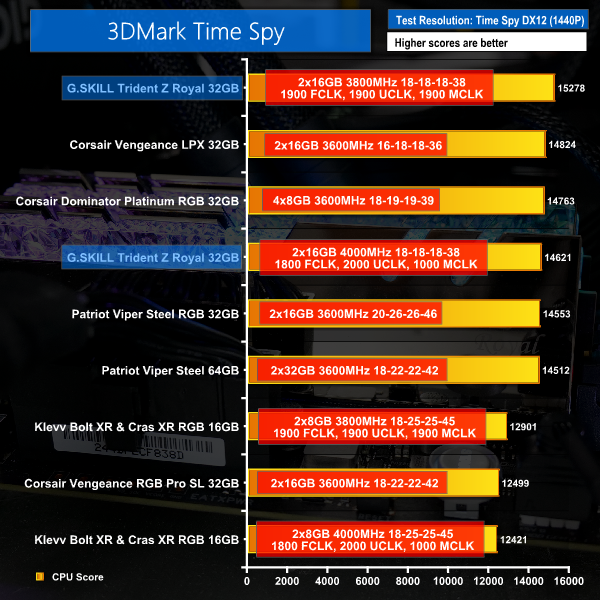
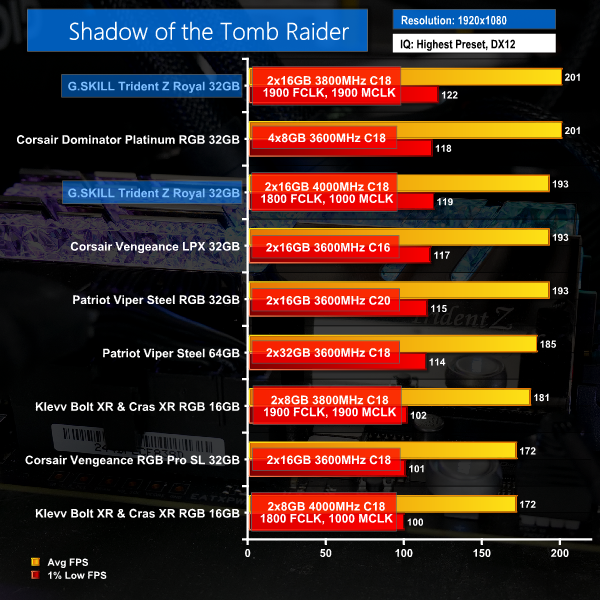
In 3DMark, we once again see a chart-topping showing from the G.SKILL memory running at 3800MHz C18 with the 1.9GHz memory controller clock function.
And the same high level of performance is maintained in Shadow of the Tomb Raider when at 3800 C18.
Overclocking
In terms of overclocking, we actually had a very good deal of success from the G.SKILL Trident Z Royal modules.
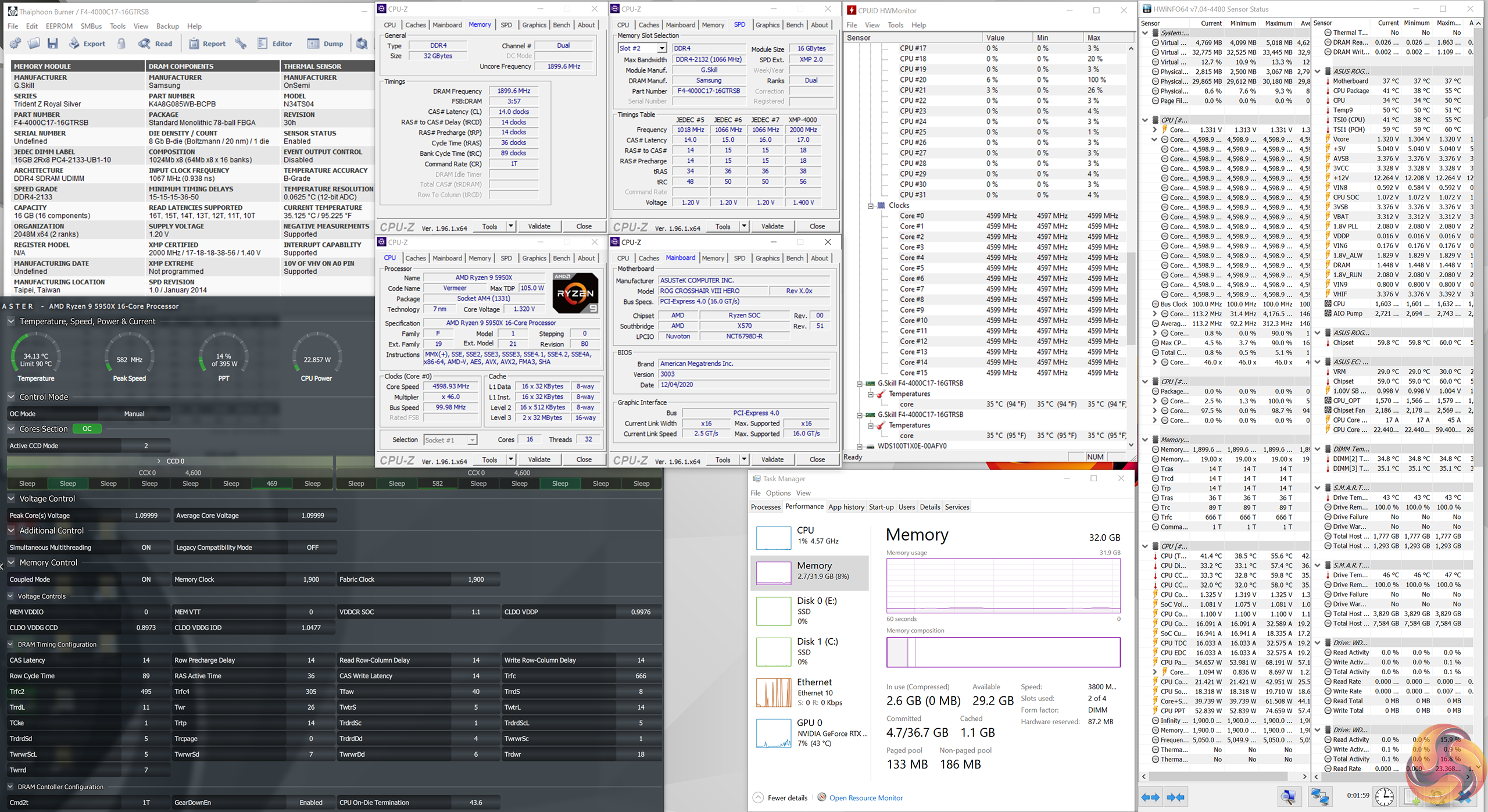
The best result that we reached with our voltage limit of 1.45V was 3800MHz 14-14-14-36. This represents a solid improvement over the stock 17-18-18-38 timings.
3800MHz 14-14-14-36 at 1.45V is a quick-and-dirty overclock that we were happy with. Better yet, it allowed us to maintain the preferential 1:1 1900MHz IF and memory controller clock frequency.
How could you possibly not love Samsung B-die? It is just awesome!
To summarise nice and briefly – because there really isn’t all that much that needs to be said – the G.SKILL Trident Z Royal memory is absolutely superb.
Our 4000MHz C17 kit delivered excellent performance when ran at the preferential 3800MHz clock speed with 1900MHz CPU tie-in frequencies. In most cases, the 2x16GB set of dual-rank modules delivered chart-topping performance. And overclocking to 3800MHz 14-14-14 at 1.45V was another boost that we were very happy to see.
Aesthetics and styling are absolutely fantastic, in my opinion. I personally have essentially zero gripes with the overall appearance and attention to detail paid by G.SKILL. Perhaps the 44mm module height will be an issue for some, though that’s unlikely. Oh, and the mirror-finish aluminium heatspreaders are fingerprint magnets, but a cloth for wiping off grubbiness is included.
And in terms of RGB lighting, this is once again excellent. The brightness is strong, that unique crystalline diffuser effect looks cool and works well, and the control through various software suites is positive.
Basically, I am struggling to see any real downsides for the Trident Z Royal memory from G.SKILL. Performance, aesthetics, RGB lighting – it ticks all boxes.
The key disappointment from our perspective is the dire UK availability and complete confusion when it comes to actual pricing this side of the pond. But for our US-based audience, $329.99 for a 32GB 4000MHz C17 kit really doesn’t seem all that bad when compared to other ‘God Tier’ competitors. Though do let me know in the comment section down below if you’re more au fait with the US market and disagree with that point.
For now, this kit of high-speed, high-capacity G.SKILL Trident Z Royal memory sits very highly in our preference for DDR4 sets. Roll on the new versions for DDR5, is all I can say!
Discuss on our Facebook page HERE.
Pros:
- Absolutely gorgeous aesthetics and overall styling.
- Strong performance at XMP timings (when tuned for AMD).
- Good overclocking potential for latency tightening.
- Excellent RGB lighting implementation with good diffusion and a unique form.
- Lighting control software support is positive.
Cons:
- Dire UK availability and completely unknown pricing.
- Mirror-finish heatspreaders get grubby quickly, but a cloth is bundled.
KitGuru says: Gorgeous memory that ticks the performance, RGB, and aesthetics boxes convincingly!