 KitGuru KitGuru.net – Tech News | Hardware News | Hardware Reviews | IOS | Mobile | Gaming | Graphics Cards


It has been quite some time since we have analysed an Enermax power supply, so it is with great interest that we take a look at the new DigiFanless 550W today. This supply is a pure modular, fanless design and has achieved an 80 Plus Platinum certification. Enermax also incorporate management software, which will surely appeal to a specific audience who enjoy ‘tweaking' settings.
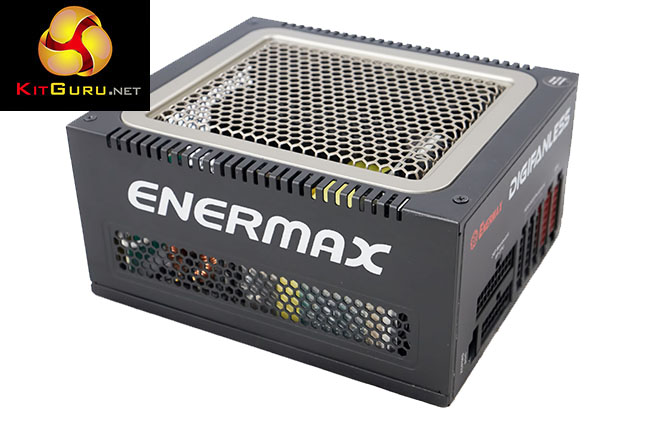
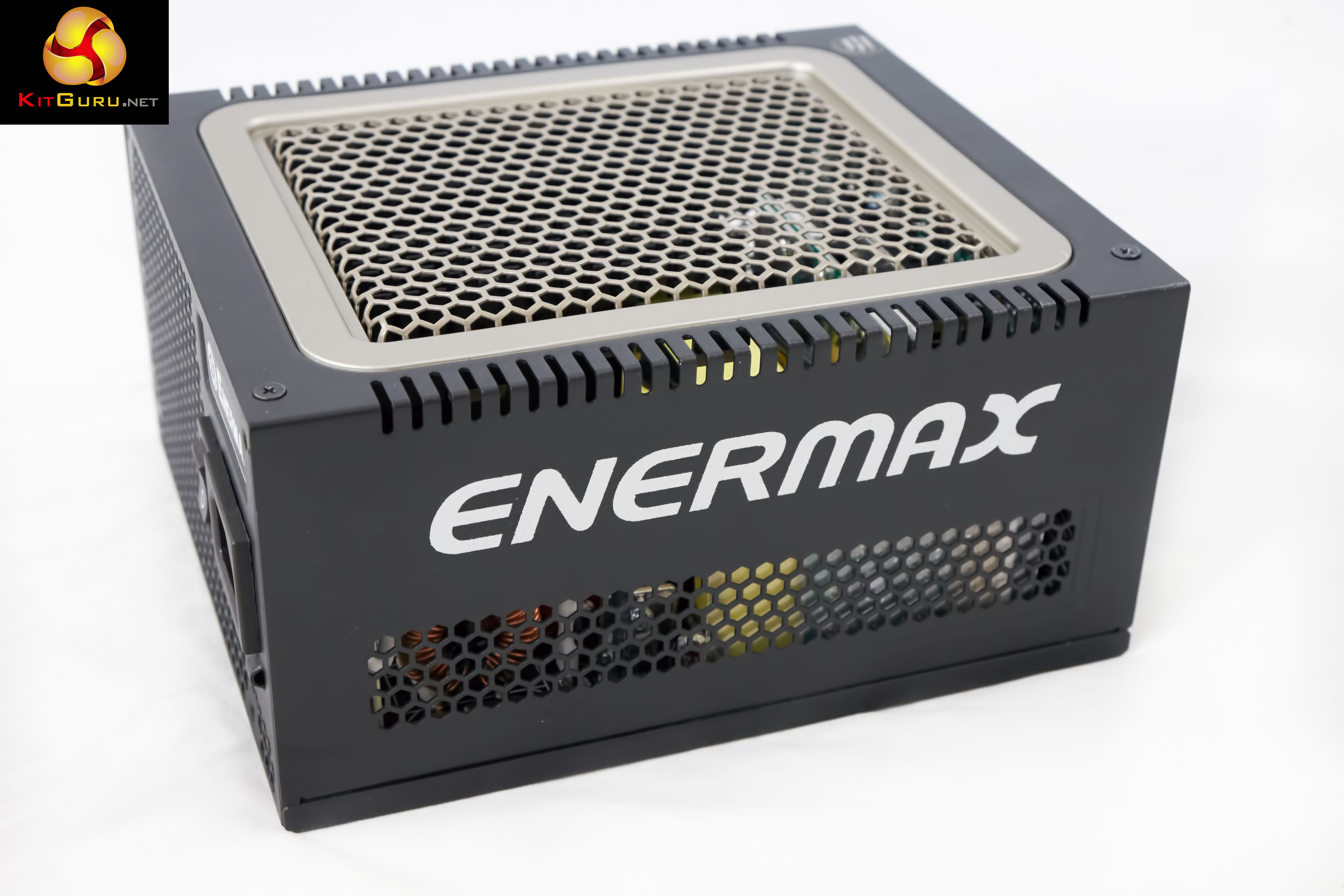
One of the main talking points is the fact that this power supply is fanless, therefore silent. Enermax recommend the power supply is installed in the position shown in the picture above. The natural airflow of hot air is upwards, so installing this power supply incorrectly with the primary vent down could potentially cause stability issues.
Enermax have included individually sleeved cables which is likely appeal to enthusiast users focused on appearance, such as those building inside a windowed chassis with backlighting.
Specifications:
- Fanless Power Supply
- Digital Monitoring & Control System
- Full Modular Cable Management with Individually Sleeved Cables
- 80 Plus Platinum
- Support oF EU Eco-Design Regulations.
- DC-to-DC Design
- Copper Bridge Array
- Multi Rail Design with Single Rail Option
- 24/7 x 40c
- Durable and High Quality Components.
- 5 Year Manufacturer Warranty.
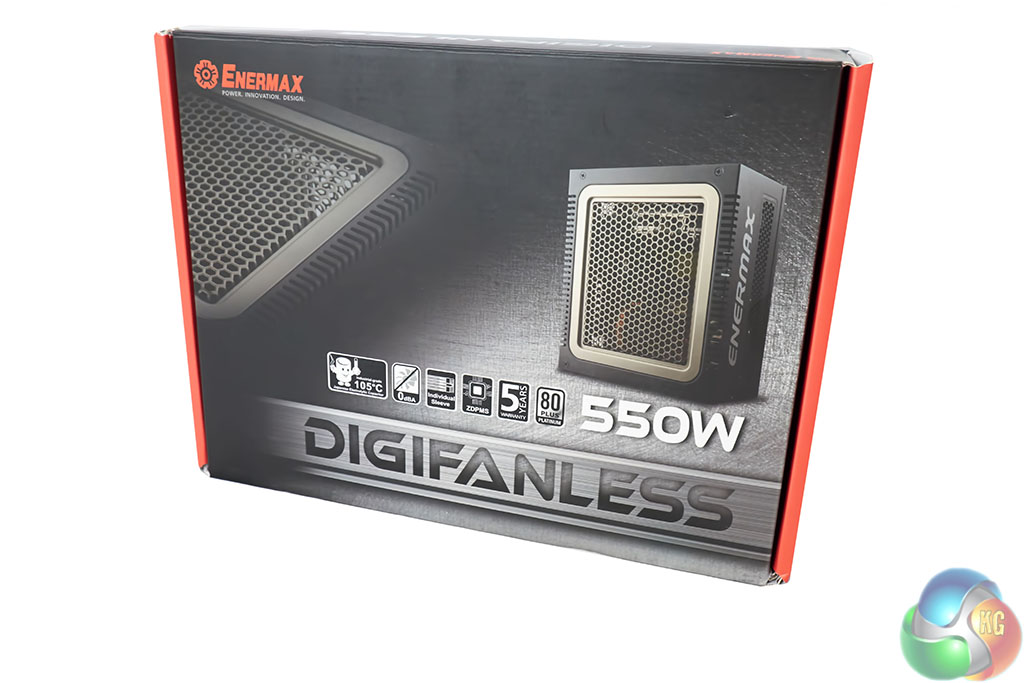
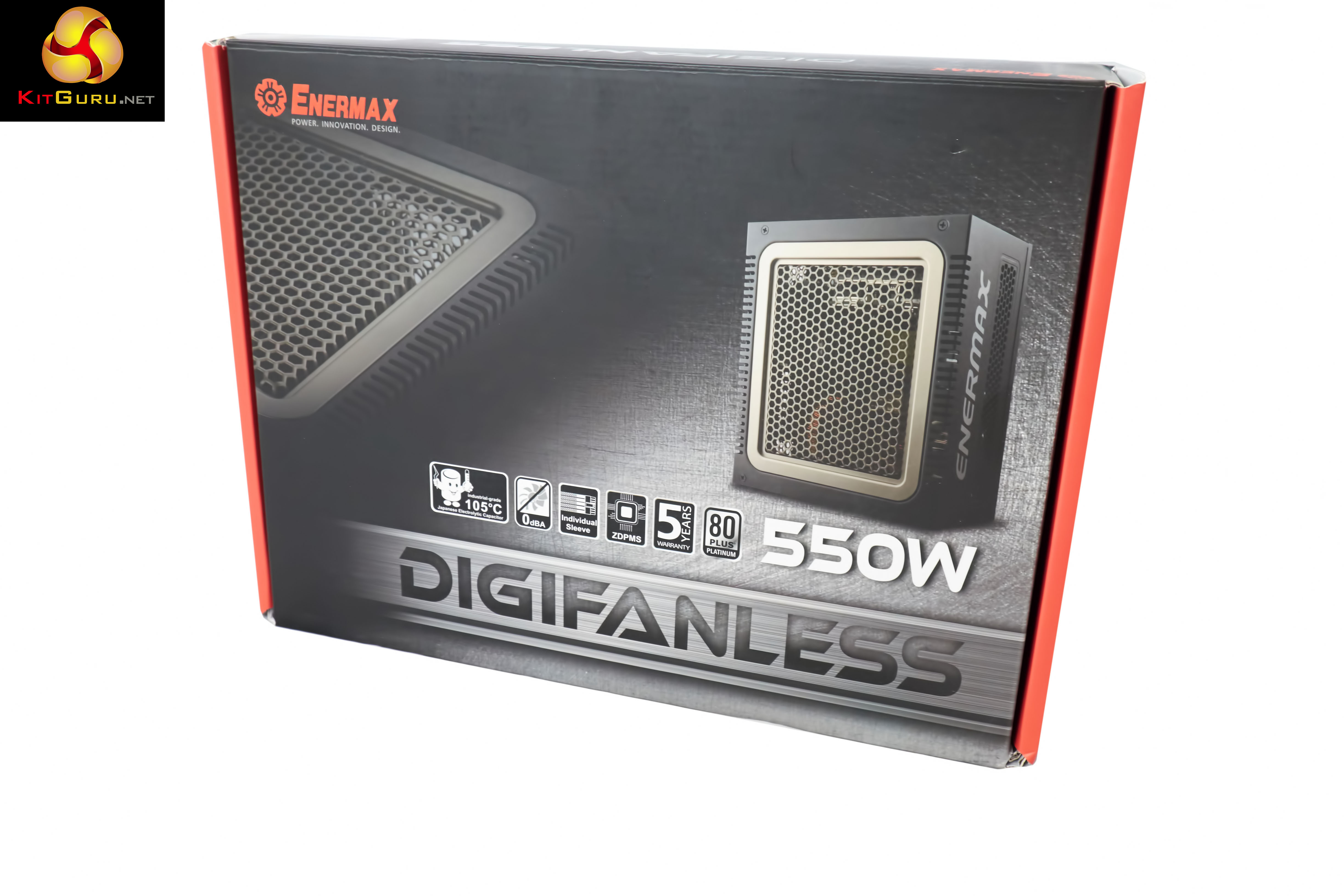
The Enermax DigiFanless 550W box is quite attractive and features a high resolution image of the powersupply, focusing on the fan less vent.
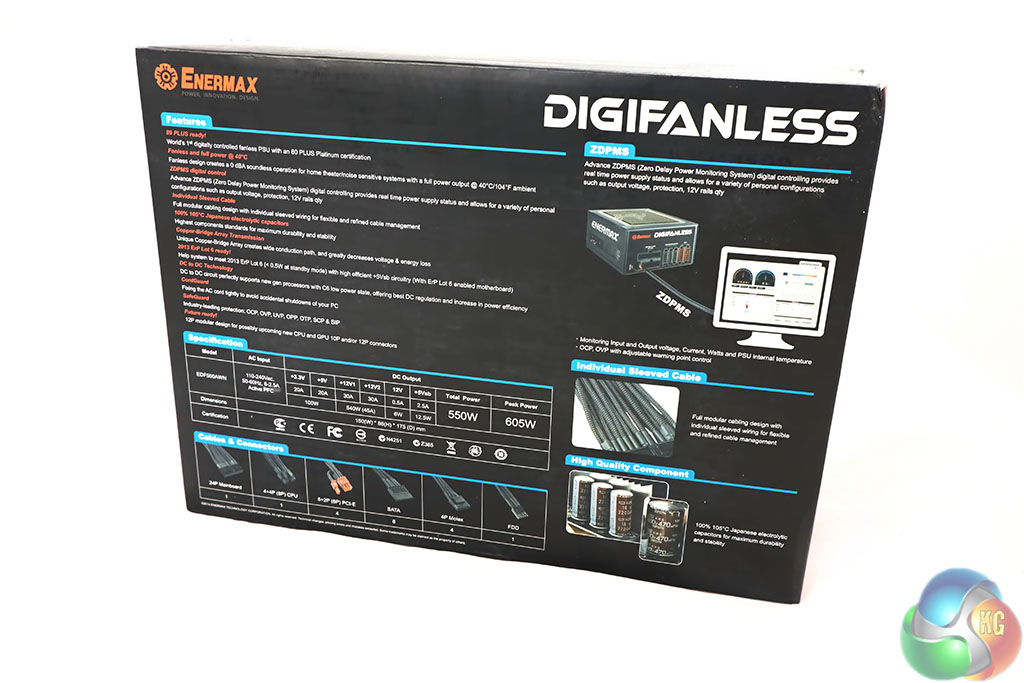
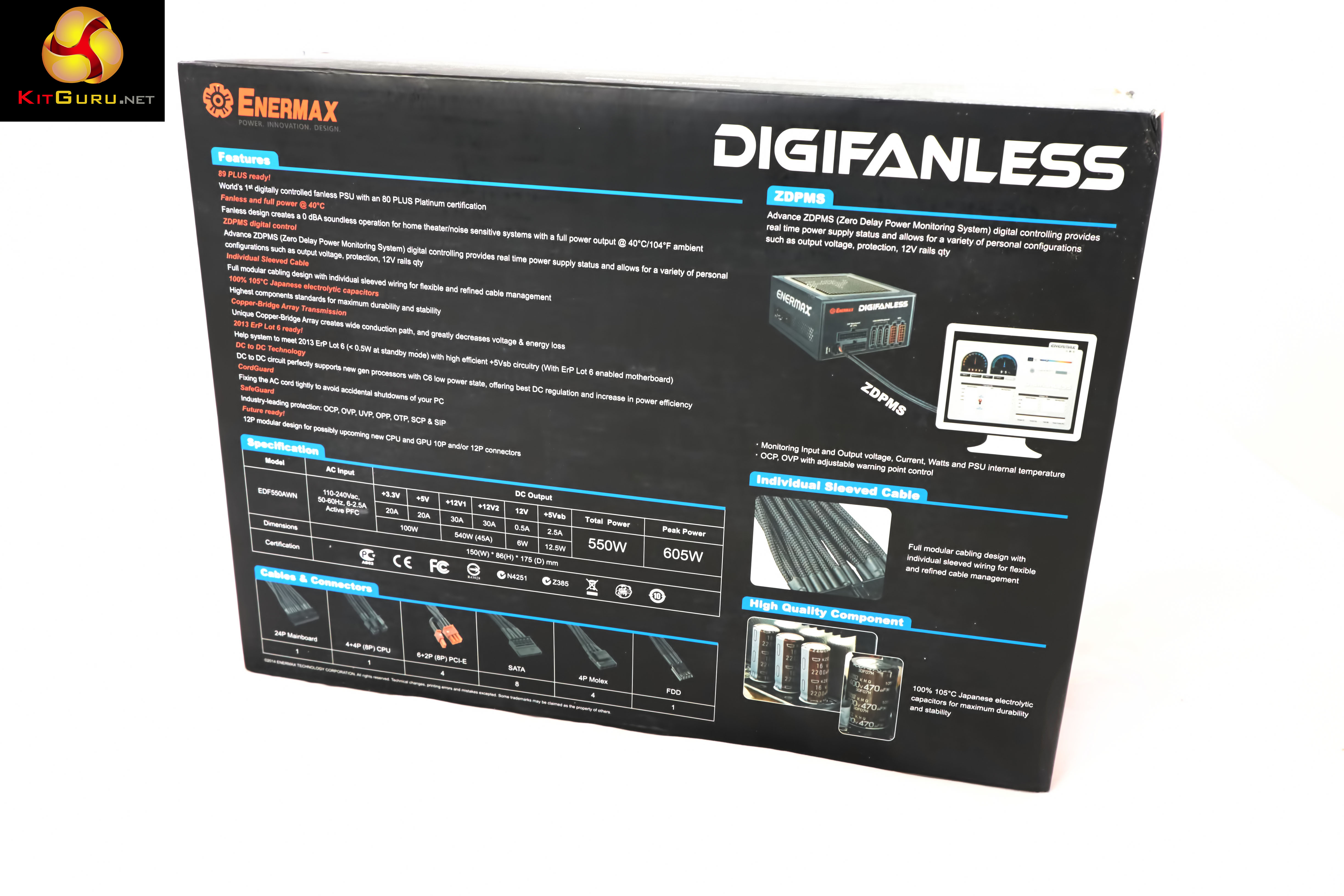
The back of the box contains technical data on the power supply. Enermax are keen to point that they are using high grade Japanese capacitors. Something we always like to see.
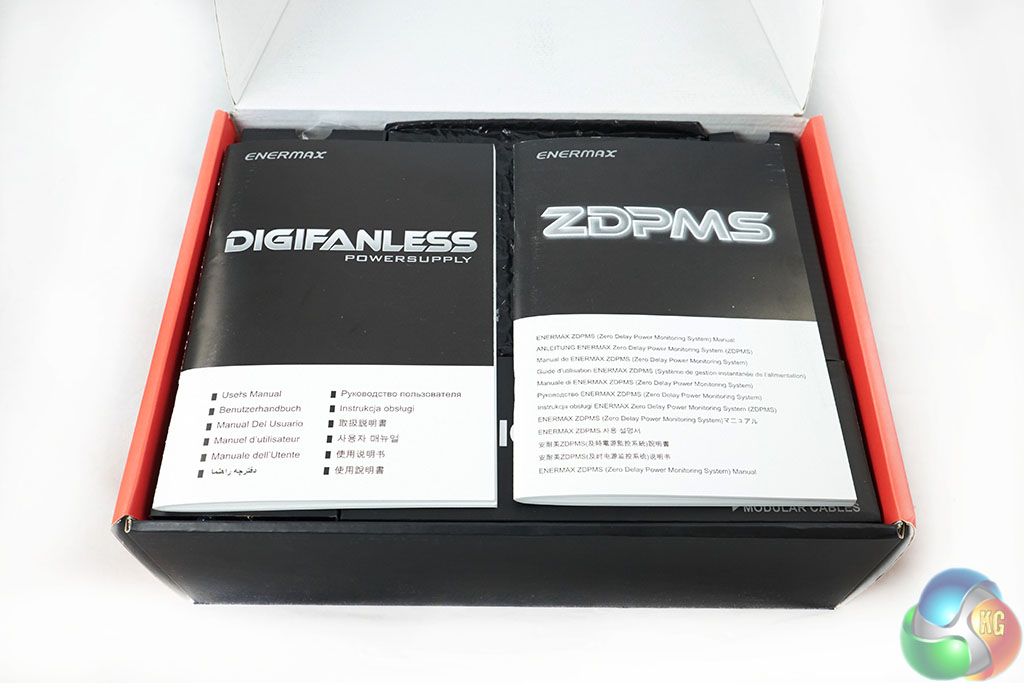
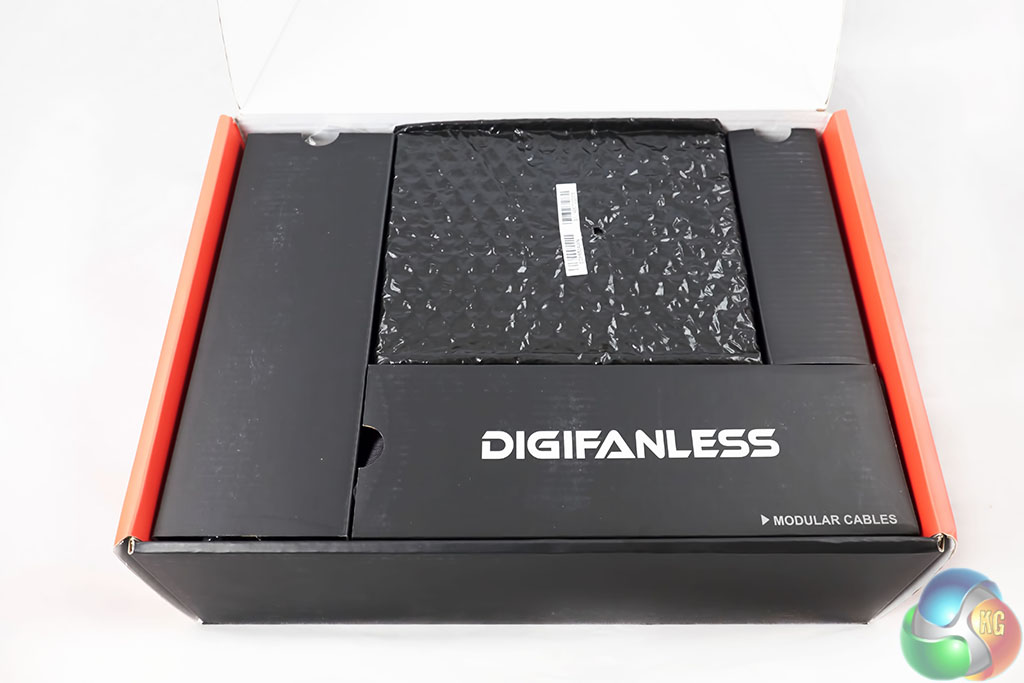
The user manual and other information rest on top of the components underneath. Accessories are kept inside sections closed with cardboard panels. The power supply is protected inside a little bubblewrap storage pouch. Not the greatest packaging we have seen.
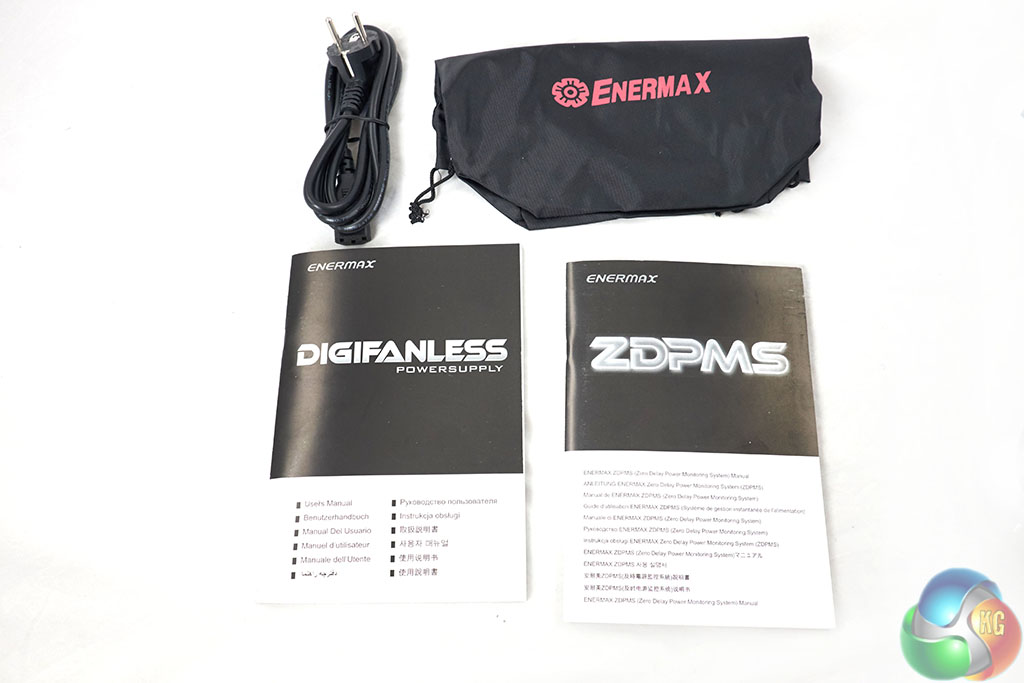

Enermax include a regional specific power plug and a storage pouch for any left over cables. There is also a little metal clip called the ‘CordGuard' which secures the power cable to stop accident removal during operation.
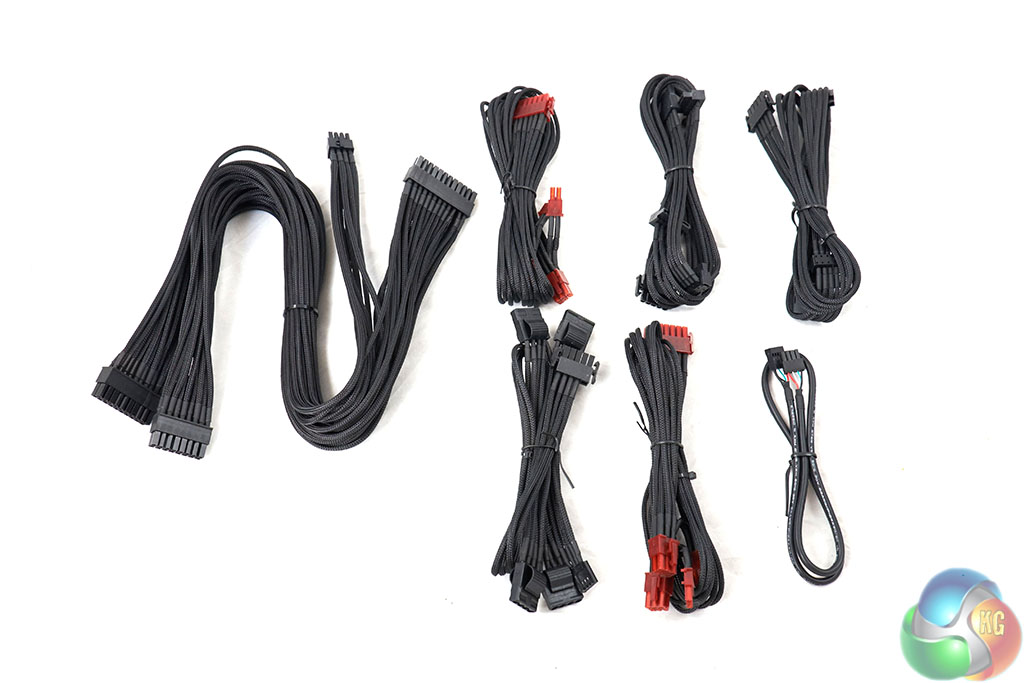
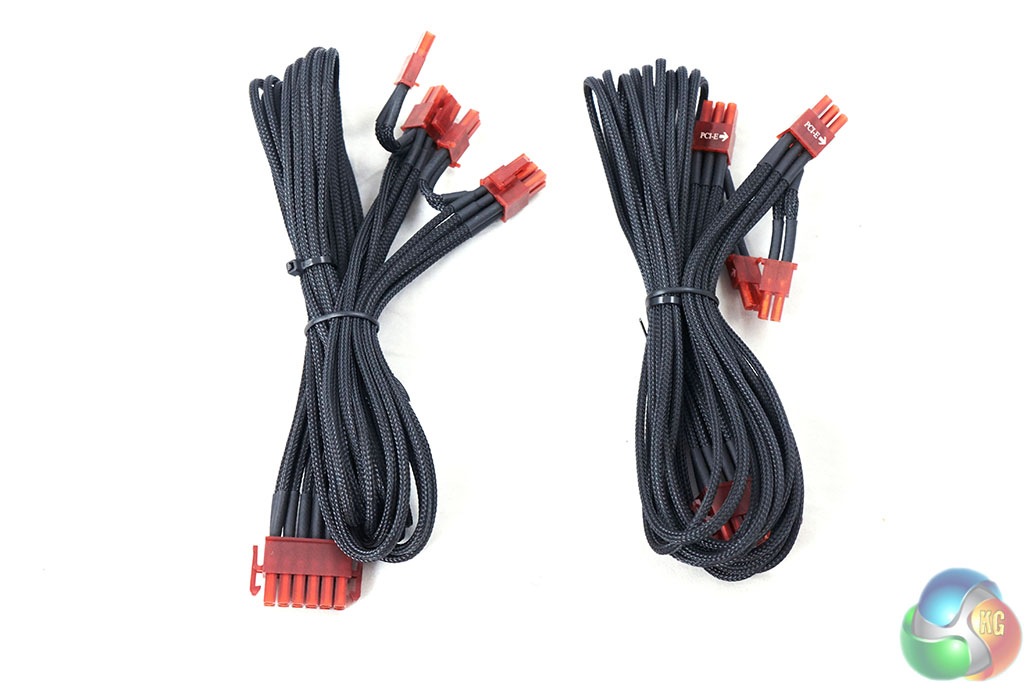
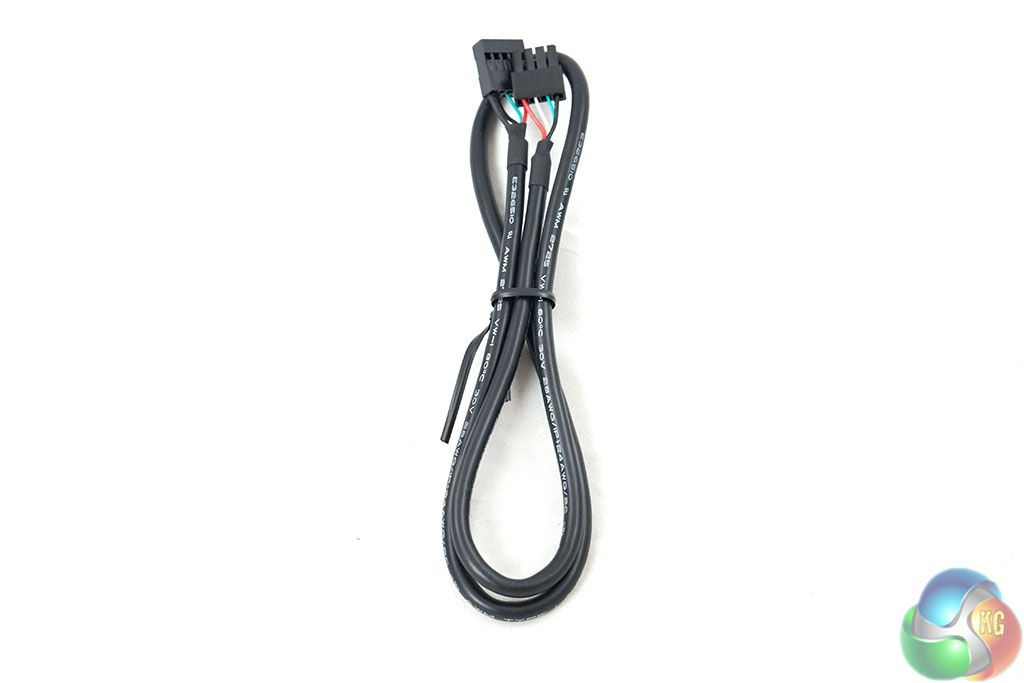
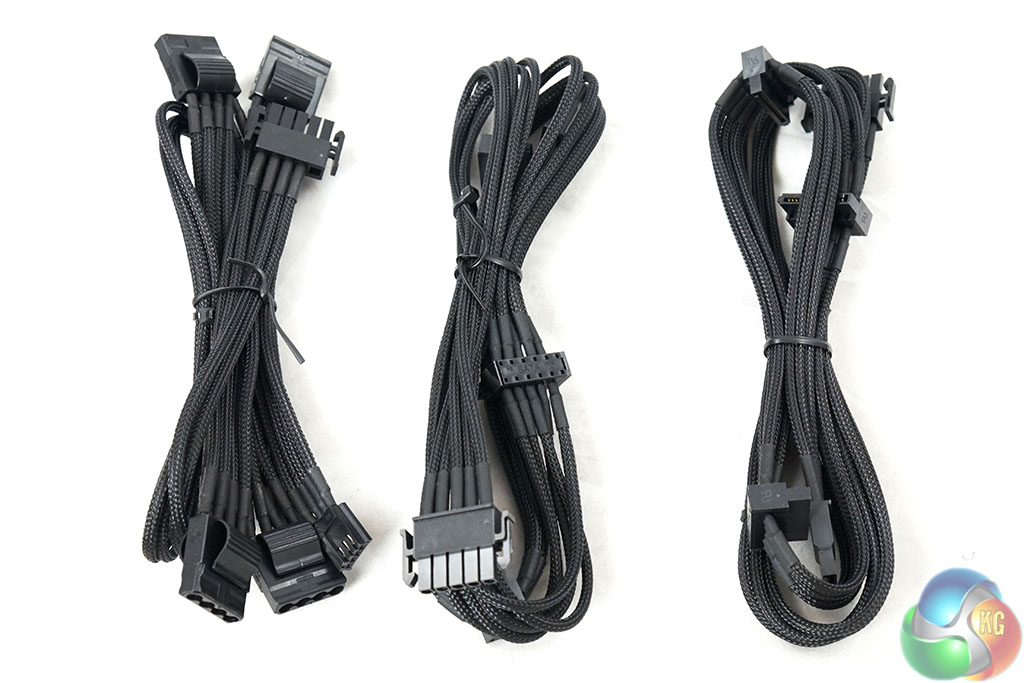
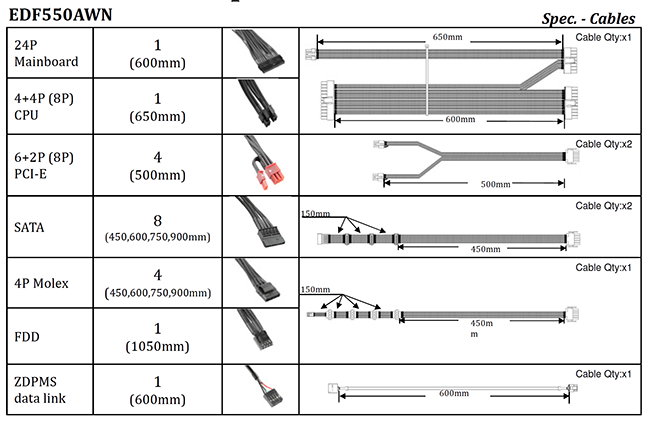
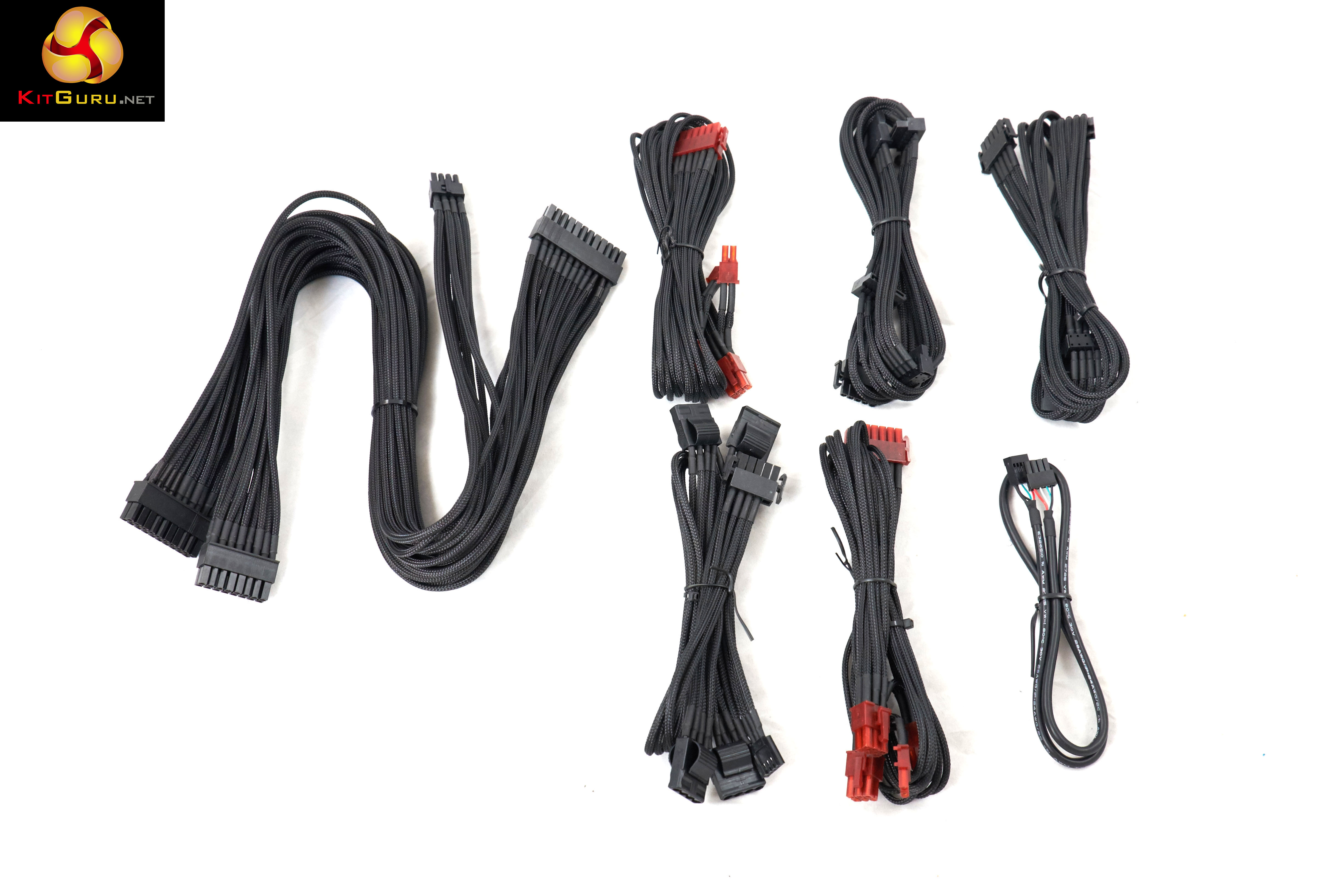
This power supply ships with two PCIe 6+2 pin cables, featuring a total of four connectors – ideal for mid range dual GPU configurations from either Nvidia or AMD. They include 8 SATA connectors for hard drives and devices. The quality of the sleeving on the cables is excellent and a huge step up over many other designs we have seen in recent months. Hard core modders will sleeve their own cables, but for the rest of us, this is a welcome addition.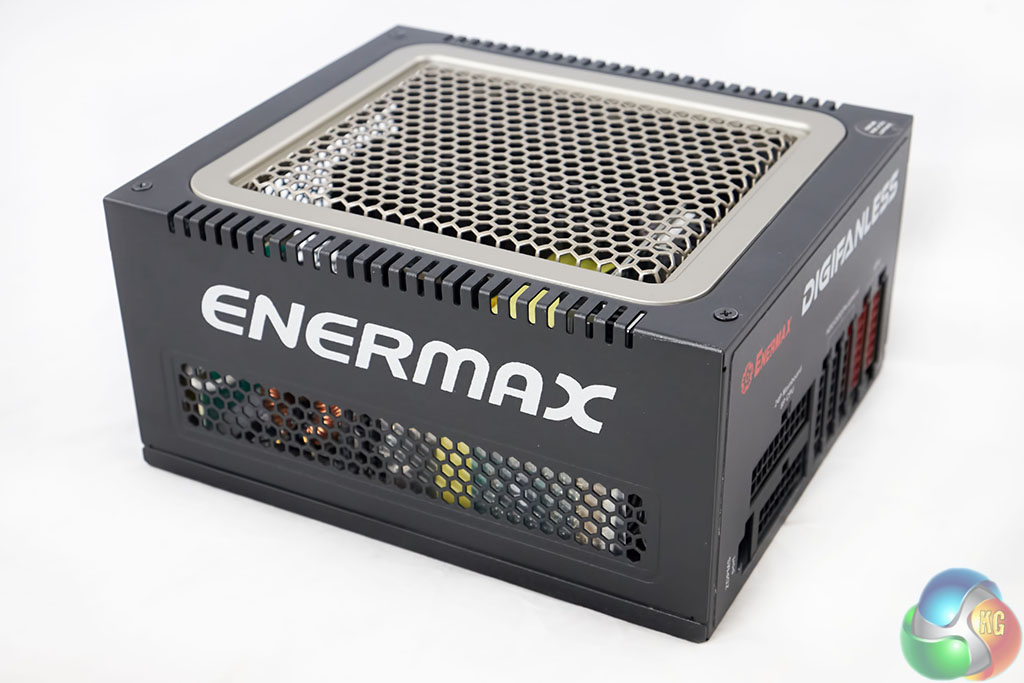
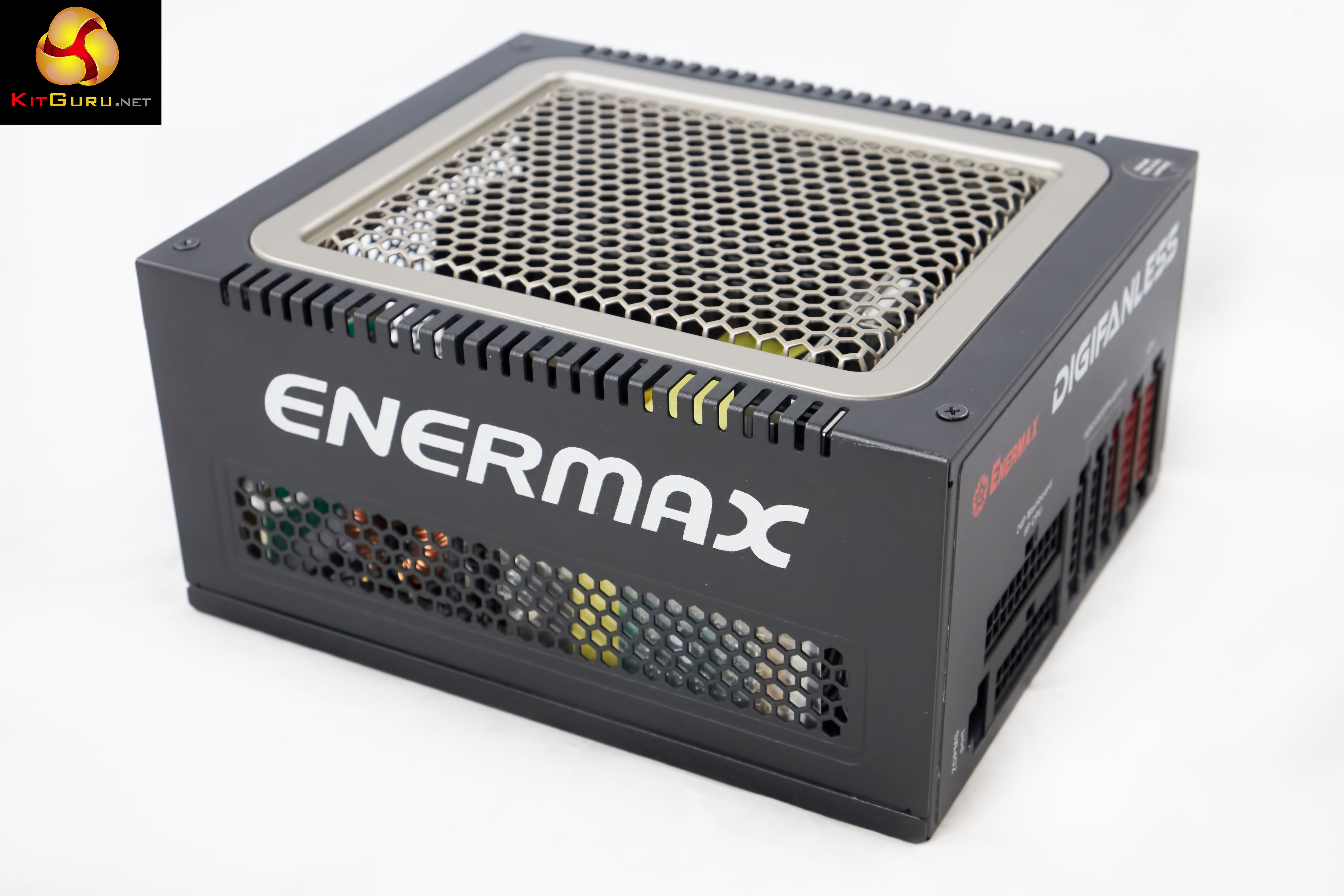
The Enermax DigiFanless 550W is an attractive power supply with plenty of venting on the panels to support good airflow. This is obviously critically important as there is no fan in the unit. The unit measures 150 mm (W) x 86mm (H) x 175 mm (D).
The Enermax power supply passed our ‘screwdriver’ test without a hitch. This involves running the head of a Philips head driver down the side of the chassis with light to medium force. After all, how many times have you accidentally connected with a power supply during a system build?
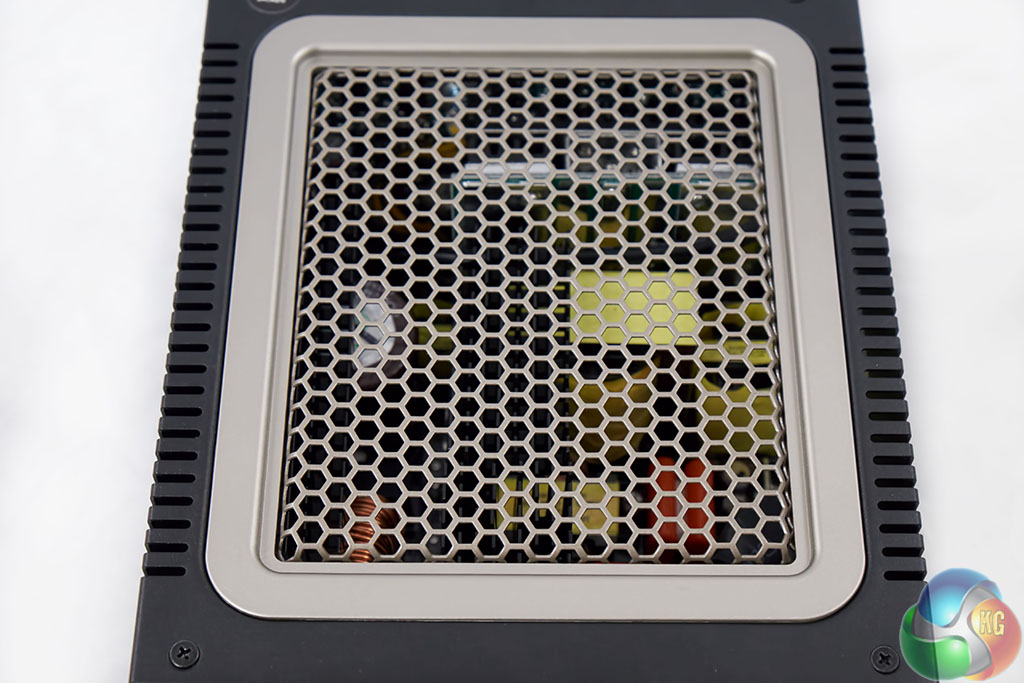
A direct photograph from the top of the power supply. No fan, just vents.
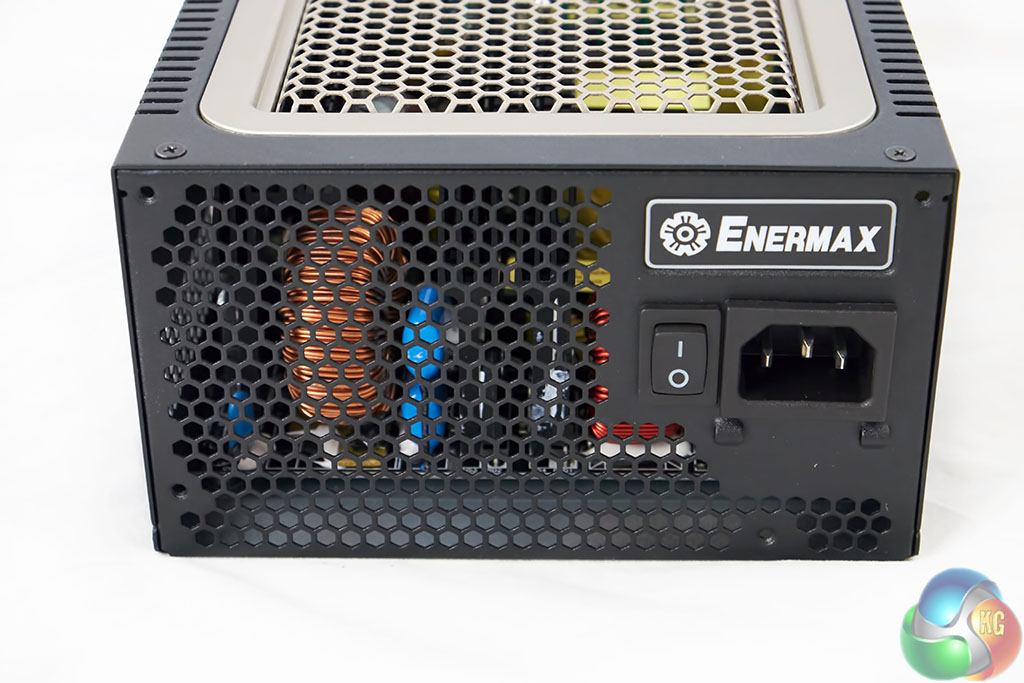
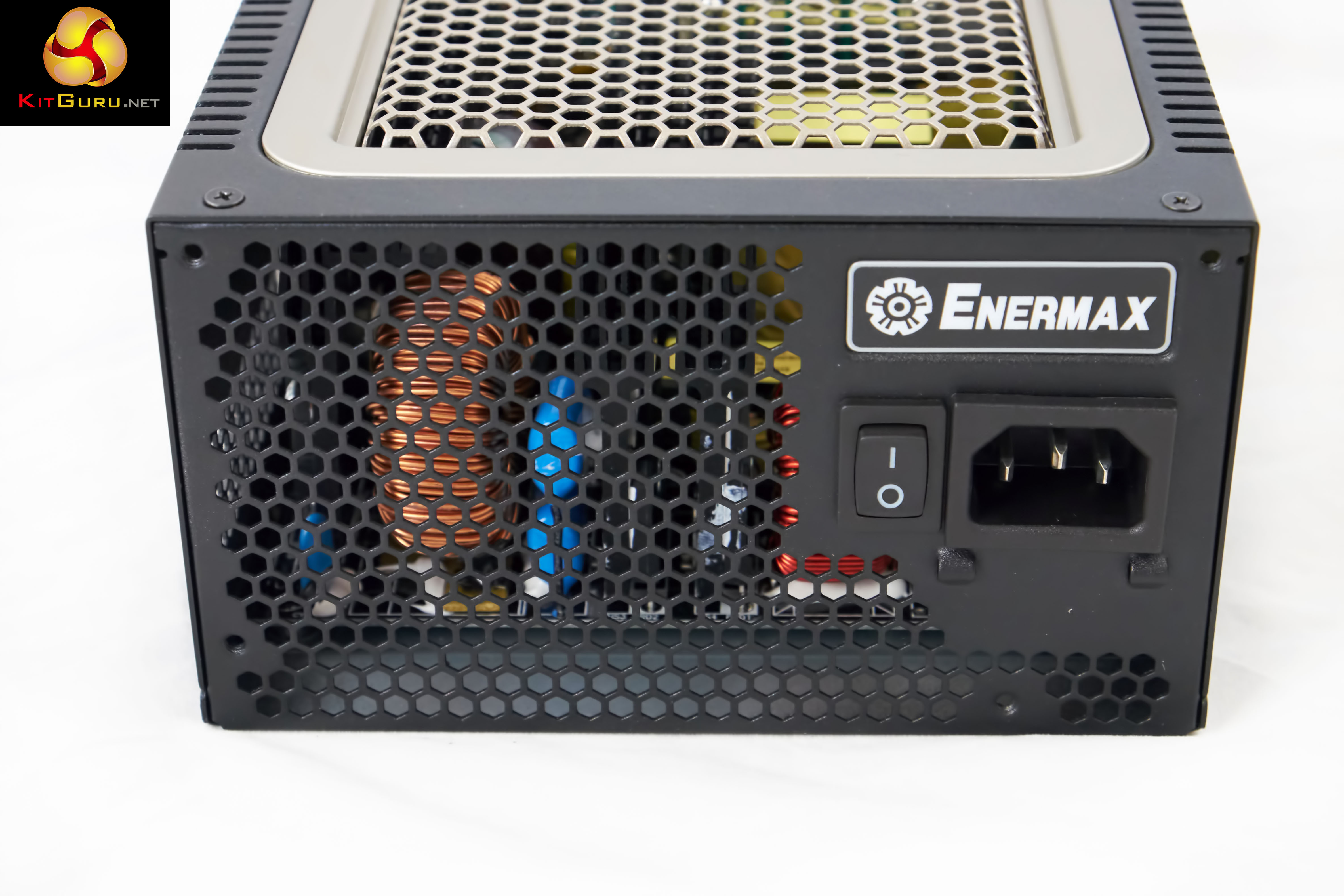
One side of the DigiFanLess power supply has a Enermax sticker, and underneath, a power connector and switch. More venting on this side to ensure there is plenty of airflow.
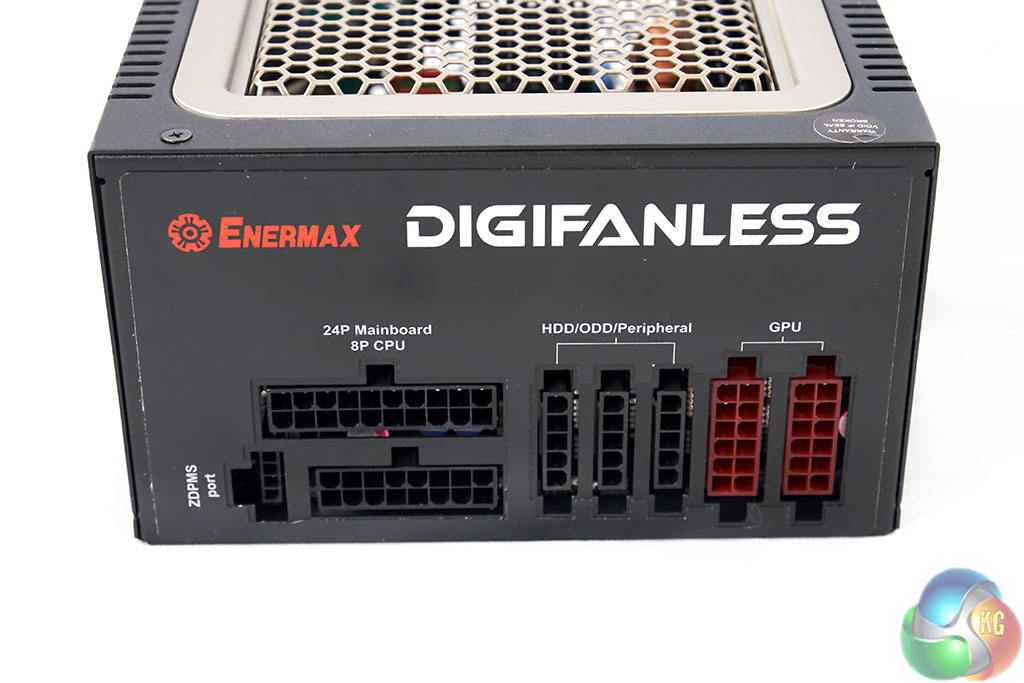
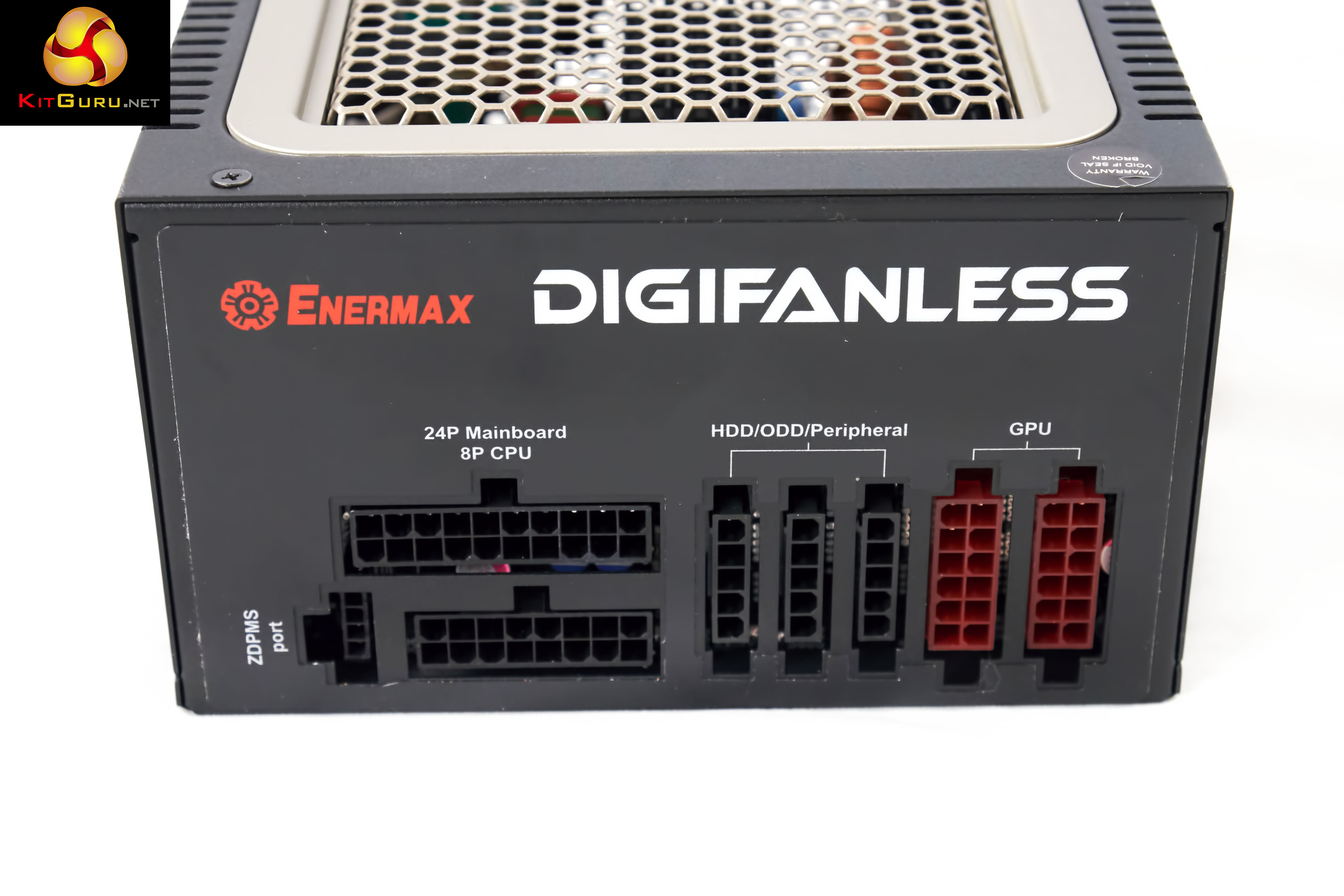
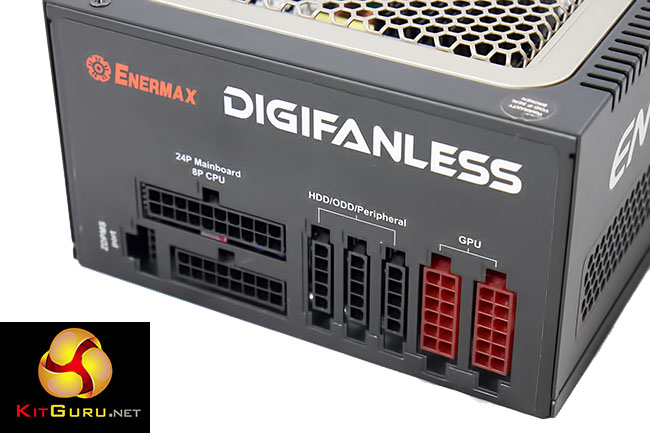
One side of the power supply is home to the modular panel, which is clearly labeled and colour coded to help ease installation. There is also a digital interface point for connection to the main system – this allows the software to read information and to control certain areas of the power supply.
| Enermax DigiFanless 550W PSU | ||||||
|
DC Output
|
+3.3V
|
+5V
|
+12V1 | +12V2 |
-12V
|
+5Vsb
|
|
Max Output
|
20A
|
20A
|
30A | 30A |
0.5A
|
2.5A
|
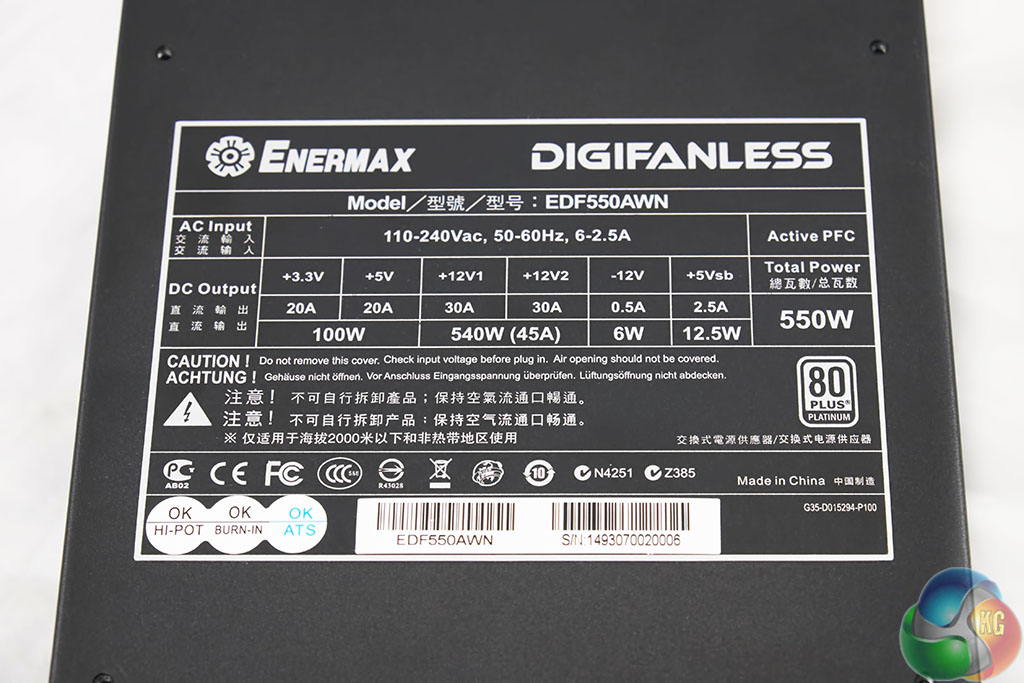
| Total Power | 100W | 540W | 6W | 12.5W | ||
| 550W (peak 605W) | ||||||
The +3.3V and +5V rails each deliver up to 20A of power. The +12V rail can deliver up to 540W of the total power.
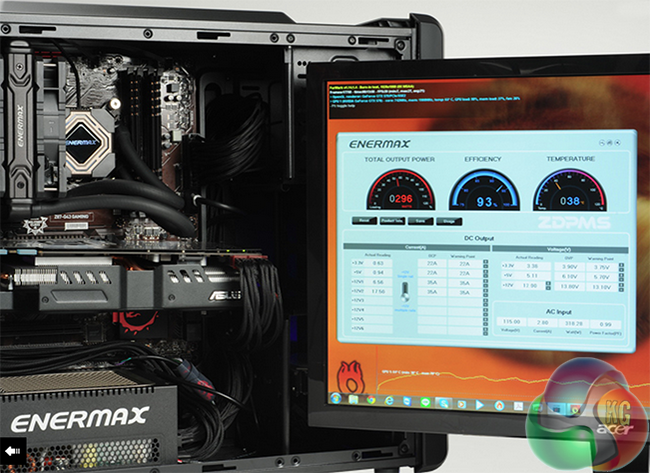
Enermax bundle software (called ZDPMS) with the power supply however you must use the digital interface control cable, supplied with the unit. You can download the latest version of this software from the ‘downloads' page here: http://www.enermax.co.uk/digifanless.
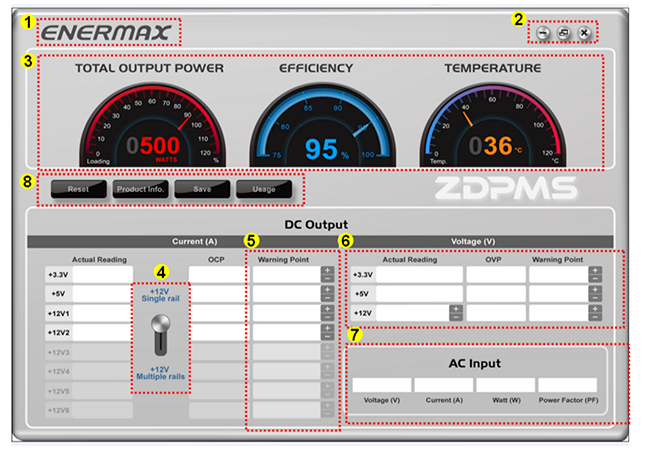
- Quick link to Enermax
- Window Control Tab
- General PSU Status Information
- 12V rail(s) controller
- DC output Current status & control
- DC output Voltage status & control
- AC input status
- Additional Information Tab
Section 2 in the list offers settings for minimising the window, and a change to ‘Simple Mode'. Simple mode depicts Total Output, Efficiency level and running temperature.
Section 3 shows the power supplies current DC output wattage, efficiency and internal temperature.
Section 4 gives a pull down for multiple rails output, and a pull up for a single 12V rail output setting.
Section 5 monitors the power supply DC rails output amperes and lets the end user set the Over Current Protection warning point by clicking the + and – buttons within the range highlighted below.
| Min Trigger Point | Adjustable warning point range | |
| +3.3V | 22A | 18-22A |
| +5V | 22A | 19-22A |
| +12V1 | 35A | 31-35A |
| +12V2 | 35A | 31-35A |
| +12V (Single Rail Mode) | 50A | 46-50A |
Section 6 monitors DC output voltage, and allows the user to tune +12V output voltage and the OVP warning point by clicking + or – buttons. The voltage/warning adjustable range is shown in the table below.
| Adjustable output range | Adjustable warning point range | |
| +3.3V | – | 3.45-3.7V |
| +5V | – | 5.2-5.7V |
| +12V | 11.64-12.36V (±3%) | 12.4-13.1V |
Section 7 monitors AC input voltage range, input current, wattage and power factor values.

Section 8 is the additional Information tab. Reset will return all settings back to default. Clicking the Product Information tab will show the power supply model number and ZDPMS software version. The Save tab allows your own configurations to be stored to a drive for easy recall.
The Usage tab may come in handy if you want to analyse your power drain all year. You can track operation time, and (KwH) to estimate electricity costs.
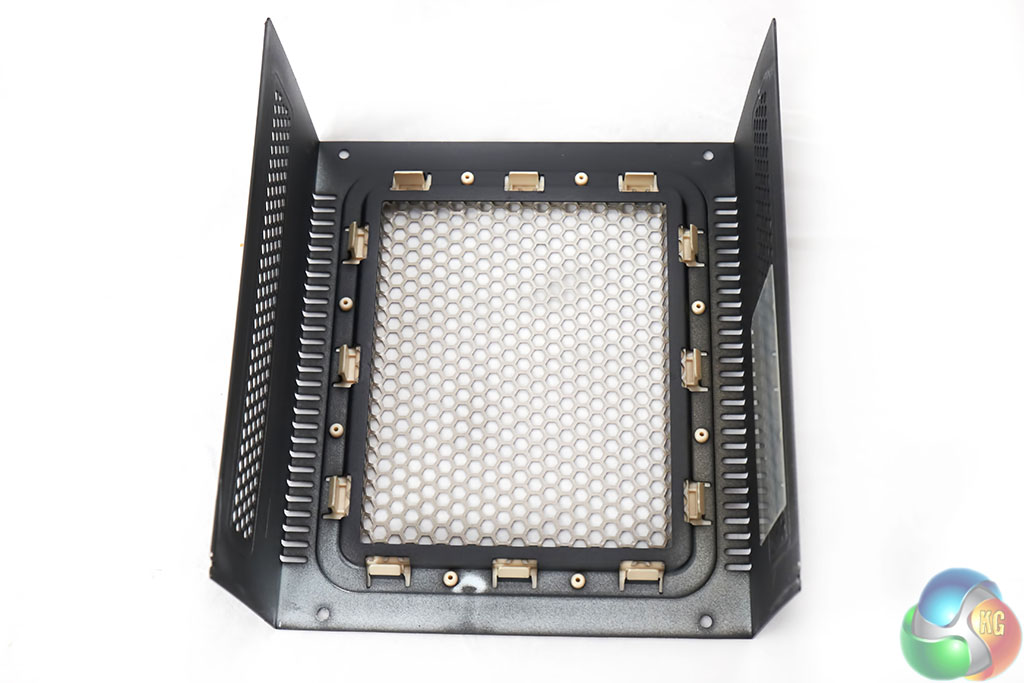
The top of the power supply has no fan installed, so its basically a simple grill, sprayed and attached to the metal chassis.
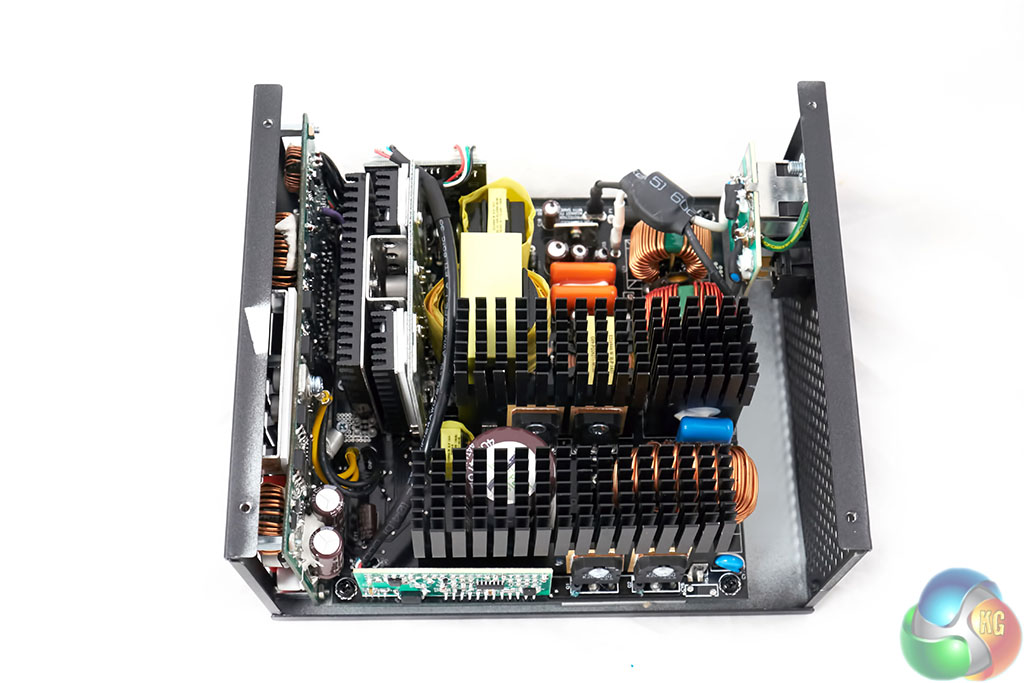
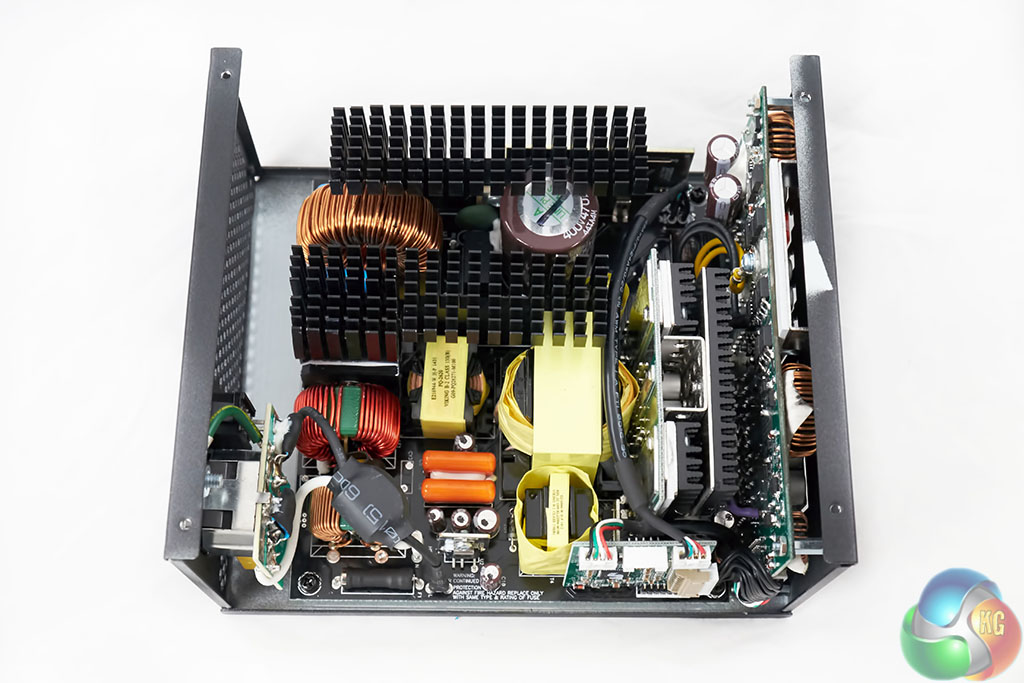
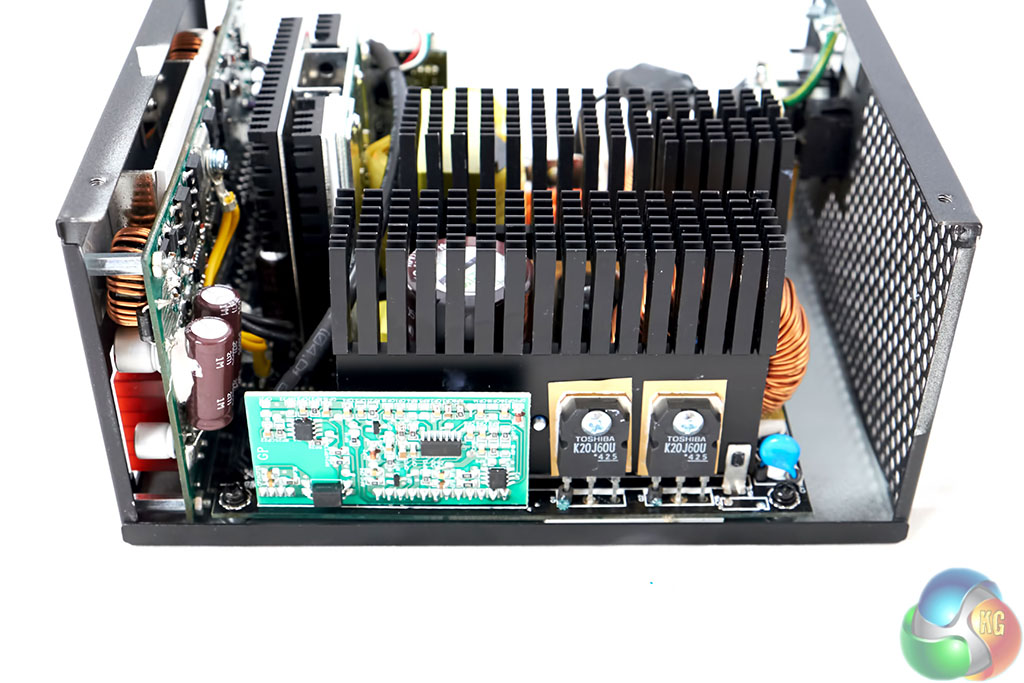
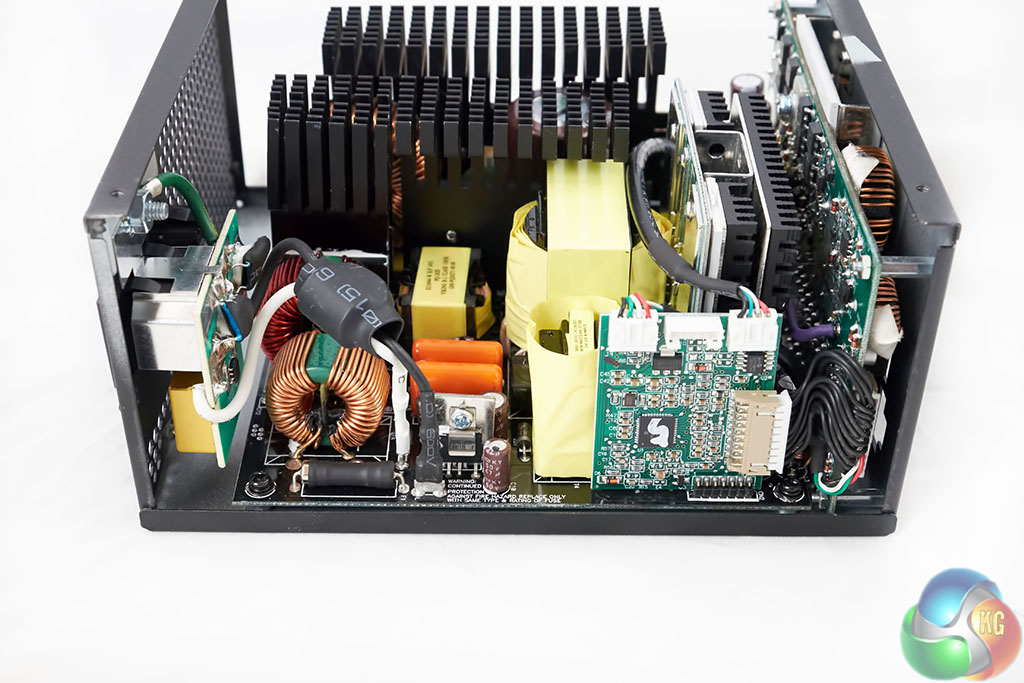
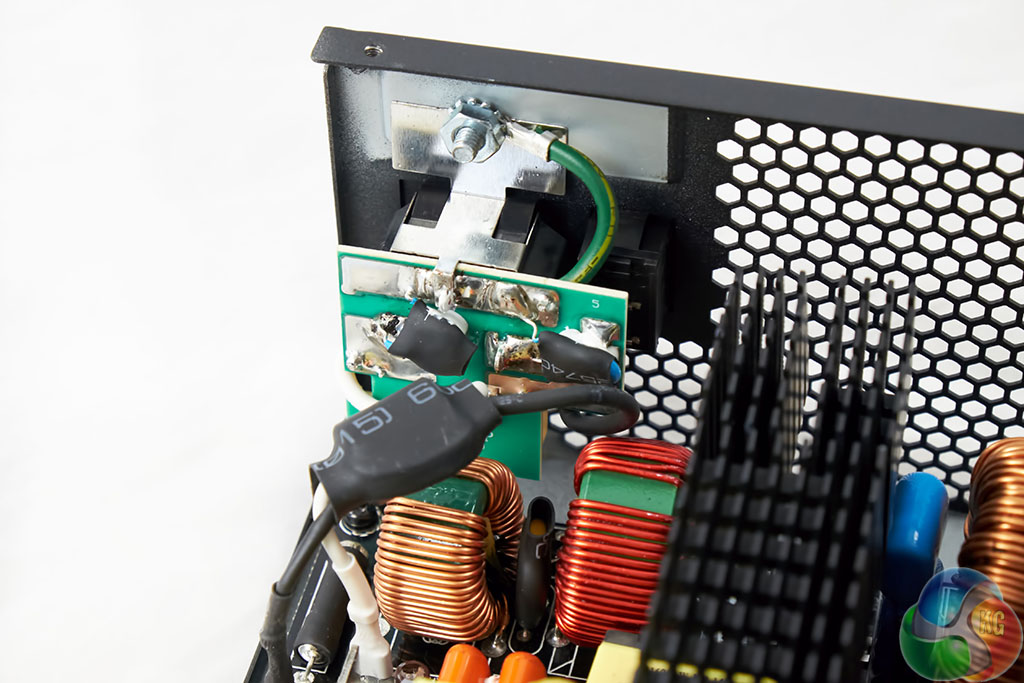
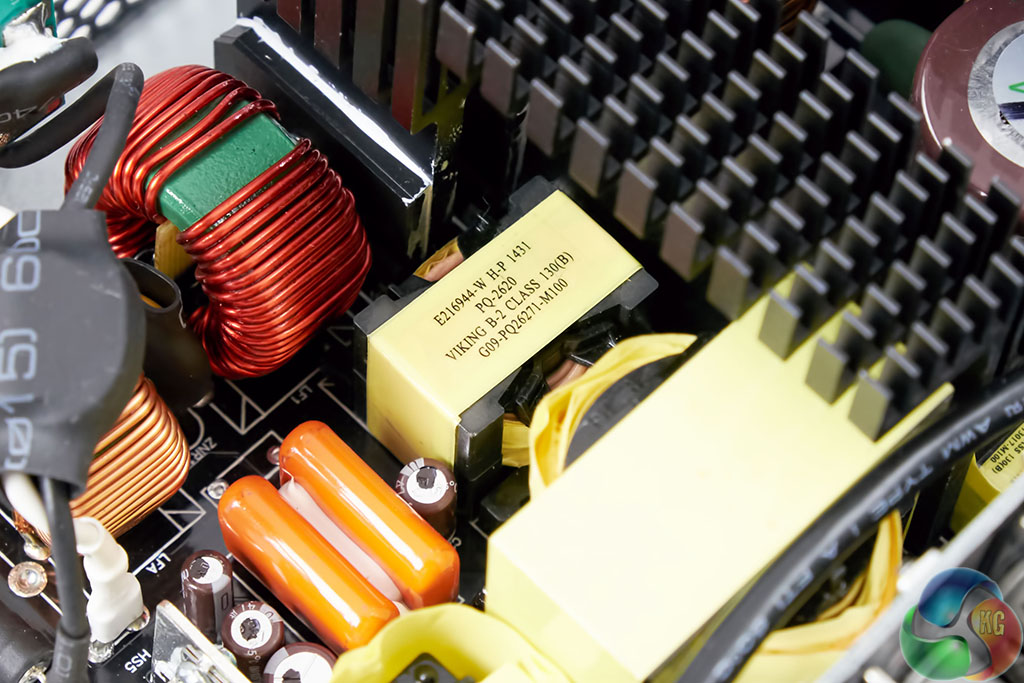
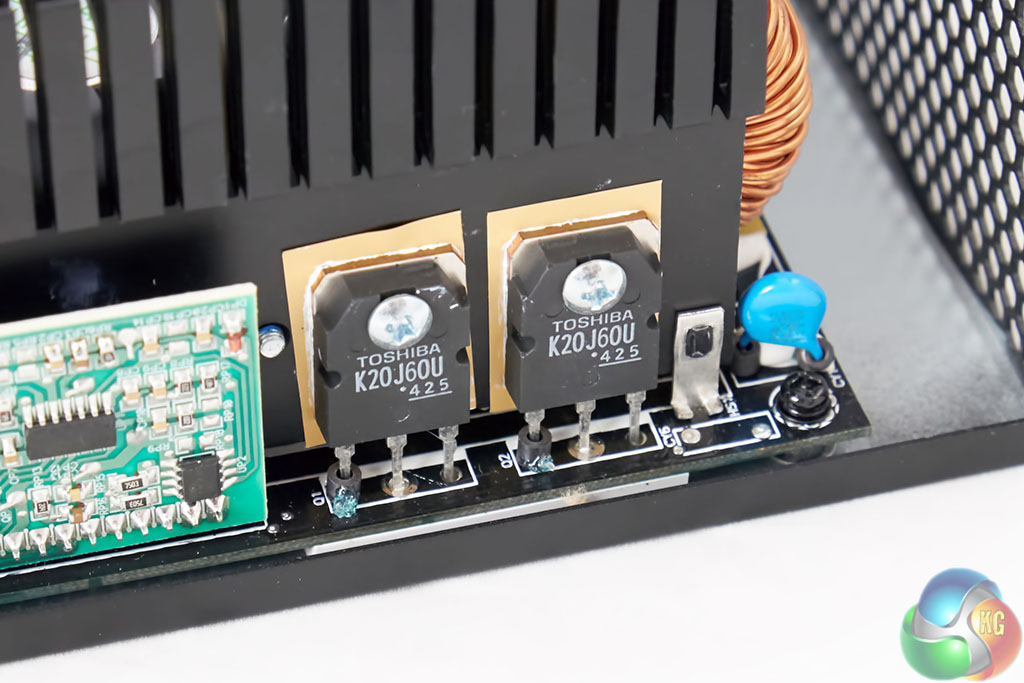
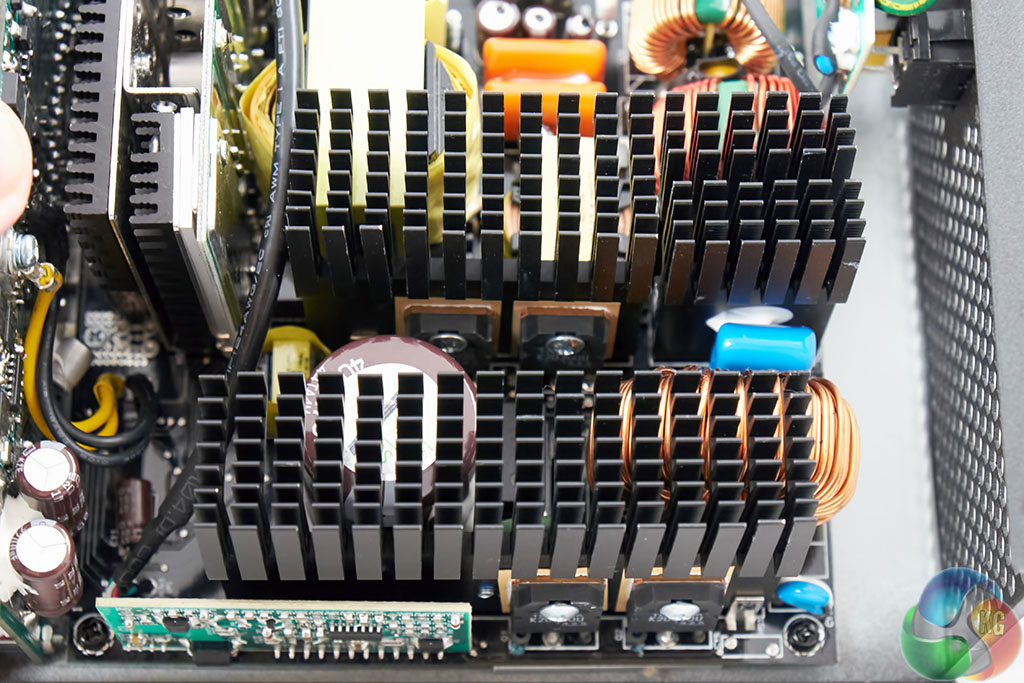
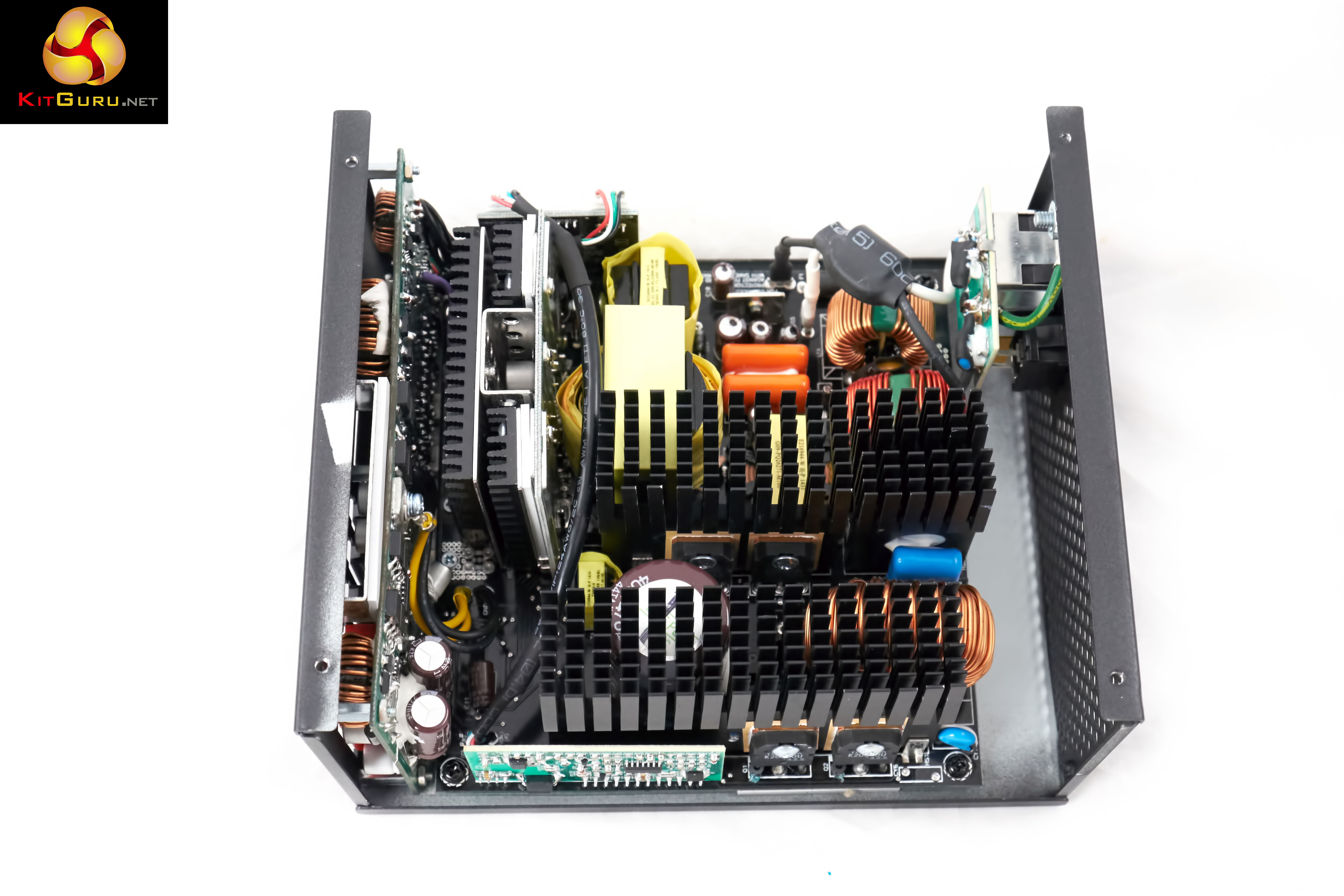
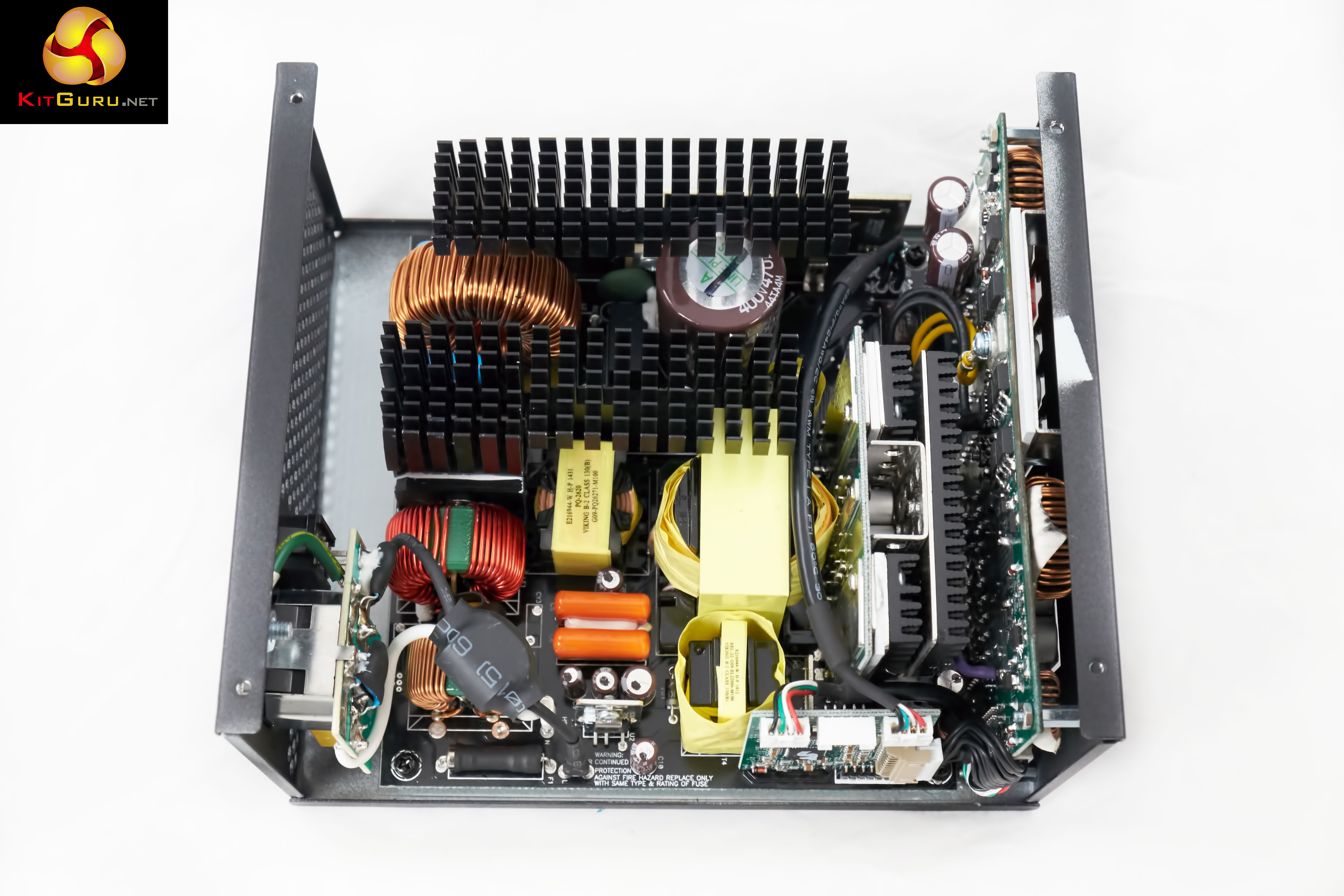
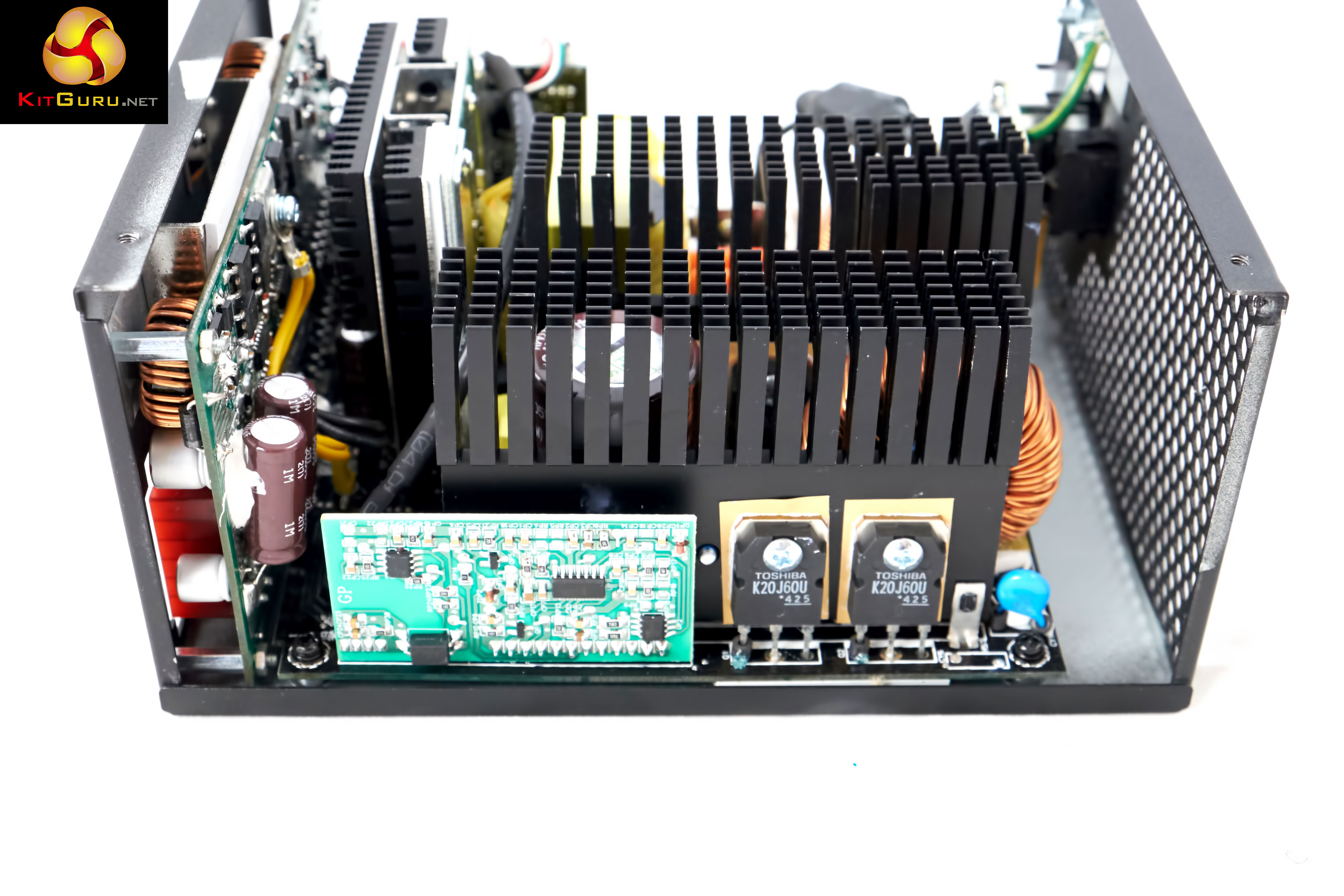
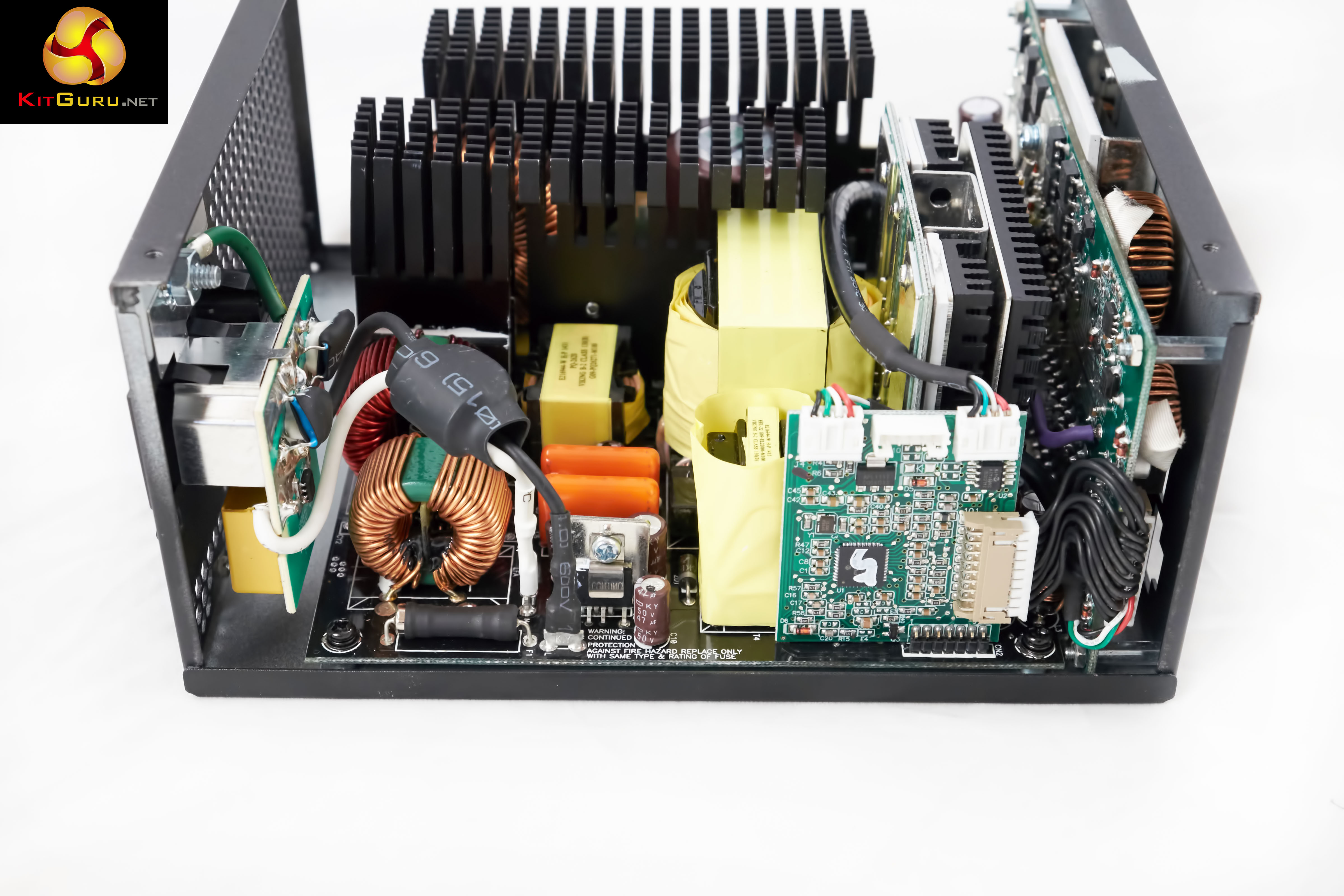
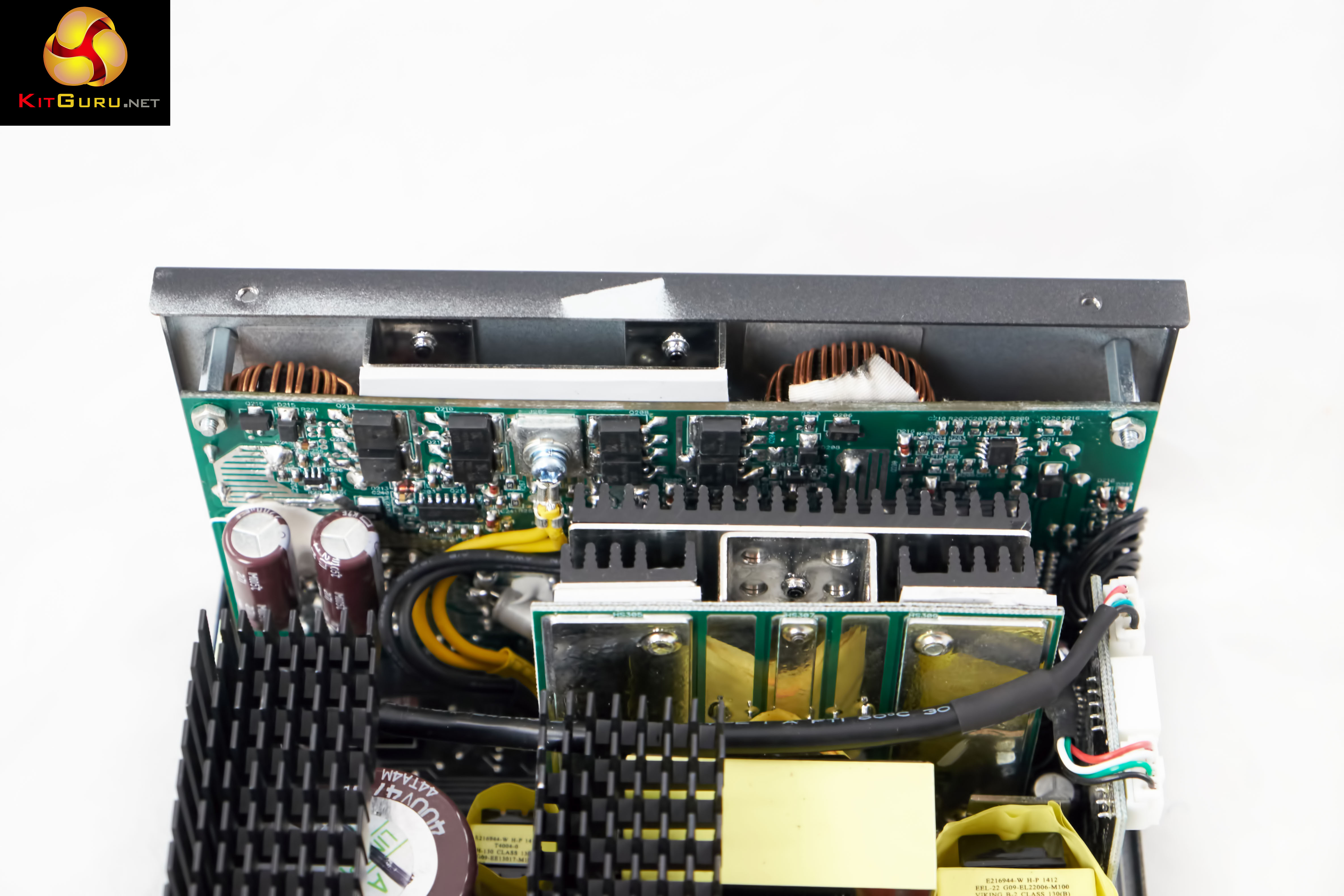
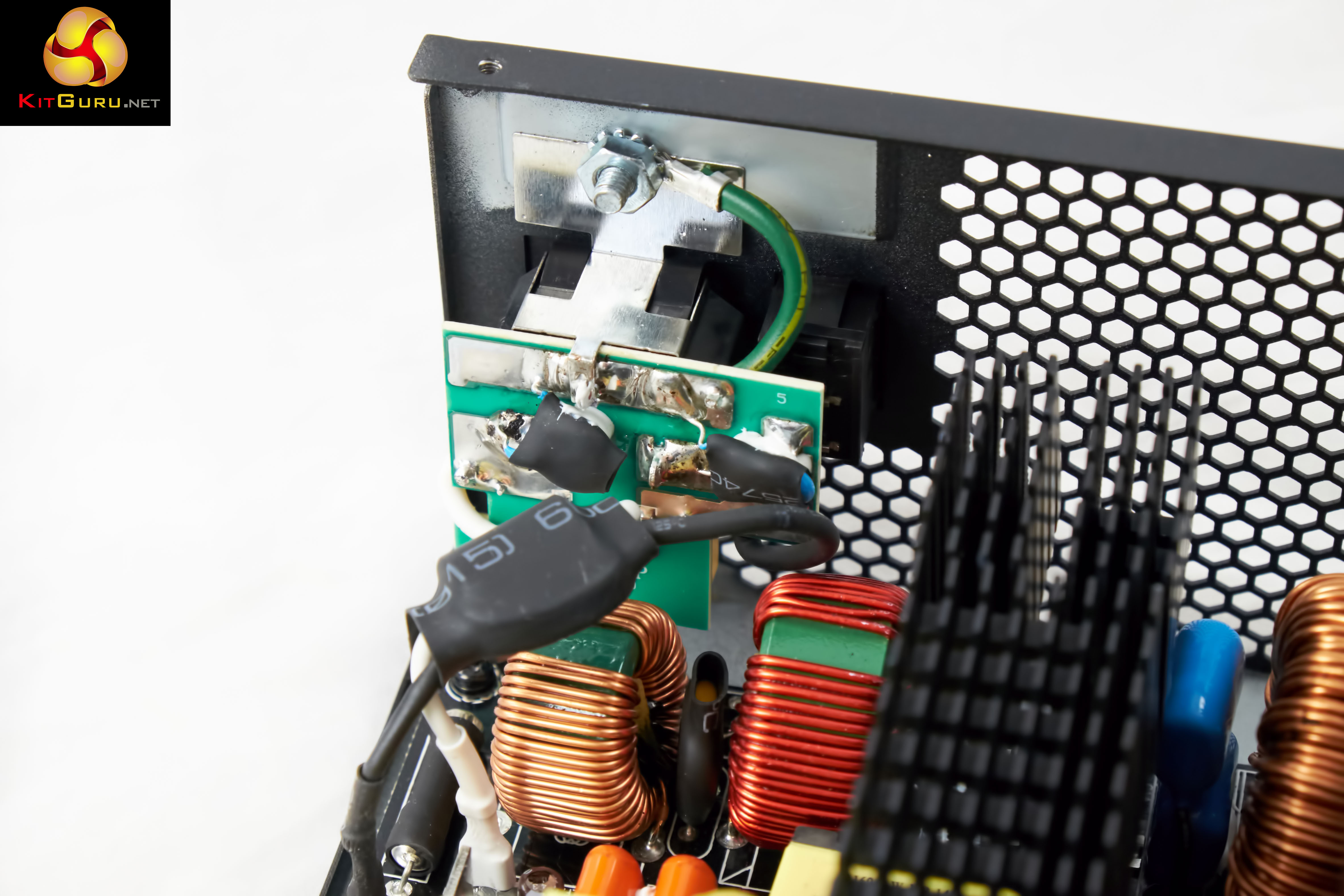
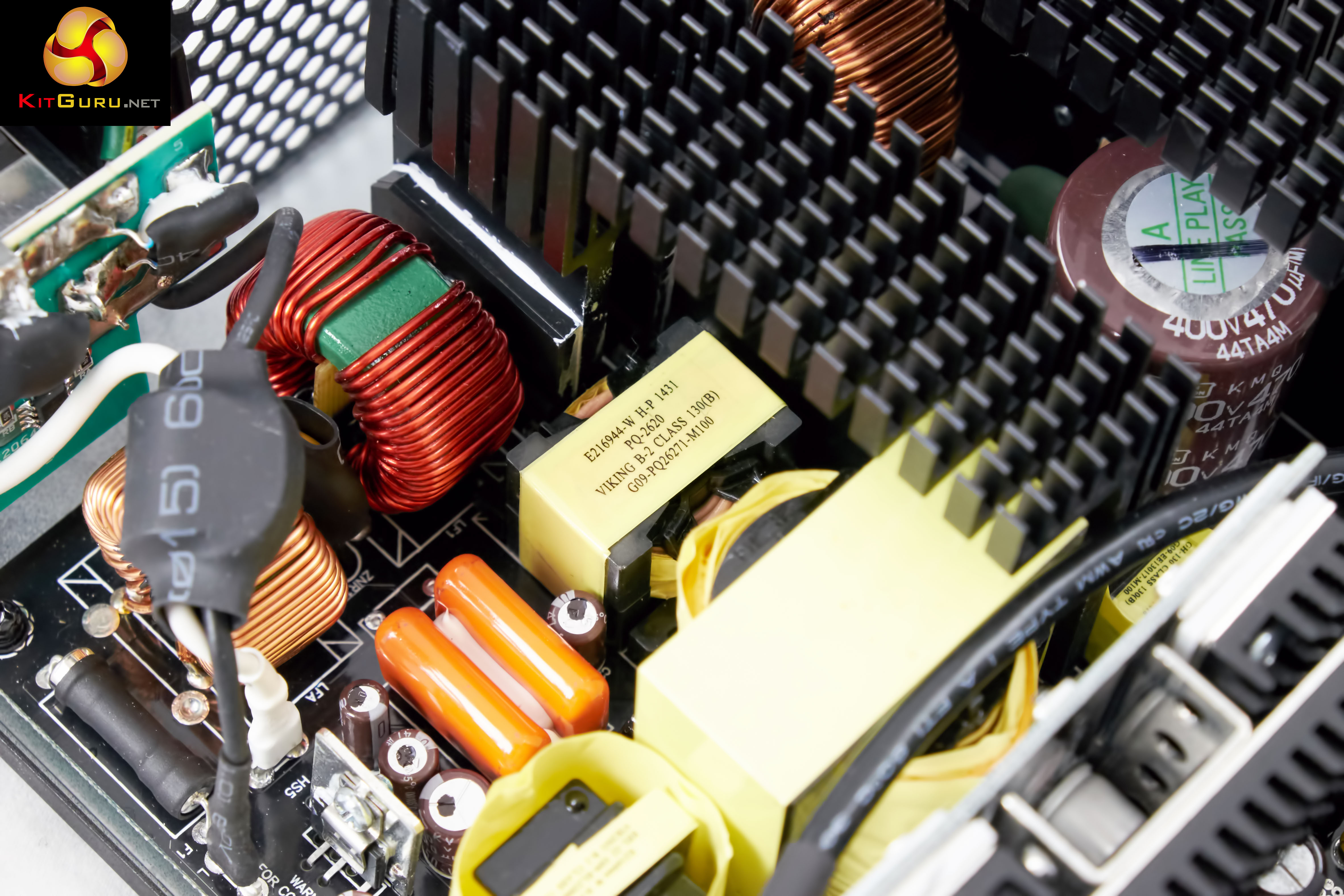
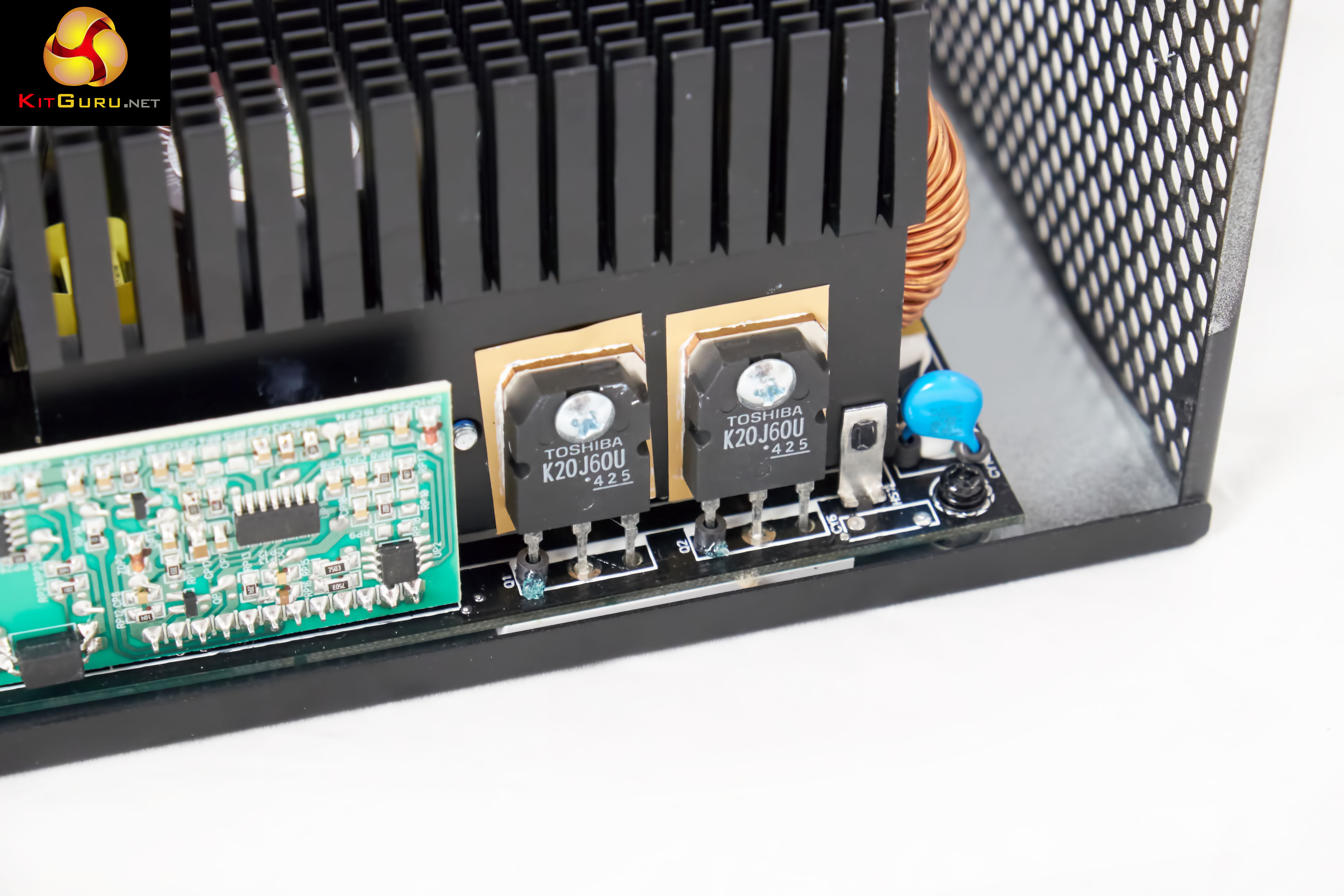
The filtering stage has two Y capacitors and a single X capacitor. The filtering stage continues to the main PCB with one Y capacitor and four polyfilm capacitors with two ferrite coils, an MOV and a CM choke. Four mosfets from Toshiba are attached to large passively cooled heatsinks.
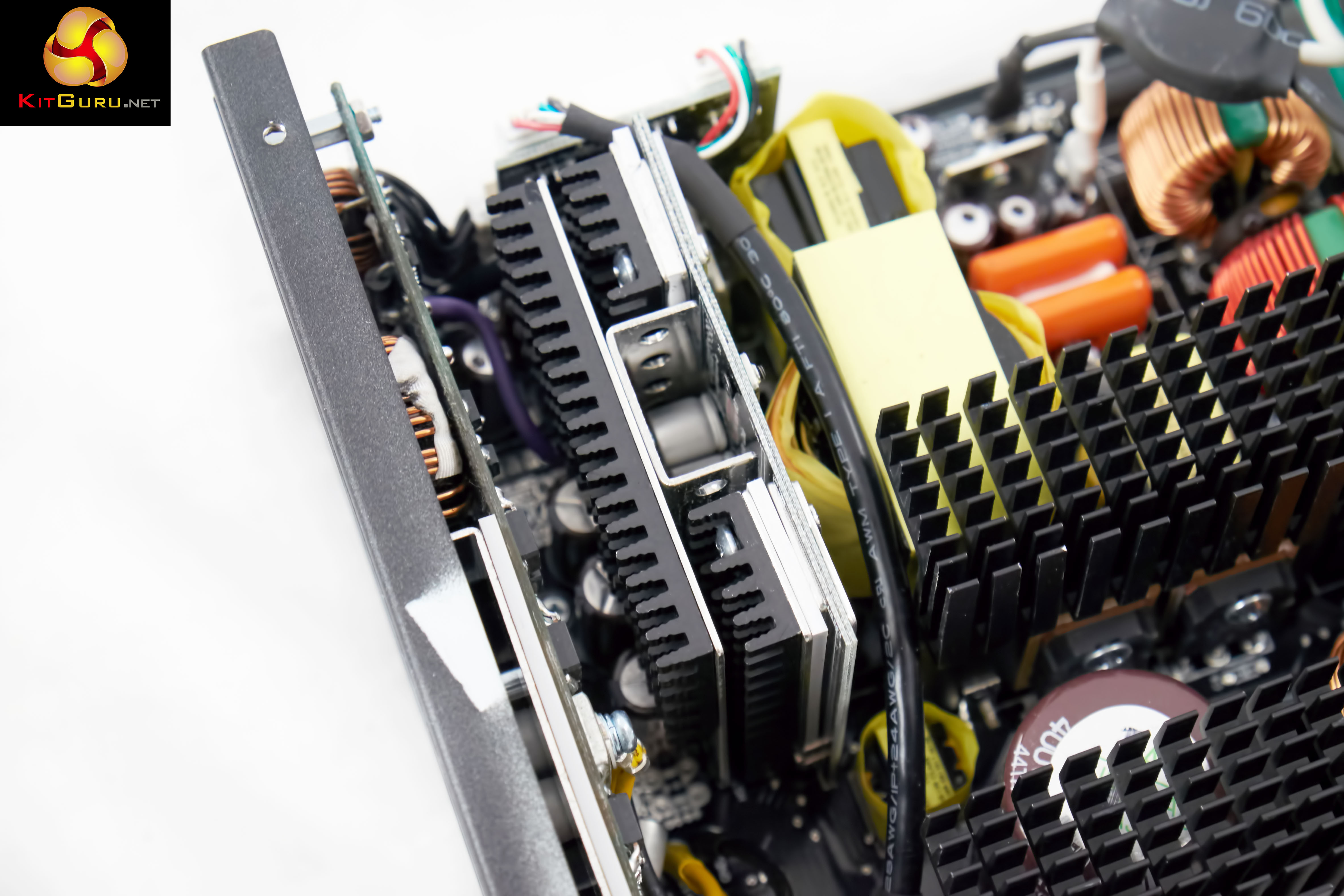
On the secondary side, the 3.3V and 5V are generated from the 12V by DC-DC conversion. Voltage modulation is handled by two additional PCB, which are placed on either side of the supply.
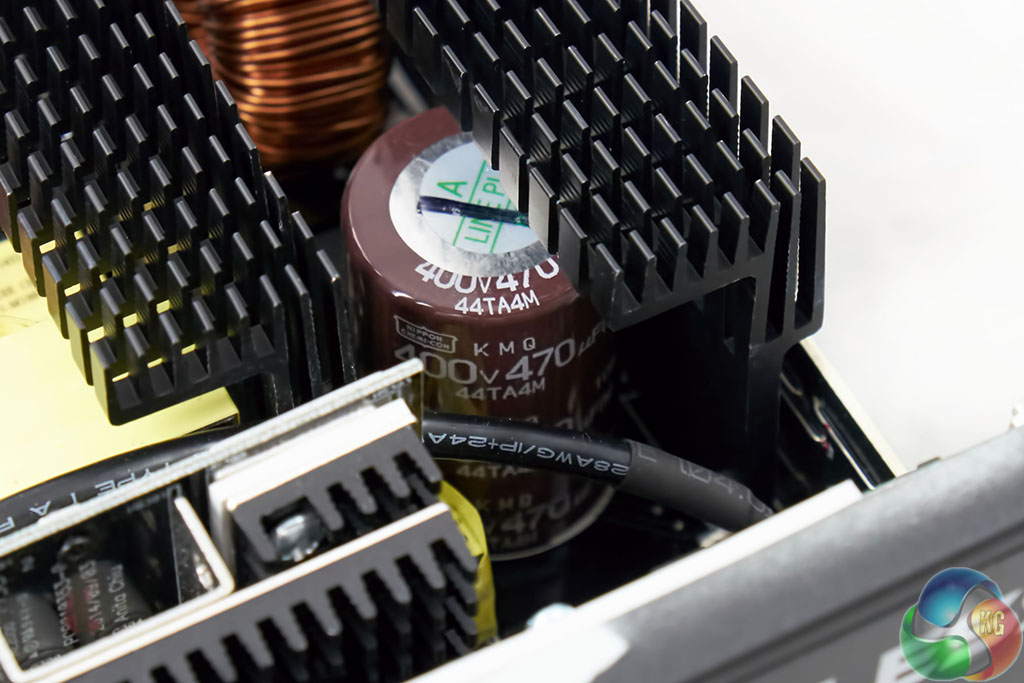
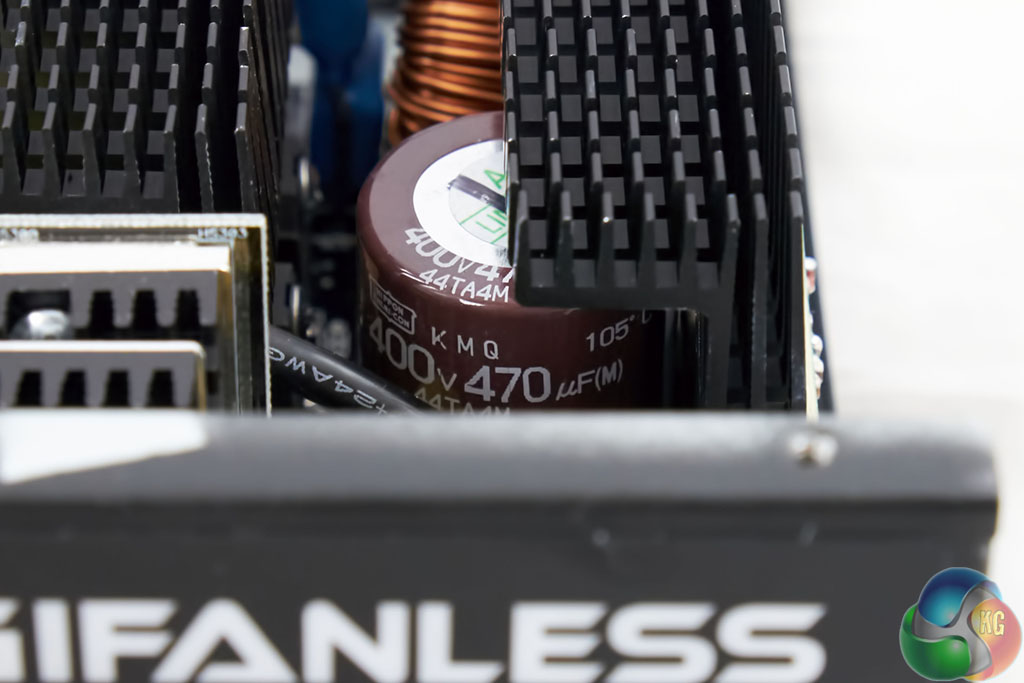
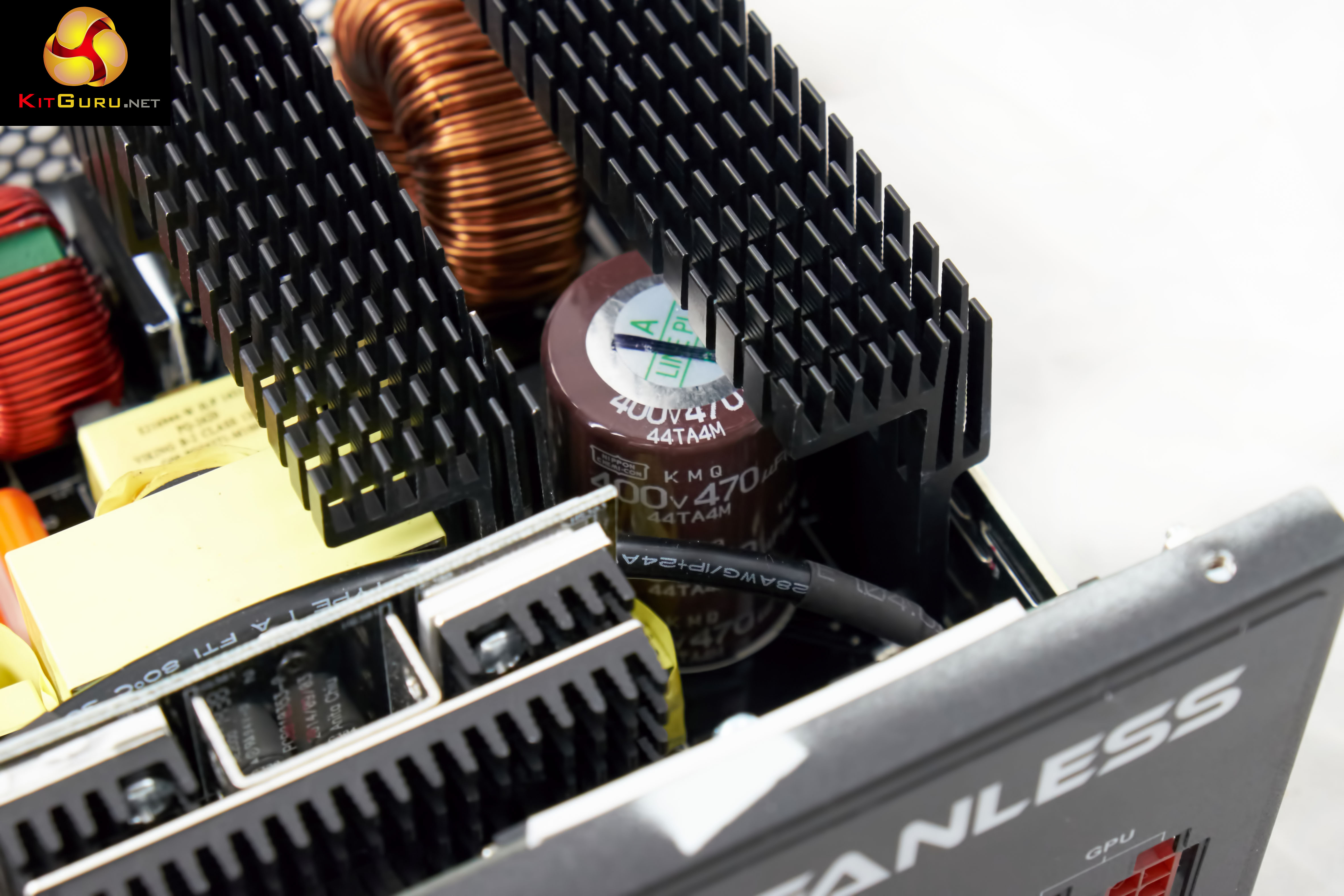
Always good to see a manufacturer not skimping and using high grade Japanese capacitors. The primary capacitor is 105c, 400V 470uF rated, and by Nippon Chemi Con, from their KMQ family.
On this page we present some high resolution images of the product taken with the Fuji XT1 camera. These will take much longer to open due to the dimensions, especially on slower connections. If you use these pictures on another site or publication, please credit Kitguru.net as the owner/source.
Additional technical assistance: Peter McFarland and Jeremy Price.
Correctly testing power supplies is a complex procedure and KitGuru have configured a test bench which can deliver up to a 2,000 watt DC load. Due to public requests we have changed our temperature settings recently – previously we rated with ambient temperatures at 25C, we have increased ambient temperatures by 10c (to 35c) in our environment to greater reflect warmer internal chassis conditions.
We use combinations of the following hardware:
• SunMoon SM-268
• CSI3710A Programmable DC load (+3.3V and +5V outputs)
• CSI3711A Programmable DC load (+12V1, +12V2, +12V3, and +12V4)
• Extech Power Analyzer
• Extech MultiMaster MM570 digital multimeter
• SkyTronic DSL 2 Digital Sound Level Meter (6-130dBa)
• Digital oscilloscope (20M S/s with 12 Bit ADC)
• Variable Autotransformer, 1.4 KVA
We combine all +12V output for the results below.
|
DC Output Load Regulation
|
||||||||
|
Combined DC Load |
+3.3V
|
+5V
|
+12V
|
+5VSB
|
||||
|
A
|
V
|
A
|
V
|
A
|
V
|
A
|
V
|
|
|
110W
|
1.18
|
3.34
|
1.18
|
5.07
|
8.02
|
12.04
|
0.50
|
5.02
|
|
220W
|
2.07
|
3.34
|
2.07
|
5.07
|
16.13
|
12.01
|
0.50
|
5.02
|
|
340W
|
3.04
|
3.33
|
3.05
|
5.06
|
25.12
|
11.99
|
1.00
|
5.01
|
| 445W |
4.12
|
3.33
|
4.06
|
5.06
|
33.23
|
11.97
|
1.50
|
5.00 |
|
550W
|
5.13
|
3.33
|
5.03
|
5.04
|
41.03
|
11.95
|
2.50
|
5.00
|
| Enermax DigiFanless 550W |
Maximum Load |
| 619W |
Load regulation is acceptable across the output range. The power supply delivered 619 watts of power before it would shut down, safely.
Next we want to try Cross Loading. This basically means loads which are not balanced. If a PC for instance needs 500W on the +12V outputs but something like 30W via the combined 3.3V and +5V outputs then the voltage regulation can fluctuate badly.
| Cross Load Testing | +3.3V | +5V | +12V | -12V | +5VSB | |||||
| A | V | A | V | A | V | A | V | A | V | |
| 493W | 1.0 | 3.34 | 1.0 | 5.07 | 40.5 | 11.94 | 0.2 | -12.03 | 0.50 | 5.00 |
| 153W | 15.0 | 3.31 | 15.0 | 5.04 | 2.0 | 12.05 | 0.2 | -12.03 | 0.50 | 5.01 |
The unit passed the Cross Load test with flying colours. The +12V rail dropped to 11.94 when hit with 40.5A, still well within safe parameters.
We then used an oscilloscope to measure AC ripple and noise present on the DC outputs. We set the oscilloscope time base to check for AC ripple at both high and low ends of the spectrum. ATX12V V2.2 specification for DC output ripple and noise is defined in the ATX 12V power supply design guide.
|
ATX12V Ver 2.2 Noise/Ripple Tolerance
|
|
|
Output
|
Ripple (mV p-p)
|
|
+3.3V
|
50
|
|
+5V
|
50
|
|
+12V1
|
120
|
|
+12V2
|
120
|
|
-12V
|
120
|
|
+5VSB
|
50
|
Obviously when measuring AC noise and ripple on the DC outputs the cleaner (less recorded) means we have a better end result. We measured this AC signal amplitude to see how closely the unit complied with the ATX standard.
| AC Ripple (mV p-p) | ||||
| DC Load | +3.3V | +5V | +12V | 5VSB |
| 110W | 5 | 10 | 10 | 5 |
| 220W | 5 | 10 | 20 | 5 |
| 340W | 5 | 10 | 20 | 10 |
| 445W | 5 | 10 | 25 | 10 |
| 550W | 5 | 10 | 30 | 10 |
Noise suppression is excellent, peaking at 30 mV at full load on the +12V output. All other rails held to 5mV-10mV when fully loaded.
|
Efficiency (%)
|
|
|
110W
|
90.21
|
|
220W
|
93.88
|
|
340W
|
93.45
|
|
445W
|
92.23
|
|
550W
|
91.78
|
Efficiency is excellent, peaking at almost 94% at 50% load. At full load, this drops to just under 92%. Superb results.
We take the issue of noise very seriously at KitGuru and this is why we have built a special home brew system as a reference point when we test noise levels of various components. Why do this? Well this means we can eliminate secondary noise pollution in the test room and concentrate on components we are testing. It also brings us slightly closer to industry standards, such as DIN 45635.
Today to test the Power Supply we have taken it into our acoustics room environment and have set our SkyTronic DSL 2 Digital Sound Level Meter (6-130dBa) one meter away from the unit. We have no other fans running so we can effectively measure just the noise from the unit itself. That said, measuring lower than 28dBa proves very difficult, unless in strict laboratory conditions.
As this can be a little confusing for people, here are various dBa ratings in with real world situations to help describe the various levels.
KitGuru noise guide
10dBA – Normal Breathing/Rustling Leaves
20-25dBA – Whisper
30dBA – High Quality Computer fan
40dBA – A Bubbling Brook, or a Refrigerator
50dBA – Normal Conversation
60dBA – Laughter
70dBA – Vacuum Cleaner or Hairdryer
80dBA – City Traffic or a Garbage Disposal
90dBA – Motorcycle or Lawnmower
100dBA – MP3 Player at maximum output
110dBA – Orchestra
120dBA – Front row rock concert/Jet Engine
130dBA – Threshold of Pain
140dBA – Military Jet takeoff/Gunshot (close range)
160dBA – Instant Perforation of eardrum
|
Noise (dBA)
|
|
|
110W
|
/
|
|
220W
|
/
|
|
340W
|
/
|
|
445W
|
/
|
| 550W | / |
There is no fan, so the unit rates as silent. We didn't experience any coil whine either in our tests.
|
Temperature (c)
|
||
|
Intake
|
Exhaust
|
|
|
110W
|
36
|
43
|
|
220W
|
38
|
48
|
|
340W
|
41
|
54
|
|
445W
|
44
|
58
|
|
550W
|
46
|
66
|
Temperatures rise to a 20c above ambient when fully loaded.
|
Maximum load
|
Efficiency
|
|
619W
|
91.32
|
Pushing the PSU above its rated limits generates an efficiency level of around 91.32%. This is not a viable ‘real world’ situation, but its interesting nonetheless.
The last time we reviewed a passively cooled power supply was almost 3 years ago. It was the Seasonic Platinum Fanless 520W model, a stellar power supply which walked away with our highest award. The enthusiast audience demanding lower noise levels is increasing all the time. The only downside with a passive, fanless design is the high cost – the Seasonic 520W fanless power supply retails for £124.99 inc vat, three years later. By anyone's standards this is a fair chunk of change.
The Enermax DigiFanLess 550W is even more expensive than the Seasonic Platinum Fanless 520W. While no stock is yet available in the United Kingdom, we have been told that the price is 210 euros. If we do a direct euro conversion to pounds sterling at xe.com, the final price is likely to be close to £160, possibly more if there are extra charges for UK VAT.
Technically we find there is a lot to recommend. The Enermax DigiFanless 550W can deliver a sustained 600W+ load and it exhibits no major weaknesses. Load regulation is stellar, ripple suppression is fantastic, and there is no noise whatever, regardless of the load. Special care needs to be taken for the installation phase, as the main vent should be at the top, so the hot air can rise upwards, and out. Incorrect mounting could be potentially fatal for the power supply, over time.
We appreciate the lengths Enermax have taken to ensure it not only performs well, but it looks well. From the deep, rich paint work, to the attractive individually sleeved cables, this is a power supply that will look great on display inside a premium windowed chassis. The option to control aspects of the power supply via software is likely to be a key selling point to the audience who love to ‘tweak' settings.
Inside, the company has used all, high grade Japanese capacitors, rated at 105c. Having these capacitors in a passive design is critical to long term stability, especially if you are likely to be drawing in excess of 400 watts under sustained load.
You should consider the Enermax DigiFanless 550W if you are trying to reduce your rigs noise as far as possible and have a little extra money in your pocket. Otherwise, I feel regardless of how good this power supply is, that the £160+ price is going to be a tough ask for 90% of the potential audience.
Right now, we can't link to any store, as there is no availability. According to Enermax, Overclockers UK, Scan and Amazon should have stock in the coming weeks.
Discuss on our Facebook page, over HERE.
Pros:
- Fantastic looking power supply.
- fanless, therefore silent (didn't exhibit coil whine either).
- handled a sustained 600Watt load for a long time.
- software implementation is interesting.
- individually sleeved cables.
- fully modular.
Cons:
- It is expensive, UK price is likely to be similar to many leading 1000W units.
KitGuru says: The Enermax DigiFanless 550W is built to cater to a specialist audience, and it is an exceptionally well built unit that performs just as well. The asking price may prove too much for many however.


Damn I would have loved this! But I can’t justify a £100ish premium just for being silent.
Expensive, and unless you could realistically make the entire system fanless, there is little point in the PSU being fanless, and I doubt a system that needed 500W could be – and the digital feature also seems out of place at this power level.
I expect they will do a non-digital version at a better price point.