KitGuru KitGuru.net – Tech News | Hardware News | Hardware Reviews | IOS | Mobile | Gaming | Graphics Cards


Seagate's new IronWolf 110 SSD is the world's first SSD designed from the ground up for use in NAS devices, aimed at all-flash arrays or for use as tiered cache in NAS devices that support caching. It uses a combination of an in-house Seagate controller and Toshiba 3D TLC NAND.
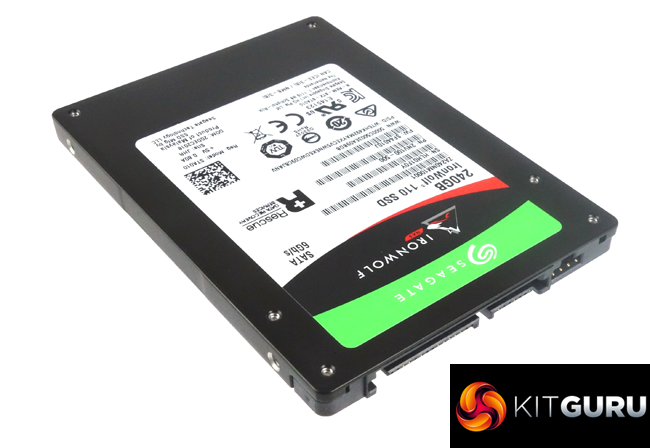
At the time of writing this review there are five models in the IronWolf 110 line-up; the entry level 240GB (the drive we are looking at), 480GB, 960GB, 1.92TB and finally the flagship 3.84TB drive. All five drives have the same 560GB Sequential read rating and all bar the 240GB drive have an official Sequential write speed of 535MB/s. The 240GB drive has an official rating of 345MB/s.
The 240GB drive's 4K random read/write performance is quoted by Seagate as up to 55,000 and 30,000 IOPS respectively (tested at a queue depth of 32). The endurance rating for the 240GB drive is 435TB TBW and Seagate back the drive with a five-year warranty. You also get a two-year Seagate Rescue Recovery Services plan. The plan provides access to Seagate’s technical services who will assist with data recovery in the event of a drive failure.
Power consumption figures for the 240GB drive are 2.3W maximum average active and 1.1W average idle.
Physical Specifications:
- Usable Capacities: 240GB
- NAND Components: Toshiba BiCS3 3D TLC
- NAND Controller: Seagate
- Cache: 256MB DDR3-1866.
- Interface: Serial ATA (SATA) 6Gb/s (SATA III)
- Form Factor: 2.5in.
- Dimensions: 100.25 x 70.10 x 7mm
- Drive Weight: 70.6g
Firmware Version: SF44010J
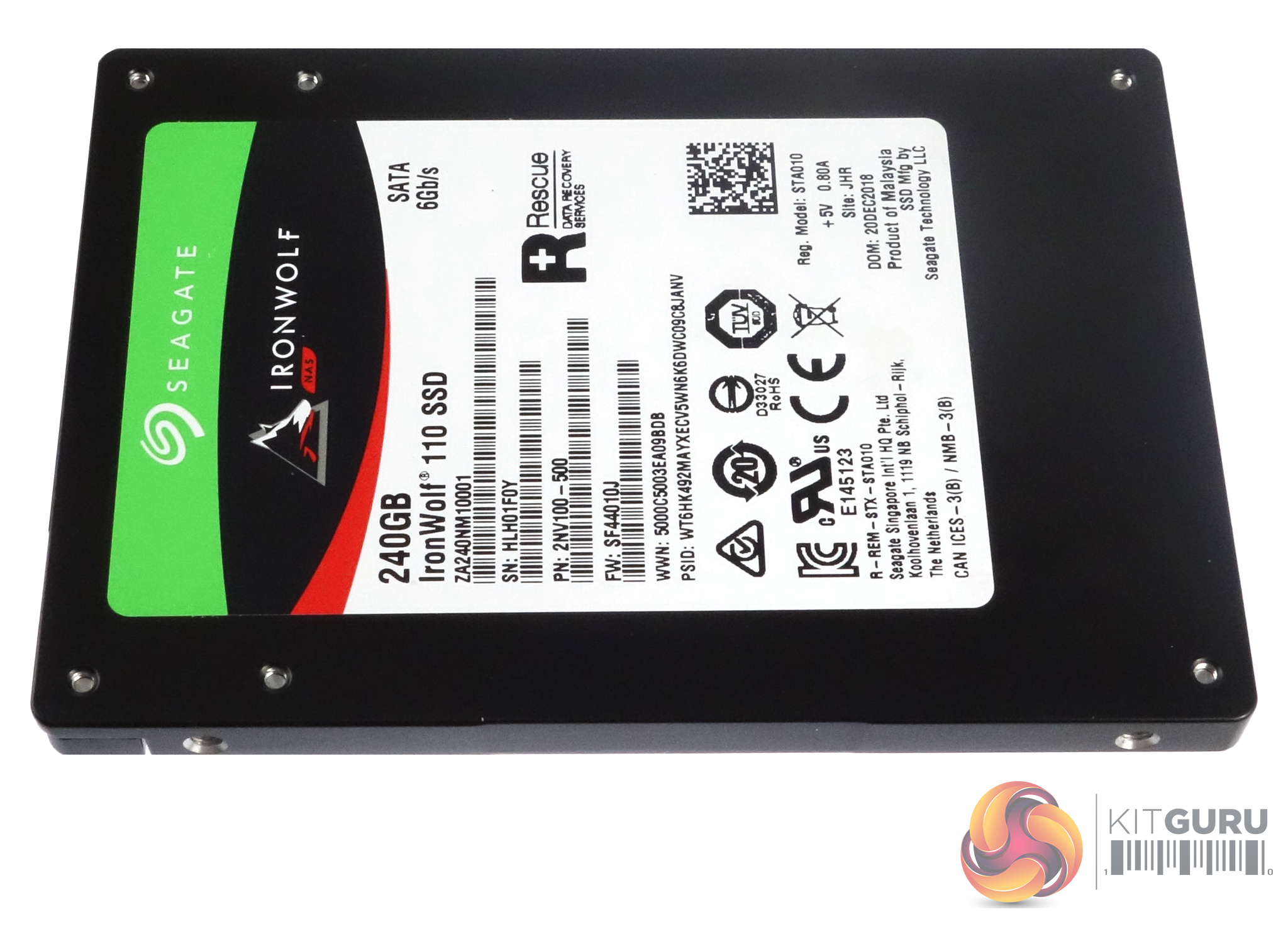
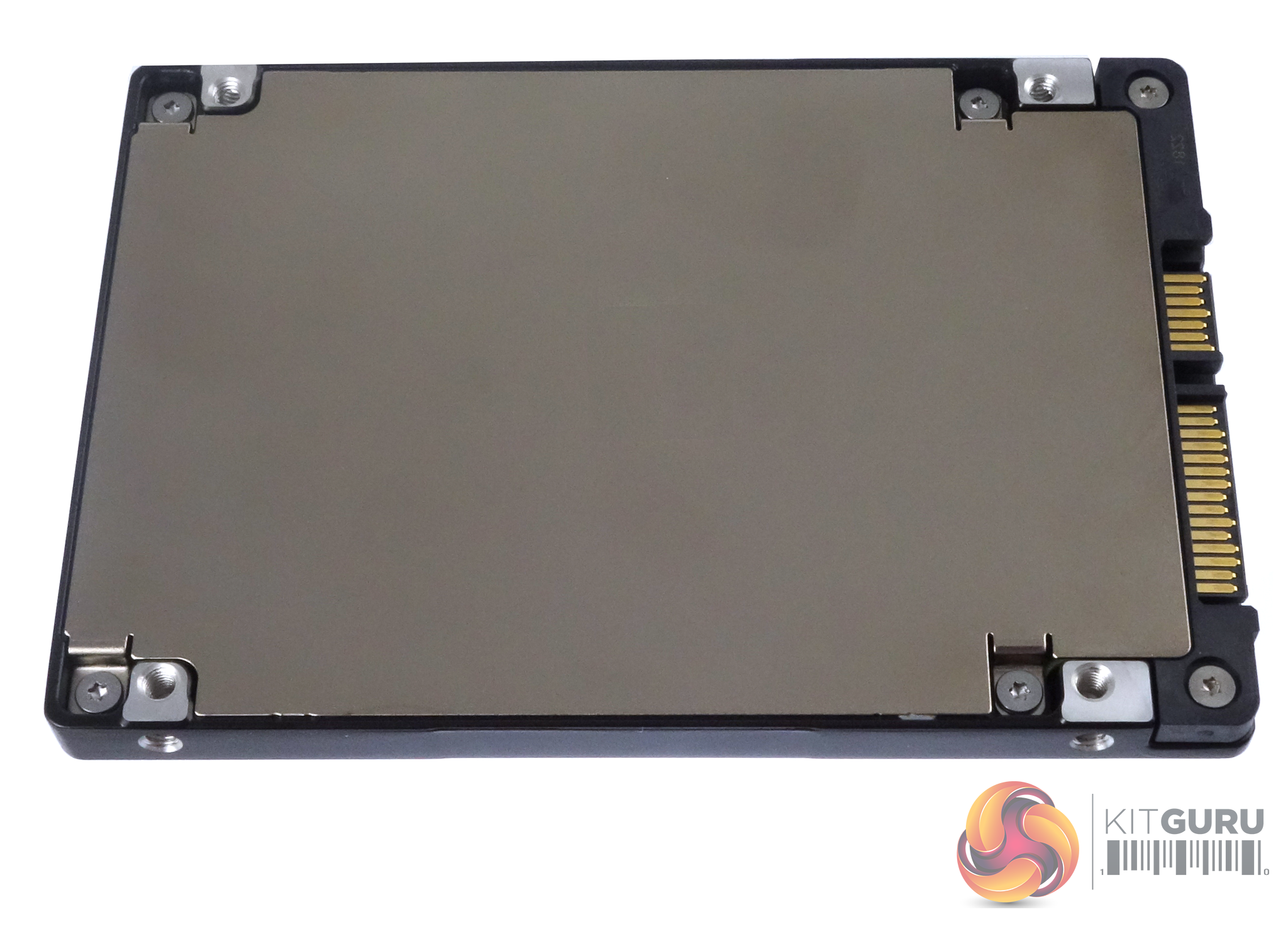
The IronWolf 110 is built on a standard 2.5in format using a good quality metal enclosure. Four tiny screws are used to keep the enclosure together.
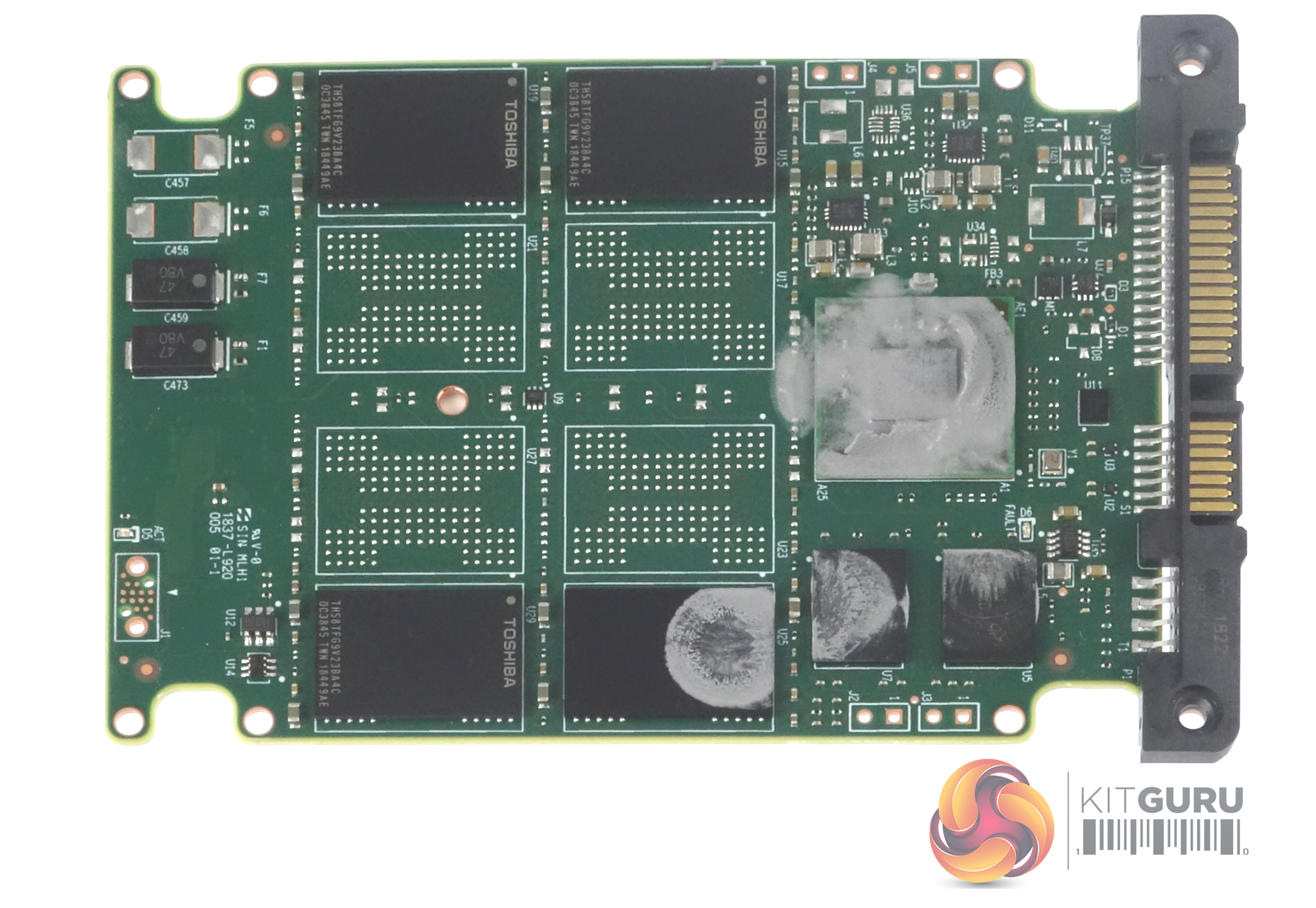
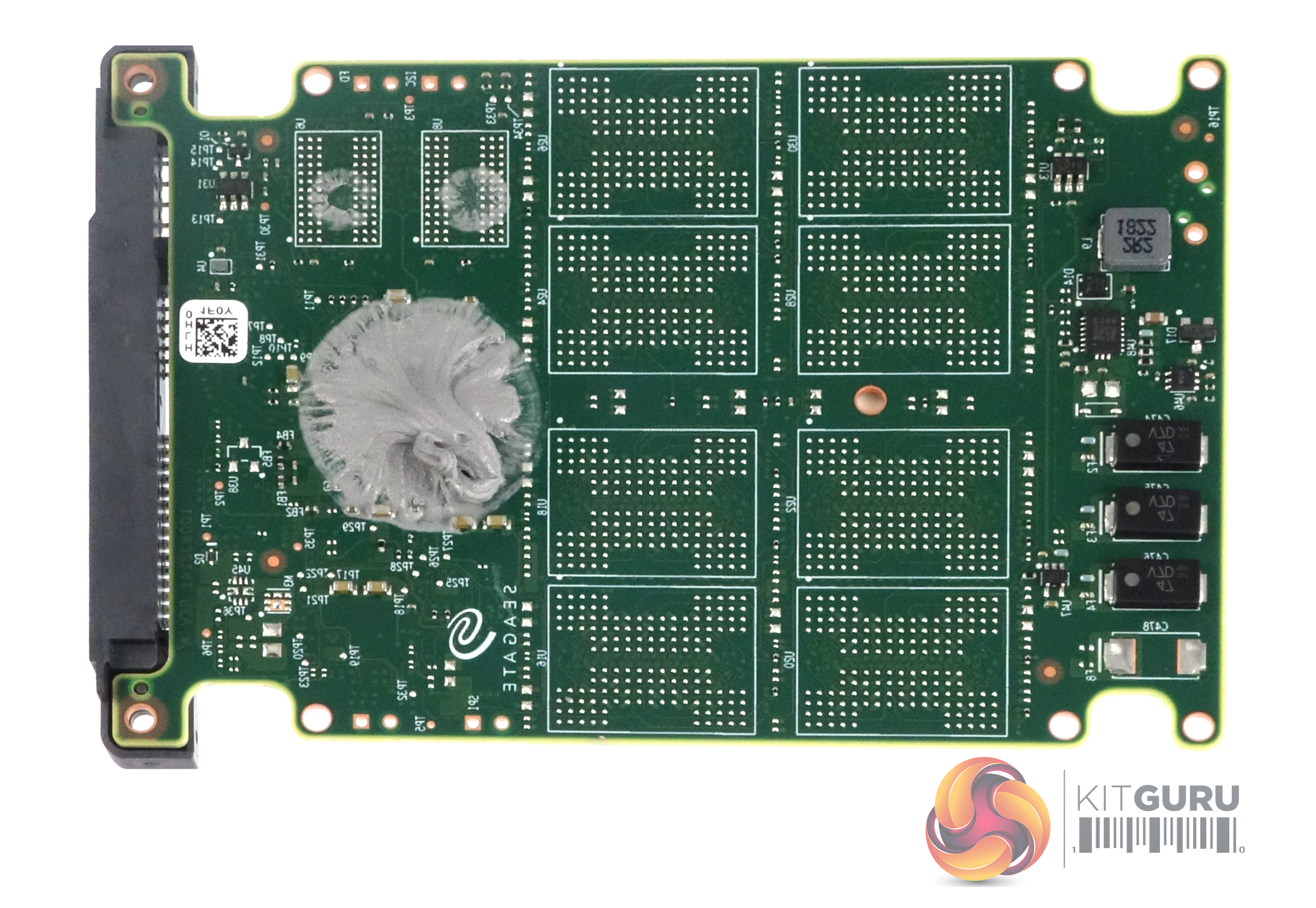
First thing you notice when you get inside the drive is that, unusually, Seagate has opted for thermal paste to keep the controller cool and not the more common thermal pads. The 240GB IronWolf has a lot of empty real estate as it uses a full sized PCB to house just the Seagate in-house controller (labelled 50002176), four Toshiba 3D TLC BiCS3 (TH58TFG9V23BA4C) NAND packages and two Micron DDR3-1866 (MT41K128M8DA-107:J) cache chips. The drive also has power-loss data protection via on-board capacitors.
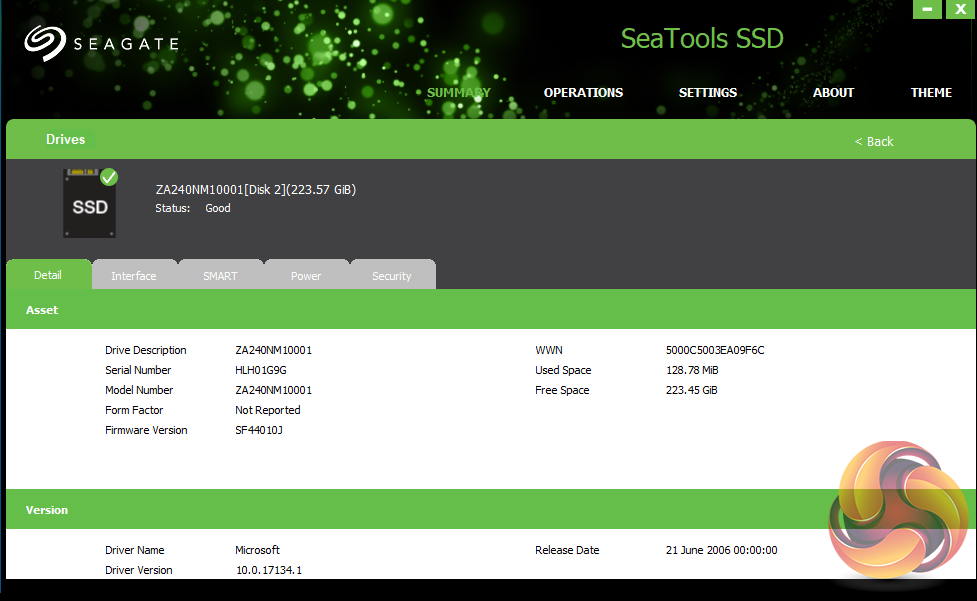
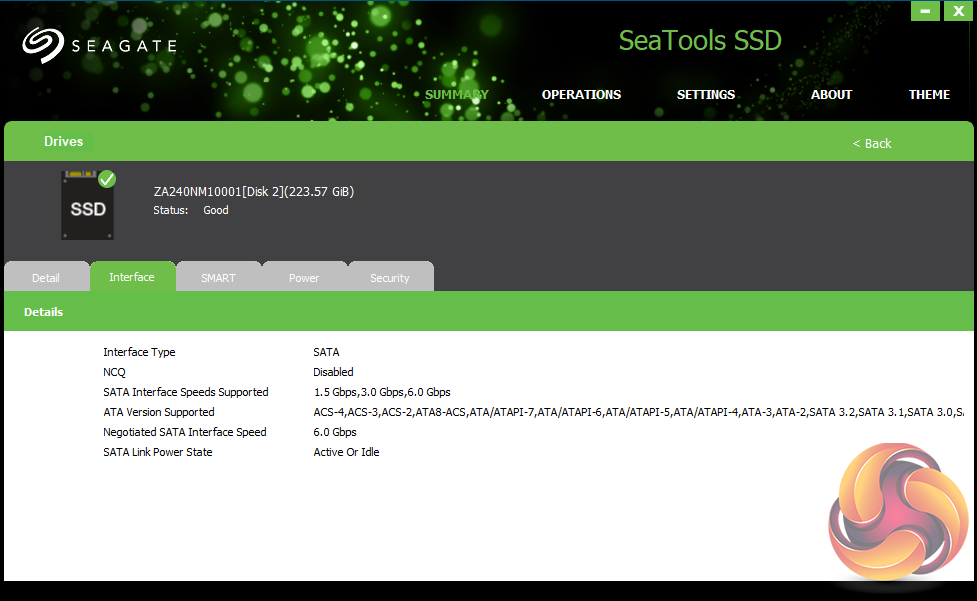
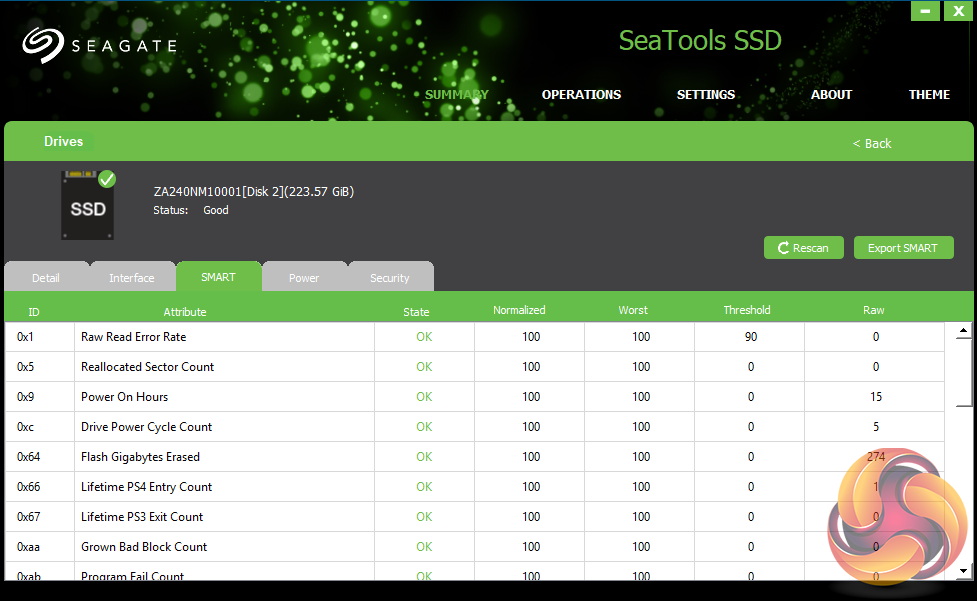

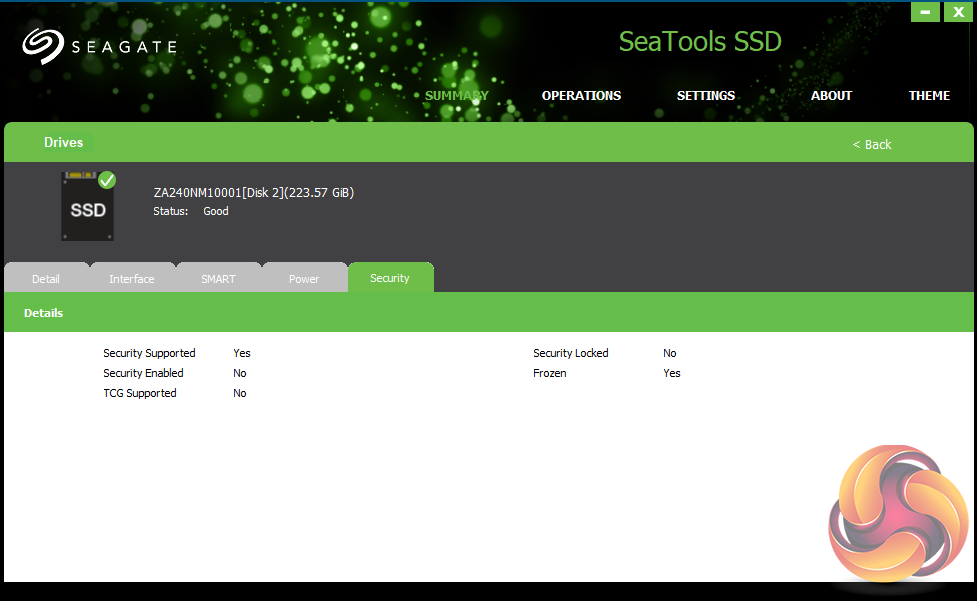
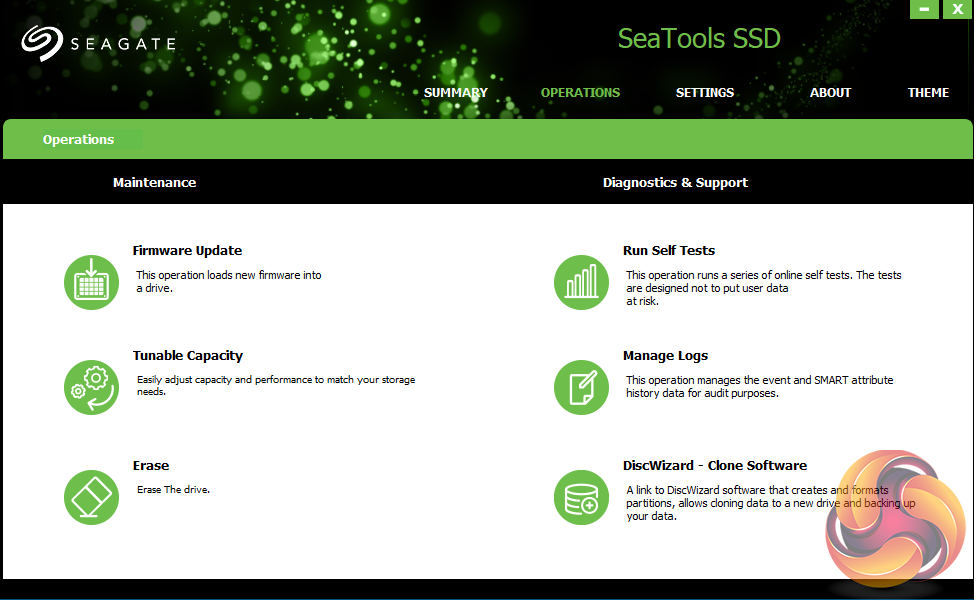
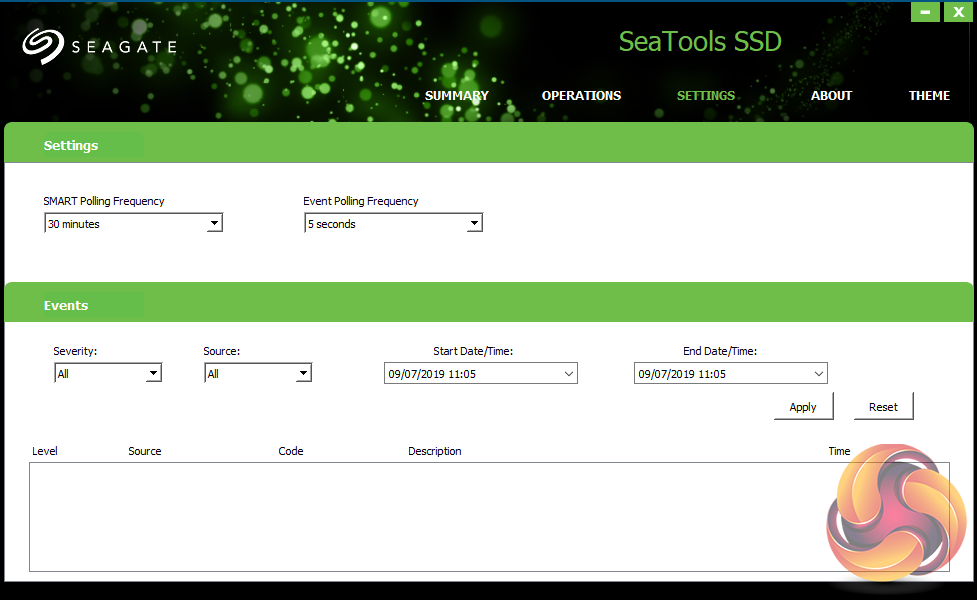
Seagate's SSD utility is SeaTools SSD. SeaTools SSD is a pretty comprehensive management tool that displays drive information including model, capacity, disk usage, temperature and remaining life. It also displays information about the SATA interface. It has an event log that can be exported and with it you can perform firmware updates. Firmware updates are done via the Operations page. Within this page you can also run drive diagnostics, and, if the drive supports it, switch between performance optimised and capacity optimised modes. There's also a link to Seagate's disc cloning software – DiscWizard.
For testing, the drives are all wiped and reset to factory settings by HDDerase V4. We try to use free or easily available programs and some real world testing so you can compare our findings against your own system.
This is a good way to measure potential upgrade benefits.
Main system:
Intel Core i7-7700K with 16GB of DDR4-3200 RAM, Sapphire R9 390 Nitro and an Asus Prime Z270-A motherboard.
Other drives:
Corsair Neutron XTi 480GB
Crucial BX300 480GB
Crucial BX500 480GB
Intel SSD730 480GB
Kingston DC400 480GB
Kingston HyperX 3K 480GB
OCZ Trion 100 480GB
OCZ Trion 150 480GB
Patriot Ignite 480GB
PNY CS2111 XLR8 480GB
SanDisk Extreme Pro 480GB
Samsung 840DC EVO 480GB
Seagate 600 480GB
Transcend SSD220S 480GB
Software:
Atto Disk Benchmark.
CrystalMark 3.0.3.
AS SSD.
IOMeter.
Futuremark PC Mark 8
All our results were achieved by running each test five times with every configuration this ensures that any glitches are removed from the results. Trim is confirmed as running by typing fsutil behavior query disabledeletenotify into the command line. A response of disabledeletenotify =0 confirms TRIM is active.
CrystalDiskMark is a useful benchmark to measure theoretical performance levels of hard drives and SSD’s. We are using V3.0.3.
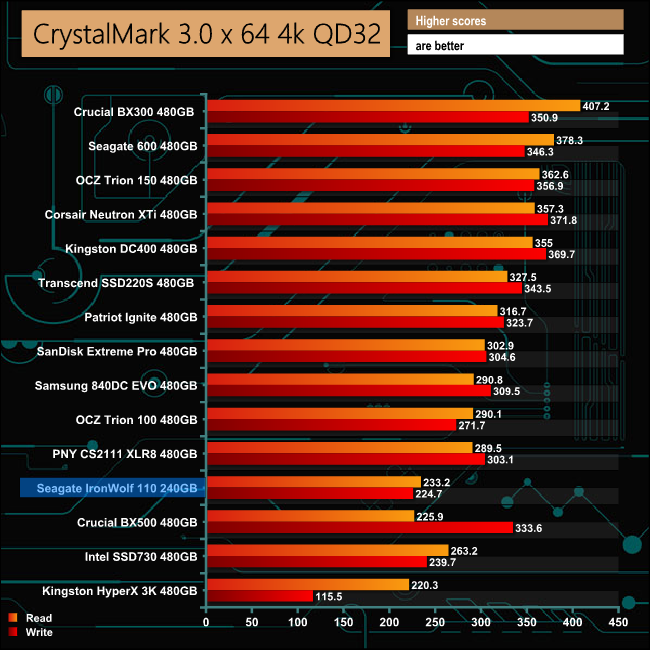
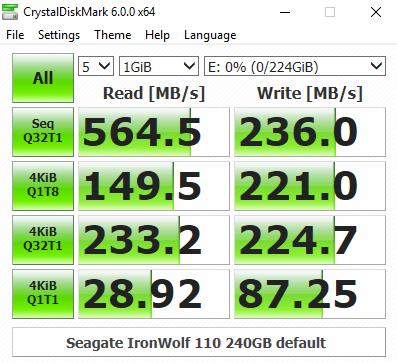
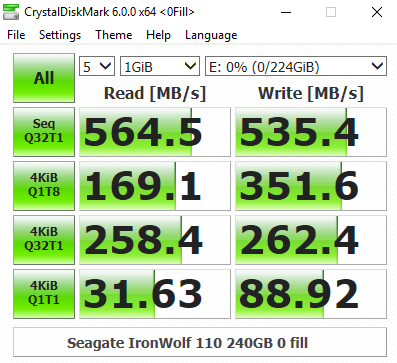
The IronWolf 110 doesn't handle the CrystalDiskMark benchmark tests, at a deep queue depth of 32, too well. Looking at the two benchmark result screens, it appears that the Seagate controller has a preference for compressible data particularly when it comes to writes.
The ATTO Disk Benchmark performance measurement tool is compatible with Microsoft Windows. Measure your storage systems performance with various transfer sizes and test lengths for reads and writes. Several options are available to customise your performance measurement including queue depth, overlapped I/O and even a comparison mode with the option to run continuously.
Use ATTO Disk Benchmark to test any manufacturers RAID controllers, storage controllers, host adapters, hard drives and SSD drives and notice that ATTO products will consistently provide the highest level of performance to your storage.
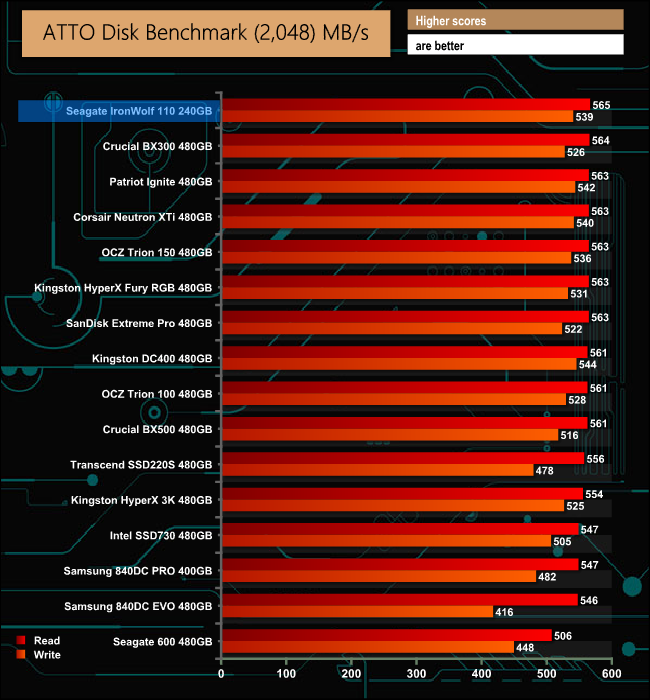
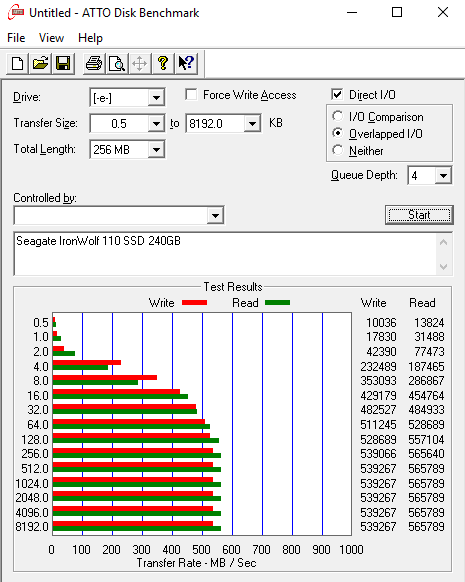
The 240GB version of the IronWolf 110 is rated as up to 560MB/s for Sequential reads and up to 345MB/s for writes. Using the ATTO benchmark we could confirm those figures with a read result of 565MB/s. That official write figure seems to be on the conservative side as our ATTO write result was 539MB/s. The read figure of 565MB/s is just enough to sit the IronWolf 110 on top of our results chart.
AS SSD is a great free tool designed just for benching Solid State Drives. It performs an array of sequential read and write tests, as well as random read and write tests with sequential access times over a portion of the drive. AS SSD includes a sub suite of benchmarks with various file pattern algorithms but this is difficult in trying to judge accurate performance figures.
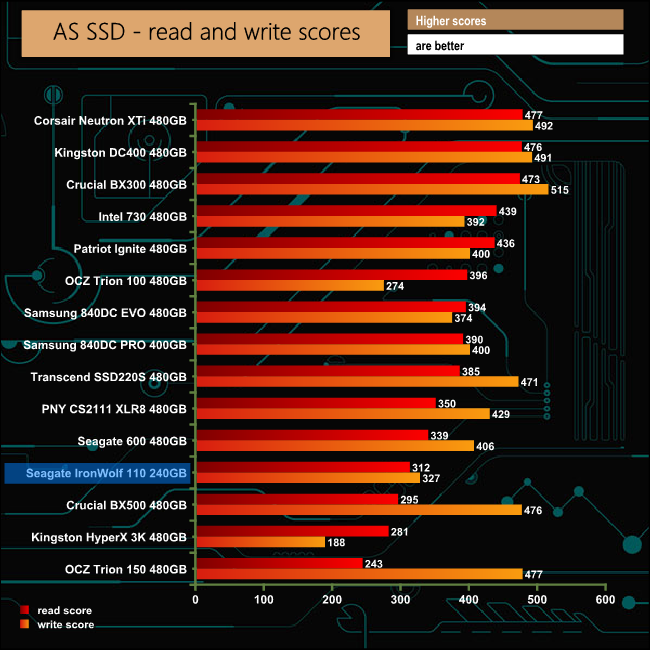
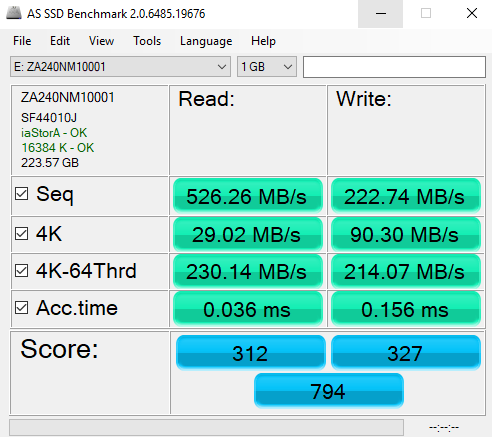
The read score of 312 places the IronWolf 110 in the bottom group of drives in our results chart. Its write score of 327 isn't as strong as some of the drives around it on the chart.
IOMeter is another open source synthetic benchmarking tool which is able to simulate the various loads placed on hard drive and solid state drive technology.
We test with both random read and write 4k tests, as shown above. There are many ways to measure the IOPS performance of a Solid State Drive, so our results will sometimes differ from manufacturer’s quoted ratings. We do test all drives in exactly the same way, so the results are directly comparable.
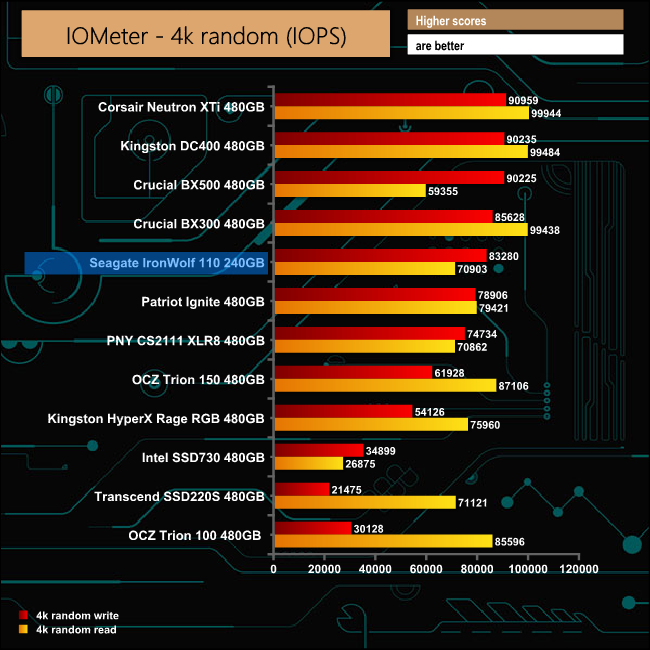
The official 4k random read/write figures for the drive are up to 55,000 and 30,000 IOPS respectively. These figures are from testing done at a queue depth of 32. We tested the drive at QD1 and got a read figure of 70,903 IOPS, with 83,280 IOPS for writes.
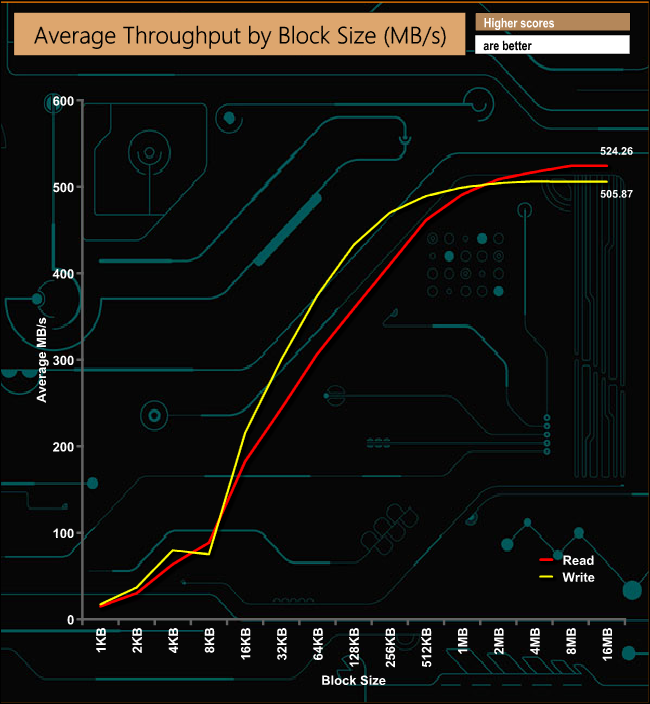
The peak average read speed of 524.31MB/s came at the 8MB block size while peak writes occurred at the 4MB block size at 506.54MB/s.
Futuremark’s PCMark 8 is a very good all round system benchmark but it’s Storage Consistency Test takes it to whole new level when testing SSD drives. It runs through four phases; Preconditioning, Degradation, Steady State, Recovery and finally Clean Up. During the Degradation, Steady State and Recovery phases it runs performance tests using the 10 software programs that form the backbone of PCMark 8; Adobe After Effects, Illustrator, InDesign, Photoshop Heavy and Photoshop Light, Microsoft Excel, PowerPoint, Word, Battlefield 3 and World of Warcraft. With some 18 phases of testing, this test can take many hours to run.
Preconditioning
The drive is written sequentially through up to the reported capacity with random data, write size of 256 × 512 = 131,072 bytes. This is done twice.
Degradation
Run writes of random size between 8 × 512 and 2048 × 512 bytes on random offsets for 10 minutes. It then runs a performance test. These two actions are then repeated 8 times and on each pass the duration of random writes is increased by 5 minutes.
Steady State
Run writes of random size between 8 × 512 and 2048 × 512 bytes on random offsets for final duration achieved in degradation phase. A performance test is then run. These actions are then re-run five times.
Recovery
The drive is idled for 5 minutes. Then a performance test is run. These actions are then repeated five times.
Clean Up
The drive is written through sequentially up to the reported capacity with zero data, write size of 256 × 512 = 131,072 bytes.
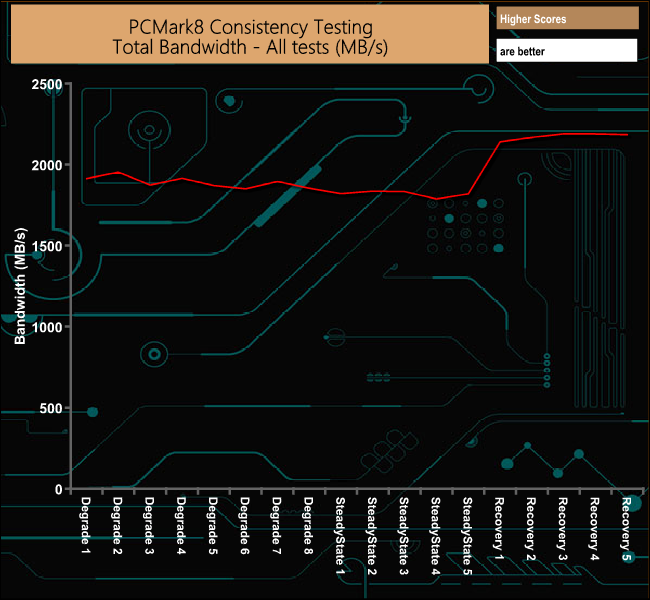
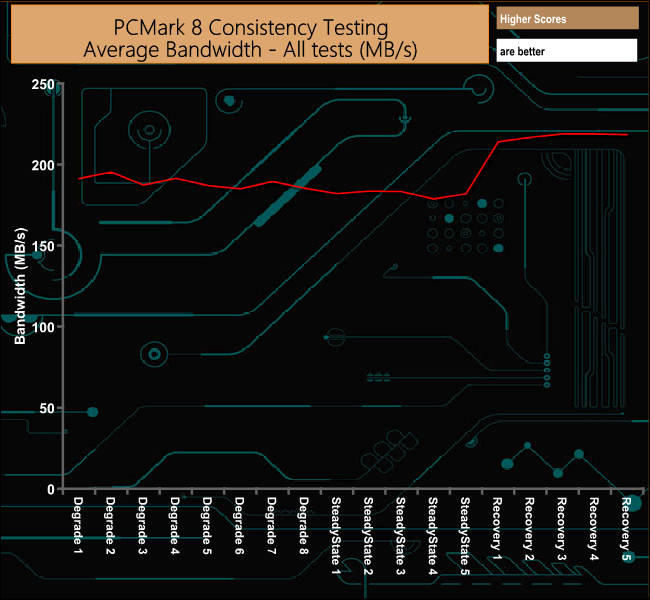
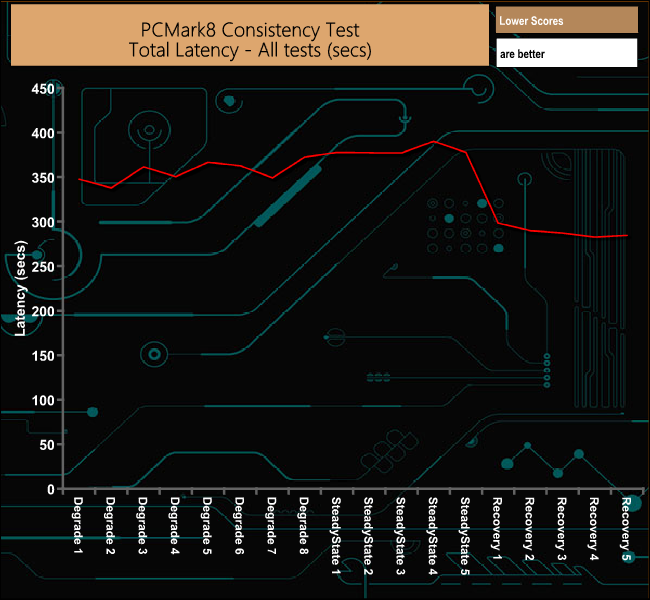
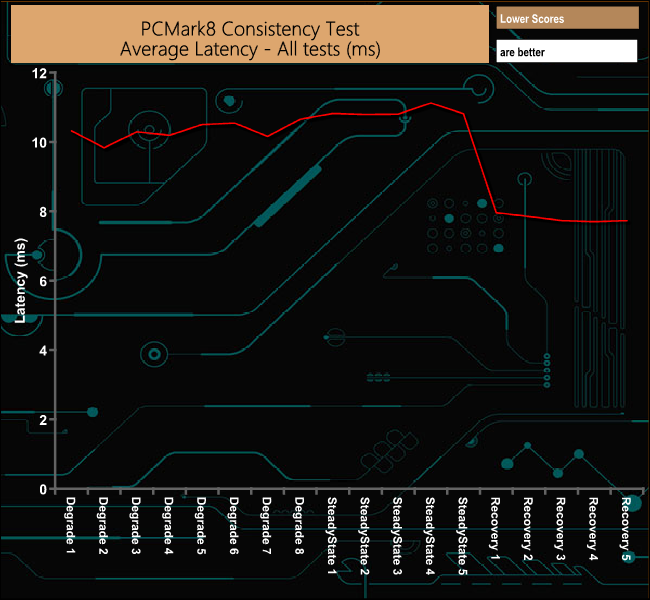
Seagate's IronWolf 110 deals with the rigours of PCMark 8's Consistency test pretty well. The bandwidth starts to drop off a little during the SteadyState phases but pulls back up during the Recovery runs.
PCMark 8’s Consistency test provides a huge amount of performance data, so here we’ve looked a little closer at how the 240GB IronWolf 110 performs in each of the benchmarks test suites.
Adobe Creative Cloud

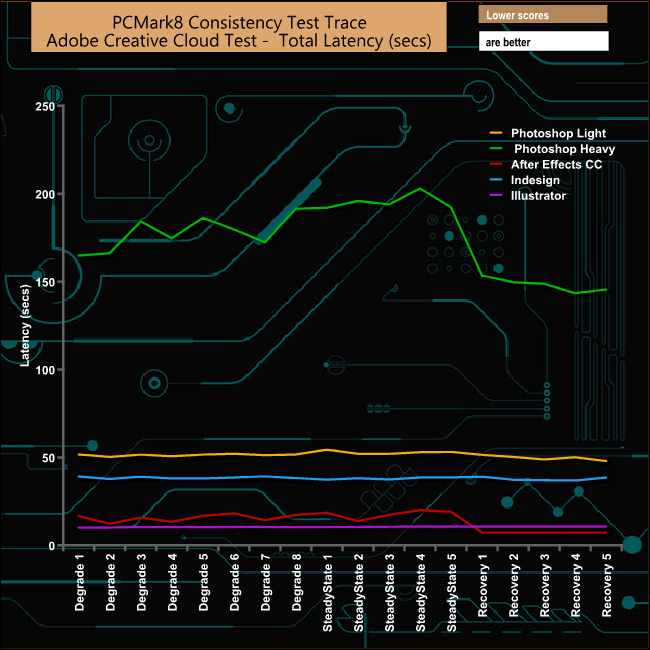
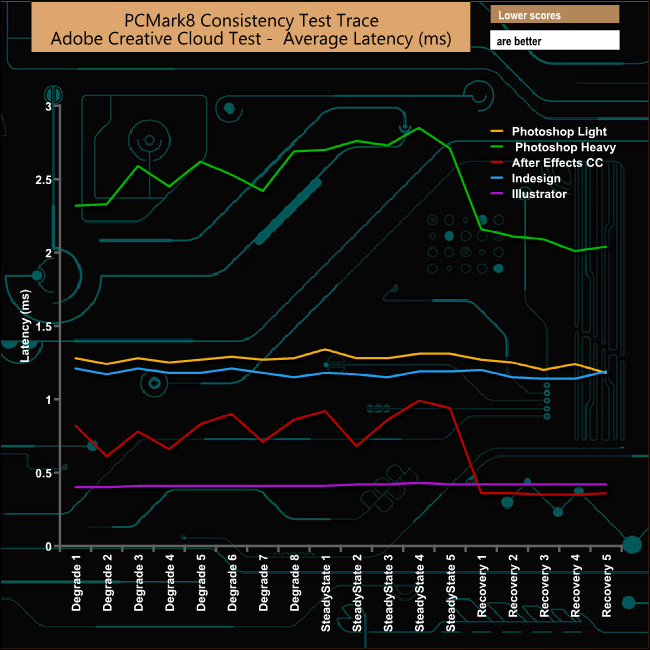
The IronWolf 110 handles the Adobe part of the Consistency test well with no alarming dips in bandwidth in any of the test traces. The most erratic performance comes from the After Effects CC trace but the drive recovers well from the ordeal.
Microsoft Office
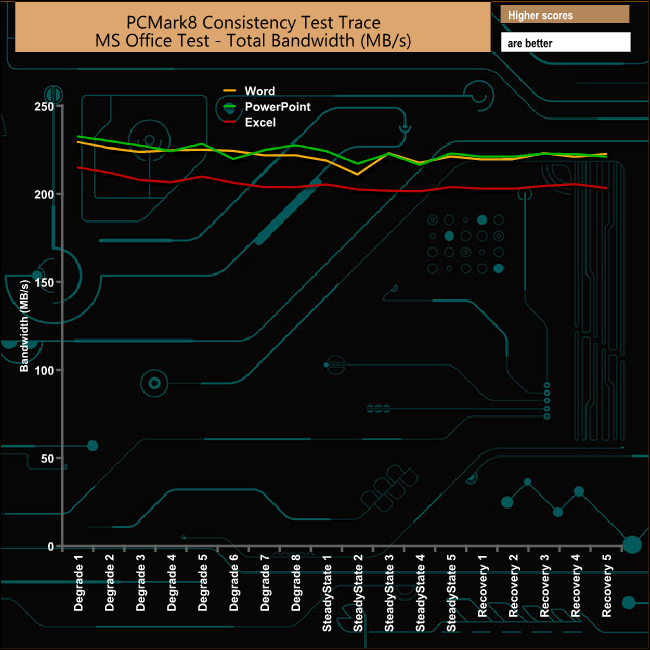
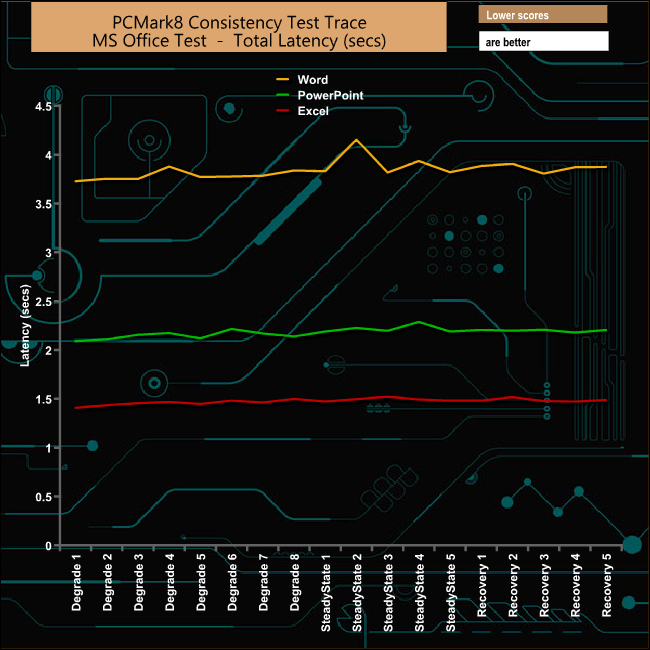
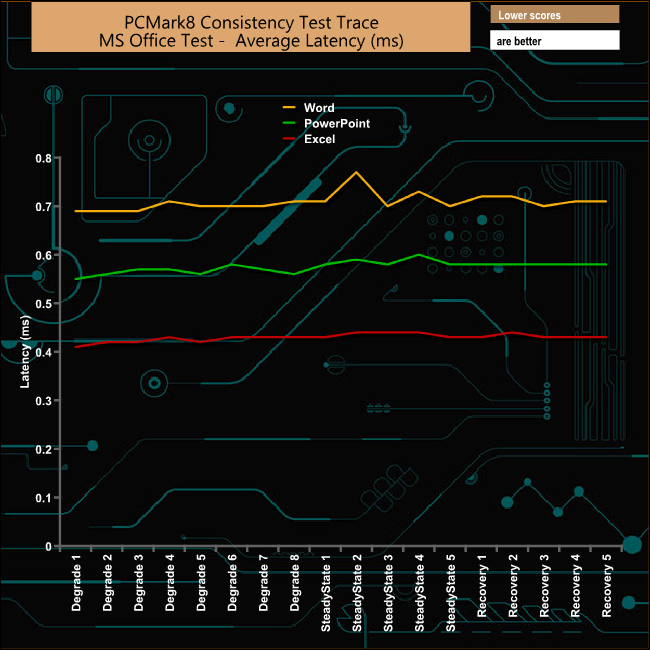
The drive deals with the MS Office part of the test very well indeed – even the MS Word trace, which often causes major problems, is dealt with very efficiently.
Casual Gaming
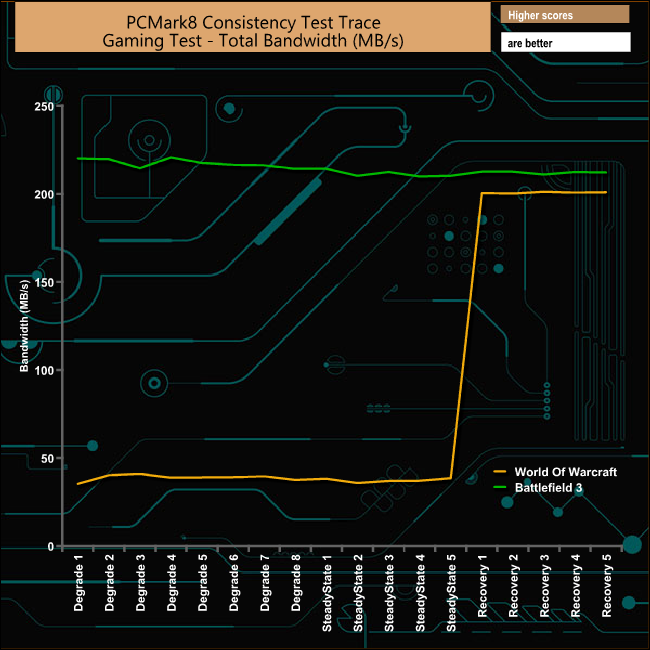
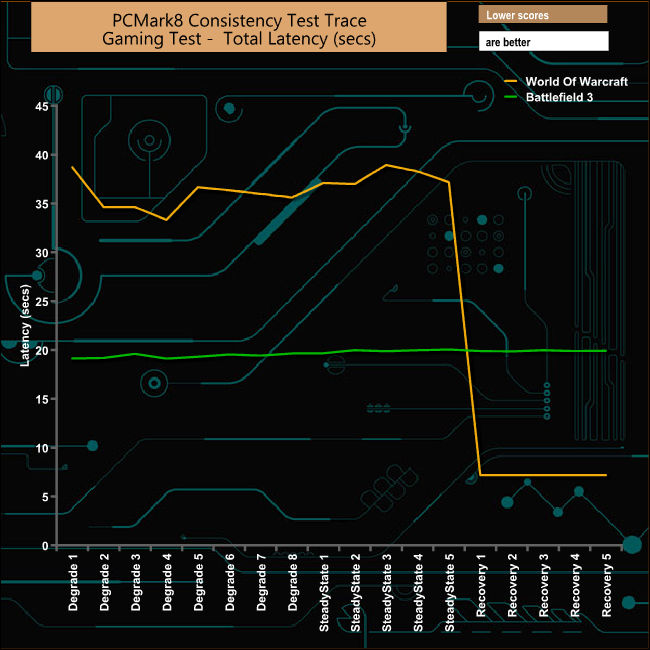

With the casual gaming tests, it's the World Of Warcraft trace that stresses the drive the most. The bandwidth for the Degradation and SteadyState runs is low, averaging just 38MB/s. However, the performance improves dramatically during the Recovery phases.
Just like the Consistency test, PCMark 8’s standard Storage Test also saves a large amount of performance data. The default test runs through the test suite of 10 applications three times. Here we show the total bandwidth performance for each of the individual test suites for the third and final benchmark run.
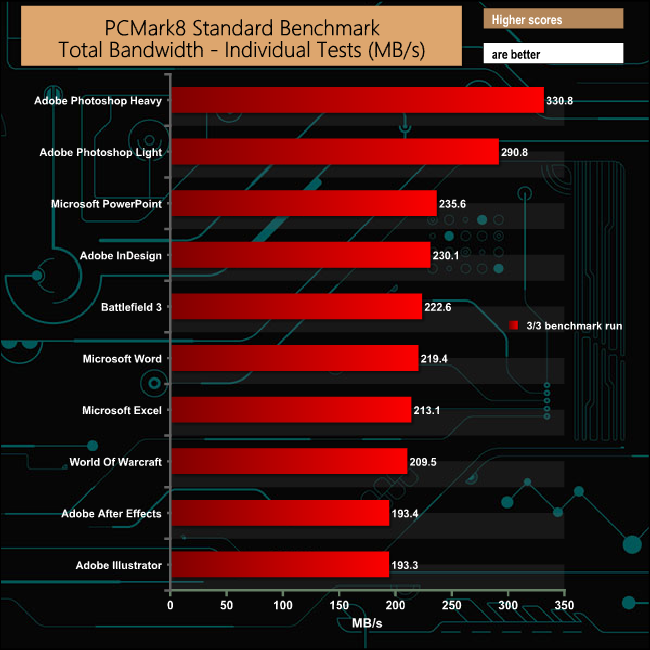
Taking the two Photoshop results out of the picture, the drive's performance across the remaining eight applications is pretty consistent.
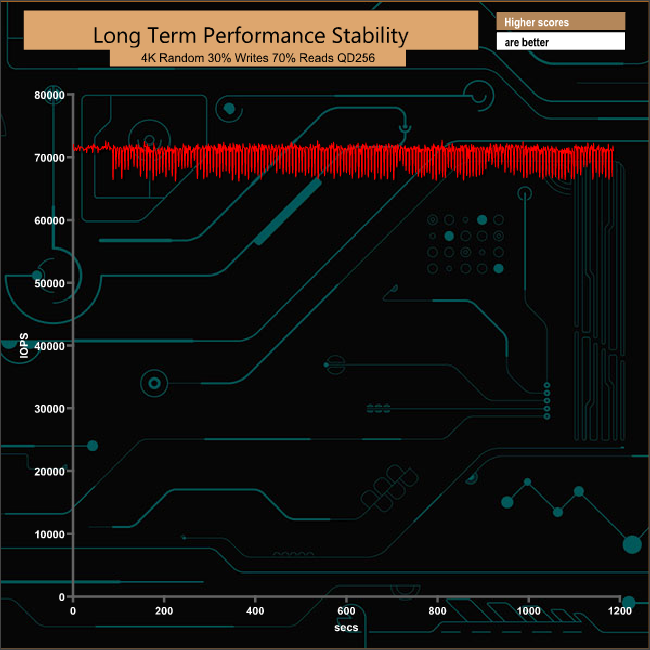
For the long term performance stability test, we set the drive up to run a 20-minute 4K random test with a 30% write, 70% read split, at a Queue Depth of 256 over the entire disk. The IronWolf 110 240GB drive averaged 70,841.22 IOPS for the test with a superb, enterprise-grade performance stability of 97%.
We tested the IronWolf 110 with a number of workloads that it may face in the real world. The settings for these scenarios are as follows.
File Server
512MB file size, 16KB Block size, 80% Read 20% Write 100% Random, I/O queue depth 128
Web Server
1GB file size, 16KB Block size, 100% Read 0% Write 100% Random, I/O queue depth 64
Database
2GB file size, 4KB Block size, 90% Read 10% Write, 90% Random, 10% Sequential, I/O queue depth 128
Workstation
1GB file size, 16KB Block size, 70% Read 30% Write, 50% Random 50% Sequential, I/O depth 1
Media Streaming
160GB file size, 64K Block size, 98% Read 2% Write, 100% Sequential, I/O queue depth 64, Threads/Workers: 8
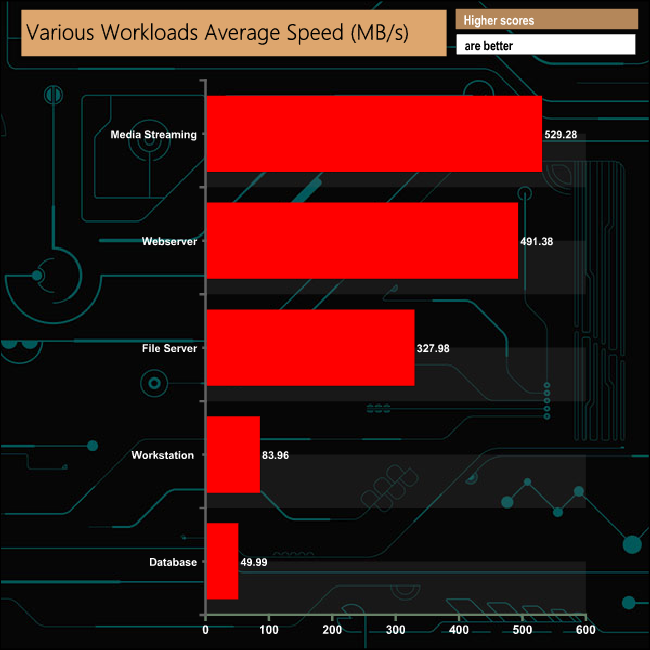
The 240GB IronWolf 110 showed strong performance across all of the workloads we tested on it, particularly the 529MB/s Media Streaming figure and the 50MB/s performance for the Database workload.
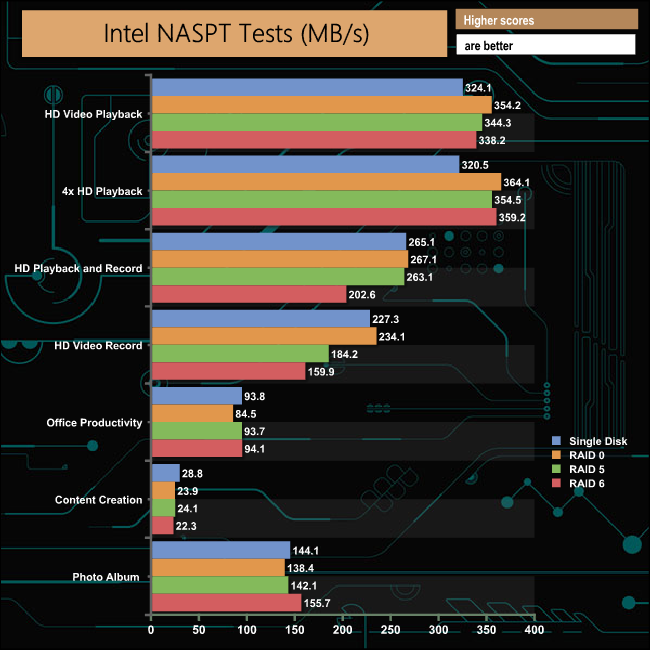
Seagate supplied us with four 240GB IronWolf 110s so we did a quick RAID test with Intel's NASPT benchmark using an Asustor AS4004T via a 10GbE connection. We tested a single disk and then RAIDs 0, 5 and 6. Overall, the performance of the drives in the various arrays was pretty consistent – although the RAID 6 performance in the HD Playback and Record test fell away somewhat. The same can be said for the performance of both RAID 5 and 6 in the HD Video Record test.
To test real life performance of a drive we use a mix of folder/file types and by using the FastCopy utility (which gives a time as well as MB/s result) we record the performance of drive reading from & writing to a 256GB Samsung SSD850 PRO.
We use the following folder/file types:
- 100GB data file.
- 60GB iso image.
- 60GB Steam folder – 29,521 files.
- 50GB File folder – 28,523 files.
- 12GB Movie folder – 24 files (mix of Blu-ray and 4K files).
- 10GB Photo folder – 621 files (mix of .png, raw and .jpeg images).
- 10GB Audio folder – 1,483 files (mix of mp3 and .flac files).
- 5GB (1.5bn pixel) photo.
- 11GB 4K Raw Movie Clips (8 MP4V files).
- 21GB 8K Movie demos.
- 4.25GB 3D Printer File Folder (mostly .STL).
- 1GB AutoCAD File Folder (.dwg and .dxf).
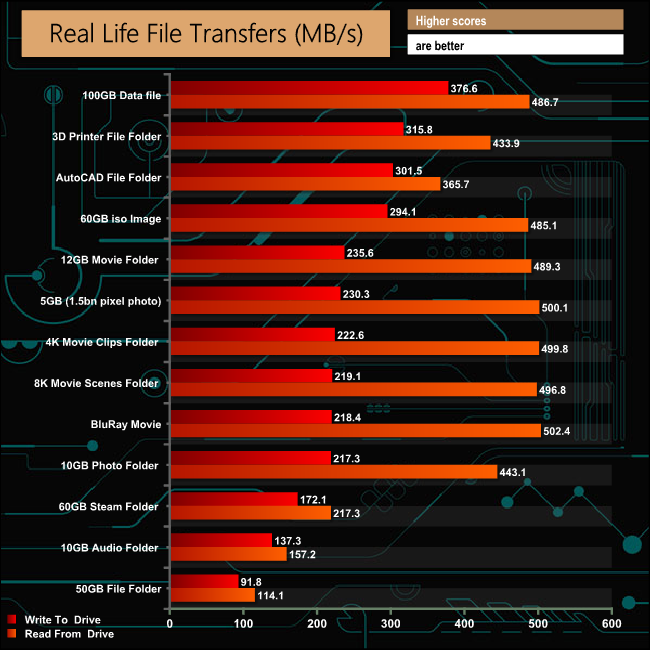
The only time the transfer rate dropped beneath the 100MB/s level in our real life file transfer tests was when the drive transferred the small bity files in the 50GB File Folder.
First announced at CES 2019, Seagate's IronWolf 110 SSD product family is making its way to the retail channels. The IronWolf 110 is the world's first SSD designed from the ground up for use in NAS devices. Seagate are aiming the drive towards all-flash array's (AFA) or for use with tiered caching jobs in NAS devices that support the function.
Based on the Nytro 1351 enterprise drive, but with firmware modifications, it uses a combination of an in-house Seagate controller and Toshiba 3D TLC NAND. The five model line-up starts with the 240GB drive and finishes with the flagship 3.84TB unit, in-between there are 480GB, 960GB and 1.92TB capacity drives.
Seagate quote Sequential read/write performance figures for the 240GB drive as up to 560MB/s and 345MB/s. We could confirm that read figure with the ATTO benchmark, the review drive producing a figure of 565MB/s, bang on the money. However, that official Sequential write figure seems to be on the conservative side to say the least as we got a figure of 539MB/s from the drive.
The official 4K random performance for the drive is up to 55,000 IOPS for reads and up to 30,000 IOPS for writes, these figures being gained from testing done at a queue depth of 32. We tested the drive at a queue depth of one and got a read figure of 70,903 IOPS with writes coming in at 83,280 IOPS.
As with all IronWolf and IronWolf Pro mechanical drives, the IronWolf 110 features Seagate's AgileArray firmware which is optimised for multi-drive RAID configurations to prevent issues resulting from any inconsistent performance across multi-drive enclosures. The drive features Seagate’s DuraWrite lossless data technology which helps prolong the lifespan of the NAND and in the case of system power failure, it has power loss data protection via on-board capacitors.
Although not implemented (at the time of writing this review) as yet, but coming very soon, the IronWolf 110 will also support IronWolf Health Management for NAS devices that in turn support IWM.
Seagate back the drive with a five-year warranty which includes a two-year Seagate Rescue Recovery Services plan. The plan provides access to Seagate’s technical services who will assist with data recovery in the event of a drive failure.

We found the 240GB IronWolf 110 available to pre-order at Overclockers UK for £79.99 (inc VAT) HERE
Pros
- Strong Sequential performance.
- Endurance.
- 2-year data protection and recovery plan included.
- 5-year warranty
Cons
- Pricey.
KitGuru says: The IronWolf 110 brings all of Seagate's NAS drive expertise from the mechanical IronWolf range, into a much faster performing, purpose built SSD. That said, it does come with a hefty price tag.