 KitGuru KitGuru.net – Tech News | Hardware News | Hardware Reviews | IOS | Mobile | Gaming | Graphics Cards


We measure the system power consumption at the wall – not factoring in the monitor. We test when idle – then when loading with Cinebench R15 and the ‘combined' test in 3Dmark11.
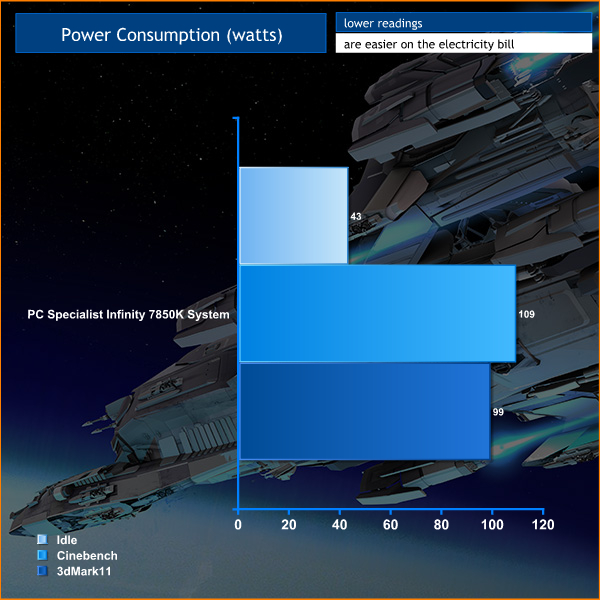
When idle, the system was consuming around 40 watts of power at the socket. When all the cores are loaded in Cinebench the power demand rises to 109 watts. When the last ‘combined' test in 3DMark 11 is initiated, the power demand moves between 85 watts and 110 watts. We took the average over repeated runs – just under 100 watts.
Tags A10 7850K A10 7850K review kaveri PC Specialist Infinity 7850K PC Specialist Infinity 7850K review PCSPECIALIST A10 7850K FM2 System PCSPECIALIST A10 7850K FM2 System review Review
Check Also

KitGuru Games: DLSS 5 misses the point
It would be hard to argue that NVIDIA’s DLSS technologies haven’t been a net positive to the PC space, with the machine-learning based upscaler successfully translating lower resolution inputs into a final image which is perceivably sharper while hogging fewer resources. Though somewhat more contentious, the next evolution of DLSS came in the form of Frame Generation, using ML in order to generate additional frames for high-refresh rate gaming. Both techniques can have their issues, but generally speaking they’ve allowed for more people to experience higher-end titles at increased frame rates. DLSS 5, however, takes a sharp pivot, with a very different end goal in mind than the performance-boosting versions that came before.