KitGuru KitGuru.net – Tech News | Hardware News | Hardware Reviews | IOS | Mobile | Gaming | Graphics Cards


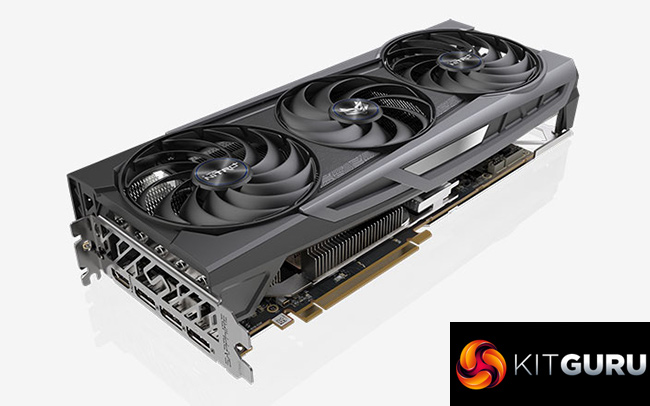
After the launch of AMD's flagship GPU, the RX 6900 XT, today we take step down to take a look at another custom RX 6800 XT. In for review is the Sapphire RX 6800 XT Nitro+, a large triple-fan solution with factory overclocked core and increased power limit compared to the reference specifications. We put this card through its paces and see how it compares to both AMD's reference design, as well as the PowerColor Red Devil.
Sapphire's Nitro+ series has earned a well-deserved reputation for quality, with the RX 5700 XT Nitro+ impressing us when we reviewed it last year. Sapphire also produces slightly more affordable cards as part of the Pulse series, but we are told these models will be coming later.
For now, our focus is on the RX 6800 XT Nitro+, and while stock is still seemingly impossible to come by, we have been told by Sapphire this model has an MSRP of £694 here in the UK. There is also a Nitro+ SE (special edition), which comes with ARGB fans and an extra USB-C port at a slightly higher price point, but this review is focused on the regular Nitro+.
| RX 6900 XT | RX 6800 XT | RX 6800 | RX 5700 XT | RX 5700 | |
| Architecture | RDNA 2 | RDNA 2 | RDNA 2 | RDNA | RDNA |
| Manufacturing Process | 7nm | 7nm | 7nm | 7nm | 7nm |
| Transistor Count | 26.8 billion | 26.8 billion | 26.8 billion | 10.3 billion | 10.3 billion |
| Die Size | 519 mm² | 519 mm² | 519 mm² | 251 mm² | 251mm² |
| Ray Accelerators | 80 | 72 | 60 | n/a | n/a |
| Compute Units | 80 | 72 | 60 | 40 | 36 |
| Stream Processors | 5120 | 4608 | 3840 | 2560 | 2304 |
| Game GPU Clock | Up to 2015MHz | Up to 2015MHz | Up to 1815MHz | Up to 1755MHz | Up to 1625MHz |
| Boost GPU Clock | Up to 2250MHz | Up to 2250MHz | Up to 2105MHz | Up to 1905MHz | Up to 1725MHz |
| Peak SP Performance | Up to 23.04 TFLOPS | Up to 20.74 TFLOPS | Up to 16.17 TFLOPS | Up to 9.75 TFLOPS | Up to 7.95 TFLOPS |
| Peak Half Precision Performance | Up to 46.08 TFLOPS | Up to 41.47 TFLOPS | Up to 32.33 TFLOPS | Up to 19.5 TFLOPS | Up to 15.9 TFLOPS |
| Peak Texture Fill-Rate | Up to 720 GT/s | Up to 648.0 GT/s | Up to 505.2 GT/s | Up to 304.8 GT/s | Up to 248.4 GT/s |
| ROPs | 128 | 128 | 96 | 64 | 64 |
| Peak Pixel Fill-Rate | Up to 288.0 GP/s | Up to 288.0 GP/s | Up to 202.1 GP/s | Up to 121.9 GP/s | Up to 110.4 GP/s |
| AMD Infinity Cache | 128MB | 128MB | 128MB | n/a | n/a |
| Memory | 16GB GDDR6 | 16GB GDDR6 | 16GB GDDR6 | 8GB GDDR6 | 8GB GDDR6 |
| Memory Bandwidth | 512 GB/s | 512 GB/s | 512 GB/s | 448 GB/s | 448 GB/s |
| Memory Interface | 256-bit | 256-bit | 256-bit | 256-bit | 256-bit |
| Board Power | 300W | 300W | 250W | 225W | 185W |
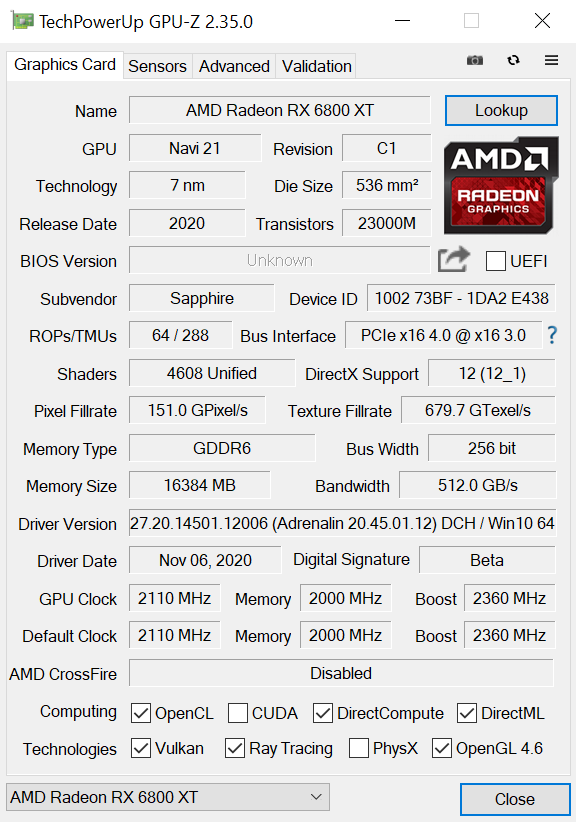
As a quick recap, here we can take a high-level overview of the Navi 21 GPU that forms the basis of the RX 6800 XT. While it is still fabricated on TSMC’s 7nm process node, as per the RX 5000-series, Navi 21 sports a much larger GPU die, measuring 519 mm². For the RX 6800 XT, it houses 72 Compute Units (CUs), with 64 Stream Processors each, giving a grand total of 4608 shaders.
Rated clock speed has increased significantly for the RX 6000 series. The reference RX 6800 XT, for instance, has a rated game clock of 2015MHz and a rated boost clock of up to 2250MHz. The Sapphire Nitro+ has increased this to 2110MHz and 2360MHz, respectively.
AMD has also increased the memory capacity, with 16GB of GDDR6 memory found on every RX 6000 SKU (so far). The memory is clocked at 16Gbps, and operates over a 256-bit memory interface for total bandwidth of 512 GB/s. AMD has also implemented a 128MB Infinity Cache on the Navi 21 GPU, to significantly increase effective memory bandwidth without excess power draw.
Speaking of power, the reference RX 6800 XT has a rated total board power (TBP) of 300W, though Sapphire has increased this for the Nitro+, as we will see later in this review.
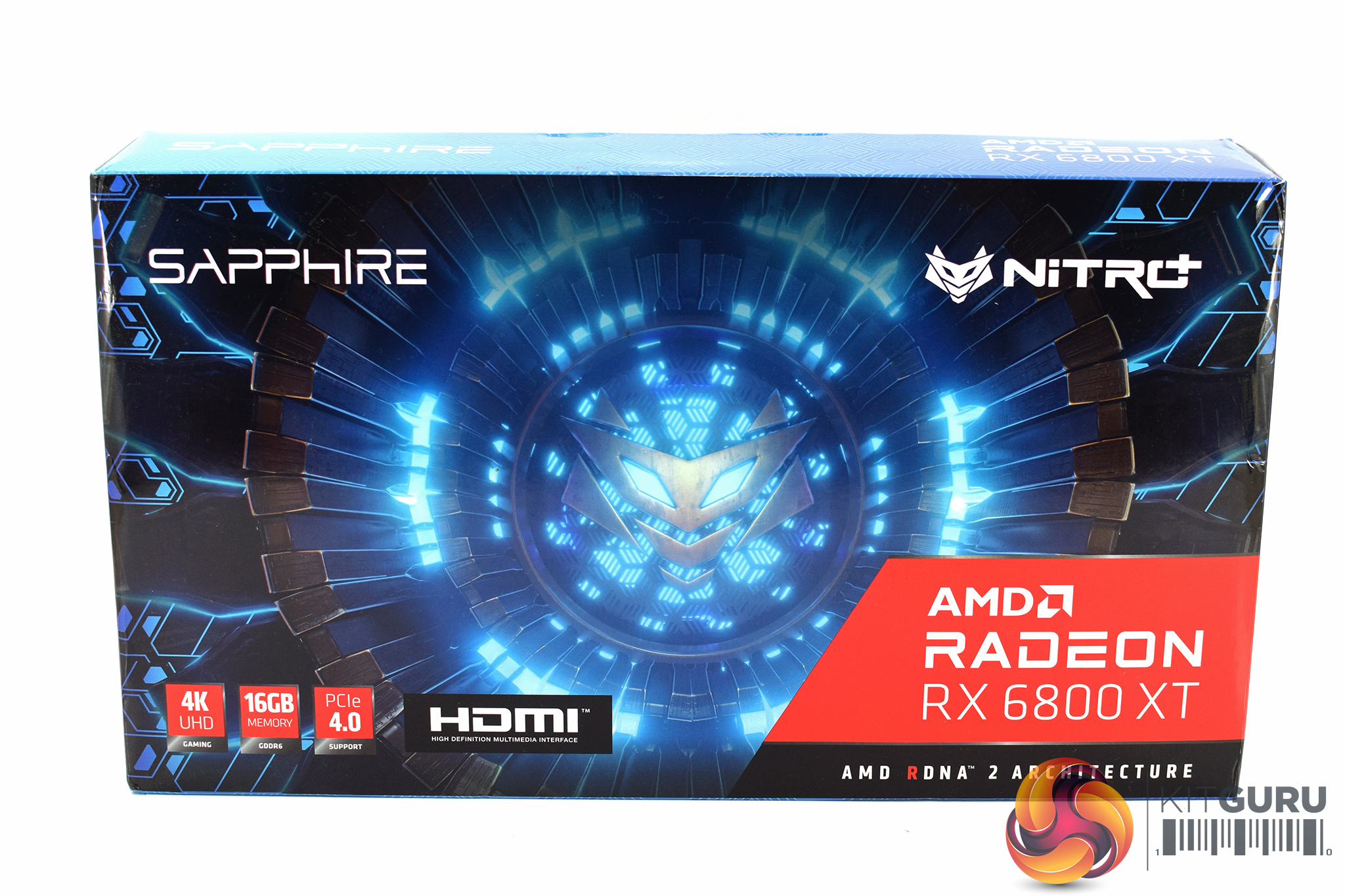
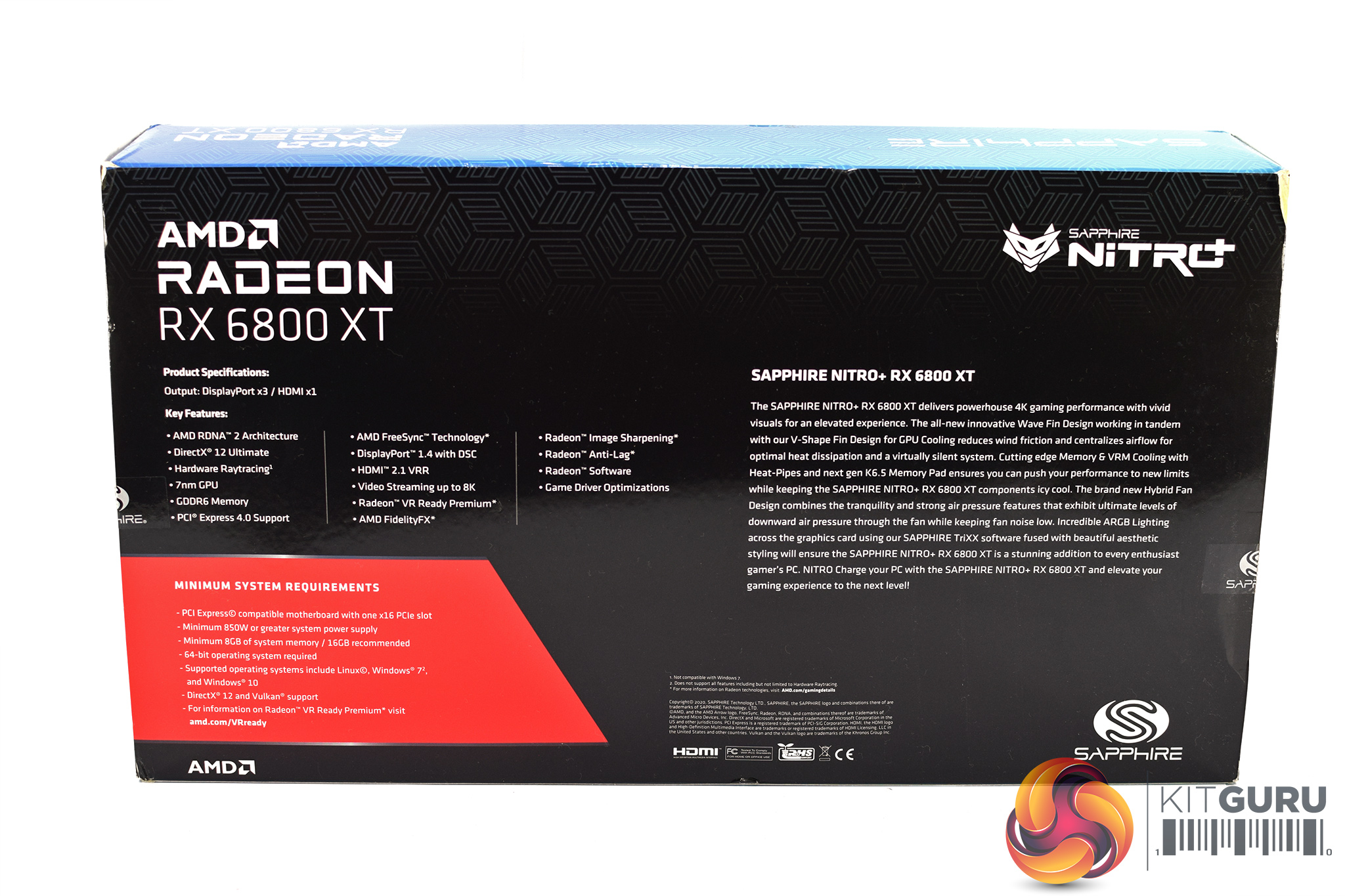
The Sapphire RX 6800 XT Nitro+ ships in a dark blue box, with the Nitro logo visible in a neon blue colour on the front.
On the back, several specifications of the GPU are listed, while Sapphire also highlights some of the design features of the Nitro+ card.
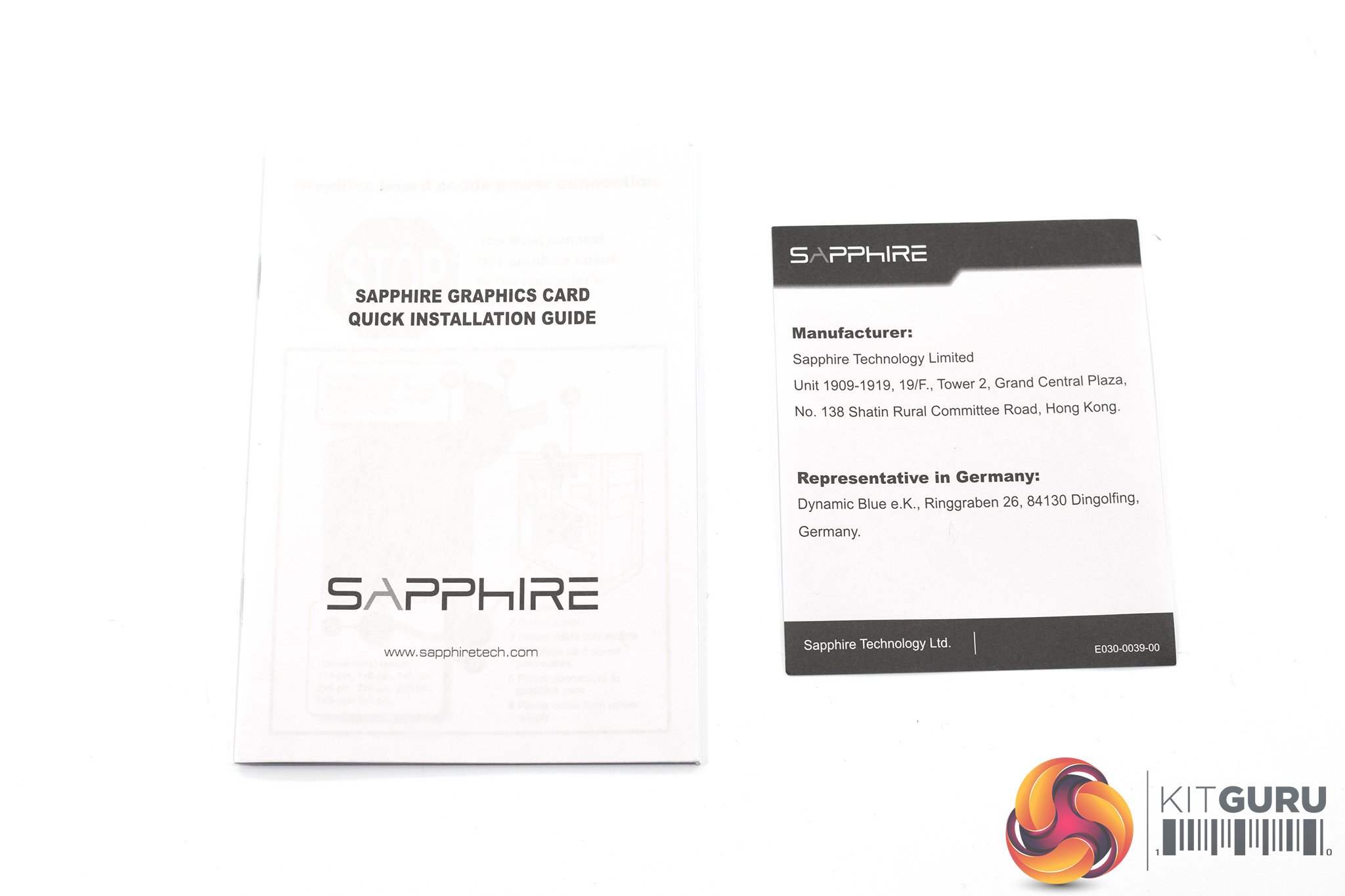
Not much is included in the way of accessories, with just a quick installation guide and manufacturer note in the box.
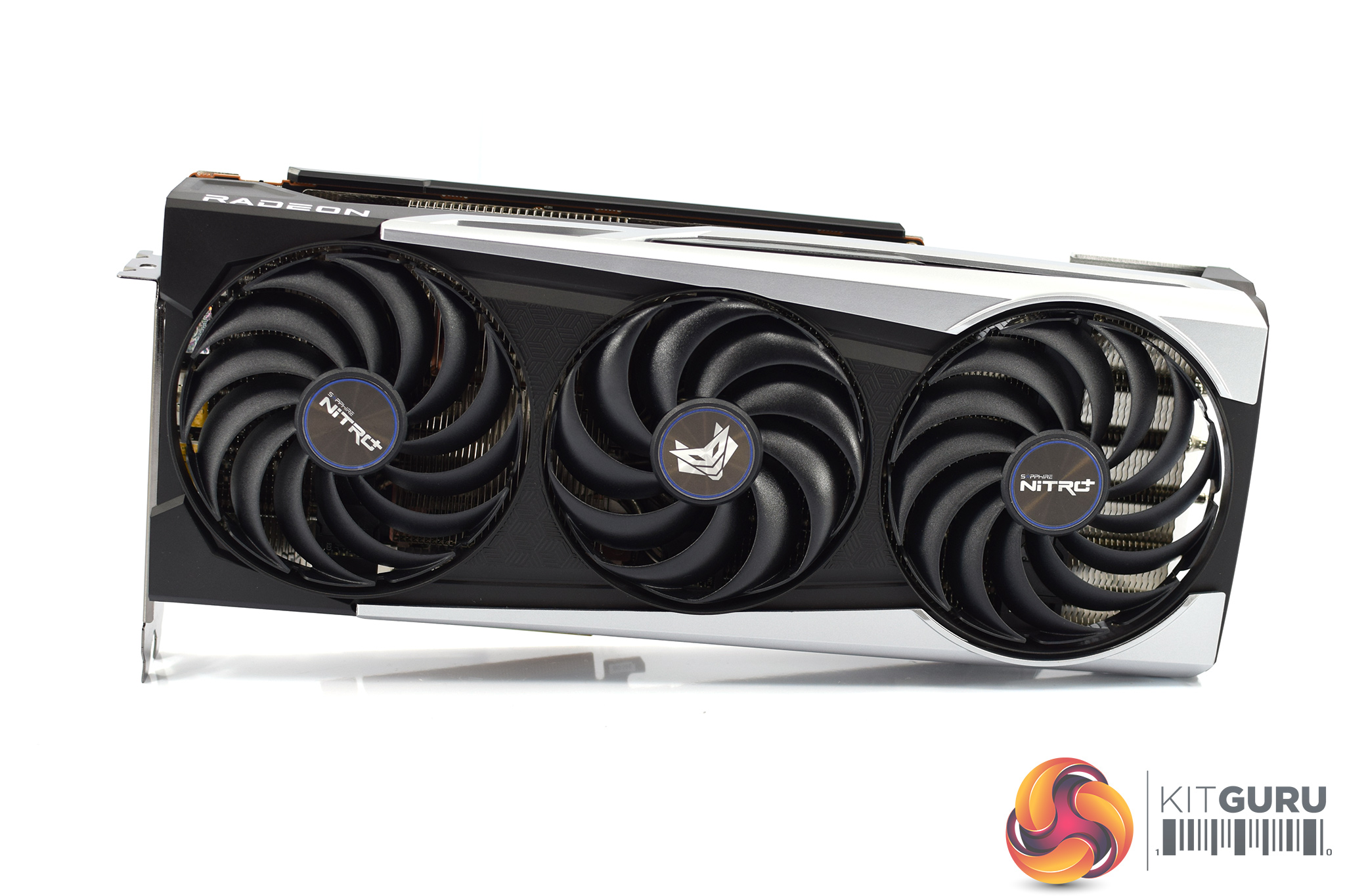
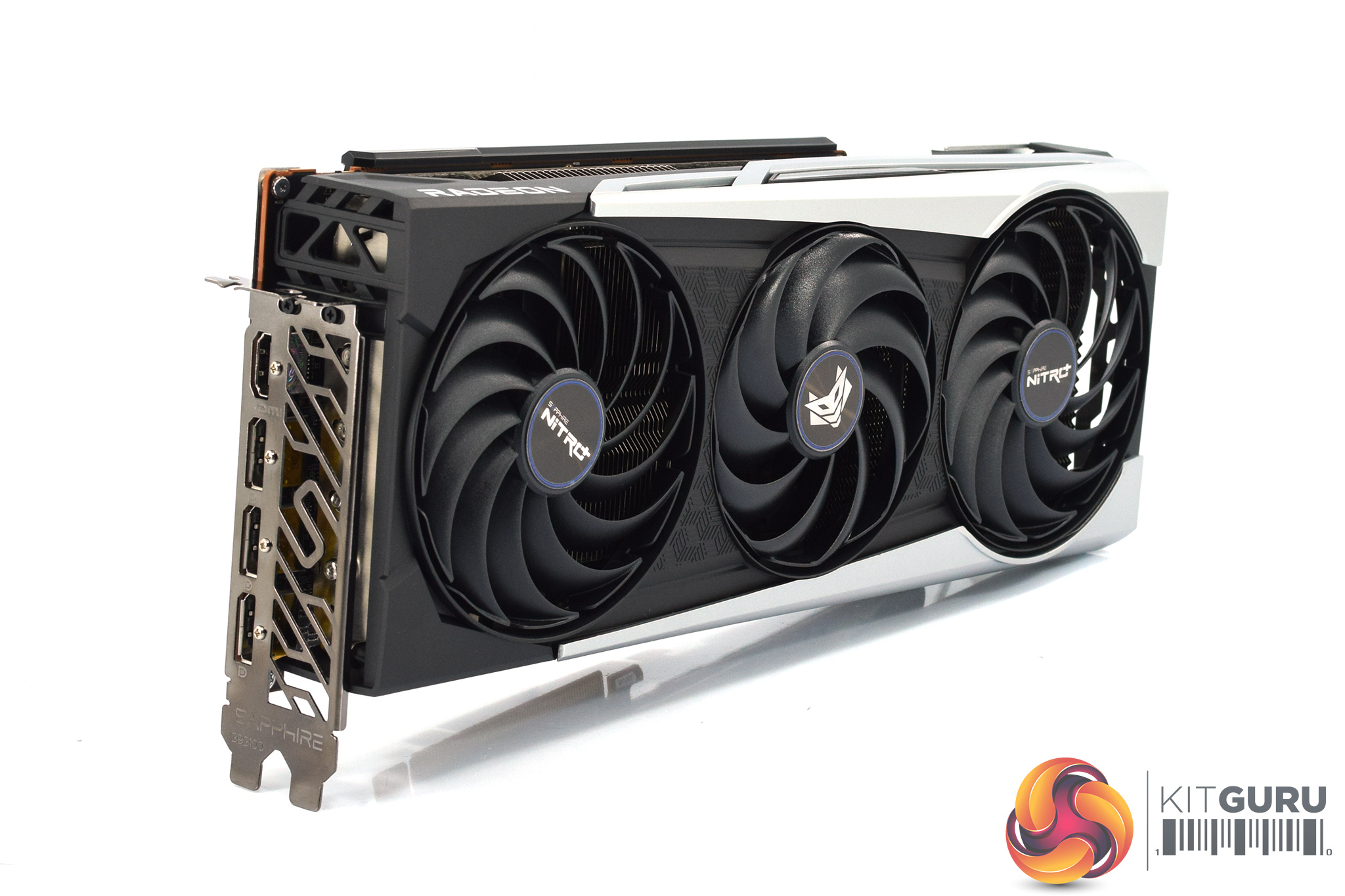
As for the graphics card itself, its design language is overall fairly similar to the RX 5700 XT Nitro+ that we reviewed in 2019. It's a mostly black plastic shroud, but with some prominent silver sections as well which add some contrast to the design.
Looking at the fans, here we can see some tweaks to the design. First of all, there’s two 100mm fans at either end, while the central fan is slightly smaller at 90mm. All three feature a new ring around the outer edge of the fan, and Sapphire calls the new design a ‘Hybrid Fan', as they say it is meant to offer the increased pressure of a blower fan combined with the traditional low noise levels of an axial fan. We can also see the central fan spins in reverse, relative to the outer two, similar to what we’ve seen from the likes of Gigabyte and ASUS over the past year or two.
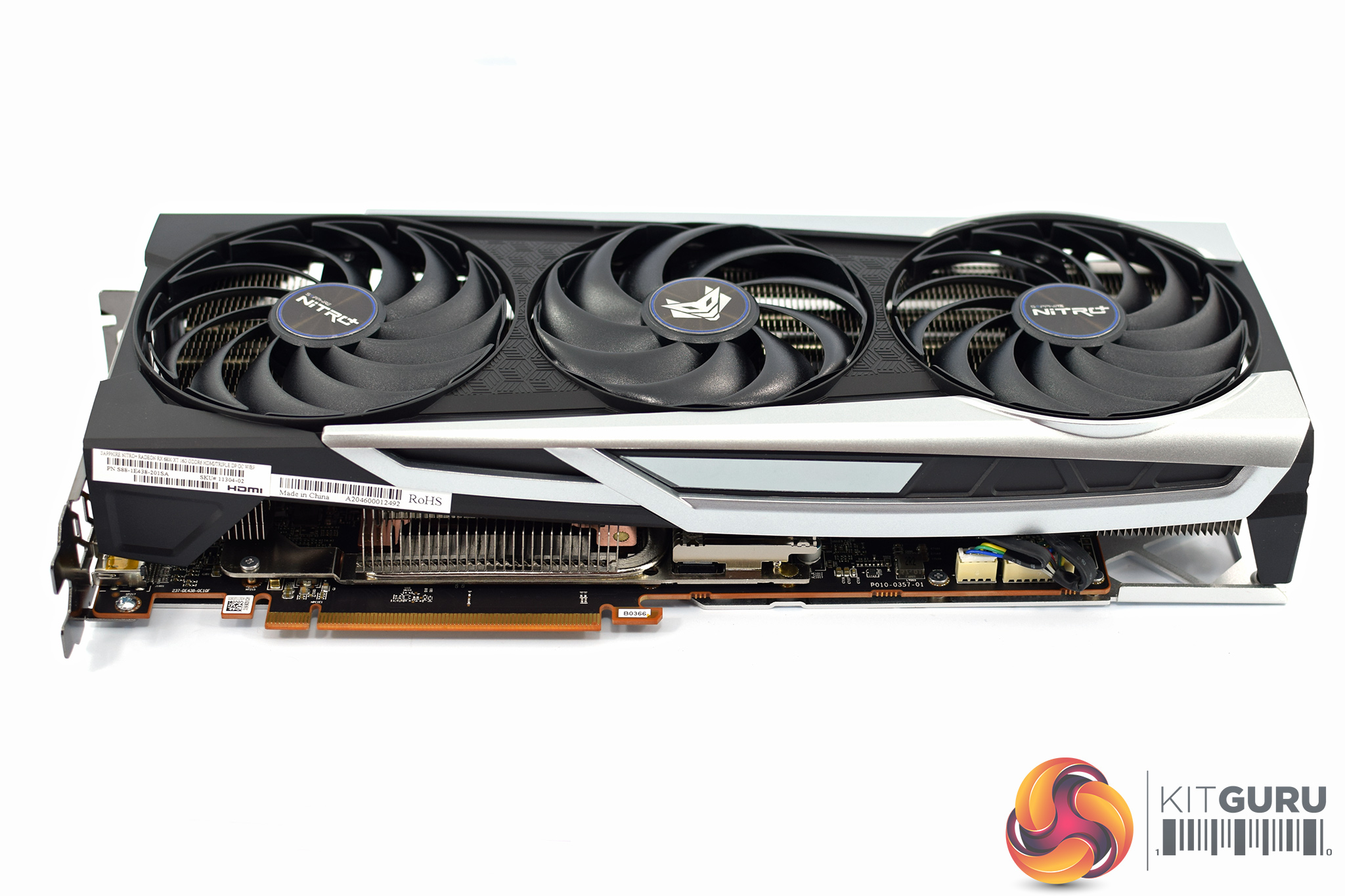
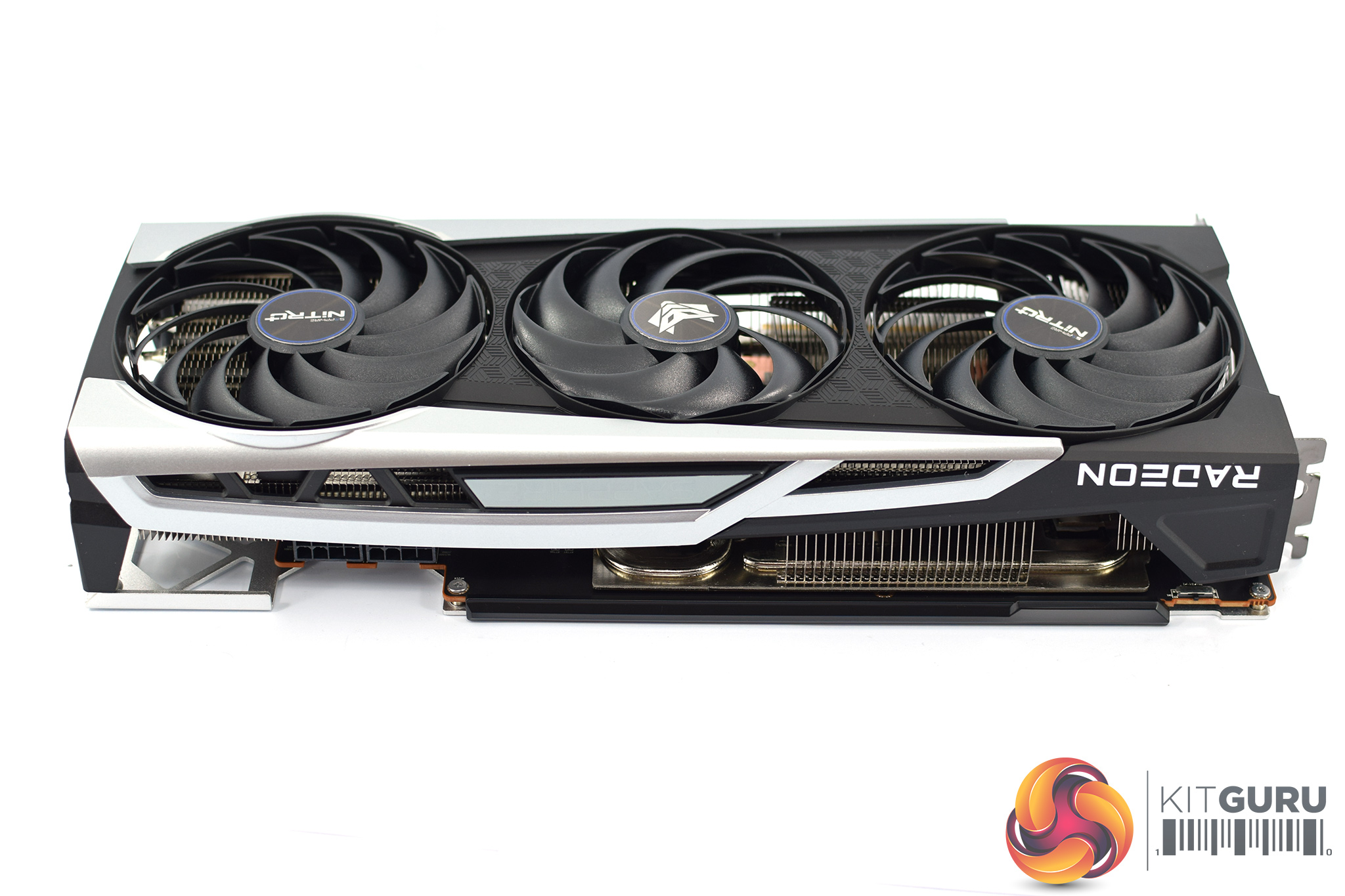
In terms of its size, the Nitro+ measures 310 x 134.3 x 55.3mm, so it is fractionally smaller than the PowerColor Red Devil (which is 320 x 135 x 62mm), but not by a lot. Sapphire is keen to emphasise the lower weight of the Nitro+ though, and on my scale it weighs in at 1239g. The Red Devil is almost 400g heavier at 1612g, while the reference design weighs in at 1496g.
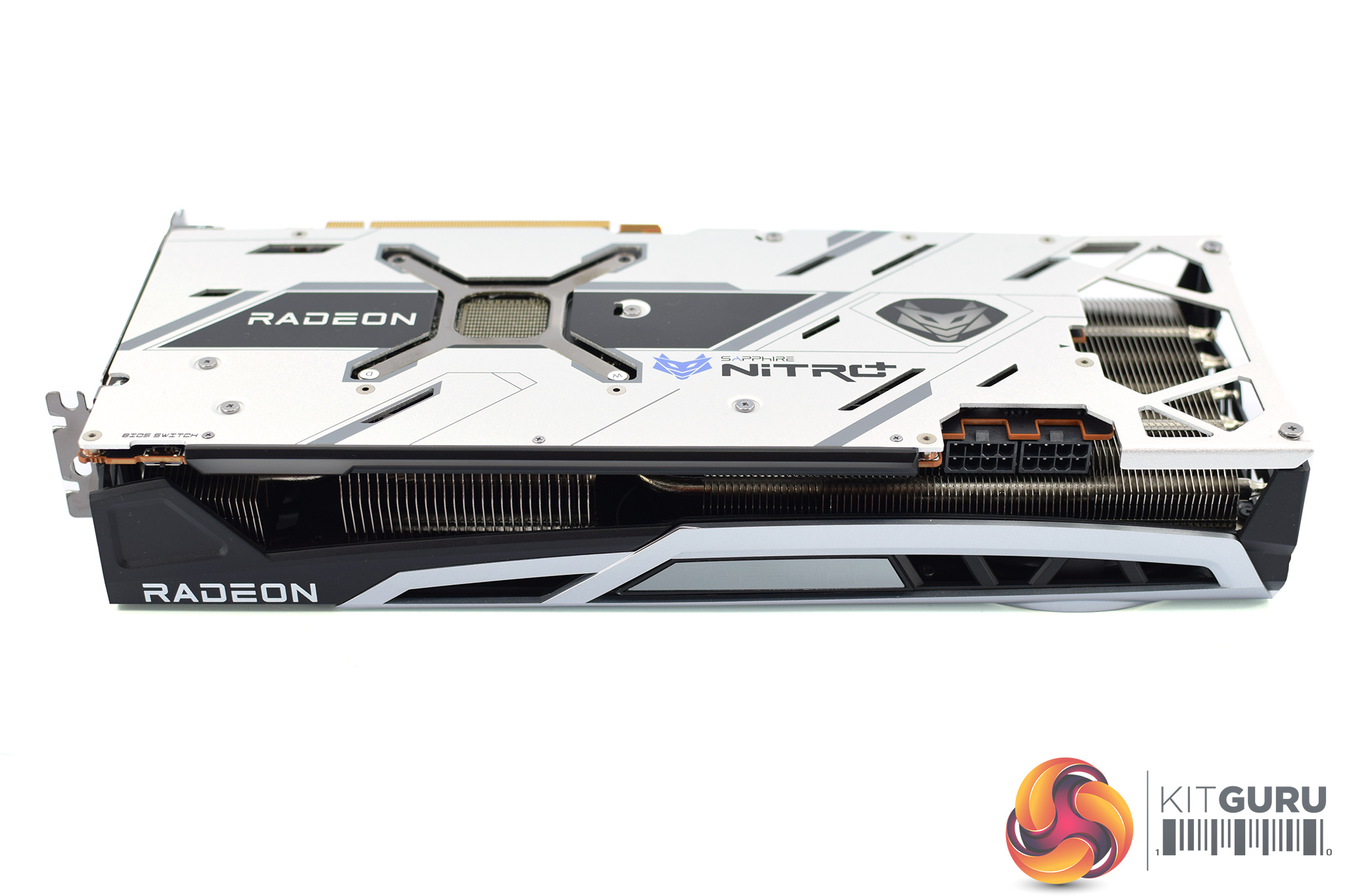
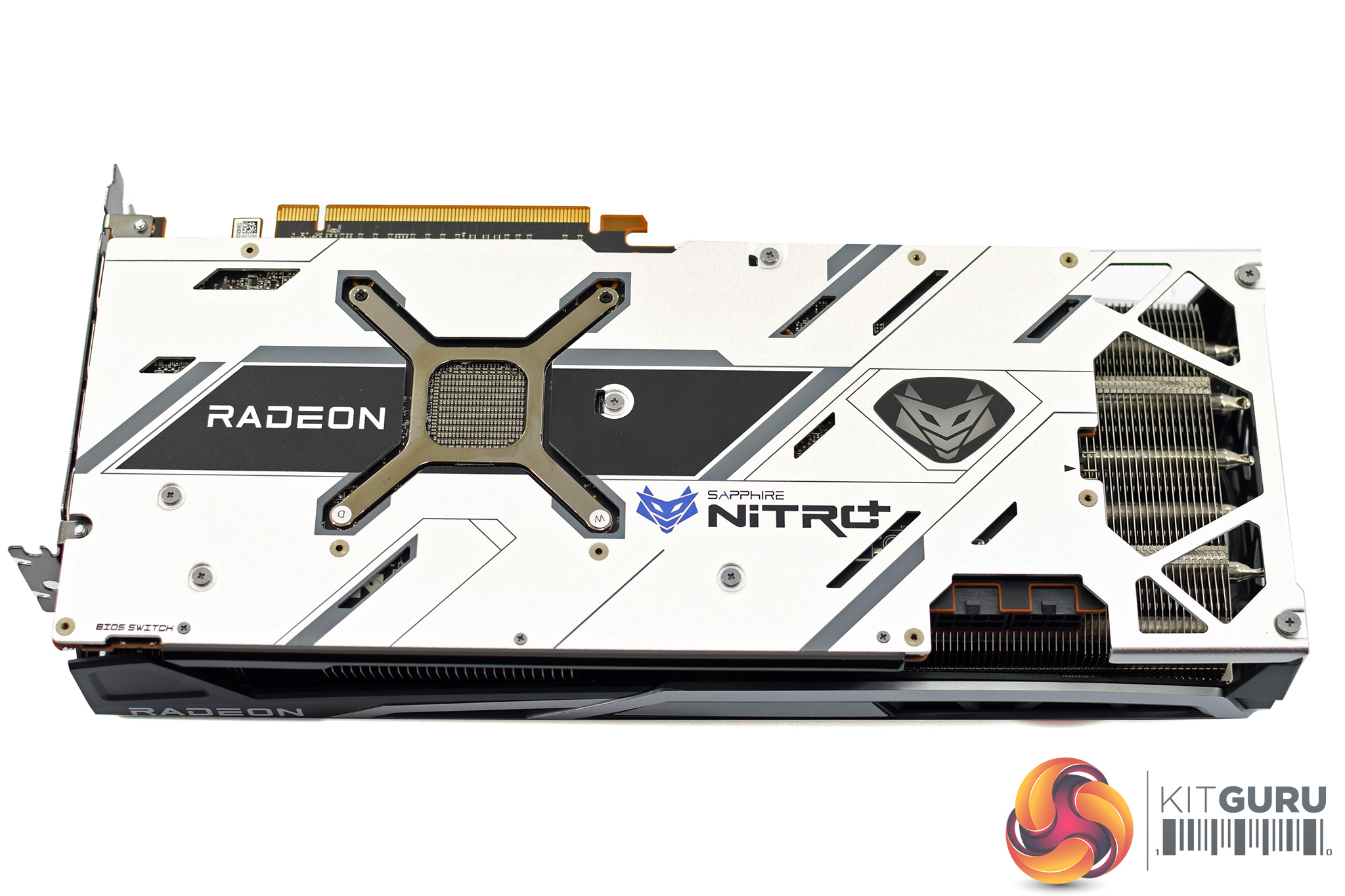
On the front edge of the card, we get a look at the dual BIOS switch. By default, the Nitro+ uses the Performance BIOS (number 1), but you can switch it over to the Silent BIOS (number 2) as well, which drops fan speed, clocks and the power target. There’s even a third position on the BIOS switch, but this is to let you change between Performance and Silent modes using the Trixx software.
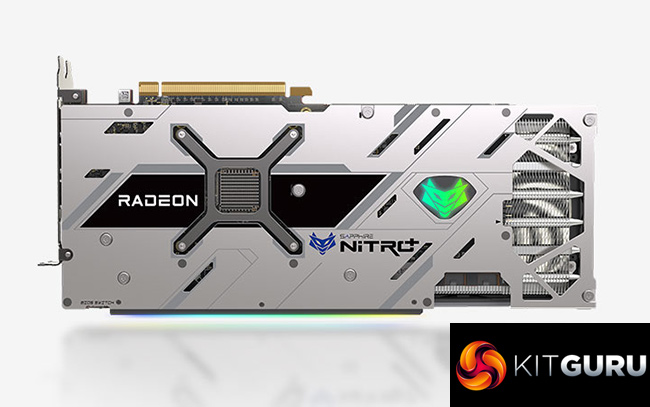
In terms of the backplate, this is a full length aluminium design with a pretty striking silver colour, and I have to say I do really like the aesthetic. There’s a cut-out behind the GPU die, and also at the very end of the card to provide a bit of flow-through from the fan. We can also note the Nitro logo is one of the RGB zones on the card. The rest of the RGB comes from a strip running along the front edge, as well a small Sapphire logo on the front as well. There’s even an ARGB header at the end card to synchronise the lighting with your motherboard.
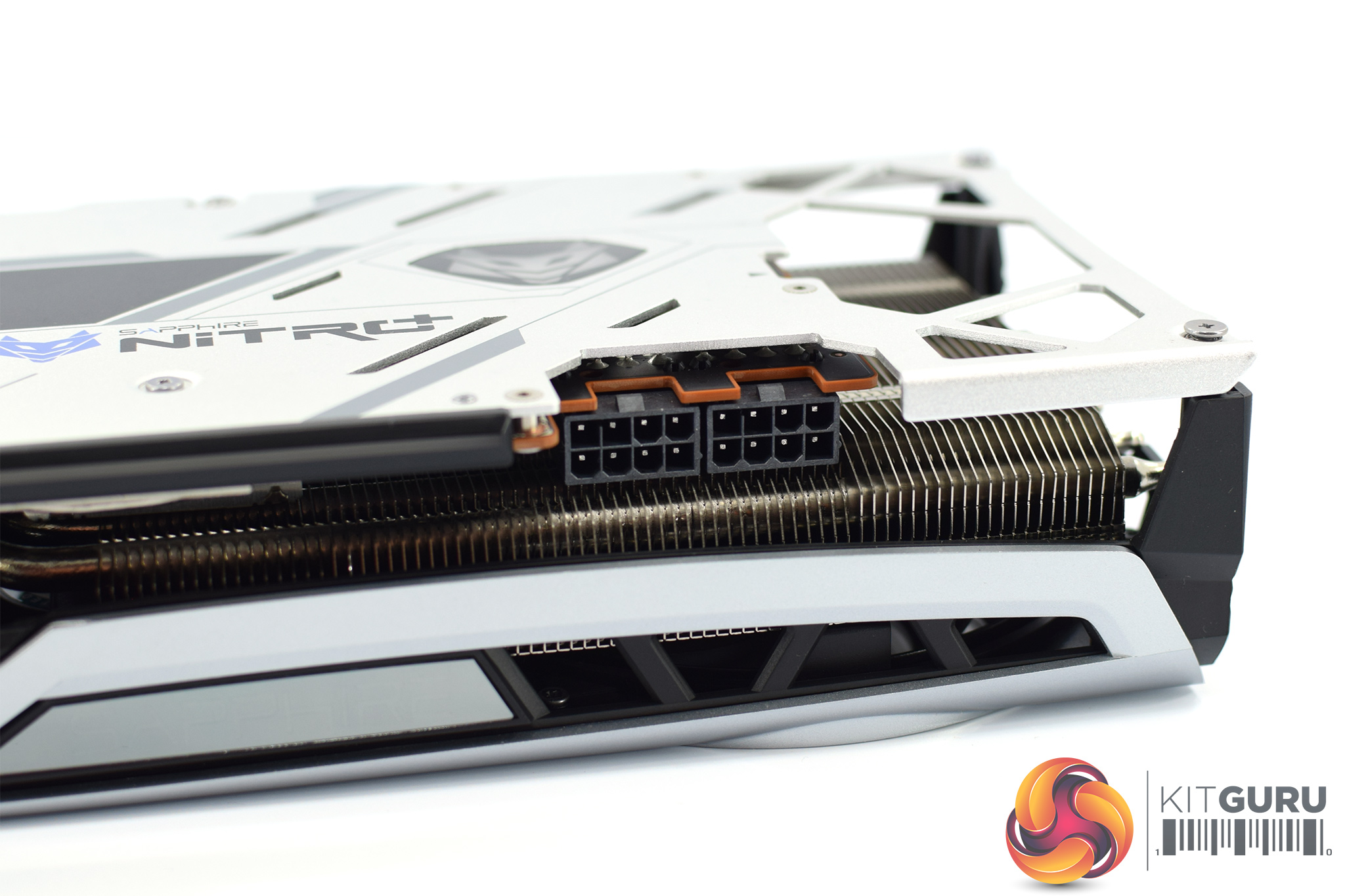
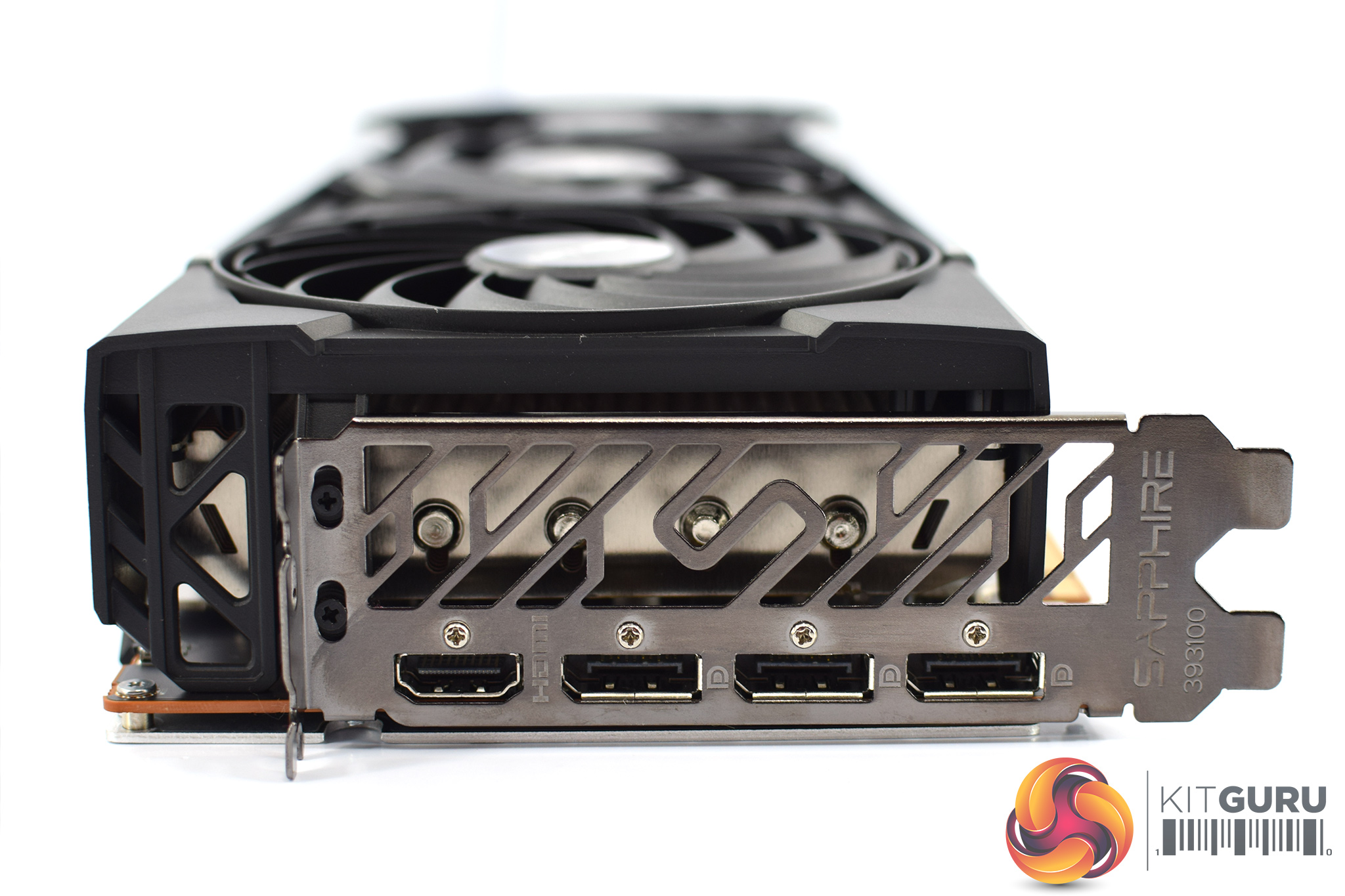
Elsewhere, we can note the two 8-pin power connectors, while the display outputs consist of 1x HDMI 2.1, and 3x DisplayPort 1.4 connectors.
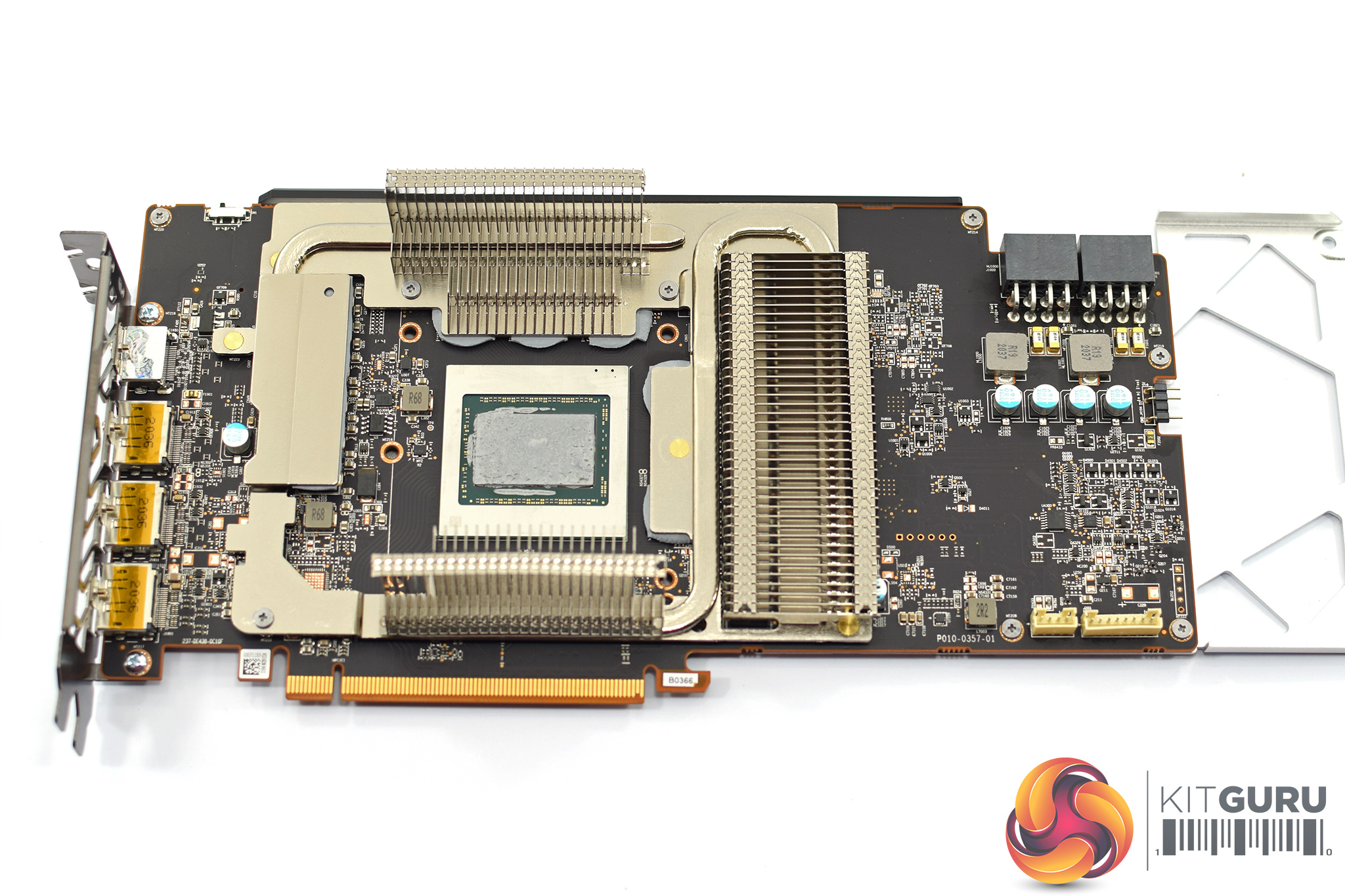
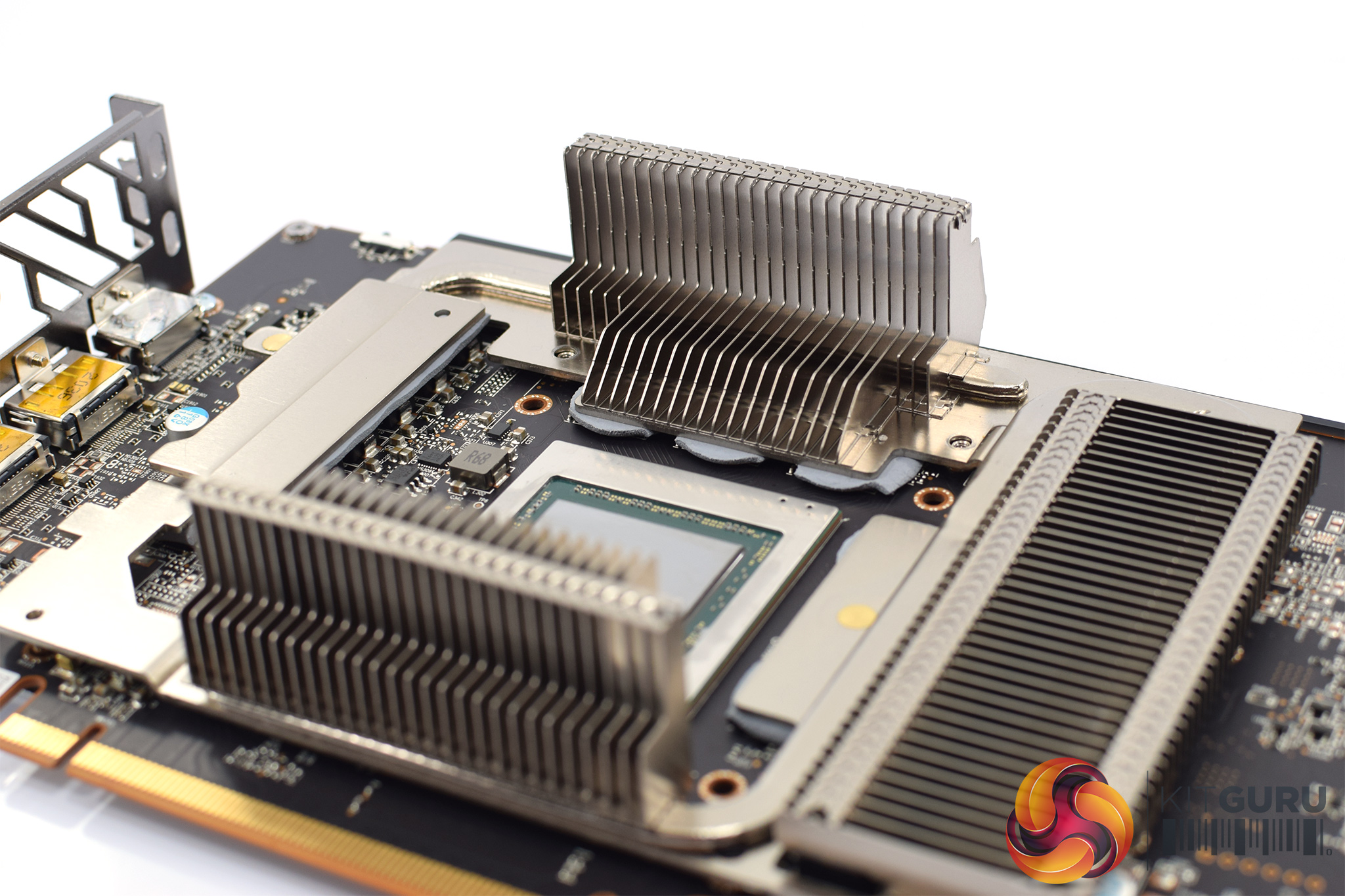
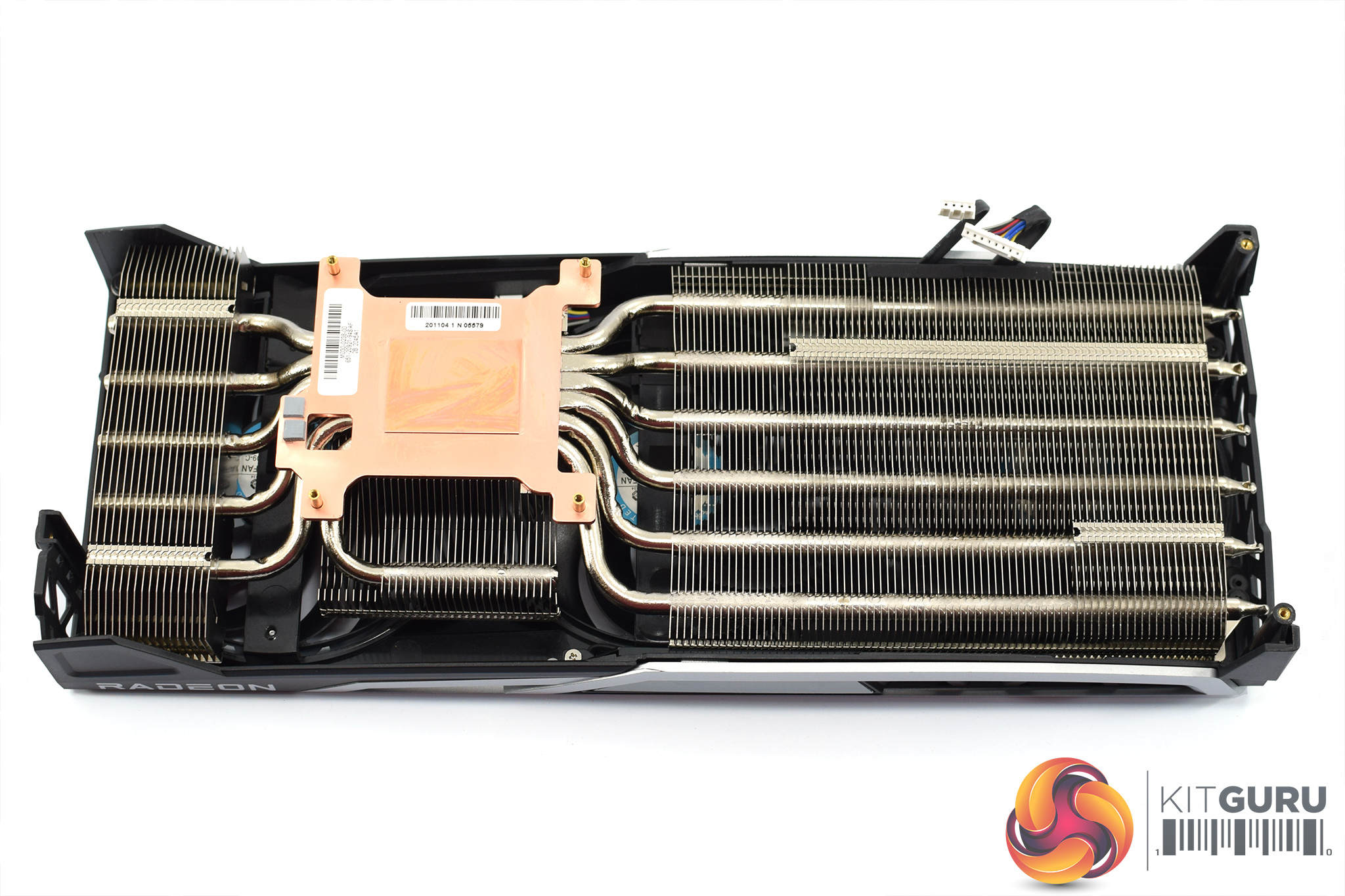
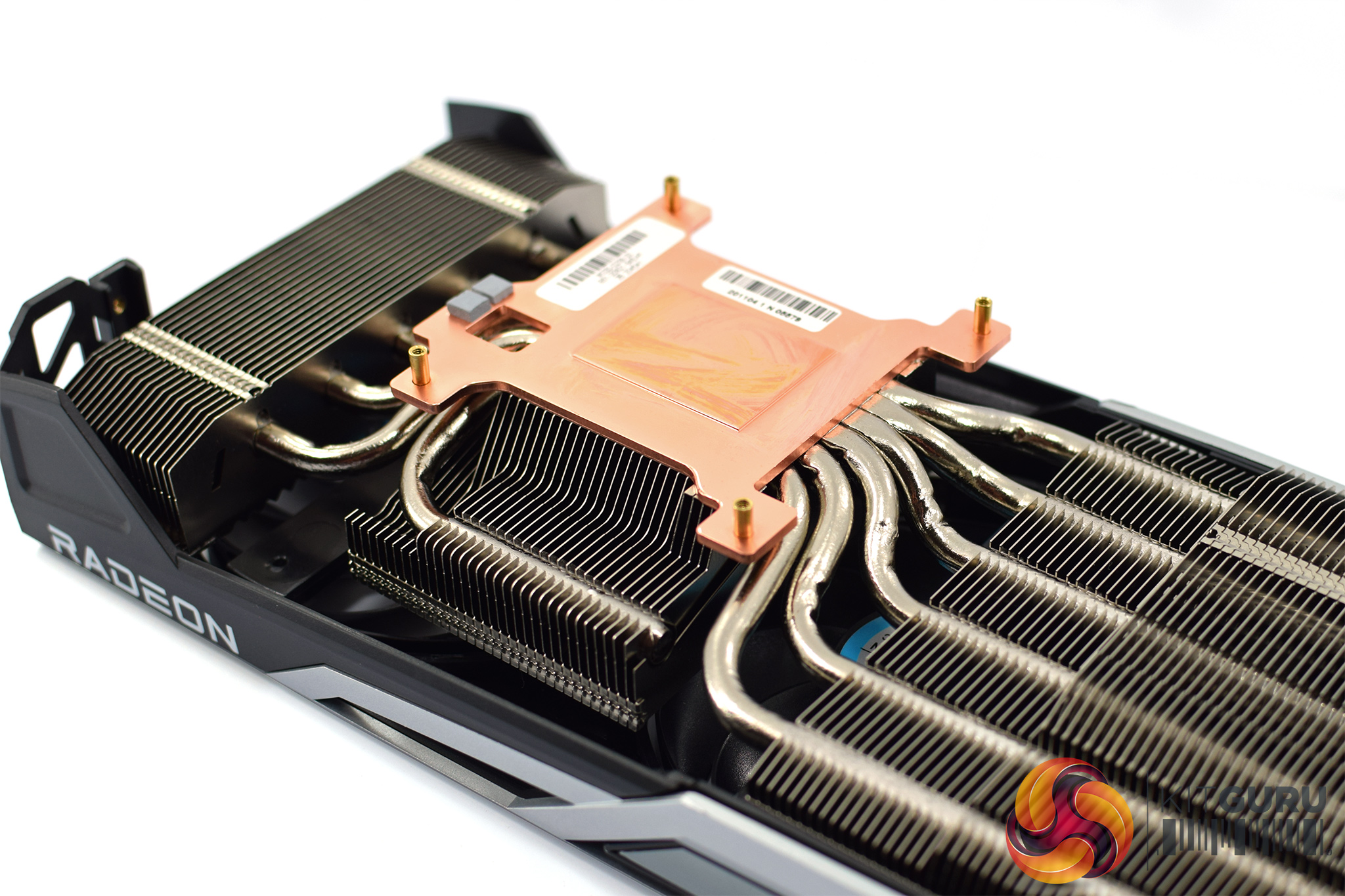
Dissembling the card, the first thing to touch on is the use of a dedicated heatsink for the memory and VRM. This uses a couple of flattened heatpipes and three small fin stacks, contacting with the memory and VRM via thermal pads. The primary heatsink also sports three, much larger fin stacks, connected by 6x 6mm heatpipes. Meanwhile, the GPU die contacts with a copper baseplate.
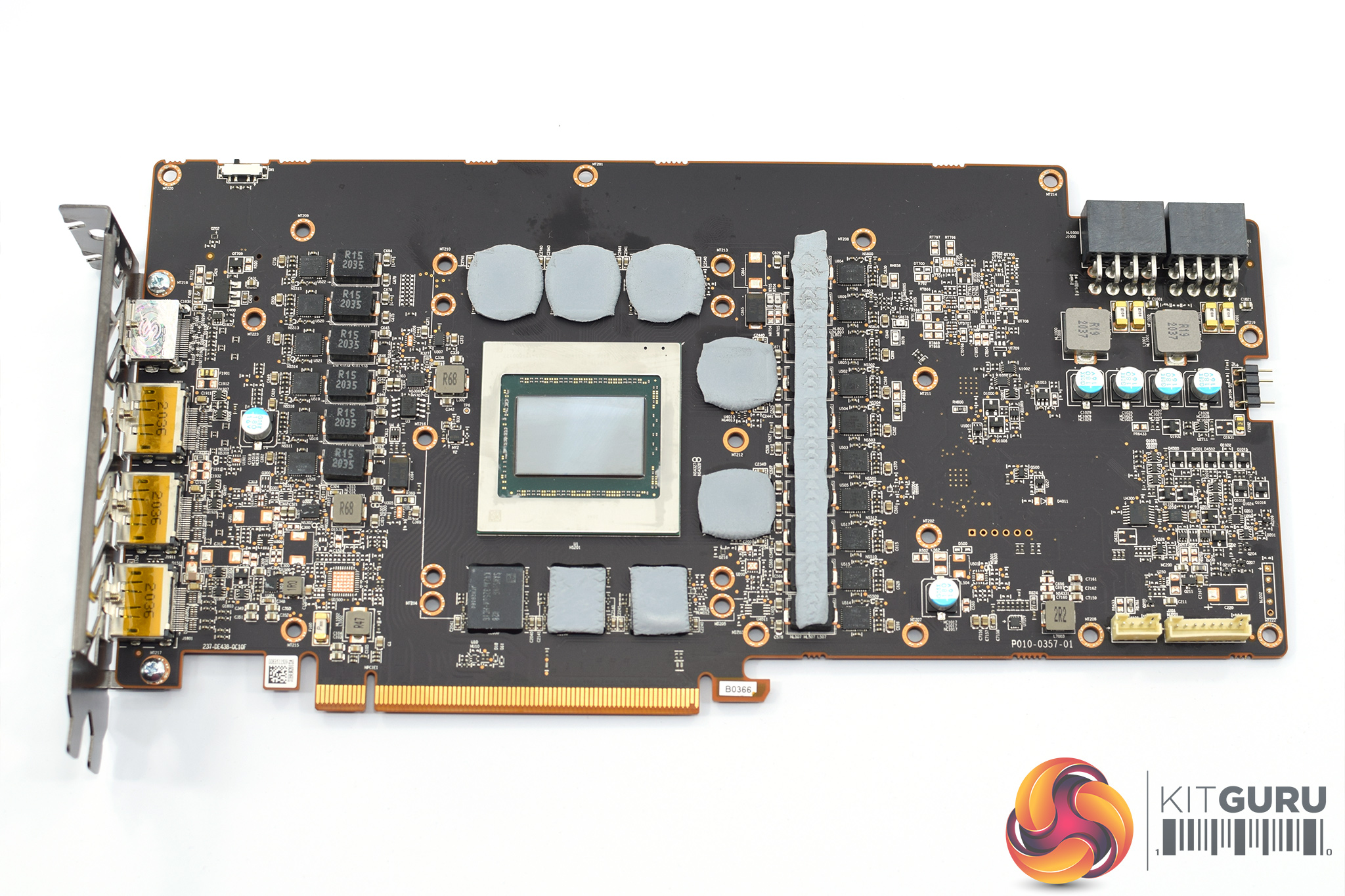
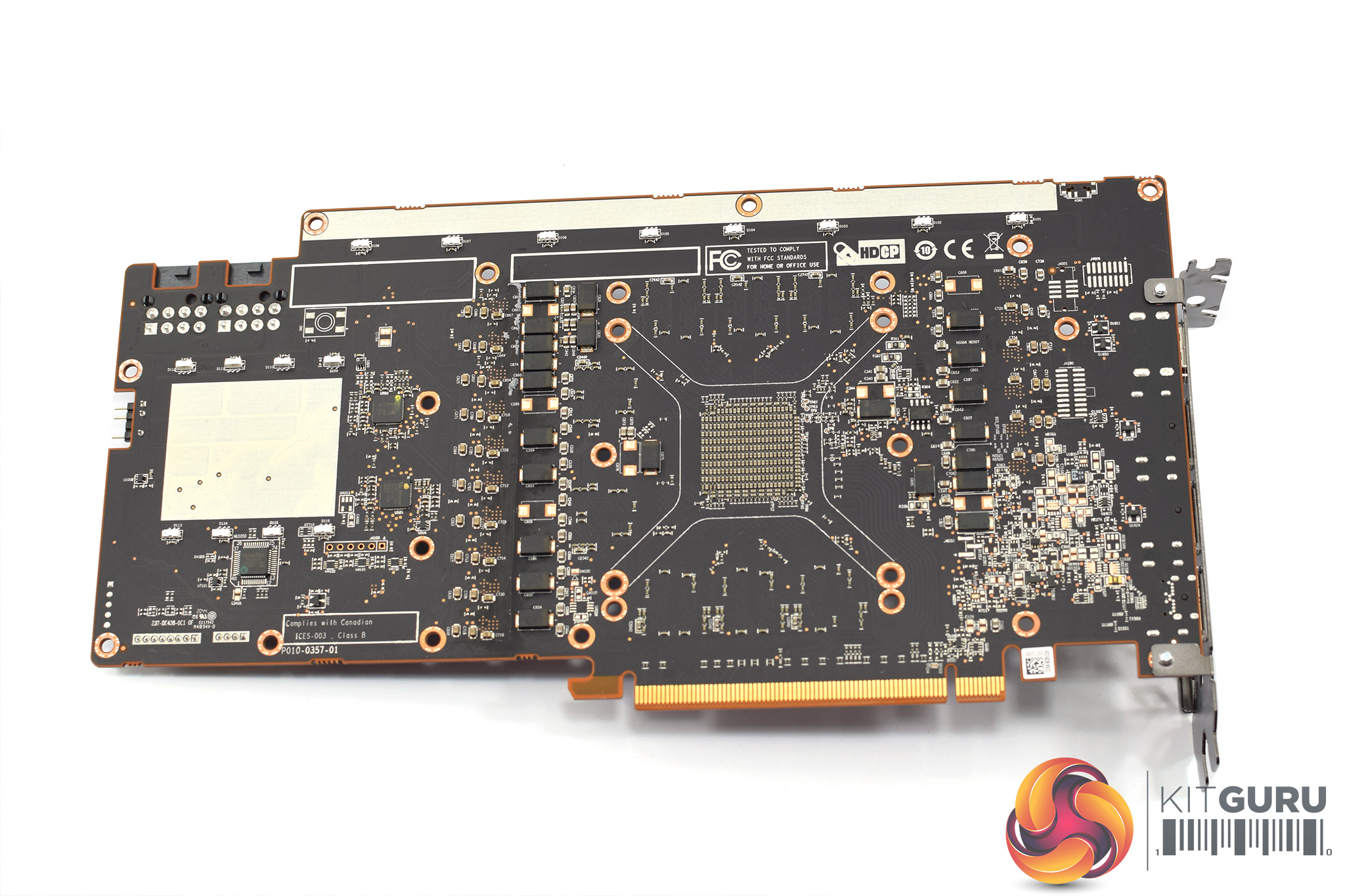
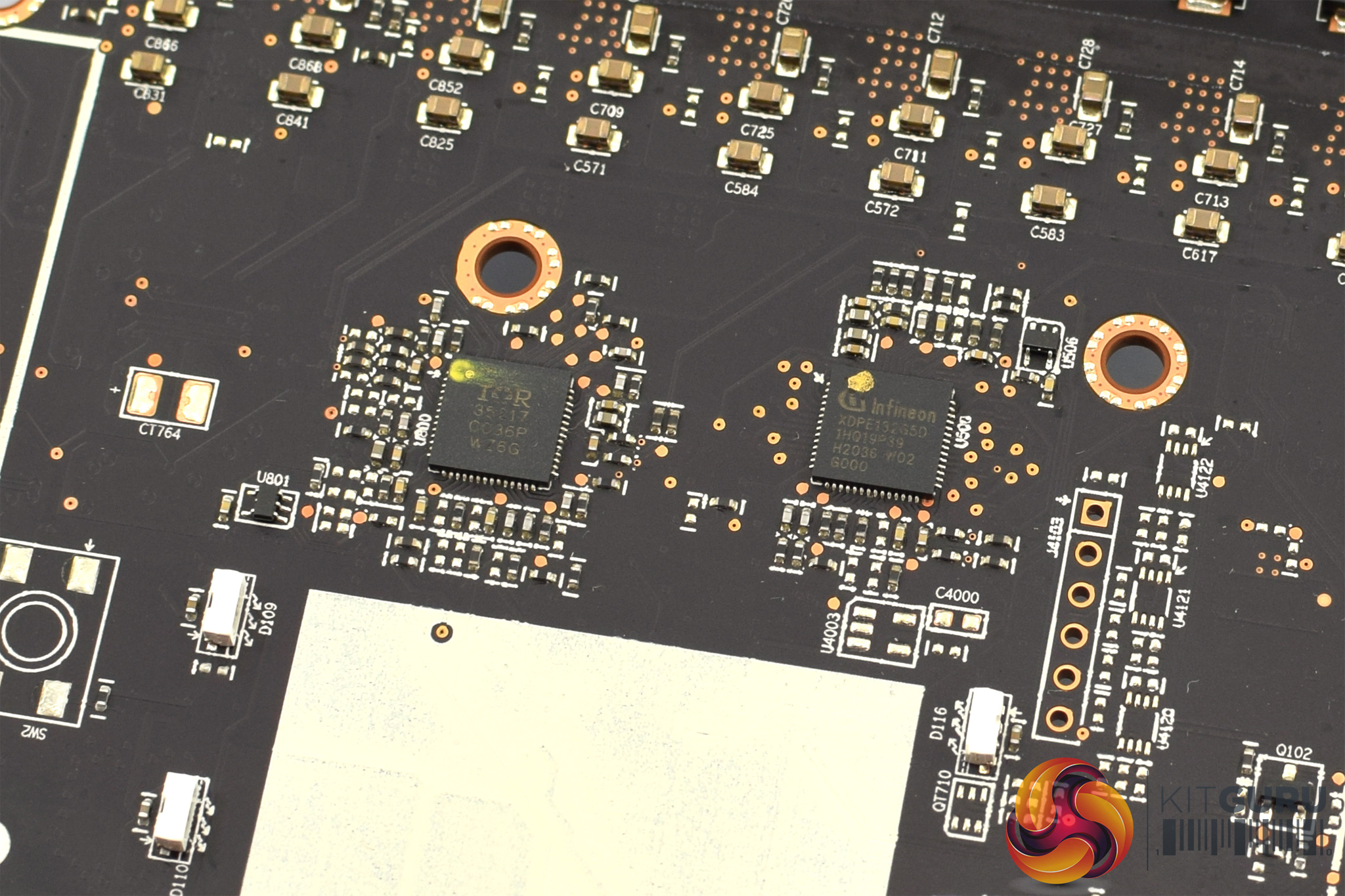
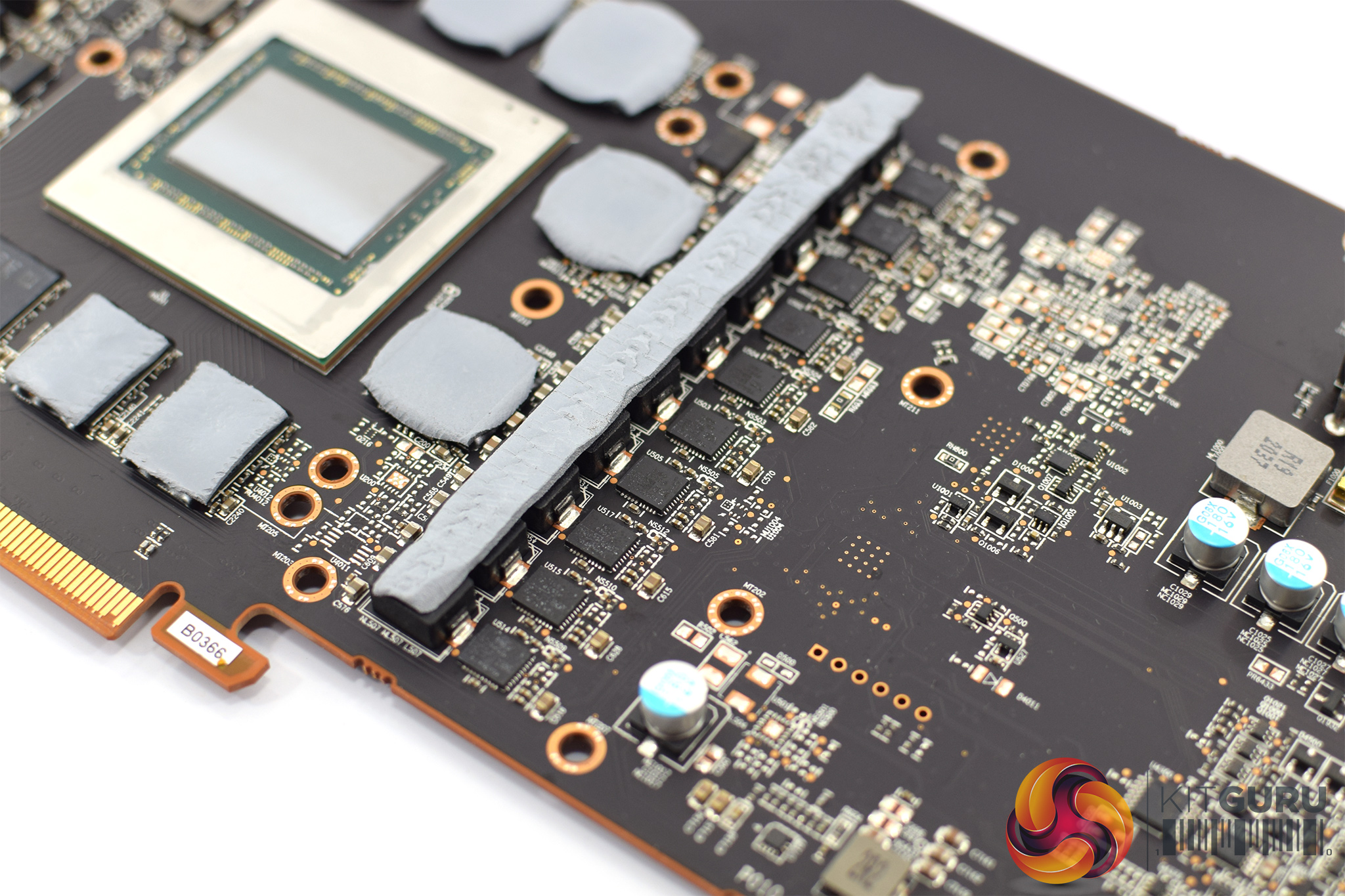
As for the PCB, this looks pretty similar to AMD's reference design, with a 13-phase VRM for the GPU and 3-phase VRM for the memory. Sapphire is using International Rectifier TDA21472 MOSFETs, rated at 70 Amps, while the GPU VRM controller is the Infineon XDPE132G5D. The memory controller is an International Rectifier IR35217, while we can also note the memory modules themselves are from Samsung, rated for 16Gbps.
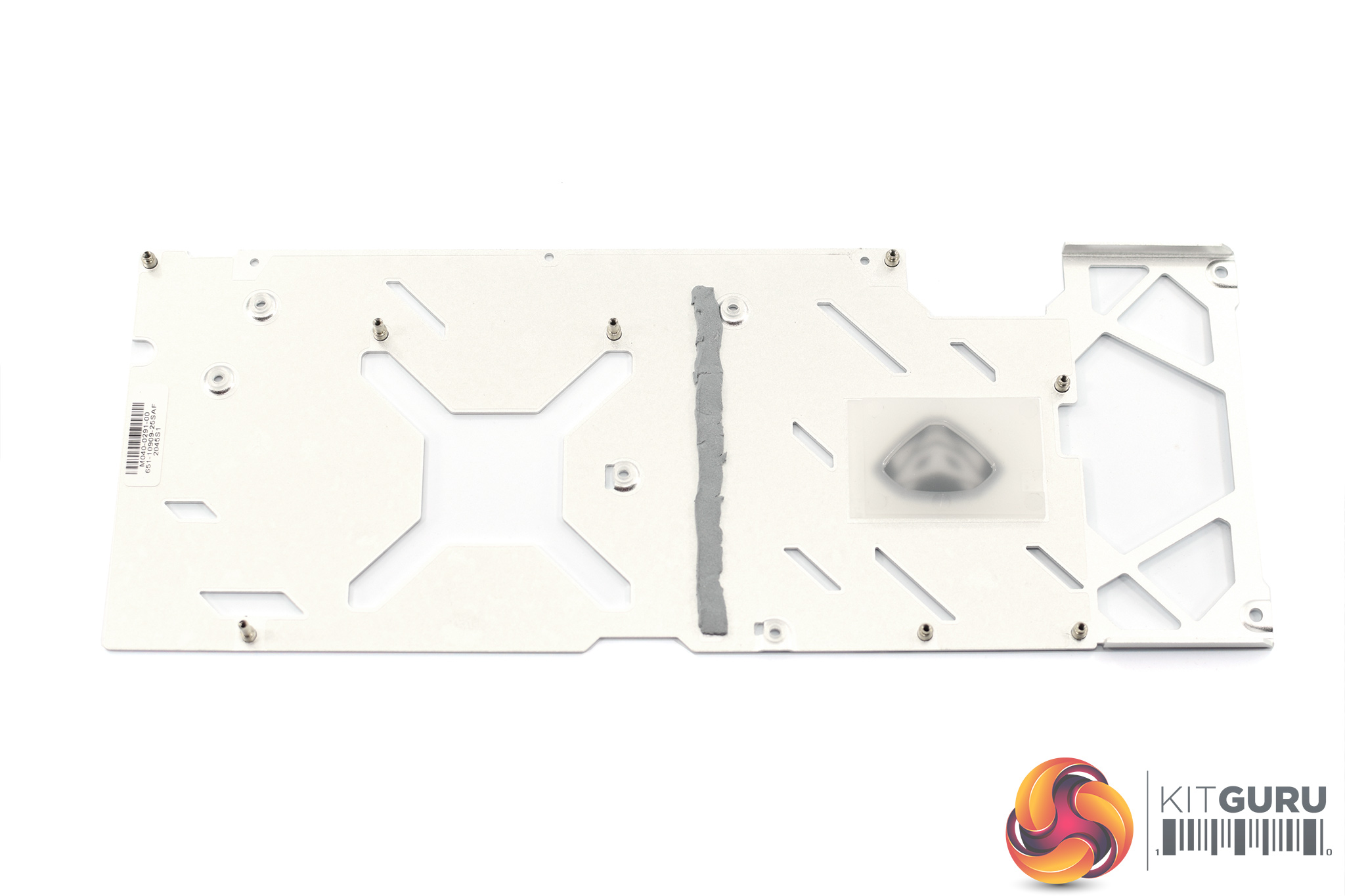
Finally, the backplate uses one small thermal pad to contact the underside of the PCB.
Driver Notes
- All Nvidia GPUs (except RTX 3060 Ti) were benchmarked with the 457.09 driver.
- RTX 3060 Ti was benchmarked with the 457.40 driver supplied to press.
- All AMD GPUs (except RX 6000) were benchmarked with the Adrenalin 20.11.1 driver.
- RX 6800 and RX 6800 XT were benchmarked with the Adrenalin 20.45.12.1 driver supplied to press.
- RX 6900 XT was benchmarked with the Adrenalin 20.45.01.14 driver supplied to press.
Test System
We test using the a custom built system from PCSpecialist, based on Intel’s latest Comet Lake-S platform. You can read more about it over HERE, and configure your own system from PCSpecialist HERE.
| CPU |
Intel Core i9-10900K
Overclocked to 5.1GHz on all cores |
| Motherboard |
ASUS ROG Maximus XII Hero Wi-Fi
|
| Memory |
Corsair Vengeance DDR4 3600MHz (4 X 8GB)
CL 18-22-22-42
|
| Graphics Card |
Varies
|
| System Drive |
500GB Samsung 970 Evo Plus M.2
|
| Games Drive | 2TB Samsung 860 QVO 2.5″ SSD |
| Chassis | Fractal Meshify S2 Blackout Tempered Glass |
| CPU Cooler |
Corsair H115i RGB Platinum Hydro Series
|
| Power Supply |
Corsair 1200W HX Series Modular 80 Plus Platinum
|
| Operating System |
Windows 10 2004
|
Comparison Graphics Cards List
- Gigabyte RTX 3090 Eagle OC
- Nvidia RTX 3080 FE 10GB
- Nvidia RTX 3070 FE 8GB
- Nvidia RTX 2080 Ti FE 11GB
- Nvidia RTX 2080 Super FE 8GB
- Nvidia RTX 2080 FE 8GB
- Nvidia RTX 2070 Super FE 8GB
- Nvidia RTX 2060 Super FE 8GB
- AMD RX 6900 XT 16GB
- AMD RX 6800 XT 16GB
- PowerColor RX 6800 XT Red Devil 16GB
- AMD RX 6800 16GB
- AMD Radeon VII 16GB
- AMD RX 5700 XT 8GB
- AMD RX Vega 64 8GB
Software and Games List
- 3DMark Fire Strike & Fire Strike Ultra (DX11 Synthetic)
- 3DMark Time Spy (DX12 Synthetic)
- 3DMark Raytracing Feature Test (DXR Synthetic)
- Borderlands 3 (DX12)
- Control (DX12)
- Death Stranding (DX12)
- The Division 2 (DX12)
- F1 2020 (DX12)
- Far Cry New Dawn (DX11)
- Gears 5 (DX12)
- Ghost Recon: Breakpoint (Vulkan)
- Metro: Exodus (DX12)
- Middle Earth: Shadow of War (DX11)
- Red Dead Redemption 2 (Vulkan)
- Shadow of the Tomb Raider (DX12)
- Total War Saga: Troy (DX11)
- Watch Dogs: Legion (DX12)
We run each benchmark/game three times, and present mean averages in our graphs. We use OCAT to measure average frame rates as well as 1% low values across our three runs.
Fire Strike is a showcase DirectX 11 benchmark for modern gaming PCs. Its ambitious real-time graphics are rendered with detail and complexity far beyond other DirectX 11 benchmarks and games. Fire Strike includes two graphics tests, a physics test and a combined test that stresses the CPU and GPU. (UL).
3DMark Time Spy is a DirectX 12 benchmark test for Windows 10 gaming PCs. Time Spy is one of the first DirectX 12 apps to be built the right way from the ground up to fully realize the performance gains that the new API offers. With its pure DirectX 12 engine, which supports new API features like asynchronous compute, explicit multi-adapter, and multi-threading, Time Spy is the ideal test for benchmarking the latest graphics cards. (UL).
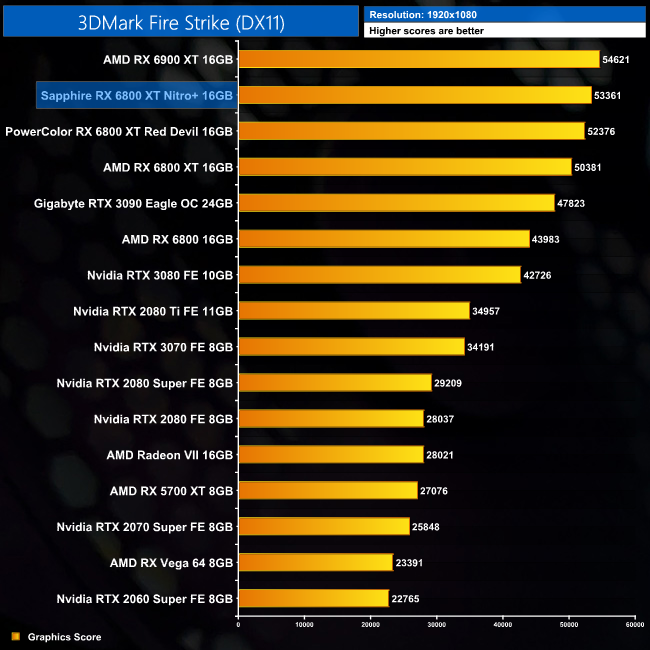
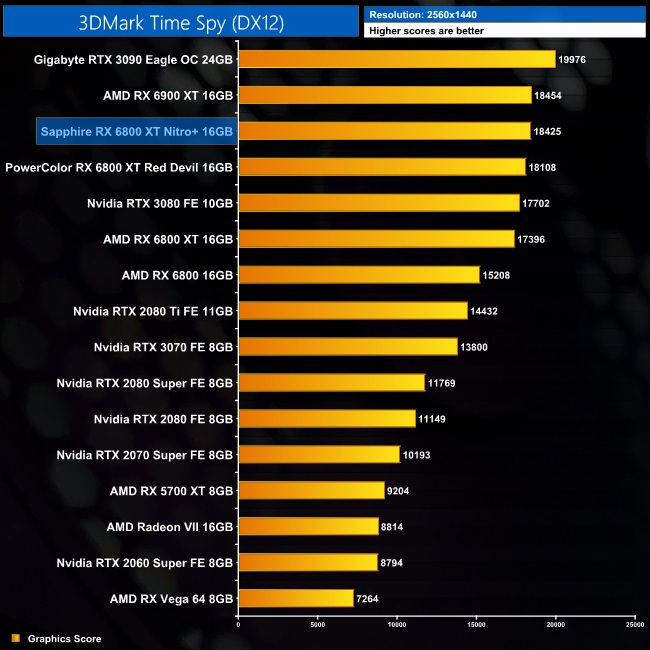
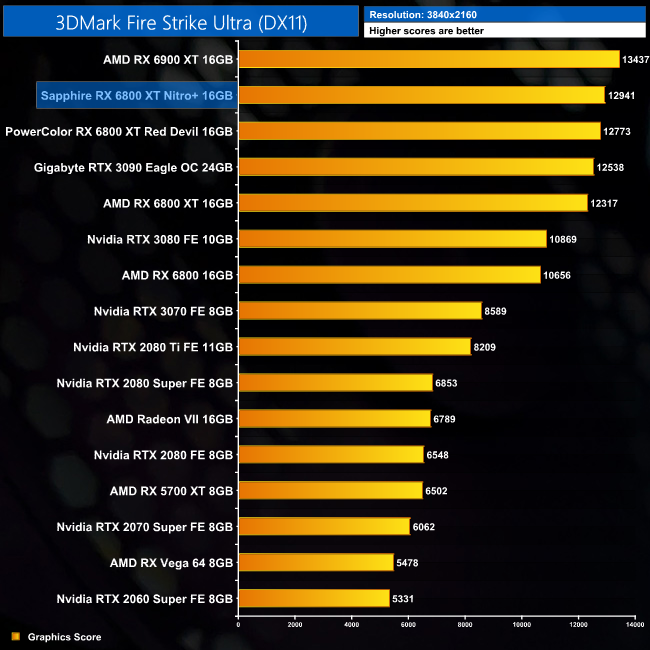
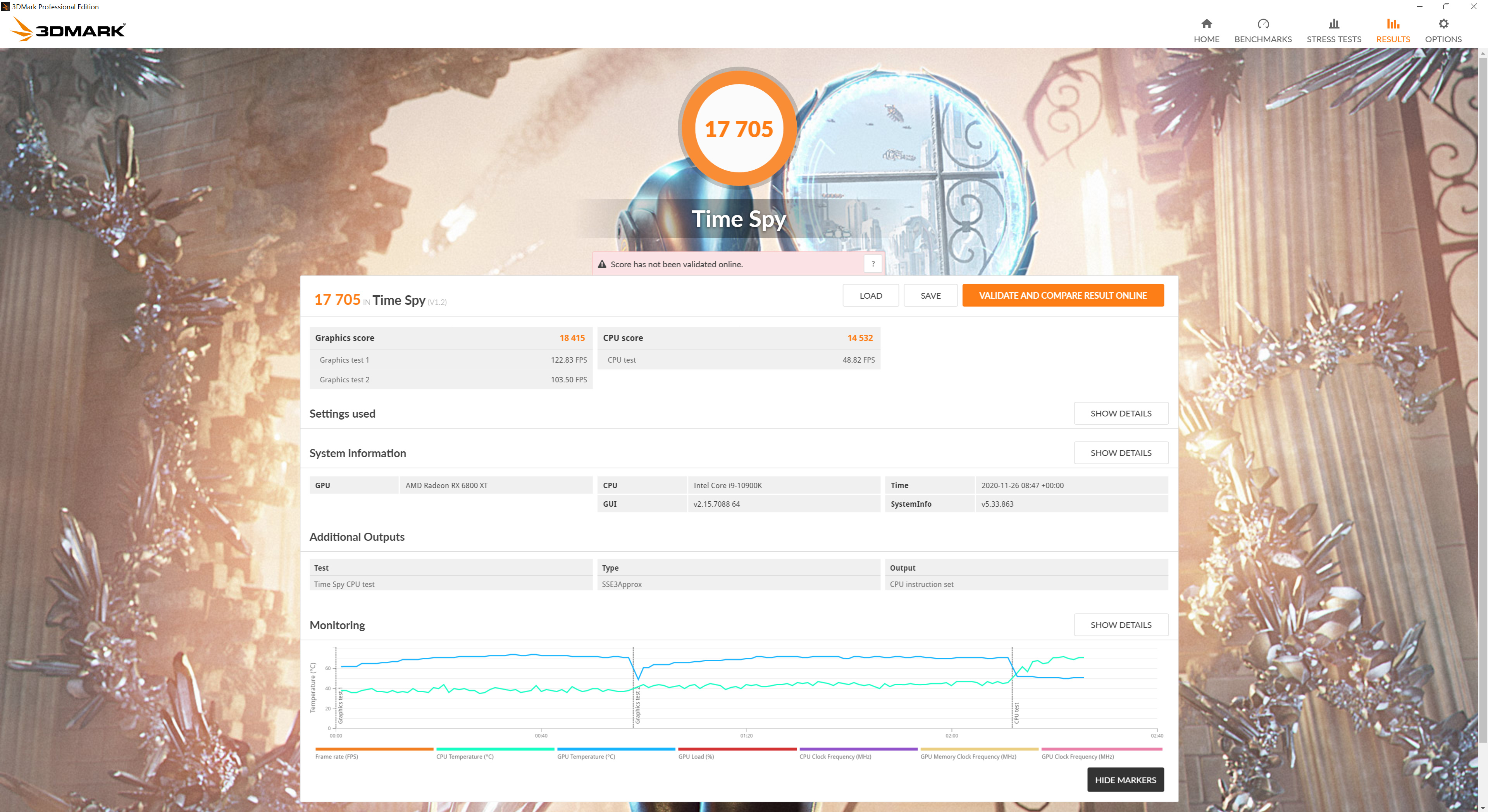
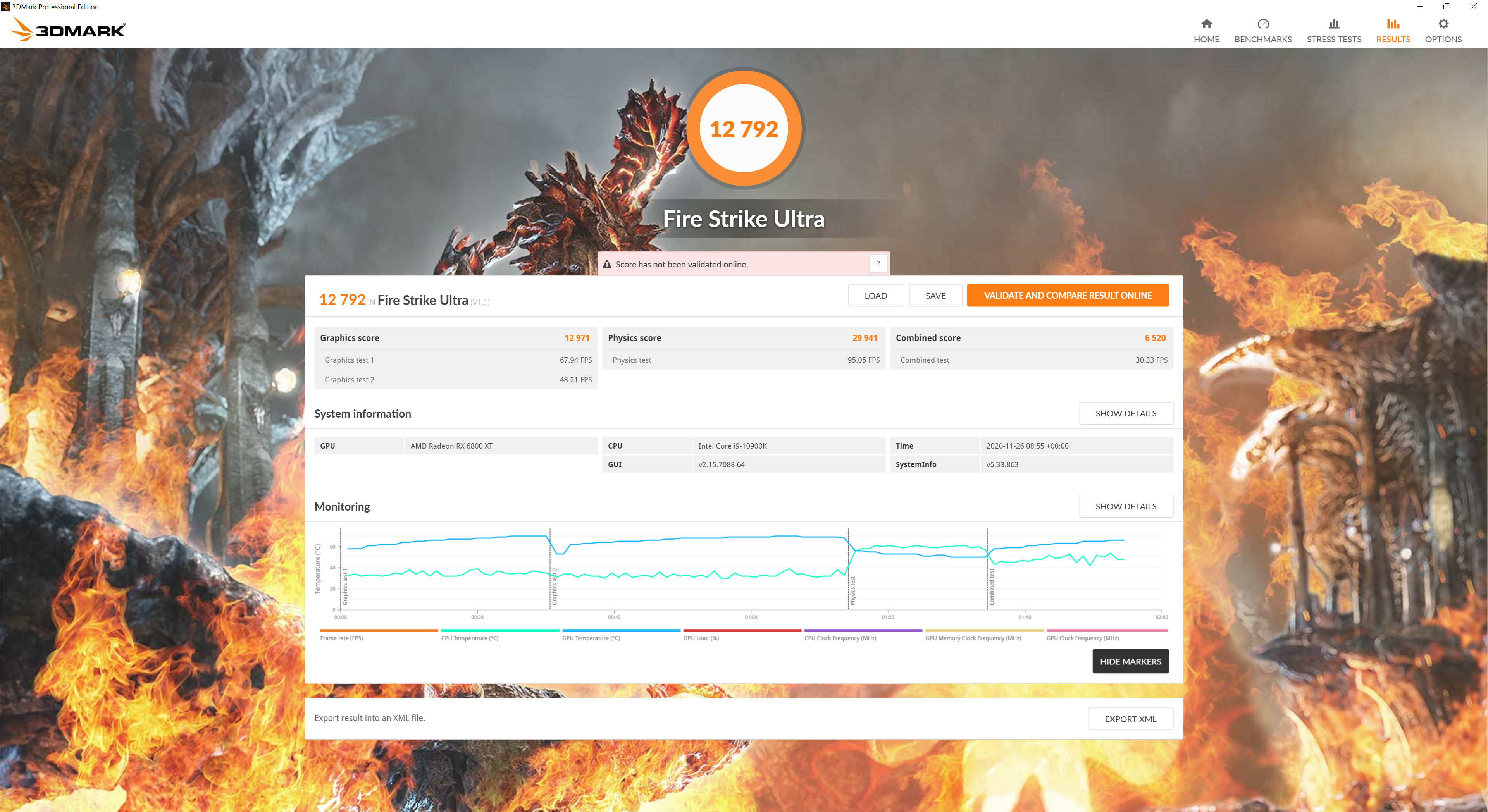
Starting with a look at 3DMark, the Nitro+ is 6% faster than the reference 6800 XT in both Fire Strike and Time Spy, while this falls to 5% in Fire Strike Ultra. That puts it 1-2% ahead of the PowerColor Red Devil, and it's only 2% slower than the RX 6900 XT in Fire Strike.
Real-time ray tracing is incredibly demanding. The latest graphics cards have dedicated hardware that’s optimized for ray-tracing. The 3DMark DirectX Raytracing feature test measures the performance of this dedicated hardware. Instead of using traditional rendering techniques, the whole scene is ray-traced and drawn in one pass. The result of the test depends entirely on ray-tracing performance. (UL).
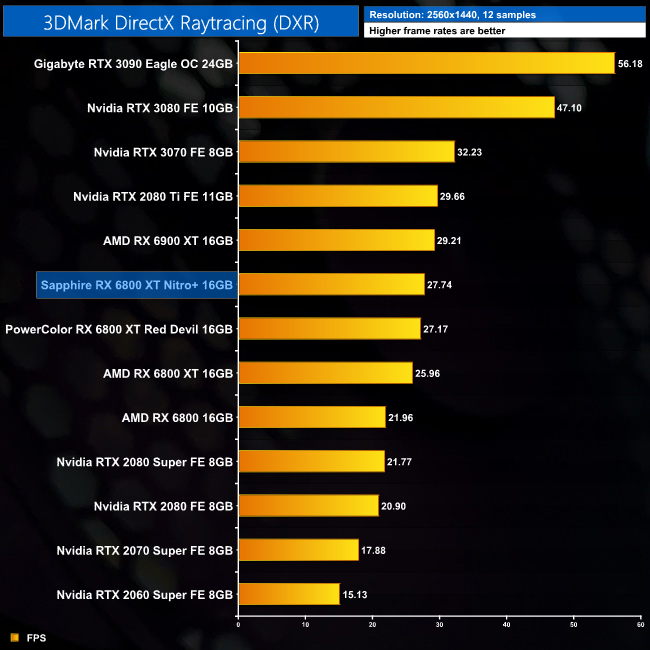
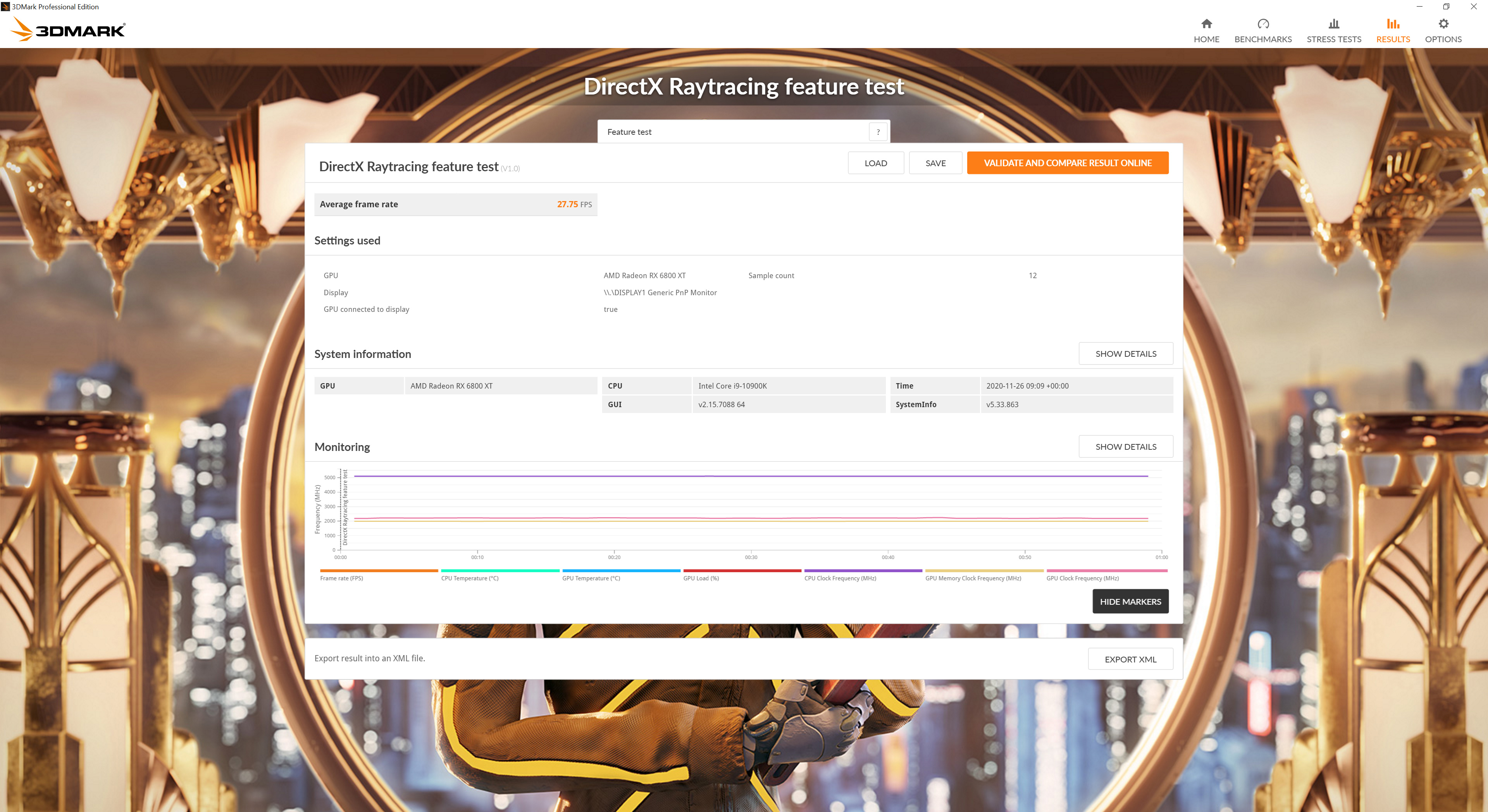
Looking at 3DMark's DXR feature test, the Nitro+ delivers an extra 7% over the reference design, putting it just 5% behind the RX 6900 XT.
Control is an action-adventure video game developed by Remedy Entertainment and published by 505 Games. Control was released on 27 August 2019 for Microsoft Windows, PlayStation 4, and Xbox One. (Wikipedia).
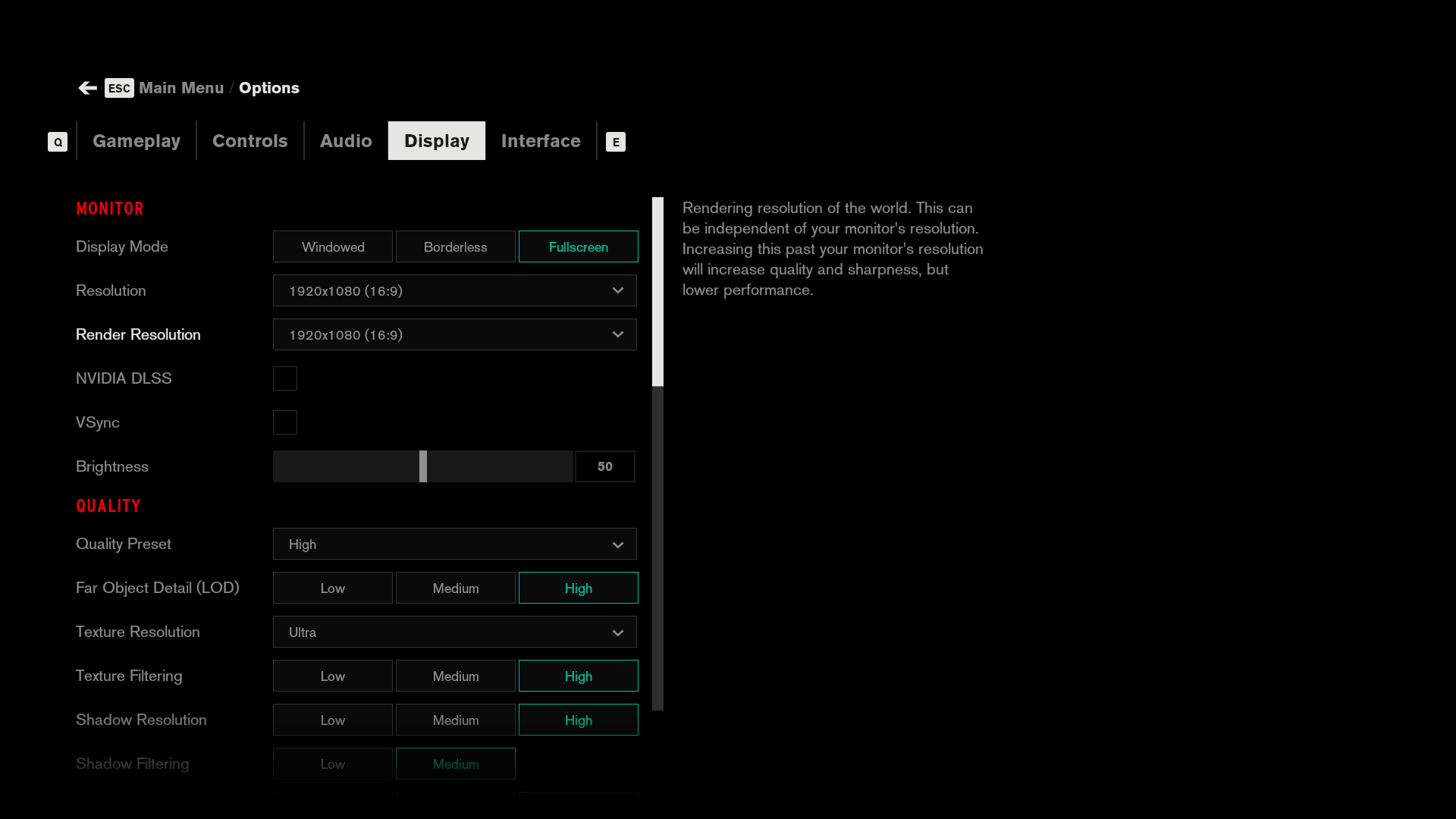
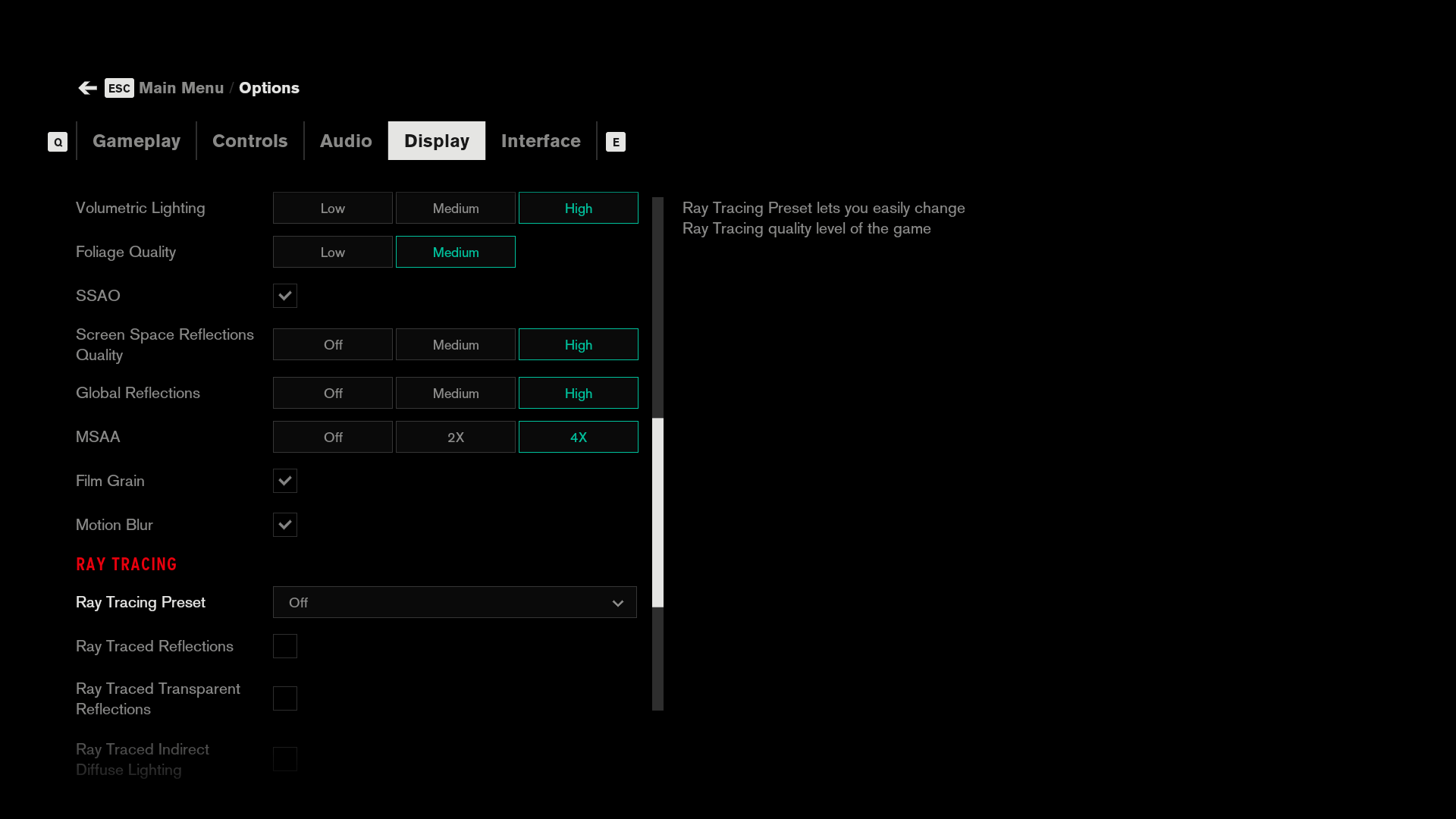
Engine: Northlight Engine. We test using the High preset, with 4x MSAA, DX12 API.
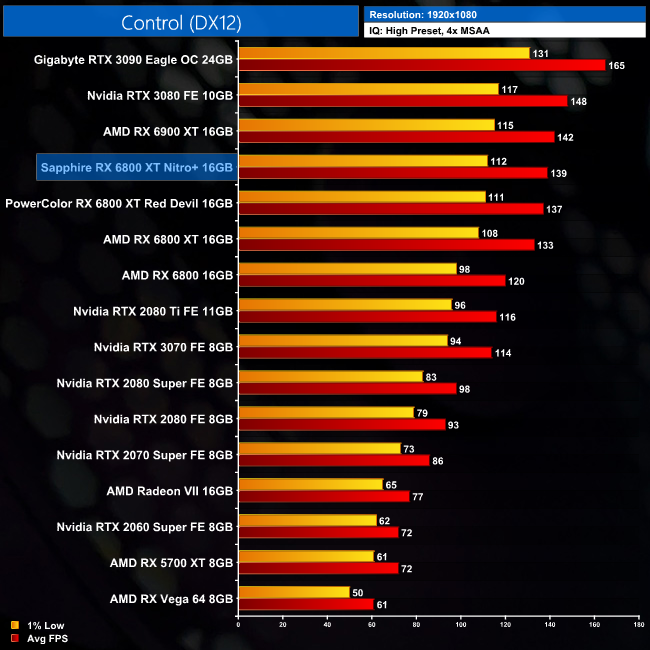
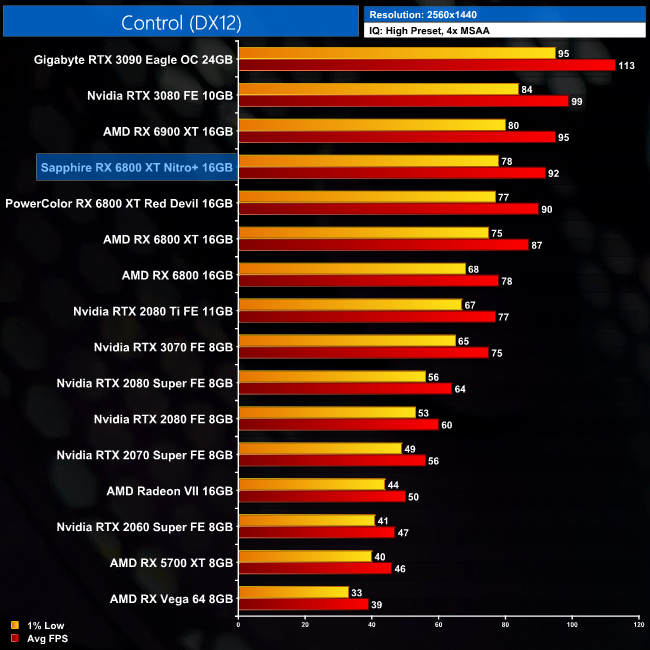
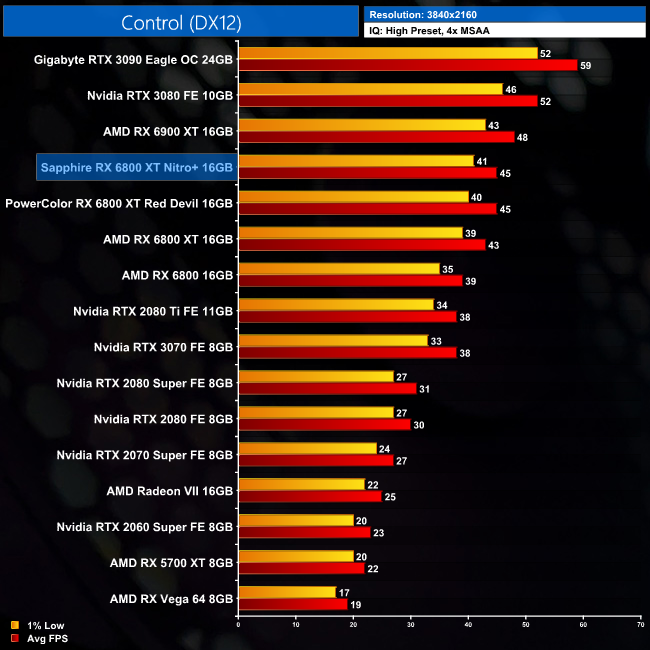
Taking a look at Control, at 1440p the Nitro+ delivers an extra 5FPS over the reference design, which is a difference of 6%, while it is also 2% ahead of the Red Devil.
For 4K gaming, it's still 5% faster than the reference card, but on par with the Red Devil.
F1 2020 is the official video game of the 2020 Formula 1 and Formula 2 Championships developed and published by Codemasters. It is the thirteenth title in the Formula 1 series developed by the studio and was released on 7 July 2020 for pre-orders of the Michael Schumacher Edition and 10 July 2020 for the Seventy Edition on Microsoft Windows, PlayStation 4, Xbox One. (Wikipedia).
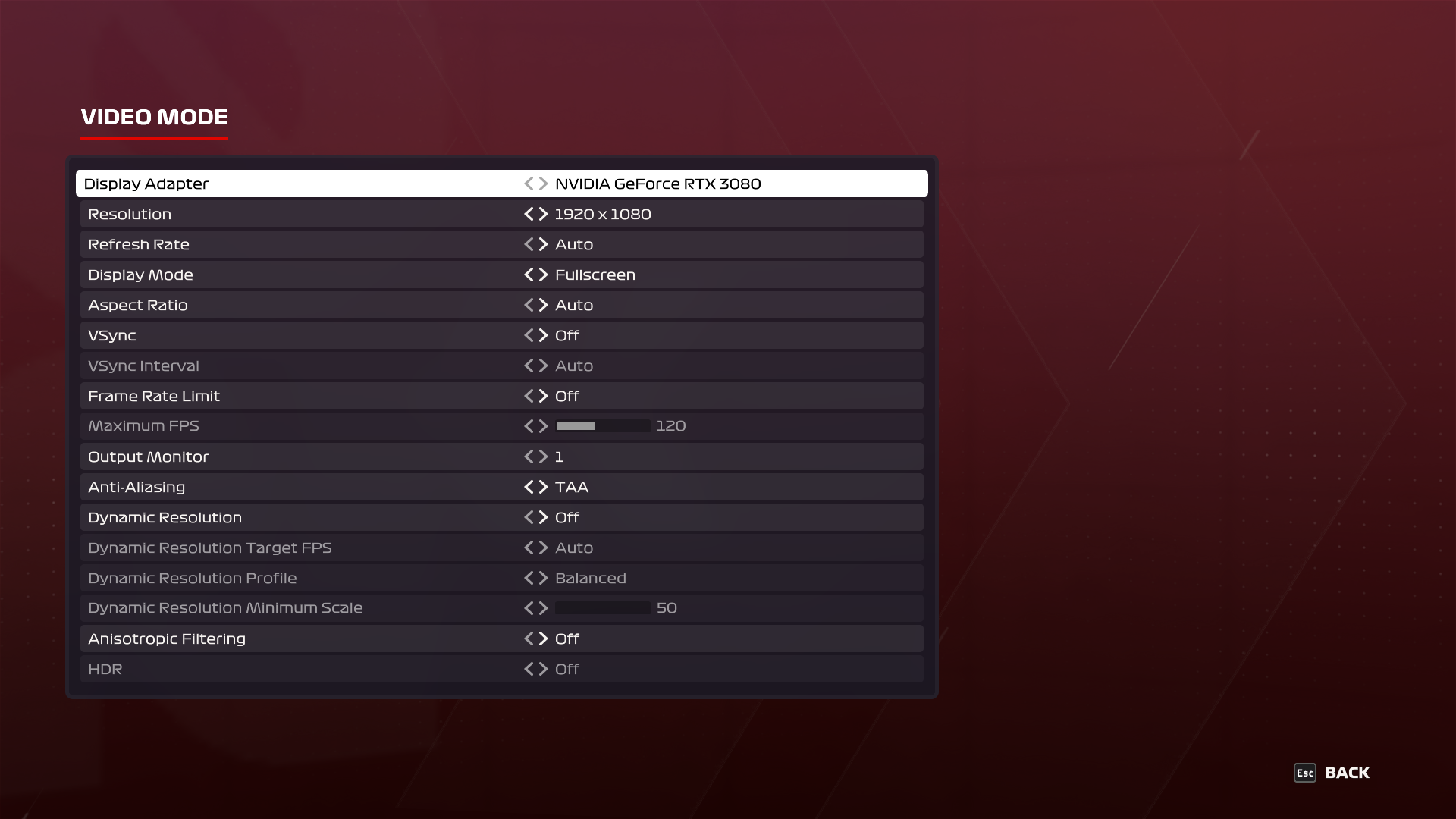
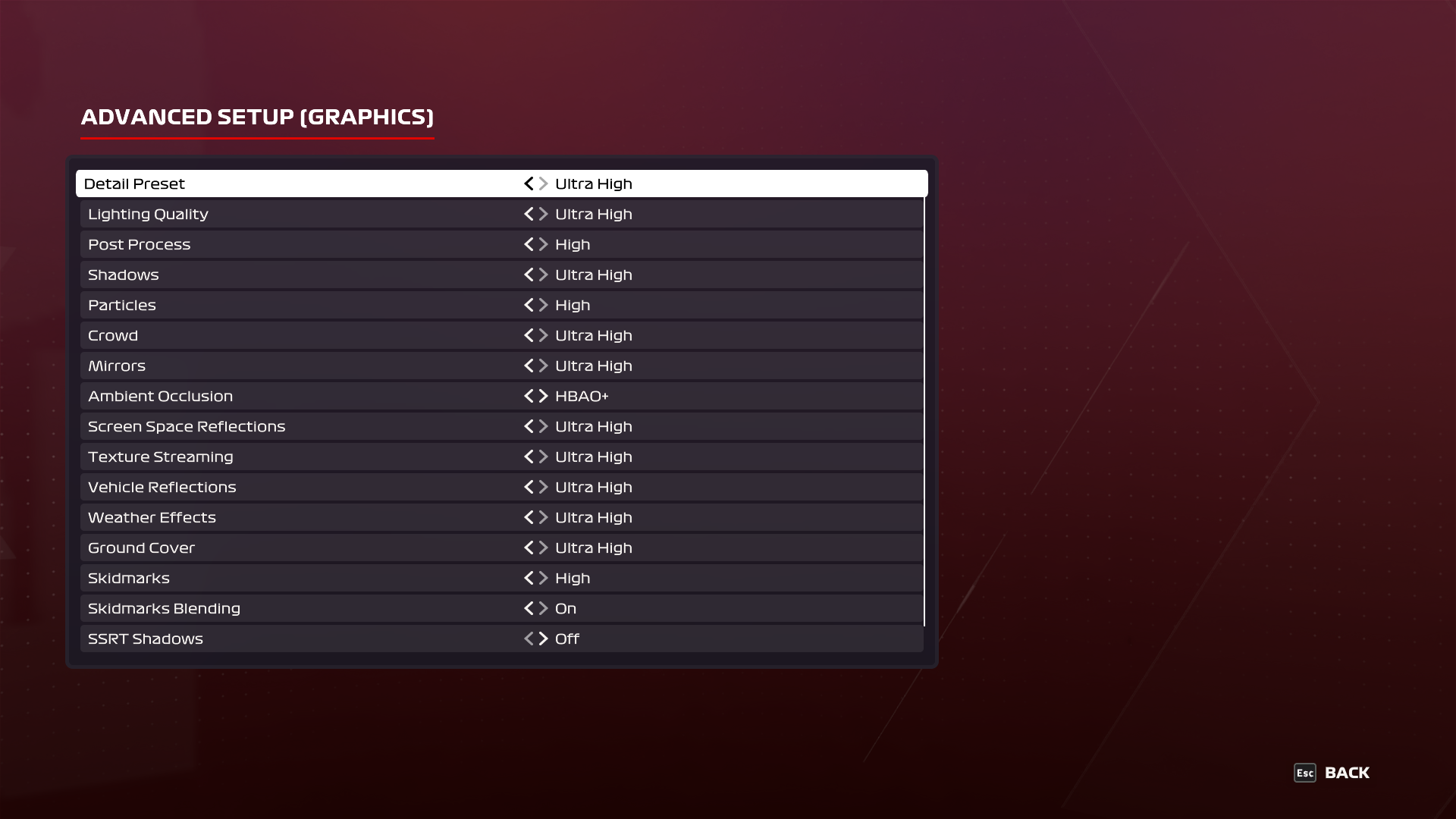
Engine: EGO. We test using the Ultra High preset, DX12 API.
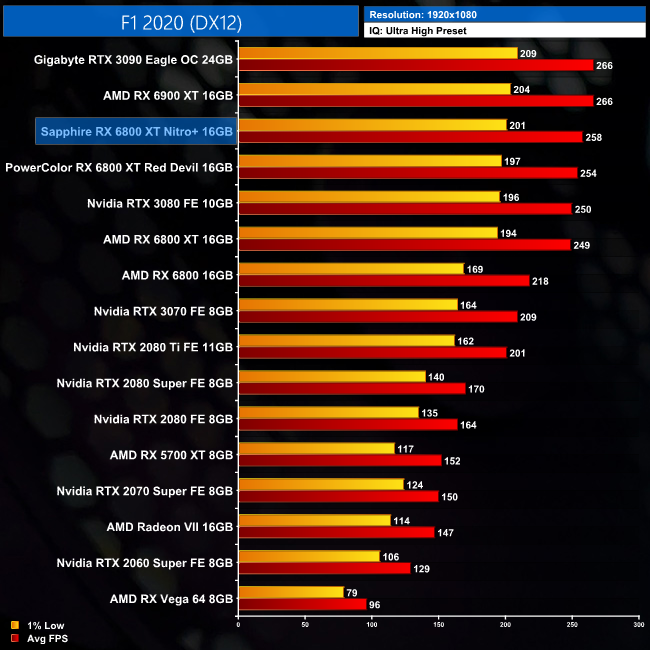
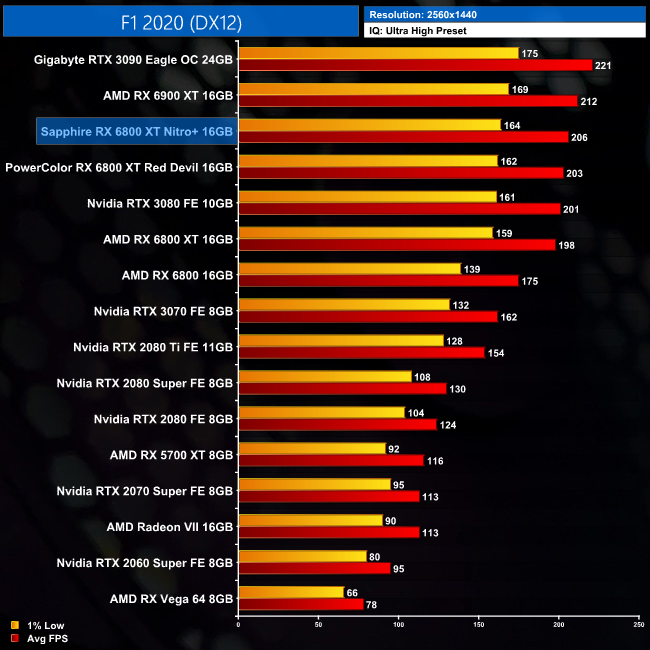
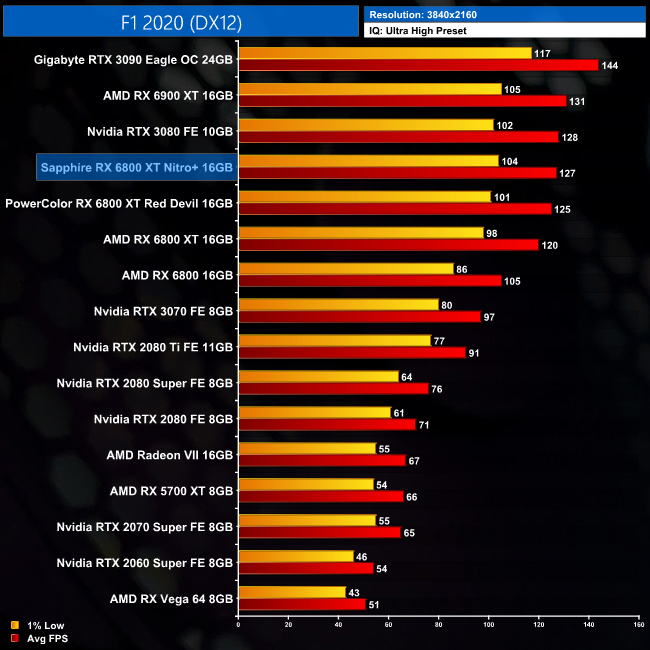
F1 2020 shows impressive performance from the Nitro+ – across all three resolutions tested, it's just 3% slower than the RX 6900 XT. It's also 1-2% faster than the PowerColor Red Devil here.
Tom Clancy's Ghost Recon Breakpoint is an online tactical shooter video game developed by Ubisoft Paris and published by Ubisoft. The game was released worldwide on 4 October 2019, for Microsoft Windows, PlayStation 4 and Xbox One, (Wikipedia).
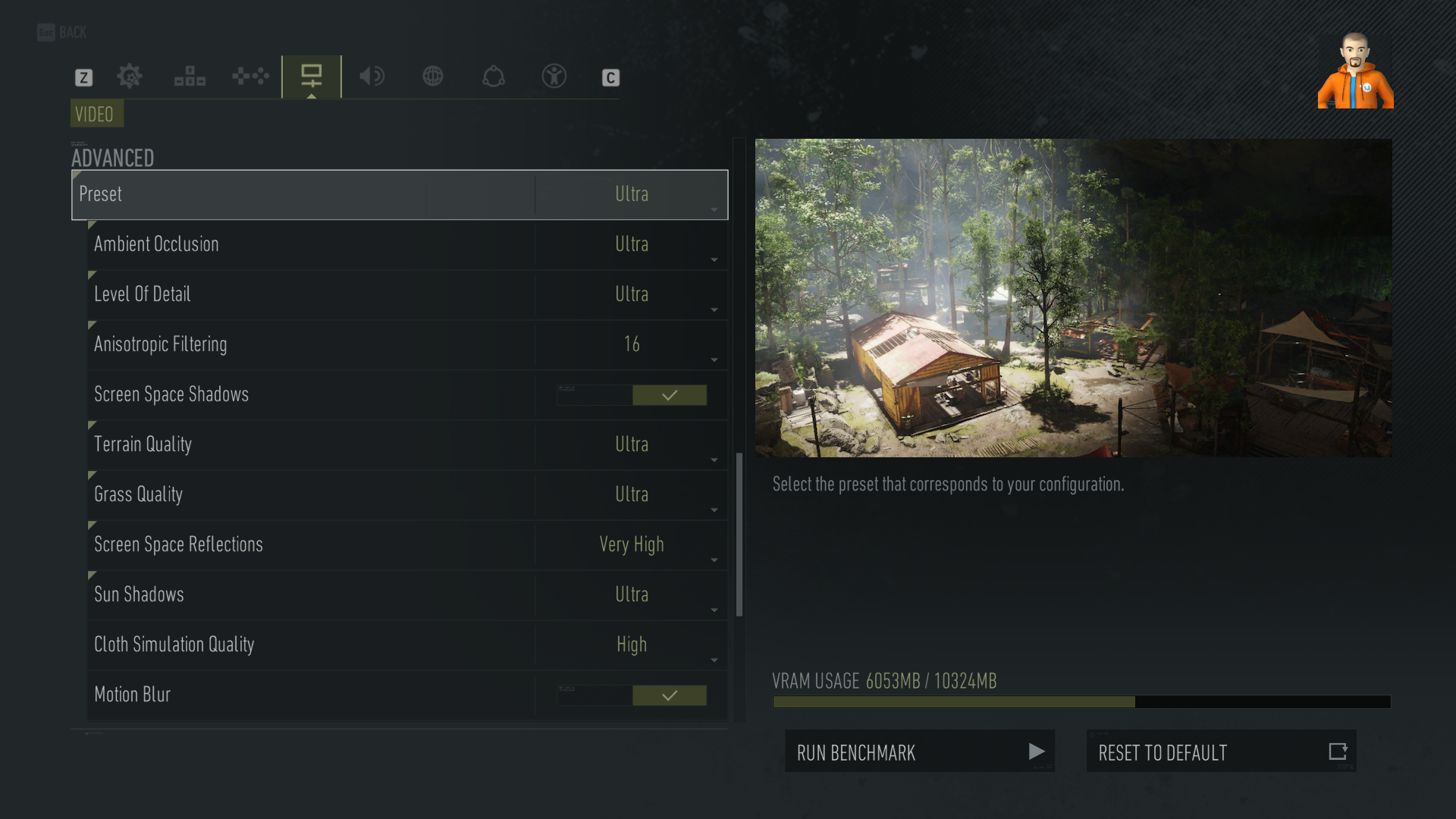
Engine: AnvilNext 2.0. We test using the Ultra preset, with AA disabled, Vulkan API.

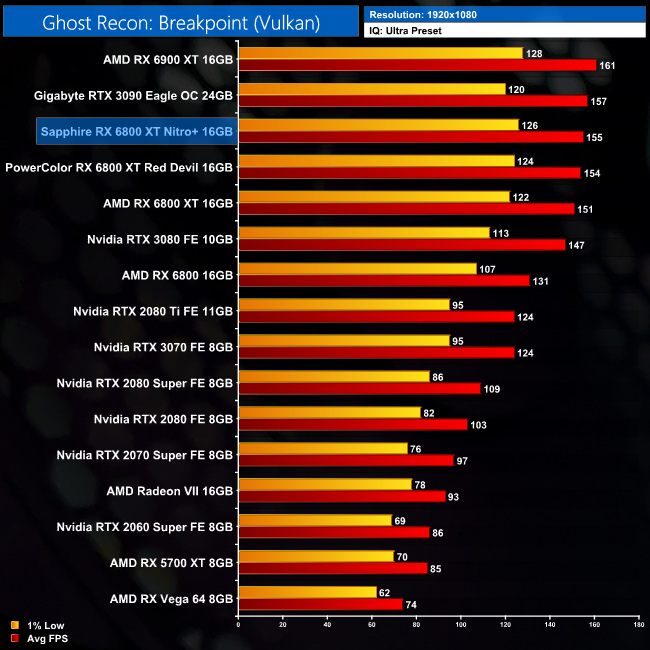
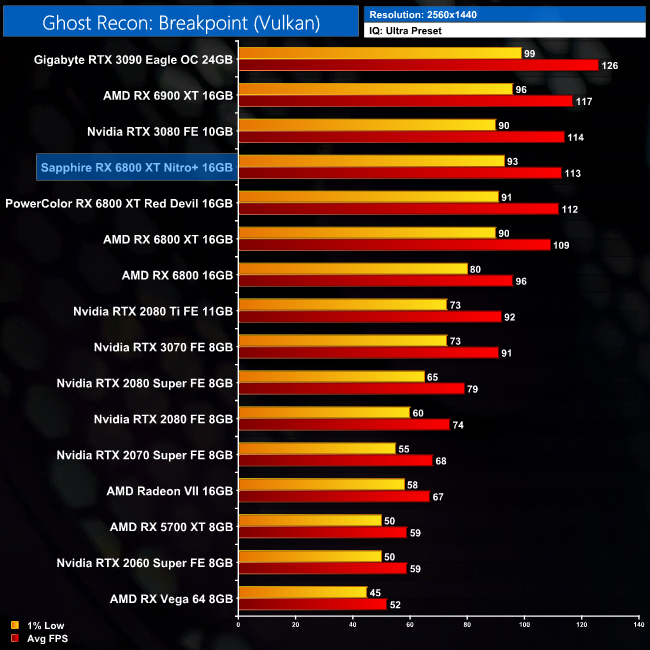
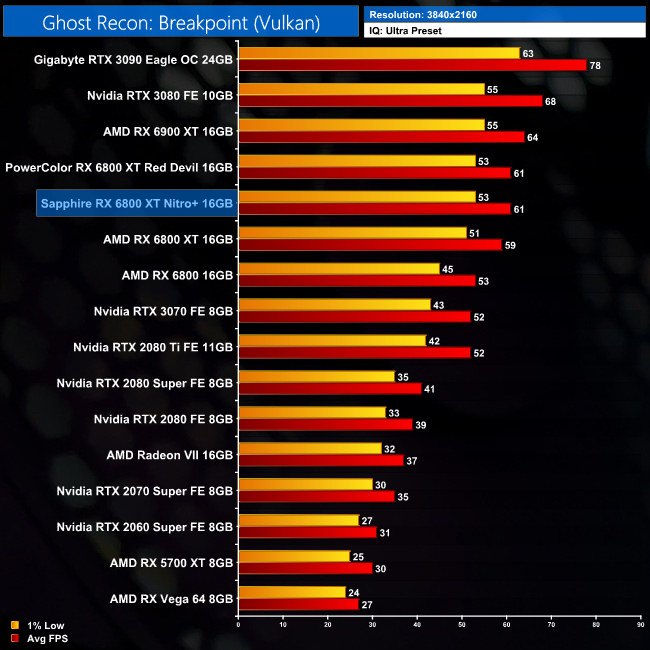
Ghost Recon: Breakpoint shows more limited gains over the reference card, as the Nitro+ is 3% faster at 4K. That puts it on level pegging with the Red Devil in this title, with no more than 1FPS separating the two cards.
Metro Exodus is a first-person shooter video game developed by 4A Games and published by Deep Silver in 2019. It is the third instalment in the Metro video game series based on Dmitry Glukhovsky's novels, following the events of Metro 2033 and Metro: Last Light. (Wikipedia).
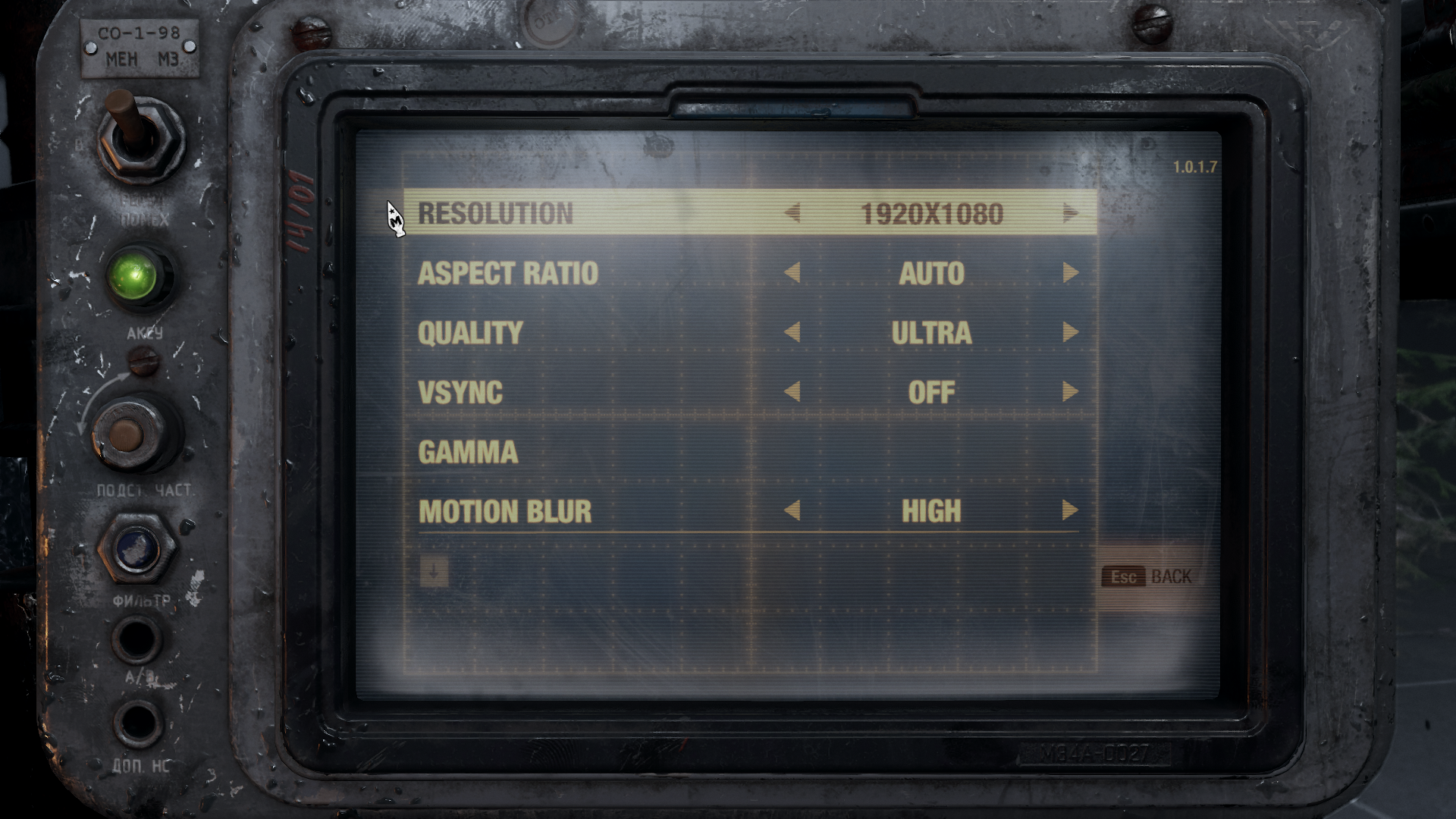
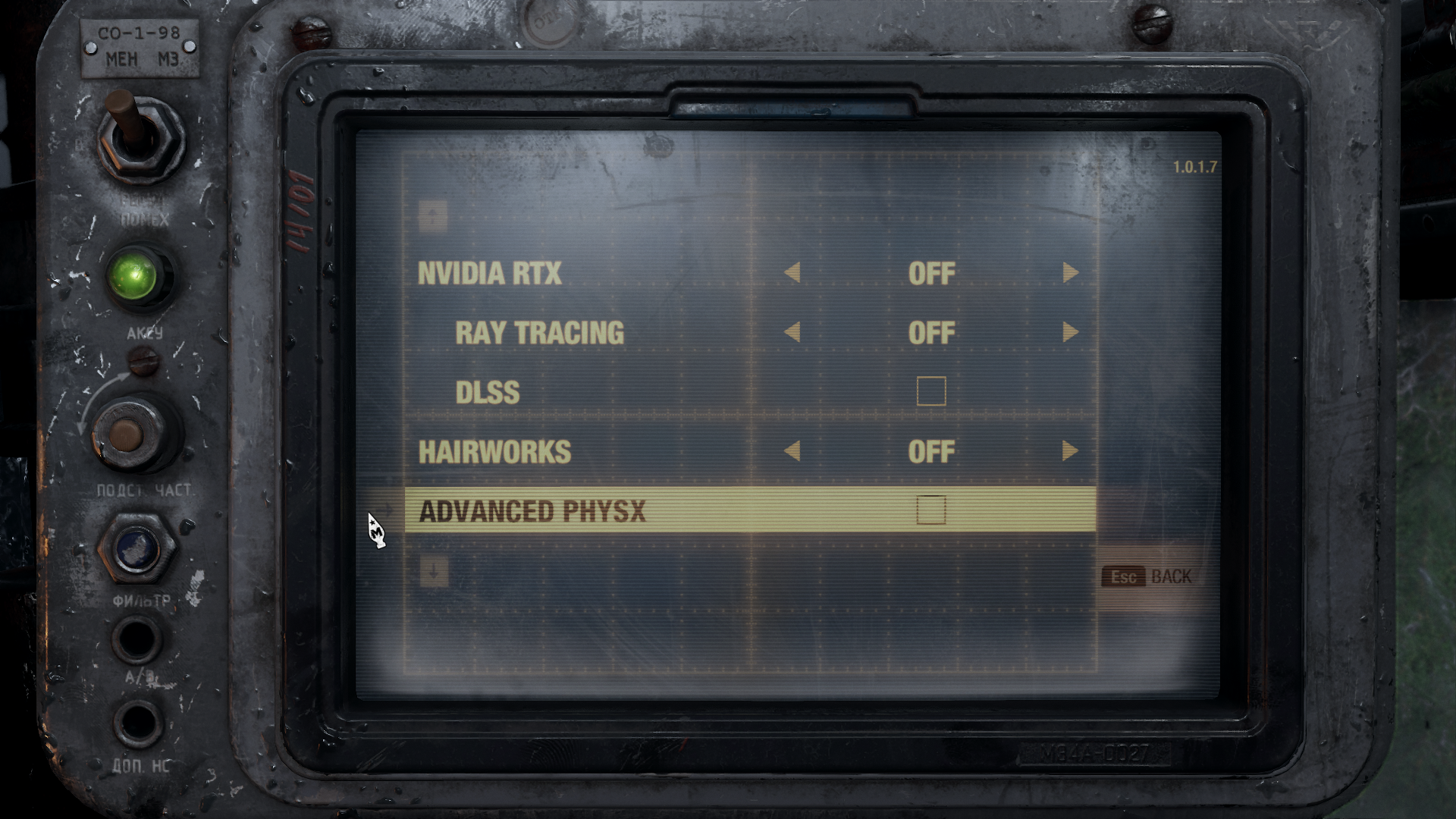
Engine: 4A Engine. We test using the Ultra preset, but with Hairworks and Advanced PhysX turned off, DX12 API.
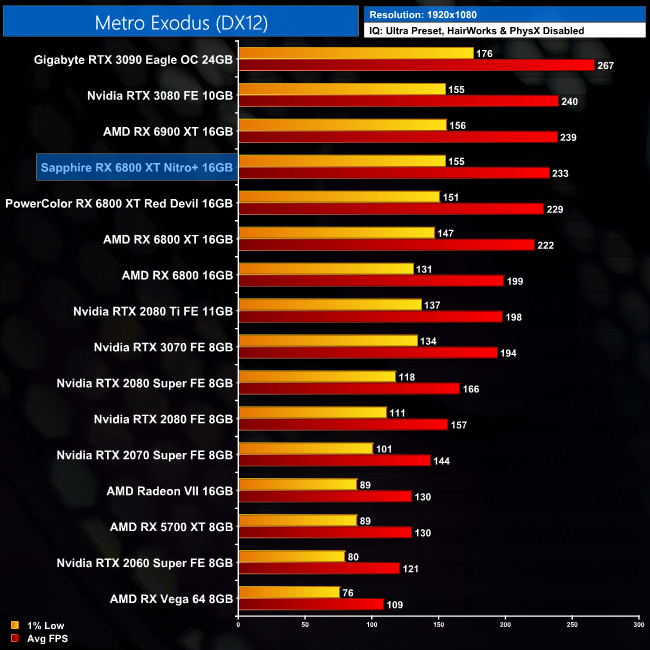
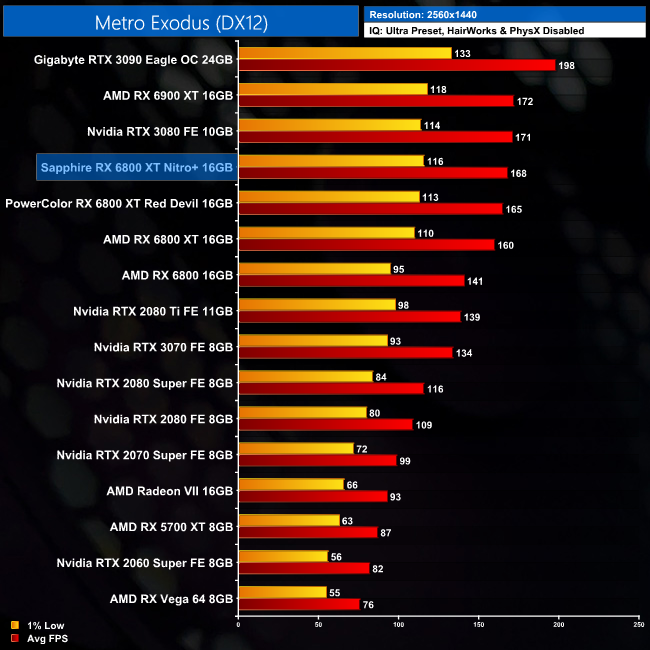
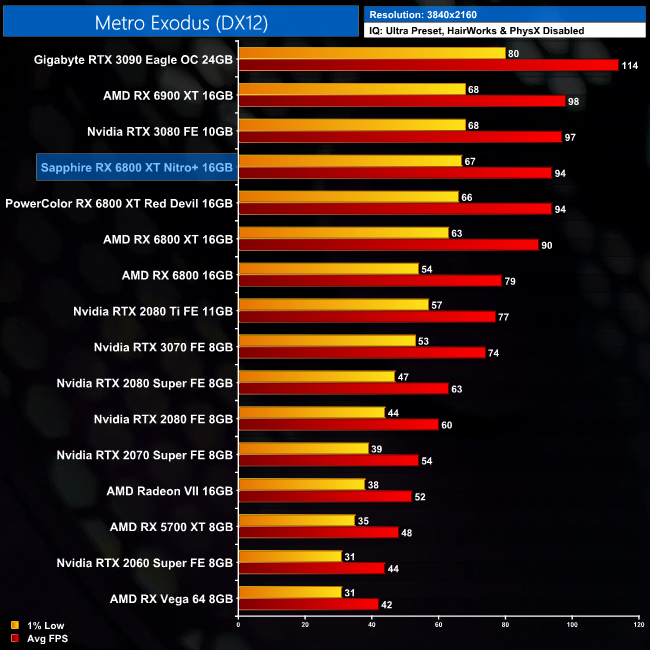
Up next is Metro Exodus, and here the Nitro+ is 5% faster than the reference card at 1440p, while this falls to 4% at 4K. It's again very close to the RX 6900 XT however, being just 2% and 4% slower at 1440p and 4K, respectively.
Red Dead Redemption 2 is a 2018 action-adventure game developed and published by Rockstar Games. The game is the third entry in the Red Dead series and is a prequel to the 2010 game Red Dead Redemption. Red Dead Redemption 2 was released for the PlayStation 4 and Xbox One in October 2018, and for Microsoft Windows and Stadia in November 2019. (Wikipedia).
Engine: Rockstar Advance Game Engine (RAGE). We test by manually selecting Ultra settings (or High where Ultra is not available), TAA, Vulkan API.


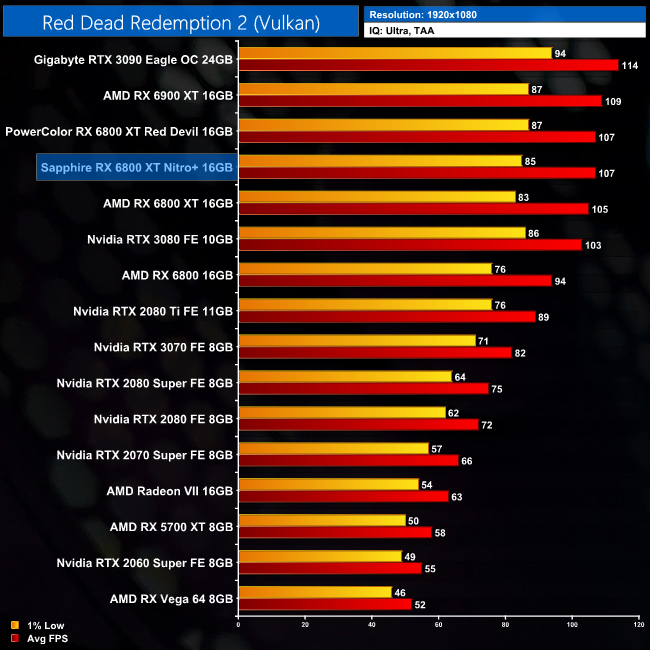
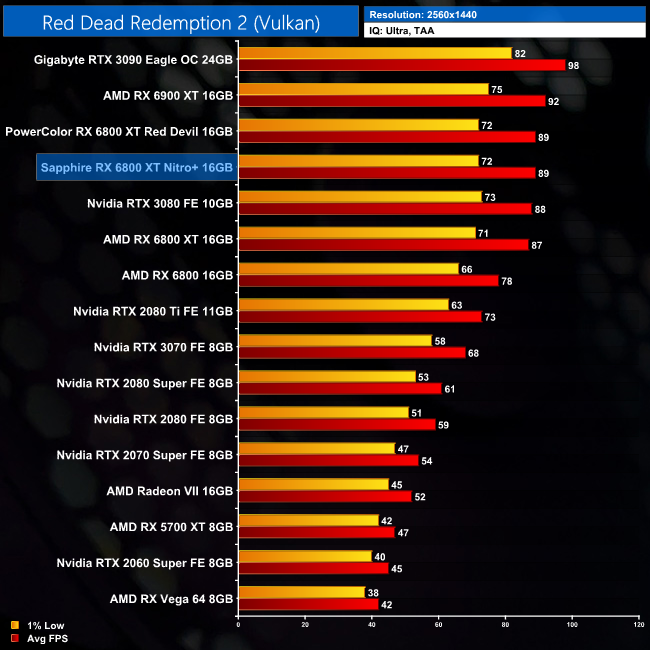
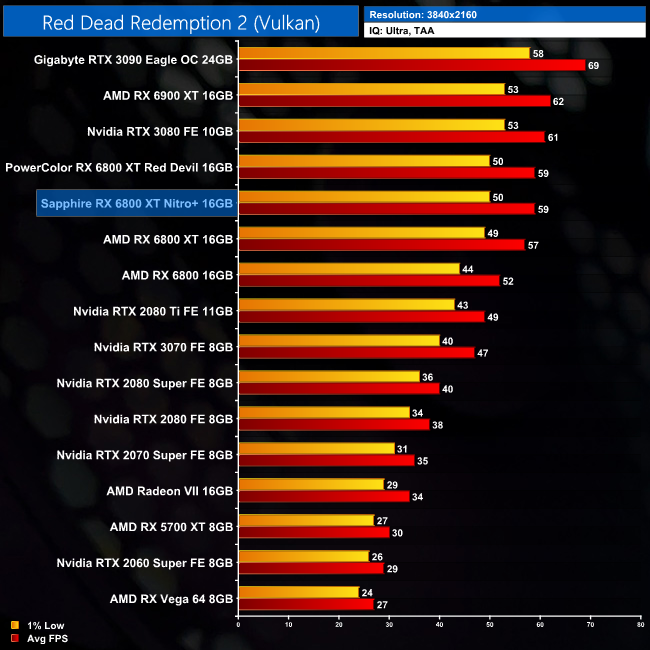
Red Dead Redemption 2 is another game where the extra clock speed doesn't bring massive benefit to the Nitro+, especially at 1440p where it is just 2% faster than the reference card and level with the Red Devil. At 4K, it's 5% slower than the RX 6900 XT.
Watch Dogs: Legion is a 2020 action-adventure game published by Ubisoft and developed by its Toronto studio. It is the third instalment in the Watch Dogs series, and the sequel to 2016's Watch Dogs 2. Legion was released on October 29, 2020 for Microsoft Windows, PlayStation 4, Xbox One, and Stadia. (Wikipedia).
Engine: Disrupt. We test using the Ultra preset, DX12 API.

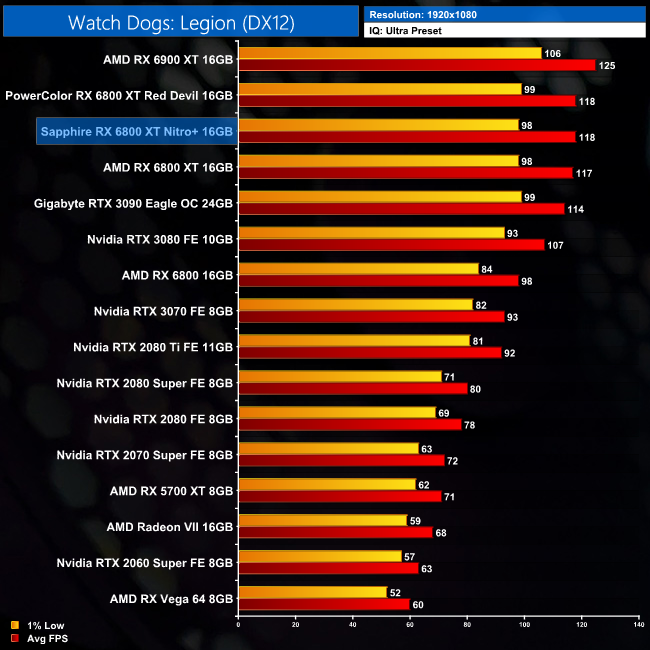
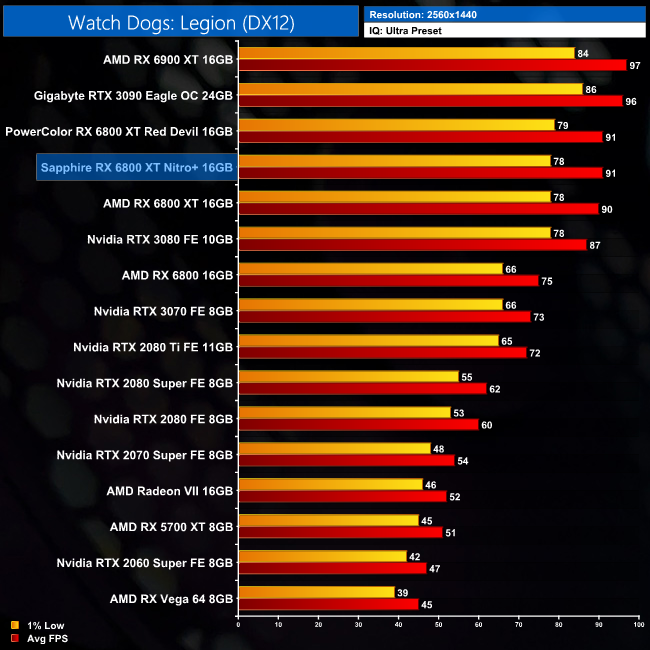
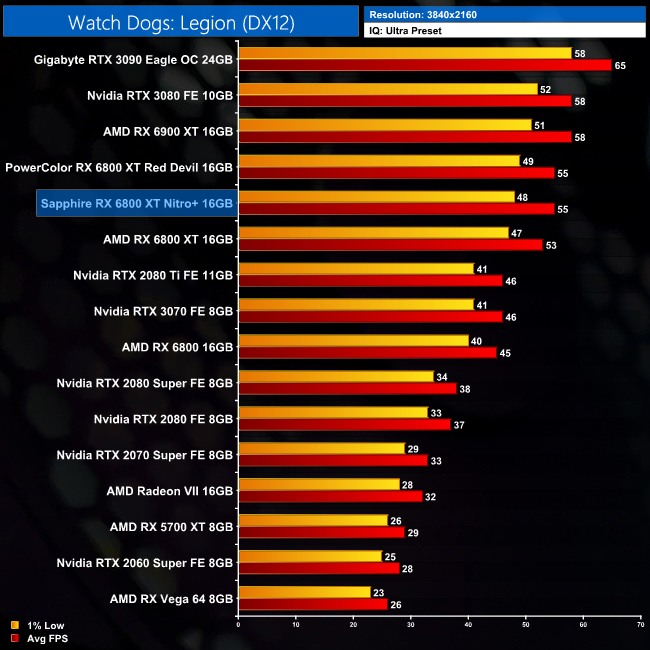
Our final game is Watch Dogs: Legion, where the Nitro+ is 1% faster than the reference card at 1440p. This does rise to 4% at 4K, however, putting it level with the Red Devil but just 5% behind the RX 6900 XT.
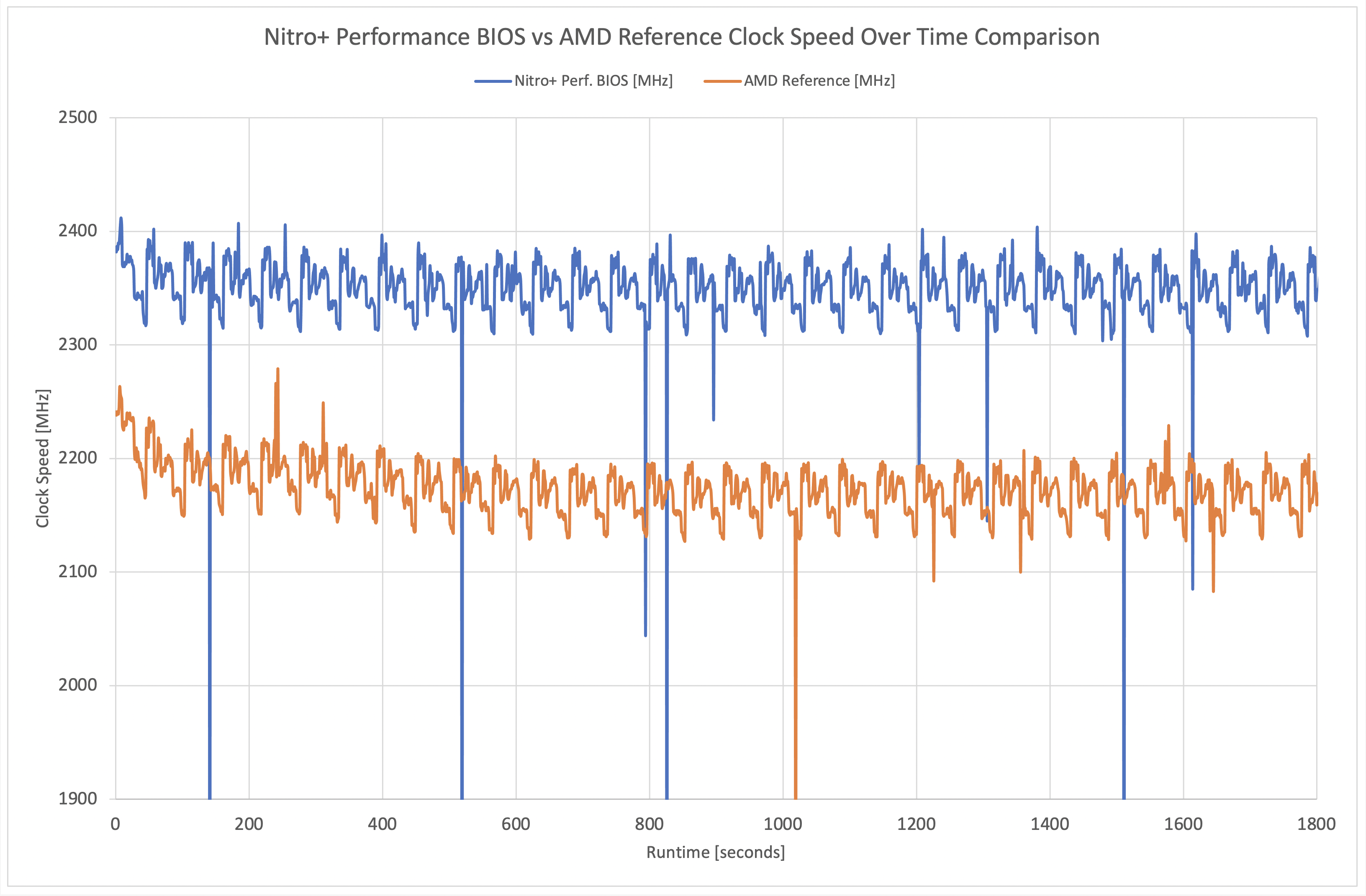
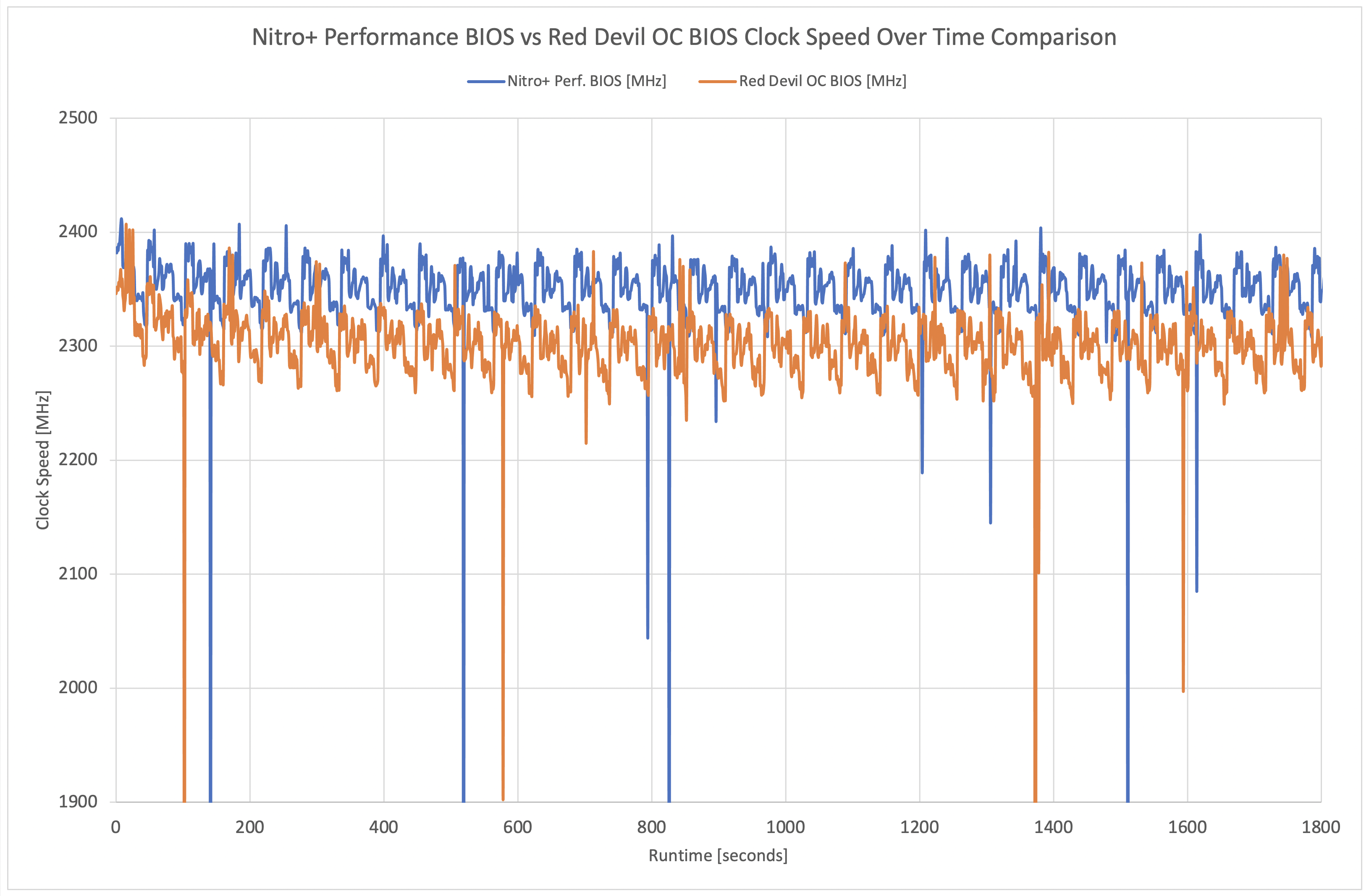
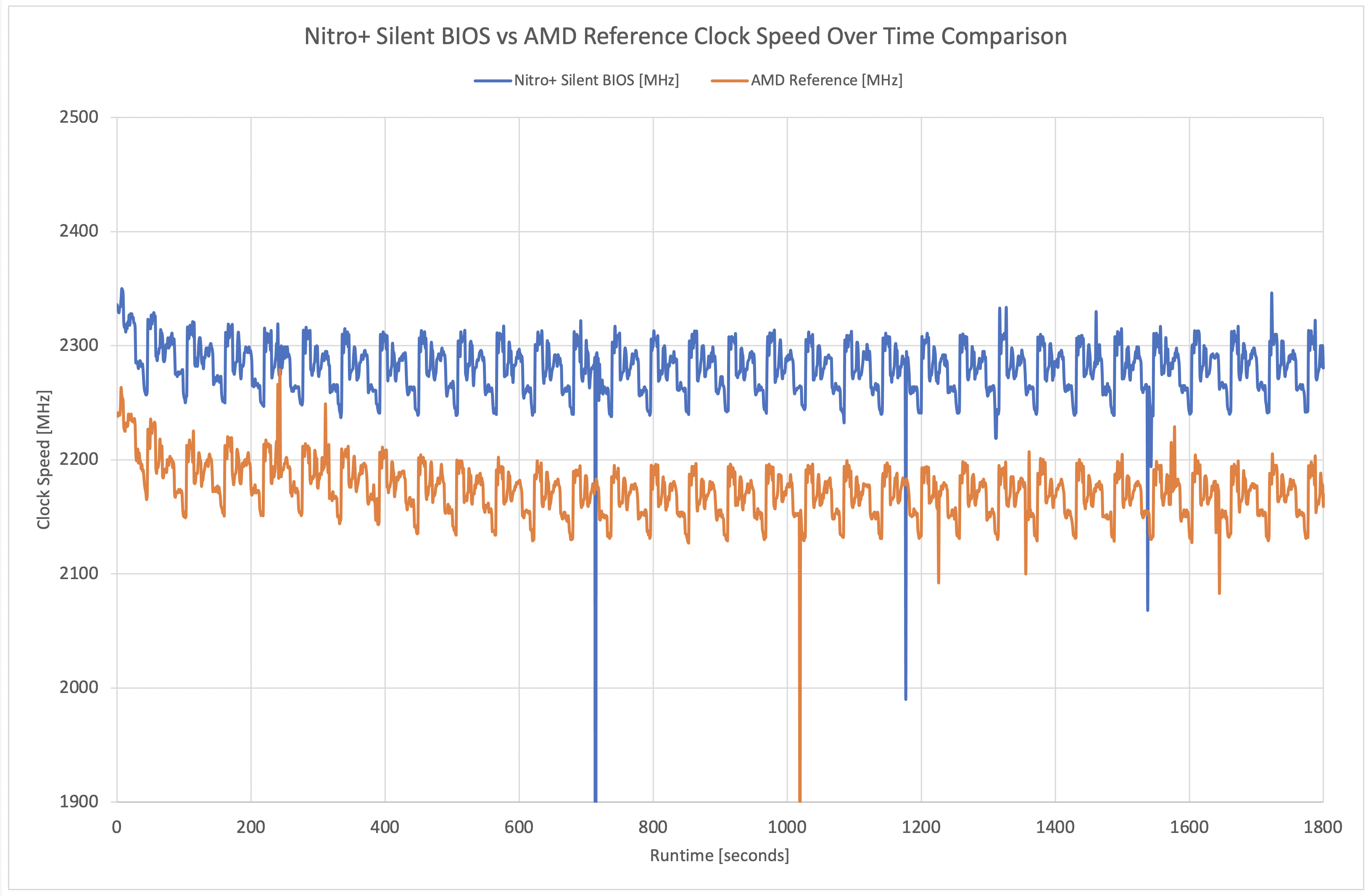
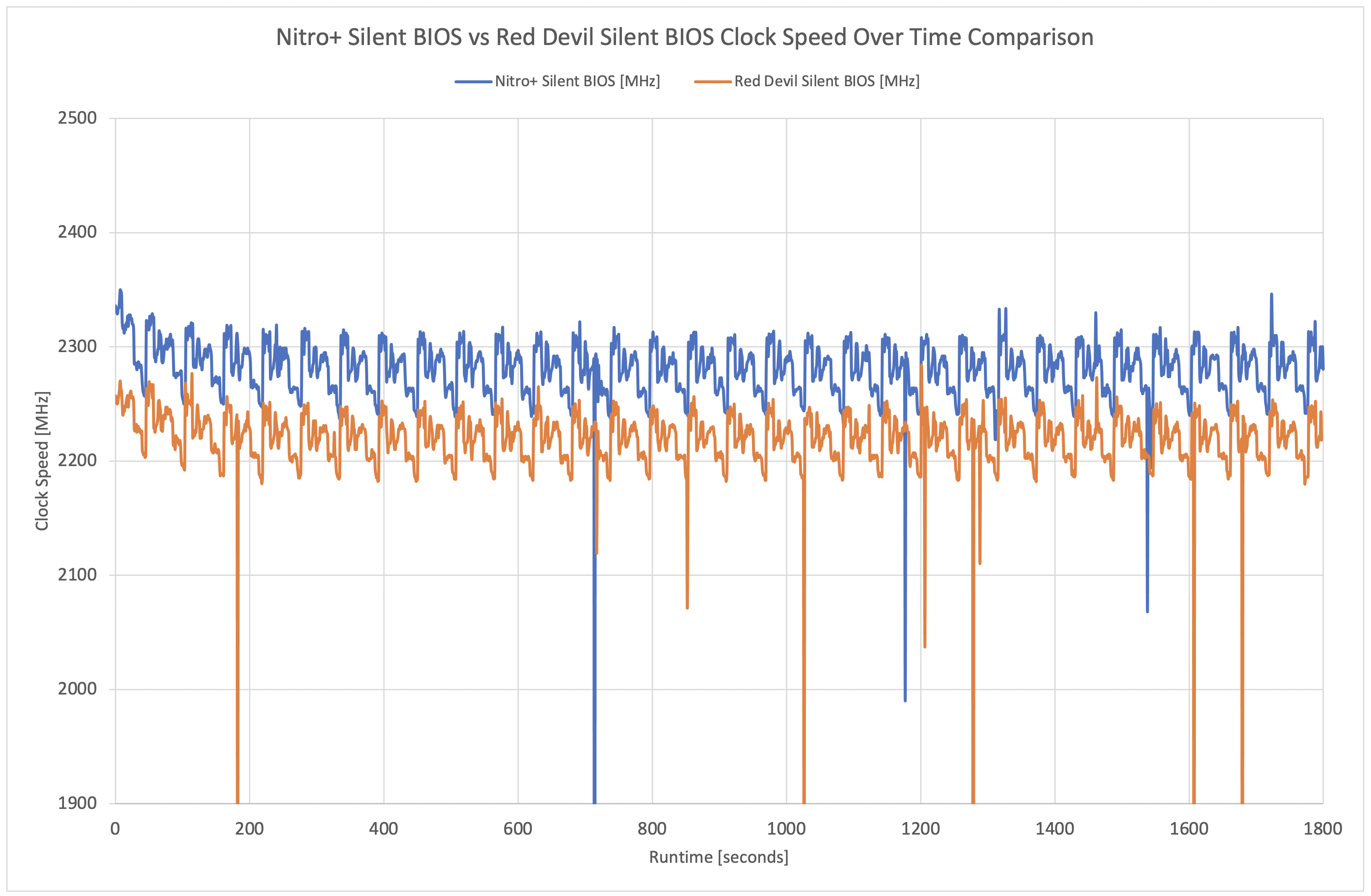
Here we present the average clock speed for each graphics card while running the 3DMark Time Spy stress test for 30 minutes. We use GPU-Z to record the GPU core frequency during the Time Spy runs. We calculate the average core frequency during the 30 minute run to present here.
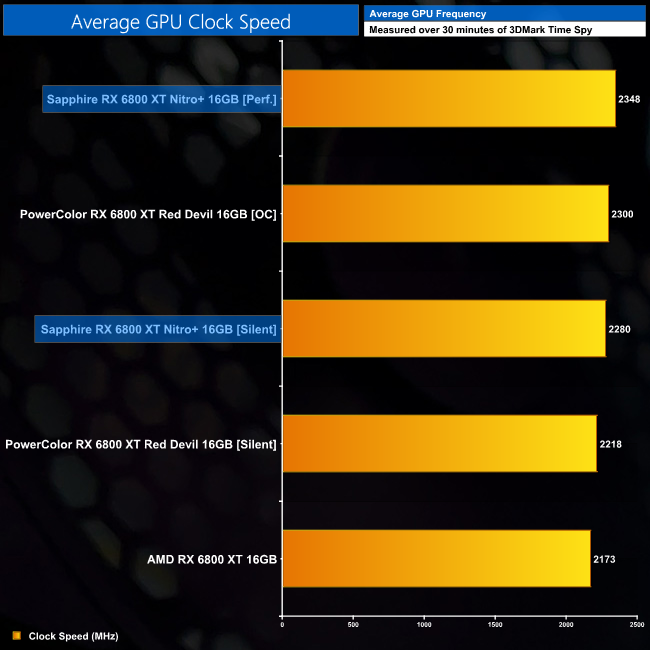
Beginning our testing of the dual-BIOS functionality of the Nitro+, we can see the Performance BIOS averaged 2348MHz across our 30 minute stress test. This means it ran about 175MHz faster than the reference card, and almost 50MHz faster than the PowerColor Red Devil OC BIOS, which explains why we saw a small performance lead for the Nitro+ in certain titles.
Even the Silent BIOS ran just 20MHz slower than the Red Devil's OC BIOS, making it over 100MHz faster than the reference card.
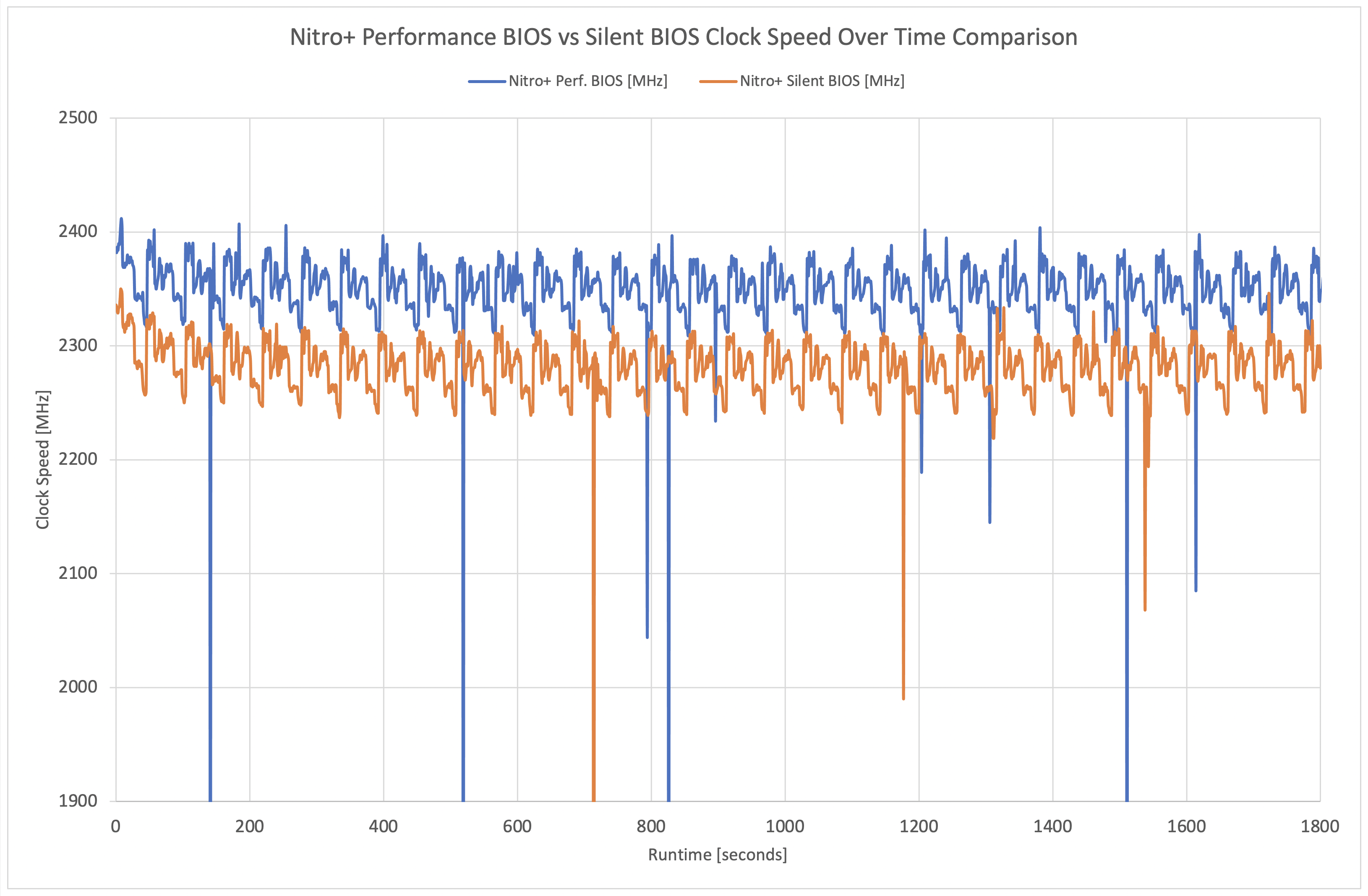
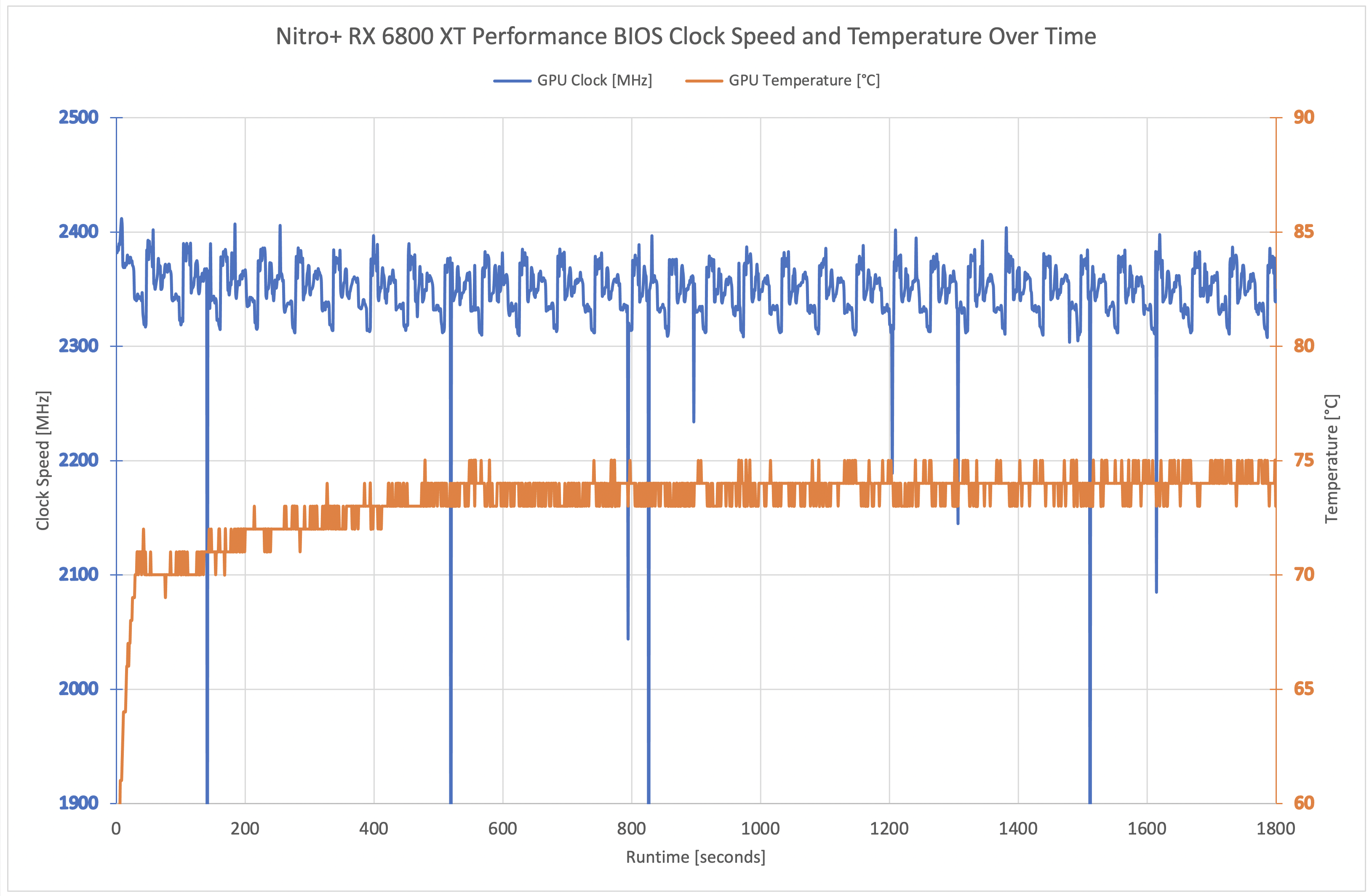
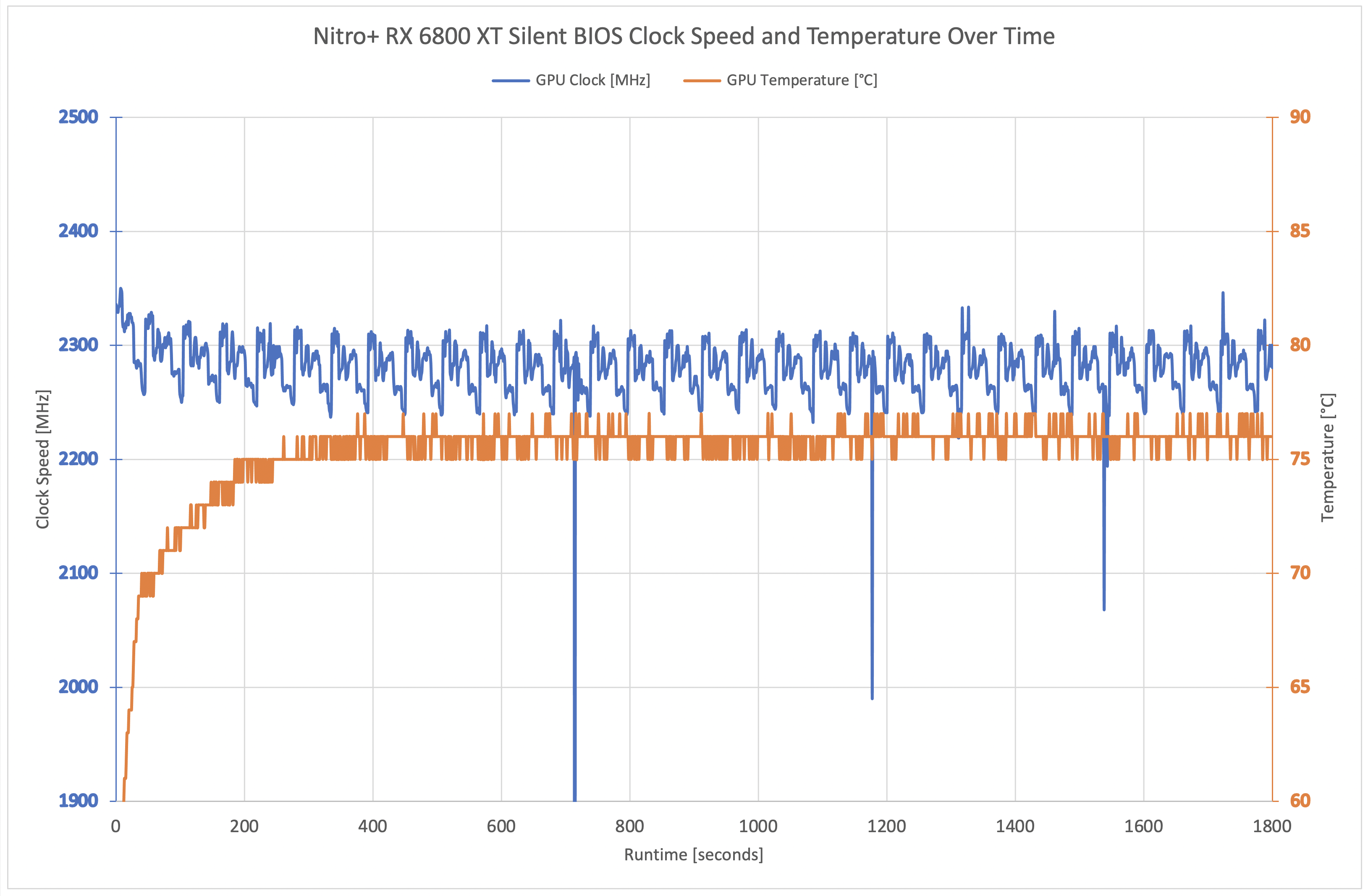
Following on from our look at average GPU clock speed, here we present a series of charts, comparing the frequency response of the Nitro+'s Performance BIOS and Silent BIOS, against the Red Devil's OC and Silent BIOS, as well as the reference RX 6800 XT.
Nitro+ Performance BIOS vs Nitro+ Silent BIOS
Nitro+ Performance BIOS vs AMD Reference
Nitro+ Performance BIOS vs PowerColor Red Devil OC BIOS
Nitro+ Silent BIOS vs AMD Reference
Nitro+ Silent BIOS vs PowerColor Red Devil Silent BIOS
Nitro+ Performance BIOS GPU Frequency Against Temperature
Nitro+ Silent BIOS GPU Frequency Against Temperature
For our temperature testing, we measure the peak GPU core temperature under load. A reading under load comes from running the 3DMark Time Spy stress test for 30 minutes.
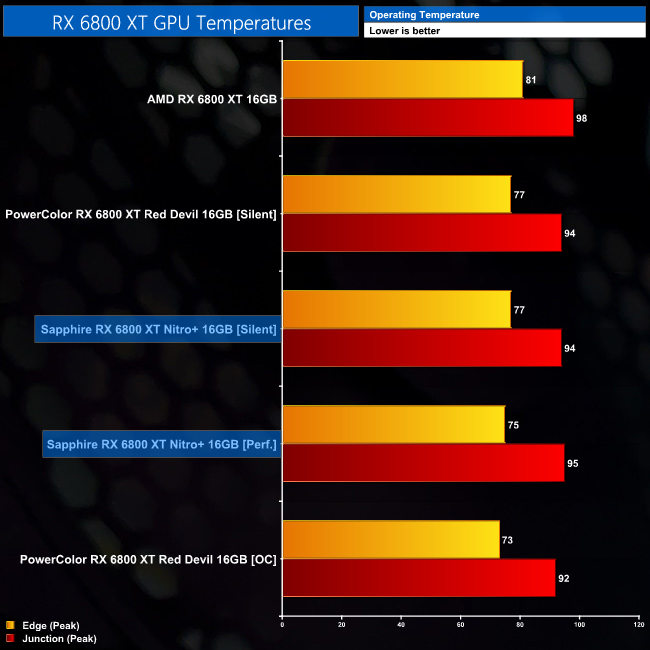
Looking now at out of the box thermal performance, we can see the Nitro+ performs at a very similar level to the PowerColor Red Devil in terms of the raw thermals. In fact, the Silent BIOS on both the Nitro+ and the Red Devil recorded the exact same temperatures, hitting 77C on the edge and 94C for the junction. The Nitro+ Performance BIOS, meanwhile, hit 75C edge and 95C junction, which is an increase of 2C compared to the Red Devil’s OC BIOS. As we will see later though, power does play a part in this.
We take our noise measurements with the sound meter positioned 1 foot from the graphics card. I measured the noise floor to be 32 dBA, thus anything above this level can be attributed to the graphics cards. The power supply is passive for the entire power output range we tested all graphics cards in, while all CPU and system fans were disabled. A reading under load comes from running the 3DMark Time Spy stress test for 30 minutes.
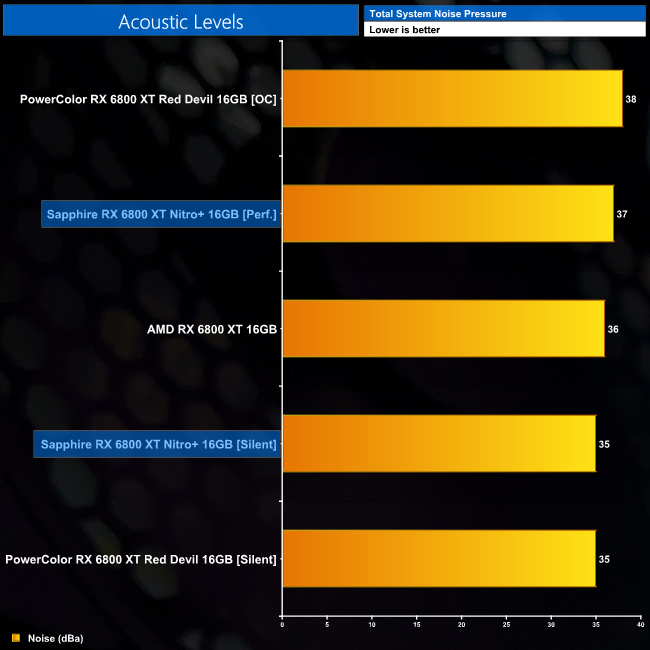
In terms of default fan behaviour, the Performance BIOS saw the fans spin up to 44%, or about 1500rpm, producing 37dBa on our sound meter. This is fractionally quieter than the Red Devil’s OC BIOS, but I’m not sure the human ear would actually be able to notice the difference. As for the Silent BIOS, this dropped fan speed to 35%, or 1200rpm, producing whisper quiet noise levels. In actual fact, just as we found with the Red Devil, with the fans spinning this slowly, a slight amount of coil whine is actually producing more noise than the fans themselves, but I didn’t notice this once the rest of the system fans were spinning at normal speeds.
Following on from our stock thermal and acoustic testing, here we re-test the operating temperature of the GPU, but with noise levels normalised to 40dBa. This allows us to measure the efficiency of the overall cooling solution as varying noise levels as a result of more aggressive fan curves are no longer a factor.
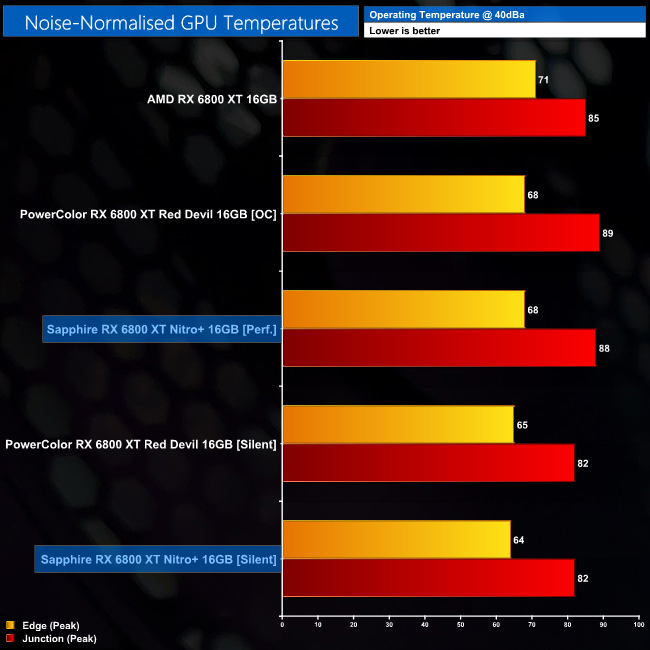
So we have covered the default thermal and acoustic behaviour of the card, but here we look at thermals when noise-normalised to 40dBa. For the Nitro+, this meant setting a fan speed of 55%, around 1890rpm, and here we can see the Nitro+ does fractionally better than the Red Devil. We’re talking a very small differences though, as the Nitro+ Performance BIOS is just 1C cooler than the Red Devil’s OC BIOS when looking at junction temperature, while the Nitro+’s Silent BIOS is 2C cooler than Red Devil’s Silent BIOS.
At the end of the day, both cards deliver great results, but the Nitro+ is technically superior. We also have to factor in power draw here – as we see on the next page, the Nitro+ does have a higher power limit, which needs to be kept in mind when looking at these results.
We measure system-wide power draw from the wall while running the 3DMark Time Spy stress test for 30 minutes.
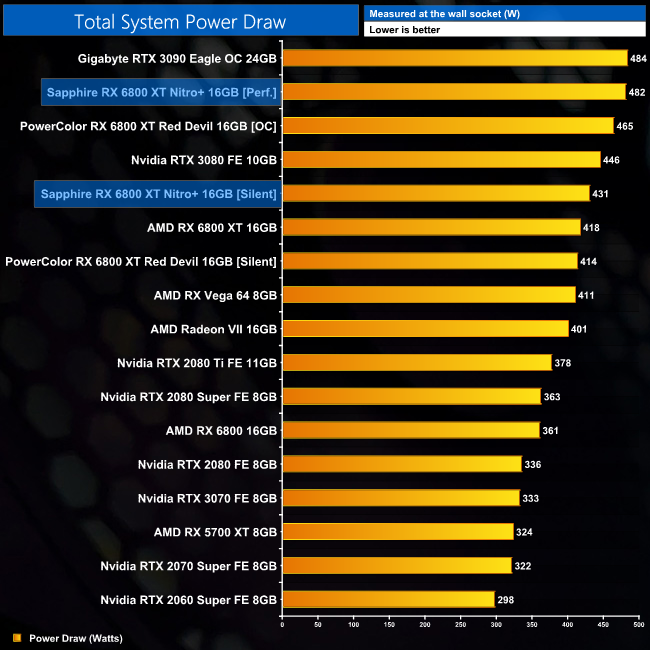
We also use Nvidia PCAT to measure power draw of the graphics card only, with readings from both the PCIe slot and the PCIe power cables combined into a single figure. This provides us with significantly more accurate data to work with as it is measuring only the GPU power, and not total system power which is a fundamentally imprecise measurement.
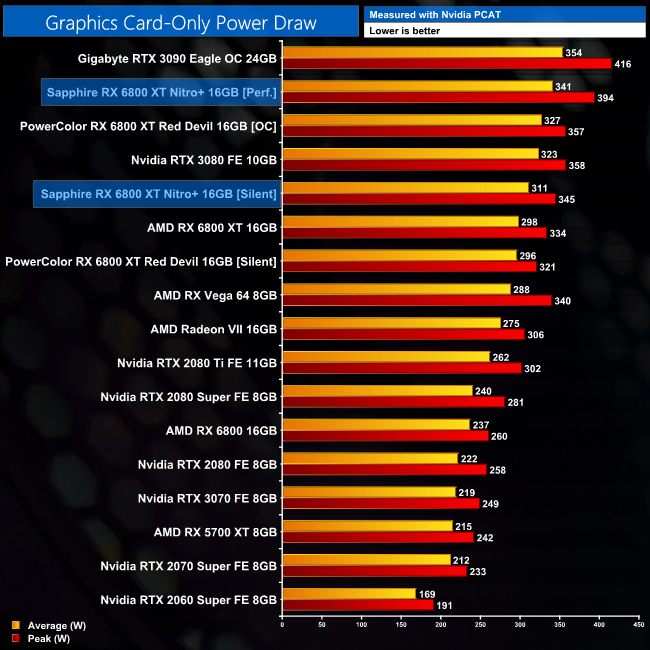
Here, we can see the Nitro+'s Performance BIOS averaged 341W under load, a 14W increased compared to the Red Devil's equivalent BIOS. As for the Nitro's Silent BIOS, this proved more frugal, limiting power draw to 311W, though this is still above both the reference card and the Red Devil's Silent BIOS.
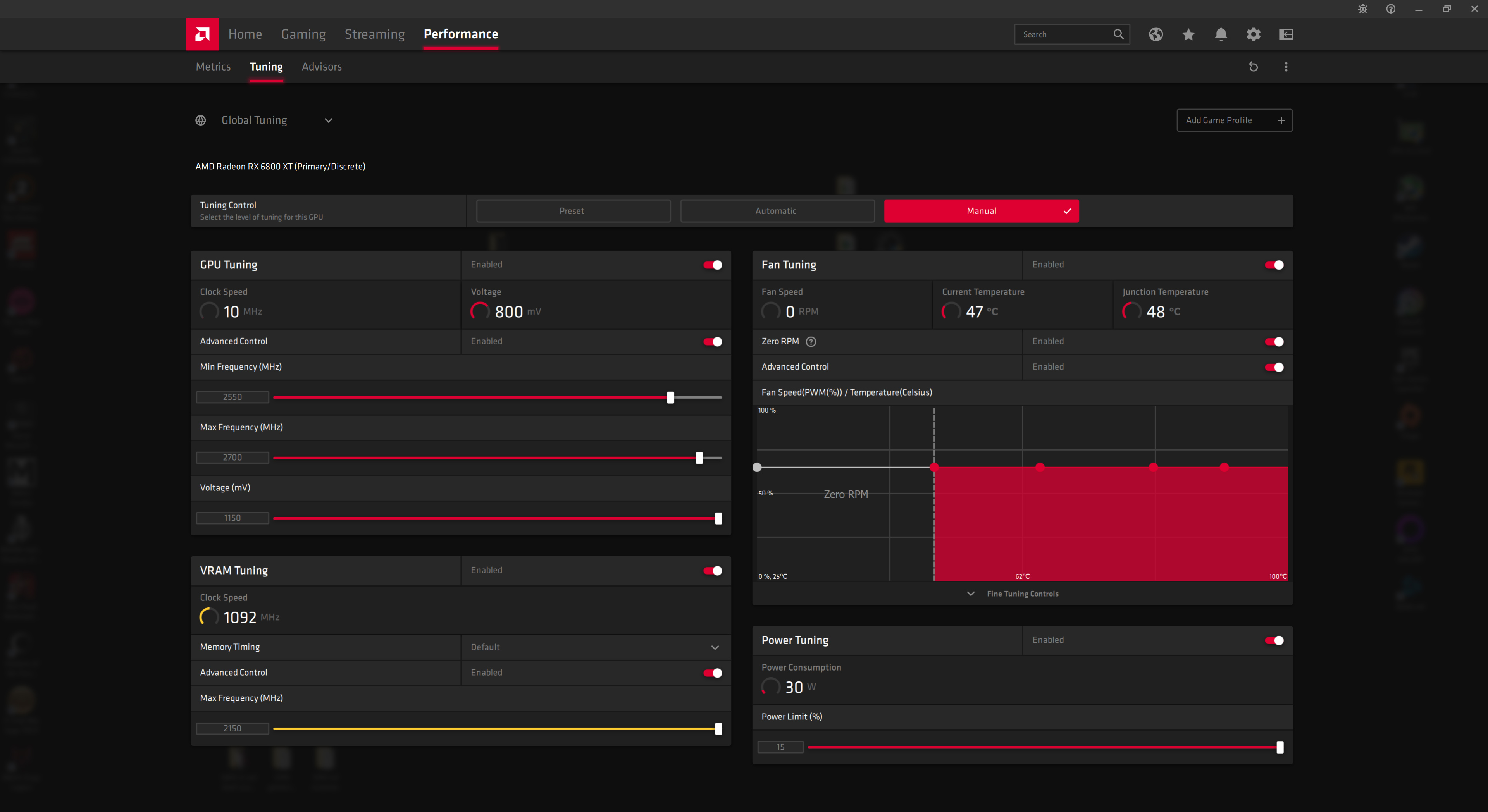
Manually overclocking the Nitro+ proved successful, and we saw better results from this card than what we got with either the Red Devil or AMD's reference card. Do remember that this will vary from sample to sample, but with my Nitro+ I was able to put the maximum GPU frequency up to 2700MHz, with the memory fully maxed out at 2150MHz. In practice, this overclock saw the GPU running between 2600 and 2650MHz, so not bad at all.
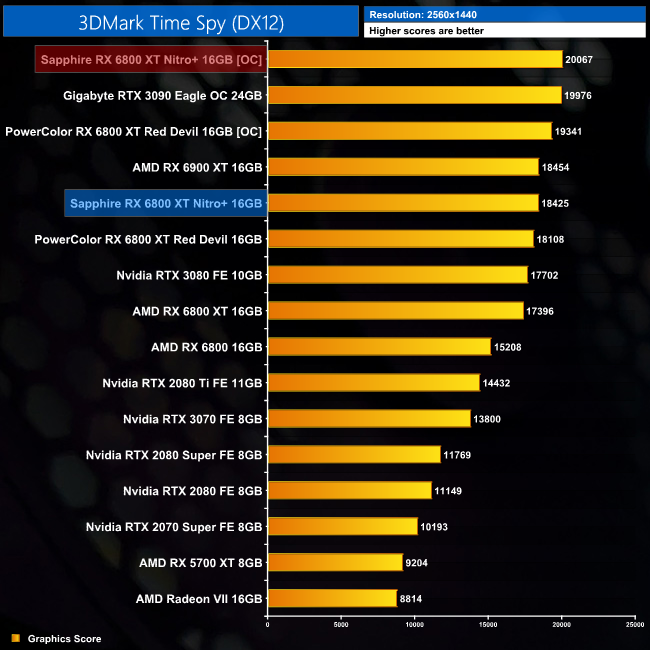
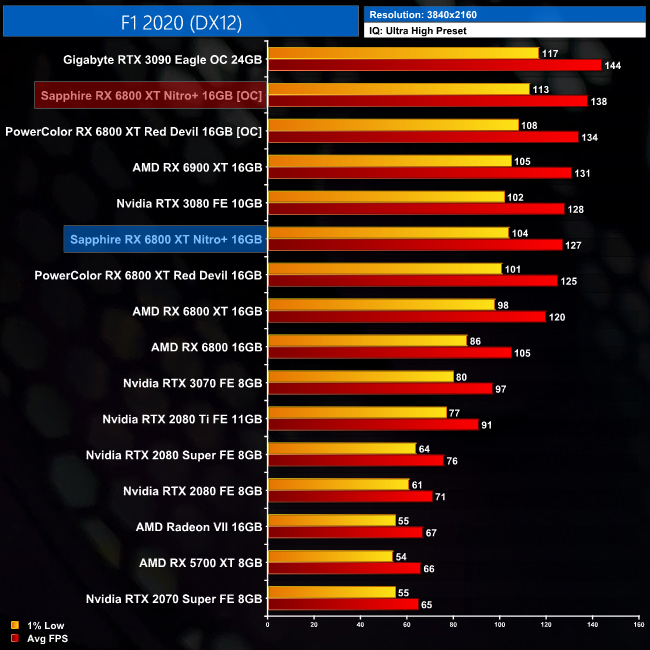
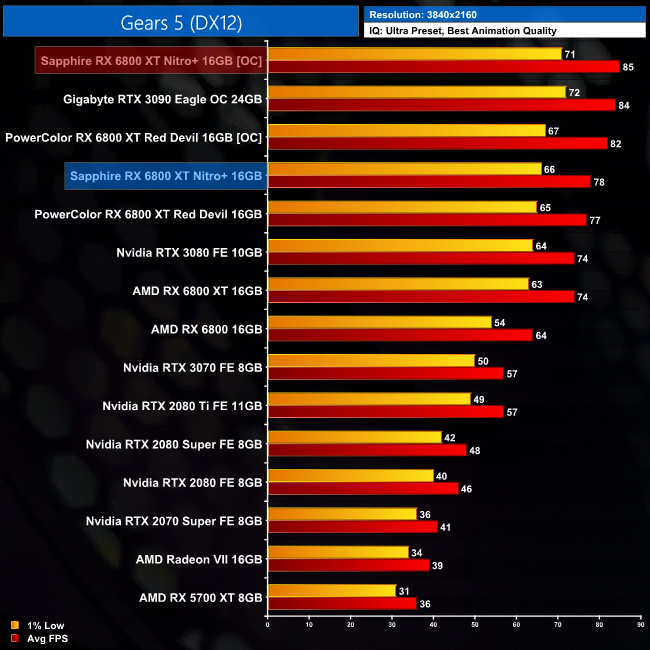
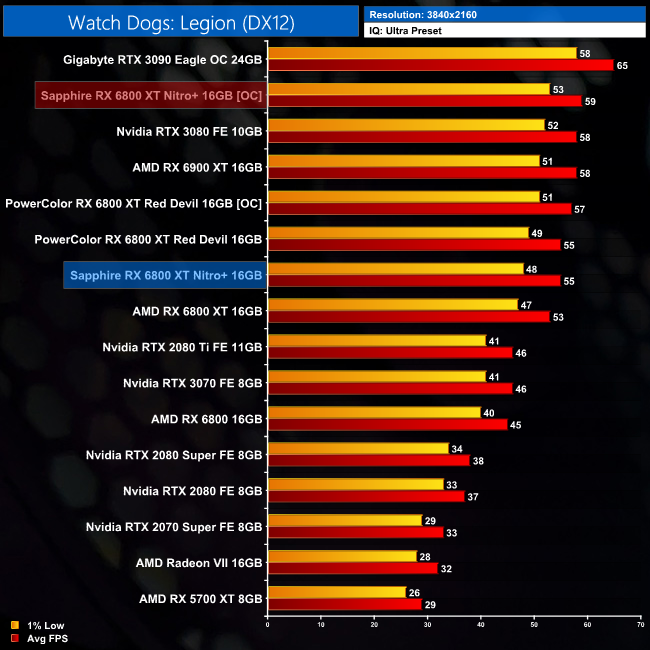
This resulted in gains of between 7-9% in the titles we re-tested, but compared to a stock-clocked reference 6800 XT, the gains came in between 11-15%, which is a pretty sizeable increase over the 6800 XT’s baseline performance.
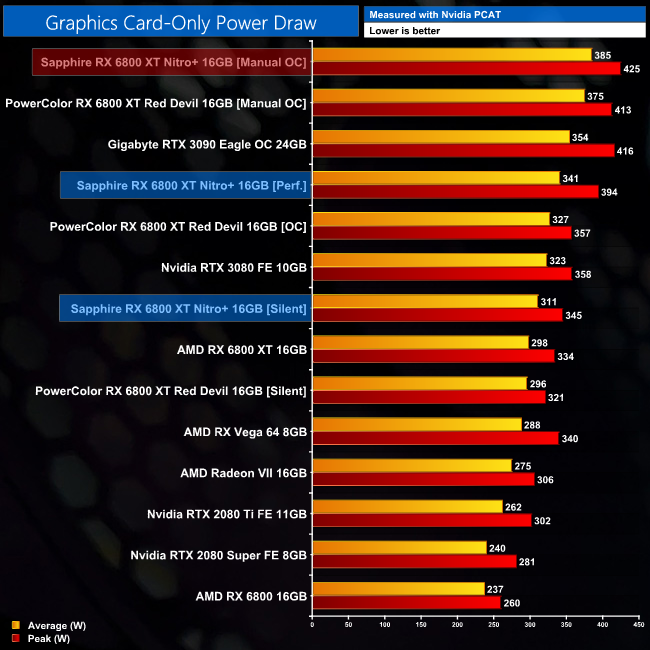
Power draw meanwhile, increased to 385W when manually overclocked, which is a 13% increase over the stock Performance BIOS.
After a brief period covering other recent GPU launches, including Nvidia's RTX 3060 Ti and AMD's RX 6900 XT, today our attention has turned back to the RX 6800 XT, which first launched in the middle of November. Specifically, we have looked at the Sapphire RX 6800 XT Nitro+.
While the Nitro+ utilises a PCB which looks very similar – if not identical – to the reference design, Sapphire has increased the power limit significantly, with the default Performance BIOS drawing an extra 40W compared to AMD's reference card. This allows the GPU to tap into its seemingly vast frequency headroom, resulting in the fastest RX 6800 XT we have tested to-date.
Even then, the performance gains over the reference card aren't huge, but we saw increases of up to 6% in certain titles, though a 4% margin was the average differential across our testing today, when looking at the 4K data. This means the Nitro+ is also faster than PowerColor's Red Devil, but only by 1% on average, and on many occasions the two were exactly even.
The extra power headroom on offer also saw the Nitro+ overclock very well, outperforming a stock-clocked reference 6800 XT by as much as 15%. It also proved a better overclocker than the Red Devil, but there is going to be some sample-to-sample variance at play here. Even then, custom RX 6800 XTs are clearly overclocking much better than the reference card, and that is certainly good news for the tinkerers out there.
Sapphire's dual-BIOS implementation also proved highly effective. The Performance BIOS is a little louder, but draws 340W of power under load, resulting in higher frequencies. The Silent BIOS, however, draws about 30W less, resulting in a fractionally slower GPU, but one that was able to get away with the fans spinning at just 1200rpm. In fact, just like the Red Devil, the fans spin so slowly in this mode that a small amount of coil while actually proved louder than the fans themselves. The whine wasn’t noticeable with the system fans running as normal though, so I can’t complain too strongly, but it is worth noting.
Despite the increase in power, the Nitro+'s cooler proved more than good enough at keeping temperatures down. In fact, when noise-normalised to 40dBa, it produced the best thermal results we have seen from a 6800 XT. I do want to stress that we are talking very fine margins when comparing the Nitro+ against the Red Devil, but it did run a tiny bit cooler when noise-normalised.
As with any graphics card review in late 2020, there appears to be simply no stock of the Nitro+ in the UK. Overclockers UK has it listed for £779.99 but it's not in stock at the time of writing. Sapphire told us directly that the MSRP for this model is £694, though MSRP figures don't mean too much when the market is effectively driving prices significantly higher due to the severe shortages.
As we noted in the Red Devil review, this makes it hard to come to a concrete conclusion. The Nitro+'s £694 MSRP is higher than the RTX 3080, which should cost £649, but neither are in stock at those prices. Ordinarily, we'd argue that RX 6800 XT needs to be cheaper than the RTX 3080, as it's not quite as fast at 4K, while its ray tracing abilities are also much more limited.
However, there has been nothing ‘ordinary' about 2020 and with the pricing situation completely out of control until supply finally lands, like I said, MSRPs don't really mean anything. What I will say is the Sapphire RX 6800 XT Nitro+ is a terrific graphics card, easily beating the reference model across the board, and is just about superior to the Red Devil, but as mentioned, the margins are very fine indeed.
We hope to see the Nitro+ in stock, with reasonable pricing, soon – right now it is listed as out of stock at Overclockers UK.
Discuss on our Facebook page HERE.
Pros
- Fastest RX 6800 XT we've tested so far.
- Excellent dual-BIOS solution.
- Overclocked very well.
- Silent BIOS is very quiet.
- Coolest-running 6800 XT when noise-normalised.
Cons
- Current stock and pricing issues.
- Slight coil whine is audible once the system fans have been disabled.
KitGuru says: The Sapphire Nitro+ is another top-class graphics card and would be deserving of a place on any final shortlist – if the cards were in stock…