KitGuru KitGuru.net – Tech News | Hardware News | Hardware Reviews | IOS | Mobile | Gaming | Graphics Cards


The AMD Radeon Pro WX 8200 isn't quite a performance revelation, but then we weren't expecting it to be one. Nevertheless, there a few small performance surprises, where it manages to get past its WX 9100 sibling. However, the real excitement comes from the fact that the WX 8200 is around half the price of the WX 9100, yet offers very similar abilities apart from having half the frame buffer.
It's not quite a complete NVIDIA Quadro P4000 killer, because there are still some professional content creation and CAD applications where the latter has the upper hand. But in most cases the WX 8200 provides similar or better performance for less, where the WX 9100 was a direct P5000 competitor and didn't quite have the grunt to be the obvious alternative.
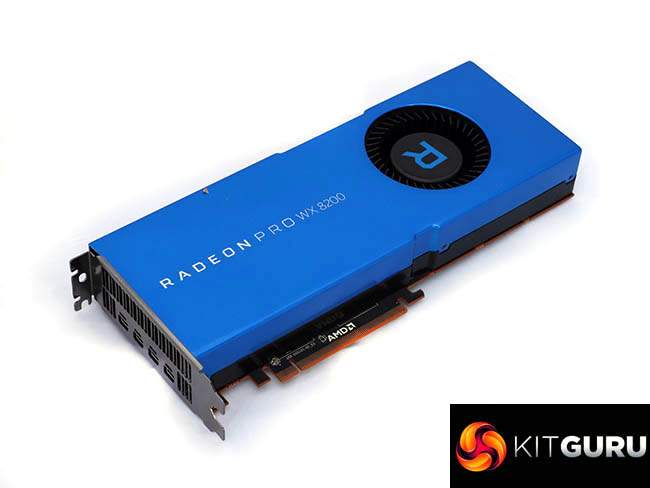
Where AMD cards have been strong for a while is GPU Compute, and the WX 8200 is not just a much better option for this than the P4000, but also shows the Quadro P5000 a thing or two. If you plan to continue modelling whilst encoding using GPU Compute acceleration, NVIDIA cards clearly aren't capable. But apart from this, the P6000 is still in a class of its own. It's exorbitantly expensive, but AMD has nothing to compete with it on raw performance at present, so if that's what you need then it may be worth the massive outlay.
Overall, though, the AMD Radeon Pro WX 8200 is a real professional 3D graphics contender. It's a very valid alternative to the NVIDIA Quadro P4000, particularly if you use Autodesk 3ds Max or Maya, and even more if you plan to use the GPU for encoding at the same time as modelling. With no Quadro RTX 4000 likely to appear this year, the AMD Radeon Pro WX 8200 takes the crown as the sub-£1,000 professional 3D graphics champion.
Pros:
- Almost as fast as AMD Radeon WX 9100 in most tests, and faster in some.
- Cheaper than NVIDIA Quadro P4000.
- Faster than NVIDIA Quadro P4000 in many 3D content creation applications.
- Faster than NVIDIA Quadro P5000 with some software.
- Excellent GPU Compute abilities.
- Much better for running GPU Compute and modelling simultaneously.
Cons:
- NVIDIA Quadro P4000 faster with some CAD and product design applications.
- Relatively power hungry.
Kitguru says: AMD has a real sub-£1,000 professional graphics acceleration contender with the Radeon Pro WX 8200. It's the optimum choice for many applications, particularly 3D animation and GPU Compute rendering.