KitGuru KitGuru.net – Tech News | Hardware News | Hardware Reviews | IOS | Mobile | Gaming | Graphics Cards


With AMD’s new Zen 3-based Ryzen 5000 processors offering new levels of compute, gaming, and power efficiency performance to mainstream desktop users, it is a great time to be a Mini-ITX fan. In this review, we examine the ASUS ROG STRIX B550-I Gaming Mini-ITX motherboard and see how it handles the AMD Zen 3 flagship CPU.
Video Timestamps:
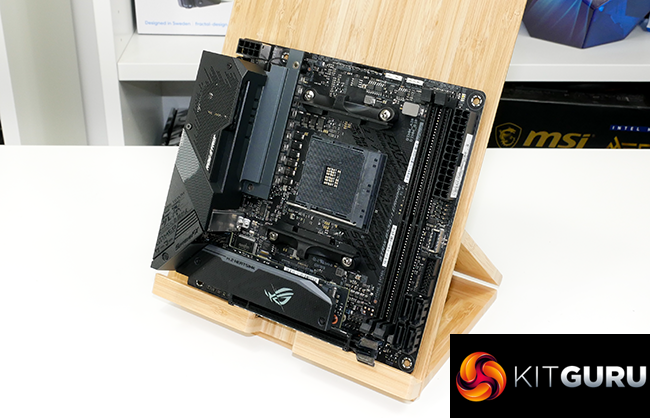
Coming in at around the £200 mark, this high-end B550 offering features an actively cooled 8+2 power stage design, dual M.2 sockets, plentiful quantities of 10Gbps USB on the rear and internally, and high-speed wired and wireless networking connectivity. ASUS also included a unique feature in its USB Type-C audio connector.
£200 is steep for a B550 motherboard, even in the typically more expensive Mini-ITX form factor. And with tough competition from the similarly priced ASRock B550 Phantom Gaming-ITX/AX motherboard in particular, can ASUS’ ROG STRIX B550-I Gaming prove its worth? Let’s take a look.
Features (information taken from the ASUS webpage):
- AMD AM4 socket: Ready for Ryzen™ 5000 Series/ 4000 G-Series/ 3000 Series Desktop Processors
- Best gaming connectivity: PCIe® 4.0-ready, dual M.2, USB 3.2 Gen 2 Type-C® plus HDMI™ 2.1 and DisplayPort 1.4 output
- Smooth networking: Onboard WiFi 6 (802.11ax) and Intel® 2.5 Gb Ethernet with ASUS LANGuard
- Robust power solution: Teamed power stages with ProCool II power connector, high-quality alloy chokes and durable capacitors
- Renowned software: Intuitive dashboards for UEFI BIOS and ASUS AI Networking make it easy to configure gaming builds
- DIY-friendly design: Includes Q-connector, BIOS FlashBack™ and FlexKey
- Unmatched personalization: ASUS-exclusive Aura Sync RGB lighting, including Aura RGB header and addressable Gen 2 RGB header
- Industry-leading Gaming Audio: Audio USB Type-C®, AI Noise Canceling Microphone, SupremeFX S1220A codec, DTS® Sound Unbound™ and Sonic Studio III for immersive audio