KitGuru KitGuru.net – Tech News | Hardware News | Hardware Reviews | IOS | Mobile | Gaming | Graphics Cards


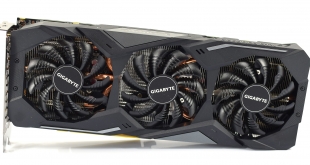
For our third GTX 1660 Ti review, we assess the Gigabyte GTX 1660 Ti Gaming OC 6G. Not to be confused with Gigabyte's 1660 Ti OC 6G, this ‘Gaming' card has an increased boost clock, a triple-fan cooler and the addition of RGB lighting. It comes with a £40 price premium over GTX 1660 Ti MSRP, however, so we will have to see whether or not Gigabyte has created a card that can justify the higher price.
There are a lot of similarities between this Gigabyte GTX 1660 Ti Gaming OC 6G and the previously reviewed 1660 Ti OC 6G. They both share the same overall design language, with the same style of shroud and backplate. The new Gaming model – the subject of this review – essentially extends the cooler to a triple-fan configuration, while it also increases the boost clock to 1860MHz.
| GPU | RTX 2070 (FE) | GTX 1070 | RTX 2060 (FE) | GTX 1660 Ti | GTX 1060 |
| SMs | 36 | 15 | 30 | 24 | 10 |
| CUDA Cores | 2304 | 1920 | 1920 | 1536 | 1280 |
| Tensor Cores | 288 | N/A | 240 | N/A | N/A |
| Tensor FLOPS | 63 | N/A | 51.6 | N/A | N/A |
| RT Cores | 36 | N/A | 30 | N/A | N/A |
| Texture Units | 144 | 120 | 120 | 96 | 80 |
| ROPs | 64 | 64 | 48 | 48 | 48 |
| Rays Cast | 6 Giga Rays/sec | 0.65 Giga Rays/sec | 5 Giga Rays/sec | – | 0.44 Giga Rays/sec |
| RTX Performance | 45 Trillion RTX-OPS | 6.5 Trillion RTX-OPS | 37 Trillion RTX-OPS | – | N/A |
| GPU Boost Clock | 1710 MHz | 1683 MHz | 1680 MHz | 1770 MHz | 1708 MHz |
| Memory Data Rate | 14 Gbps | 8 Gbps | 14 Gbps | 12 Gbps | 8 Gbps |
| Total Video Memory | 8GB GDDR6 | 8GB GDDR5 | 6GB GDDR6 | 6GB GDDR6 | 6GB GDRR5 |
| Memory Interface | 256-bit | 256-bit | 192-bit | 192-bit | 192-bit |
| Memory Bandwidth | 448 GB/sec | 256 GB/sec | 336.1 GB/sec | 288.1 GB/sec | 192 GB/sec |
| TDP | 185W | 150W | 160W | 120W | 120W |
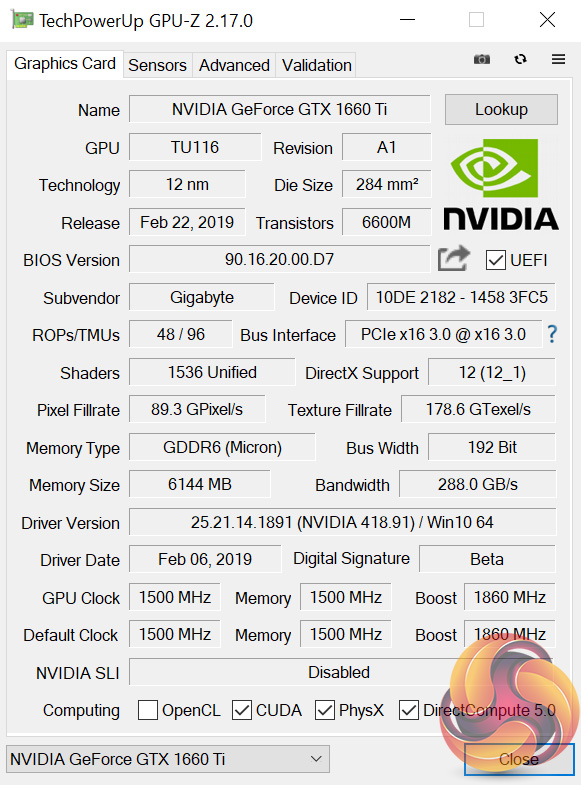
Reference spec for GTX 1660 Ti has the boost clock at 1770MHz. The MSI Gaming X card we looked at for launch day was clocked at 1875MHz, and the Gaming OC is just slightly slower at 1860MHz – making it still 90MHz faster than reference spec. How much performance difference there will between the two cards, however, is something we will look at throughout this review.
Other than that, the spec of this card is unchanged. That means it uses the TU116 GPU with 24 SMs and 1536 CUDA cores, while the 6GB GDDR6 memory is clocked at the default 12Gbps.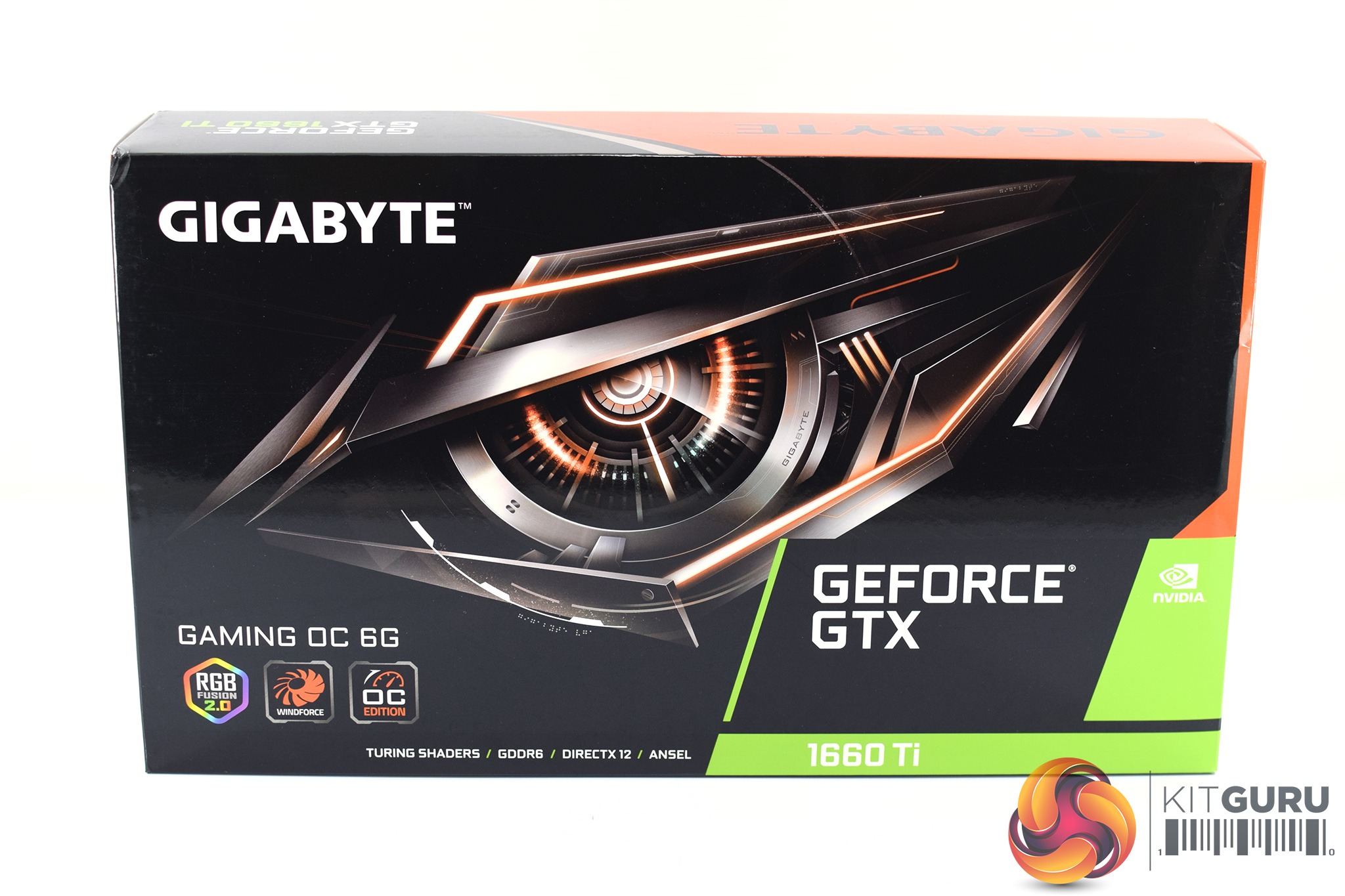
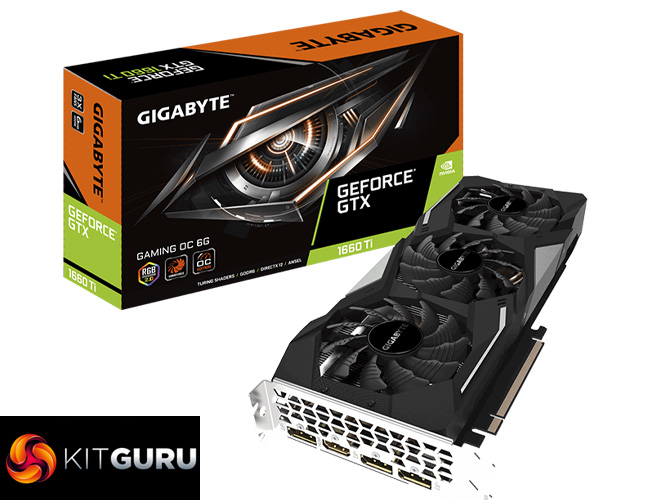
The Gigabyte GTX 1660 Ti Gaming OC 6G ships in a near-identical box to the regular OC 6G, with Gigabyte's large robotic eye logo dominating the front. Three key features of the card – the RGB lighting, Windforce cooler and overclocked core – are illustrated in the bottom left corner.
As for included accessories, inside the box we find one quick start guide, and then one driver disk.
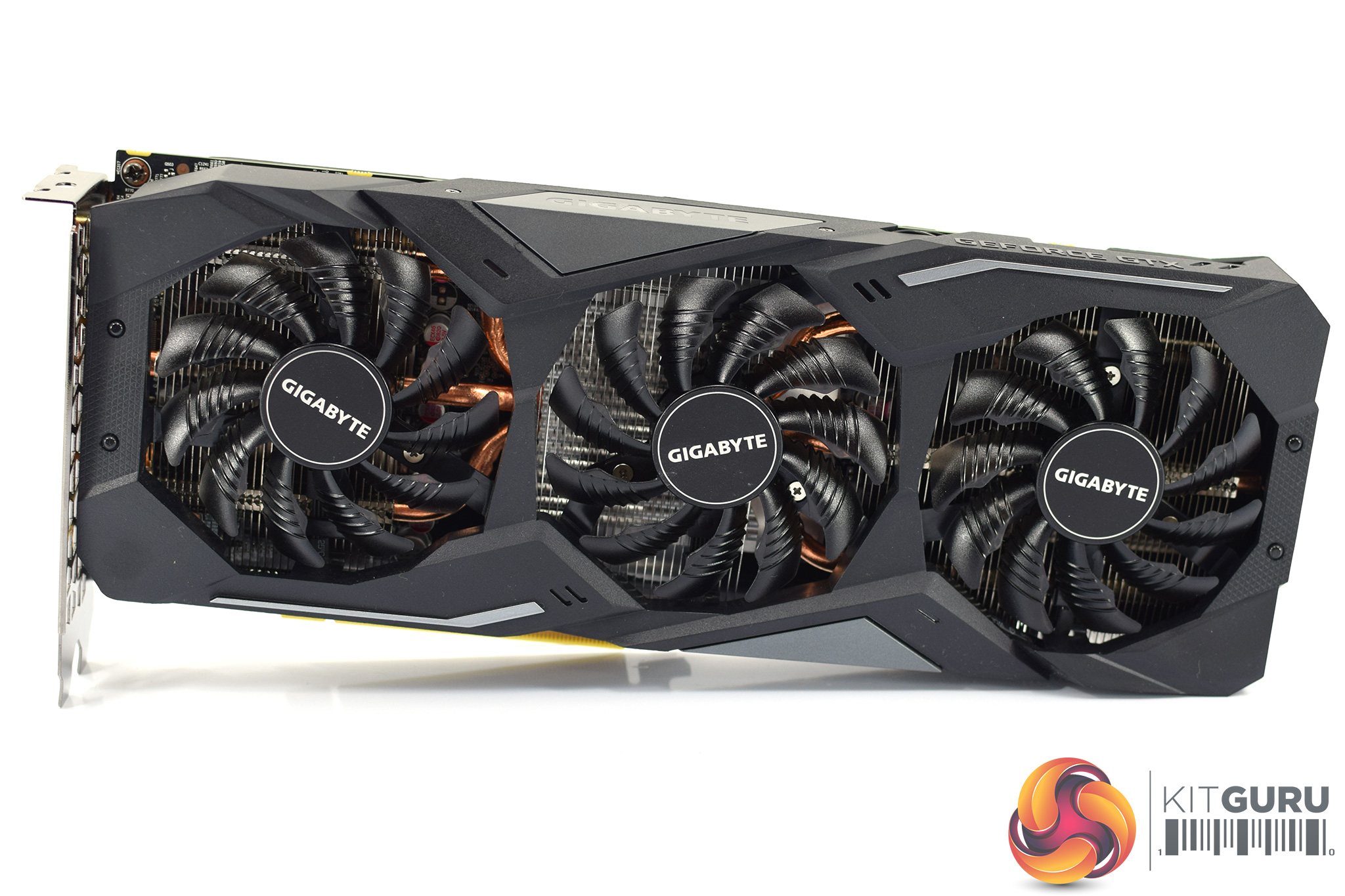
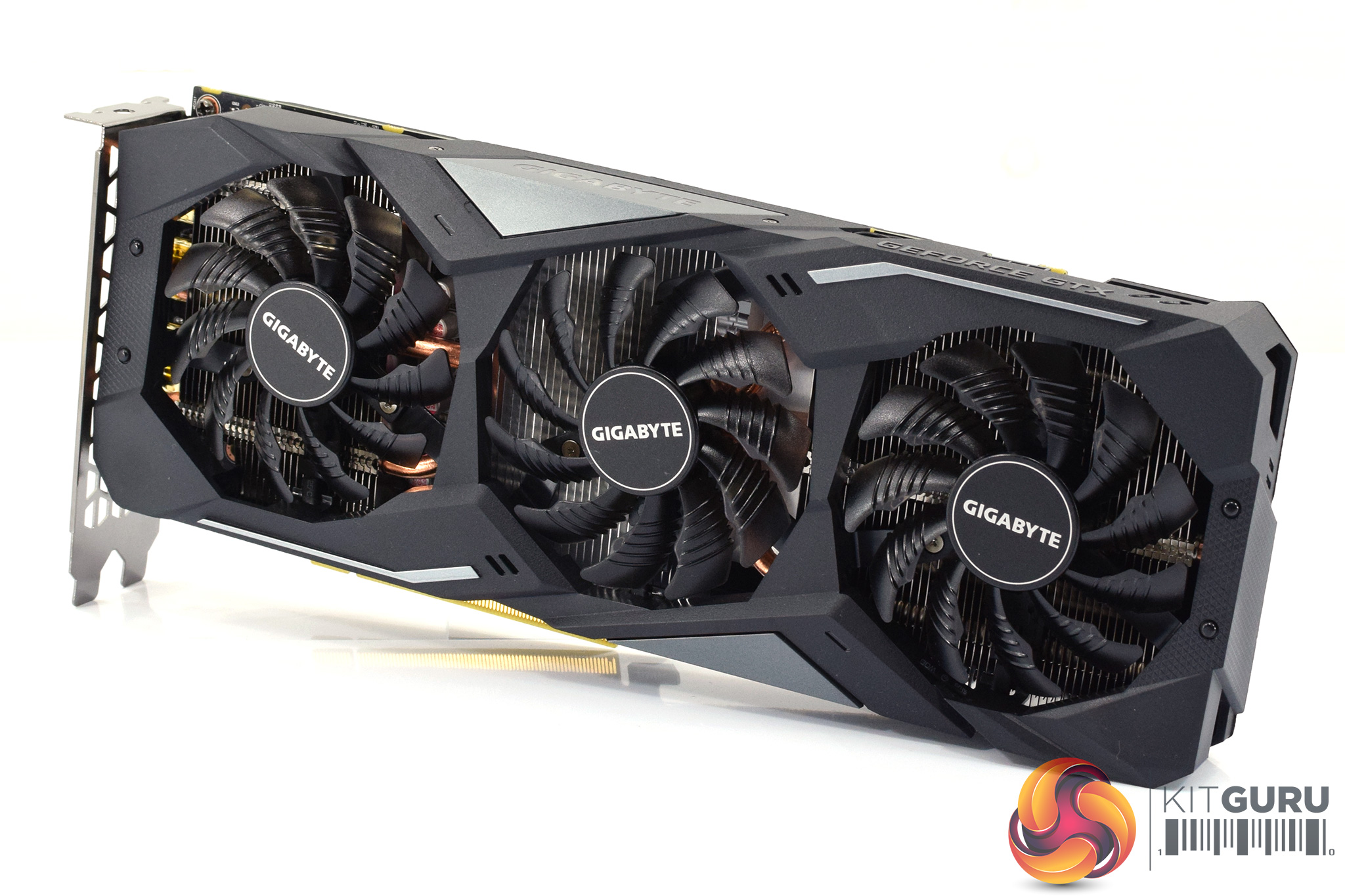
If we move on to look at the card itself, you can immediately see the design similarities between both the Gigabyte GTX 1660 Ti models we have reviewed. That's because both use matte black plastic shrouds, with just hints of grey on the front of each shroud as well. I still don't think it is a very exciting design, but at the same time it is quite inoffensive and also very colour neutral, so it would not cause any issues in a colour coordinated build.
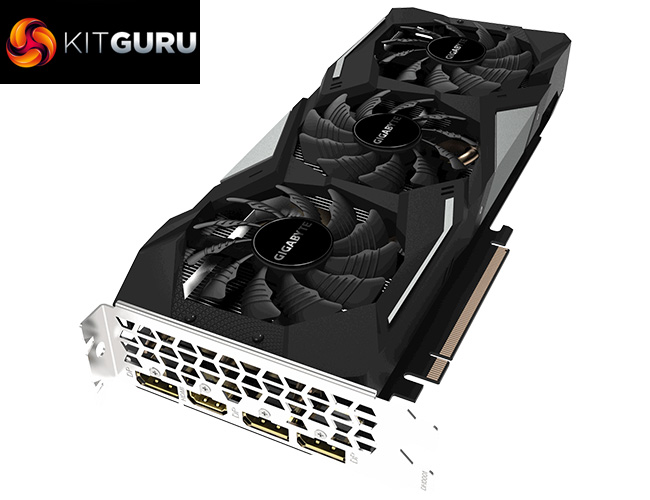
As for the fans, there are obviously three of them – hence the ‘Windforce X3' name. Each fan measures 80mm, so they are smaller than the two 90mm fans on the OC 6G, but that has enabled Gigabyte to fit one more onto the cooler. These fans still feature Gigabyte's ‘alternate spinning' technology, too, meaning the central fan spins in reverse (clockwise) relative to the two outer fans, which Gigabyte says helps reduce turbulence and increase air pressure.
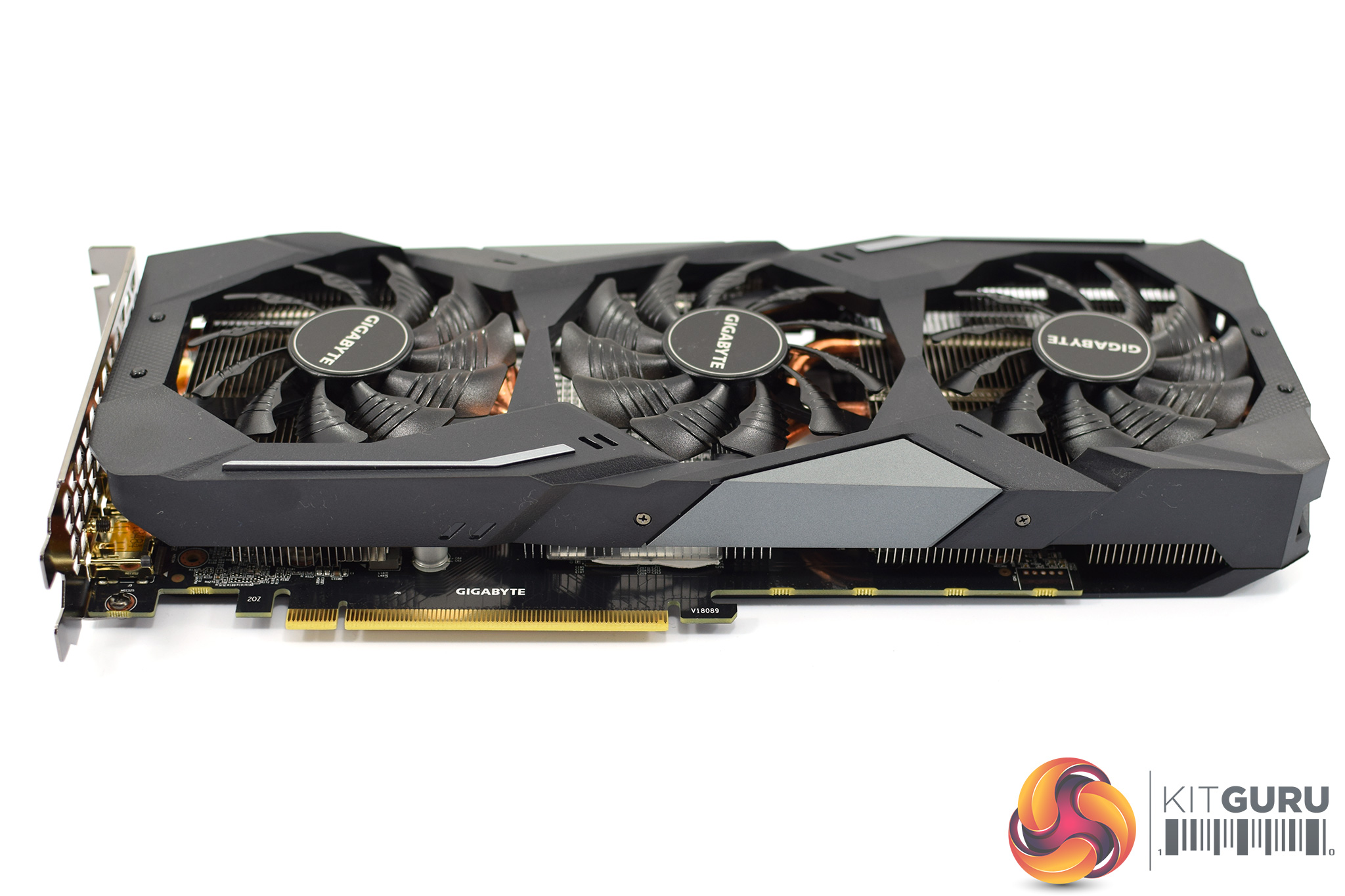
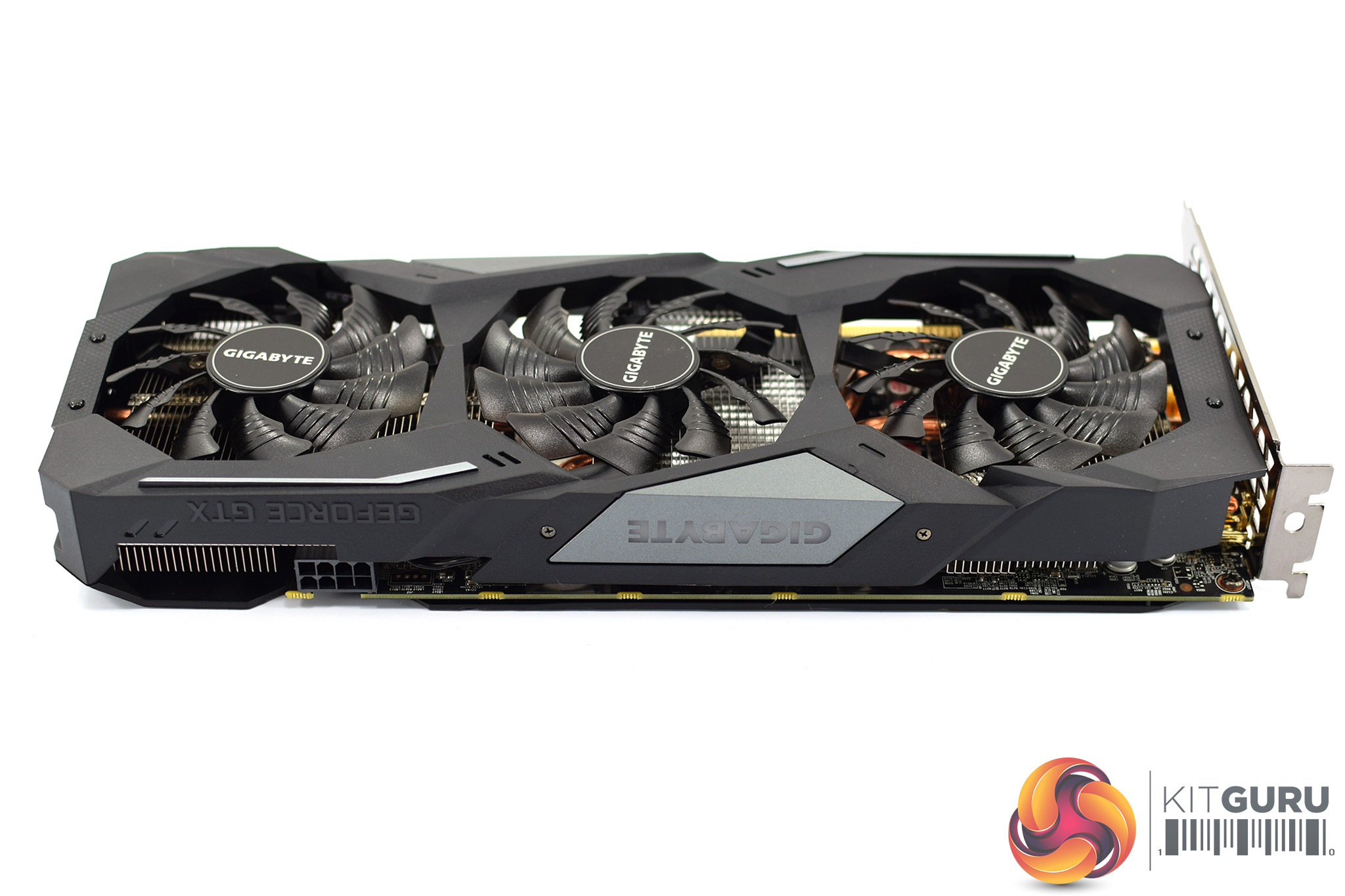
The move to a triple-fan cooling setup does mean the Gaming OC 6G is a bit larger than the other two GTX 1660 Tis we have reviewed so far – it measures 280 x 116.7 x 40.4 mm. That's quite long for a 1660 Ti, though it is still ‘only' a dual-slot thickness.
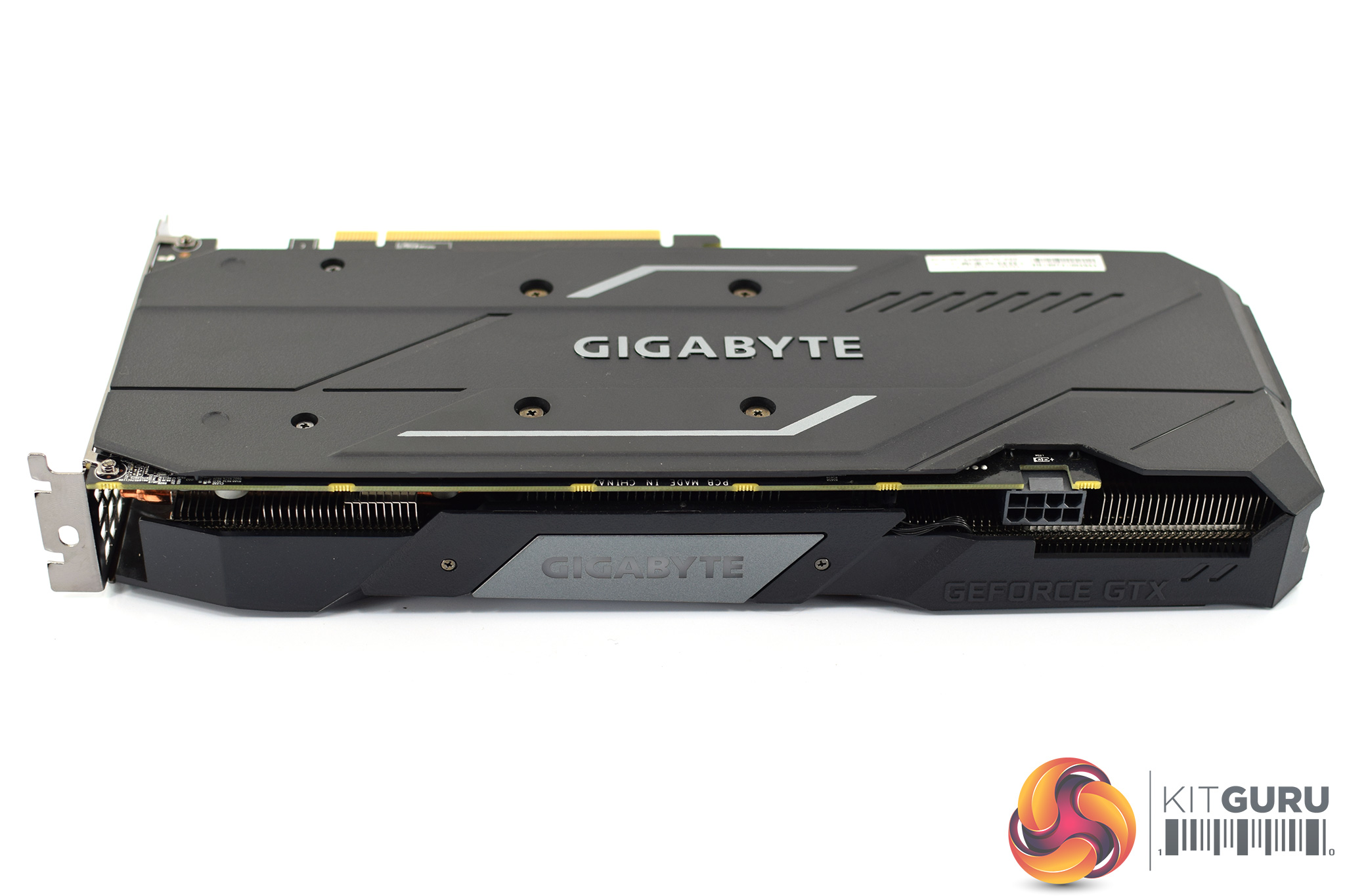
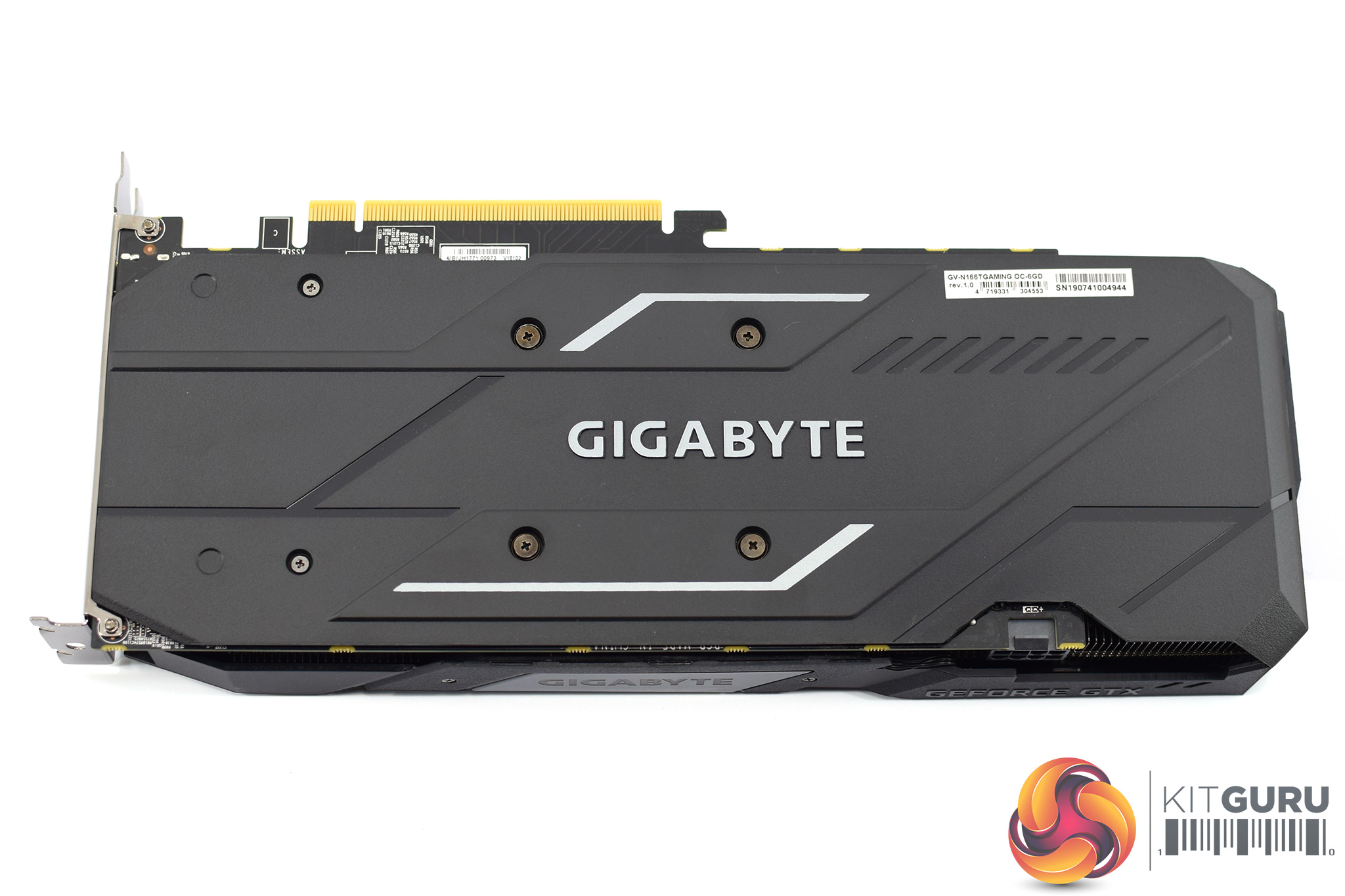
The front side of the card sports the Gigabyte logo, and this is the single RGB zone on the card which you can control using the RGB Fusion 2.0 software.
The black backplate retains the same overall look as the OC 6G, and that means it is still made out of plastic, not metal. Accordingly, it is not going to help dissipate heat from the back of the PCB, but it does help with the overall structural rigidity of the card, and I think it is also better than looking at a bare PCB.


As for the power requirements, the Gaming OC 6G still only requires a single 8-pin PCIe power connector.
Display outputs are also standard, with 1x HDMI and 3x DisplayPort connectors.
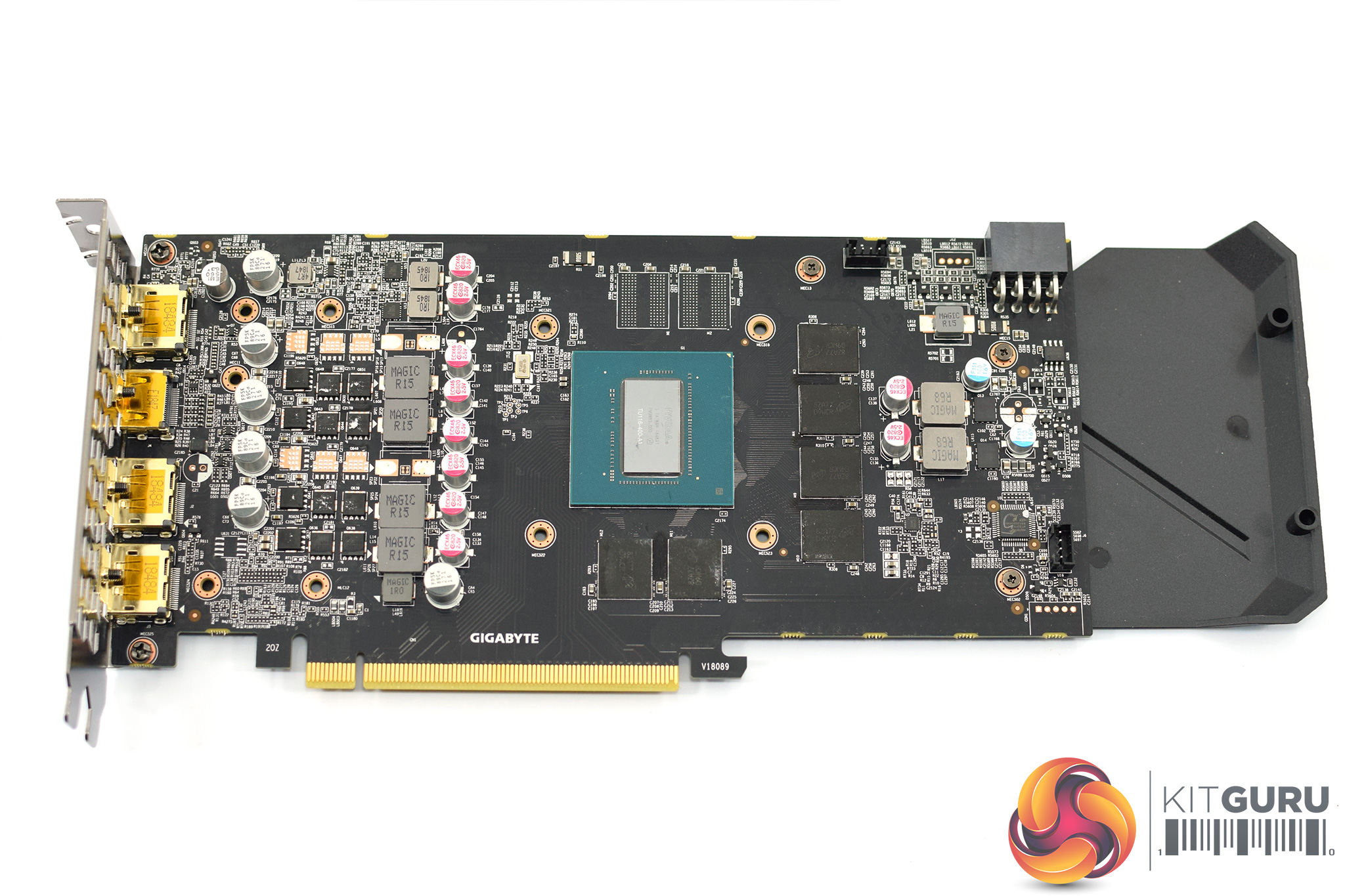
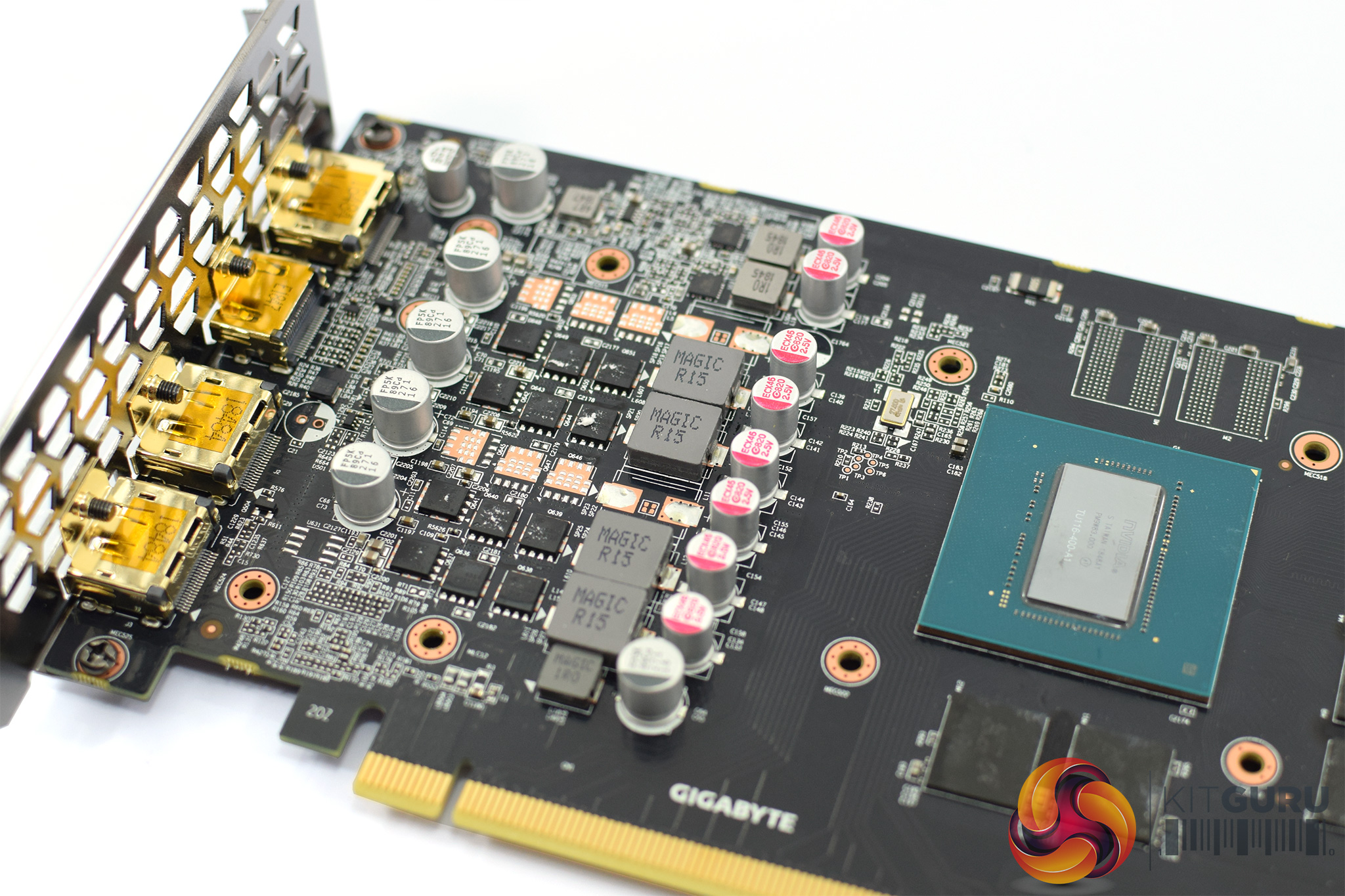

Taking the card apart is very easy, with just 6 screws that need to be removed. We can then get a look at the PCB, with Gigabyte opting for another 4+2 power phase design – the same layout as we have seen with all our GTX 1660 Ti samples so far.
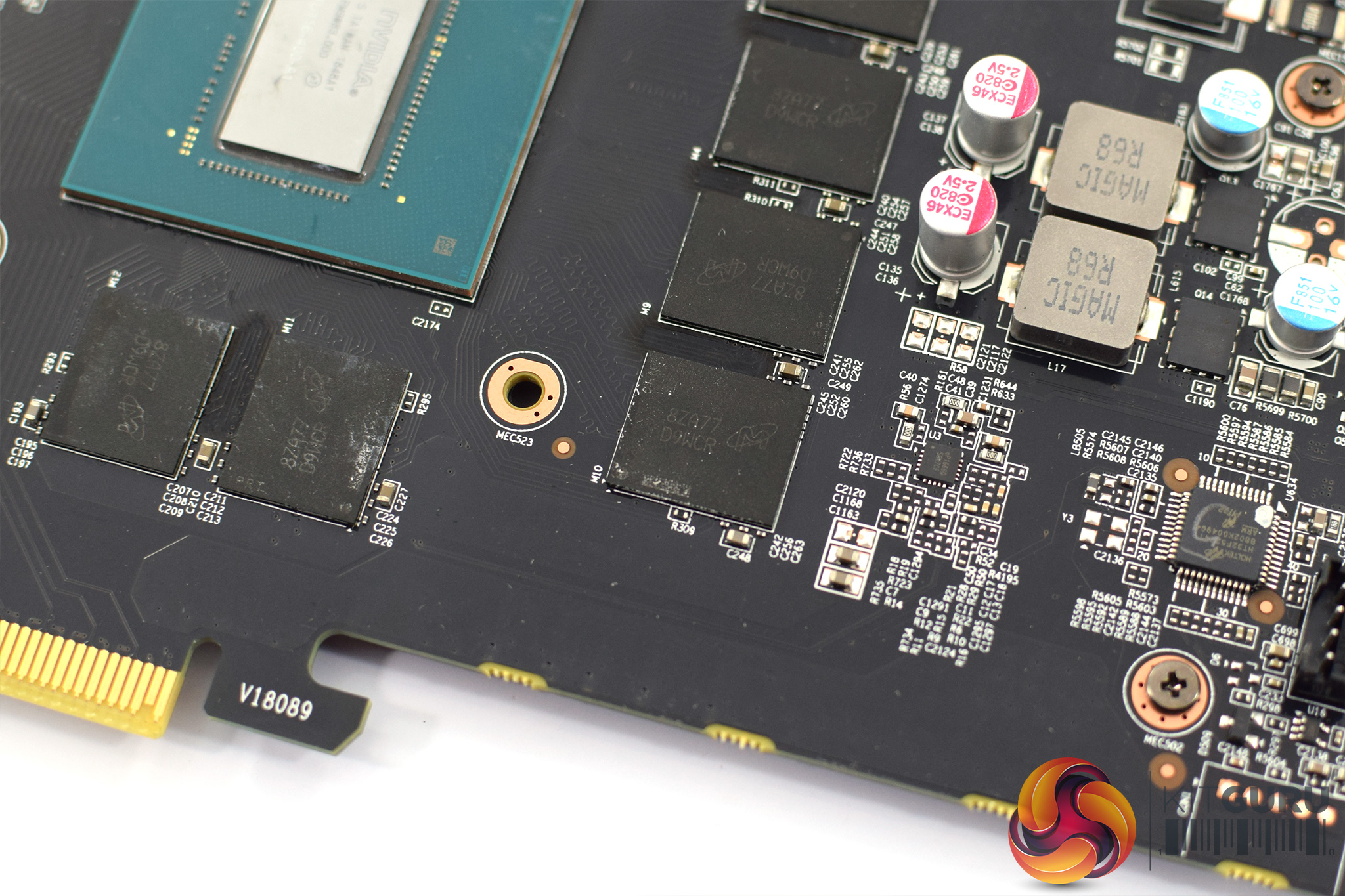
Memory again comes from Micron, with the chips labelled ‘8ZA77D9WCR.' The GPU die is labelled ‘TU116-400-A1', and just a reminder that Nvidia is not pre-binning the GPUs into ‘A’ and ‘non-A’ stacks as it does with the RTX 20-series.
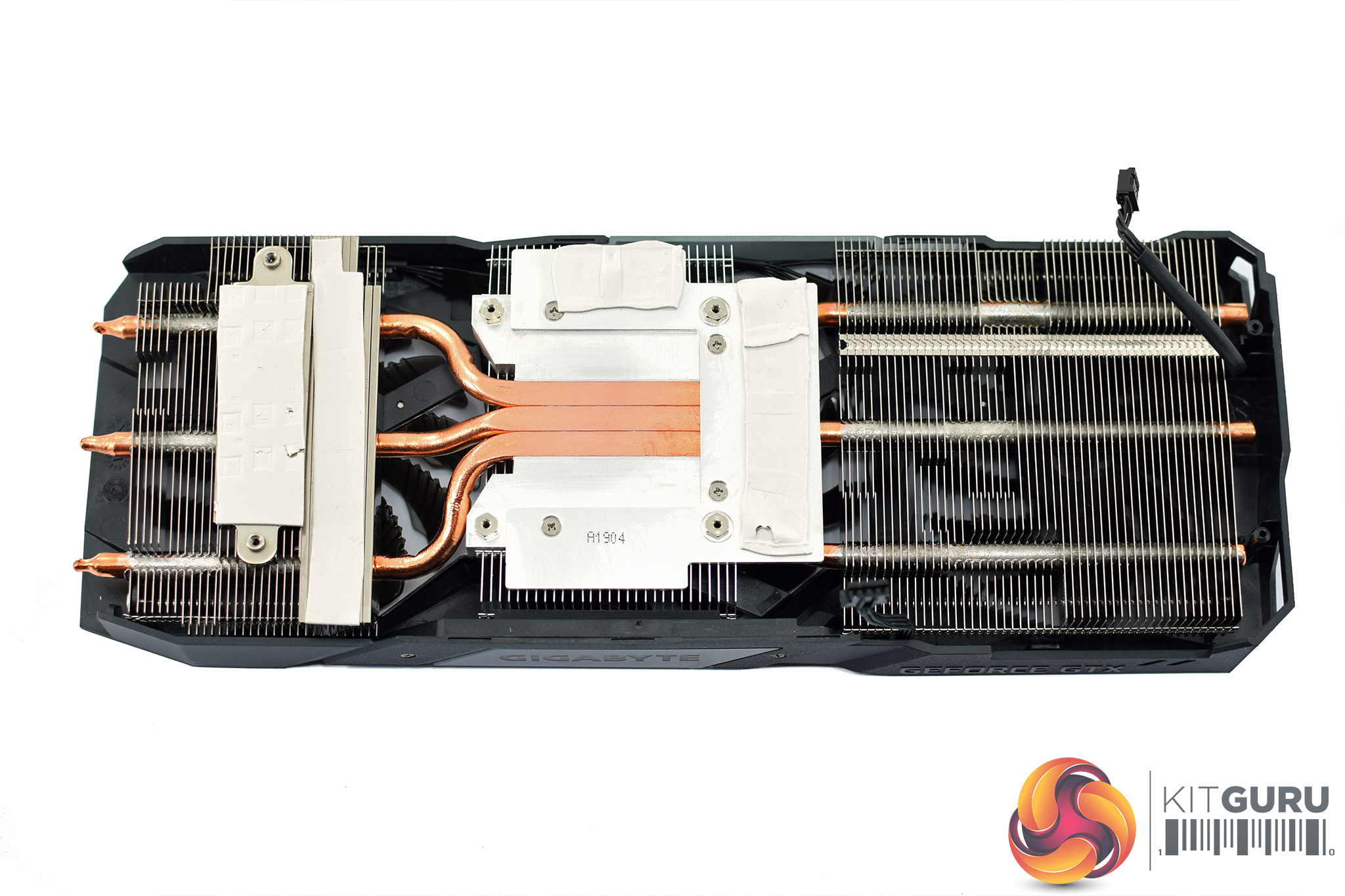
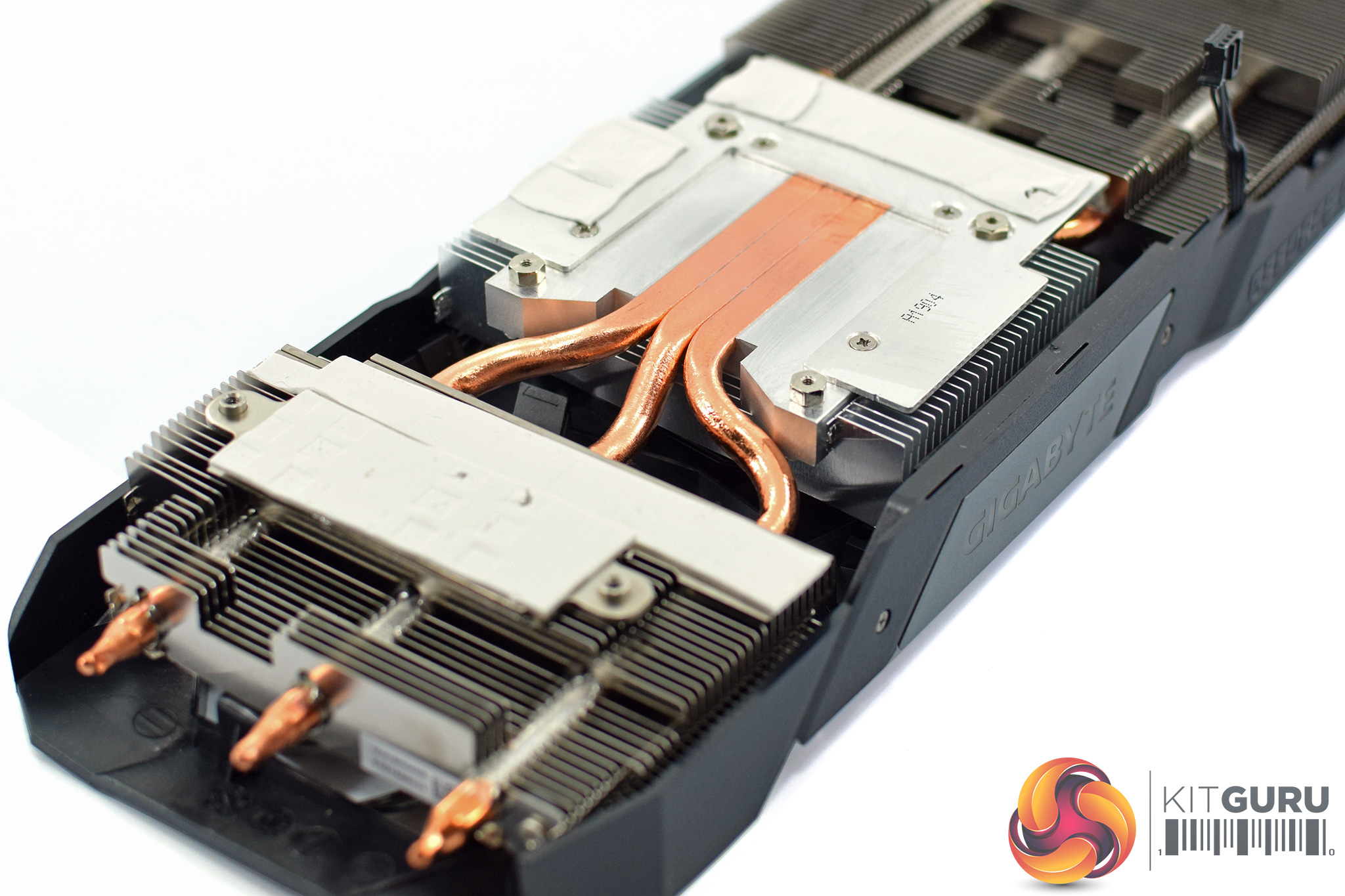
The Gaming OC 6G's heatsink has also been upgraded. Where the regular OC 6G has just one copper heatpipe, here we find three. There are also three separate aluminium fin stacks, while dedicated coldplates are used for VRAM and VRM cooling.
Considering the extra size and heatpipes, plus the third fan, I would expect this card to run a fair bit cooler than the OC 6G, but we will get to that part of our testing later in the review.Our newest GPU test procedure has been built with the intention of benchmarking high-end graphics cards. We test at 1920×1080 (1080p), 2560×1440 (1440p), and 3840×2160 (4K UHD) resolutions.
We try to test using the DX12 API if titles offer support. This gives us an interpretation into the graphics card performance hierarchy in the present time and the near future, when DX12 becomes more prevalent. After all, graphics cards of this expense may stay in a gamer’s system for a number of product generations/years before being upgraded.
We tested the RX Vega64 and Vega56 using the ‘Turbo‘ power mode in AMD’s WattMan software. This prioritises all-out performance over power efficiency, noise output, and lower thermals.
As mentioned, Gigabyte’s Gaming OC 6G card ups the boost clock from reference speed, which is 1770MHz, to 1860MHz.
Driver Notes
- All AMD graphics cards (except Radeon VII) were benchmarked with the Adrenalin 19.1.1 driver.
- Radeon VII was benchmarked with a pre-released press driver supplied by AMD.
- All Nvidia graphics cards (except GTX 1660 Ti) were benchmarked with the Nvidia 417.71 driver.
- GTX 1660 Ti was benchmarked with the Nvidia 418.91 driver supplied to press.
Test System
We test using the Overclockers UK Germanium pre-built system, though it has been re-housed into an open-air test bench. You can read more about it over HERE.
| CPU |
Intel Core i7-8700K
Overclocked to 4.8GHz |
| Motherboard |
ASUS ROG Strix Z370-F Gaming
|
| Memory |
Team Group Dark Hawk RGB
16GB (2x8GB) @ 3200MHz 16-18-18-38 |
| Graphics Card |
Varies
|
| System Drive |
Patriot Wildfire 240GB
|
| Games Drive | Crucial M4 512GB |
| Chassis | Streacom ST-BC1 Bench |
| CPU Cooler |
OCUK TechLabs 240mm AIO
|
| Power Supply |
SuperFlower Leadex II 850W 80Plus Gold
|
| Operating System |
Windows 10 Professional
|
Comparison Graphics Cards List
- MSI RTX 2080 Ti Lightning Z 11GB
- Nvidia RTX 2080 Ti Founders Edition (FE) 11GB
- Nvidia RTX 2080 Founders Edition (FE) 8GB
- Gigabyte Aorus RTX 2070 Xtreme 8GB
- Nvidia RTX 2060 Founders Edition (FE) 6GB
- MSI GTX 1660 Ti Gaming X 6GB
- Gigabyte GTX 1660 Ti OC 6G
- Nvidia GTX 1080 Ti Founders Edition (FE) 11GB
- Gigabyte GTX 1080 G1 Gaming 8GB
- Palit GTX 1070 Ti Super JetStream 8GB
- Nvidia GTX 1070 Founders Edition (FE) 8GB
- Nvidia GTX 1060 Founders Edition (FE) 6GB
- AMD Radeon VII 16GB
- AMD RX Vega 64 Air 8GB
- AMD RX Vega 56 8GB
- ASRock RX 590 Phantom Gaming X OC 8GB
- Sapphire RX 580 Pulse 8GB
- ASUS RX 570 ROG Strix Gaming OC 4GB
Software and Games List
- 3DMark Fire Strike & Fire Strike Ultra (DX11 Synthetic)
- 3DMark Time Spy (DX12 Synthetic)
- Battlefield V (DX12)
- Deus Ex: Mankind Divided (DX12)
- Far Cry 5 (DX11)
- Tom Clancy’s Ghost Recon: Wildlands (DX11)
- Middle Earth: Shadow of War (DX11)
- Shadow of the Tomb Raider (DX12)
We run each benchmark/game three times, and present averages in our graphs.3DMark Fire Strike is a showcase DirectX 11 benchmark designed for today’s high-performance gaming PCs. It is our [FutureMark’s] most ambitious and technical benchmark ever, featuring real-time graphics rendered with detail and complexity far beyond what is found in other benchmarks and games today.
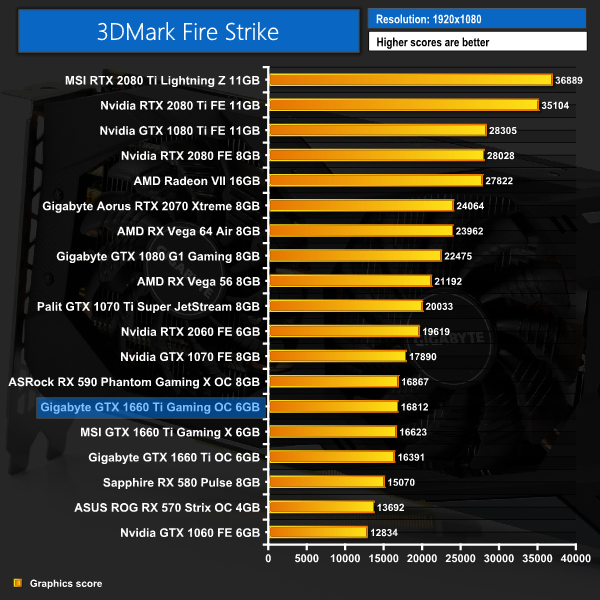
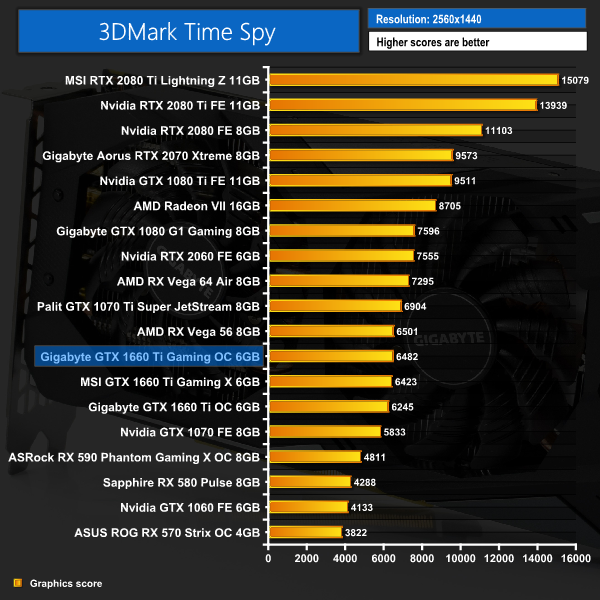
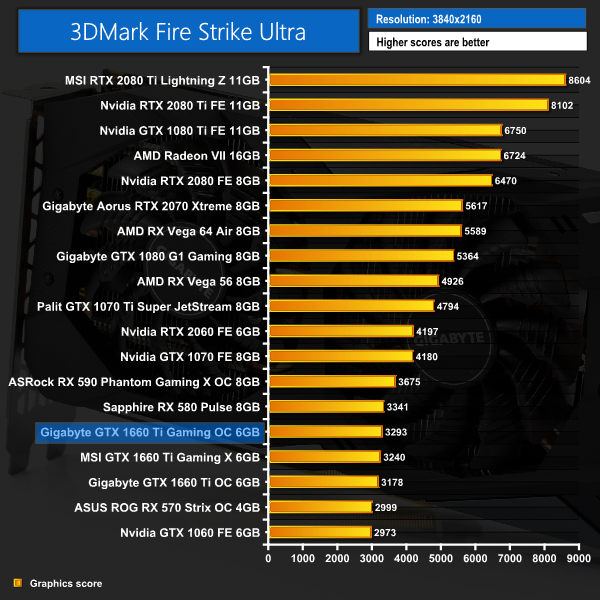
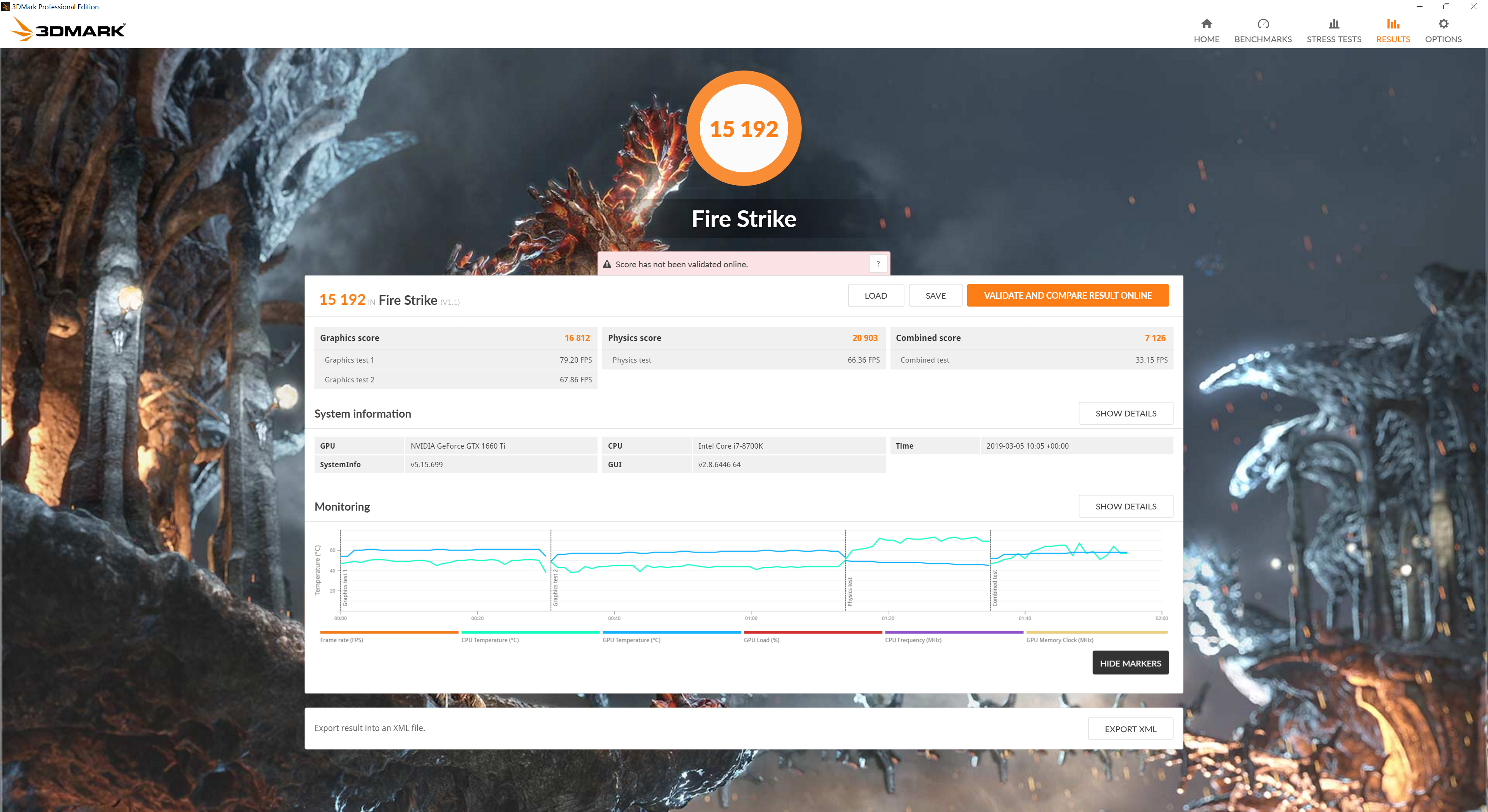
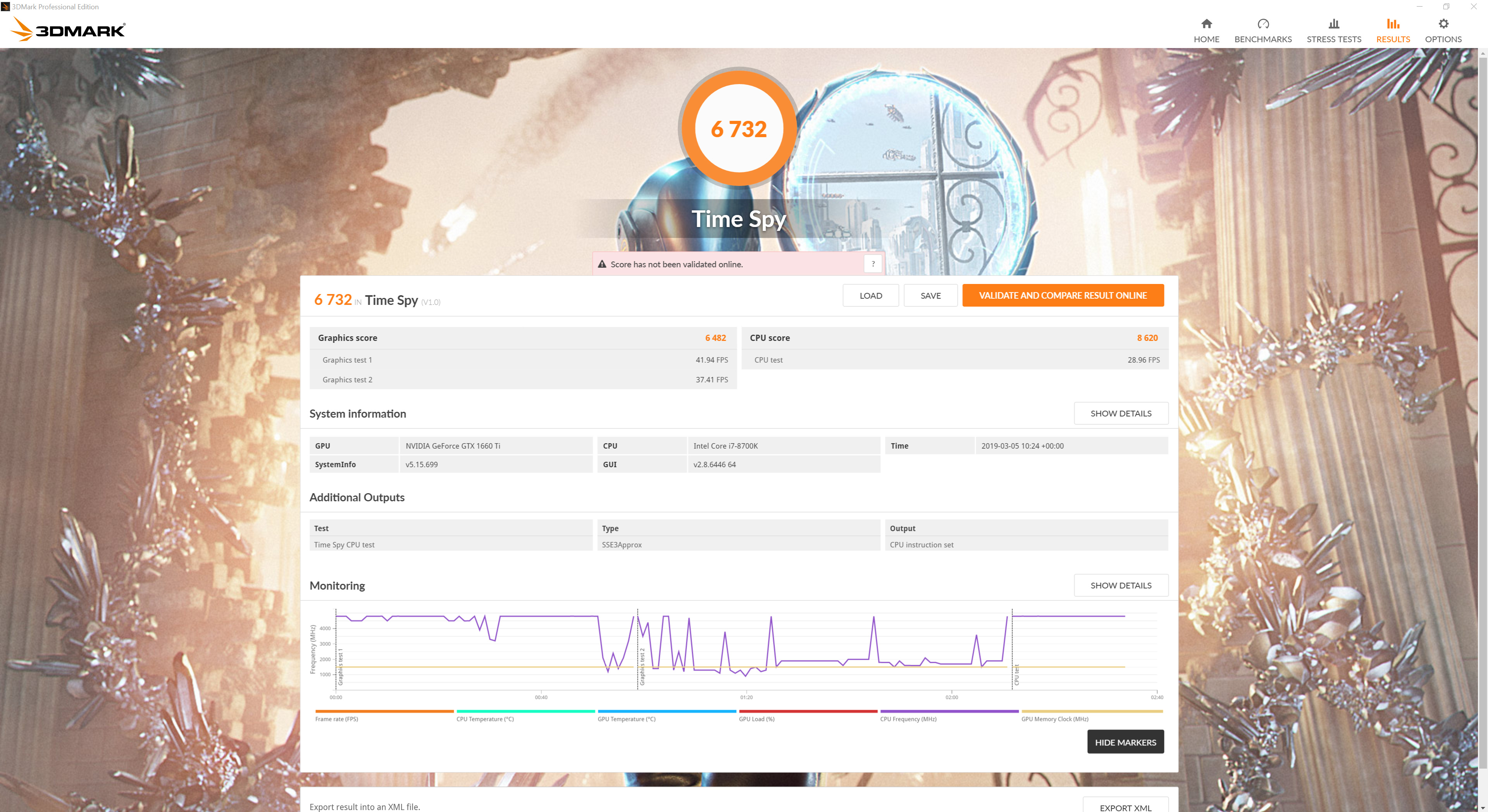
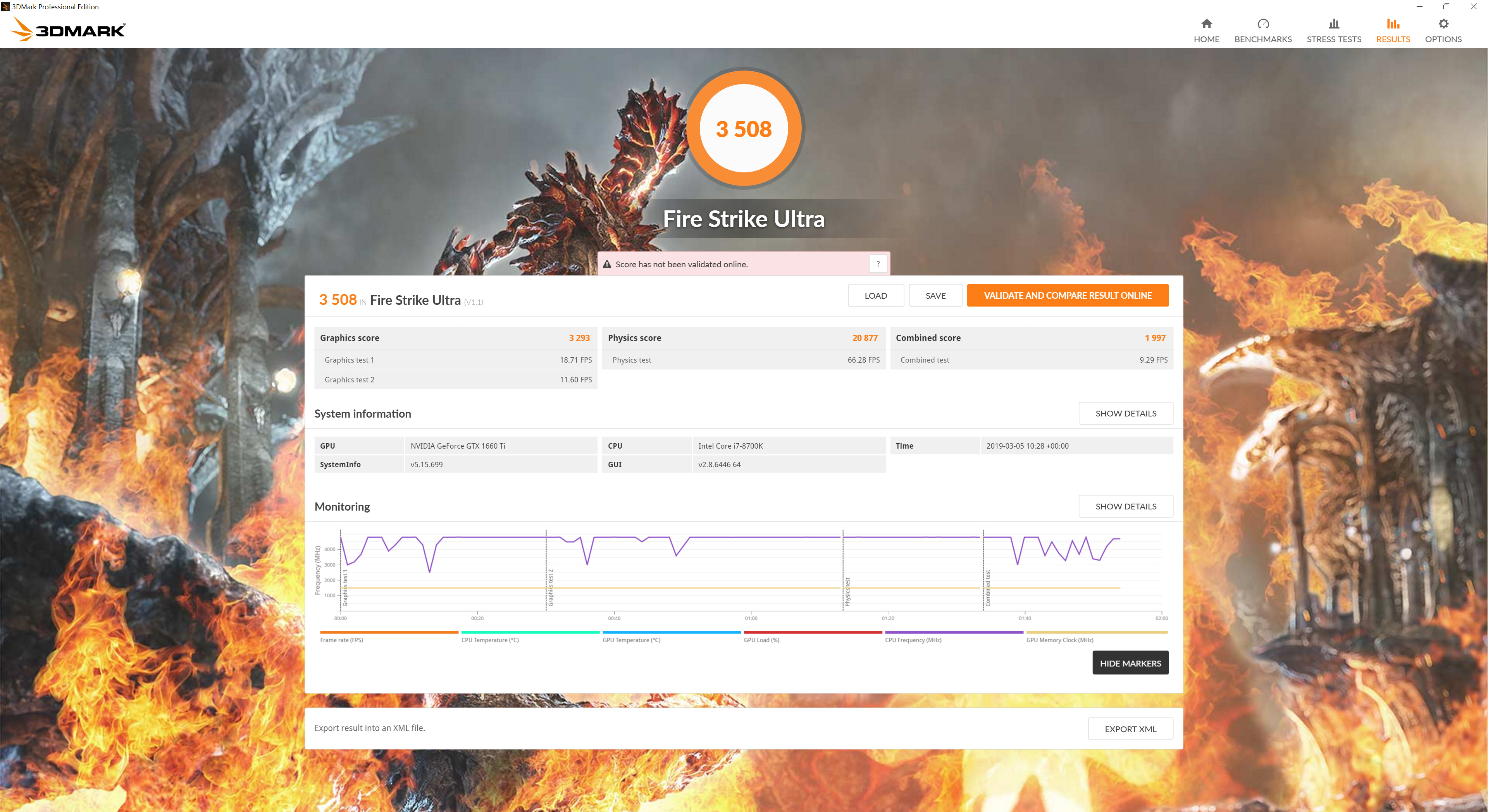
As expected, the performance of all three GTX 1660 Tis is very close across our 3DMark testing, though the Gaming OC 6G does just edge ahead of the MSI Gaming X.Battlefield V is a first-person shooter video game developed by EA DICE and published by Electronic Arts. Battlefield V is the sixteenth instalment in the Battlefield series. It was released worldwide for Microsoft Windows, PlayStation 4, and Xbox One on November 20, 2018. (Wikipedia).
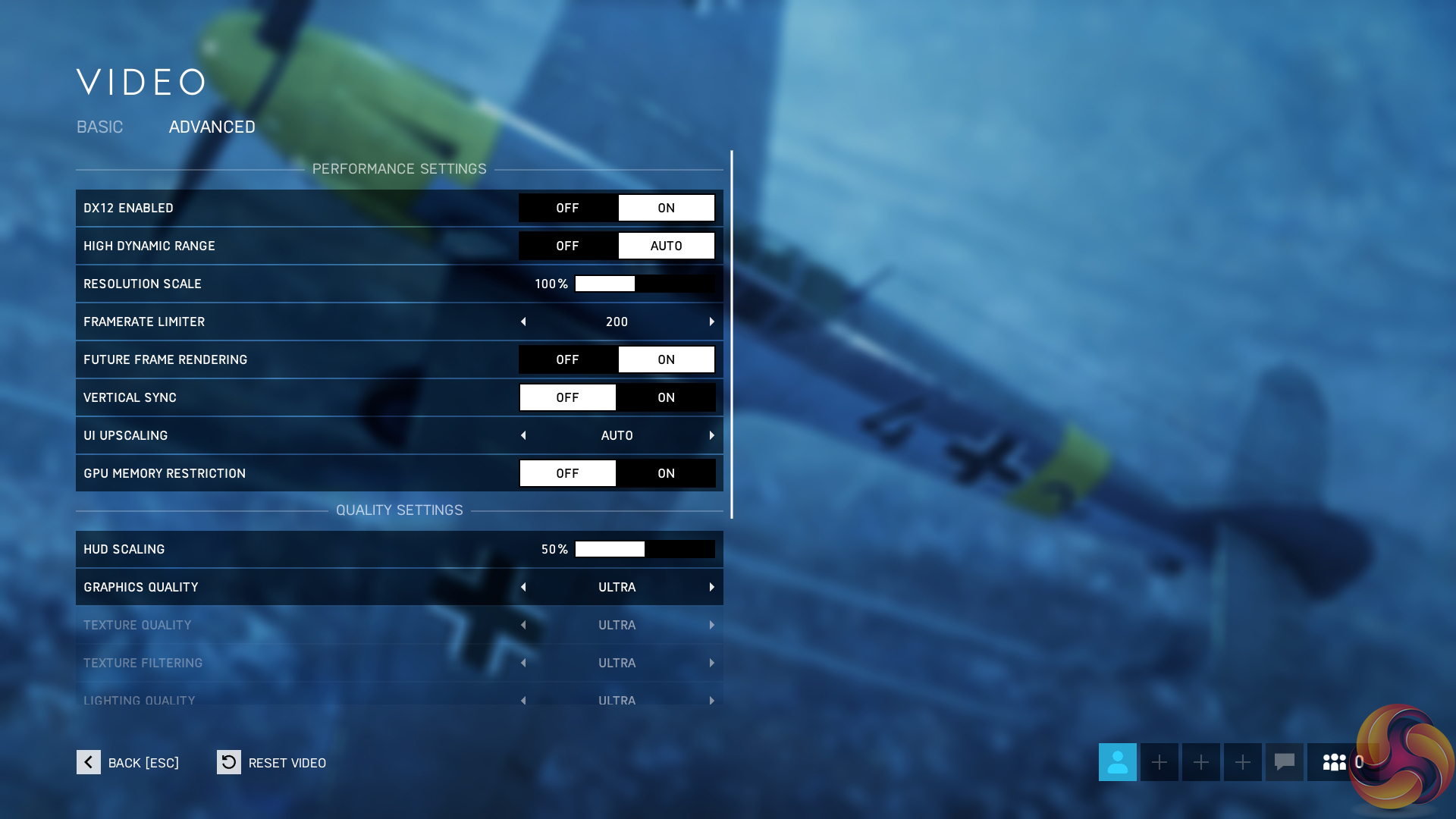
We test using the Ultra preset with the DX12 API. We usually include ray tracing results with BFV, but we have excluded those here as DXR is not a feature applicable to the GTX 1660 Ti.
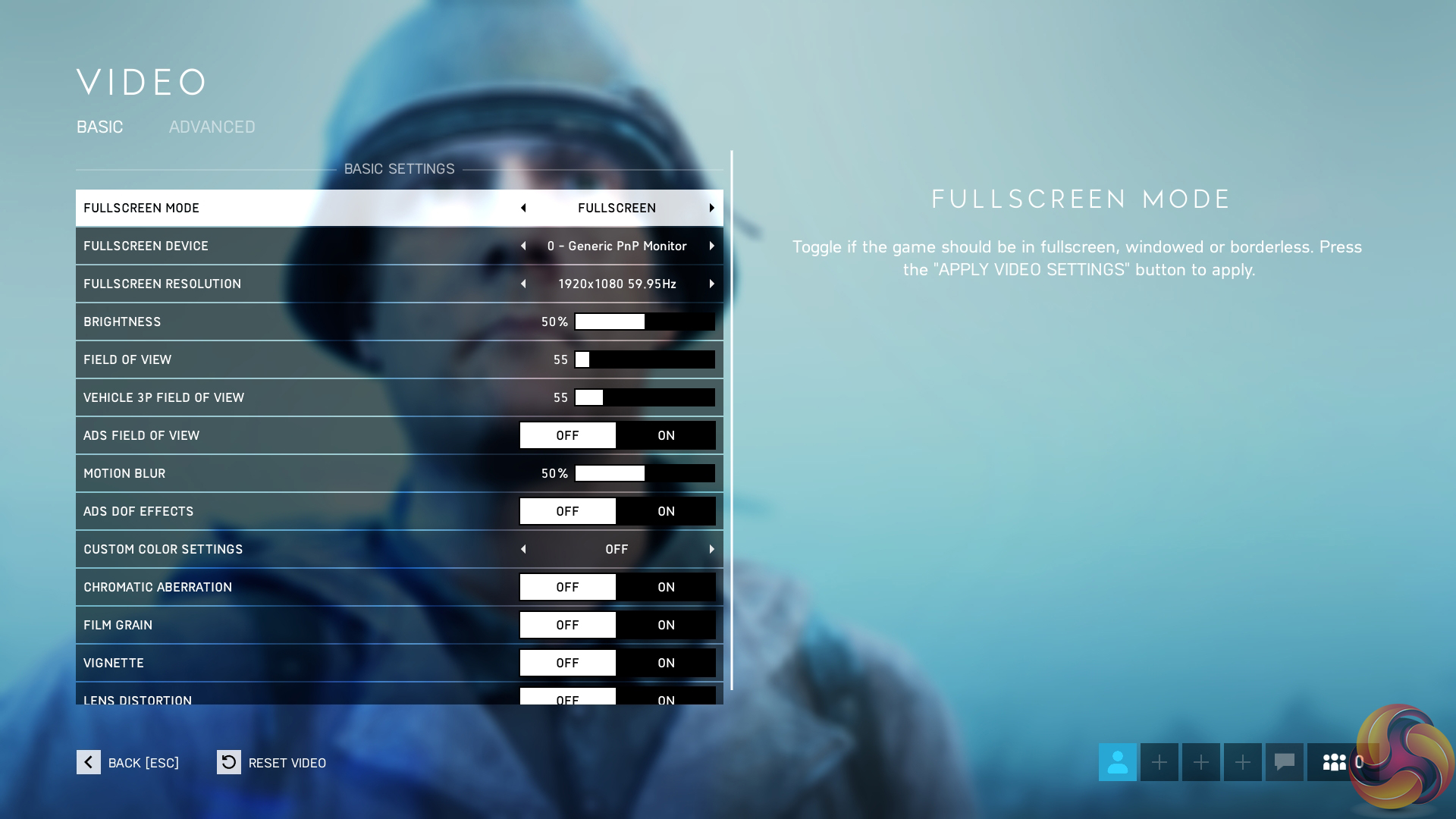
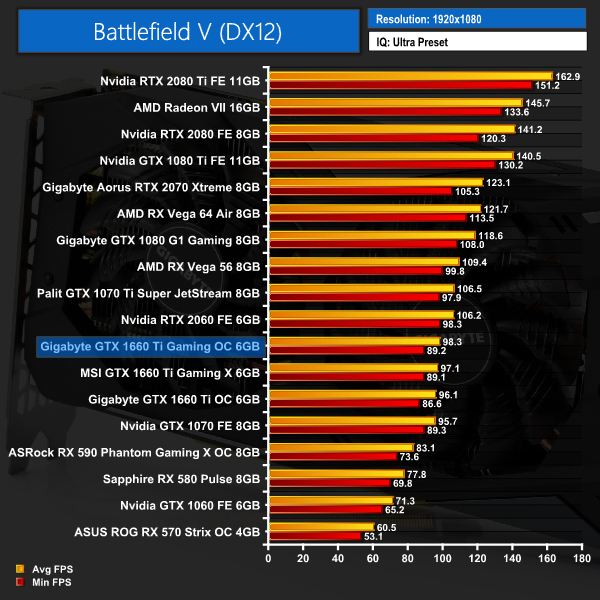
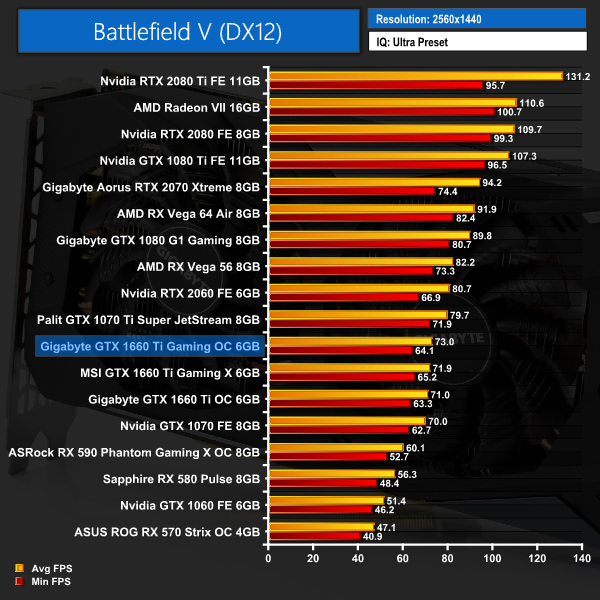
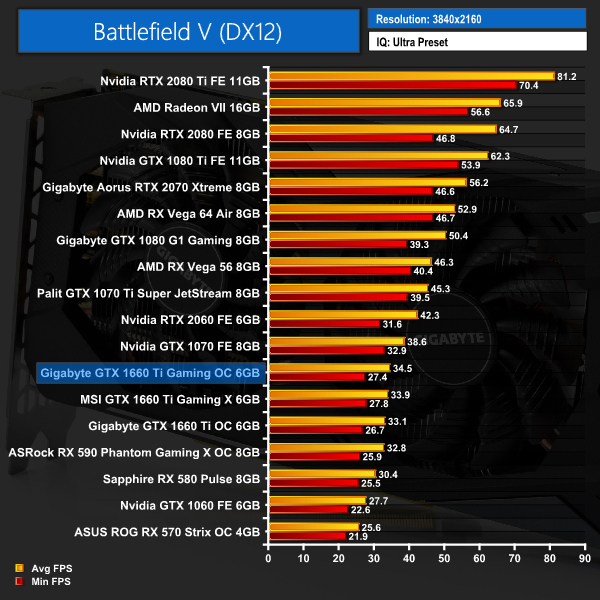
Gigabyte's Gaming OC 6G is also marginally faster than the other two 1660 Tis when we come to Battlefield V. The margins are not big, though – just 2.2FPS separates this card from the slowest 1660 Ti when gaming at 1080p.Deus Ex: Mankind Divided is set in the year 2029, two years after the events of Human Revolution and the “Aug Incident”—an event in which mechanically augmented humans became uncontrollable and lethally violent. Unbeknownst to the public, the affected augmented received implanted technology designed to control them by the shadowy Illuminati, which is abused by a rogue member of the group to discredit augmentations completely. (Wikipedia).
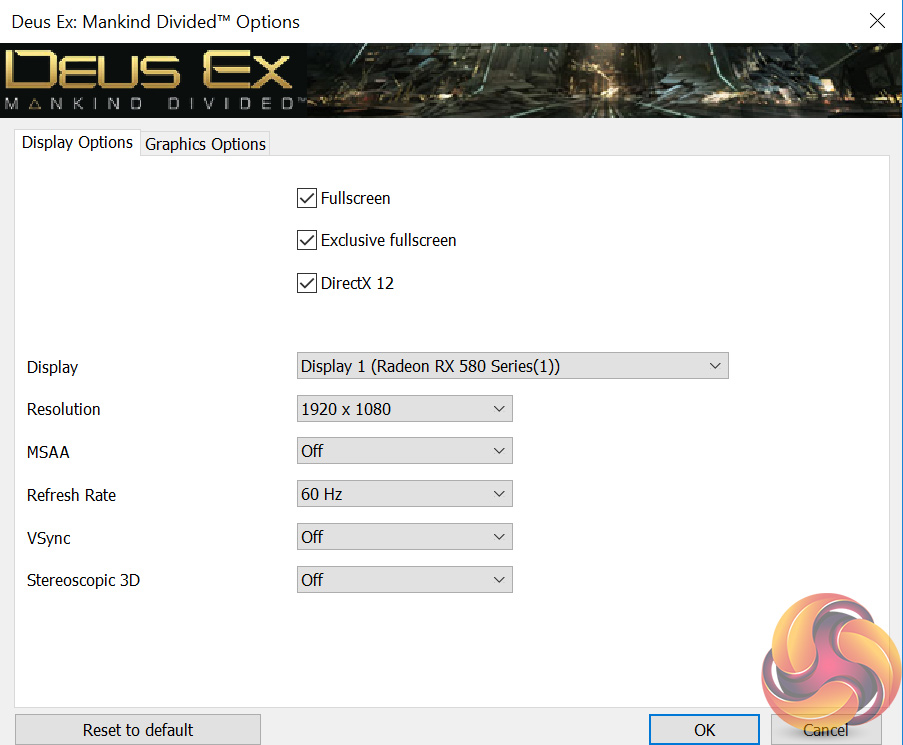
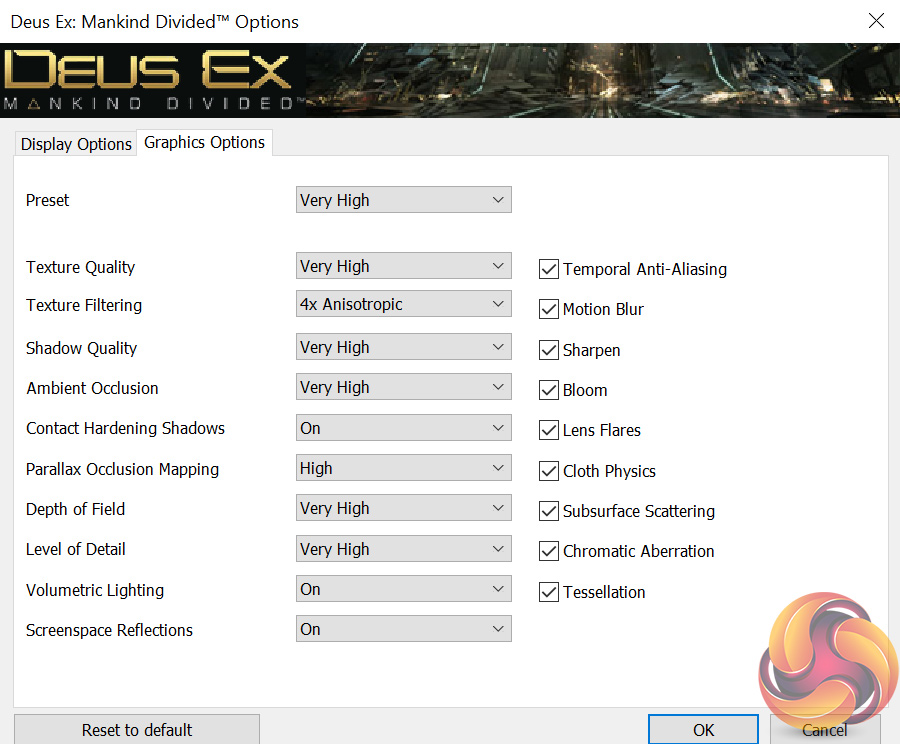
We test using the Very High preset, with MSAA disabled. We use the DirectX 12 API.
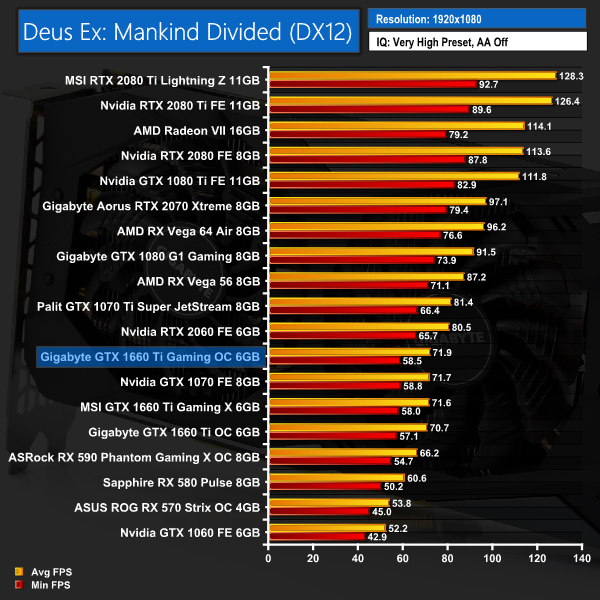
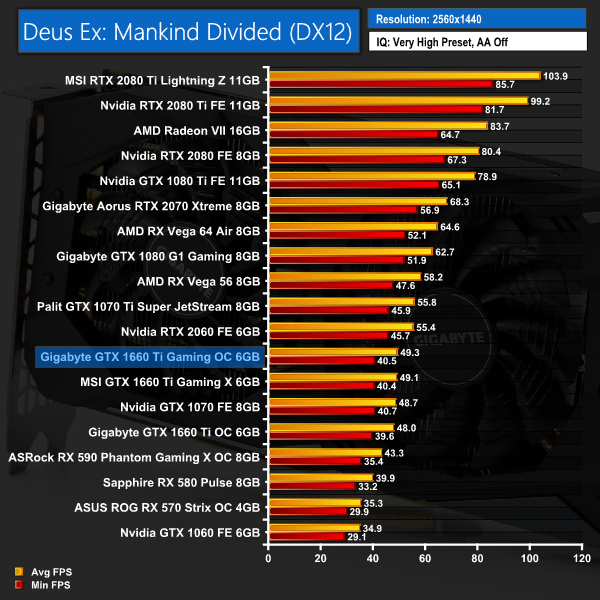
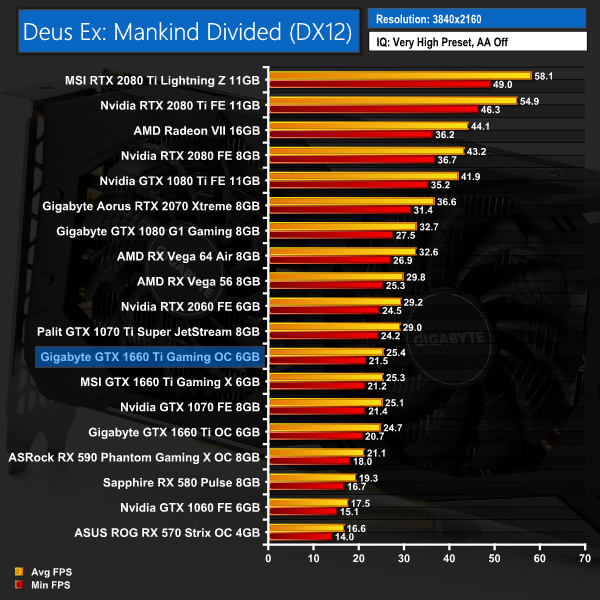
The same trend continues with Deus Ex: Mankind Divided – all three GTX 1660 Tis perform within 2FPS of each other, with the Gaming OC 6G just leading the pack.Far Cry 5 is an action-adventure first-person shooter game developed by Ubisoft Montreal and Ubisoft Toronto and published by Ubisoft for Microsoft Windows, PlayStation 4 and Xbox One. It is the eleventh entry and the fifth main title in the Far Cry series, and was released on March 27, 2018.
The game takes place in the fictional Hope County, Montana, where charismatic preacher Joseph Seed and his cult Project at Eden’s Gate holds a dictatorial rule over the area. The story follows an unnamed junior deputy sheriff, who becomes trapped in Hope County and works alongside factions of a resistance to liberate the county from Eden’s Gate. (Wikipedia).
We test using the Ultra preset, with AA and motion blur disabled.
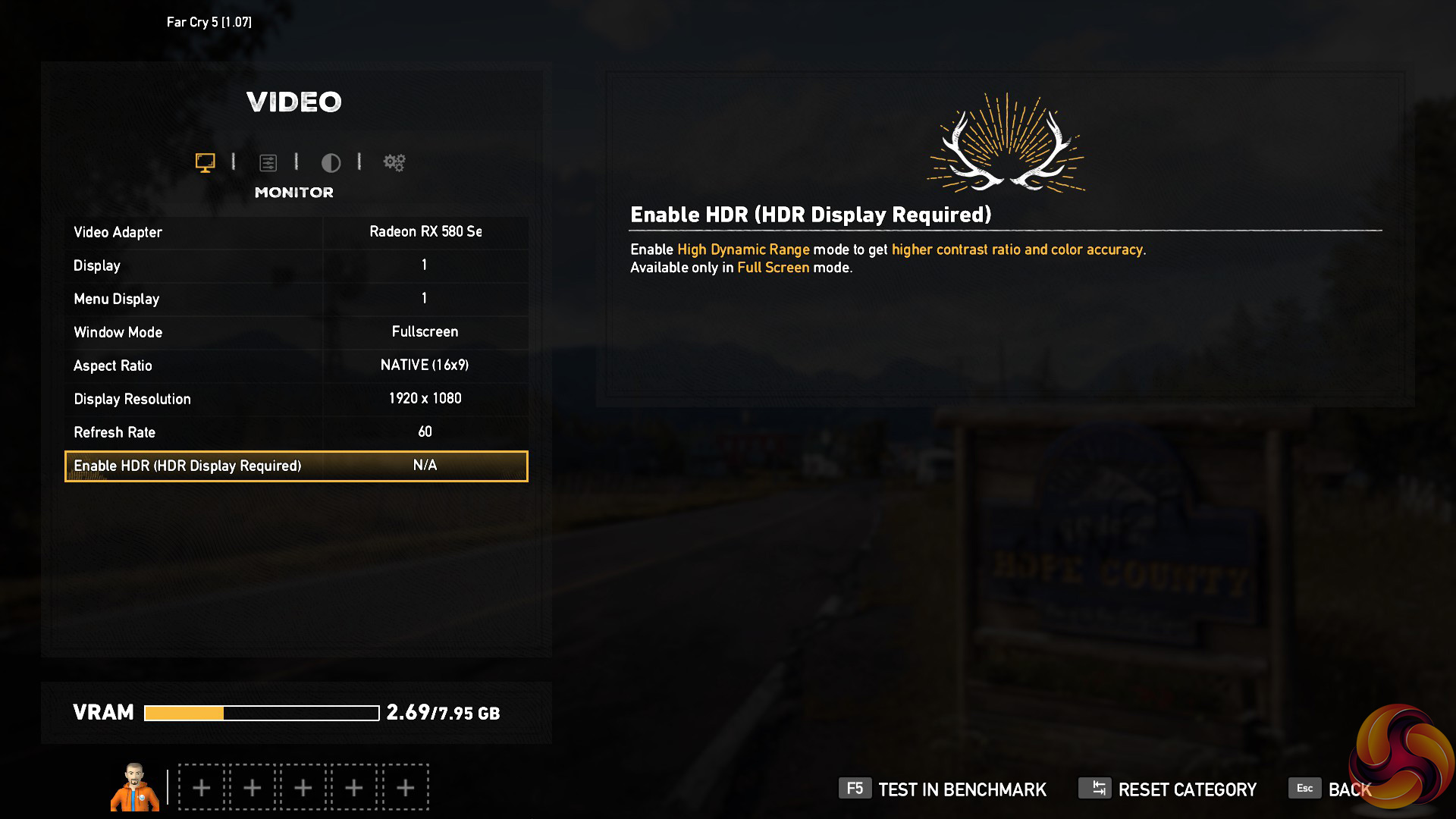
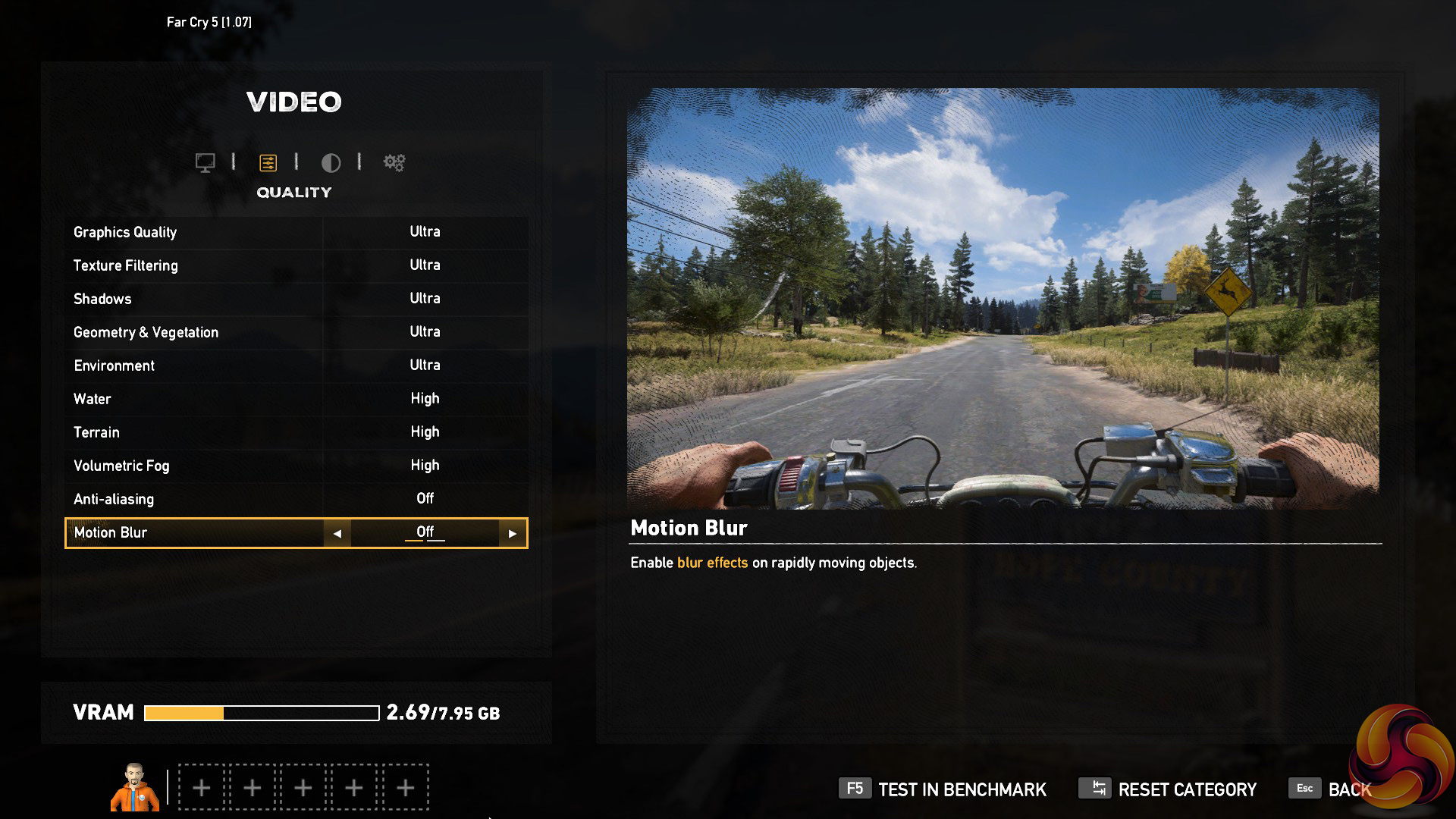
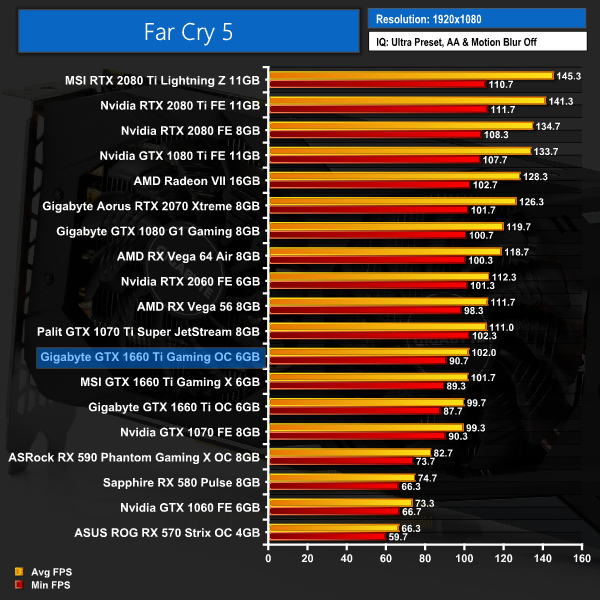
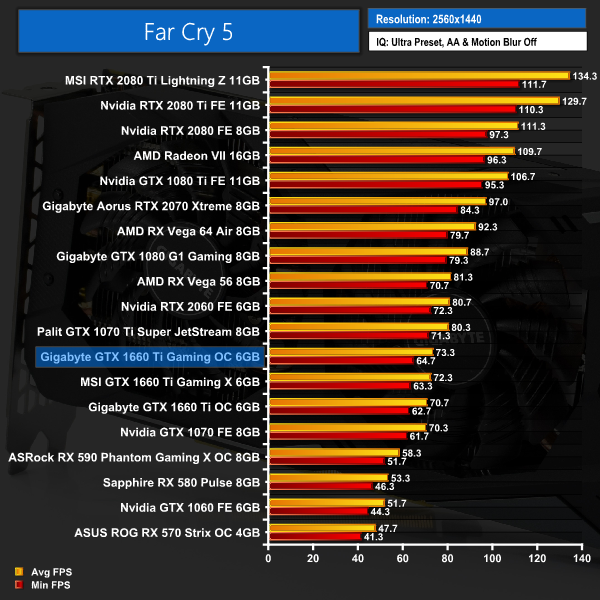
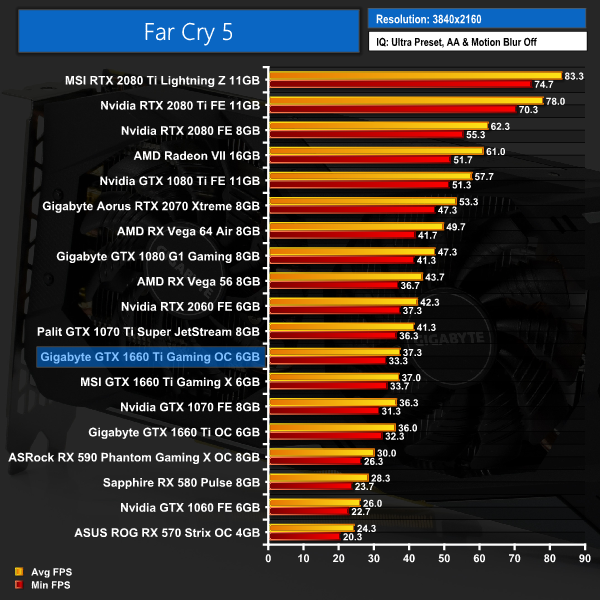
Gigabyte's Gaming OC 6G continues to edge ahead of the MSI Gaming X when we come to Far Cry 5. As you will have noticed, however, it's really a case of fine margins between all three 1660 Tis.Tom Clancy’s Ghost Recon Wildlands is a tactical shooter video game developed by Ubisoft Paris and published by Ubisoft. It was released worldwide on March 7, 2017, for Microsoft Windows, PlayStation 4 and Xbox One, as the tenth instalment in the Tom Clancy’s Ghost Recon franchise and is the first game in the Ghost Recon series to feature an open world environment. (Wikipedia).
We test using the Very High preset.
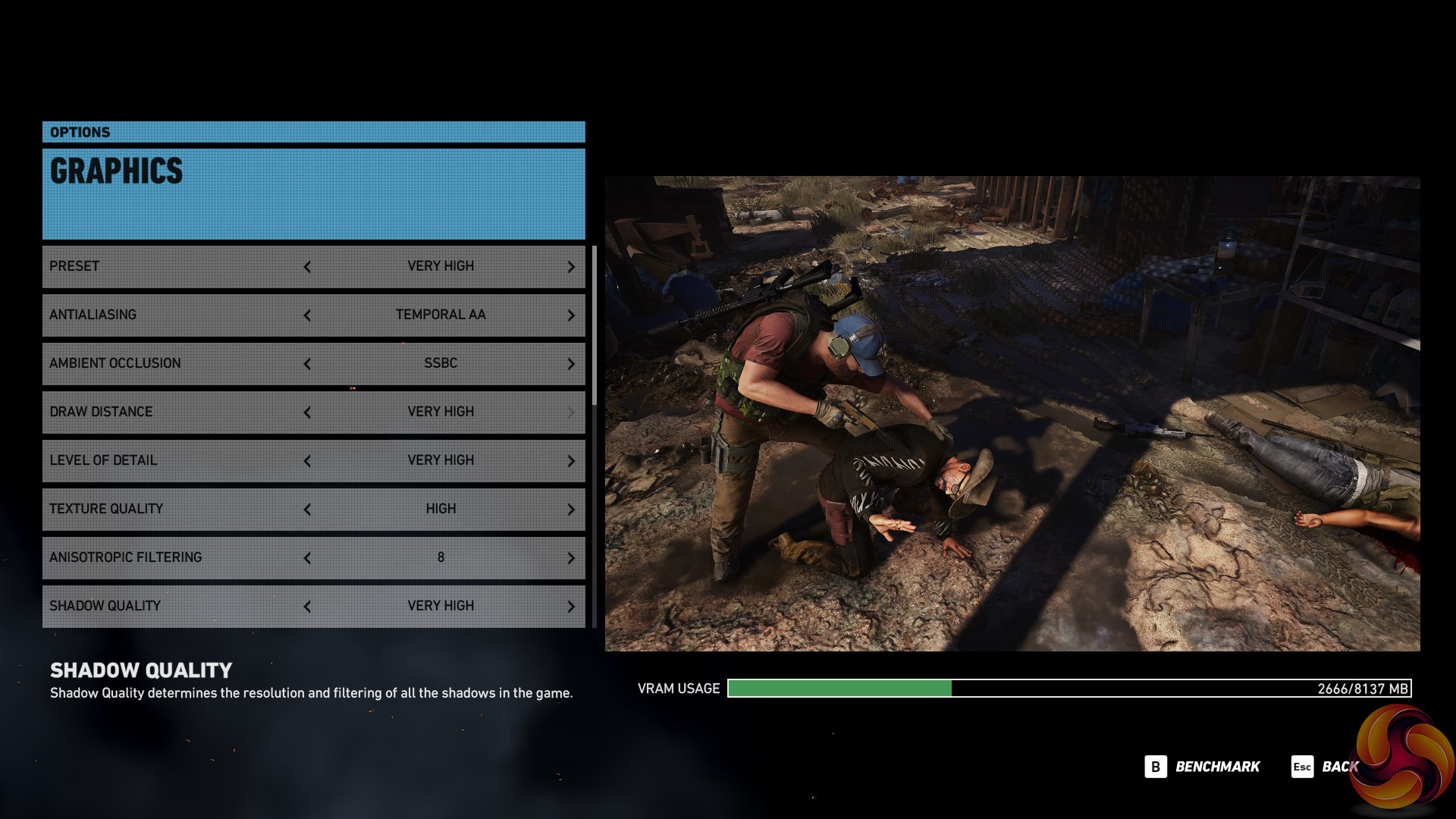
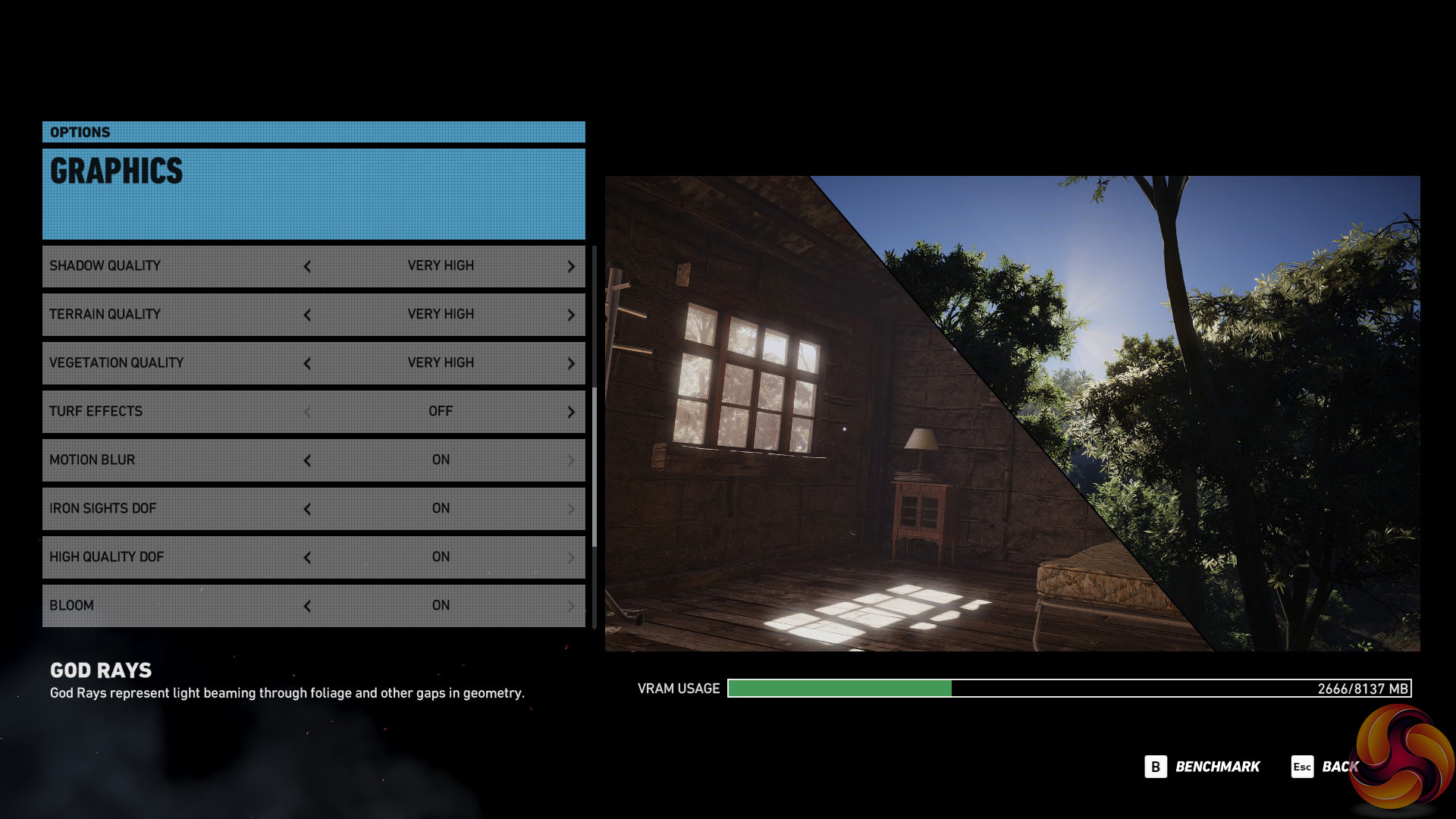
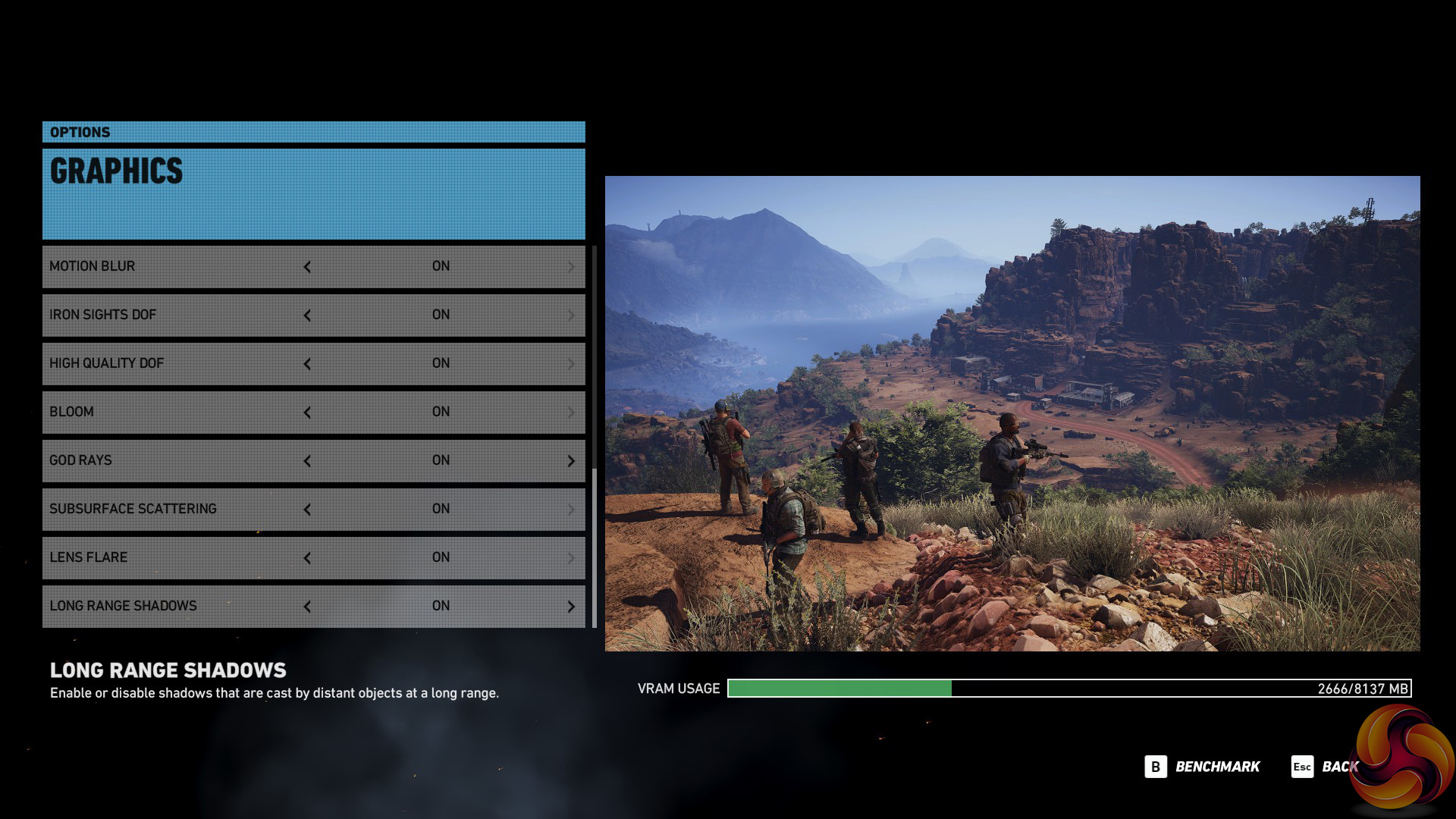
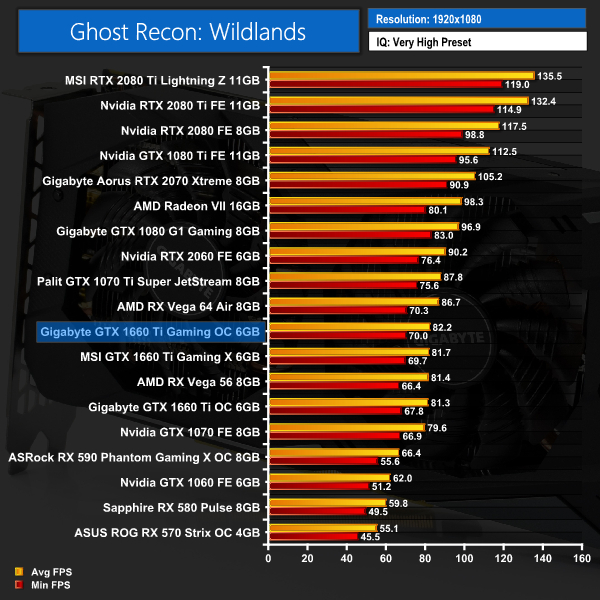
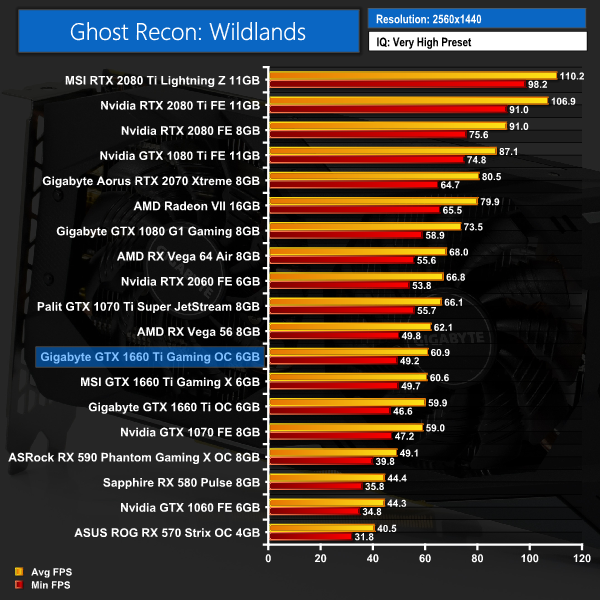
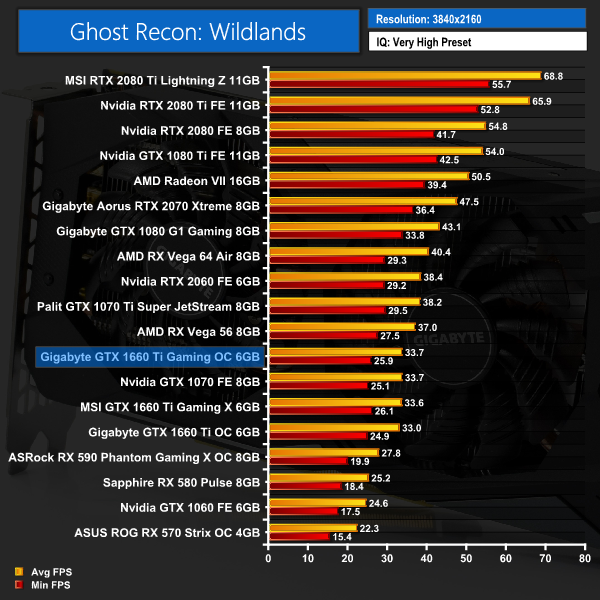
As the fastest GTX 1660 Ti yet when we come to Ghost Recon: Wildlands, here the Gaming OC 6G even edges ahead of Vega 56 at 1080p. Gigabyte's OC 6G, however, is less than a single frame slower at that same resolution.Middle-earth: Shadow of War is an action role-playing video game developed by Monolith Productions and published by Warner Bros. Interactive Entertainment. It is the sequel to 2014’s Middle-earth: Shadow of Mordor, and was released worldwide for Microsoft Windows, PlayStation 4, and Xbox One on October 10, 2017. (Wikipedia).
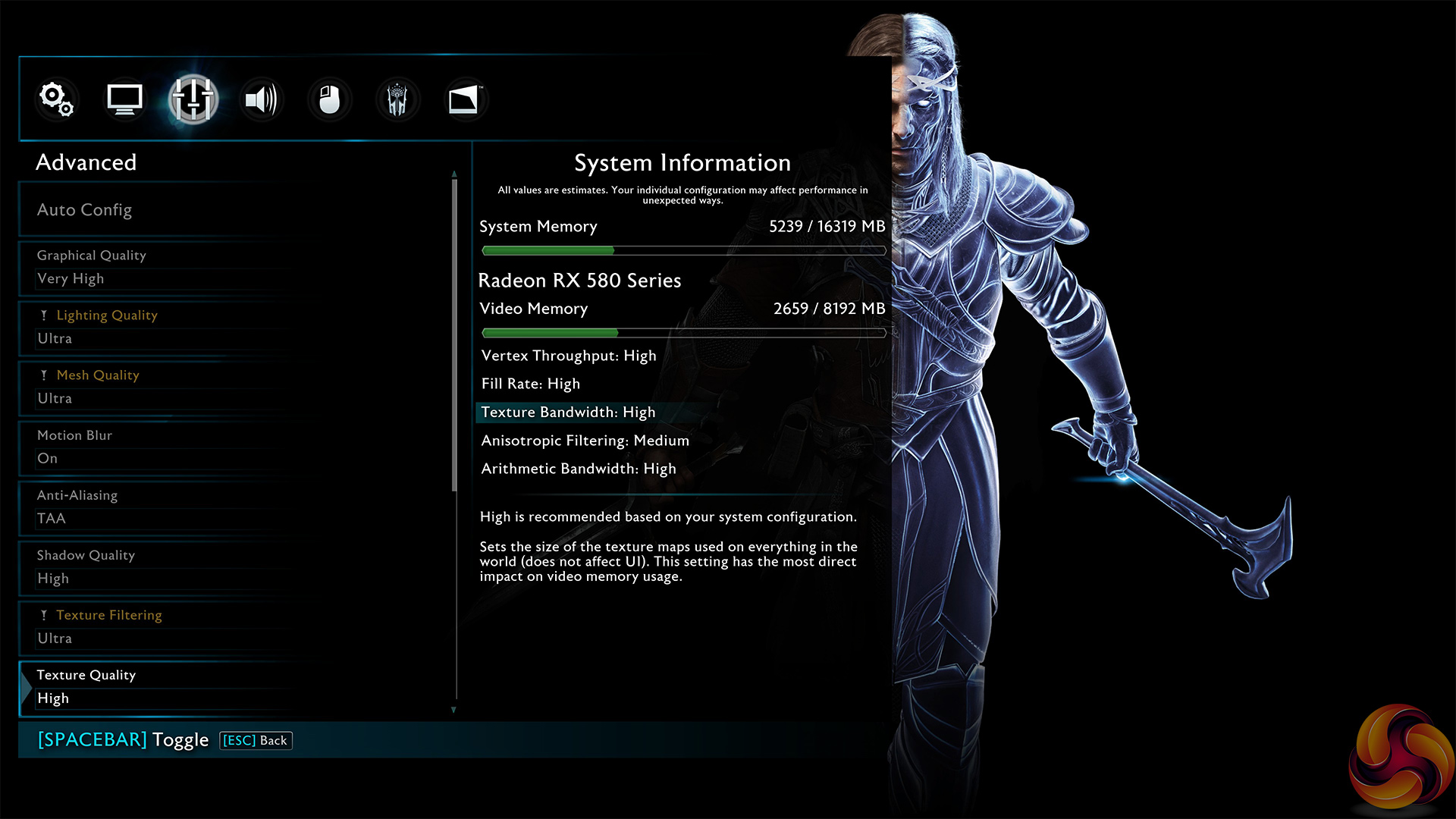
We test using the Very High preset.

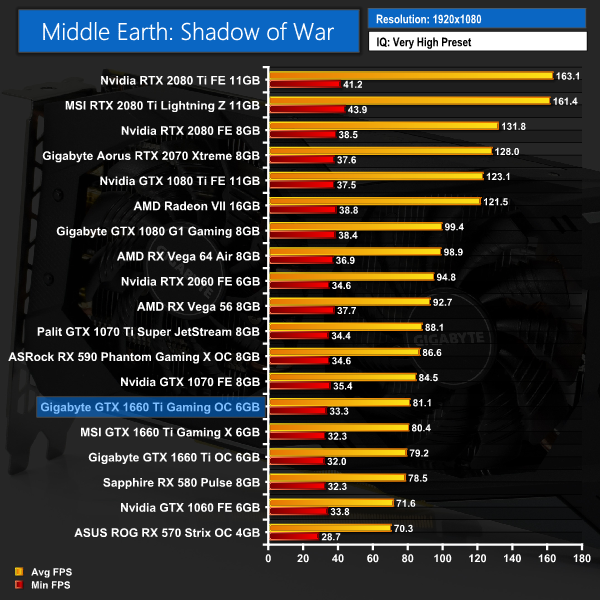
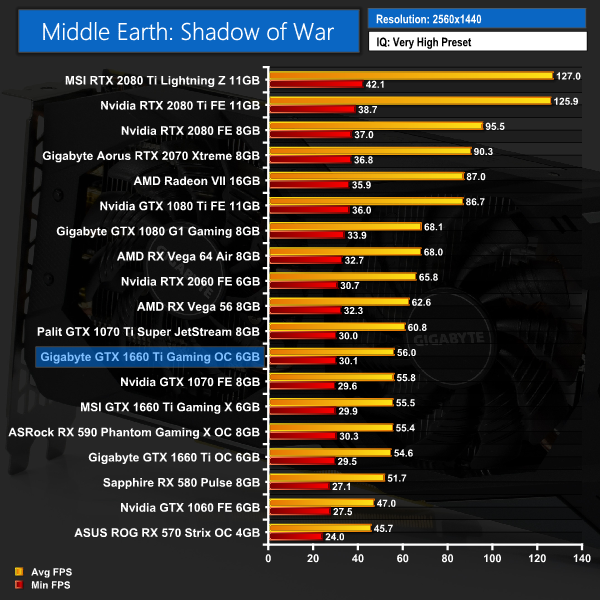
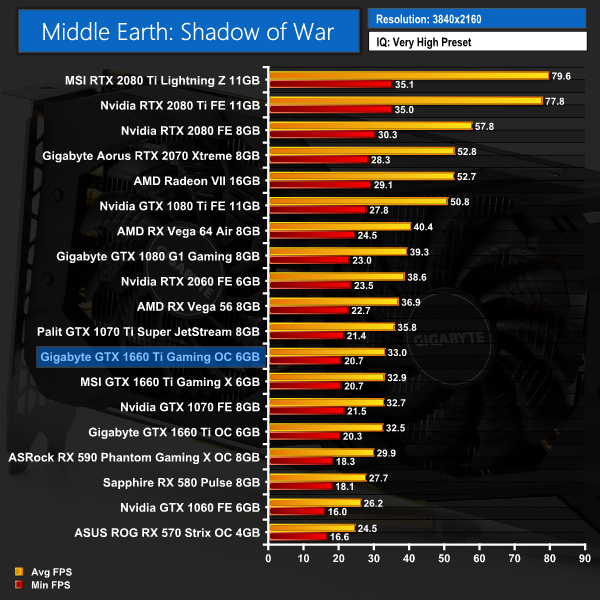
Middle Earth: Shadow of War has all three GTX 1660 Tis performing within 1FPS of each other, with the cards averaging around 80FPS at 1080p resolution,Shadow of the Tomb Raider is an action-adventure video game developed by Eidos Montréal in conjunction with Crystal Dynamics and published by Square Enix. It continues the narrative from the 2013 game Tomb Raider and its sequel Rise of the Tomb Raider, and is the twelfth mainline entry in the Tomb Raider series. The game released worldwide on 14 September 2018 for Microsoft Windows, PlayStation 4 and Xbox One. (Wikipedia).
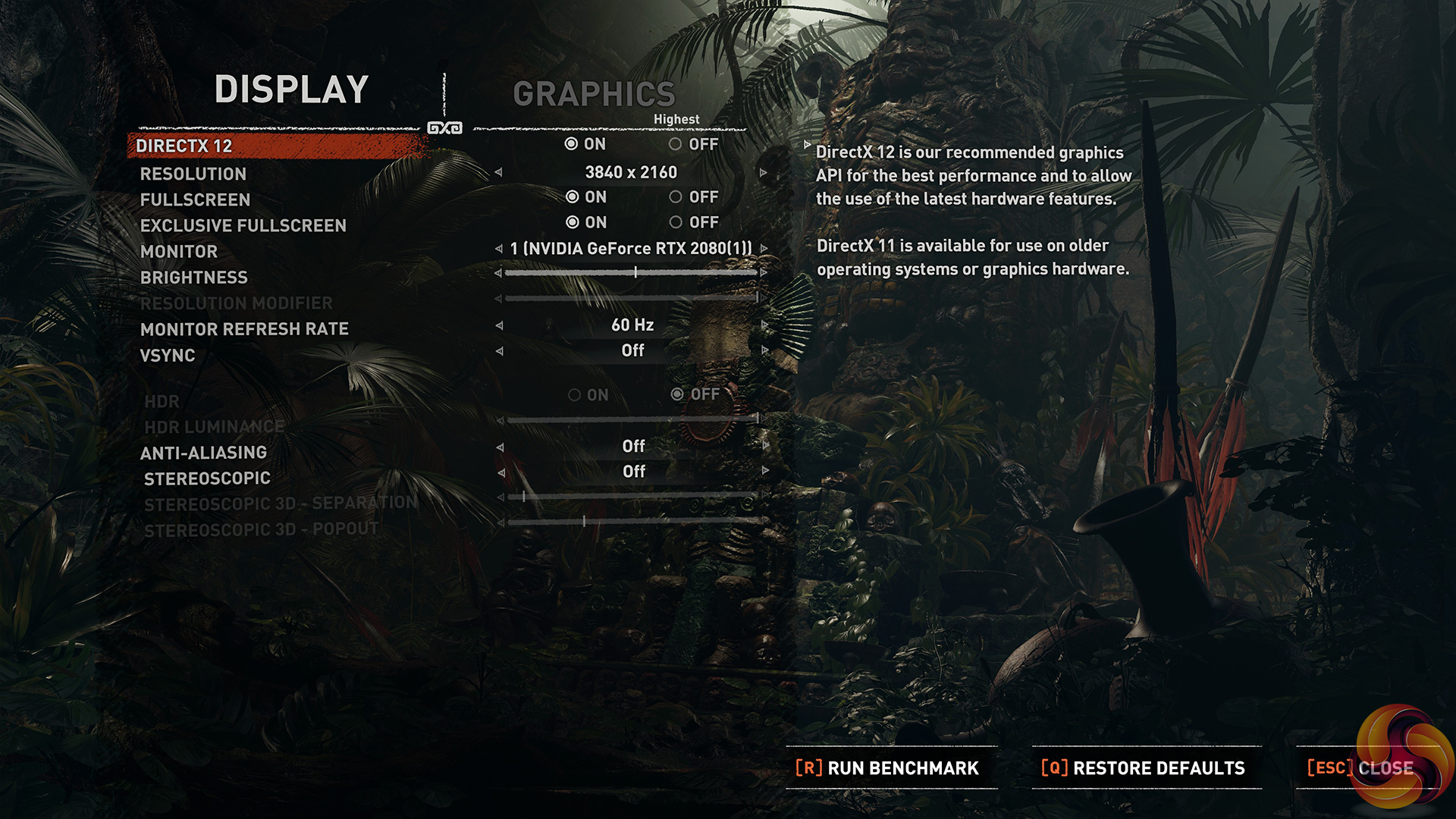
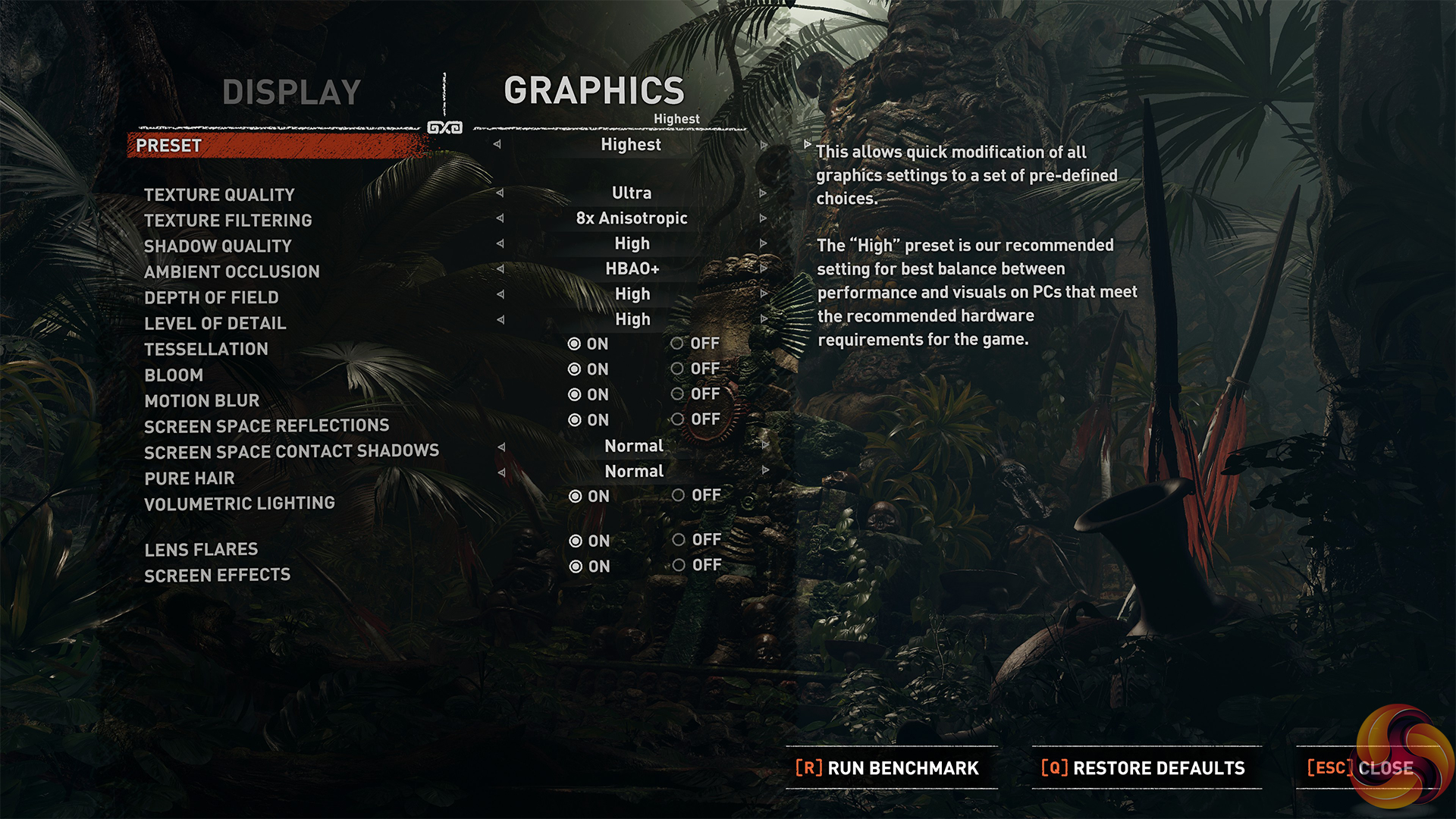
We test using the Highest preset, with AA disabled. We test using the DX12 API.
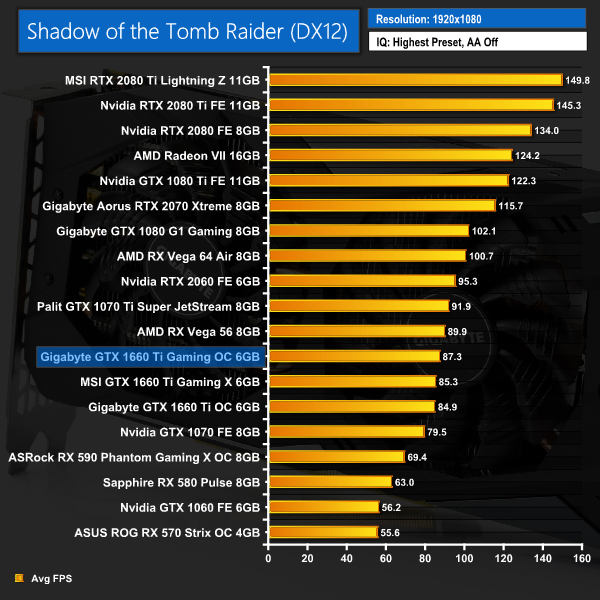
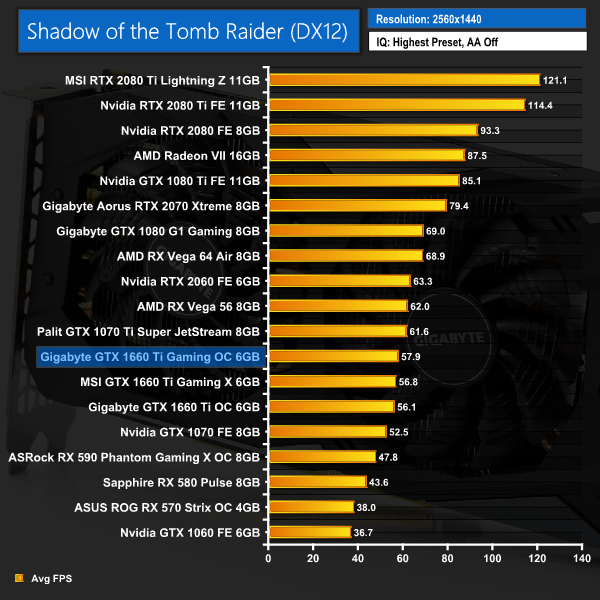
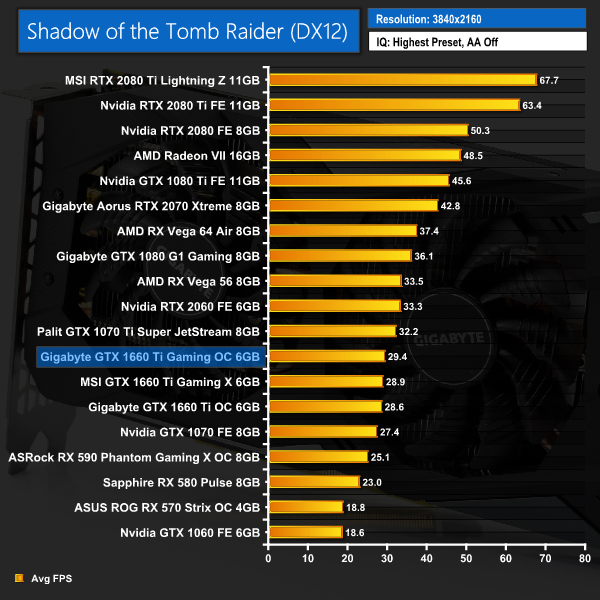
Shadow of the Tomb Raider demonstrates the biggest difference in performance between our GTX 1660 Ti models, though at 1080p the gap is still just 2.4FPS. Clearly, there is hardly anything between these partner cards.Here we present the average clock speed for each graphics card while running the 3DMark Fire Strike Ultra stress test 20 times. We use GPU-Z to record the GPU core frequency during the Fire Strike Ultra runs. We calculate the average core frequency during the entire 20-run test to present here.
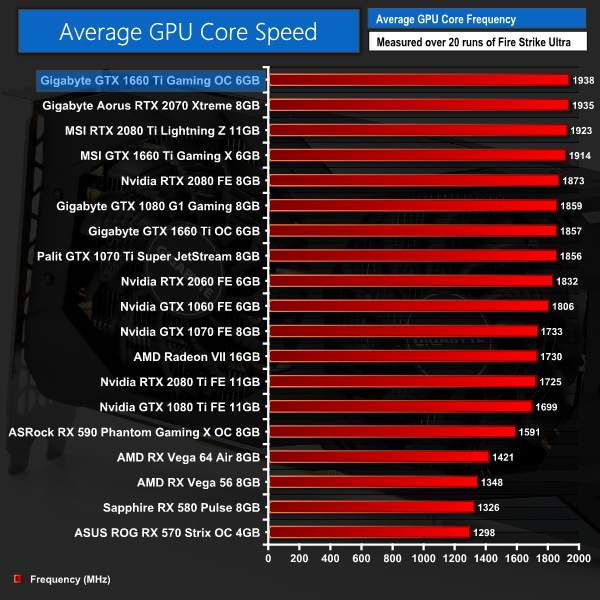
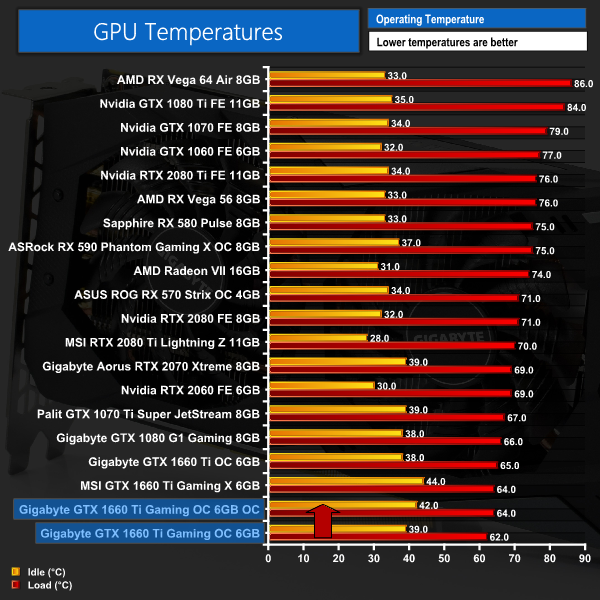
Despite having a rated boost clock of 1860MHz, the Gaming OC 6G exceeded this frequency by a fair amount – running at an average clock speed of 1938MHz. This explains why the Gigabyte card was just about edging ahead of the MSI Gaming X, even if the margins are very small.For our temperature testing, we measure the peak GPU core temperature under load, as well as the GPU temperature with the card idling on the desktop. A reading under load comes from running the 3DMark Fire Strike Ultra stress test 20 times. An idle reading comes after leaving the system on the Windows desktop for 30 minutes.
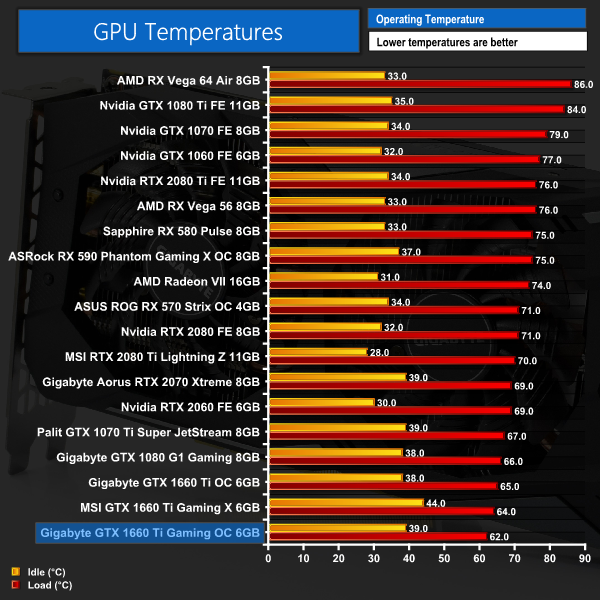
If you have seen any other GTX 1660 Ti reviews so far, you will know that the TU116 GPU is very easy to cool – just a single-fan configuration is enough to keep temperatures in check.
It's not exactly a surprise, then, that this triple-fan cooler produces exceptional results, with a peak temperature of just 62C under load. Bear in mind this is when cooling the fastest-running 1660 Ti we have seen so far, too, so it's even more impressive that it is both very fast and very cool.
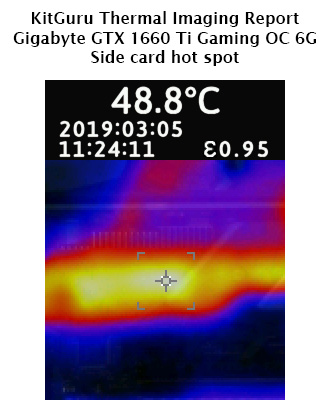
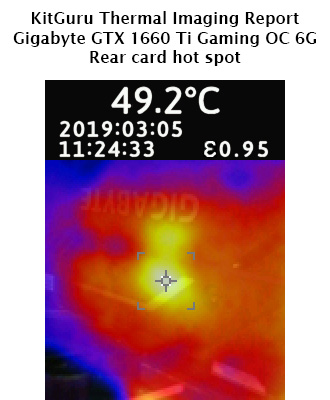
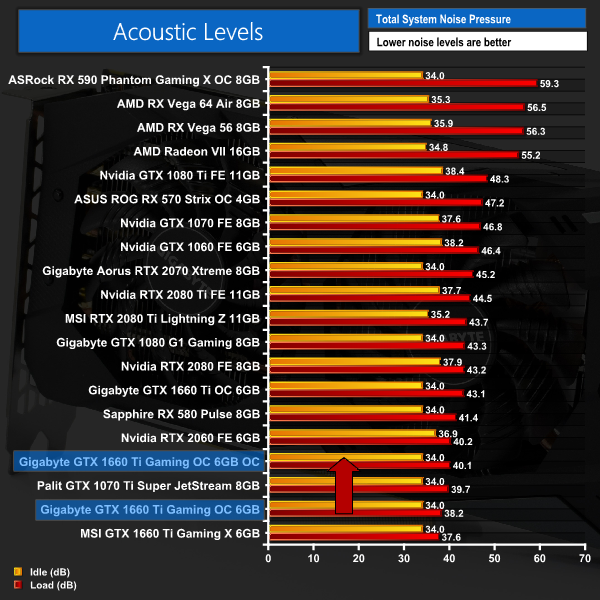
As we found from our OC 6G review, however, our thermal camera images aren't necessarily representative of the actual temperature hot spots on the card. That's because the card uses a plastic shroud and backplate which don't directly contact the heatsink or PCB – so there is little to no thermal transfer. If the backplate was metal, for instance, we would likely see a higher temperature for the hot spot on the back of the card.We take our noise measurements with the sound meter positioned 1 foot from the graphics card. I measured the sound floor to be 34 dBA, thus anything above this level can be attributed to the graphics cards. The power supply is passive for the entire power output range we tested all graphics cards in, while all CPU and system fans were disabled.
A reading under load comes from running the 3DMark Fire Strike Ultra stress test 20 times. An idle reading comes after leaving the system on the Windows desktop for 30 minutes.
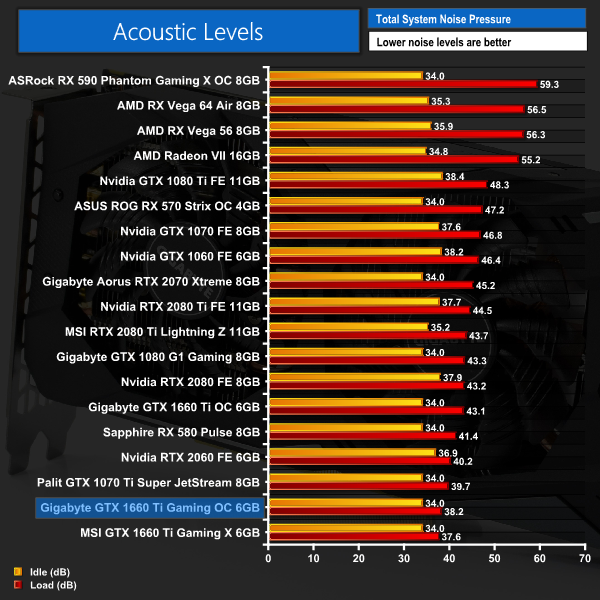
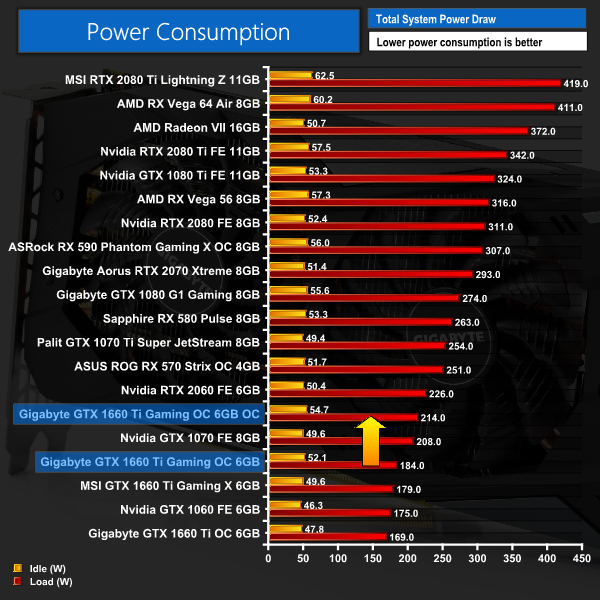
With such a large cooler (relatively speaking, at least) for this GTX 1660 Ti, not only are temperatures very low – but noise levels are also very impressive. The Gaming OC 6G isn't quite as quiet as the MSI Gaming X, but the difference is just 0.6dB – and was imperceptible to my ear. In a nutshell, it's another dead quiet card – as soon as it is put in a case, chances are you won't be able to hear it when gaming.We measure system-wide power draw from the wall while the card is sat idling at the Windows 10 desktop for 30 minutes. A reading under load comes from running the 3DMark Fire Strike Ultra stress test 20 times.
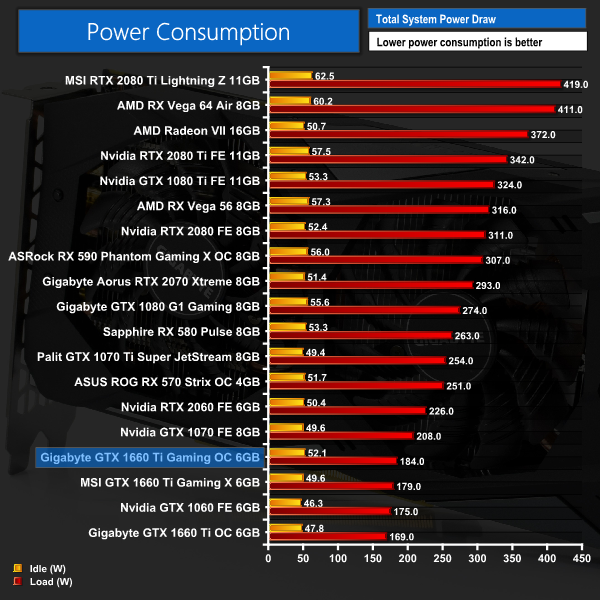
Power consumption is 5W higher than the MSI Gaming X GTX 1660 Ti, though the Gigabyte does run at a higher frequency so this is to be expected. In any case, it's still less than a GTX 1070 – while performing more-or-less the same in games – which demonstrates the improved power efficiency of the TU116 GPU.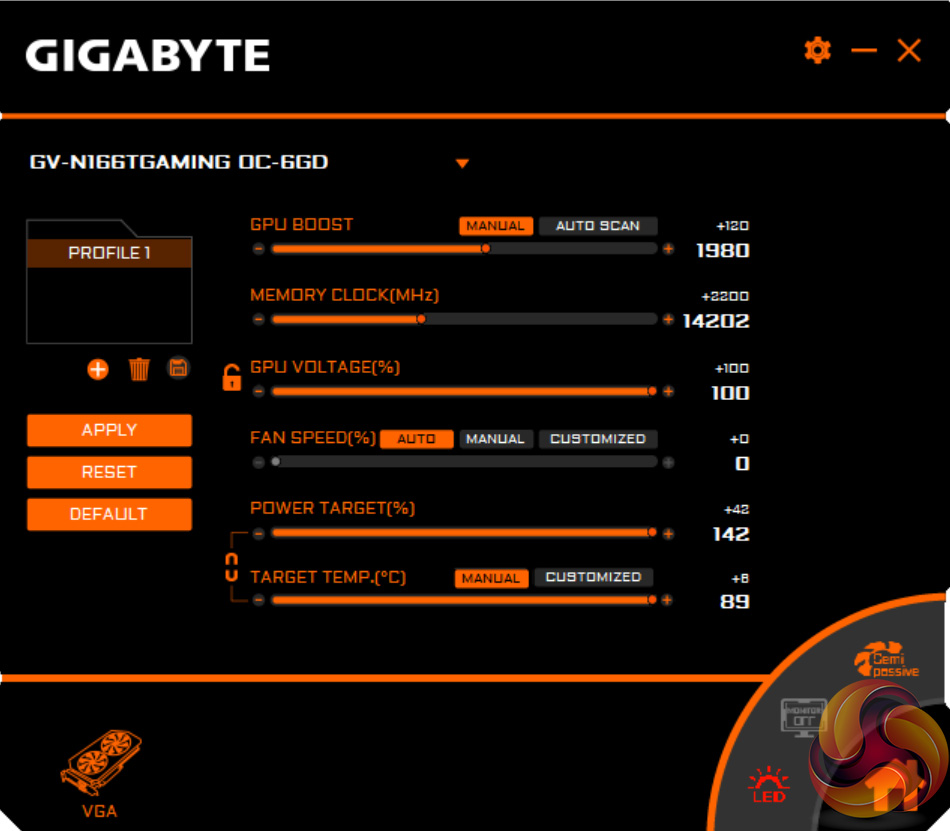
For overclocking, we used Gigabyte’s Aorus Master utility. We managed an extra +120MHz to the GPU core and +1100MHz (2200MHz effective) to the memory.
3DMark and games testing
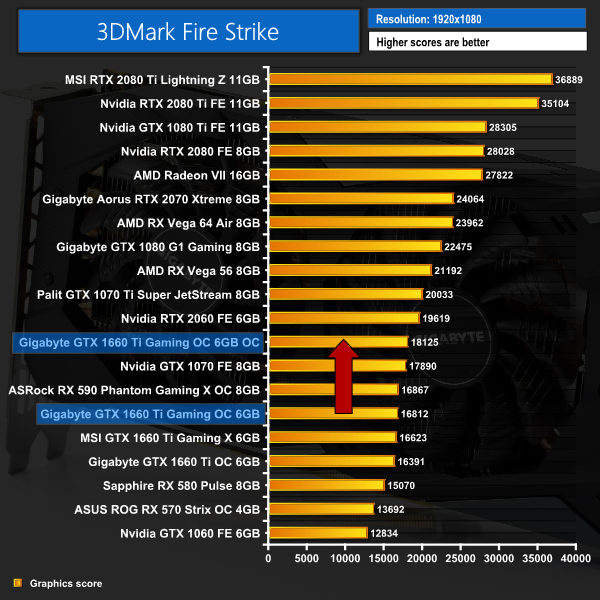
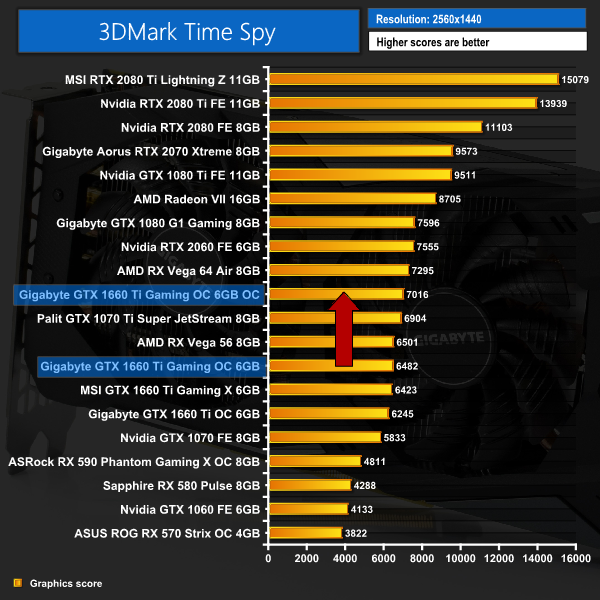
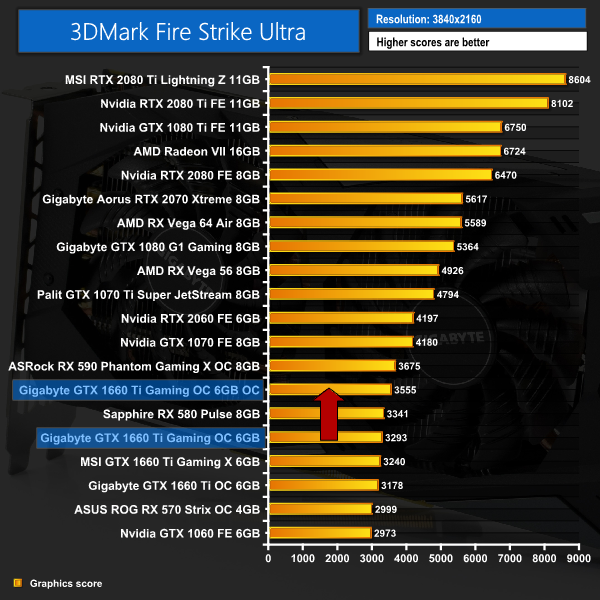
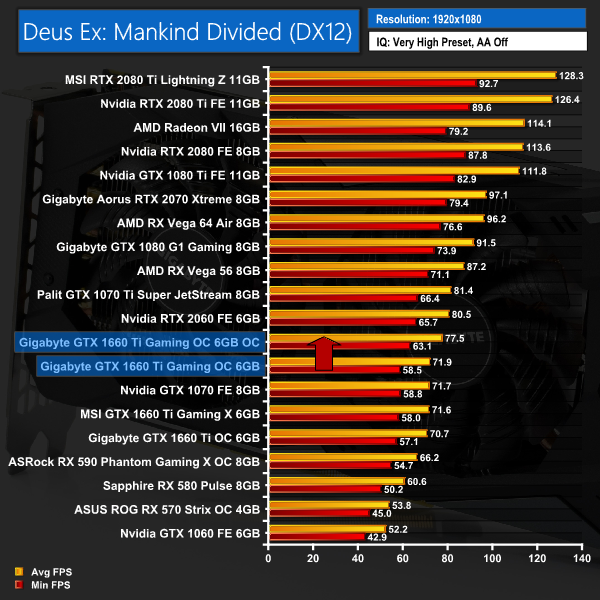
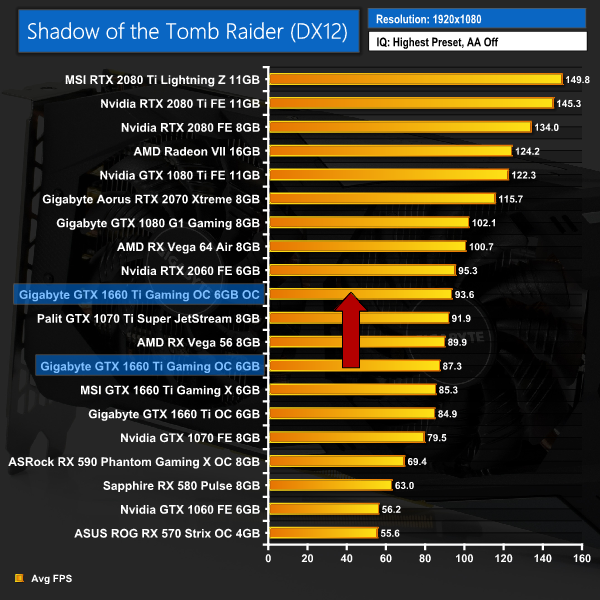
This overclock brought us some decent gains. Our Fire Strike score increased by 8%, breaking past the 18K mark, and the card performed just 1.5FPS slower than RTX 2060 in Shadow of the Tomb Raider.
Average clock speed under load
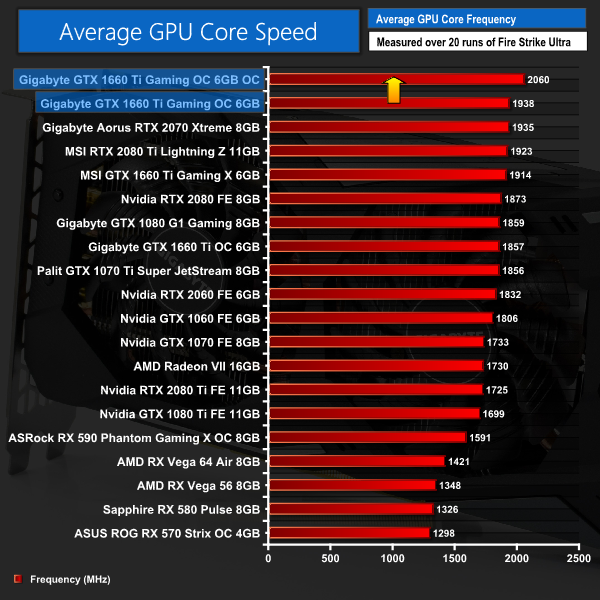
This performance increase is due to our clock speed averaging 2060MHz with the overclock applied. This is the highest frequency I've seen from any GTX 1660 Ti so far – how much of that is down to the silicon lottery vs the actual card itself is hard to say, but it is impressive nonetheless.Here, we take a further look at the impact of our overclock, looking at the increased temperatures, acoustics and power draw.
Temperatures
Acoustics
Power consumption
Overview
Considering how – dare I say – overkill this triple-fan cooler is for a GTX 1660 Ti, it is not really a surprise that it deals with the extra heat from our overclock without breaking sweat. Temperatures did rise, but only by 2C, and with noise output peaking at 40dB, this is still a whisper-quiet card.
Power consumption increased the most, up to 214W – taking it past the GTX 1070. Considering how this sample was almost on par with RTX 2060 when overclocked, however, I still don't see that as much of an issue at all.With this being our third GTX 1660 Ti review since launch day, I would go as far to say that the Gigabyte GTX 1660 Ti Gaming OC 6G is the best card of the series that we have reviewed so far.
It has a lot in common with Gigabyte's cheaper 1660 Ti OC 6G card we reviewed at the beginning of the month – it is essentially the same card, but with a triple-fan cooler (instead of dual-fan) and with an increased factory overclock. It may not sound like much of an improvement, but it definitely helps.
That's because the TU116 GPU doesn't need much in the way of cooling, so when you stick a triple-fan cooler on top of it, you get excellent results – we saw the GPU core peak at just 62C, while noise levels barely exceeded 38dB.
We also saw this card produce the highest sustained frequency from any GTX 1660 Ti so far, with an average core clock of 1938MHz under load – which is about 25MHz faster than MSI's Gaming X card we reviewed for launch day.
In the real world, however, performance between all three GTX 1660 Tis we have reviewed so far is very, very close. At 1080p, for instance, this Gaming OC 6G outperformed the slower-clocked OC 6G by no more than 2.4FPS – or just 2% on average. In many cases, the performance difference was less than a single frame – so you'd never know the difference between the two when gaming.
This Gaming OC 6G did overclock very well, however, with our card running at 2060MHz – the best result we have seen from any 1660 Ti so far. A lot of this does come down to the silicon lottery, but Gigabyte's effective cooler is definitely playing a part in keeping thermals in check, thus allowing clock speed to remain high.
Even then, it is still my opinion that Gigabyte's cheaper, and admittedly more basic, 1660 Ti OC 6G is the better buy. That card costs £269, whereas this Gaming OC 6G model comes in at £299, making it one of the more expensive 1660 Ti cards on the market. That means it is priced above Vega 56, with dual-fan partner cards currently retailing for £279.
Yes, the Gaming OC 6G is objectively very good – it is very cool, very quiet, and also very fast out of the box. That being said, GTX 1660 Ti is very much a value card – so when you add an extra 15% to the MSRP it becomes hard to justify, especially when the real-world performance difference is barely 2%. So as of now, I will say this is the best GTX 1660 Ti partner card I have reviewed so far. The card I think you should buy, however, is still the cheaper GTX 1660 Ti OC 6G.

You can buy the Gaming OC 6G from Overclockers UK for £299.99 HERE
Pros
- Fastest GTX 1660 Ti yet.
- Very cool.
- Very quiet.
- Overclocked to 2060MHz – our best result so far.
- Colour neutral design.
Cons
- Price represents a 15% increase over the £259 MSRP.
- Gigabyte's own OC 6G model is £30 cheaper and performs essentially the same.
KitGuru says: It is the best GTX 1660 Ti card we have reviewed so far. For a value-oriented product, however, GTX 1660 Ti is most appealing when cards are priced as close to MSRP as possible.