KitGuru KitGuru.net – Tech News | Hardware News | Hardware Reviews | IOS | Mobile | Gaming | Graphics Cards



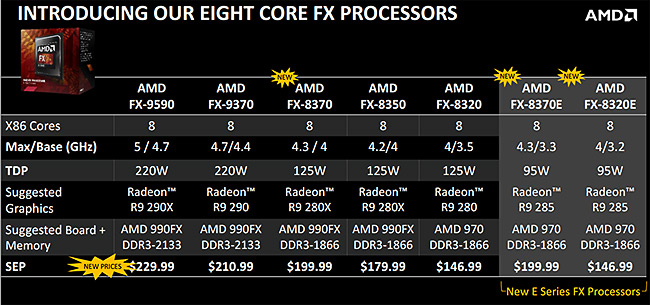
AMD has updated its FX range of CPUs with three new models that use Socket AM3+. FX-8370 slots in above FX-8350, just as you would expect, but the real interest lies with FX-8370E and FX-8320E with a TDP that has been reduced from 125W to 95W. That ‘E' suffix appears to stand for Eco.
There's no kind way to put this, but the fact is that ever since its release in 2011, the AMD FX-8xxx series of processors has struggled against Intel Core i7. AMD had the headline feature of eight hardware cores (compared to Intel's mainstream parts with and average of four cores and the option of Hyper Threading) however FX-8xxx series performance was so lacking that AMD has had to rely on clock speed at 4GHz+ to try and redress the balance.
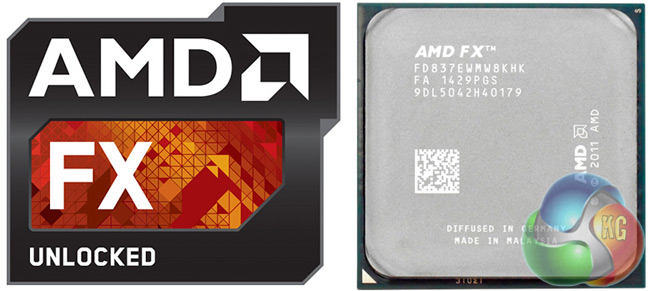
Common sense says a 25 percent reduction in TDP is likely to have a significant impact on performance so let's check out FX-8370E and see whether E stands for ‘Excellent' or ‘Execrable'.
Specification:
- Base speed 3.3GHz
- Turbo Frequency up to 4.3GHz
- Architecture Piledriver
- Core name Vishera
- Manufacturing process 32nm
- Number of cores Eight
- Memory controller Dual-channel DDR3
- L1 Cache 8 x 16KB Data, 4 x 64KB Instruction
- L2 Cache 4 x 2MB
- L3 cache 8MB
- Socket AM3+
- Thermal Design Power 95W
- Features SSE, SSE2, SSE3, SSE3, SSE4a, SSE 4.1, SSE 4.2, AMD-V, AES, AVX, XOP, FMA3, FMA4
It is tempting to simply count the number of processor cores and focus on clock speeds but sooner or later we have to look at power draw for which we can use TDP as a proxy, and this is where AMD has suffered.
To take two examples, Intel Core i7-3770K has a base speed of 3.5GHz and Turbos up to 3.9GHz while the AMD FX-8320 starts at 3.5GHz and runs up to 4GHz. On paper the two processors are near-identical and as the FX costs £100 while the Core i7 is £230 you might think it is game, set and match to AMD. In fact the Intel is a better performer and manages with a TDP of 77W, whereas the FX has a TDP of 125W – so the question about which family of CPU you should buy remains complicated.
AMD has been forced to put the emphasis on clock speed to close the performance gap with Intel and the result was clear at the launch of its FX-9xxx chips that clock up to 5GHz turbo speed. That is impressive but unfortunately FX-9590 and FX-9370 require a 220W TDP to achieve this feat which inevitably means you will have to deal with loads of heat and a significant cooling solution to keep things under control.
AMD updated its FX-x1xx Bulldozer models with Piledriver cores, denoted by a change in model codes to FX-x3xx, however that was more a matter of refinement rather than reinvention. When AMD brought out its third generation Steamroller cores they were restricted to the Kaveri family of APUs and were explicitly not extended to FX.
This refusal to use Steamroller pretty much felt like the end of the line for the FX desktop processor. Without development it could only get less appealing compared to Core i7, so in many respects AMD has pulled a rabbit from the hat with its latest announcements as it has reinvented its product stack pretty much out of thin air.
If you prefer, you can think of it as a placeholder while AMD develops its Zen microarchitecture.
At the high end the FX-9590 and FX-9370 have had their prices cut. Below that we see the introduction of FX-8370 which is 100MHz faster than the FX-8350, presumably thanks to improvements in the fabrication process.
The existing FX-8350 and FX-8320 models remain in place and then we see the introduction of FX-8370E and FX-8320E which are 95W versions of the non-E 125W CPUs.
AMD gives no clue as to how it has achieved this trick, despite the fact that lopping 30W off the TDP is a massive step. Judging by the specifications, the FX-8370E appears to be identical to the FX-8370 – except for a lower base speed of 3.3GHz compared to 4.0GHz for the 125W model. The Turbo speed of 4.3GHz is the same for both models, so the reduction in TDP is little short of amazing and well worth investigating.
AMD sent me the FX-8370e installed in an ASRock 990FX Killer motherboard which, as the name suggests, uses an AMD 990FX chipset with SB950 Southbridge. For comparison I have an FX-8350 processor which is very similar to the FX-8370 that I would ideally have used.
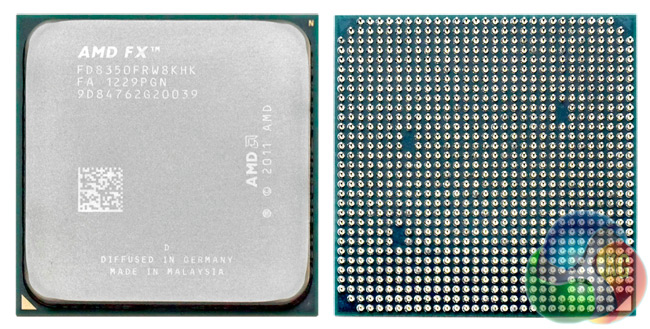
As you will see the ‘missing' 100MHz makes little odds.
| Test Configurations | AMD FX 8370E 3.3ghz/4.3ghz |
AMD FX-8350 4GHz/4.2GHzCPU OC +10% – 4.4GHz |
AMD FX-8350 4GHz/4.2GHzCPU OC – Auto 4.0GHz |
| Motherboard | ASRock 990FX Killer | ASRock 990FX Killer | ASRock 990FX Killer |
| Memory | AMD DDR3 2400mhz AMP 2,133MHz |
AMD DDR3 2400mhz AMP 2,052MHz |
AMD DDR3 2400mhz AMP 2,133MHz |
| Chipset | AMD 990FX+ SB950 | AMD 990FX+ SB950 | AMD 990FX+ SB950 |
| HDD | Samsung 840 EVO SSD | Samsung 840 EVO SSD | Samsung 840 EVO SSD |
| Graphics | Sapphire R9 290 Tri-X | Sapphire R9 290 Tri-X | Sapphire R9 290 Tri-X |
| Operating System | Windows 7 Pro 64 bit | Windows 7 Pro 64 bit | Windows 7 Pro 64 bit |
CPU-Z
AMD FX8370E
AMD FX8350
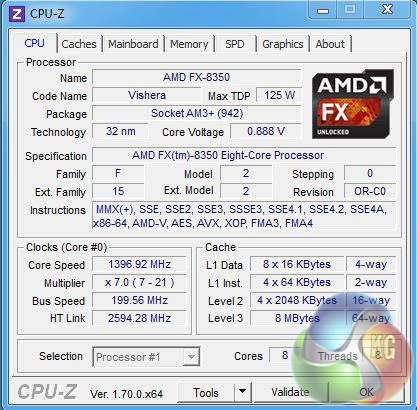
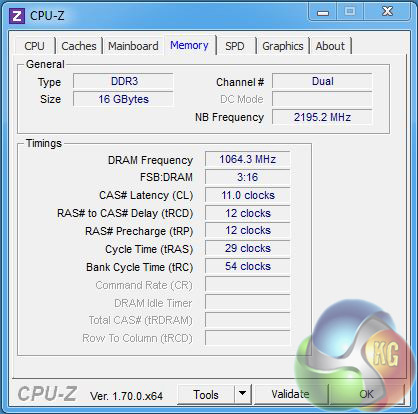
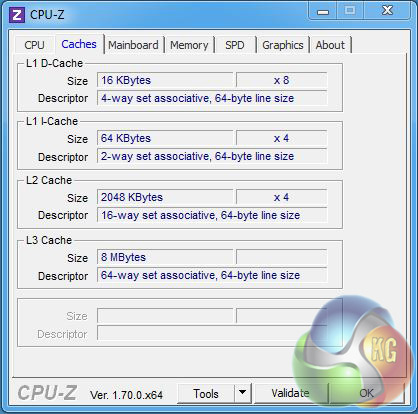
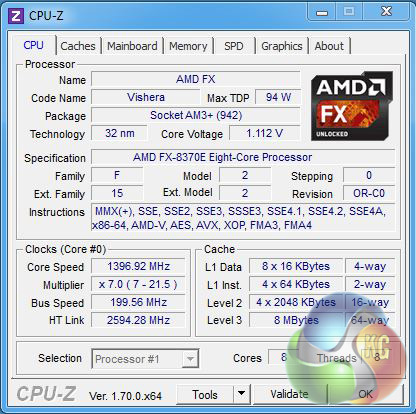
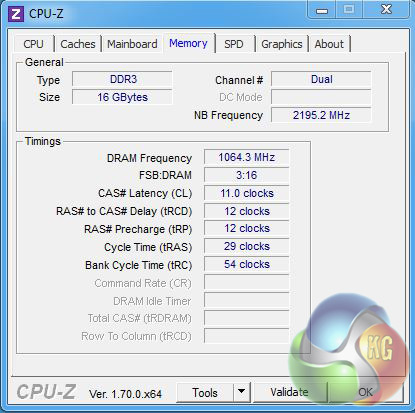
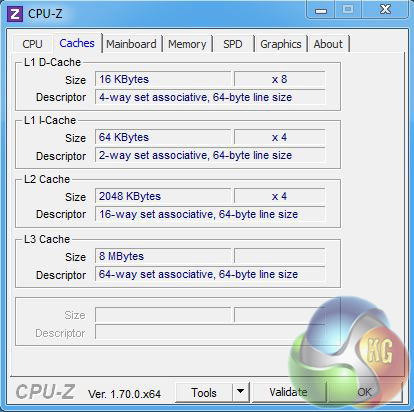
CPU-Z shows us that FX-8350 and FX-8370E are essentially identical and use the same stepping 0 silicon with the same bus speeds and operating voltages. The only obvious differences are the model name of the CPU and the TDP.
Memory bandwidth
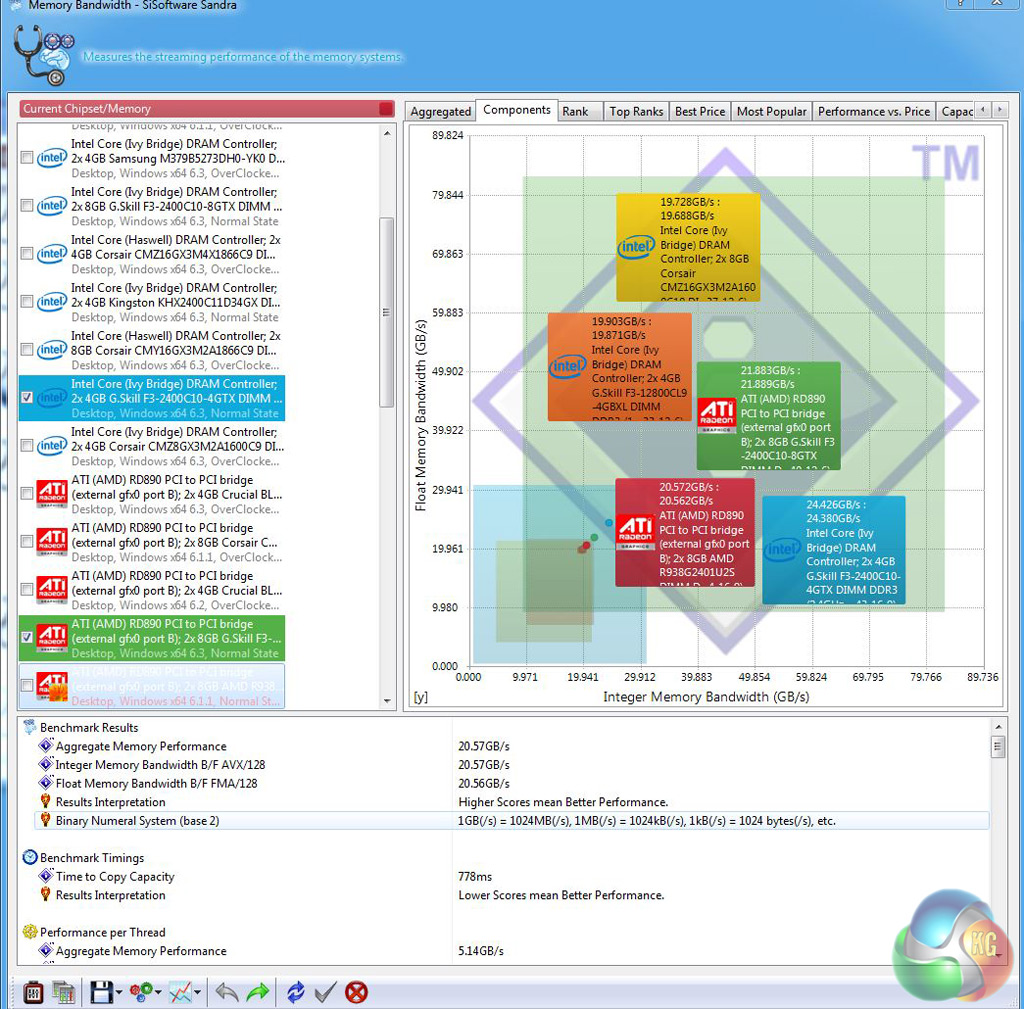
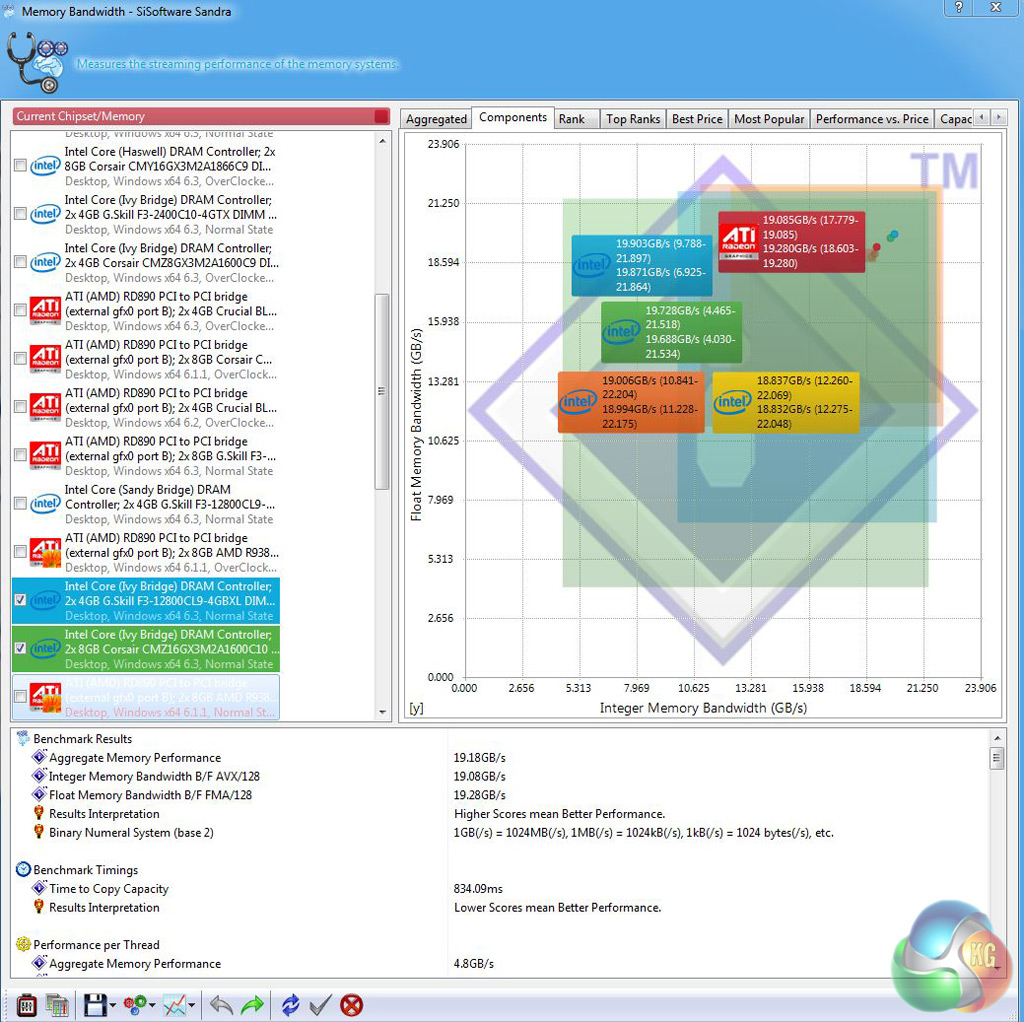
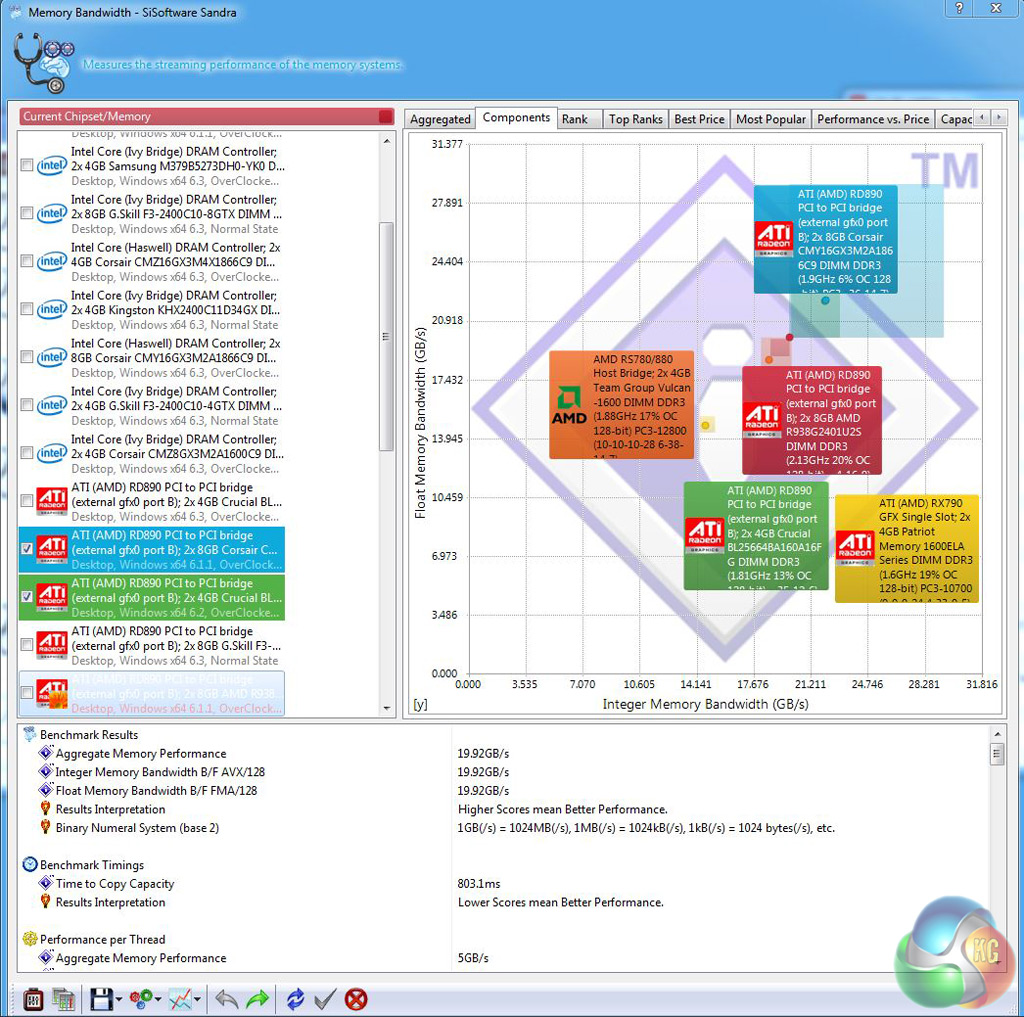
AMD-FX-8370e / AMD-FX-8350-Overclocked / AMD-FX-8350
The system memory for these benchmark tests is AMD Radeon R9 that is rated at a maximum speed of 2,400MHz. In practice you would expect to find a preset profile in the BIOS with a maximum speed of 2,133MHz although I note the ASRock manual also lists a quirky overclock speed of 2,450MHz.
SiSoft Sandra gives us a simple start to the benchmarking.
With the FX-8350 running at stock speed and AMP enabled in the BIOS the memory ran at 2,133MHz and delivered a bandwidth of 19.92GB/sec. The FX-8370E also ran the memory at 2,133MHz however the bandwidth was slightly higher at 20.57GB/sec. In practice these two figures are identical. Overclocking the FX-8350 with a +10 percent profile lowered the memory speed to 2,052MHz which in turn reduced the bandwidth to 19.18GB/sec.
Keen readers of KitGuru will have worked out that 2,052MHz is 1,866MHz +10 percent so when it comes to memory bandwidth the FX-8350 and FX-8370E perform as you would expect.
PC Mark 8
The other components in the test PC used for benchmarking were a Samsung 840 SSD and a Sapphire Radeon R9 290 graphics card, which is the sort of hardware that should reveal the performance of any CPU.
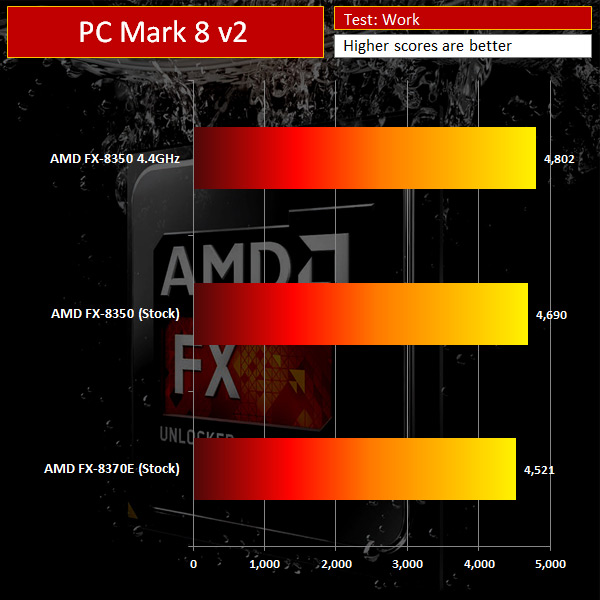
PC Mark 8 threw up some curious results. The stock FX-8350 scored 4,690 which increased to 4,802 when the CPU was overclocked. That is an extra 2.3 percent performance for ten percent more CPU speed, which illustrates the point that PC Mark tests the whole system and not just the CPU.
So imagine my surprise when I saw that the nominally faster FX-8370E turned in a lower score of 4,521 – which is 9.6 percent less than the stock FX-8350 – and suggests the CPU was running somewhere around its base speed of 3.3GHz.
3D Mark shows a clear trend.
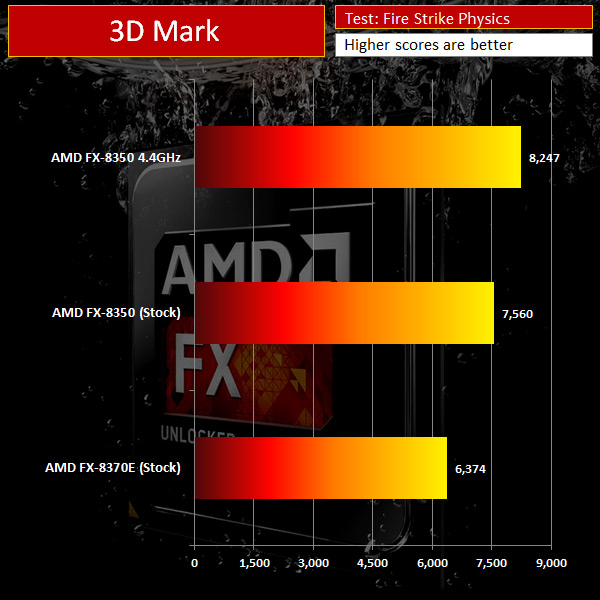
If we take the FX-8350 as a baseline, then the overclocked FX-8350 scores extra marks in the physics tests which are driven by the CPU, while the graphics tests remains steady.
FX-8370E throws things up in the air as the graphics score comes in at the same level as FX-8350 however the physics score drops by 15 percent, which suggests the FX-8370E is running a good bit slower than FX-8350.
Unigine Heaven and Valley
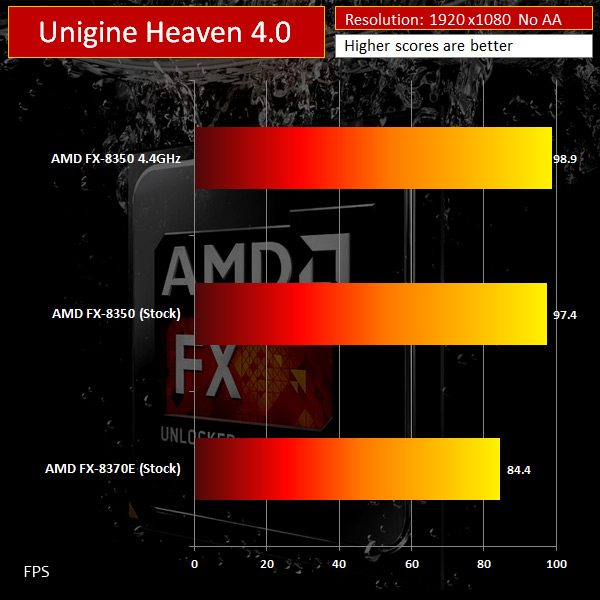
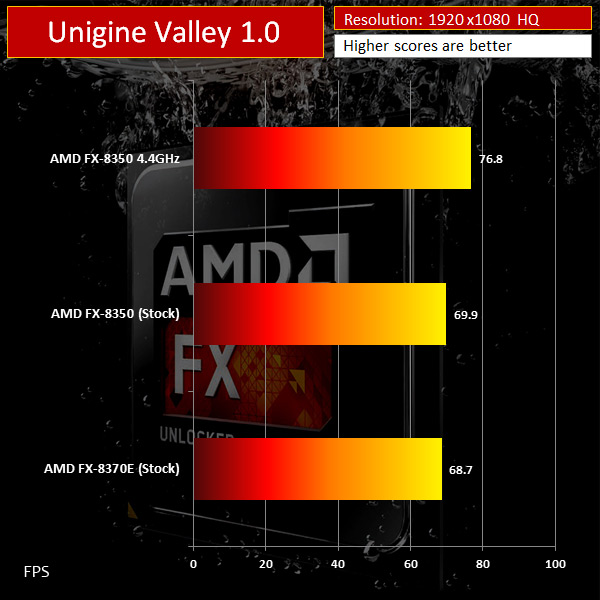
I am grouping the test results from Unigine Heaven 4.0 and Valley 1.0 together as they show a consistent pattern. FX-8350 performs well and the extra ten percent from overclocking gives a noticeable lift. FX-8370E does the exact opposite and drags the numbers down.
The Valley test exaggerates the differences between the three test set-ups and by this stage I was wondering whether my FX-8370E was actually running anywhere close to 4.0GHz, let alone the claimed maximum Turbo speed of 4.3GHz.
Cinebench
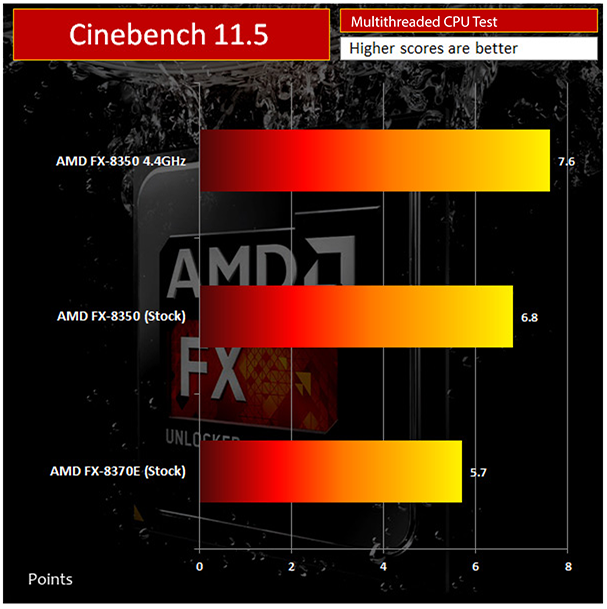
Certainly when all eight cores were fully loaded in Cinebench it was clear the FX-8370E was running at the base speed of 3.3GHz without a hint of Turbo Boost.
To put it another way, AMD says the FX-8370E runs ‘…up to 4.3GHz' which suggested the 95W TDP would kick in when multiple cores were heavily loaded.
MediaEspresso
So let's take a piece of software that loads a CPU at 100 percent to render videos as quickly as possible.
CyberLink MediaEspresso 6.7 acts like a benchmark but is a legitimate piece of multi-threaded software that will extract the maximum from a CPU.
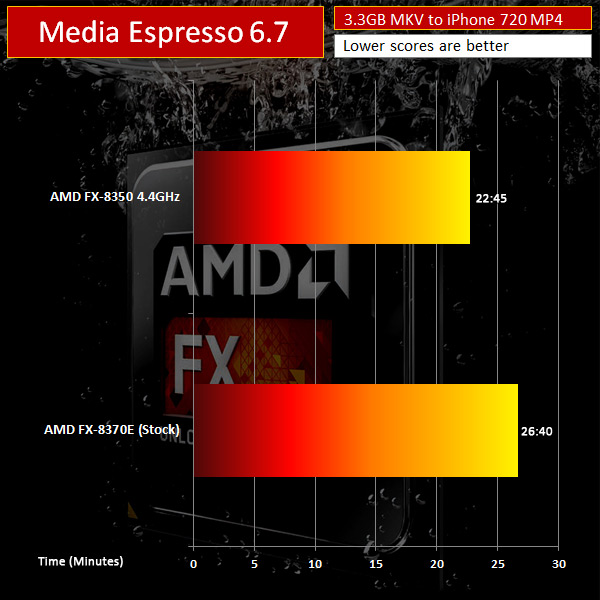
Converting a 3.3GB movie file to iPhone 4 format took 22 minutes 45 seconds with hardware acceleration disabled.
Overclocking the FX-8350 without hardware acceleration caused the software to freeze, which suggests the ASRock +10 percent was close to the CPU's limit.
Games are notorious for using CPUs inefficiently and in particular for not making full use of the available cores, however they are a superb real world test of your hardware.
We test with Dirt 3.
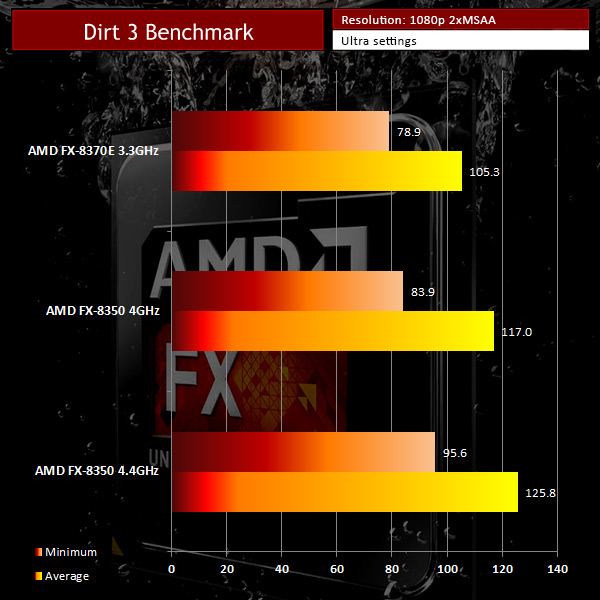
Running the built-in benchmark tests in Tomb Raider and DIRT 3 highlights a couple of relevant points.
DIRT 3 dates back to 2011 and looks pretty good on any competent PC however the benchmark reports frame rates way beyond anything your eye might see.
They show that the overclocked FX-8350 delivered about 10fps extra compared to the stock FX-8350 while FX-8370E lost 10fps. These are minimum frame rates around 80fps with an average of 105fps and you simply cannot see the difference by eye. On the one hand FX-8370E has lower performance than FX-8350 but on the other hand you won't be aware of that fact in DIRT 3.
Pov Ray hammers the CPU as it renders an image. It was obvious this would show the FX-8370E in a poor light however POV-Ray has the handy feature that it can run on a single CPU thread as an alternative to running on all available threads.
As expected the FX-8370E loses out to FX-8350 as the ‘faster' CPU is throttled to its base speed of 3.3GHz while the FX-8350 happily ramps up its speed and hence its performance.
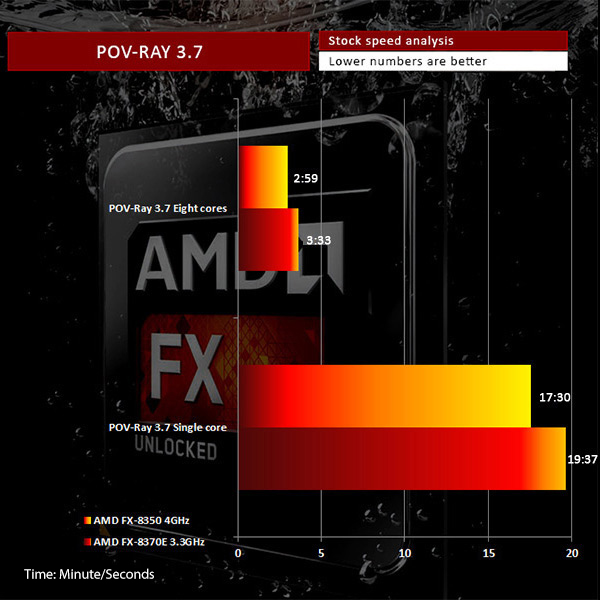
Running the test again on a single thread also proved damaging to FX-8370E as the single core loaded at 100 percent was clearly sufficient to hit the 95W TDP and that killed performance. While I was watching CPU-Z and Windows Task Manager I was able to see the FX-8370E initially increased its clock speed beyond 4GHz and then rapidly clocked back to 3.6GHz.
In other words the 3.3GHz base speed Turbo'd slightly to 3.6GHz which was better than I had previously seen – however it was a long way shy of 4.3GHz, the supposed maximum speed.Power draw
So how much power does it take to drive these test systems?
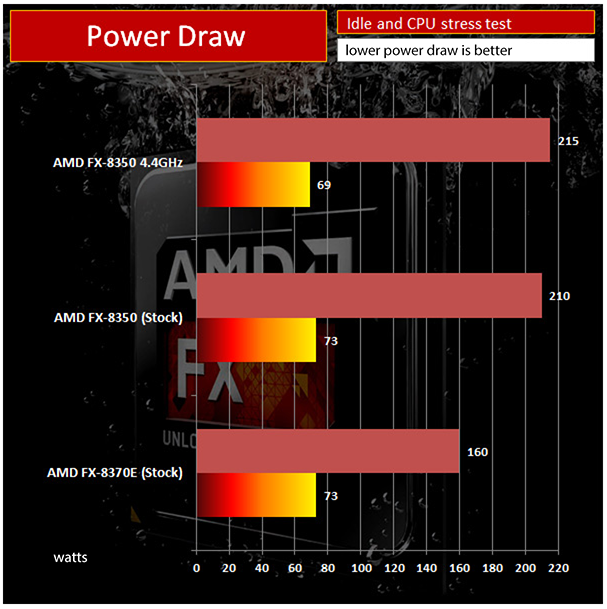
At the wall socket they draw 69W-73W whilst idling in the Windows desktop which seems pretty good but is higher than I would expect to see with a comparable Core i7 system.
Under load in a CPU test (where the graphics card plays little part) the FX-8350 system drew 210W, an increase of 137W. The overclocked FX-8350 required 215W, an increase of 146W, which is pretty much what you expect from a 125W TDP processor.
By contrast the FX-8370E system pulled 160W under load, an increase of 87W from idle. This means the FX-8370E requires 50W less than the FX-8350 which is much less than I expected, and certainly far greater than the difference between the 95W and 125W TDP of the two CPUs.
Temperatures


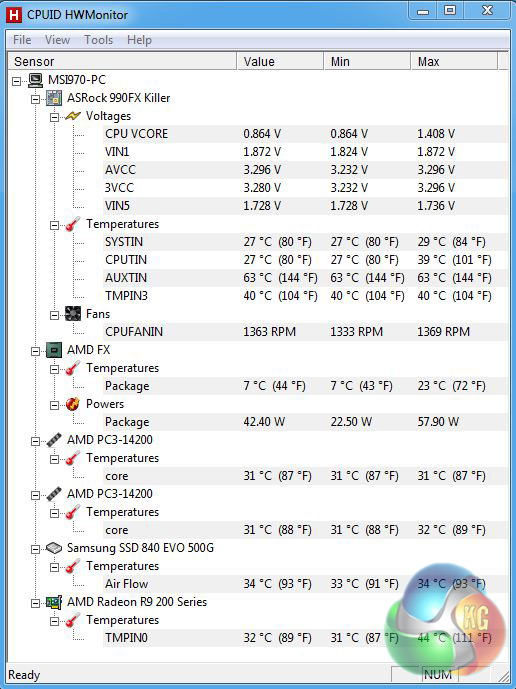
A reduction in power draw and TDP should be evident in the temperature figures that you measure within the CPU. The CPU package temperature for both FX-8350 and FX-8370E was in the range 36-39 degrees which means the CPU cooler was doing its job and all was well.
The HW Monitor utility reported a CPUTIN (CPU Temperature Index) figure of 47 degrees under load for FX-8350 that rose to 51 degrees when the CPU was loaded, whereas the FX-8370E ran at 23 degrees which is 24 degrees cooler.
That's an impressive reduction in temperature.
When I started testing AMD's FX-8370E I had the horrible suspicion that it might be faulty as the clock speed started at 3.3GHz and didn't seem to increase with Turbo. This meant the performance was significantly lower than the 4.0GHz/4.2GHz FX-8350 – which didn't seem right.
The explanation is that FX-8370E rapidly hits its 95W TDP when it is under load. When the cores are heavily loaded the clock speed will throttle back until you have a 3.3GHz or 3.6GHz CPU.
AMD calls the FX-8370E a 3.3GHz/4.3GHz part but, to our way of thinking, it is effectively a 3.3GHz/3.6GHz CPU and it would be more appropriate to rename this processor as an FX-8310 with a 95W TDP and slot it in below the 125W FX-8320. You would also need to price it at £99 to achieve any kind of ‘winning feeling'.
While it's good that the FX-8370E draws less power, it's still high and not recommended for a small chassis. To get it anywhere near ‘cool and quiet' will require work on the cooling.
The biggest problem that we see with AMD's FX-8370E, is that people who buy a chip labelled as ‘4.3GHz' will expect it to run at that speed when they need performance the most. In all likelihood, your FX-8370E will top out at 3.6GHz when the going gets tough. For a chip costing £145 inc vat that seems a little stingy.
Ultimately, you will get similar performance with a lower power draw by looking at an Intel chip. If you go with AMD's FX family, then bear in mind that the monster 4.4GHz FX-9370 is only £10 more and the 4GHz 8350 is just £128. The pricing of the FX8370E is just wrong.
Discuss on our Facebook page, over HERE.
Pros:
- Compatible with existing AM3+ boards
- Uses 30w less than previous version
- Enough performance for mainstream users
Cons:
- Rapidly hits power limit, which disables the turbo boost.
- Hard to achieve the claimed 4.3GHz in regular use, in most cases it tops out at 3.6GHz.
- Uses Piledriver rather than Steamroller technology.
- Pulls almost 50% more wattage than equivalent Intel Core i5 with no clear performance win.
- Expensive.
KitGuru says: One of the biggest challenges facing mankind in the 21st century will be power. Bills are increasing, alternative sources are being investigated and, for the first time, gamers and enthusiasts are wondering if they can ‘get away with less'. As it stands, this AMD processor is £145 in the UK (inc vat), which is not cheap, and it uses around 95 watts. If power saving is your aim, then it's hard to ignore the fact that the AMD FX-8370E will draw significantly more power than an Intel processor in the same class. Hardly ‘Eco' by any stretch of the imagination. If you're hunkering for 8-core FX-8xxx action from AMD, we'd suggest the full blown 8370 that's currently attacking world records.