KitGuru KitGuru.net – Tech News | Hardware News | Hardware Reviews | IOS | Mobile | Gaming | Graphics Cards


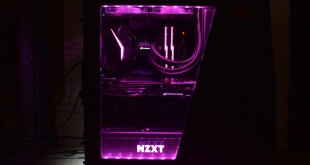
Priced at £1614.99, CCL's Athena Aura boasts a Kaby Lake i5-7600K and a GTX 1070 graphics card. Incidentally, that graphics card is an ASUS ROG model which is clearly a bit of a theme with this system – the motherboard is also a ROG product, while the NZXT Noctis 450 is the special ‘ROG edition.' The benefit of that is, performance aside, all the components can synchronise their RGB lighting via ASUS' Aura software – hence the name, ‘Athena Aura'.
However, at this price, we are far more interested in how well-built and how fast the CCL Athena Aura really is. Considering its core components, the on-paper spec does look like that of a very solid mid-range system, so let's dive right in and see how the Athena Aura performs.
Specification
- Intel Core i5-7600K
- Corsair Hydro H100i v2 CPU Cooler
- ASUS ROG STRIX Z270F Motherboard
- G.Skill Trident Z RGB 16GB Dual Channel 3200MHz
- ASUS GeForce GTX 1070 STRIX
- Samsung 960 EVO 250GB M.2 SSD
- Seagate BarraCuda 2TB 3.5” HDD
- Corsair TX550M PSU
- NZXT Noctis 450 ROG Chassis
- 3 Year On-Site Warranty
Price: £1614.99 inc. VAT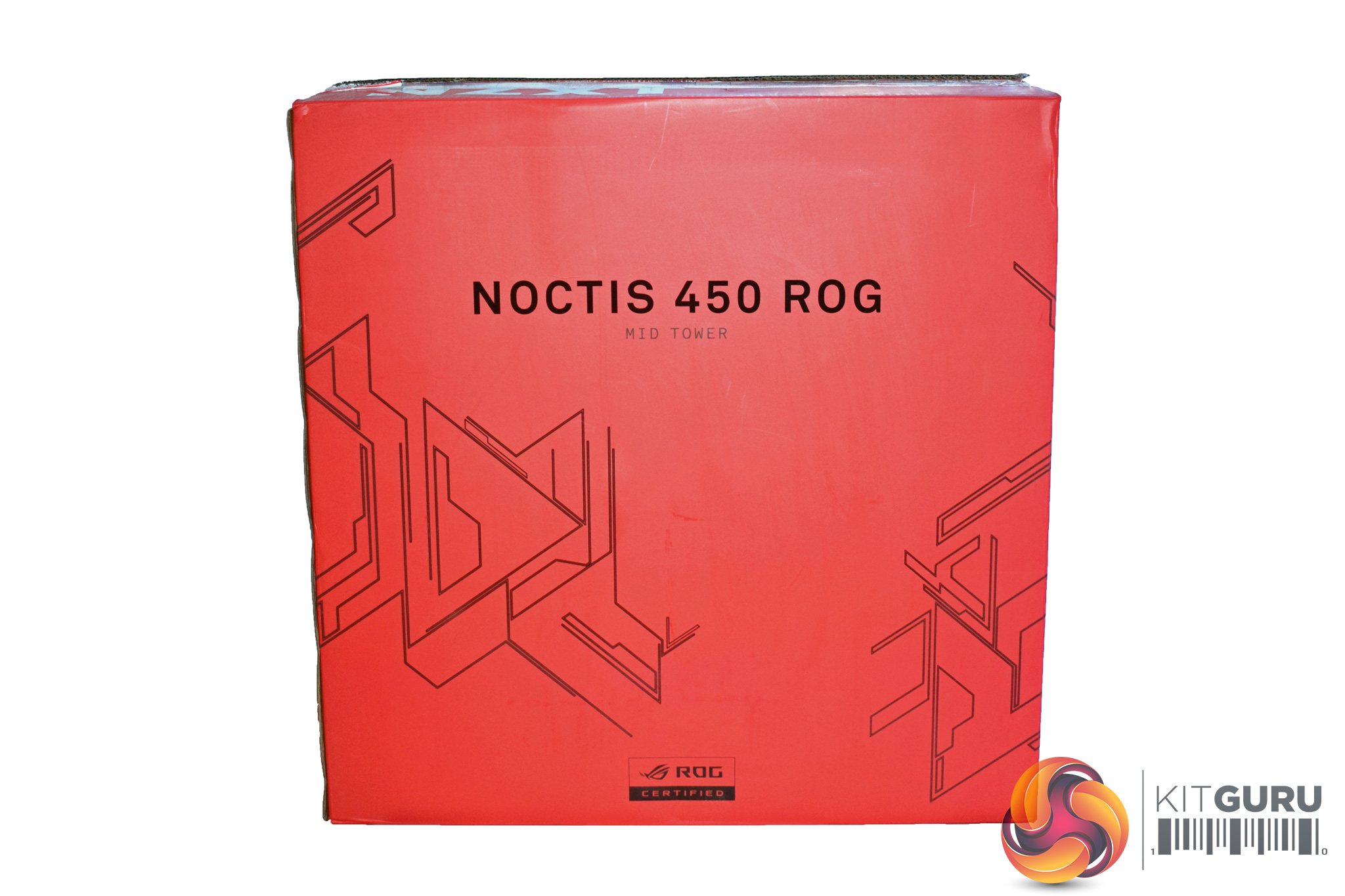
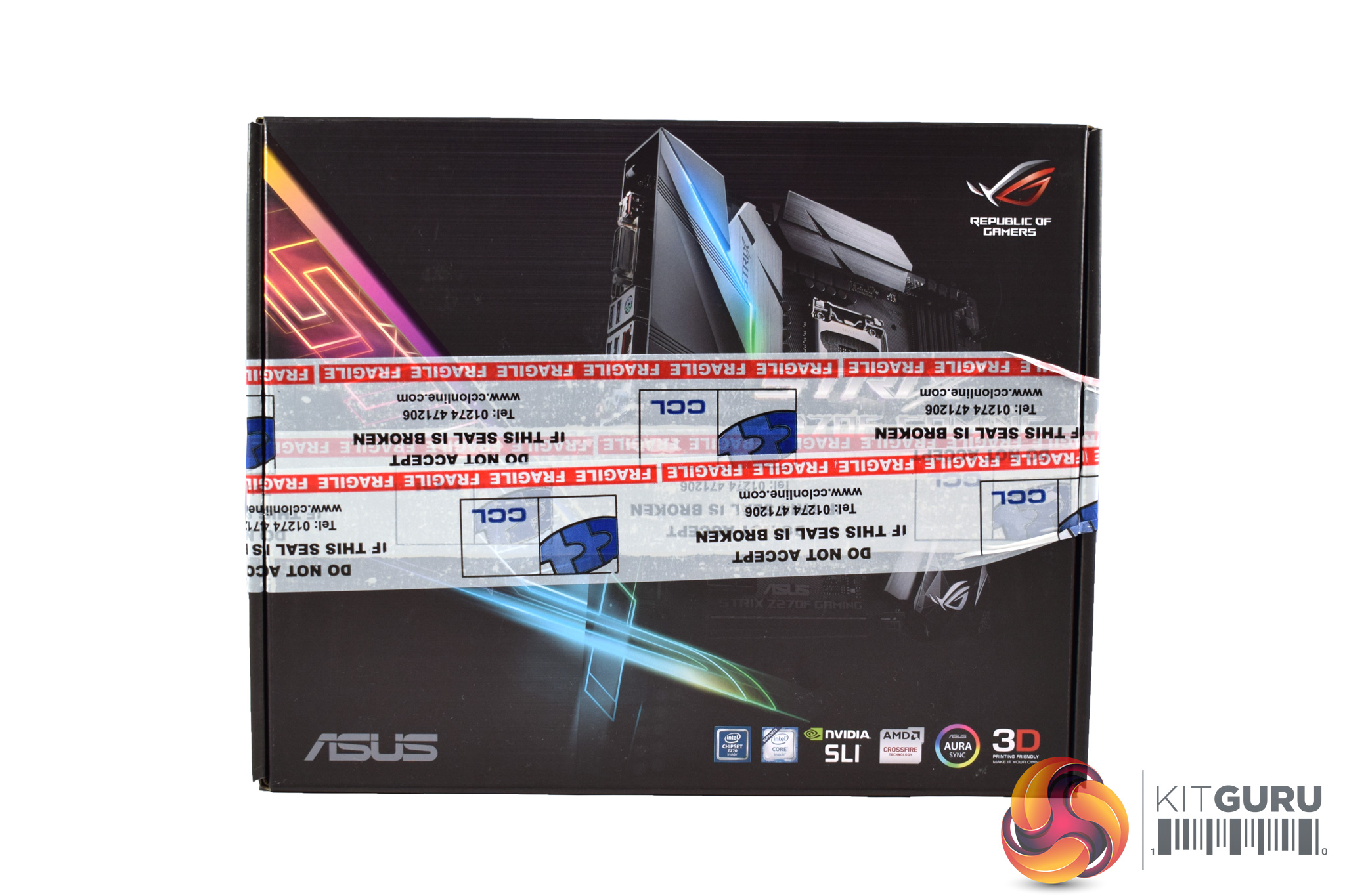
As expected, the CCL Athena Aura ships in the red Noctis 450 ROG box, while the motherboard box is also included, filled with things like extra cables, screws and accessories.
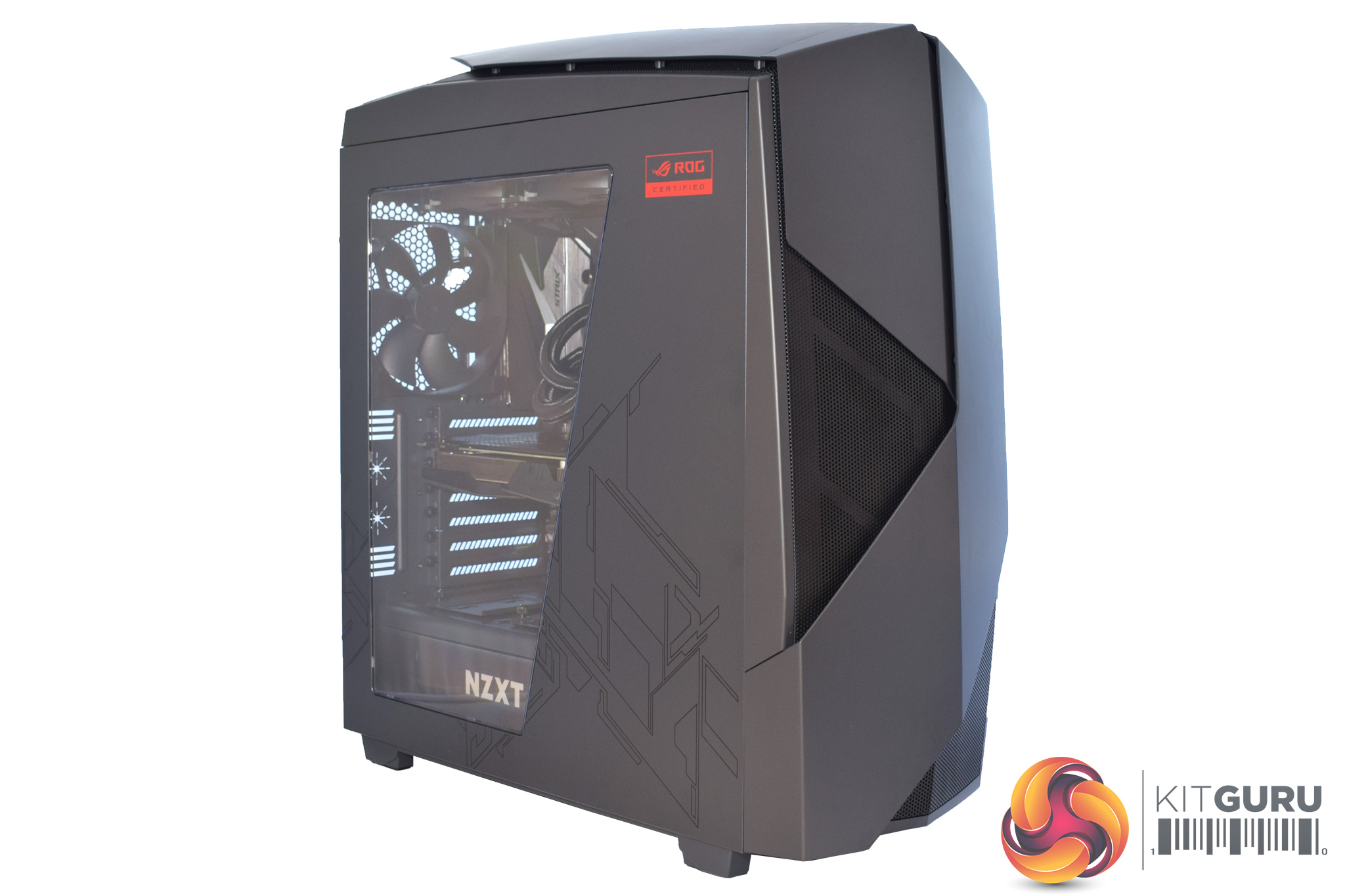
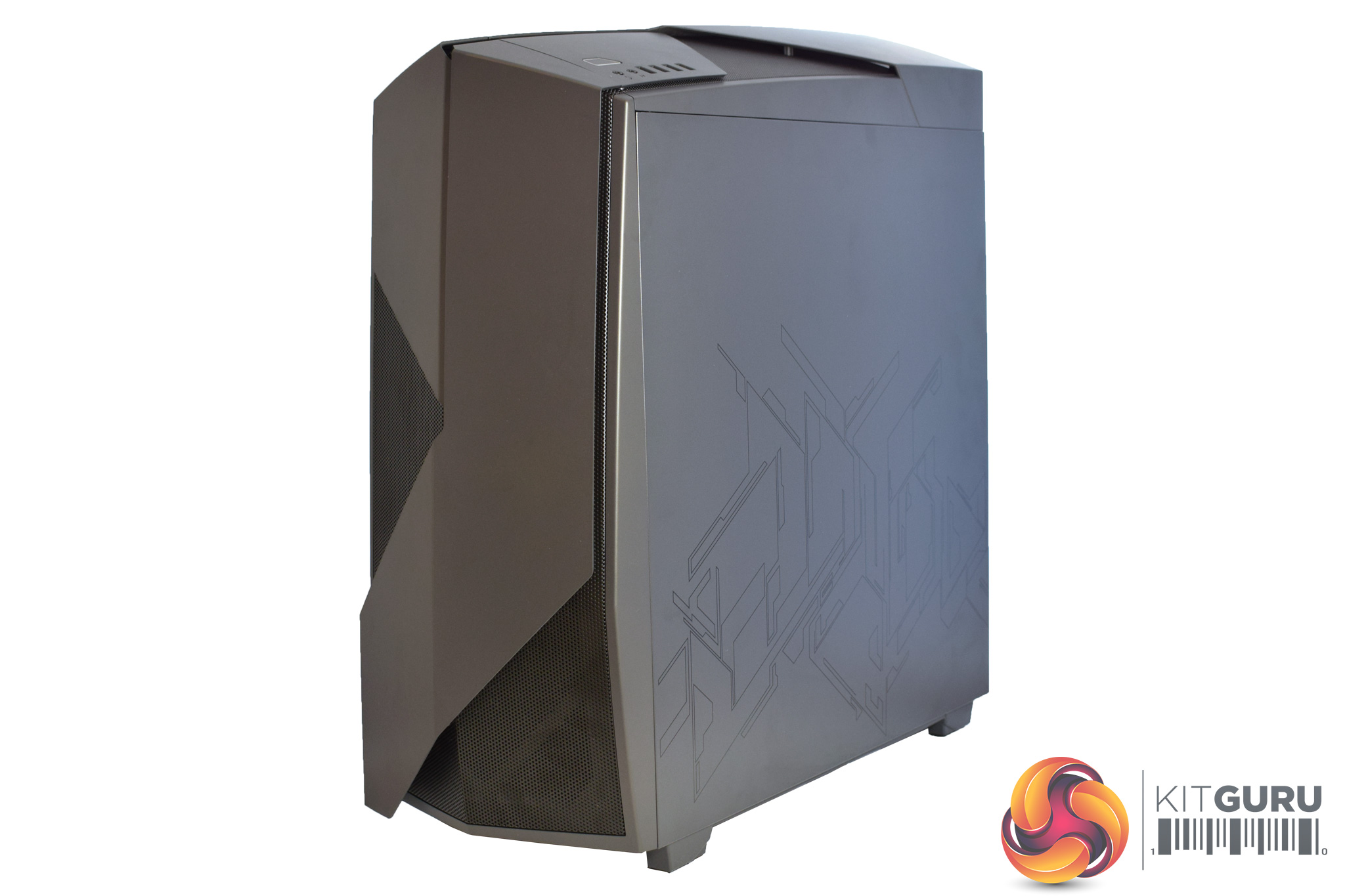
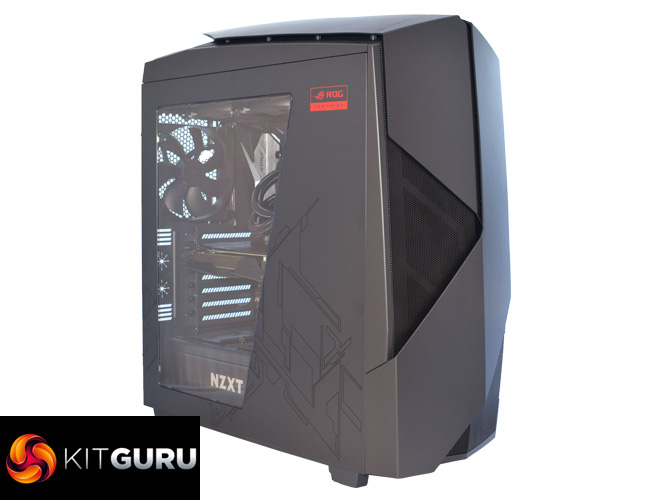
Taking our first look at the system, the Noctis 450 immediately grabs your attention with its aggressive angles and meshed sections.
We did a full review of this case, but this ROG edition has been enhanced slightly, as you can see the ‘Mayan-inspired' detailing on both side panels – something which is a feature of all ROG products. I think it looks great and it will definitely appeal to ROG fans.
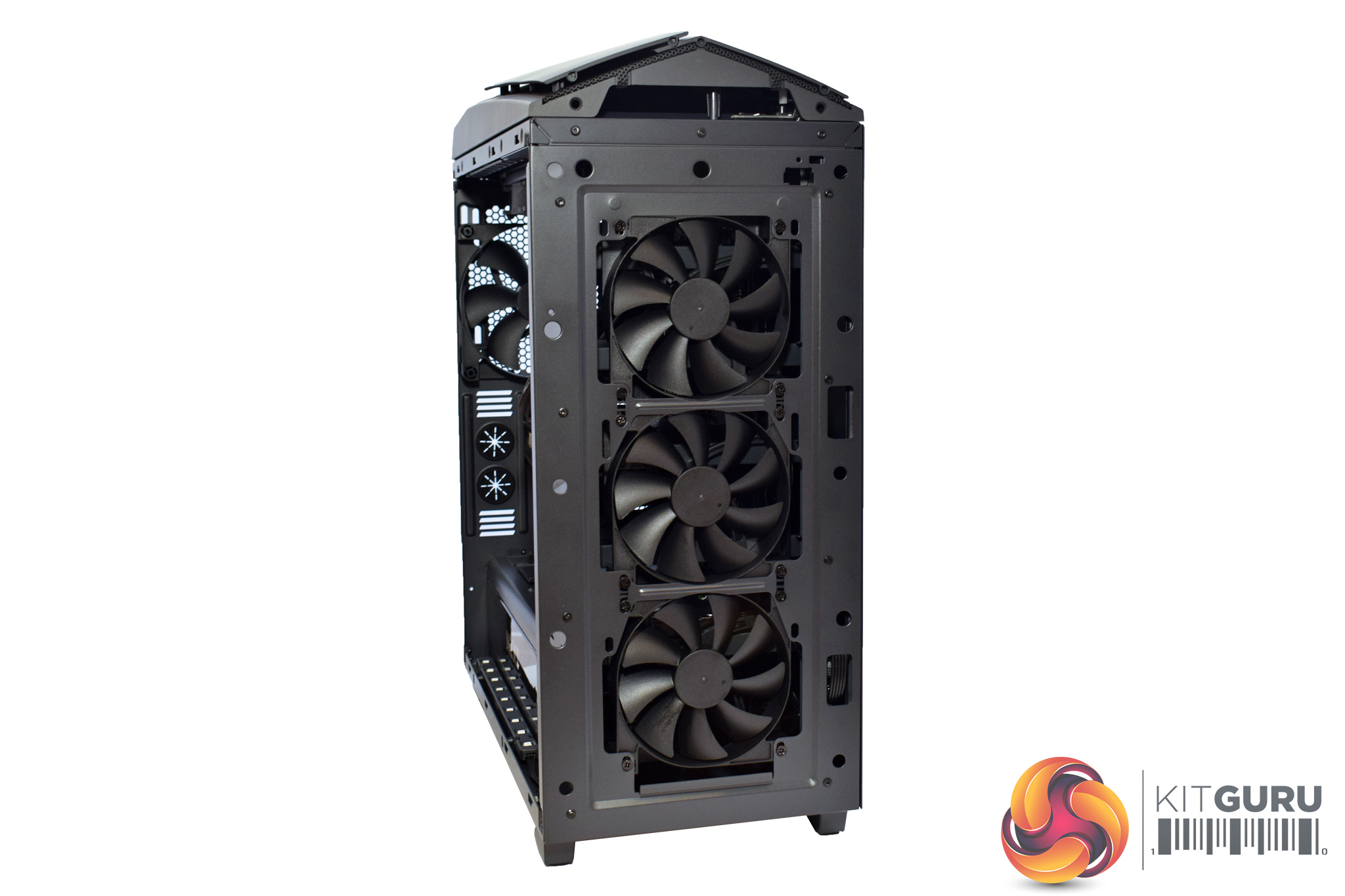
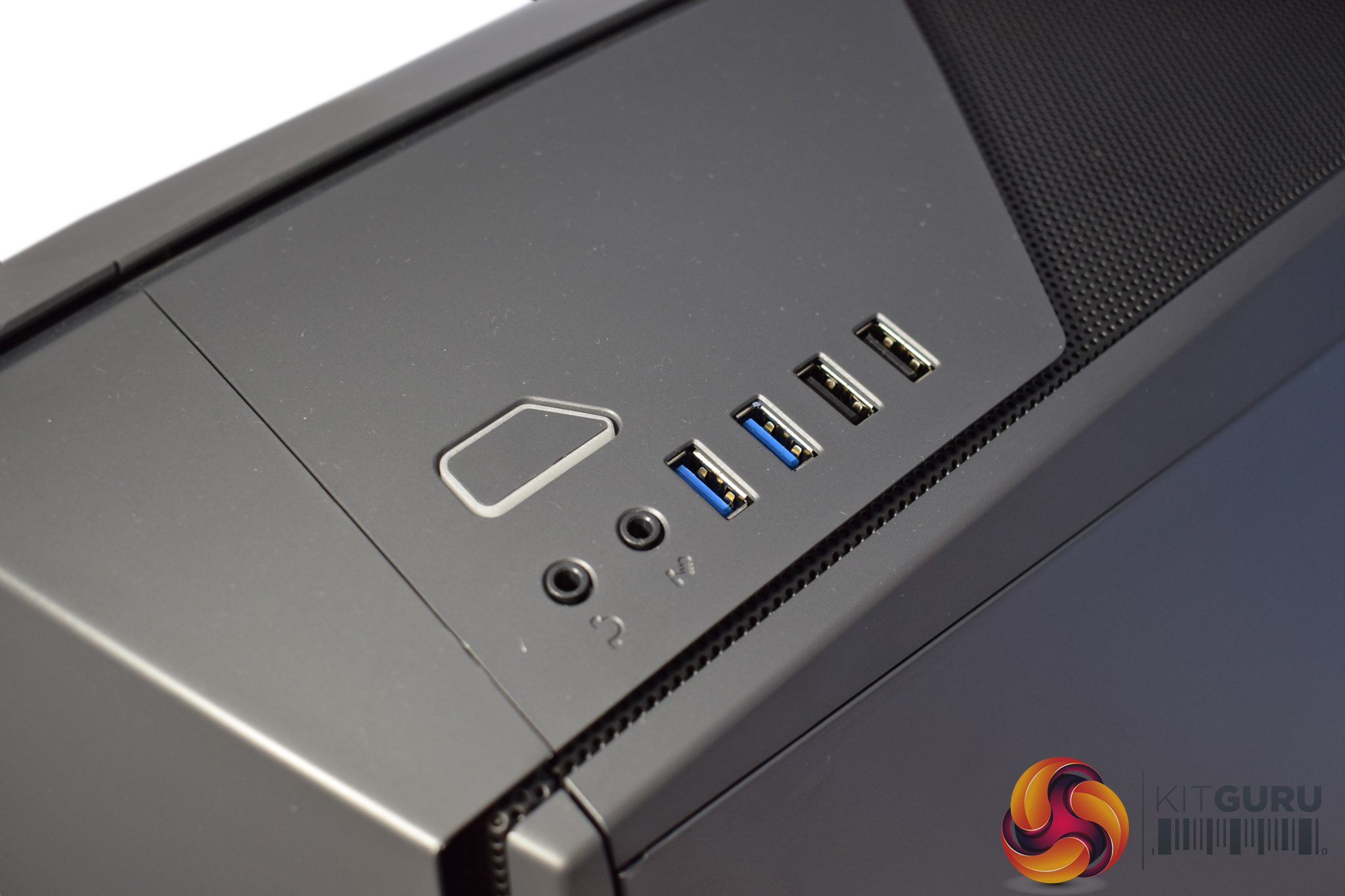
Prising off the front panel reveals 3x 120mm fans acting as intakes.
The front I/O is found on the top panel and consists of headset jacks, 2x USB 3.0 and 2x USB 2.0 ports.
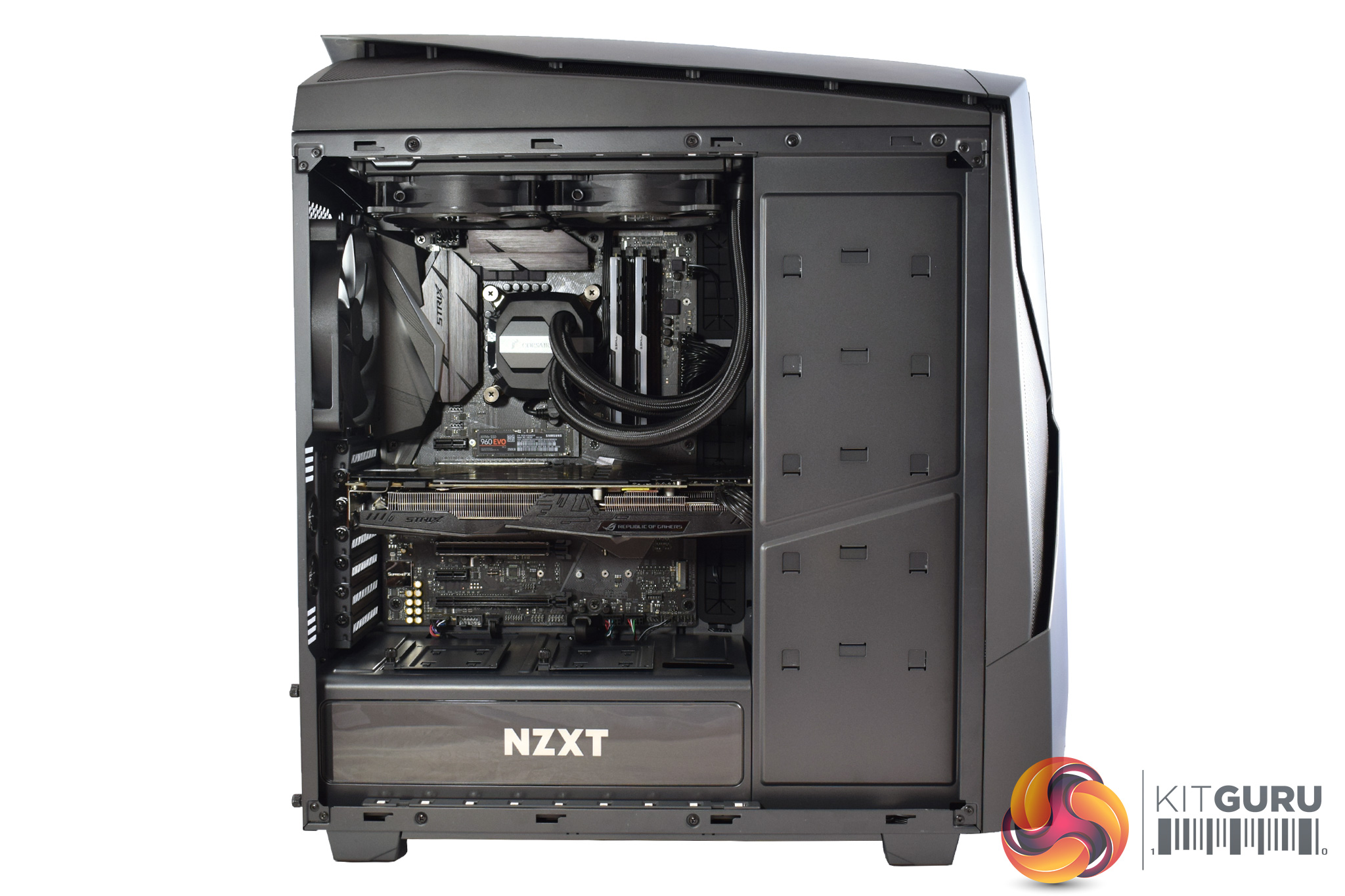
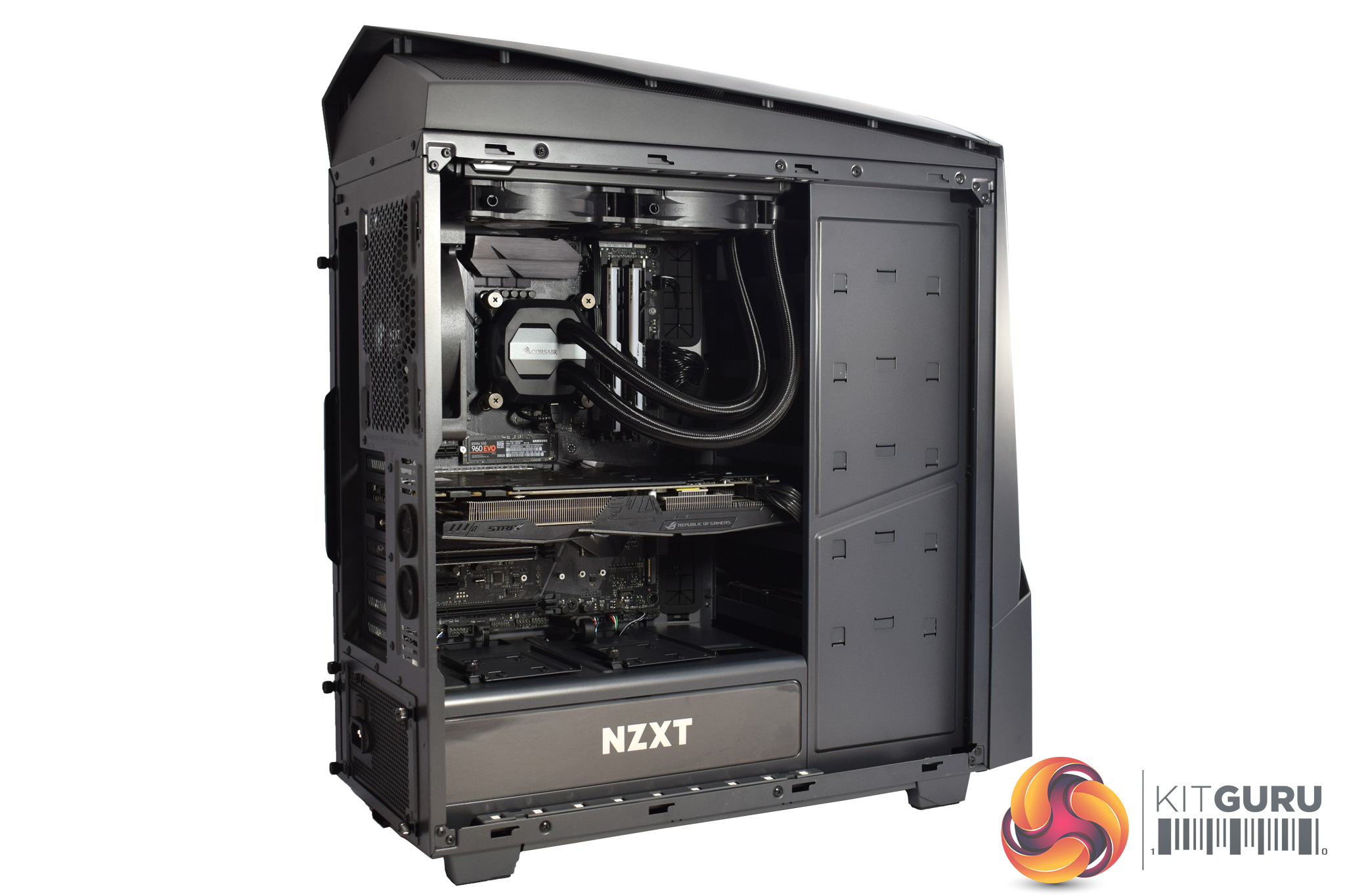
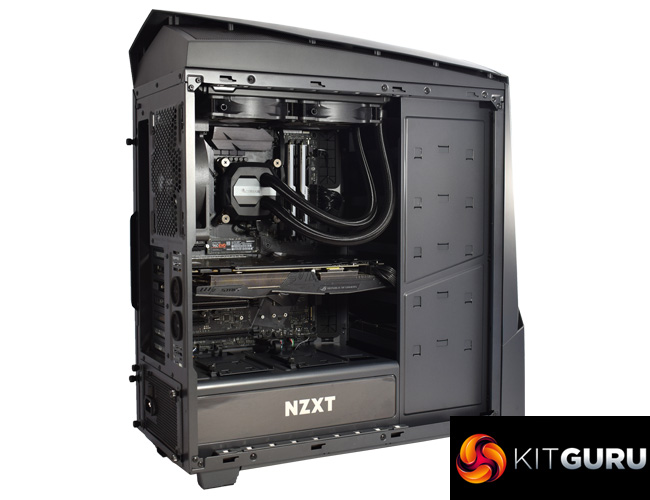
Removing the side panel reveals the system itself and it is safe to say it is very well built. Not only is everything black – creating a very stealthy look – but the cables have also been managed very well, to the point where it looks like there might not be any cables at all.
On the topic of colour-scheme, I did mention that everything is all-black – but that is until you turn the system on. Then the RGB lighting comes into play, and we will look at that below.
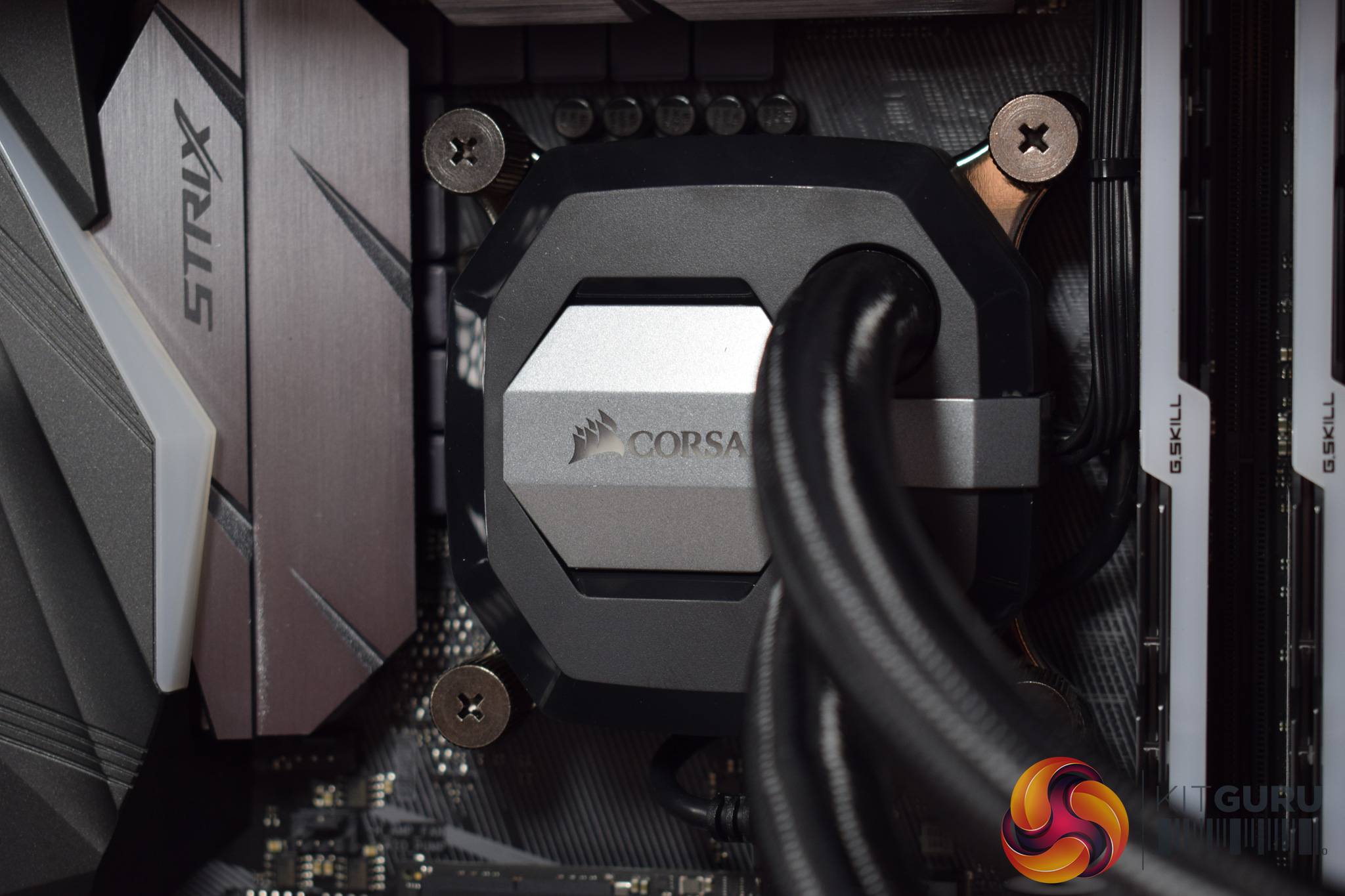
Starting with a tour of the components, the i5-7600K is cooled by a Corsair H100i V2 240mm liquid cooler. This is all well and good, but I was disappointed to discover that the CPU is not overclocked – it has been left at stock clocks, meaning it will turbo boost to 4.2GHz but no higher. Considering Kaby Lake processors are best when overclocked to the max, it is a shame to see the i5-7600K left untouched here.
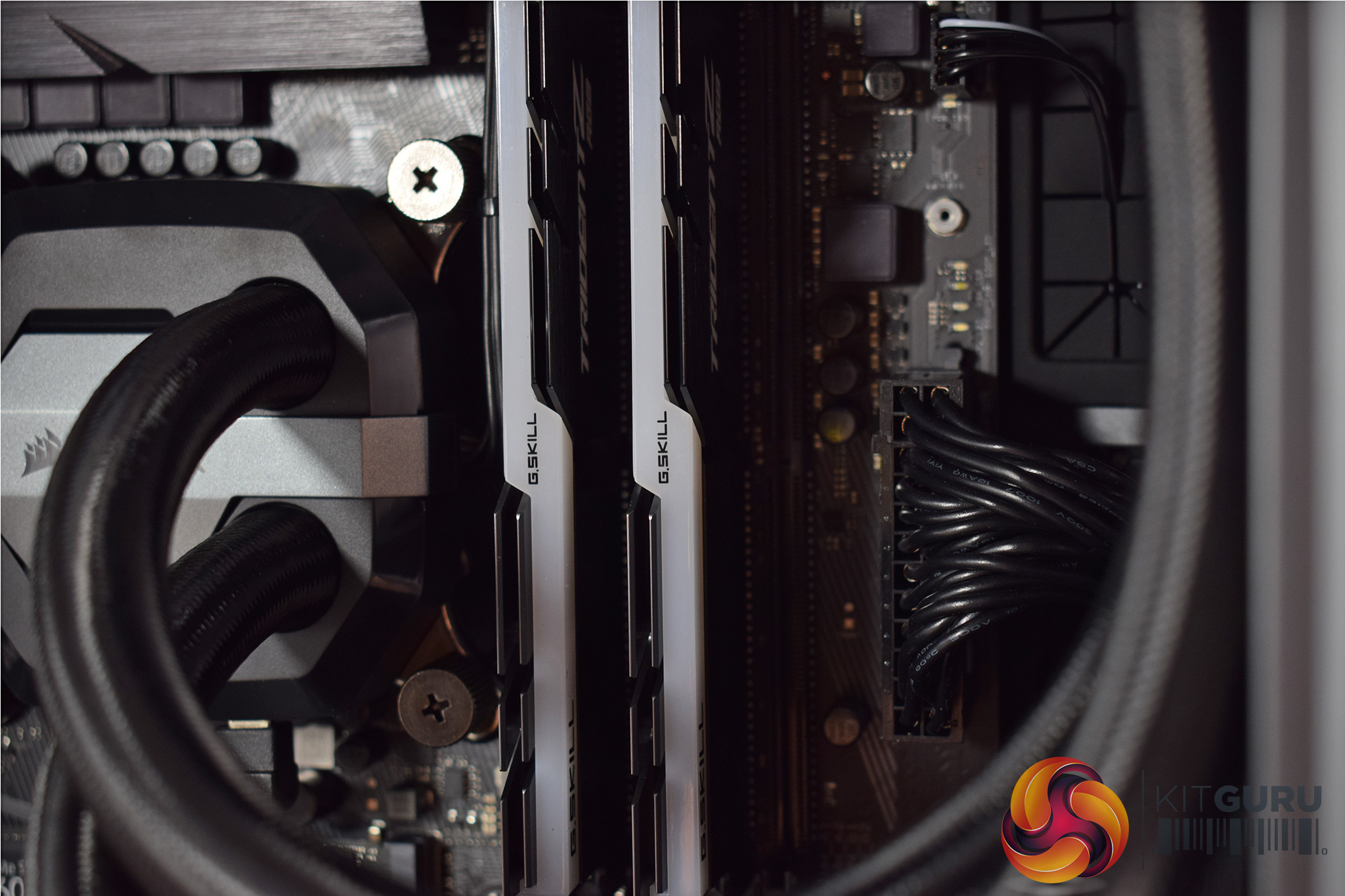
To the right of the cooler we find 2x8GB of G.Skill 3200MHz Trident Z RGB memory, which we looked at in detail over here. It looks off-white when the system is turned off, but oh boy just wait until its turned on!
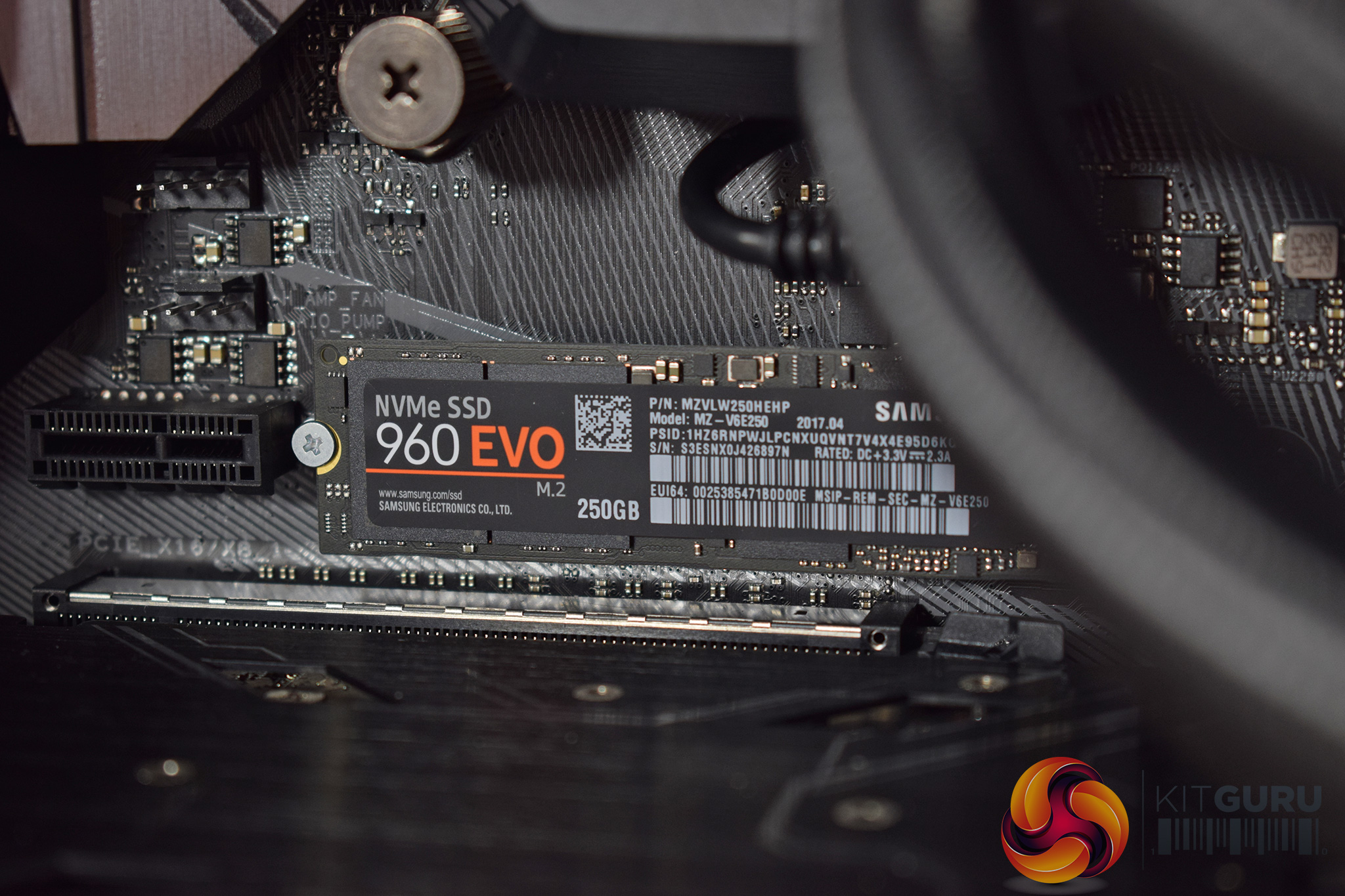
Positioned just below the H100i V2's pump is our NVMe storage, the Samsung 960 EVO SSD. CCL has fitted the 250GB model and that is a good size for Windows plus a few choice applications.
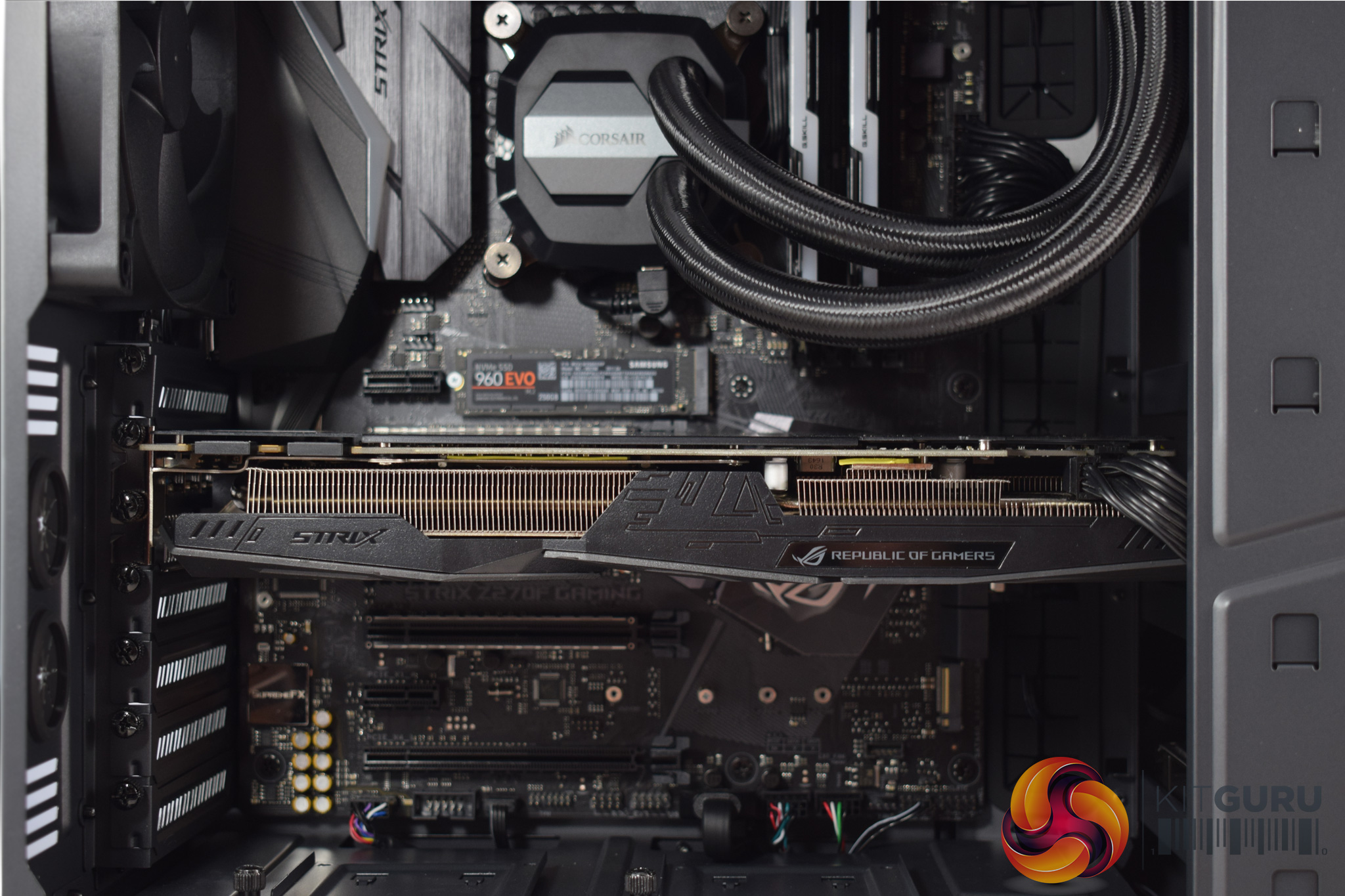
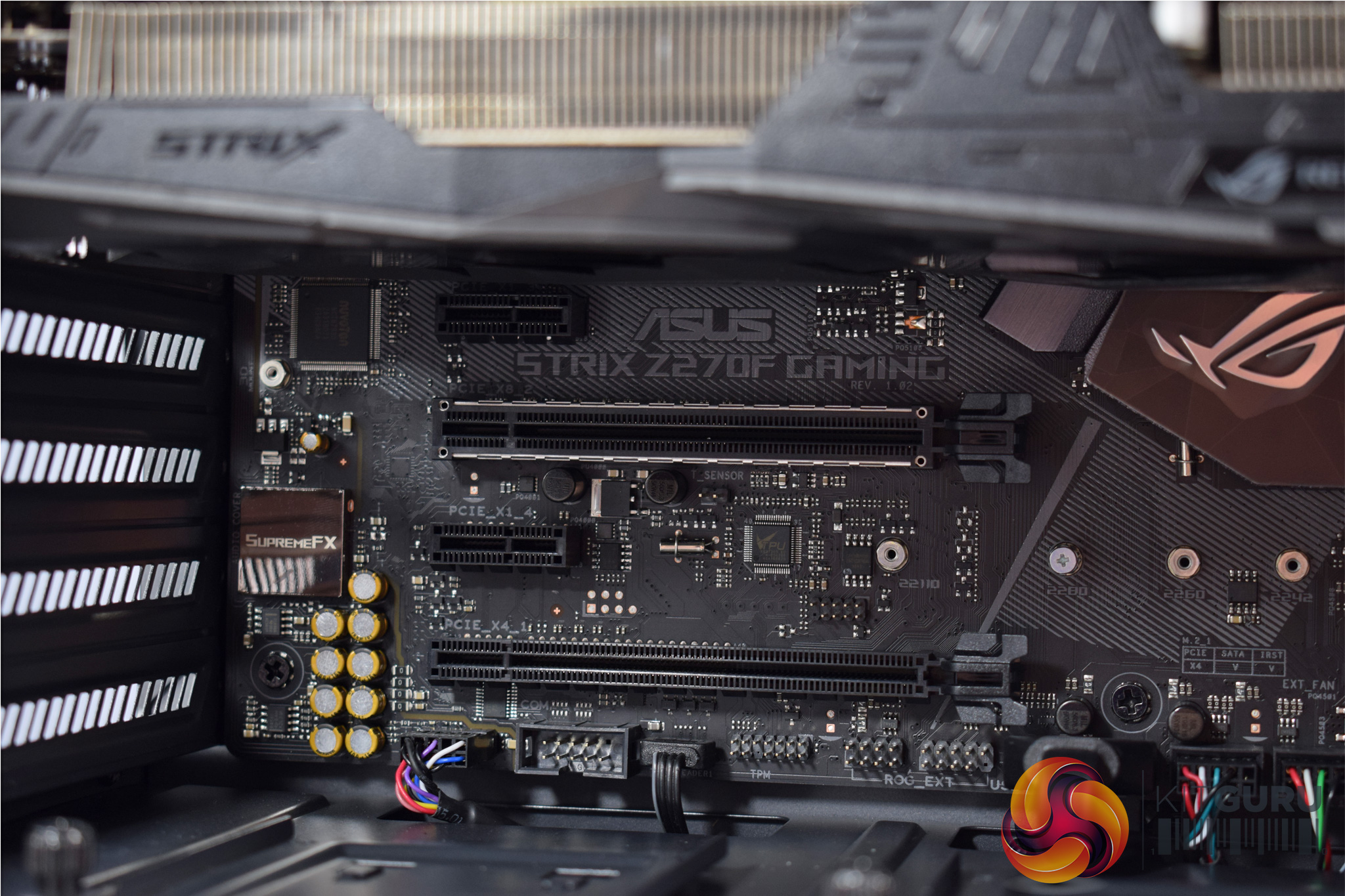
Next, we come to the graphics card. The ROG Strix GTX 1070 is a triple-fan beast and won our top award when it first launched last year, so we can expect good things from it here.
Incidentally, the Strix Z270F motherboard has two spare PCIe x16 slots so there is definitely scope for SLI in the future, should you want to go down that route.
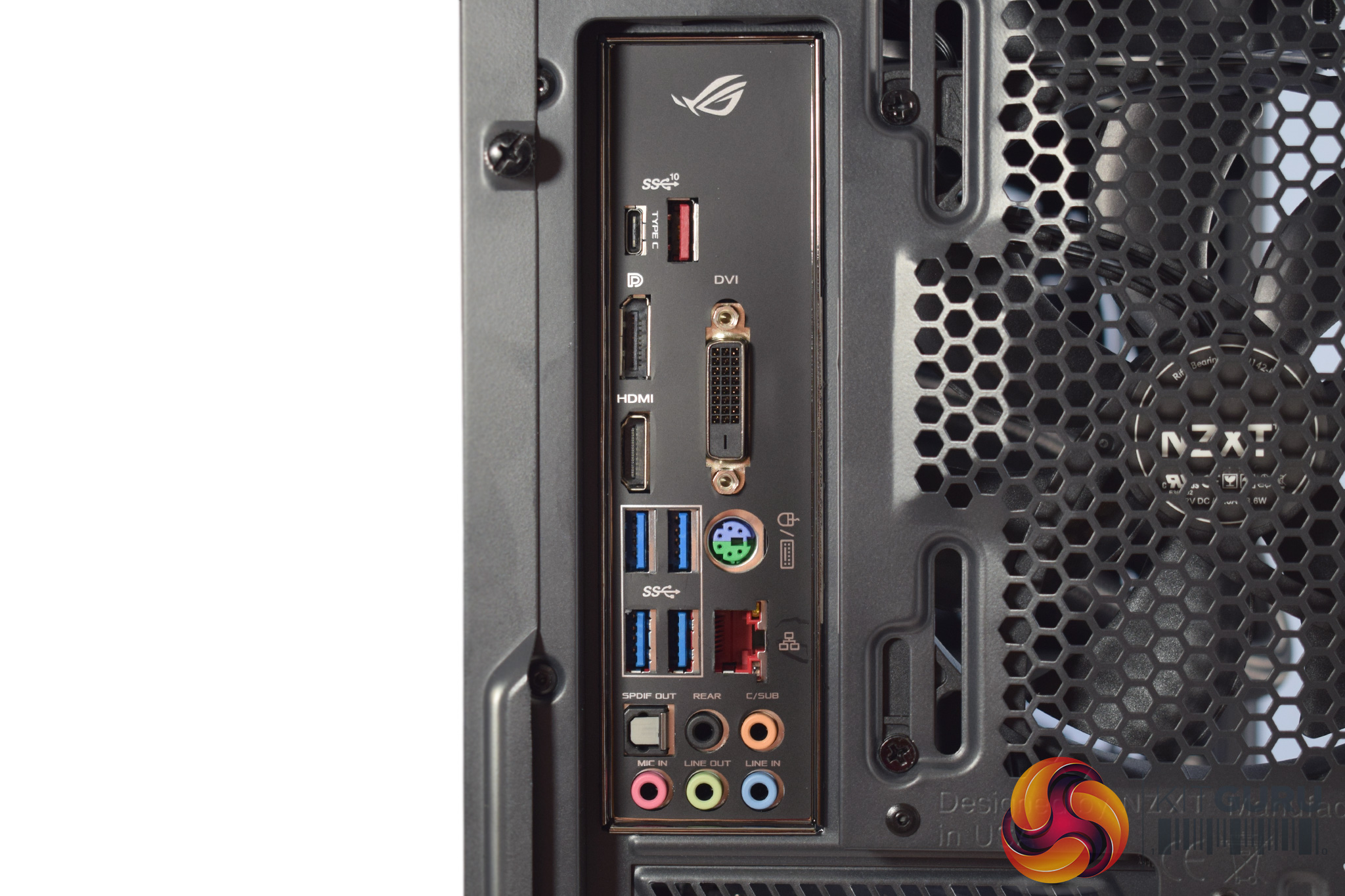
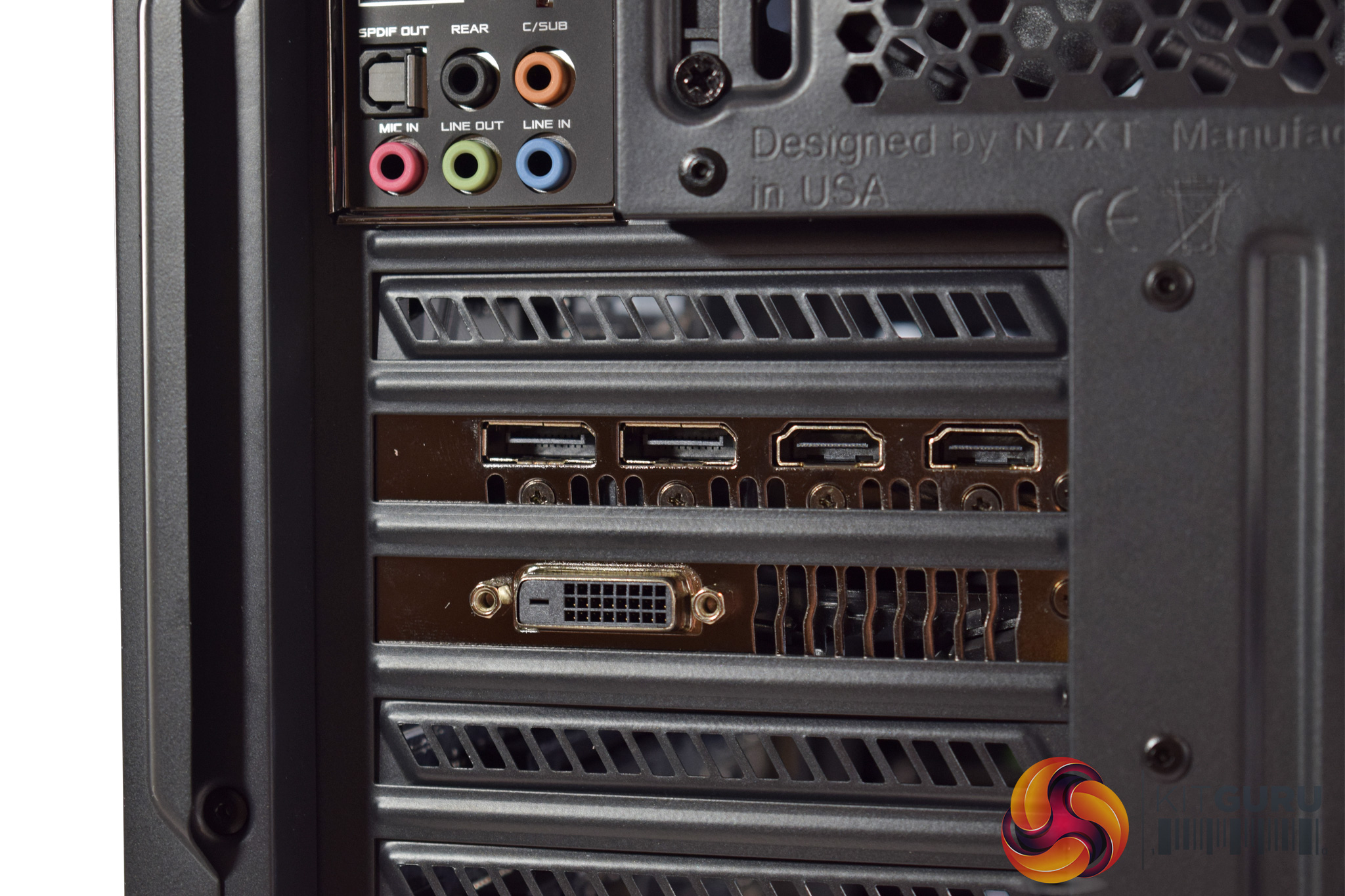
The motherboard has the following rear I/O ports: 1 x PS/2 keyboard/mouse combo port(s), 1 x DVI-D, 1 x DisplayPort, 1 x HDMI, 1 x LAN (RJ45) port, 2 x USB 3.1 Gen 2 Type-A + USB Type-CTM, 4 x USB 3.1 Gen 1 (blue), 1 x Optical S/PDIF out, 5 x Audio jack(s).
The graphics card has 2x DisplayPort, 2x HDMI and 1x DVI ports.
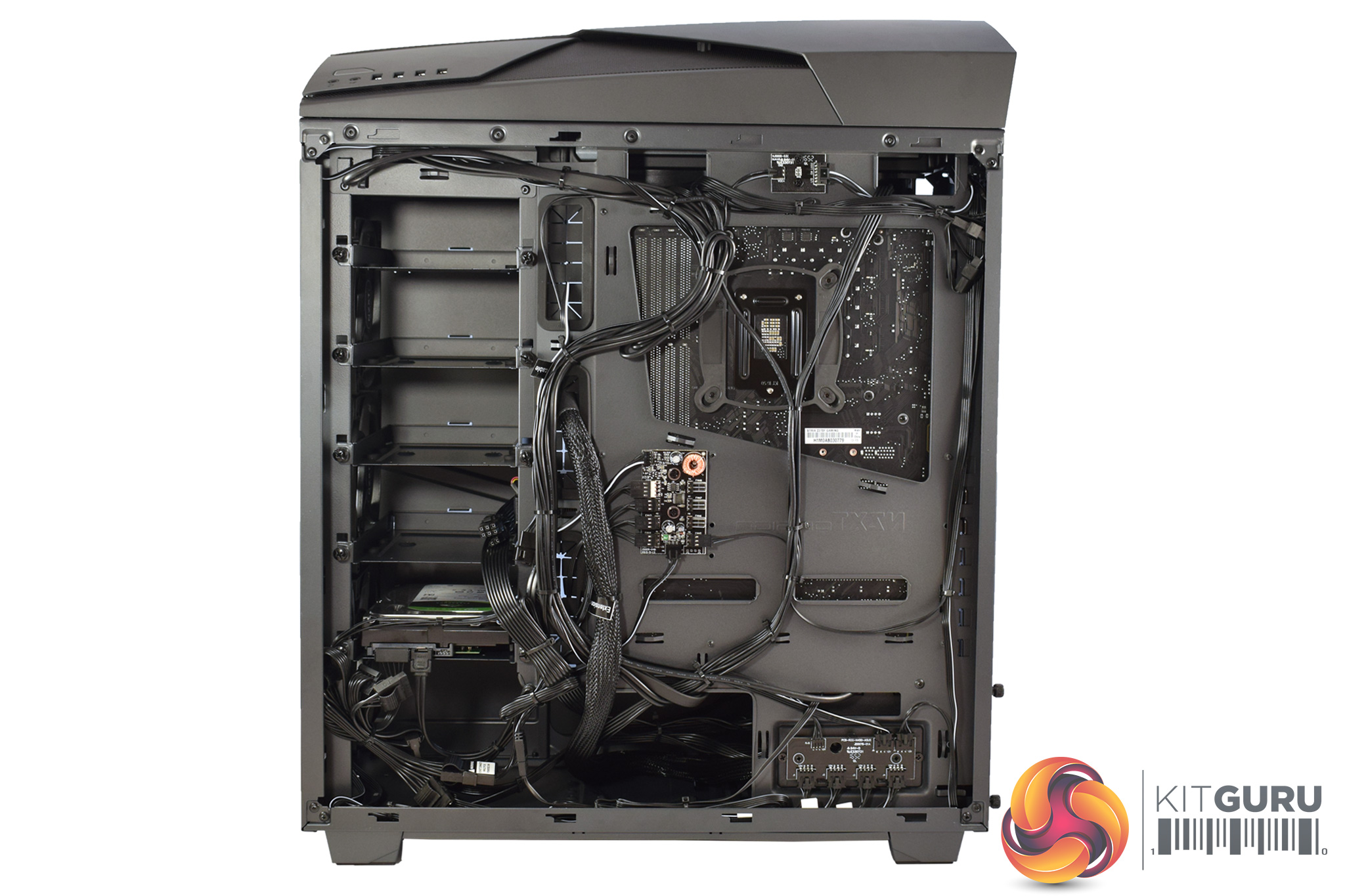
Turning to the back of the system, rear cable management is decent but there is a lot of cabling to hide and it does look a bit messy. Still, it is functional and did not cause me any problems while on test.
What we can't see is the Corsair TX550M power supply tucked away in the bottom right-hand corner. This is an 80+ Gold certified unit and its wattage should prove more than enough for this system.
Lastly, on the left-hand side, we find the 2TB Seagate Barracuda drive which offers a good capacity for users' files and media libraries.
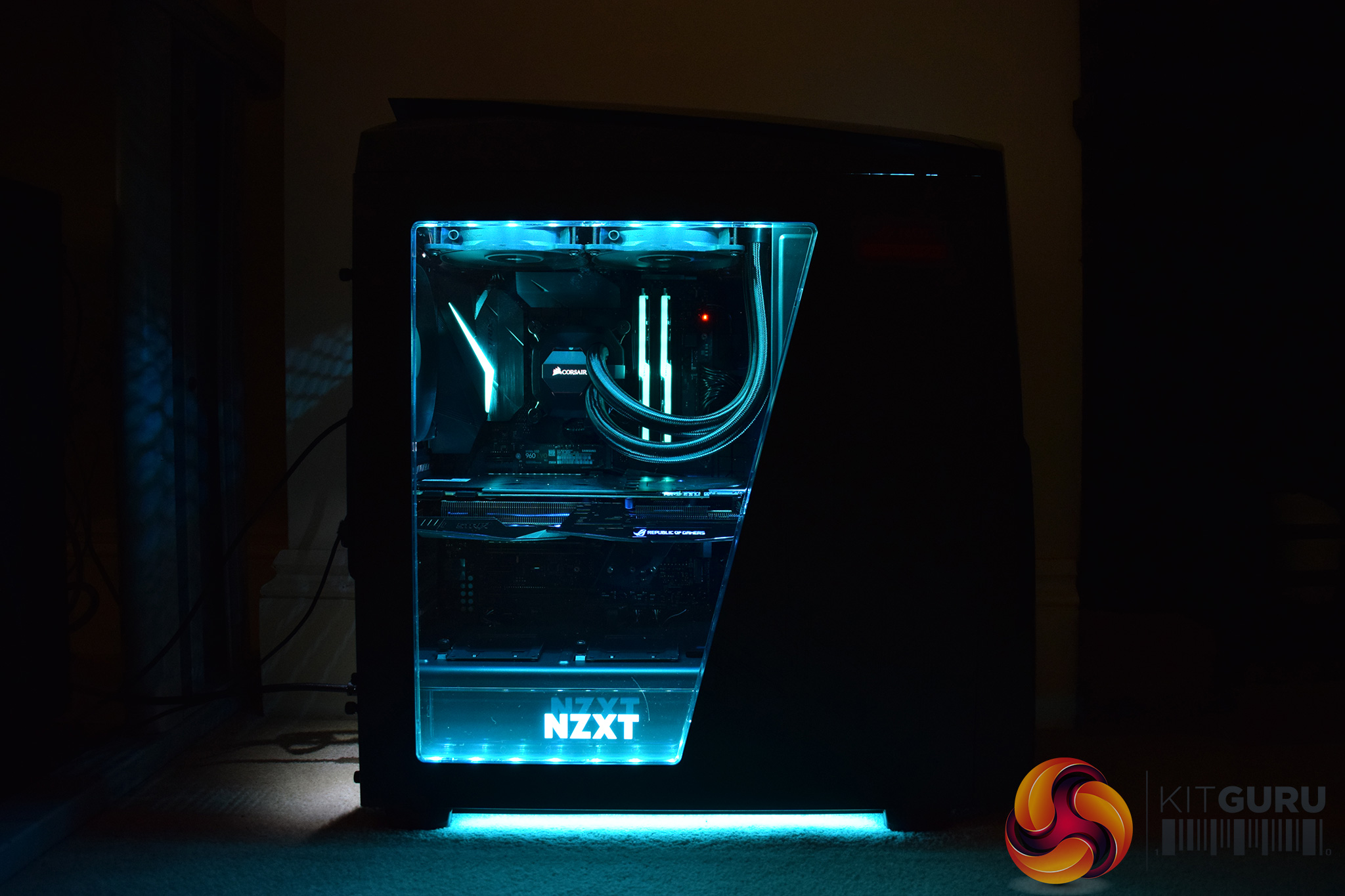
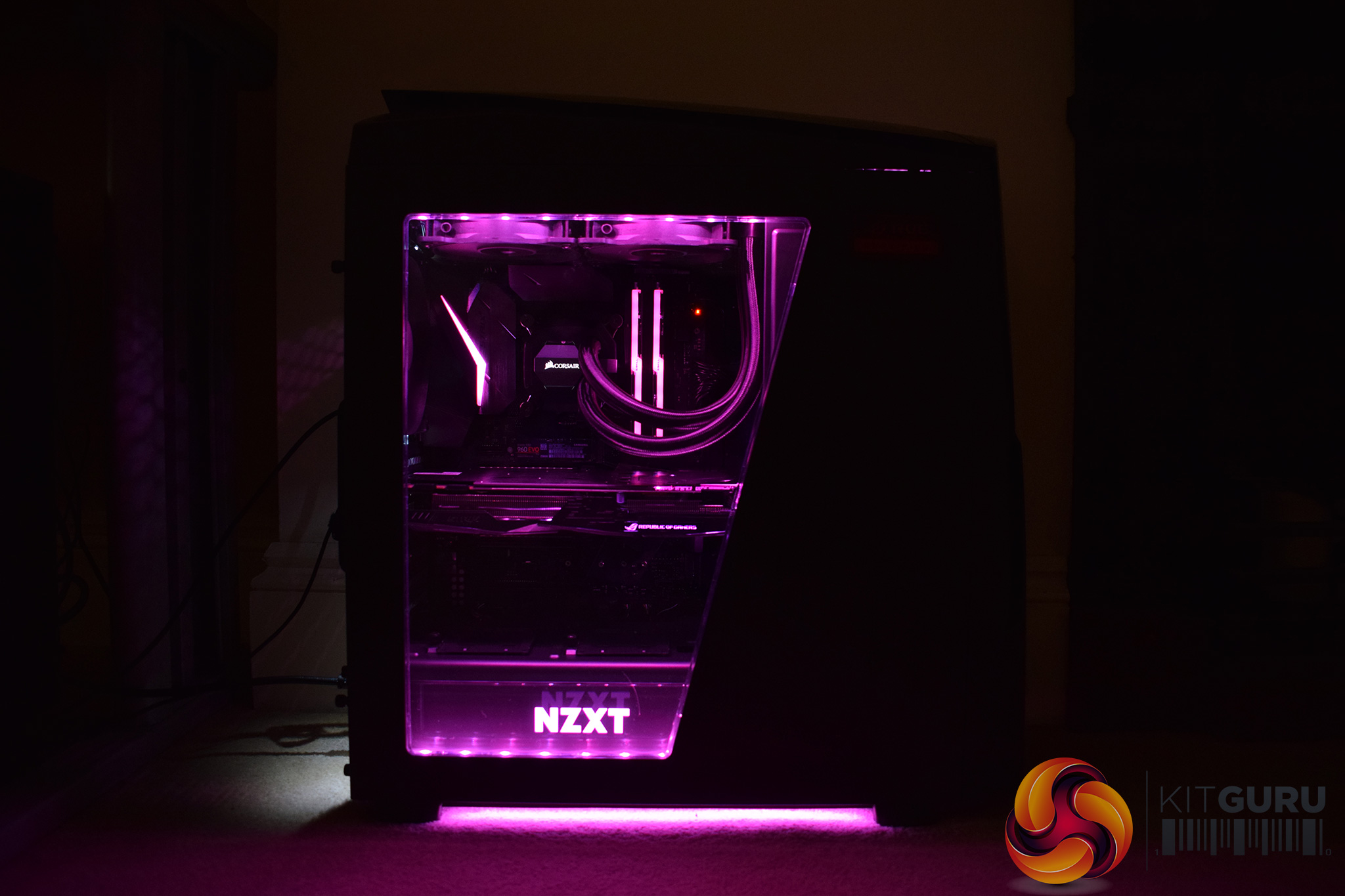
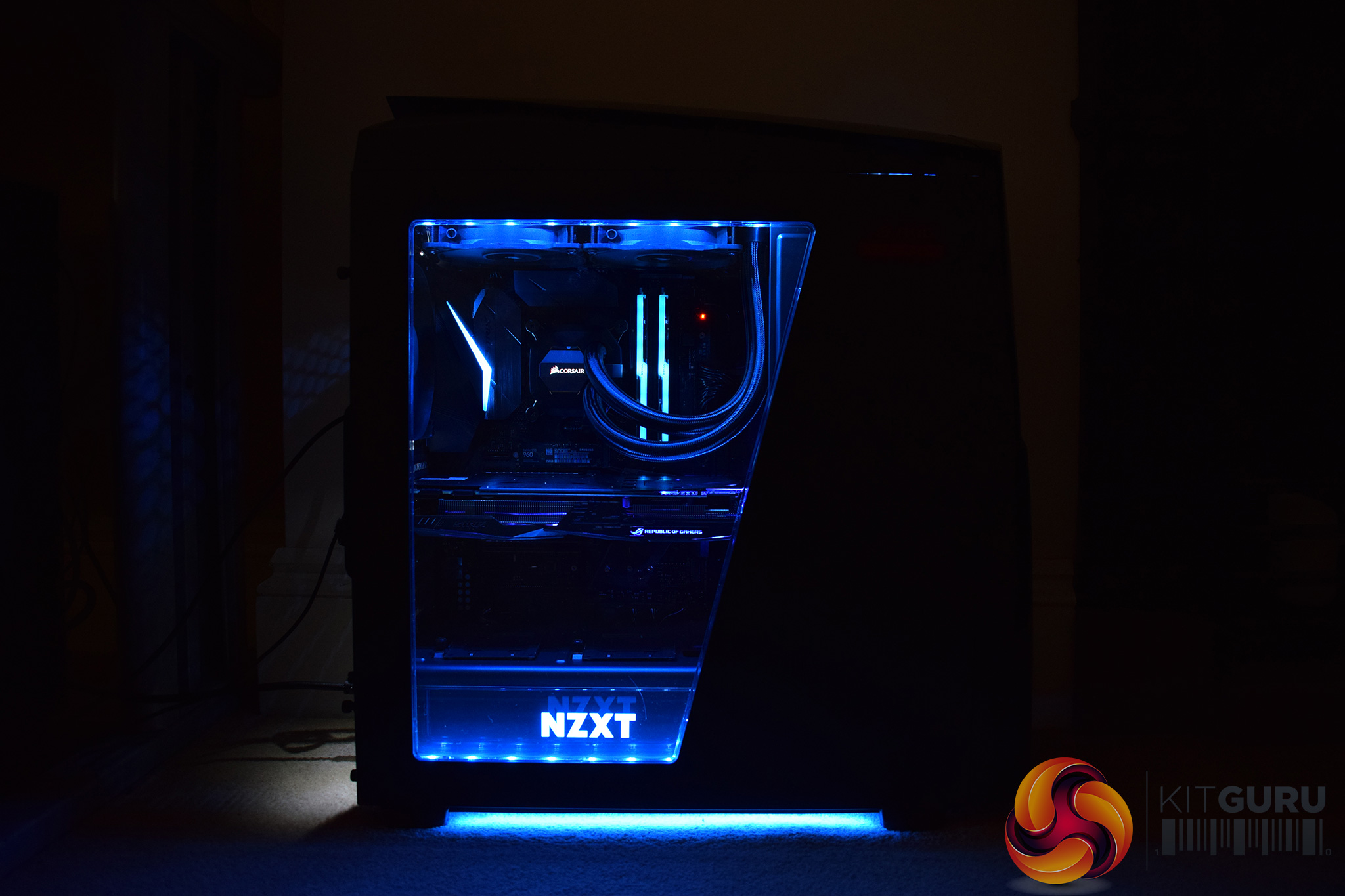
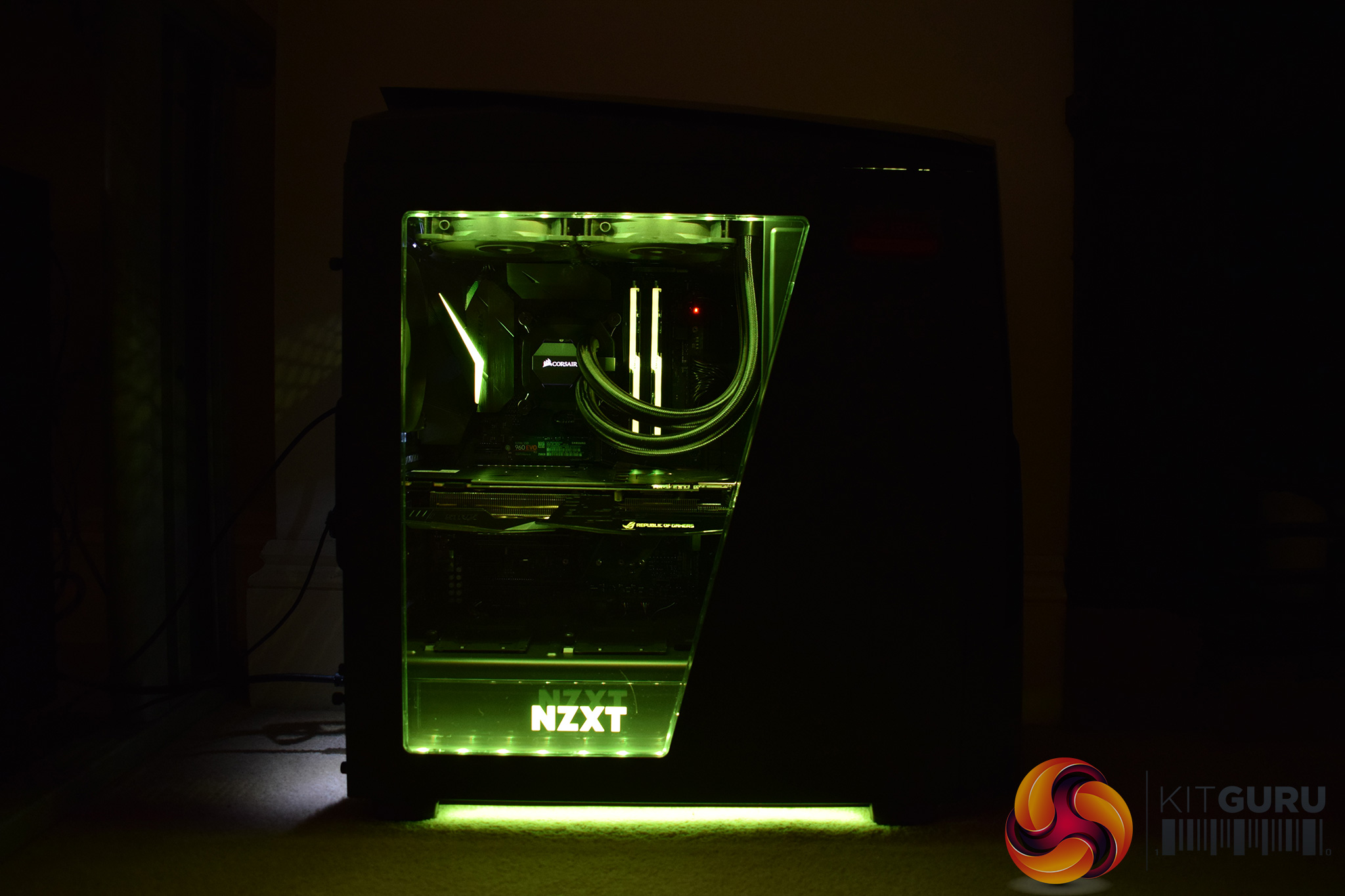
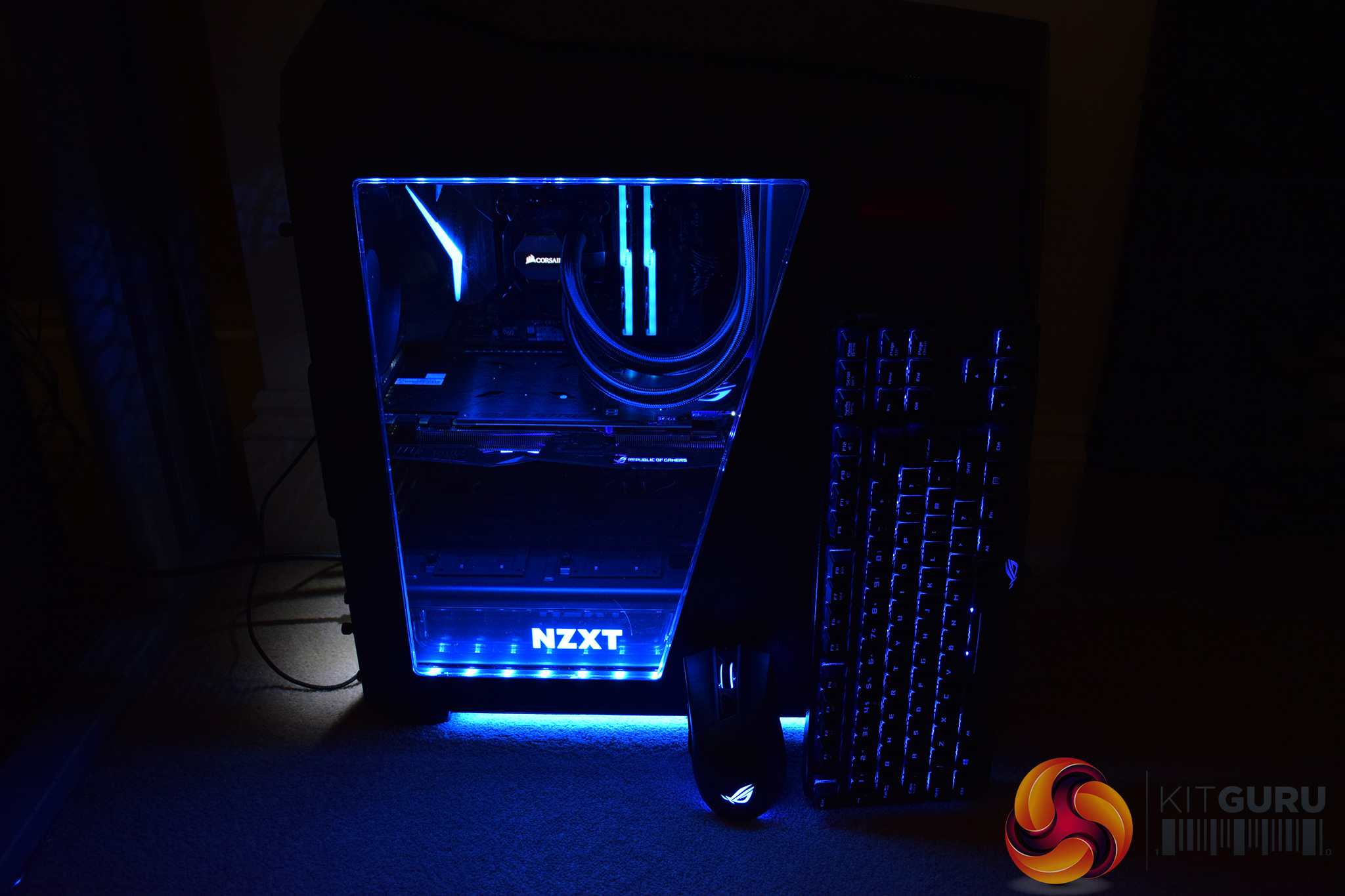
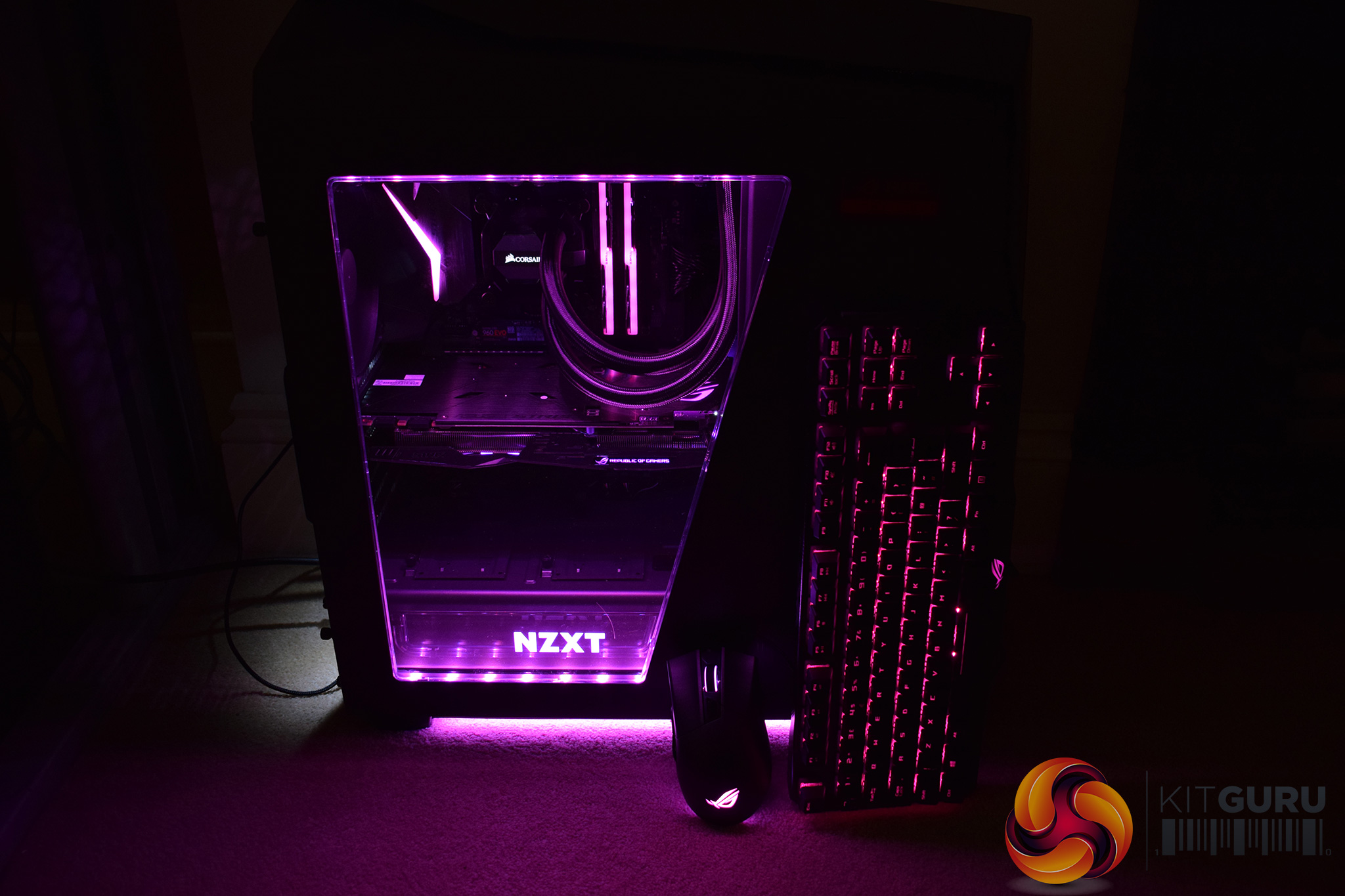
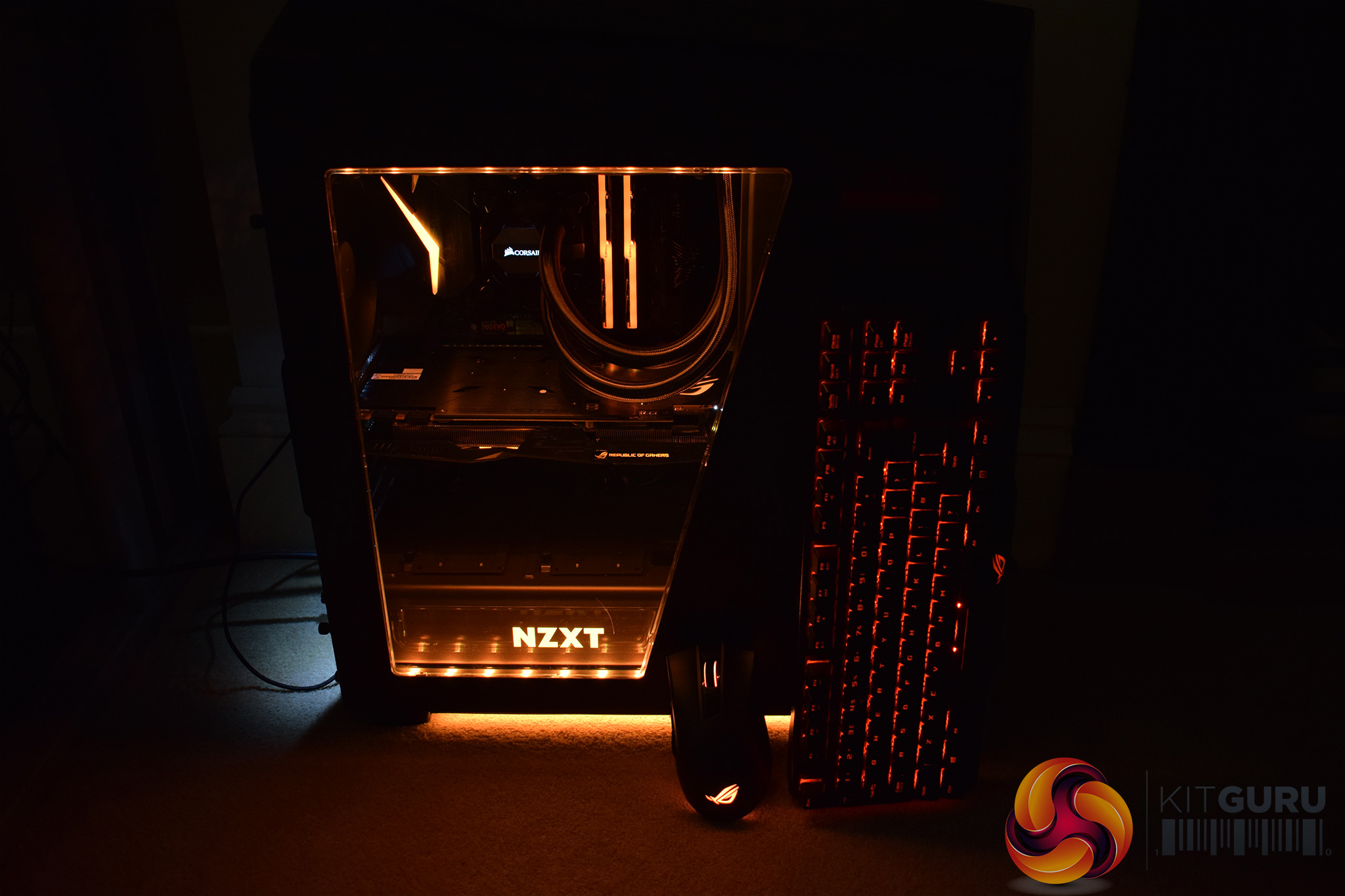
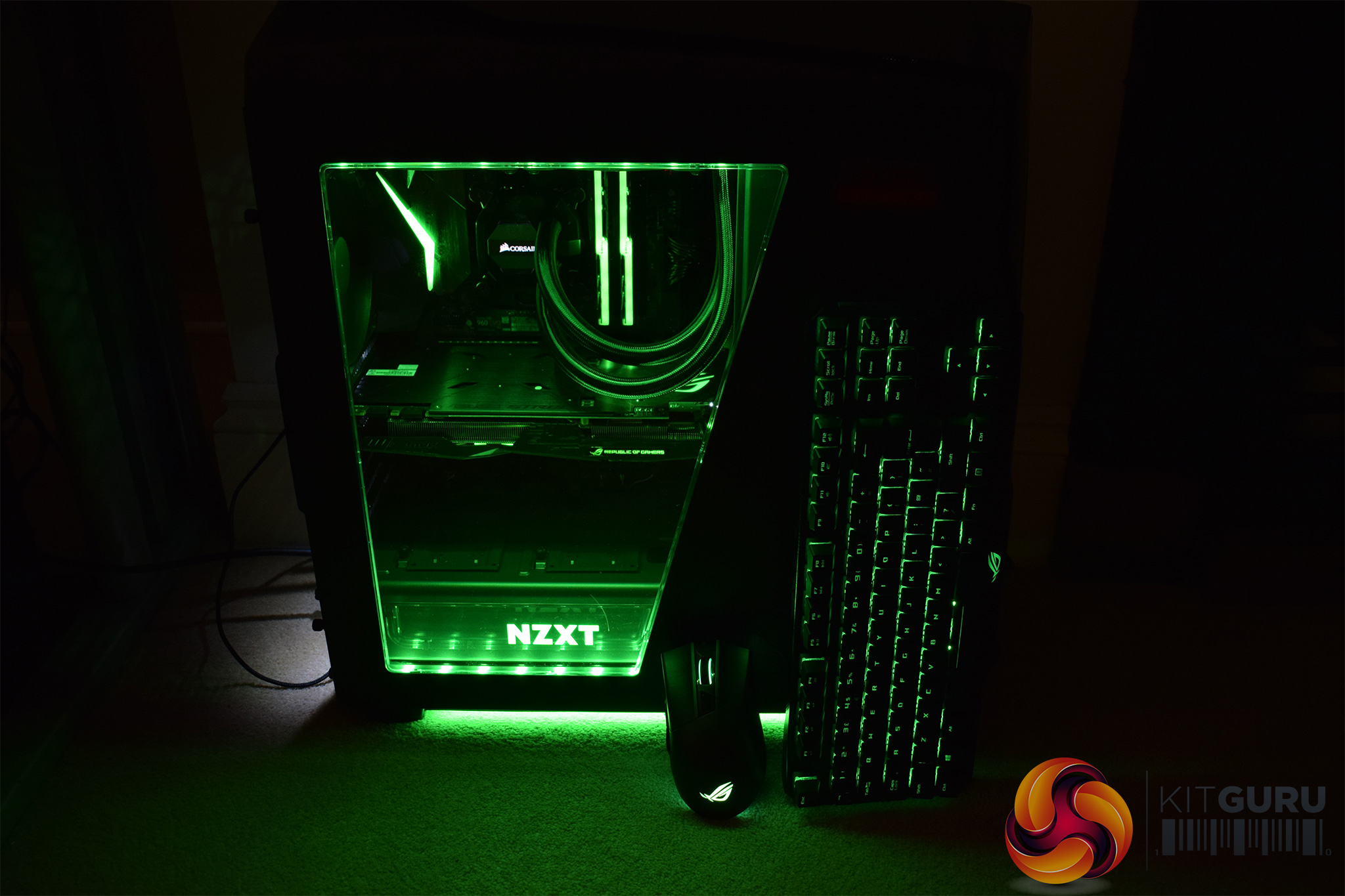
Above we get a look at the system powered on, RGB LEDs shining proudly. Due to the amount of ROG products, everything syncs together using the Aura software – even the case and the memory. It looks great and definitely adds some value.
CCL were also keen to point out that ROG peripherals can also sync via the Aura system, so in the last 4 images you can see the ROG Claymore and ROG Gladius II positioned alongside the Athena Aura, LEDs matching the main system. These peripherals don't come included with the Athena Aura but you could buy them alongside if you want perfectly matching peripherals.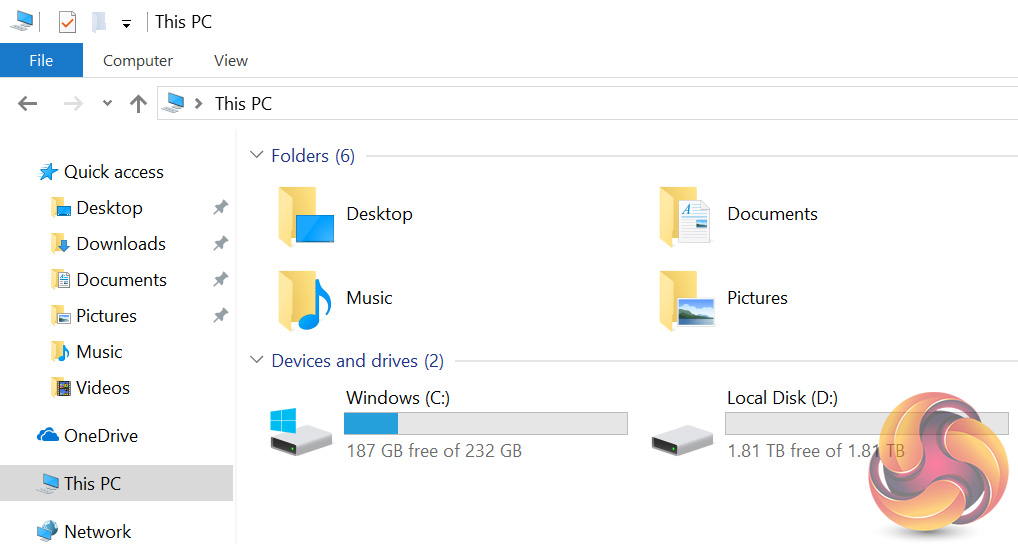
First of all, it is worth saying that the 960 EVO SSD arrived with 187GB of free space, while the HDD arrived untouched.
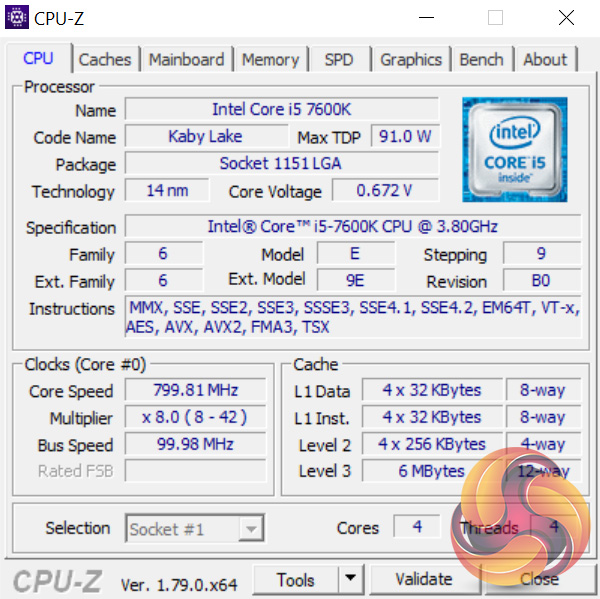
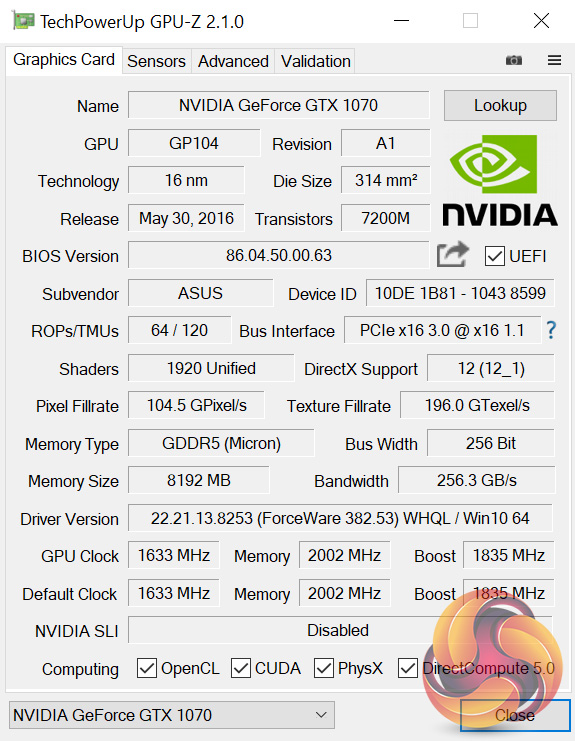
The Kaby Lake i5-7600K is a quad-core unit without support for HyperThreading. As I mentioned previously, it has not been overclocked so it will turbo to 4.2GHz but no higher.
The GTX 1070 Strix card has a healthy factory overclock with a boost clock of 1835MHz. However, in games it will actually boost a fair bit higher thanks to GPU Boost 3.0 technology.
Comparison systems
- Intel Core i7-6700HQ
- Nvidia GTX 960M
- 16GB Dual-Channel 1600MHz DDR3 RAM
- 128GB SSD + 1TB HDD
- Intel Bay Trail-M Celeron N2808 SoC
- Intel HD Graphics
- 4GB DDR3L RAM
- 64GB eMMc storage
- Intel Braswell N3050 SoC
- Intel HD Graphics
- 2GB DDR3L RAM
- 32GB eMMC storage
- Intel Core i3 i3-5010U
- Intel HD Graphics 5500
- 8GB Kingston SODIMM DDR3 1600MHz (1 x 8GB)
- 240GB Kingston V300 SSD
- Intel Core™ m5-6Y57
- Intel HD Graphics 515
- 8GB LPDDR3 1866MHz Memory
- 256GB Solid State Drive M2 2280 PCIe
- Intel Core i5-6500
- Asus Turbo GTX 960
- 8GB Corsair Vengeance LPX 2400MHz DDR4 RAM
- 500GB Samsung 850 EVO SSD
- Intel Core i7-6820HK
- Nvidia GTX 980 (desktop)
- 32GB DDR4 2400MHz RAM
- 2x 256GB Samsung SM951 PCIe SSDs in RAID0
- AMD FX-8320
- AMD RX-480
- 16GB DDR3 2133MHz RAM
- 240GB Adata Premier SP550
PCSpecialist Defiance III 17.3
- Intel i7-6700HQ
- Nvidia GTX 1060
- 16GB HyperX DDR4 2133MHz RAM
- 512GB SanDisk X400 M.2 SATA SSD
- Intel i7-6700HQ
- Nvidia GTX 950
- 16GB Crucial DDR4 2133MHz RAM
- 512GB Samsung Pro M.2 SSD
- Intel i7-7500U
- Intel HD Graphics 620
- 16GB G.Skill DDR4 2133MHz RAM
- 256GB Toshiba OCZ RD400 M.2 SSD
- Intel i7-6700K
- Nvidia GTX 1070
- 16GB Corsair Vengeance 3000MHz DDR4 RAM
- 500GB Samsung 750 EVO SSD
- Intel i5-6402P
- Nvidia GTX 1060
- 16GB Corsair Vengeance LED 3000MHz DDR4 RAM
- 256GB Intel 600p M.2 SSD
- Intel i5-6200U
- Intel HD Graphics 520
- 16GB G.Skill Ripjaws 1600MHz DDR3 RAM
- 256GB Toshiba OCZ RD400 M.2 SSD
- Intel i5-6600K
- Nvidia GTX 1070
- 16GB Corsair Vengeance 3000MHz DDR4 RAM
- 256GB Intel 600p M.2 SSD
- Intel i5-7600K
- Nvidia GTX 1060
- 16GB HyperX 2133MHz DDR4 RAM
- 250GB SK Hynix SL308 SSD
- Intel i7-7500U
- Intel HD Graphics 620
- 8GB 1866MHz DDR3L RAM
- 256GB PCIe SSD
- Intel i5-7600K
- Nvidia GTX 1060
- 16GB Corsair Vengeance 3000MHz DDR4 RAM
- 250GB WD Blue M.2 SSD
- Intel i5-7200U
- Intel HD Graphics 620
- 8GB 2133MHz DDR3L RAM
- 512GB SATA M.2 SSD
- Ryzen 7 1700X
- Nvidia GTX 1080
- 16GB 2933MHz DDR4 RAM
- 256GB Intel 600p M.2 SSD
- Ryzen 5 1600
- Nvidia GTX 1070
- 16GB 2400MHz DDR4 RAM
- 250GB Samsung 960 EVO M.2 SSD
- Intel i7-7700K
- Nvidia GTX 1080
- 16GB 3200MHz DDR4 RAM
- 500GB Samsung 960 EVO M.2 SSD
- Ryzen 5 1500X
- AMD RX 580
- 16GB 2400MHz DDR4 RAM
- 500GB Samsung 850 EVO SSD
Test software
- SiSoft Sandra
- Cinebench R15
- Handbrake
- CrystalDiskMark
- ATTO Disk Benchmark
- 3DMark 11
- 3DMark
- VRMark
- Prime 95 (version 26.6)
- CPUID HWMonitor
- AIDA64 Engineer
- Fraps
Test games
- Grand Theft Auto V
- Rise of the Tomb Raider
- Ashes of the Singularity
- Deus Ex: Mankind Divided
- Tom Clancy’s Ghost Recon: Wildlands
Today we are testing the Athena Aura at 1080p, 1440p and 2160p (Ultra HD 4K). All tests were conducted using the Nvidia 382.53 driver, the latest at the time of writing.SiSoftware Sandra (the System ANalyser, Diagnostic and Reporting Assistant) is an information & diagnostic utility. It should provide most of the information (including undocumented) you need to know about your hardware, software and other devices whether hardware or software.
Sandra is a (girls’) name of Greek origin that means “defender”, “helper of mankind”. We think that’s quite fitting.
It works along the lines of other Windows utilities, however it tries to go beyond them and show you more of what’s really going on. Giving the user the ability to draw comparisons at both a high and low-level. You can get information about the CPU, chipset, video adapter, ports, printers, sound card, memory, network, Windows internals, AGP, PCI, PCI-X, PCIe (PCI Express), database, USB, USB2, 1394/Firewire, etc.
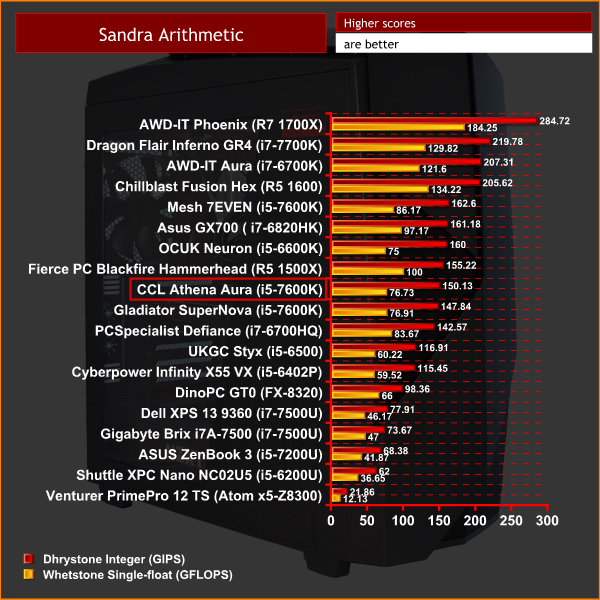
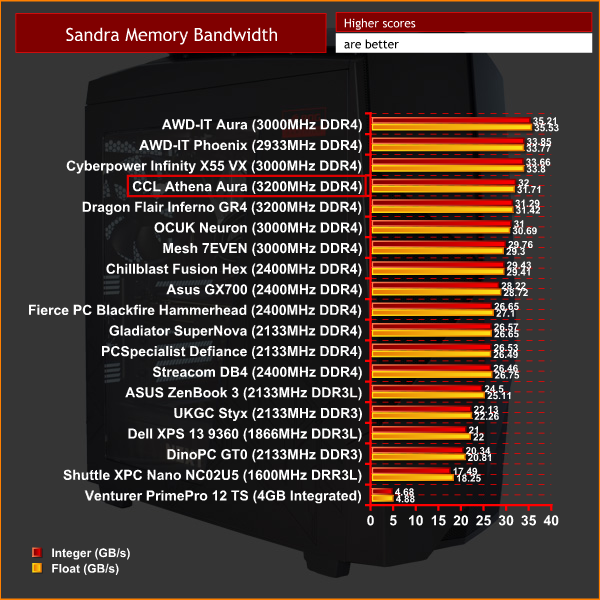
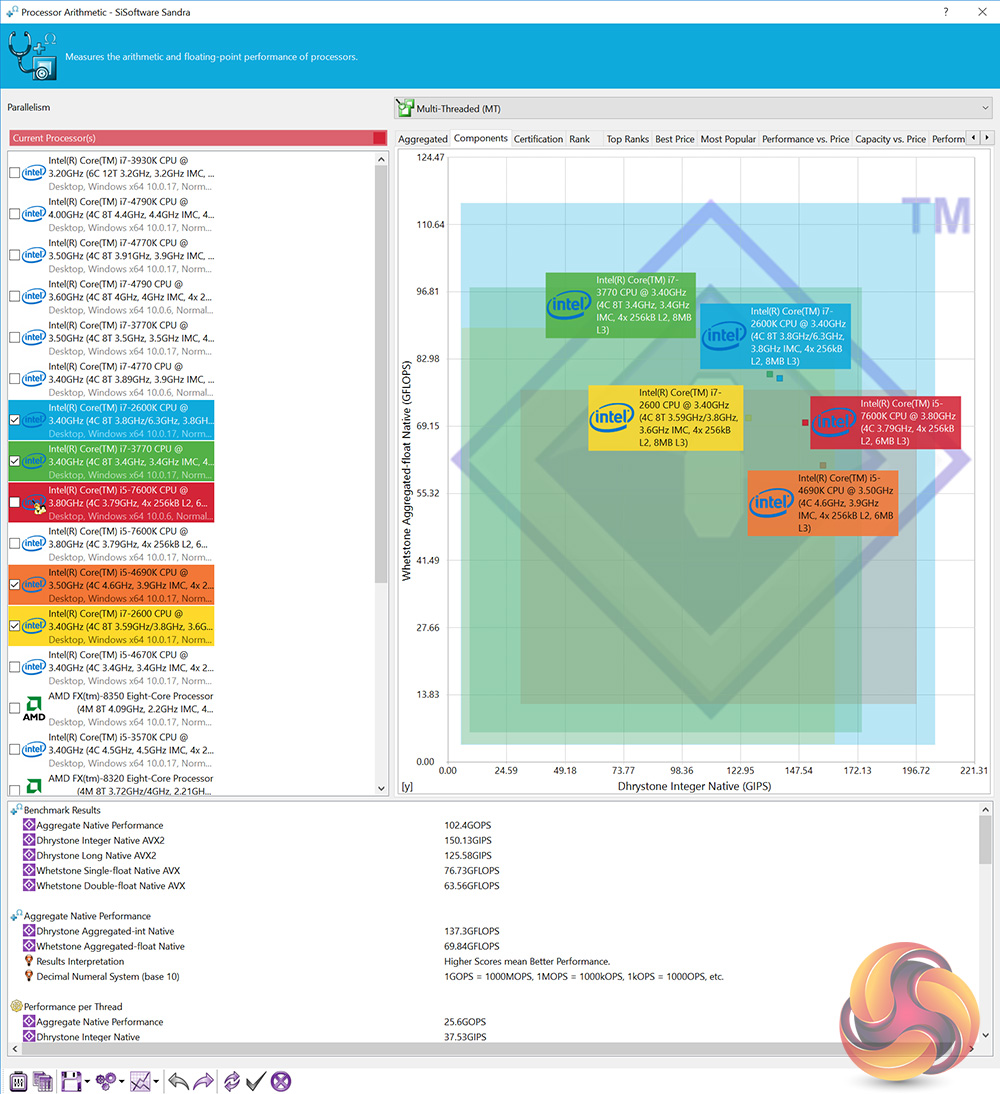
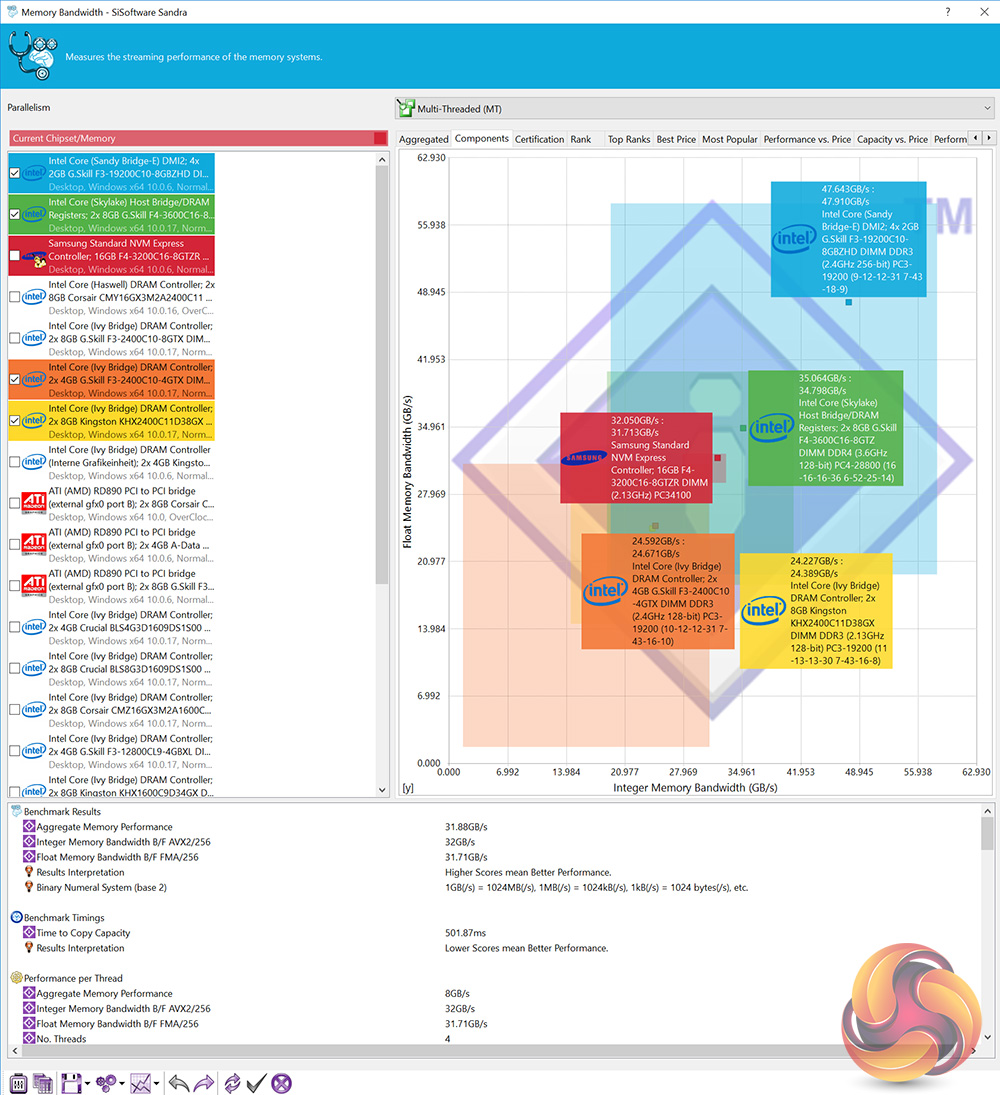
While the CPU score is very ‘middle-of-the-road', as a quad-core without HyperThreading is quickly becoming left behind since the launch of Ryzen 5 and Ryzen 7 processors, the 3200MHz DDR4 is very fast and performs accordingly.CINEBENCH R15 is a cross-platform testing suite that measures hardware performance and is the de facto standard benchmarking tool for leading companies and trade journals for conducting real-world hardware performance tests. With the new Release 15, systems with up to 256 threads can be tested.
CINEBENCH is available for both Windows and OS X and is used by almost all hardware manufacturers and trade journals for comparing CPUs and graphics cards.
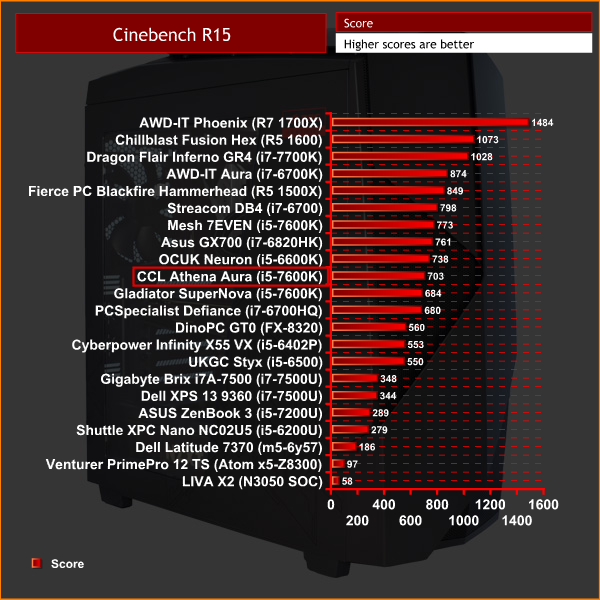
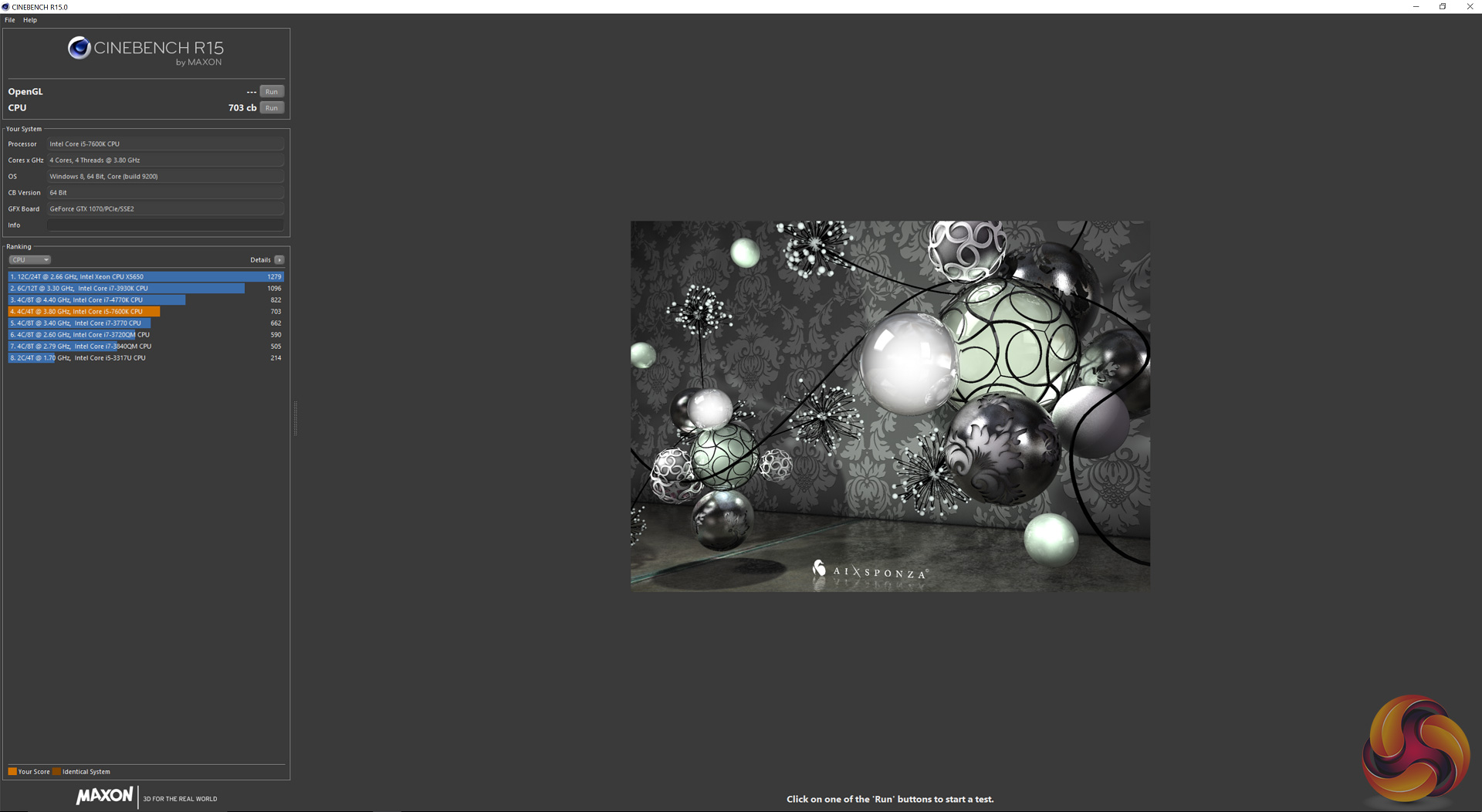
A score of 703 in Cinebench is another middling score. We can see that the Ryzen 5 1600 processor outscores it by a significant margin, and that processor is actually cheaper than this i5.HandBrake is a tool for converting video from nearly any format to a selection of modern, widely supported codecs.
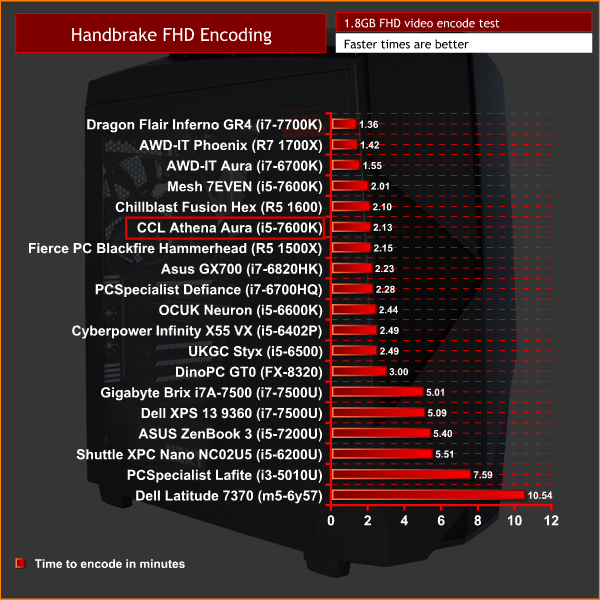
The i5 does better with HandBrake, though it is still behind the cheaper Ryzen 5 1600.Here we test the Athena Aura' s storage performance, using CrystalDiskMark 5.1.1 and ATTO Disk Benchmark 2.47.
SSD Performance
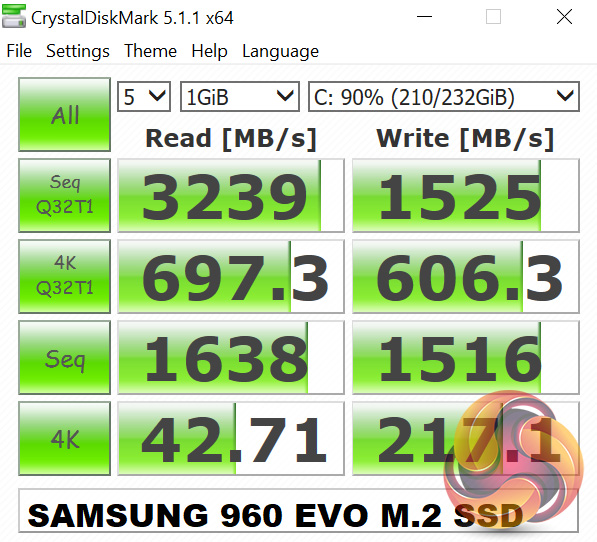
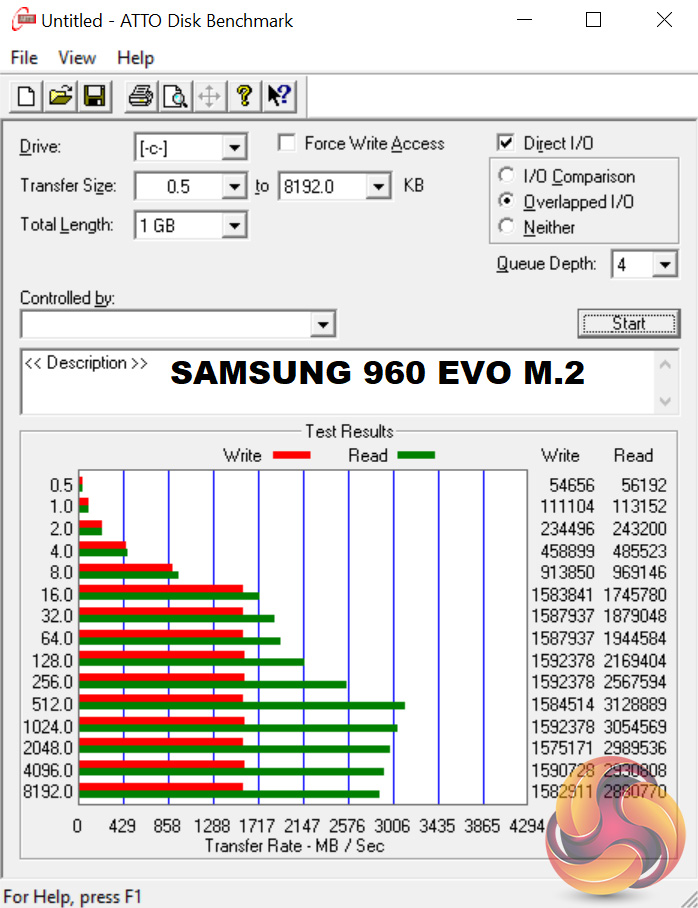
We've seen the 960 EVO before so it is no surprise to see its blazing-fast speeds delivered once again.
HDD Performance
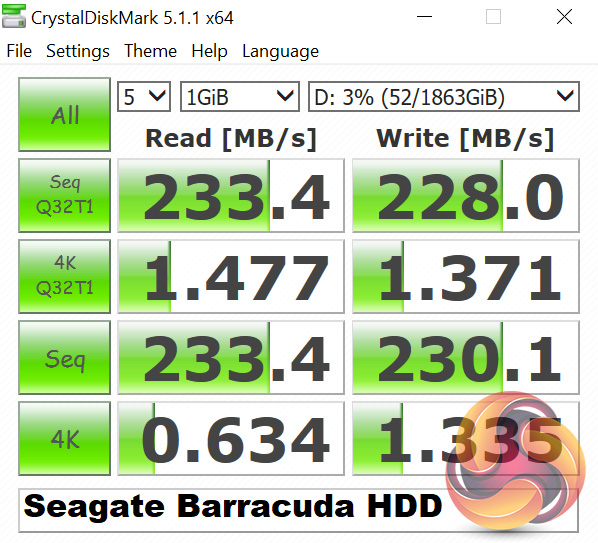
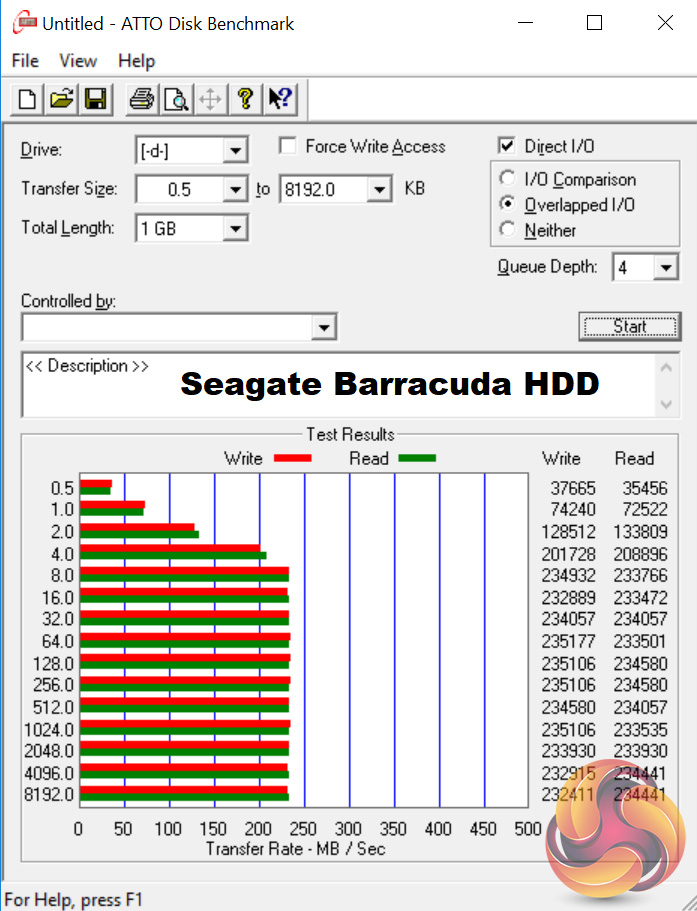
Again, no surprises here from the 2TB mechanical hard drive. It is not the fastest drive in the world but it does give mass storage space.To test the USB 3.0 ports on the Athena Aura, I plugged in an OCZ Trion 150 SSD via a SATA-to-USB 3.0 5Gbps adapter, which uses the ASMedia ASM1053 controller. We reviewed the SSD HERE, finding it delivers good speed at a budget price.
Most importantly, it is capable of saturating the USB 3.0 bus, allowing us to test the speeds the USB 3.0 ports deliver. To test this, I ran both CrystalDiskMark and ATTO Disk Benchmark on the Trion 150 drive.
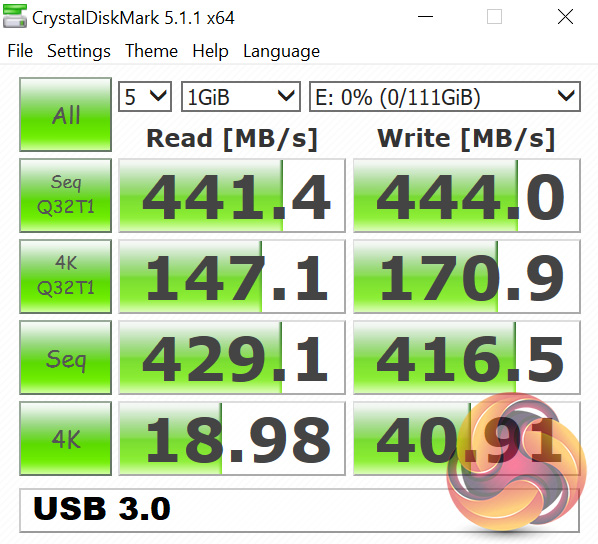
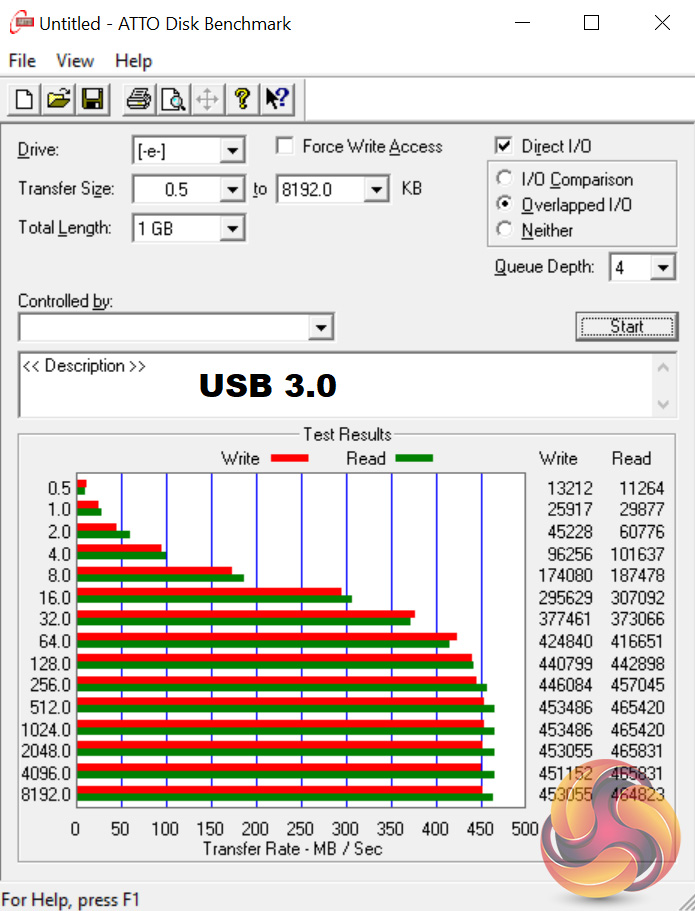
As expected, we see speeds in excess of 400 MB/s which indicates that the USB 3.0 interface is just fine.3DMark 11 is designed for testing DirectX 11 hardware running on Windows 7 and Windows Vista. The benchmark includes six all new benchmark tests that make extensive use of all the new features in DirectX 11 including tessellation, compute shaders and multi-threading.
After running the tests 3DMark gives your system a score with larger numbers indicating better performance. Trusted by gamers worldwide to give accurate and unbiased results, 3DMark 11 is the best way to test DirectX 11 under game-like loads.
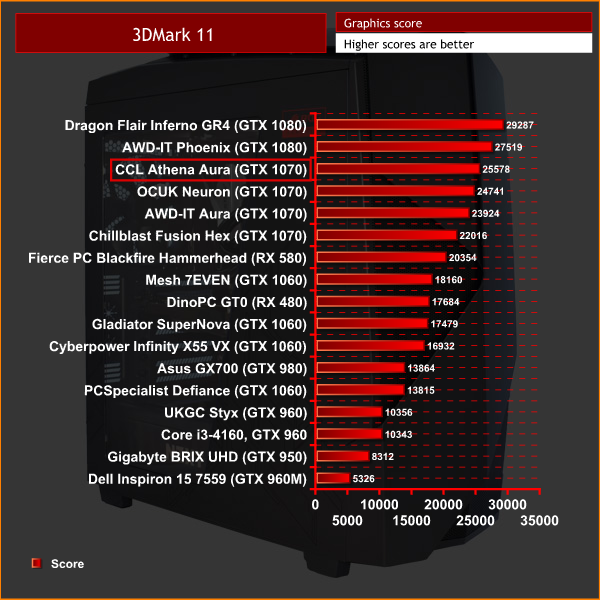
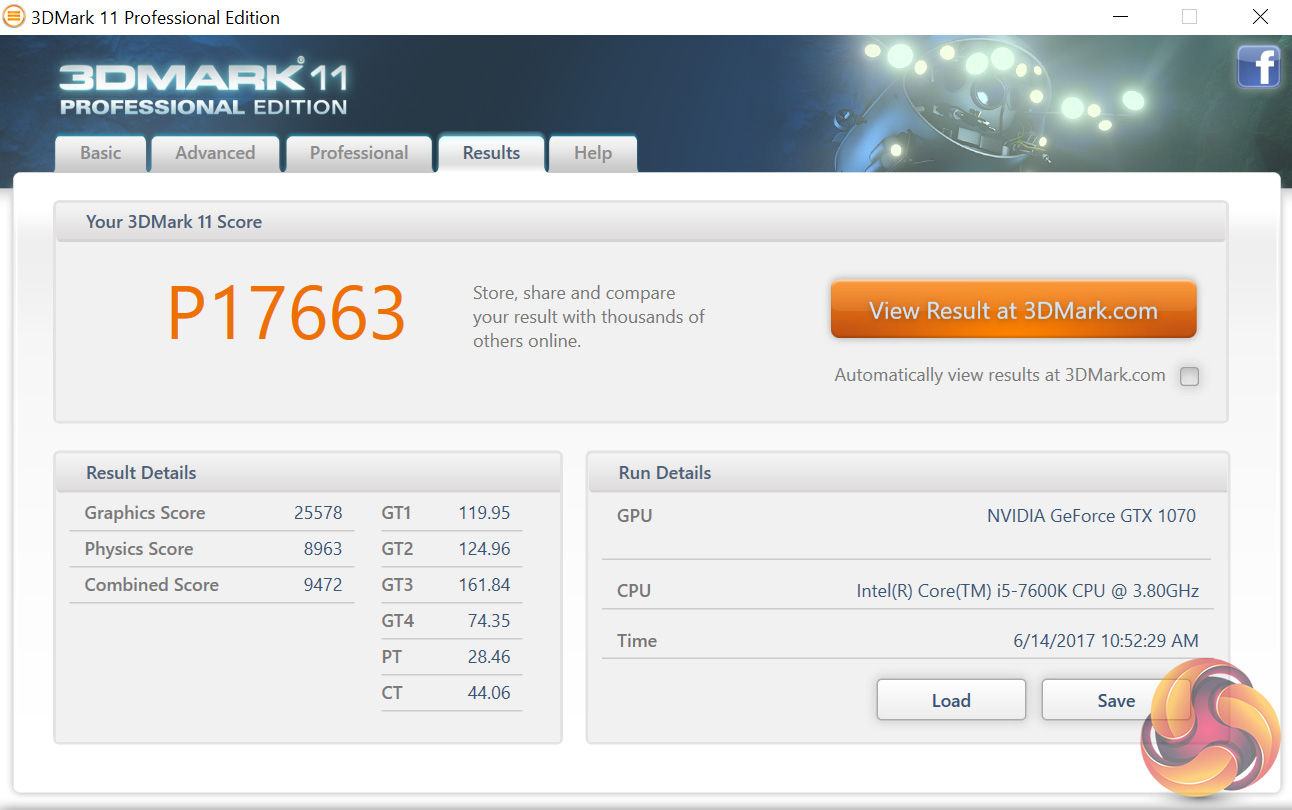
The Athena Aura comes out as the fastest GTX 1070-based system I've tested thanks to the high factory overclock on the Strix card.3DMark is an essential tool used by millions of gamers, hundreds of hardware review sites and many of the world’s leading manufacturers to measure PC gaming performance. Futuremark say “Use it to test your PC’s limits and measure the impact of overclocking and tweaking your system. Search our massive results database and see how your PC compares or just admire the graphics and wonder why all PC games don’t look this good. To get more out of your PC, put 3DMark in your PC.”
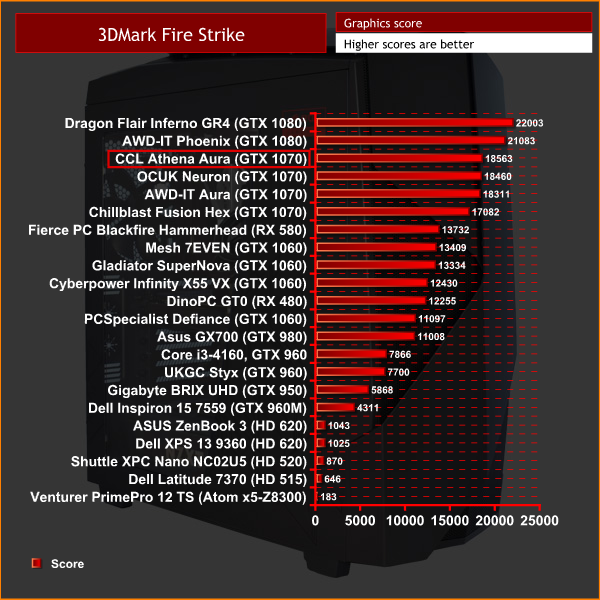
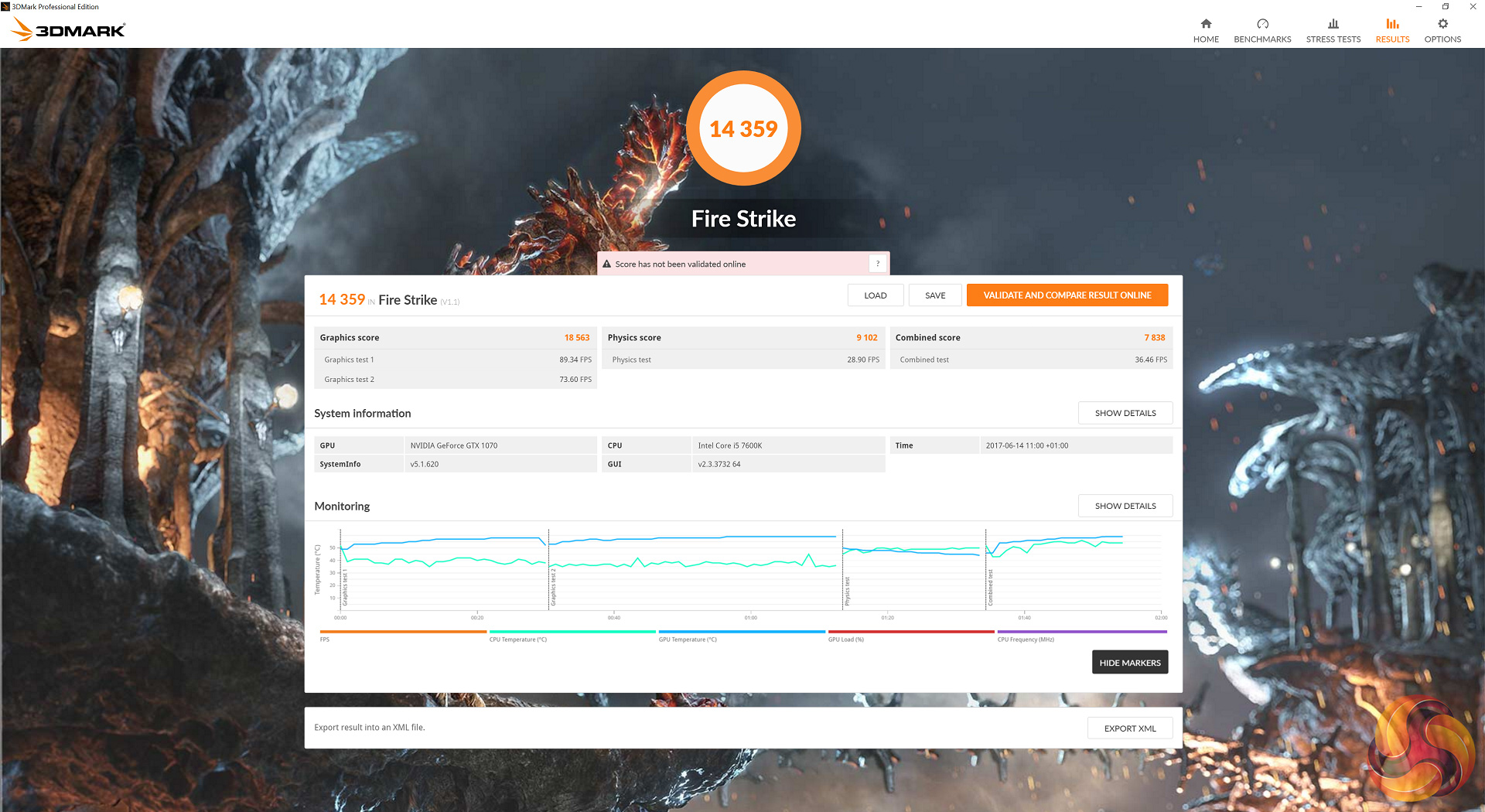
Again, the Athena Aura just pips the OCUK Neuron to the post courtesy of its fast GTX 1070.VRMark is a benchmark designed specifically with virtual reality gaming in mind. Futuremark say: ‘the performance requirements for VR games are much higher than for typical PC games. So if you’re thinking about buying an HTC Vive or an Oculus Rift, wouldn’t it be good to know that your PC is ready for VR? VRMark includes two VR benchmark tests that run on your monitor, no headset required, or on a connected HMD. At the end of each test, you’ll see whether your PC is VR ready, and if not, how far it falls short.’
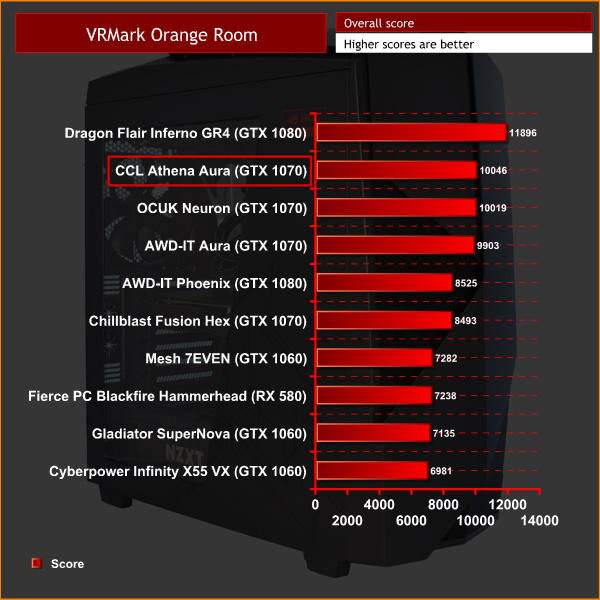
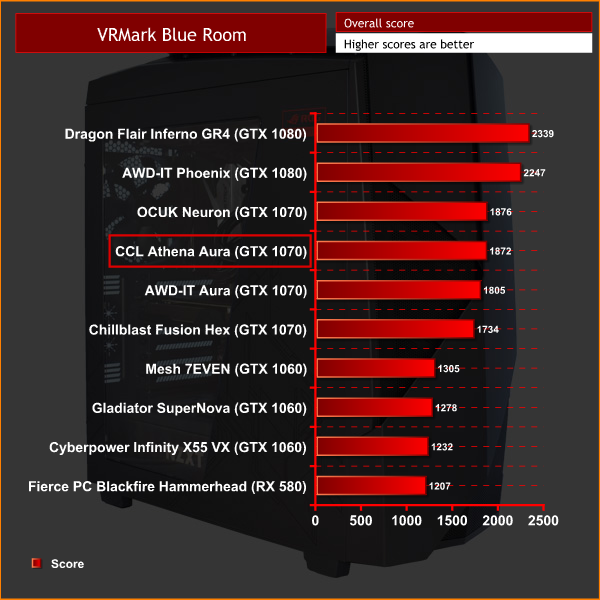
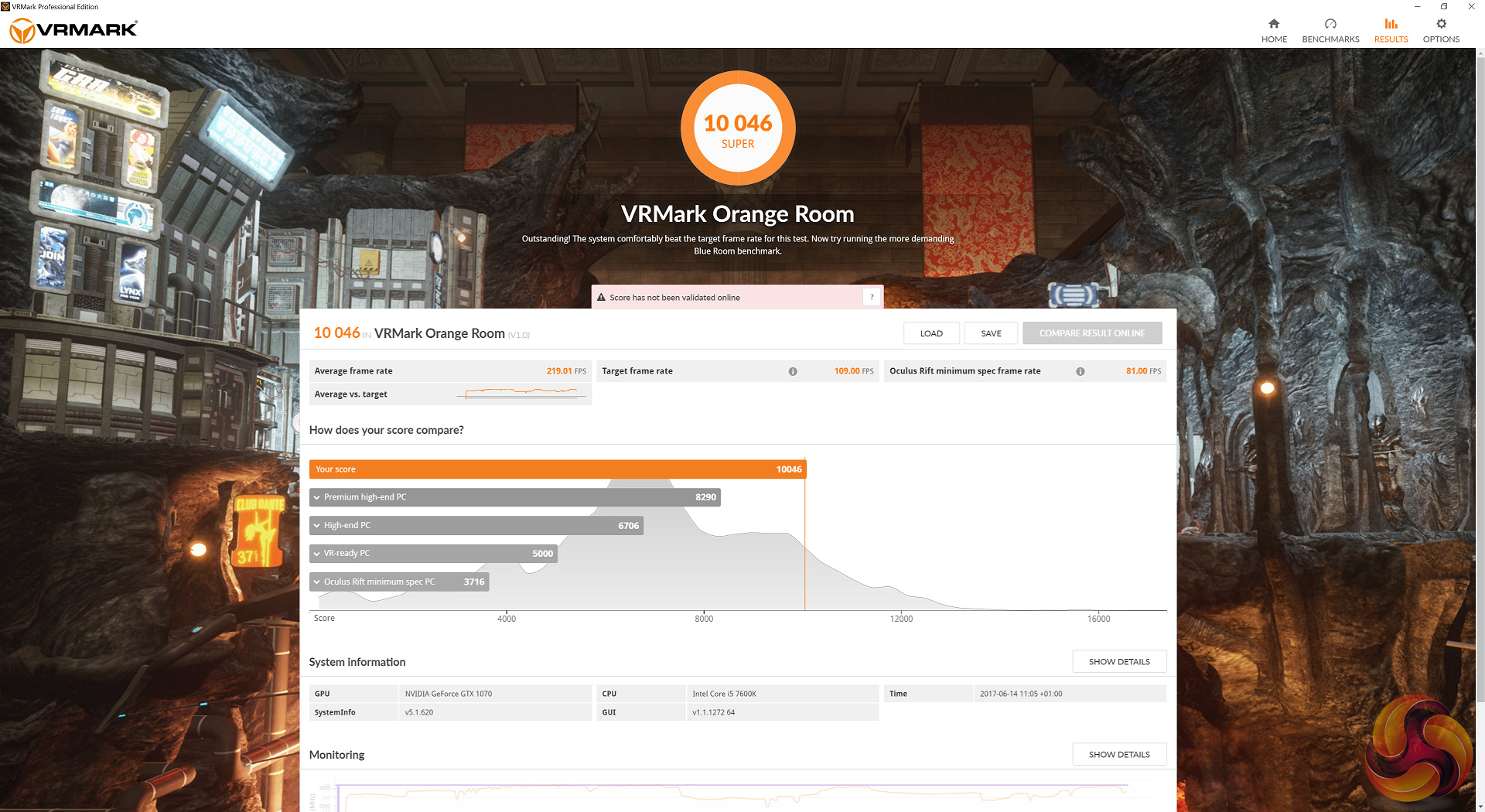
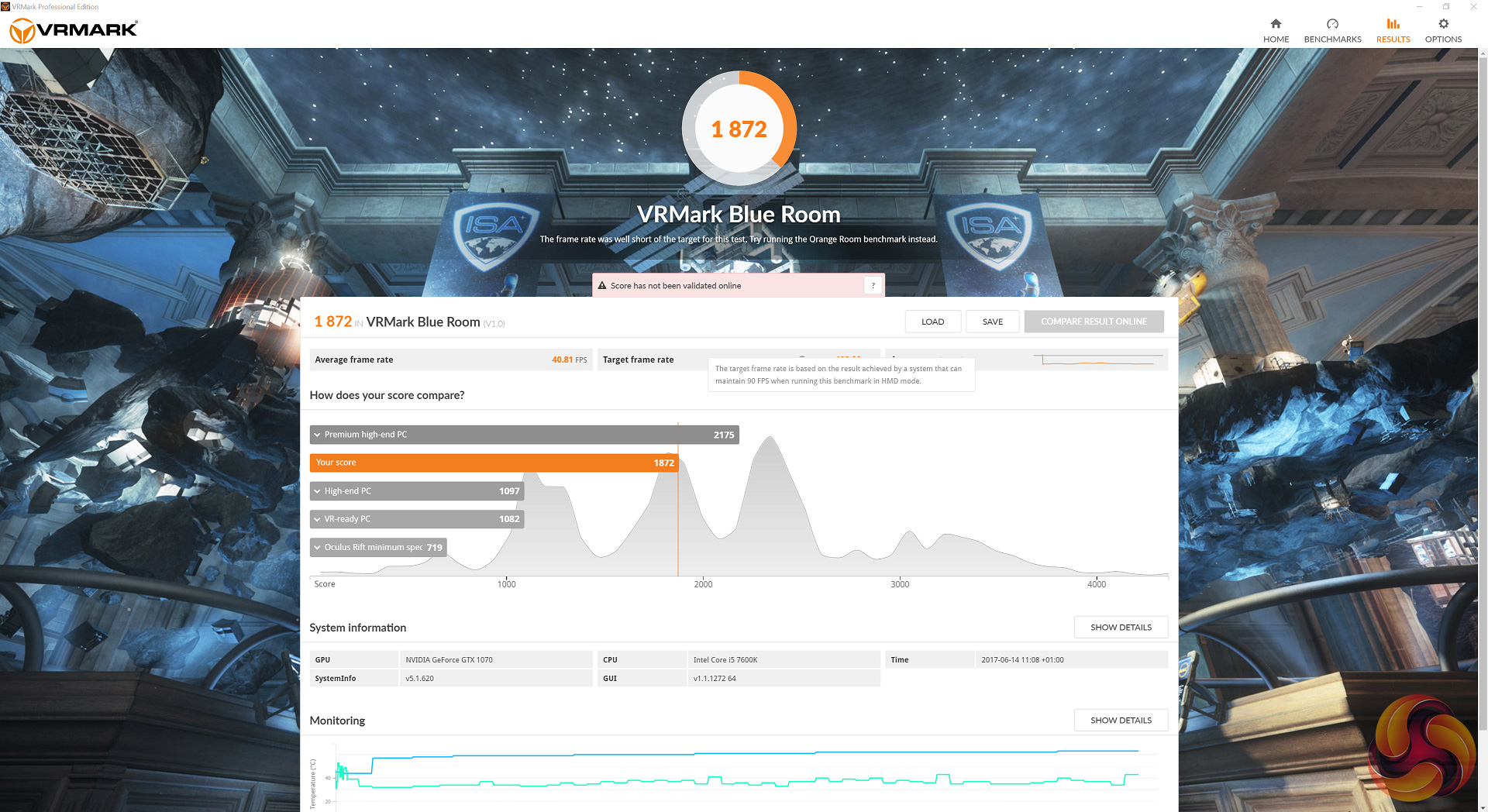
A new addition to our benchmarking suite, VRMark looks like one of the few valid ways of testing the VR capabilities of a PC. Consisting of two ‘rooms’, or benchmark tests, the Orange Room is the standard test, while the Blue Room is much more demanding.
Across both tests the Athena Aura is there or thereabouts, and it is of course fully VR ready.Grand Theft Auto V is an action-adventure game played from either a first-person or third-person view. Players complete missions—linear scenarios with set objectives—to progress through the story. Outside of missions, players may freely roam the open world.
Composed of the San Andreas open countryside area and the fictional city of Los Santos, the world is much larger in area than earlier entries in the series. It may be fully explored after the game’s beginning without restriction, although story progress unlocks more gameplay content.
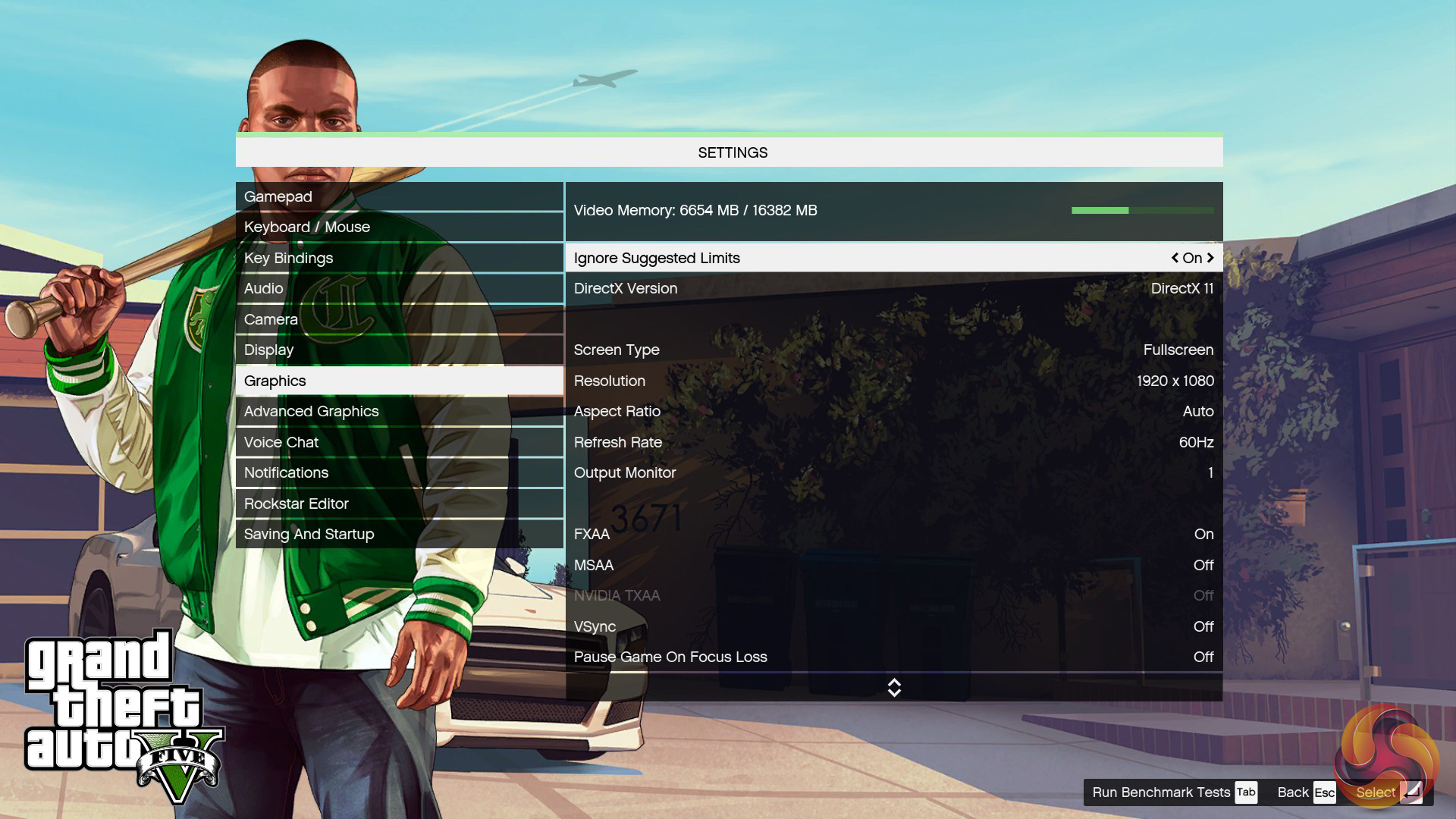
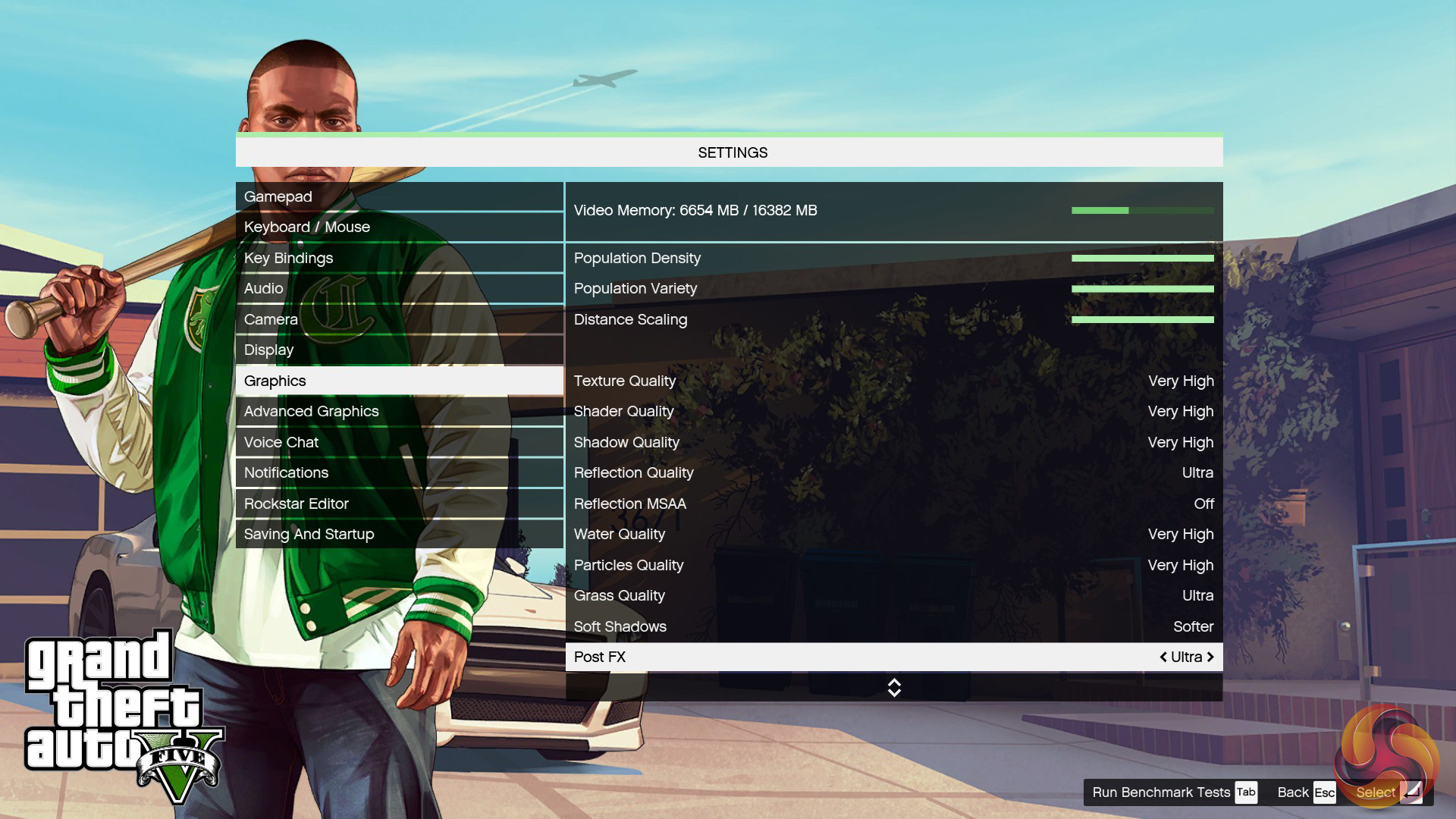
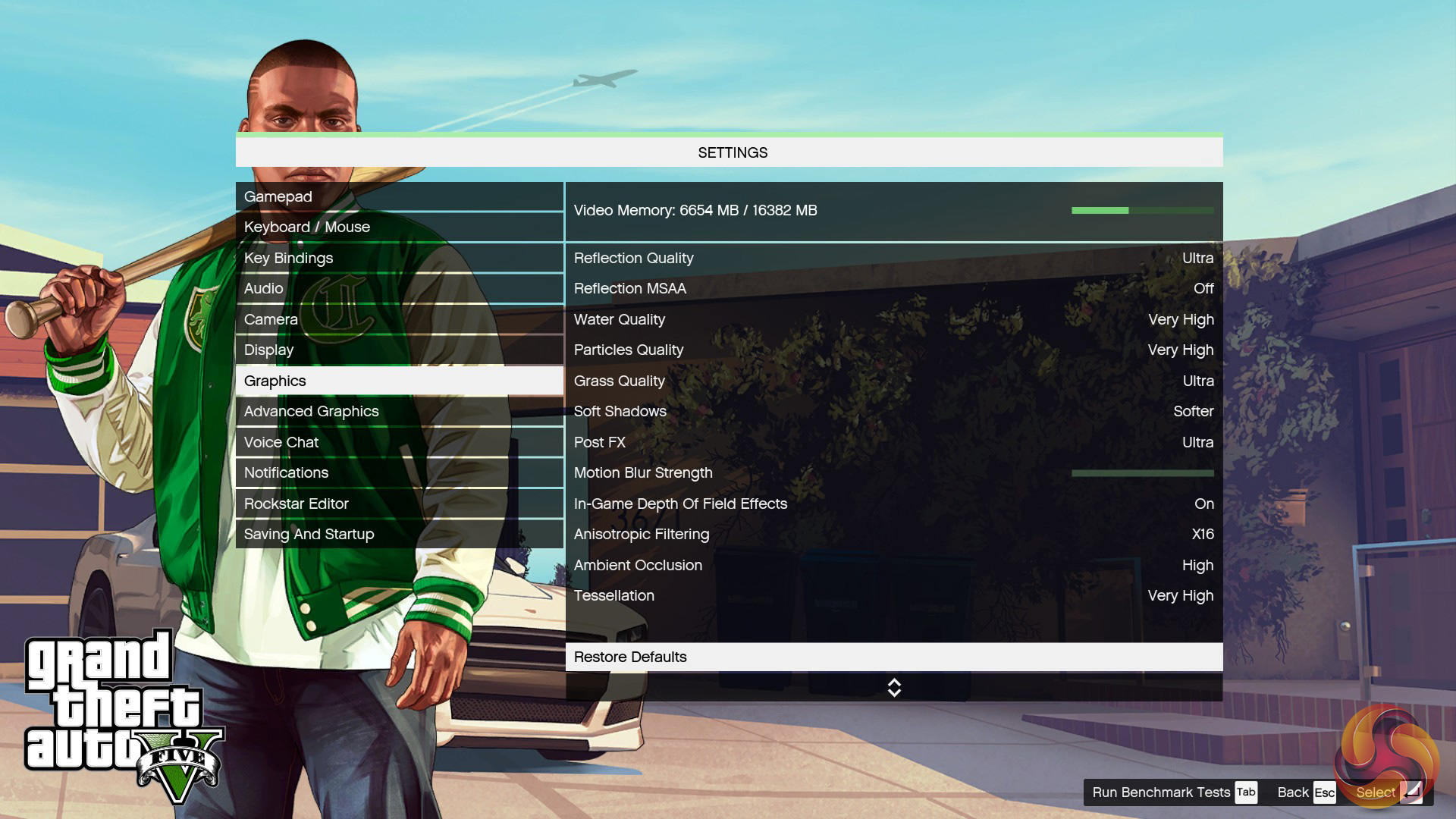
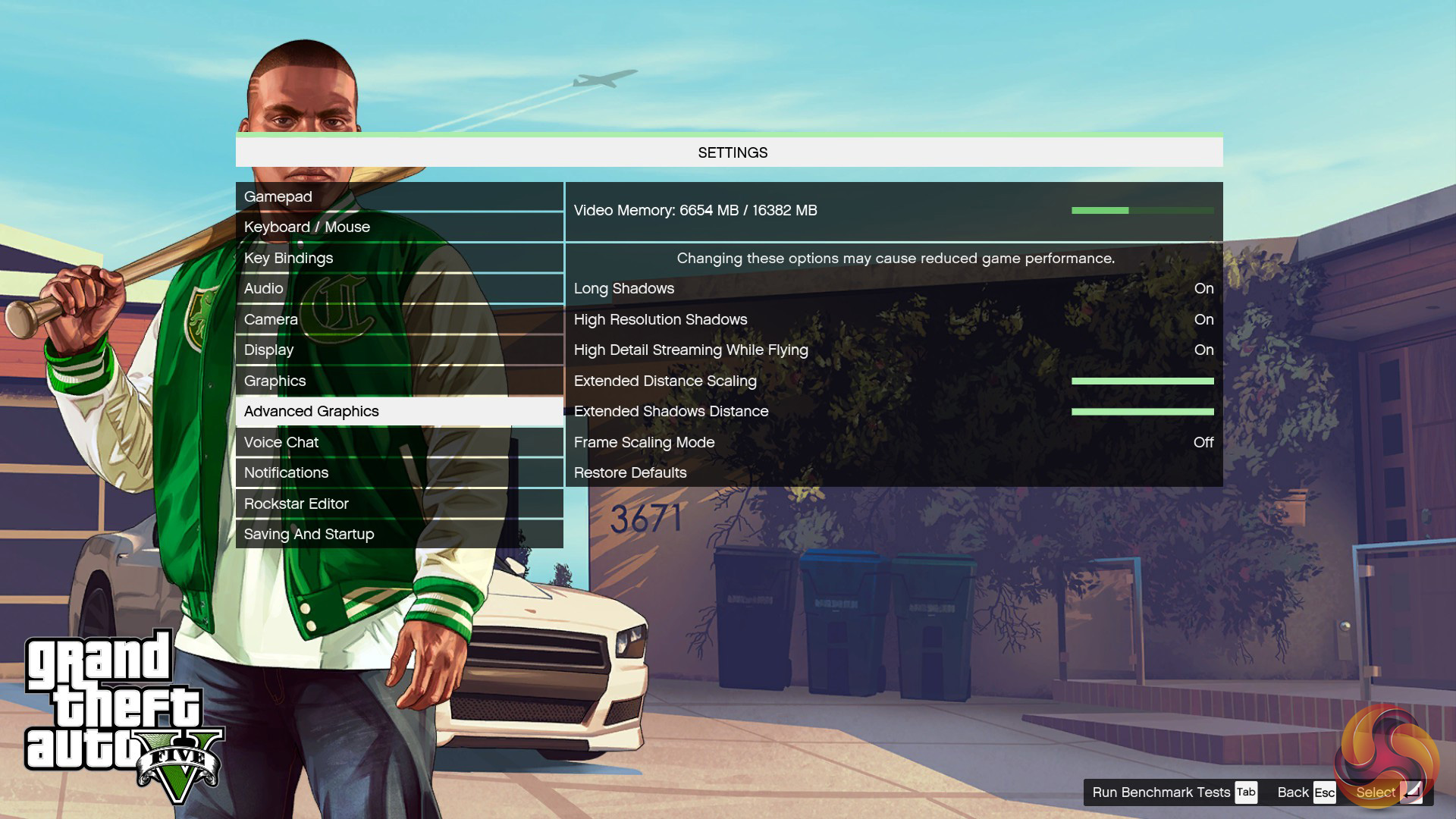
We maximise every setting but leave MSAA disabled.
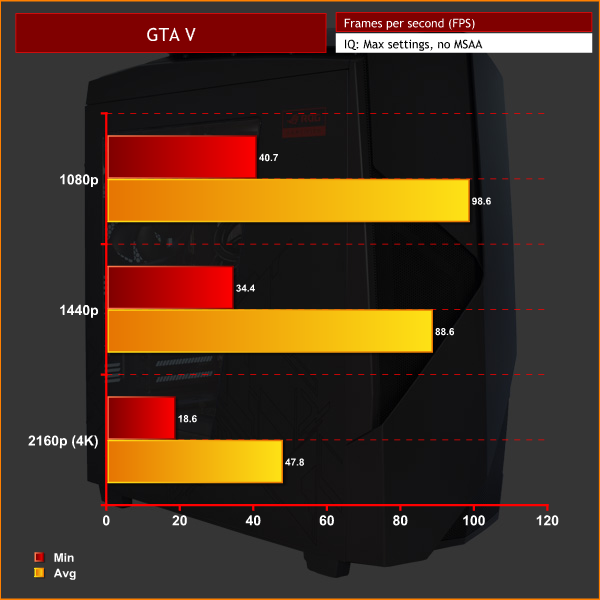
As you can see, the frame rates are very good at both 1080p and 1440p. The GTX 1070 does struggle at 4K, though, with the minimum frame rate dropping to 18.6.Rise of the Tomb Raider is a third-person action-adventure game that features similar gameplay found in 2013’s Tomb Raider. Players control Lara Croft through various environments, battling enemies, and completing puzzle platforming sections, while using improvised weapons and gadgets in order to progress through the story. It uses a Direct X 12 capable engine.
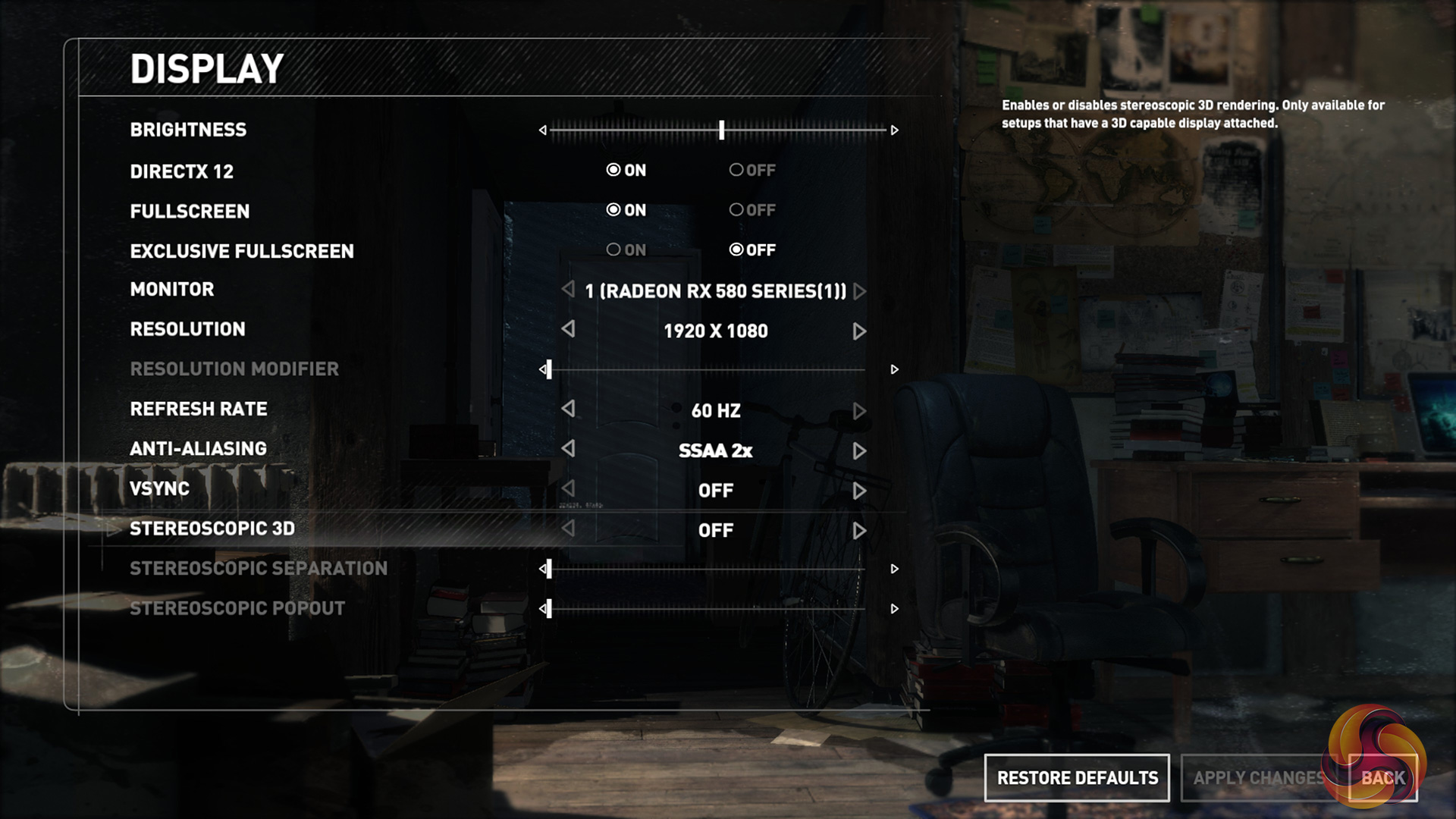
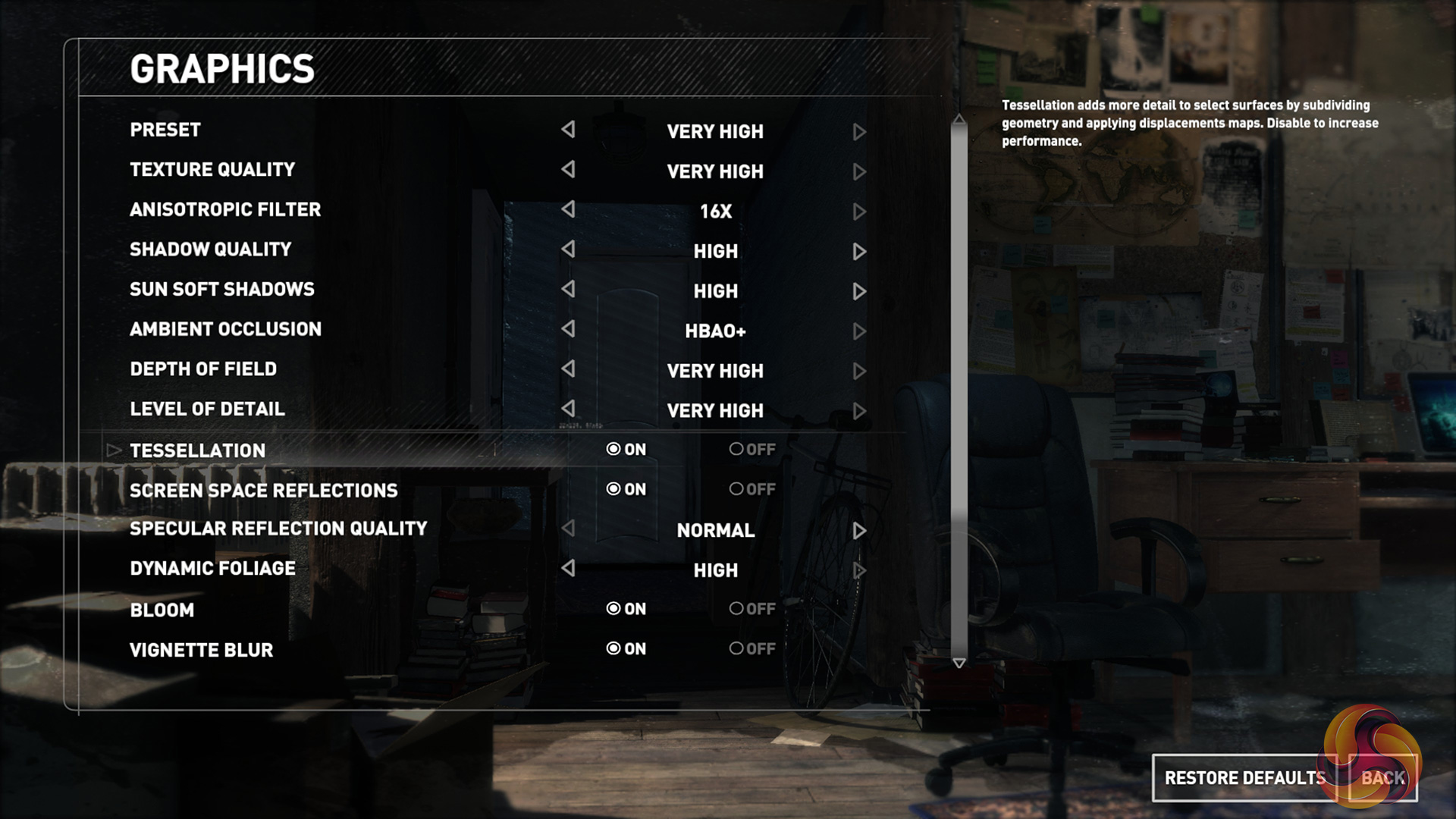
We test using the DX12 API, the ‘very high’ IQ preset and 2x SSAA.
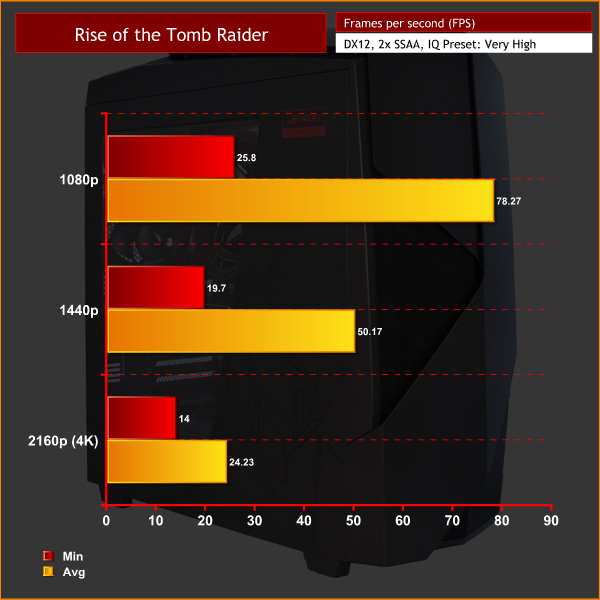
Minimum frame rates seem quite low when using the in-built benchmark and this could be due to the DX12 API – I have previously seen Nvidia cards do quite poorly in this game using DX12.Ashes of the Singularity is a real-time strategy game set in the future where descendants of humans (called Post- Humans) and a powerful artificial intelligence (called the Substrate) fight a war for control of a resource known as Turinium.Players will engage in massive-scale land/air battles by commanding entire armies of their own design. Each game takes place on one area of a planet, with each player starting with a home base (known as a Nexus) and a single construction unit.
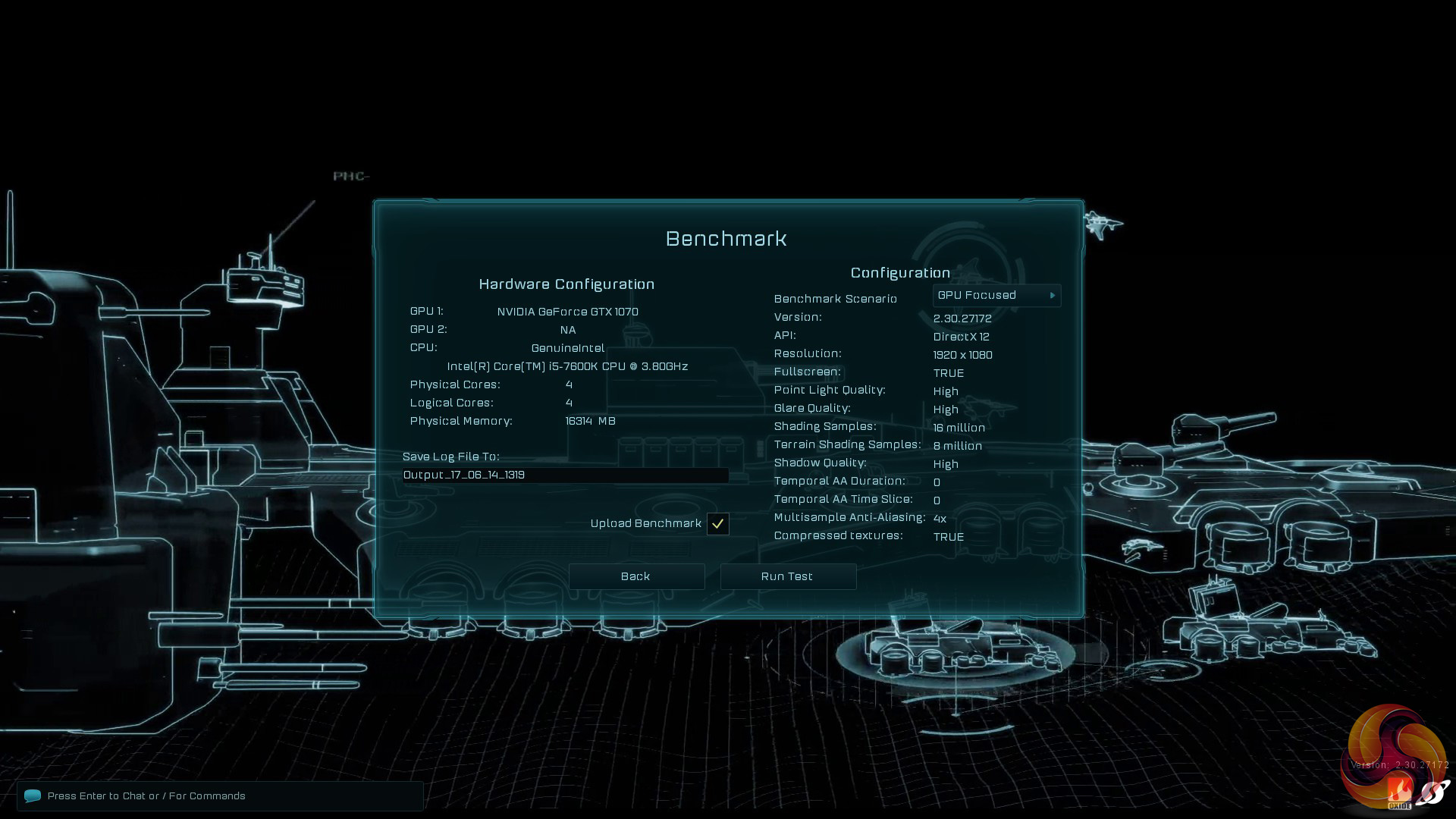
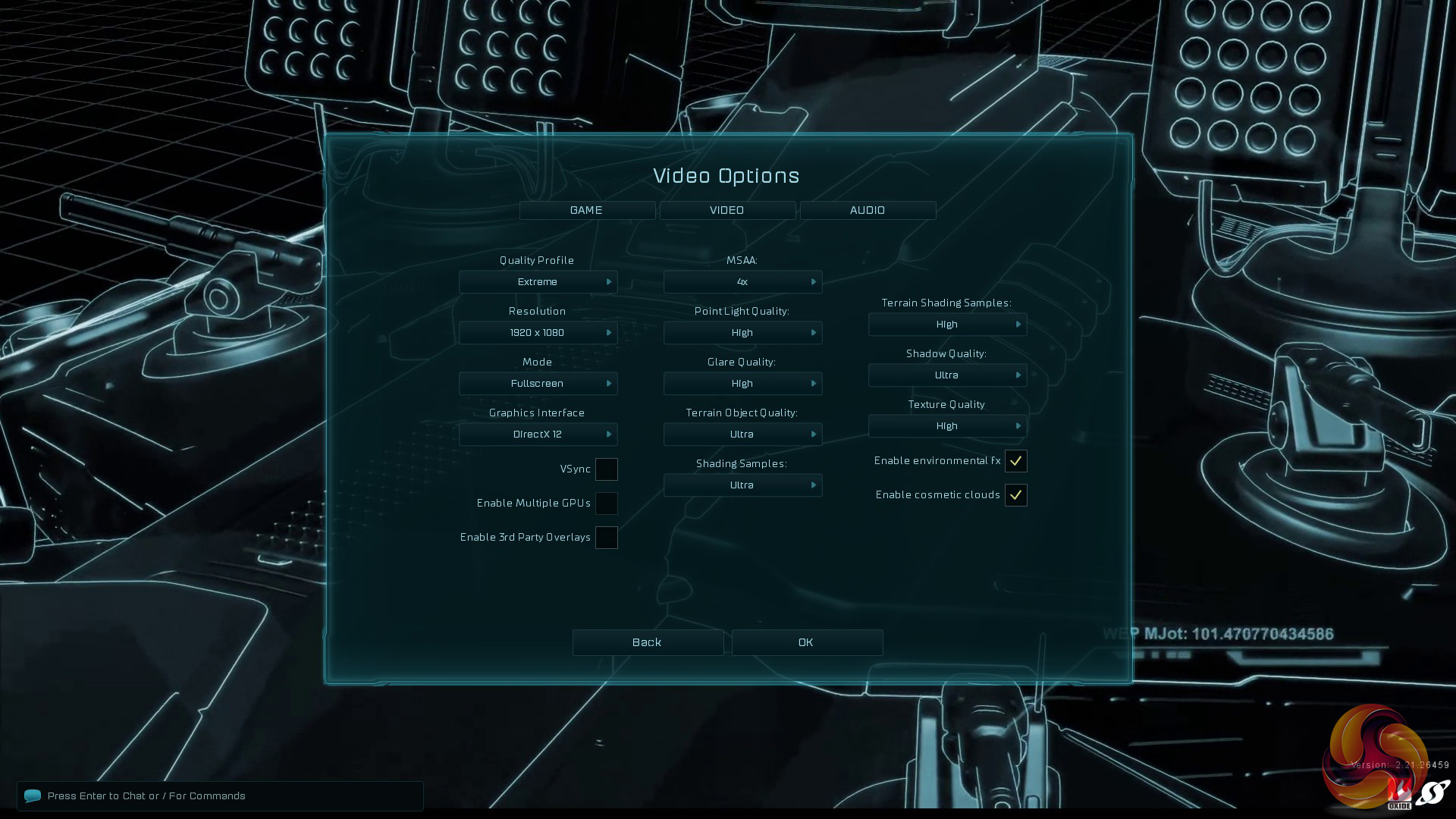
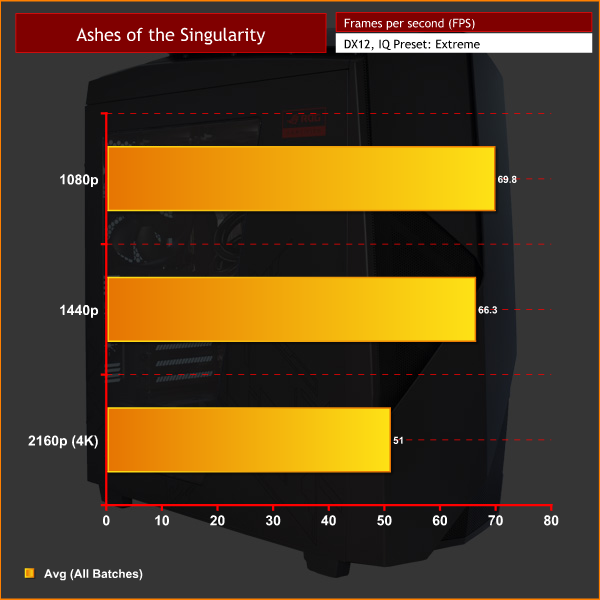
All three resolutions deliver very playable frame rates here, so Ashes players will have no issues running the game.Deus Ex: Mankind Divided is set in the year 2029, two years after the events of Human Revolution and the “Aug Incident”—an event in which mechanically augmented humans became uncontrollable and lethally violent.
Unbeknownst to the public, the affected augmented received implanted technology designed to control them by the shadowy Illuminati, which is abused by a rogue member of the group to discredit augmentations completely. (Wikipedia).
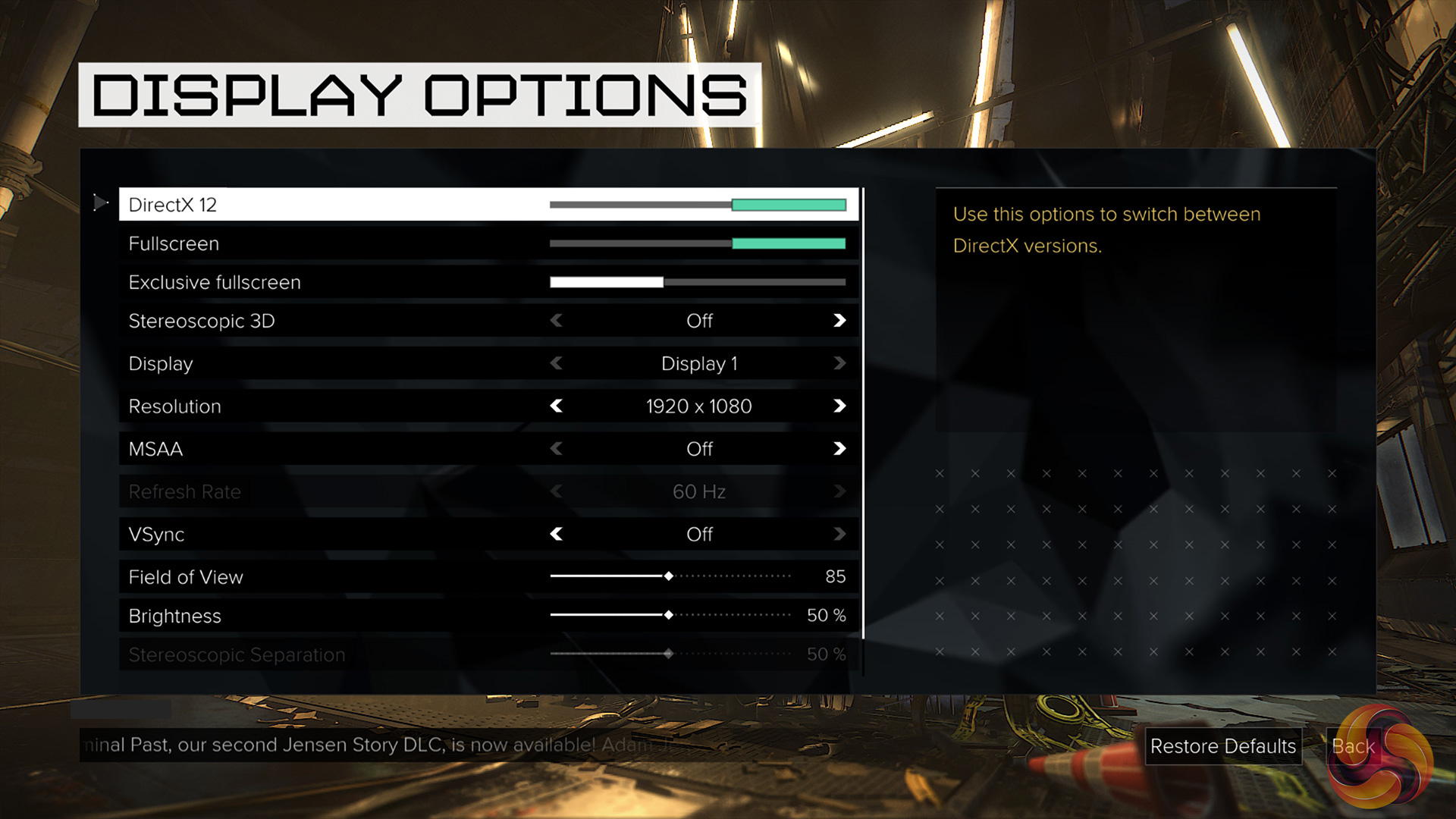
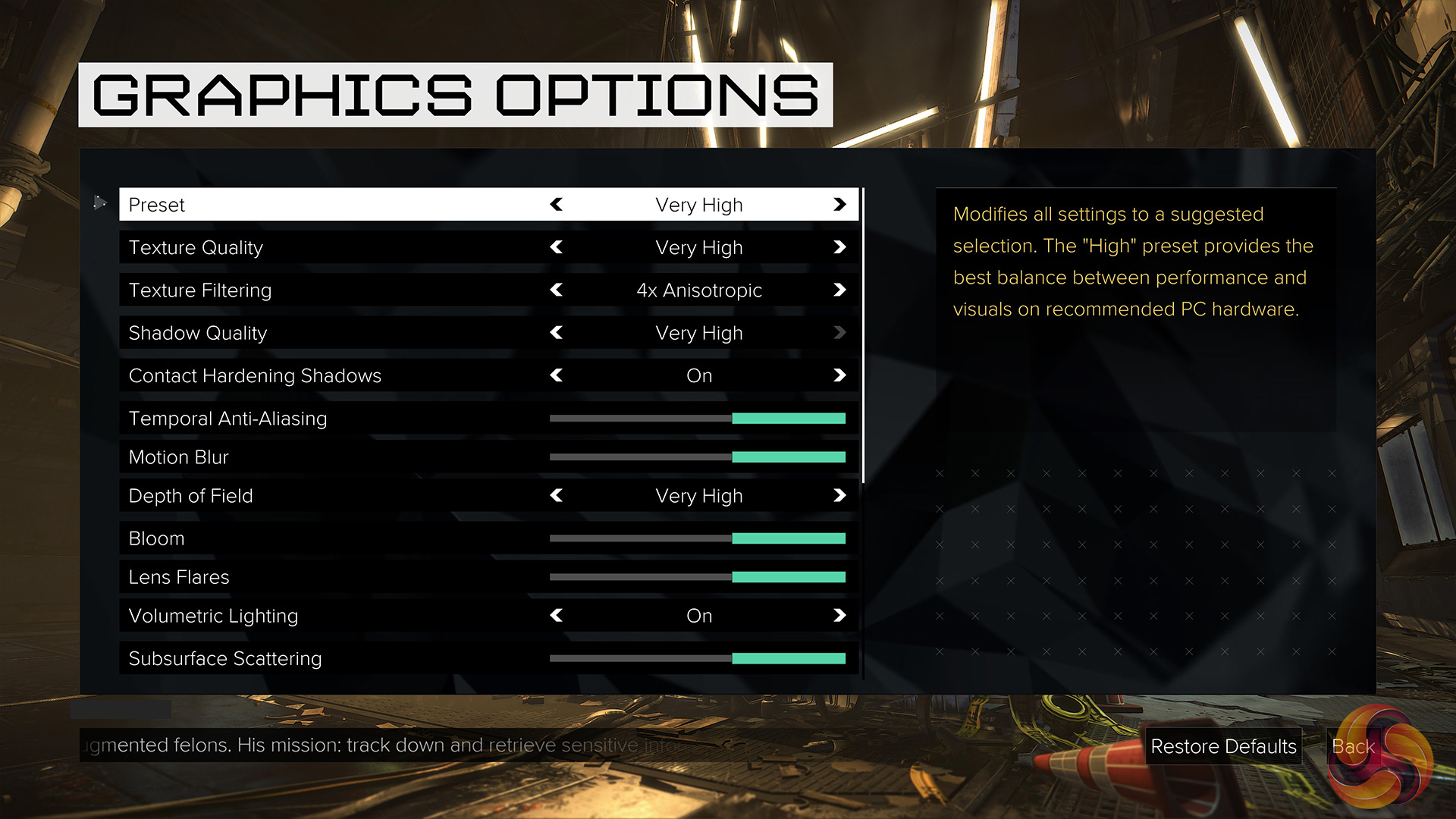
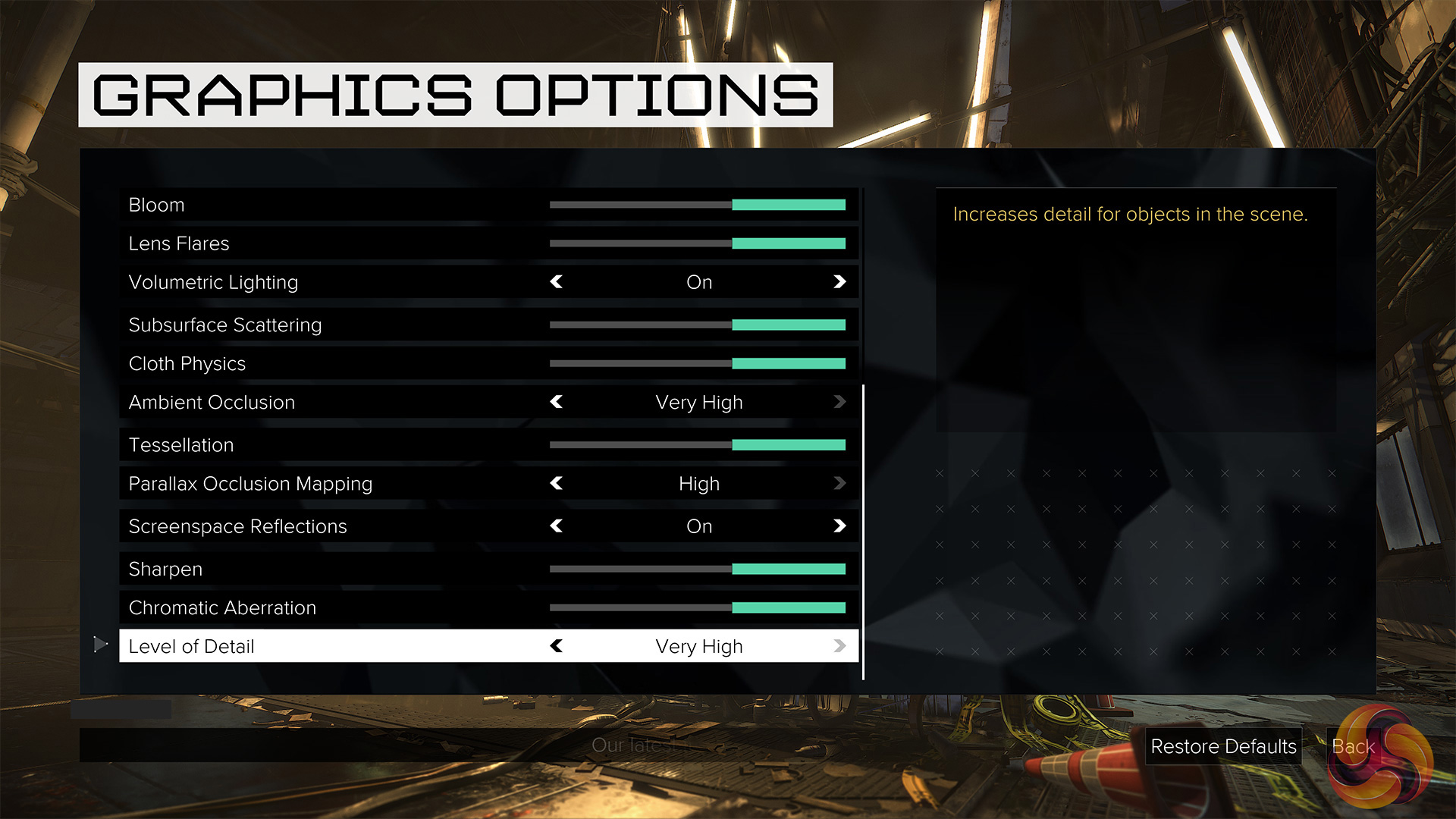
We test using the DX12 API and the ‘very high’ IQ preset.
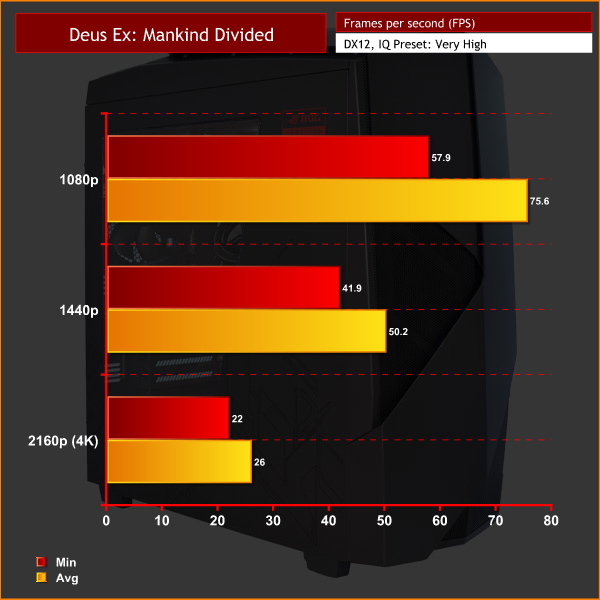
Gameplay is smooth at both 1080p and 1440p, though 4K gaming is not going to happen without a fair bit of IQ tweaking.Tom Clancy’s Ghost Recon Wildlands is an open world tactical shooter video game developed by Ubisoft Paris. It is the tenth instalment in the Tom Clancy’s Ghost Recon franchise and is the first Ghost Recon game to feature an open world environment. Ubisoft described it as one of the biggest open world games that they have ever published, with the game world including a wide variety of environments such as mountains, forests, deserts and salt flats. The game was released on March 7, 2017 for Microsoft Windows, PlayStation 4 and Xbox One. (Wikipedia).
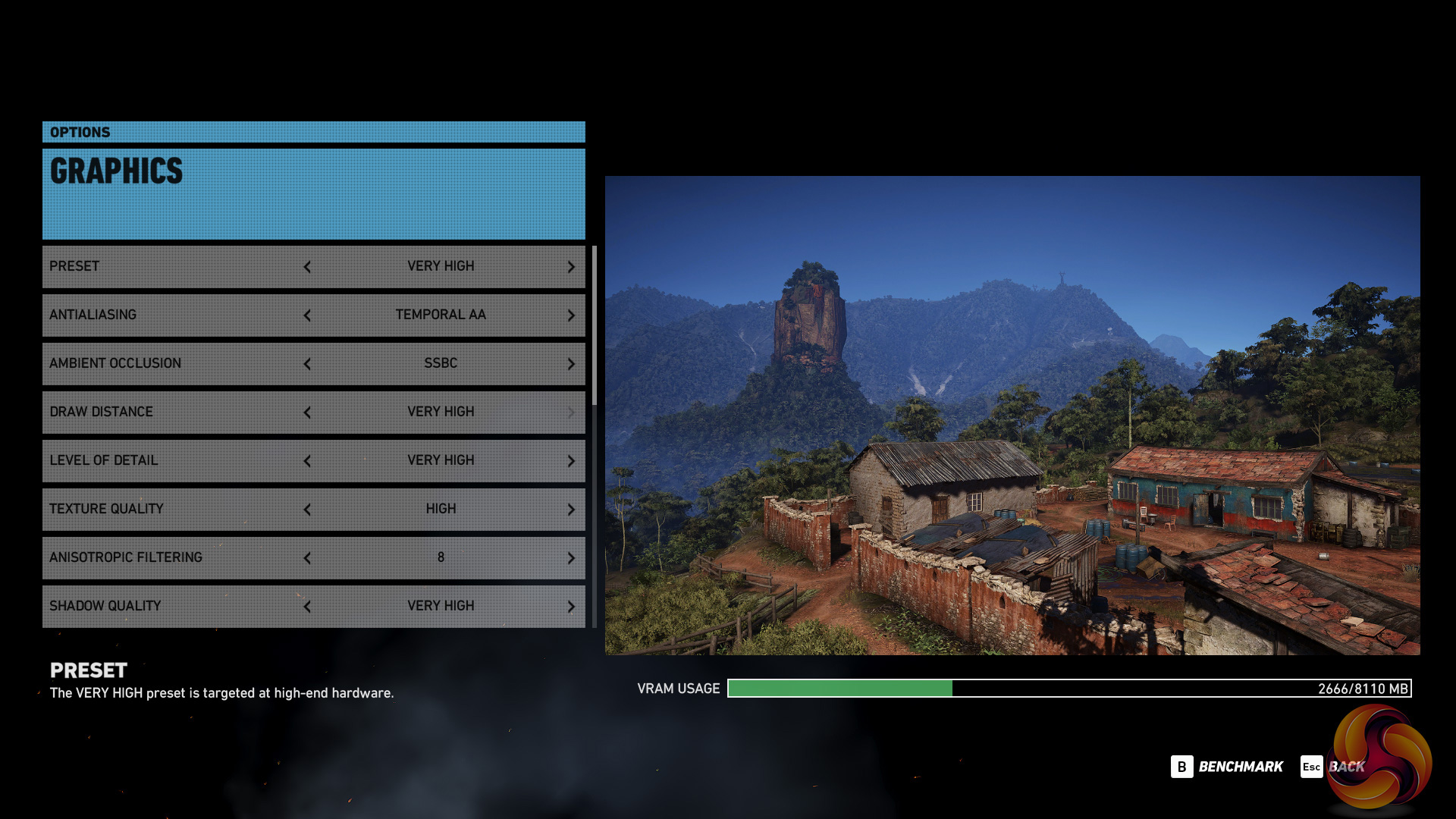
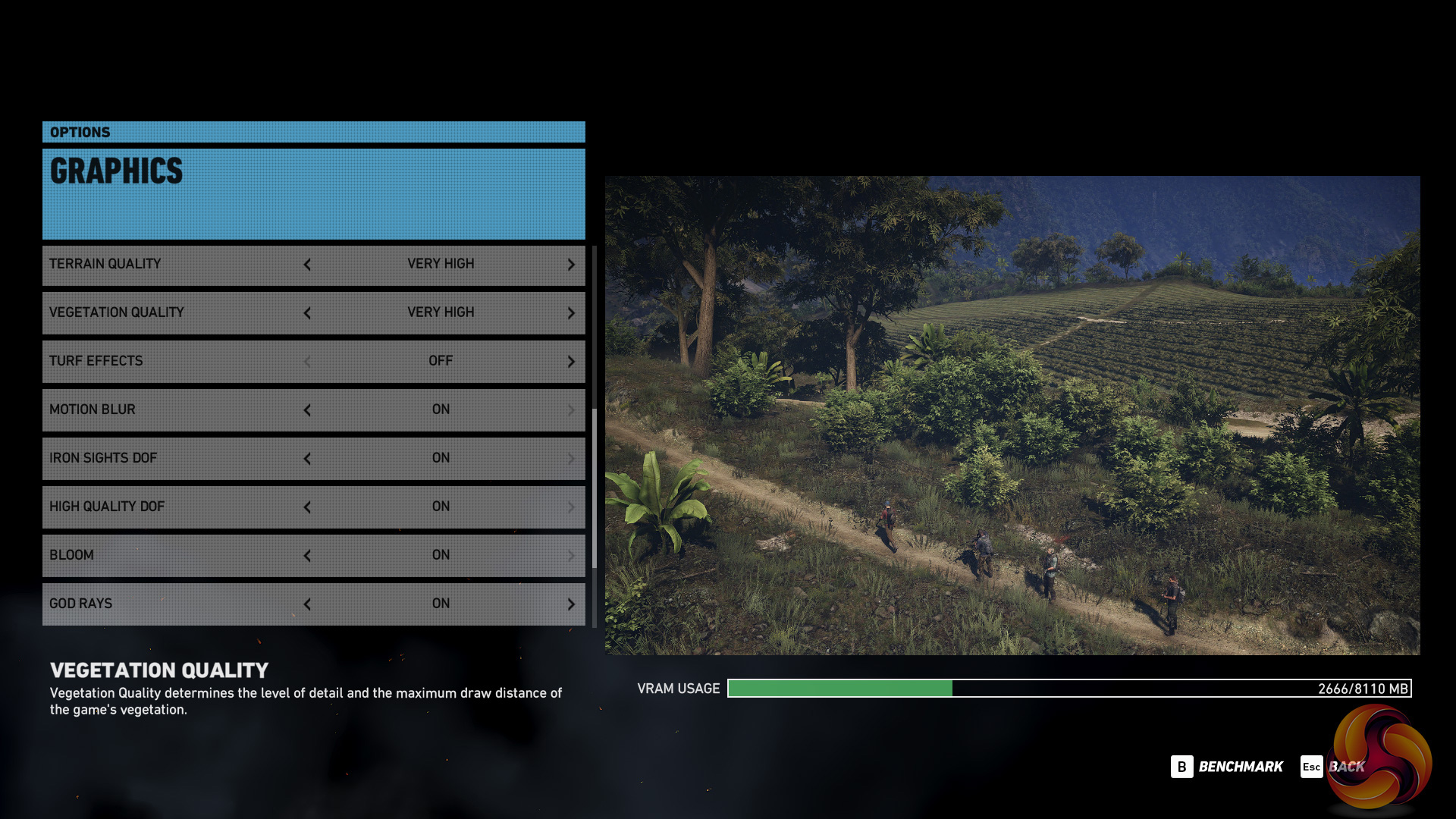
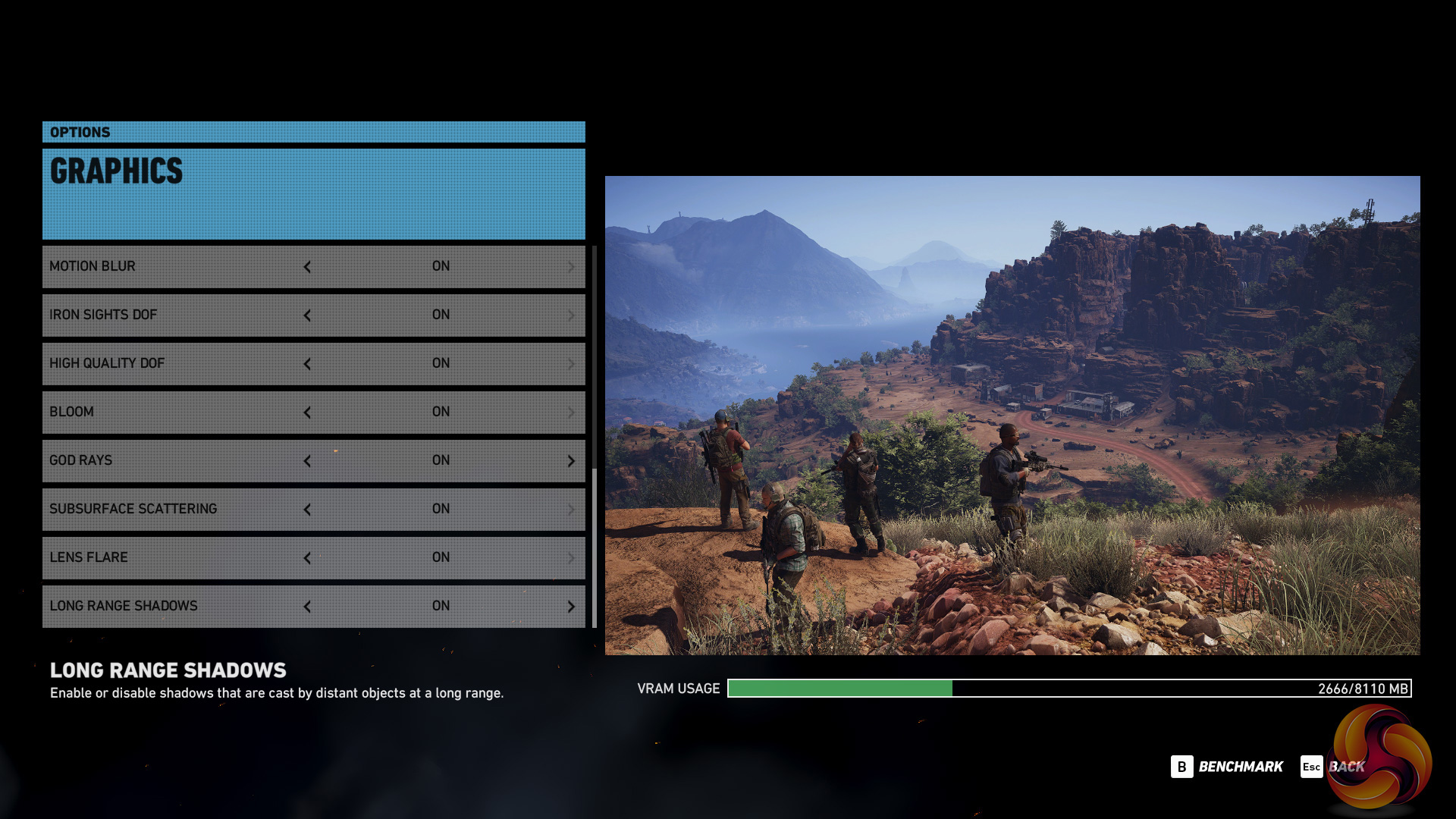
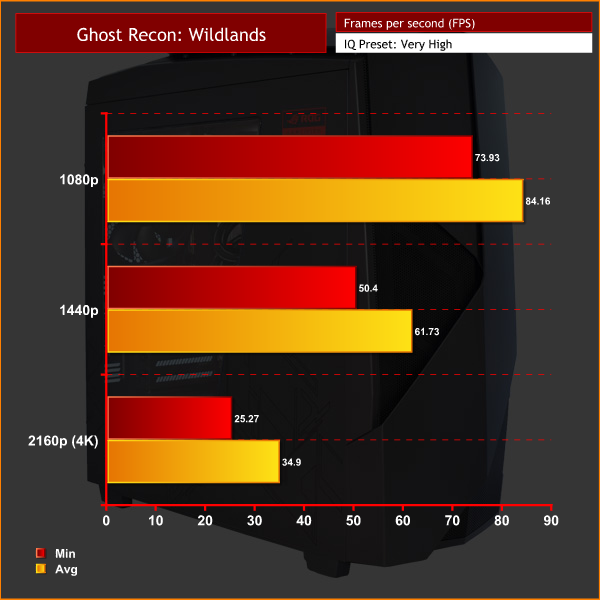
Wildlands also delivers good frame rates at 1080p and 1440p, though 4K is a bit of a stretch with a minimum of 25 FPS.Thermal dynamics
To measure idle temperatures, a reading was taken after having Windows open on the desktop for 30 minutes. A reading under load was taken with Prime 95’s SmallFFt test running alongside 3DMark Fire Strike.
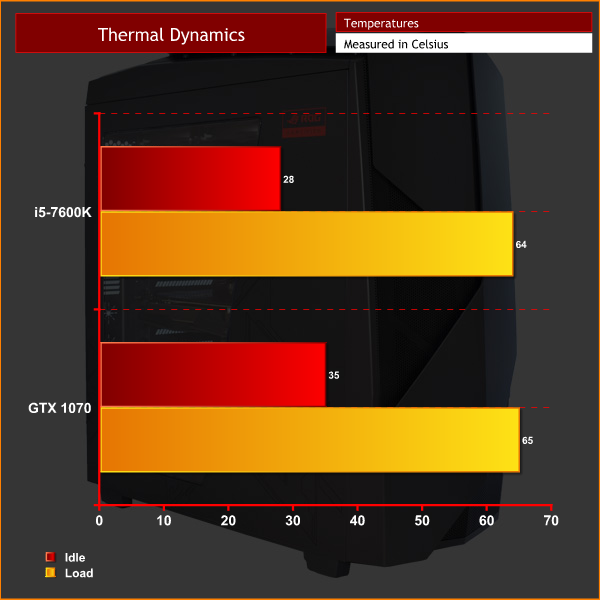
Ambient: 20C
The CPU peaking at 64 degrees is to be expected considering the chip has not been overclocked. A peak of just 65 degrees for the GPU is particularly impressive, though, and is definitely a testament to the Strix card's cooling solution.
Acoustics
The Athena Aura does idle slightly louder than I would like as it is audible at all times, though it is not overly loud or offensive. The flip-side of that is it hardly gets any louder when gaming, so overall its acoustics are just fine. Perhaps a slightly smarter fan curve would've eliminated some of the idle noise, but I can't complain too much.For ‘idle’ power draw, a reading was taken after having Windows open on the desktop for 30 minutes. A reading under load was taken with Prime 95’s SmallFFt test running alongside 3DMark Fire Strike.
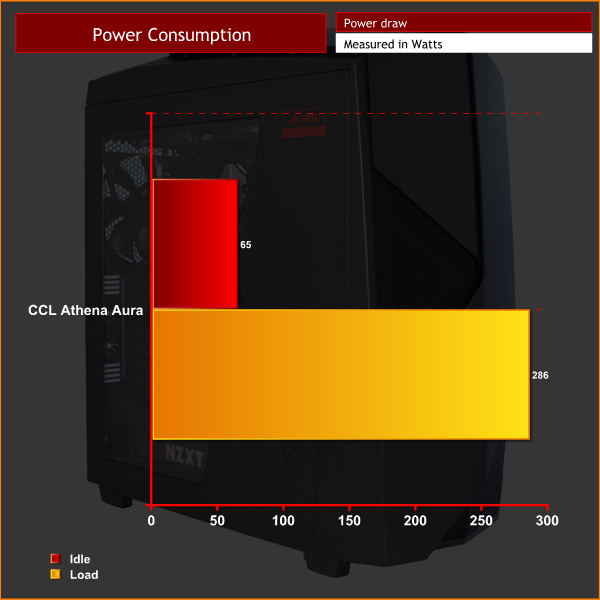
A peak power draw of 286 Watts is just over half of the power supply's rated capacity, and that ensures good efficiency levels and a quiet fan. There is also ample room for another GTX 1070 in the future.On the whole, the CCL Athena Aura is an impressive pre-built system.
It is very well-built and the specification is well-balanced, too, with quality components used throughout. The fact that all of the RGB lighting can be controlled via ASUS' Aura software is an added bonus that is very much appreciated.
I do have to point out the fact that the i5-7600K processor has not been overclocked, though, meaning its max frequency is just 4.2GHz when we know Kaby Lake chips can reach 4.7-4.8GHz with ease. There is also ample thermal headroom for this kind of overclock so it is a bit disappointing to see the CPU left at stock clocks.
On-top of that is the fact that Intel's i5 line-up – quad-core chips without HyperThreading – do seem less desirable now that Ryzen processors have been released. After all, the Ryzen 5 1600 offers 6 cores and 12 thread for less money than this i5-7600K, while gaming performance is not too far behind either.
Still, the i5/GTX 1070 combination is tried-and-trusted and the Athena Aura delivers the goods when it comes to gaming. We saw excellent frame rates across the board, though 4K gaming is still hit-and-miss with a GTX 1070. 1080p and 1440p gamers, though, will have no problem cranking the IQ settings to the max.
On the whole, we are happy to recommend the CCL Athena Aura. It costs £1614.99, which is a mark-up of around £180 over individual component retail prices. This is slightly steep but CCL does offer a 3-year on-site warranty which goes a long way to making it seem a better deal. Even so, you are clearly paying a bit extra for the ROG ecosystem and synchronised RGB lighting.
You can buy one for £1614.99 inc. VAT HERE.
Pros
- Well built.
- Very good looking, especially with the RGB lighting synchronised.
- Great for 1080p and 1440p gaming.
- Fast M.2 SSD.
- 3-year on-site warranty.
Cons
- i5 has not been overclocked.
- Ryzen 5 1600 is definitely worth thinking about as an alternative to the i5.
- Could do with a £50 price cut to be more competitive considering the spec.
KitGuru says: The CCL Athena Aura is a very solid gaming PC. It is well built, filled with quality components and looks great – especially when the RGB lighting is turned on. However, not overclocking the CPU was a mistake, while I would even argue a Ryzen 5 1600-based system is worth considering as an alternative processor to the i5.