KitGuru KitGuru.net – Tech News | Hardware News | Hardware Reviews | IOS | Mobile | Gaming | Graphics Cards


Almost three weeks ago, Nvidia launched the GTX 1660 Ti – the first GPU based on the Turing architecture to not have any RTX features. In what will come as a surprise to absolutely no one, today marks the release of the GTX 1660. GTX 1660 uses the same TU116 GPU as its bigger brother, but with one TPC disabled – meaning there are two less SMs and 128 less CUDA cores. It also keeps 6GB of VRAM, but in the form of older GDDR5 memory, rather than GDDR6. With prices starting at £199, is GTX 1660 worth buying?
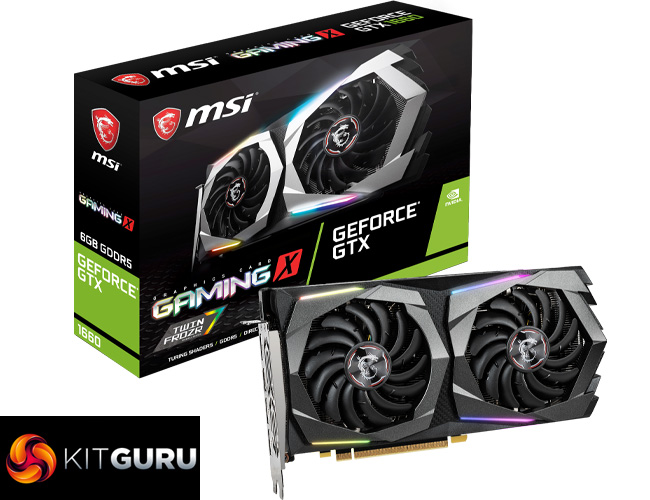
While the baseline MSRP for GTX 1660 is indeed £199, the model we are looking at today is the MSI GTX 1660 Gaming X 6G. This has a much higher price tag of £249.99, making it very much a top-end GTX 1660 card. MSI is hoping the factory overclocked core, Twin Frozr 7 cooler and RGB lighting will be enough to tempt buyers to stump up the extra cash, but why don't we see for ourselves whether or not this price can be justified.
| GPU | GTX 1070 | RTX 2060 (FE) | GTX 1660 Ti | GTX 1660 | GTX 1060 |
| SMs | 15 | 30 | 24 | 22 | 10 |
| CUDA Cores | 1920 | 1920 | 1536 | 1408 | 1280 |
| Tensor Cores | N/A | 240 | N/A | N/A | N/A |
| Tensor FLOPS | N/A | 51.6 | N/A | N/A | N/A |
| RT Cores | N/A | 30 | N/A | N/A | N/A |
| Texture Units | 120 | 120 | 96 | 88 | 80 |
| ROPs | 64 | 48 | 48 | 48 | 48 |
| Rays Cast | 0.65 Giga Rays/sec | 5 Giga Rays/sec | – | – | 0.44 Giga Rays/sec |
| RTX Performance | 6.5 Trillion RTX-OPS | 37 Trillion RTX-OPS | – | – | N/A |
| GPU Boost Clock | 1683 MHz | 1680 MHz | 1770 MHz | 1785 MHz | 1708 MHz |
| Memory Data Rate | 8 Gbps | 14 Gbps | 12 Gbps | 8 Gbps | 8 Gbps |
| Total Video Memory | 8GB GDDR5 | 6GB GDDR6 | 6GB GDDR6 | 6GB GDDR5 | 6GB GDDR5 |
| Memory Interface | 256-bit | 192-bit | 192-bit | 192-bit | 192-bit |
| Memory Bandwidth | 256 GB/sec | 336.1 GB/sec | 288.1 GB/sec | 192.1 GB/sec | 192 GB/sec |
| TDP | 150W | 160W | 120W | 120W | 120W |
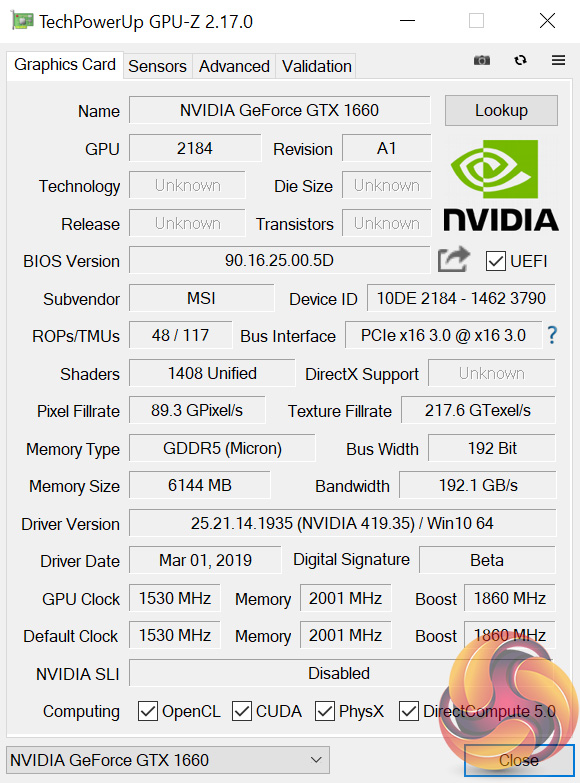
As we already mentioned, GTX 1660 uses the TU116 GPU – as seen in GTX 1660 Ti. It has been slightly scaled back for GTX 1660, however, with one less Texture Processing Cluster (TPC). Given that, within the Turing architecture, one TPC houses two Streaming Multiprocessors (SMs), GTX 1660 accordingly has 22 SMs instead of 24. Two less SMs also means 128 less CUDA cores, giving us a total of 1408.
The other notable change between GTX 1660 and 1660 Ti is the memory. Instead of using GDDR6 memory, the card reverts back to GDDR5 – and that is ‘just' GDDR5, not the faster GDDR5X which debuted with the GTX 1080. Nvidia says this is because G5 gives the ‘best balance of performance and cost' – so G5X/G6 is likely just too expensive for a £200 card. There is still 6GB of memory, but as it is G5 it runs at a slower 8 Gbps, with a total bandwidth of 192.1 GB/sec – effectively the same as GTX 1060.
Lastly, touching on boost clocks, a reference-spec card has a boost clock of 1785MHz. This Gaming X, as we mentioned, comes factory overclocked with a rated clock speed of 1860MHz. GPU Boost 4.0 will take this as far as it can without any manual overclocking, though, and we look at the real-world operating frequency of the card later in the review.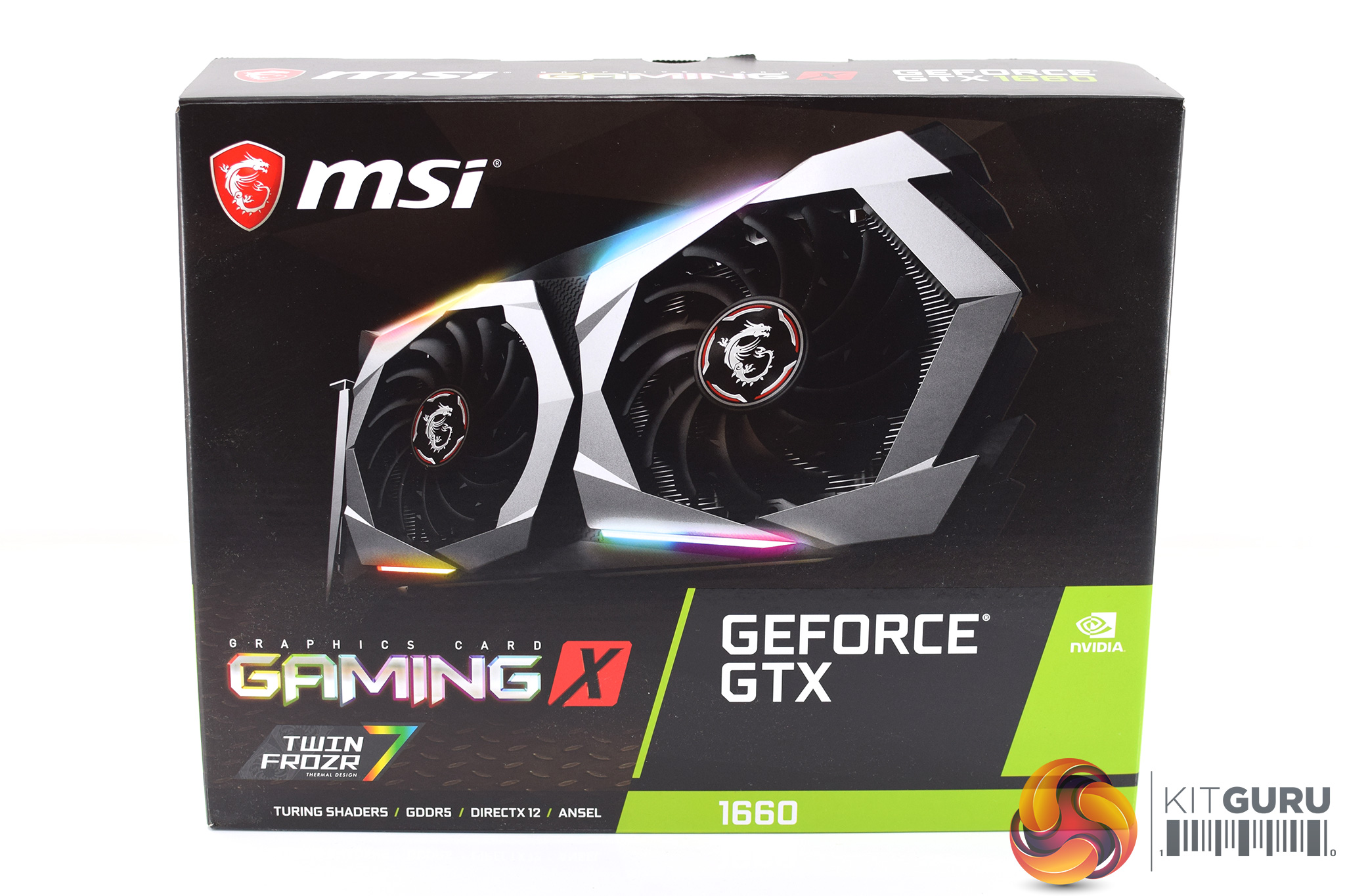
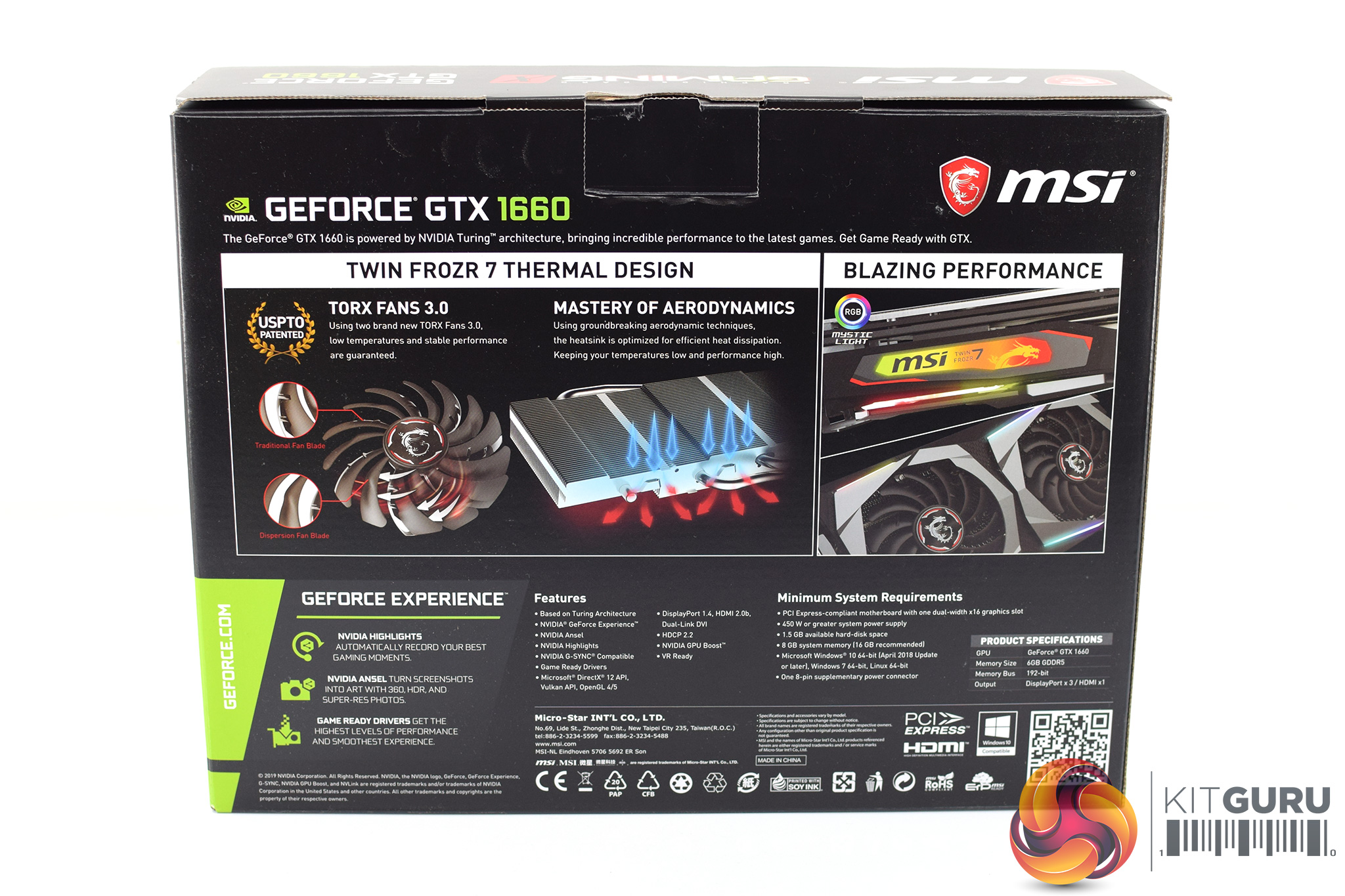
Packaging of this MSI GTX 1660 Gaming X is identical to the GTX 1660 Ti Gaming X we reviewed recently – a large image of the card dominates the front, while some key features of the card and cooler are highlighted on the back.
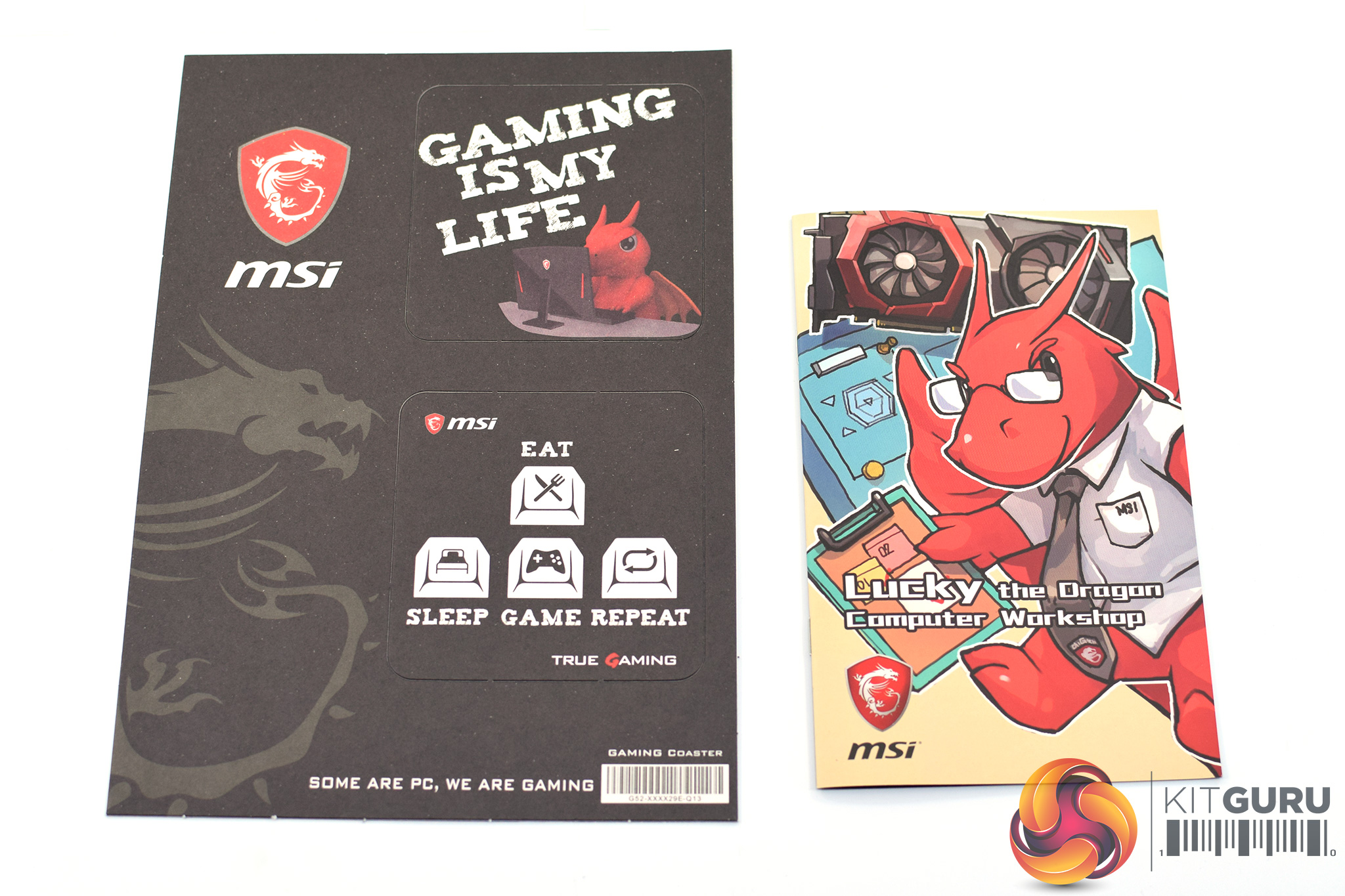
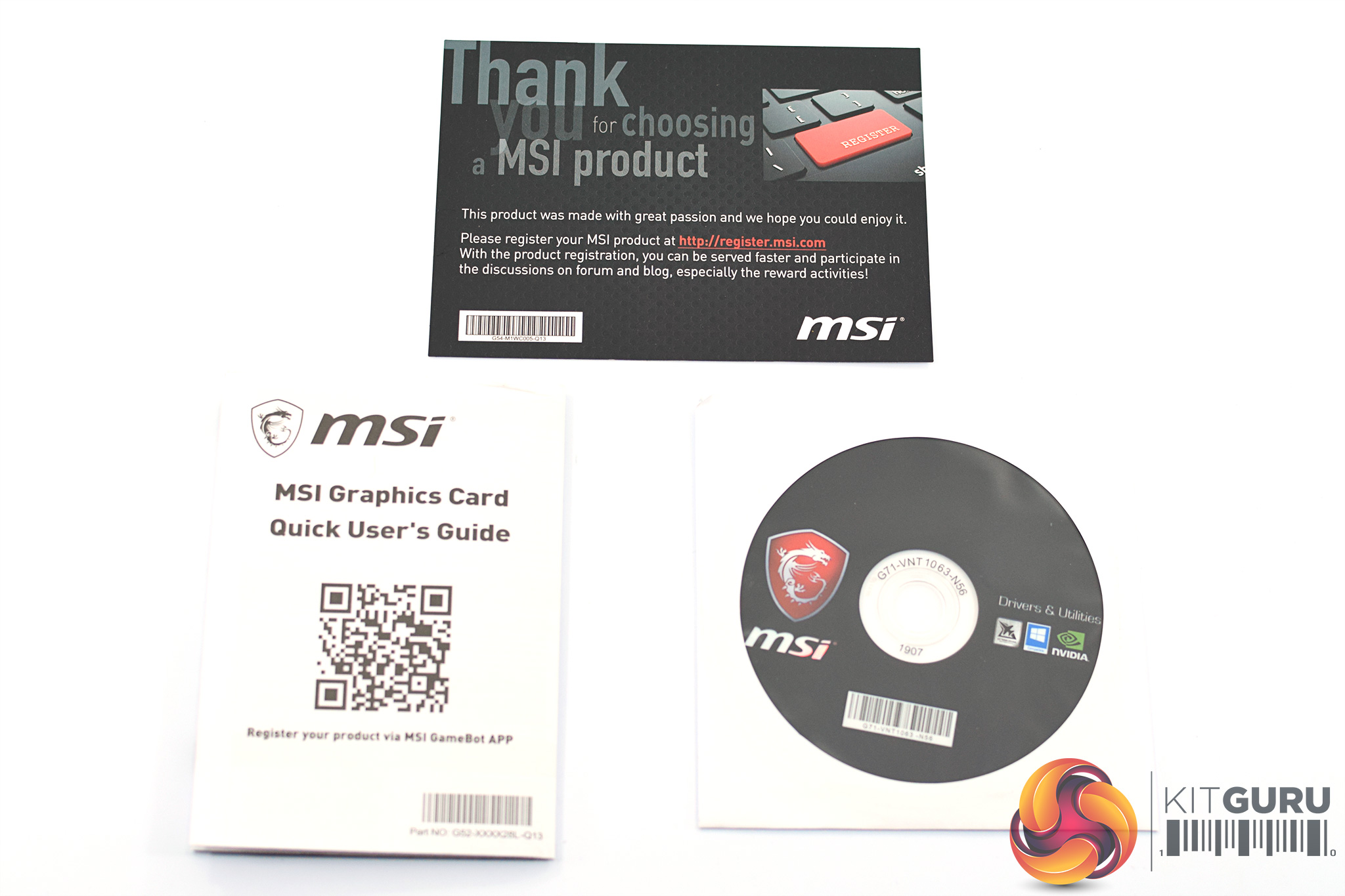
Inside, we get the usual bundle from MSI – meaning there are two coasters and a Lucky the Dragon cartoon, alongside a quick start guide, driver disk and ‘thank you’ note.
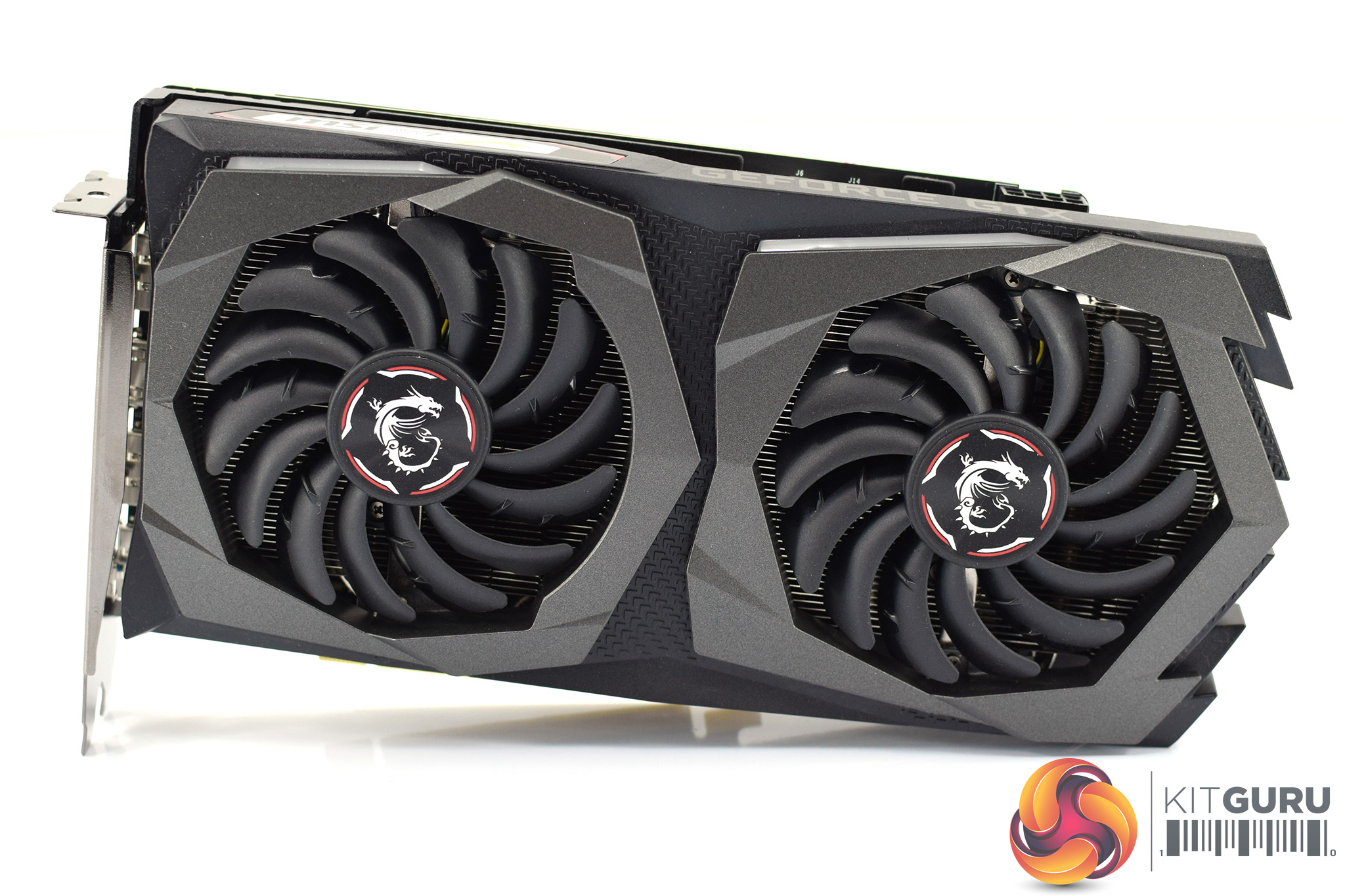
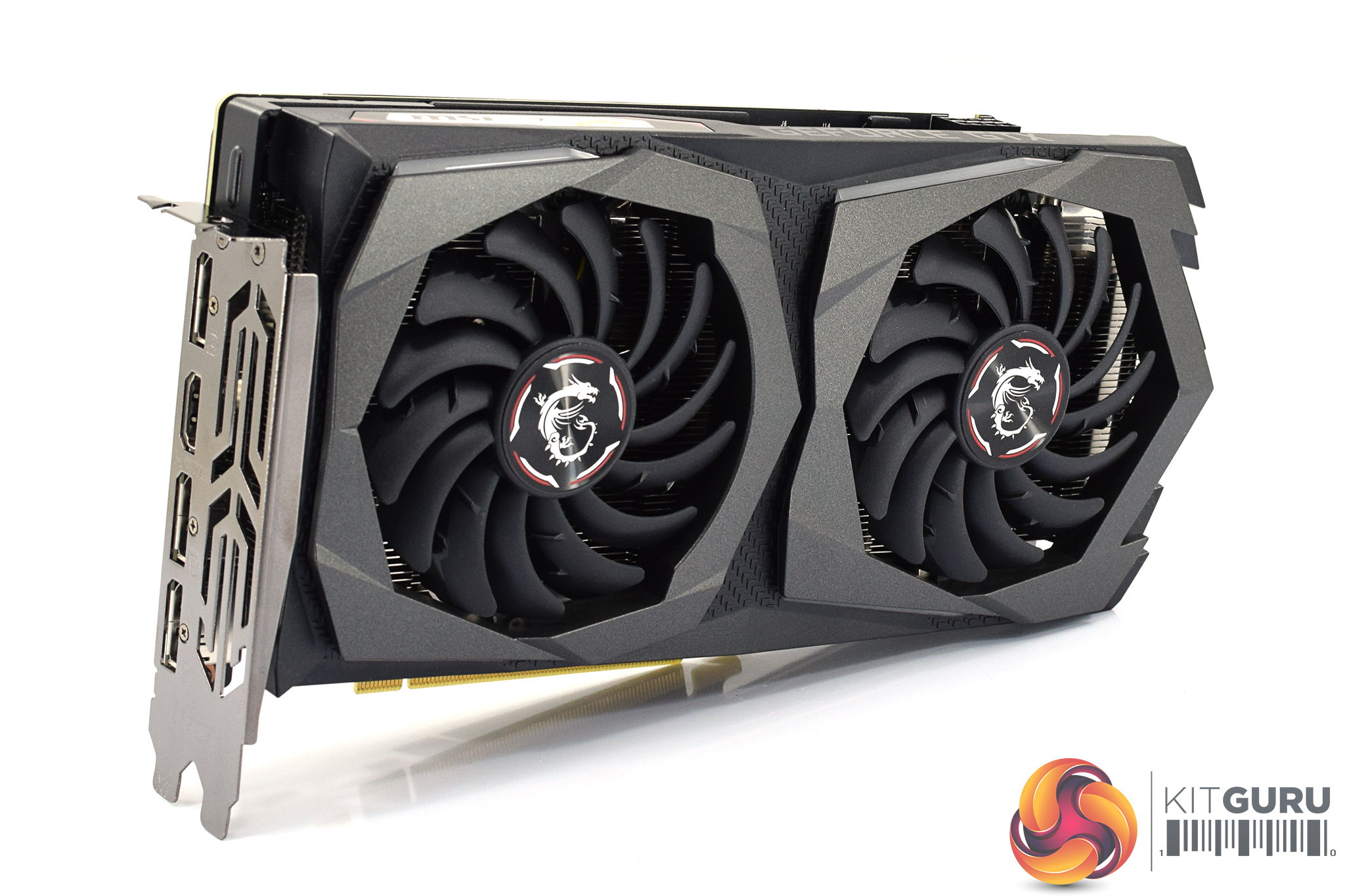
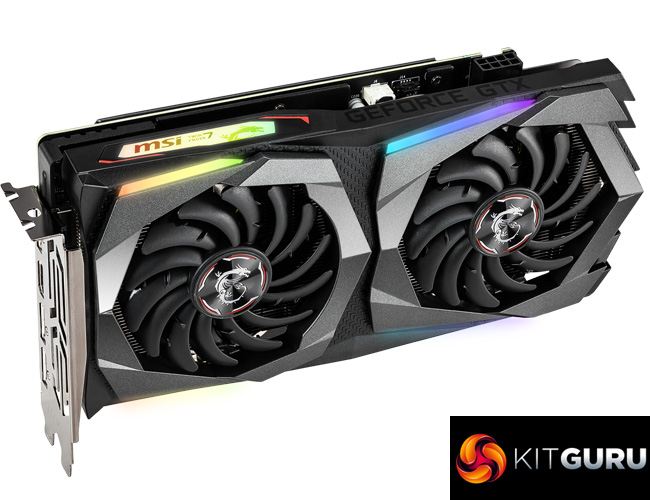
As for the card itself, it probably looks familiar. That's because we've seen it before – as far as I can tell, from both the external and internal design, this is exactly the same card as the 1660 Ti Gaming X model.
That's not bad thing, though, as the design is both colour-neutral and quite attractive in my opinion, with a mix of matte black and gunmetal grey plastic used for the card's shroud.
The two fans are the same 90mm (85mm blade-to-blade) Torx 3.0 models, too, which sport MSI's ‘dispersion fan blade' design which aims to increase airflow pressure down onto the heatsink. There is also support for Zero Frozr, MSI's fan-stop mode.
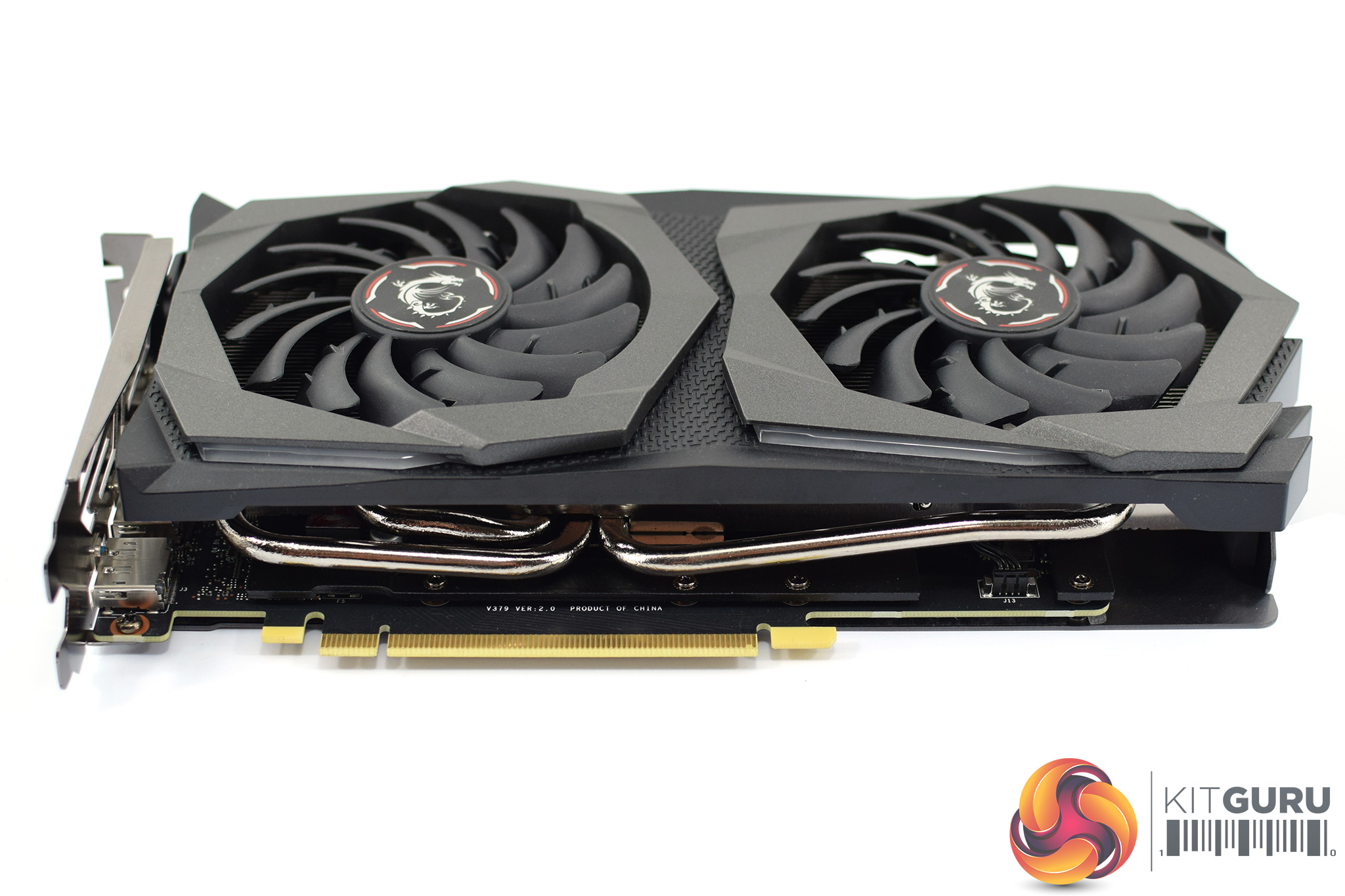
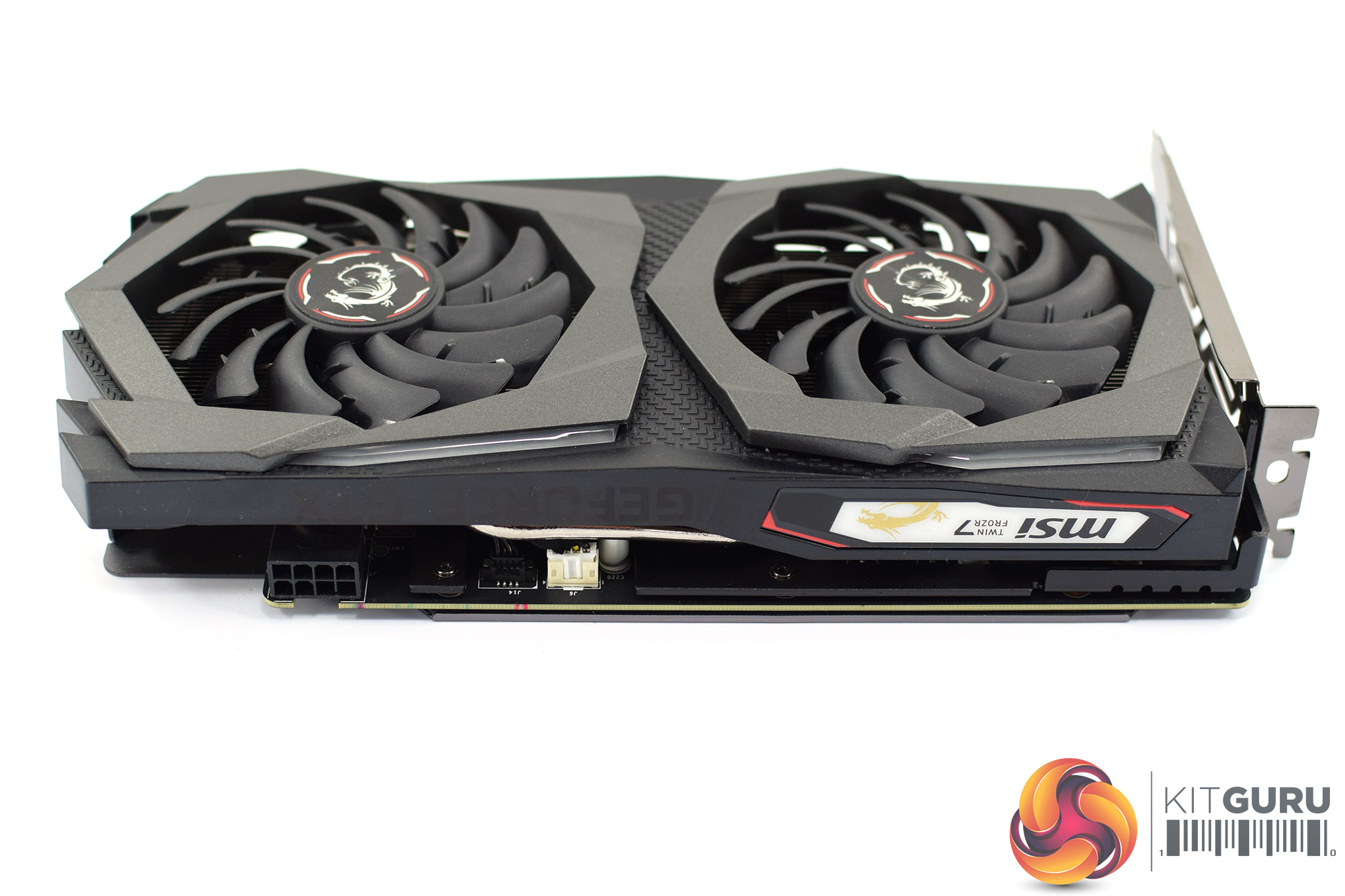
As for dimensions, they are exactly the same as the GTX 1660 Ti Gaming X, meaning the card measures 247 x 127 x 46 mm. It's not going to be as small as the single-fan GTX 1660 models on the market, but it is still a relatively compact card.
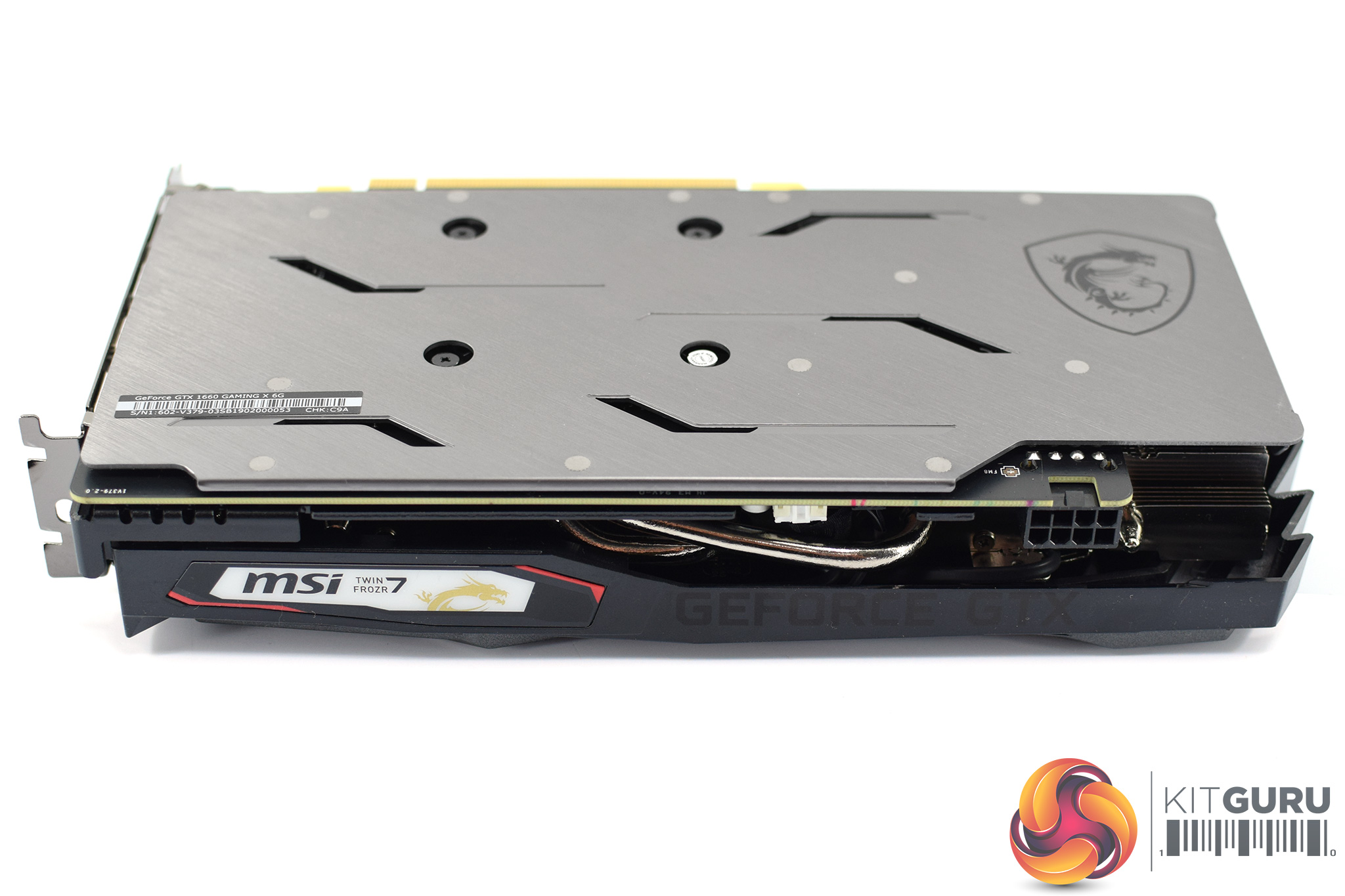
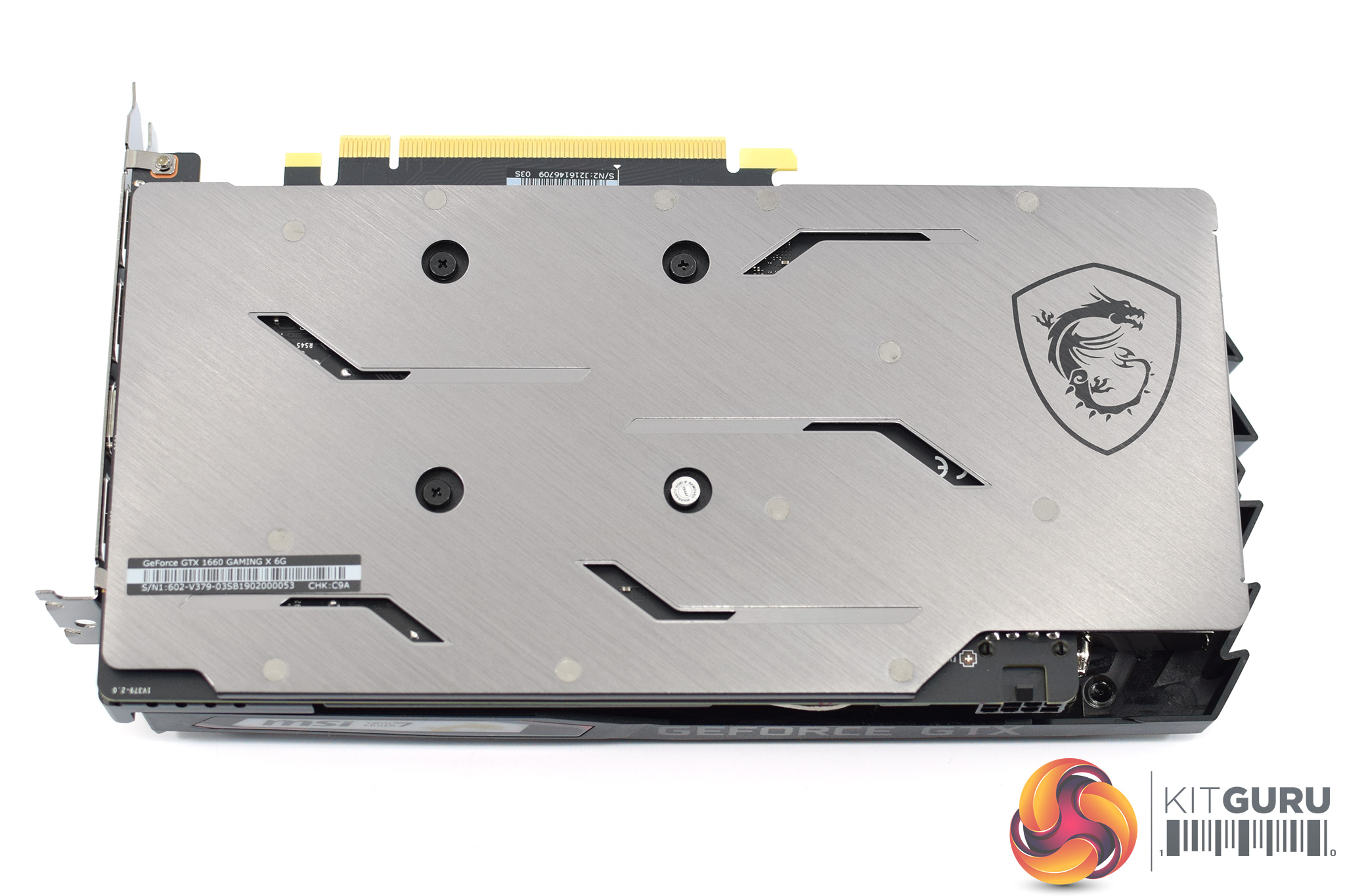
This GTX 1660 retains the lovely brushed metal backplate we have seen from other MSI Gaming cards of this generation, and I have to say it looks really stylish without being ‘in-your-face' or obnoxious, with just a small-ish MSI logo positioned to the right hand side.
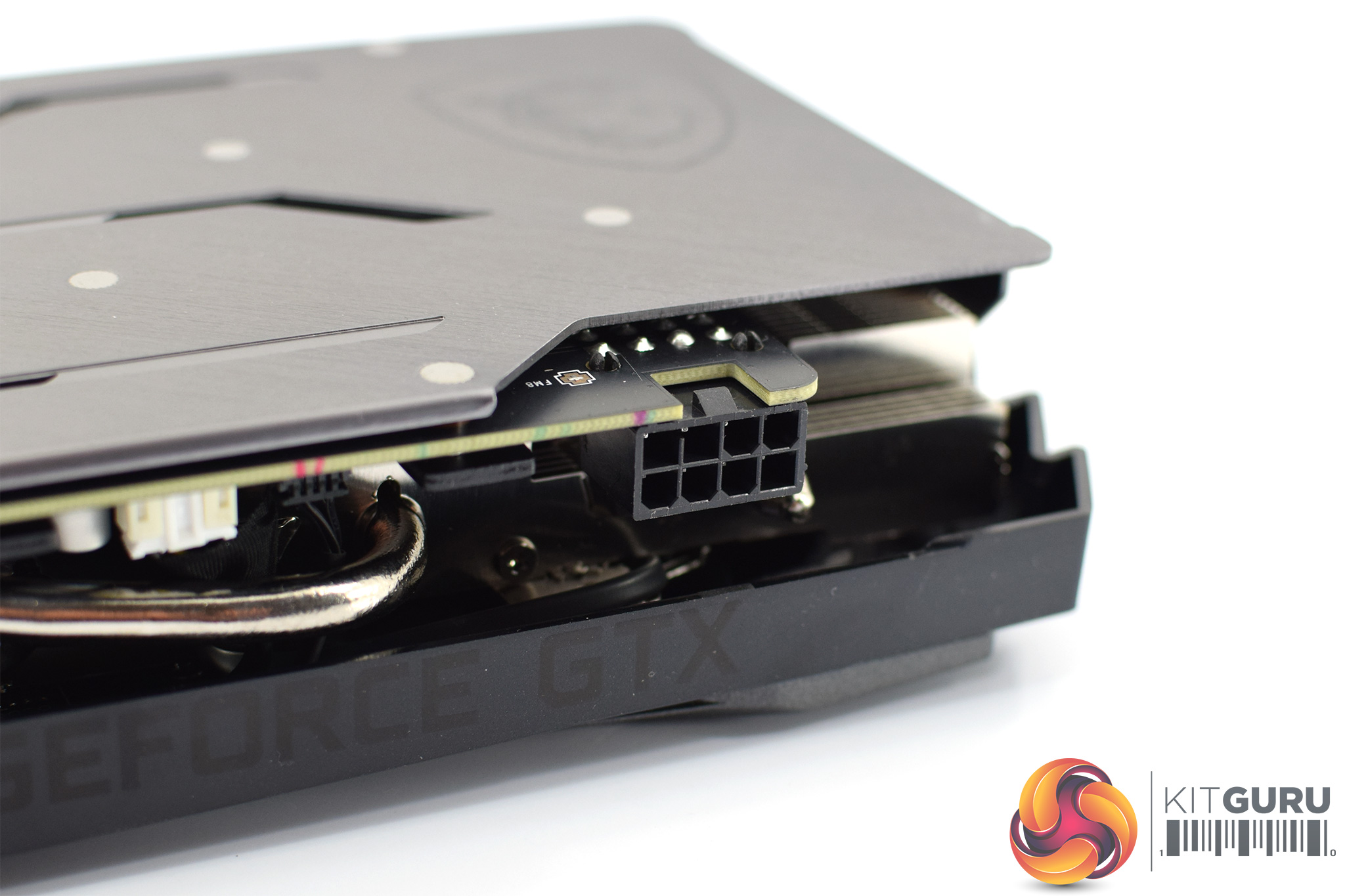
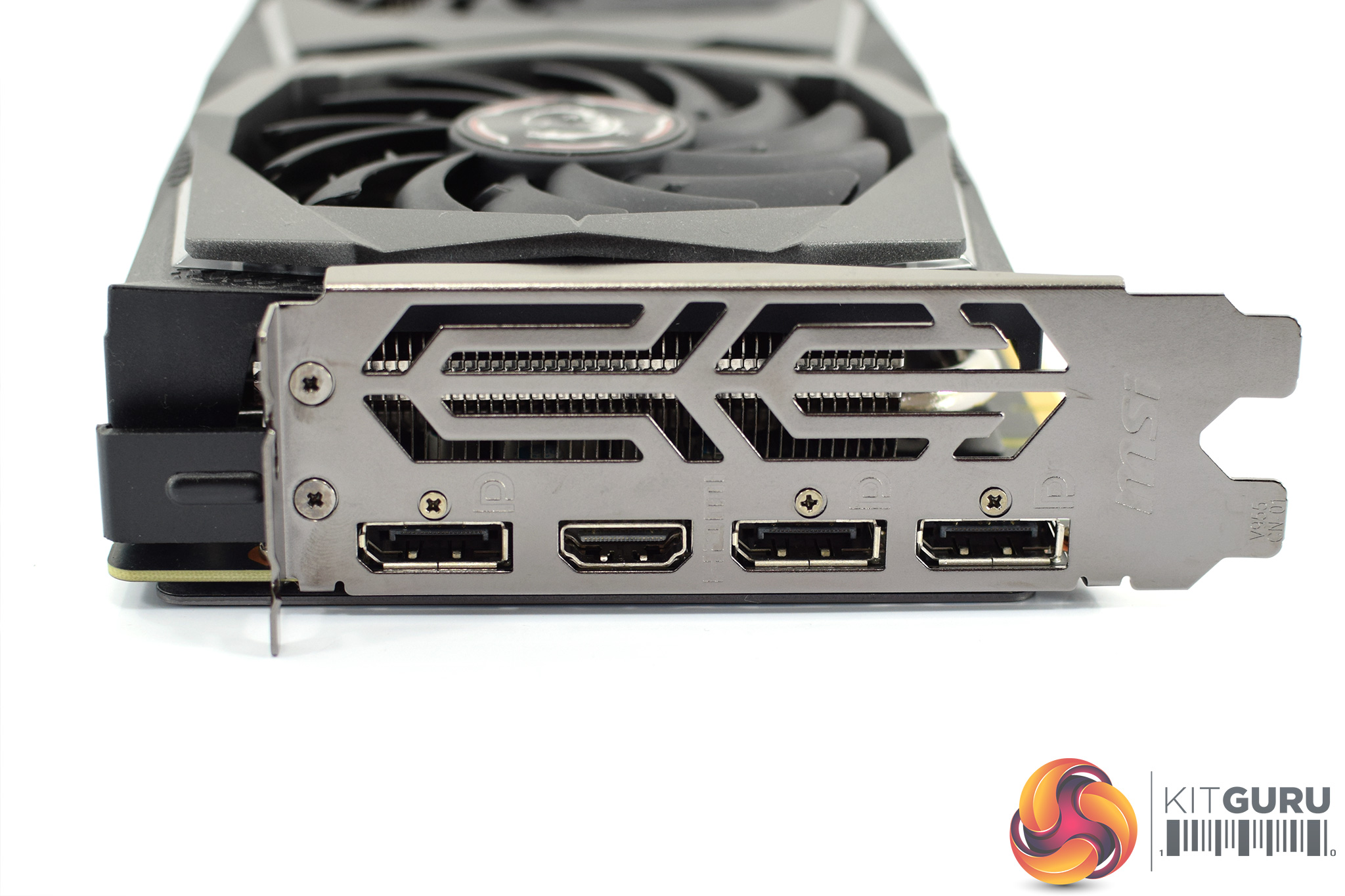
Elsewhere, GTX 1660 retains the single 8-pin PCIe power connector of its bigger brother, while this card also keeps the same display outputs: 3x DisplayPort and 1x HDMI.
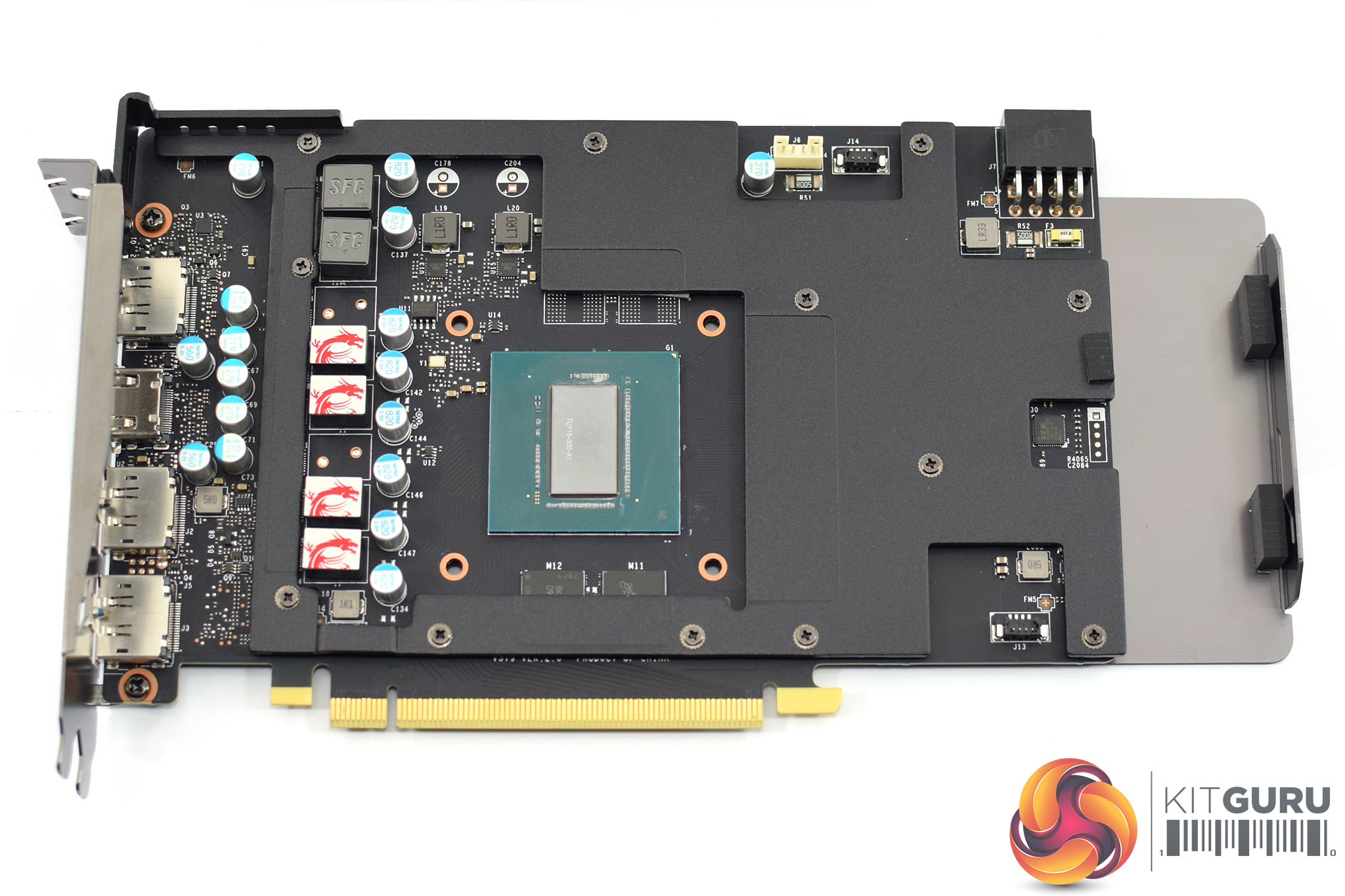
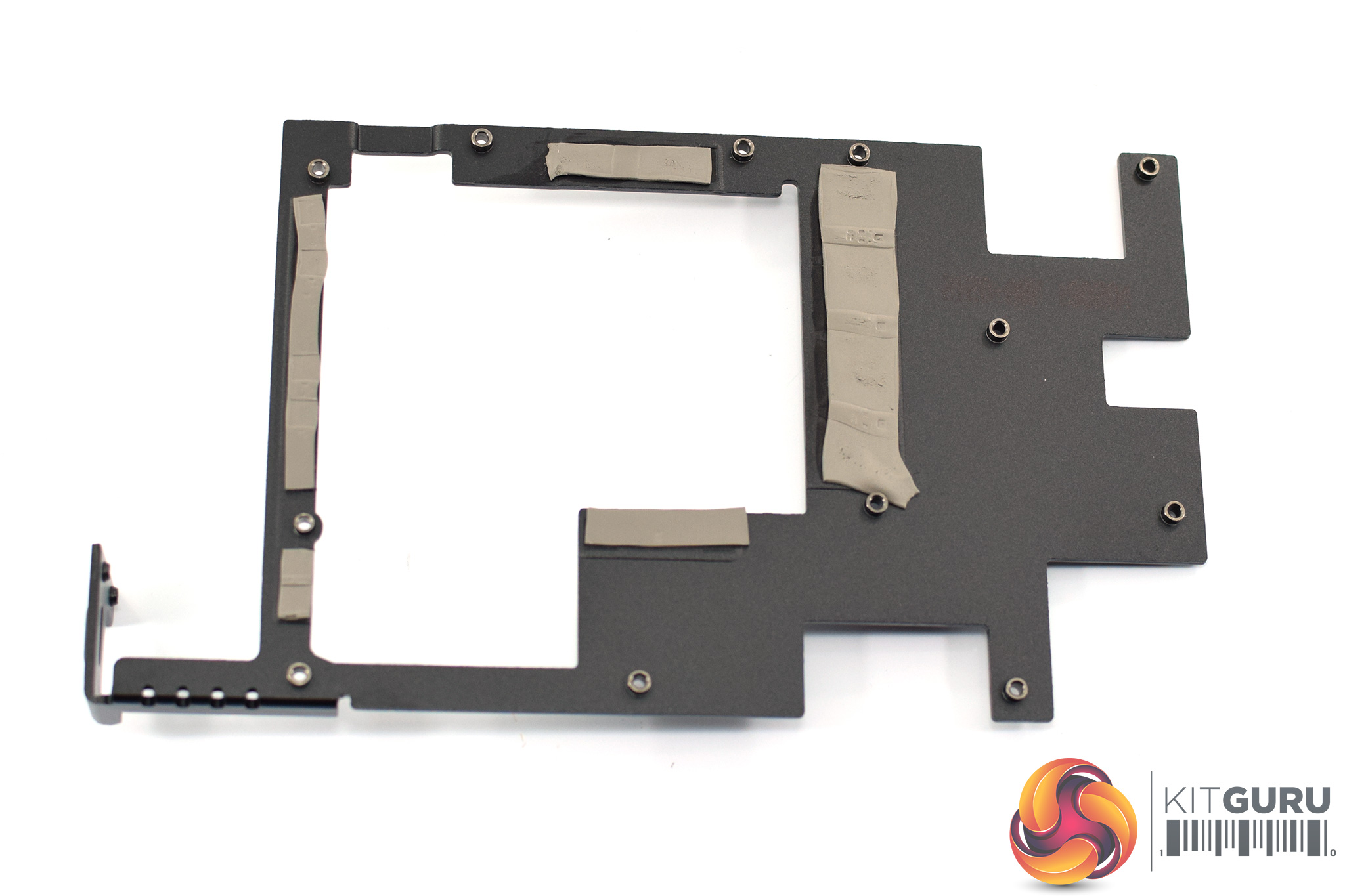
Taking the card apart only requires the removal of four screws from the back of the card. MSI is using another die-cast metal frame to cover most of the PCB, though, and this acts as a heatsink for the VRAM chips as well as the MOSFETs.
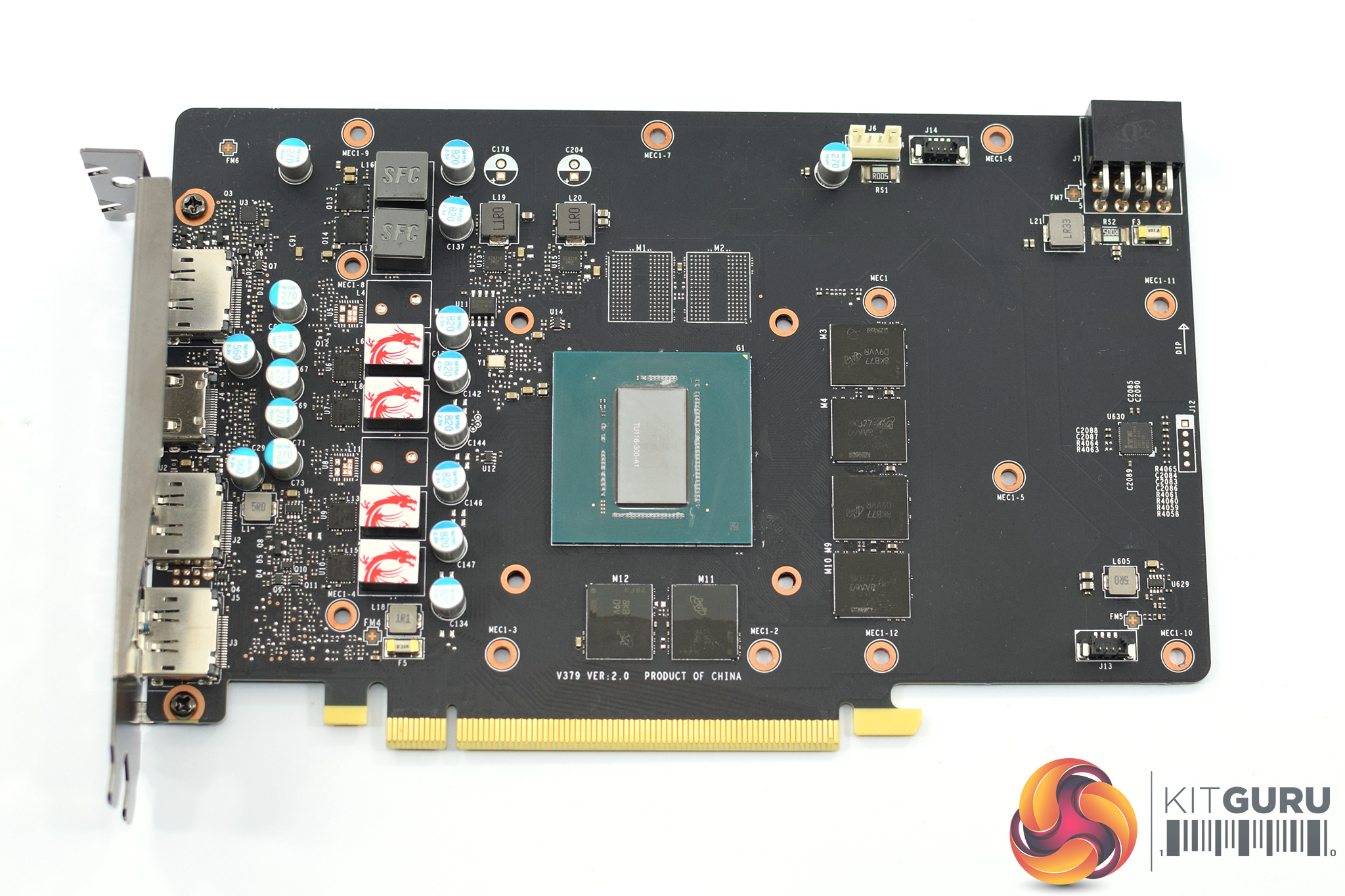
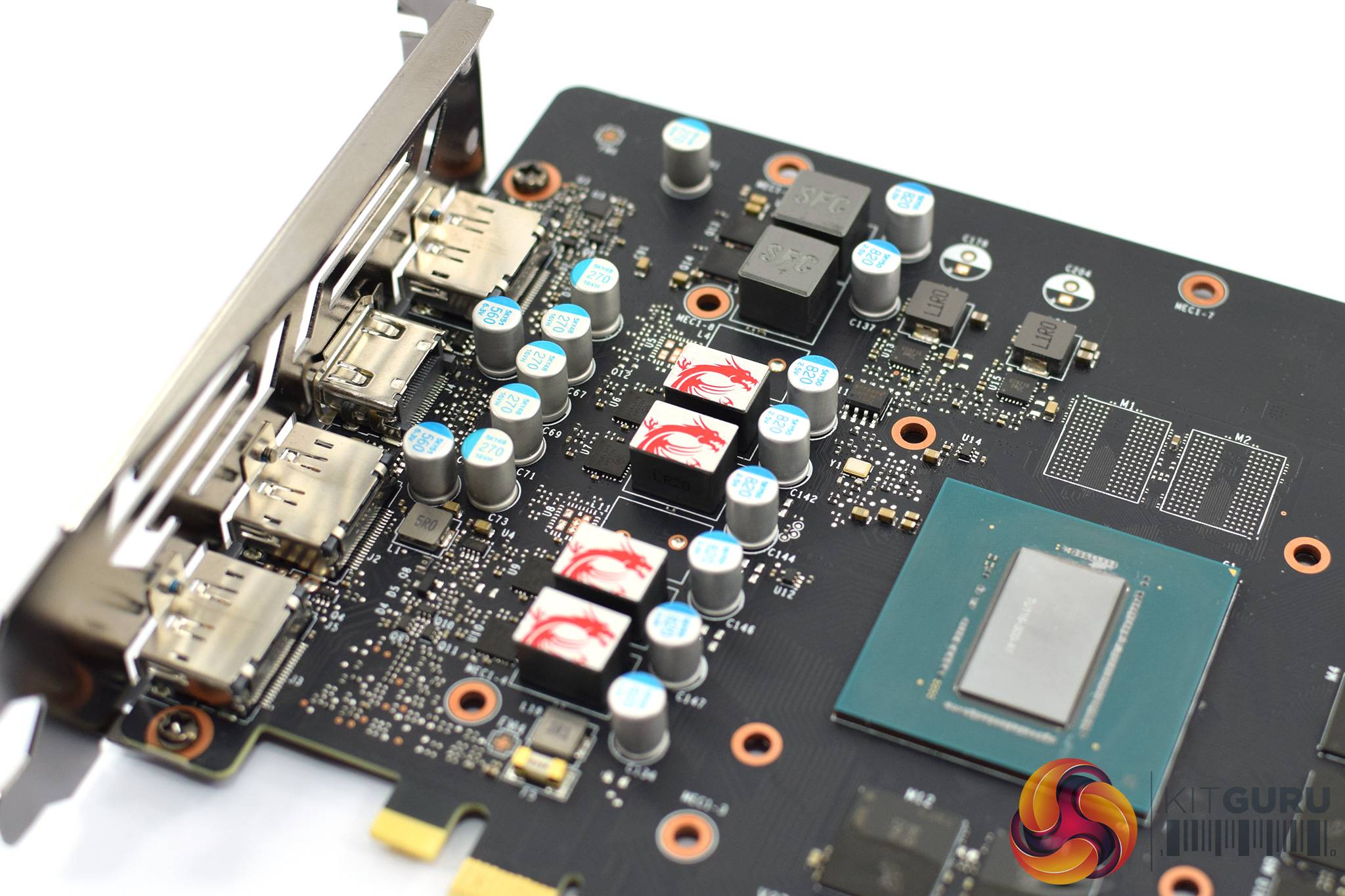
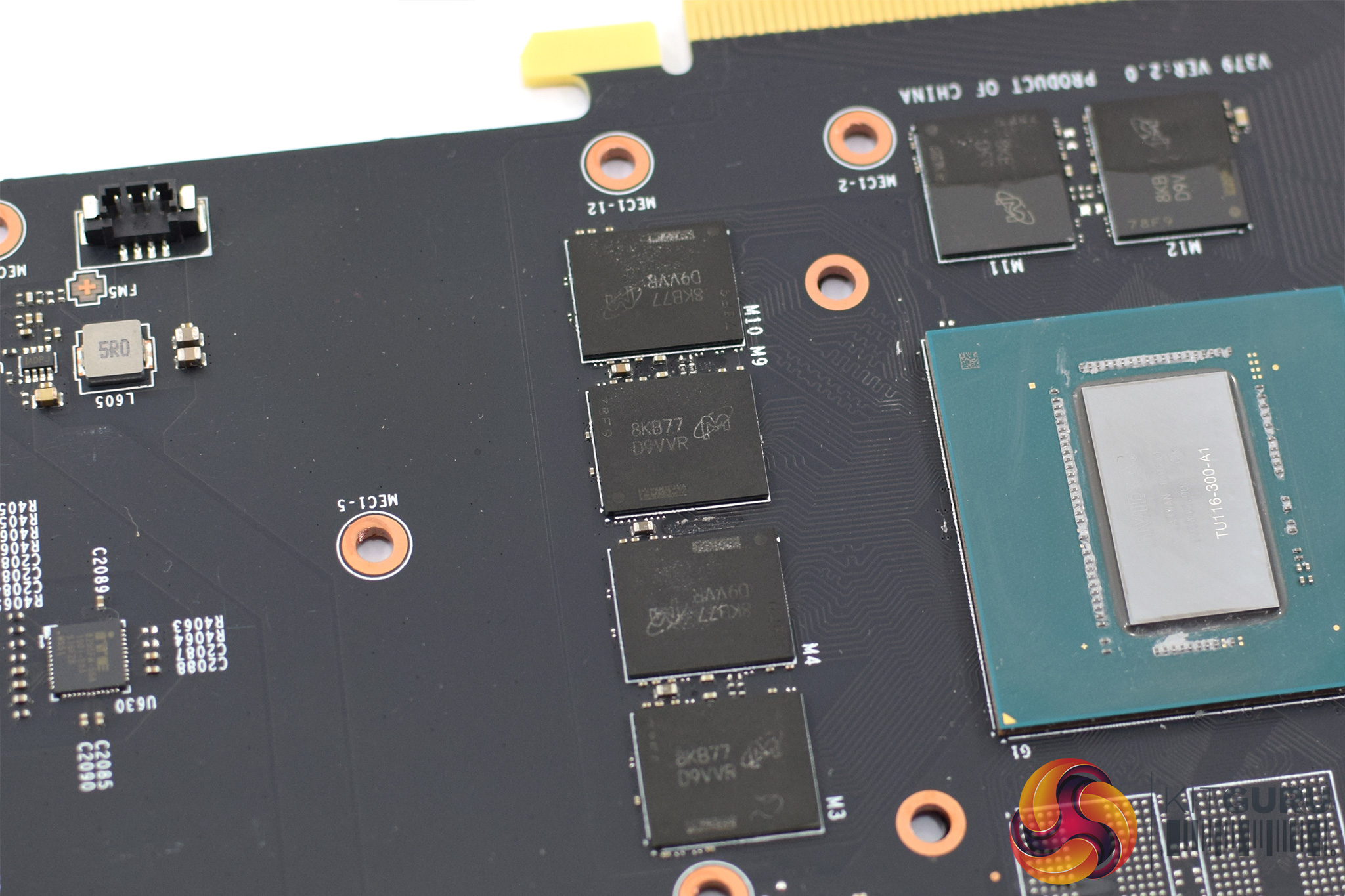
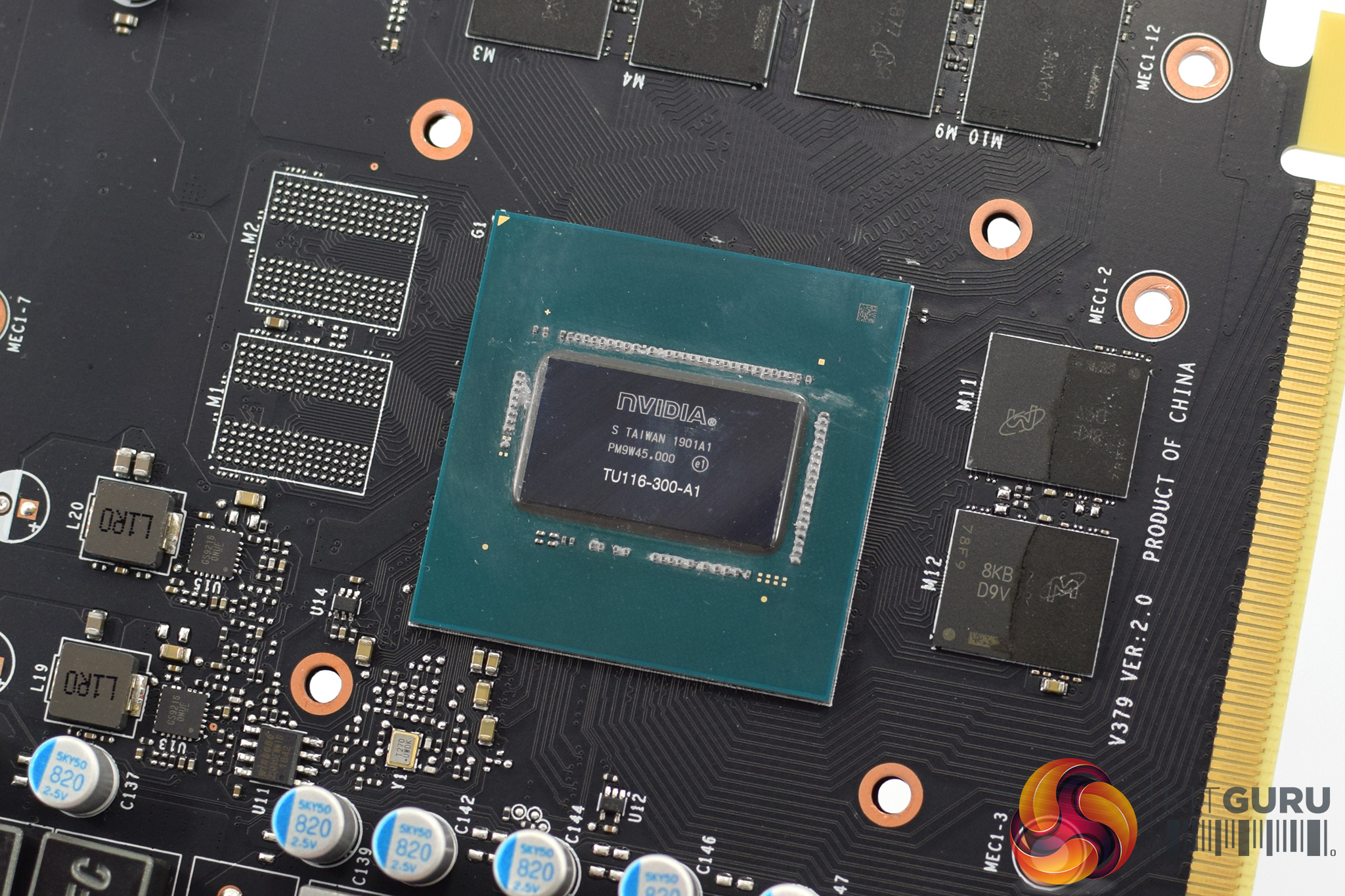
When we remove this frame and get a look at the PCB itself, and to my eye it remains effectively unchanged from the PCB of the GTX 1660 Ti Gaming X, which makes sense since it is the same GPU. That means MSI retains 4+2 phases for the power delivery, and we still get 6GB of VRAM from Micron. Remember, though, the memory is GDDR5, not GDDR6, and the chips are labelled ‘8KB77D9VVR'.
The GPU, while still TU116, is now labelled ‘TU116-300-A1', instead of ‘400-A1' as per GTX 1660 Ti. Either way, Nvidia is not pre-binning TU116 into ‘A' and ‘non-A' stacks, so there are no restrictions for Nvidia's partners as to what chips can be sold with a factory overclock.
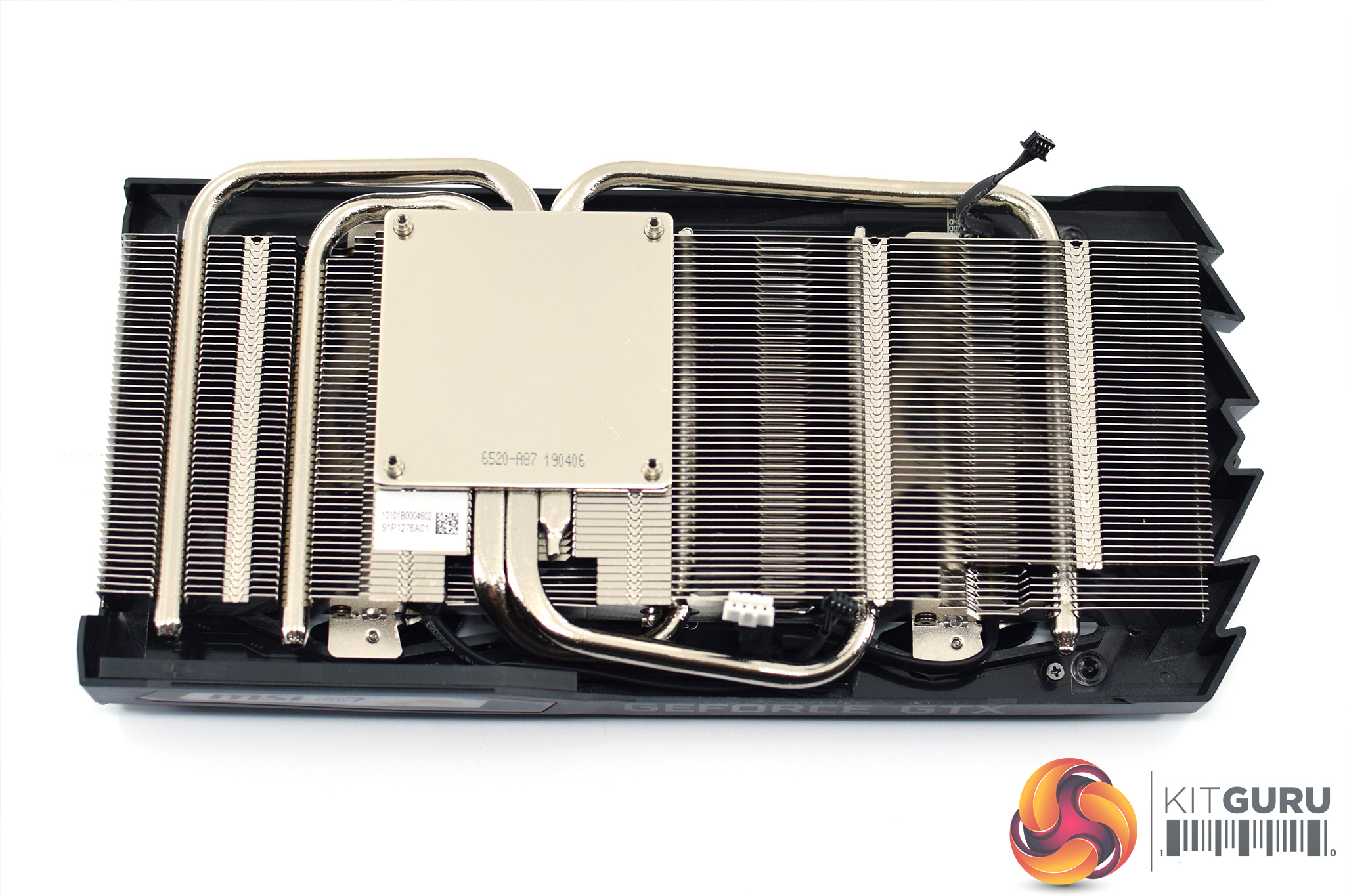
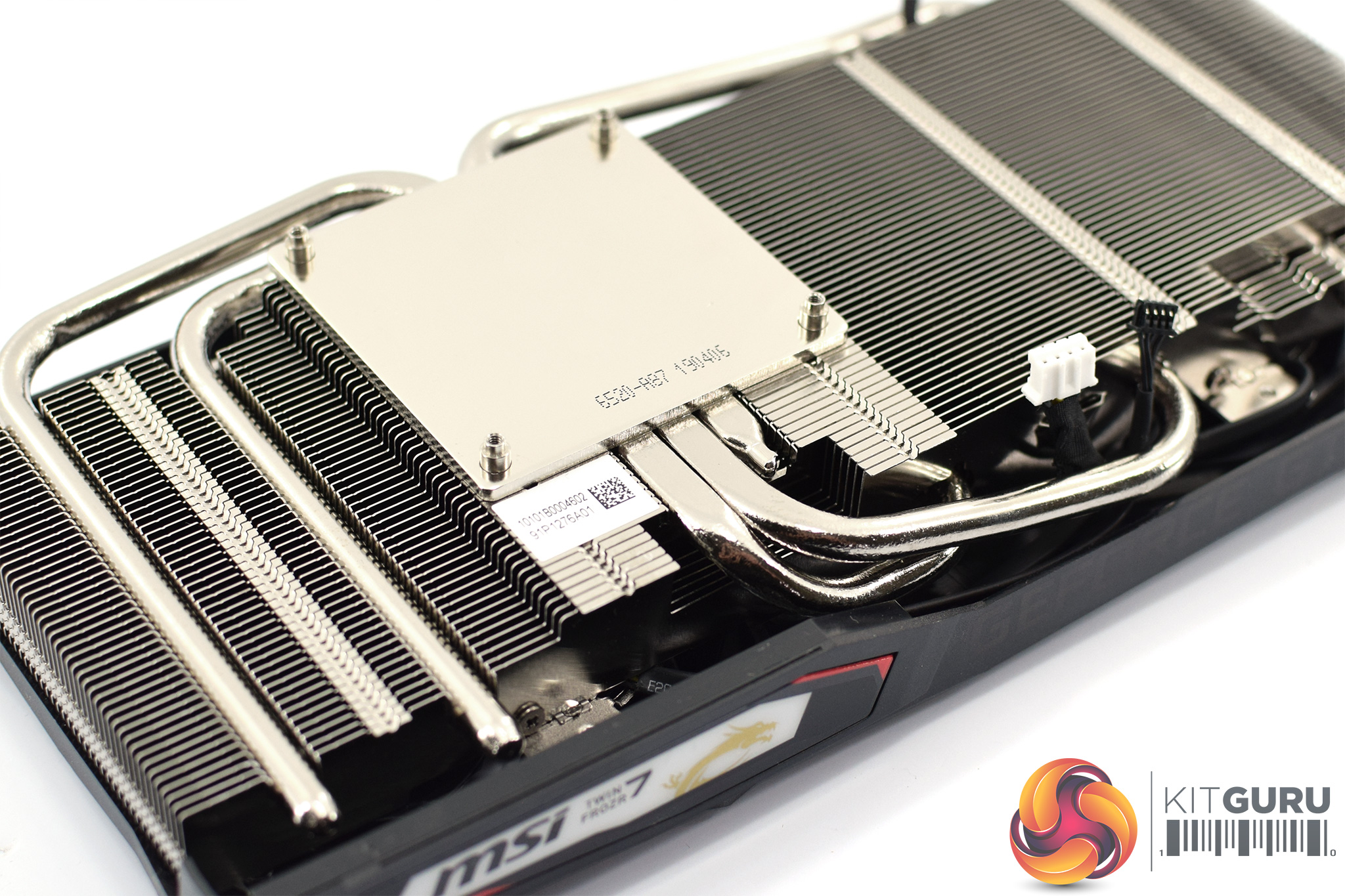
Lastly, as expected, the heatsink is again identical to that of MSI's GTX 1660 Ti Gaming X. That means it uses a single aluminium fin stack, with a total of 3 nickel-plated copper heatpipes, each of which measures 6mm. The GPU die contacts with a sizeable coldplate, too.Our newest GPU test procedure has been built with the intention of benchmarking high-end graphics cards. We test at 1920×1080 (1080p), 2560×1440 (1440p), and 3840×2160 (4K UHD) resolutions.
We try to test using the DX12 API if titles offer support. This gives us an interpretation into the graphics card performance hierarchy in the present time and the near future, when DX12 becomes more prevalent. After all, graphics cards of this expense may stay in a gamer’s system for a number of product generations/years before being upgraded.
We tested the RX Vega64 and Vega56 using the ‘Turbo‘ power mode in AMD’s WattMan software. This prioritises all-out performance over power efficiency, noise output, and lower thermals.
As mentioned, reference speed for the GTX 1660 is 1785 MHz boost. This MSI Gaming X increases that to 1860MHz.
Driver Notes
- All AMD graphics cards (except Radeon VII) were benchmarked with the Adrenalin 19.1.1 driver.
- Radeon VII was benchmarked with a pre-released press driver supplied by AMD.
- All Nvidia graphics cards (except GTX 1660 & 1660 Ti) were benchmarked with the Nvidia 417.71 driver.
- GTX 1660 Ti was benchmarked with the Nvidia 418.91 driver supplied to press.
- GTX 1660 was benchmarked with the Nvidia 419.35 driver supplied to press.
Test System
We test using the Overclockers UK Germanium pre-built system, though it has been re-housed into an open-air test bench. You can read more about it over HERE.
| CPU |
Intel Core i7-8700K
Overclocked to 4.8GHz |
| Motherboard |
ASUS ROG Strix Z370-F Gaming
|
| Memory |
Team Group Dark Hawk RGB
16GB (2x8GB) @ 3200MHz 16-18-18-38 |
| Graphics Card |
Varies
|
| System Drive |
Patriot Wildfire 240GB
|
| Games Drive | Crucial M4 512GB |
| Chassis | Streacom ST-BC1 Bench |
| CPU Cooler |
OCUK TechLabs 240mm AIO
|
| Power Supply |
SuperFlower Leadex II 850W 80Plus Gold
|
| Operating System |
Windows 10 Professional
|
Comparison Graphics Cards List
- MSI RTX 2080 Ti Lightning Z 11GB
- Nvidia RTX 2080 Ti Founders Edition (FE) 11GB
- Nvidia RTX 2080 Founders Edition (FE) 8GB
- Gigabyte Aorus RTX 2070 Xtreme 8GB
- Nvidia RTX 2060 Founders Edition (FE) 6GB
- MSI GTX 1660 Ti Gaming X 6GB
- Gigabyte GTX 1660 Ti OC 6G
- Gigabyte GTX 1660 Ti Gaming OC 6G
- Nvidia GTX 1080 Ti Founders Edition (FE) 11GB
- Gigabyte GTX 1080 G1 Gaming 8GB
- Palit GTX 1070 Ti Super JetStream 8GB
- Nvidia GTX 1070 Founders Edition (FE) 8GB
- Nvidia GTX 1060 Founders Edition (FE) 6GB
- AMD Radeon VII 16GB
- AMD RX Vega 64 Air 8GB
- AMD RX Vega 56 8GB
- ASRock RX 590 Phantom Gaming X OC 8GB
- Sapphire RX 580 Pulse 8GB
- ASUS RX 570 ROG Strix Gaming OC 4GB
Software and Games List
- 3DMark Fire Strike & Fire Strike Ultra (DX11 Synthetic)
- 3DMark Time Spy (DX12 Synthetic)
- Battlefield V (DX12)
- Deus Ex: Mankind Divided (DX12)
- Far Cry 5 (DX11)
- Tom Clancy’s Ghost Recon: Wildlands (DX11)
- Middle Earth: Shadow of War (DX11)
- Shadow of the Tomb Raider (DX12)
We run each benchmark/game three times, and present averages in our graphs.3DMark Fire Strike is a showcase DirectX 11 benchmark designed for today’s high-performance gaming PCs. It is our [FutureMark’s] most ambitious and technical benchmark ever, featuring real-time graphics rendered with detail and complexity far beyond what is found in other benchmarks and games today.
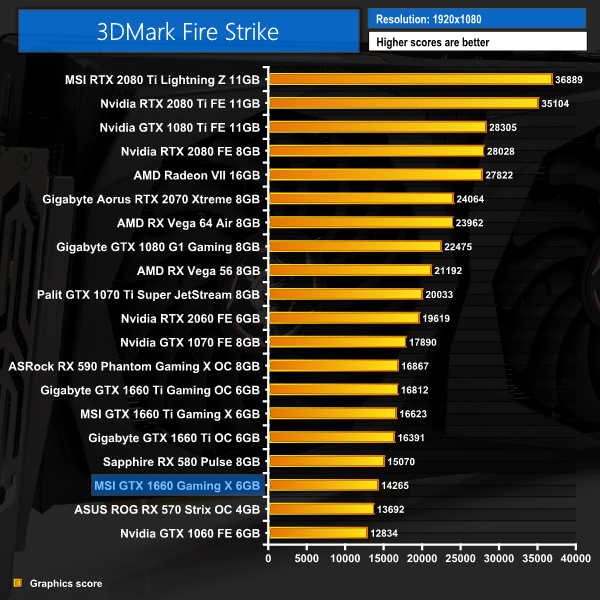
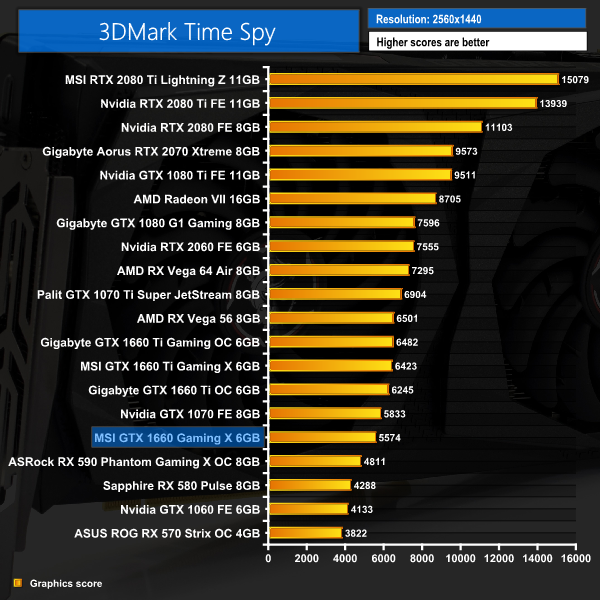
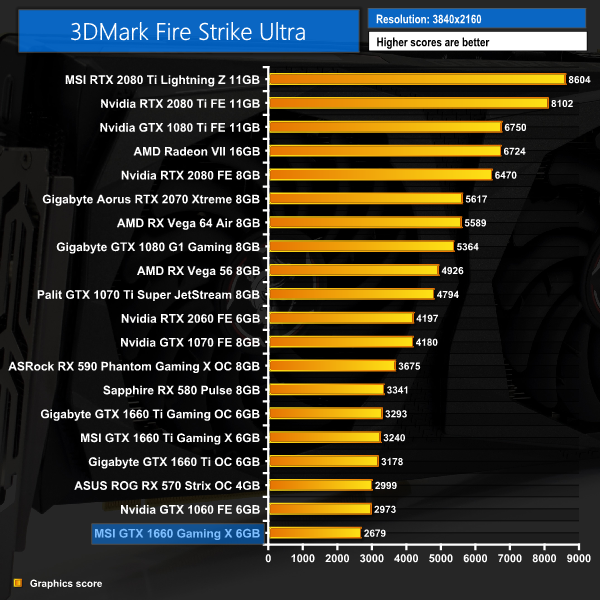
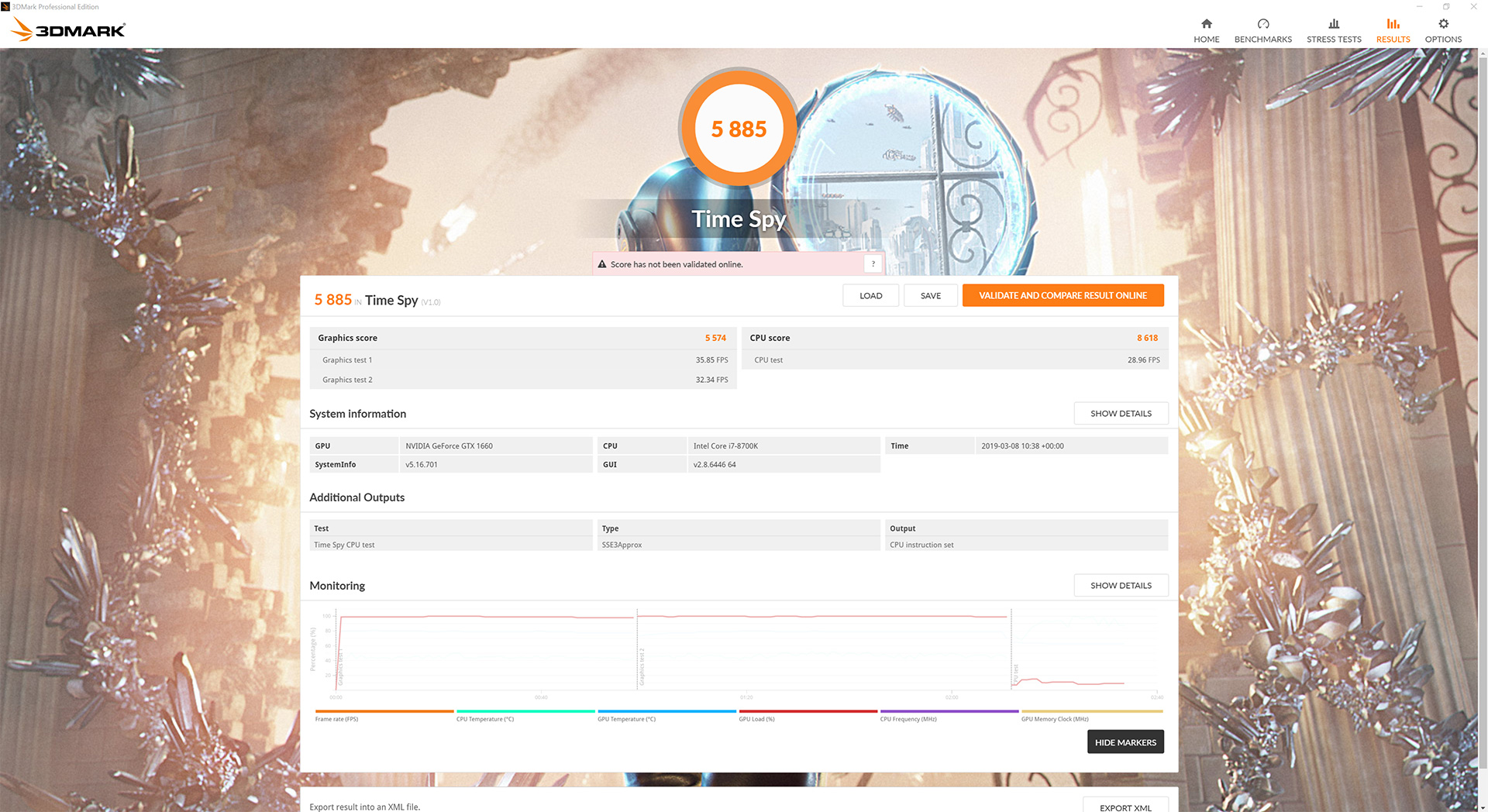
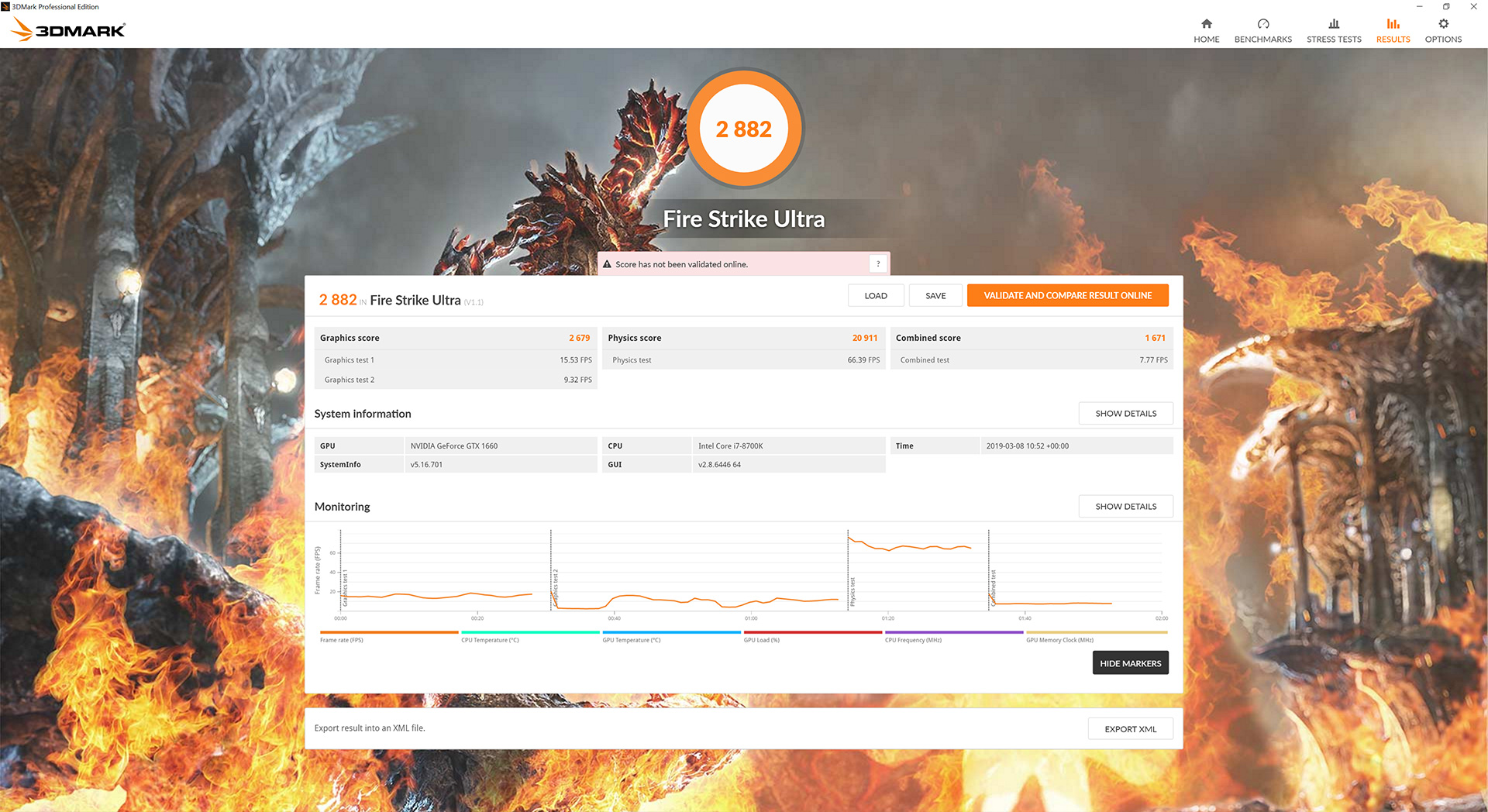
It's a mixed bag when we start with the usual 3DMark benchmarks. This GTX 1660 scores less than RX 580 in the 1080p Fire Strike test, but comes within touching distance of GTX 1070 in Time Spy. In Fire Strike Ultra (4K) it bizarrely performs worse than GTX 1060 – I can't explain that one so it is likely just a quirk from the benchmark itself.Battlefield V is a first-person shooter video game developed by EA DICE and published by Electronic Arts. Battlefield V is the sixteenth instalment in the Battlefield series. It was released worldwide for Microsoft Windows, PlayStation 4, and Xbox One on November 20, 2018. (Wikipedia).
We test using the Ultra preset with the DX12 API. We usually include ray tracing results with BFV, but we have excluded those here as DXR is not a feature applicable to the GTX 1660 Ti.
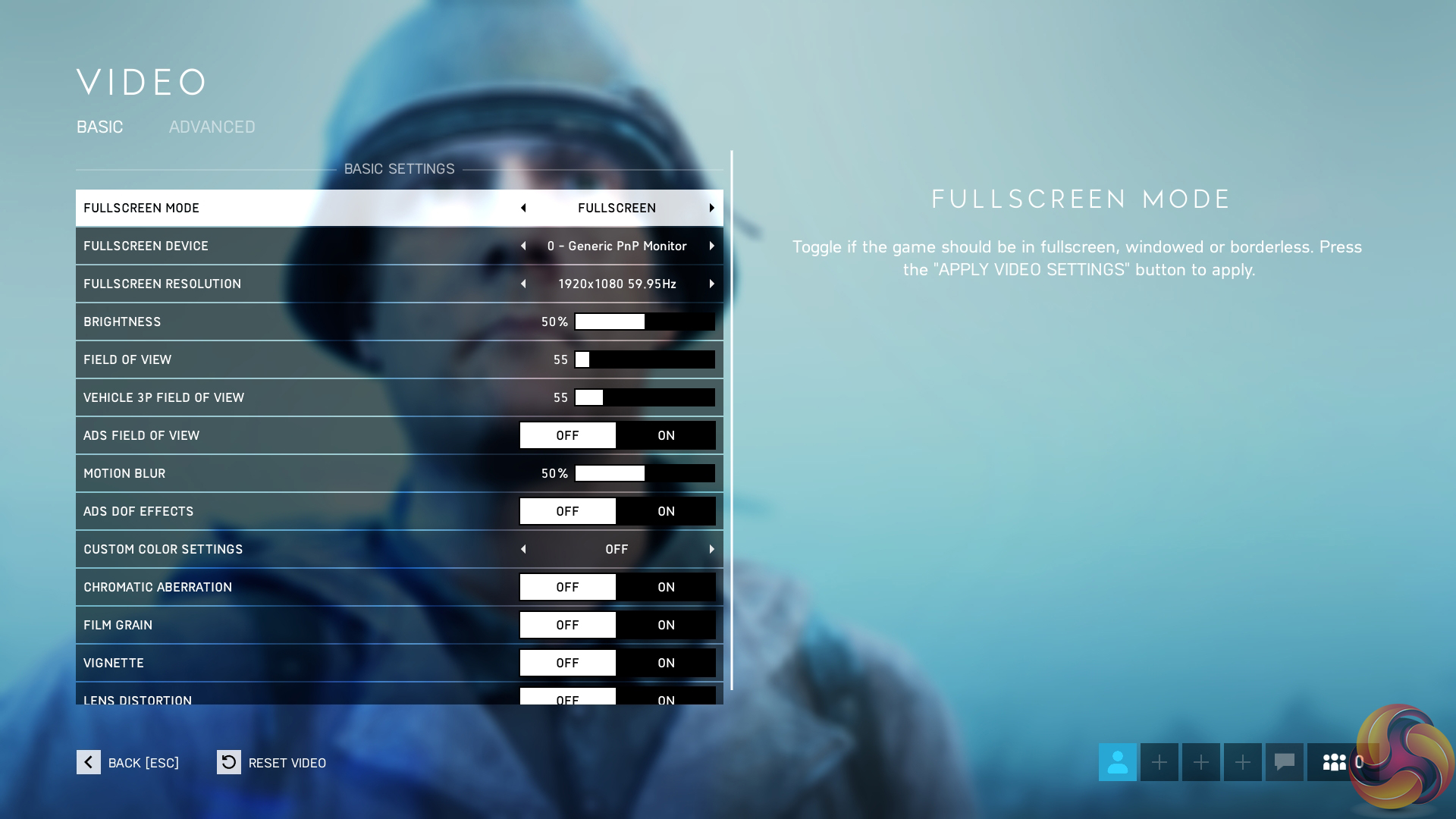
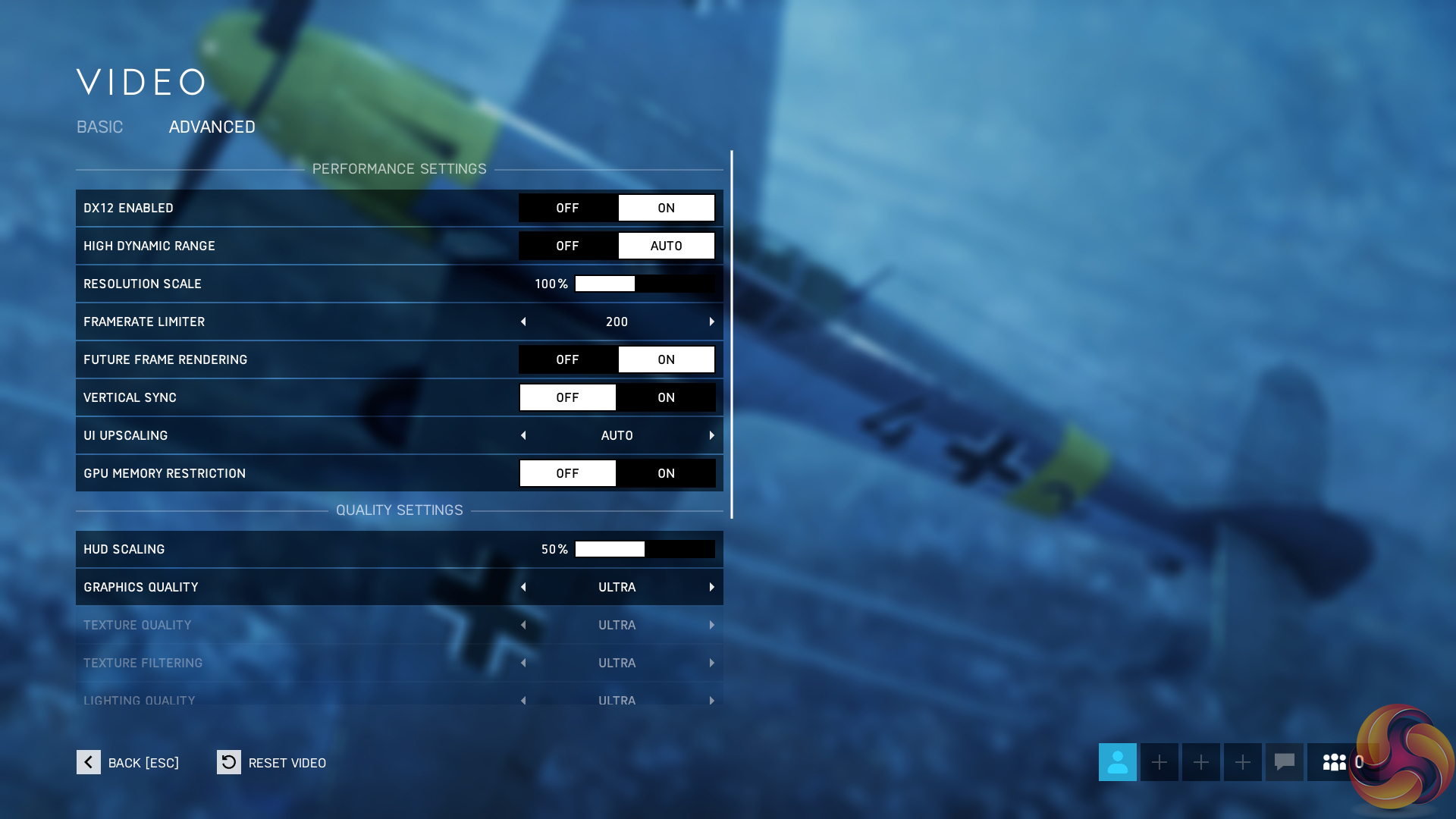
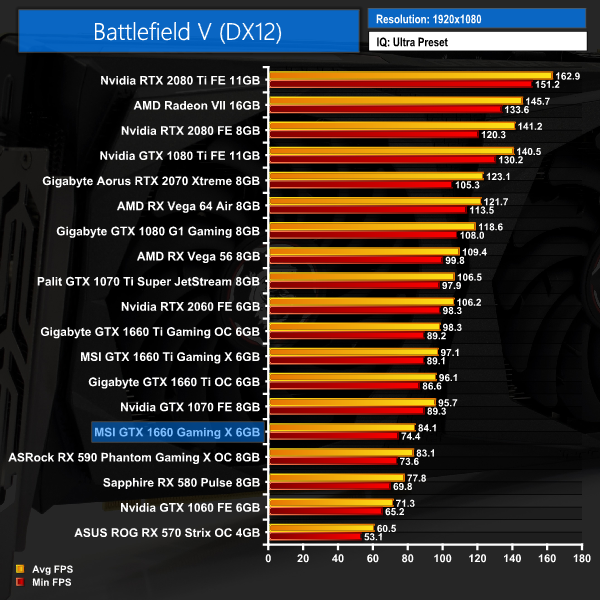
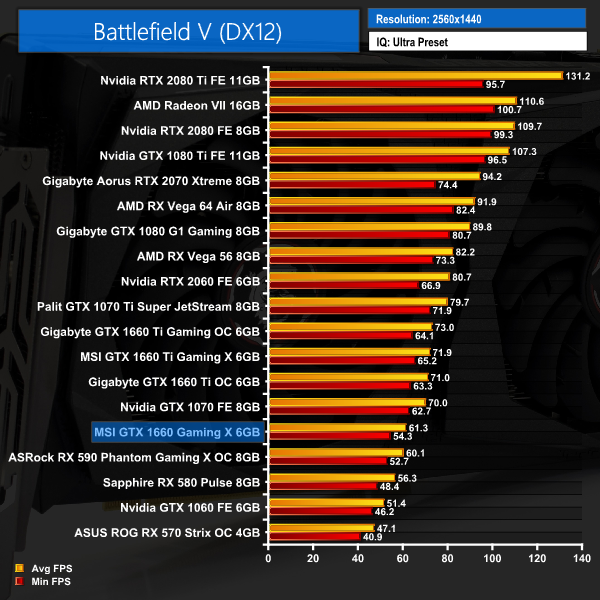
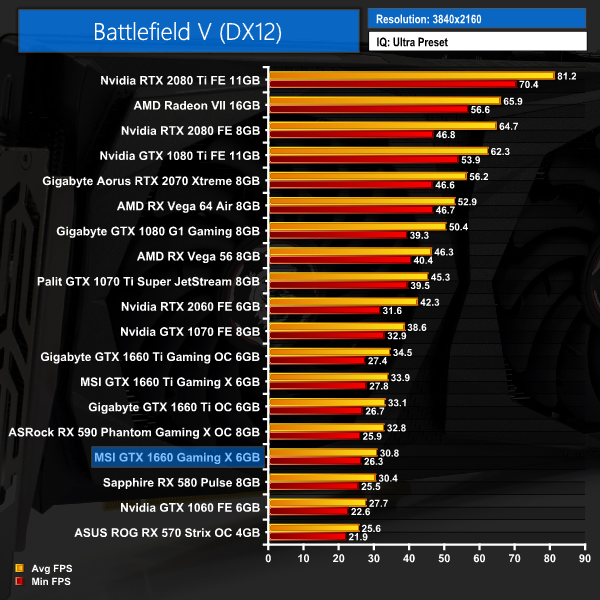
Battlefield V is much more consistent with how the GTX 1660 performs. At both 1080p and 1440p it edges just ahead of the RX 590, before falling behind by 2FPS at 4K – the latter resolution proving too demanding for this card anyway.Deus Ex: Mankind Divided is set in the year 2029, two years after the events of Human Revolution and the “Aug Incident”—an event in which mechanically augmented humans became uncontrollable and lethally violent. Unbeknownst to the public, the affected augmented received implanted technology designed to control them by the shadowy Illuminati, which is abused by a rogue member of the group to discredit augmentations completely. (Wikipedia).
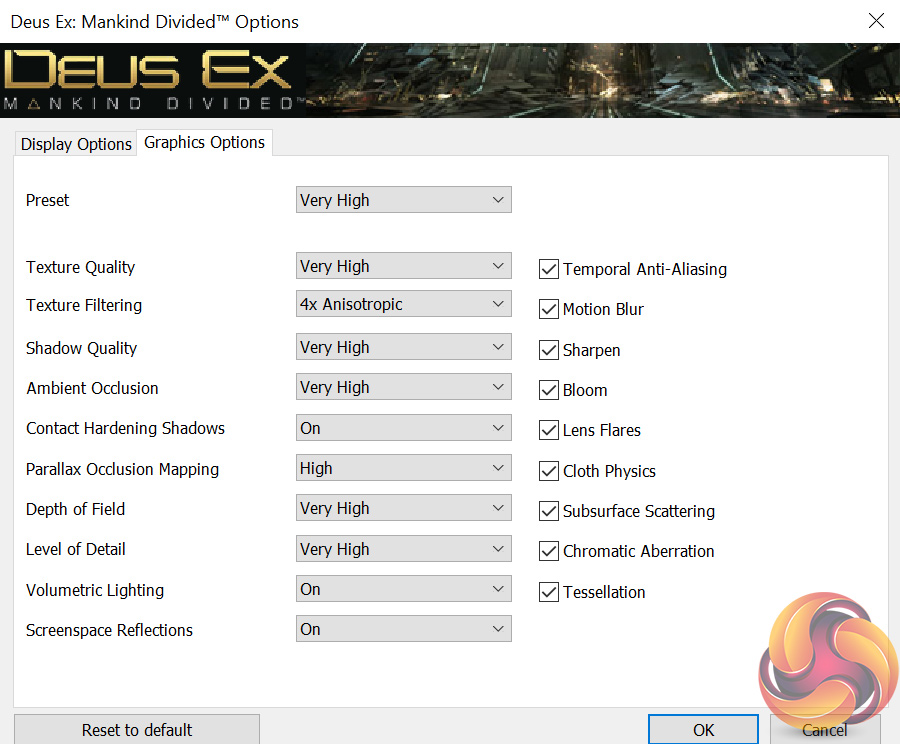
We test using the Very High preset, with MSAA disabled. We use the DirectX 12 API.
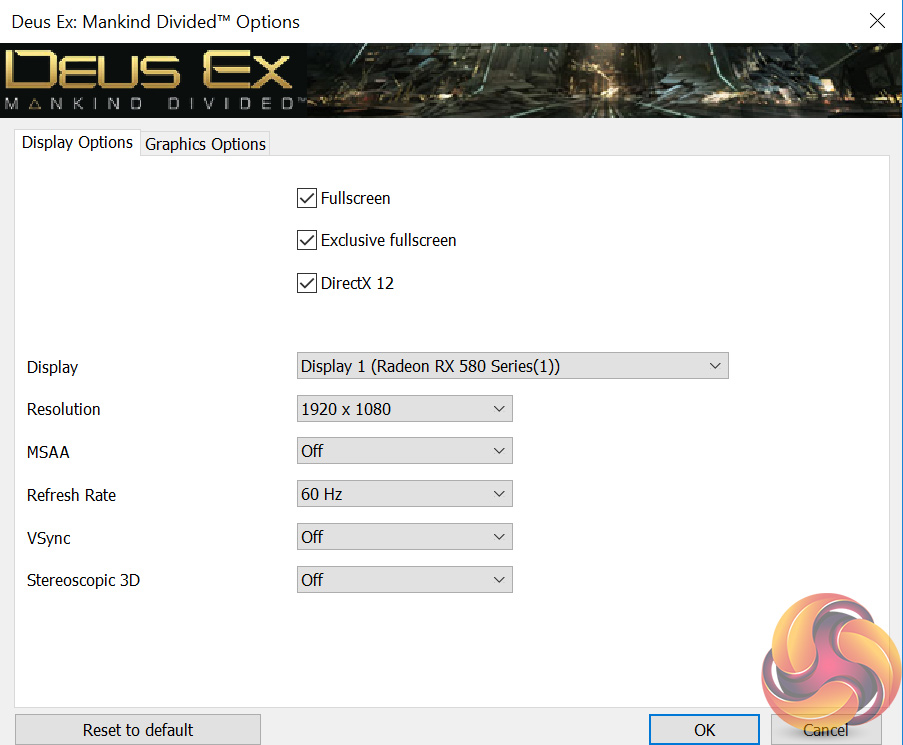
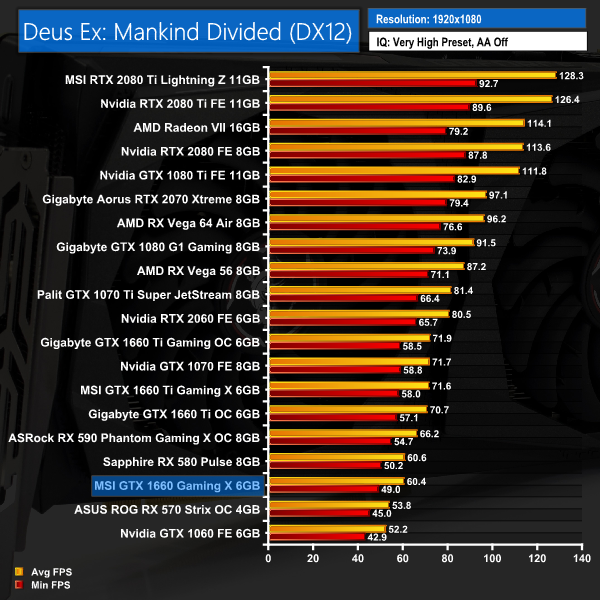
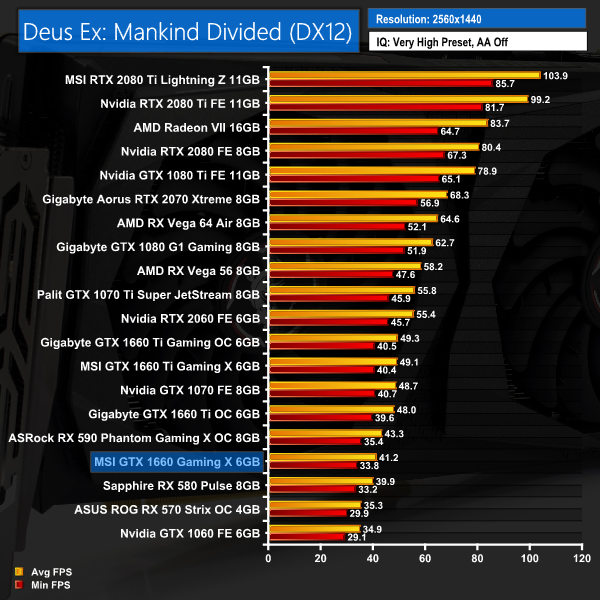
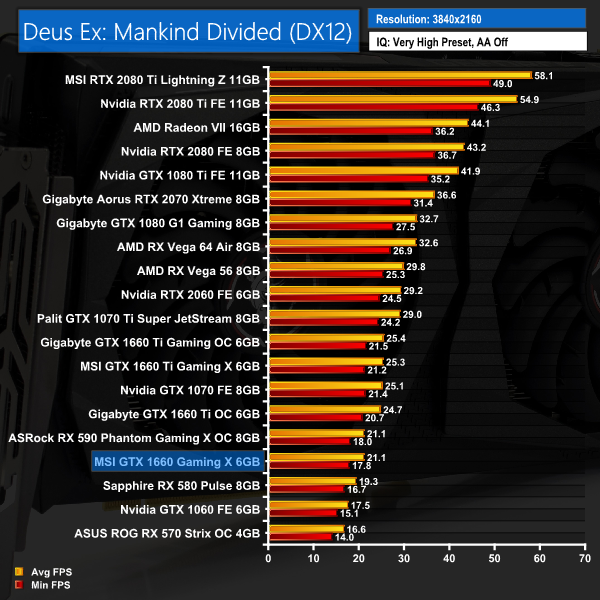
Deus Ex: Mankind Divided puts the GTX 1660 closer to the RX 580 at 1080p, with the RX 590 about 6FPS faster. At 1440p, however, things level out with the RX 590 barely 2FPS faster than the 1660.Far Cry 5 is an action-adventure first-person shooter game developed by Ubisoft Montreal and Ubisoft Toronto and published by Ubisoft for Microsoft Windows, PlayStation 4 and Xbox One. It is the eleventh entry and the fifth main title in the Far Cry series, and was released on March 27, 2018.
The game takes place in the fictional Hope County, Montana, where charismatic preacher Joseph Seed and his cult Project at Eden’s Gate holds a dictatorial rule over the area. The story follows an unnamed junior deputy sheriff, who becomes trapped in Hope County and works alongside factions of a resistance to liberate the county from Eden’s Gate. (Wikipedia).
We test using the Ultra preset, with AA and motion blur disabled.
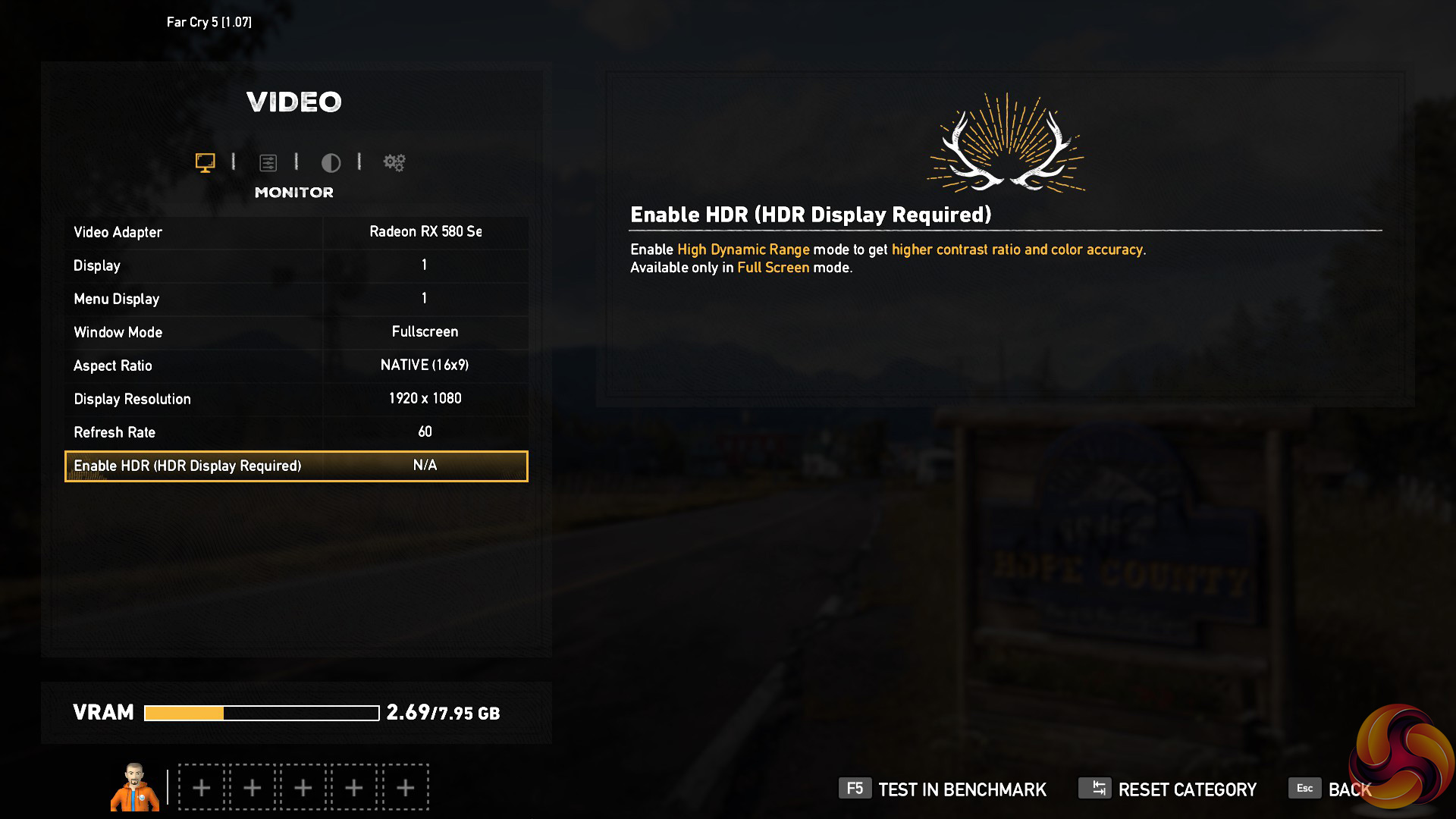
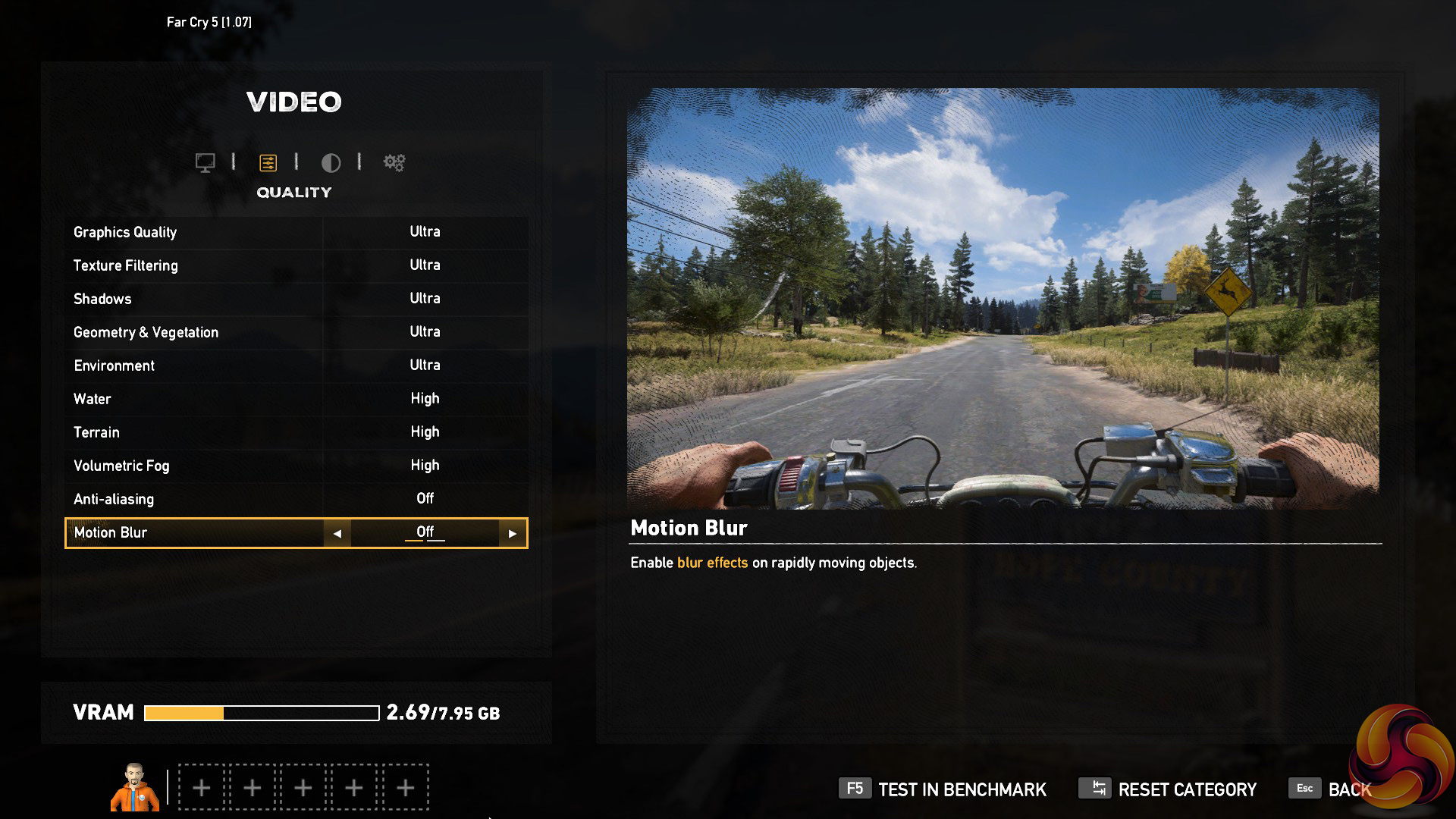
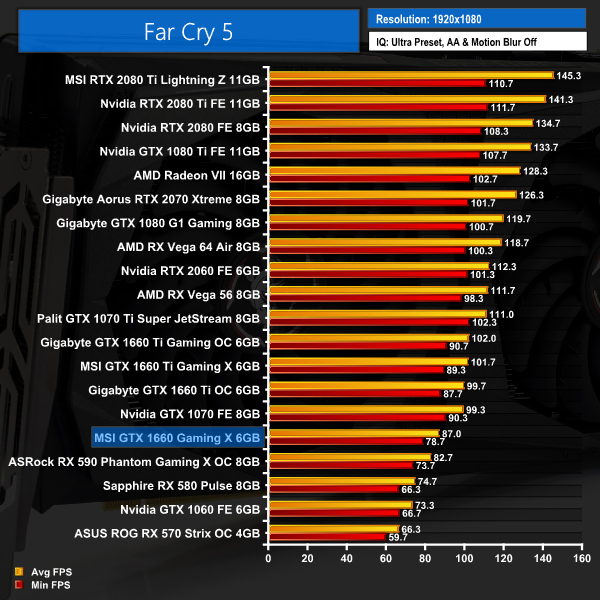
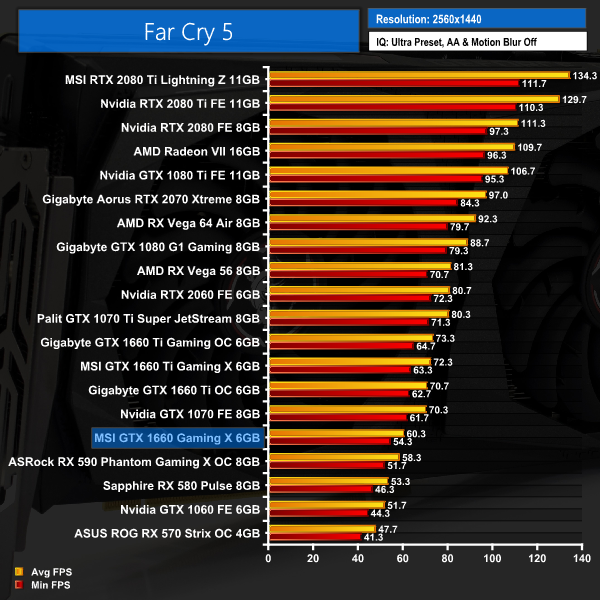
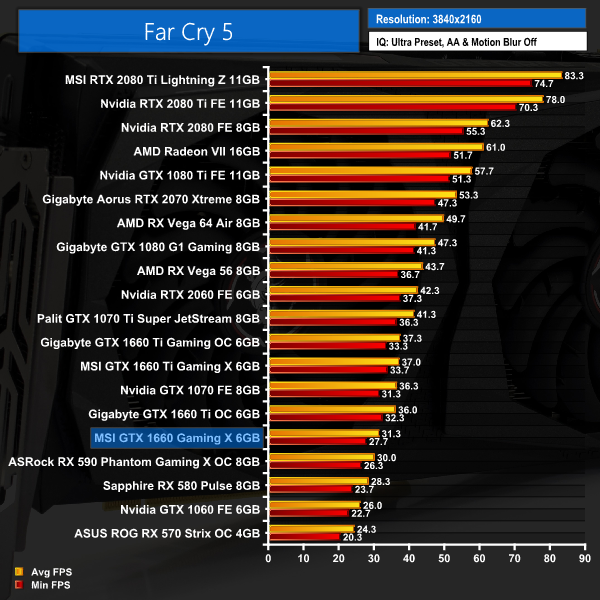
Far Cry 5 keeps the same trend across all three resolutions tested – with GTX 1660 sitting just ahead of RX 590. It's not a massive difference – 5FPS at 1080p, then 2FPS at 1440p – but it is still a win for GTX 1660.Tom Clancy’s Ghost Recon Wildlands is a tactical shooter video game developed by Ubisoft Paris and published by Ubisoft. It was released worldwide on March 7, 2017, for Microsoft Windows, PlayStation 4 and Xbox One, as the tenth instalment in the Tom Clancy’s Ghost Recon franchise and is the first game in the Ghost Recon series to feature an open world environment. (Wikipedia).
We test using the Very High preset.
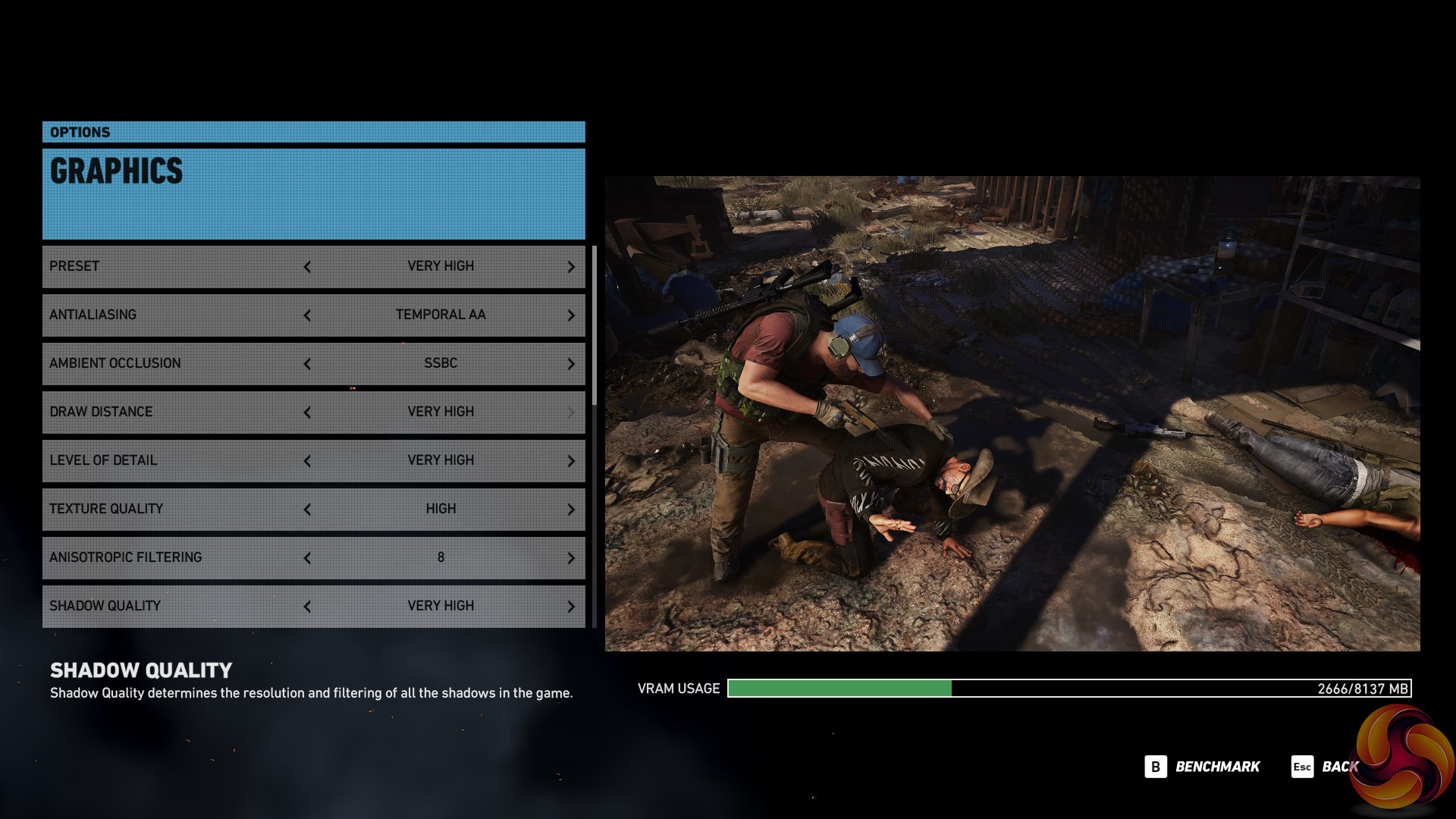
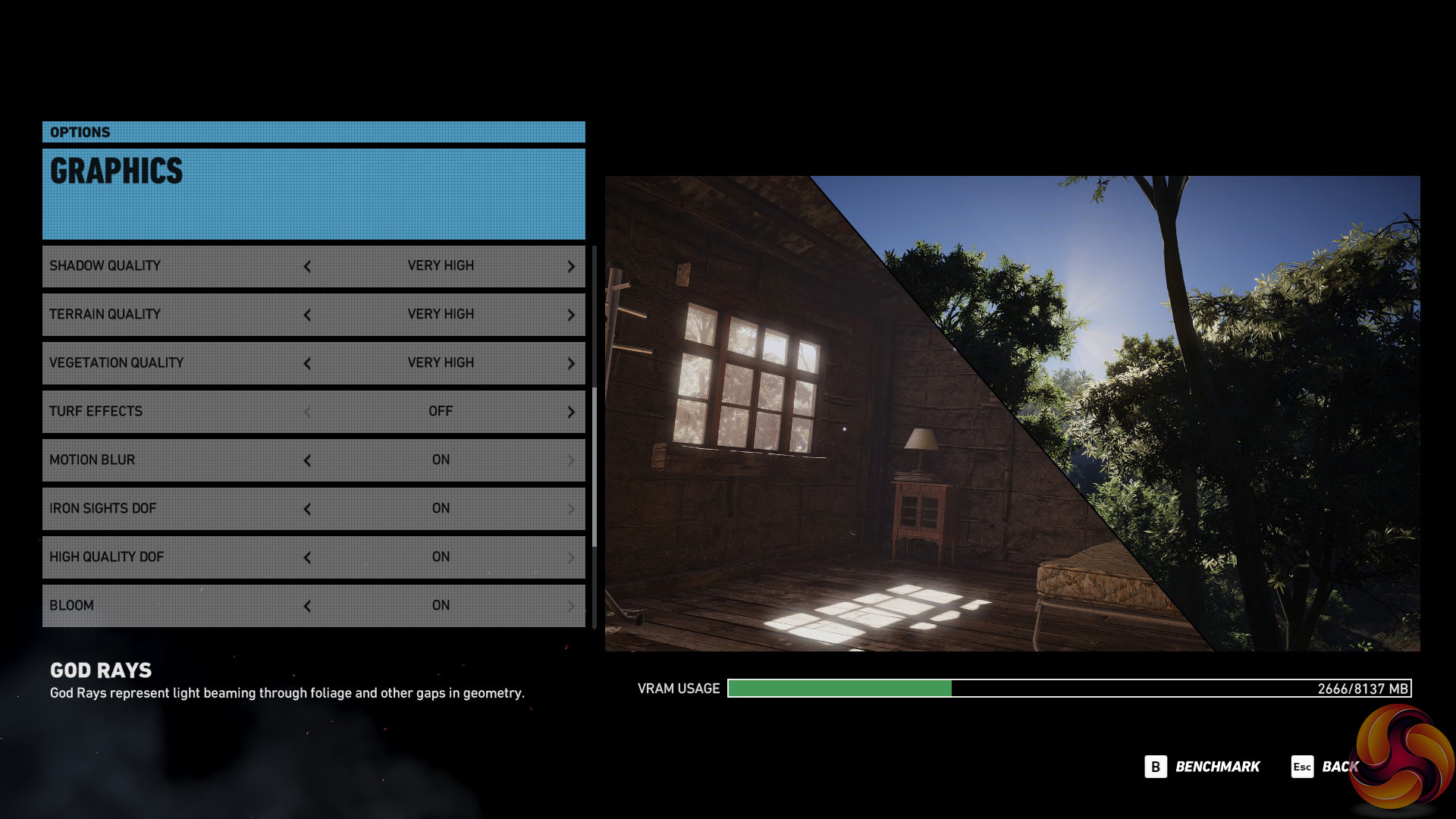
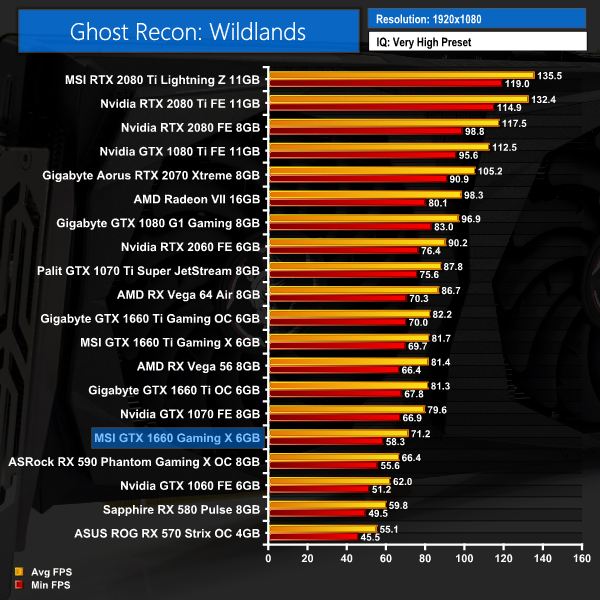
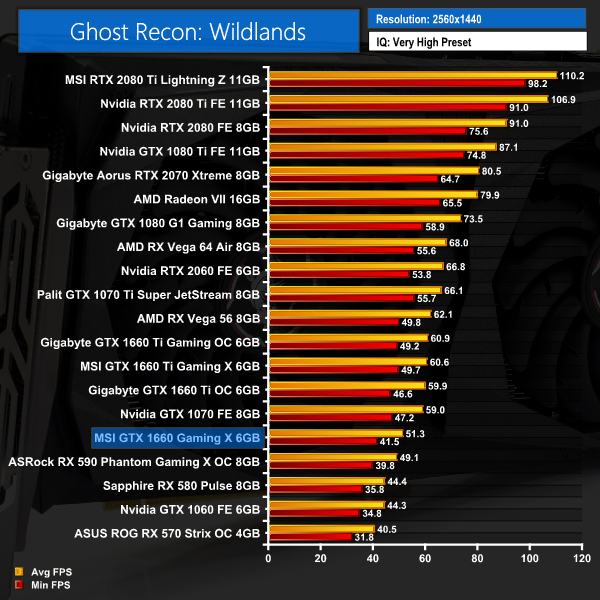
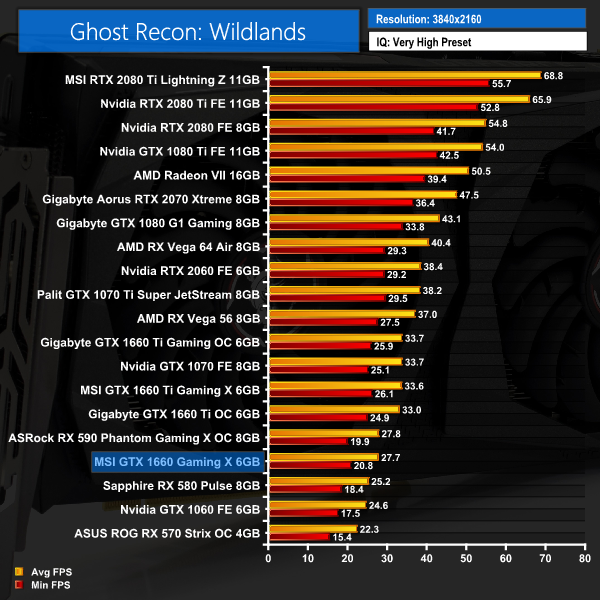
Ghost Recon: Wildlands again puts the GTX 1660 above the RX 590 at both 1080p and 1440p resolutions. It falls just behind at 4K, but considering neither card is capable of maintaining 30FPS at that resolution, it isn't a hugely meaningful result.Middle-earth: Shadow of War is an action role-playing video game developed by Monolith Productions and published by Warner Bros. Interactive Entertainment. It is the sequel to 2014’s Middle-earth: Shadow of Mordor, and was released worldwide for Microsoft Windows, PlayStation 4, and Xbox One on October 10, 2017. (Wikipedia).
We test using the Very High preset.

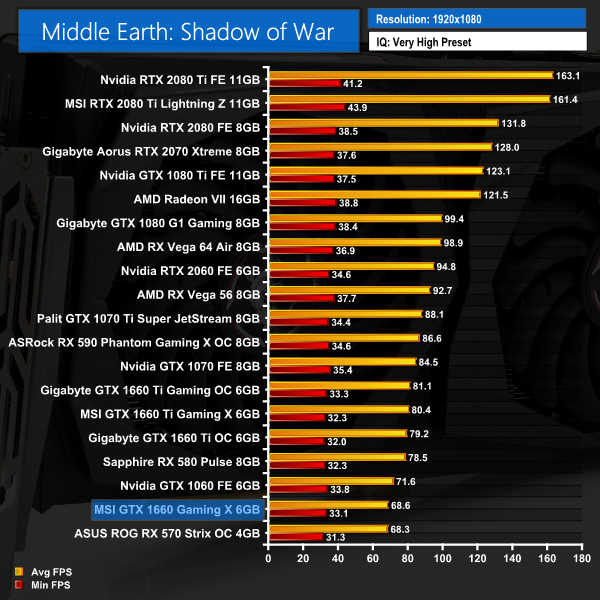
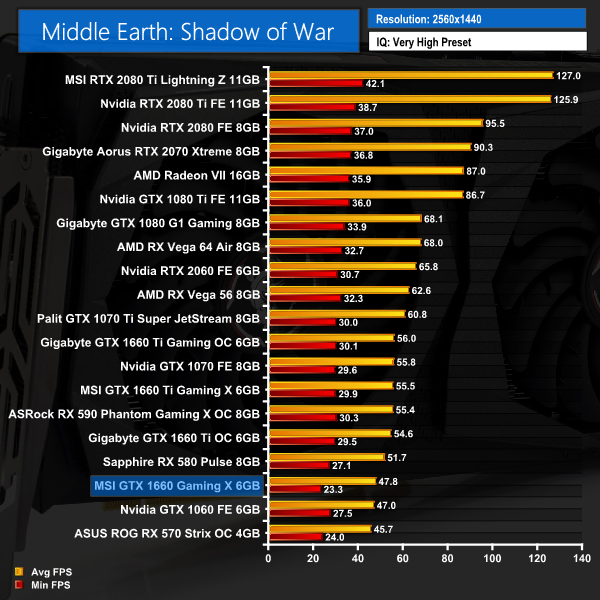
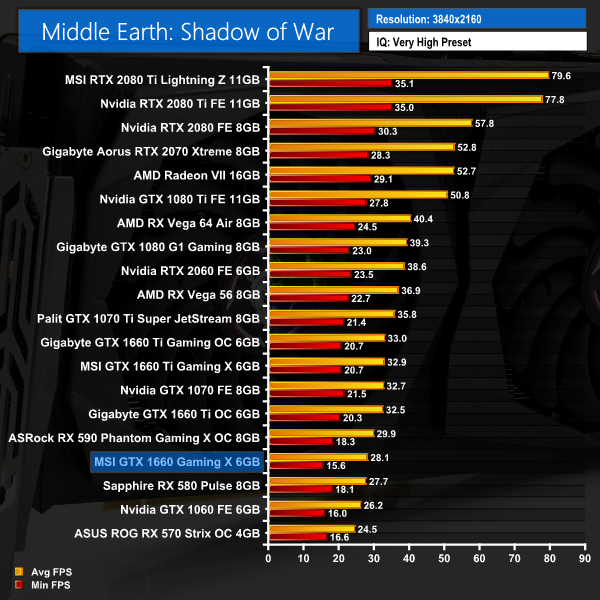
Now, this is where I have to scratch my head – for an as yet unknown reason, the MSI GTX 1660 performs marginally worse than GTX 1060 at 1080p, and then barely any faster at 1440p. This is clearly an anomaly as 1660 has (and should) outperformed 1060 across all of our other tests. Yet, no matter how many times I ran the benchmarks – I tried re-installing the driver, re-seating the card etc – the results stayed the same.
I would guess it is either a driver issue or a quirk within the game itself – I can't see a reason why GTX 1060 would outperform the 1660 if not for some kind of issue, so we will circle back to this in the future once a WHQL driver is available for the GTX 1660 and see if that helps.Shadow of the Tomb Raider is an action-adventure video game developed by Eidos Montréal in conjunction with Crystal Dynamics and published by Square Enix. It continues the narrative from the 2013 game Tomb Raider and its sequel Rise of the Tomb Raider, and is the twelfth mainline entry in the Tomb Raider series. The game released worldwide on 14 September 2018 for Microsoft Windows, PlayStation 4 and Xbox One. (Wikipedia).
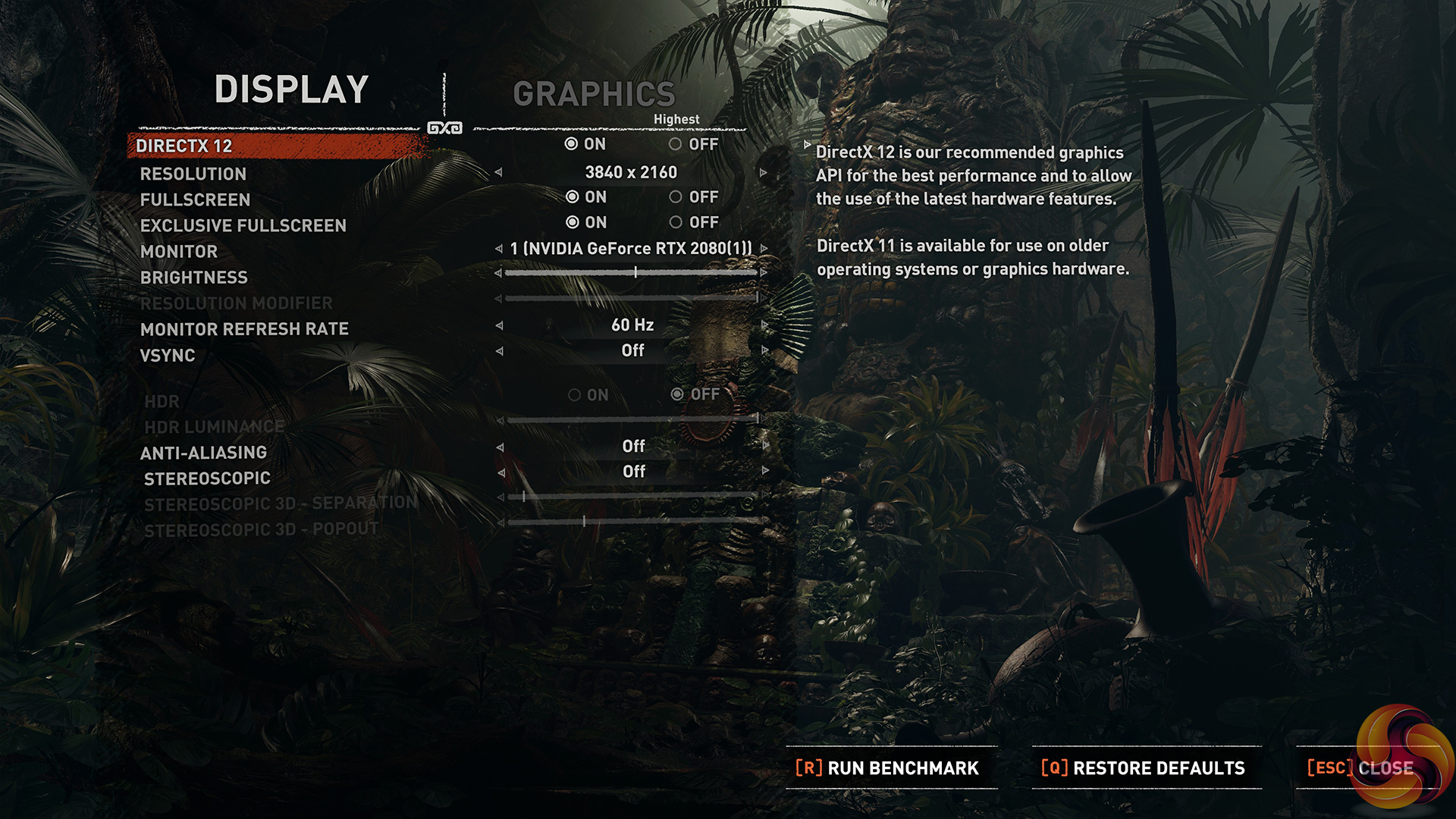
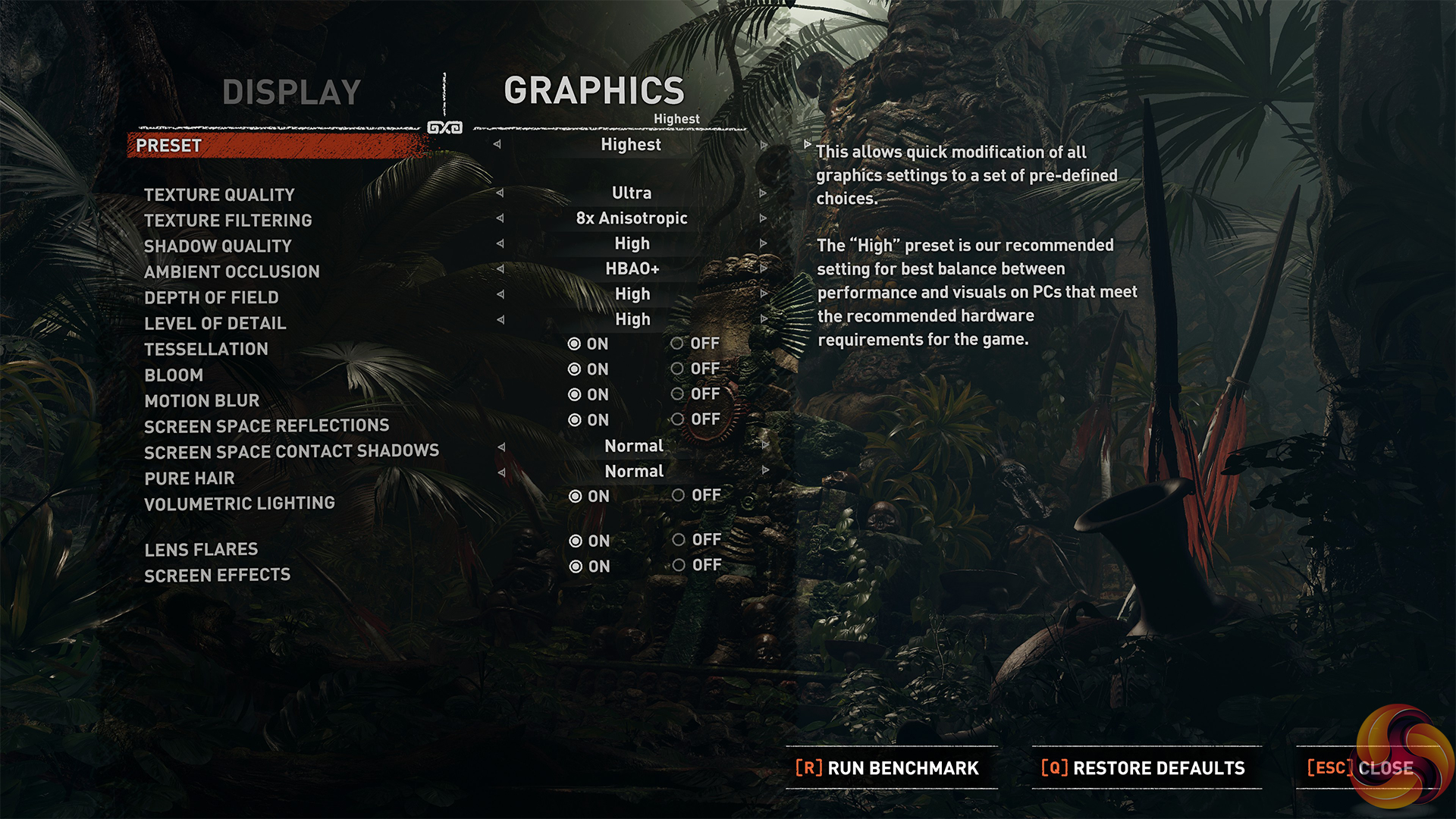
We test using the Highest preset, with AA disabled. We test using the DX12 API.
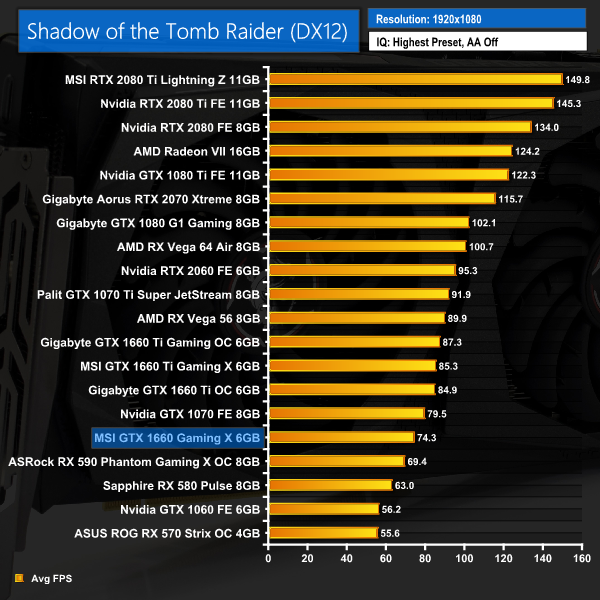
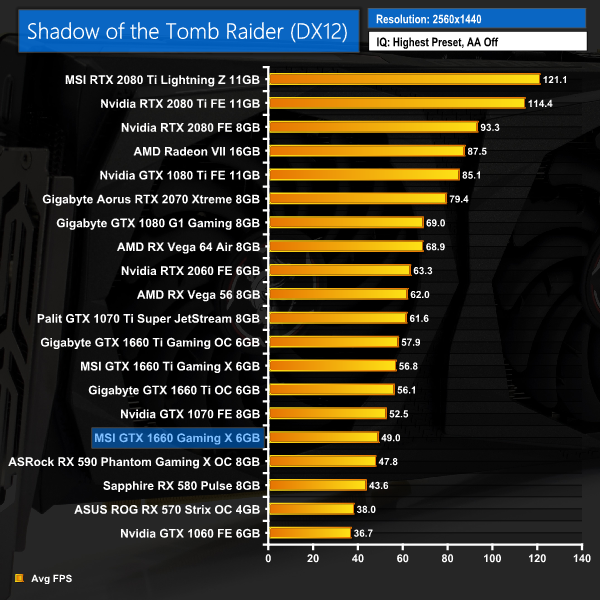
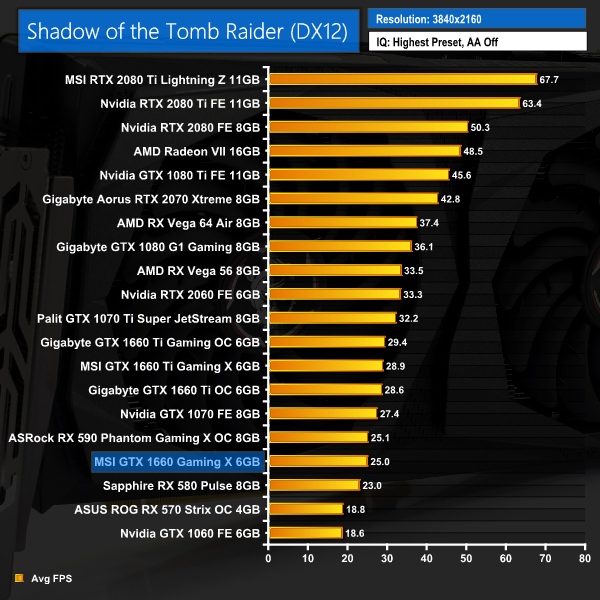
Things return to normal when playing Shadow of the Tomb Raider – the GTX 1660 outperforms RX 590 at both 1080p and 1440p, before falling behind by just 0.1FPS at 4K.Here we present the average clock speed for each graphics card while running the 3DMark Fire Strike Ultra stress test 20 times. We use GPU-Z to record the GPU core frequency during the Fire Strike Ultra runs. We calculate the average core frequency during the entire 20-run test to present here.
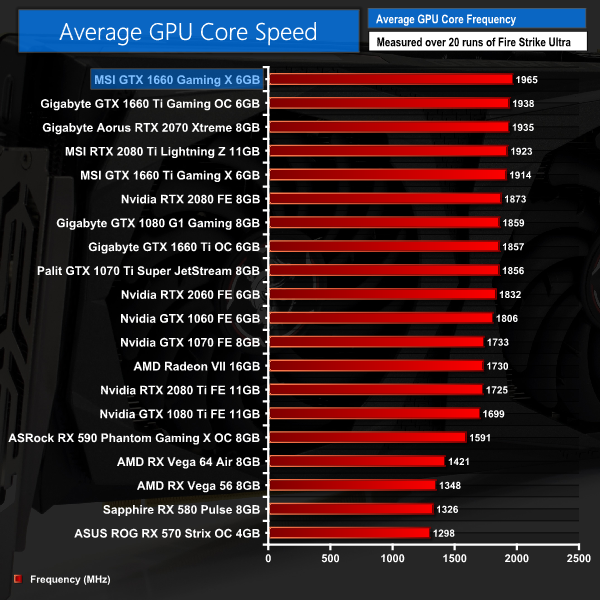
This MSI GTX 1660 Gaming X has a rated boost clock of 1860MHz. The card actually exceeds this by over 100MHz when in operation, with an average operating frequency of 1965MHz right out of the box. I have to say this is very impressive – the GPU is almost at 2GHz with not a hint of a manual overclock. Whether or not this will limit the card's headroom when we get to manual overclocking, however, we will have to see later on in the review.For our temperature testing, we measure the peak GPU core temperature under load, as well as the GPU temperature with the card idling on the desktop. A reading under load comes from running the 3DMark Fire Strike Ultra stress test 20 times. An idle reading comes after leaving the system on the Windows desktop for 30 minutes.
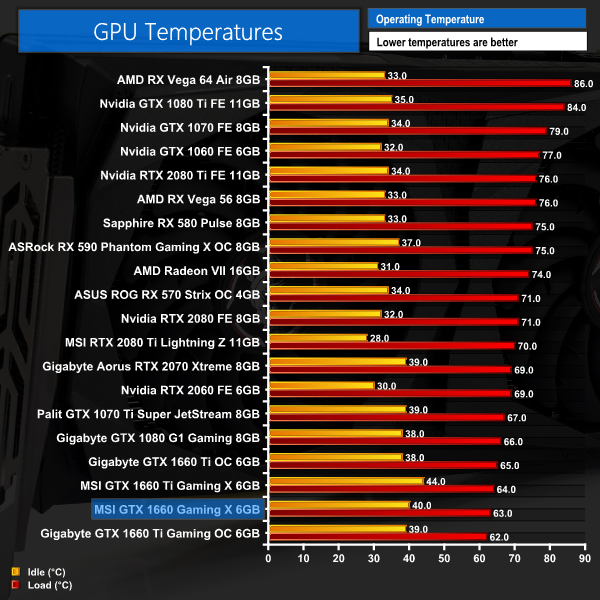
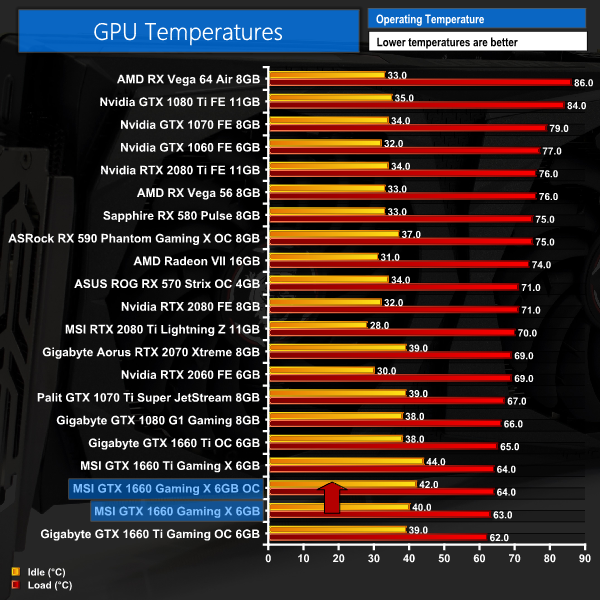
Given this 1660 Gaming X uses the same cooler as MSI's 1660 Ti Gaming X, thermal performance is fantastic – as expected. The GPU core peaked at just 63C under load, or 1C cooler than the GTX 1660 Ti Gaming X. We will have to wait and see how this compares to other GTX 1660 cards, but it is likely to be one of the best performing 1660s we see.
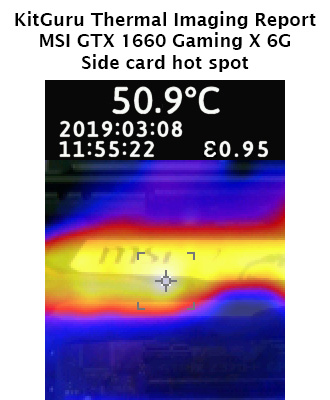
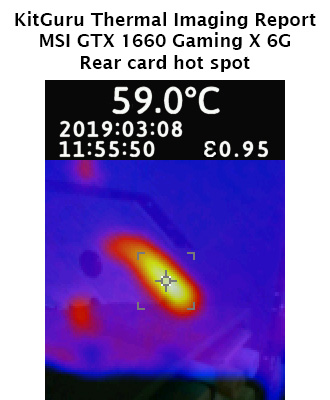
This is reinforced by the images from our thermal camera – the side of the card barely reached 50C, with the hotspot on the back of the card peaking at 59C. This cooler is clearly more than good enough for a GTX 1660.We take our noise measurements with the sound meter positioned 1 foot from the graphics card. I measured the sound floor to be 34 dBA, thus anything above this level can be attributed to the graphics cards. The power supply is passive for the entire power output range we tested all graphics cards in, while all CPU and system fans were disabled.
A reading under load comes from running the 3DMark Fire Strike Ultra stress test 20 times. An idle reading comes after leaving the system on the Windows desktop for 30 minutes.
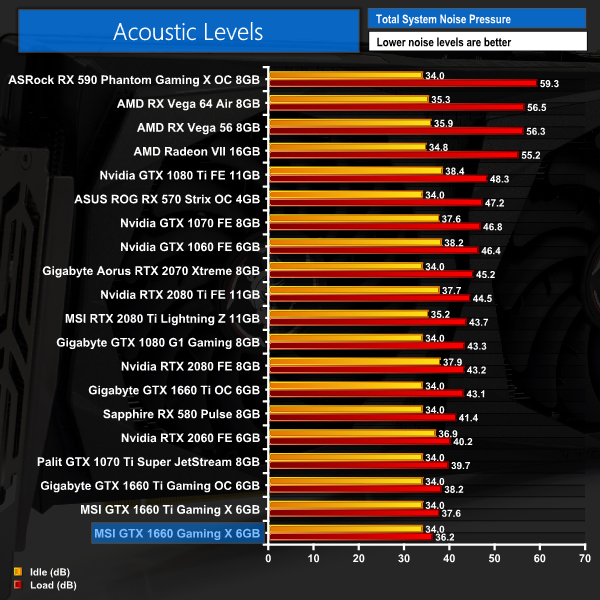
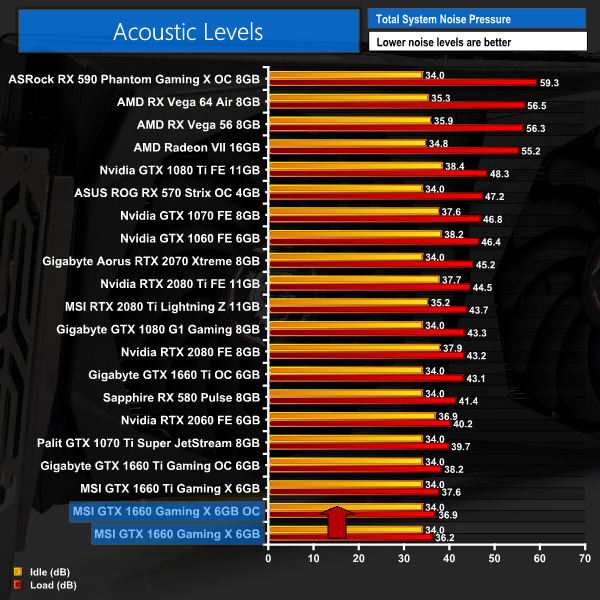
Acoustic performance is even better than what we saw from the GTX 1660 Ti Gaming X – with total noise output barely going past 36dB. It's simply an incredibly quiet card, to the extent I just couldn't hear the fans spinning – even with the card on an open-air test bench on the desk beside me. Clearly, this cooler is just so capable of keep the temperatures in check, the fans barely have to spin – to illustrate this, we saw a peak fan speed of just 1120rpm.We measure system-wide power draw from the wall while the card is sat idling at the Windows 10 desktop for 30 minutes. A reading under load comes from running the 3DMark Fire Strike Ultra stress test 20 times.
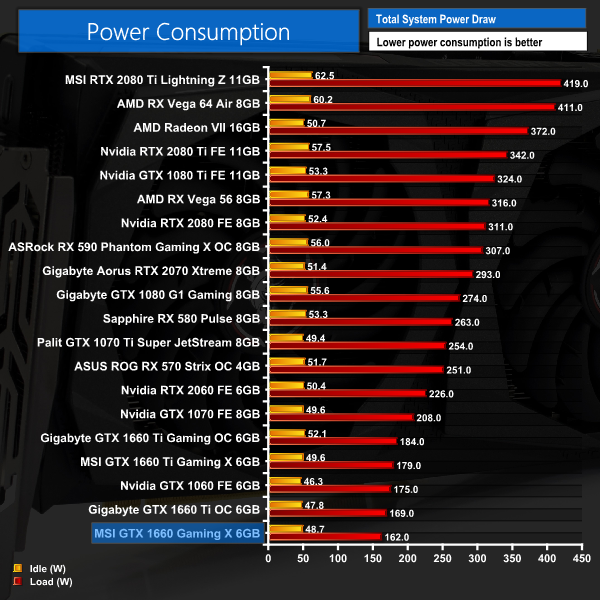
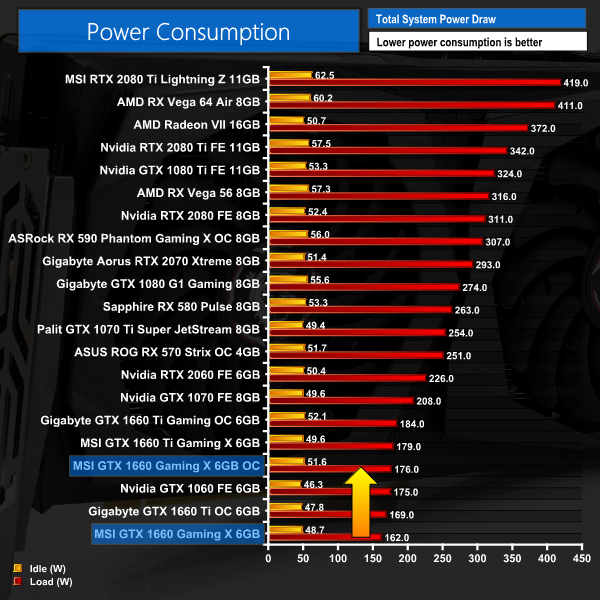
As for power consumption, officially GTX 1660 has the same 120W TDP as the GTX 1660 Ti. That being said, disabling one TPC on the TU116 GPU seems to make some difference, even if it is not much. That's because we saw total system power draw hit 162W, 7W less than Gigabyte's GTX 1660 Ti OC 6G and 17W less than MSI's GTX 1660 Ti Gaming X.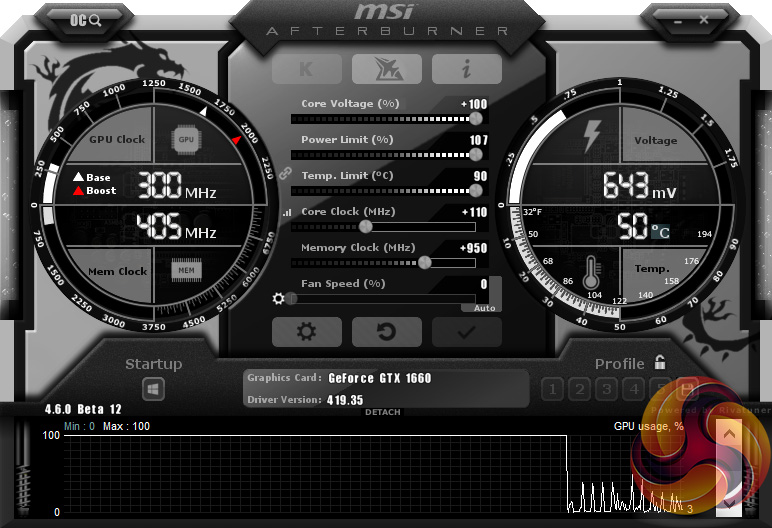
For overclocking, we used MSI Afterburner. Our best manual overclock came +110MHz to the GPU and +950MHz to the GDDR5 memory.
Average clock speed under load
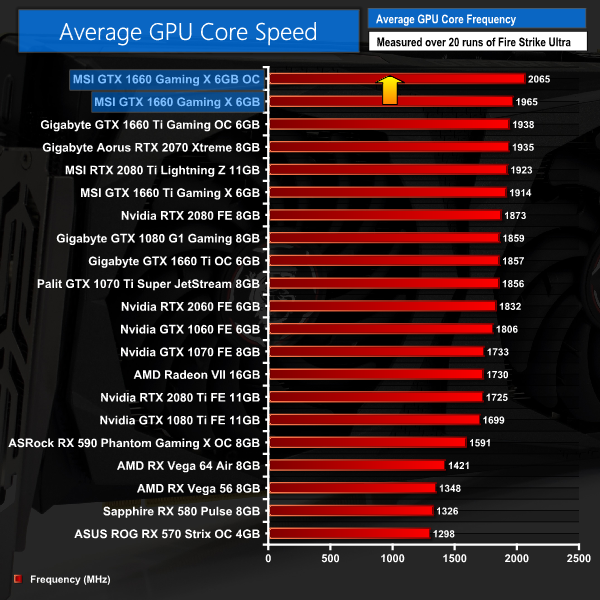
This brought the average clock speed up to 2065MHz, with a peak of 2085MHz. This is clearly a pretty decent frequency for a GTX 1660 – it will be interesting to see how other cards fare, but for now this card certainly did better than I thought it would, given the already high clock speeds out of the box.
3DMark and games testing
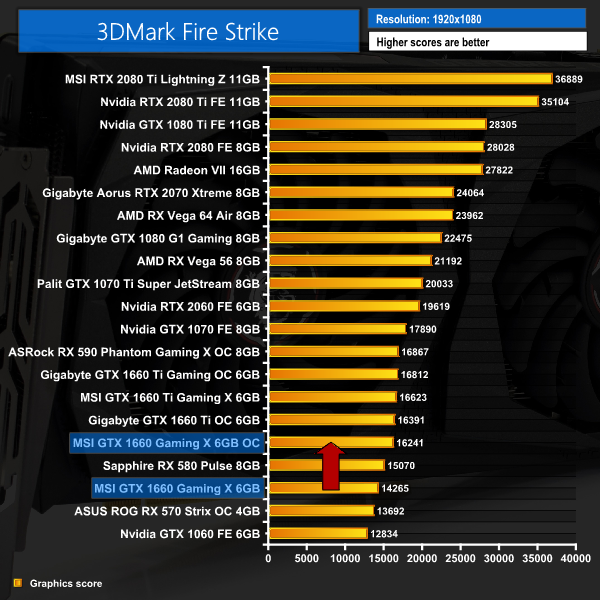
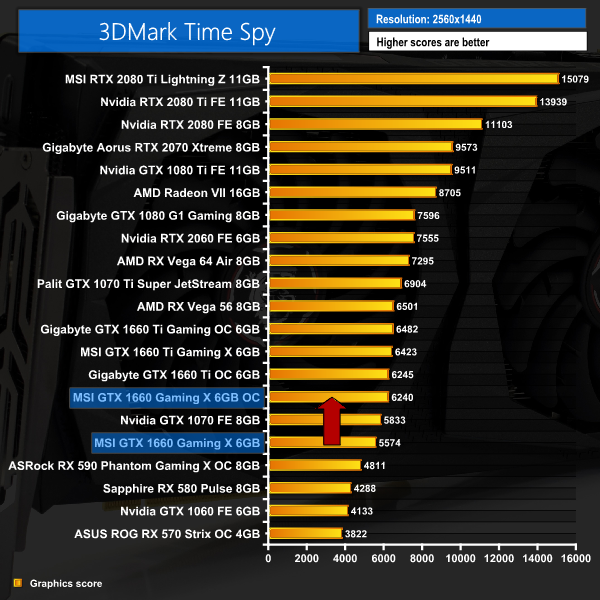
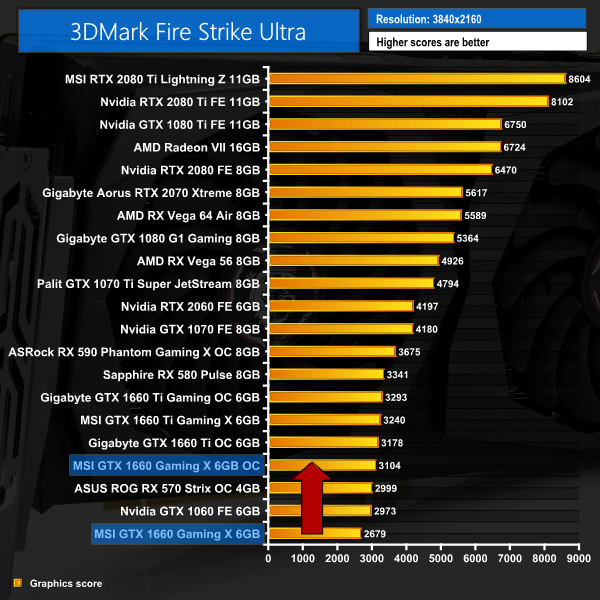
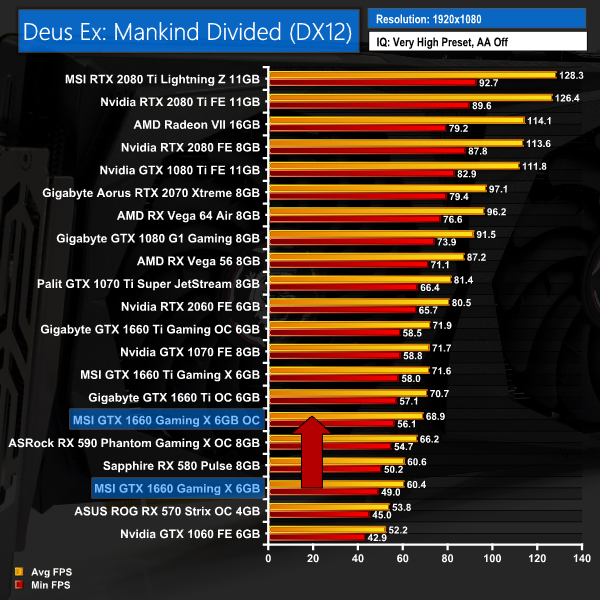
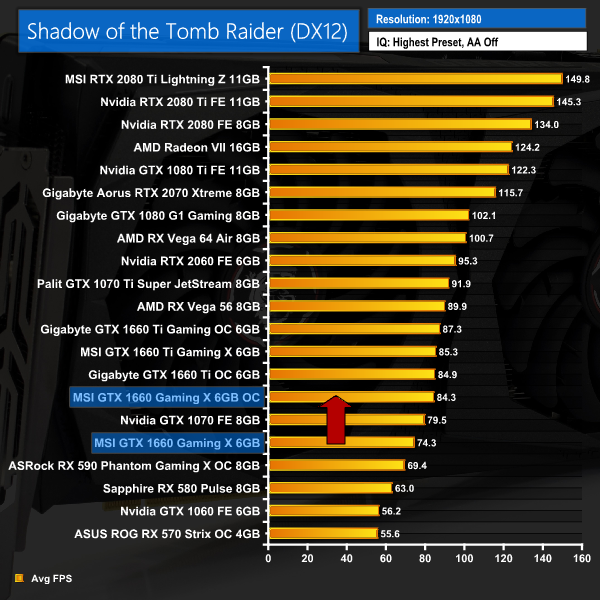
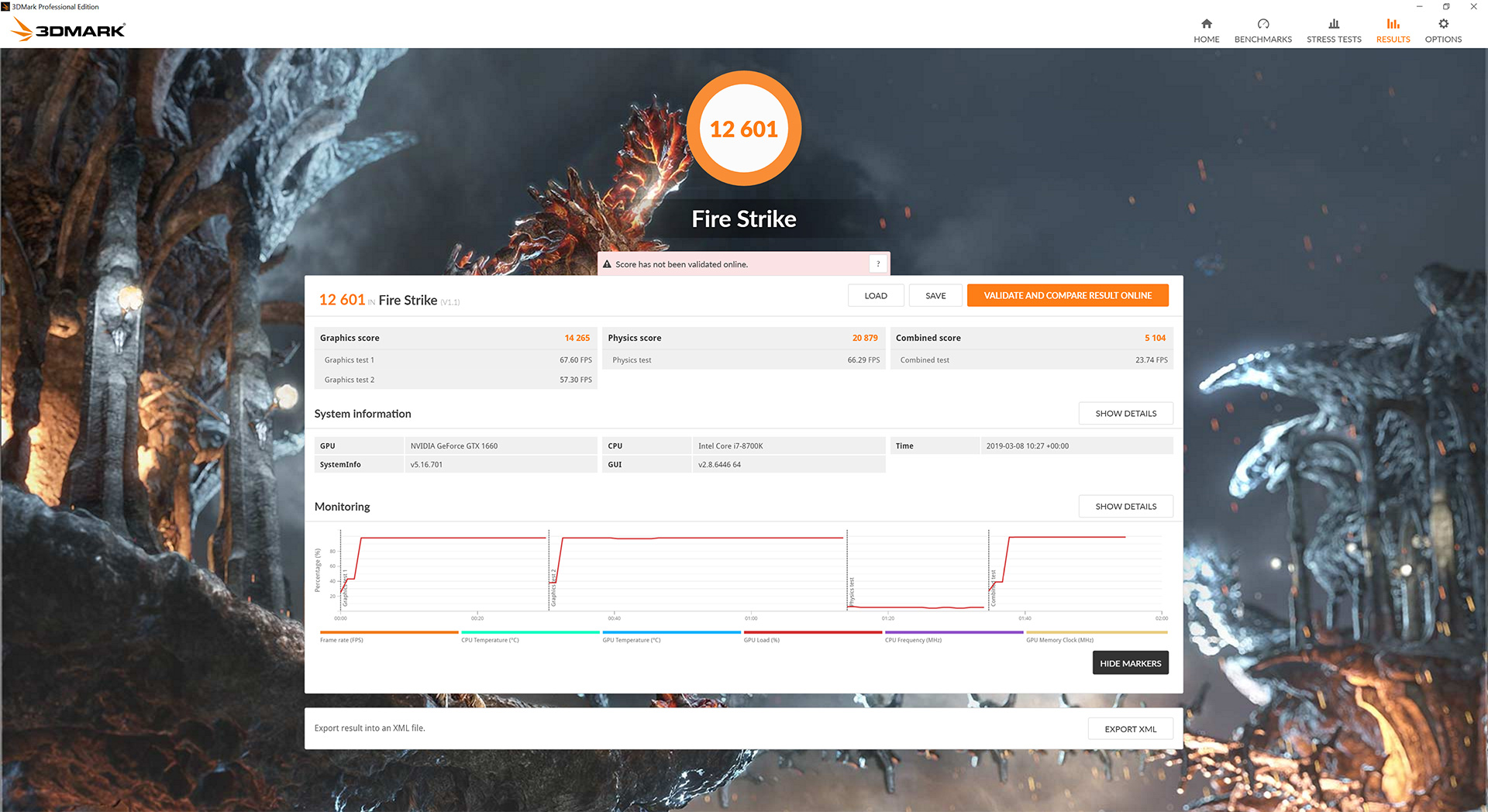
This extra frequency saw our Fire Strike score increase by a whopping 14%, with our 1080p game tests also showing similar improvements – both Deus Ex: Mankind Divided and Shadow of the Tomb Raider performed 8-10FPS better than stock, putting this card's performance within touching distance of GTX 1660 Ti.Here, we take a further look at the impact of our overclock, looking at the increased temperatures, acoustics and power draw.
Temperatures
Acoustics
Power consumption
Overview
This Gaming X is able to handle the increased frequency from our overclock without any issues. GPU temperatures, for instance, rose by just 1C – and noise levels didn't even increase by a single decibel. Power draw did jump up 14W or so, but even that only puts it alongside GTX 1060, so it is still a highly efficient card even when overclocked.About three weeks on from the launch of GTX 1660 Ti, Nvidia has released its smaller brother – the GTX 1660. Both use the same TU116 GPU, though with GTX 1660 it has one TPC disabled – meaning 128 less CUDA cores. The 6GB of memory is also GDDR5, not GDDR6.
The specific card we have looked at today is the MSI GTX 1660 Gaming X. It uses the same cooler and shroud design as MSI's GTX 1660 Ti, and it is really very technically proficient. GPU temperatures peaked at just 63C, and that was with the fans hardly spinning, too – noise levels are the lowest we have seen from any card of this generation.
Clearly, MSI's cooler is more than capable enough of cooling both the GTX 1660 and GTX 1660 Ti, and it shows – from a technical standpoint, this is probably one of the best GTX 1660 cards we will see.
As for the actual gaming performance of GTX 1660, it is very much trading blows with AMD's RX 590 – the performance difference between the two cards is barely 2% in the RX 590's favour, though it does vary slightly on a game-by-game basis. Compared to GTX 1060, this new Turing-based card comes in 15% faster on average.
For me, GTX 1660 is best suited for 1080p gaming, where it would typically push around 70FPS, even in demanding titles. The jump up to 1440p is possible, but it really depends on how smooth you like your gameplay – frame rates can dip down as low as 33FPS depending on the title, with average FPS hovering around the 40-50FPS mark.
It's a decent performer, certainly, and I can imagine it appealing to any aspiring esports gamers looking to get good frame rates while gaming at 1080p. That being said, I don't think a 15% improvement over GTX 1060 is something to go wild about. I do appreciate the GTX 1660 MSRP is £40 lower than what GTX 1060 launched for, but even then this is hardly a monumental leap forward for the £200 market segment.
If we look at this specific card in question, however, things are complicated further – GTX 1660s will start at £199, but this MSI Gaming X card has its own MSRP of £249.99. I have to say, this is just ridiculous. I'm all for board partners releasing custom cards with low temperatures and acoustics – but when those models come with a 25% price premium, for what is really a value graphics card, it just makes no sense.
Looking at the bigger picture, too, GTX 1660 Ti starts at £259 – so just £10 more than this 1660. Considering Gigabyte's 1660 Ti OC 6G is itself on average 15% faster than this 1660, it really is a no brainer. MSI is just pricing itself out of this budget-oriented market with the Gaming X.
We will have to wait and see how compelling a GTX 1660 priced at £199 will be. Based on past experience, a reference clocked 1660 will probably perform about 2-4% slower than this factory overclocked model, but even that would offer far superior value when compared to the Gaming X. AMD's RX 590 is the closest competitor to GTX 1660, but pricing remains north of £240 for even the cheapest models at the time of writing.
That means GTX 1660 has the potential to become the go-to card in the £200 market segment as it does outperform both GTX 1060 and RX 580 – the two cards currently occupying this price point – though we will have to wait and see how a card that is actually priced at £199 performs.
For now, we can say MSI's GTX 1660 Gaming X 6G is a superb offering from a technical standpoint, but with its £50 (25%) price premium over GTX 1660's MSRP, it really makes no sense to actually go out and buy one.

Update: Shortly after going to press, this GTX 1660 Gaming X was made available on Overclockers UK for £229.99. This is £20 less than the card's MSRP given to us by MSI and definitely makes things more palatable. That being said, the Gaming X is still priced 15% higher than the £199 MSRP so our original conclusion remains. GTX 1660 is a good buy at £199, but higher-end cards like the Gaming X aren't as appealing.
Pros
- Dead silent.
- Temperatures are very low.
- High clock speed out of the box.
- Overclocked well.
Cons
- £249.99 price at launch puts this in an impossible position.
KitGuru says: MSI's GTX 1660 is technically excellent. However, you just cannot justify the £249.99 MSRP when GTX 1660 Ti starts for just £10 more.