KitGuru KitGuru.net – Tech News | Hardware News | Hardware Reviews | IOS | Mobile | Gaming | Graphics Cards


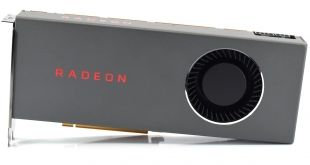
July 7 marks a busy day for AMD, as it releases not only its new 7nm Ryzen 3000 processors, but two new 7nm graphics cards as well – the Radeon RX 5700 and RX 5700 XT. Built on the new RDNA architecture, these cards are AMD's attempt to win back the mid-range market segment after its Radeon VII GPU wasn't able to topple Nvidia's RTX 2080 in the high-end earlier this year.
In this review we are focusing on the $349 RX 5700, but we also have a full review of the RX 5700 XT over here if you are interested. Going head to head with Nvidia's RTX 2060, can the RX 5700 come out on top?
When AMD gave us our first good look at the new cards back at E3, the Radeon RX 5700 was compared to Nvidia's RTX 2060 and its performance looked compelling. As a preemptive strike, however, Nvidia recently launched its new RTX 2060 SUPER and RTX 2070 SUPER graphics cards, which both offer decent performance increases over the original models.
Adding a further twist to proceedings, AMD announced on Friday that it has actually dropped pricing of both its new cards ahead of launch. The RX 5700 is now priced at $349, and the 5700 XT costs at $399, throwing a real spanner in the works as the 5700 is now competing against the 2060, not the 2060 SUPER as Nvidia had anticipated.
| RX 5700 | RX 5700 XT | RX Vega 56 | RX Vega 64 | Radeon VII | |
| Architecture | Navi | Navi | Vega 10 | Vega 10 | Vega 20 |
| Manufacturing Process | 7nm | 7nm | 14nm | 14nm | 7nm |
| Transistor Count | 10.3 billion | 10.3 billion | 12.5 billion | 12.5 billion | 13.2 billion |
| Die Size | 251mm² | 251mm² | 486mm² | 495mm² | 331mm² |
| Compute Units | 36 | 40 | 56 | 64 | 60 |
| Stream Processors | 2304 | 2560 | 3584 | 4096 | 3840 |
| Base GPU Clock | Up to 1465MHz | Up to 1605MHz | 1156 MHz | 1274 MHz | 1400 MHz |
| Game GPU Clock | Up to 1625MHz | Up to 1755MHz | n/a | n/a | n/a |
| Boost GPU Clock | Up to 1725MHz | Up to 1905MHz | 1471 MHz | 1546 MHz | 1750 MHz |
| Peak Engine Clock | n/a | n/a | 1590 MHz | 1630 MHz | 1800 MHz |
| Peak SP Performance | Up to 7.95 TFLOPS | Up to 9.75 TFLOPS | Up to 10.5 TFLOPS | Up to 12.7 TFLOPS | Up to 14.2 TFLOPS |
| Peak Half Precision Performance | Up to 15.9 TFLOPS | Up to 19.5 TFLOPS | Up to 21.0 TFLOPS | Up to 25.3 TFLOPS | Up to 28.1 TFLOPS |
| Peak Texture Fill-Rate | Up to 248.4 GT/s | Up to 304.8 GT/s | Up to 330.0 GT/s | Up to 395.8 GT/s | 432.24 GT/s |
| ROPs | 64 | 64 | 64 | 64 | 64 |
| Peak Pixel Fill-Rate | Up to 110.4 GP/s | Up to 121.9 GP/s | Up to 94.0 GP/s | Up to 98.9 GP/s | 115.26 GP/s |
| Memory | 8GB GDDR6 | 8GB GDDR6 | 8GB HBM | 8GB HBM | 16GB HBM2 |
| Memory Bandwidth | 448 GB/s | 448 GB/s | 410 GB/s | 483.8 GB/s | 1 TB/s |
| Memory Interface | 256-bit | 256-bit | 2048-bit | 2048-bit | 4096-bit |
| Board Power | 185W | 225W | 210W | 295W | 300W |
Built on AMD's new RDNA architecture, the RX 5700 is the lesser of the two new Navi GPUs hitting the market. It sports 36 Compute Units (CUs), the design of which has been completely reworked for Navi, which is 4 less than its bigger brother, the RX 5700 XT. Each CU is home to 64 stream processors, therefore the RX 5700 has 2304 of those.
The Navi GPU is fabricated on TSMC's 7nm process, which not only means a physically smaller die size for both new cards – 251mm², versus 486mm² for Vega 56, for instance – but higher clock speeds as well. Base clock for the RX 5700 is rated at 1465MHz, with a boost of up to 1725MHz. Interestingly, AMD is also touting a new ‘game clock', the frequency which you can expect to see the card hit while gaming. For the RX 5700, its game clock is 1625MHz.
On top of these developments, Navi also marks AMD's shift away from High Bandwidth Memory (HBM), for its mid-range cards at least. Both RX 5700 and RX 5700 XT sport the latest GDDR6 memory, running at the same 14Gbps that we have become used to with Nvidia's RTX series of cards. Over a 256-bit bus, this provides 448 GB/s of memory bandwidth.
Lastly, total board power for the RX 5700 is rated at 185W. This is 10W than the rated Total Graphics Power (TGP) of the RTX 2060 SUPER.
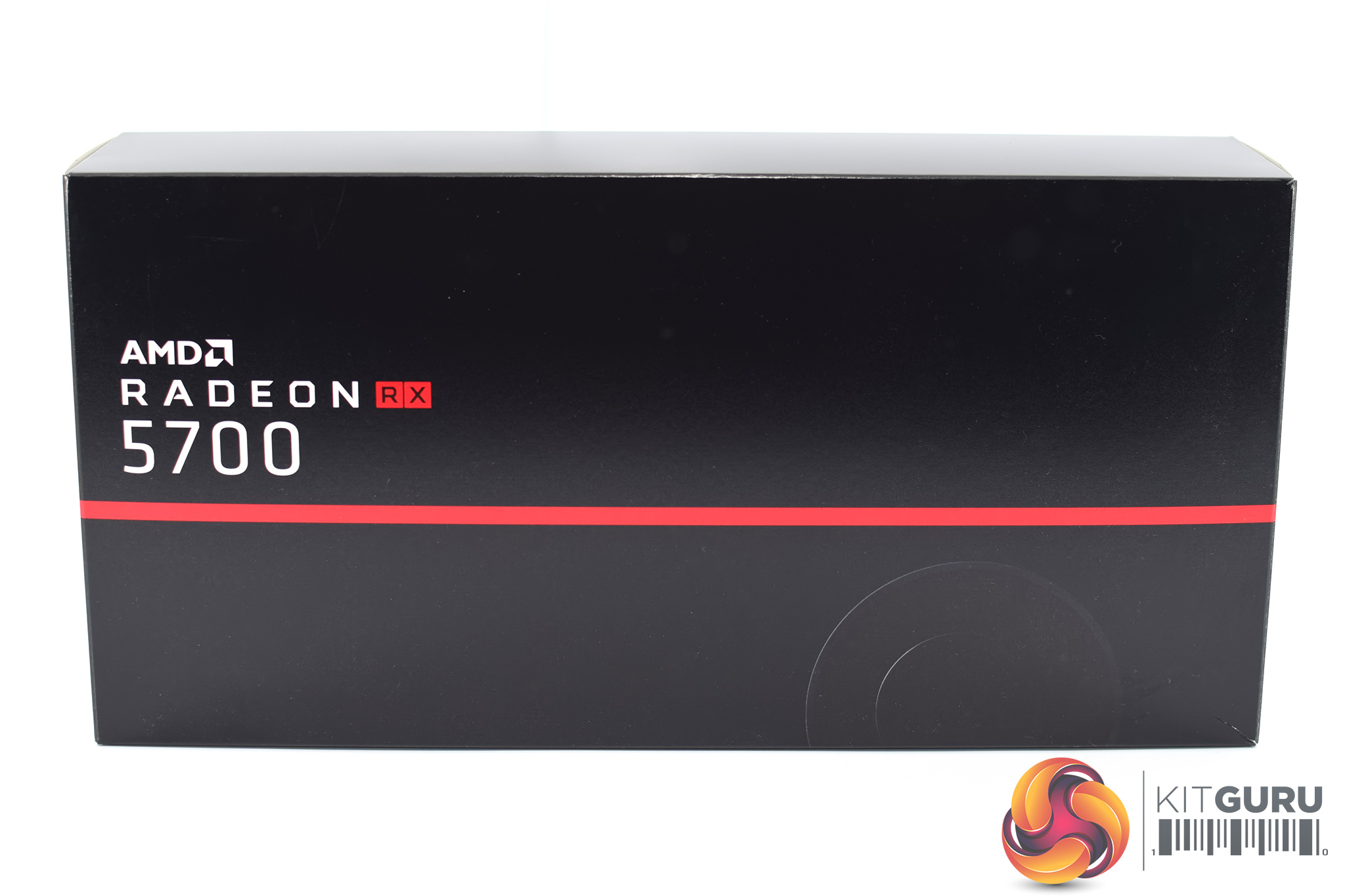
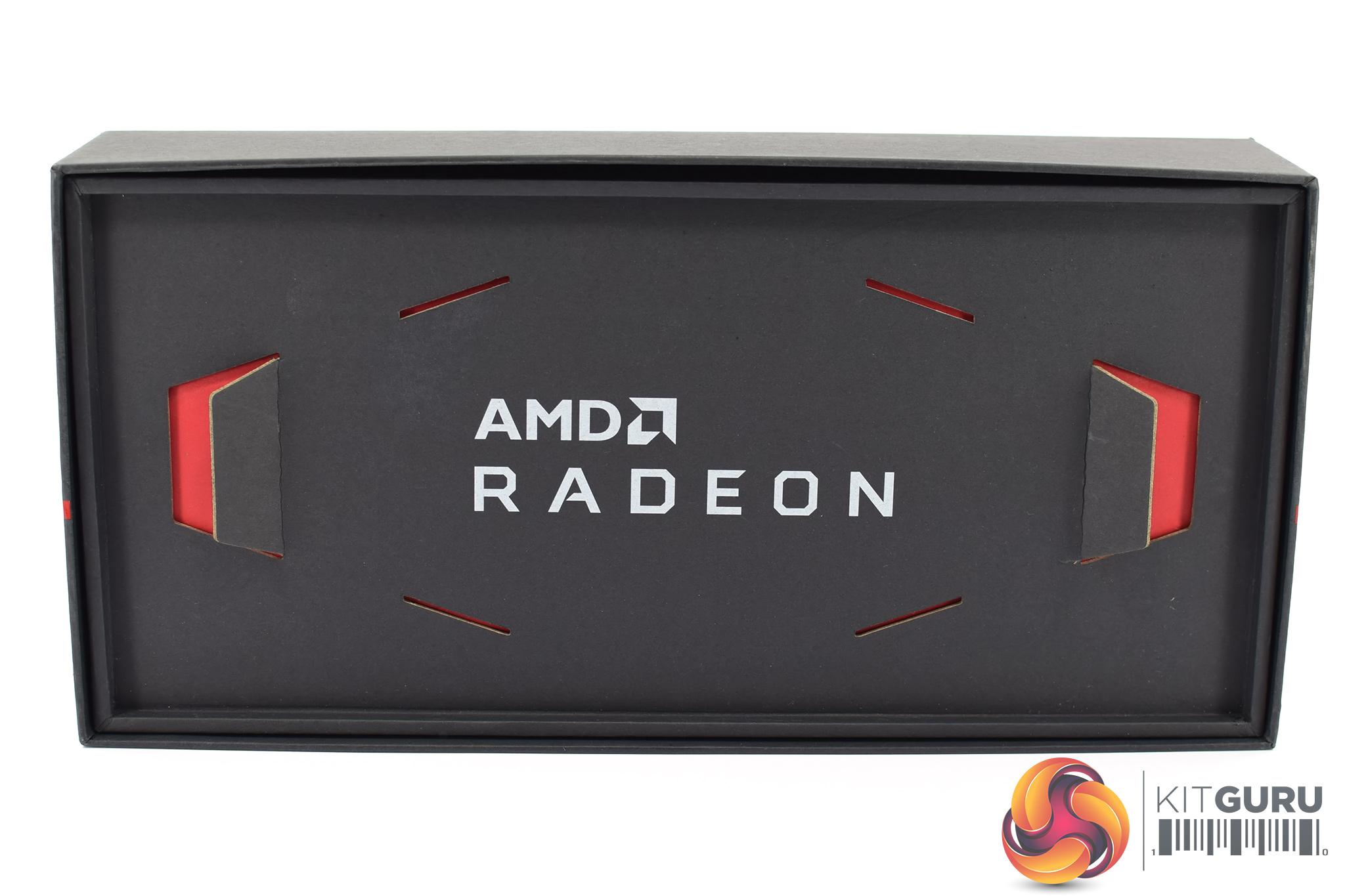
The AMD Radeon RX 5700 ships in a compact black box, with just product branding and a red strip visible on the front.
A smaller box slides out to reveal the AMD Radeon logo printed on a piece of cardboard. This acts a lid – you just need to lift by the pull-tabs to reveal the card housed underneath.
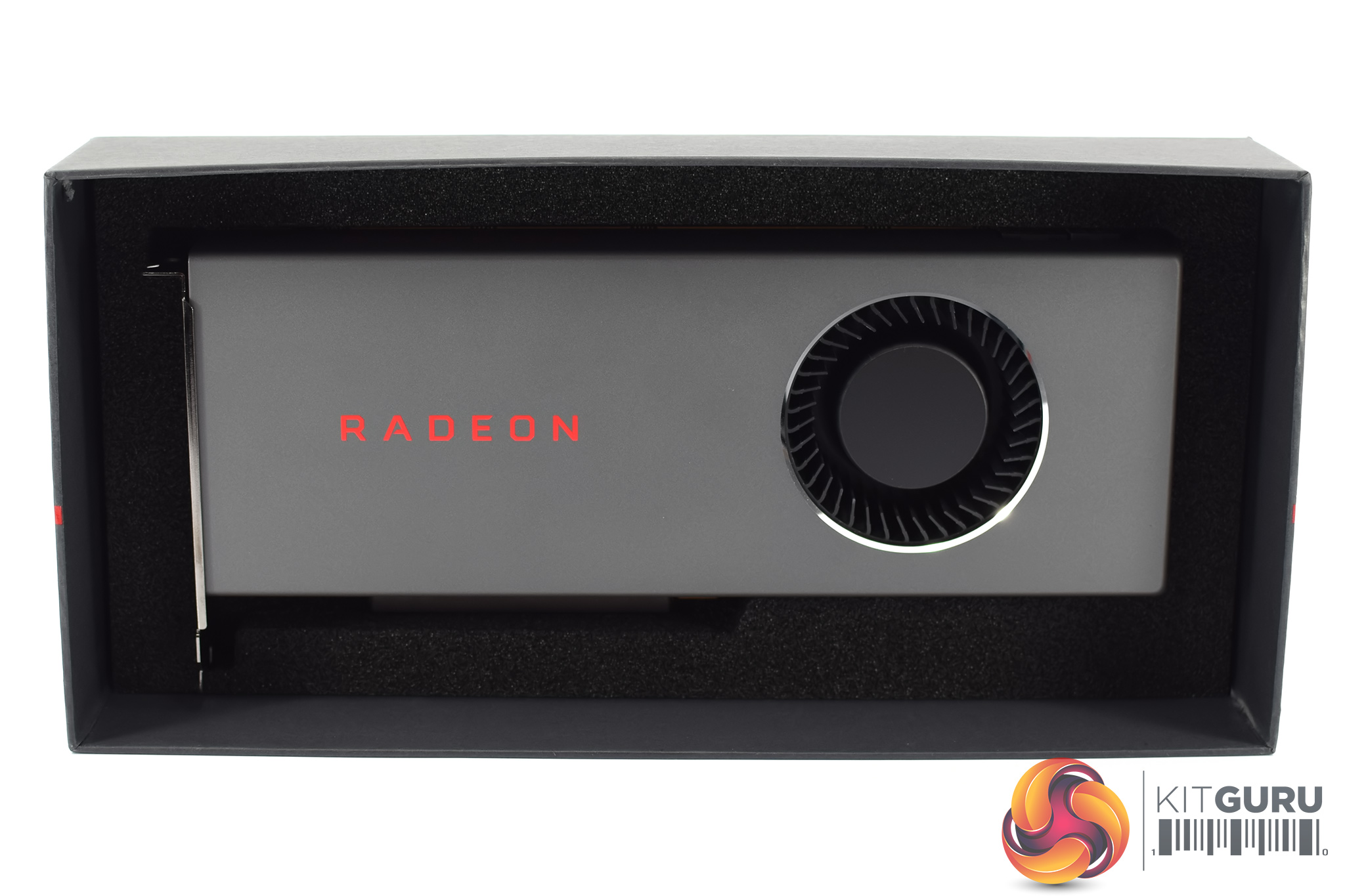
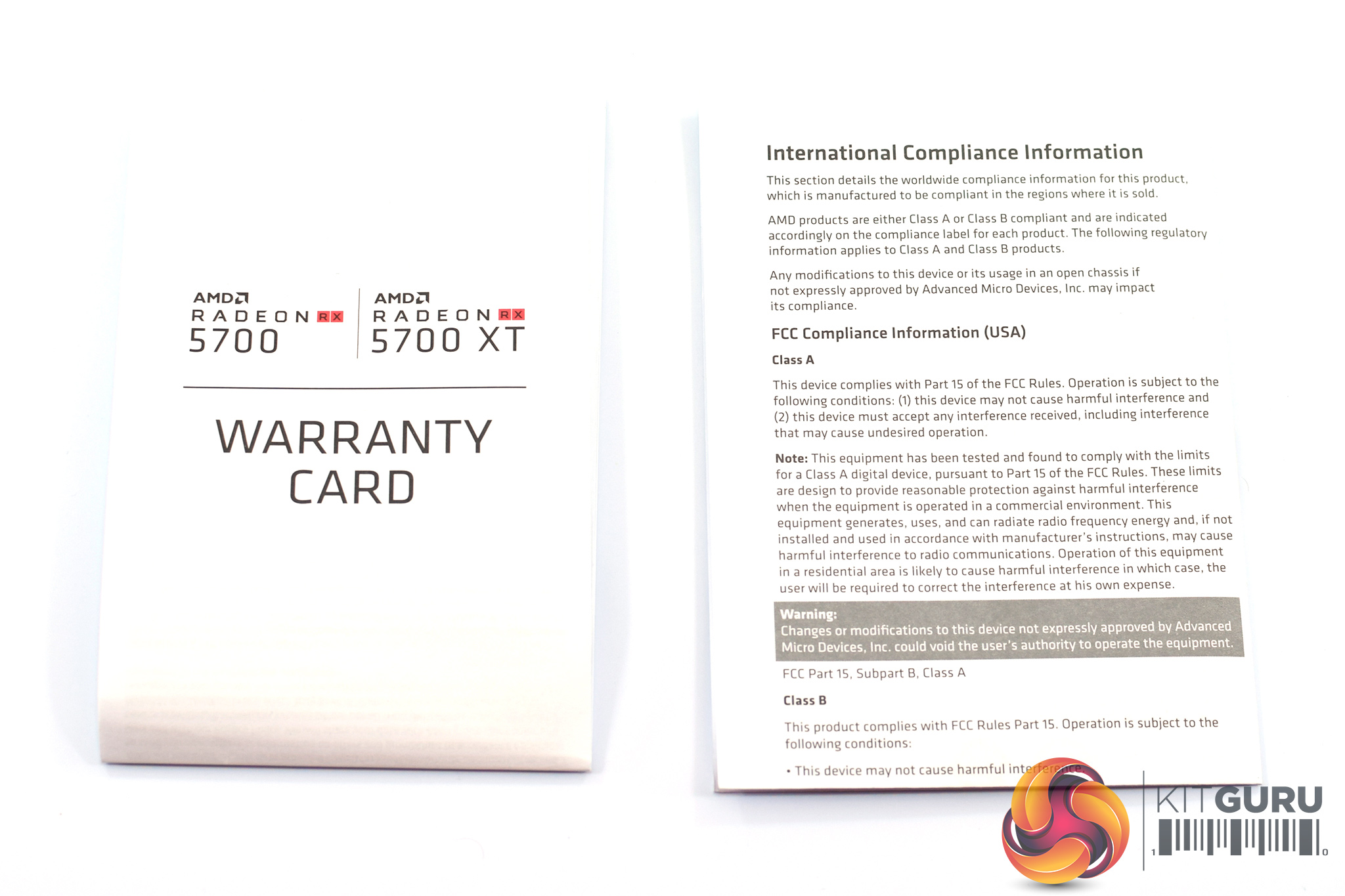
With that done, we get our first look at the card as it sits in a foam surround. Also included is a small warranty card and a leaflet about international compliance information.
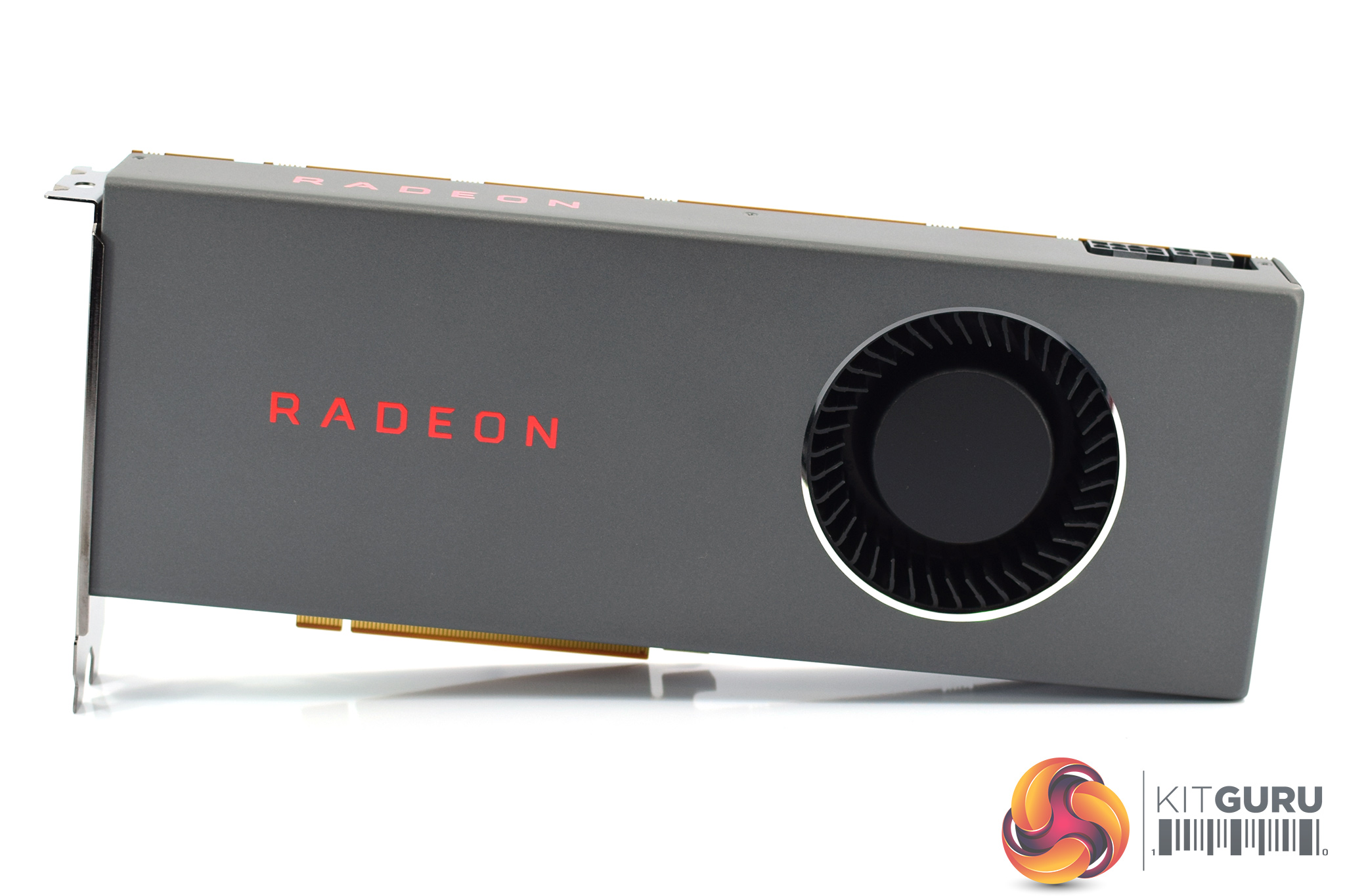
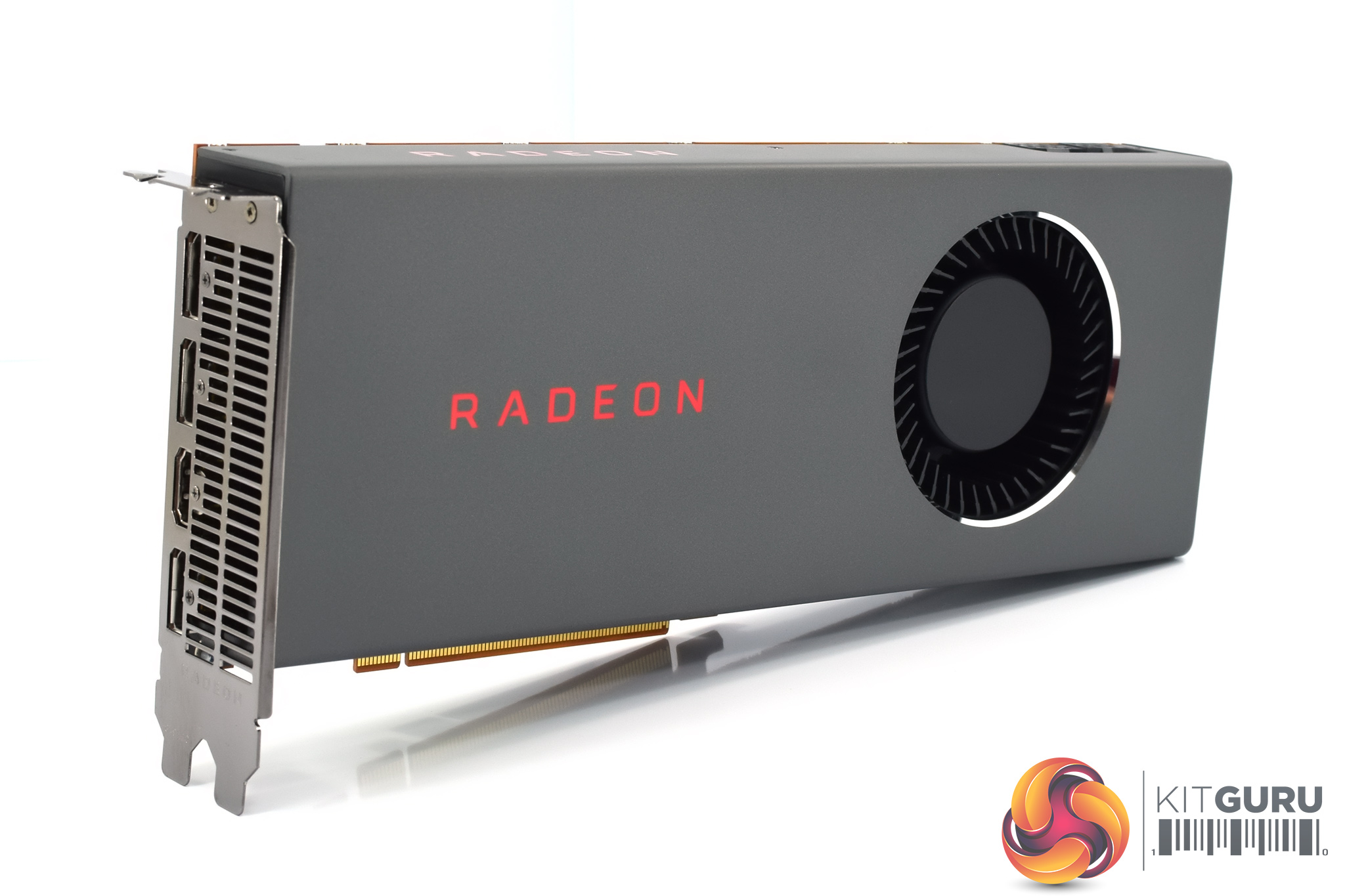
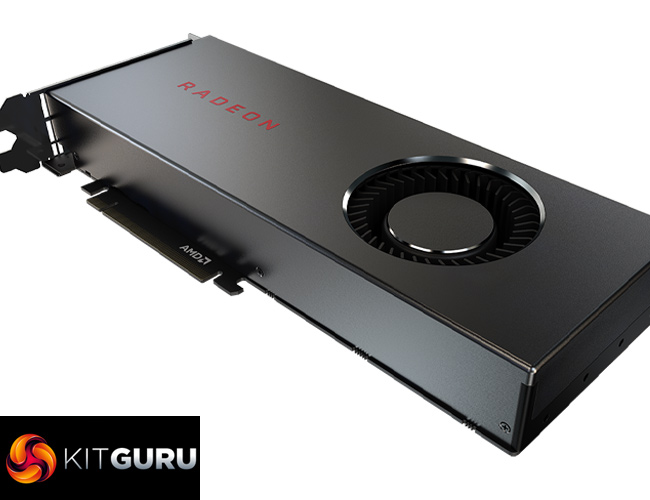
Looking closer at the card, it sports a pretty simple design with an understated grey shroud. The only piece of additional styling comes from the Radeon logo printed in red. It's not a very complicated design, but the card itself does feel great in the hand thanks to its anodised aluminium shroud. If you look closely, you can see the micro-texture on the card's surface.
It's also obvious that this is another of AMD's blower-style reference cards. I had wondered if we had seen the last of these when Radeon VII launched with its triple axial cooler, but they have made a return here – it will be interesting to look at temperatures and noise levels later in the review, as the Vega 56/64 designs were famously loud and hot-running.
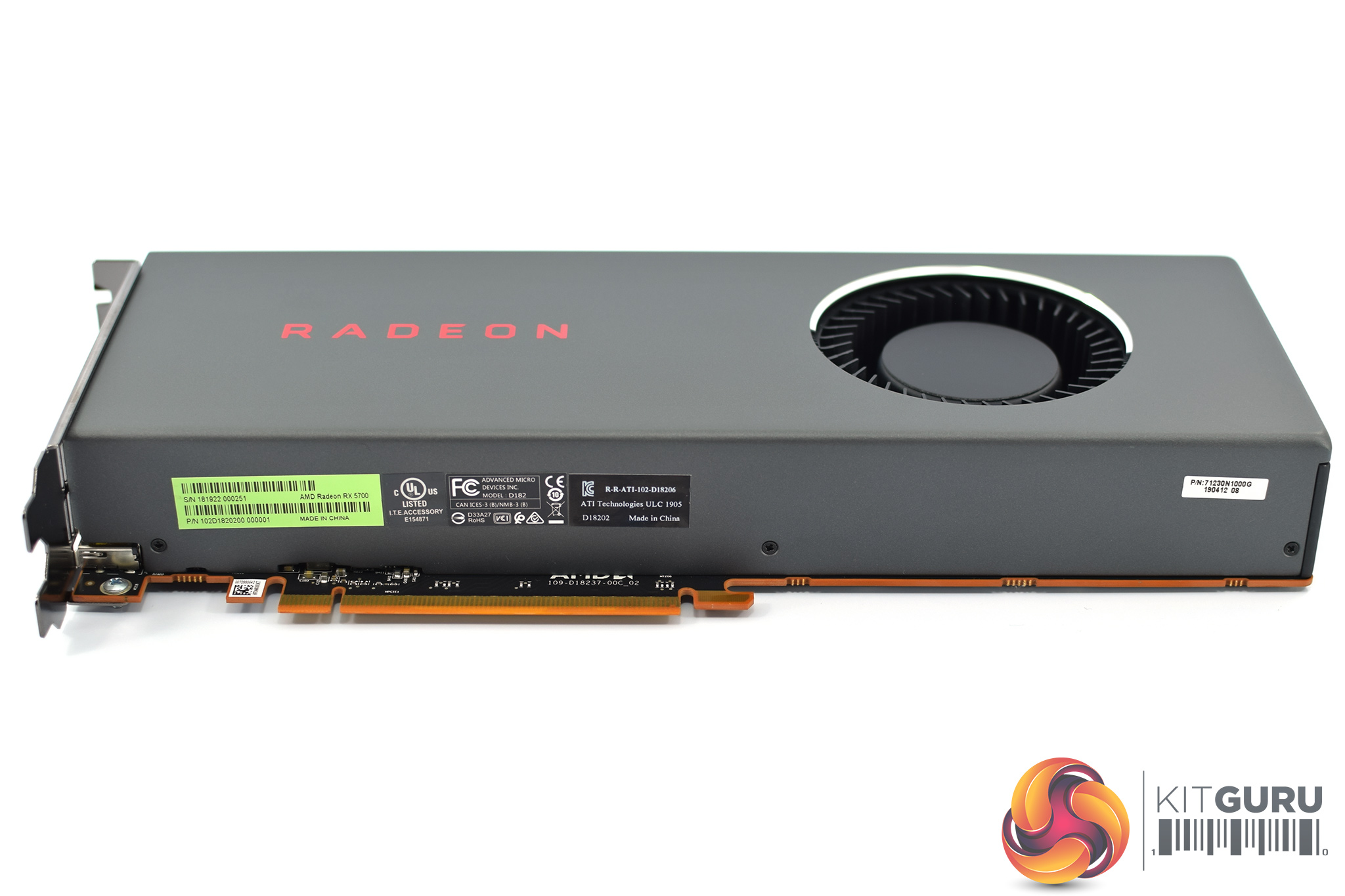
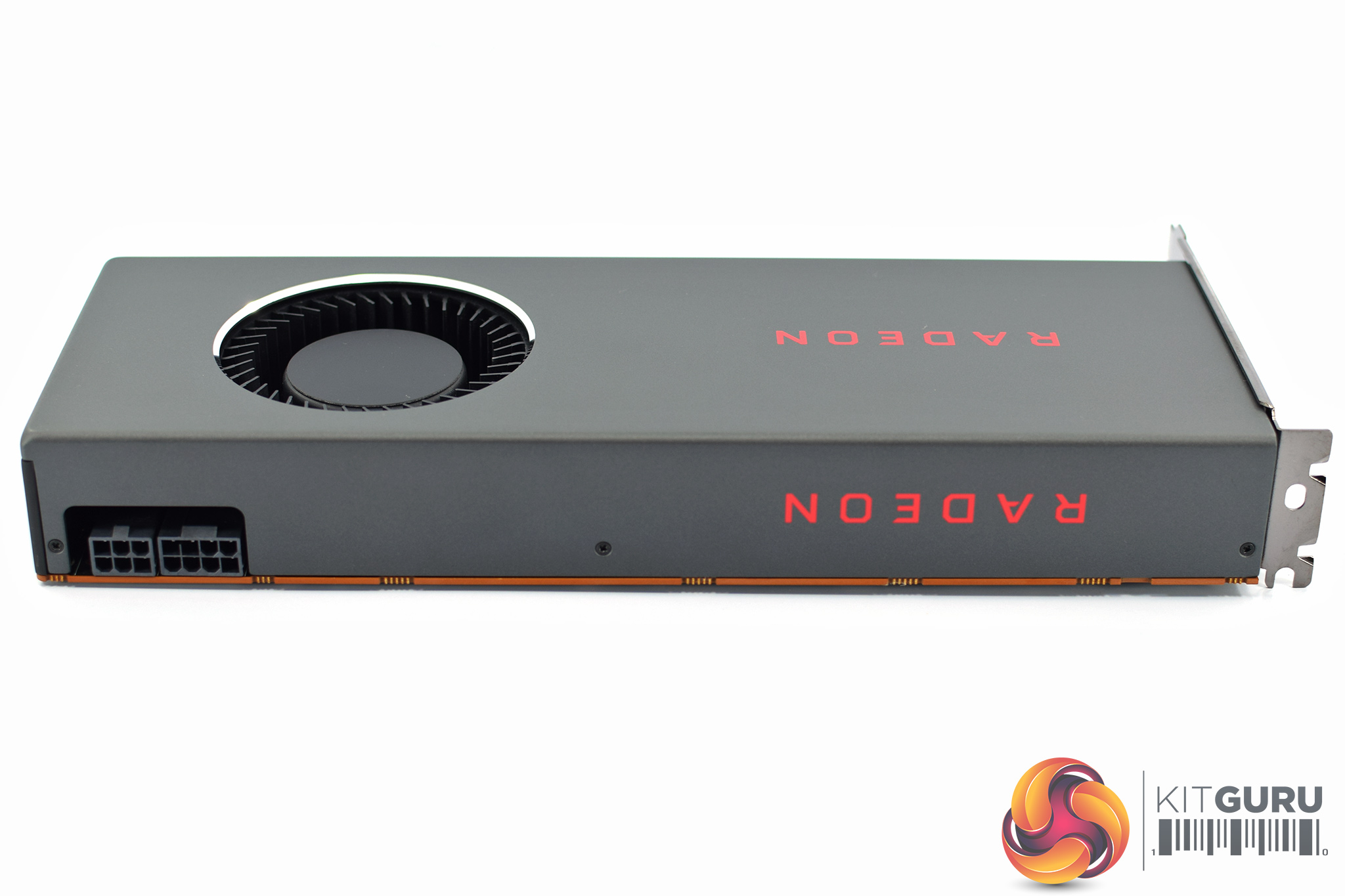
Taking a look at the sides of the card, the grey shroud is clearly very box-like in its design – no curves or ‘dents' here.
It's also worth mentioning the dimensions of the card. It's a standard dual-slot thickness, while my measurements have it 268mm long and 110mm tall.
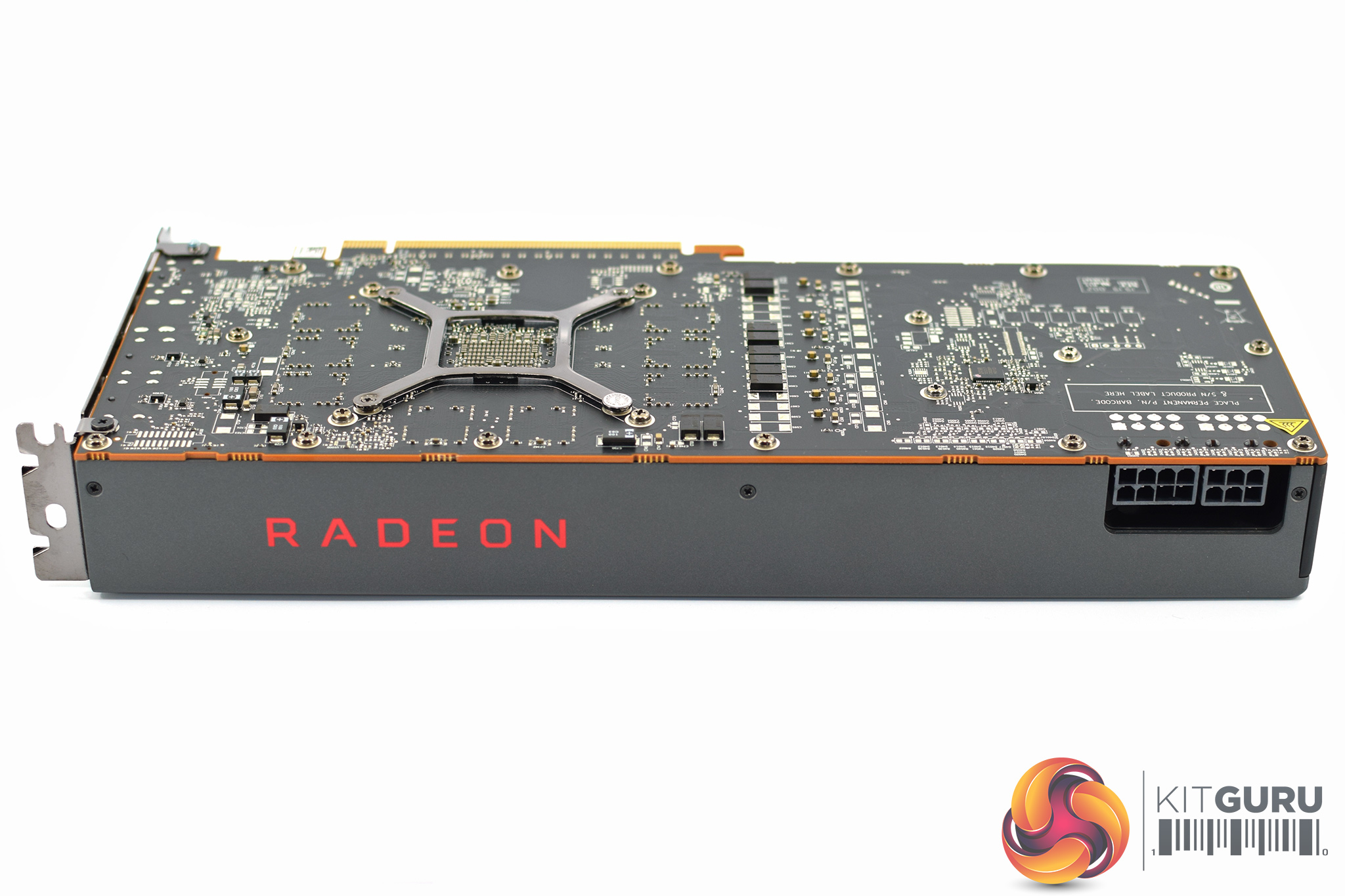
Back to the front side of the card, here we see a second Radeon logo printed in red, though this isn't illuminated by LEDs so nothing changes once your system is powered on.
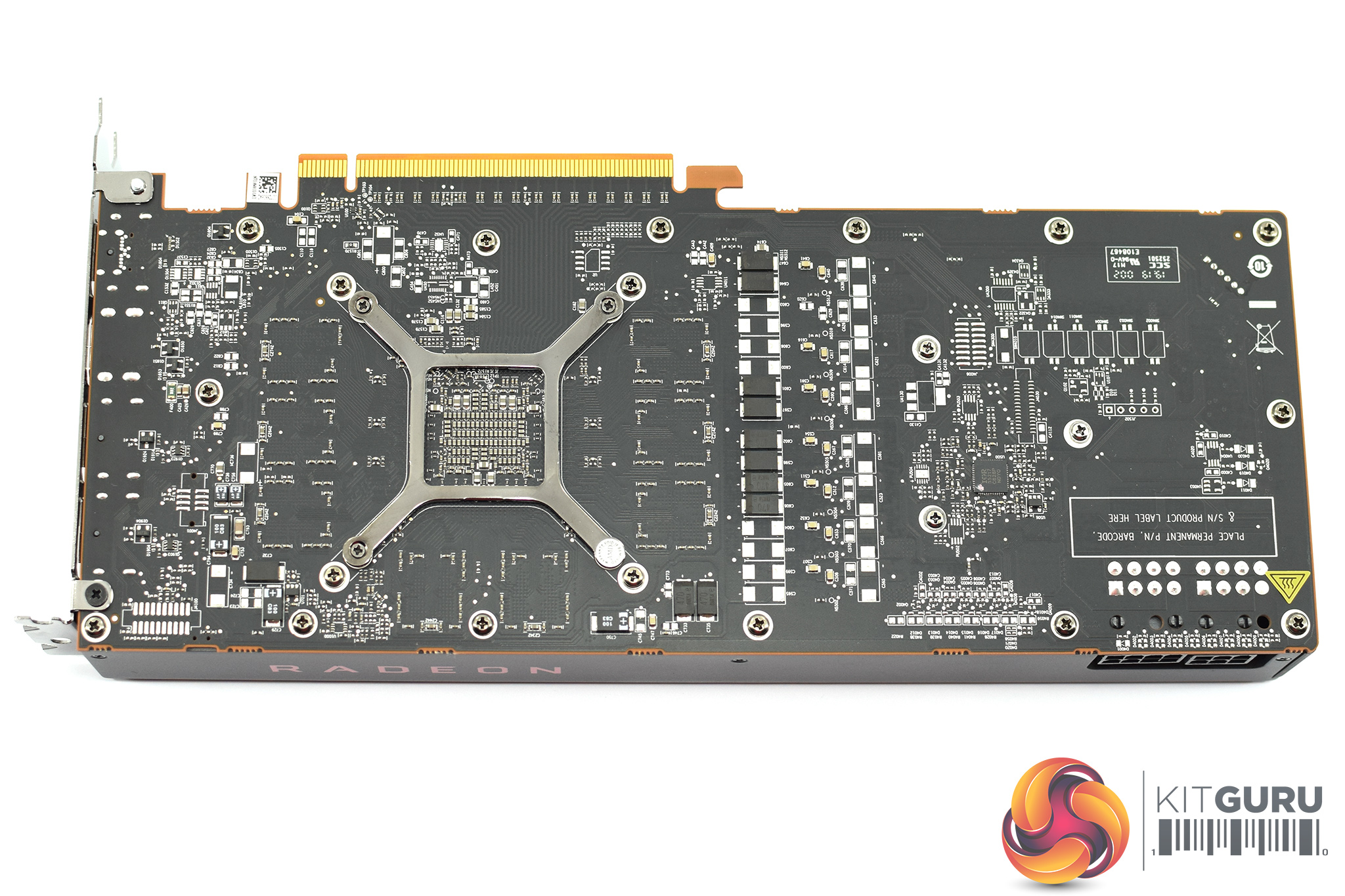
As for the backplate… well, there isn't one, and we instead get a direct look onto the back of the card's PCB. This isn't the absolute end of the world, and I appreciate AMD is trying to keep costs down – but this is still a $349 graphics card, and I would expect a backplate at this price. Not only to help with hot spots on the back of the PCB, but also to provide a layer of protection against a potentially leaky AIO cooler, and also I think it looks better from an aesthetic point of view.
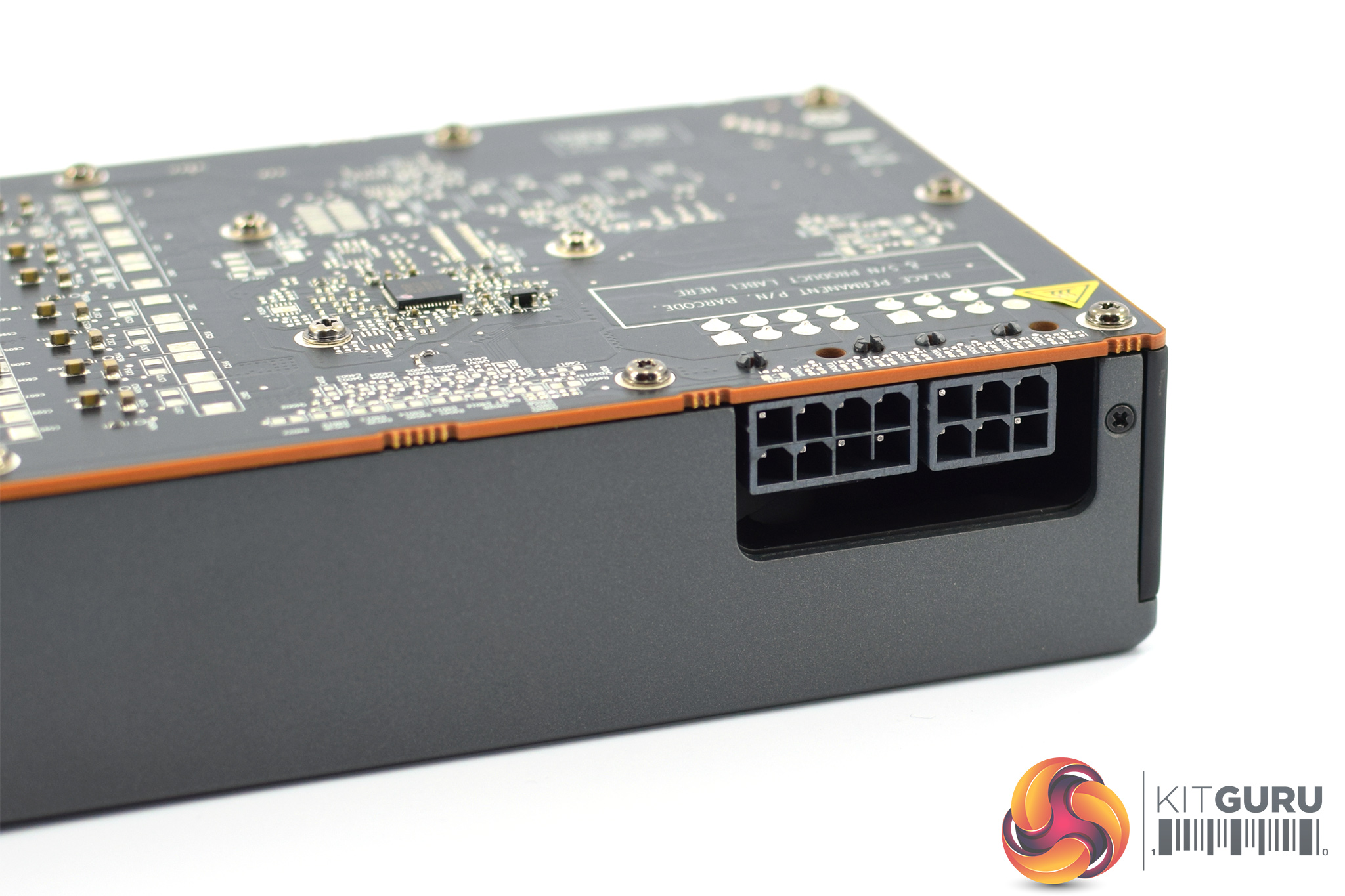
As for the board's power requirements, you'll need 1x 8-pin and 1x 6-pin power connectors. For reference, RTX 2060 SUPER only requires 1x 8-pin, but rated board power is just 10W higher for the AMD card.
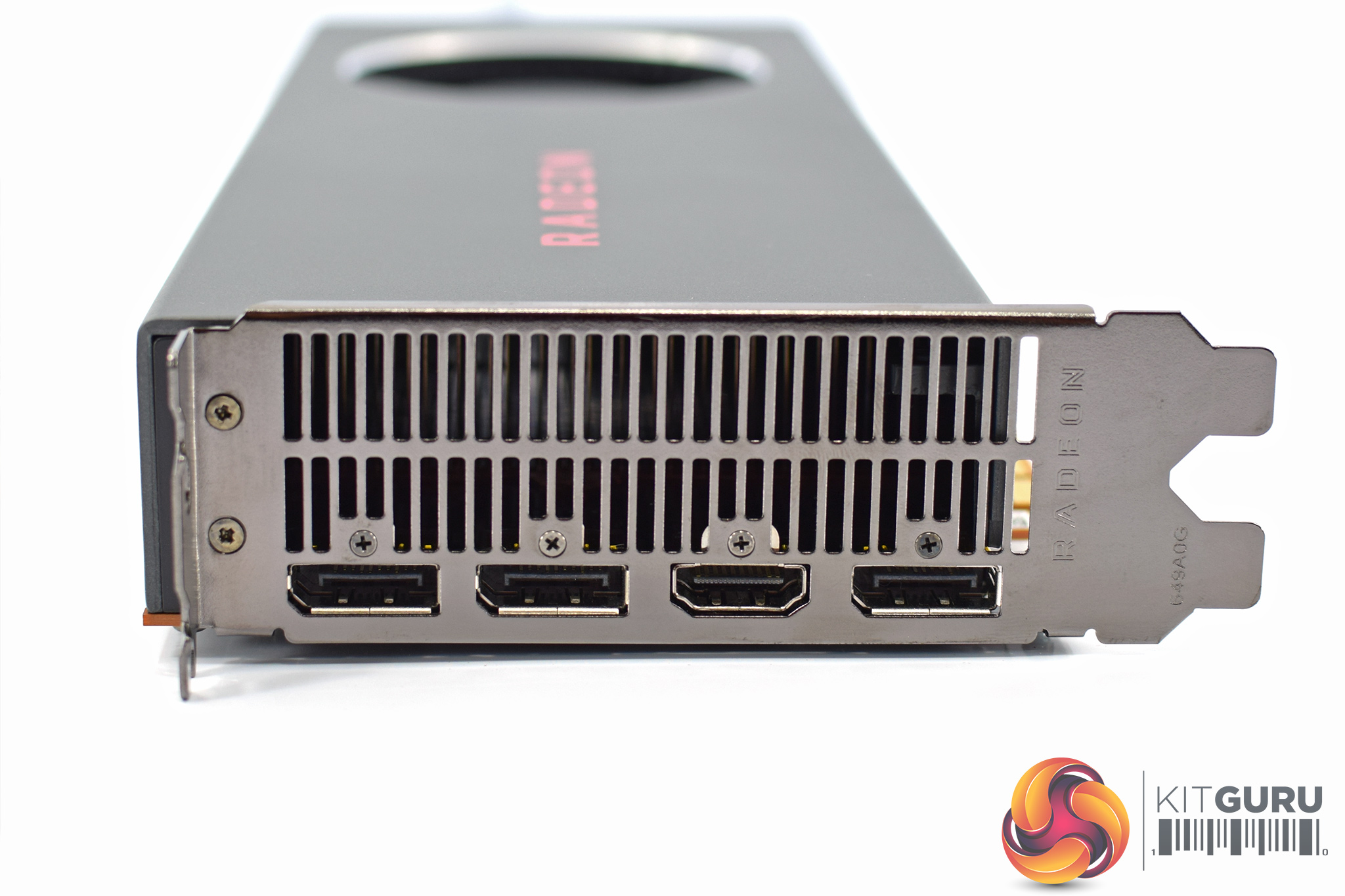
Lastly, for display outputs there are 3x DisplayPort and 1x HDMI connectors. Most of the I/O bracket is given over to ventilation, where the hot air will be exhausted out the back of the case.
Our newest GPU test procedure has been built with the intention of benchmarking high-end graphics cards. We test at 1920×1080 (1080p), 2560×1440 (1440p), and 3840×2160 (4K UHD) resolutions.
We try to test using the DX12 API if titles offer support. This gives us an interpretation into the graphics card performance hierarchy in the present time and the near future, when DX12 becomes more prevalent. After all, graphics cards of this expense may stay in a gamer’s system for a number of product generations/years before being upgraded.
We tested the RX Vega64 and Vega56 using the ‘Turbo‘ power mode in AMD’s WattMan software. This prioritises all-out performance over power efficiency, noise output, and lower thermals.
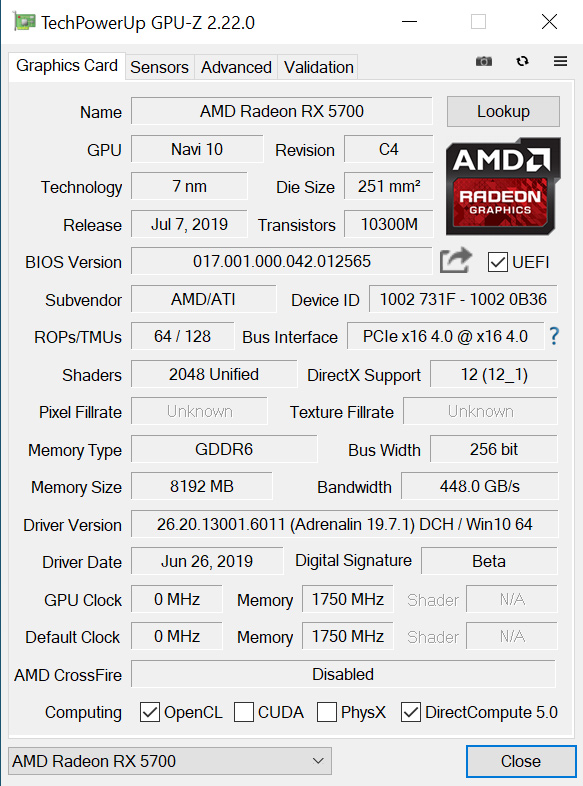
GPU-Z is not yet 100% friendly with the new Navi cards, so clock speed information and shader count is not listed correctly. The 5700 reference design has a base clock of 1465MHz, a game clock of 1625MHz and a boost clock of 1725MHz.
Driver Notes
- All AMD graphics cards (except RX 5700/5700 XT) were benchmarked with the Adrenalin 19.6.2 driver.
- All Nvidia graphics cards (except 2060/2070 SUPER) were benchmarked with the Nvidia 430.86 driver.
- Nvidia RTX 2060/2070 SUPER cards were benchmarked with the 431.16 driver supplied to press ahead of launch.
- AMD RX 5700/5700 XT were benchmarked with the Adrenalin 19.7.1 driver supplied to press ahead of launch.
Test System
We test using the Overclockers UK Germanium pre-built system, though it has been re-housed into an open-air test bench. You can read more about it over HERE.
| CPU |
Intel Core i7-8700K
Overclocked to 4.8GHz |
| Motherboard |
ASUS ROG Strix Z370-F Gaming
|
| Memory |
Team Group Dark Hawk RGB
16GB (2x8GB) @ 3200MHz 16-18-18-38 |
| Graphics Card |
Varies
|
| System Drive |
Samsung 960 EVO 500GB
|
| Games Drive | Crucial M4 512GB |
| Chassis | Streacom ST-BC1 Bench |
| CPU Cooler |
OCUK TechLabs 240mm AIO
|
| Power Supply |
Corsair AX1500i 80+ Titanium PSU
|
| Operating System |
Windows 10 1903
|
Comparison Graphics Cards List
- Nvidia RTX 2080 Ti Founders Edition (FE) 11GB
- Nvidia RTX 2080 Founders Edition (FE) 8GB
- Nvidia RTX 2070 SUPER Founders Edition (FE) 8GB
- MSI RTX 2070 Armor 8GB
- Nvidia RTX 2060 SUPER Founders Edition (FE) 8GB
- Nvidia RTX 2060 Founders Edition (FE) 6GB
- Gigabyte GTX 1660 Ti OC 6G
- Gigabyte GTX 1660 Gaming OC 6G
- Palit GTX 1650 StormX OC 4GB
- Nvidia GTX 1080 Ti Founders Edition (FE) 11GB
- Gigabyte GTX 1080 G1 Gaming 8GB
- Palit GTX 1070 Ti Super JetStream 8GB
- Nvidia GTX 1070 Founders Edition (FE) 8GB
- Nvidia GTX 1060 Founders Edition (FE) 6GB
- AMD Radeon VII 16GB
- AMD RX Vega 64 Air 8GB
- AMD RX Vega 56 8GB
- Sapphire RX 590 Nitro+ SE 8GB
- Sapphire RX 580 Pulse 8GB
- ASUS RX 570 ROG Strix Gaming OC 4GB
Software and Games List
- 3DMark Fire Strike & Fire Strike Ultra (DX11 Synthetic)
- 3DMark Time Spy (DX12 Synthetic)
- Battlefield V (DX12)
- Deus Ex: Mankind Divided (DX12)
- Far Cry 5 (DX11)
- Tom Clancy’s Ghost Recon: Wildlands (DX11)
- Metro: Exodus (DX12)
- Middle Earth: Shadow of War (DX11)
- Shadow of the Tomb Raider (DX12)
We run each benchmark/game three times, and present averages in our graphs.3DMark Fire Strike is a showcase DirectX 11 benchmark designed for today’s high-performance gaming PCs. It is our [FutureMark’s] most ambitious and technical benchmark ever, featuring real-time graphics rendered with detail and complexity far beyond what is found in other benchmarks and games today.
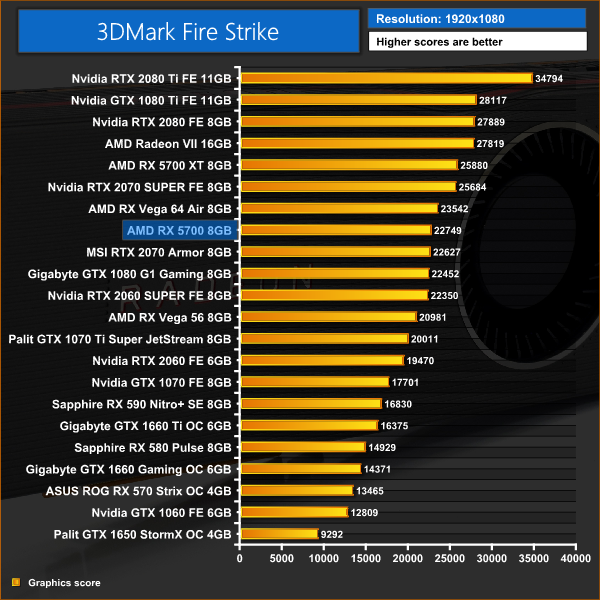
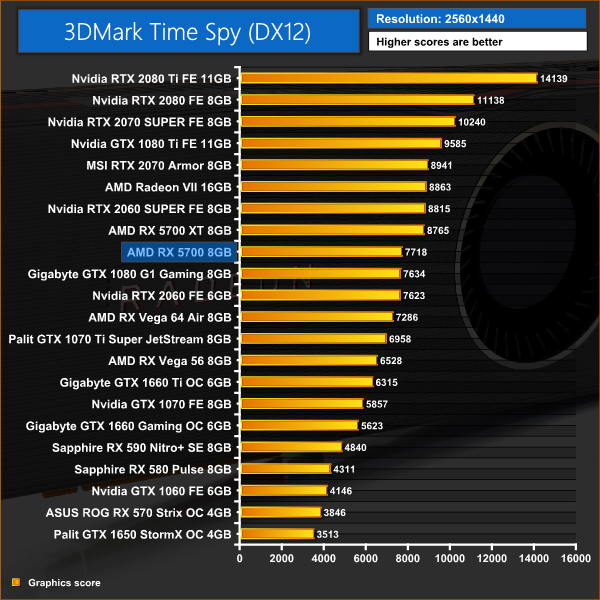
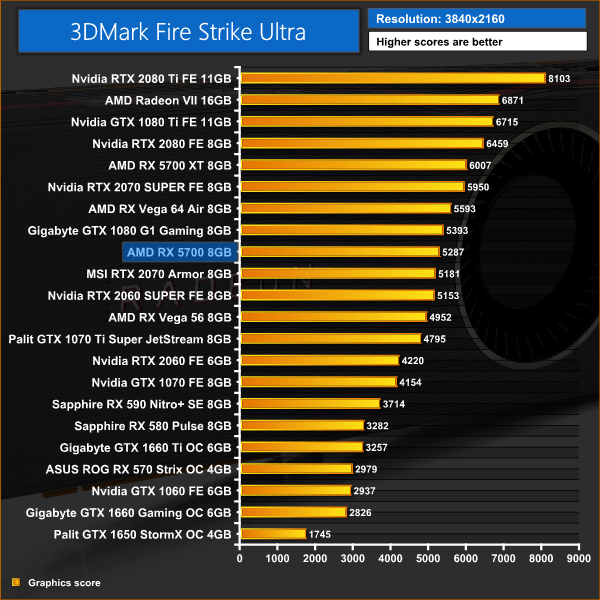
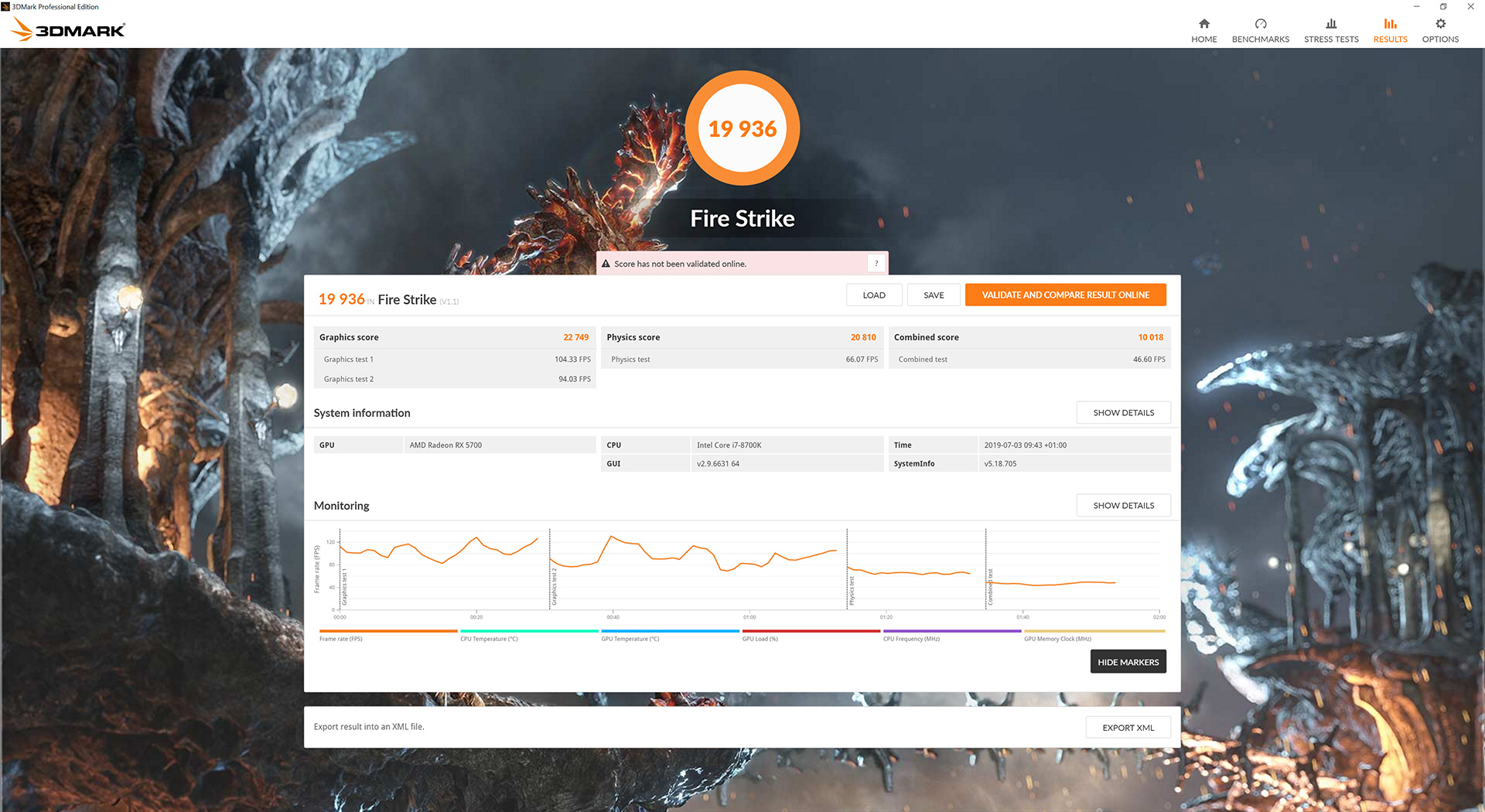
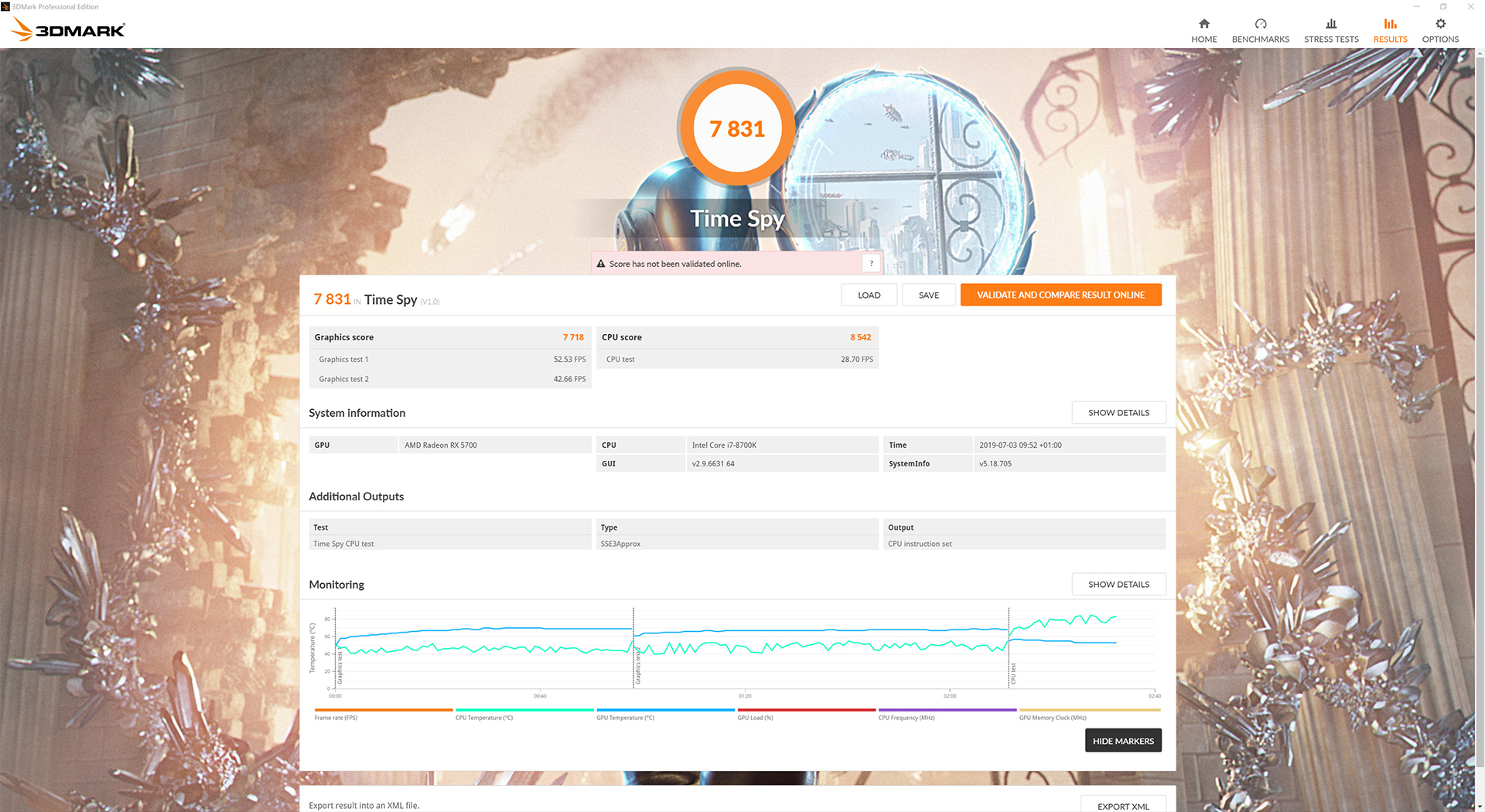
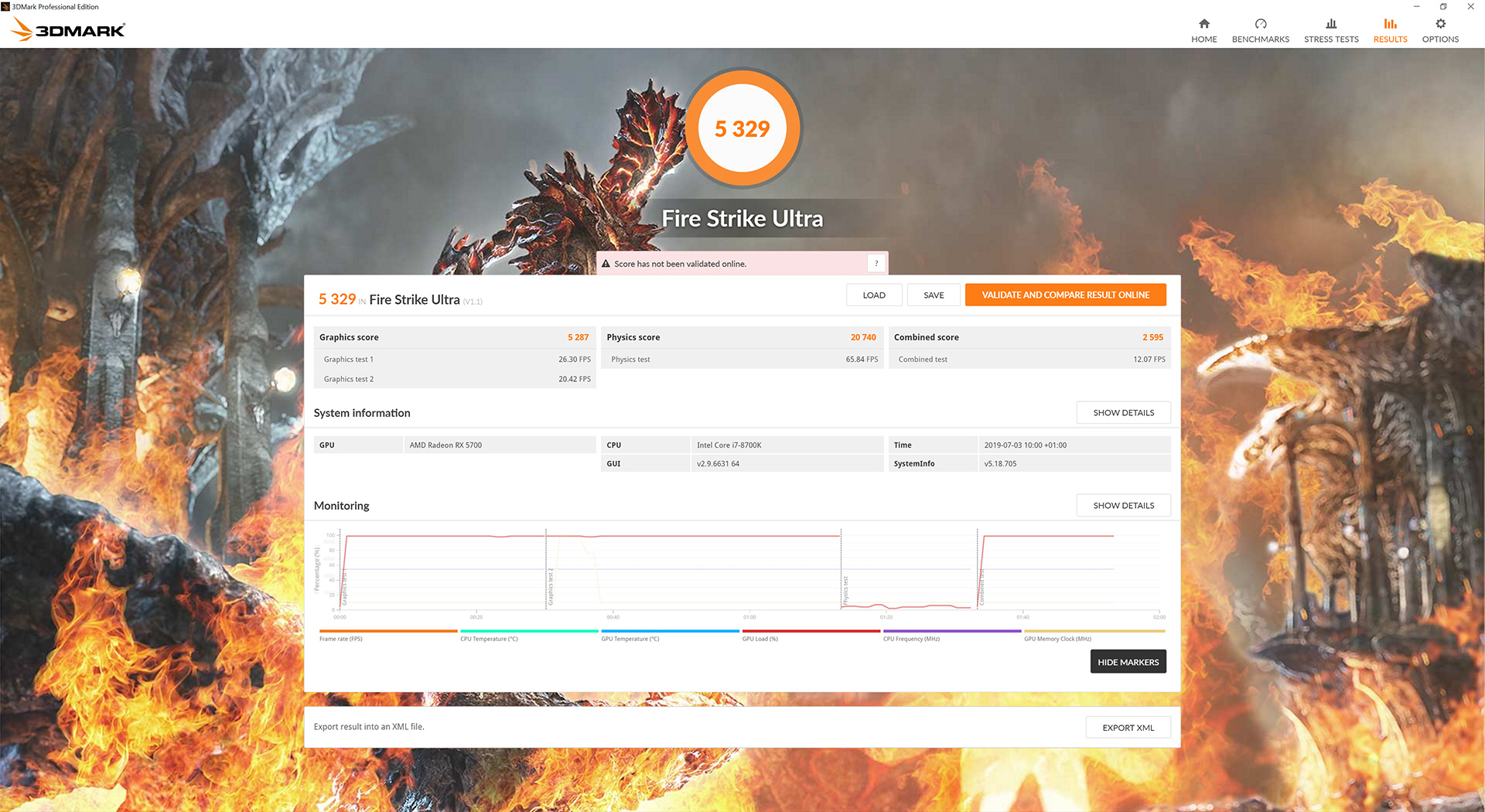
It's a very interesting start to our benchmarking for the RX 5700. Its Fire Strike and Fire Strike Ultra scores are ahead of both the RTX 2060 SUPER and RTX 2070, but the Time Spy test has both of those Nvidia cards in the lead. Games testing is going to be interesting.
Battlefield V is a first-person shooter video game developed by EA DICE and published by Electronic Arts. Battlefield V is the sixteenth instalment in the Battlefield series. It was released worldwide for Microsoft Windows, PlayStation 4, and Xbox One on November 20, 2018. (Wikipedia).
We test using the Ultra preset with the DX12 API.
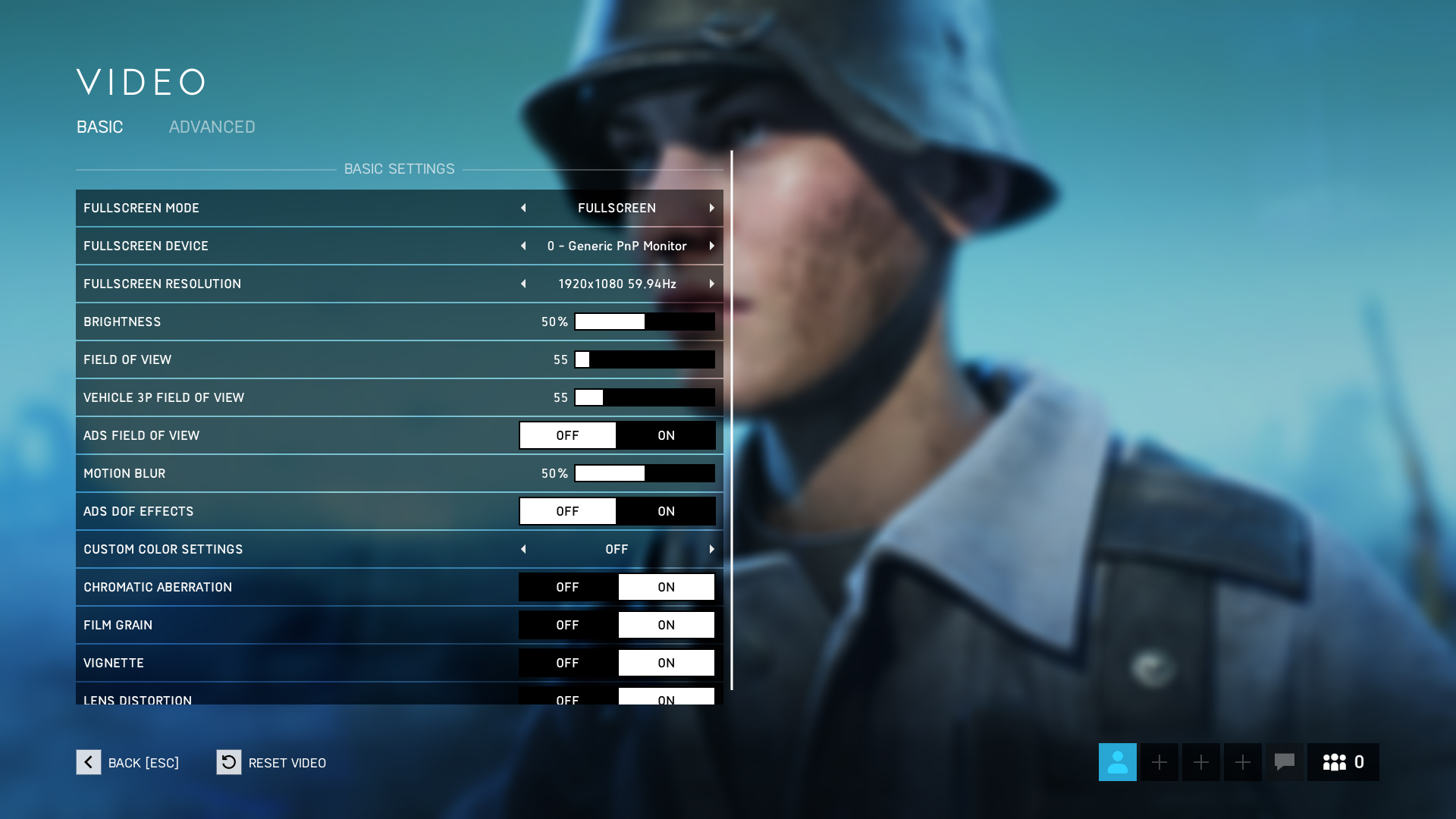
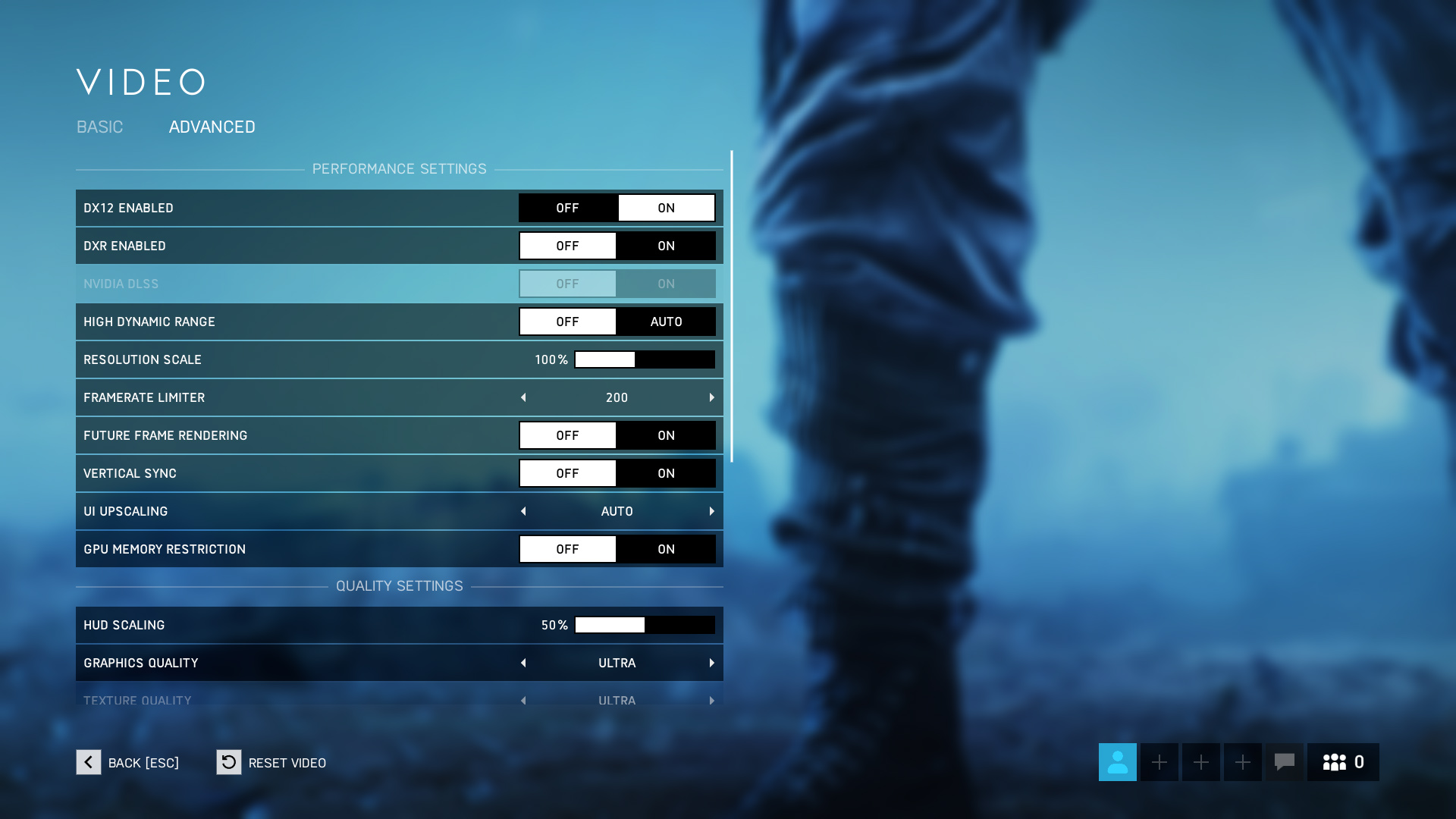
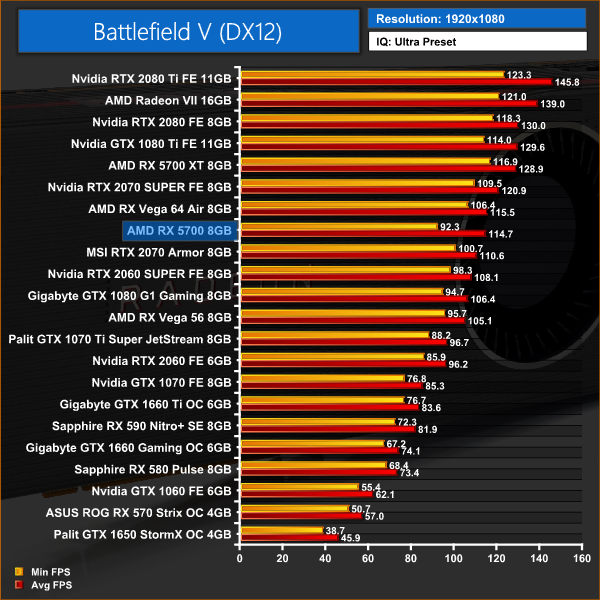
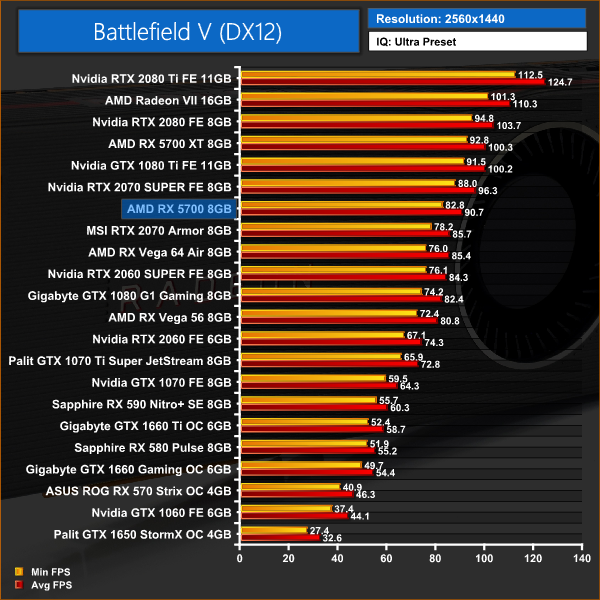
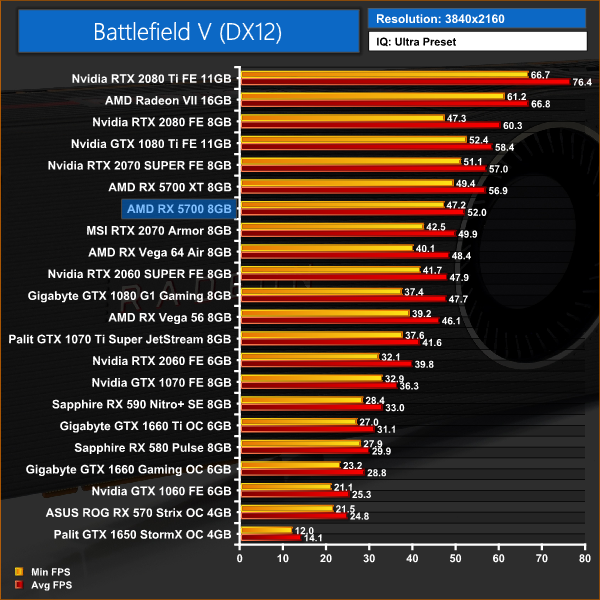
It was at this point when benchmarking, I began to wonder if I had installed the RX 5700 XT by mistake. But no, this is the performance of the RX 5700 in Battlefield V (DX12, it is important to stress). It's not only faster than RTX 2060 SUPER by about 8FPS at 1080p, but it's barely 6FPS slower than the 2070 SUPER – a card which costs $100 more.
AMD cards to tend to do well in Battlefield V – whether its the DX12 API, the Frostbite Engine (or a combination of both), it's hard to say. But the RX 5700 comes out of these tests looking really good.
Deus Ex: Mankind Divided is set in the year 2029, two years after the events of Human Revolution and the “Aug Incident”—an event in which mechanically augmented humans became uncontrollable and lethally violent. Unbeknownst to the public, the affected augmented received implanted technology designed to control them by the shadowy Illuminati, which is abused by a rogue member of the group to discredit augmentations completely. (Wikipedia).
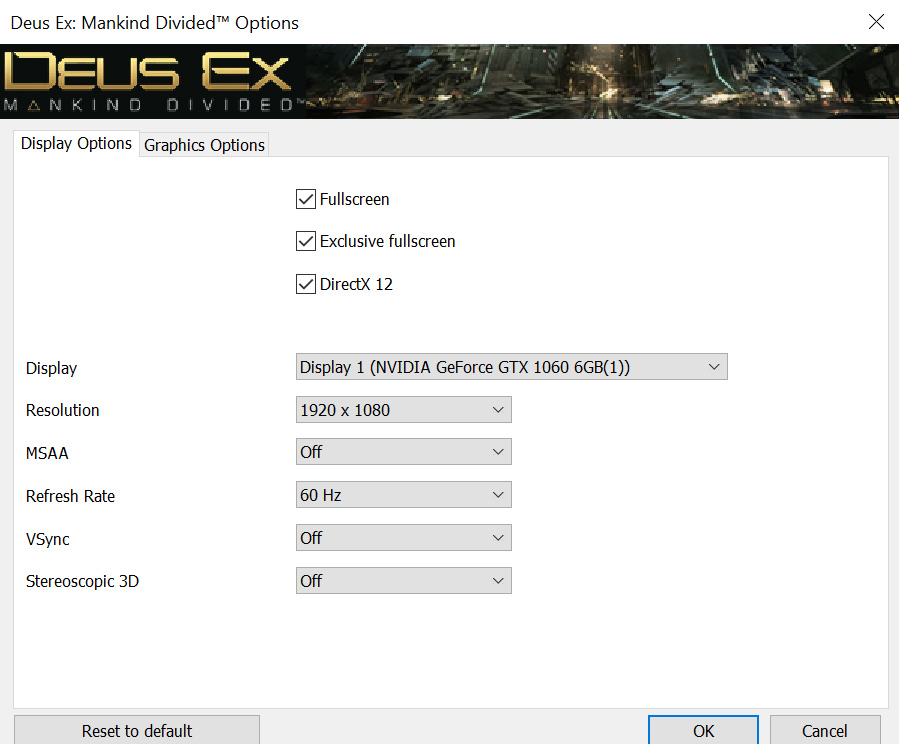
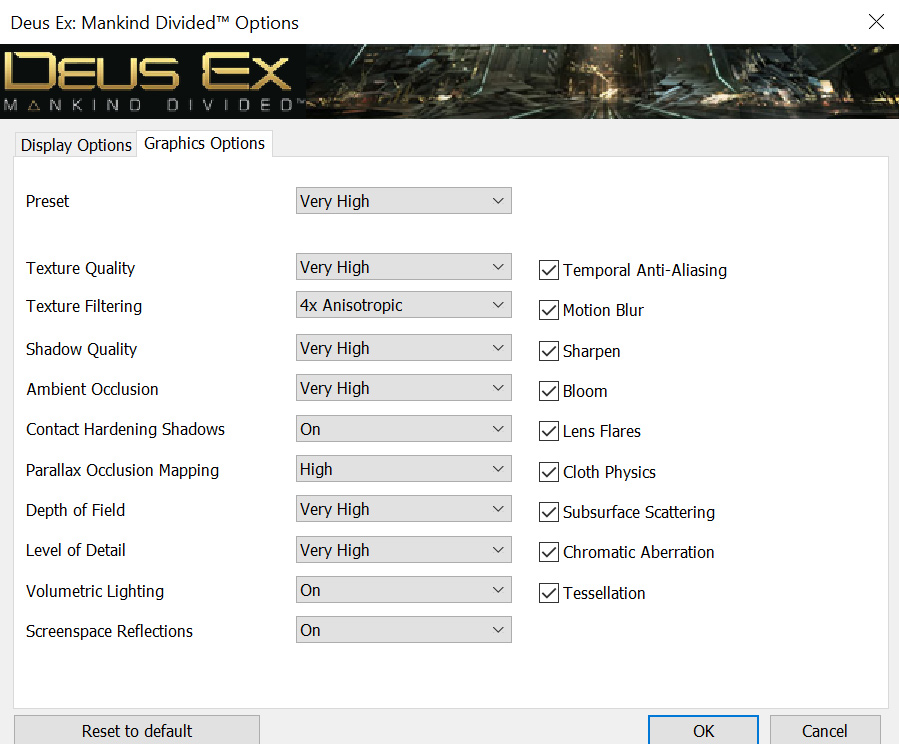
We test using the Very High preset, with MSAA disabled. We test using the DX12 API.
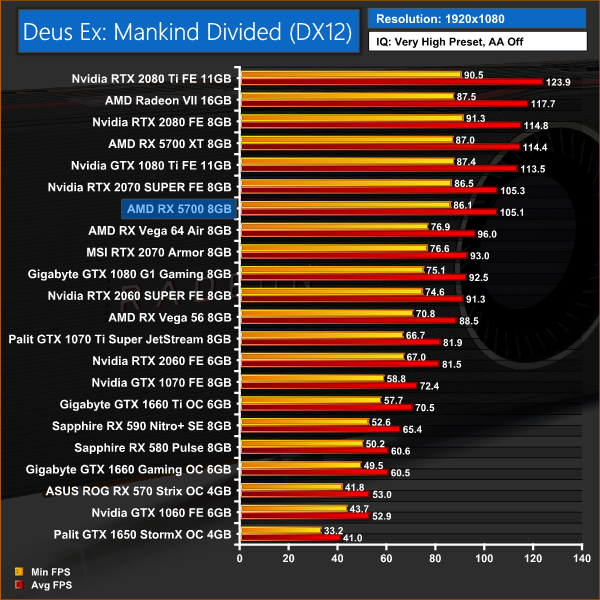
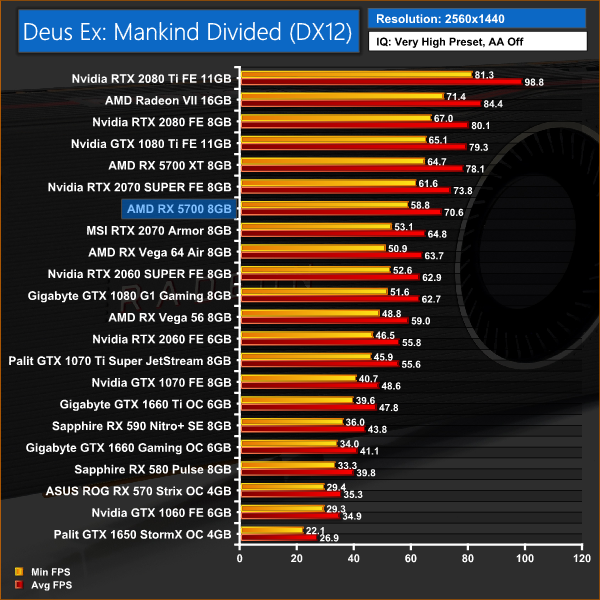
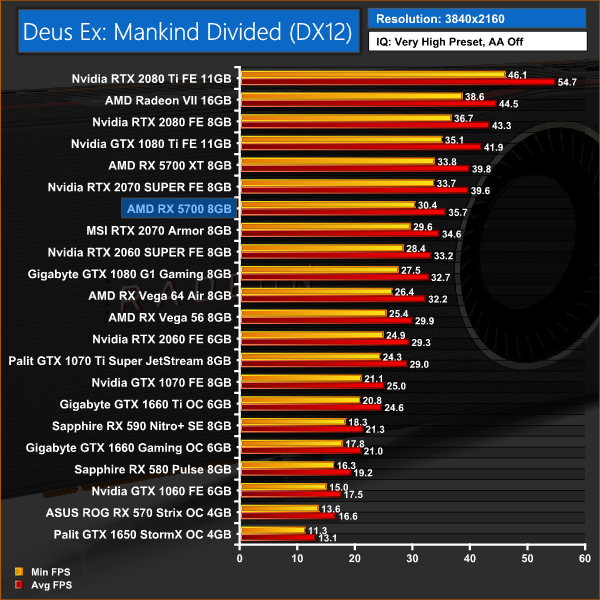
Deus Ex: Mankind Divided is another DX12 which shows a clear preference for AMD hardware – RX 5700 is faster than 2060 SUPER across the board, and effectively matches the 2070 SUPER at 1080p. Its relative performance lead over the 2060 SUPER is cut significantly as the resolution increases – from 15% at 1080p, to 8% at 4K – but it is a clear win for the RX 5700 here.
At this point in the benchmarking process, I was really beginning to think AMD had absolutely pulled it out of the bag, but let's see how things pan out across the rest of our benchmarks…
Far Cry 5 is an action-adventure first-person shooter game developed by Ubisoft Montreal and Ubisoft Toronto and published by Ubisoft for Microsoft Windows, PlayStation 4 and Xbox One. It is the eleventh entry and the fifth main title in the Far Cry series, and was released on March 27, 2018.
The game takes place in the fictional Hope County, Montana, where charismatic preacher Joseph Seed and his cult Project at Eden’s Gate holds a dictatorial rule over the area. The story follows an unnamed junior deputy sheriff, who becomes trapped in Hope County and works alongside factions of a resistance to liberate the county from Eden’s Gate. (Wikipedia).
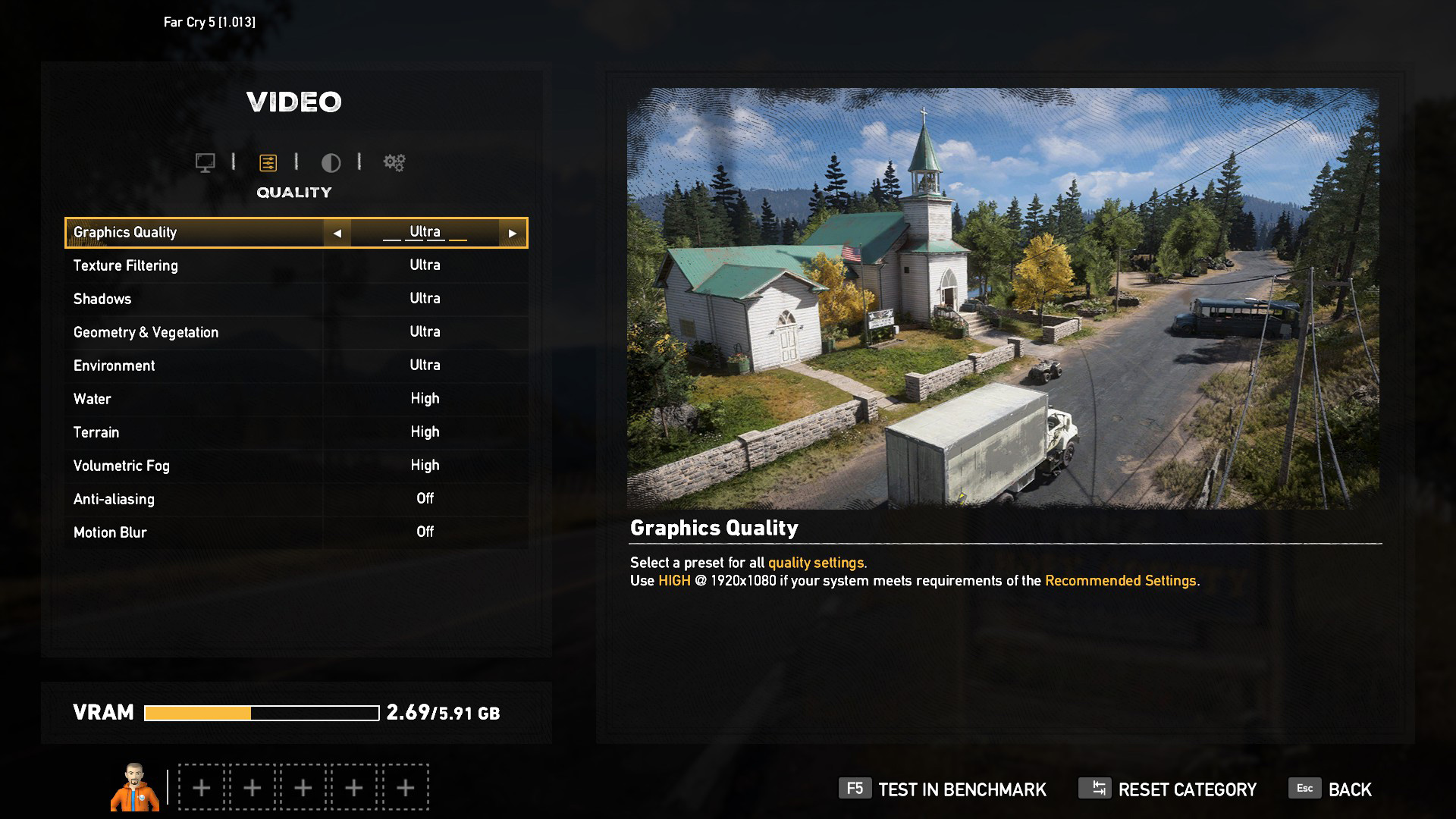
We test using the Ultra preset, with AA and motion blur disabled.
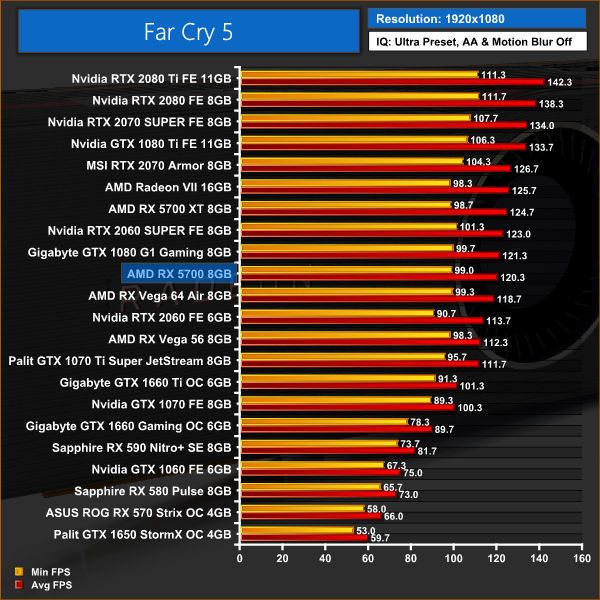
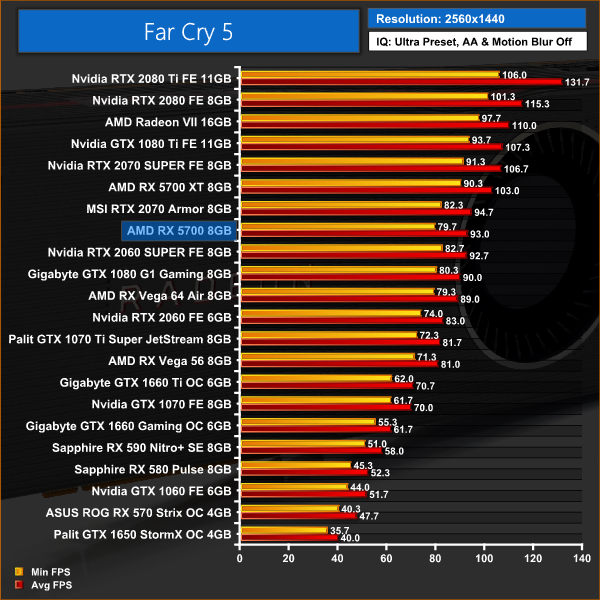
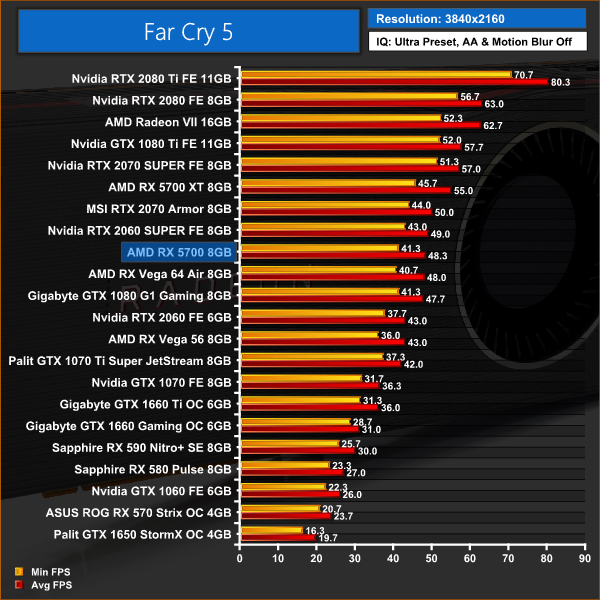
Far Cry 5 sees the RTX 2060 SUPER come back into contention, with small leads over the RX 5700 at both 1080p and 4K. The RX 5700, however, is a whisker faster at 1440p – but both cards are closely matched here, certainly much closer than our first two games would suggest.
Tom Clancy’s Ghost Recon Wildlands is a tactical shooter video game developed by Ubisoft Paris and published by Ubisoft. It was released worldwide on March 7, 2017, for Microsoft Windows, PlayStation 4 and Xbox One, as the tenth instalment in the Tom Clancy’s Ghost Recon franchise and is the first game in the Ghost Recon series to feature an open world environment. (Wikipedia).
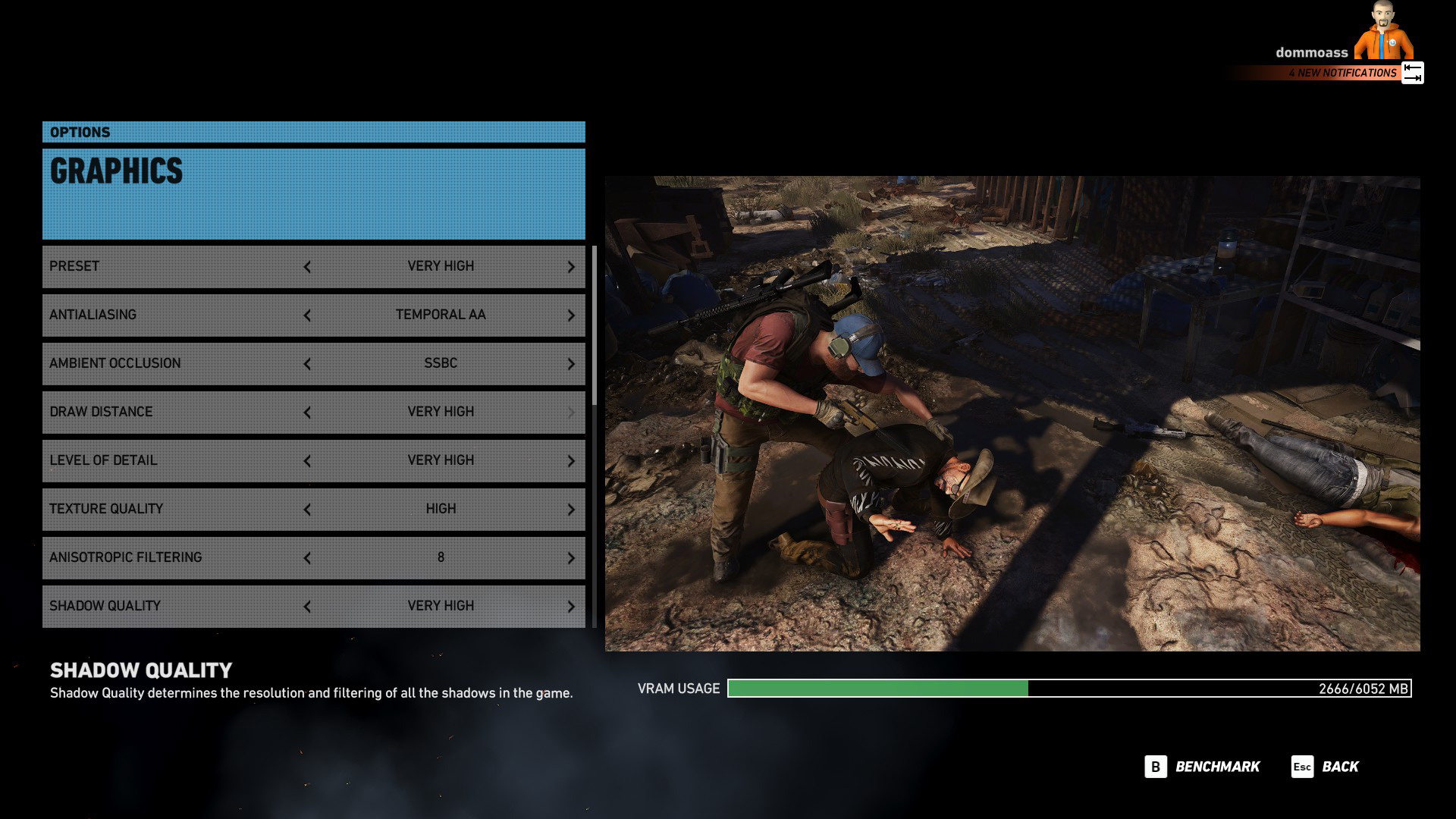
We test using the Very High preset.
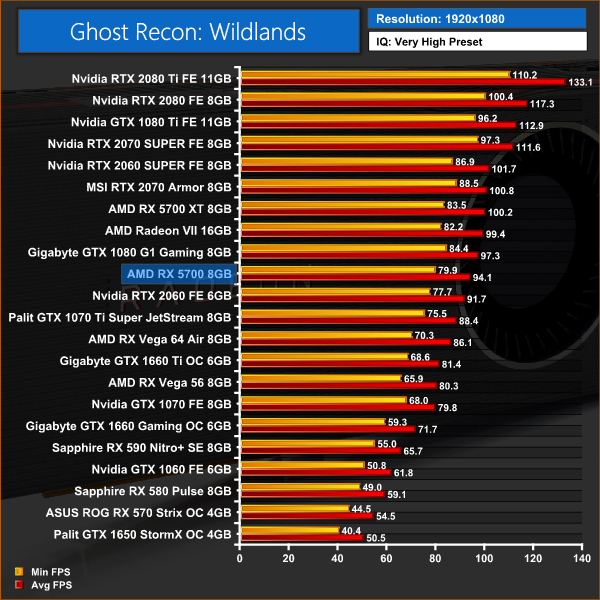
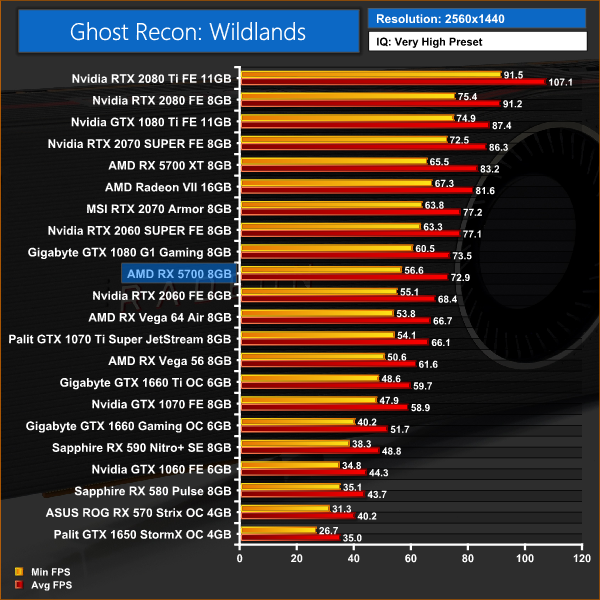
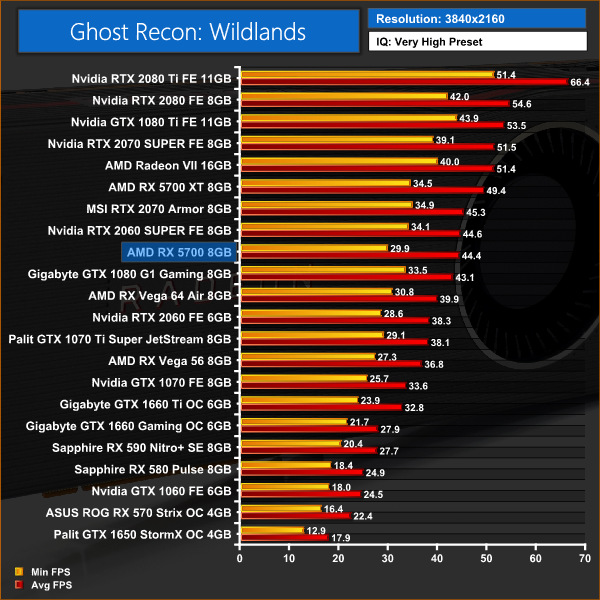
RX 5700 is consistently slower than RTX 2060 SUPER when it comes to Ghost Recon: Wildlands. The margin is 7FPS at 1080p, and 4FPS at 1440p, though at 4K the 5700 does come back to within a single frame.
Metro Exodus is a first-person shooter video game developed by 4A Games and published by Deep Silver in 2019. It is the third instalment in the Metro video game series based on Dmitry Glukhovsky's novels, following the events of Metro 2033 and Metro: Last Light. (Wikipedia)
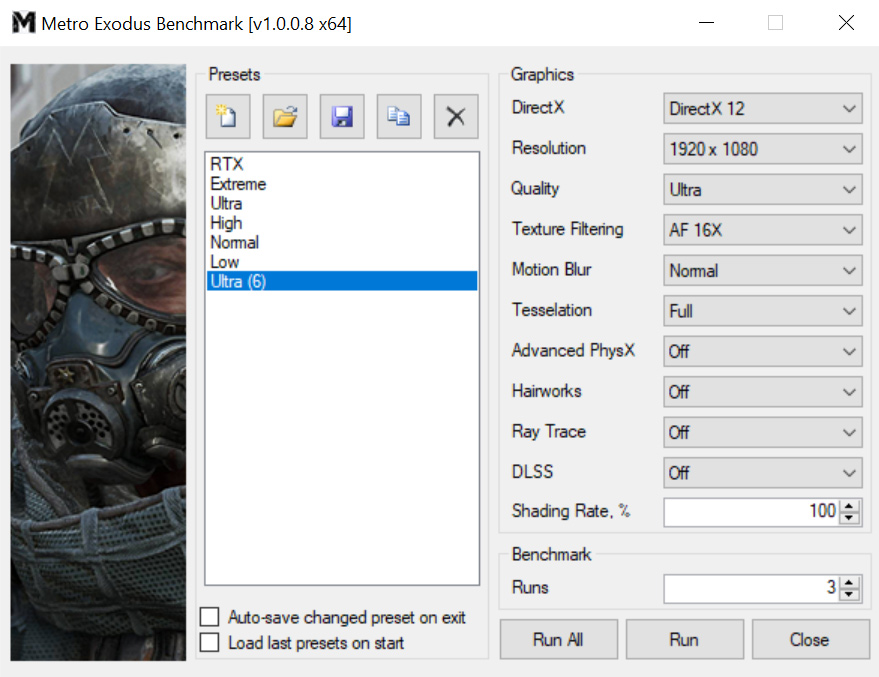
We test using the Ultra preset, but with Hairworks and Advanced PhysX turned off. We test using the DX12 API.
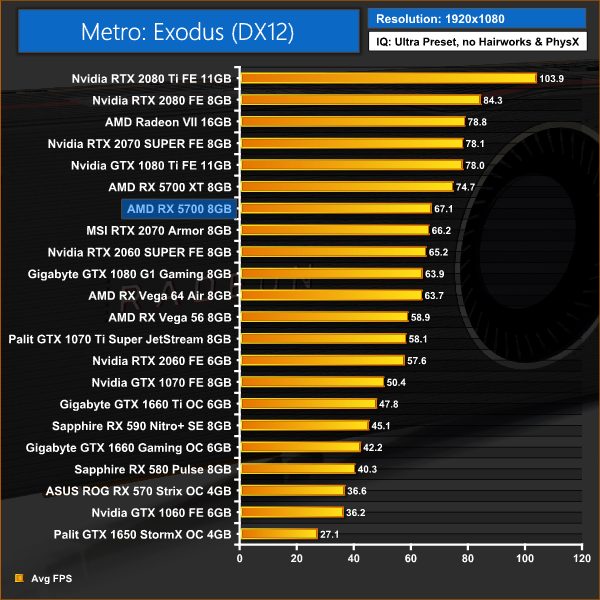
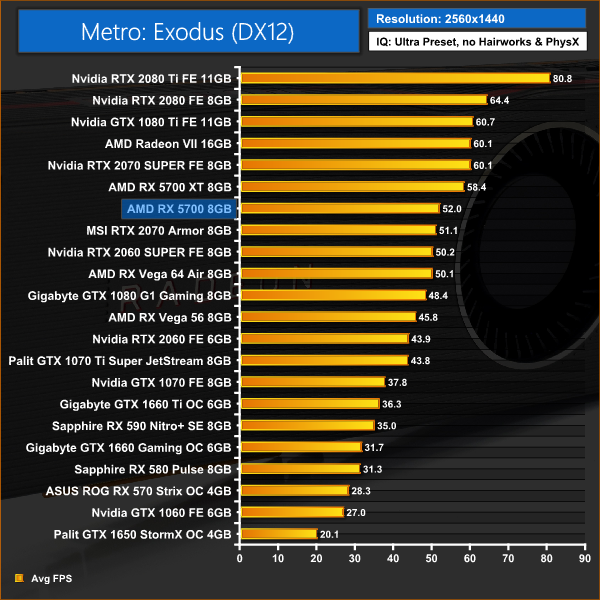
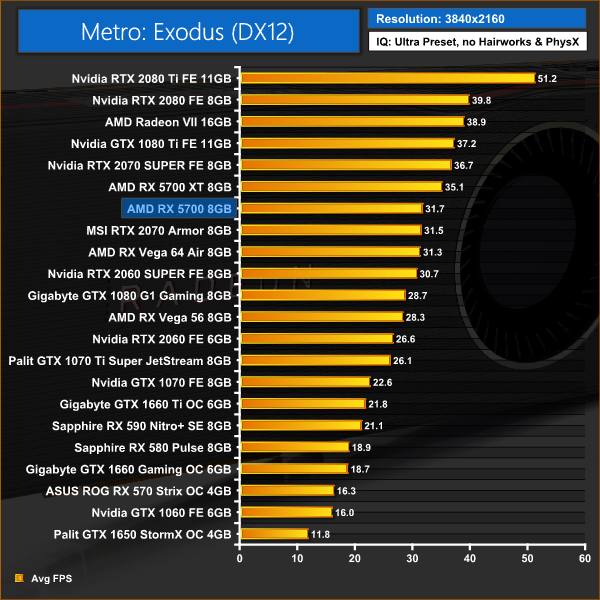
There's only a couple of frames in it when we come to Metro Exodus, but it's the RX 5700 which comes out on top versus the 2060 SUPER. It's lead is even greater when compared to the original 2060, with a 10FPS gap at 1080p.
I have to say this was surprising given how Metro Exodus was one of the first flagship titles with support for Nvidia's RTX technology, but on average the RX 5700 comes in 3% faster in this title. It's another DX12 game, which is noteworthy.
Middle-earth: Shadow of War is an action role-playing video game developed by Monolith Productions and published by Warner Bros. Interactive Entertainment. It is the sequel to 2014’s Middle-earth: Shadow of Mordor, and was released worldwide for Microsoft Windows, PlayStation 4, and Xbox One on October 10, 2017. (Wikipedia).
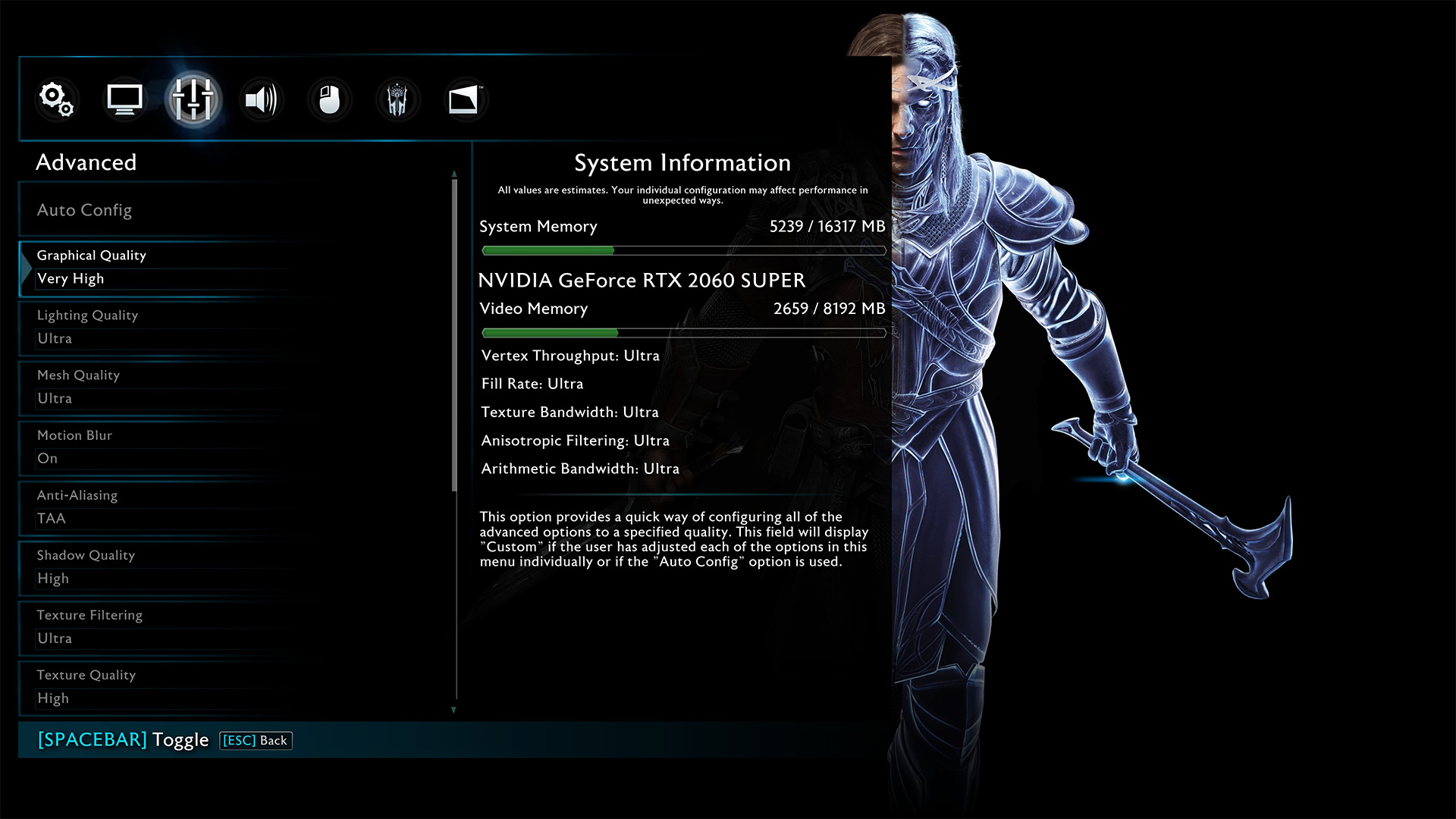
We test using the Very High preset.
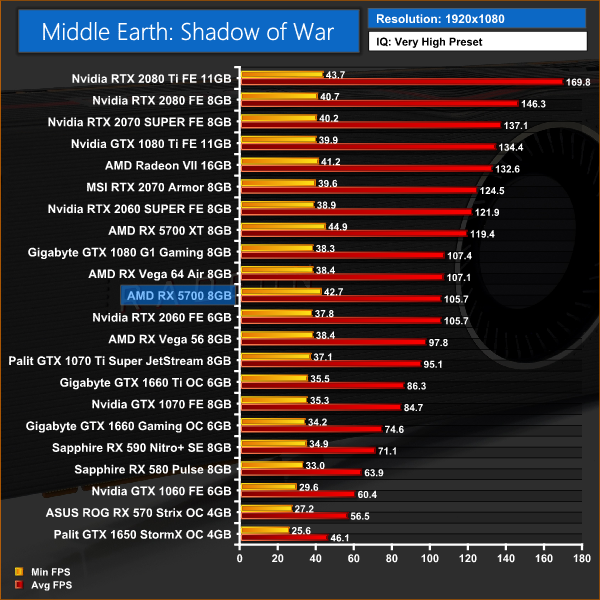
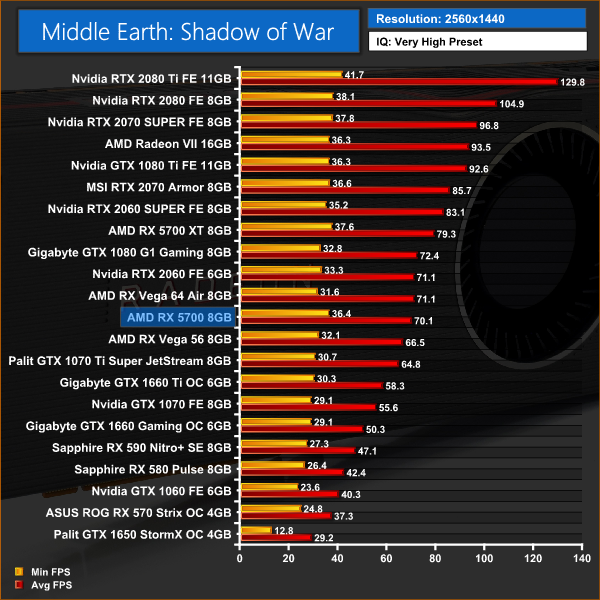
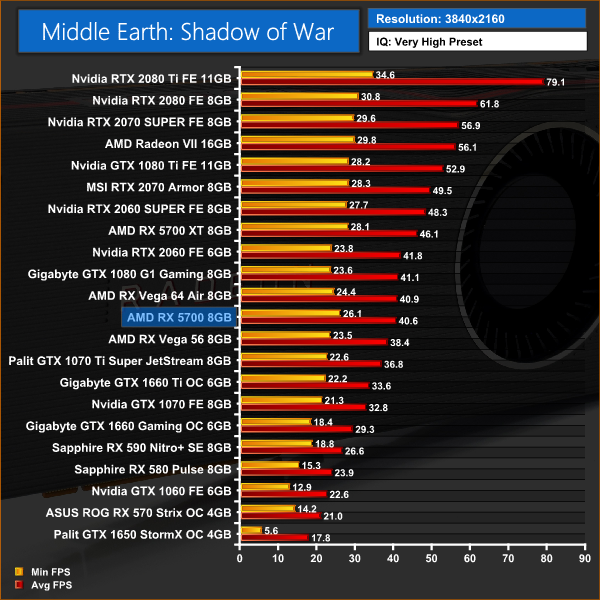
Nvidia's RTX 2060 SUPER comes back with a vengeance in Shadow of War – outstripping even the 5700 XT and 1080p and 1440p. RX 5700 is overall 15% slower in this title, and it's actually the only game we tested where the original RTX 2060 is faster than the 5700.
Shadow of the Tomb Raider is an action-adventure video game developed by Eidos Montréal in conjunction with Crystal Dynamics and published by Square Enix. It continues the narrative from the 2013 game Tomb Raider and its sequel Rise of the Tomb Raider, and is the twelfth mainline entry in the Tomb Raider series. The game released worldwide on 14 September 2018 for Microsoft Windows, PlayStation 4 and Xbox One. (Wikipedia).
We test using the Highest preset, with AA disabled. We test using the DX12 API.
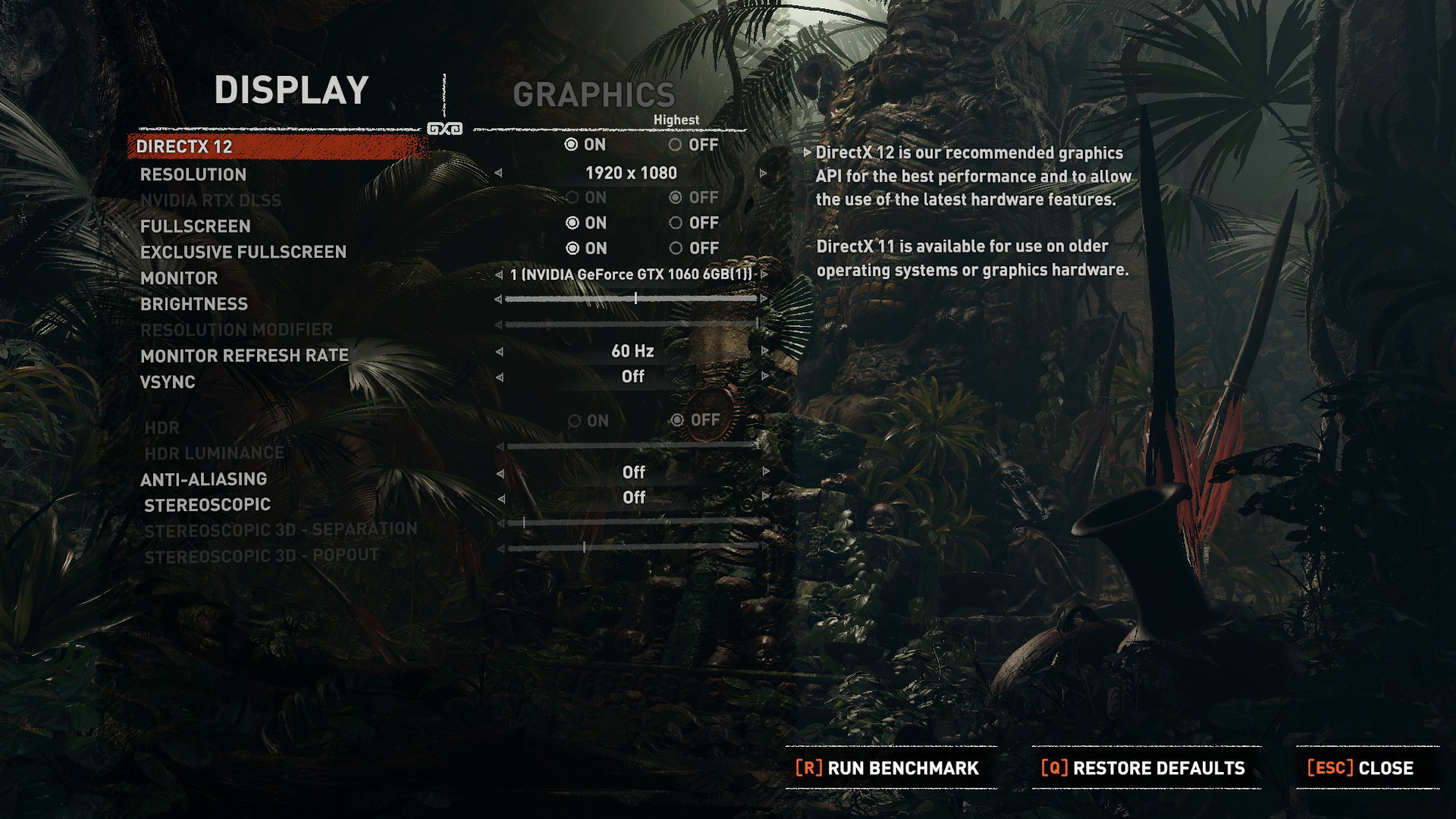
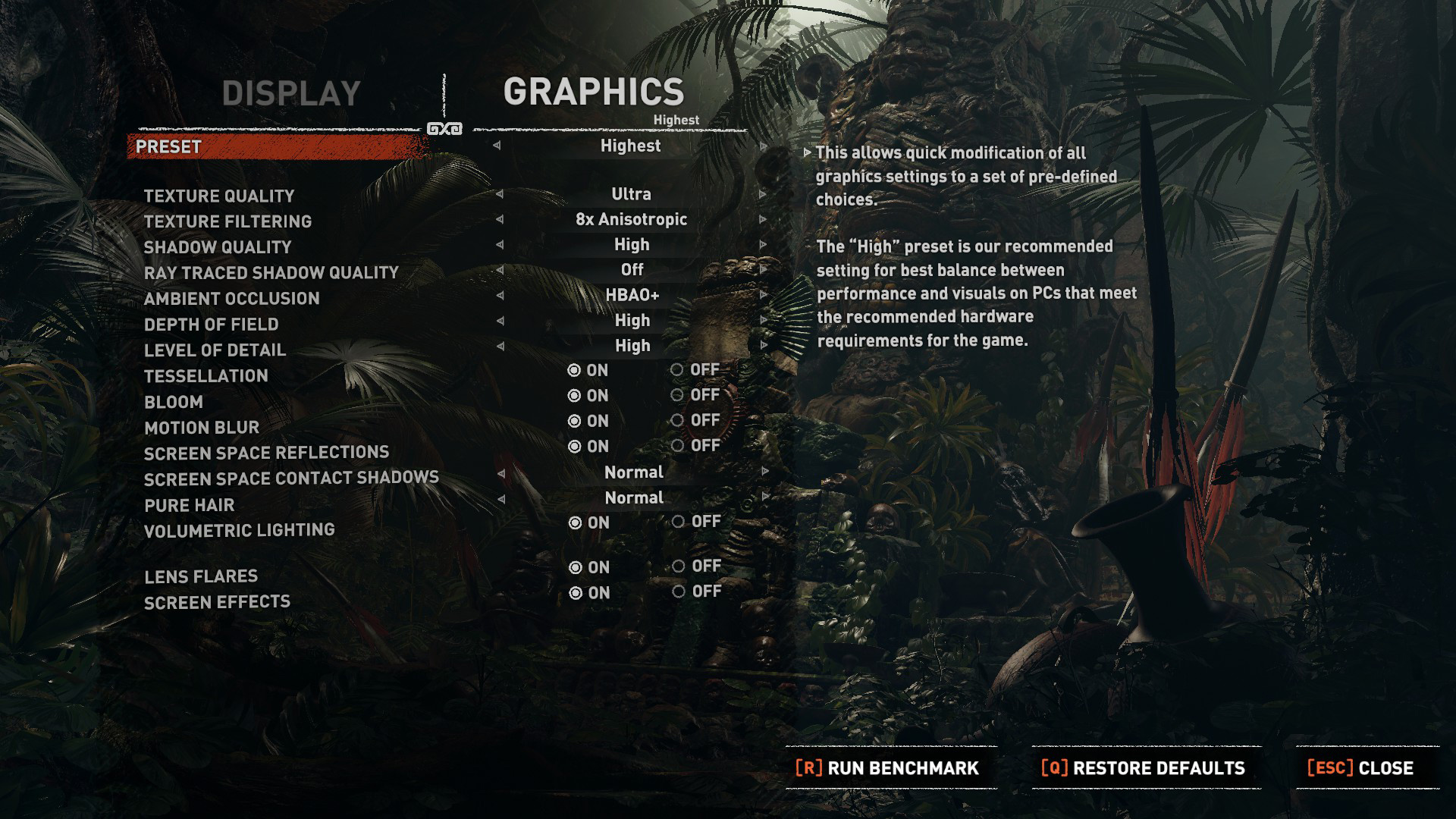
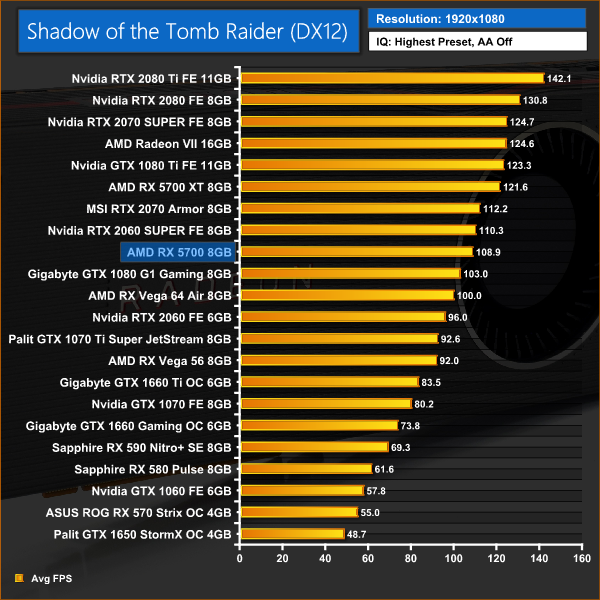
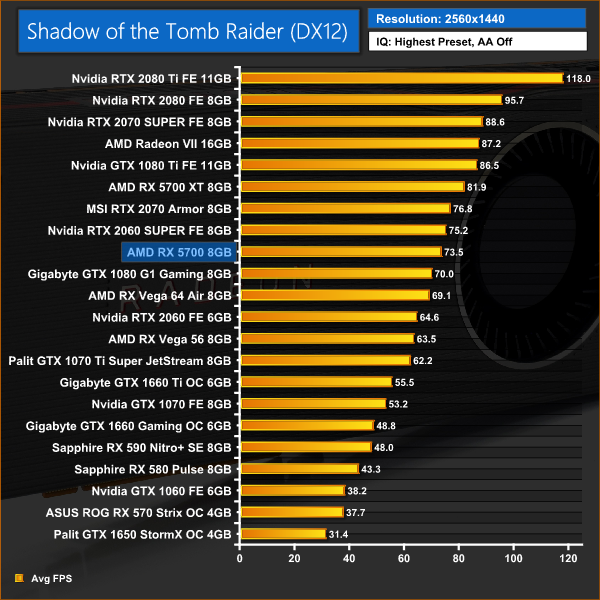
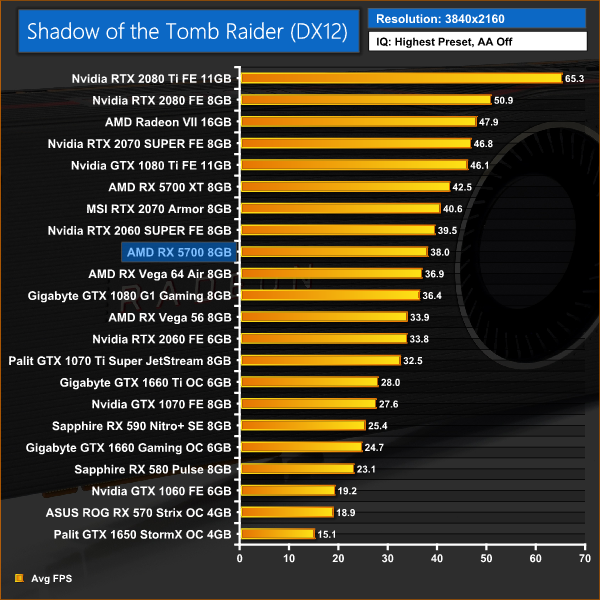
Rounding off our games testing, we turn to Shadow of the Tomb Raider. Here, things are once again much closer between the RX 5700 and the RTX 2060 SUPER. It is the Nvidia card which has the edge, though, but not by more than a couple frames across all three resolutions tested. As for the original 2060, this is consistently slower than the 5700, with a 12FPS gap between the two at 1080p.Of the seven games in our benchmarking suite, four of them support the DX12 API, and we test with DX12 where available. Of those four games – Battlefield V, Deus Ex: Mankind Divided, Metro Exodus, and Shadow of the Tomb Raider – the RX 5700 proved to be the faster card (versus RTX 2060 SUPER) across three titles. For our other three games which use DX11, RX 5700 was slower, on average, in all of them.
That's a clear preference for DX12 demonstrated by the RX 5700, so without exhaustively testing more games using both DX11/DX12, we re-tested those four titles listed above in DX11 to get an idea for the performance scaling between the two APIs.
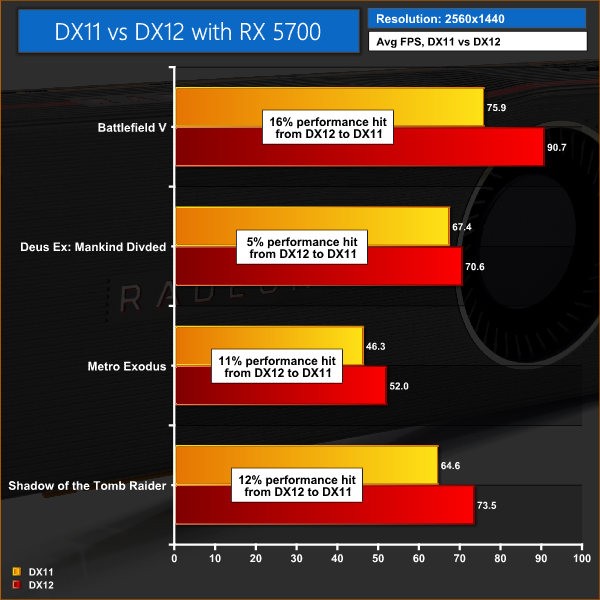
The differences are bigger than I expected. Deus Ex aside, which still shows a 5% hit moving from DX12 to DX11, we saw performance drops of 11%, 12% and 16% across the other three titles. That's an average performance hit of 11% when using DX11 vs DX12.
Of course, this is only a small sample size and it would be fascinating to test further. But there's no doubt in my mind that you'll be getting the most from your RX 5700 when using the DX12 API.
Here we present the average clock speed for each graphics card while running the 3DMark Fire Strike Ultra stress test 20 times. We use GPU-Z to record the GPU core frequency during the Fire Strike Ultra runs. We calculate the average core frequency during the entire 20-run test to present here.
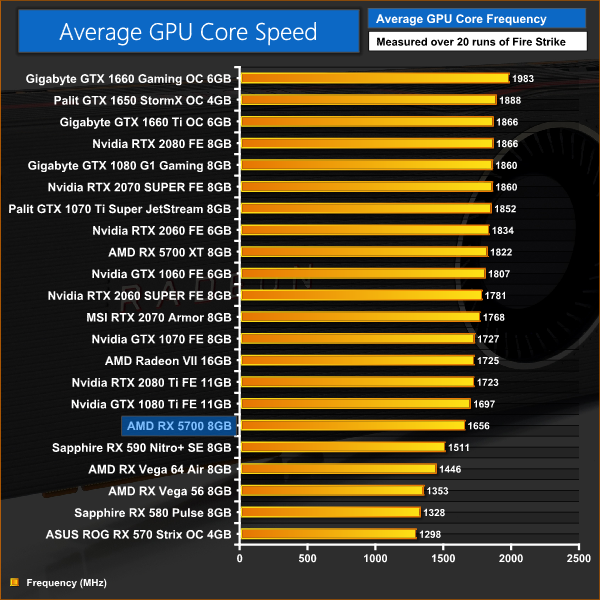
As we mentioned on the first page, AMD has introduce a new ‘game clock' metric for the Navi GPUs – essentially, this is the sort of clock speed you should expect from the card while gaming, and it is lower than the rated boost clock. For the RX 5700, the game clock is rated at ‘up to 1625MHz', so we put this to the test with our usual loop of 3DMark Fire Strike.
Interestingly, my RX 5700 actually exceeded the game clock rating, with an average frequency of 1656MHz throughout this test. It did also exceed the rated boost clock of 1725MHz, but only for a split second at the beginning of the test before the frequency dropped down into the 1600s.
For our temperature testing, we measure the peak GPU core temperature under load, as well as the GPU temperature with the card idling on the desktop. A reading under load comes from running the 3DMark Fire Strike Ultra stress test 20 times. An idle reading comes after leaving the system on the Windows desktop for 30 minutes.
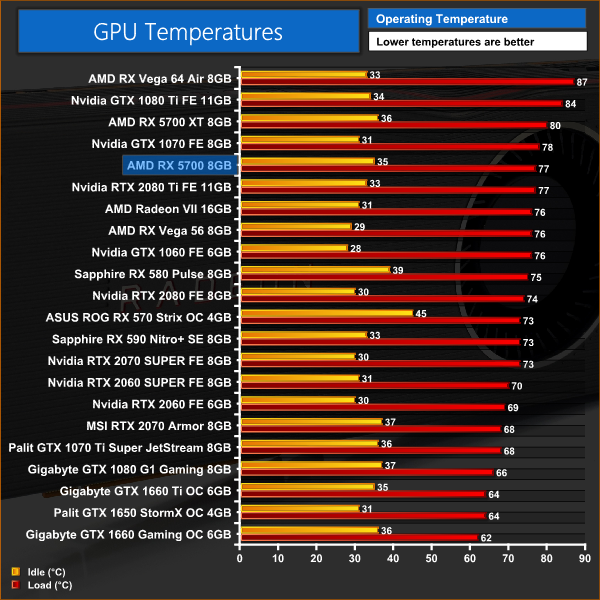
I wasn't too sure what to expect from AMD's reference cooler in terms of its temperatures. It's certainly not as hot-running as Vega 64, and its peak of 77C is below that 80C+ threshold where you start to wish temperatures were a bit lower. For a reference card, with its blower-style fan, temperatures are fine. That said, I do sincerely hope to see a number of good aftermarket cards from AMD's partners which will significantly reduce core temperatures.
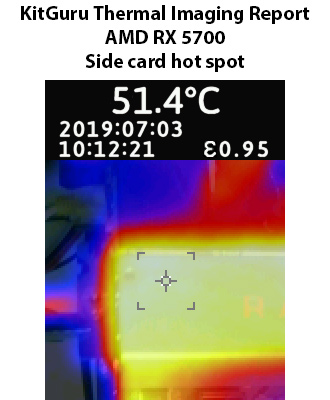
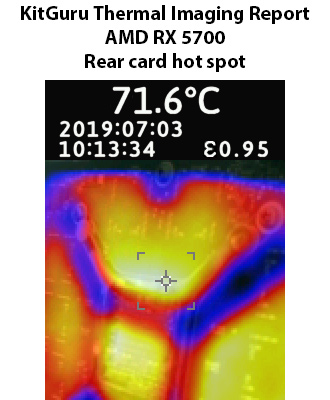
The thermal gun doesn't show any dangerously high temperature hot spots on the card's shroud, but there is a sizeable concentration of heat around the GPU core. We saw a peak temperature of 71.6C here, so that is still nothing to worry about, but a backplate would have helped spread this heat out more effectively.
We take our noise measurements with the sound meter positioned 1 foot from the graphics card. I measured the noise floor to be 32 dBA, thus anything above this level can be attributed to the graphics cards. The power supply is passive for the entire power output range we tested all graphics cards in, while all CPU and system fans were disabled.
A reading under load usually comes from running the 3DMark Fire Strike Ultra stress test 20 time, however with both AMD cards I noticed significantly louder noise levels while gaming versus this stress test. To give more representative figures, the results below come from playing Battlefield V for twenty minutes. An idle reading comes after leaving the system on the Windows desktop for 30 minutes.
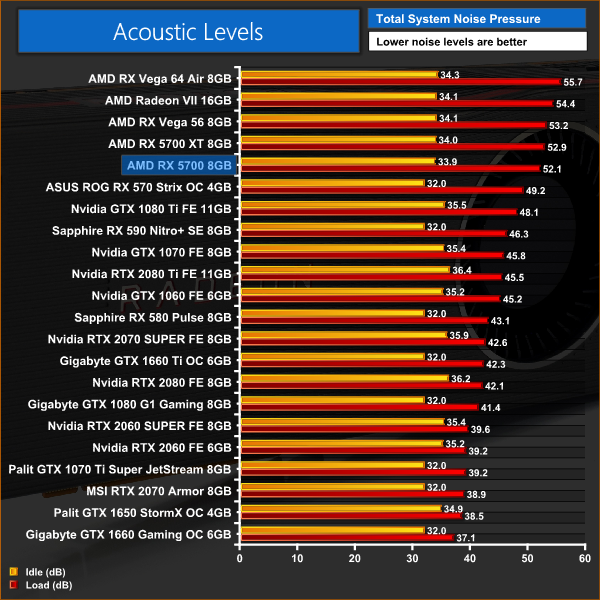
Despite the OK thermal performance, AMD's reference card remains loud. It is not quite as turbo-charged as Vega 64, but this still produces a significant racket – it's 4dB louder than the nearest Nvidia card, and that happens to be the GTX 1080 Ti. As ever, we are reliant on custom cards to bring noise levels in check – as things stand, you'll almost certainly want to game with a headset on.
We measure system-wide power draw from the wall while the card is sat idling at the Windows 10 desktop for 30 minutes. A reading under load comes from running the 3DMark Fire Strike Ultra stress test 20 times.
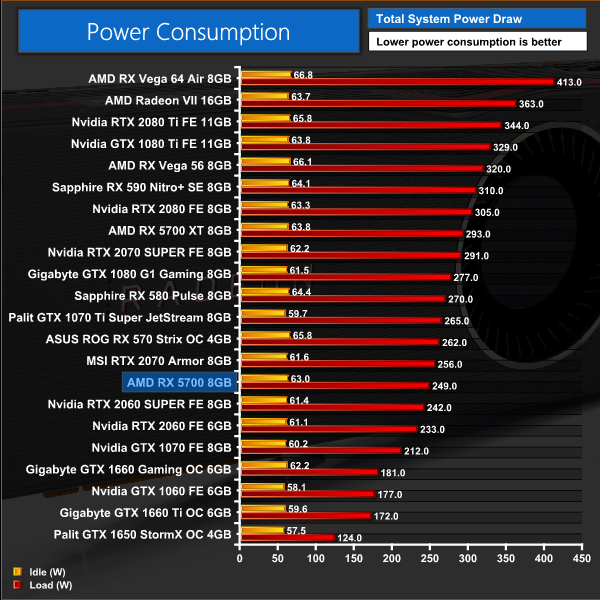
It is great to see AMD much more competitive when it comes to power draw, with system-wide power consumption with the RX 5700 installed hovering around the 250W mark. In fact, its peak reading of 249W is just 7W more than Nvidia's competing RTX 2060 SUPER. This is a far cry from the Vega 56/64 cards, and even RX 570 draws more power despite being significantly slower overall. Times are a-changin', that's for sure.
Our overclocking section of this review is not as detailed as I would like, purely due to time constraints. The driver we did all of our testing with (19.7.1, dated June 27) was not friendly to overclocking and AMD themselves acknowledged this and asked reviews to hold off with overclocking testing until it could provide a new driver. Well, that driver arrived on Saturday, July 6 – just one day before launch.
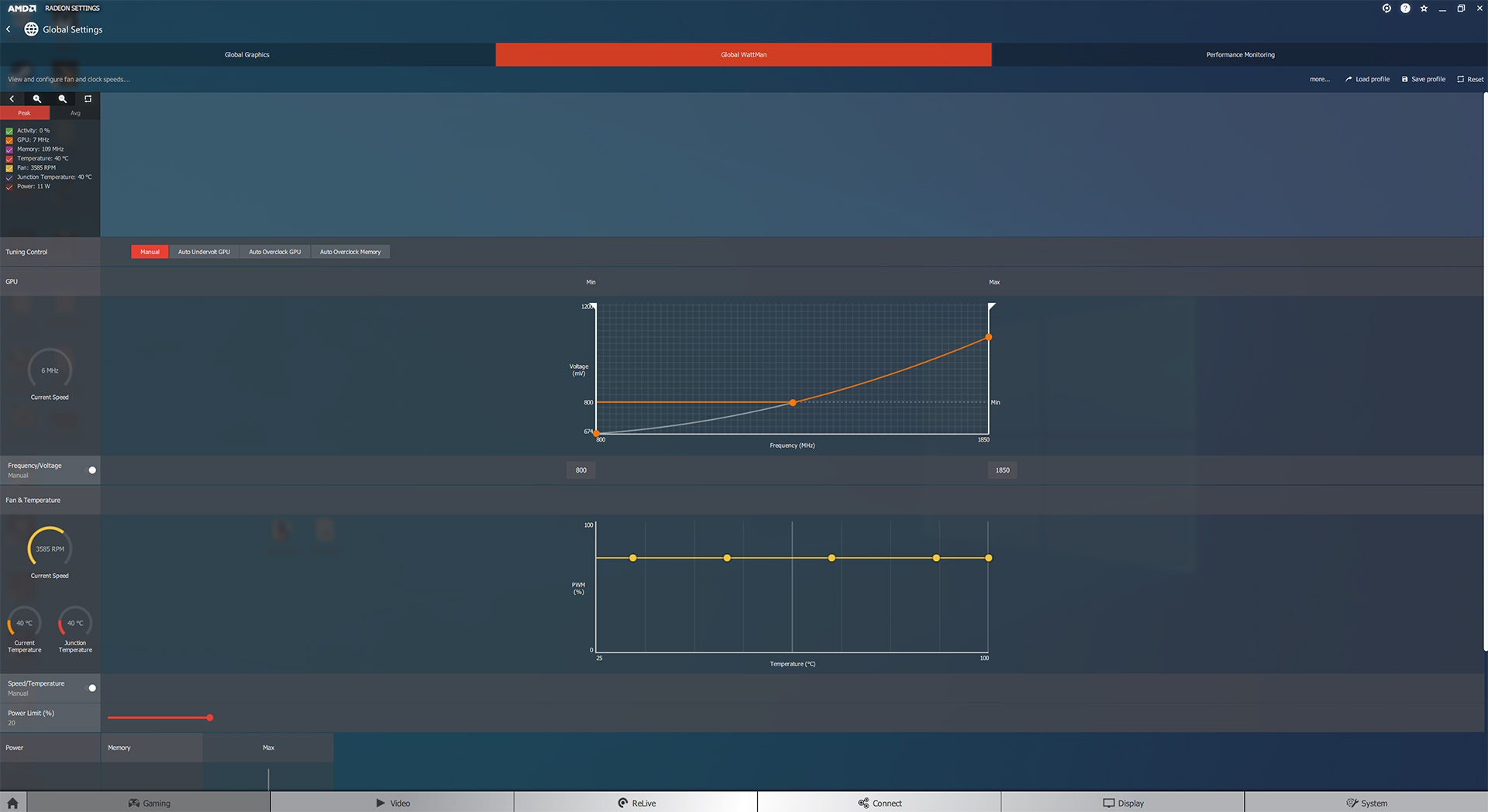
So, I tried my best with the new driver in the short window that was available to me, but initial testing suggests relatively limited overclocking headroom. Using Wattman – MSI Afterburner wasn't playing nice with voltage adjustments – after a reasonable amount of time spent adjusting the curve, I achieved my best results with the above settings.
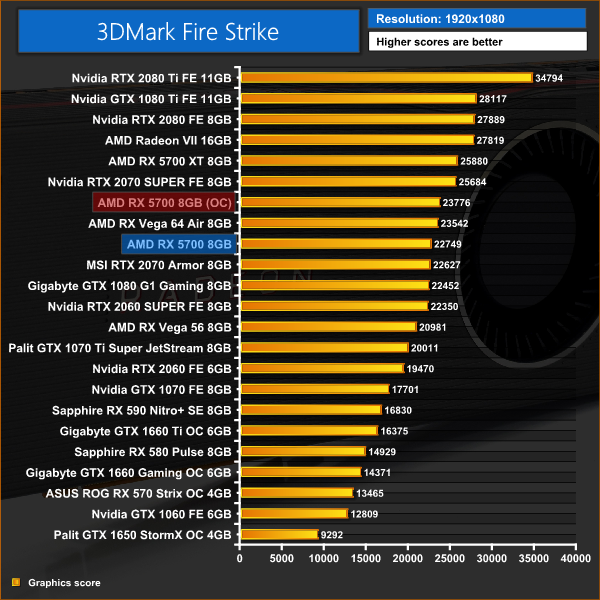
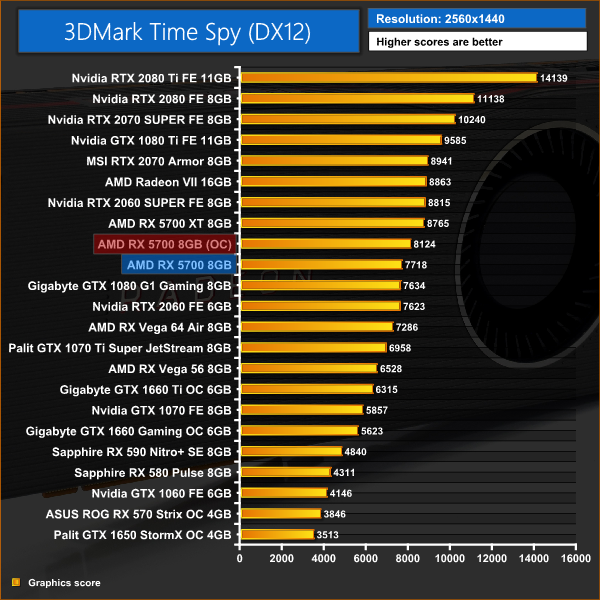
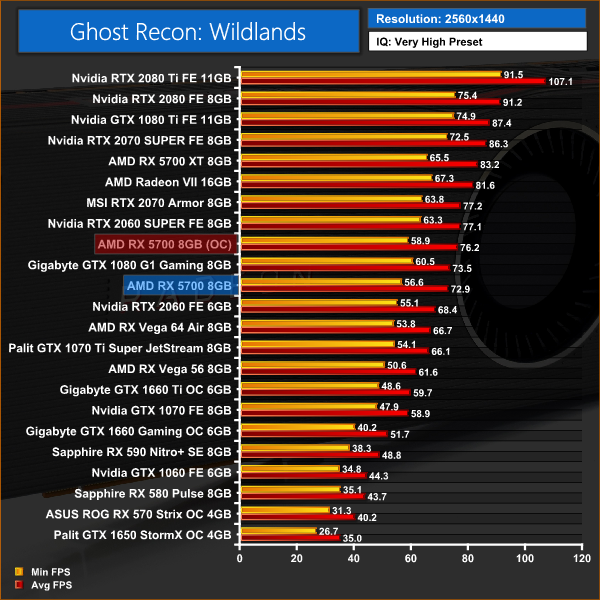
Like I found with the RX 5700 XT, overclocking the 5700 doesn't really bring big gains. Our Fire Strike score increased by just over 1000 points, while Time Spy saw an increase of around 400 points – both of which are fairly mediocre improvements. A gain over just over 3FPS in Ghost Recon: Wildlands isn't something to get too excited about either. We'll see how the situation develops as overclocking a partner card with a better cooler/increased power limit may help, while additional driver optimisations may also be needed. Right now, however, overclocking seems pretty limited.
Today marks the official launch of AMD's new Ryzen 3000 processors, but also two new graphics cards – the Radeon RX 5700 and RX 5700 XT. This review has been focused on the cheaper of the two, the RX 5700, but if you want to read our launch-day review of the XT, you can find that over here.
Getting right to it, there is no doubt in my mind that AMD is back with a massive bang in the mid-range graphics market. Even at its original price of $399/£379 the RX 5700 proves competitive, and it puts a lot of pressure on Nvidia's £379 RTX 2060 SUPER which itself only launched earlier this week.
However, AMD really cranked things up a notch with its price cut, communicated to us on Friday that the RX 5700 would now cost $349 – making it $50 cheaper than 2060 SUPER, and the same price as the original 2060.
If you haven't already, I recommend you take the time to go through the benchmark results shown earlier in this review, on a game-by-game basis. The RTX 2060 SUPER is on average 1% faster than the RX 5700, but that number hides some big performance swings. The RX 5700 really shines in Battlefield V and Deus Ex: Mankind Divided, two titles where it outstrips the 2060 SUPER by 7% and 12% respectively.
The Nvidia hardware fares better in DX11 games, though, particularly Middle Earth: Shadow of War where the RX 5700 proved 15% slower than 2060 SUPER. This is also the only title in our suite where the original RTX 2060 out-paced the RX 5700. Other wins for the 2060 SUPER came from Far Cry 5, Ghost Recon: Wildlands and Shadow of the Tomb Raider – though the margins of difference across all three games proved less than 5%.
Relative to the new RX 5700 XT, my figures show RX 5700 to be 10% slower, but also 13% cheaper based on the respective $399 and $349 MSRPs. Up against the RTX 2060 at the $349 price point, it's a clear win for AMD as RX 5700 proves 13% faster on average – though, again, that number hides some very significant performance variation.
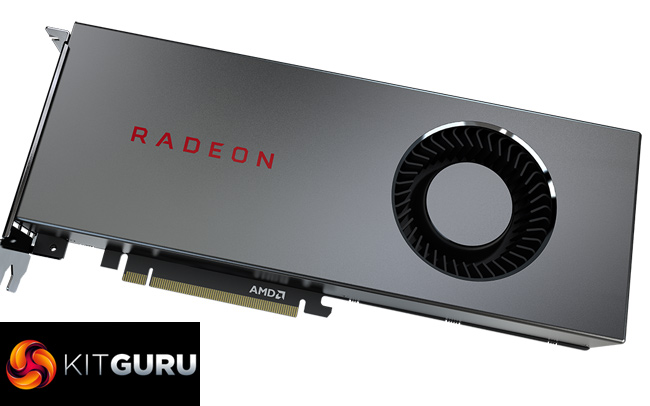
As AMD's reference card designs go, the RX 5700 is OK but still not great. The cooler kept temperatures at 77C or below, which is fine but not fantastic so hopefully there will be a variety of good custom cards hitting the market soon. The main issue really is noise levels again, as while the RX 5700 is noticeable quieter than the likes of Vega 64, it is still very much a loud card.
Power draw has improved significantly, however, and AMD's claim of 1.5x performance-per-watt over GCN is very easily believed. We saw total system power draw barely 7W higher than with the 2060 SUPER, and only 16W higher than the RTX 2060. This is a remarkable comeback for AMD, whose cards have long been known to draw significantly more power than their Nvidia counterparts. Those days seem to be over.
So, to answer the question I am sure many of our readers are thinking – should I buy the RX 5700 or the RTX 2060 SUPER? Well, that is the question I would have asked if pricing hadn't changed just before launch – now the 5700 is priced the same as the original RTX 2060.
While things aren't especially clear-cut when comparing the RX 5700 to the 2060 SUPER, there is no doubt in my mind that the 5700 is a much better buy than the RTX 2060. It's on average 13% faster – with some even bigger performance leads hidden by that number, as it proves 24% faster in Battlefield V, for instance.
Even up against the 2060 SUPER, our games have the 5700 just 1% slower on average, though do bear in mind there is a lot of performance variation from game-to-game, API-to-API, and even resolution-to-resolution based on our testing. There's no doubt these new AMD cards favour the DX12 API, though Nvidia cards still do best in DX11.
One thing worth factoring in, too, is ray tracing support – which is currently non-existent for AMD's desktop graphics cards. Admittedly, at the moment, I do not see ray tracing as a big value-add for Nvidia at all, with just three titles (not including Quake II…) supported as of July 7. E3 saw some pretty big names announce support for the technology, however, including Cyberpunk 2077, Watchdogs: Legion, Call of Duty, Wolfenstein… There's no doubt that industry adoption is, however slowly, on the up.
Even so, if you asked a room full of gamers whether they'd prefer a card which is 13% faster with no ray tracing support, or the slower card with ray tracing support – I can give a good guess which they'd pick. As of right now, AMD's Radeon RX 5700 is a fantastic return to form for the company and has become the new go-to card at this price point.
I would definitely urge potential buyers to wait and see what custom cards become available, as a decent model is going to run cooler and quieter than the reference design. Even taking that into account, the RX 5700 is just what the marked needed and it will be fascinating to see how Nvidia responds.

RX 5700 has a MSRP of $349, and we'd expect to see UK pricing around the £329 mark. You can see all the options available from Overclockers UK HERE.
- Goes toe-to-toe with RTX 2060 SUPER and handily beats RTX 2060.
- Clears wins over Nvidia hardware in titles like Battlefield V and Metro Exodus.
- Pre-launch price cut makes this the best option at $349.
- Vastly improved power efficiency for AMD.
- Premium aluminium shroud.
Cons
- Reference card is still loud.
- Limited gains from overclocking.
- No backplate.
- No ray tracing support at launch.
KitGuru says: I think a lot of people will be surprised, but AMD's RX 5700 is a fantastic addition to this market segment and that pre-release price cut has really upped the ante. It will be fascinating to see how Nvidia responds, but for now the RX 5700 is the top choice if you're looking for a $349 graphics card.