 KitGuru KitGuru.net – Tech News | Hardware News | Hardware Reviews | IOS | Mobile | Gaming | Graphics Cards


Today we finally get the chance to look at Sapphire's R9 290X Vapor X 8GB graphics card. Prices of Ultra HD 4k screens may have dropped in price recently – but sadly this is only part of the overall cost. Driving smooth frames at 3,840×2,160 places a very intense demand on the system – particularly the graphics card. Even current generation cards such as Nvidia's GTX980 struggle in single formation. Today's article focuses on Sapphire's new 290X 8GB Vapor X cards in Crossfire against a selection of other high end hardware running in Crossfire and SLI.
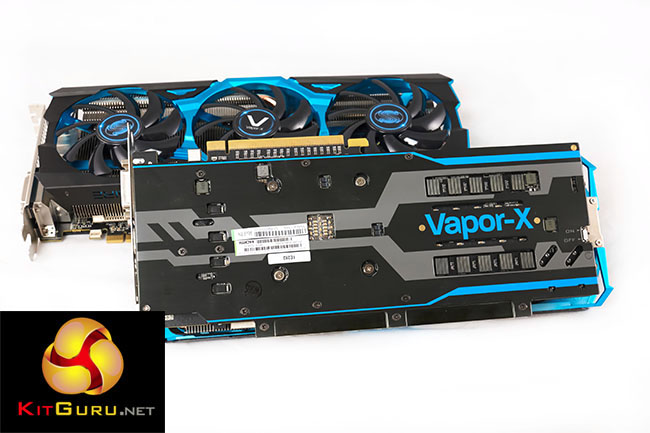
But wait, you have seen these Sapphire cards months ago, right?
Yes … this isn't the first time that Sapphire have released 8GB R9 290X graphics cards. They produced a limited 8GB run that was bought exclusively by CaseKing, and sold by Overclockers in the UK. This time around – with AMD's approval, Sapphire have relaunched the larger 8GB models. A handful of additional AMD partners will also be launching their own custom 8GB models.
With the GTX980 stealing all the headlines, OverclockersUK have dropped the R9 290x 8GB price to £379.99 inc vat – a massive £240 reduction on the original asking price of £599.99 (head to the end of this review to get a special OCUK CODE deal for KitGuru readers). If you bought one (or two) of these 8GB R9 290X cards at the previous price we can't imagine you are jumping with joy today, but in the crazy world of technology price bombing to stay competitive is a fairly commonplace practice. Early adopters beware.
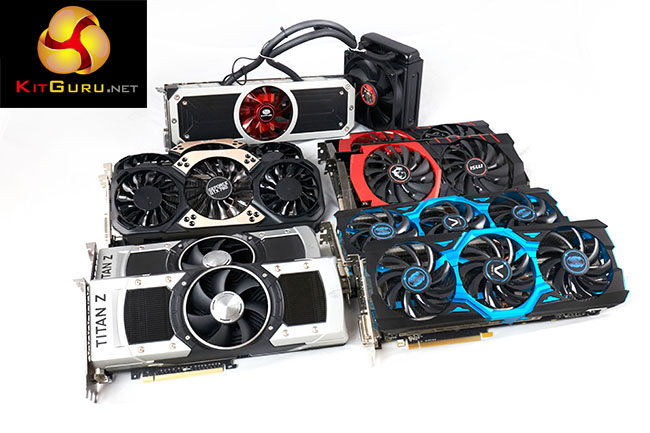
For comparison today we raided our storage room to bring out some high end cards to compare in SLI and Crossfire. The Sapphire R9 290X Vapor X cards are custom, overclocked flagship solutions, so it seemed only fair to grab the best competing hardware we could find.
First up, the award winning MSI GTX980 Gaming 4G which we reviewed back in October – these are fantastic cards. Next, a couple of Nvidia's GTX Titan Z cards – which we test today in both single and dual configurations. Tri SLI has always worked great for us, but Quad SLI can be prone to driver related performance issues so it will be interesting to see how two Titan Z's perform with a selection of games.
We supplement the testing by slotting in the excellent watercooled Sapphire R9 295X2 – a card I rate very highly due to the combination of killer performance and low noise levels. Lastly we add in a pair of overclocked 6GB Palit GTX780, which are priced very similarly against the Sapphire R9 290X Vapor X 8GB cards. Nvidia owners wanting more than 4GB of memory have to choose between these GTX780's or the Titan series of cards … the choices are currently quite limited.
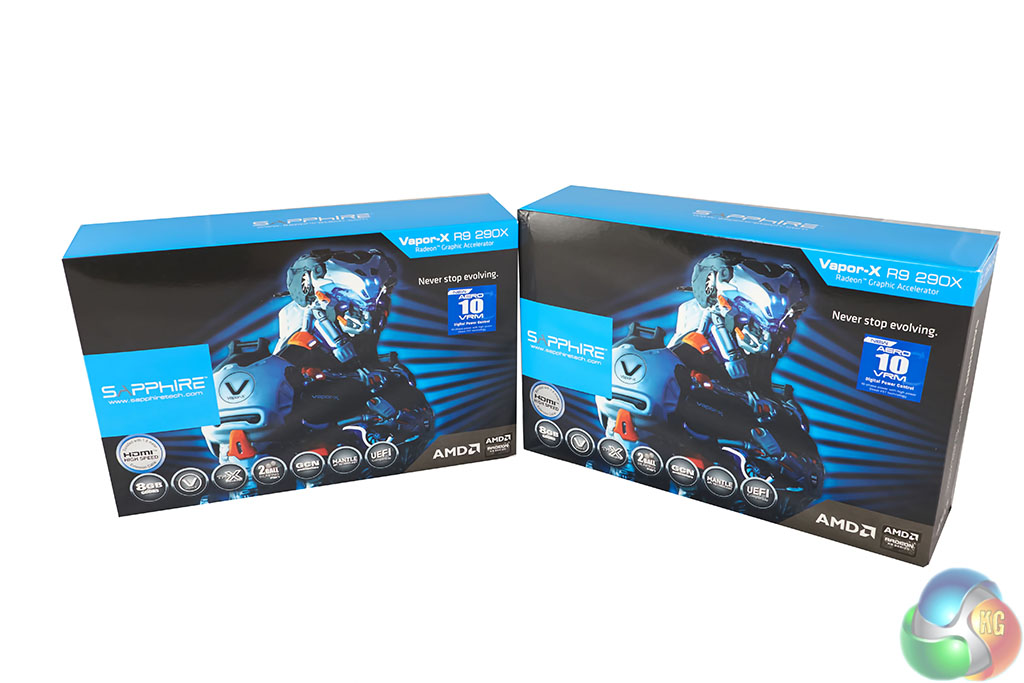
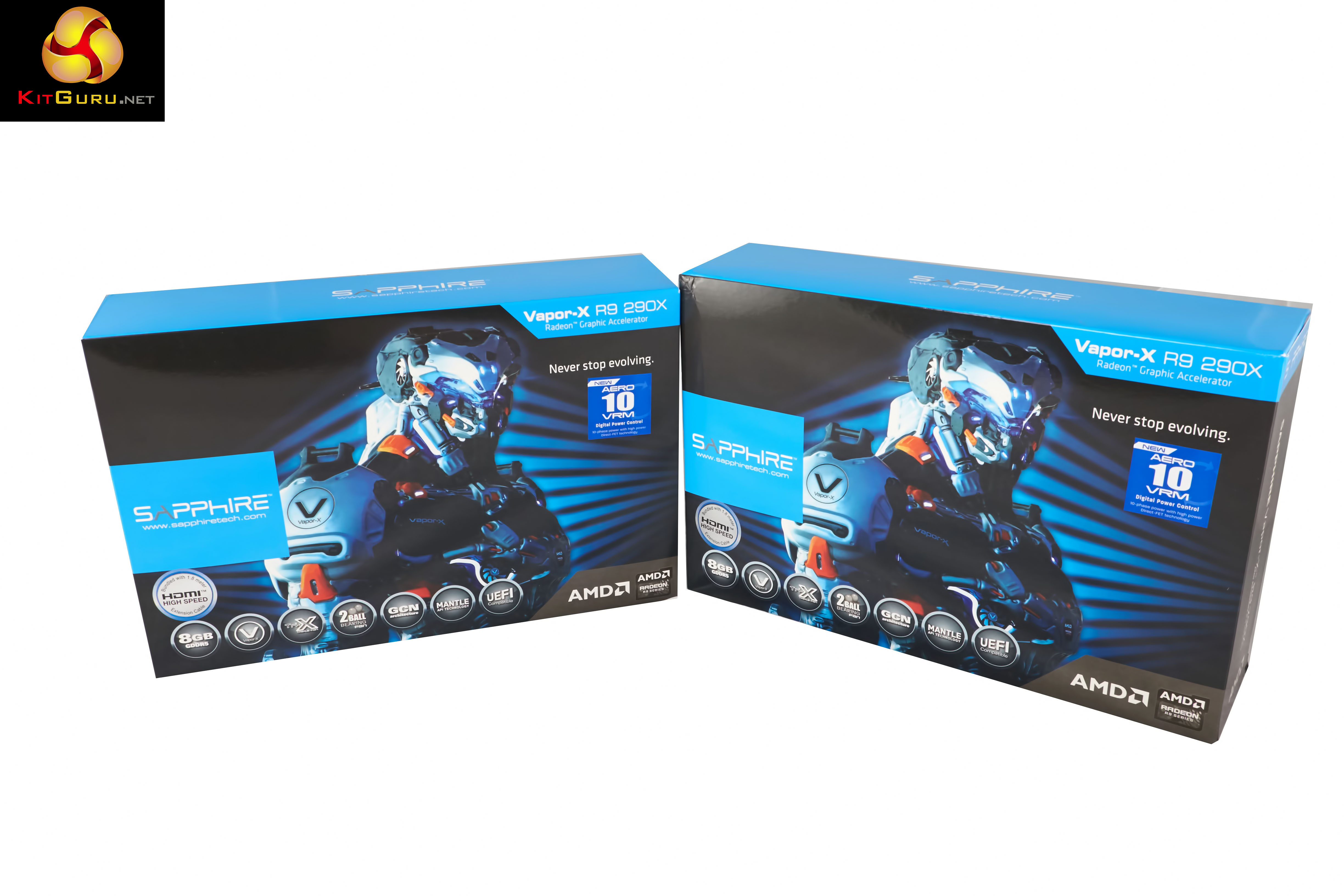
The Sapphire R9 290X Vapor X 8GB ships in a large blue box featuring a futuristic robot.

The bundle is reasonably good, some power converter cables, an HDMI cable, software disc and literature on the product. No Crossfire cable is needed as the R9 290X supports bridgeless crossfire. Hopefully Nvidia add something similar in future revisions of their hardware.
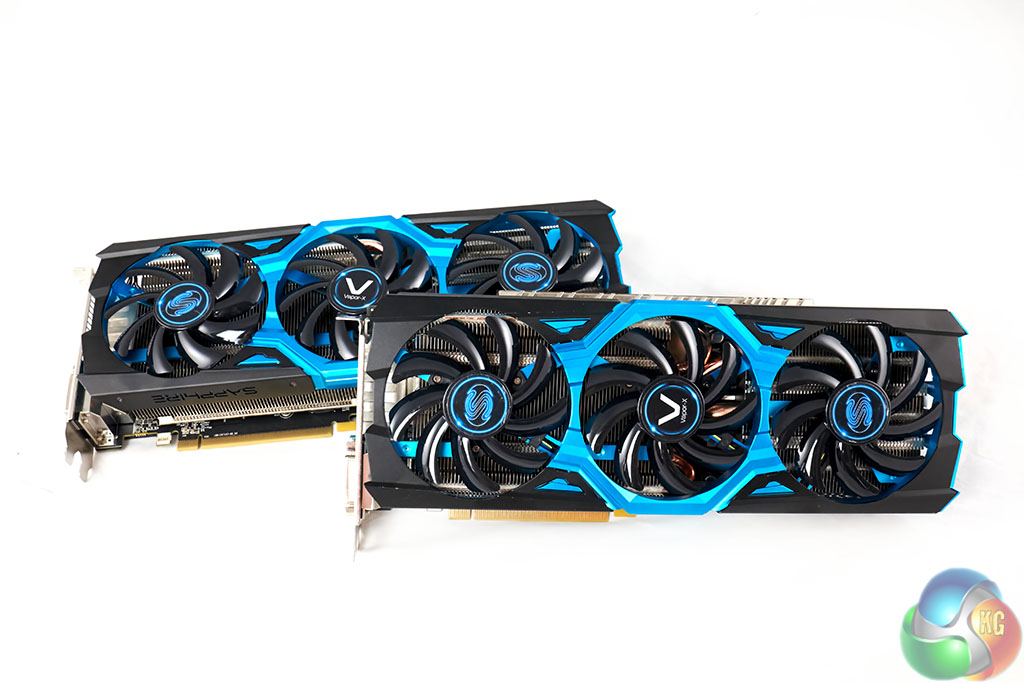
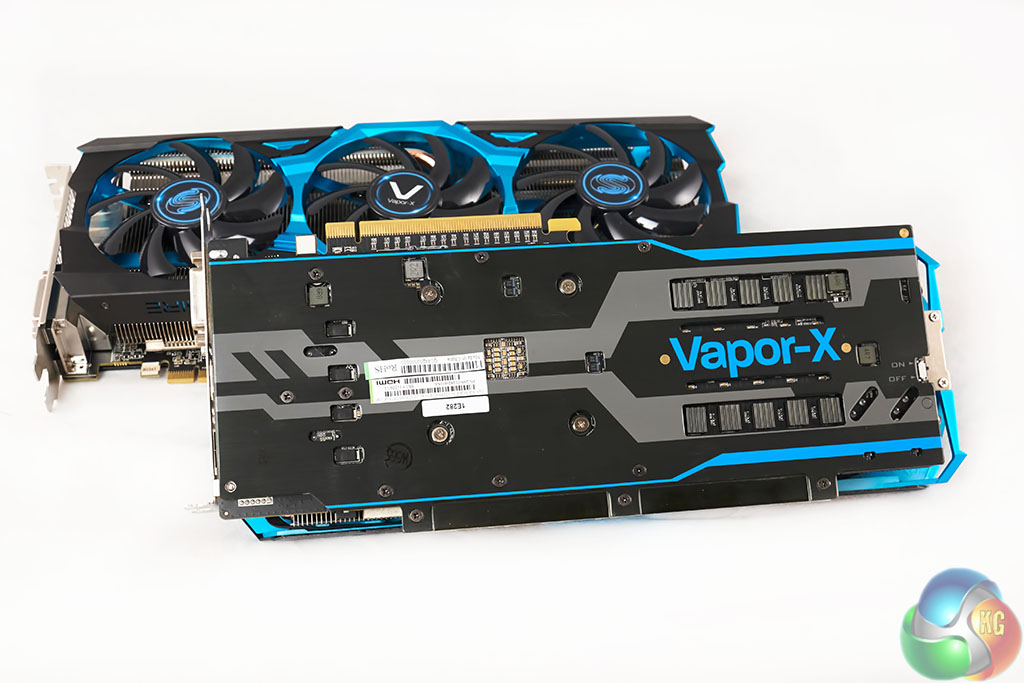
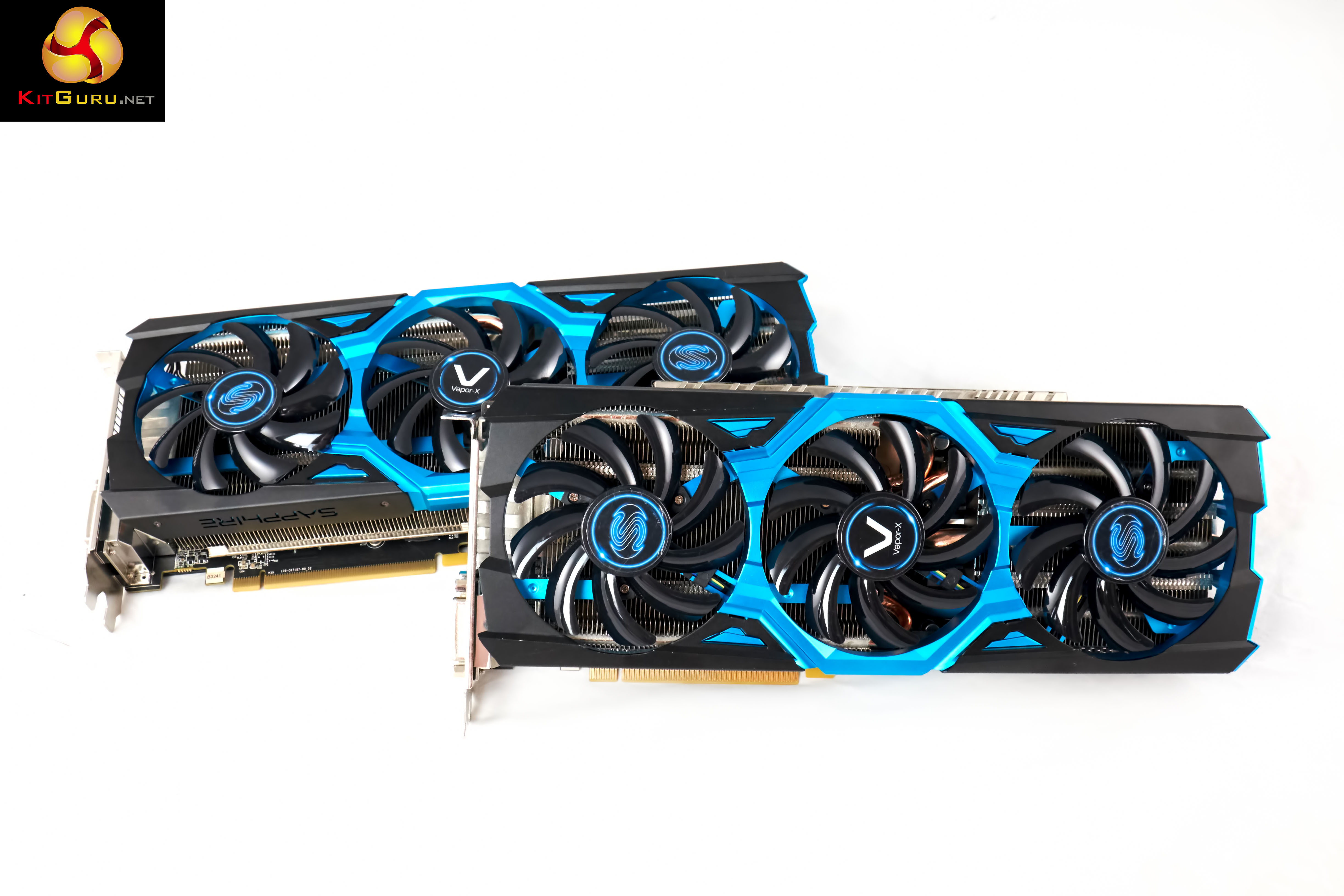
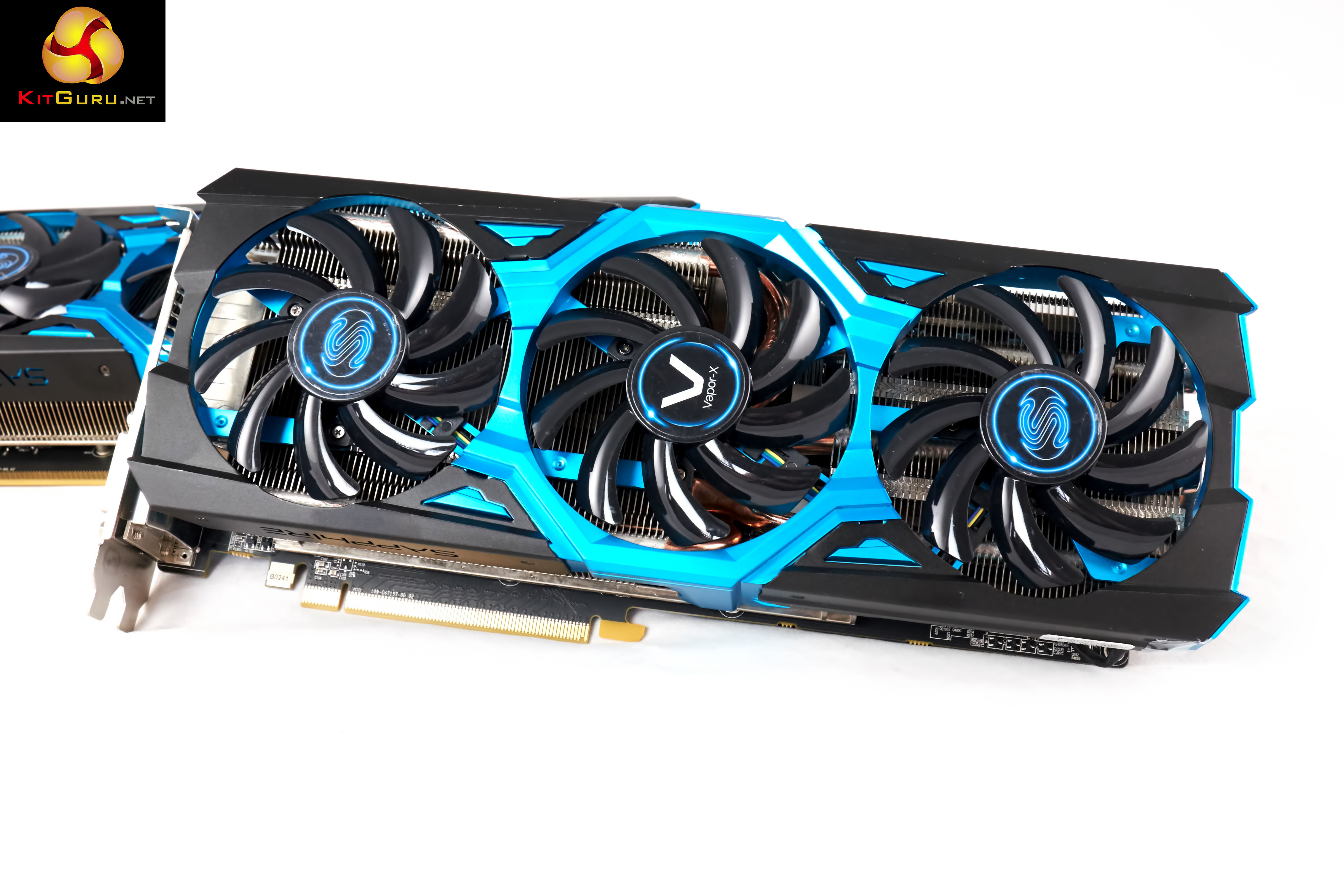
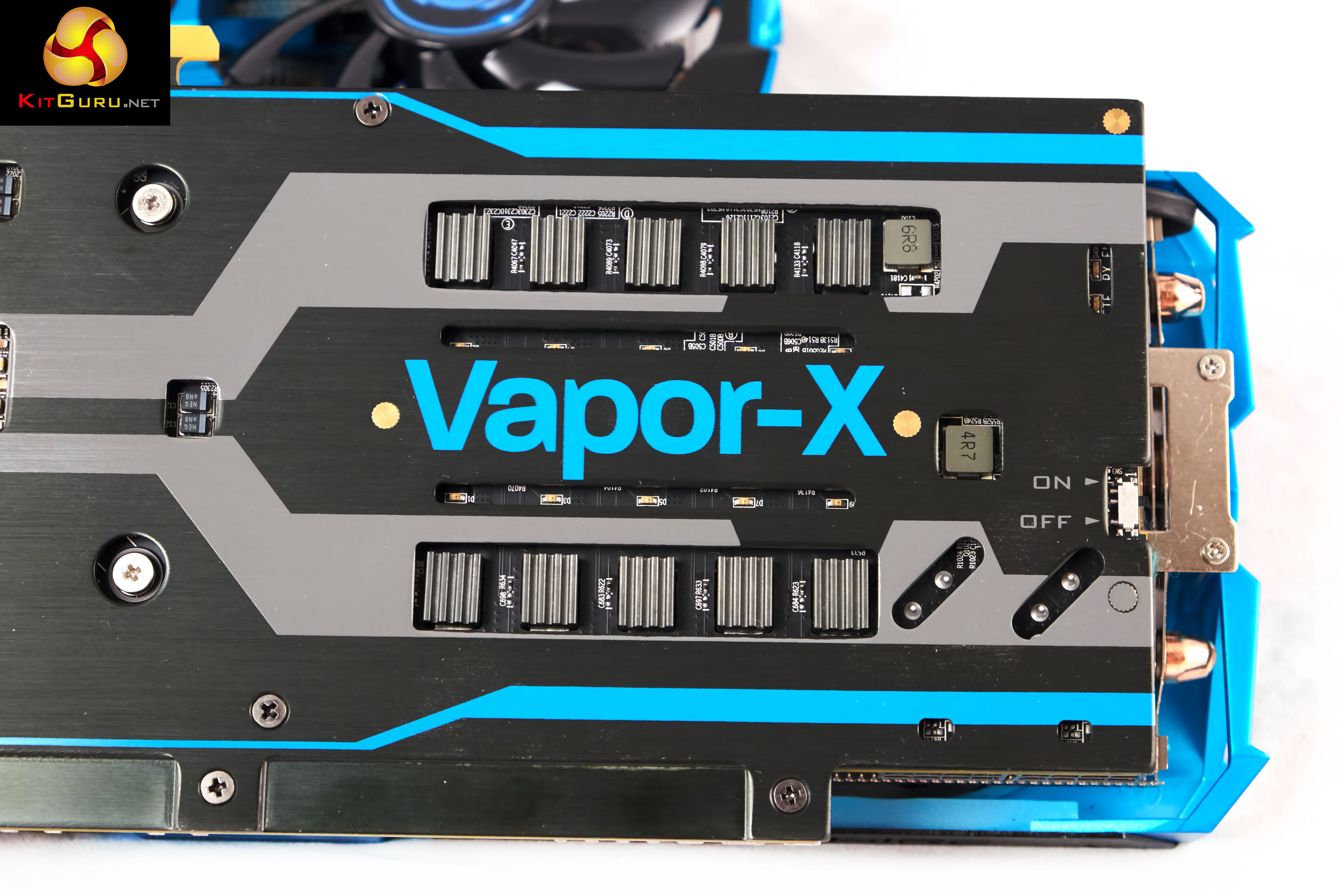
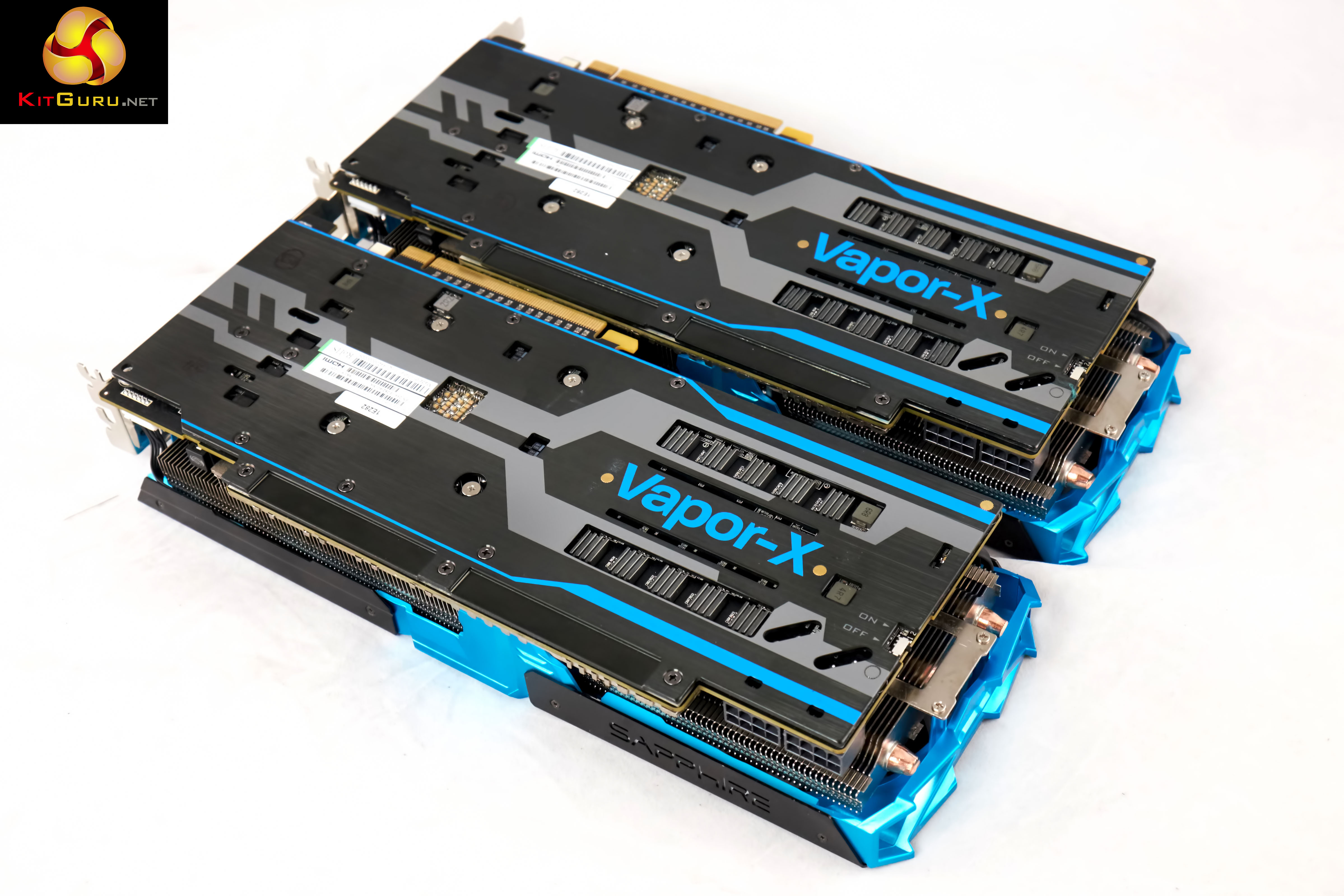
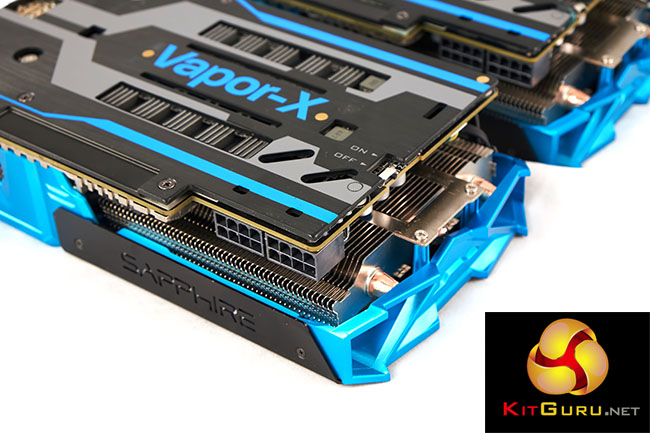
These are large, heavy cards, with a triple fan cooling system. There is a rear backplate to improve cooling efficiency and to offer some level of protection for the delicate PCB underneath.
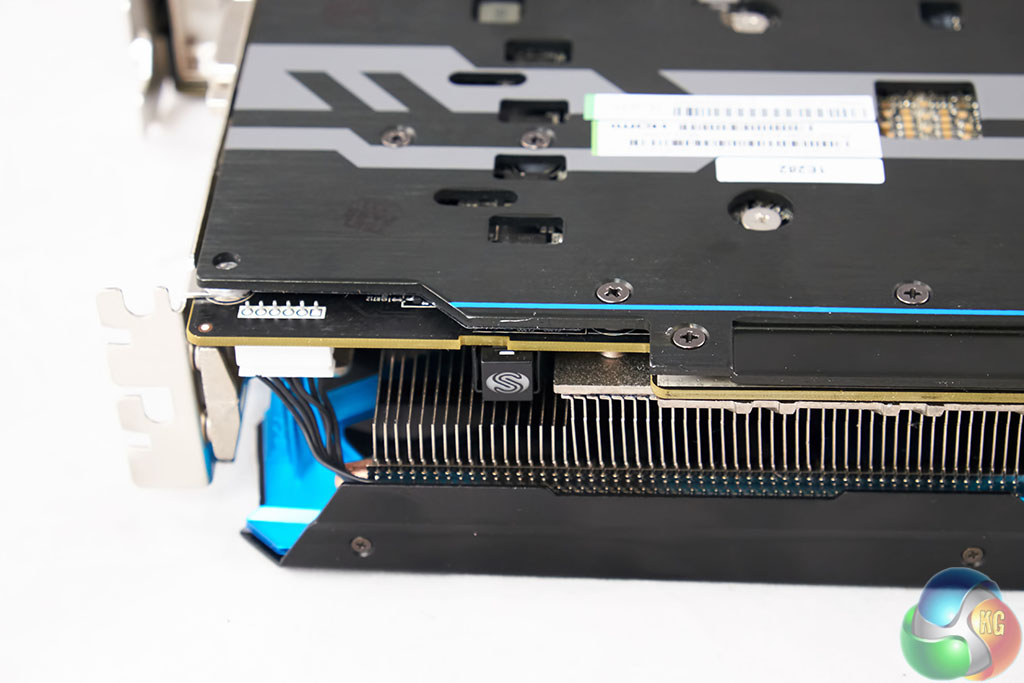
No Crossfire header is needed – but there is a Sapphire button closeby which offers UEFI support.
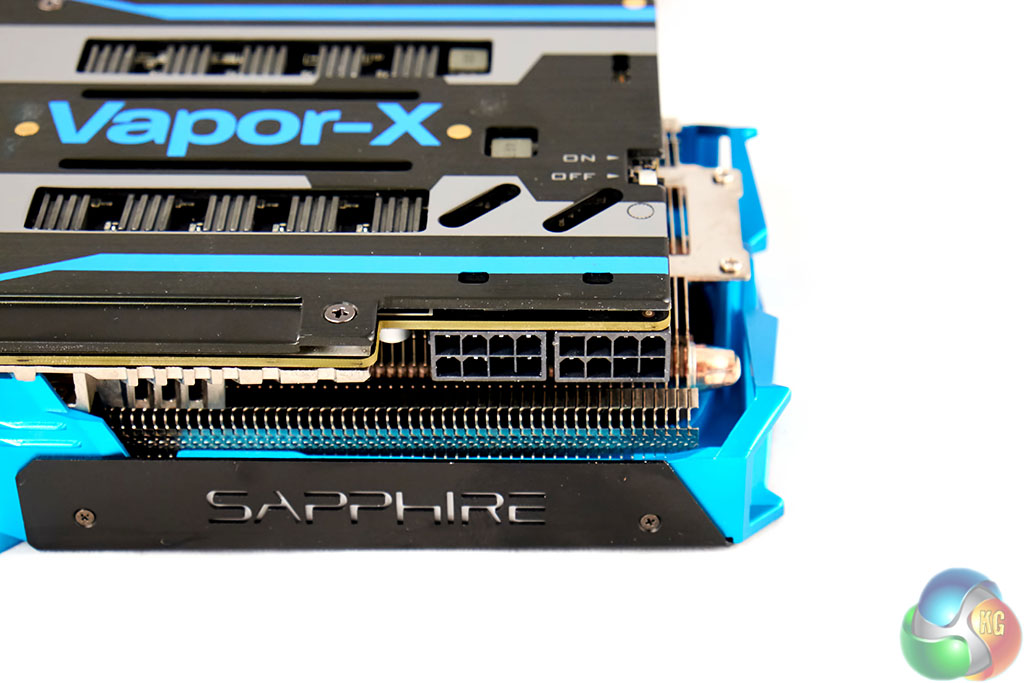
Power is fed via two 8 pin power connections, shown above.
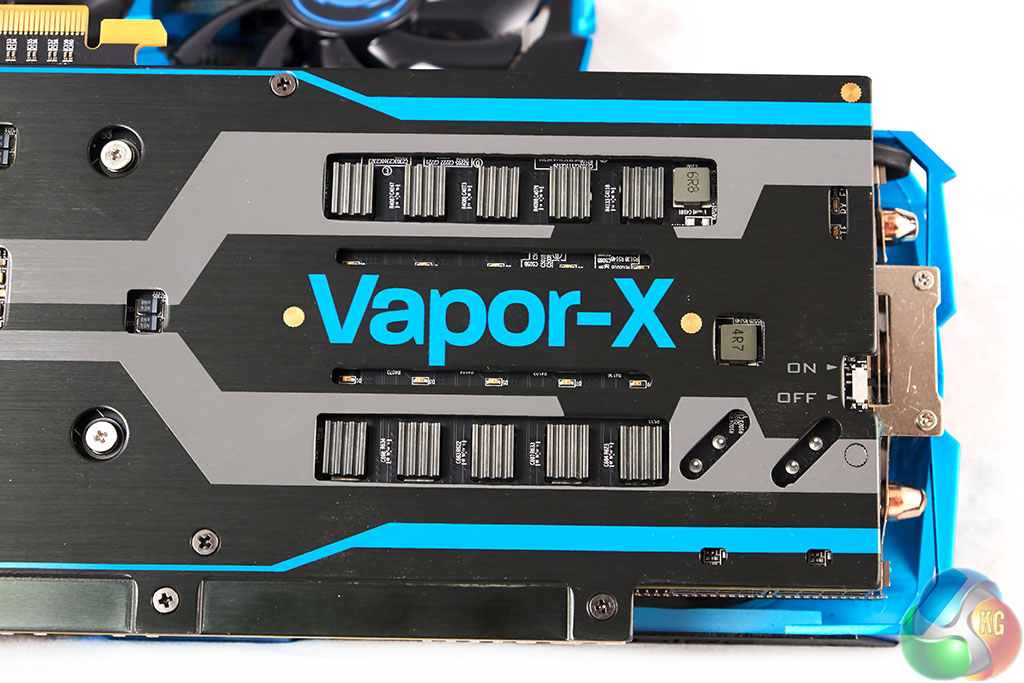
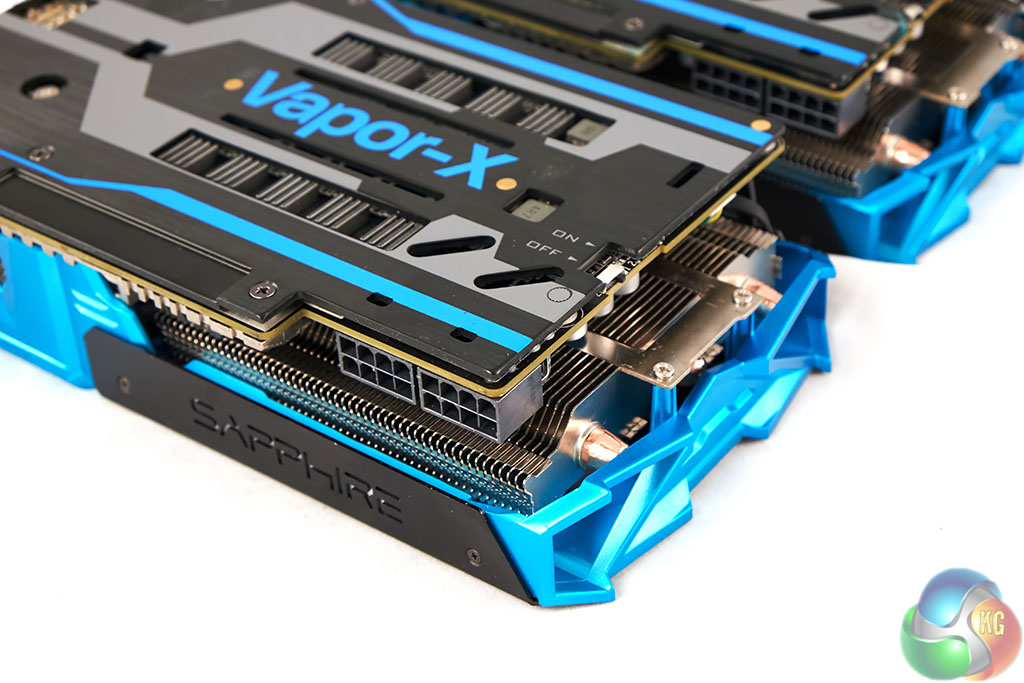
In the middle of the card, on the back is an ‘on/off’ switch. Sapphire has added a new feature to this card which they are calling ‘Intelligent Fan Control (IFC)’. With this feature enabled only one of the three fans (center) will spin with lower loads. When the GPU temperature rises then all three fans will kick in. In theory this should reduce noise emissions under most situations. Gamers and overclockers can turn this off, so the three fans spin all the time.
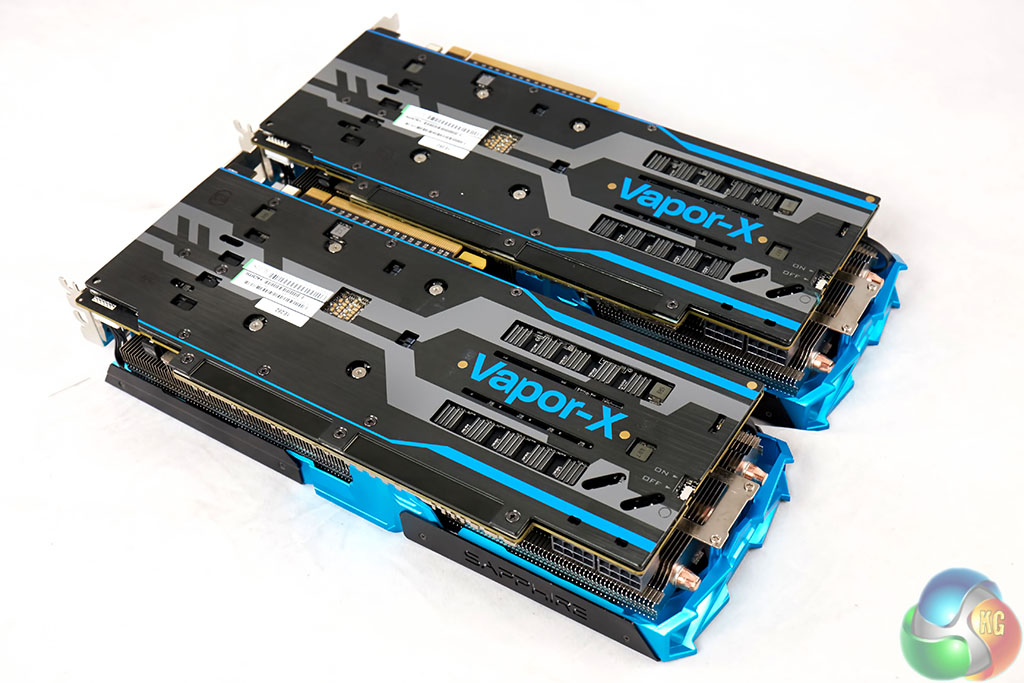
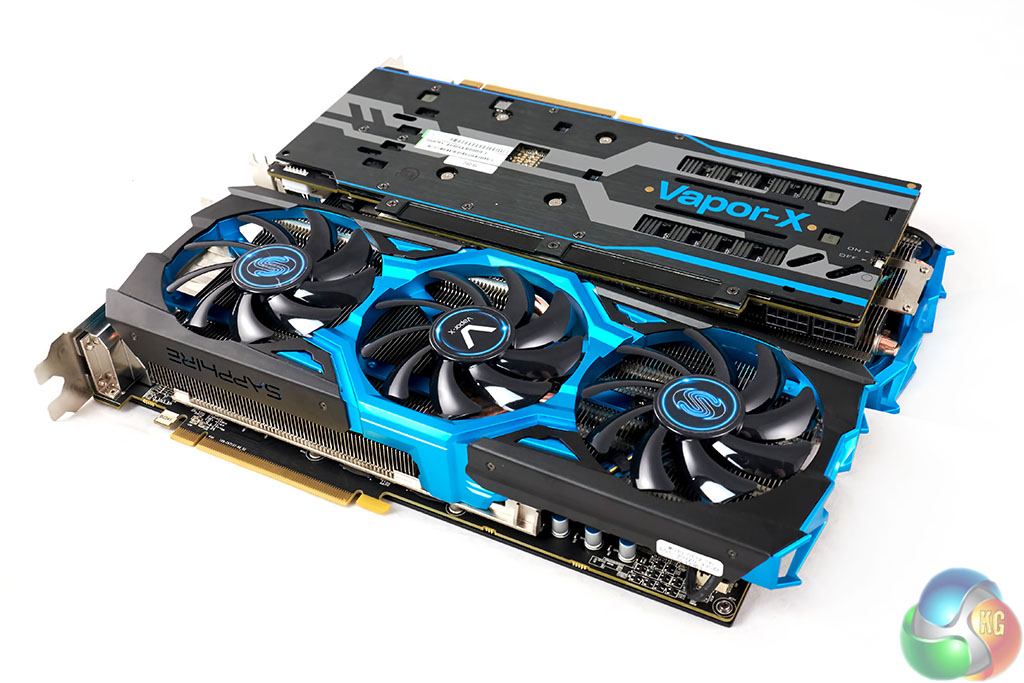
These cards are slightly thicker than 2 slots and they need a little space for air circulation. Be sure your system can accommodate two of them.
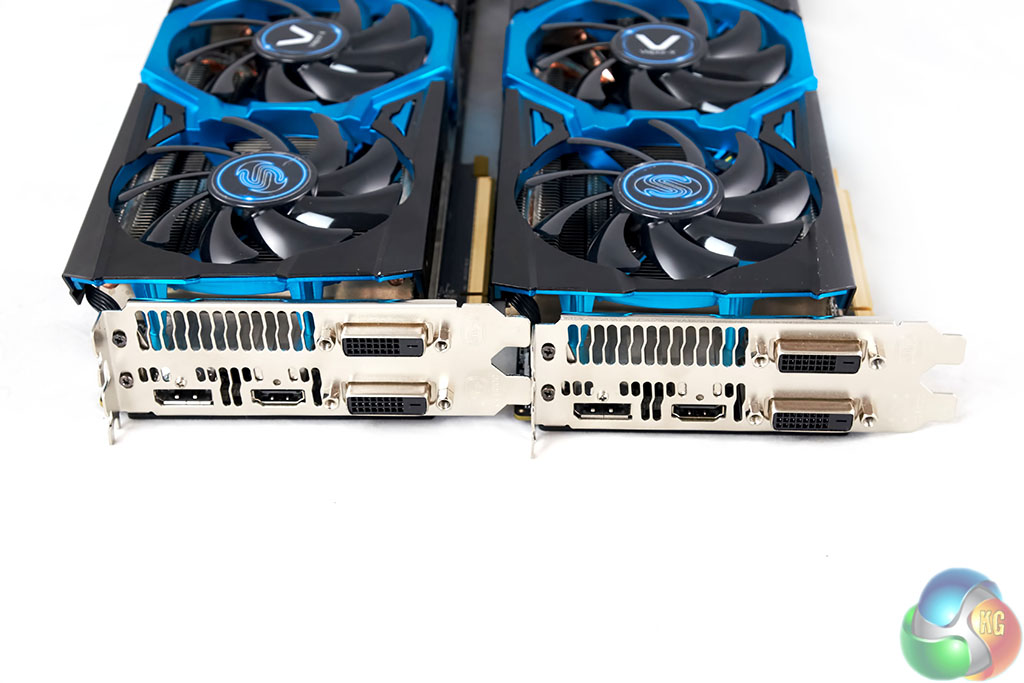
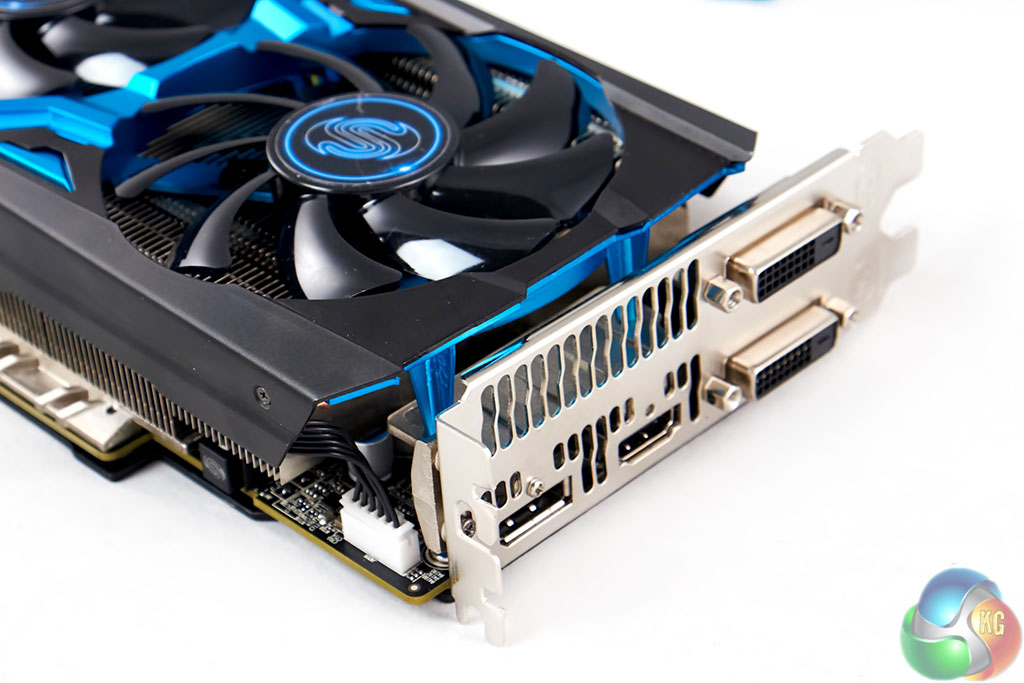
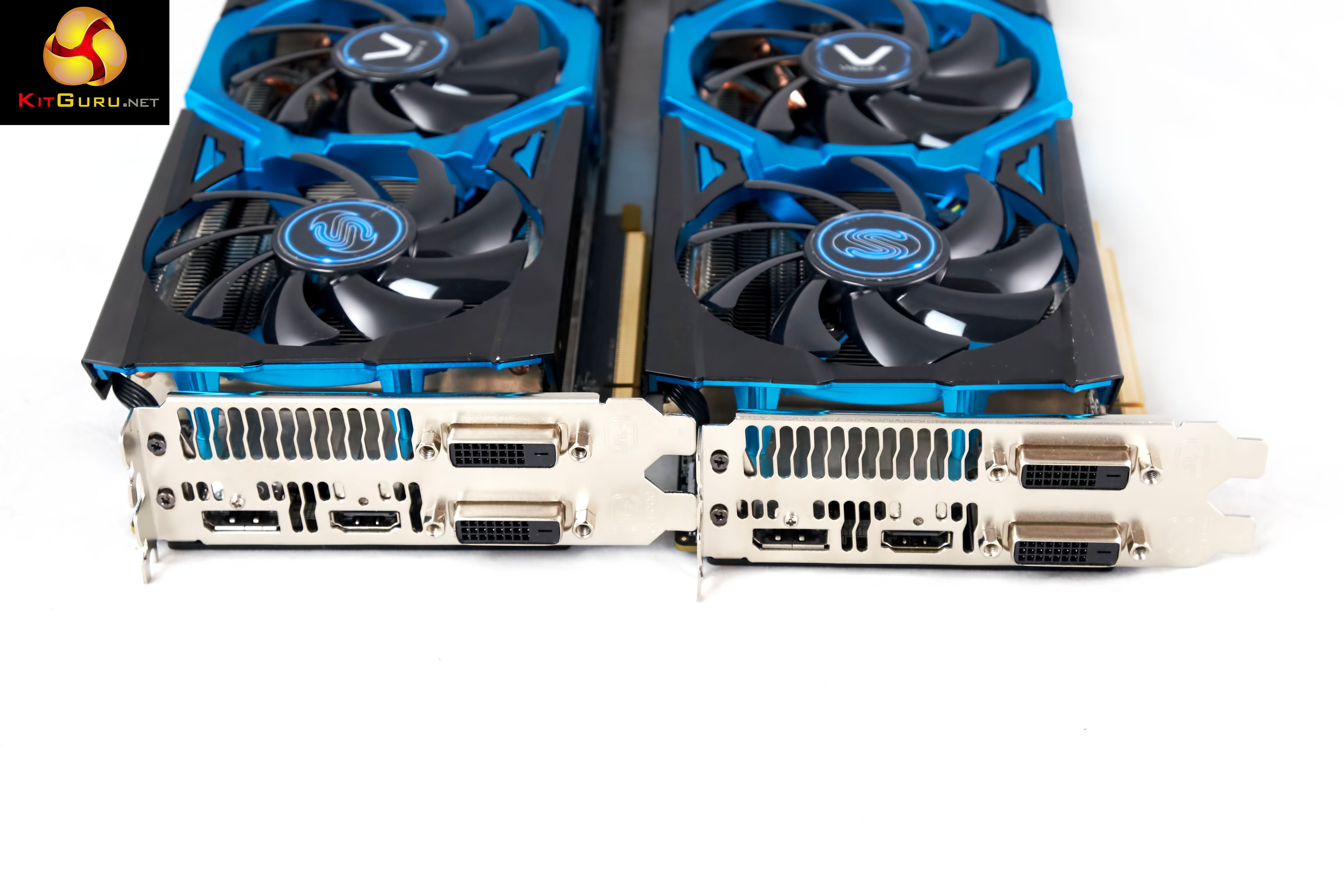
A single link, and dual link DVI connector are present, alongside a full sized HDMI (1.4a) and DisplayPort (1.2) connector. Eyefinity is fully supported and no active adapter is required.
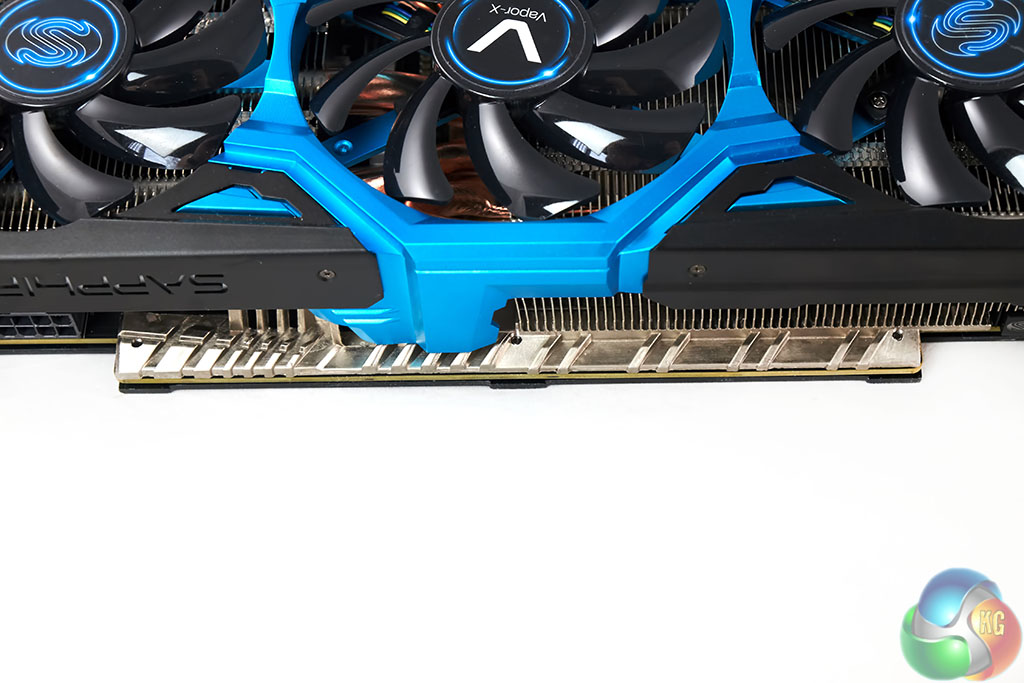
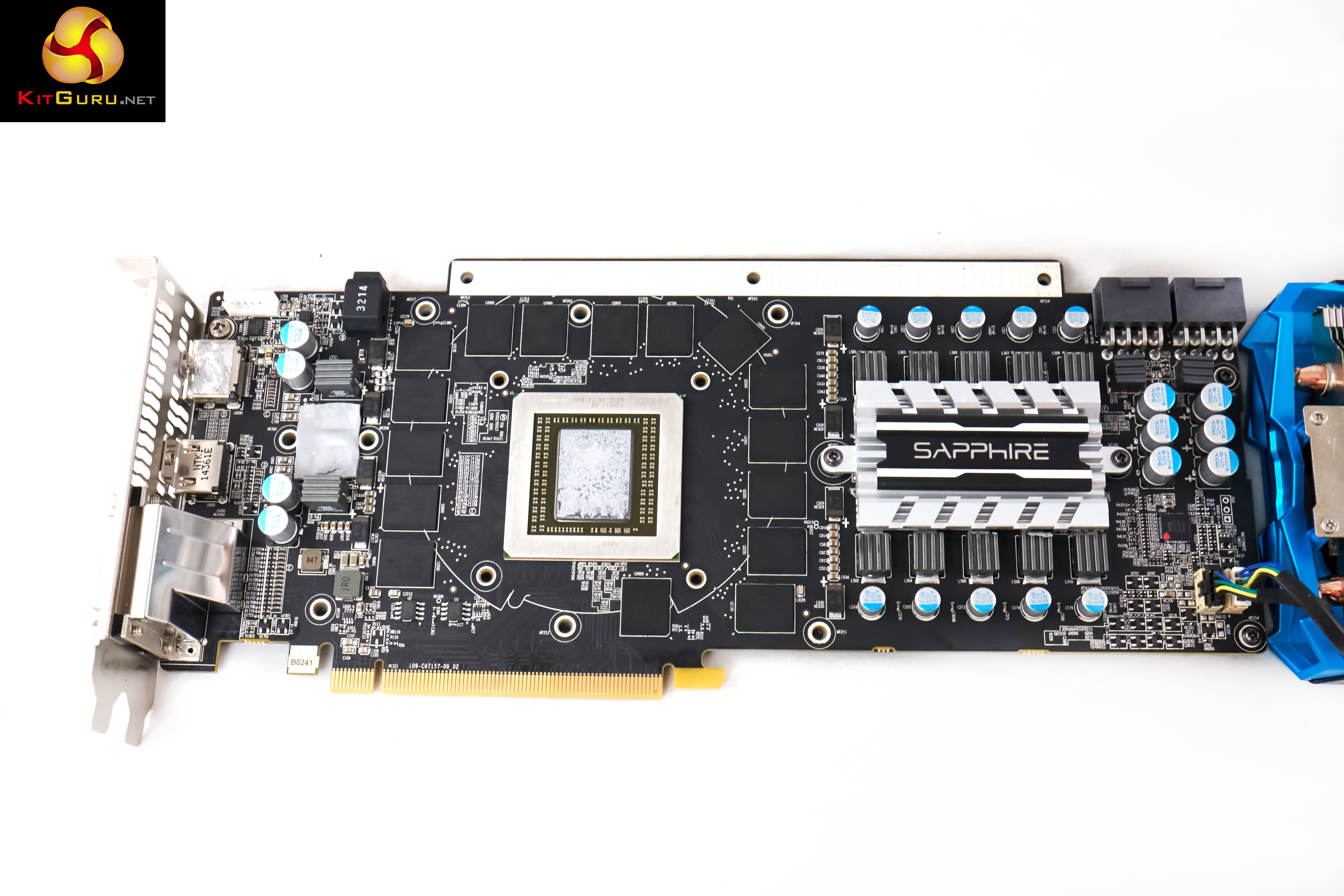
You may have seen the white strip running along the top of the card, close to the two 8 pin power connectors. Sapphire’s engineering team have left one of the copper layers exposed. An additional heatsink mounted direct to the copper layer means that heat can be absorbed into the PCB from the GPU, then transferred out. Sapphire claim a reduction in overall temperature by ‘several degrees’.
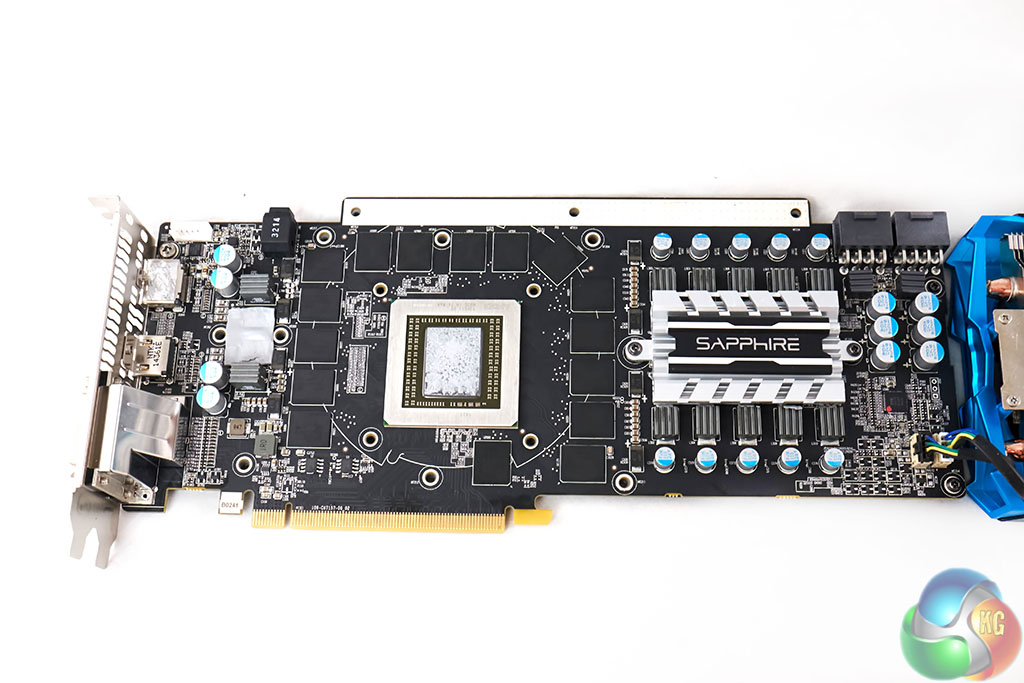
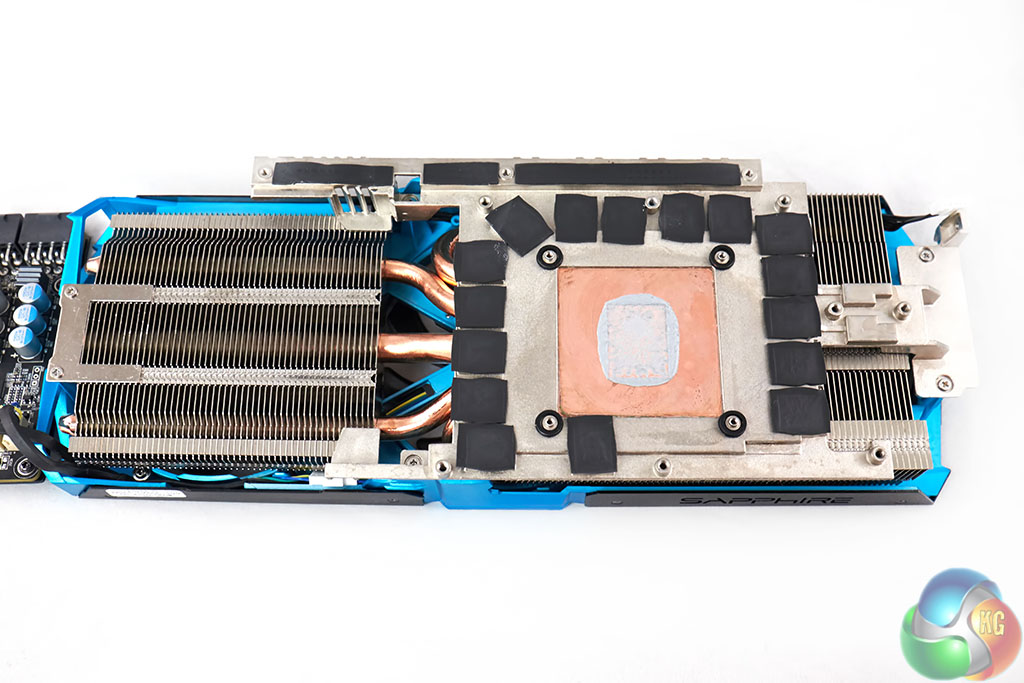
This is a very impressive looking cooler. The R9 290X Vapor-X 8GB card uses Digital Power Control and a new Aero10 VRM section to deliver 10 phase power with high power Direct-FET technology to the GPU, memory and control circuitry.
The power design on this card uses Sapphire Black Diamond chokes – featuring a black ferrite cooler for better efficiency. Sapphire are using high grade electrolyte capacitors throughout the design.
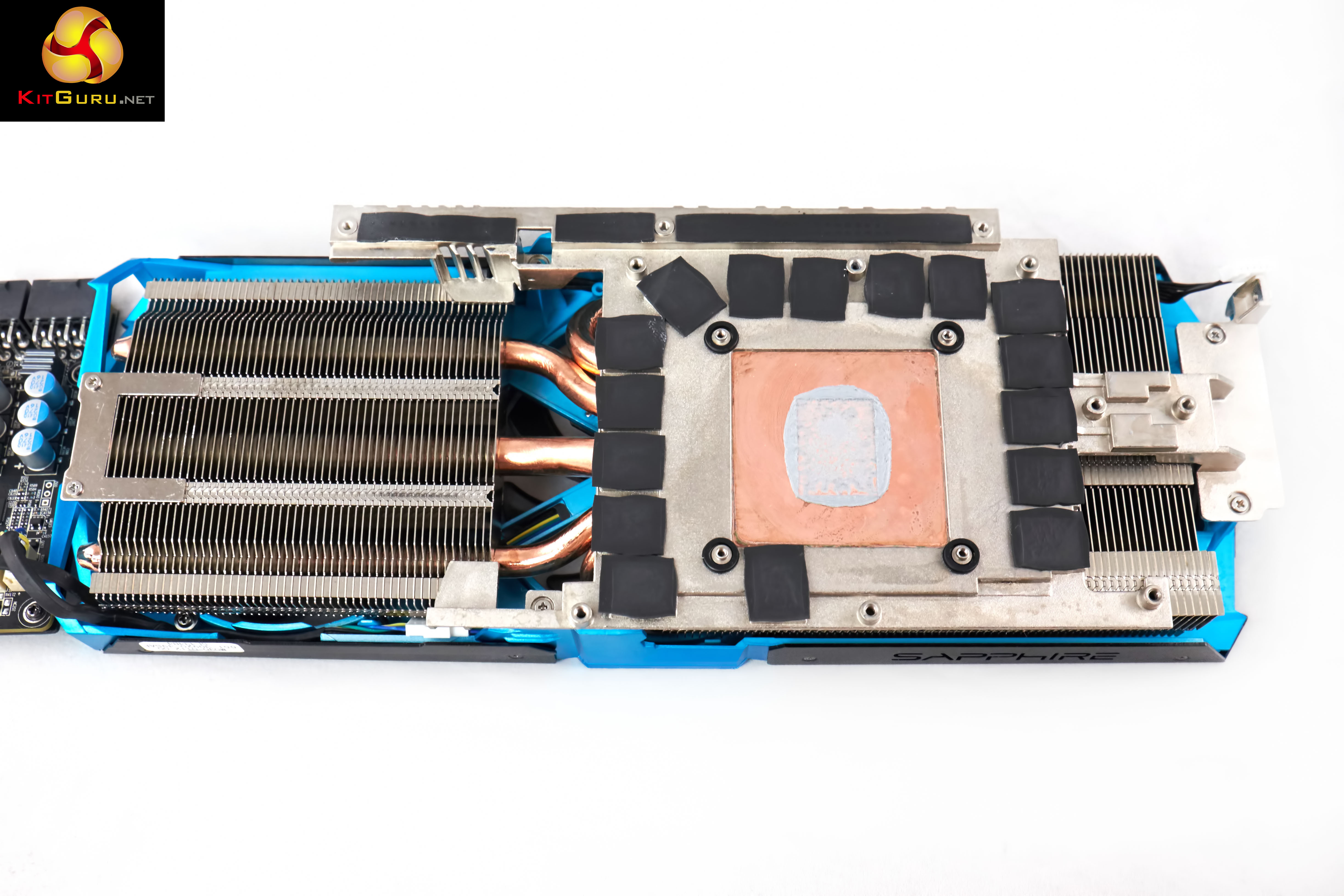
The Tri-X cooler is mounted on top, utilising a monster 10mm heatpipe, with two 8mm pipes and two 6mm pipes spreading across the full length of the PCB.
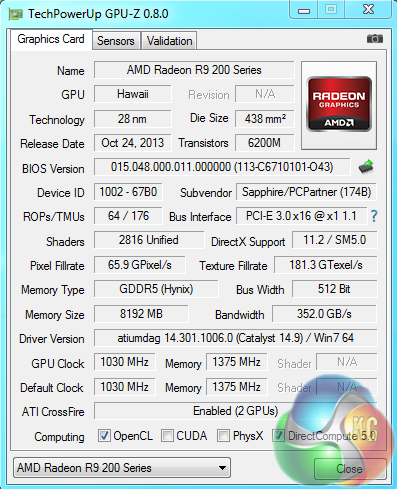
The Sapphire R9 290X Vapor X 8GB is built on the 28nm process and we can see the Bios date is set at Oct 24th, 2013. The Hawaii core is overclocked to 1,030mhz, and the 8GB of GDDR5 memory is connected via a wide 512bit interface, running at 1,375mhz (5.5Gbps effective). There are 64 ROPs, 176 Texture units and 2816 Stream processors onboard.
On this page we present some high resolution images of the product taken with a Fuji XT1 camera. These will take much longer to open due to the dimensions, especially on slower connections. If you use these pictures on another site or publication, please credit Kitguru.net as the owner/source.

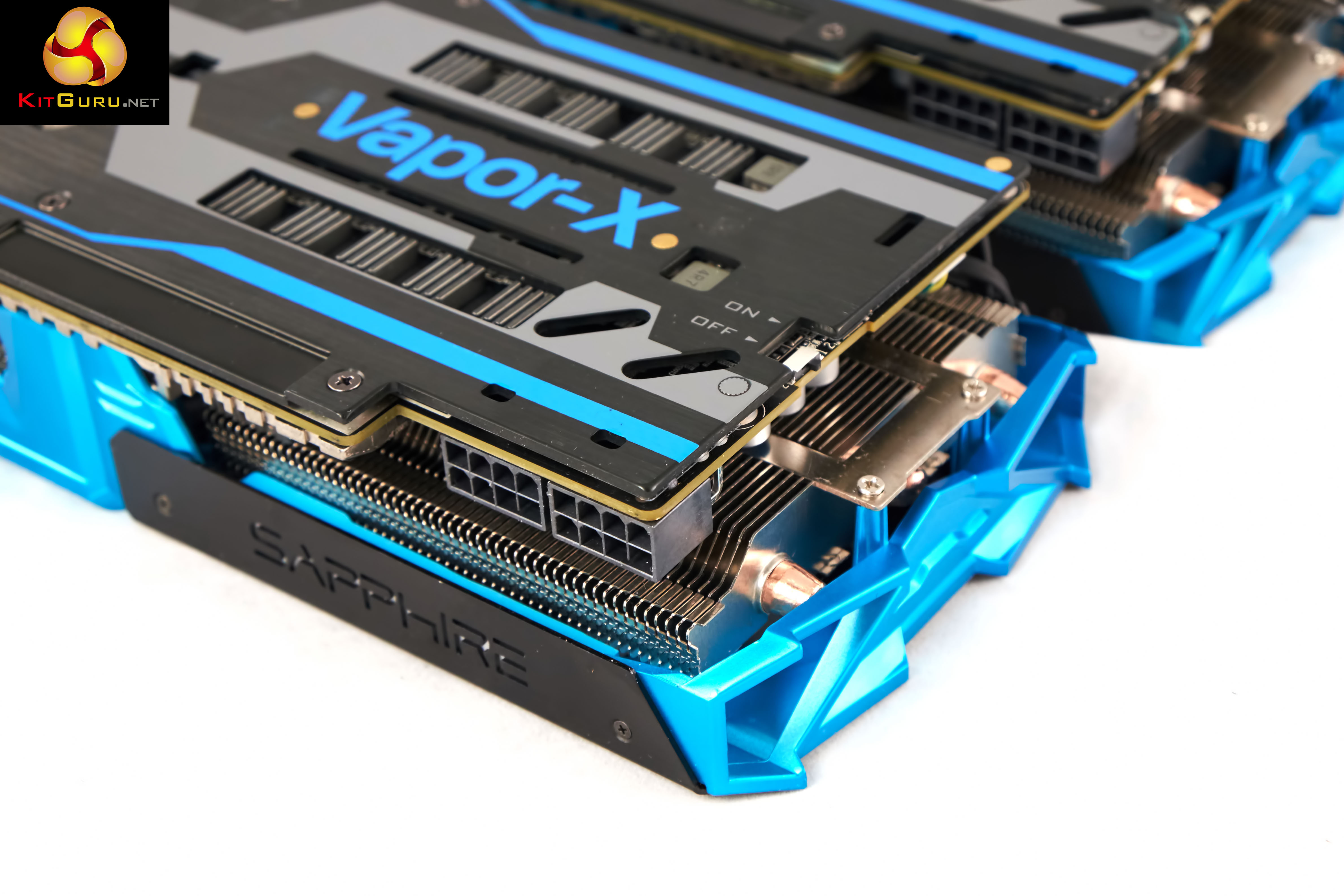
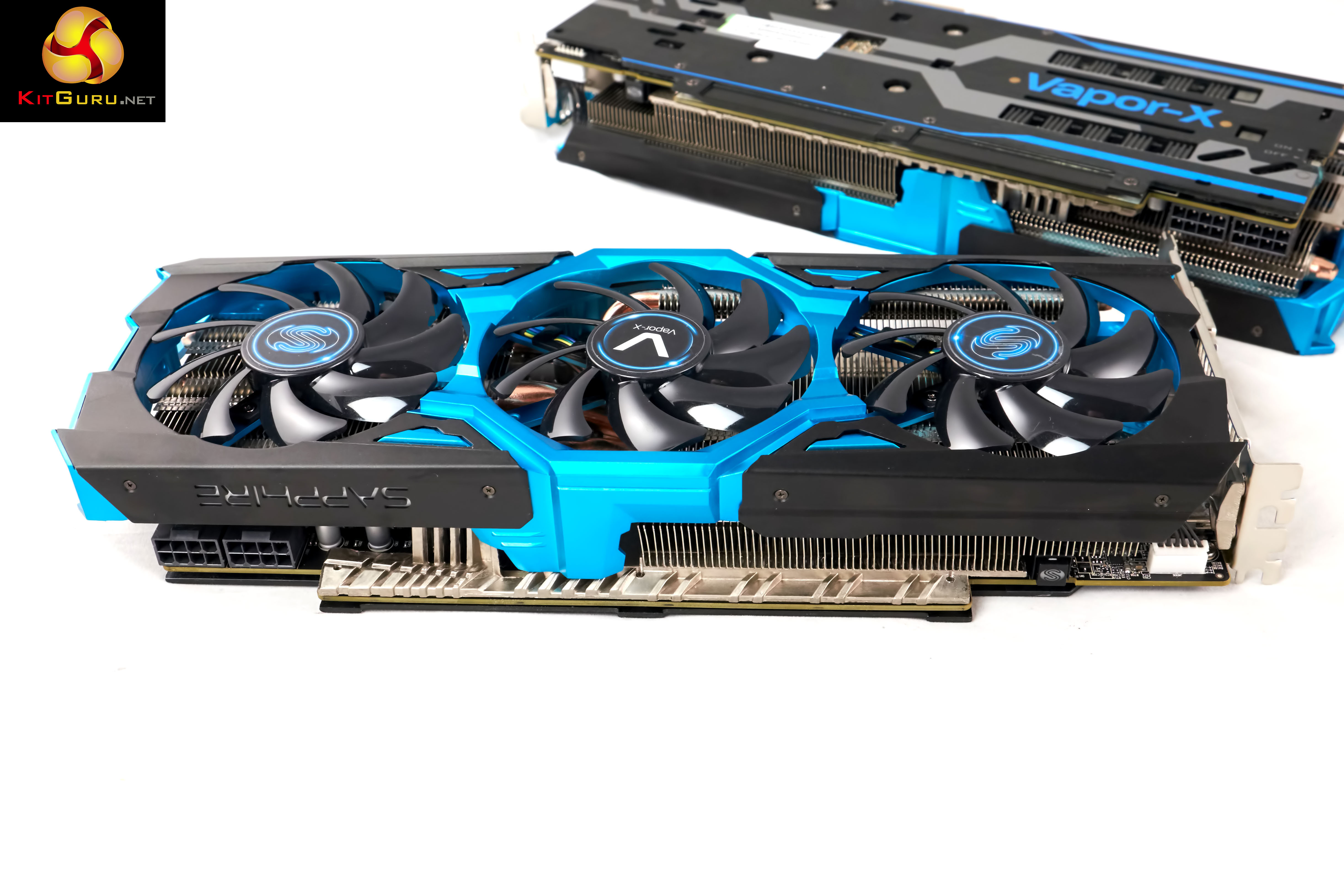
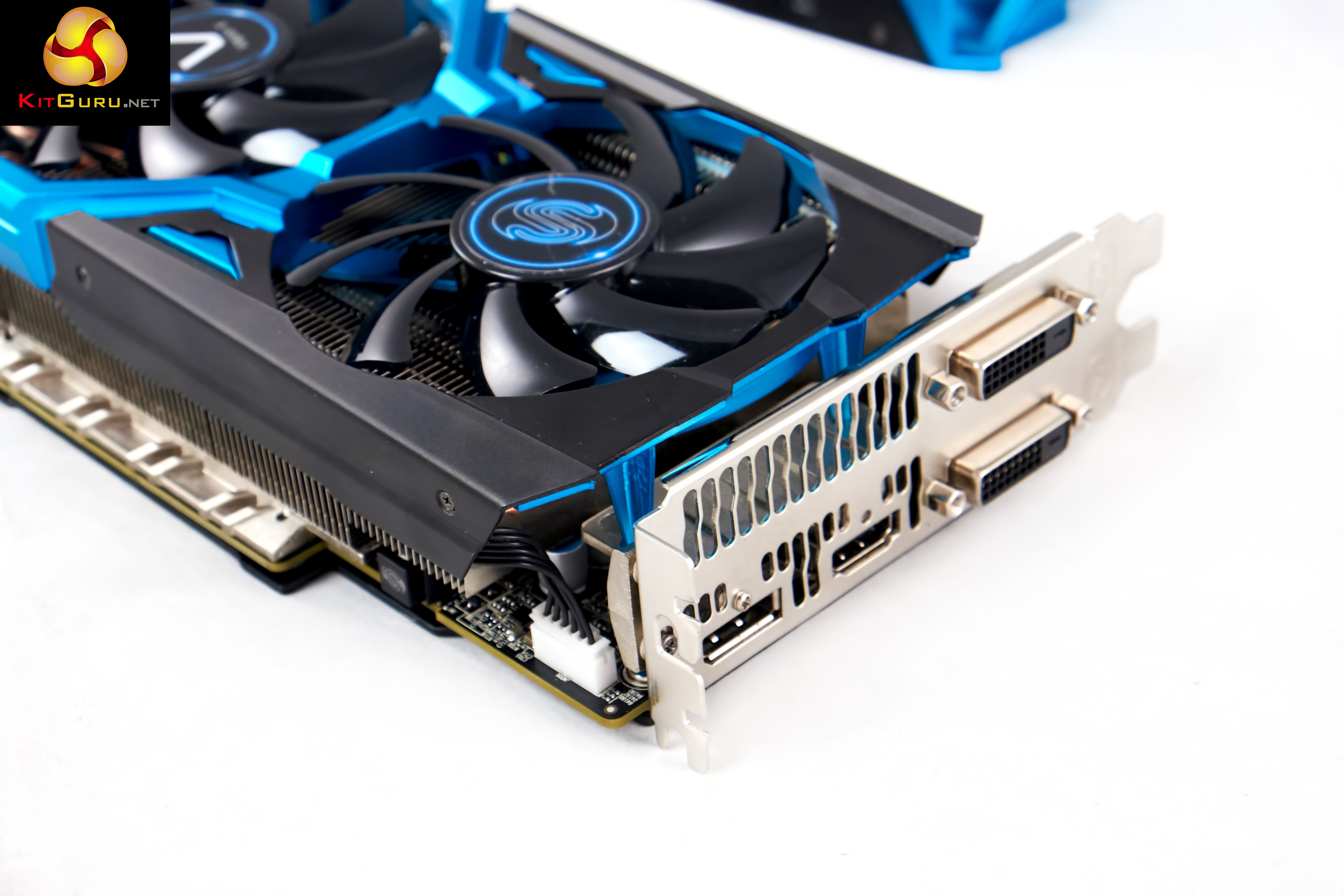
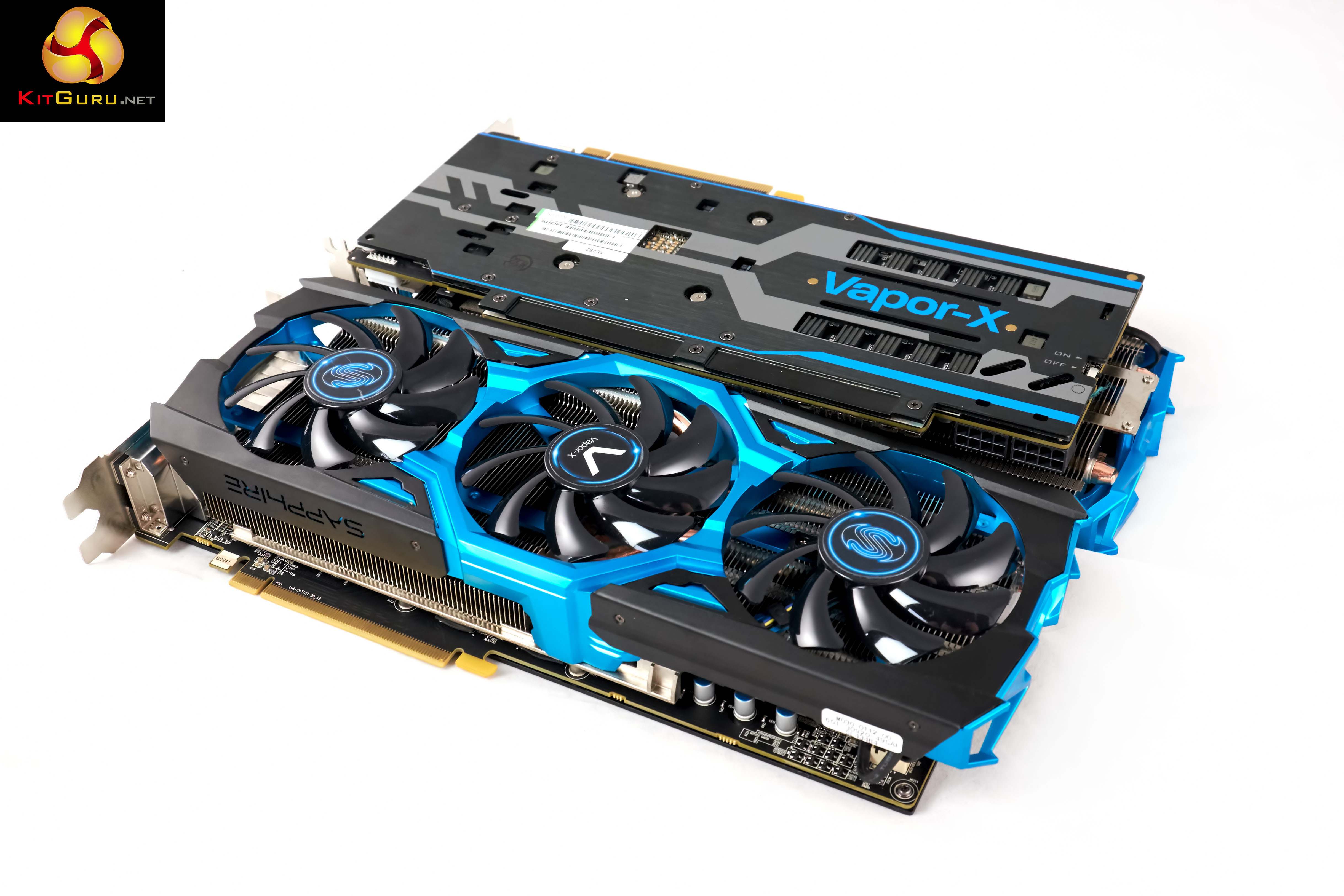
For this review today we have been testing all the hardware over the last 10 days, running the latest AMD Catalyst 14.9.2 driver, and Nvidia Forceware 344.48 driver.
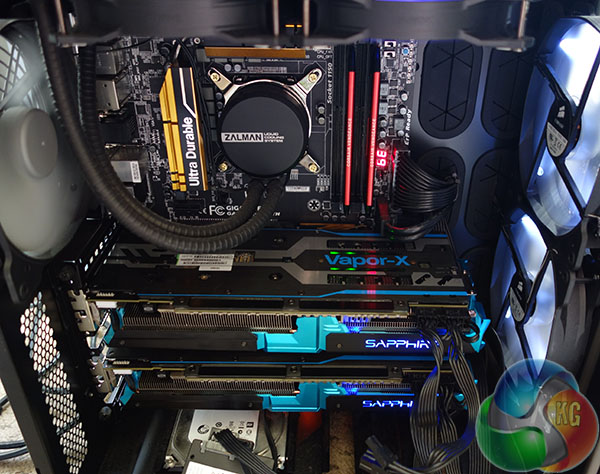
We are using one of our brand new test rigs supplied by DINOPC and built to our specifications.
If you want to read more about this, or are interested in buying the same Kitguru Test Rig, check out our article with links on this page. We are using an Asus PB287Q 4k monitor for this review today.
Hardware on test:
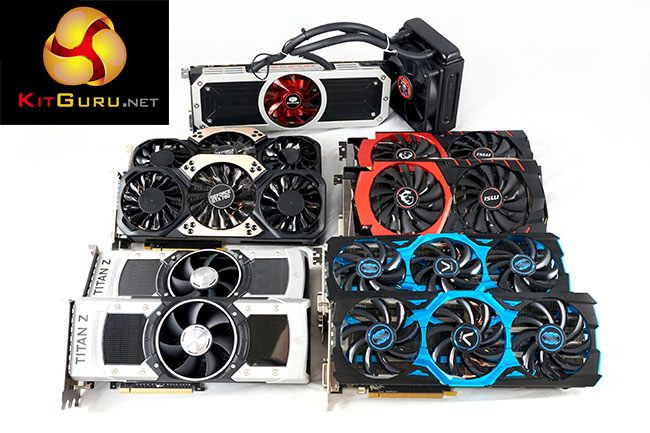
Sapphire R9 290X Vapor X 8GB (1,030mhz core / 1,375 mhz memory)
MSI GTX980 4G Gaming SLI (1,216mhz core / 1,753 mhz memory)
Nvidia GTX Titan Z (706mhz core / 1,753mhz memory)
Palit GTX780 6GB Jetstream (902 mhz more / 1,502 mhz memory)
Sapphire R9 295X2 (1,018mhz core / 1,250 mhz memory)
Software:
Windows 7 Enterprise 64 bit
Unigine Heaven Benchmark
3DMark Vantage
3DMark 11
3DMark
Fraps Professional
Steam Client
FurMark
Games:
Tomb Raider.
Grid AutoSport.
Metro Last Light Redux Edition.
Total War Rome 2 Emperor Edition.
Watchdogs.
Thief.
Far Cry 3.
Battlefield 4.
All the latest BIOS updates and drivers are used during testing. We perform generally under real world conditions, meaning KitGuru tests games across five closely matched runs and then average out the results to get an accurate median figure. If we use scripted benchmarks, they are mentioned on the relevant page.
Game descriptions edited with courtesy from Wikipedia.
Futuremark released 3DMark Vantage, on April 28, 2008. It is a benchmark based upon DirectX 10, and therefore will only run under Windows Vista (Service Pack 1 is stated as a requirement) and Windows 7. This is the first edition where the feature-restricted, free of charge version could not be used any number of times. 1280×1024 resolution was used with performance settings.
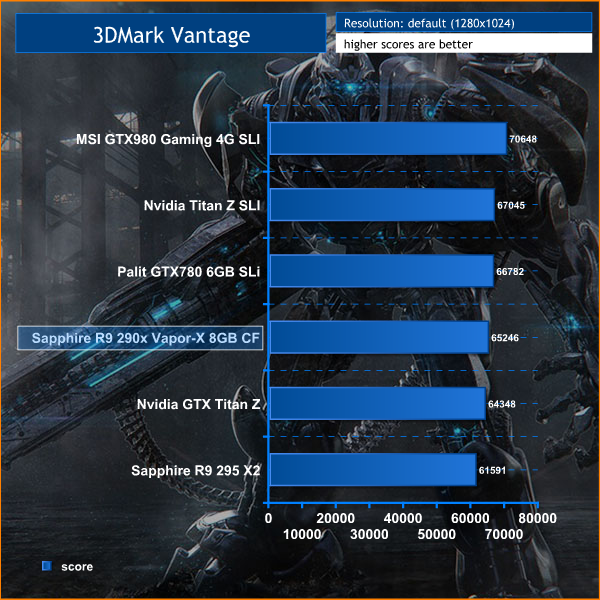
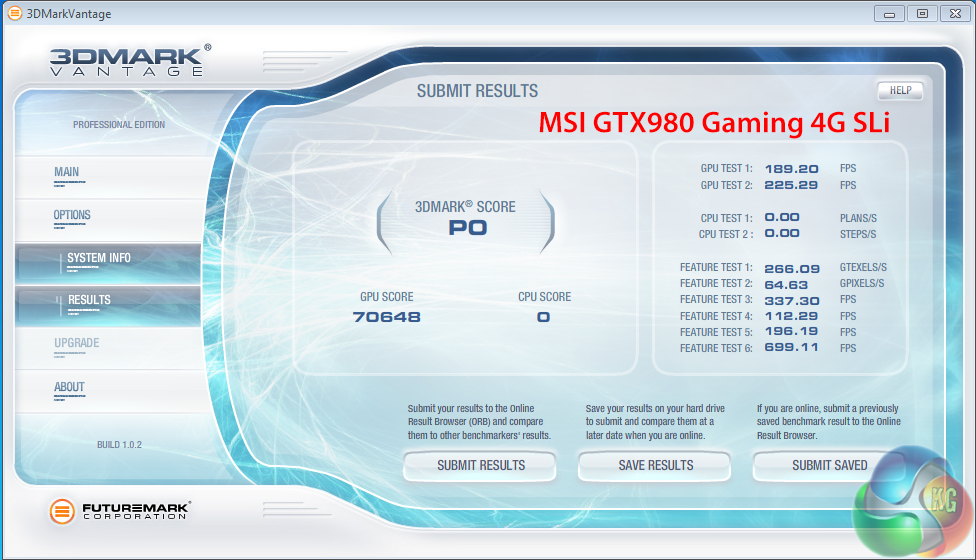
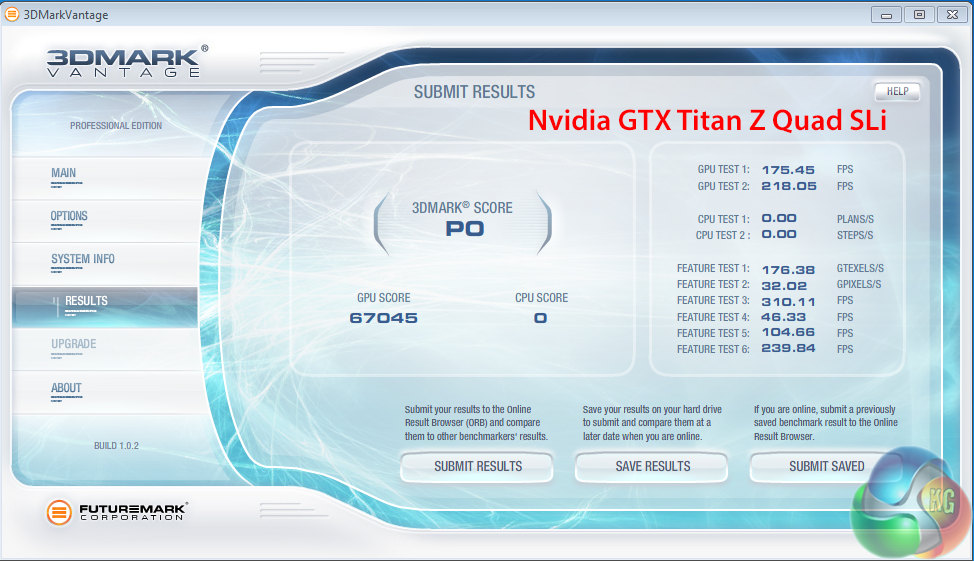
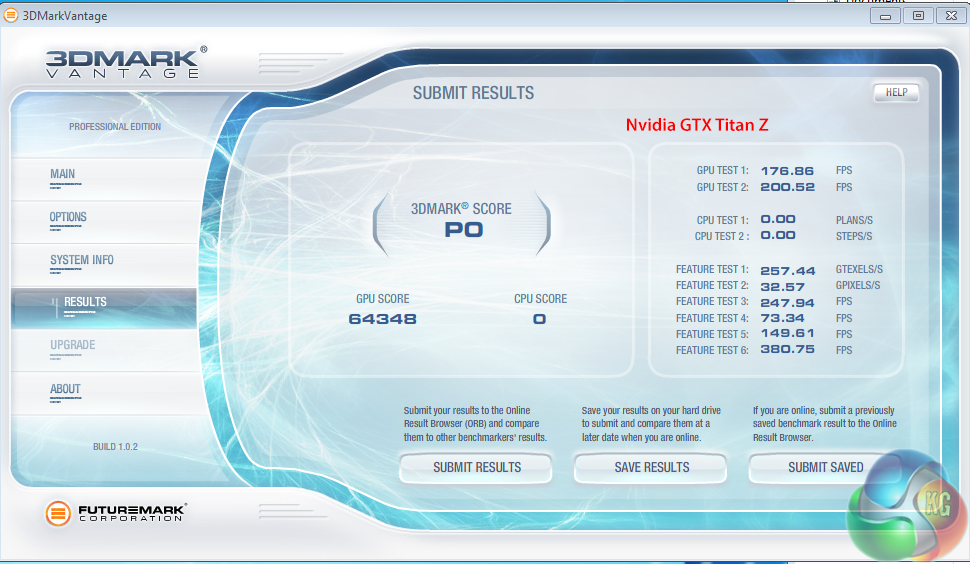
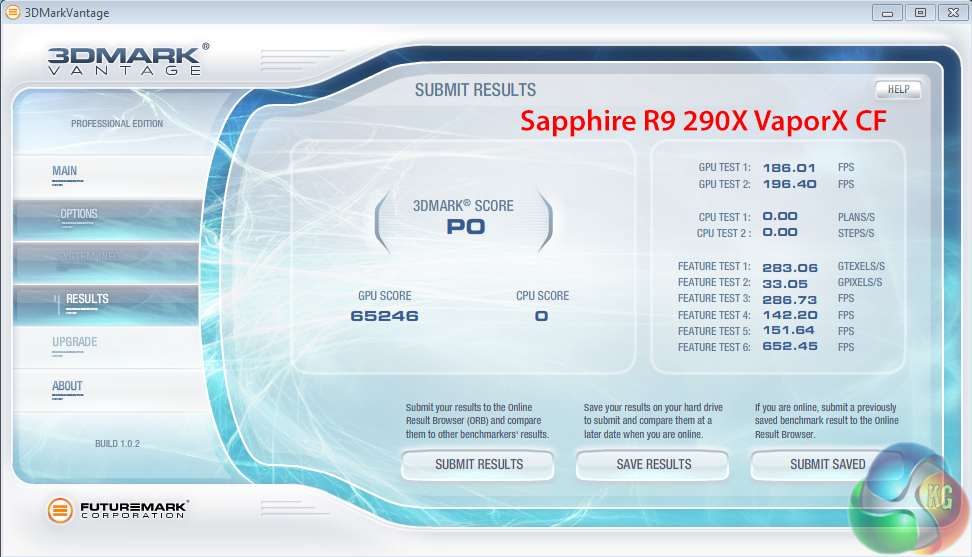
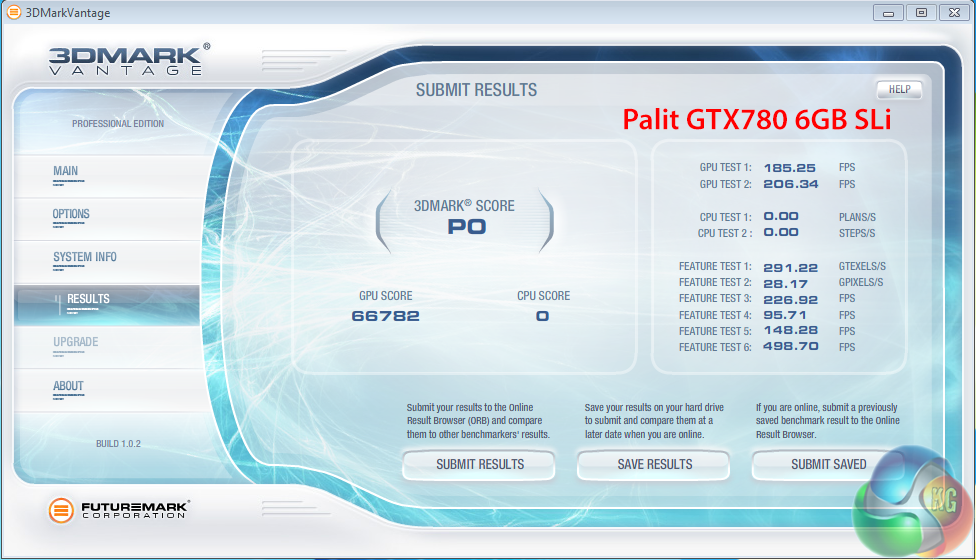
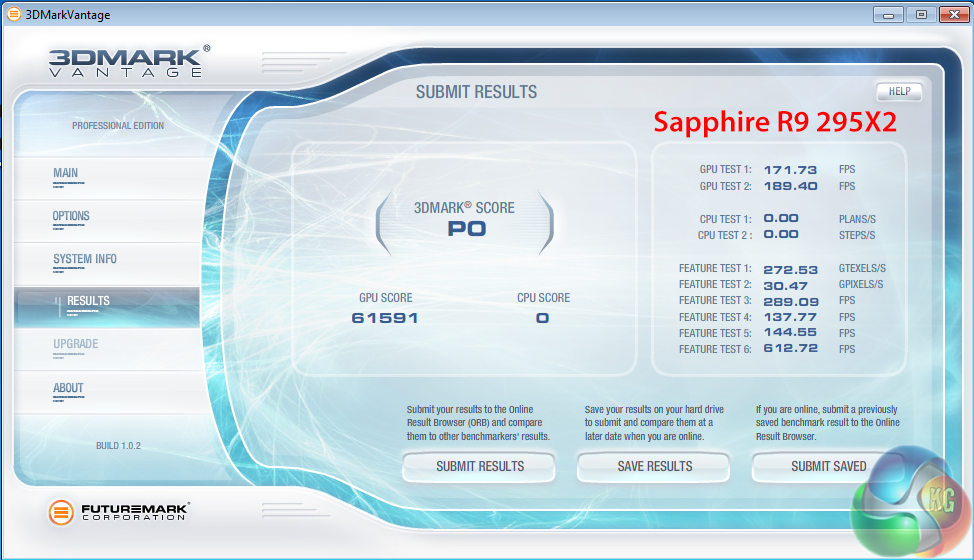
We normally include this older Direct X 10 benchmark in the mix and we can see that the MSI GTX980 Gaming 4G cards come out top in SLi. Two Nvidia GTX Titan Z's in Quad SLI struggle to match the results.
We would put this down to a lack of driver optimisations for this older benchmark once we move to 4 GPU cores. We would imagine the two Titan Z cards will score better in the upcoming Direct X 11 Futuremark benchmarks.
3DMark 11 is designed for testing DirectX 11 hardware running on Windows 7 and Windows Vista the benchmark includes six all new benchmark tests that make extensive use of all the new features in DirectX 11 including tessellation, compute shaders and multi-threading. After running the tests 3DMark gives your system a score with larger numbers indicating better performance. Trusted by gamers worldwide to give accurate and unbiased results, 3DMark 11 is the best way to test DirectX 11 under game-like loads. If you want to learn more about this benchmark, or to buy it yourself, head over to this page.
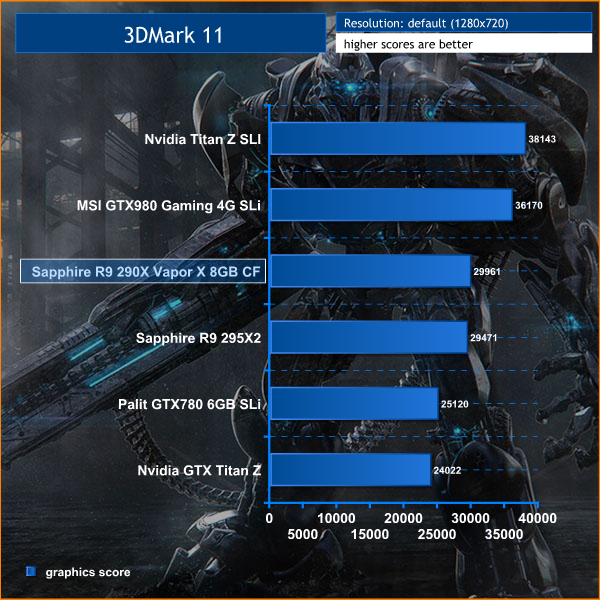
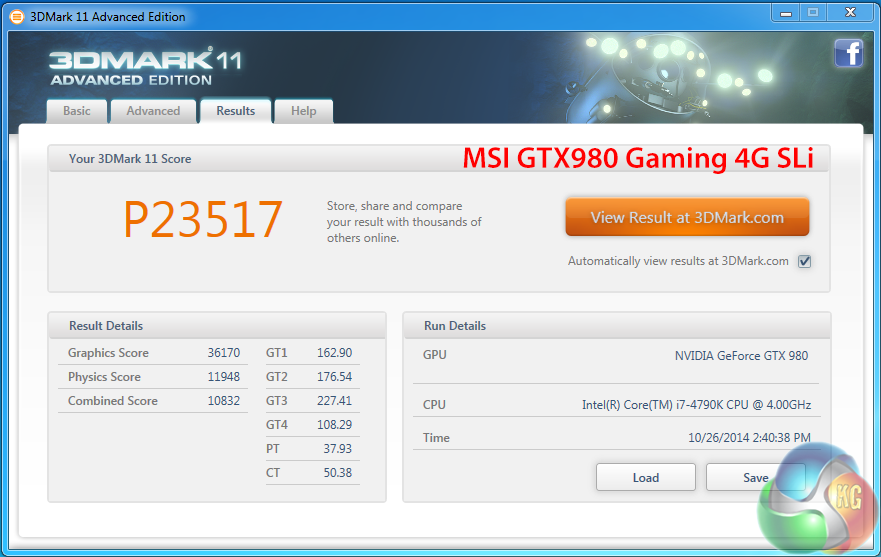
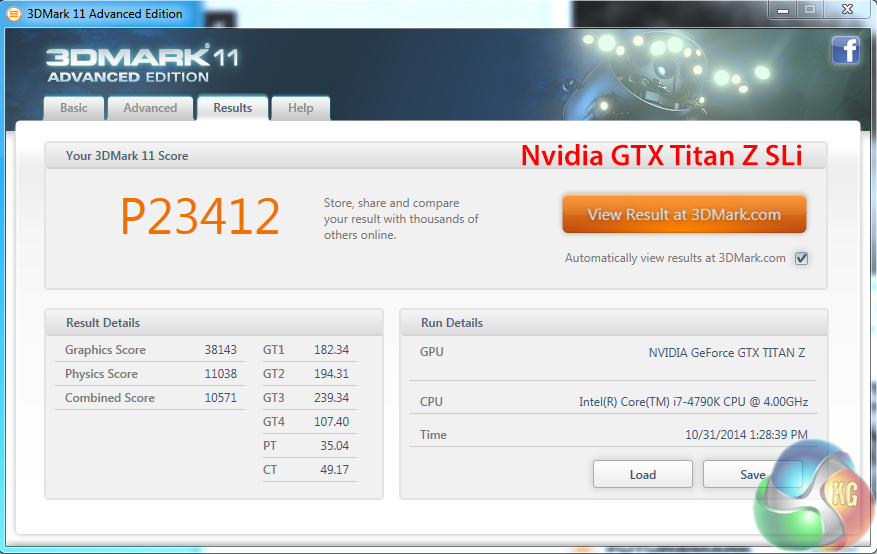
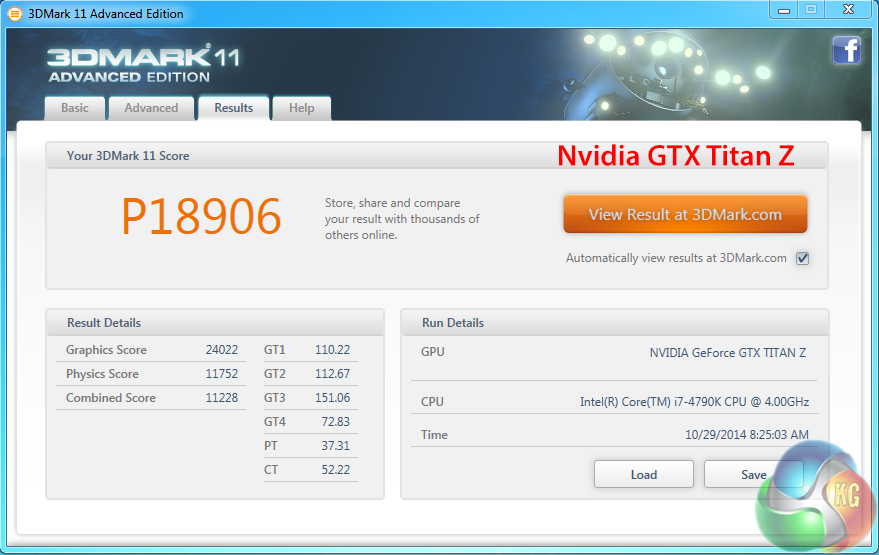
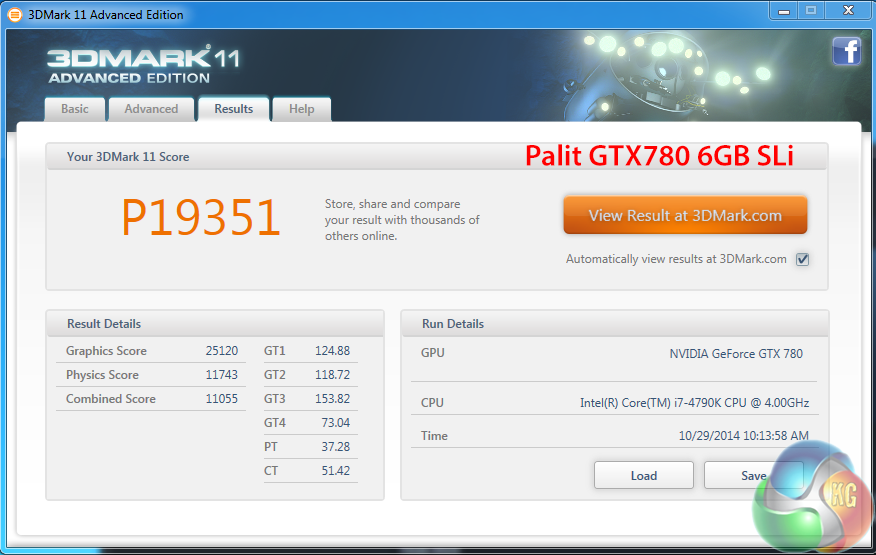
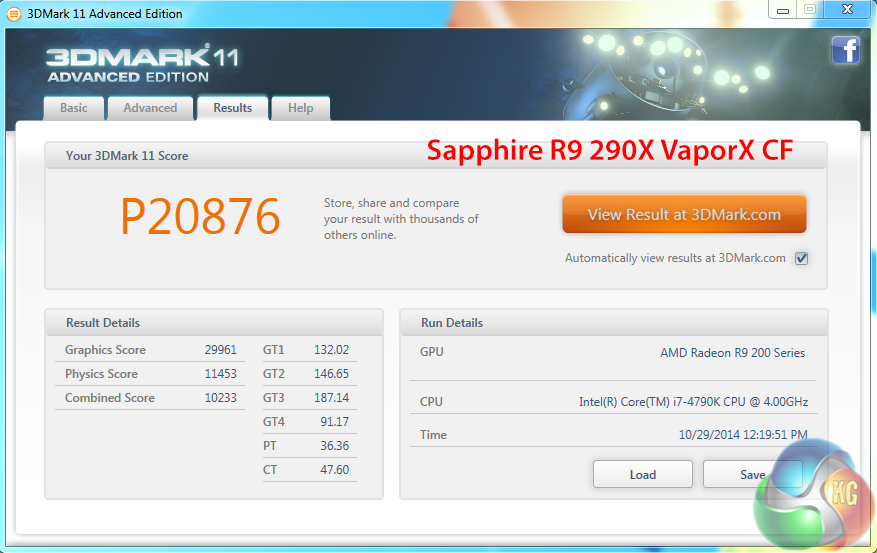
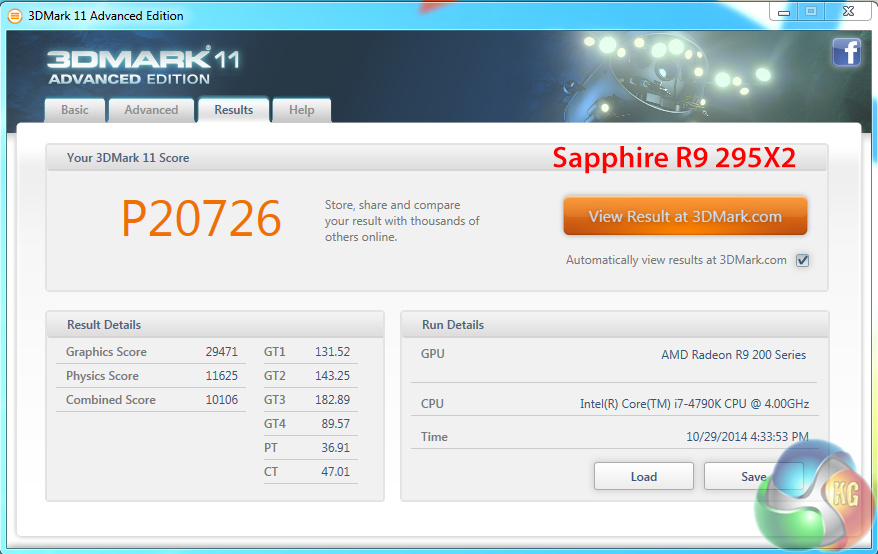
The two Nvidia Titan Z cards claim top position, scoring 38,143 points. The MSI GTX980 Gaming 4G cards in SLi take second place, scoring 36,170 points. The Sapphire R9 290X Vapor X cards in Crossfire score almost 30,000 points, taking third place. The Palit GTX780 6GB cards in SLI score much less, at 25,120 points.
The single Titan Z is bottom of our chart, scoring 24,022 points. Both of the GPU cores are clocked very modestly at 706mhz, which impacts performance.
3DMark is an essential tool used by millions of gamers, hundreds of hardware review sites and many of the world’s leading manufacturers to measure PC gaming performance.
Futuremark say “Use it to test your PC’s limits and measure the impact of overclocking and tweaking your system. Search our massive results database and see how your PC compares or just admire the graphics and wonder why all PC games don’t look this good.
To get more out of your PC, put 3DMark in your PC.”
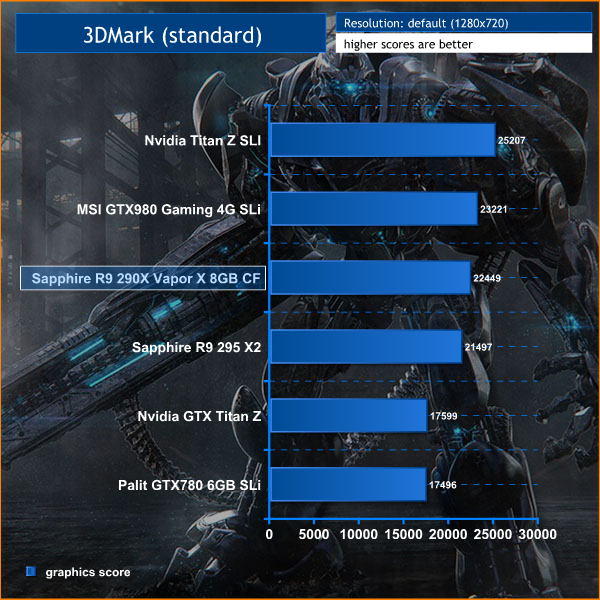
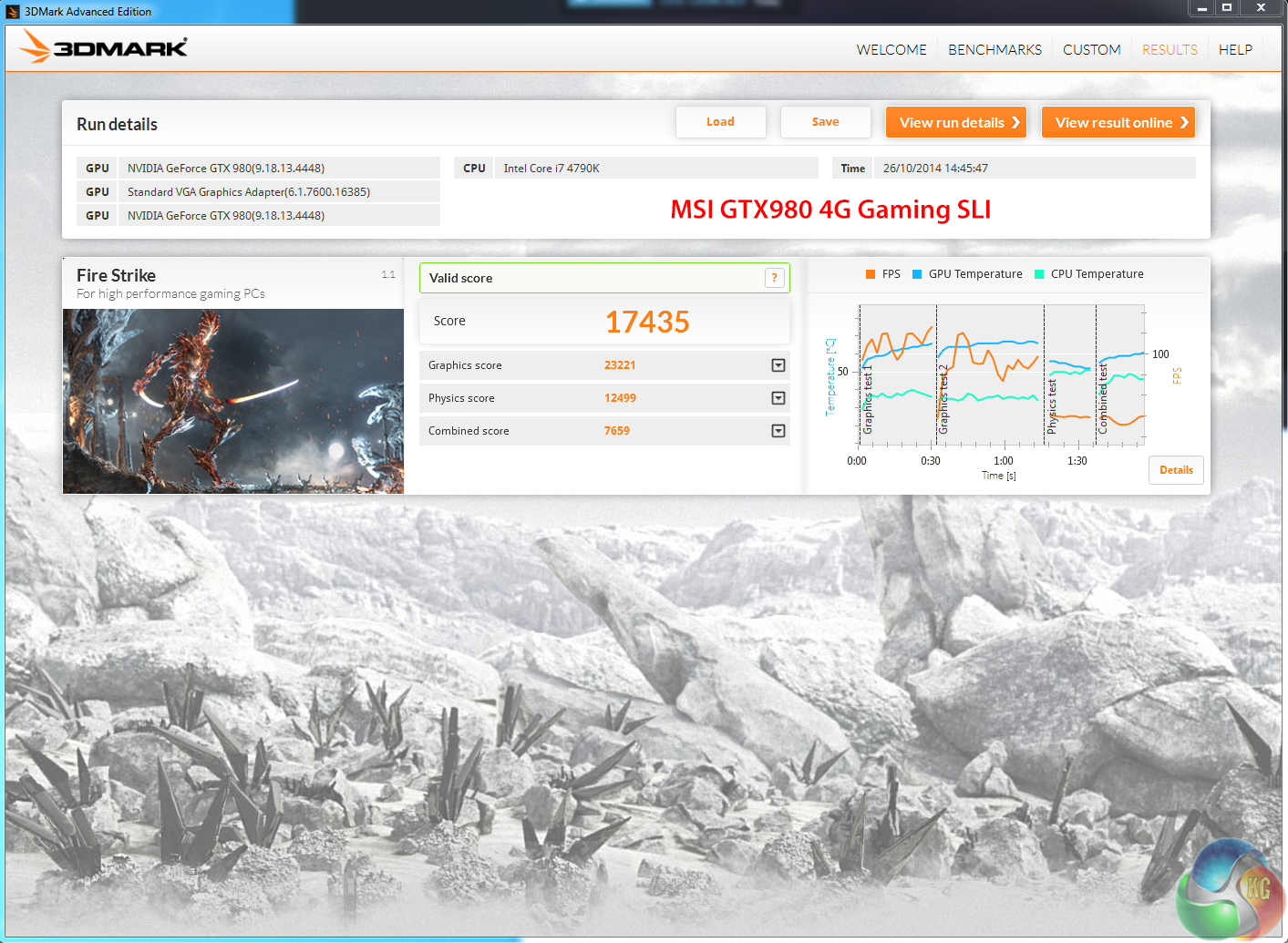
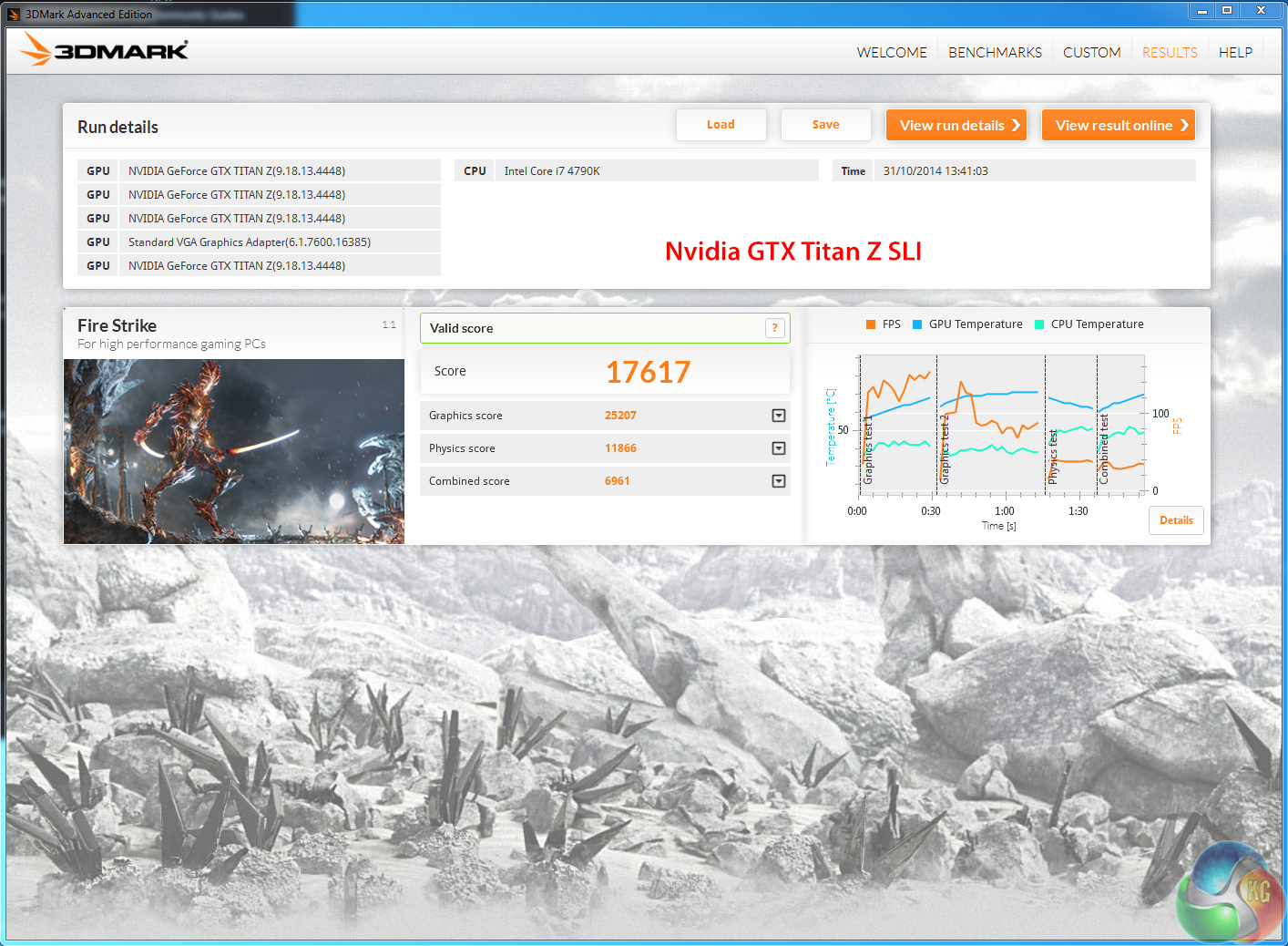
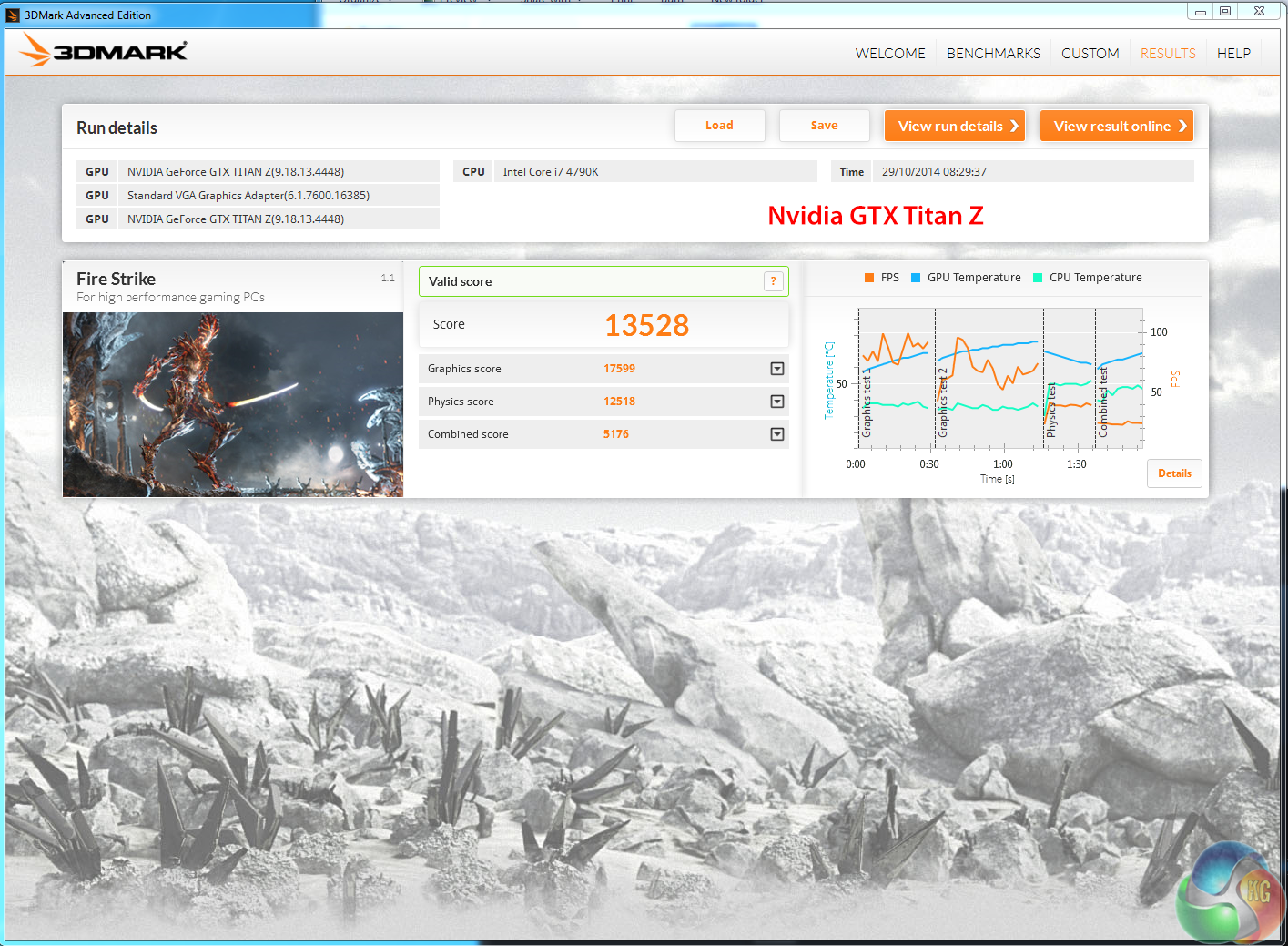
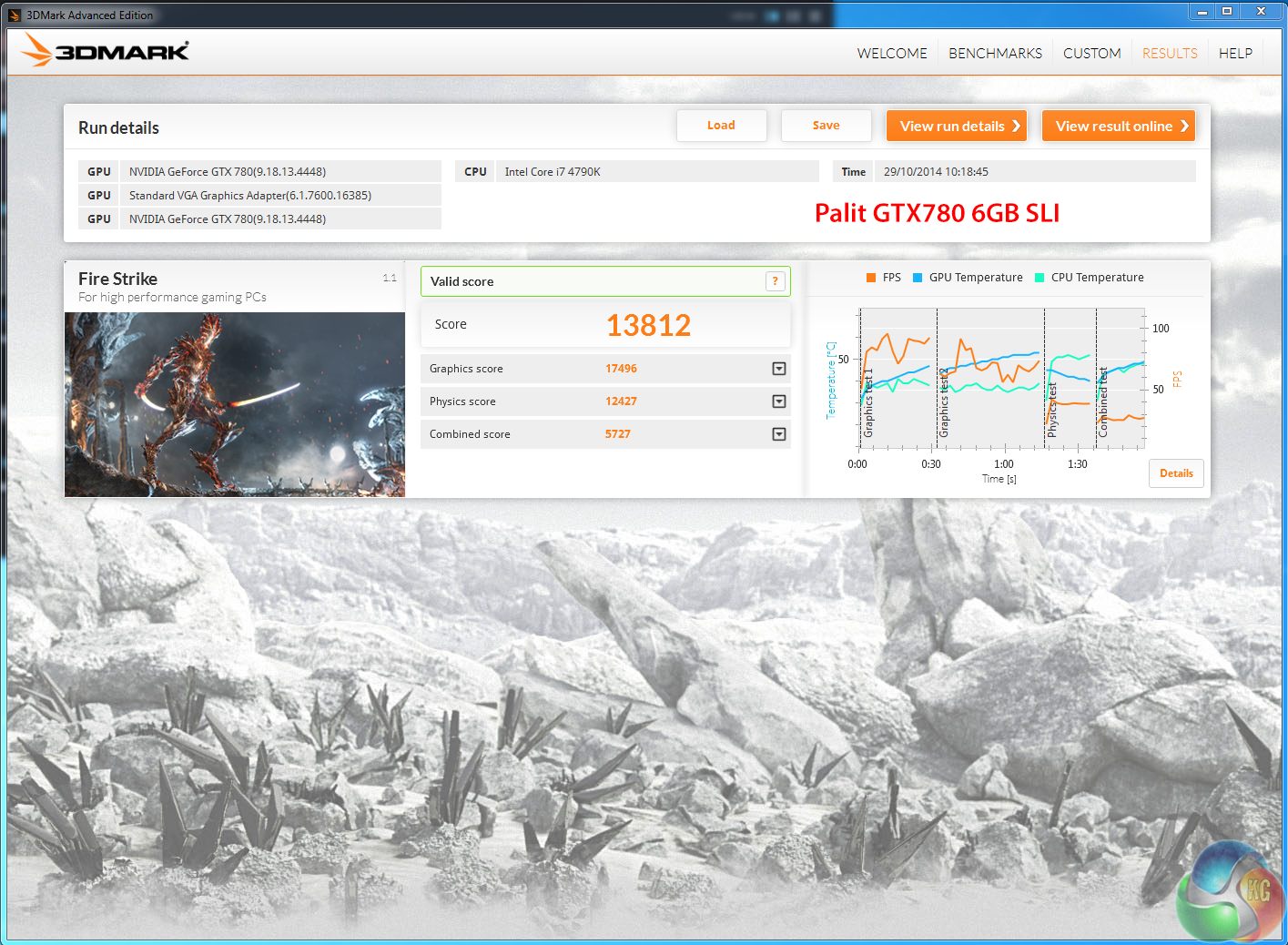
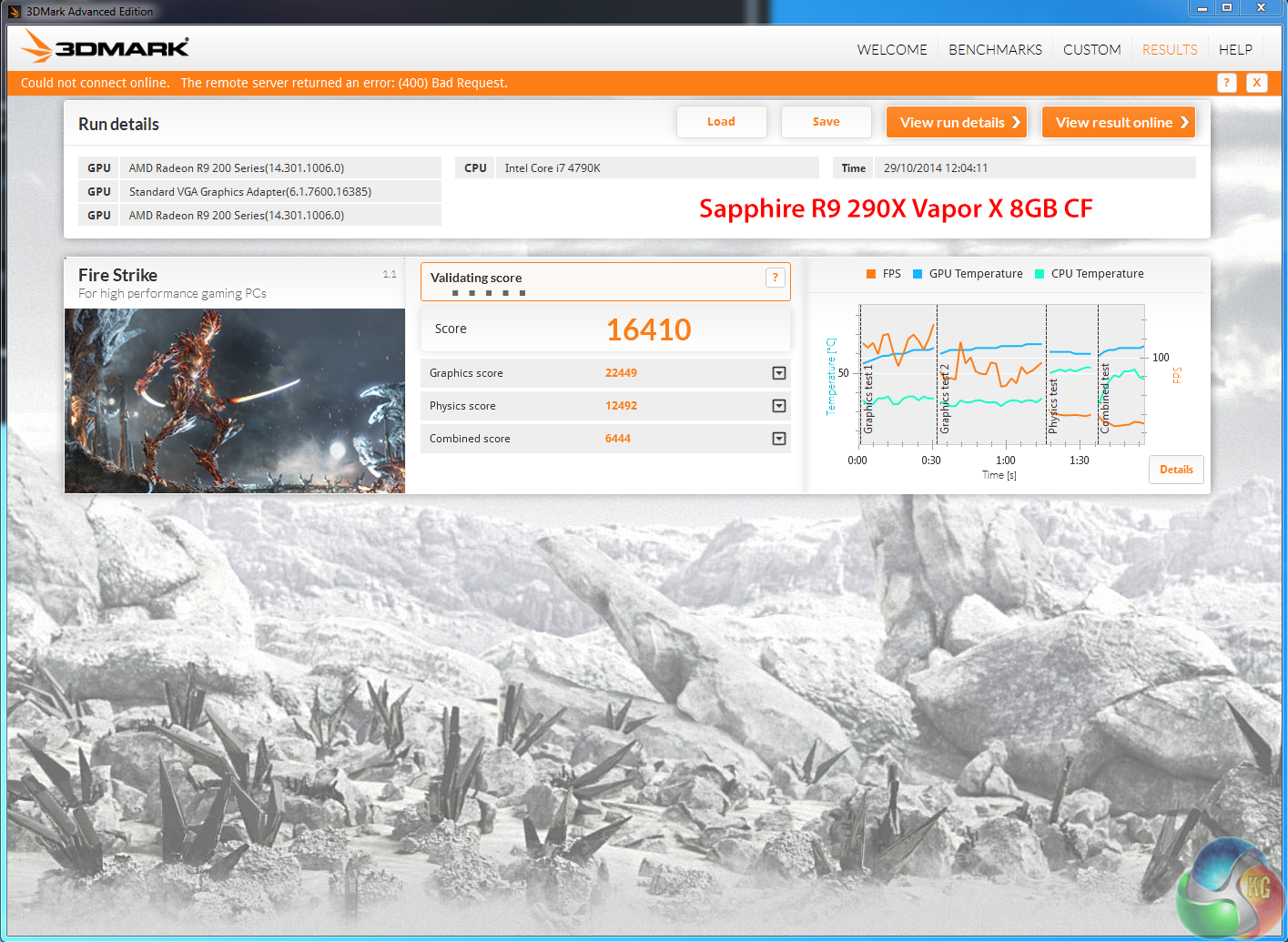
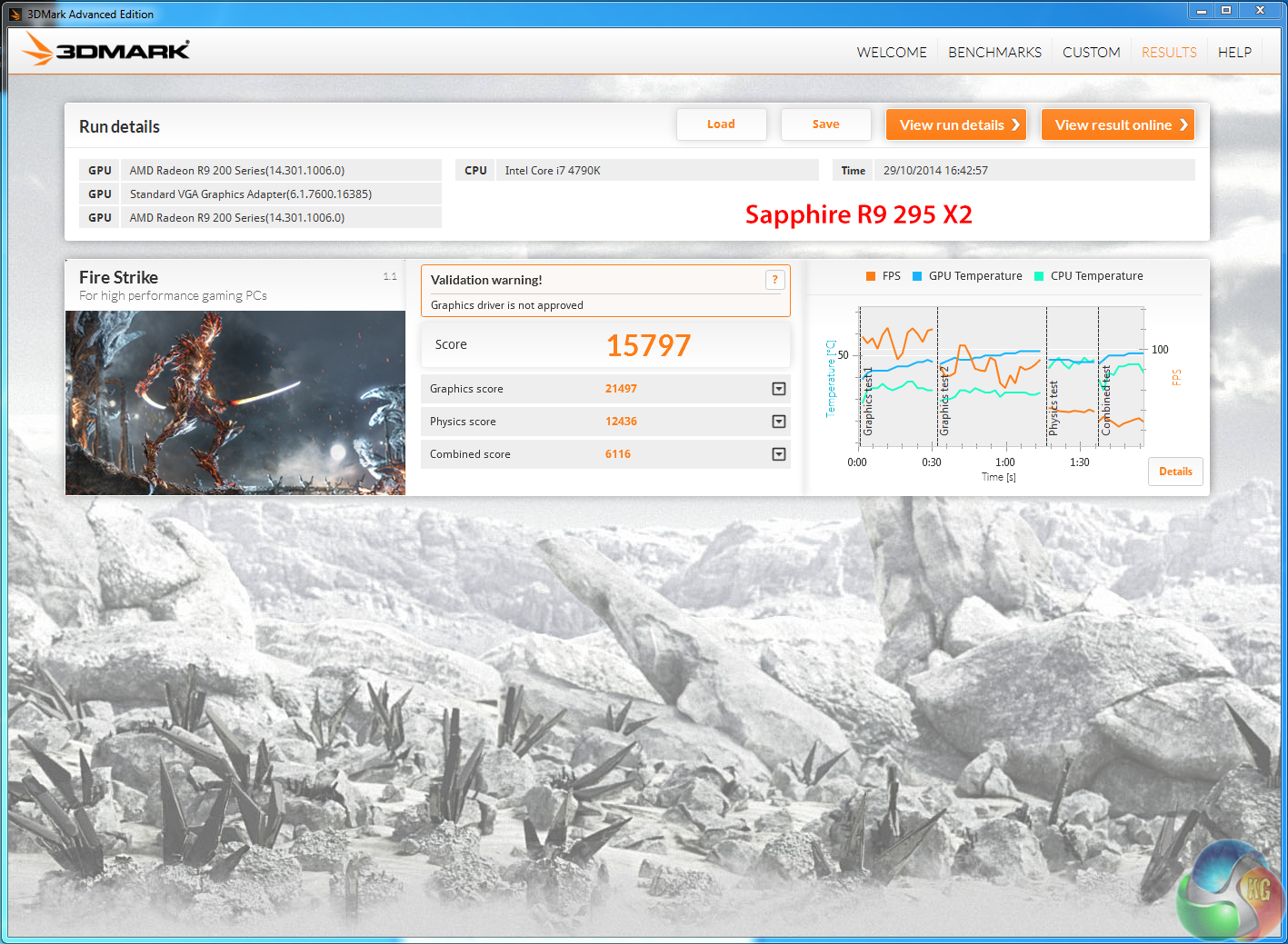
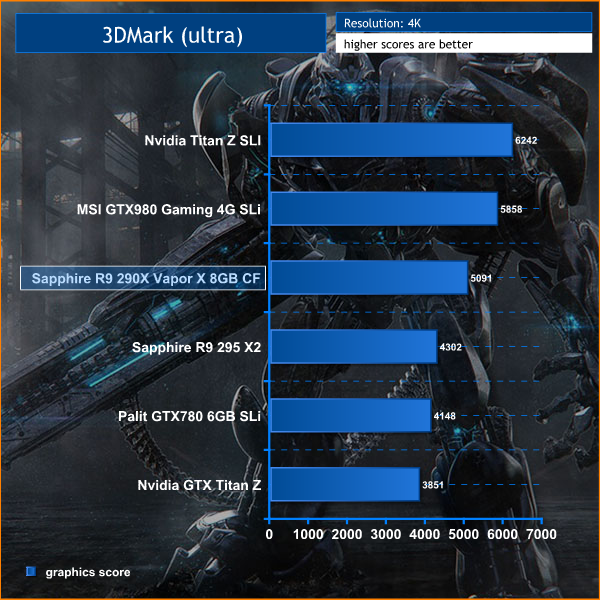
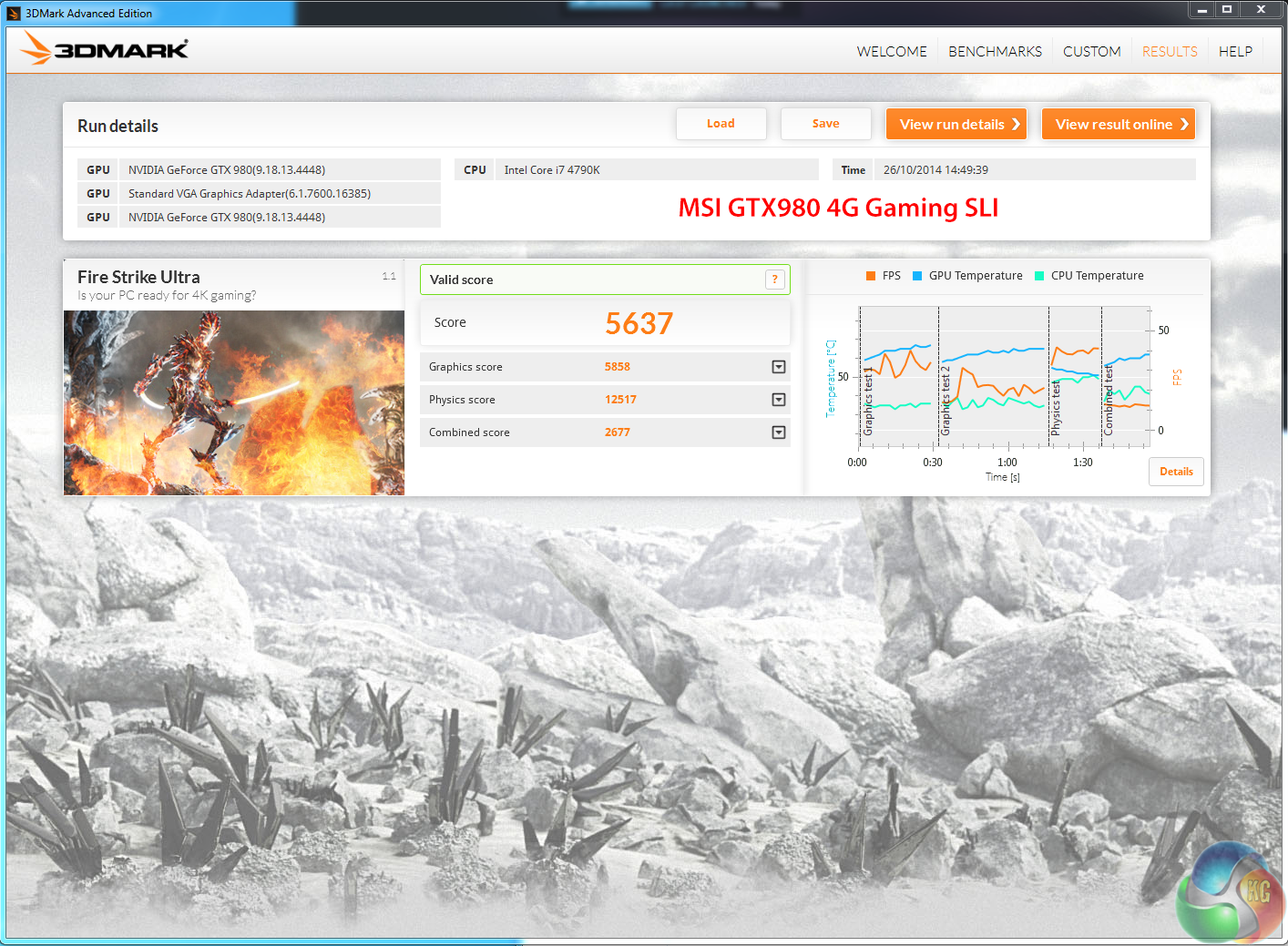
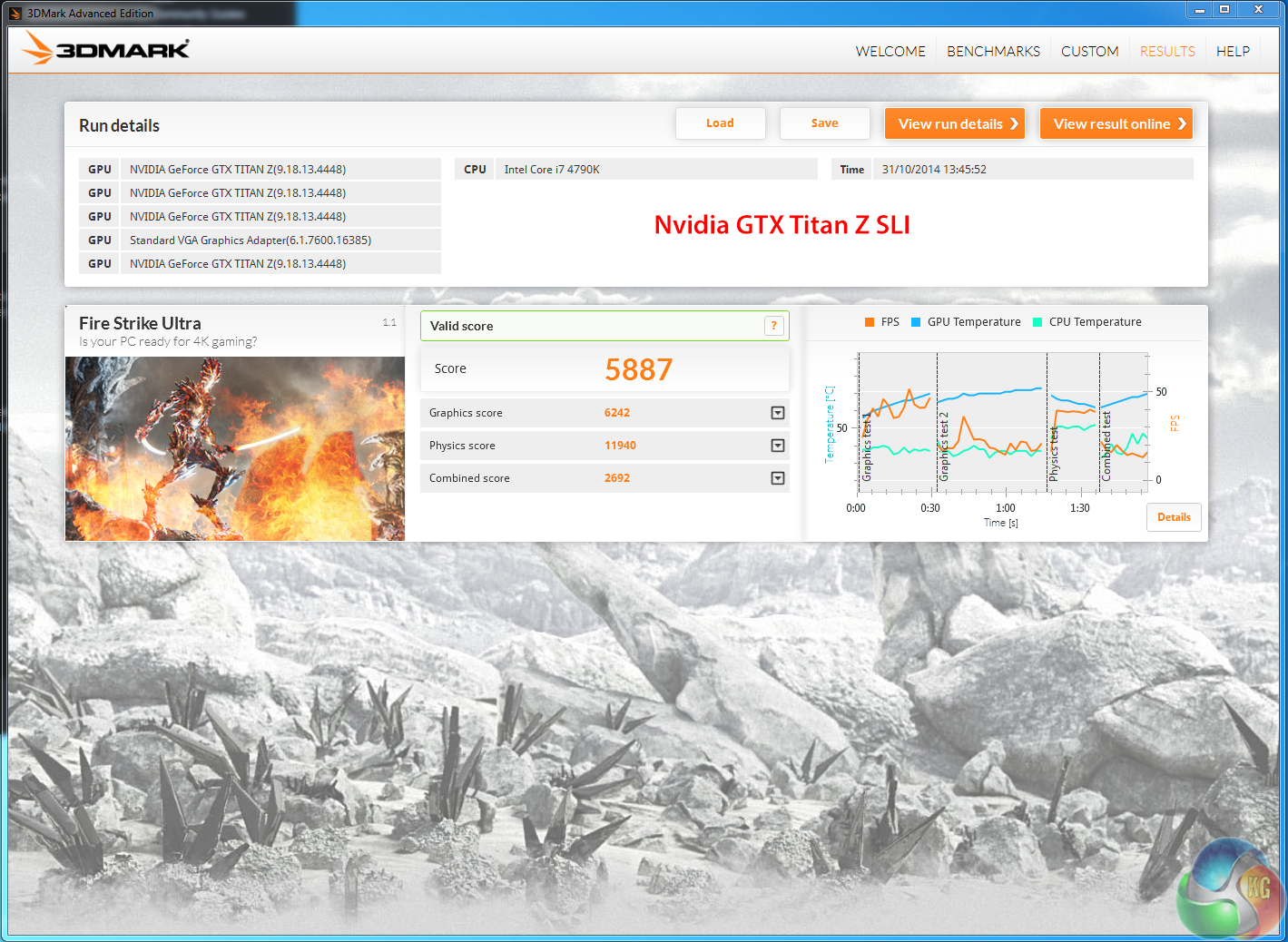
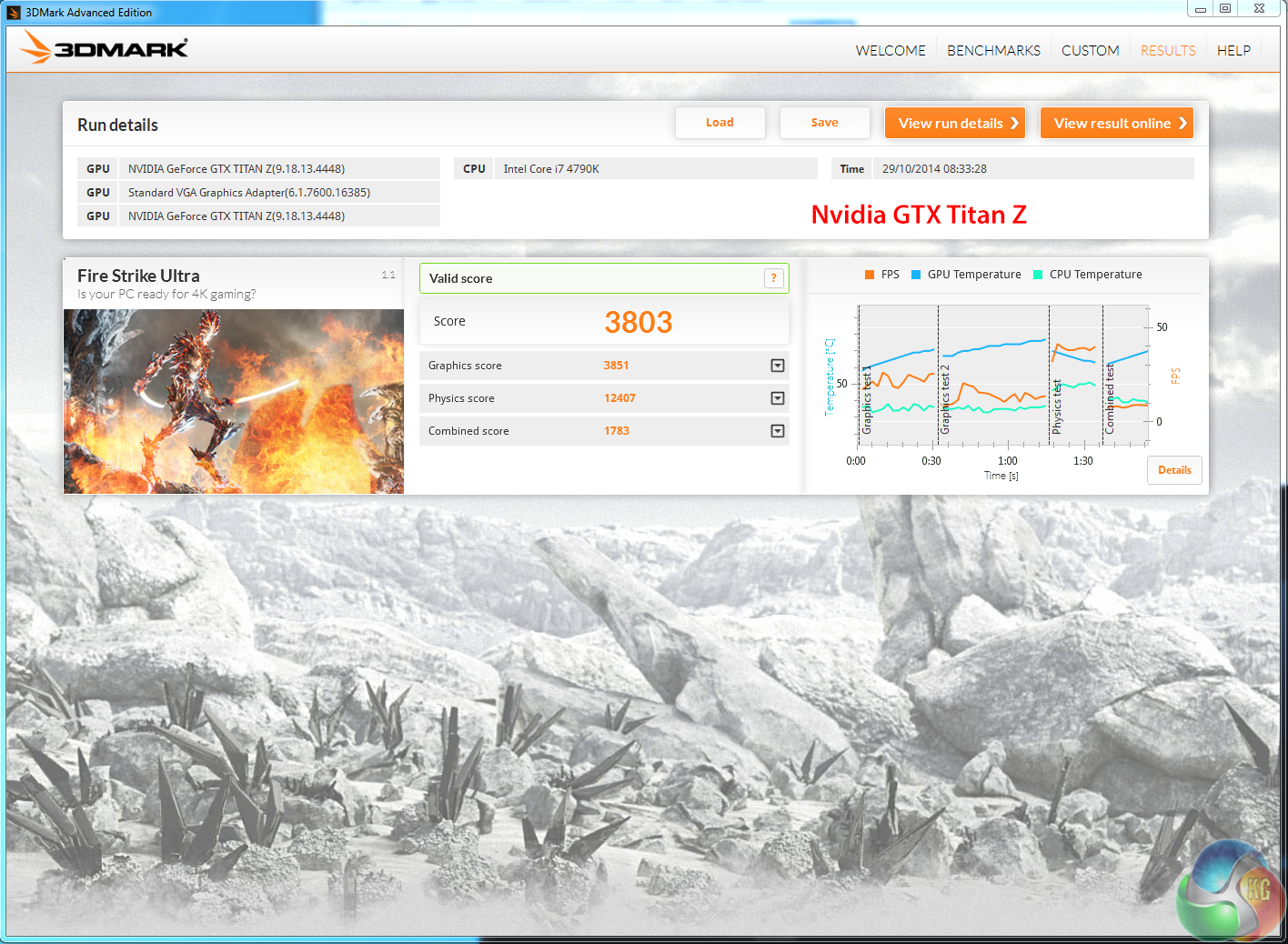
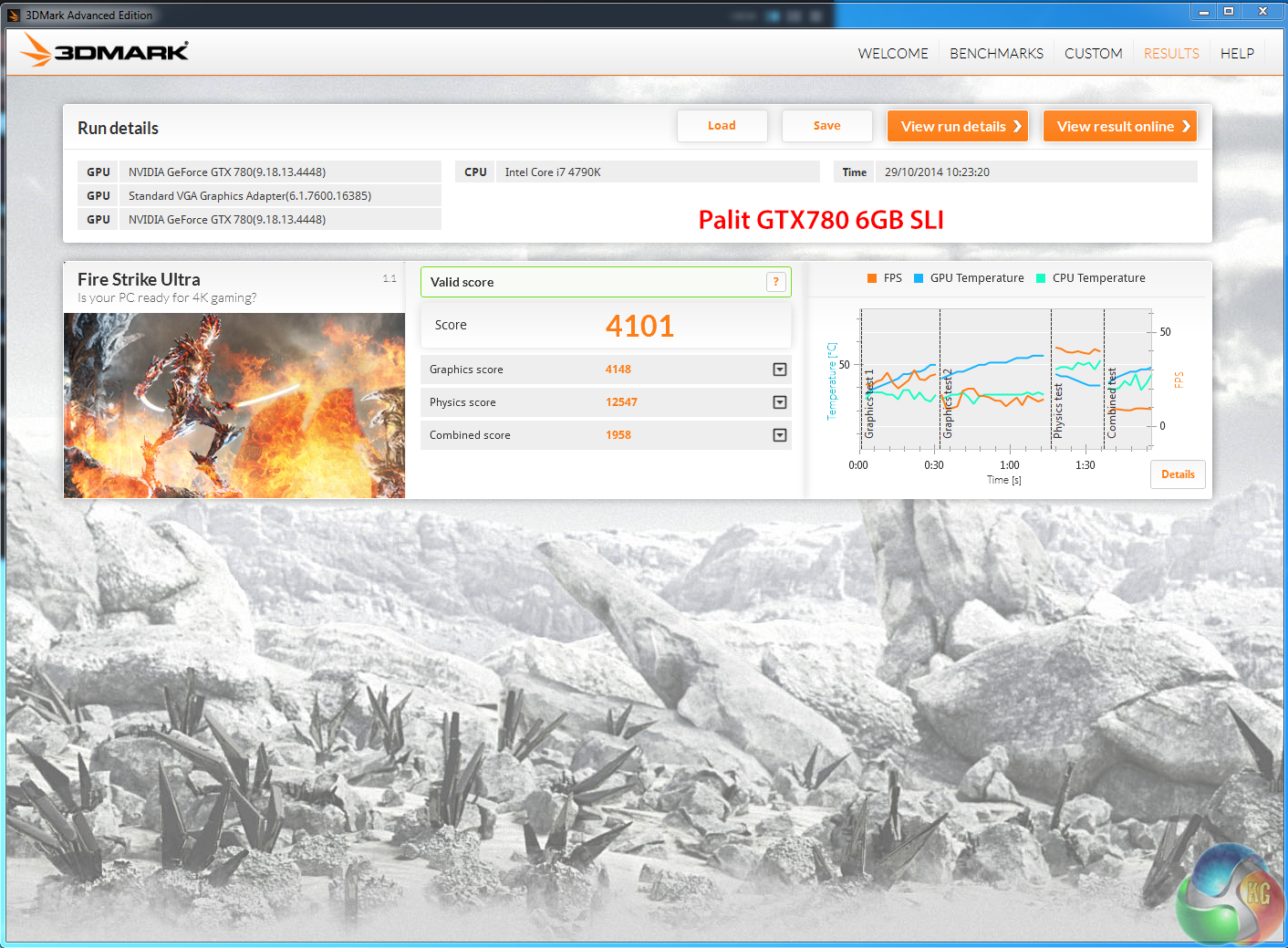
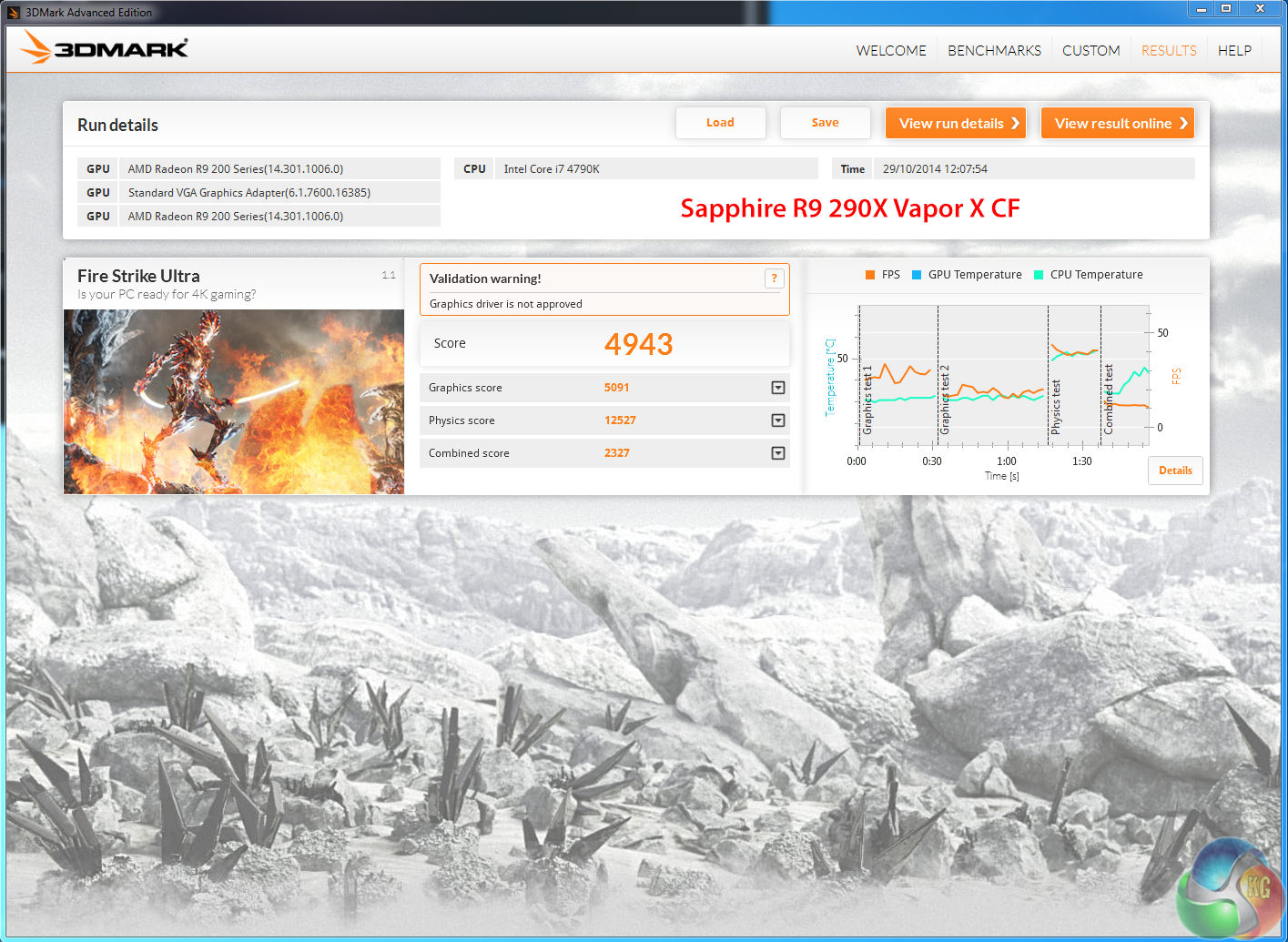
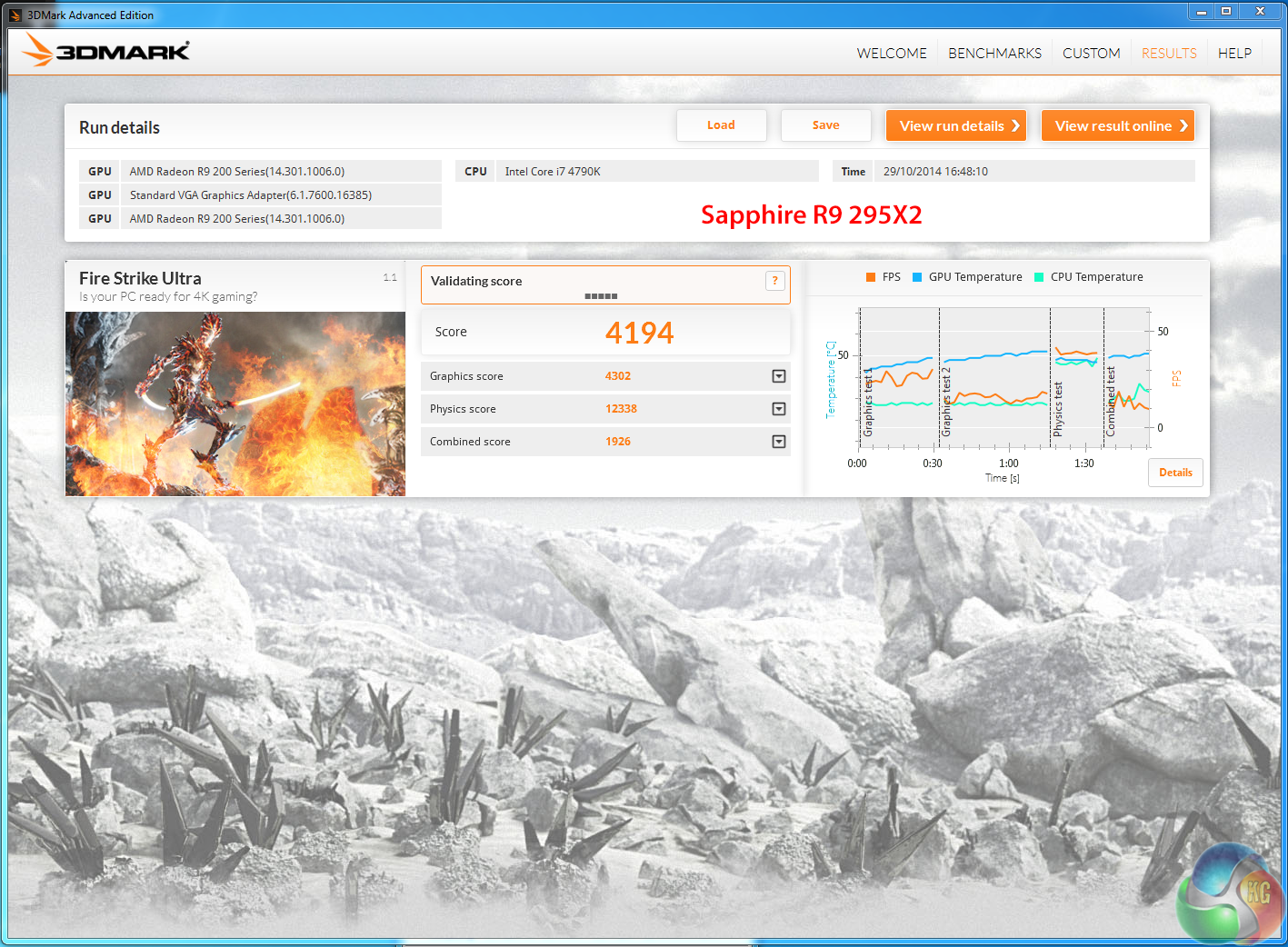
The two Titan Z cards in Quad SLi hold top position in the latest Direct X 11 benchmark from Futuremark. The Sapphire R9 290X Vapor X cards in Crossfire hold a mid position in the table, above the R9 295X2. The single Titan Z scores at the bottom of the chart trading places with the Palit GTX780 6GB in SLi, due to the low clock speeds of both GPU cores.
Unigine provides an interesting way to test hardware. It can be easily adapted to various projects due to its elaborated software design and flexible toolset. A lot of their customers claim that they have never seen such extremely-effective code, which is so easy to understand.
Heaven Benchmark is a DirectX 11 GPU benchmark based on advanced Unigine engine from Unigine Corp. It reveals the enchanting magic of floating islands with a tiny village hidden in the cloudy skies. Interactive mode provides emerging experience of exploring the intricate world of steampunk. Efficient and well-architected framework makes Unigine highly scalable:
- Multiple API (DirectX 9 / DirectX 10 / DirectX 11 / OpenGL) render
- Cross-platform: MS Windows (XP, Vista, Windows 7) / Linux
- Full support of 32bit and 64bit systems
- Multicore CPU support
- Little / big endian support (ready for game consoles)
- Powerful C++ API
- Comprehensive performance profiling system
- Flexible XML-based data structures
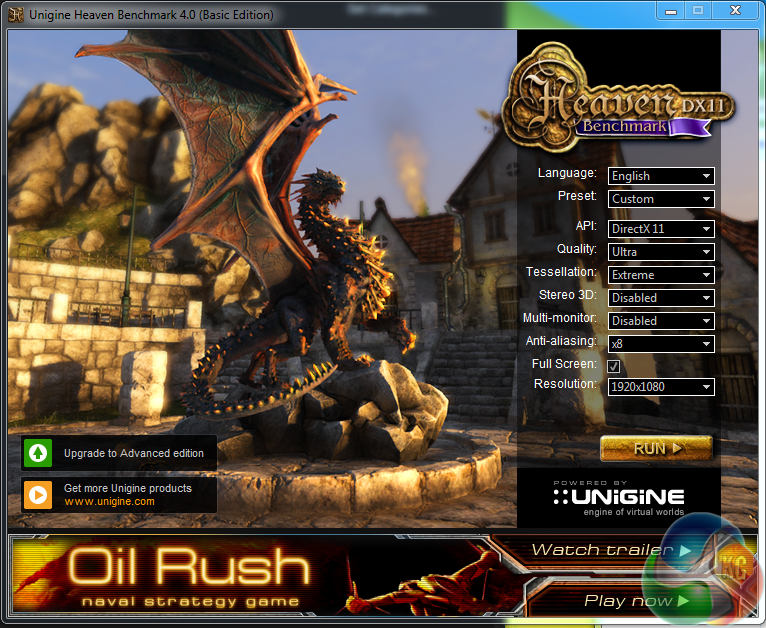
We run the test at 1080p and select EXTREME Tessellation, with 8 times Anti Aliasing. Quality is set to ULTRA.
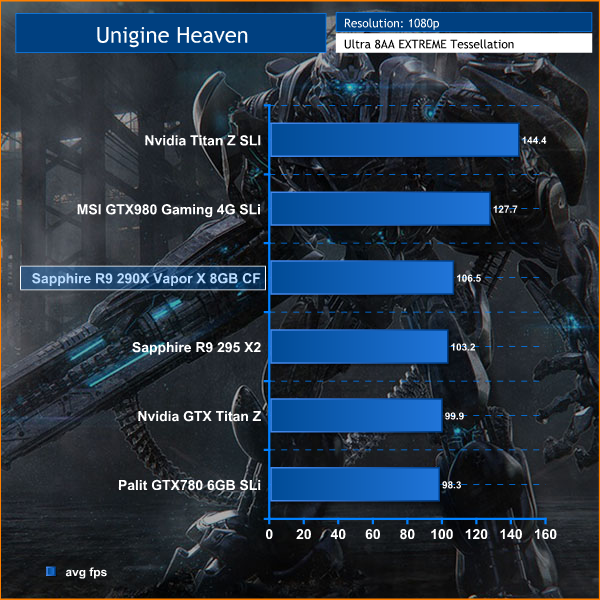
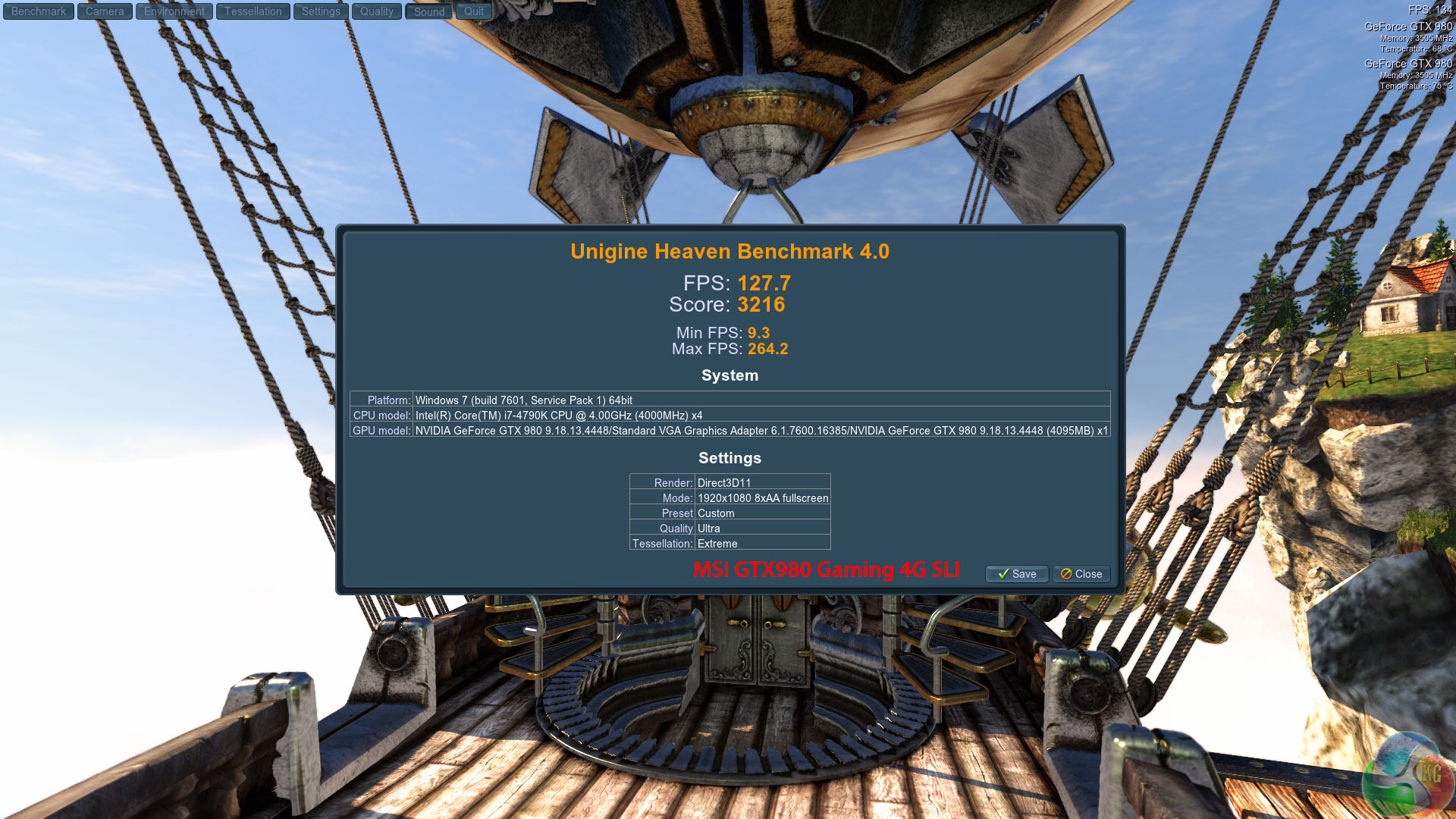
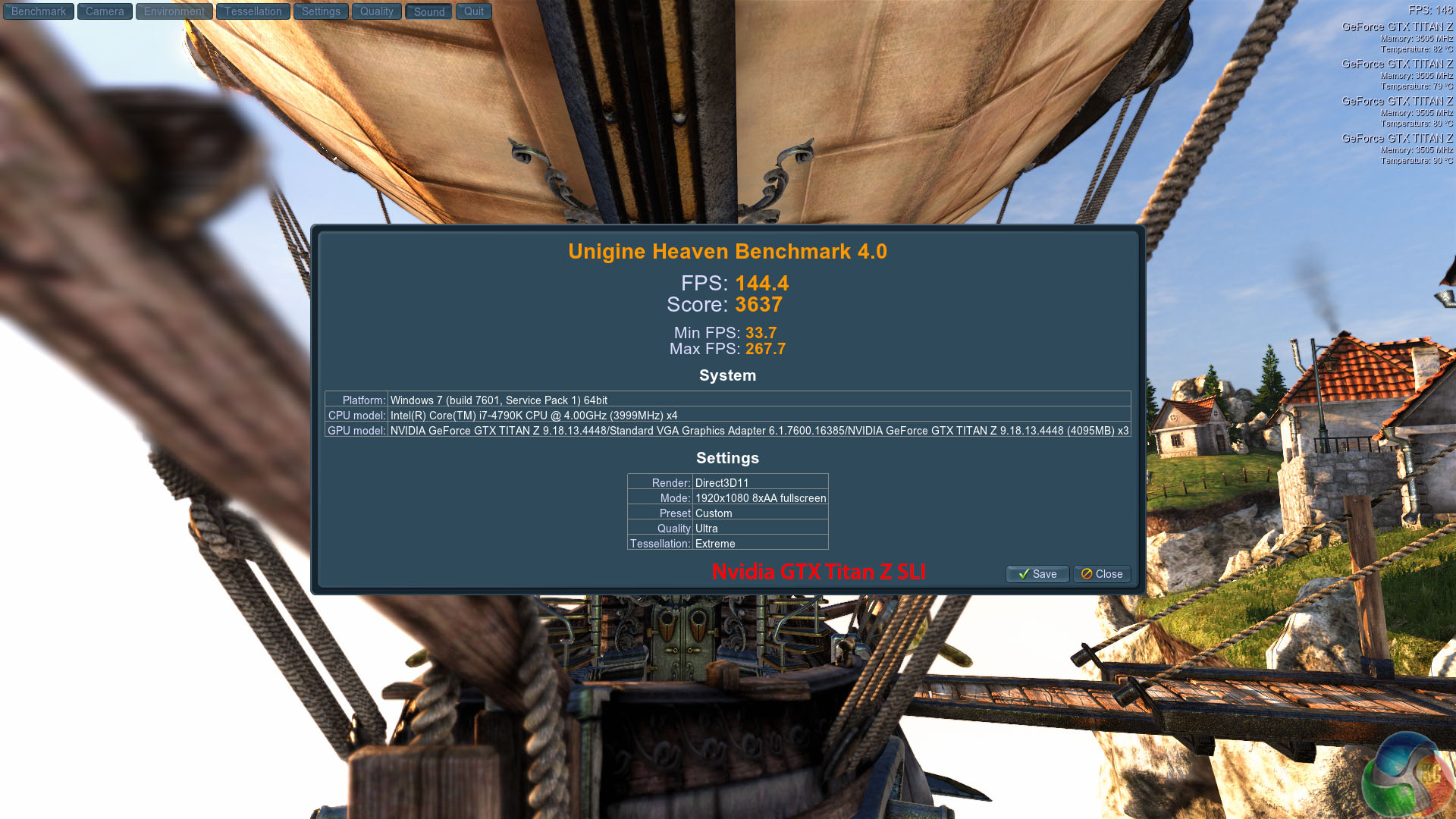
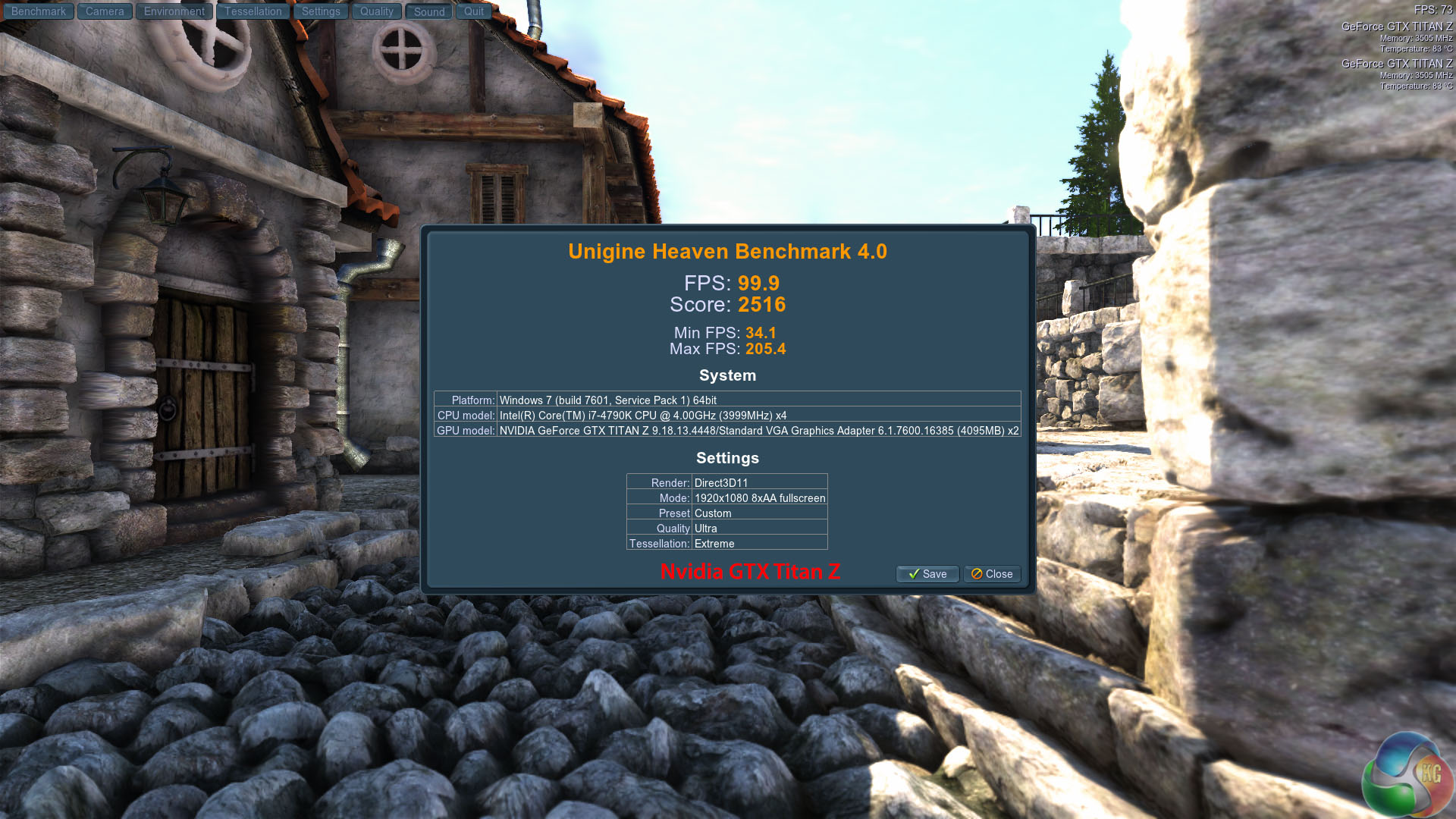
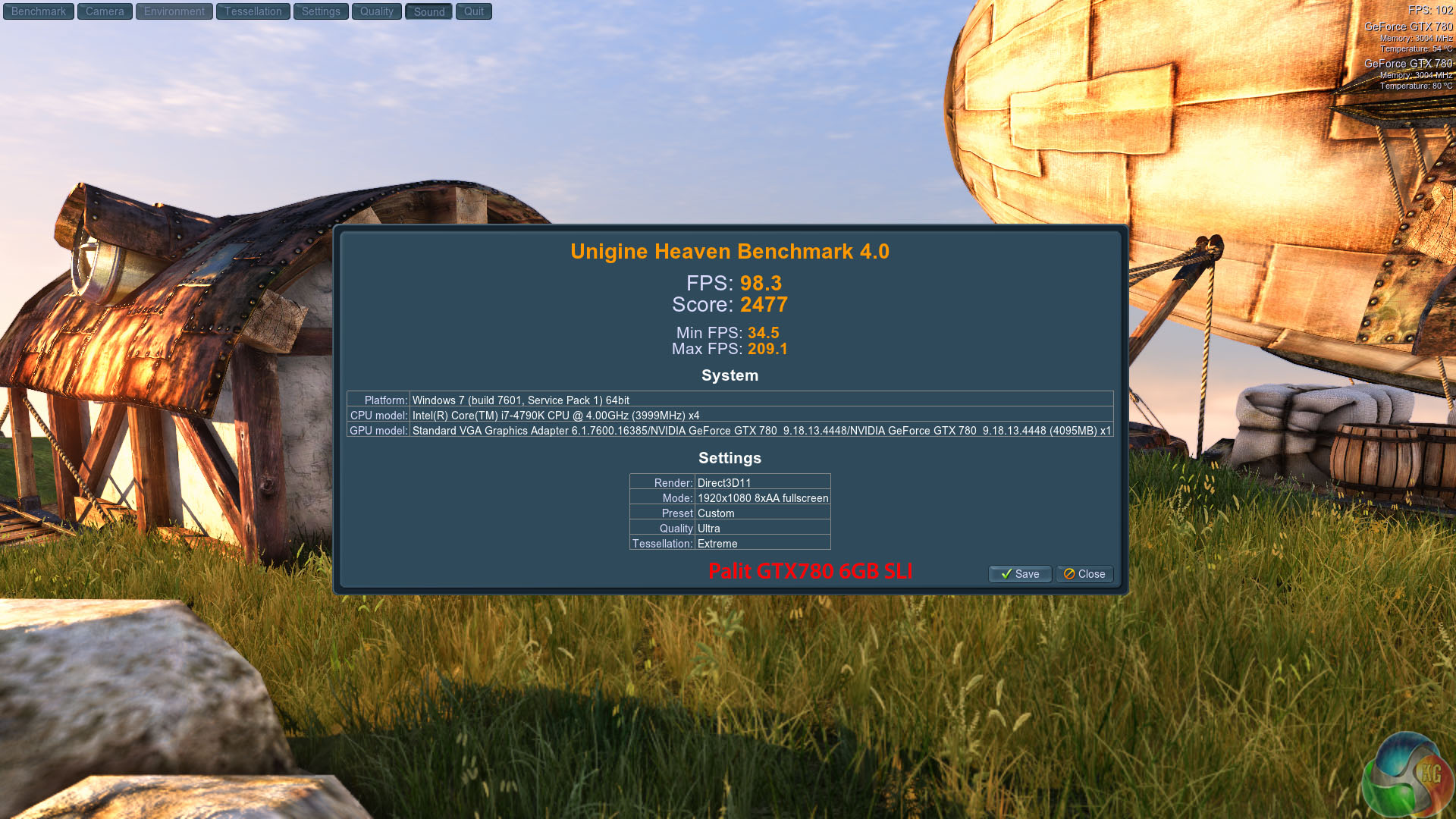
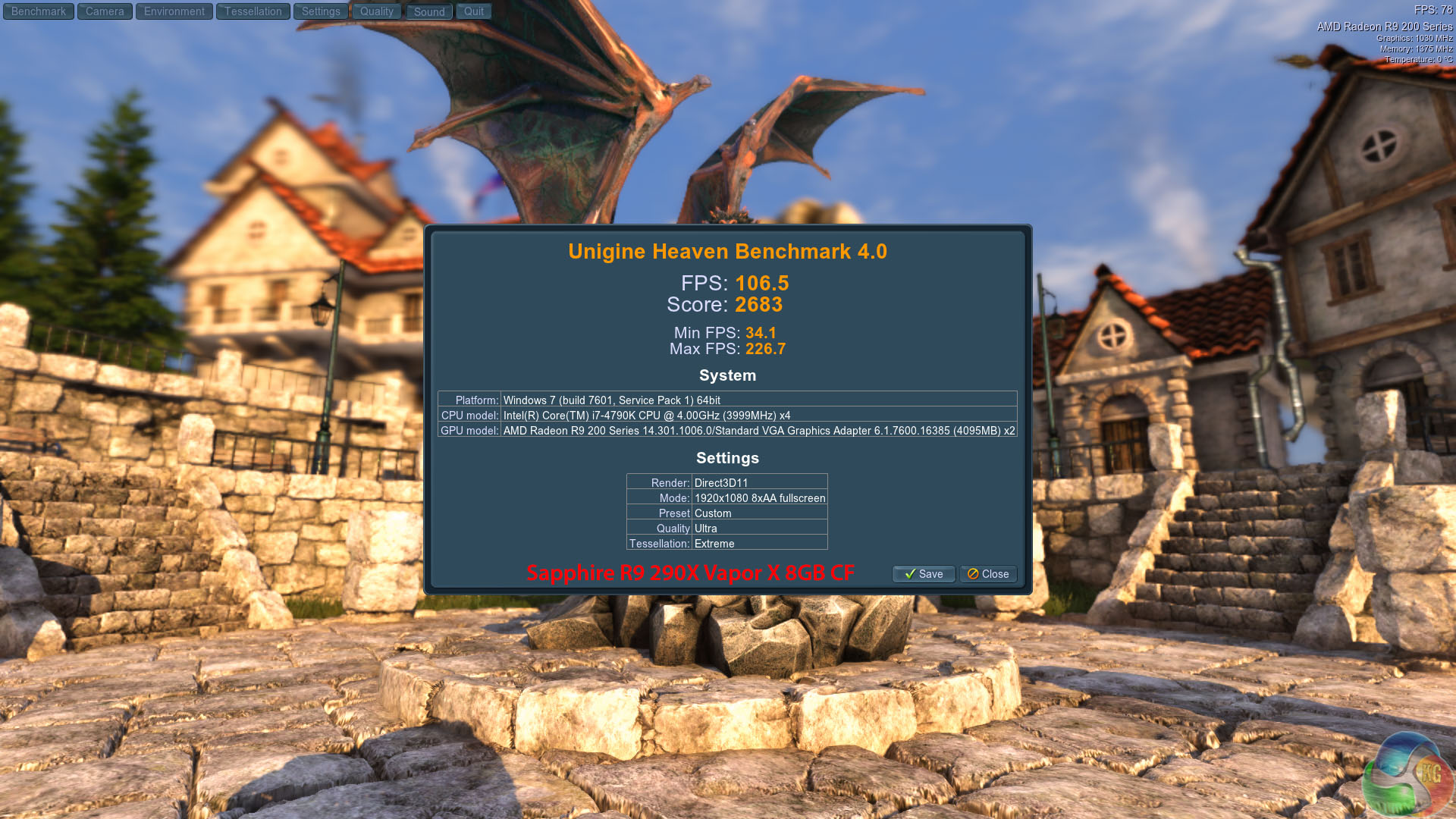
The Sapphire R9 290X Vapor X 8GB cards hold an average of 106.5 frames per second, placing them around 21 frames behind the MSI GTX980 Gaming 4G SLi configuration. The dual Titan Z graphics cards hold an average of 144.4 frames per second with the single card holding a 100 frame per second average.
Tomb Raider received much acclaim from critics, who praised the graphics, the gameplay and Camilla Luddington’s performance as Lara with many critics agreeing that the game is a solid and much needed reboot of the franchise. Much criticism went to the addition of the multiplayer which many felt was unnecessary. Tomb Raider went on to sell one million copies in forty-eight hours of its release, and has sold 3.4 million copies worldwide so far. (Wikipedia).
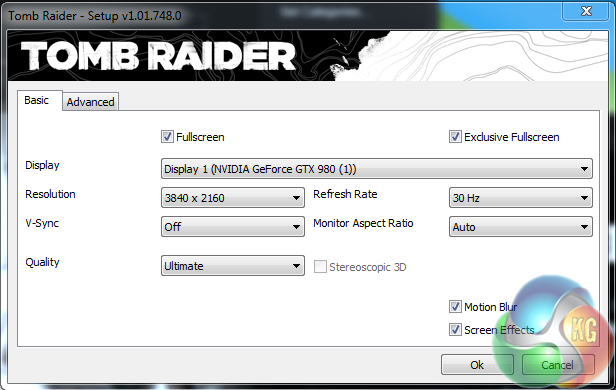
We test at Ultra HD 4k resolution with the ULTIMATE image quality profile. This is the most demanding settings you can use in this game engine and a single card will struggle to produce smooth frame rates.
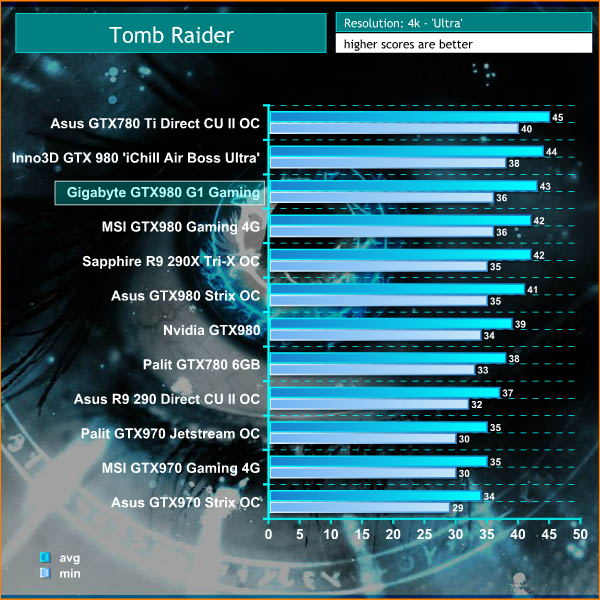
The Tomb Raider engine is one of the best and it supports SLI and Crossfire very well. The Two Titan Z's in Quad SLi produce amazing frame rates and are the only cards on test that combined will hold a frame rate above 60 at all times. Of course we need to factor in the price – one of them still costs more than both of the MSI GTX980 Gaming 4G cards in SLI. The Sapphire R9 290X Vapor X 8GB in Crossfire hold an average frame rate of 60, dropping to 45 in the more intensive sections of the environment.
Grid Autosport (styled as GRID Autosport) is a racing video game by Codemasters and is the sequel to 2008′s Race Driver: Grid and 2013′s Grid 2. The game was released for Microsoft Windows, PlayStation 3 and Xbox 360 on June 24, 2014. (Wikipedia).
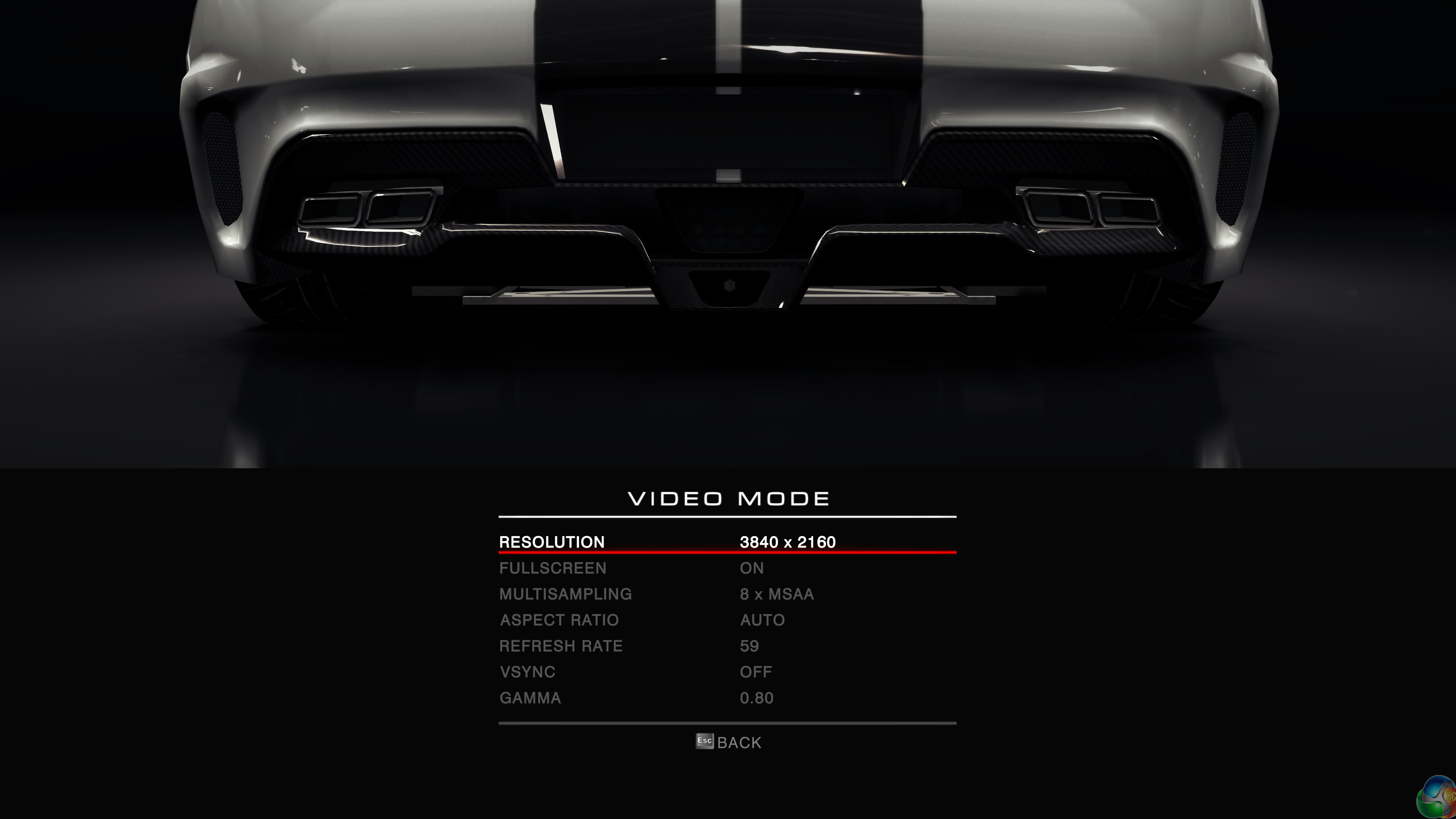
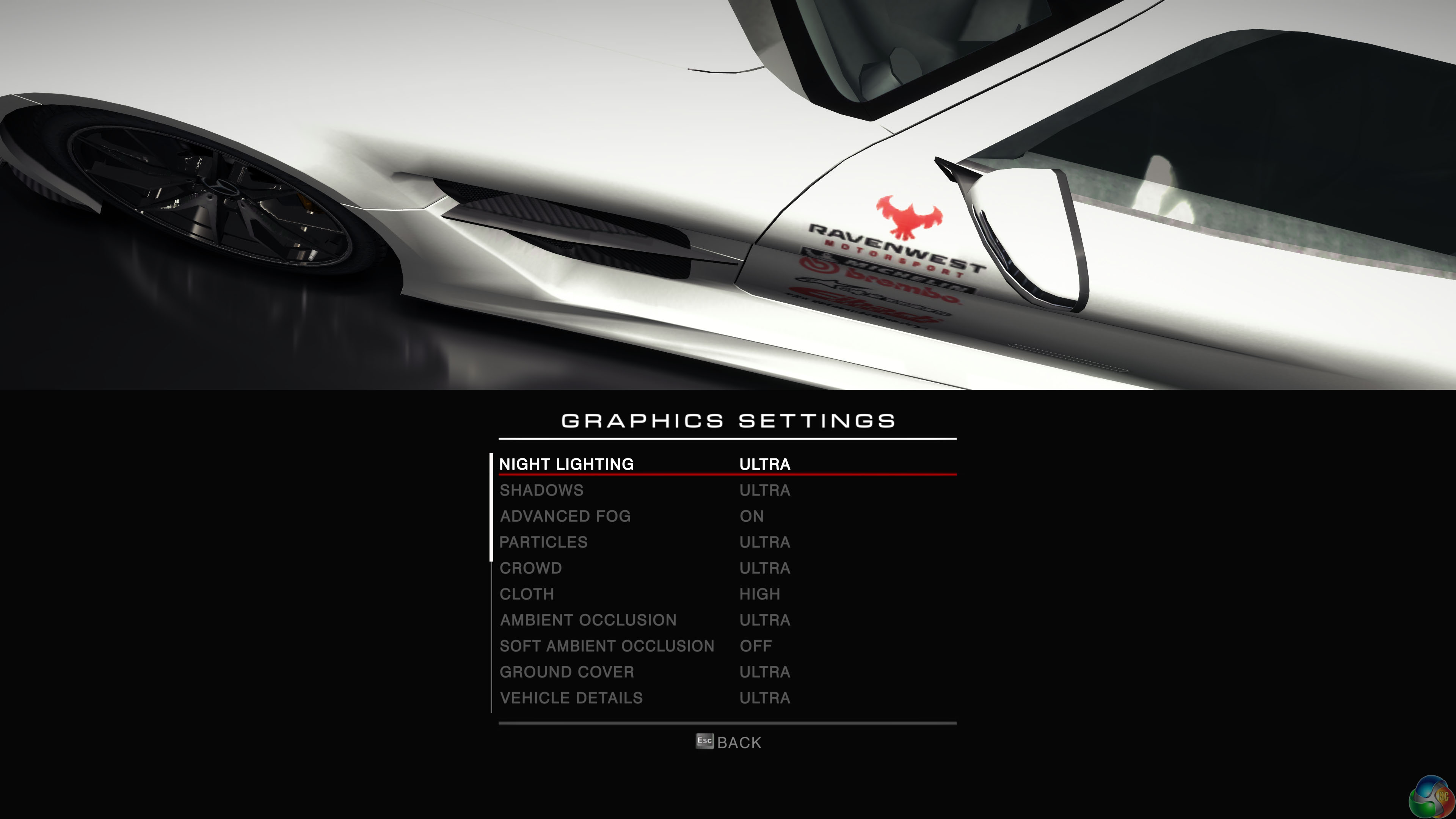
We test at Ultra HD 4k with the ULTRA image quality profile enabled for maximum image quality. Anti Aliasing is set to 8 times MSAA.
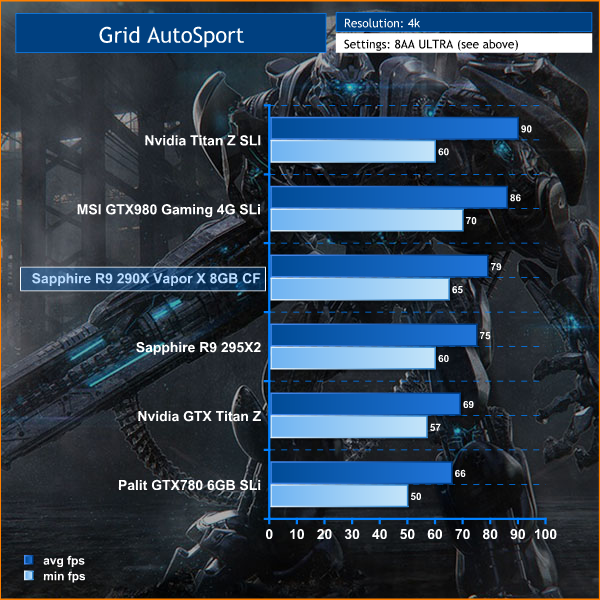
This engine isn't too demanding at lower settings, but at Ultra HD 4k, with 8AA at ‘ULTRA' preset it demands a good GPU to get smooth frame rates. The Sapphire R9 290X Vapor X 8GB cards in Crossfire perform exceptionally well, holding a frame rate between 65 and 79.On May 22, 2014, a Redux version of Metro Last Light was announced. It was released on August 26, 2014 in North America and August 29, 2014 in Europe for the PC, PlayStation 4 and Xbox One. Redux adds all the DLC and graphical improvements. A compilation package, titled Metro Redux, was released at the same time which includes Last Light and 2033. (Wikipedia). We test with following settings: Quality-High, SSAA-on, Texture Filtering-16x, Motion Blur-off, Tessellation-Normal, Advanced Physx-on.
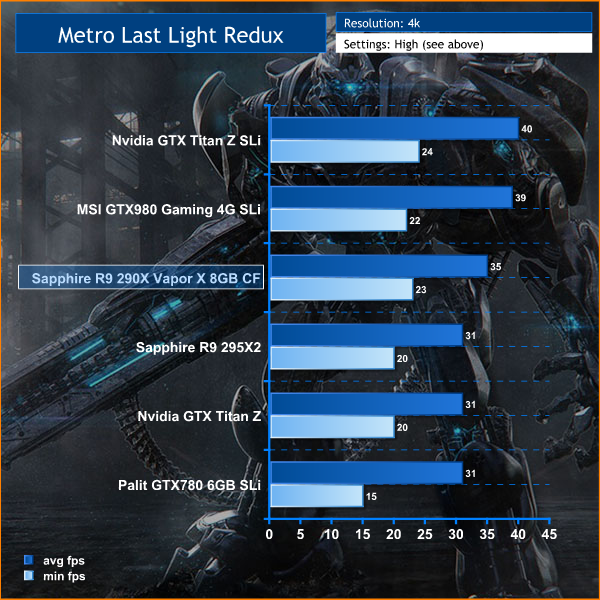
At these settings this engine is incredibly demanding, bringing the cards to their knees. The Titan Z in Quad SLI doesn't deliver massive gains, around 9fps extra. We wouldn't call any of the configurations completely playable however and some image quality would need reduced.
Total War: ROME II – Emperor Edition: Emperor Edition is the definitive edition of ROME II, featuring an improved politics system, overhauled building chains, rebalanced battles and improved visuals in both campaign and battle.

We test at Ultra HD 4K with the ULTRA and EXTREME profiles – the most visually taxing in game settings possible.
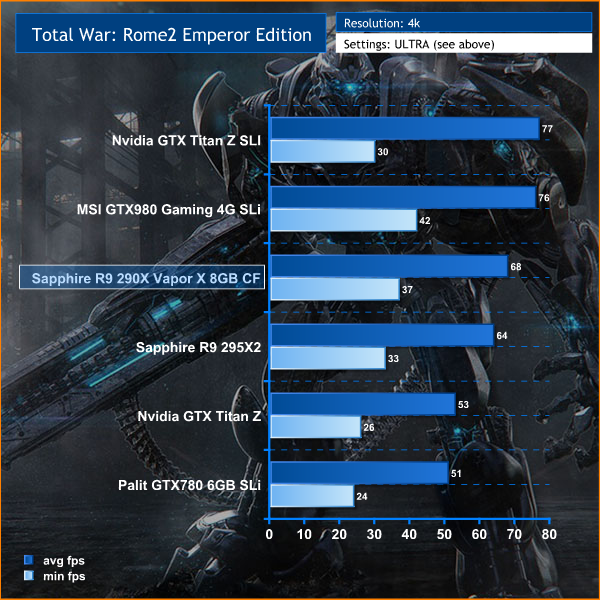
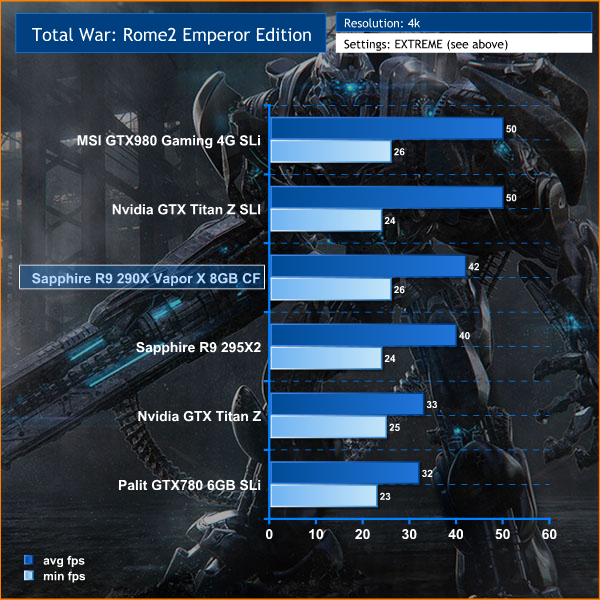
A very demanding engine, but quite well optimised lately for multiple cards.The Sapphire R9 290X VaporX 8GB CF perform well, holding a 60+ frame rate average, dropping to 26-37 during the most intensive sections of the battles.
Watch Dogs is an action-adventure game played from a third-person perspective. Players complete missions—linear scenarios with set objectives—to progress through the story. Outside of missions, players can freely roam the open world of Chicago. The world may be fully explored from the beginning of the game without restrictions, although story progress unlocks more gameplay content. (Wikipedia).
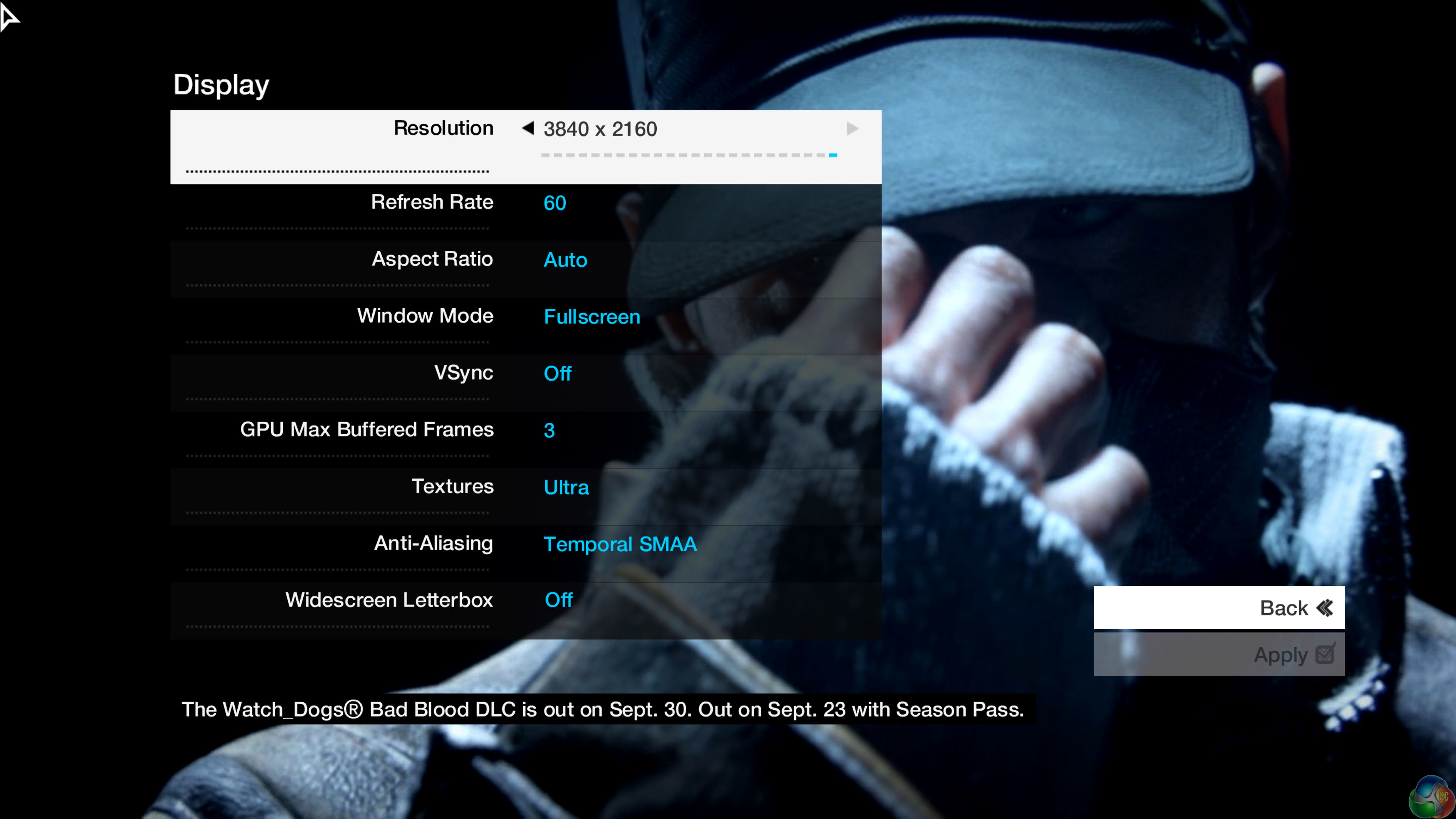
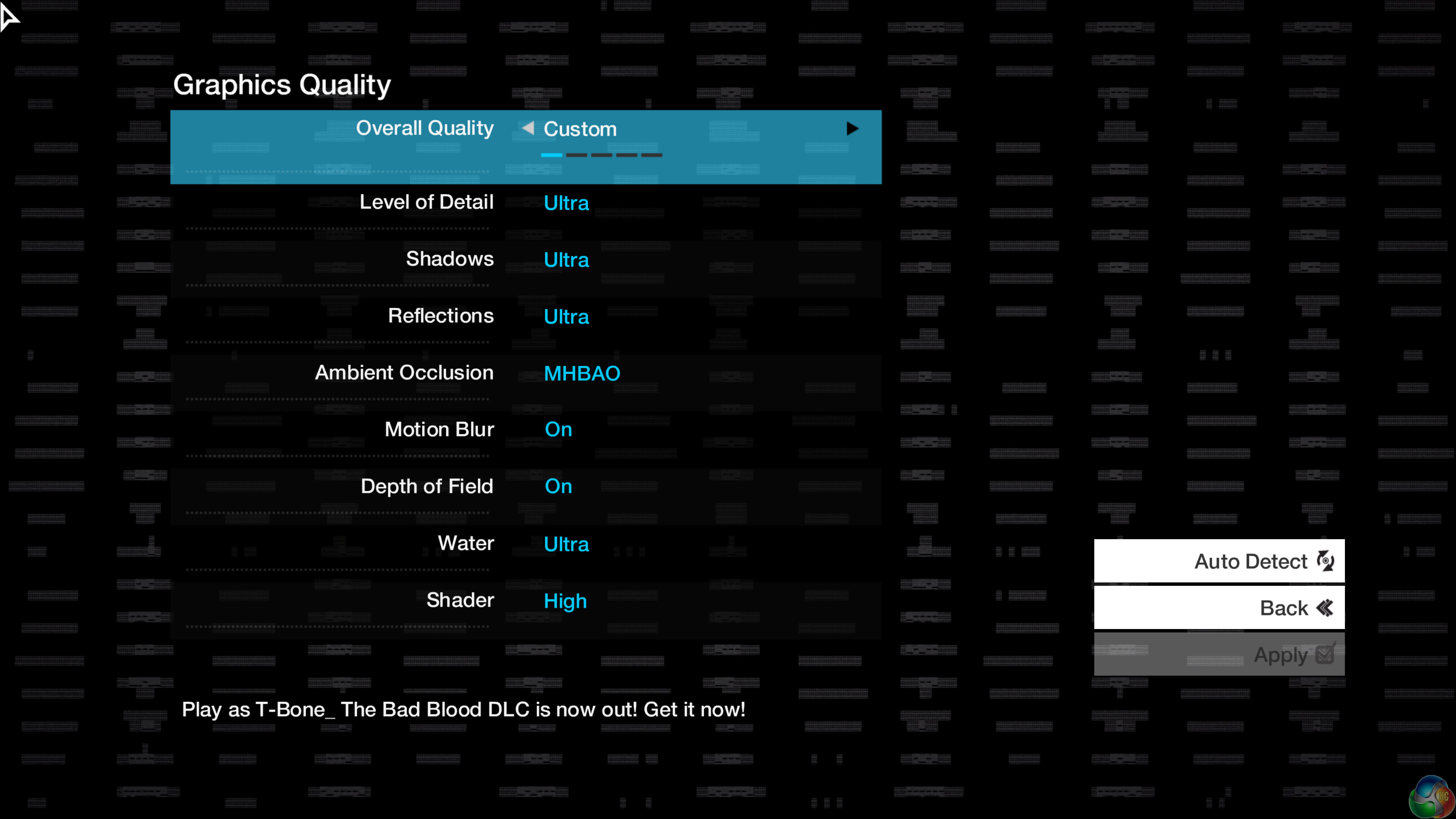
We configure image quality settings as shown above, to test the hardware at 4K.
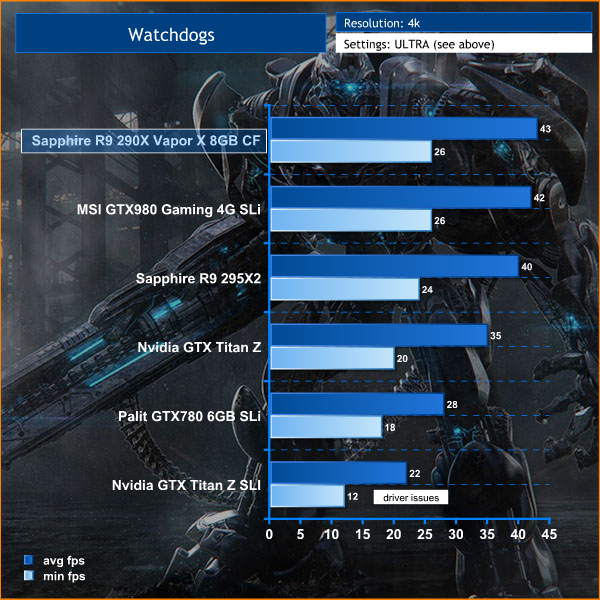
We experienced significant driver issues when running two Titan Z cards in SLi. In the title screens the frame rate would be high, but the actual game engine would suffer compared to a single Titan Z card – which ran very well. The Sapphire R9 290X Vapor X 8GB cards claimed top position in this particular test, only slightly ahead of the MSI GTX980 Gaming 4G cards in SLI.
Thief is set in a dark fantasy world inspired by Victorian, gothic, and steampunk aesthetics. Garrett, a master thief who has been away from his hometown for a long time, returns to it, a place known only as The City, and finds it ruled with an iron grip by a tyrant called The Baron. While The City is ravaged by a plague, the rich continue to live in isolation and good fortune while the poor are forming numerous mobs against the authorities, Garrett intends to use the volatile situation to his favor. (Wikipedia).
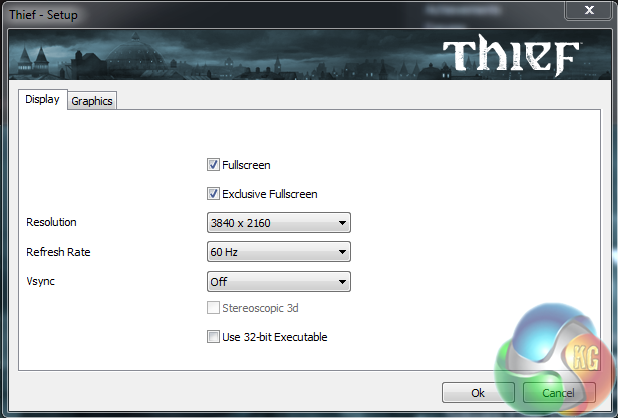
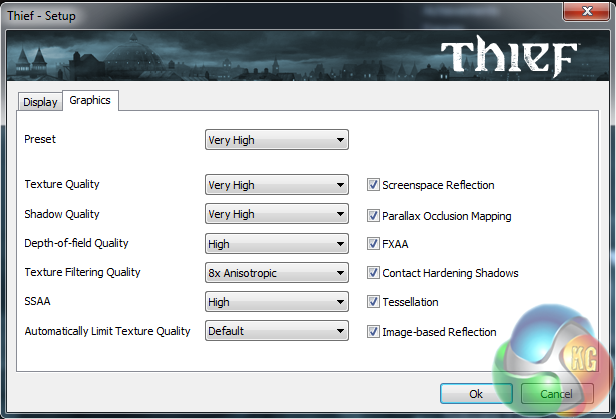
We test at Ultra HD 4K with the ‘very high' setting enabled.
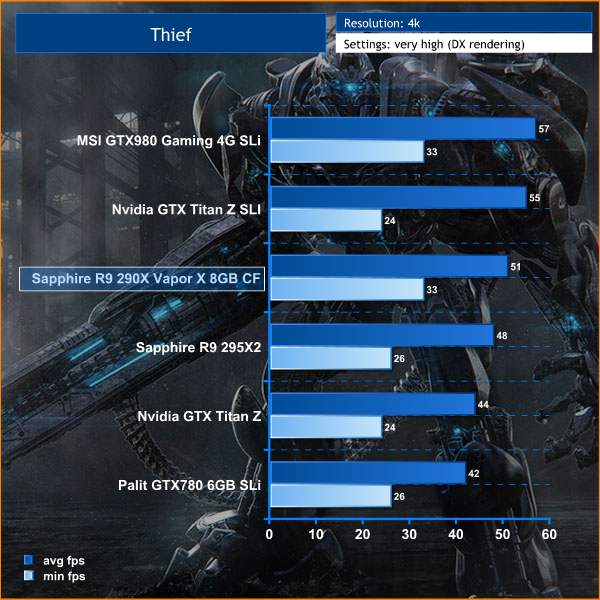
The MSI GTX980 Gaming 4G cards scored very well in this benchmark thanks to the very high core clock speeds. The Quad SLI driver profile didn't work out too great, especially as the minimum frame rate was identical to the single card.
Far Cry 3 is a first-person shooter, which also features role-playing game elements including experience points, skill trees, and a crafting system. The player has the ability to take cover behind objects to break enemies' lines of sight and to peek around and over cover and blindfire. The player has the ability to perform silent takedowns by performing melee attacks from above, below, or close behind. The game's narrative director, Jason Vandenberghe, said that the story mode map is around ten times larger than the game's previous installments. (Wikipedia).
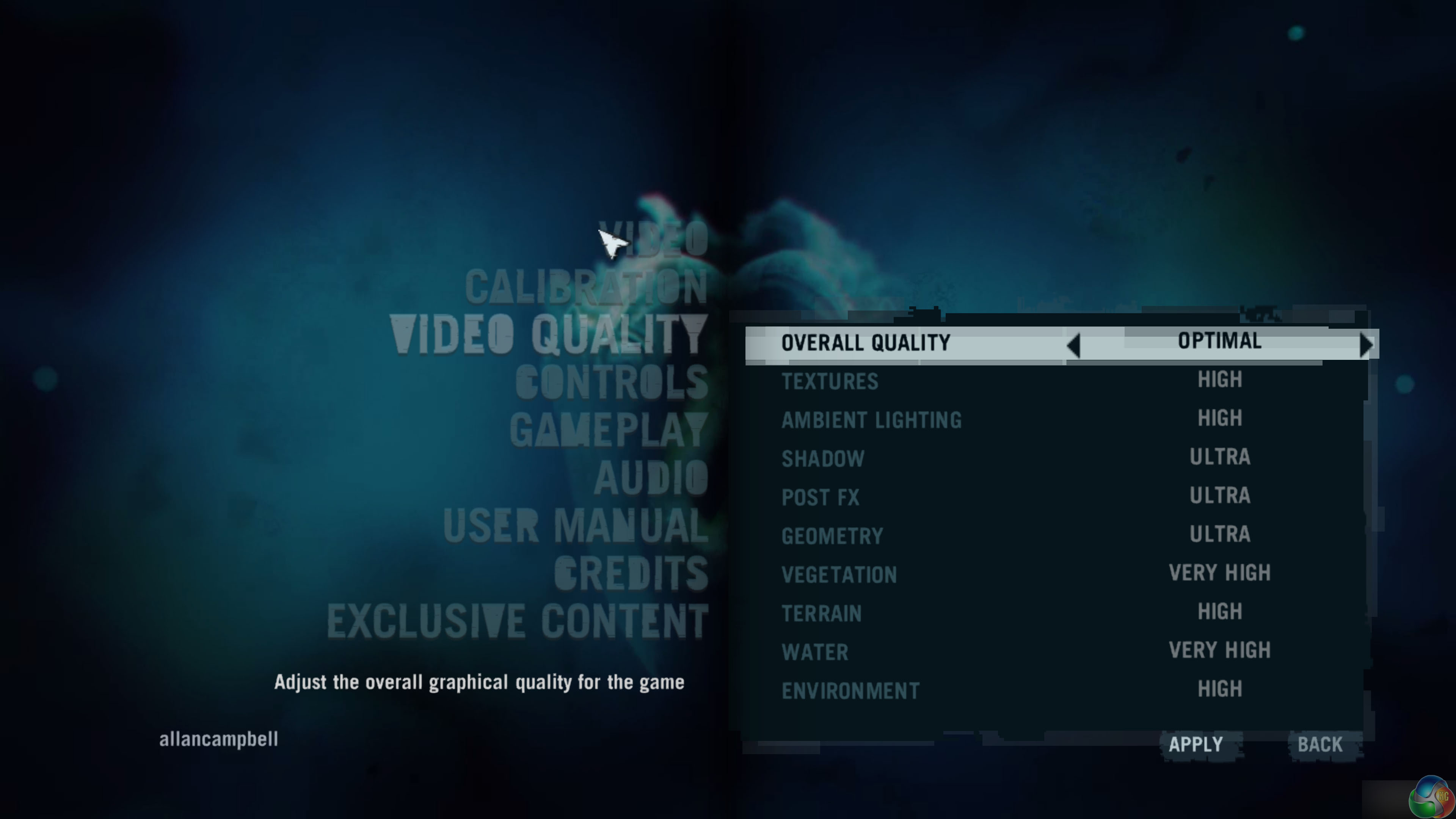
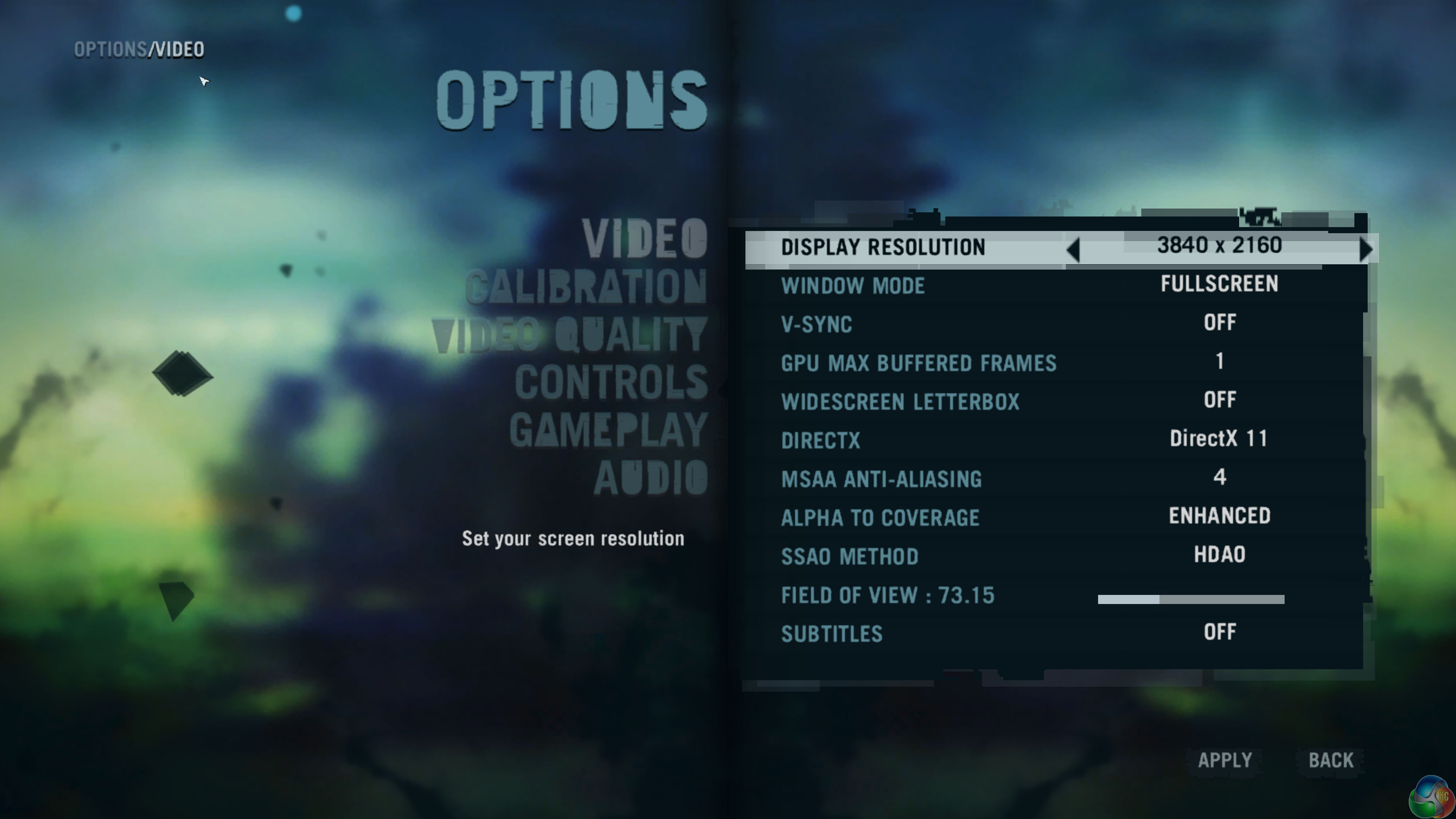
We select Ultra HD 4k resolution and high/ultra image quality settings, as shown above. 4xMSAA was also enabled.
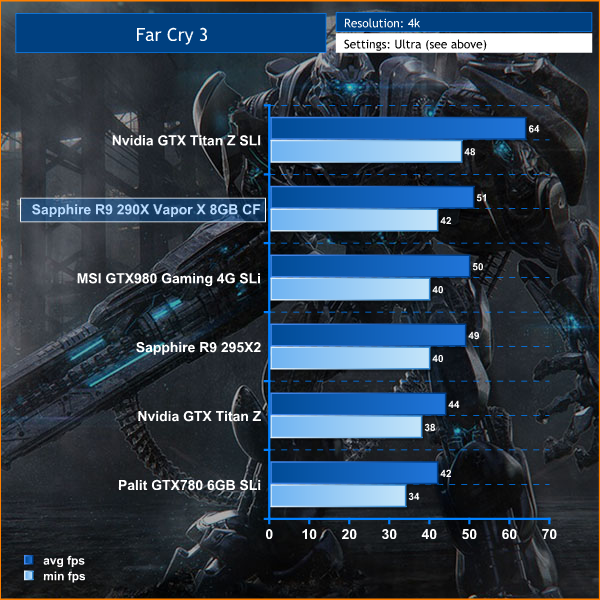
The Nvidia Titan Z in SLi claim top position, although the game suffered from some flickering textures on the buildings. We were never able to eliminate this at the test settings which ruined the game. The Sapphire R9 290X Vapor X 8GB scored very well in this particular engine, averaging 51 frames per second – right ahead of the GTX980 Gaming 4G cards in SLI.
Battlefield 4 's single-player Campaign takes place in 2020, six years after the events of its predecessor. Tensions between Russia and the United States have been running at a record high, due to a conflict between the two countries that has been running for the last six years. (Wikipedia).
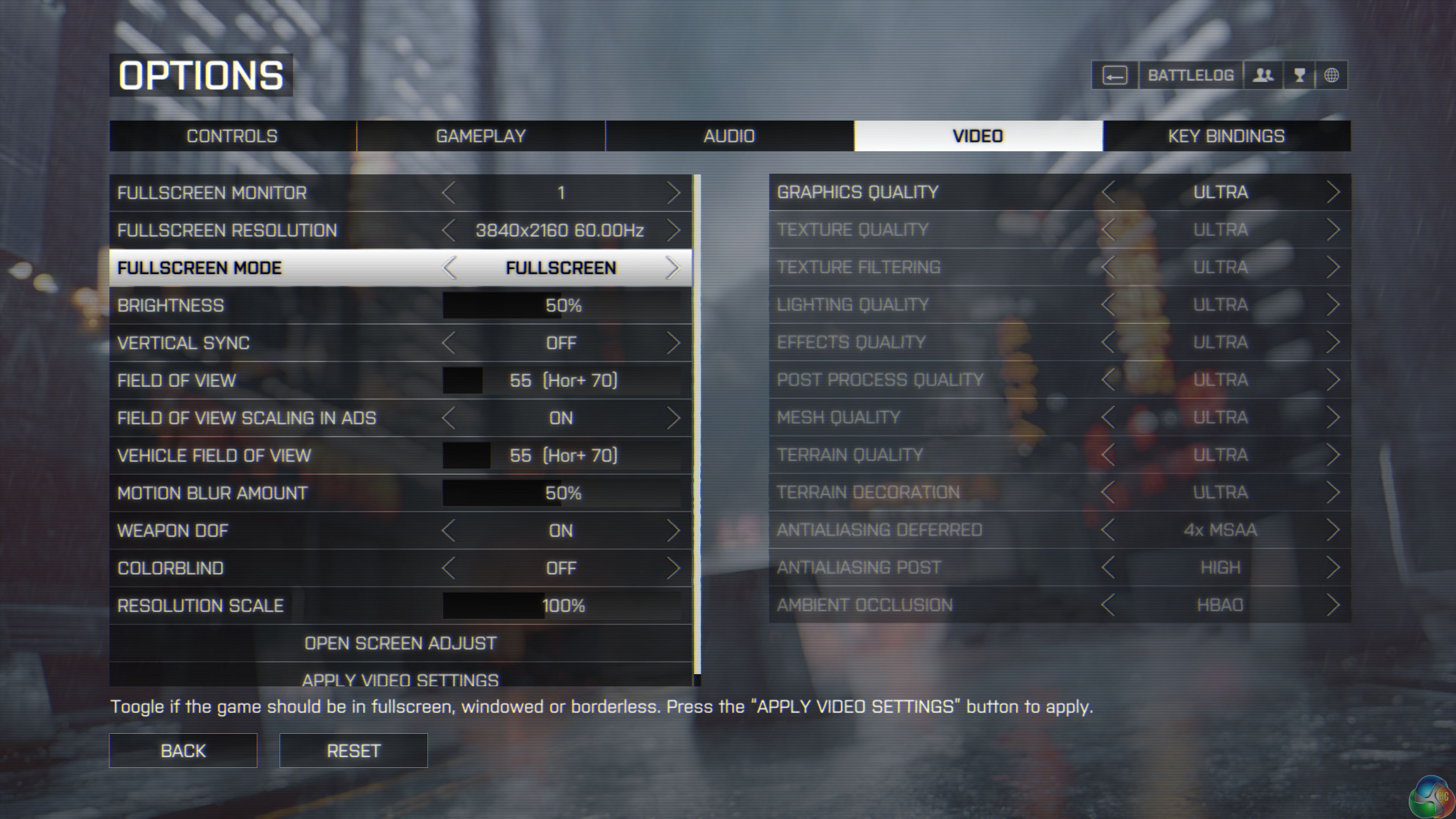
We test at Ultra HD 4K with the ULTRA image quality settings enabled.
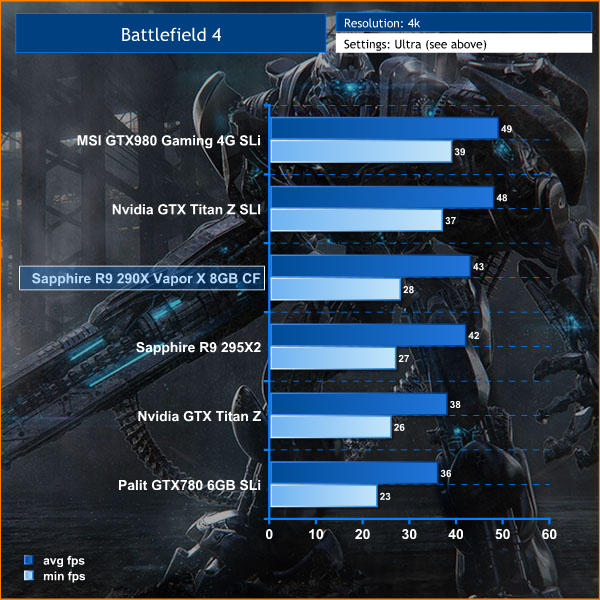
Quad SLI driver optimisations could be better in this game, as the MSI GTX980 Gaming 4G cards in SLI claim the top spot. The Sapphire R9 290X Vapor X 8GB cards score well, averaging 43 frames per second, just slightly ahead of the R9 295X2.
We have built a system inside a Lian Li chassis with no case fans and have used a fanless cooler on our CPU. The motherboard is also passively cooled. This gives us a build with almost completely passive cooling and it means we can measure noise of just the graphics card inside the system when we run looped 3dMark tests.
We measure from a distance of around 1 meter from the closed chassis and 4 foot from the ground to mirror a real world situation. Ambient noise in the room measures close to the limits of our sound meter at 28dBa. Why do this? Well this means we can eliminate secondary noise pollution in the test room and concentrate on only the video card. It also brings us slightly closer to industry standards, such as DIN 45635.
KitGuru noise guide
10dBA – Normal Breathing/Rustling Leaves
20-25dBA – Whisper
30dBA – High Quality Computer fan
40dBA – A Bubbling Brook, or a Refrigerator
50dBA – Normal Conversation
60dBA – Laughter
70dBA – Vacuum Cleaner or Hairdryer
80dBA – City Traffic or a Garbage Disposal
90dBA – Motorcycle or Lawnmower
100dBA – MP3 player at maximum output
110dBA – Orchestra
120dBA – Front row rock concert/Jet Engine
130dBA – Threshold of Pain
140dBA – Military Jet takeoff/Gunshot (close range)
160dBA – Instant Perforation of eardrum
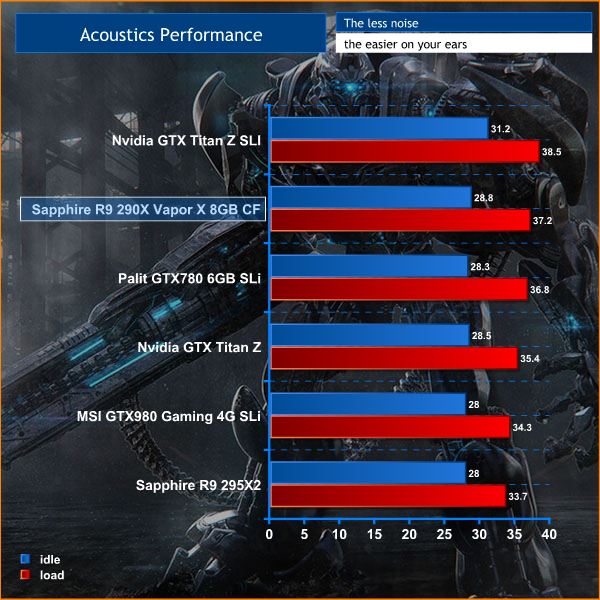
The reference cooled Nvidia GTX Titan Z in SLI produce a fair bit of noise under load. Closely situated they radiate heat into each other – which causes the fans to spin even higher. The Sapphire R9 290X Vapor X cards are also thicker than 2 slots in width and with a pair in Crossfire, they radiate a lot of heat.
The quietest solution is the Sapphire R9 295X2 which is watercooled. Nvidia really should have thought about this for the Titan Z, especially as they could have cranked the core clock speeds in excess of 900mhz, and perhaps even up to 1GHZ. This would have had a huge, positive impact on overall performance.
To test power consumption today we measure system wide drain at the socket – the monitor is not included in the final result. We measure results while gaming in Tomb Raider at 4k resolution.
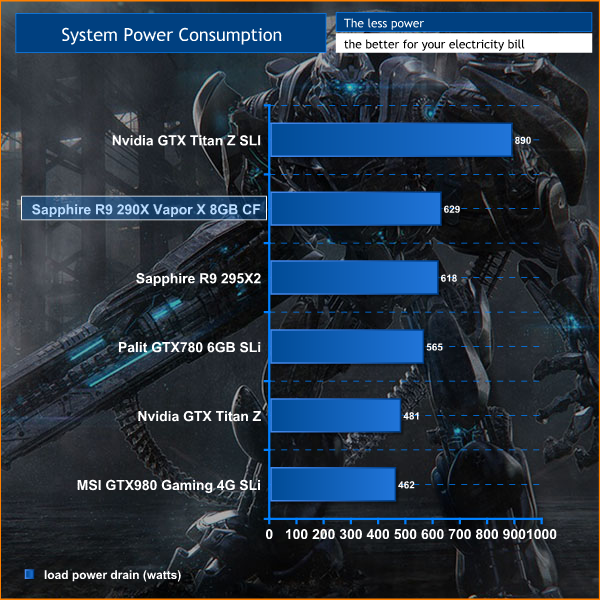
Two Titan Z cards consume a lot of power, bringing the system total to 890 watts. We would expect this as it is basically four GPU cores across two cards, and it is not built around the latest Nvidia Maxwell architecture either.
At the other end of the spectrum are the two Maxwell MSI GTX980 Gaming 4G cards in SLI. The system consumes a total of 462 watts, or around 50% of the draw which is needed to power two Titan Z's.
Current generation AMD hardware is not very power efficient, and we can see the Sapphire R9 290X VaporX 8GB cards bring total system load to 629 watts – 167 watts more than the two MSI GTX980's.
This review has been interesting for us especially as we get the opportunity to test a lot of the high end solutions available today with some of the biggest games released in the last couple of years.
The Sapphire R9 290X Vapor X 8GB graphics cards perform very well at high resolutions – Ultra HD 4k has been a particular strong point for the flagship AMD hardware in recent months.
Two Nvidia Titan Z cards in Quad SLI was merely included in this review out of interest, we don't consider this a practical solution. We have never had a wonderful experience with Quad SLI … unless all you do is benchmark with specific programs, such as 3DMark. Titles such as Watchdogs performed terribly for us with two Titan Z's, and we noticed a ton of texture glitching in games such as Far Cry 3. Single Titan Z? not a problem.
Dual or Tri SLI definitely delivers more consistent results overall. While the Titan Z has dropped in price to around £1,100 online, forking out £2,200 on two Titan Z's for Quad SLi is really rather silly, especially when we analyse performance of the MSI GTX980 Gaming 4G cards – priced at £442.99 each. This dual card configuration costs around £250 less than a single Titan Z, and will outperform it easily, while consuming less power. There has been much negative talk of Nvidia launching the GTX980 with a 256 bit memory interface, but in the real world, the new compression engine designed for the Maxwell architecture does help reduce the demand on DRAM bandwidth. Make no mistake these are fantastic cards to pair up with a new 4K screen.
The R9 295X2 is slightly slower than two of the Sapphire R9 290X Vapor X 8GB cards combined, but it has the advantage of being water cooled. The R9 295X2 is actually one of the quietest cards on test today and while it does require an extra radiator to be fitted inside a chassis, it only takes up one slot on the motherboard. In many ways it is more convenient.
A R9 295X2 did cost £1,100, but has recently dropped in price – with the Sapphire model we included in the review today available from Overclockers UK for only £599.99 inc vat. If I was in the market myself for a 4K gaming card, the R9 295X2 would get my money – at £599.99 it is an absolute steal. Well, in relative terms, and within the context of this review anyway.
The Palit GTX780 JetStream 6GB cards were included in SLI today because they ship with the highest amount of VRAM available on an Nvidia GPU, equal to the Titan series of cards. They performed at the bottom, or close to the bottom of the pile today, and as they seem to be still selling for around £400 inc vat, each – in reality they add up to a poor buying decision.
When we reviewed the 6GB GTX780's back in May they rated highly, but the market has changed so dramatically in the last six months. These £400 6GB GTX780 cards are the closest match in price to the Sapphire R9 290X Vapor X 8GB, which retail for £379.99 inc vat. It doesn't take a lot of effort to see that the AMD cards deliver much better performance at 4K, and at a lower price too.
Sapphire are AMD's biggest partner for a reason, they deliver some of the best custom cooling designs you can buy, and their build quality is really second to none. While the Sapphire R9 290X Vapor X 8GB do deliver great results the architecture is starting to look rather dated next to Nvidia's Maxwell. Even with such a sophisticated cooling system, these 290X cards consume much more power, and subsequently run hotter too. The fans spin faster, so more noise is generated under load.
Until AMD release new updated architecture there is nothing Sapphire, or any other partner can do to eliminate this.
You can buy the Sapphire R9 290X Vapor X 8GB cards from Overclockers UK for £379.99 inc vat. At the price they are good value, and with the 8GB of VRAM they offer plenty of futureproofing. If you have your mind set on a high end AMD configuration, this is pretty much as good as it gets.
It is worth pointing out that the 4GB Sapphire R9 290X Tri-X OC is £100 less (£259.99) at OCUK, making it an exceptional deal. Unless you specifically want 8GB of GDDR5 memory, that is a significant saving.

Overclockers UK have created a deal for KITGURU readers. If you want one (or two) of the Sapphire R9 290X Vapor X 8GB cards, then you can enter a special code to get a further £20 reduction – bringing the total price down to £359.99 inc vat.

This is a staggering £240 less than the original asking price of £599.99. Just head to this page and enter CODE KITGURU8GB. You also get five free games with the purchase.
As an overall package, and considering the OCUK/KitGuru price deal of £359.99 inc vat we award the Sapphire R9 290X VaporX 8GB our ‘WORTH BUYING AWARD'. Two of these cards are able to outperform an NVIDIA GTX TITAN Z and a pair of 6GB GTX780 Ti – all of which are more expensive. They have a tougher battle at 4K against a pair of custom GTX980's, but the price difference in their favour certainly means they are difficult to ignore. As already mentioned, the biggest problem is the £100 premium when compared directly against the 4GB Sapphire R9 290X Tri-X solution.
Pros:
- built to the highest standards.
- 8GB of GDDR5 memory for futureproofing.
- high clock speeds.
- backplate.
- great performance at Ultra HD 4k.
Cons:
- well priced, but Maxwell based GTX980s are available at only £40 extra.
- Sapphire's watercooled R9 295X2 is available now for only £599.99 inc vat.
- Sapphire Tri-X 4GB R9 290x's are £100 less.
Kitguru says: Sapphire are pushing current AMD architecture to the limit and for AMD fans these are WORTH BUYING cards. In the overall market place however for only a little extra you can pick up custom, overclocked GTX980's. The quiet, water cooled Sapphire R9 295X2 is also available now for only £599.99 as well – that would get my own money if I wanted to build a 4K system.


Would have been interesting to to see if a Titan-Z plus a PhysX Titan-Z was able to beat Titan-Z SLI in Metro.
“Sapphire’s single slot R9 295X2 is available now for only £599.99 inc vat.”, you mean dual slot? 😛
AMD really is beaten by Nvidia this time around. Don’t get me wrong, i own R9 270x in crossfire and i always buy AMD products, but when you look at 900 series grapvics card from Nvidia you realize that beside price war there’s no competition. 980 has more or less the same TDP as R9 270x yet it is far more powerful in performance. More than 100% at 1080p. Really hope that AMD can crush them for their sake with new R9 that will be launched next year.
@KitGuru
Metro Last Light chart needs a little fixing.
These cards might show much better numbers in future titles that recommend or ask as minimum 4GB RAM. It’s still early for an 8GB card in PC games.
The is the opposite of what I have seen everywhere else, the 290x CF and the 295×2 beat the GTX 980 at high res???
The is the opposite of what I have seen everywhere else, the 290x CF and the 295×2 beat the GTX 980 at high res???
You already see a little of that in Watch_Dogs so I hope we see some Shadow of Mordor numbers @ 4K
You already see a little of that in Watch_Dogs so I hope we see some Shadow of Mordor numbers @ 4K
what a biased untruthful review, guys better off to read Hexus and other trusted sources reviews, this review is a joke, all benchmarks showed no difference between 4G and 8G since no game yet actually using that amount so there is no benefit, in this review 290X ALMIGHTY card is 20% behind TitanZ SLI and beat 980 SLI, what a joke review from a joker!!
what a biased untruthful review, guys better off to read Hexus and other trusted sources reviews, this review is a joke, all benchmarks showed no difference between 4G and 8G since no game yet actually using that amount so there is no benefit, in this review 290X ALMIGHTY card is 20% behind TitanZ SLI and beat 980 SLI, what a joke review from a joker!!
wtf
wtf
its 290x CF not single!
its 290x CF not single!
I do as well and I only use Nvidia cards, Competition keeps everyone in check and brings next gen tech out faster.
That’s right. And prices as well. So it does not matter whos gpu you preffer, you buy what you want but there mudt be healthy competition
Yes, and the 970s for example (can only speak for them) have massive coil whine problems. I received the second one, that was louder than my GTX460 on full load with 100% fan speed. That can’t be the game, sorry. I’m not trading a smooth running card, that is actually relatively quiet for performance and energy consumption plus pseudo silentness cause it’s only silent when you grab a properly working one.
I’m at the moment fed up with NVIDIAs politics to save money by using lower quality material that causes problems. Waiting until that problem has been solved or a new series of AMD/NVIDIA comes up. Maybe I’ll also have to go with a 280x in the meantime, cause my GTX460 has met performance limits.
I thought to go with one of those but these coil whine issues are stopping me from getting one.
That’s hilarious. You know the R9 290X is a year old right? Having the 980 barely beat it is disgusting. Maxwell offers so little in raw power over even Nvidias older cards. Way to innovate Nvidia. Everyone give them props. After all that hype “wait for Maxwell”.. and it barely succeeded in the area that actually matters. Wattage differences make for $20 more a year, and thermals were brought down with non reference cards in the 290X, but it had 5% less performance than Nvidias NEW technology. Bravo. Bravo Nvidia. Lets give them the standing ovation they deserve. They truly are the greatest innovators of all time. I mean, look at their sales. Look at all the people buying them up. They truly are kings in the industry. No need for competition, they are gods. Let them charge $1000. Let them put wattage and thermals before raw power. Obviously thermals and wattage can’t be fixed like Sapphire and other companies have done for AMD. They still need the now archaic sli bridges but its working out for them. I’m not even joking either. They are literally winning cause of insignificant things like that. We should all get Macs next, they advertise in other areas than raw power too. It’s brilliant. We are moving the industry forward! Put down every company just because of minimal gains and worthless filler. We need more companies like Apple. Nvidia, you go green. You’re next.
On a side note: I’m not a fan of either company in particular. Just those that innovate in the area of raw power and tangible gains. If one is winning because of something silly, I’ll put them down. Like AMD and their cpu chips, they are nothing in comparison to Intel, and Intel runs the market like mad because of it. Gpu’s though.. Nvidia hasn’t been holding their own.. but they don’t need to.. cause everyone just buys their products without thinking twice.. At least AMD is much better and consistent than any other silicon company in their pricing though..
That is true. In the last sentence. But you gotta figure that gtx 980 has more than 100% performance than my R9 270x with same or even lower consumption. And when you look at 1080p and 1440p there is no competition for nvidia, atleast nor now. As i sad on other article, AMD needs to pull a bunny from the hat and lower the consumption and increase IPC of GCN cores. I really hope that will happen because i would like to buy R9 card again. Until now i had two
If you take price difference into consideration, the difference in power consumption becomes negligible.
Ok. Let’s take it that way. How much performance would nvidia pull if they hadn’t put so much effort to make consumption so low? I know what you want to say but you have to admit that fact. Nvidia did a splendid job
I agree, they did.
Looking at your 290x only review and seeing how you show ONE 290x getting 40 fps for this game.
YET in this review you show TWO 290x 8g only getting 60. Sounds like some BS to me.
You can overclock the 970 and 980 by 40% and it sucks more power than any 290x and only gains MARGINAL fps.
True. But same is valid for any gpu. So… I’m waiting for r9 300 series, to see what AMD did with their cards this time
Same here, iv had 290’s on water for ever. 1350 core.
Wanted to buy gtx 970 instead of my 270x crossfire. But after selling one of my cards i had to keep other one because something else poped up. But looking at how my card performs i might keep it to the end of this year also.
Currently have my eye on nzxt h440
Well right now you can get 290X crossfire for the price of ONE 980 and get allmost double the fps. No idea why kids rush out to buy 970/980s when 2 year old gpus get +/- 2-5 FPS of them. Must be rich spoiled idiot kids wasting all their parents money.
Not really when gpus have an OC limit thus producing an max amount of power draw. So like he said when you OC the over priced 970/980s there power to performance starts to explode. And the fps does not increase and is not scaleable with them. All benchmarks prove this.
Well, not here were i live. I know that the prices almost everywhere are like you said but in Croatia for the price of 980 i can get one 290x and 270x, for example
nvidia is sitting on there ass just waiting on amd to compete. The whole Titan concept is proof of that. there x80 cards are actually just mid range cards these days with titans being there new x80 cards. It’s such a shame tho that company instantly abuse there position whenever they possible can.
I think that the 290x should have come with a 8gb version faster to be honest. If i would buy into a 290x version it would surely be 8gb as the v-ram is going to spike heavily in the upcoming year / years. It’s a good future proof card specially if you decide to crossfire them. while 8gb can be seen as overkill now, there are already tests done where even on 1080p games rush towards 6gb of v-ram and in 4k 8gb is close to be hit. You have enough room with the 290x to not be limited then.
I made this mistake with my 580 1,5gb. I should have gone with 3gb version and still have no issue’s to play watch dogs / unity without much issue’s. but because my card gets heavily hampered by the 1,5gb of v-ram even the lowest of the lowest setting makes teh games jam to unplayable framerates. The card is now what 4 years old? but if i would sli them today, it would stil perform equal towards a 780 / 290 with 3gb that would be far enough. The upgrade price would only be ~around 70 bucks / euro’s second handed. Which would be insane value for it’s money.
For people that buy into the cards at this day of age, i would heavily advice into getting a 8gb even while the extra 4gb do not seem to make much sense now, it can be extremely handy when you hit my spot in a few years from now. Unless you obviously upgrade every year etc.
Two video cards usually bottlenecks one of them, so you will not get 200% power. Usually just around 150-175% power.
Looks like you will be able to buy an R9 card again! Chances are it will probably actually be the same one! AMD loves rebranding hot inefficient obsoleted tech and selling it to chumps.
Nvidia to rebrand their cards. Only i 900 series there isn’t any. Price/Performance ratio with AMD cards is great and that could only get better. And that is only thing that matters to me, even if that means jump ship from AMD to Nvidia. My money, my choice
Nvidia have not rebranded any cards, I dont know what you are talking about. They promised Maxwell cards and we have the 750, 750 ti, 960, 970, 980, 980 ti and titan X. Thats 7 new cards. AMD have released one new card, the entire of the rest of the lineup is just rebrands.
Bad time to be investing in AMD, the company seems more desperate to please its shareholders than its customers. I guess it needs to be, AMD stockholders must be sweating after seeing the dreadful launch of the fury X.
I do agree with you though, I would buy the better brand but its been years since AMD were actually competing with Nvidia.
If you had read my post like you should you’d see that I write that I 900 series there isn’t any rebrands. But for example in 700 series there were
This is a great
inspiring article.I am pretty much pleased with your good work.You put really
very helpful information. Keep it up. Keep blogging. Looking to reading your
next post.
Vaporultra.com
hello can to do one review with alone one r9 290x vapor-x tri-x gddr5 plz
I know this is an old article but it’s very difficult to discern exactly what CPU and speed that was used for this test. AMD CPU? Intel CPU? Which one? You point to the test rig linked to another article but that one doesn’t even list the current CPU in use for this test either.
Why even bother wasting your time on this if we can’t tell what you used for it? *sigh*