KitGuru KitGuru.net – Tech News | Hardware News | Hardware Reviews | IOS | Mobile | Gaming | Graphics Cards


We got our first look at Nvidia's GTX 1650 Super, and AMD's RX 5500 XT GPUs, just as 2019 was drawing to a close. Since those initials reviews, however, we've not conducted further testing of these 1080p-oriented GPUs, so today we put these rivals head to head to see which card comes out on top in mid-2020.
Nvidia's GTX 1650 Super launched in late November 2019, and at the time we felt the GPU offered a much-needed performance boost over the vanilla GTX 1650, which was poorly received when it first came out in April 2019.
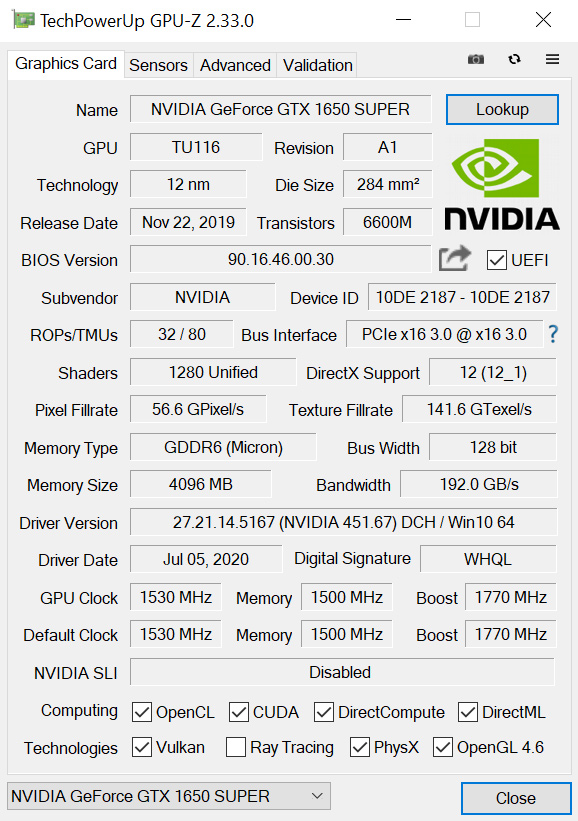
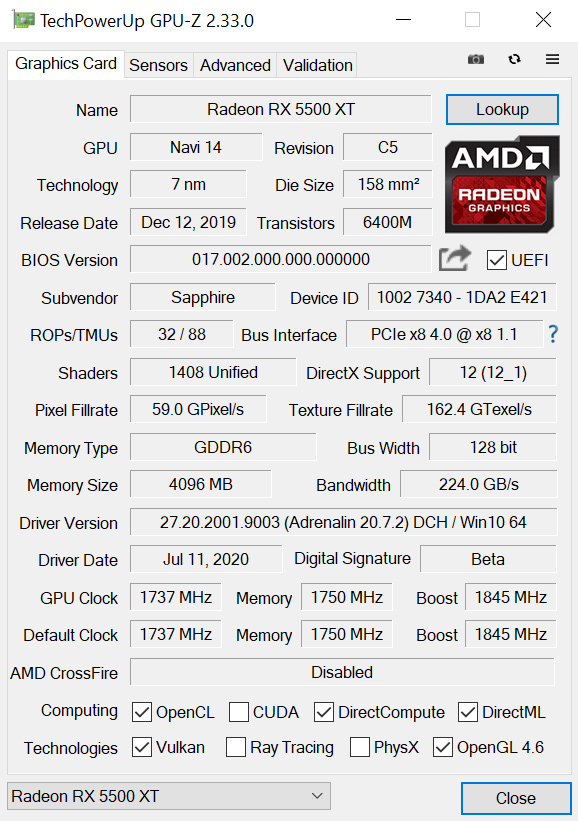
As for the AMD RX 5500 XT, this GPU comes in two distinct forms as consumers can choose between 4GB or 8GB VRAM models. The underlying graphics core is the same however, so it will be interesting to assess how many of our test games benefit from more than 4GB VRAM as we test across 1080p and 1440p resolutions.
With both GPUs aimed directly at the 1080p gaming market – a resolution that remains exceptionally popular based on the latest Steam Hardware Survey data – we test these three graphics cards across a range of games, engines and APIs to see what sort of performance you can expect from each GPU, and whether or not anything has changed since our initial reviews.

ASUS ROG RX 5500 XT Strix 8GB
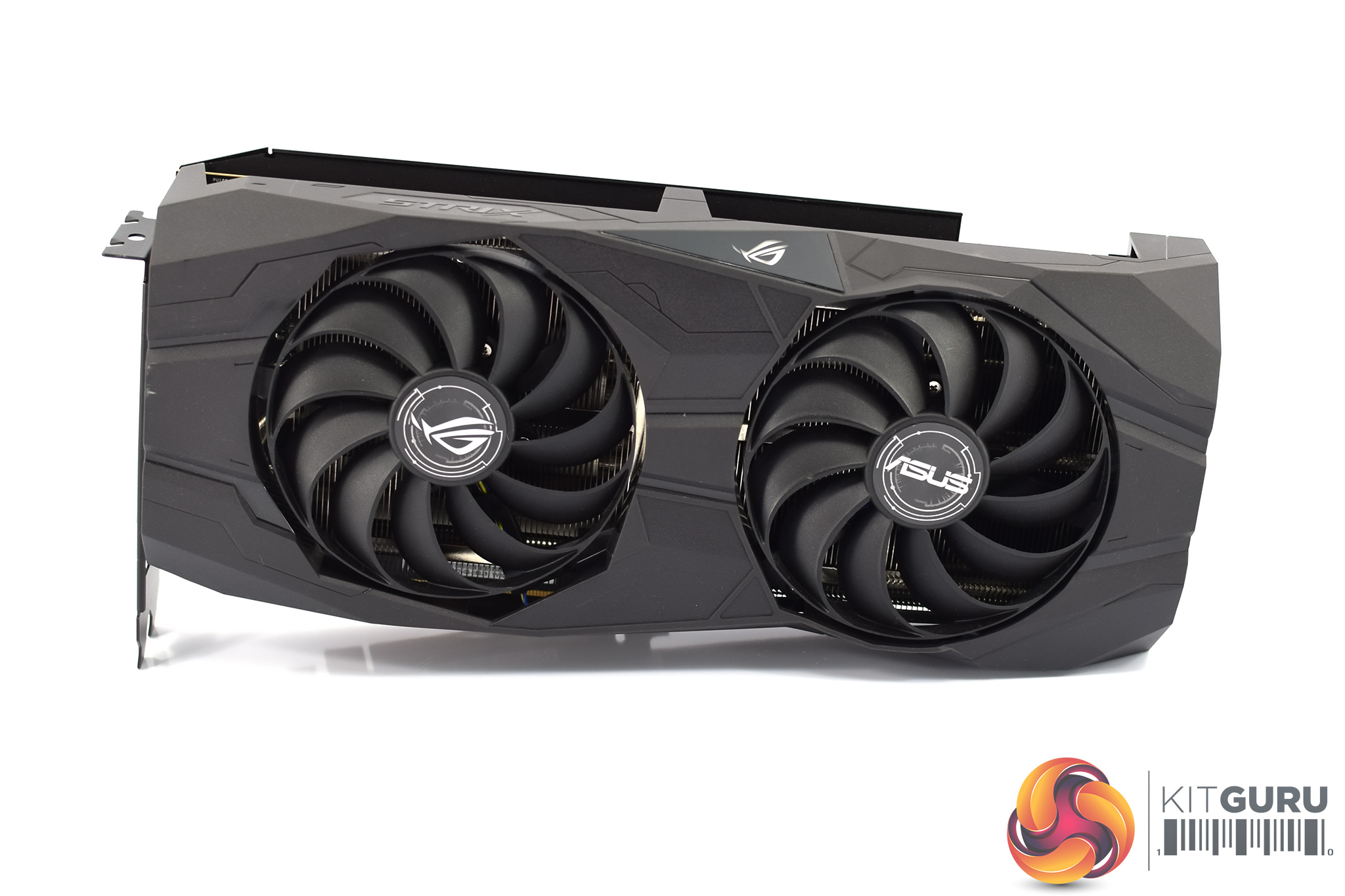
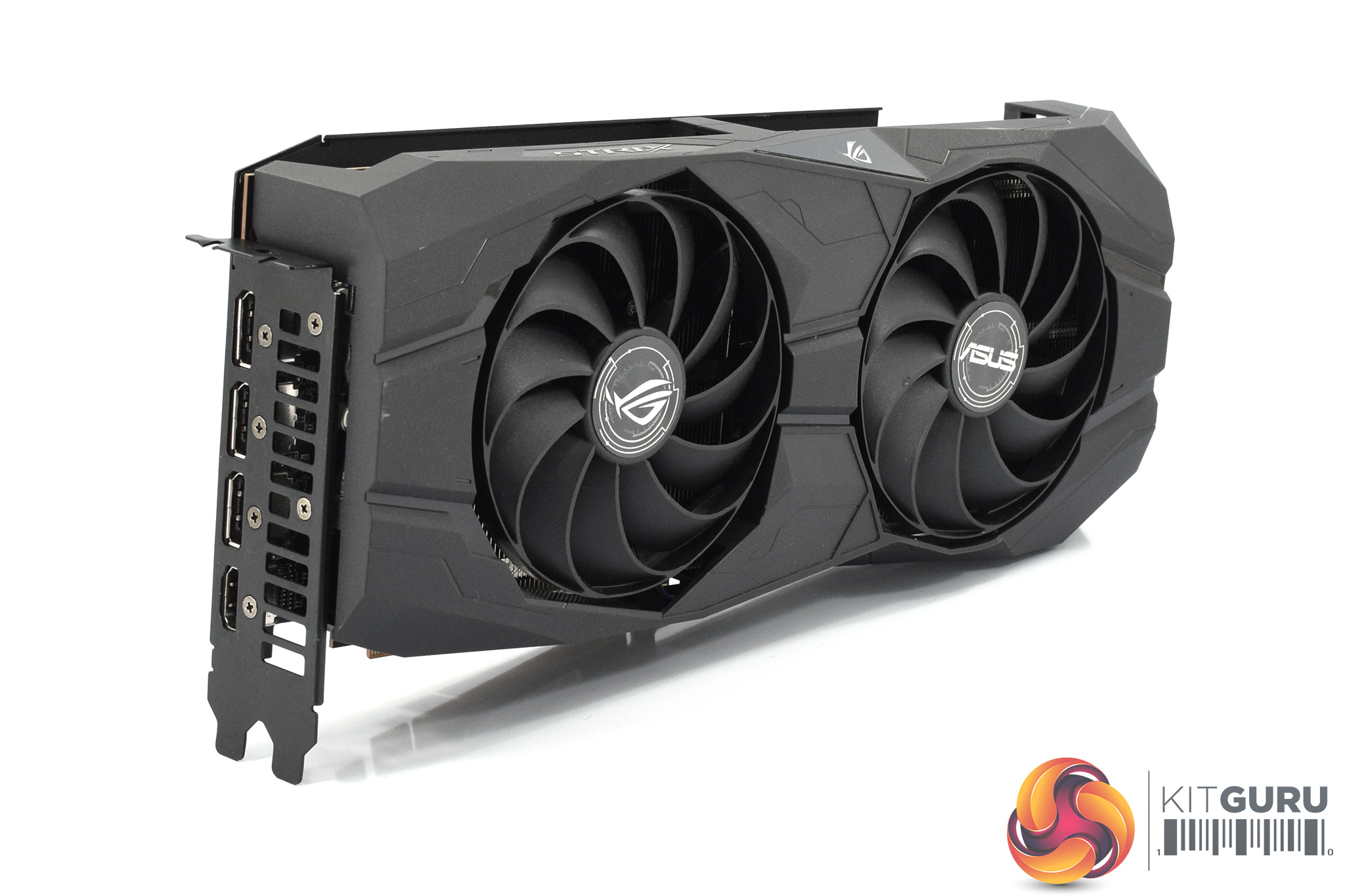
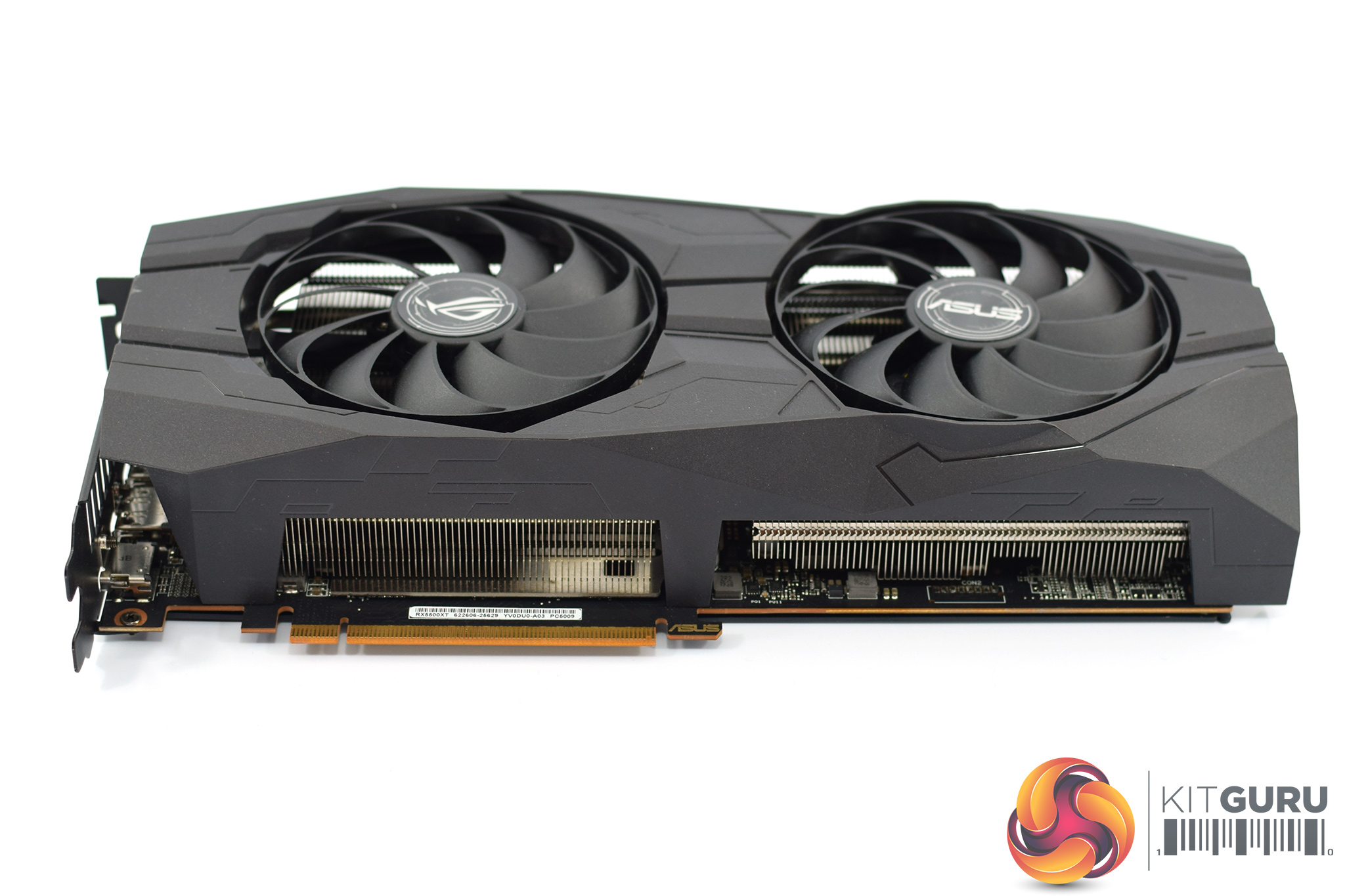

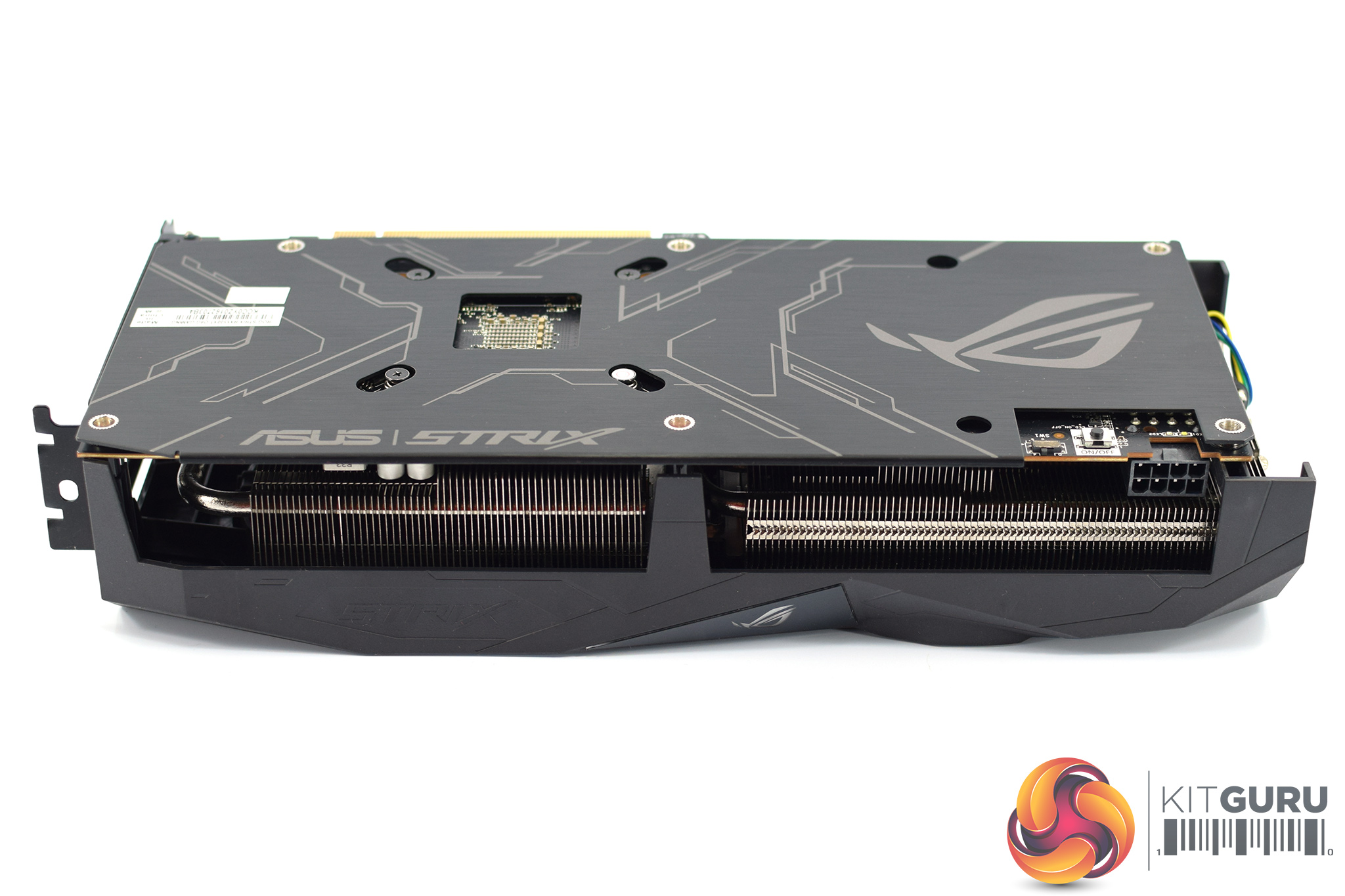
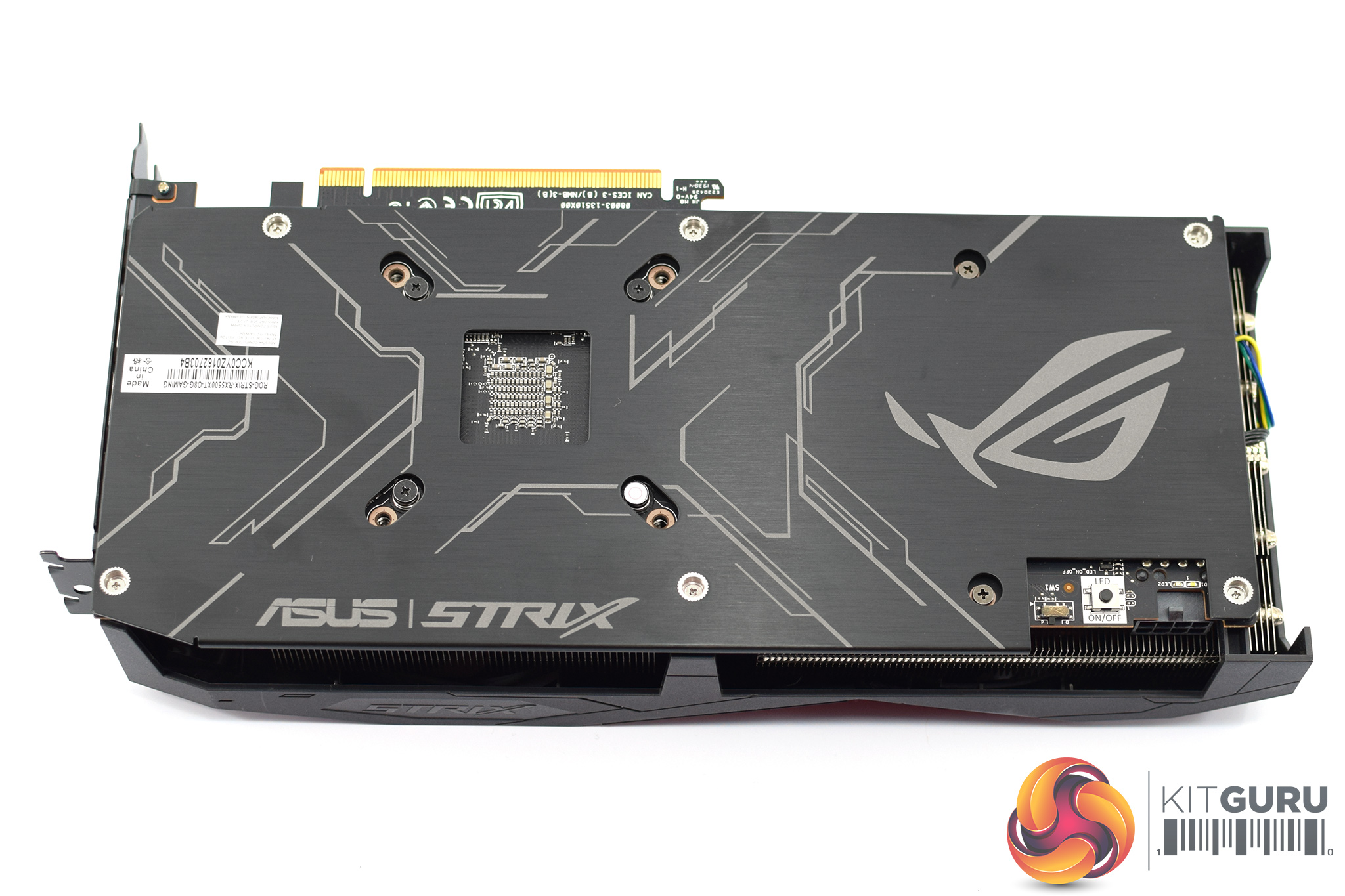
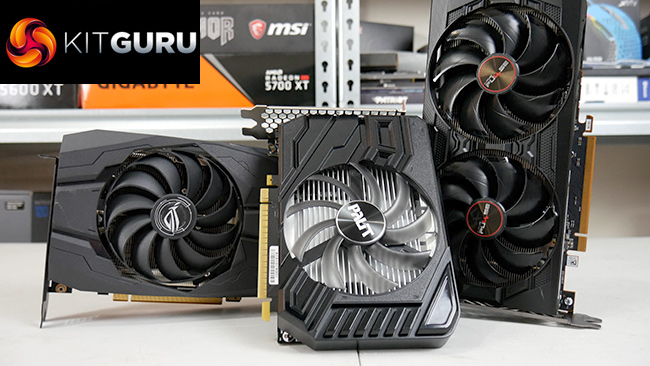
Starting off with the ASUS ROG RX 5500 XT 8GB, this model keeps to the Strix design aesthetic we have come to expect from ASUS ROG's flagship cards over the last couple of years. Aside from the stealthy, all-black design, the plastic shroud is impressively sturdy and well-built – there's not a hint of flex to this card at all.
For a 5500XT, it's also great to see a full-length, brushed metal backplate, though be aware this card is definitely on the large side, especially for a 5500 XT – it measures 28 x 12.7 x 5.8cm, so it will occupy three slots in your case. Each of the two ‘axial-tech' fans measure 100mm.
Sapphire RX 5500 XT Pulse 4GB
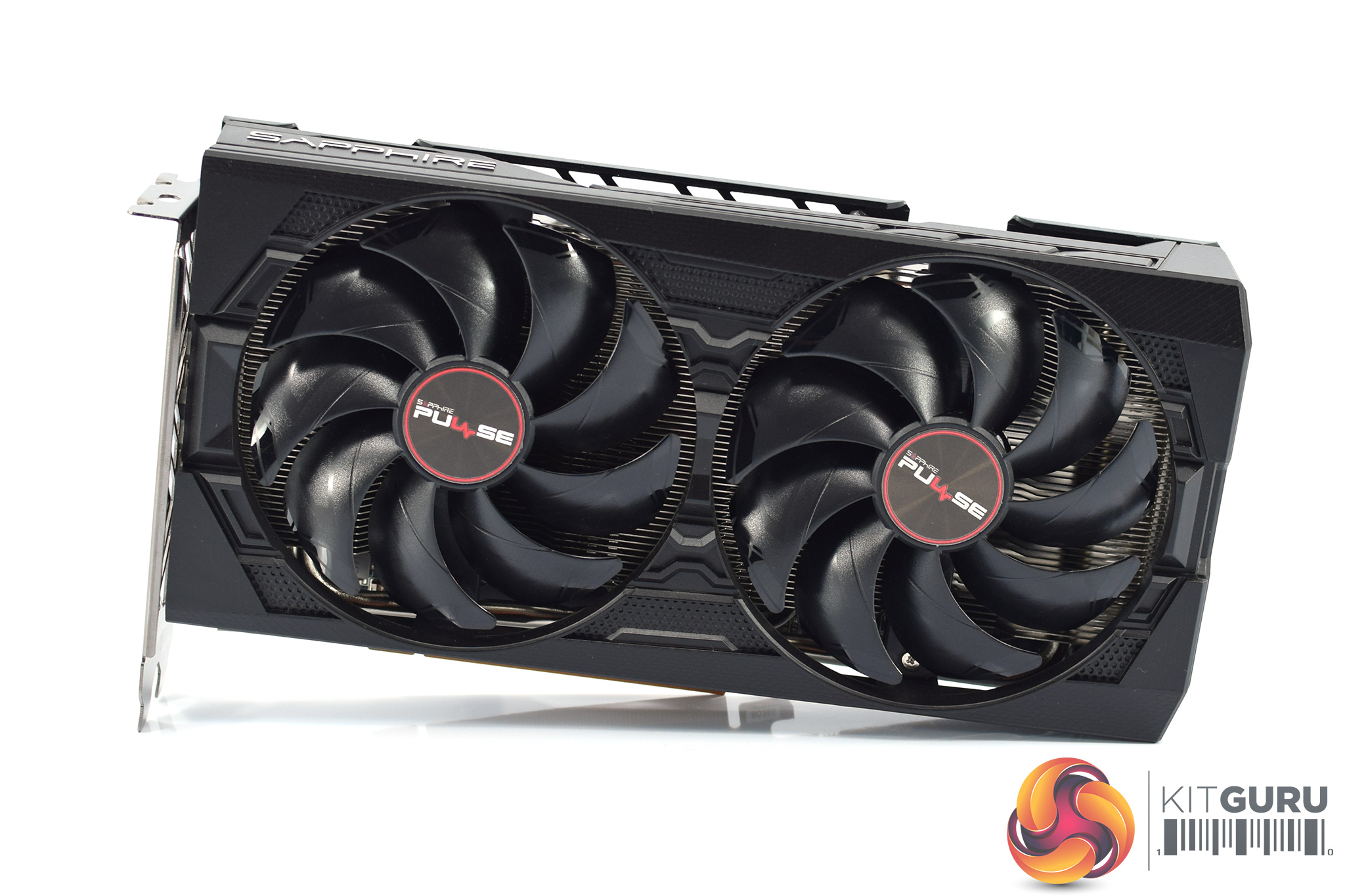
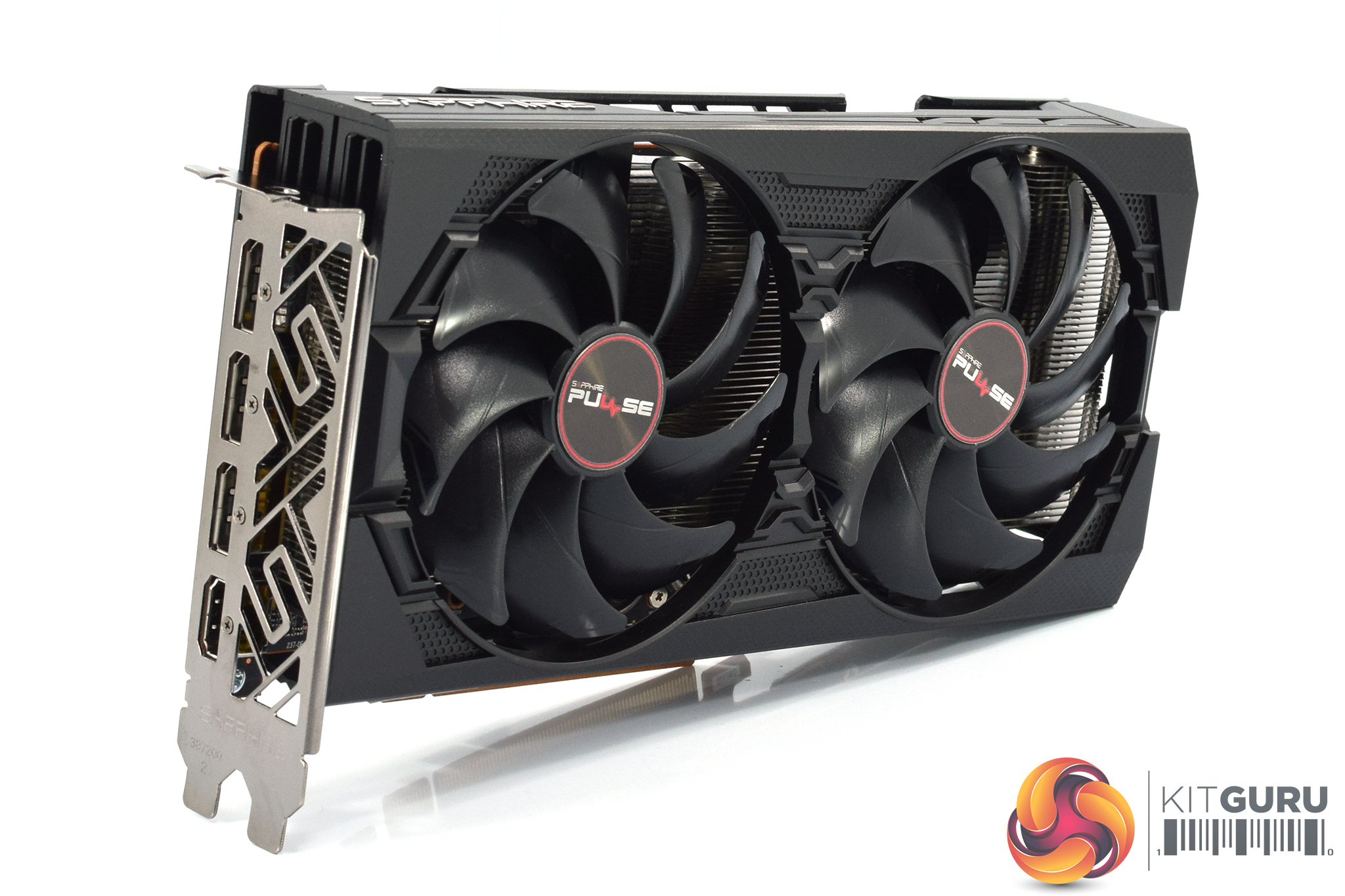
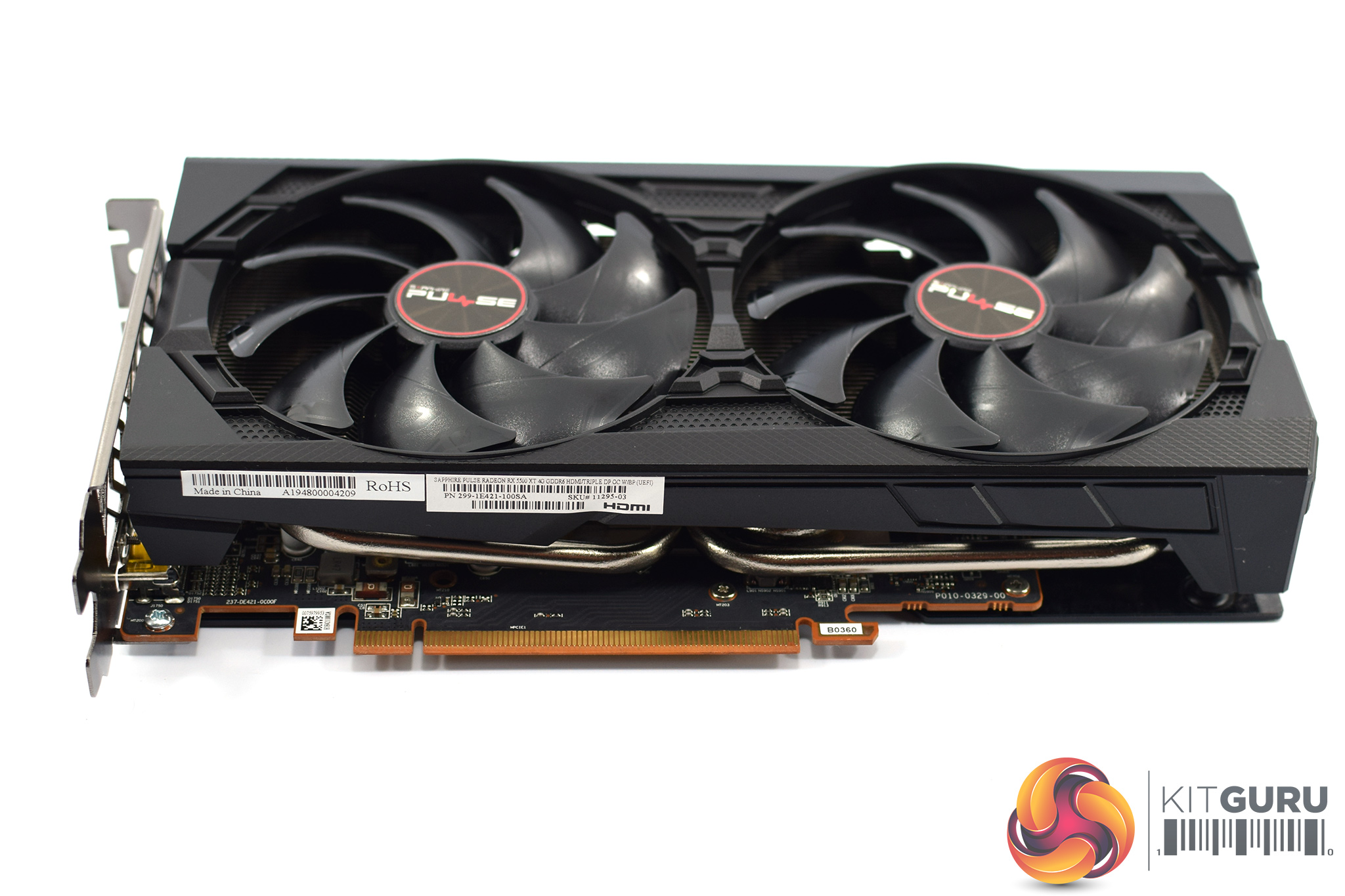
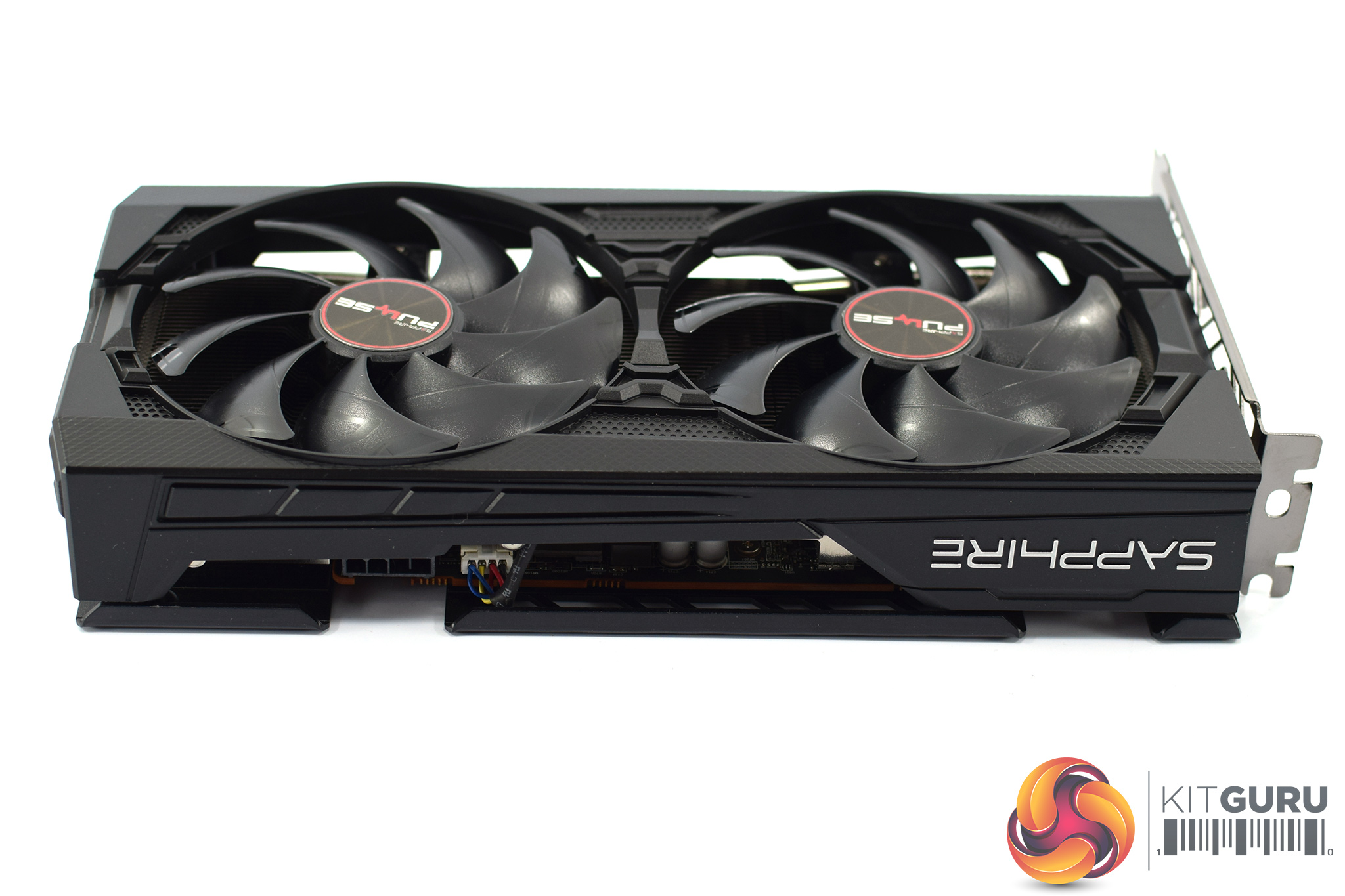
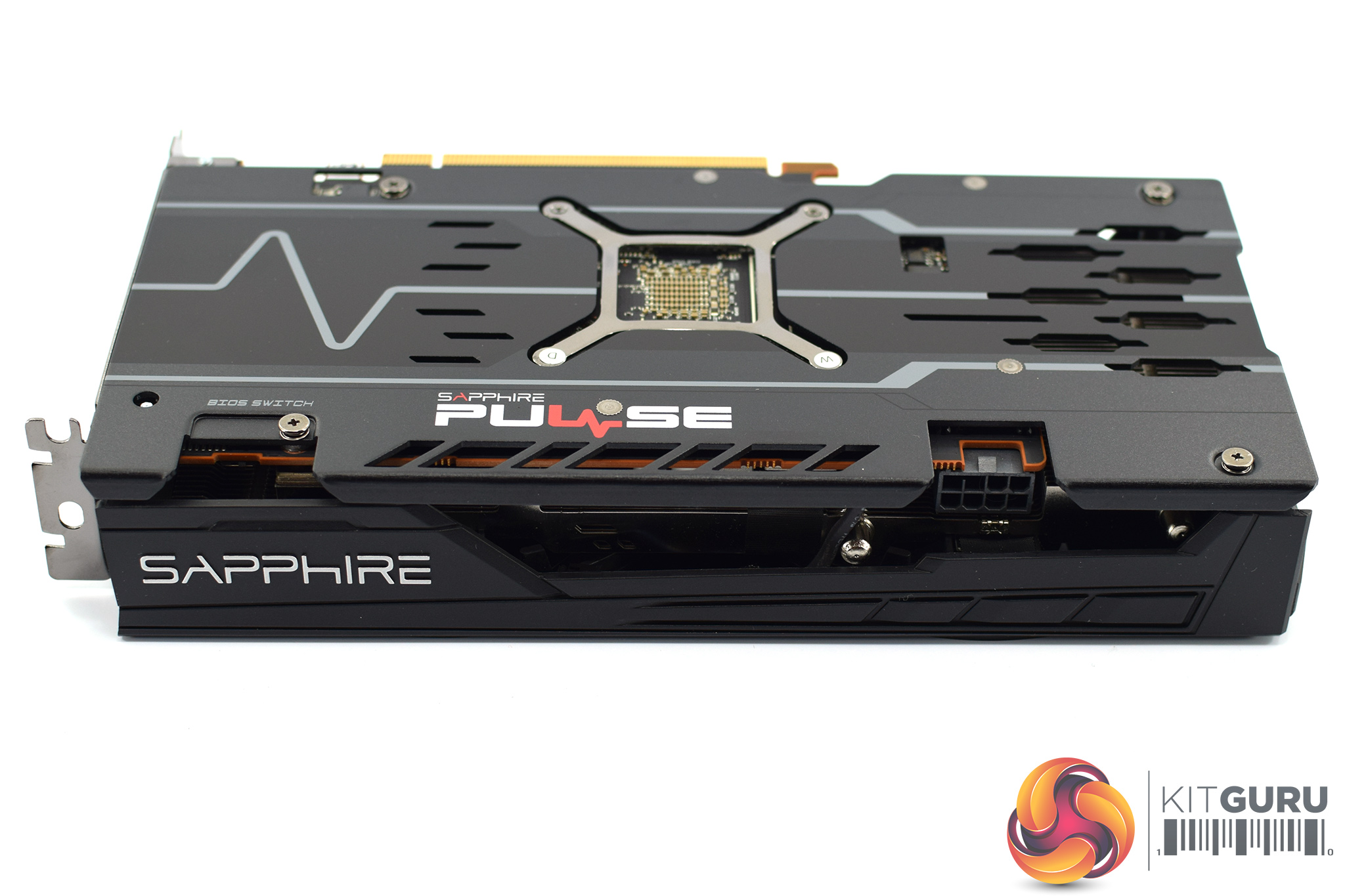
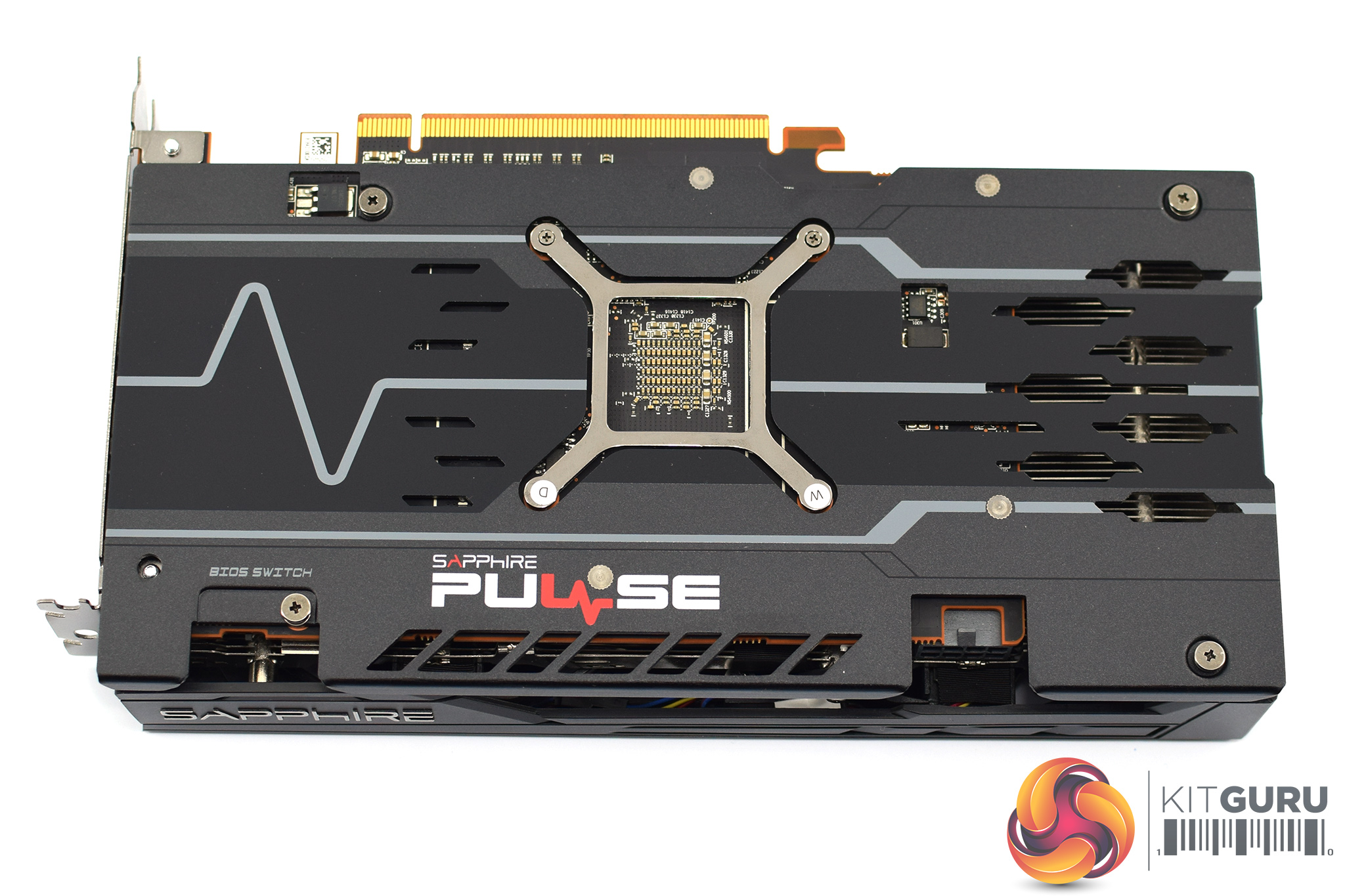
Sapphire's Pulse 5500 XT is a familiar design, adopting the same dual-fan approach as the Pulse 5600 XT and 5700 XT we have also reviewed. The stealthy black shroud and black/grey backplate does look good, plus the card has dual-BIOS support which other 5500 XT models lack.
In terms of its size, it's not massive but it's not tiny either – measuring in at 233mm x 121.8mm x 39.6mm. That means it's a standard dual-slot card, so you can expect this to fit in all but the most space-restricted of systems. Lastly, its two fans measure 100mm.
Palit GTX 1650 Super StormX OC 4GB
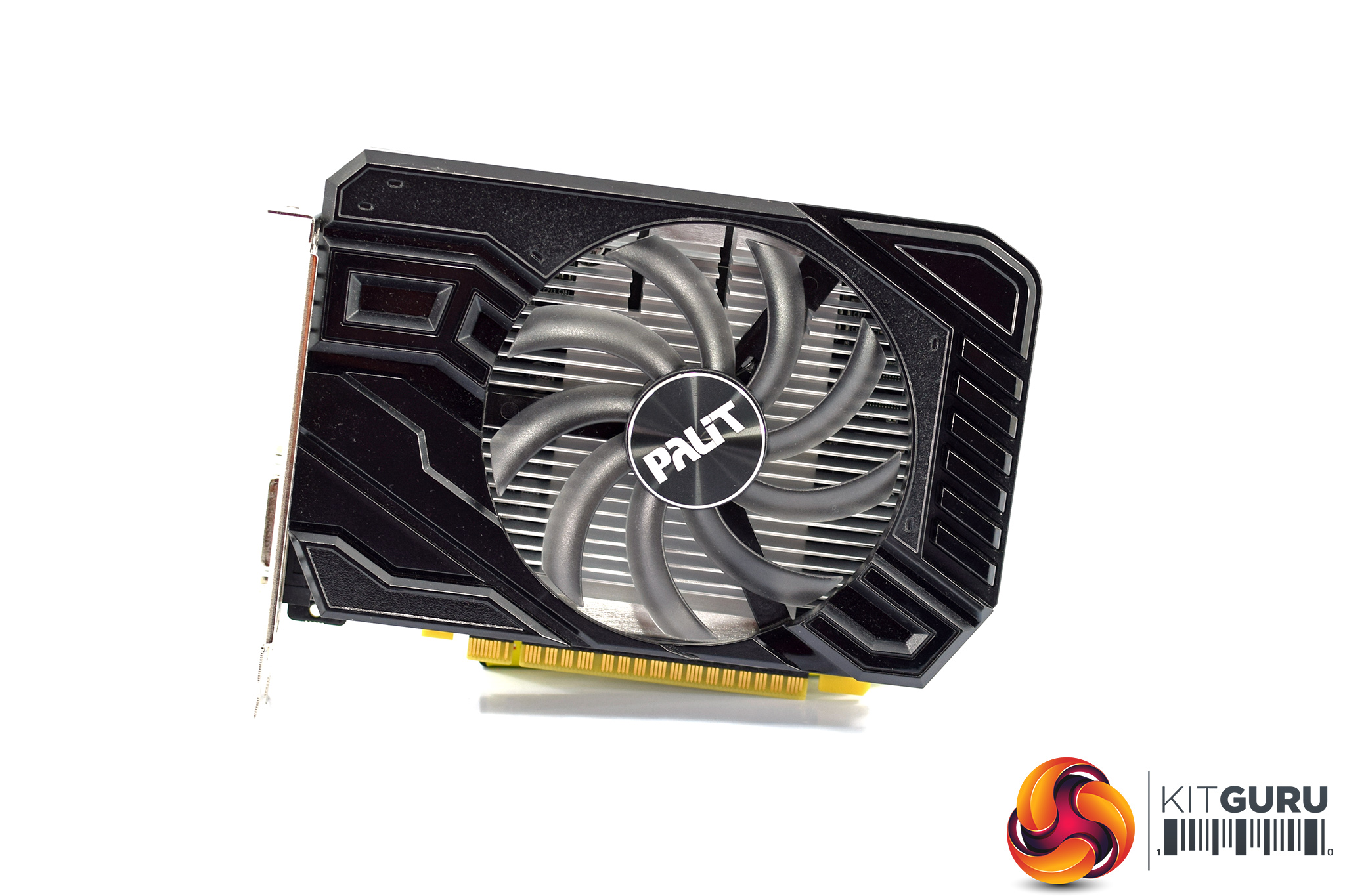
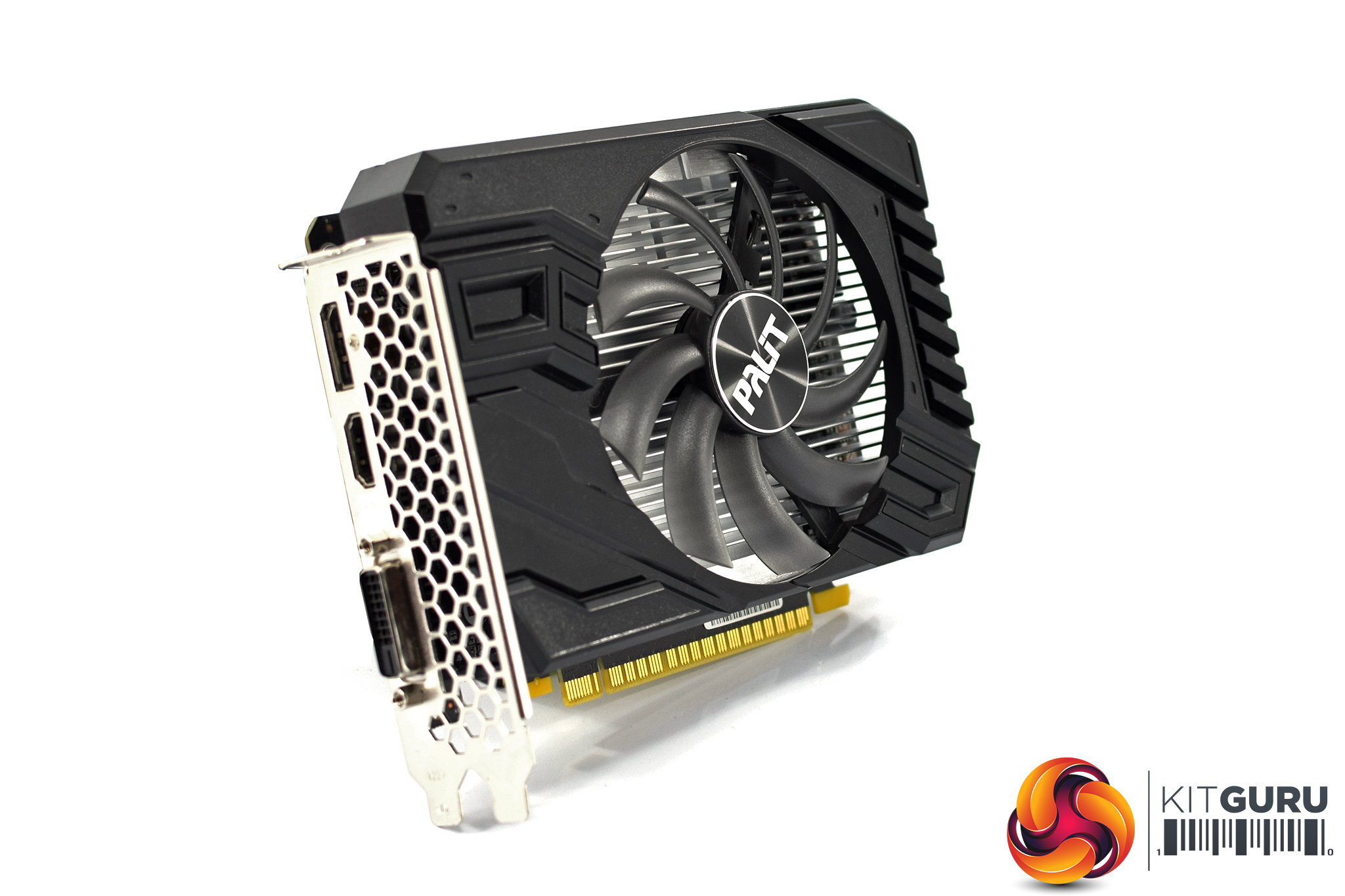
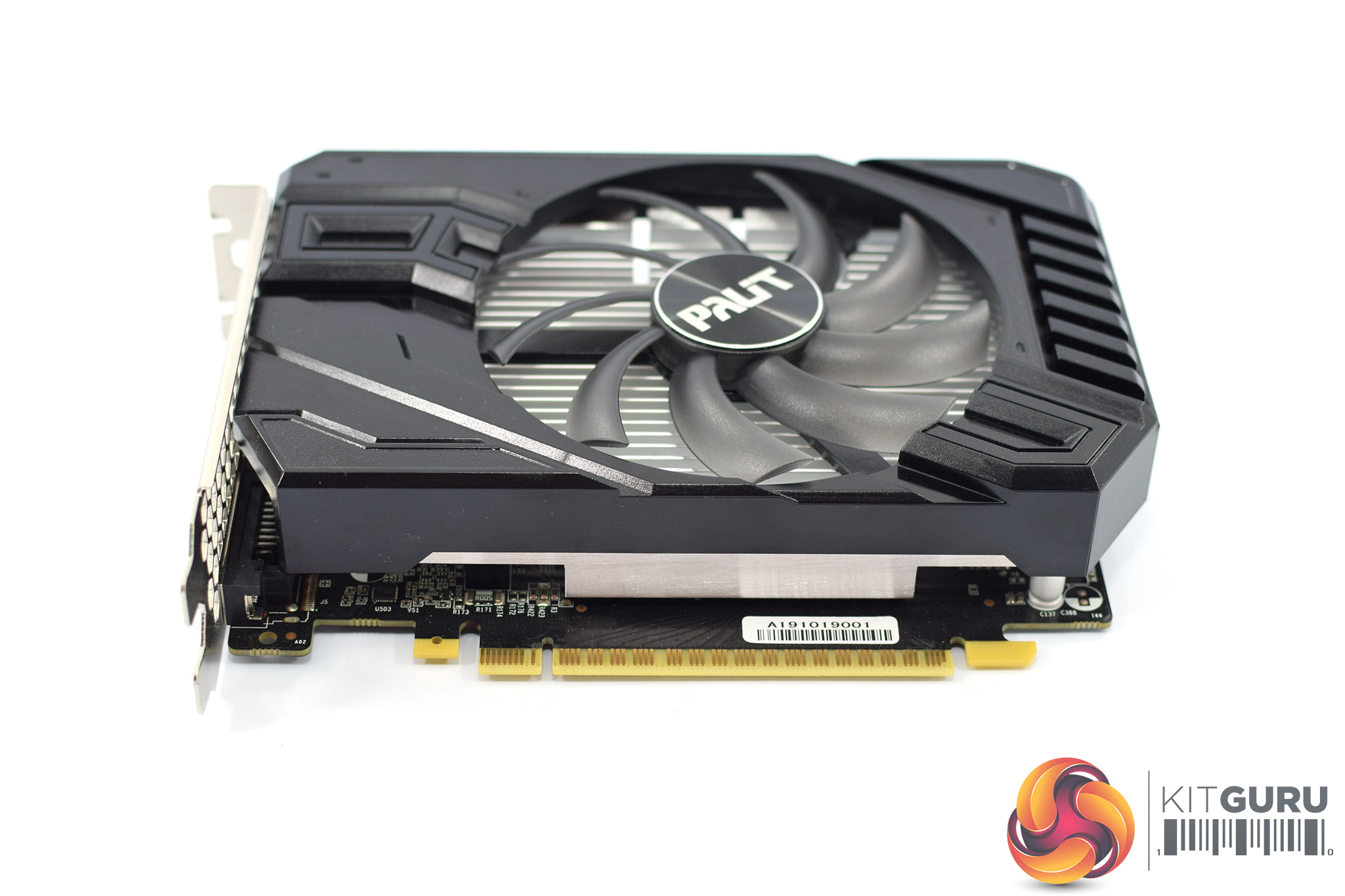
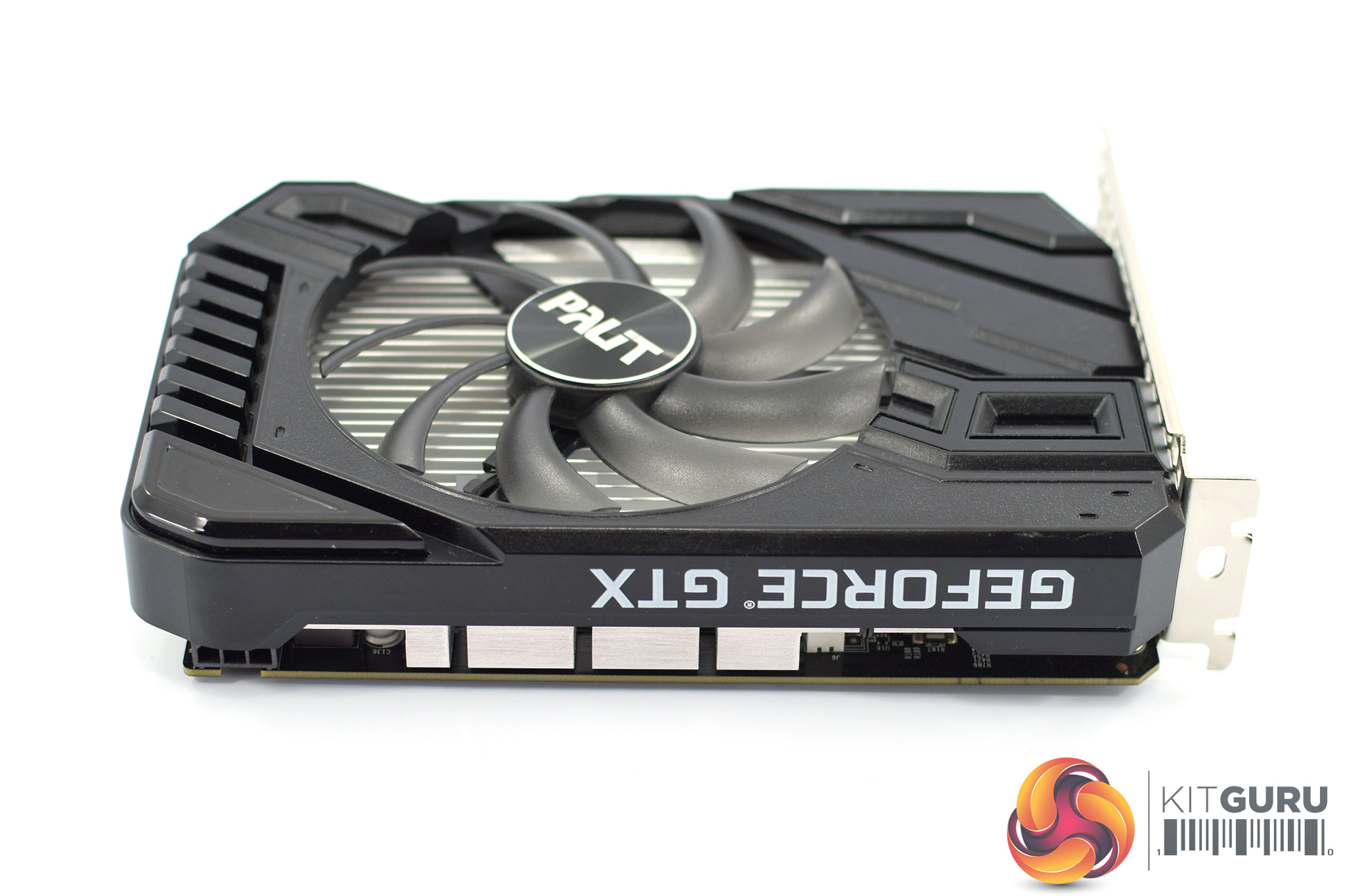
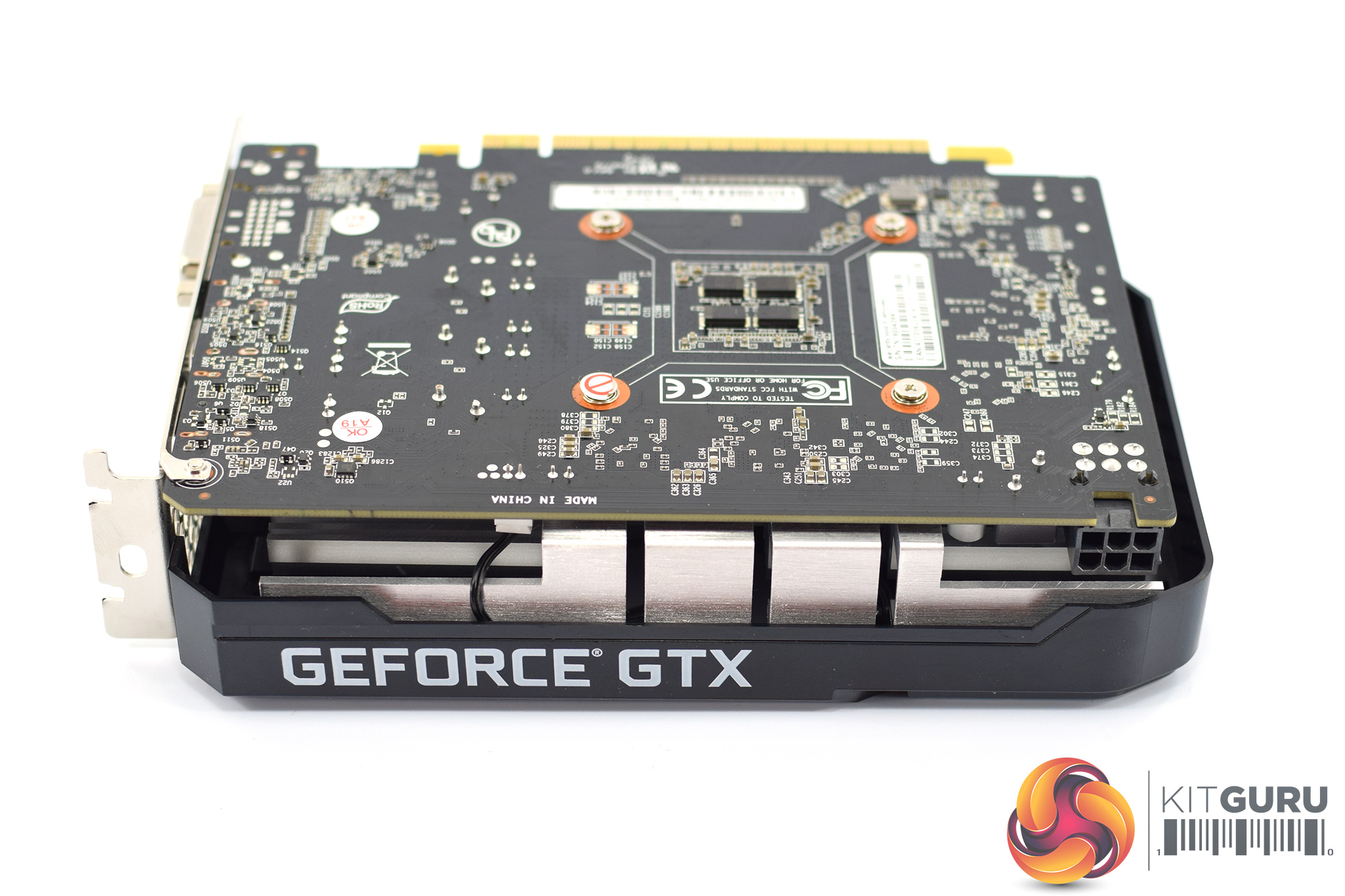
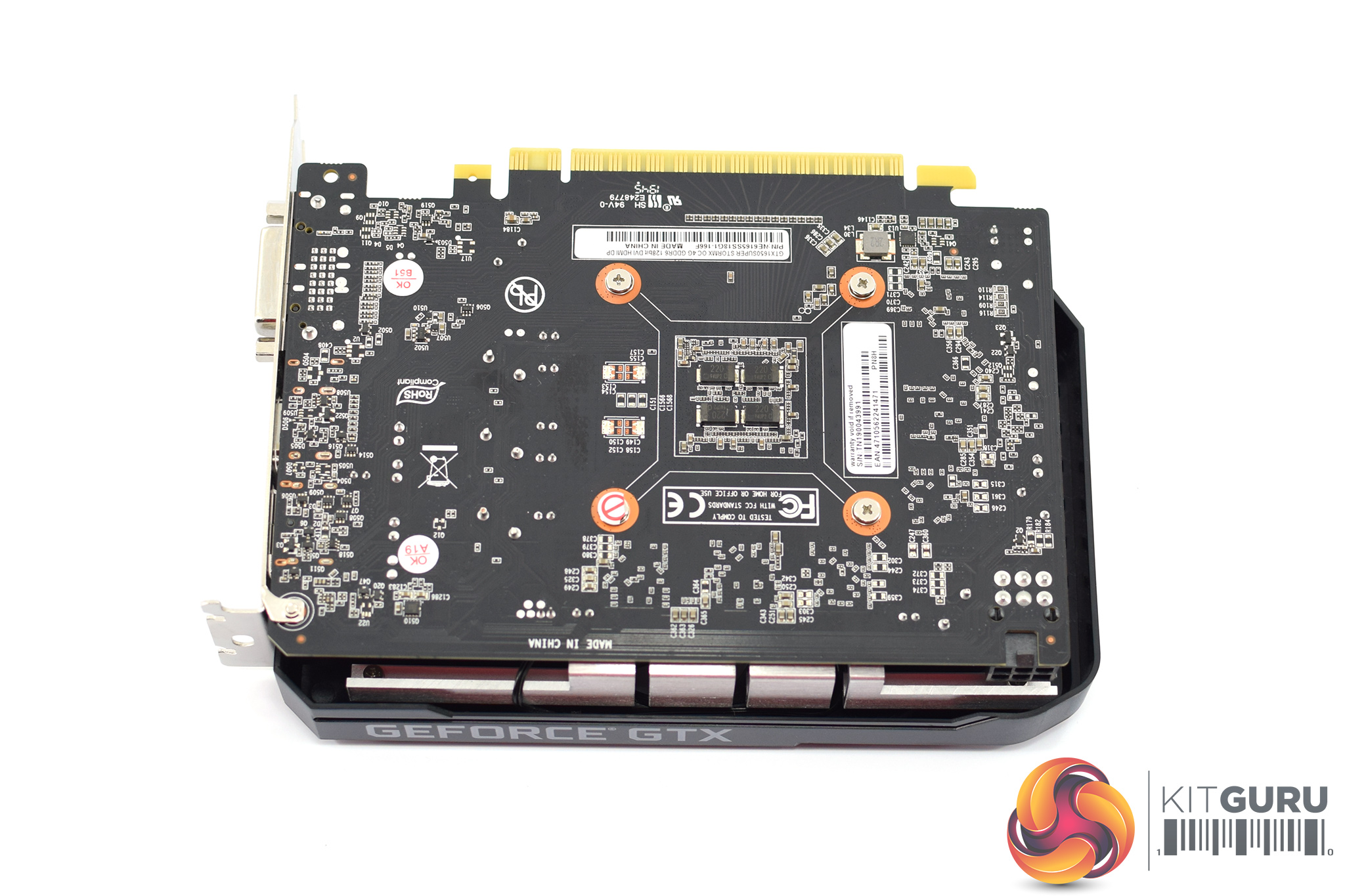
The smallest of the bunch is Palit's GTX 1650 Super. With a single 100mm fan, this card measures just 168 x 122 x 40 mm, making it perfectly suited for cases where space is at a premium. It's perhaps not the most exciting card to look at, and Palit is clearly going for a ‘bang-for-buck' approach as there is also no backplate, but the glossy plastic shroud isn't hideous.
One thing also worth making clear about 1650 Super is it does require a 6-pin power connector, unlike the vanilla GTX 1650 which could draw all its power through the PCIe slot.
Driver Notes
- RX 5500 XT was benchmarked with AMD Adrenalin 20.7.2 public driver.
- GTX 1650 Super was benchmarked with Nvidia 451.67 public driver.
Test System
We test using the a custom built system from PCSpecialist, based on Intel's latest Comet Lake-S platform. You can read more about it over HERE, and configure your own system from PCSpecialist HERE.
| CPU |
Intel Core i9-10900K
Overclocked to 5.1GHz |
| Motherboard |
ASUS ROG Maximus XII Hero Wi-Fi
|
| Memory |
Corsair Vengeance DDR4 3600MHz (4 X 8GB)
CL 18-22-22-42
|
| Graphics Card |
Varies
|
| System Drive |
500GB Samsung 970 Evo Plus M.2
|
| Games Drive | 2TB Samsung 860 QVO 2.5″ SSD |
| Chassis | Fractal Meshify S2 Blackout Tempered Glass |
| CPU Cooler |
Corsair H115i RGB Platinum Hydro Series
|
| Power Supply |
Corsair 1200W HX Series Modular 80 Plus Platinum
|
| Operating System |
Windows 10 2004
|
Comparison Graphics Cards List
- ASUS ROG RX 5500 XT Strix 8GB
- Sapphire RX 5500 XT Pulse 4GB
- Palit GTX 1650 Super StormX OC 4GB
Software and Games List
- 3DMark Fire Strike & Fire Strike Ultra (DX11)
- 3DMark Time Spy (DX12)
- Battlefield V (DX12)
- Control (DX12)
- Death Stranding (DX12)
- The Division 2 (DX11)
- F1 2019 (DX12)
- Far Cry New Dawn (DX11)
- Gears 5 (DX12)
- Ghost Recon: Breakpoint (DX11)
- Metro: Exodus (DX12)
- Middle Earth: Shadow of War (DX11)
- Red Dead Redemption 2 (Vulkan)
- Shadow of the Tomb Raider (DX12)
- Star Wars Jedi: Fallen Order (DX11)
- Total War: Three Kingdoms (DX11)
We run each benchmark/game three times, and present mean averages in our graphs. We use OCAT to measure average frame rates as well as 1% low values across our three runs.
3DMark Fire Strike is a showcase DirectX 11 benchmark designed for today’s high-performance gaming PCs. It is our [FutureMark’s] most ambitious and technical benchmark ever, featuring real-time graphics rendered with detail and complexity far beyond what is found in other benchmarks and games today.
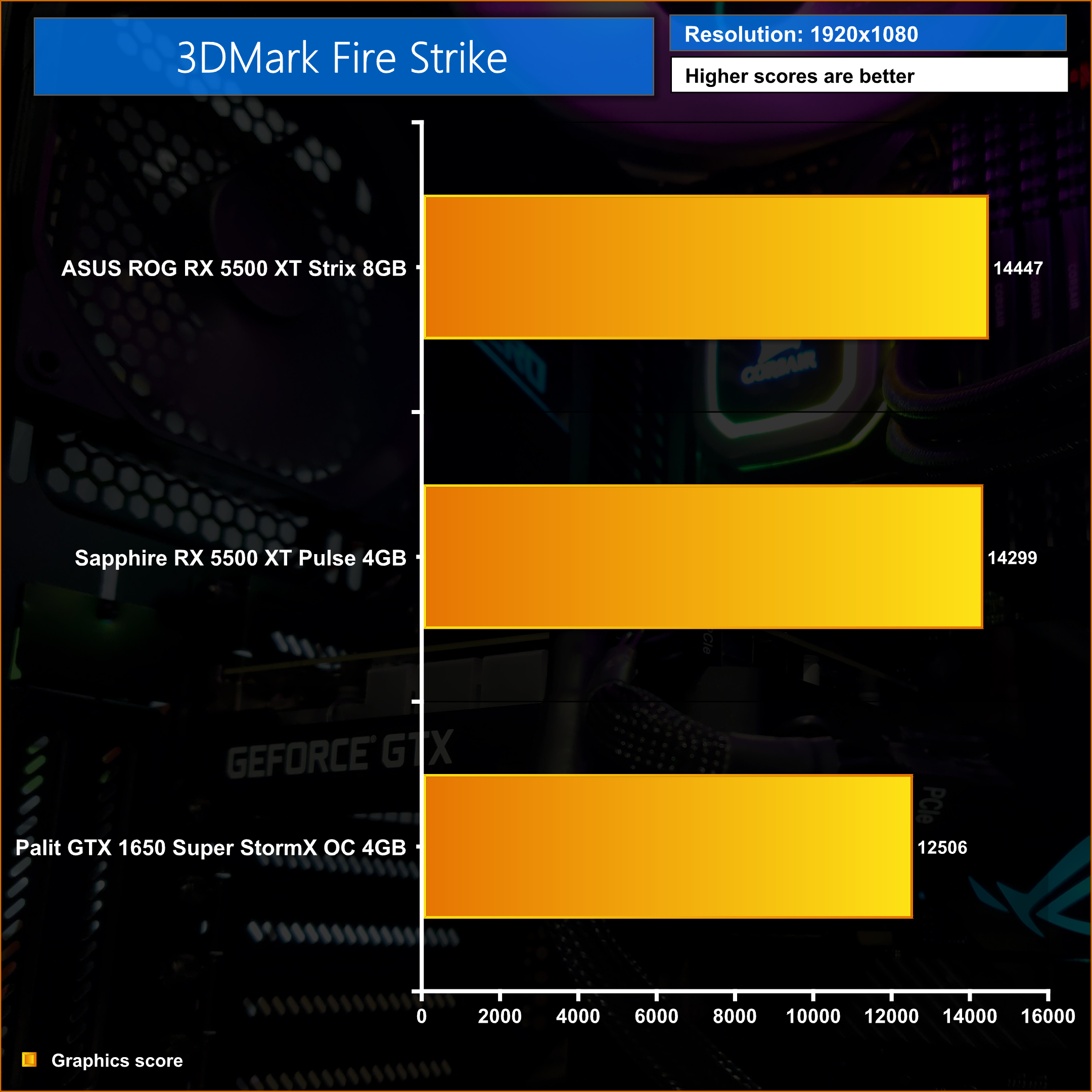
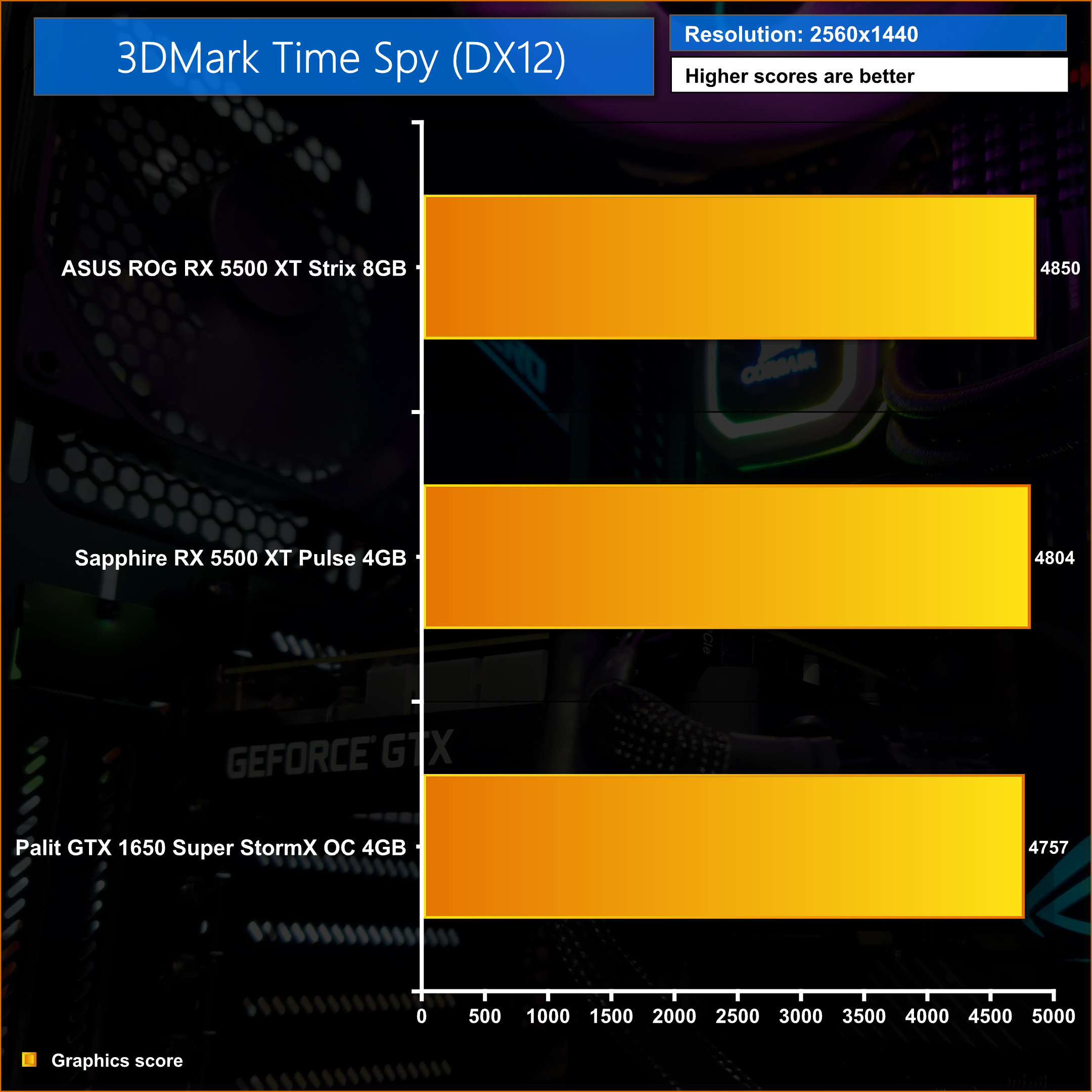
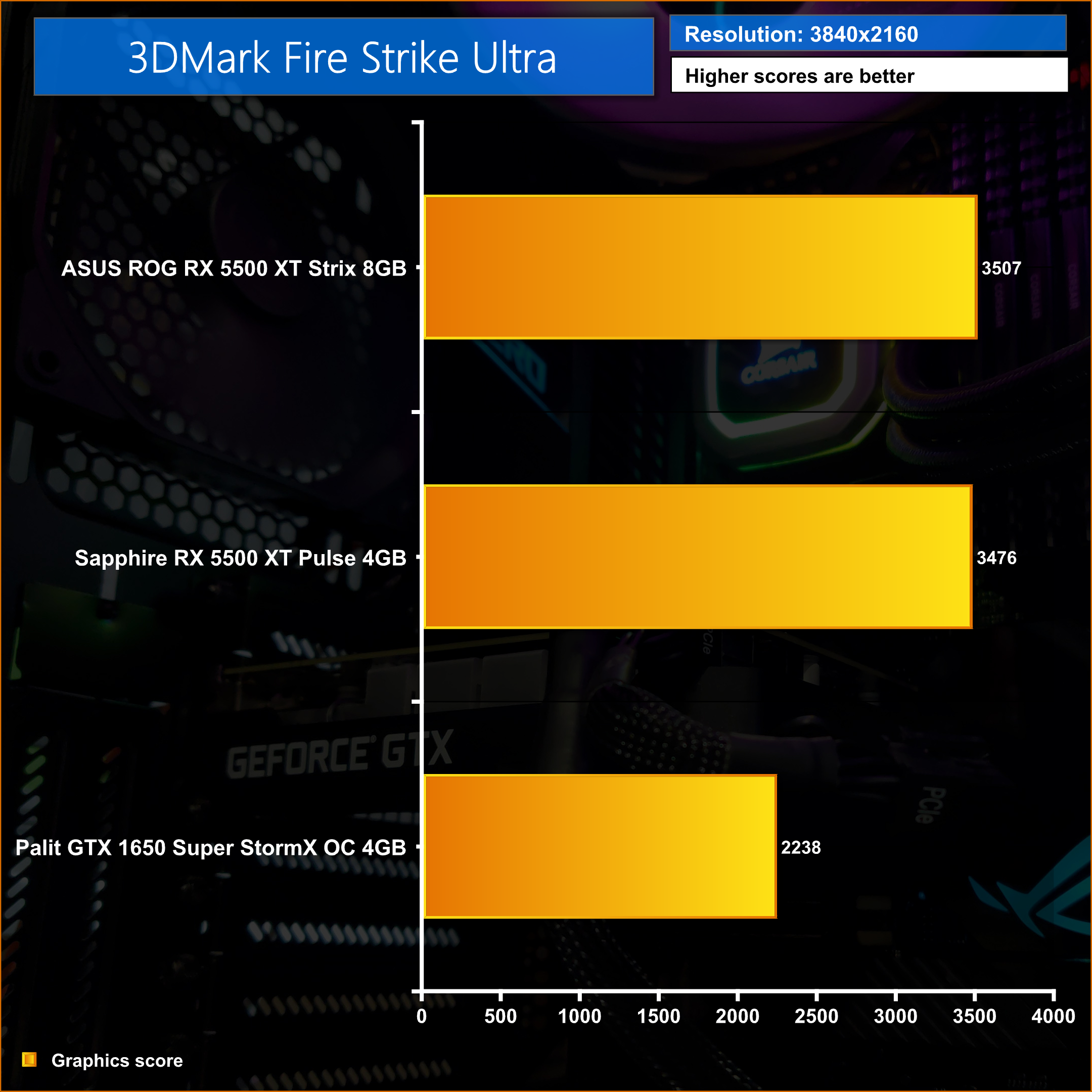
Kicking off with our 3DMark scores, it's clear from these results that the 5500 XT holds a strong performance lead in the Fire Strike and Fire Strike Ultra benchmarks, but not in Time Spy where all three cards are neck and neck.Battlefield V is a first-person shooter video game developed by EA DICE and published by Electronic Arts. Battlefield V is the sixteenth instalment in the Battlefield series. It was released worldwide for Microsoft Windows, PlayStation 4, and Xbox One on November 20, 2018. (Wikipedia).
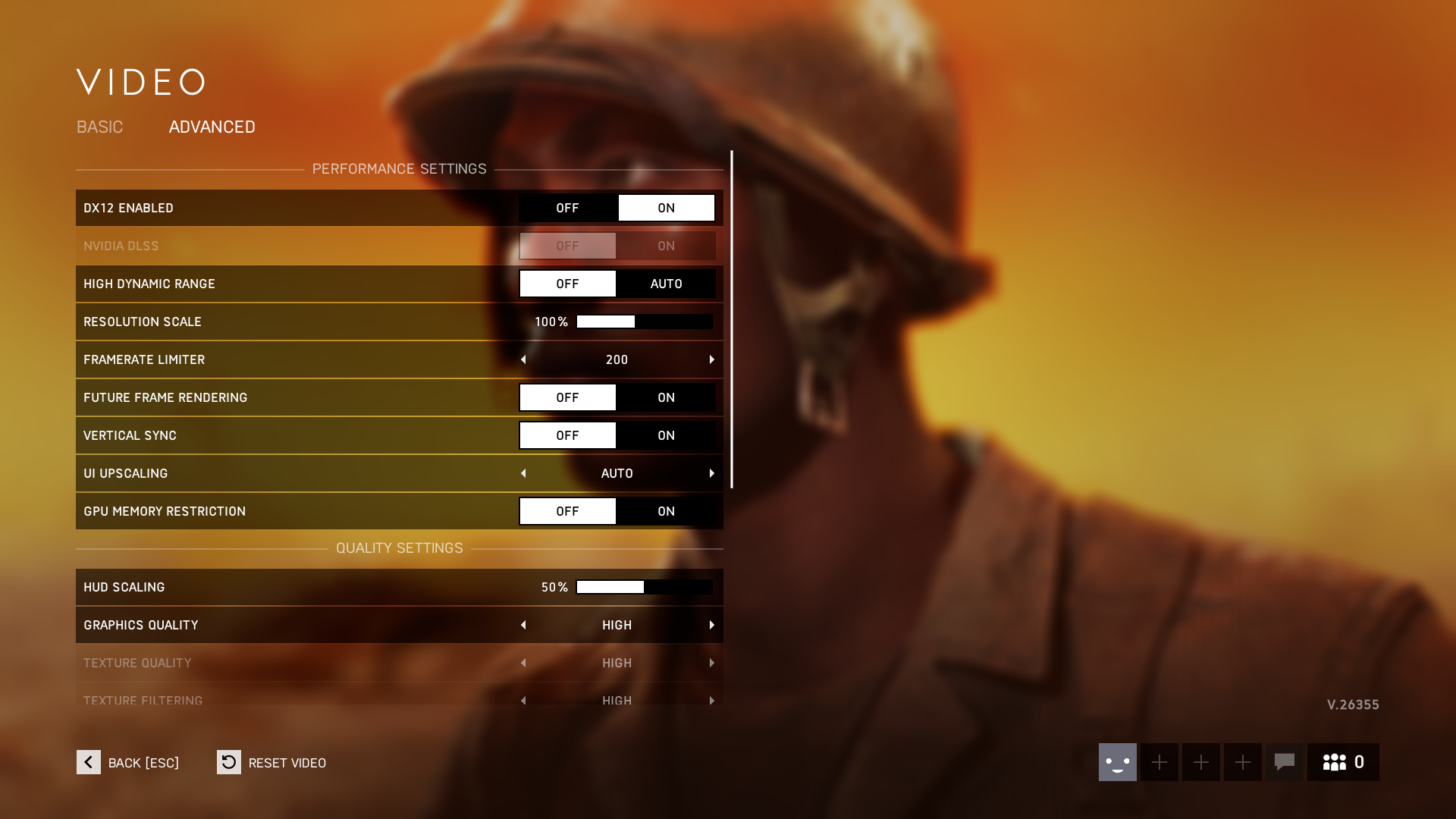
We test using the High preset, DX12 API.

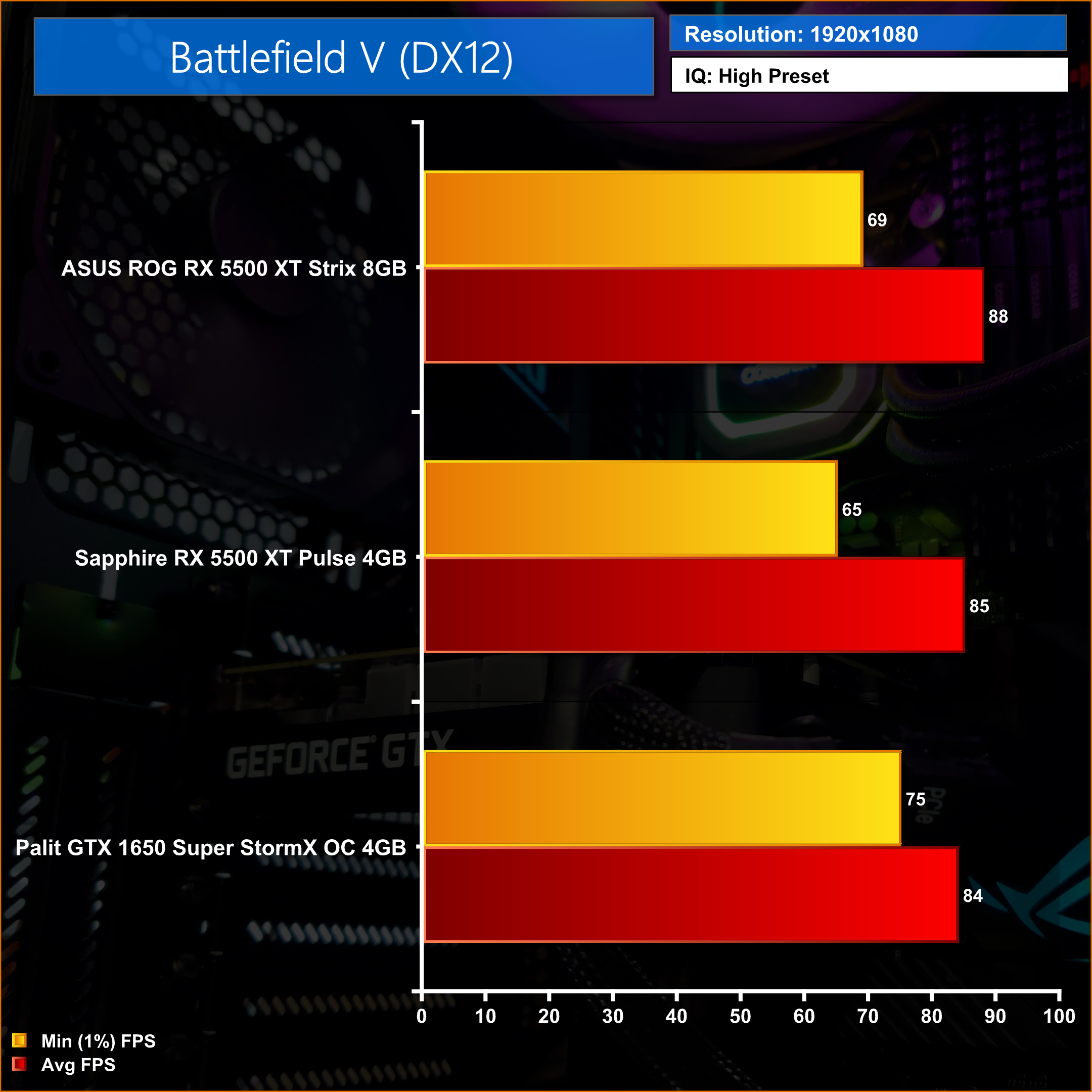
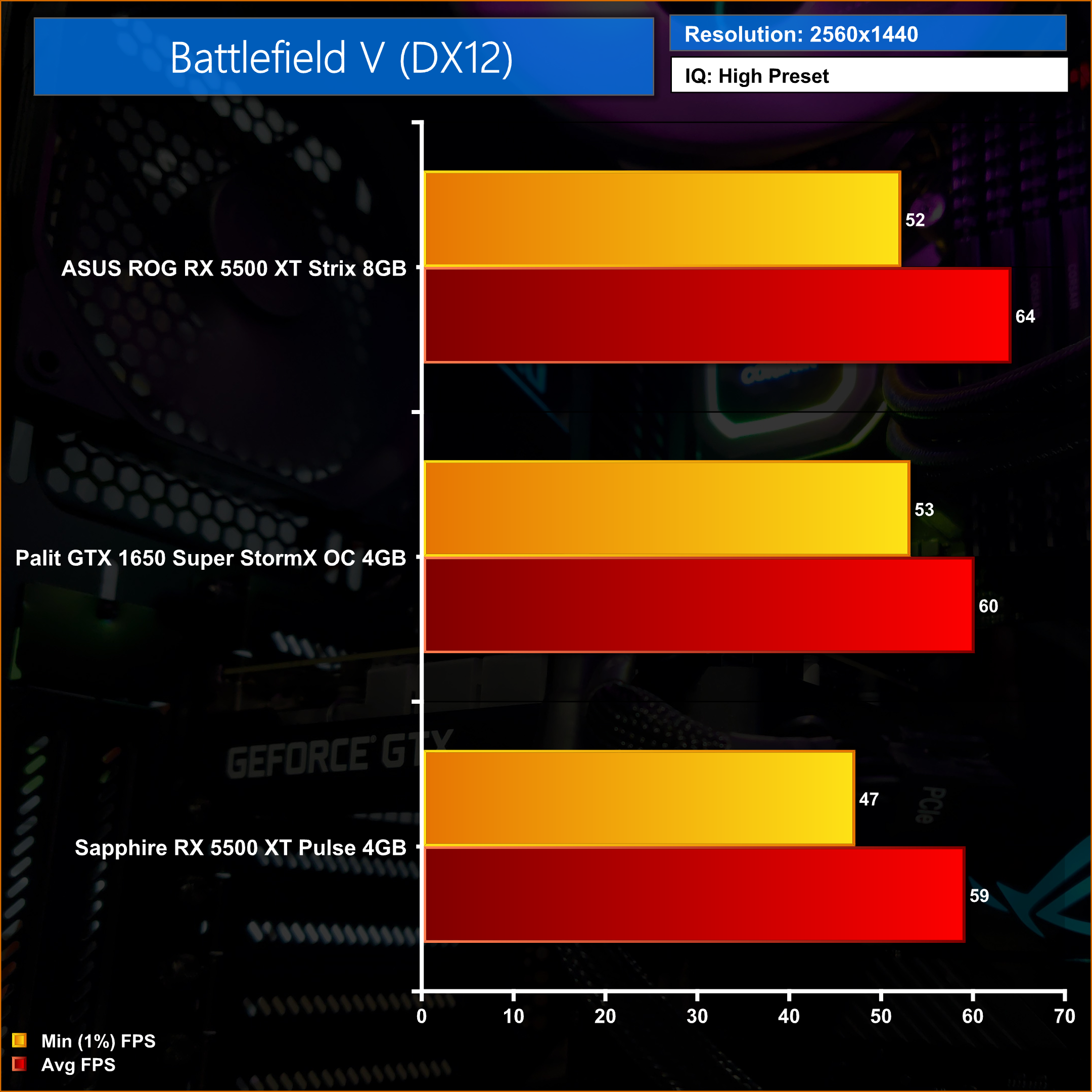
Starting things off with Battlefield V, I've been testing this game for almost two years now but it is still capable of surprises. Testing using the High preset, one step down from Ultra settings, average frame rates for all three cards are very close at 1080p, with the 8GB 5500 XT edging out the other two GPUs by just 3 or 4 FPS. Despite that, it is the 1650 Super which offers a smoother overall experience as its 1% lows are in the mid-70s, whereas the AMD GPUs drop down to the mid-to-high 60s.
At 1440p, the 5500 XT 8GB is still a few frames faster than its rivals, coming in 6.7% faster than the 1650 Super. The 8GB frame-buffer certainly helps that GPU at 1440p, as we can see the 1% lows for the 4GB 5500 XT again falling short of both the 1650 Super and 5500 XT 8GB.
Control is an action-adventure video game developed by Remedy Entertainment and published by 505 Games. Control was released on 27 August 2019 for Microsoft Windows, PlayStation 4, and Xbox One. (Wikipedia).
We test using the Medium preset, with MSAA disabled, DX12 API.
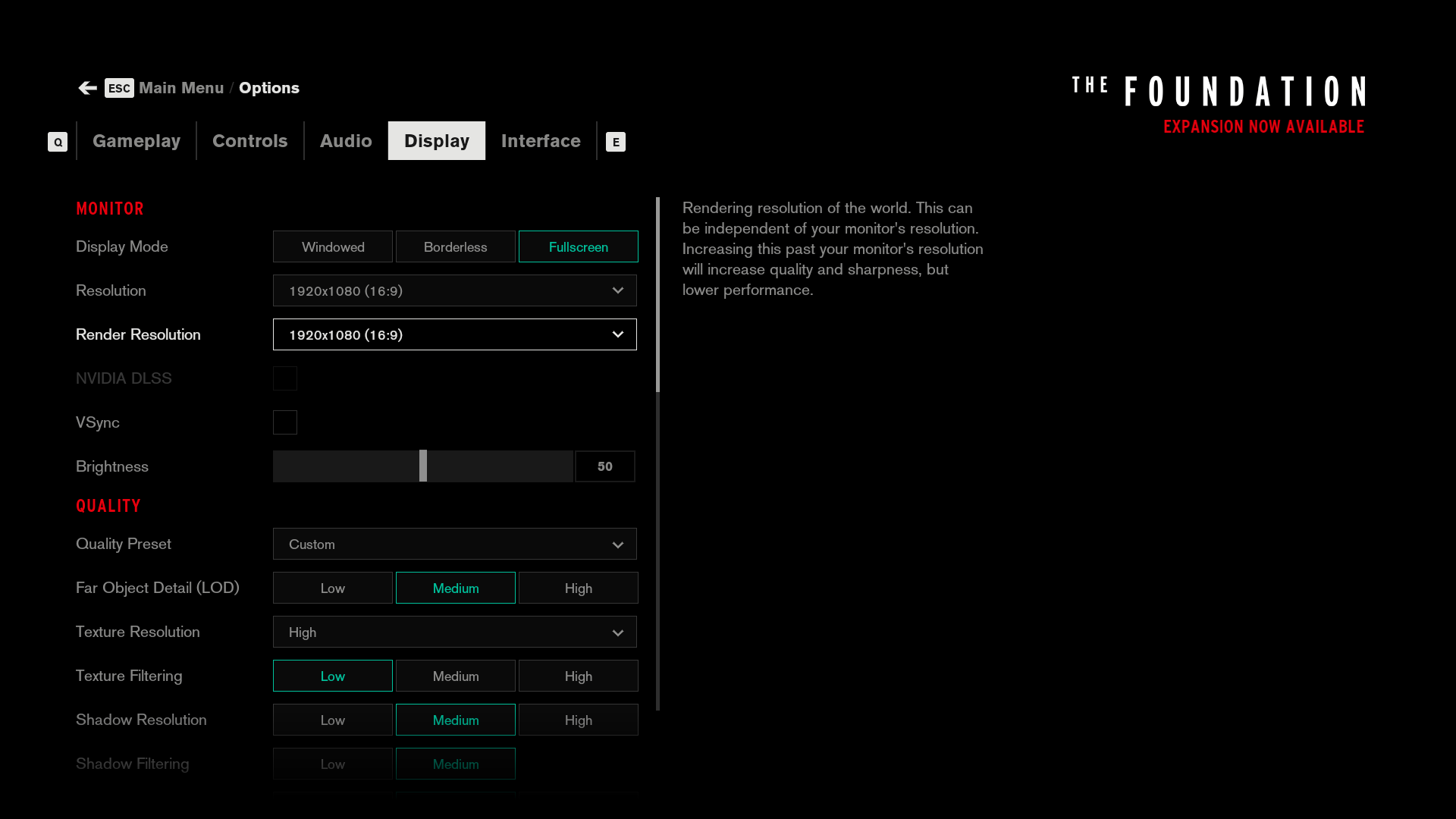
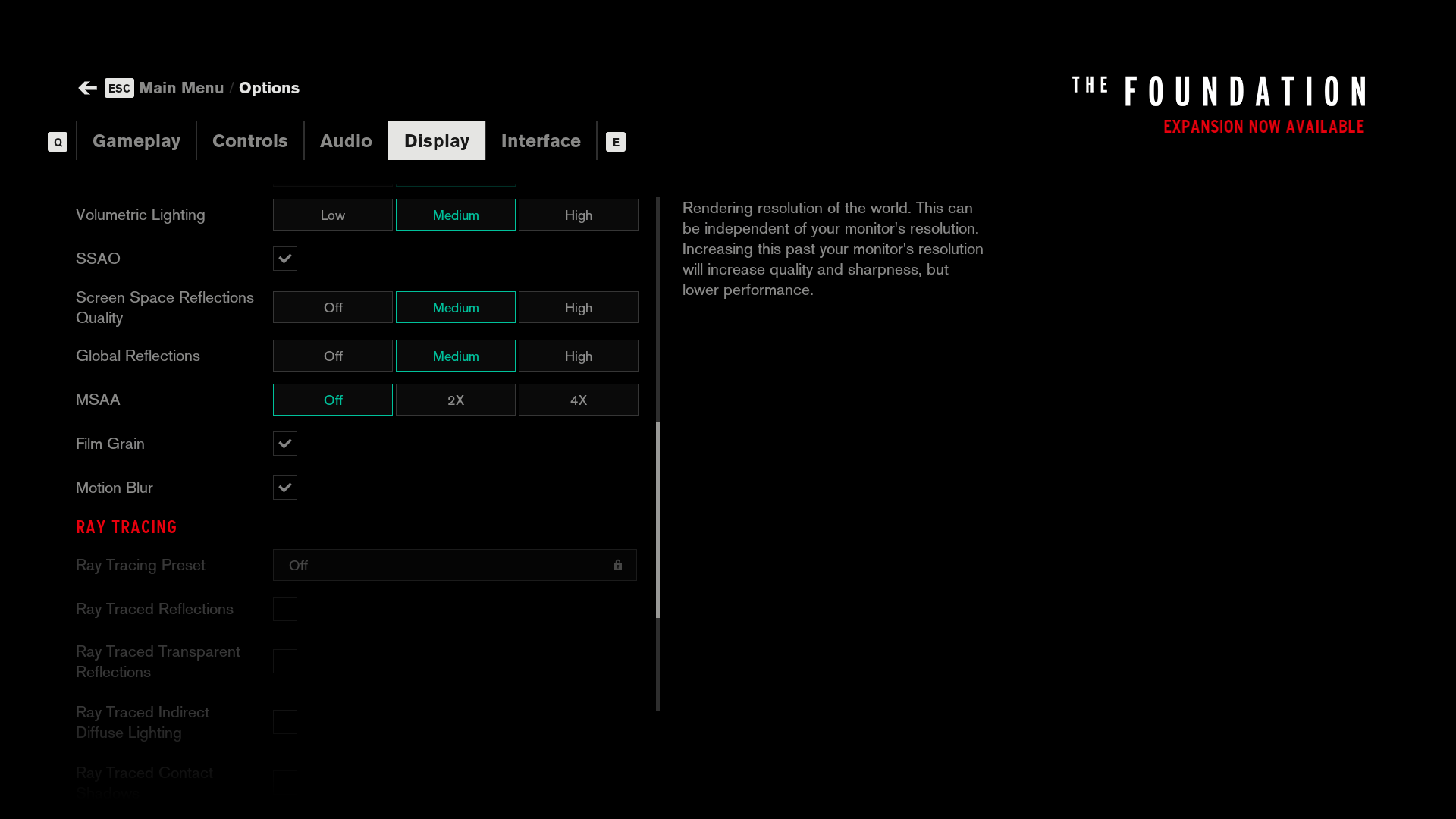
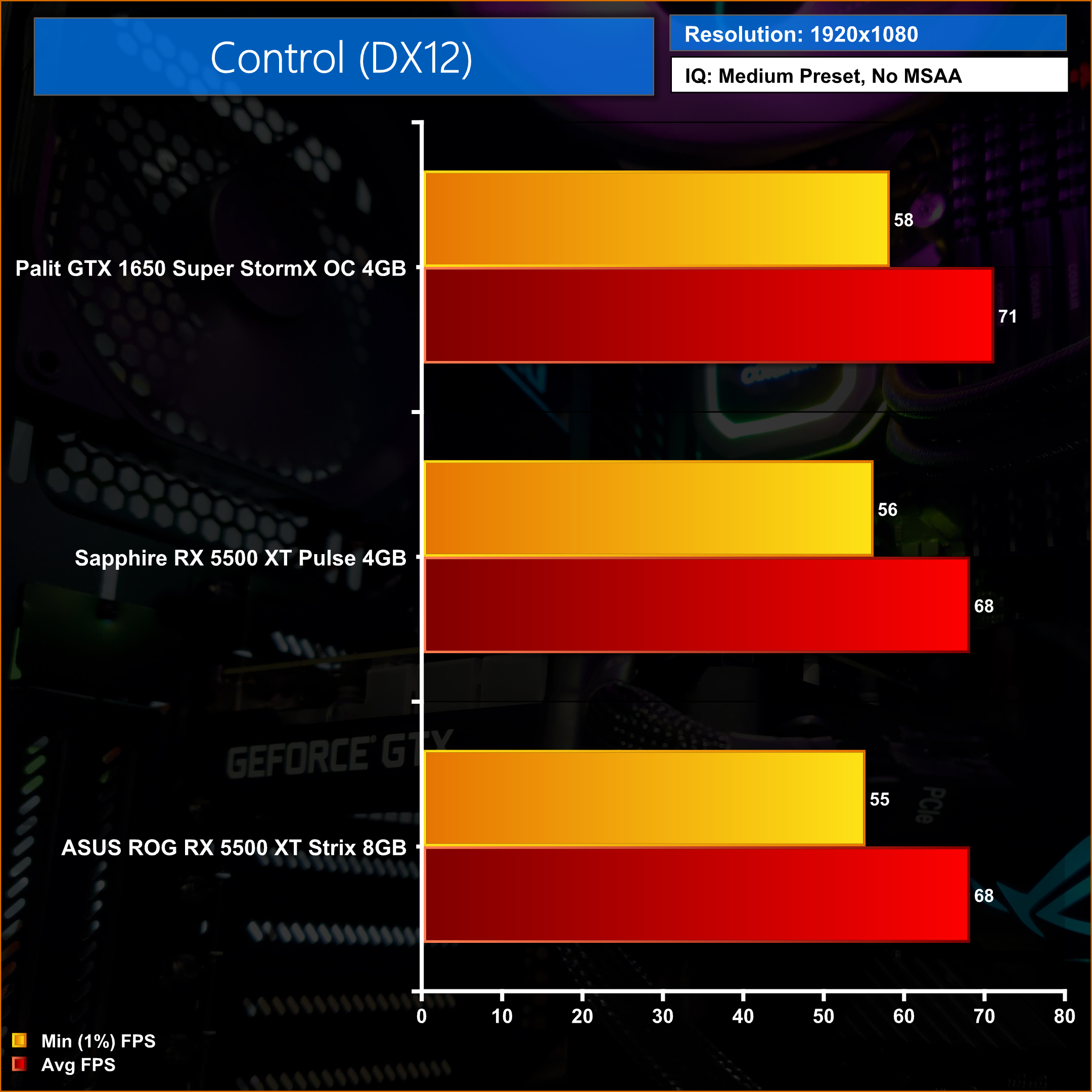
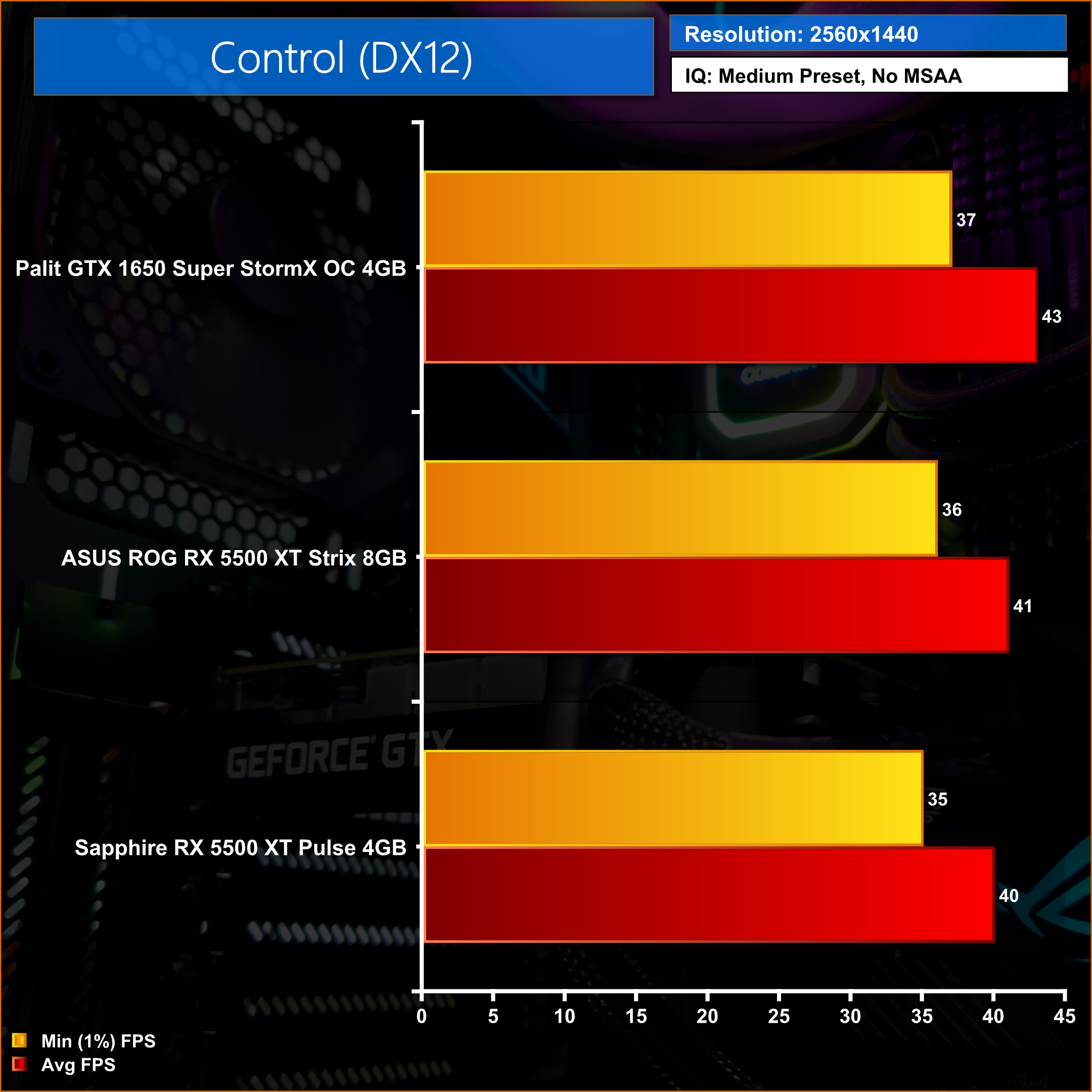
Up next is Control, a demanding title for even high-end GPUs. It only has three image quality presets – low, medium and high – so we test with the Medium preset at High is going to be to much for this calibre of GPU to handle.
At 1080p, there is really no difference between the 4GB and 8GB 5500 XT cards, both produce 68FPS on average, with only the tiniest difference for the 1% lows. GTX 1650 Super does edge ahead, however, holding a 4% advantage over both the 5500 XT GPUs.
At 1440p, all three cards are within just 3FPS of each other, though with the 1650 Super 3FPS faster than the 5500 XT 4GB, that does work out as a 7.5% performance advantage. Versus the 5500 XT 8GB, 1650 Super is 5% faster.Death Stranding is an action game developed by Kojima Productions. It is the first game from director Hideo Kojima and Kojima Productions after their split from Konami in 2015. It was released by Sony Interactive Entertainment for the PlayStation 4 on November 8, 2019, and by 505 Games for Microsoft Windows on July 14th, 2020. (Wikipedia).
We test using the Default preset, DX12 API.
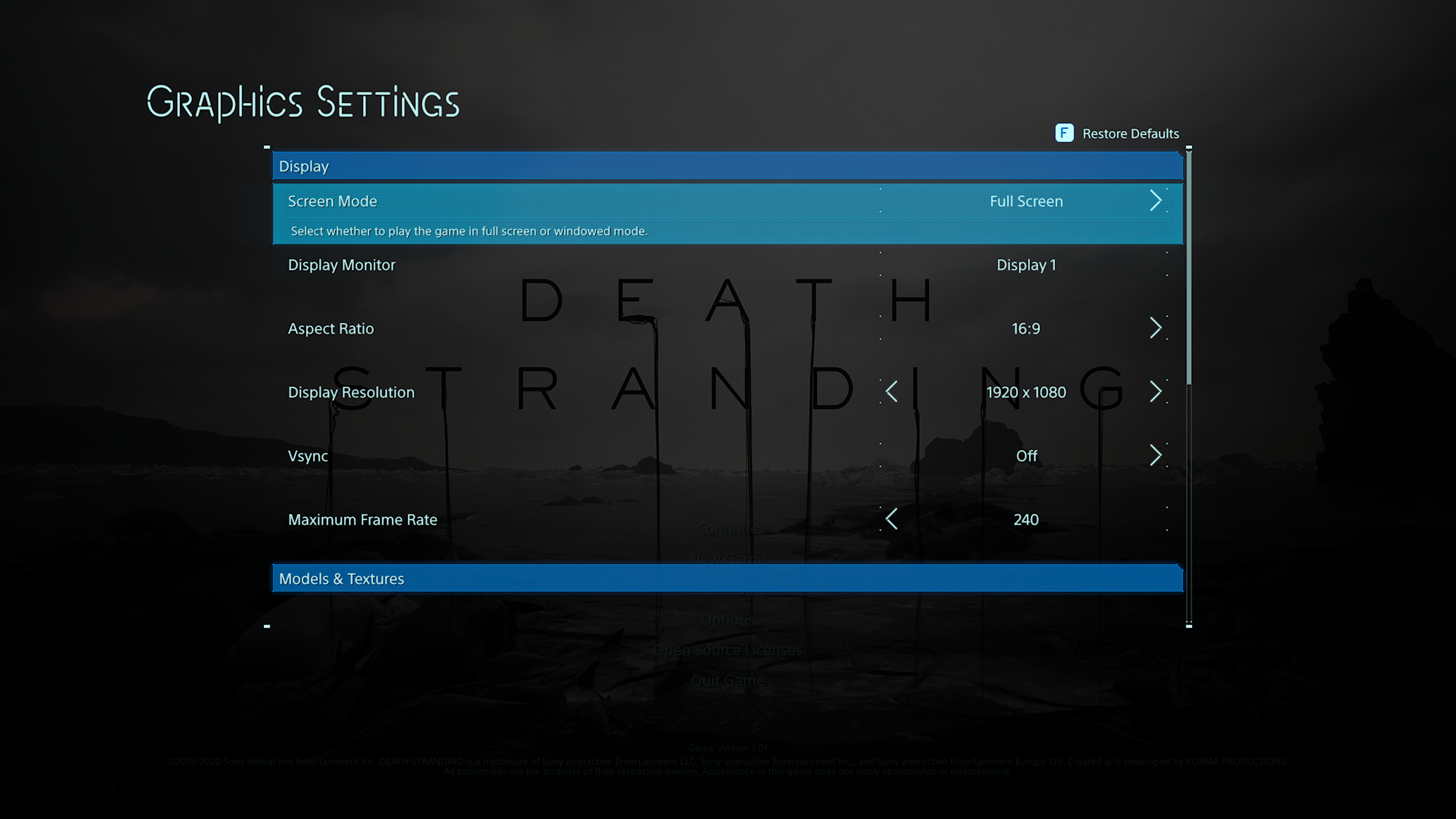
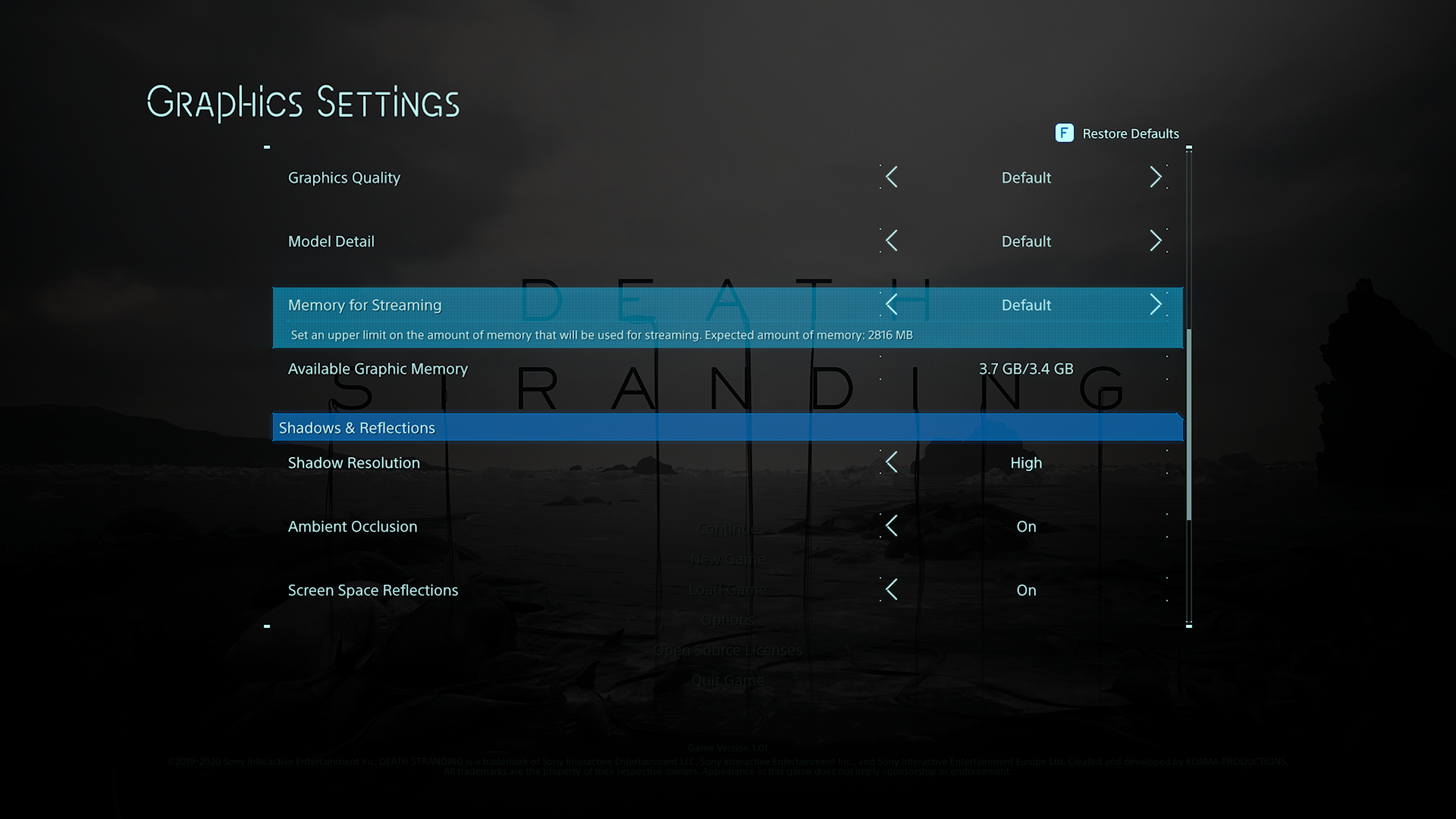
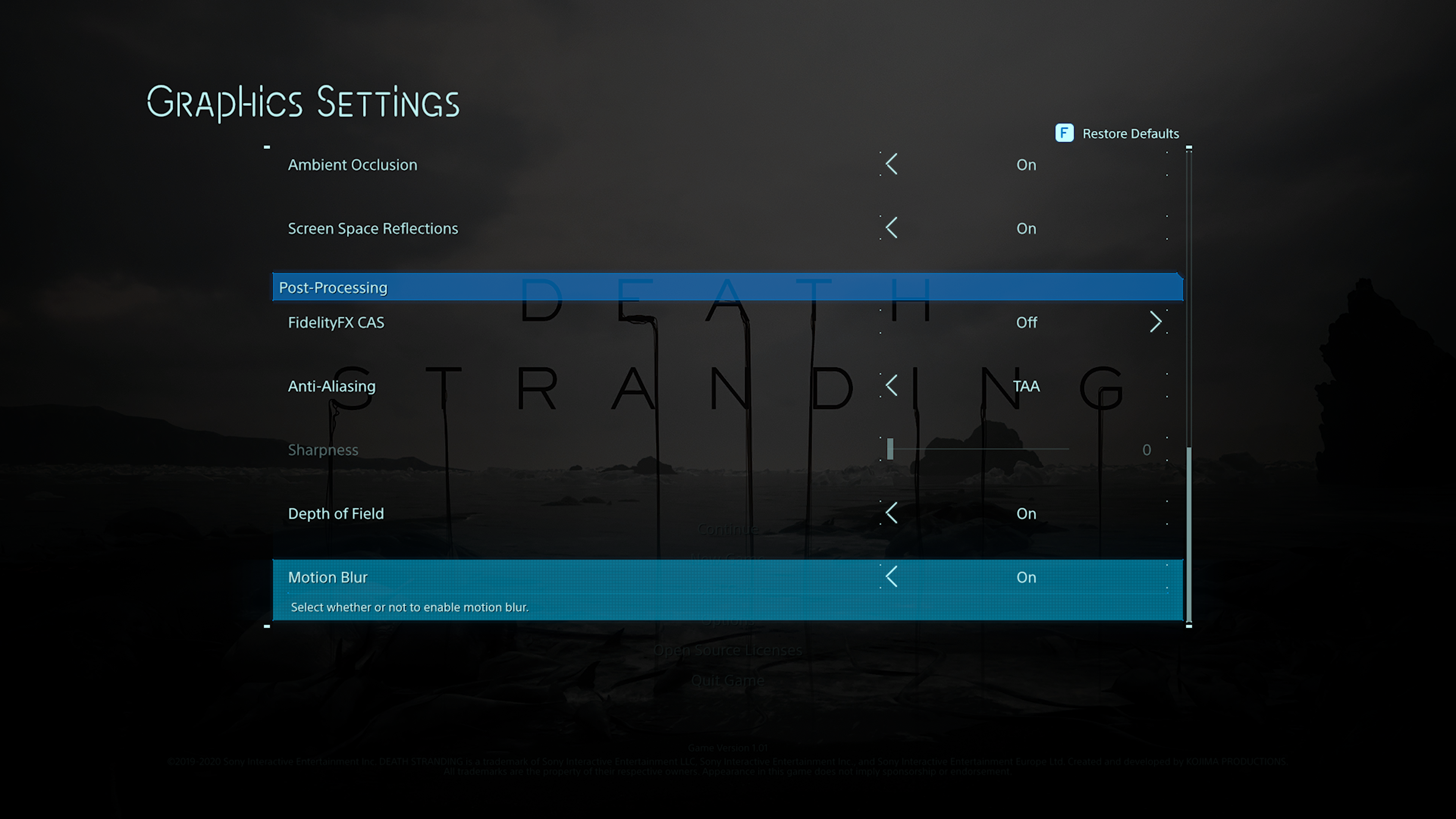
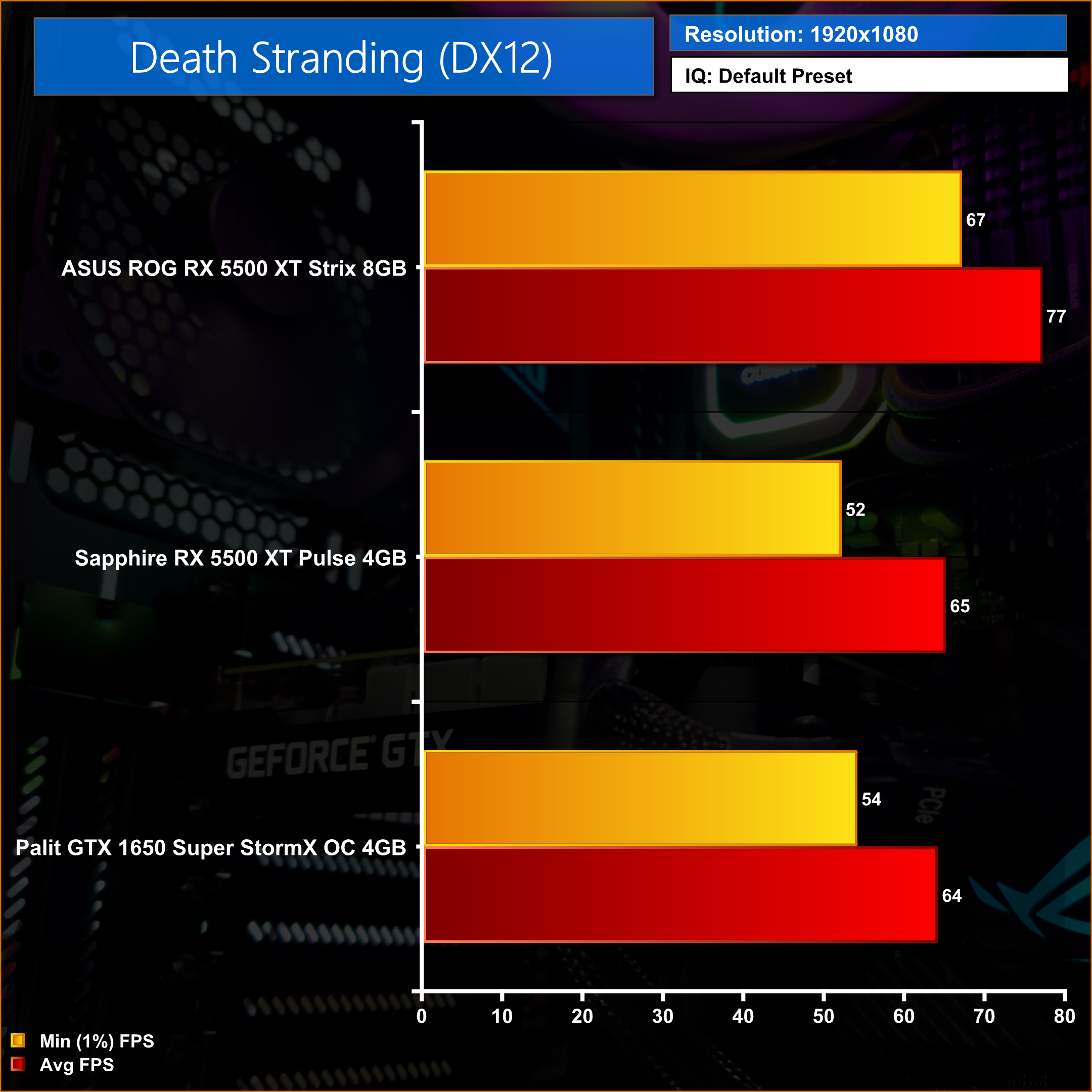
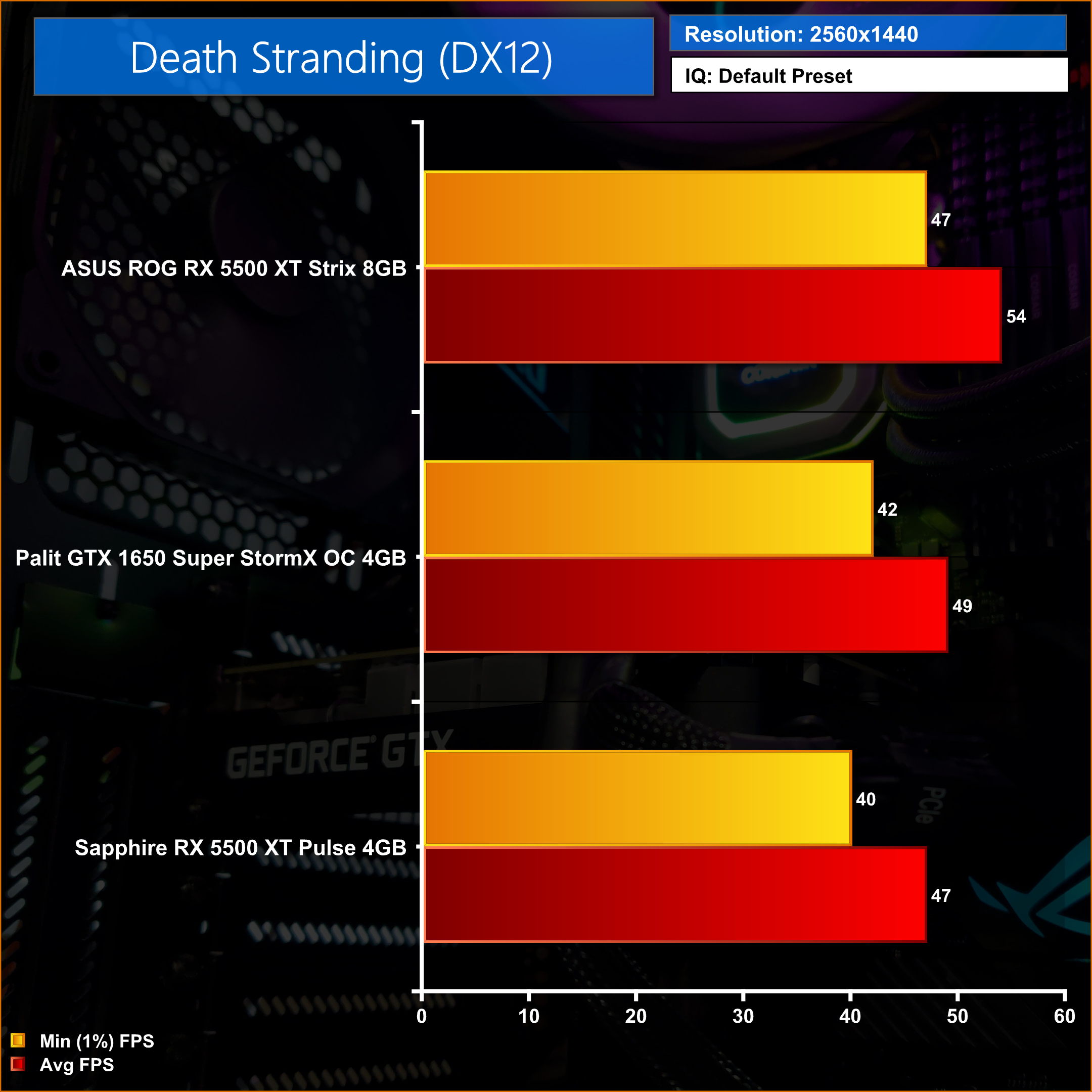
Death Stranding is the newest game in our set of benchmarks today, and we did a full performance analysis piece if you want to check that out. Using the Default settings – giving equivalent visual fidelity to playing the game on console – there is clearly something of a memory bottleneck for the 4GB cards in the test, as both the 1650 Super and 4GB 5500 XT fall well behind the 5500 XT 8GB. At 1080p, it's almost a 19% difference in favour of the 8GB card, so this is certainly a game which can benefit from larger frame-buffers.
Tom Clancy's The Division 2 is an online action role-playing video game developed by Massive Entertainment and published by Ubisoft. The sequel to Tom Clancy's The Division (2016), it is set in a near-future Washington, D.C. in the aftermath of a smallpox pandemic, and follows an agent of the Strategic Homeland Division as they try to rebuild the city. (Wikipedia).
We test using the High preset, but with V-Sync disabled, DX11 API.
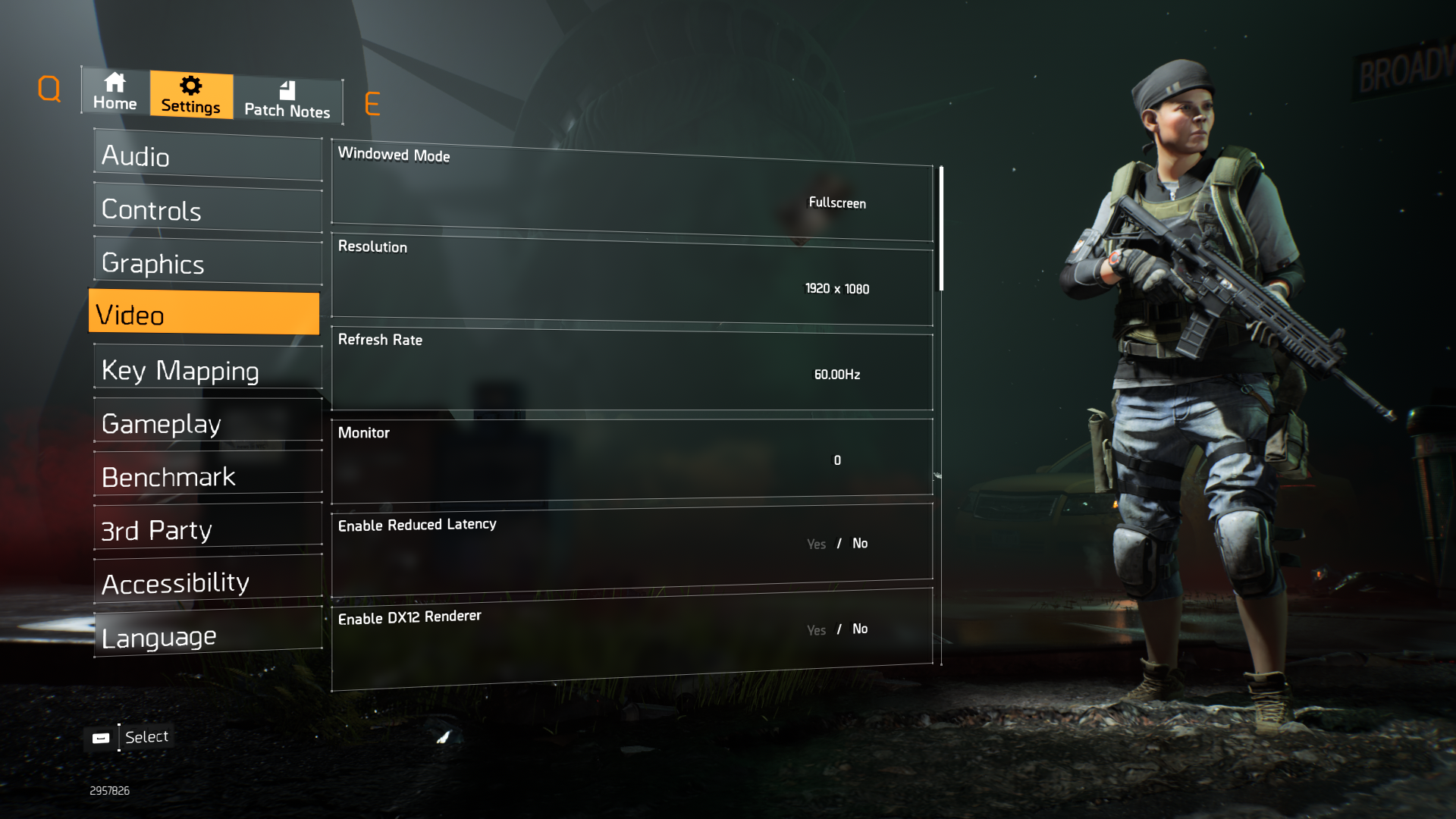
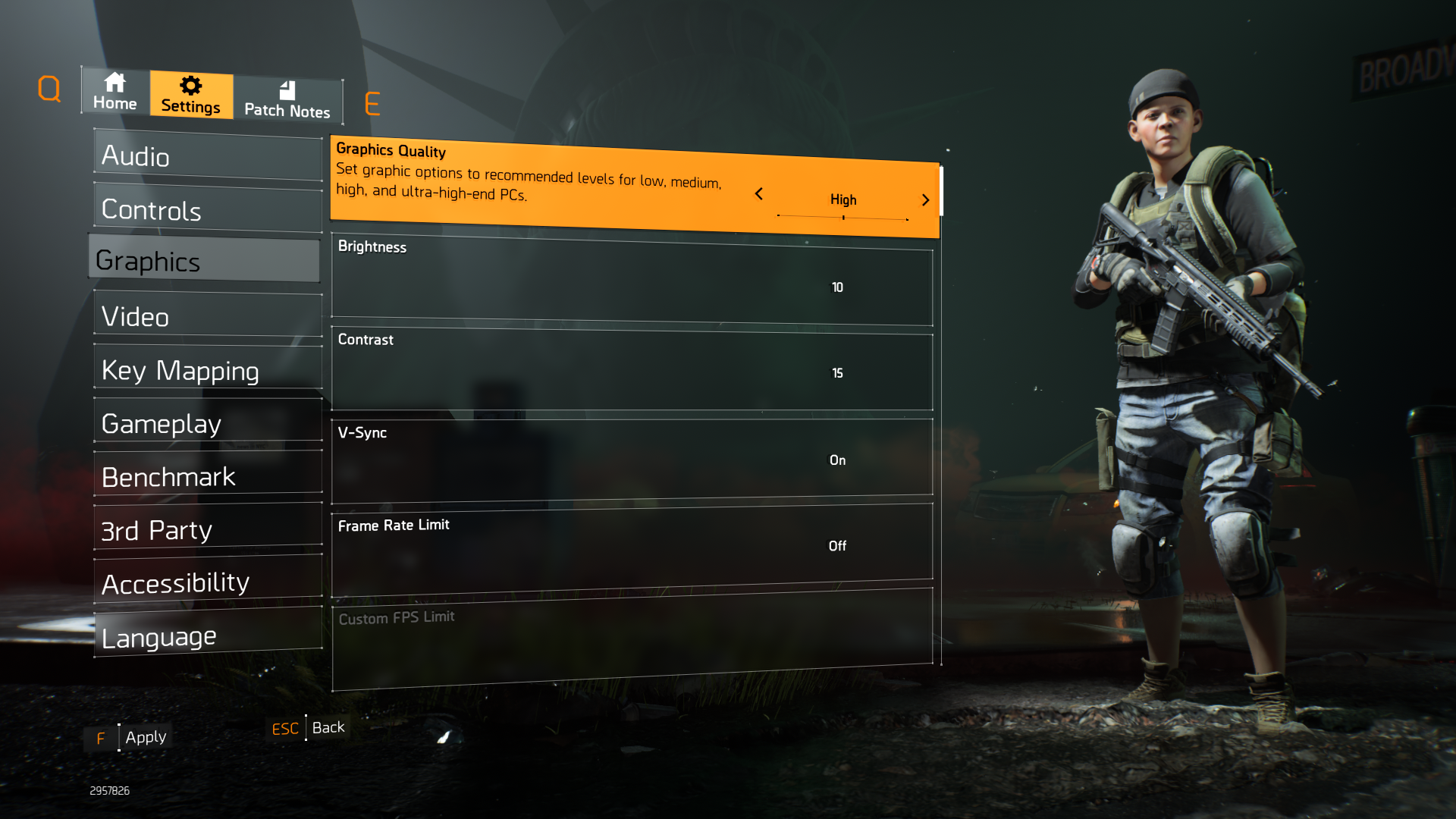
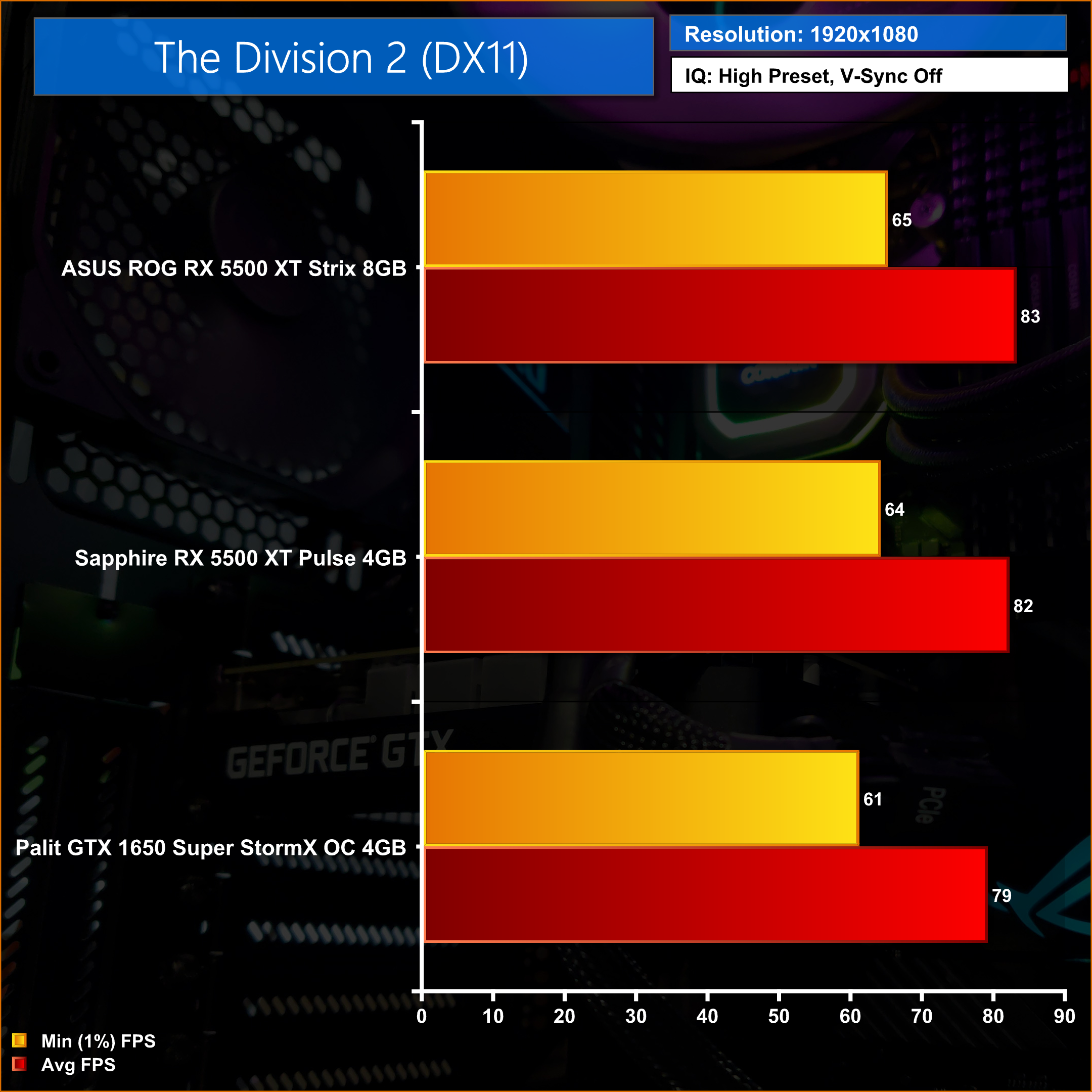
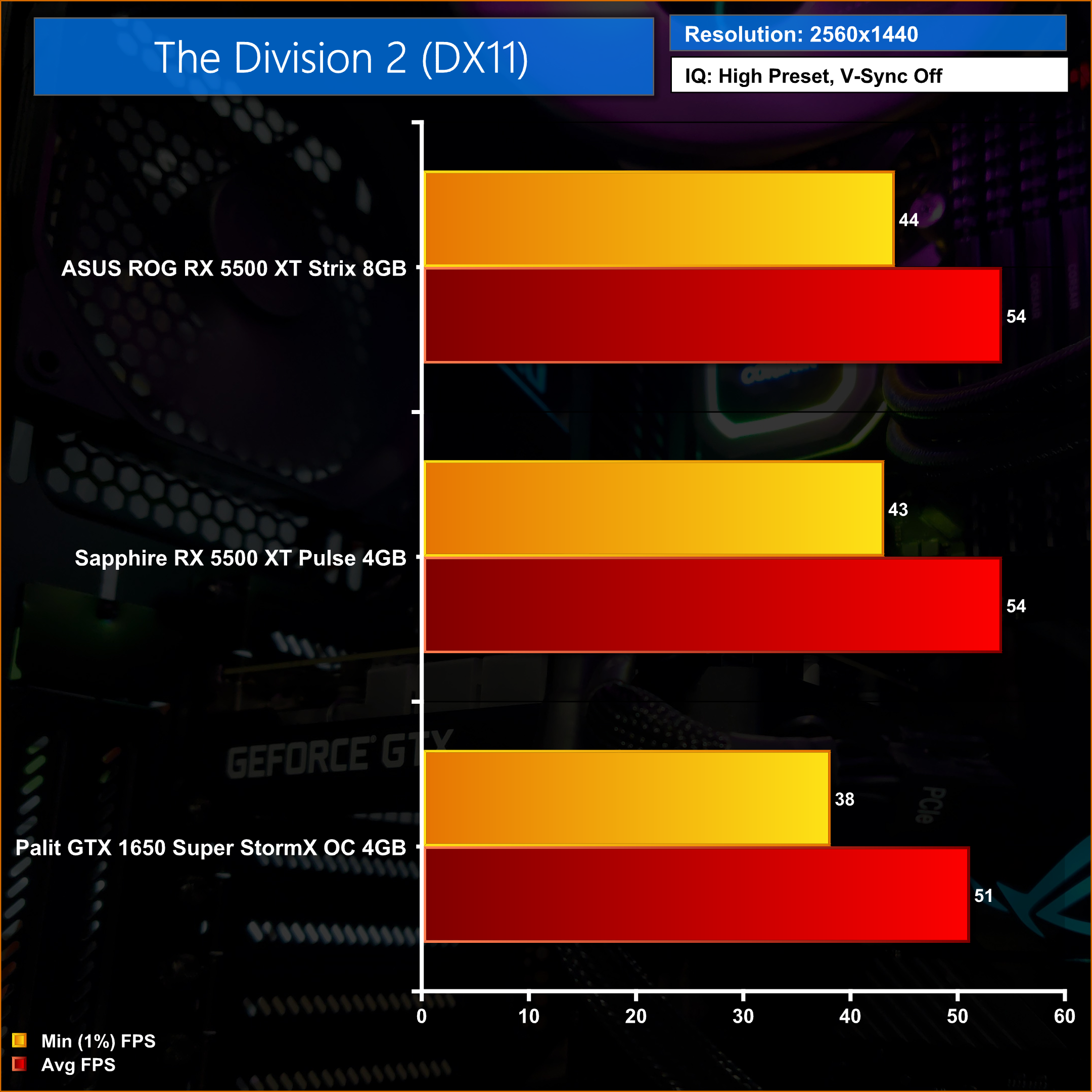
The Division 2 again sees all three cards clustered closely together, but here the AMD GPUs take a marginal lead. At 1080p, the four frame advantage for the 5500 XT 8GB works out as a difference of 5%, while the 4GB model edges ahead of 1650 Super by just 4%.
At 1440p things are still very close, but both 5500 XT models perform identically, giving them a 6% lead over 1650 Super at this resolution.
F1 2020 is the official video game of the 2020 Formula 1 and Formula 2 Championships developed and published by Codemasters. It is the thirteenth title in the Formula 1 series developed by the studio and was released on 7 July 2020 for preorders of the Michael Schumacher Edition and 10 July 2020 for the regular edition on Microsoft Windows, PlayStation 4, Xbox One and Stadia. (Wikipedia).
We test using the High preset, with TAA and 16x Anisotropic Filtering, DX12 API.
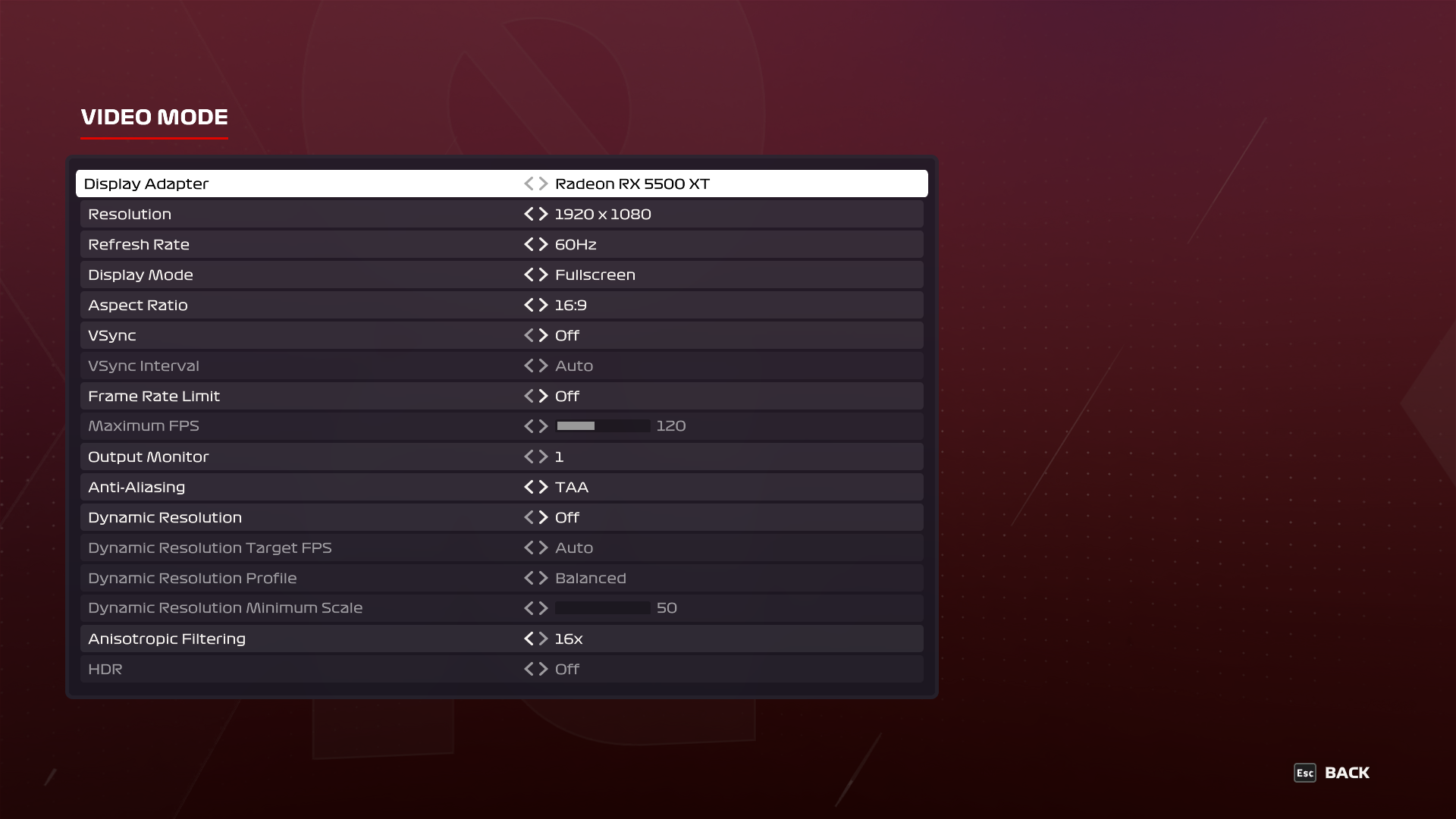
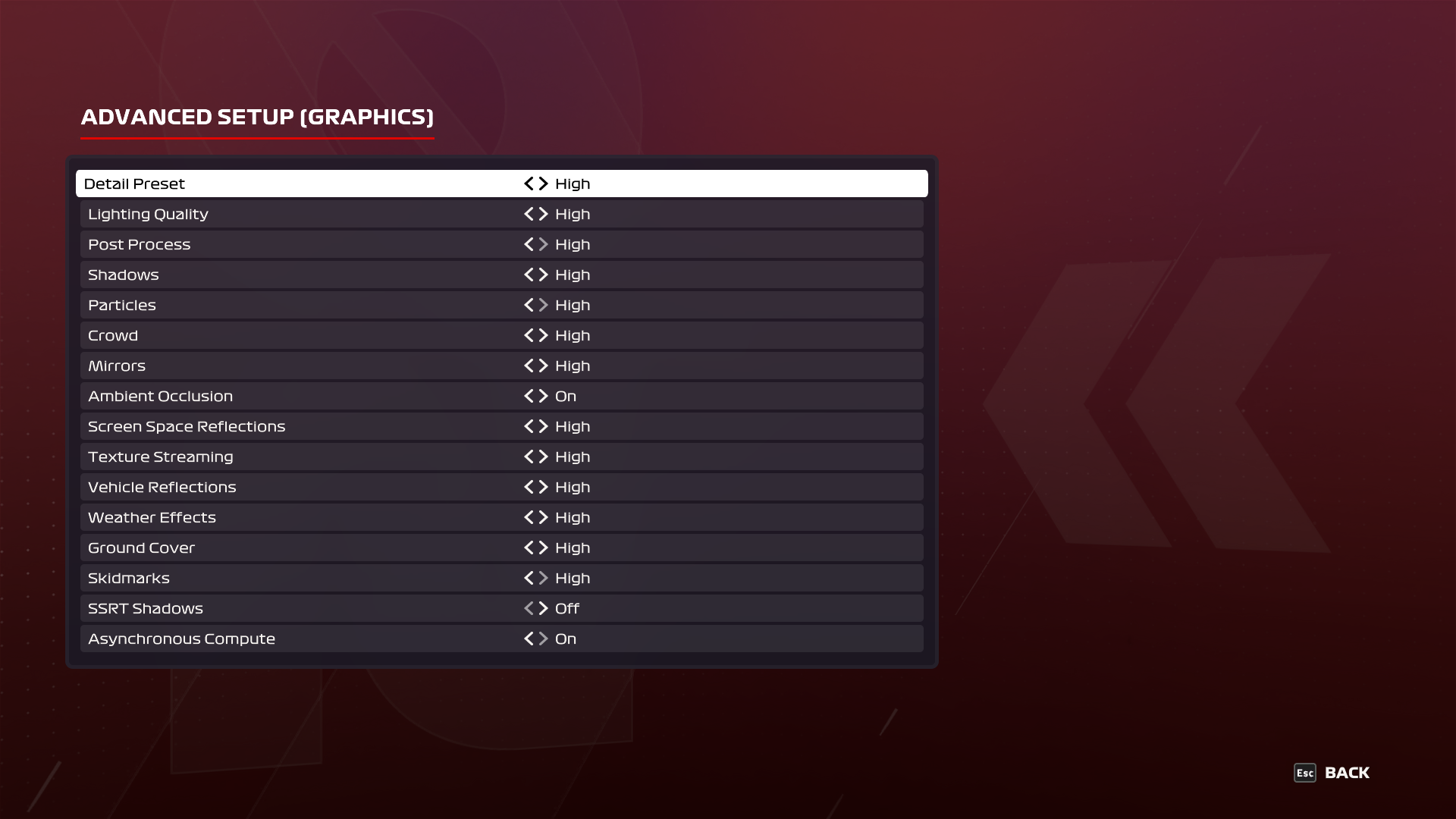
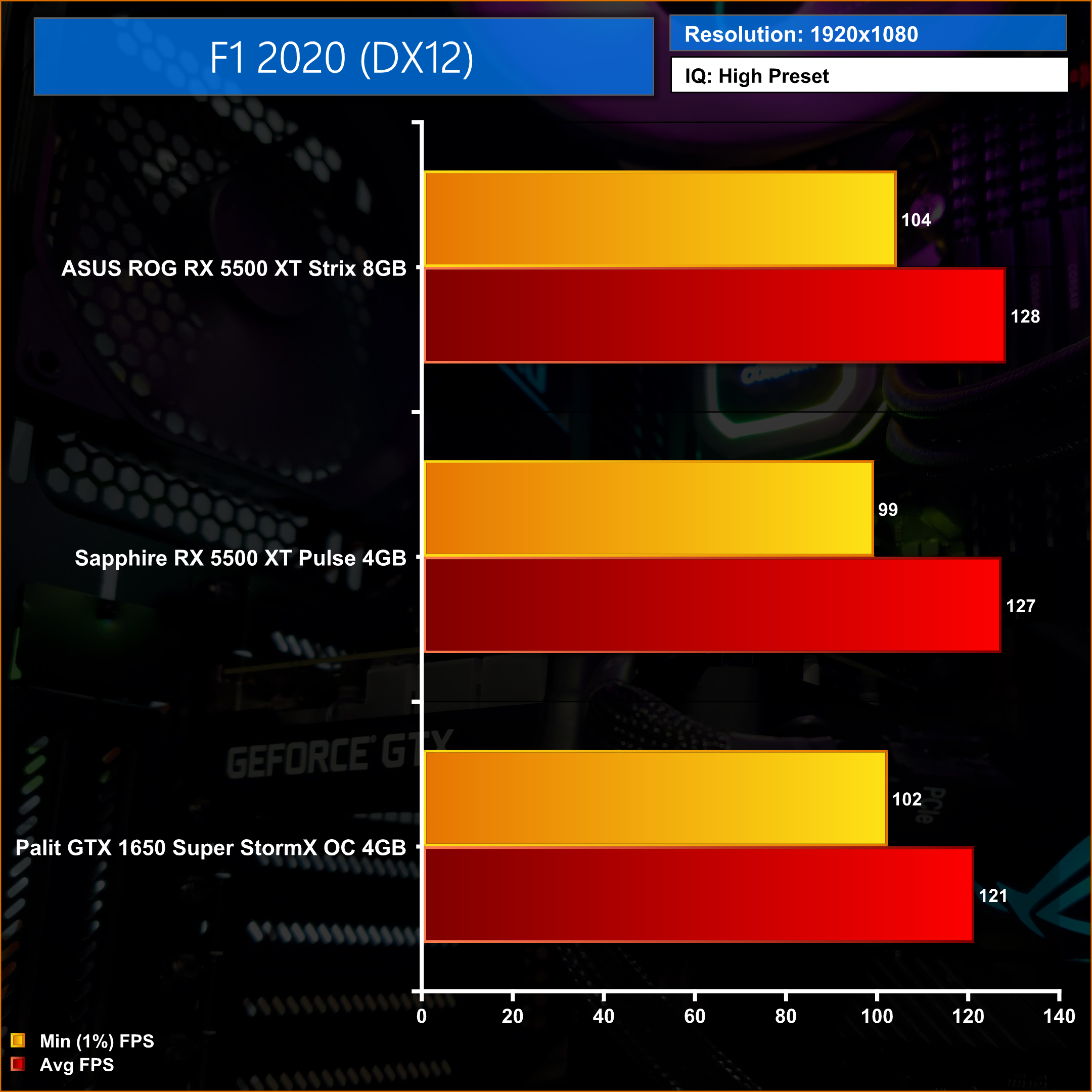
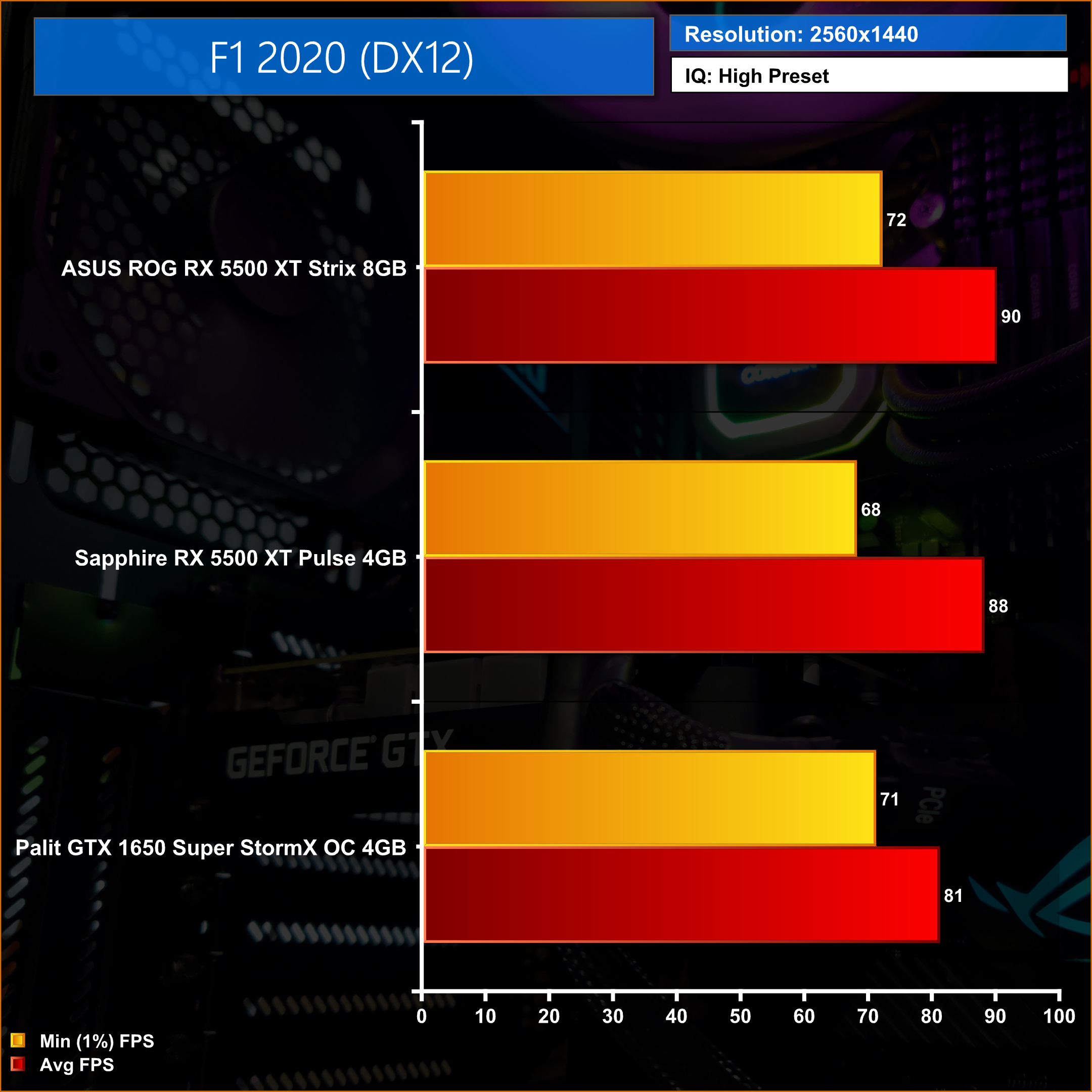
Another very recent release, we test F1 2020 using the High preset. VRAM is certainly not a limiting factor here, but the game definitely has an edge on the AMD hardware – GTX 1650 Super comes in 5% slower than the 5500 XT 4GB at 1080p. Comparing both 5500 XT cards shows effectively no difference between the two, with the 5500 XT 8GB edging ahead by a single frame, or less than a single percentage point.
These GPUs are more than capable of running this game at 1440p, too, where the 5500 XT 8GB takes an 11% lead over the 1650 Super.
Far Cry New Dawn is an action-adventure first-person shooter developed by Ubisoft Montreal and published by Ubisoft. The game is a spin-off of the Far Cry series and a narrative sequel to Far Cry 5. It was released for Microsoft Windows, PlayStation 4 and Xbox One on February 15, 2019. (Wikipedia).
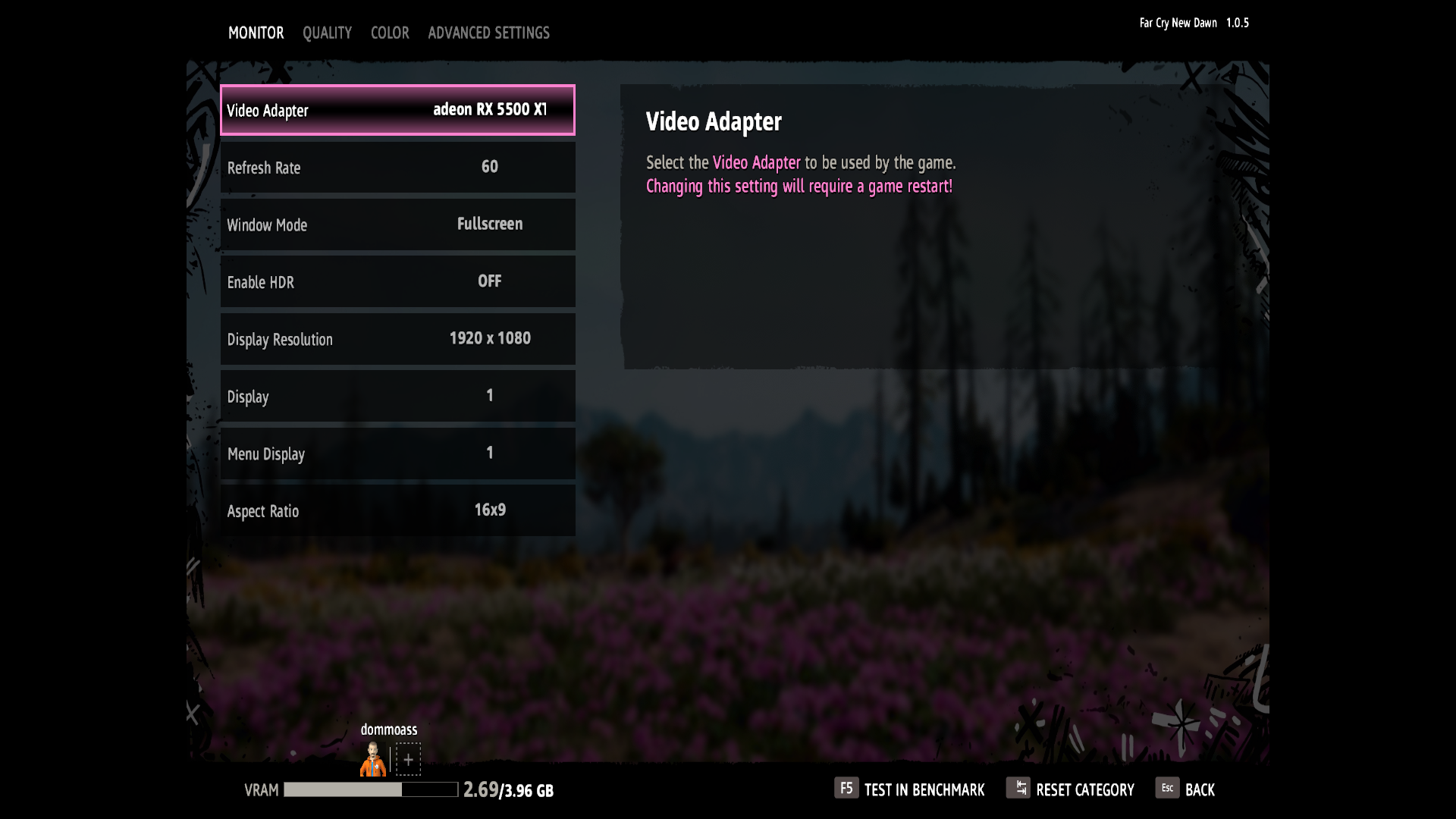
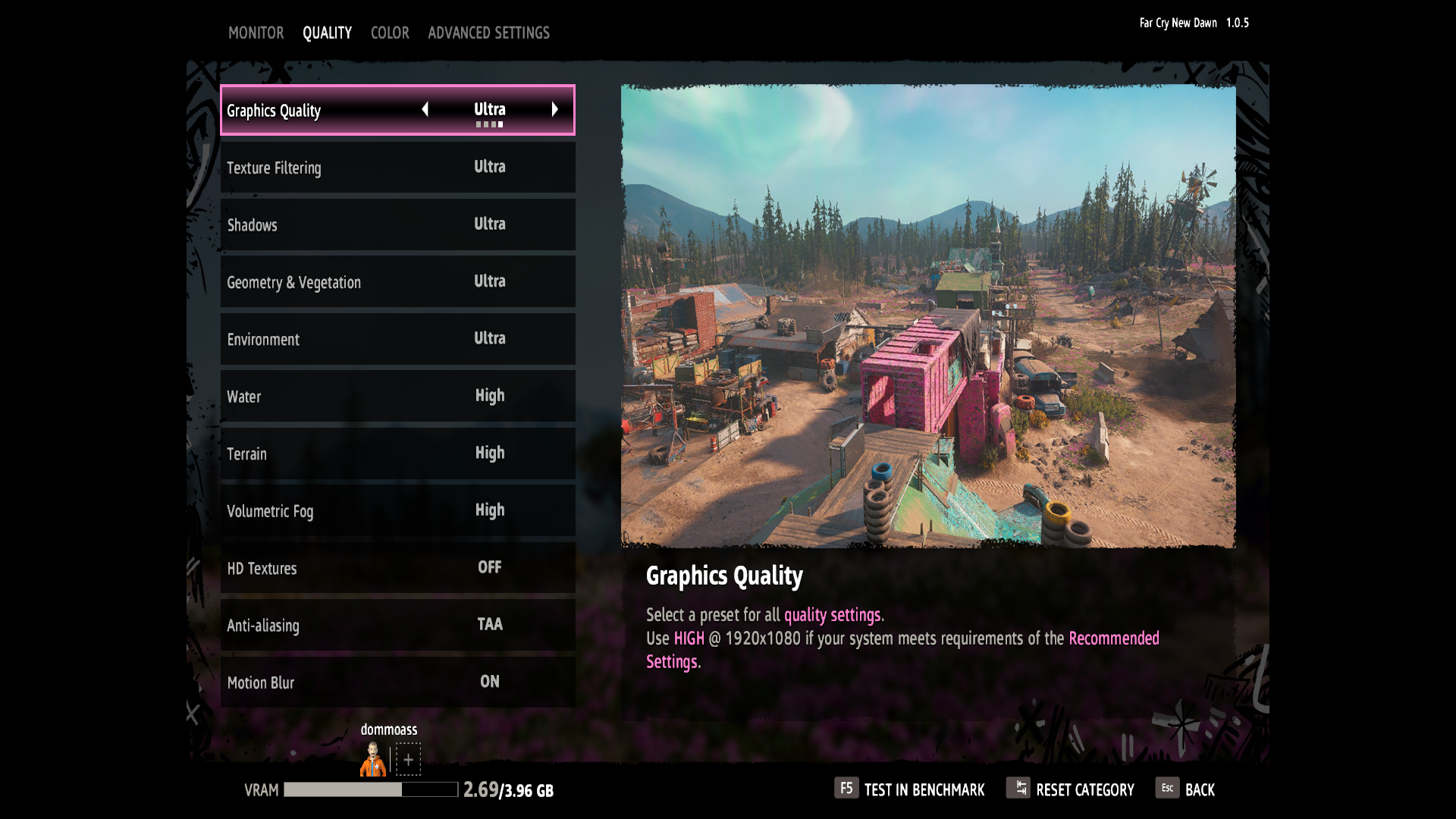
We test using the Ultra preset, with the HD Textures pack disabled, DX11 API.
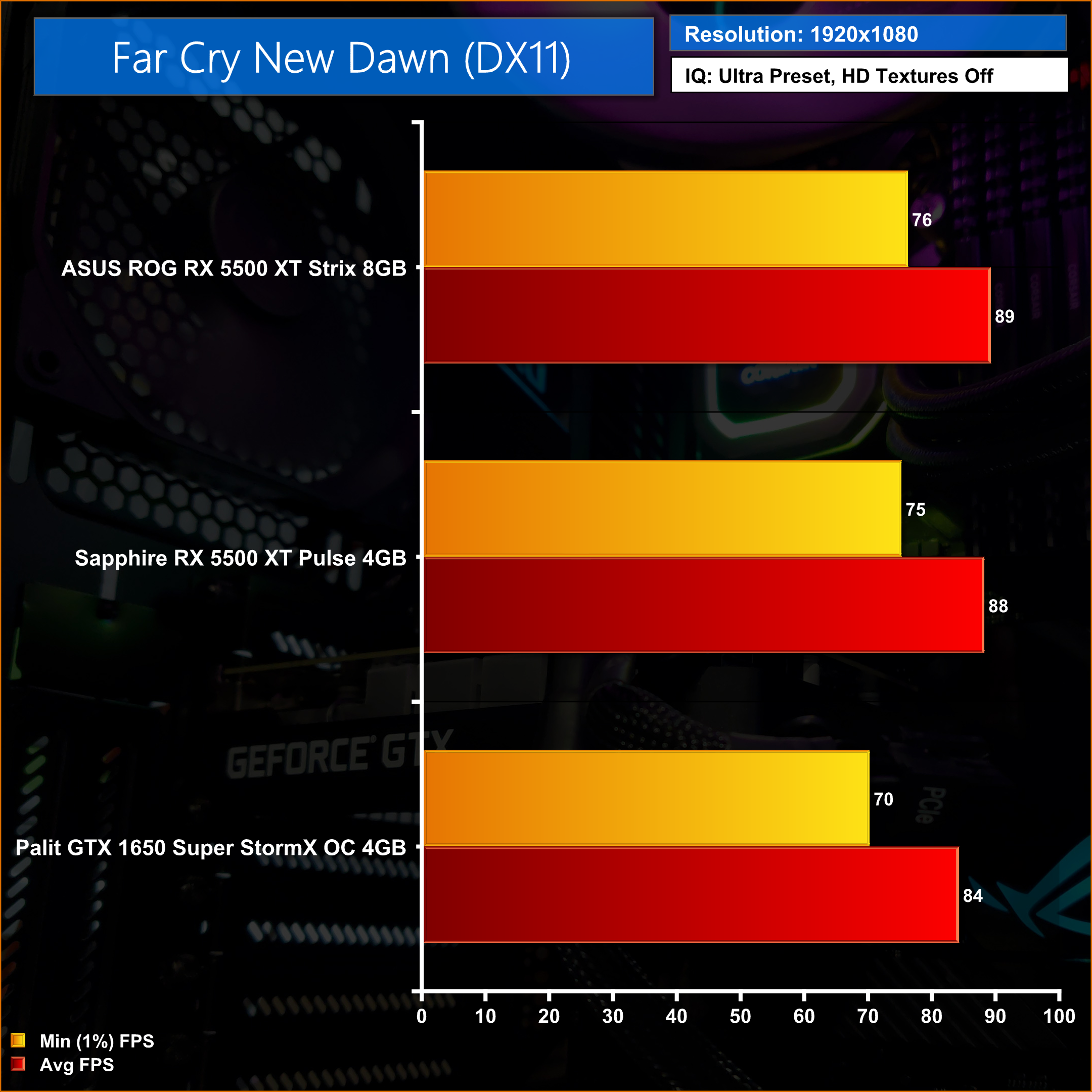
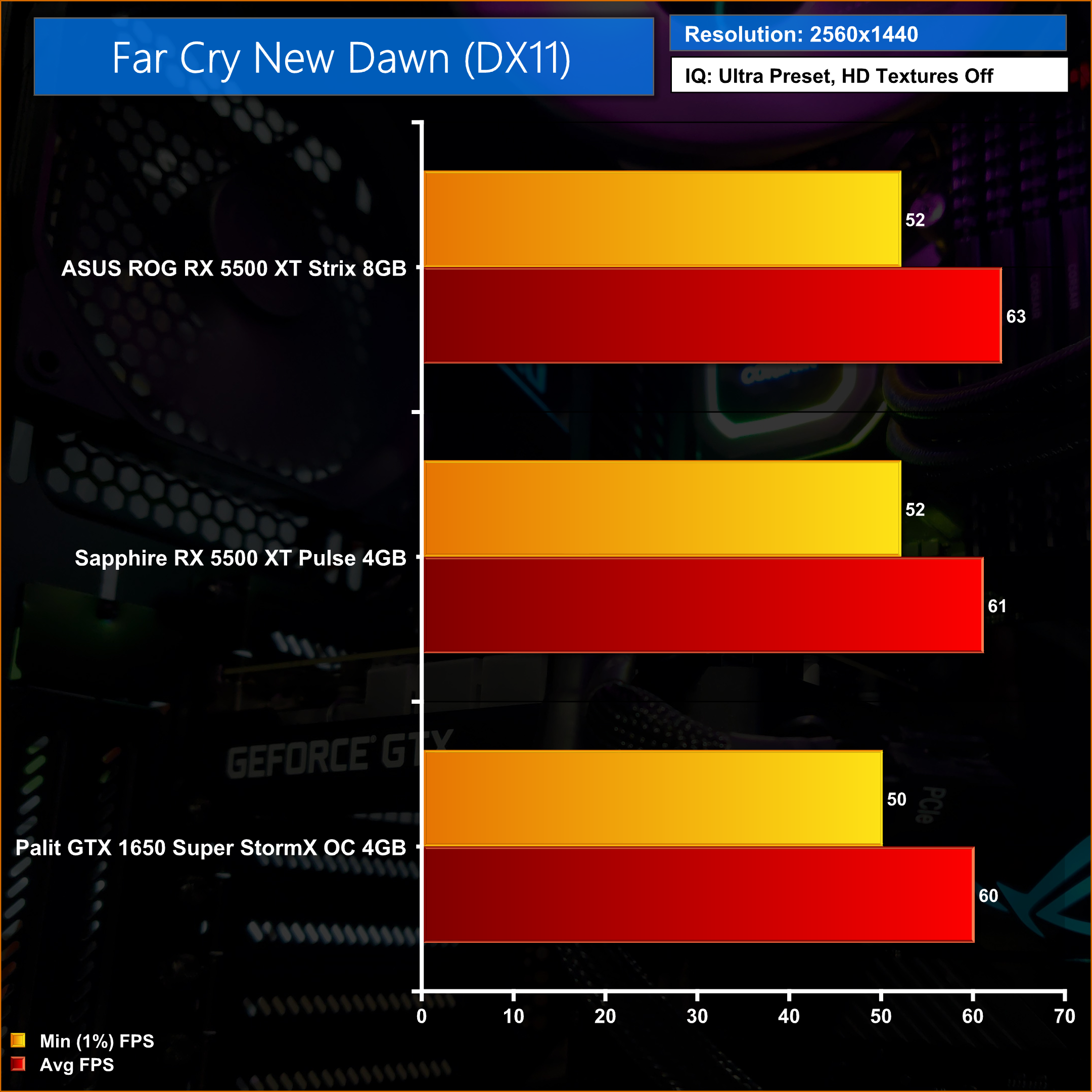
As for Far Cry New Dawn, the trend is pretty similar to F1 2020 or The Division 2, with both AMD GPUs performing about the same, but still around 5% faster than GTX 1650 Super at 1080p. Even using Ultra settings in this one, all three cards are pushing over 80FPS and we're not seeing any real difference between the 4GB and 8GB 5500 XTs.
Gears 5 is a third-person shooter video game developed by The Coalition and published by Xbox Game Studios for Microsoft Windows and Xbox One. It is the sixth instalment of the Gears of War series, and is the second Gears of War game not to be developed by Epic Games.
We test using the High preset, with Best Animation Quality (instead of Auto), DX12 API.
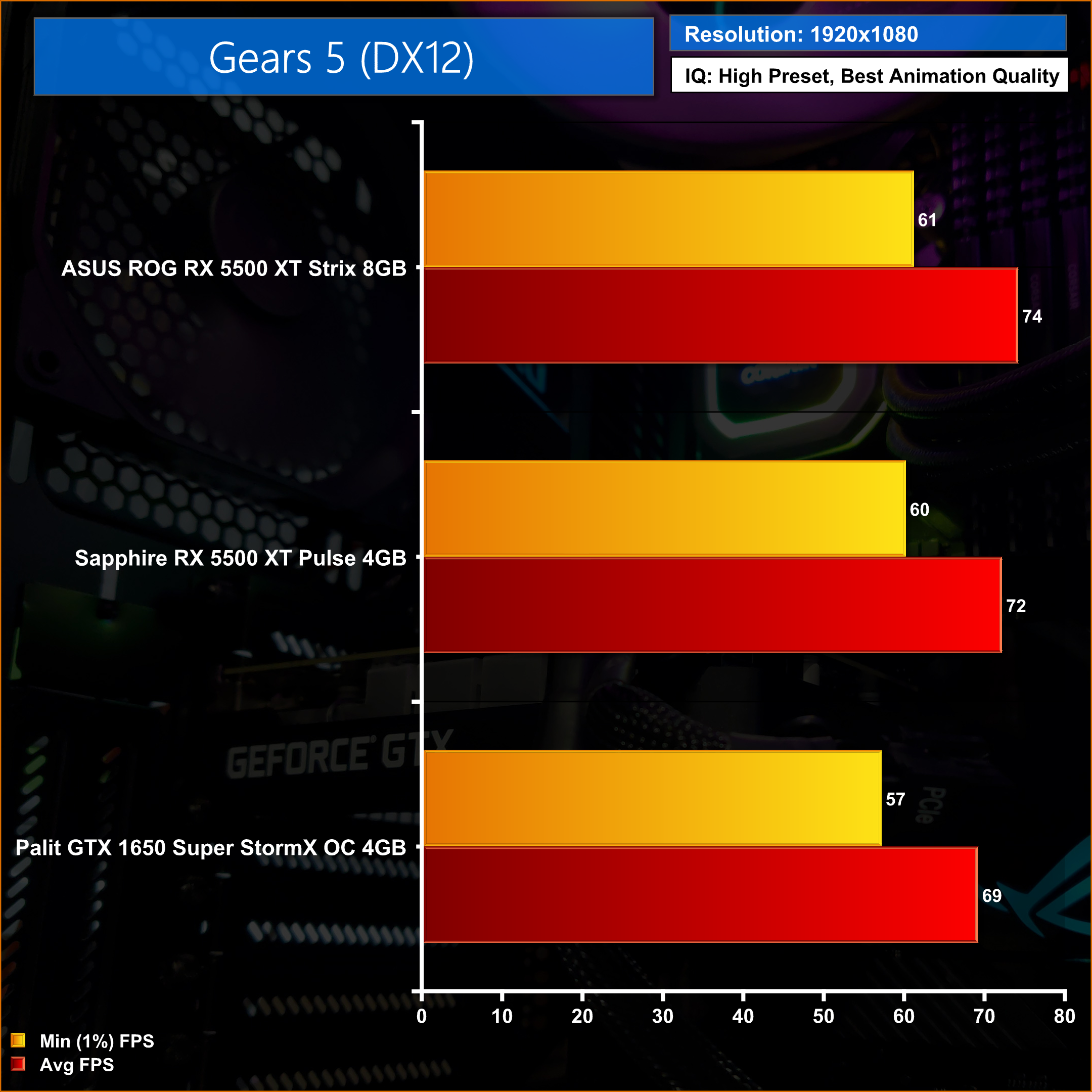
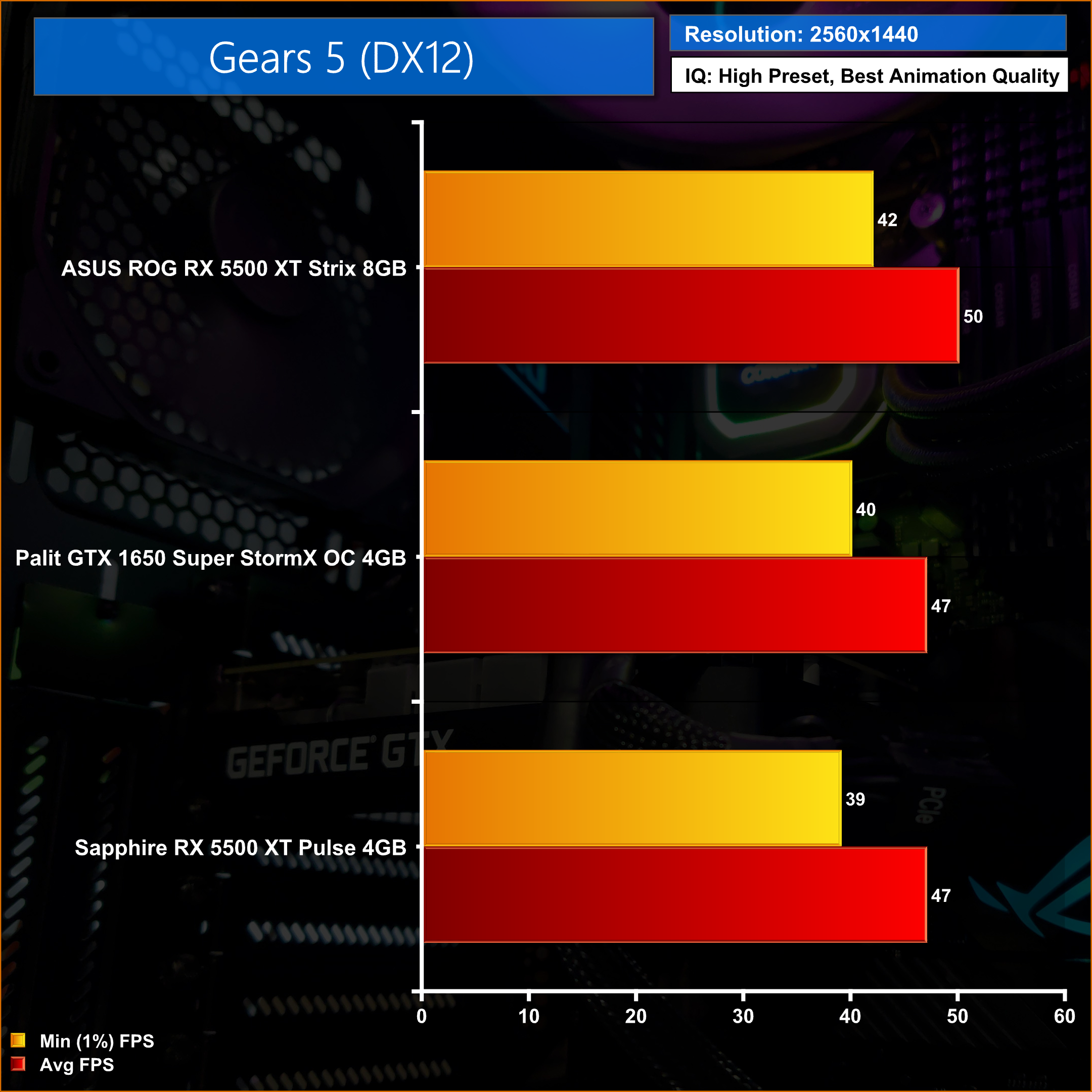
Gears 5 introduces a question mark around the 4GB GPUs, with the 8GB 5500 XT leading its 4GB counterpart by 3% at 1080p. Hardly a lot, but a little higher than a number of the other titles we have tested so far. Compared to GTX 1650 Super, however, the 8GB 5500 XT takes a 7% lead.
At 1440p, the performance of both 4GB cards is identical, as both fall 6% behind the 8GB 5500 XT.
Tom Clancy's Ghost Recon Breakpoint is an online tactical shooter video game developed by Ubisoft Paris and published by Ubisoft. The game was released worldwide on 4 October 2019, for Microsoft Windows, PlayStation 4 and Xbox One, (Wikipedia).
We test using the High preset, with AA disabled, DX11 API.
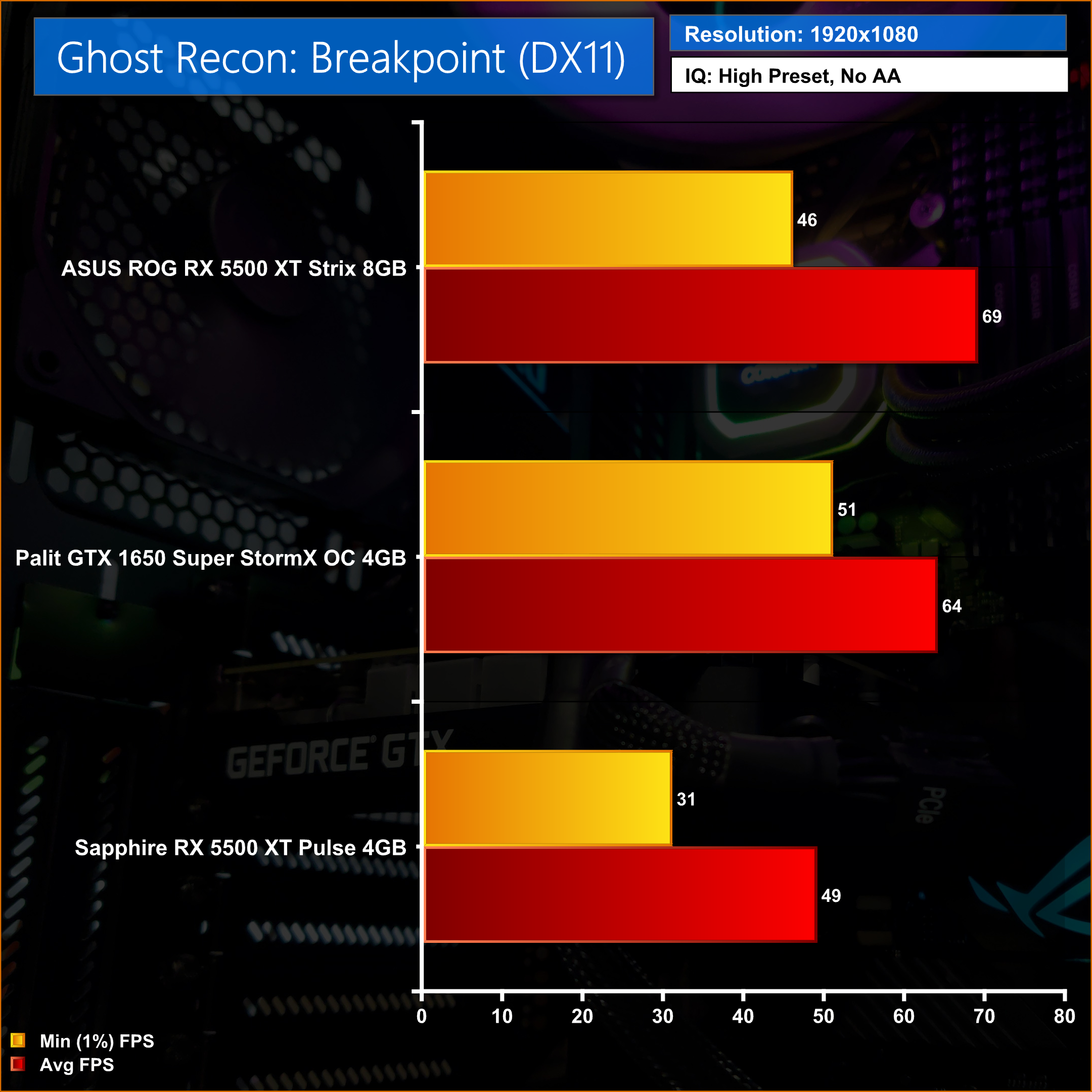
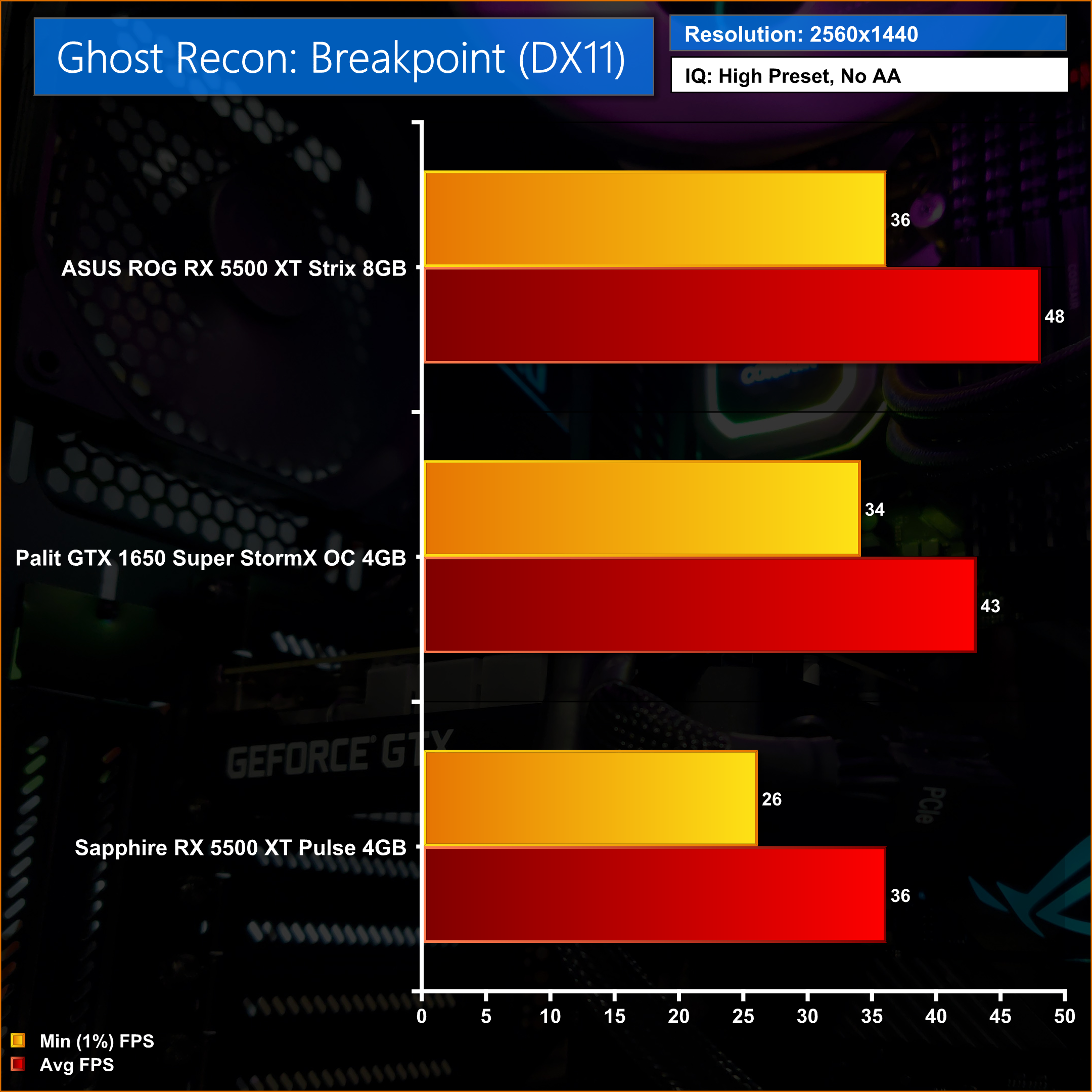
Things get very interesting in Ghost Recon Breakpoint. Despite the 4GB GTX 1650 Super doing well at 1080p – granted, the 8GB 5500 XT is still 7% faster – we see significant performance drop off from the 4GB 5500 XT, as it comes in almost 25% slower than the 1650 Super, with pretty poor 1% low performance. It seems the game definitely wants more than 4GB VRAM, but the Navi GPU pays a significantly higher price for this than its Nvidia counterpart.
This is further demonstrated at 1080p by the fact that the 8GB 5500 XT comes in over 30% faster than the 4GB model.
Metro Exodus is a first-person shooter video game developed by 4A Games and published by Deep Silver in 2019. It is the third instalment in the Metro video game series based on Dmitry Glukhovsky's novels, following the events of Metro 2033 and Metro: Last Light. (Wikipedia).
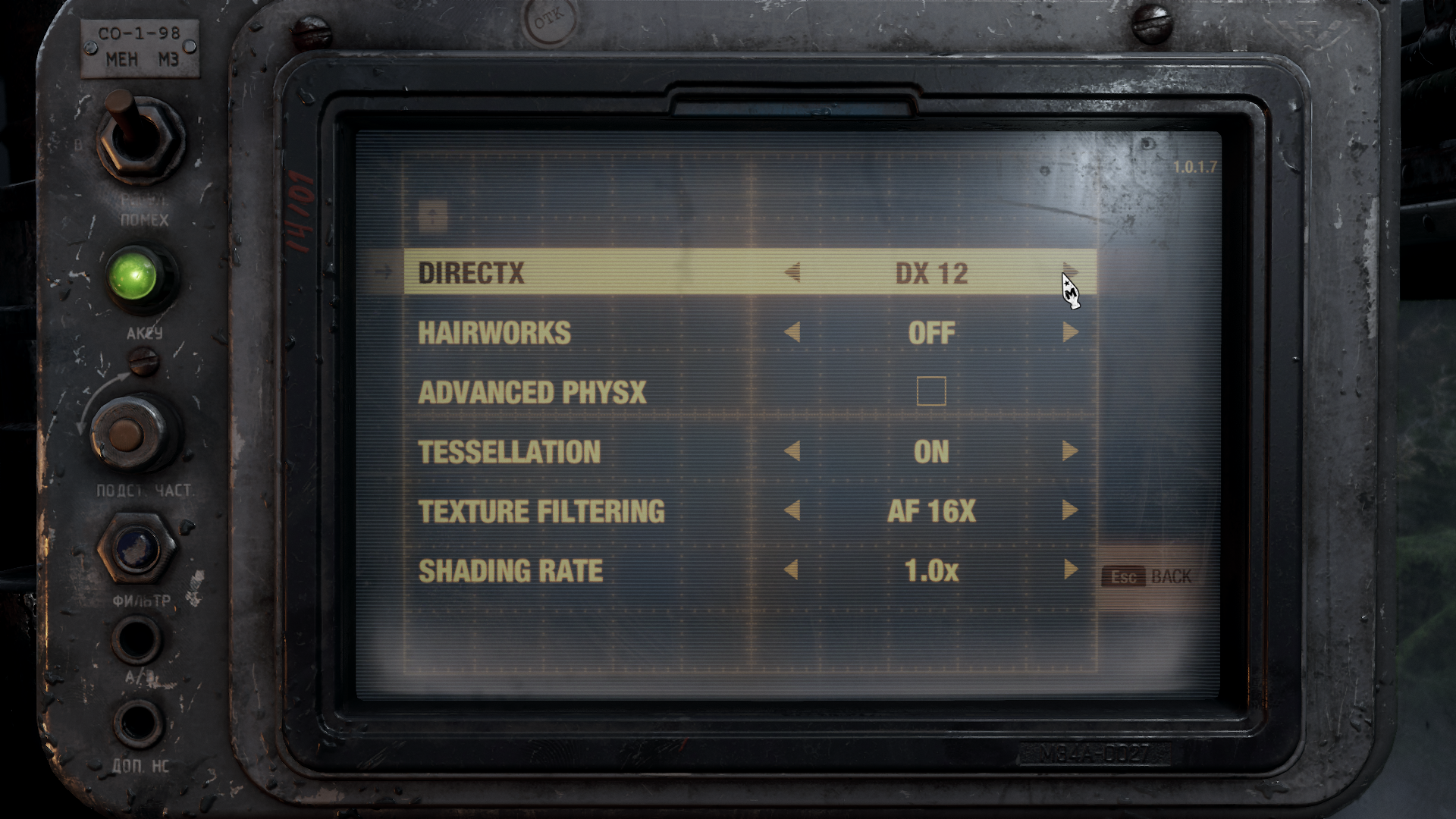
We test using the High preset, but with Hairworks and Advanced PhysX turned off, DX12 API.

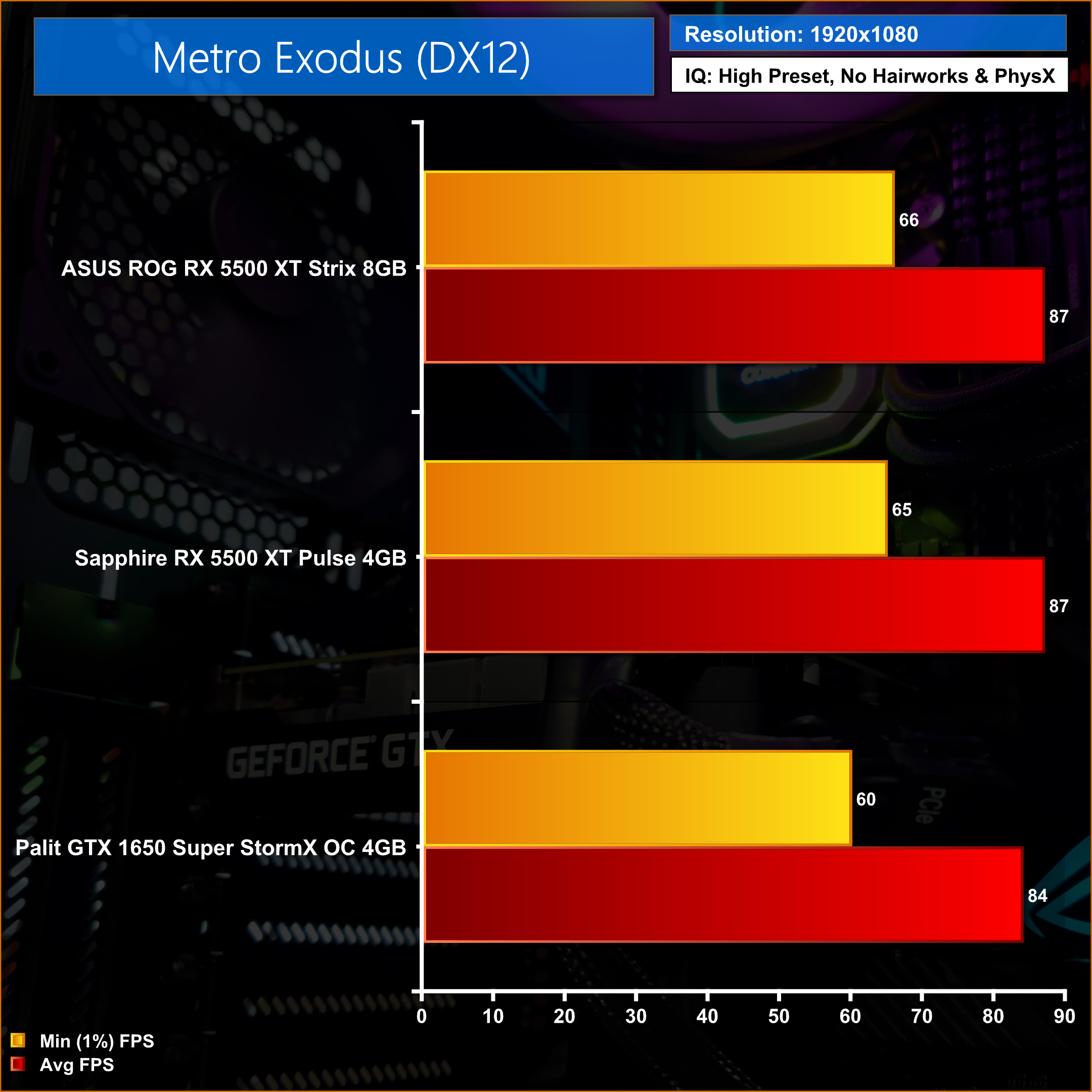
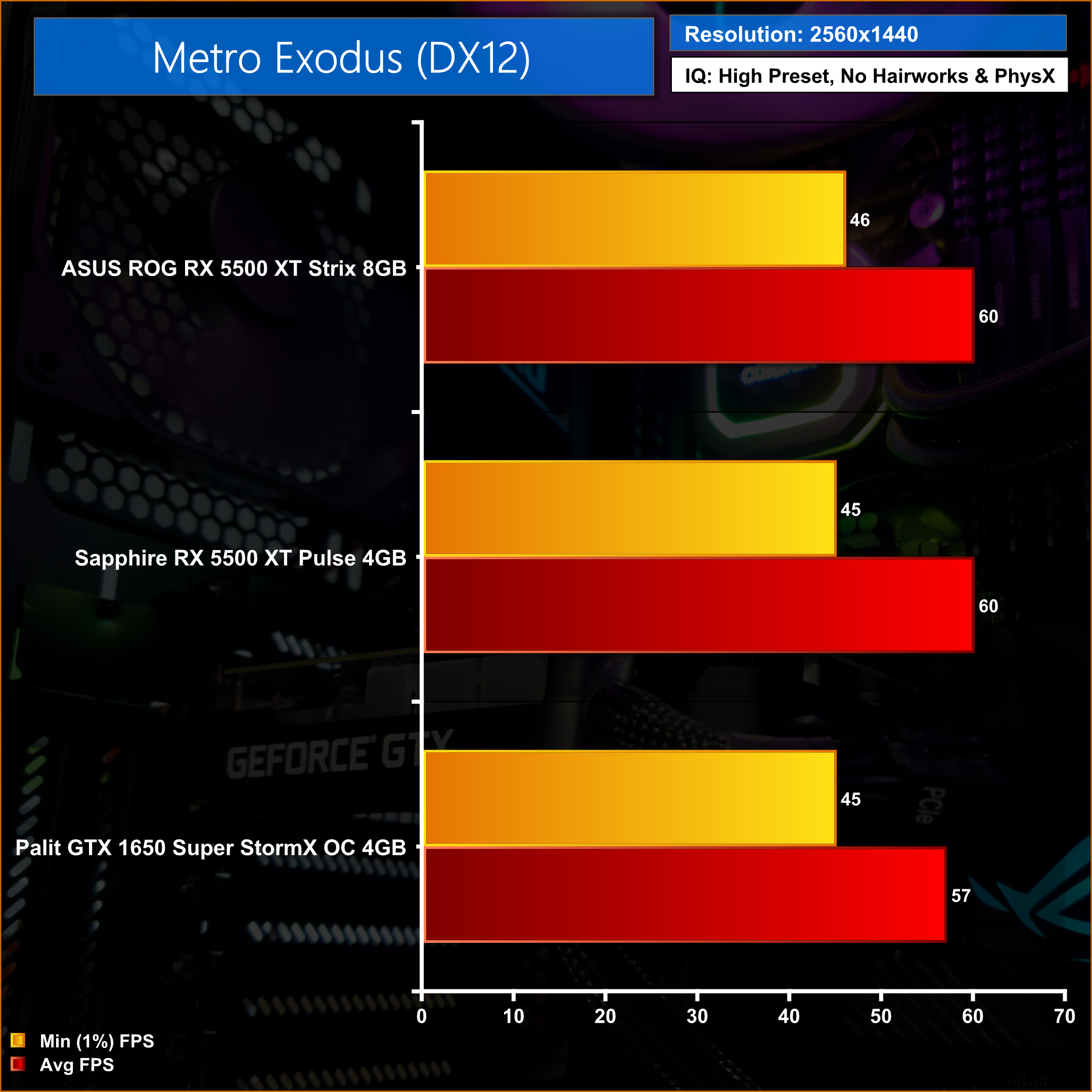
Metro Exodus puts us back on trend, with not a whole lot between all three GPUs. There is a slight preference for the AMD GPUs based on our testing, but we're talking less than a 5% difference. Memory is clearly not a factor either, as both 4GB and 8GB 5500 XT cards perform identically here.
Middle-earth: Shadow of War is an action role-playing video game developed by Monolith Productions and published by Warner Bros. Interactive Entertainment. It is the sequel to 2014’s Middle-earth: Shadow of Mordor, and was released worldwide for Microsoft Windows, PlayStation 4, and Xbox One on October 10, 2017. (Wikipedia).
We test using the Very High preset, DX11 API.
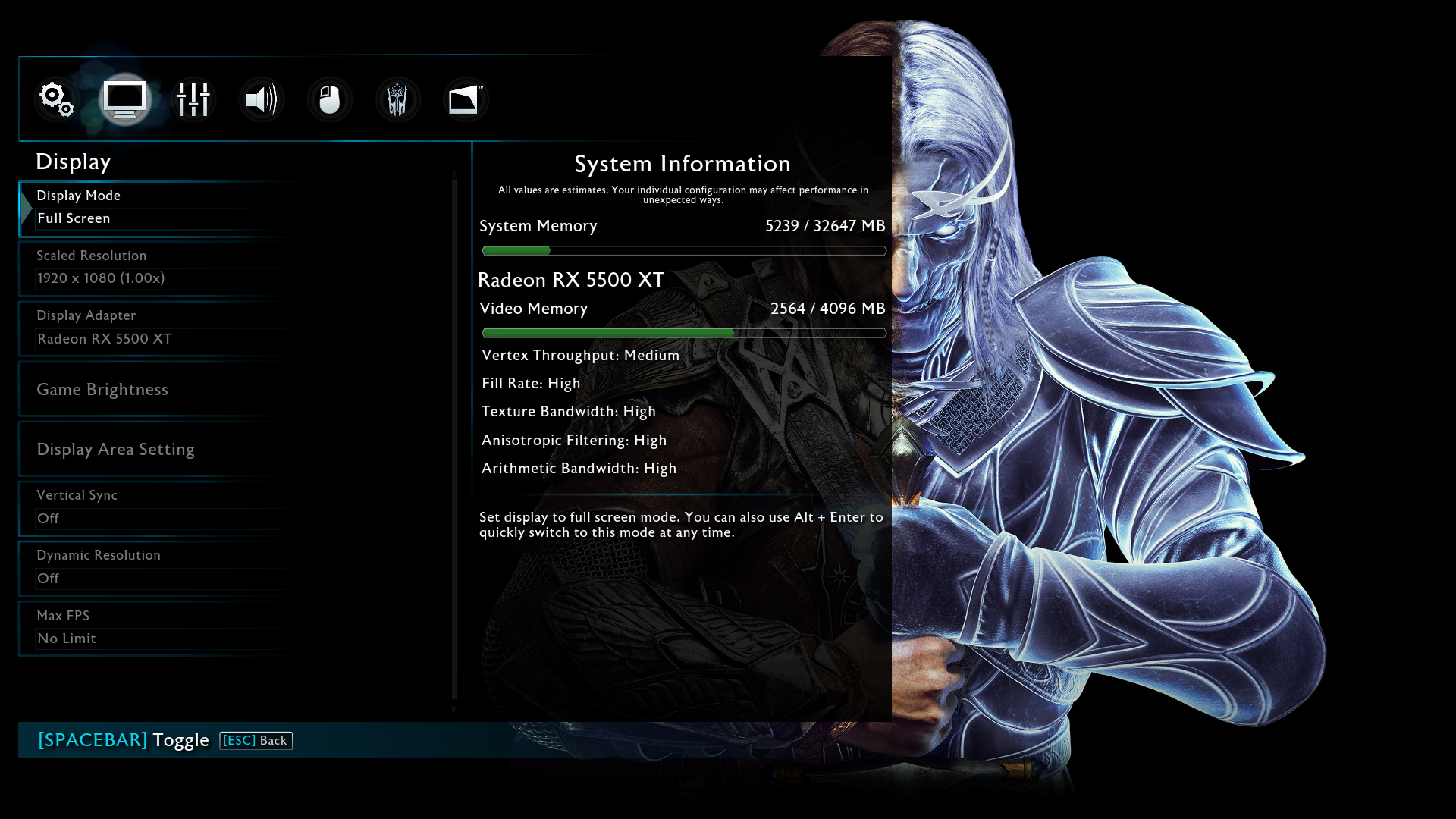
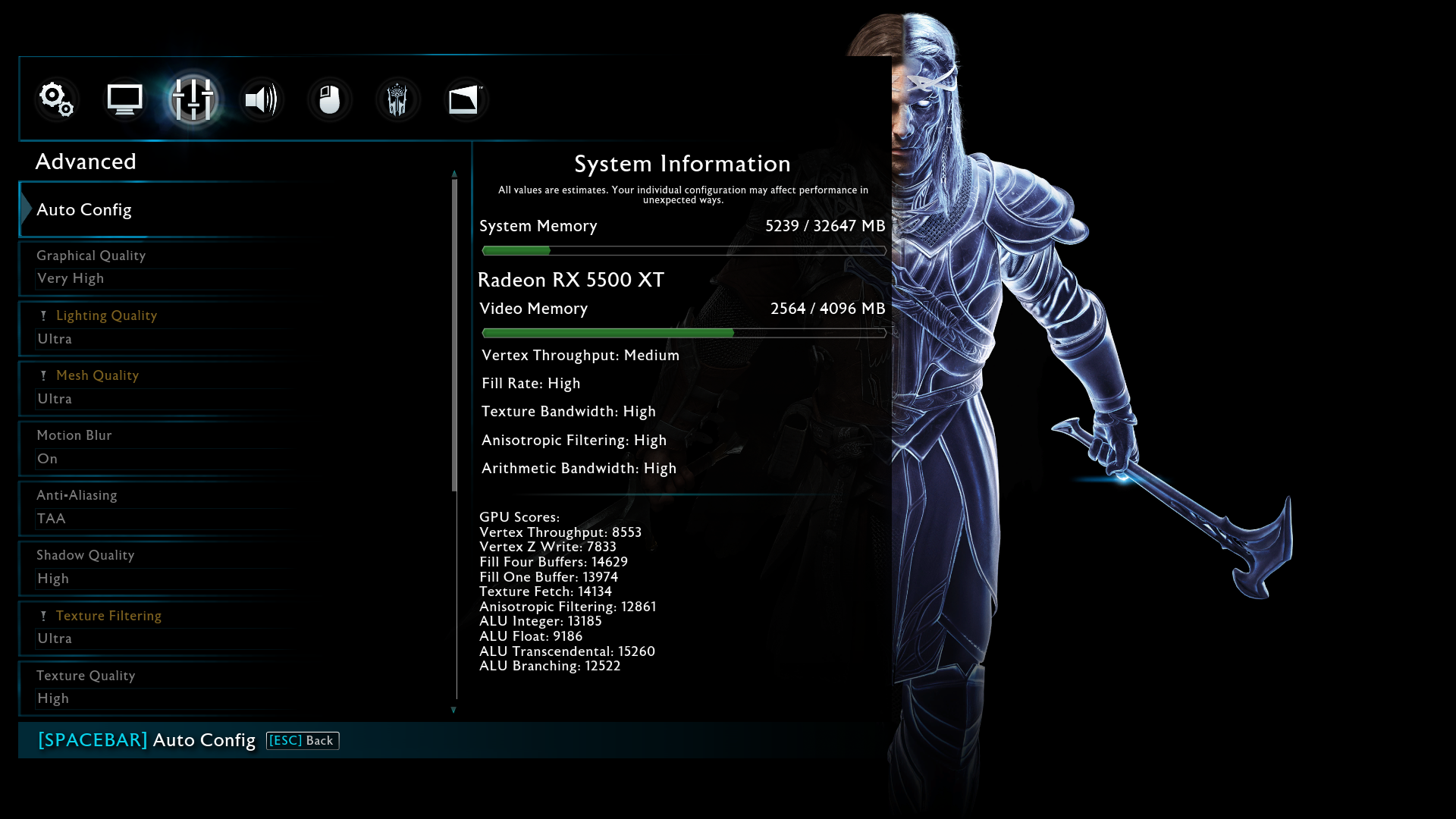
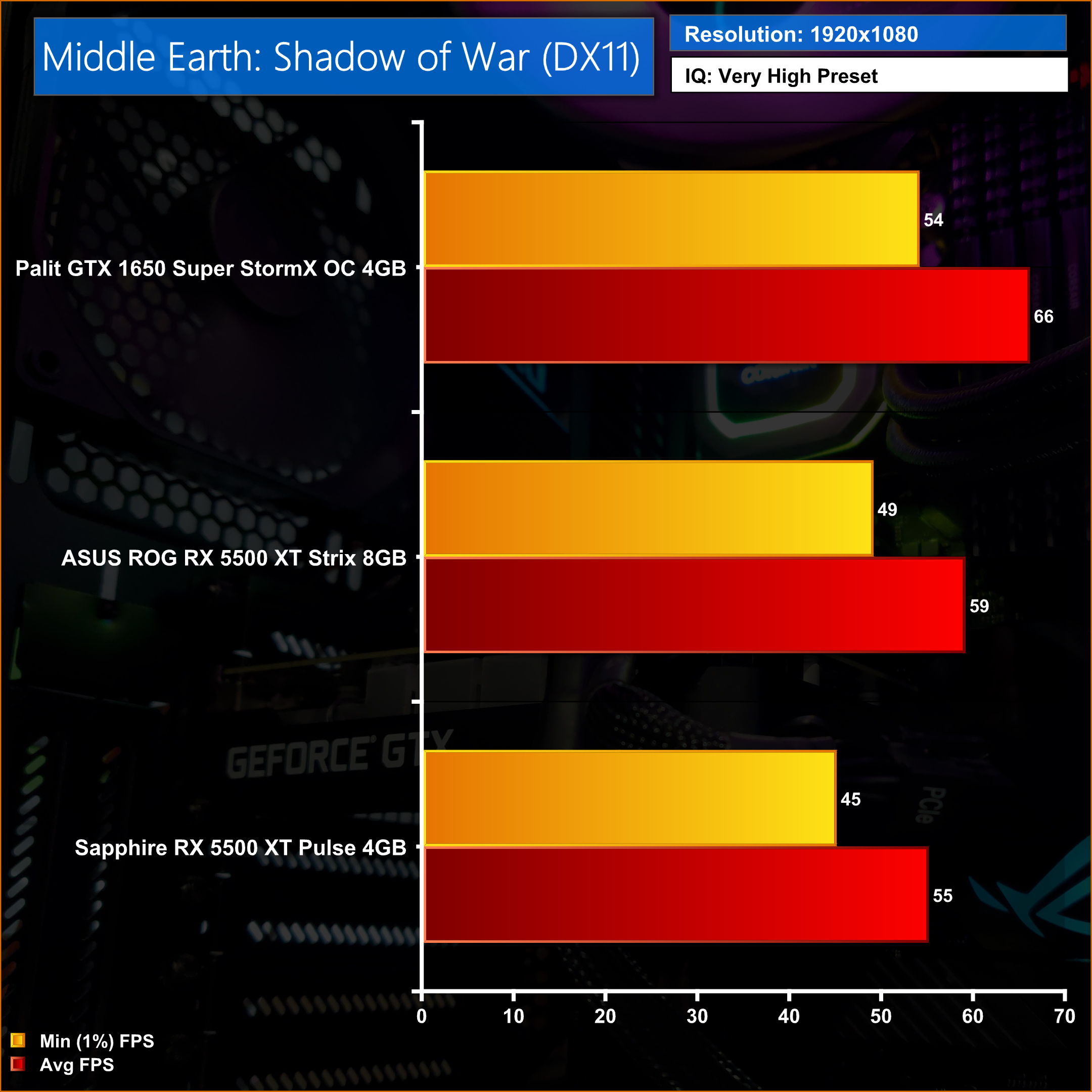
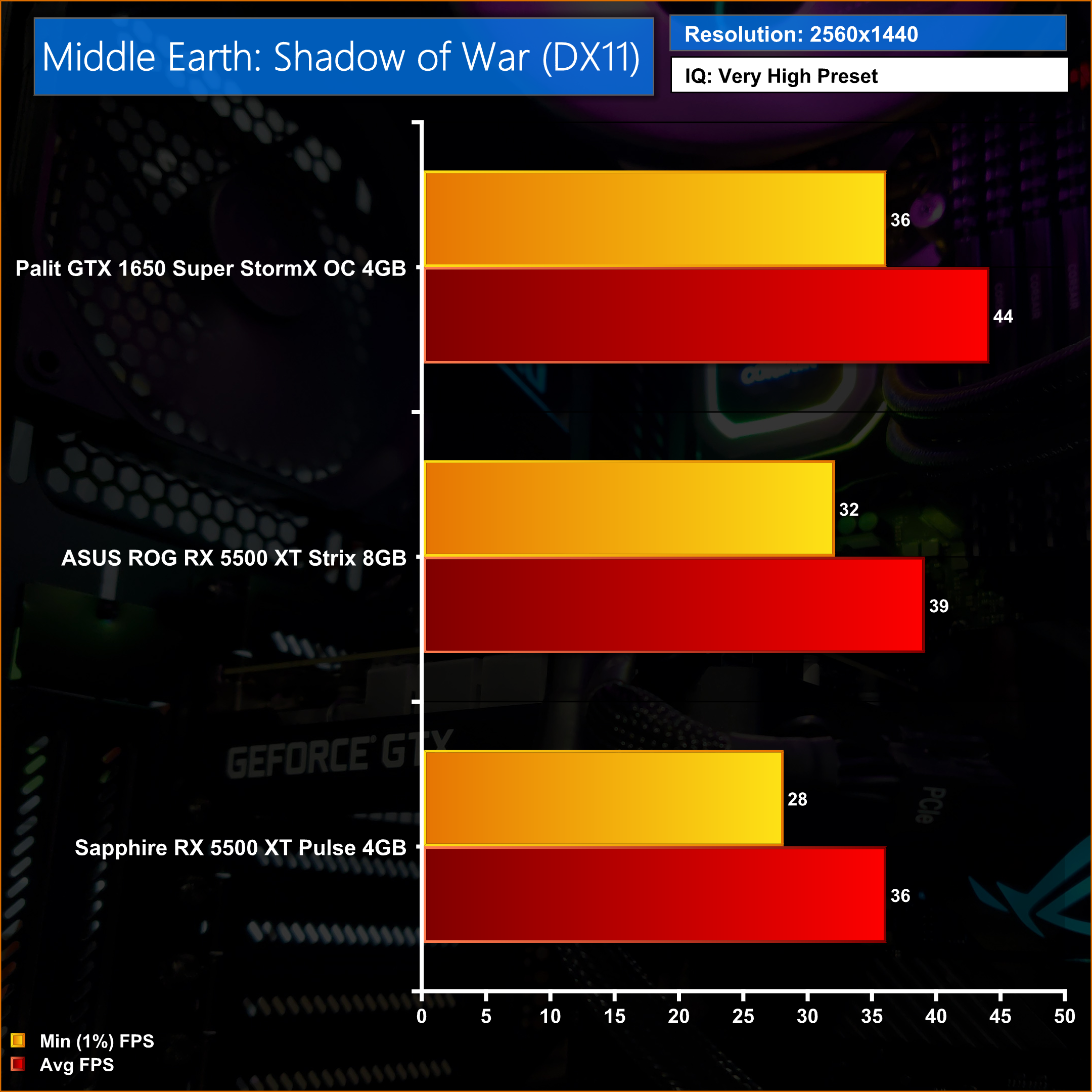
Moving on, Middle Earth: Shadow of War is another game producing interesting results, as Nvidia's GTX 1650 Super does exceedingly well, coming in 12% faster than the 8GB 5500 XT. Furthermore, the 8GB GPU also pulls 7% ahead of its 4GB brother, suggesting that memory capacity is a limited factor in this game. Yet, despite that, the 4GB 1650 Super still does very well – so again, as we saw in Ghost Recon Breakpoint, it seems the smaller frame-buffer hurts the AMD GPUs more than the Nvidia-based card.
Red Dead Redemption 2 is a 2018 action-adventure game developed and published by Rockstar Games. The game is the third entry in the Red Dead series and is a prequel to the 2010 game Red Dead Redemption. Red Dead Redemption 2 was released for the PlayStation 4 and Xbox One in October 2018, and for Microsoft Windows and Stadia in November 2019. (Wikipedia).
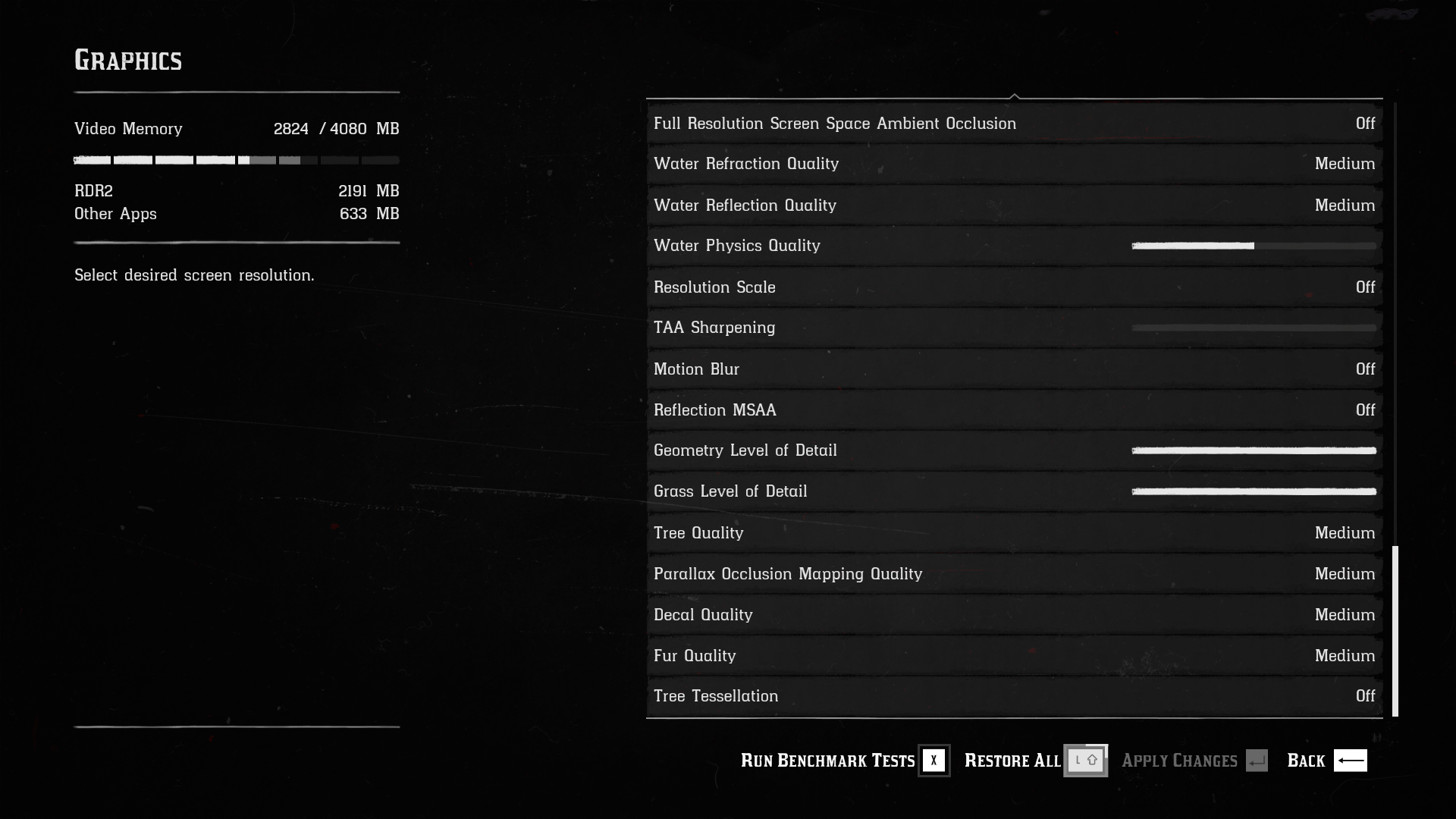
We test using Medium settings, Vulkan API.
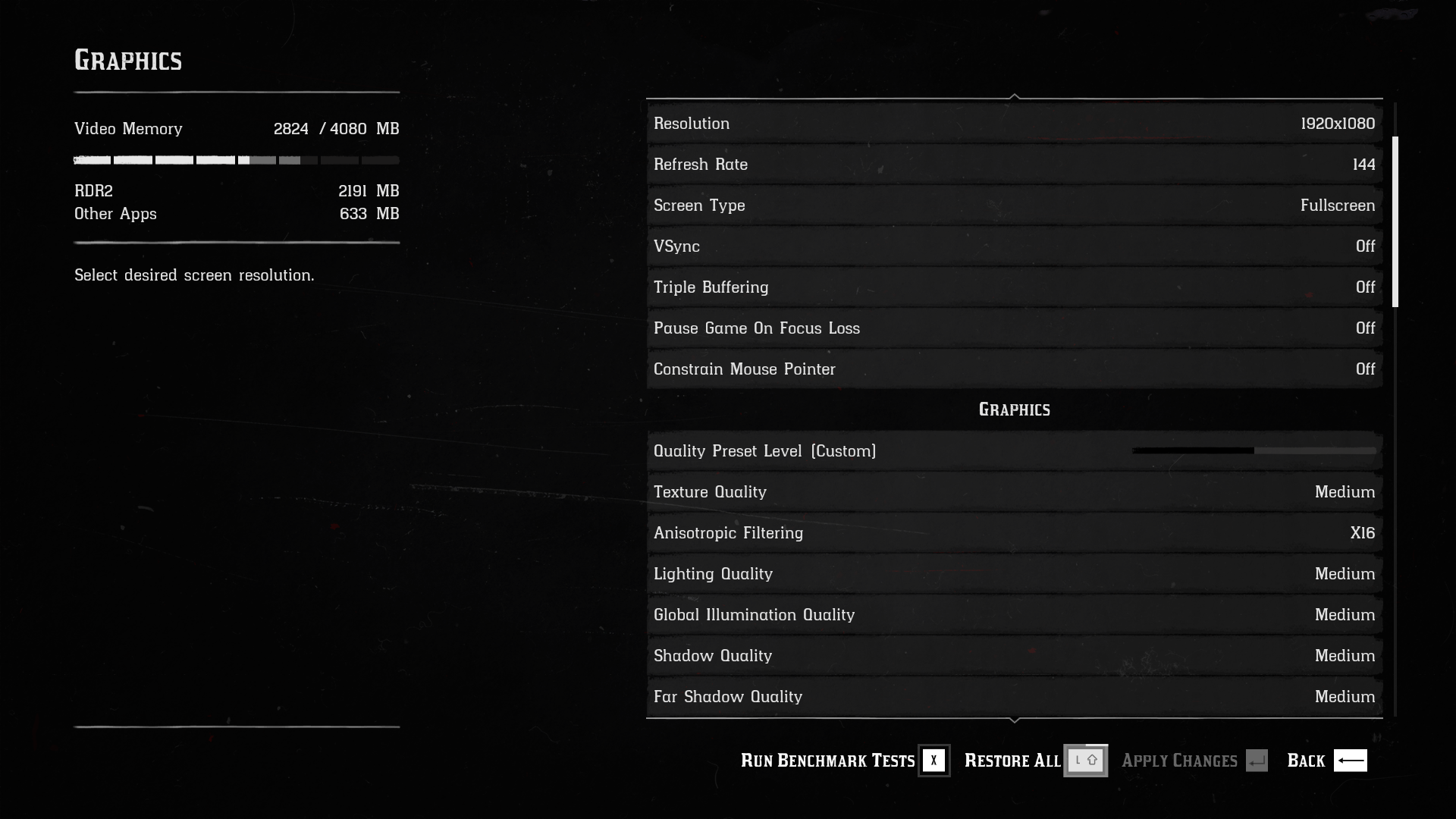
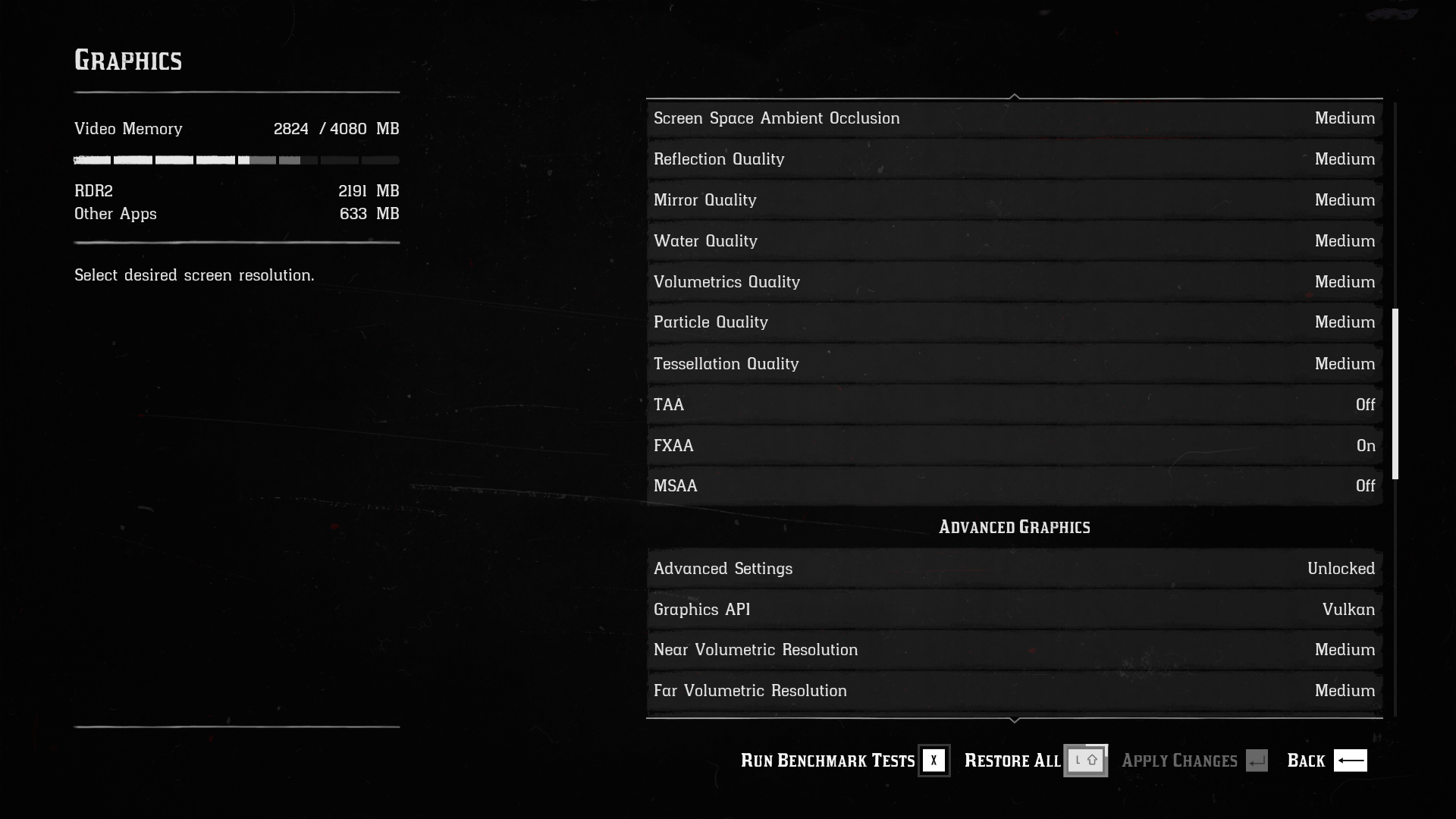
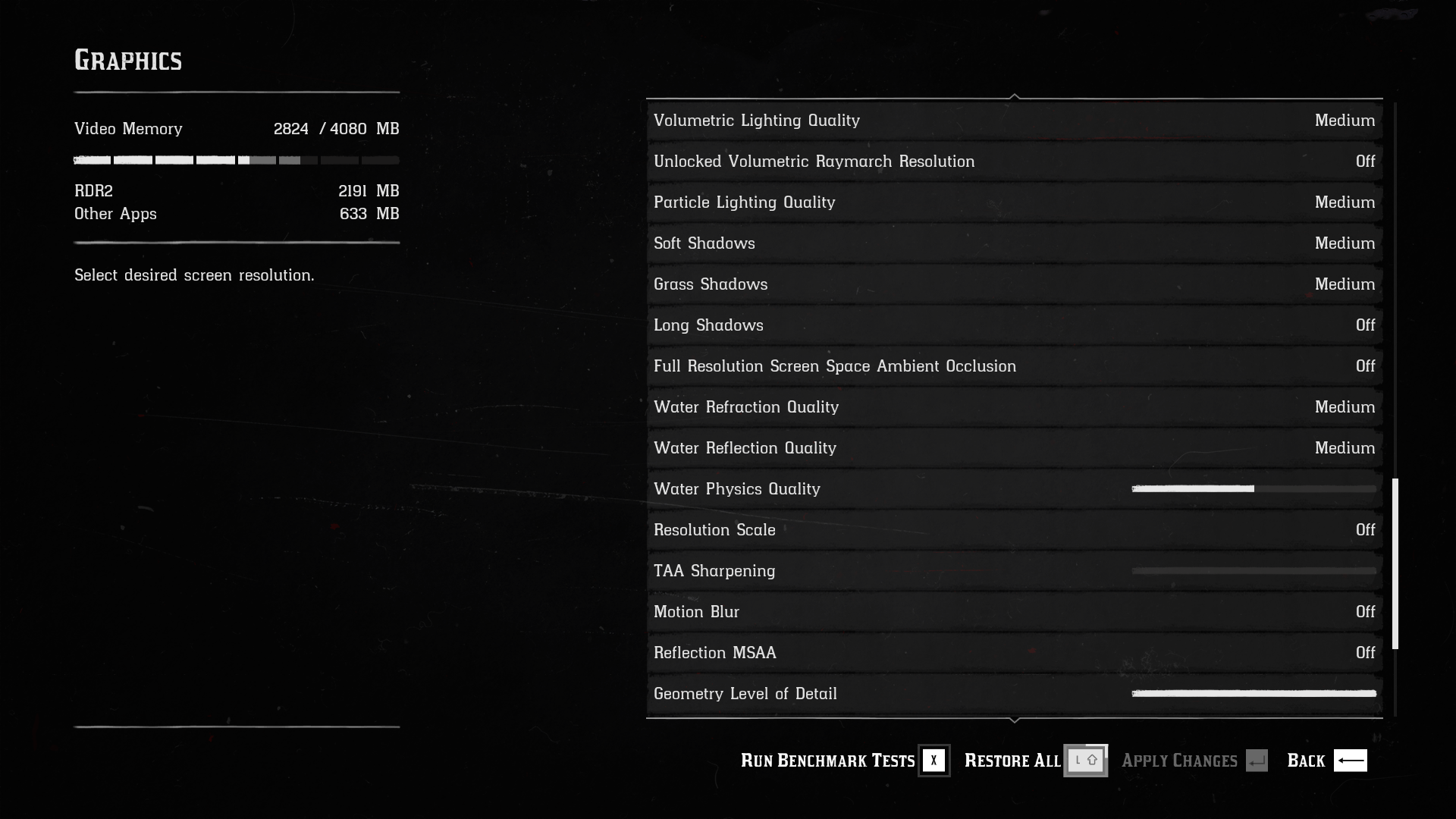
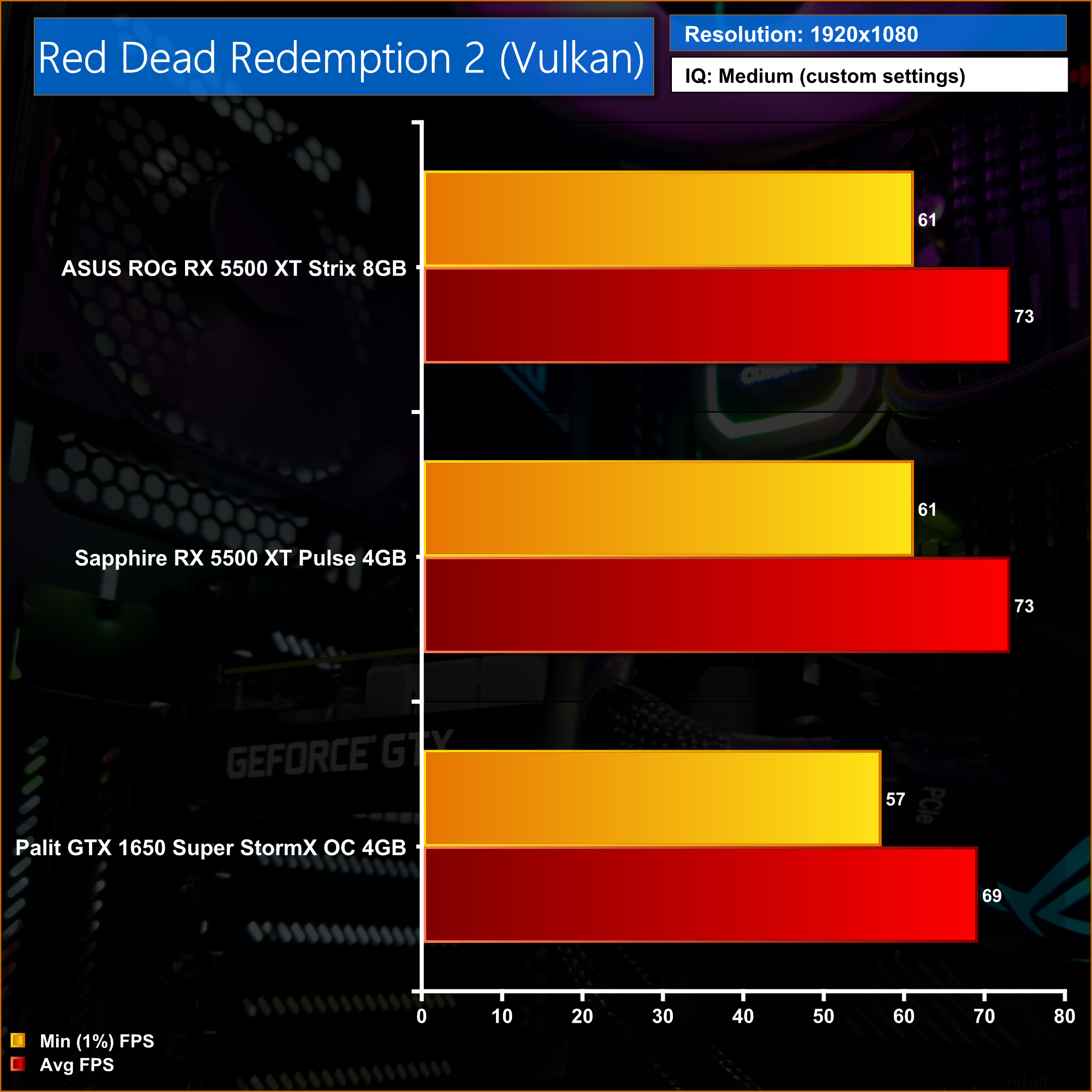
Read Dead Redemption 2 produces results very similar to Metro Exodus. At 1080p we are not memory limited, at least not using Medium settings as we are here, yet we can observe a very small preference for AMD hardware, with both 5500 XTs beating out 1650 Super by just under 6%.
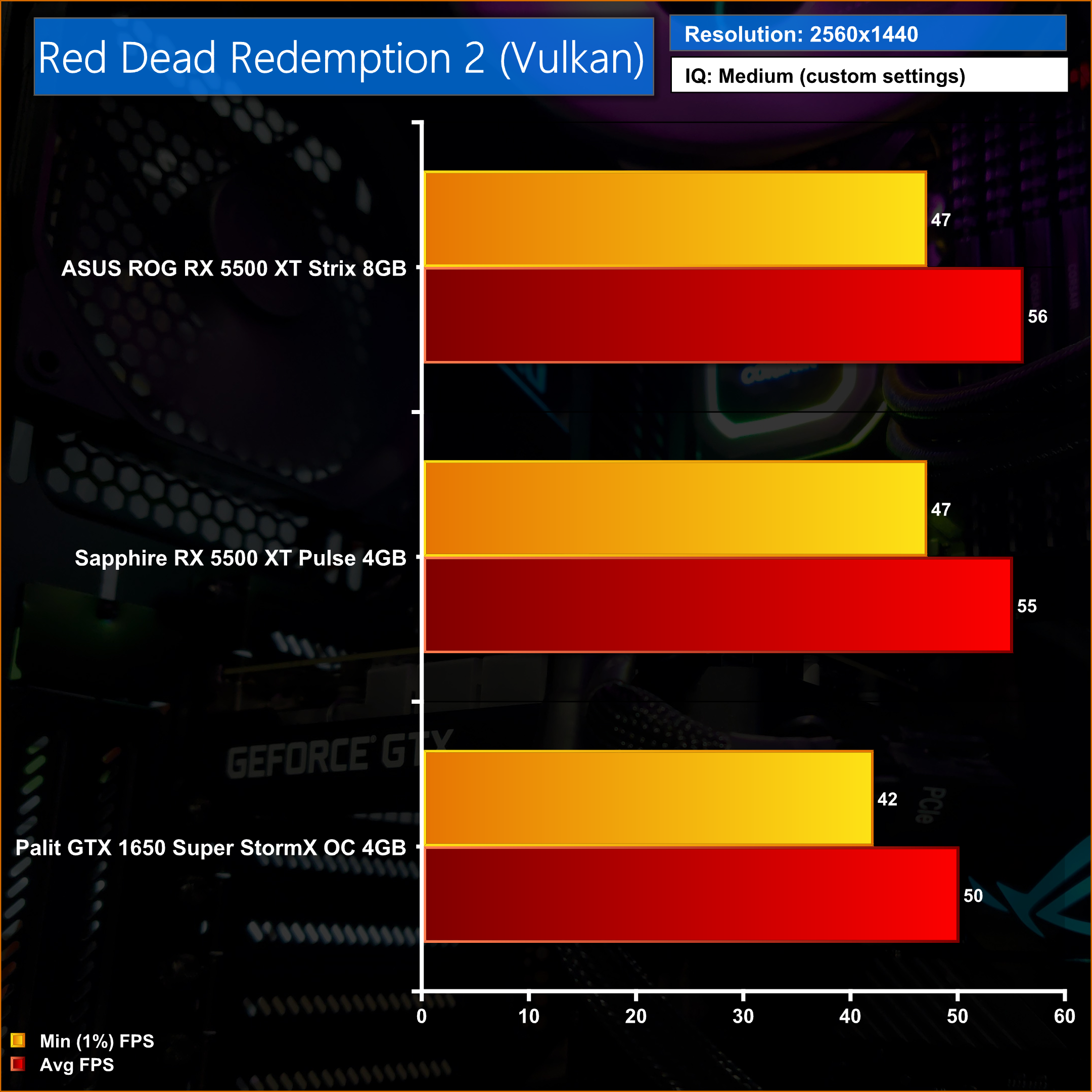
At 1440p, that gap only widens – memory still doesn't appear to be an issue at the higher resolution, yet even the 4GB 5500 XT is 10% faster than the 1650 Super.
Shadow of the Tomb Raider is an action-adventure video game developed by Eidos Montréal in conjunction with Crystal Dynamics and published by Square Enix. It continues the narrative from the 2013 game Tomb Raider and its sequel Rise of the Tomb Raider, and is the twelfth mainline entry in the Tomb Raider series. The game released worldwide on 14 September 2018 for Microsoft Windows, PlayStation 4 and Xbox One. (Wikipedia).
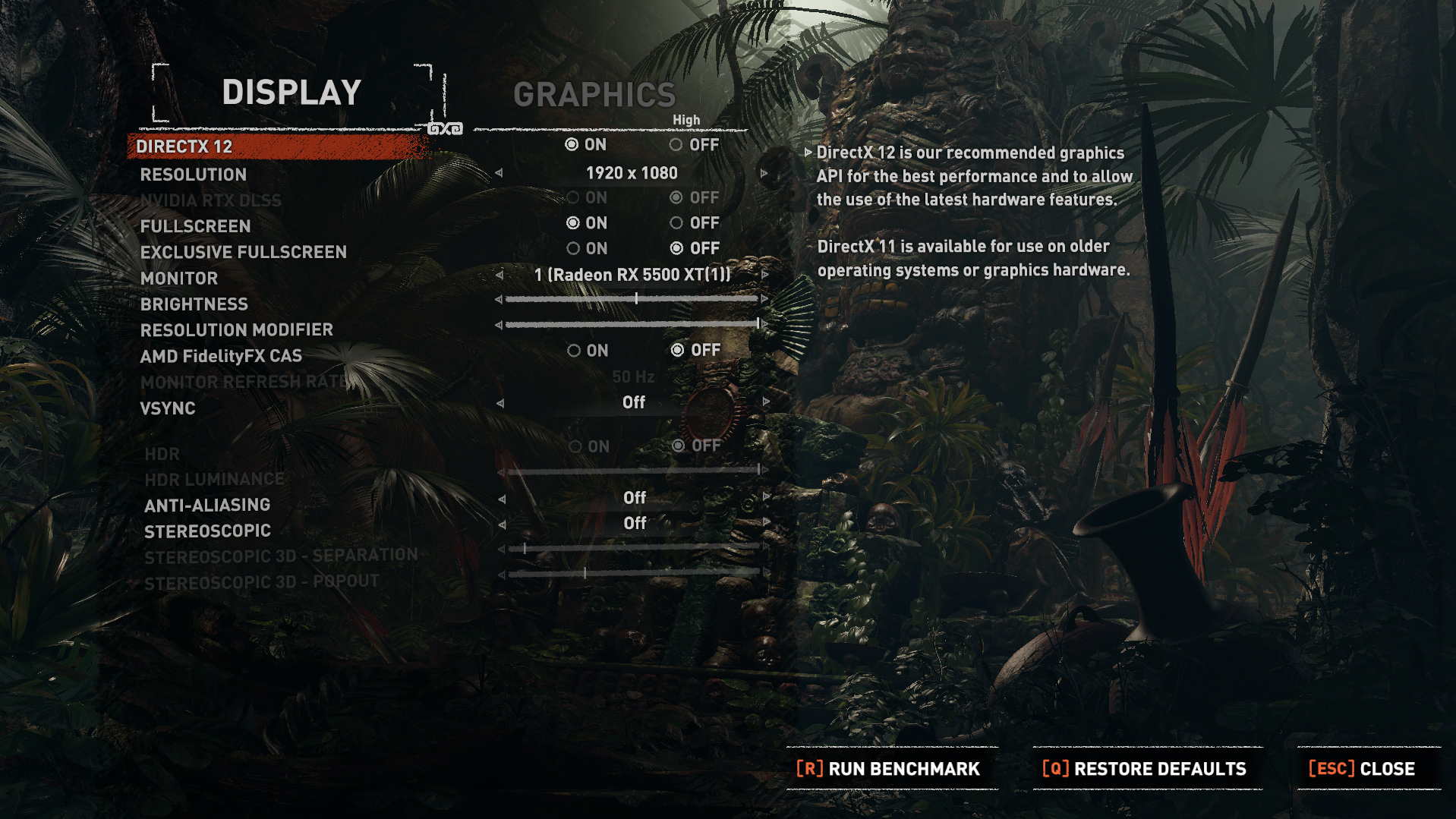
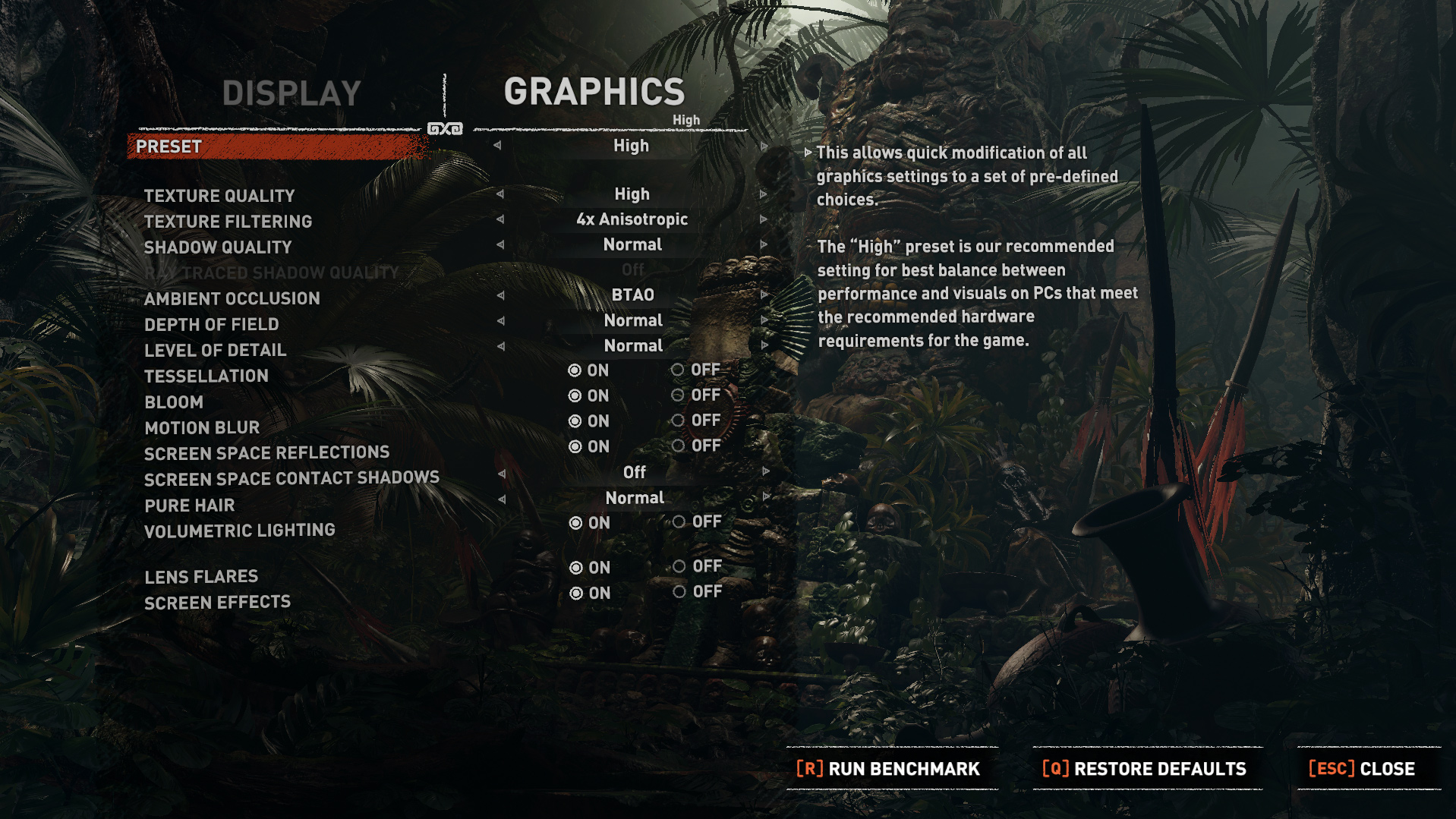
We test using the High preset, with AA disabled, DX12 API.
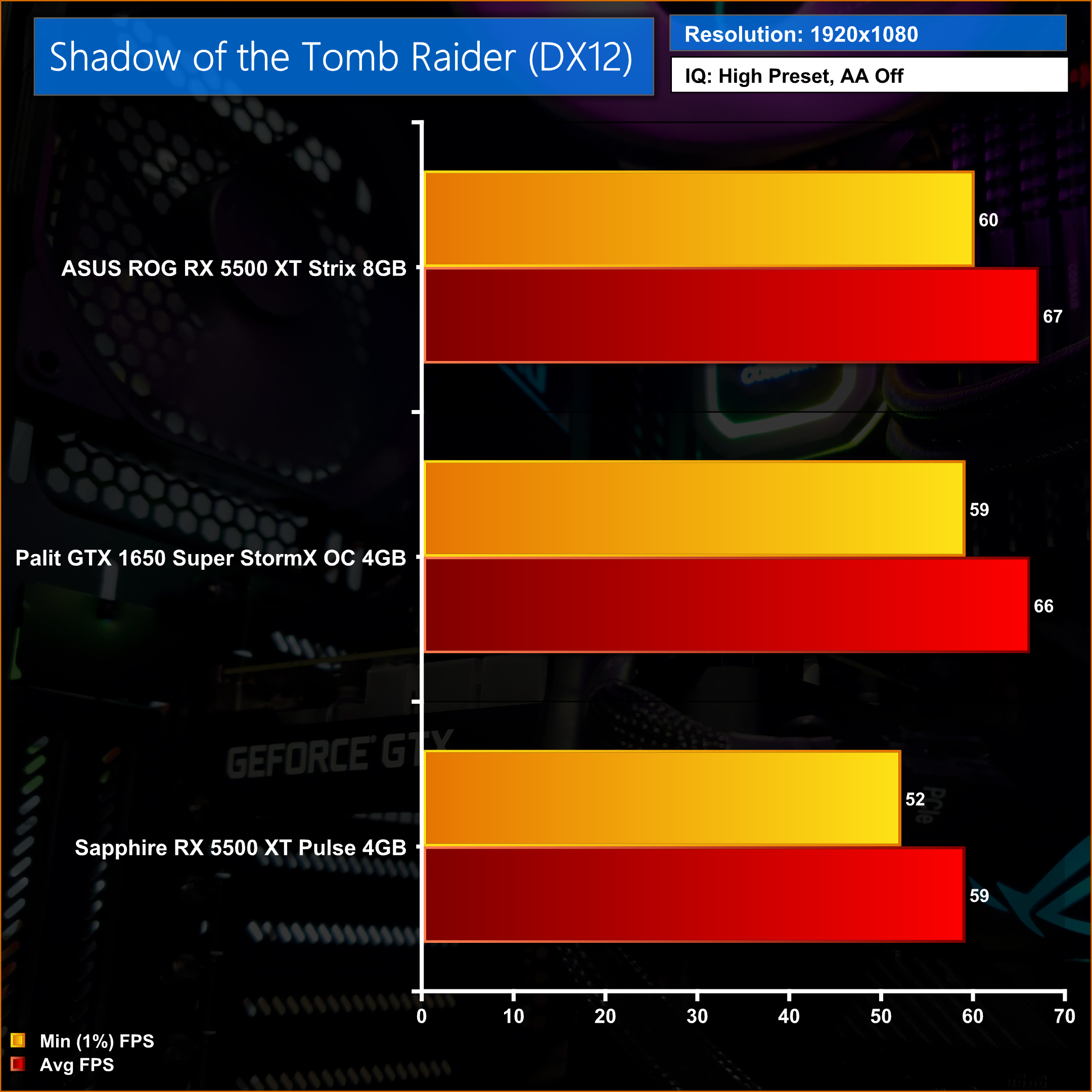
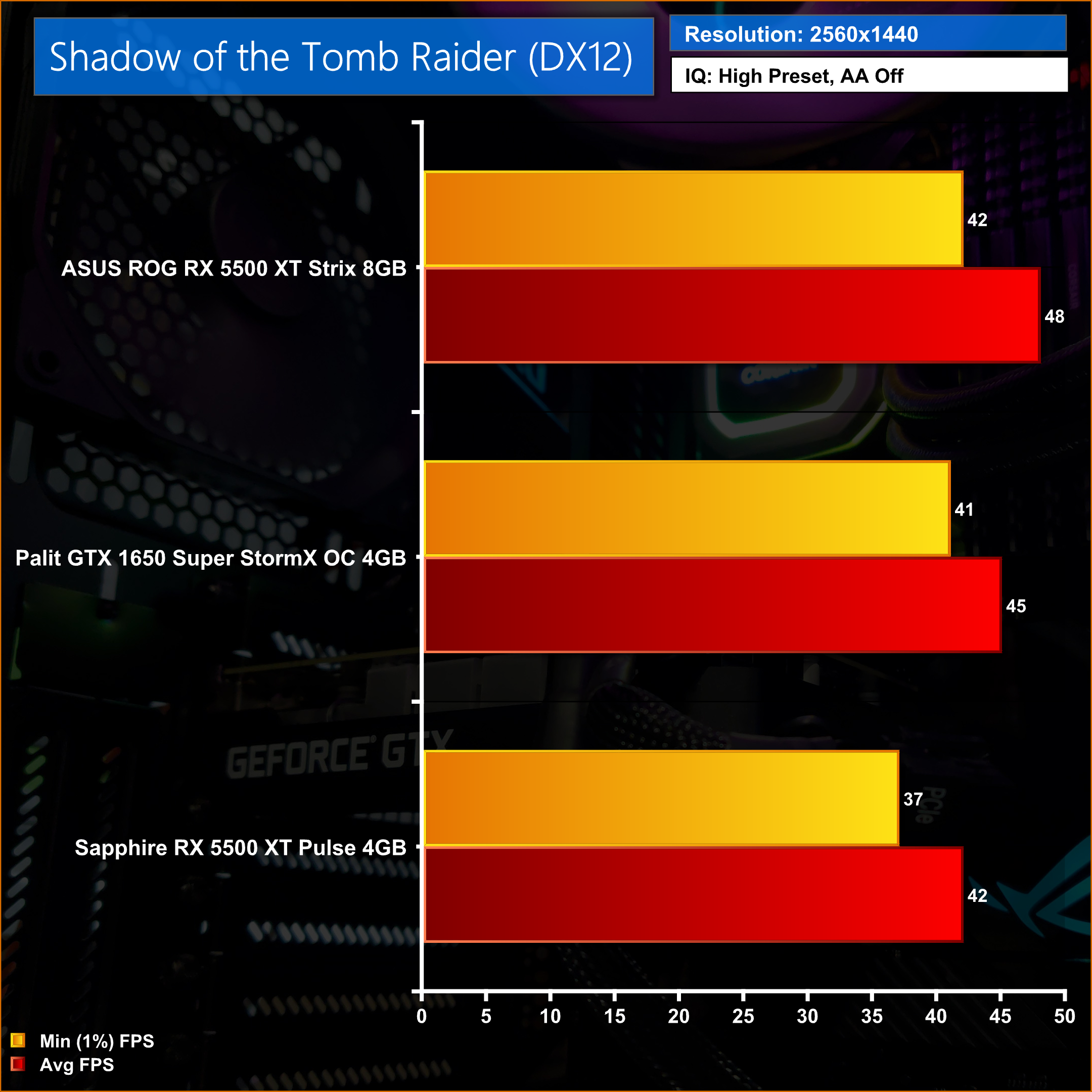
As for Shadow of the Tomb Raider, this game joins the likes of Breakpoint and Shadow of War, by showing us the 4GB 5500 XT suffering due to its memory limits, while the 4GB 1650 Super does noticeably better. The 8GB 5500 XT, for instance, is 13% faster than the 4GB model, yet 1650 Super is still 12% faster in turn. It appears to be another case where the Nvidia GPU does significantly better, despite sharing the 4GB frame-buffer.
Star Wars Jedi: Fallen Order is an action-adventure game developed by Respawn Entertainment and published by Electronic Arts. It was released for Windows, PlayStation 4, and Xbox One on November 15, 2019. (Wikipedia).
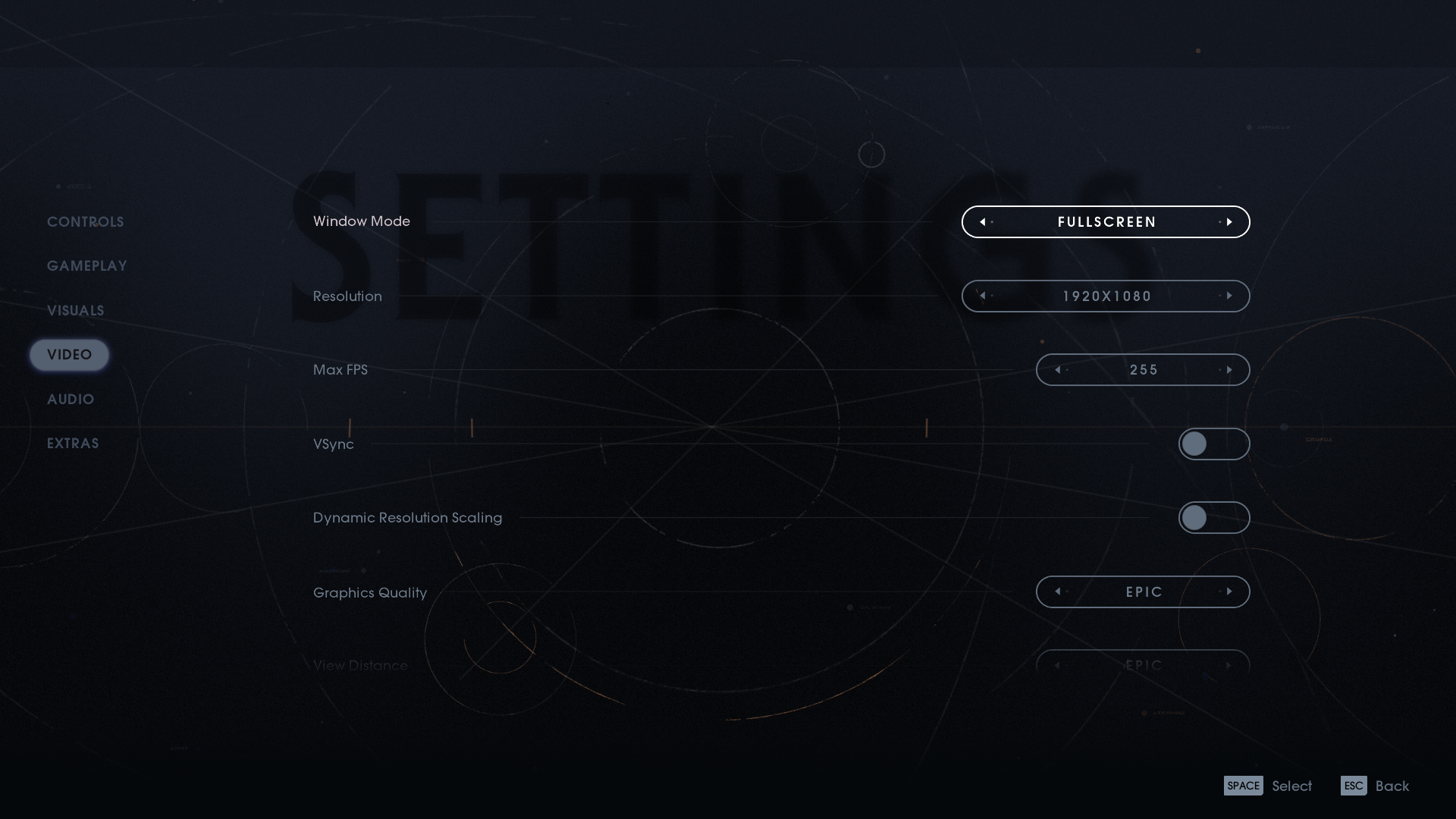
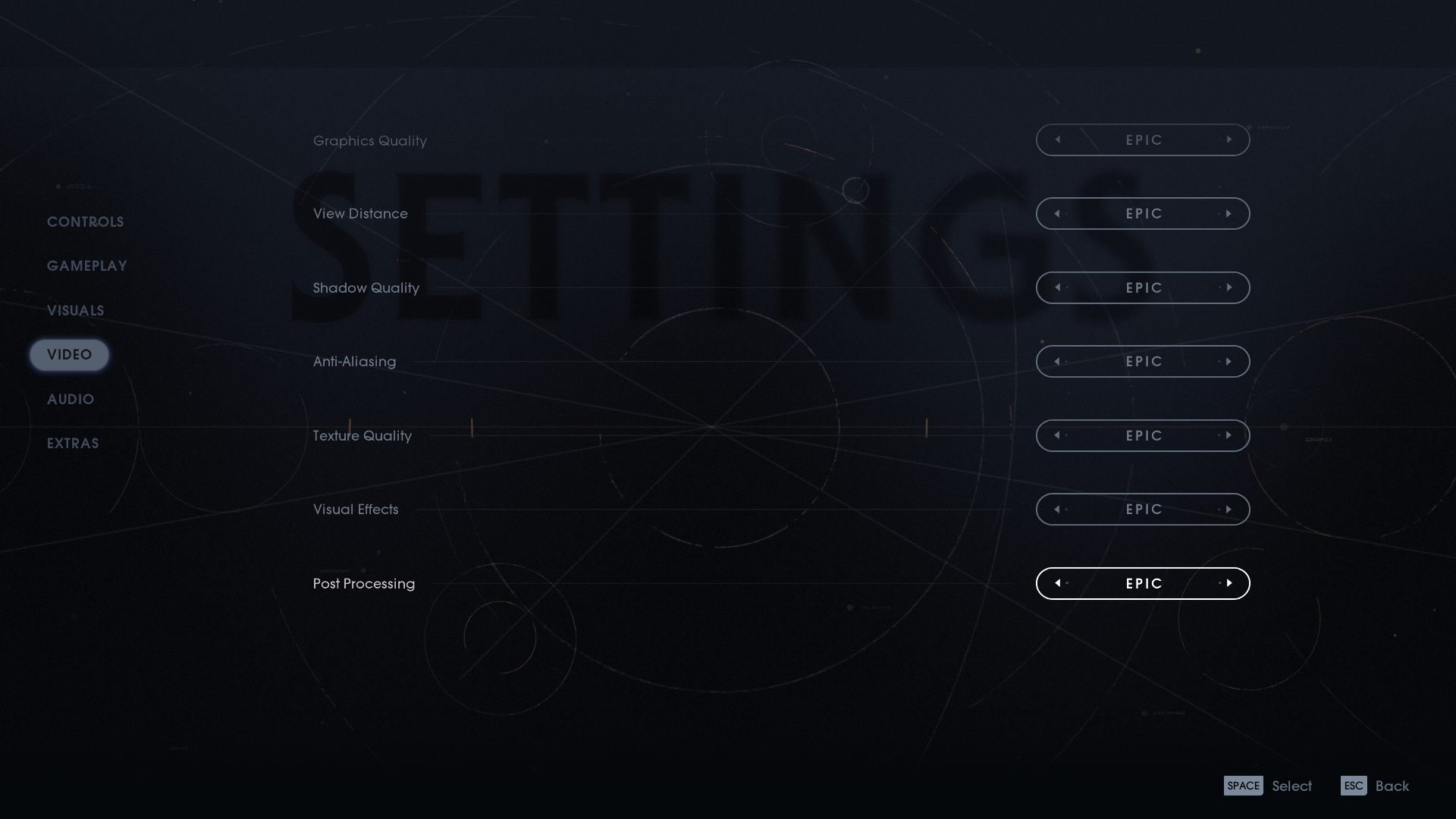
We test using the Epic preset, DX11 API.
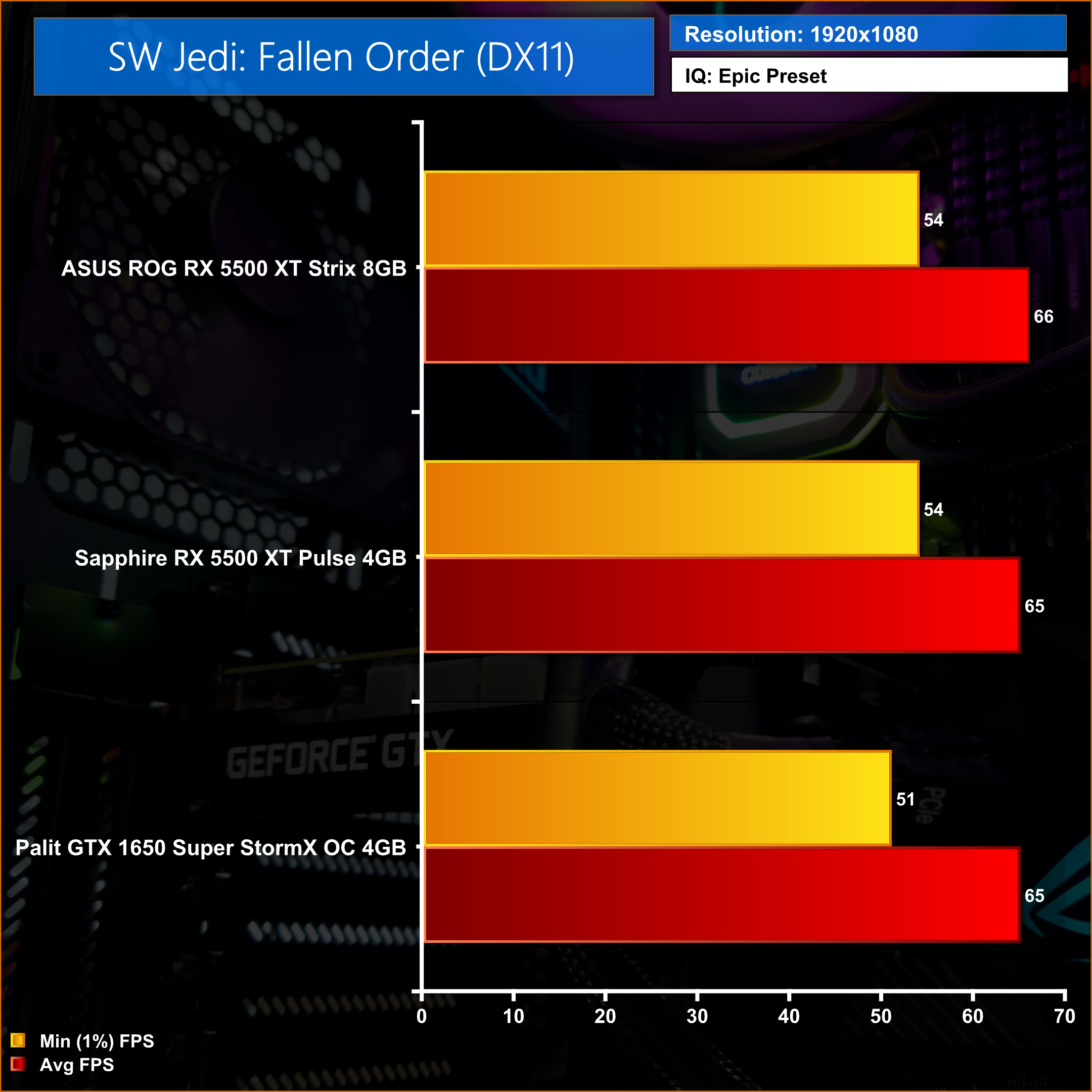
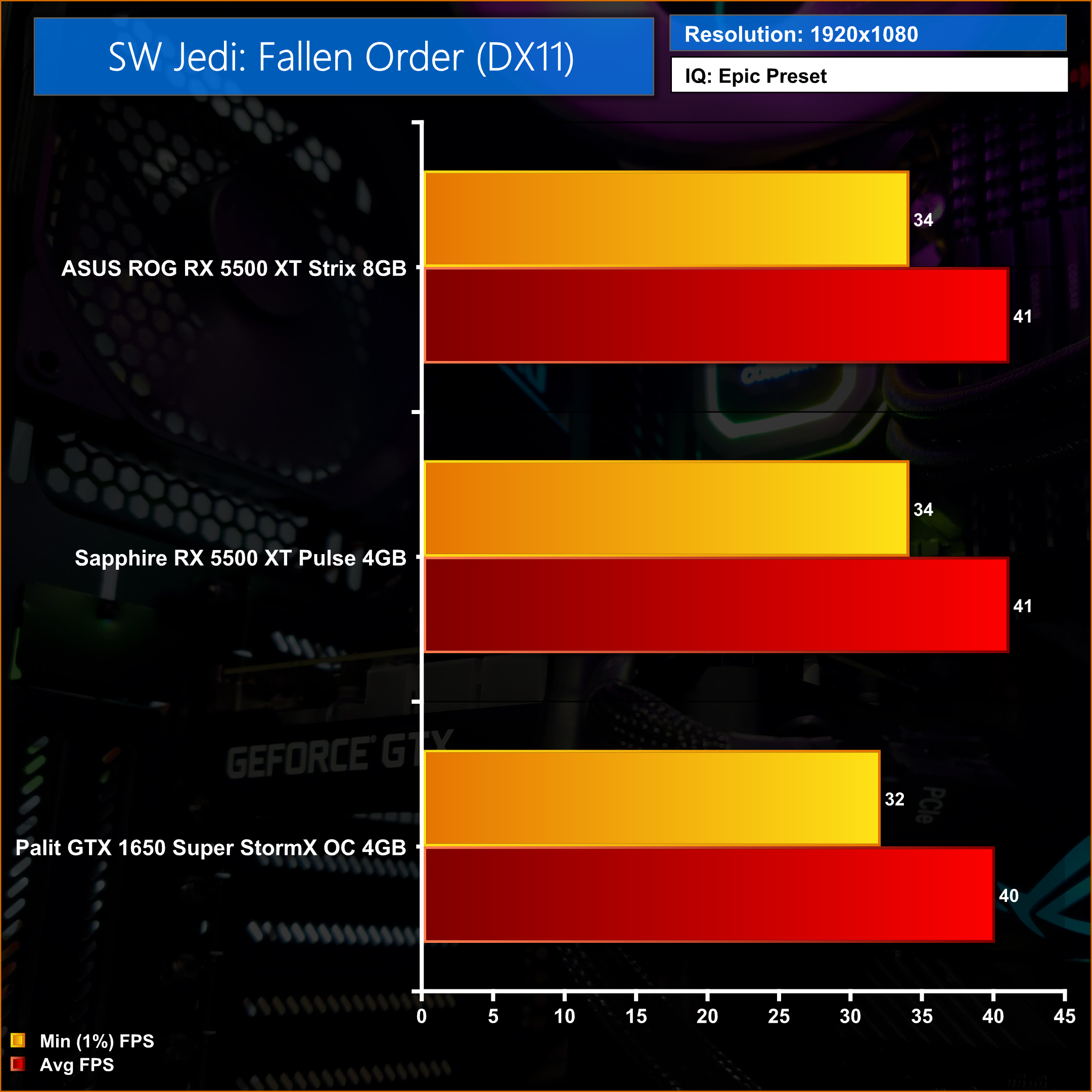
The penultimate game from our testing today is Jedi: Fallen Order, and this is the closest set of figures we have seen so far. Regardless of GPU, or memory allocation, performance between all three GPUs is pretty much identical. Any performance differences that are measurable are entirely inconsequential, so it is very much a tie here.
Total War: Three Kingdoms is a turn-based strategy real-time tactics video game developed by Creative Assembly and published by Sega. As the 12th mainline entry (the 13th entry) in the Total War series, the game was released for Microsoft Windows on May 23, 2019.
We test using the High preset, DX11 API.

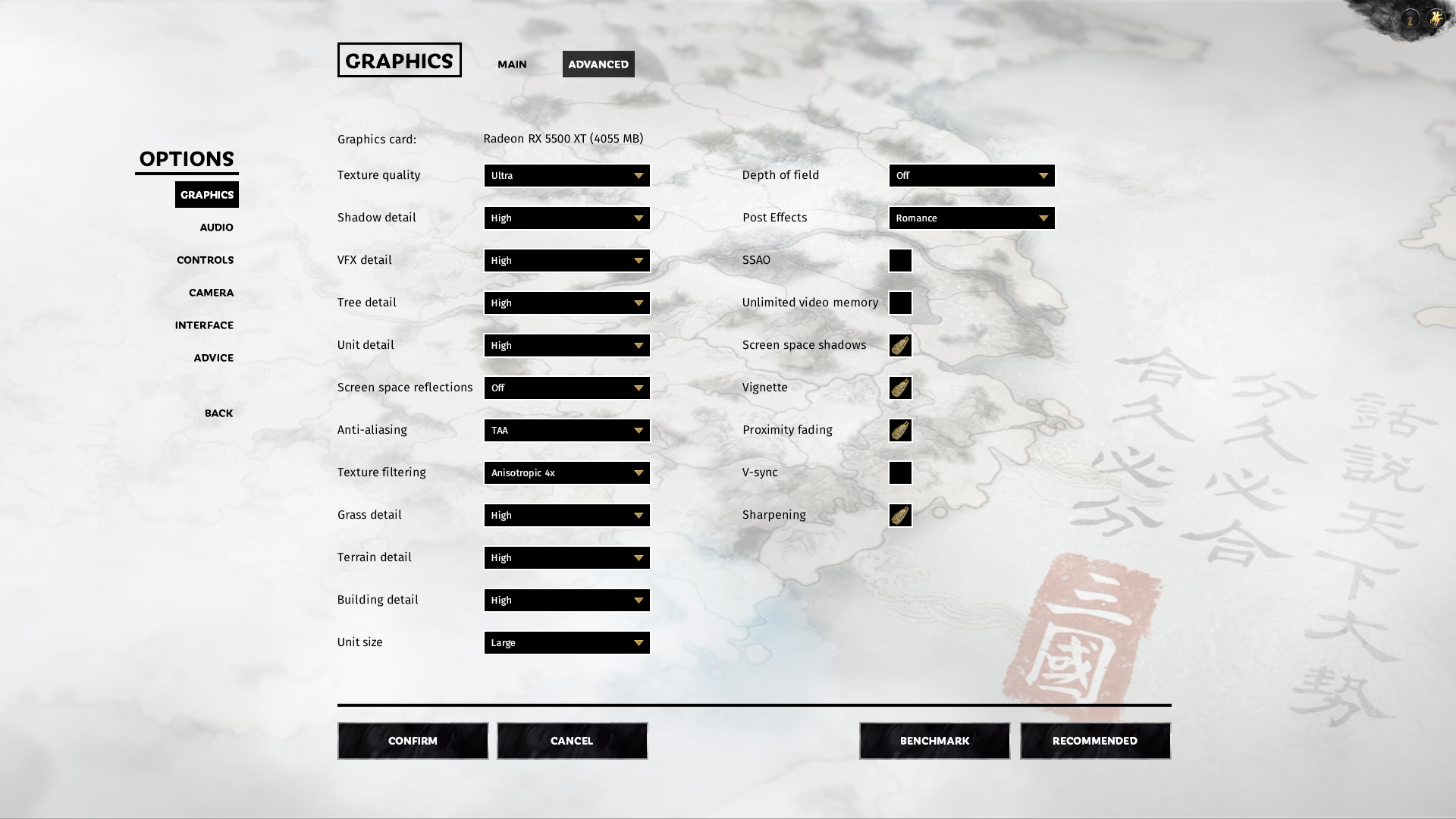
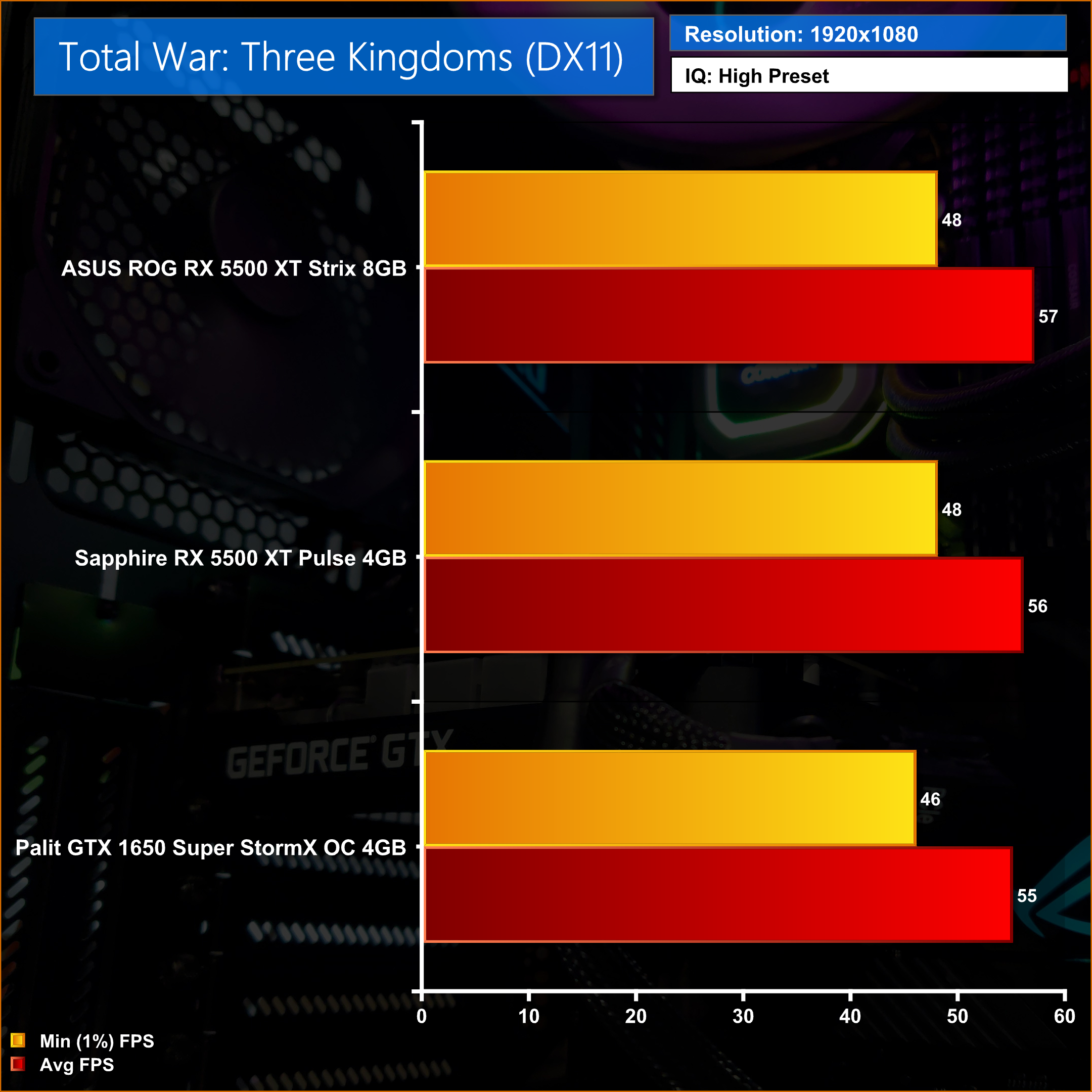
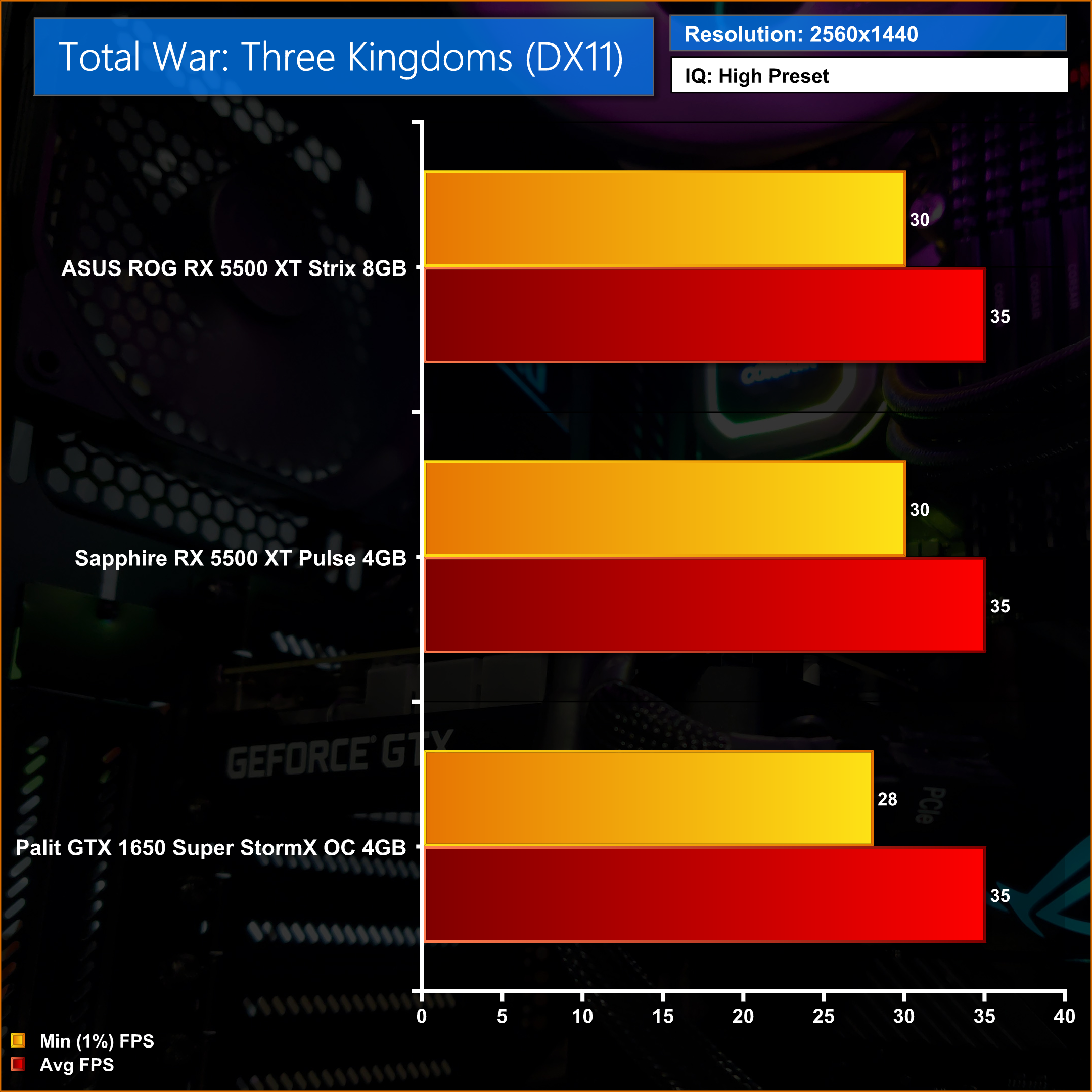
Finally, we close with Total War: Three Kingdoms. Once more, there is very little to split between these GPUs, with just a 2-frame difference between top and bottom at 1080p. It's another tie, and perhaps a fitting end to this round of benchmarking.
Here we present frame rate figures for each graphics card, averaged across all 14 games on test today. These figures can disguise significant variations in performance from game to game, but provide a useful overview of the sort of performance you can expect at each resolution tested.
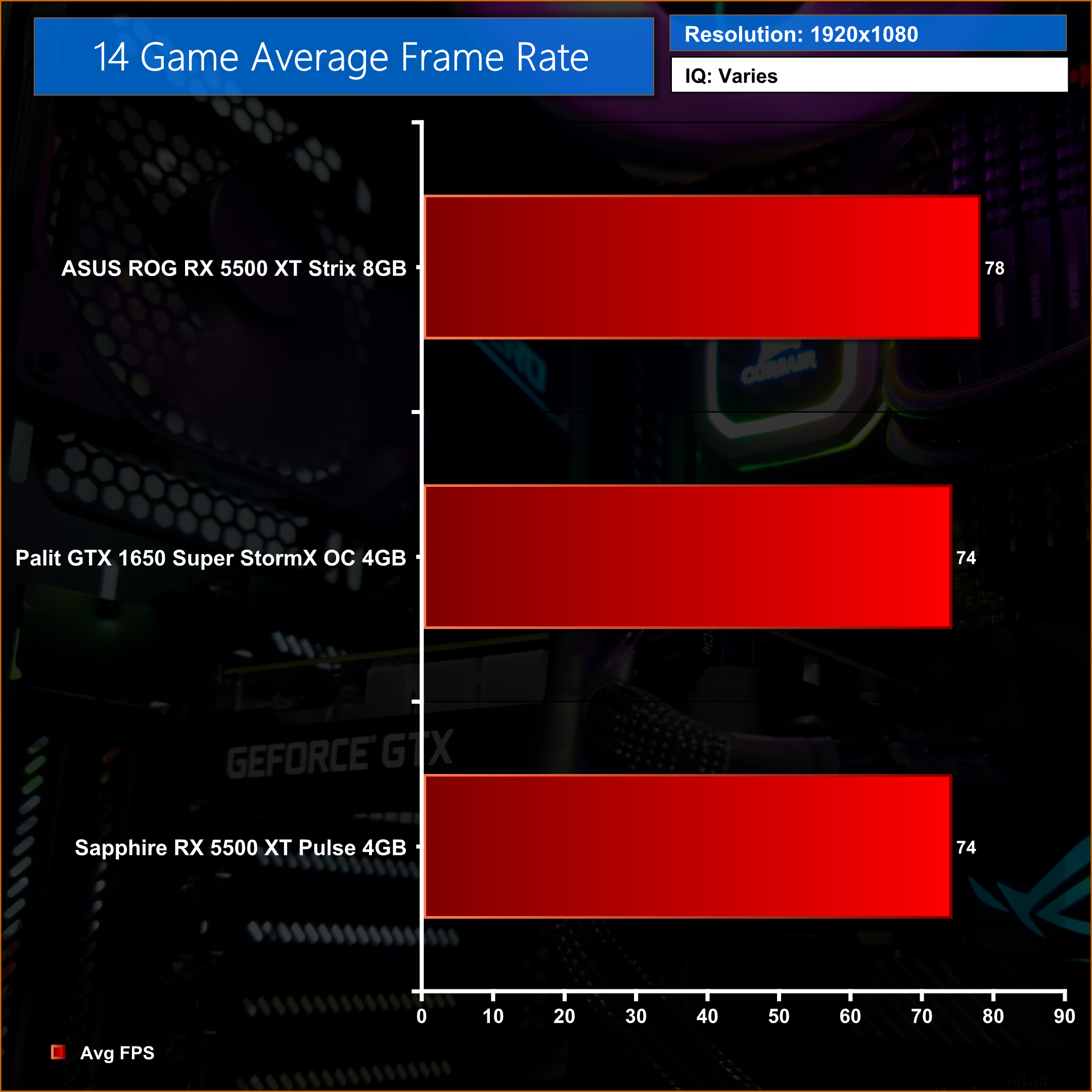
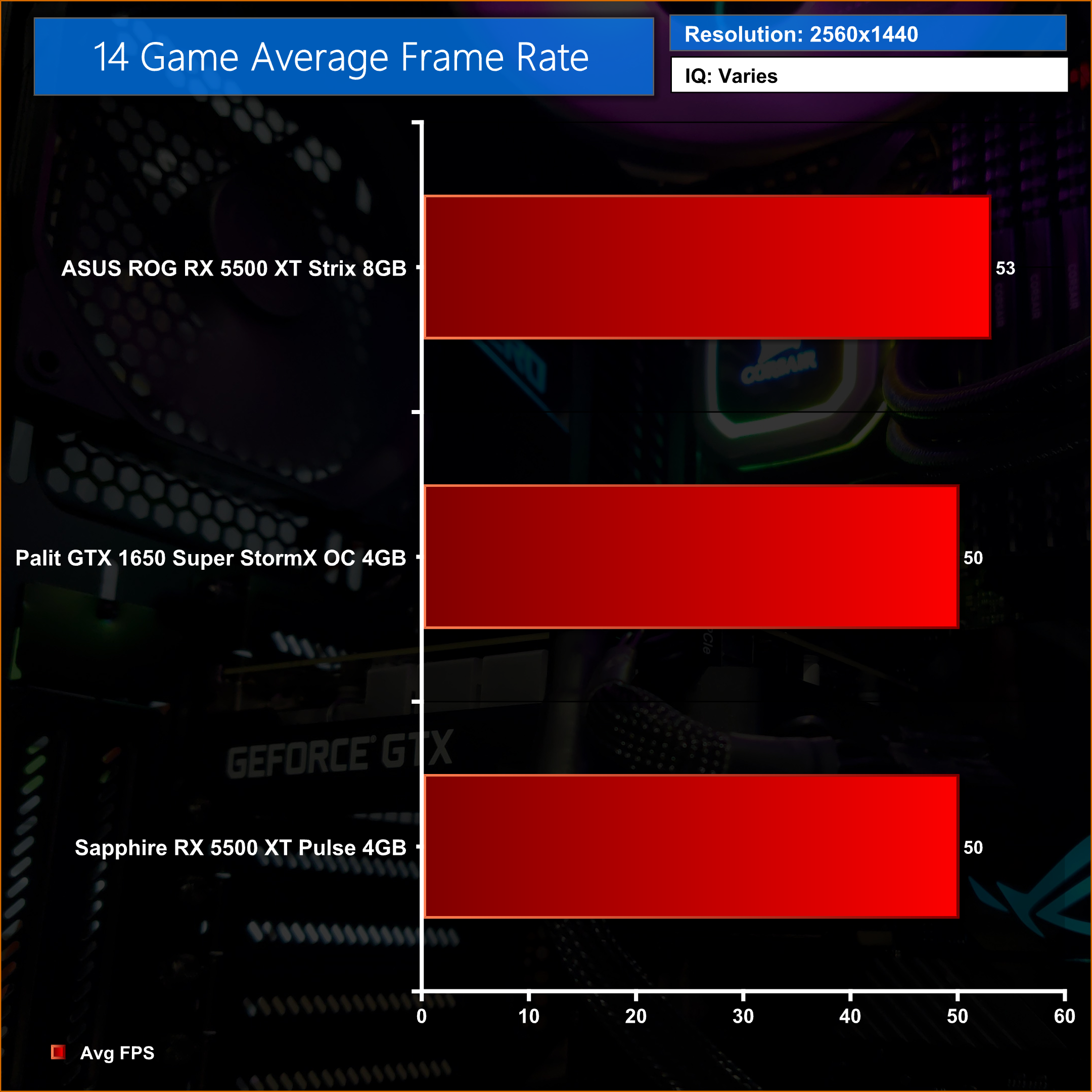
To illustrate just how these GPUs perform in the grand scheme of things, our 14-game average frame rates have the 4GB 5500 XT and GTX 1650 Super an absolute dead rubber. Yes, there are games where one takes the upper hand over the other – as we have spent the last 14 pages showing – but overall, we are getting two very evenly-matched GPUs.
The slight exception to this is the 8GB model, which can use its larger frame buffer to its advantage in a number of games, resulting in an average frame rate that is 5% higher than its competitors. Again, it's still not a lot by any stretch of the imagination, but it is a slight lead.
Here we present the average clock speed for each graphics card while running the 3DMark Time Spy stress test for 30 minutes. We use GPU-Z to record the GPU core frequency during the Time Spy runs. We calculate the average core frequency during the 30 minute run to present here.
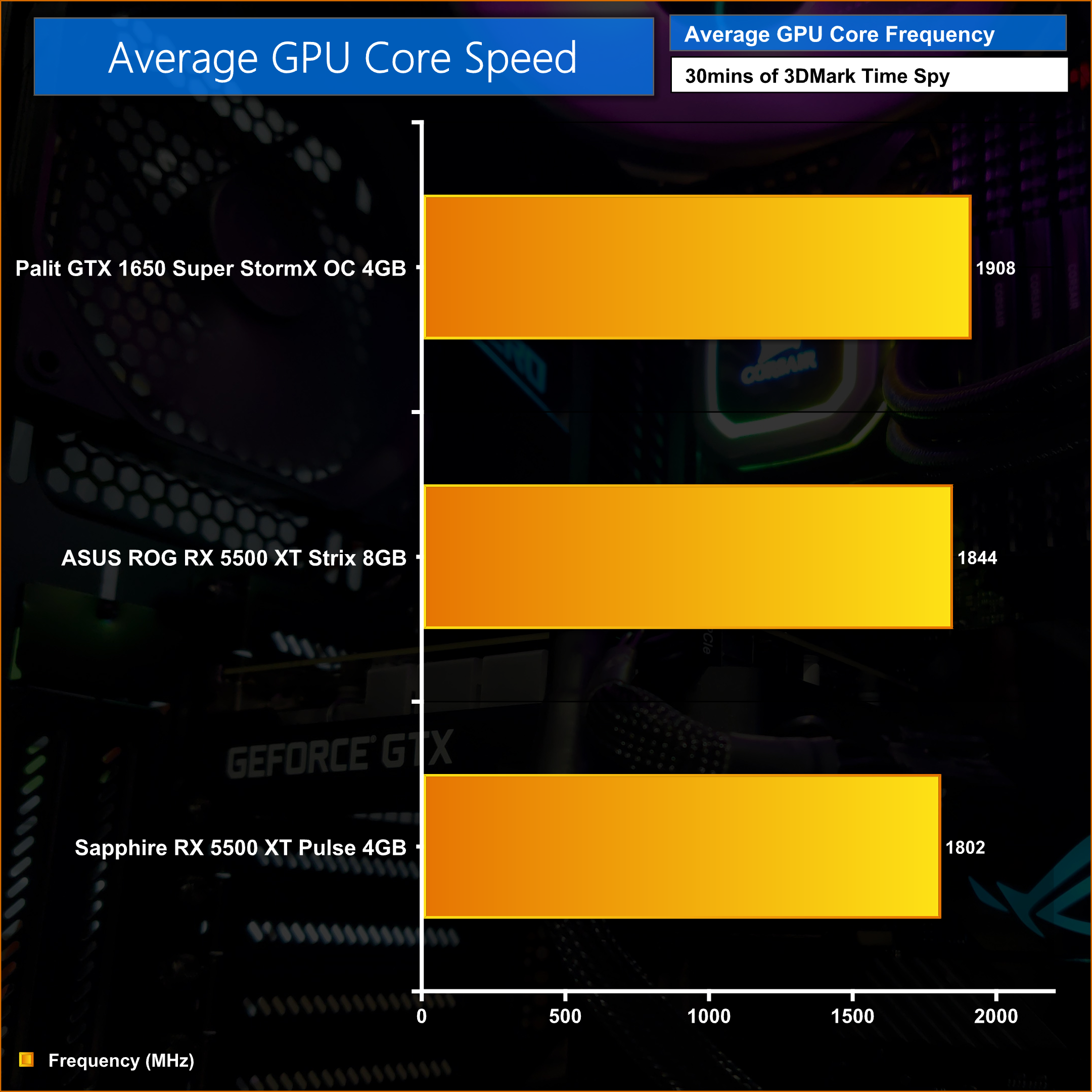
Diving into some testing specific to our cards today, we start with average clock speed. Bear in mind that the Nvidia and AMD GPUs are based on different architectures so these figures aren't directly comparable, we have simply combined the operating speeds into a single chart for ease of viewing.
For our temperature testing, we measure the peak GPU core temperature under load. A reading under load comes from running the 3DMark Time Spy stress test for 30 minutes.
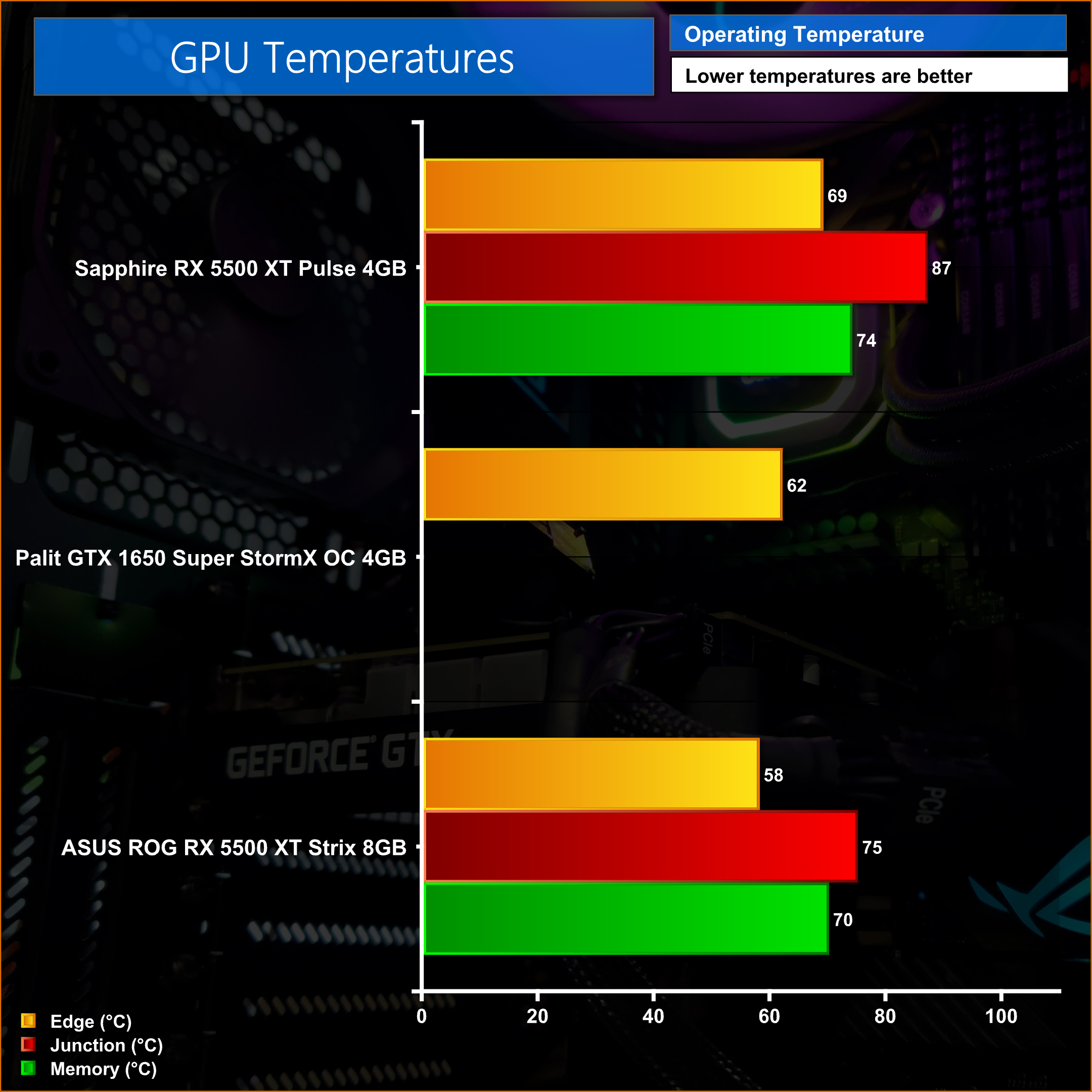
As for temperature testing, bear in mind that AMD Navi GPUs report junction and memory temperatures, which Nvidia GPUs do not. Still, I have to say all three cards perform well in their own right.
First of all, ASUS ROG's Strix 5500 XT is clearly an excellent piece of engineering, as the edge temperature remained below 60C at all times, which is highly impressive. The single hottest point on the GPU only hit 75C, too, so this really is a fantastic card in terms of thermal performance.
As for the Palit GTX 1650 Super, despite its diminutive size, it is similarly impressive to see GPU temperatures peaking at just 62C. As we will see on the next page, this does come at the cost of some noise, but it's still a very low temperature for what is, in all honesty, a basic cooler design.
Lastly, Sapphire's Pulse design may not run as cool as the Strix, but it is perfectly acceptable across the board, with hotspot and memory readings of 87C and 74C, respectively.
We take our noise measurements with the sound meter positioned 1 foot from the graphics card. I measured the noise floor to be 32 dBA, thus anything above this level can be attributed to the graphics cards. The power supply is passive for the entire power output range we tested all graphics cards in, while all CPU and system fans were set to their minimum fan speeds. A reading under load comes from running the 3DMark Time Spy stress test for 30 minutes.
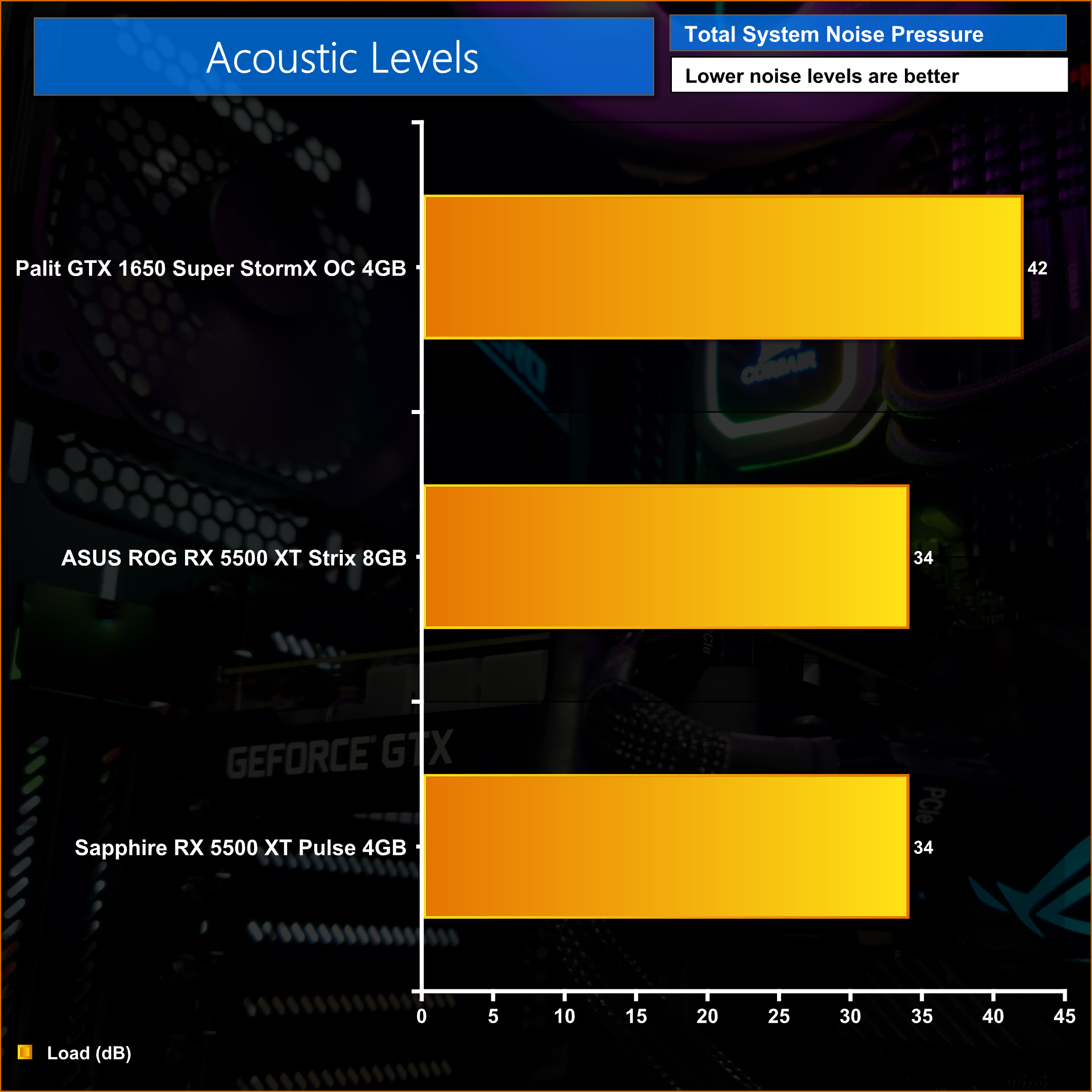
Regarding noise levels, both the ASUS and Sapphire cards are effectively inaudible under load. Both utilise 100mm fans, and in the case of the Pulse, these fans barely spun past 1000rpm, while the Strix kept its fans around the 1200rpm mark.
The Palit does make some compromise here, owing simply to its diminutive size and basic cooler. Even then, it's not ridiculously loud, but with its single 100mm fan operating at around 70% speed, you will be able to hear it when gaming.
We measure system-wide power draw from the wall while running the 3DMark Time Spy stress test for 30 minutes.
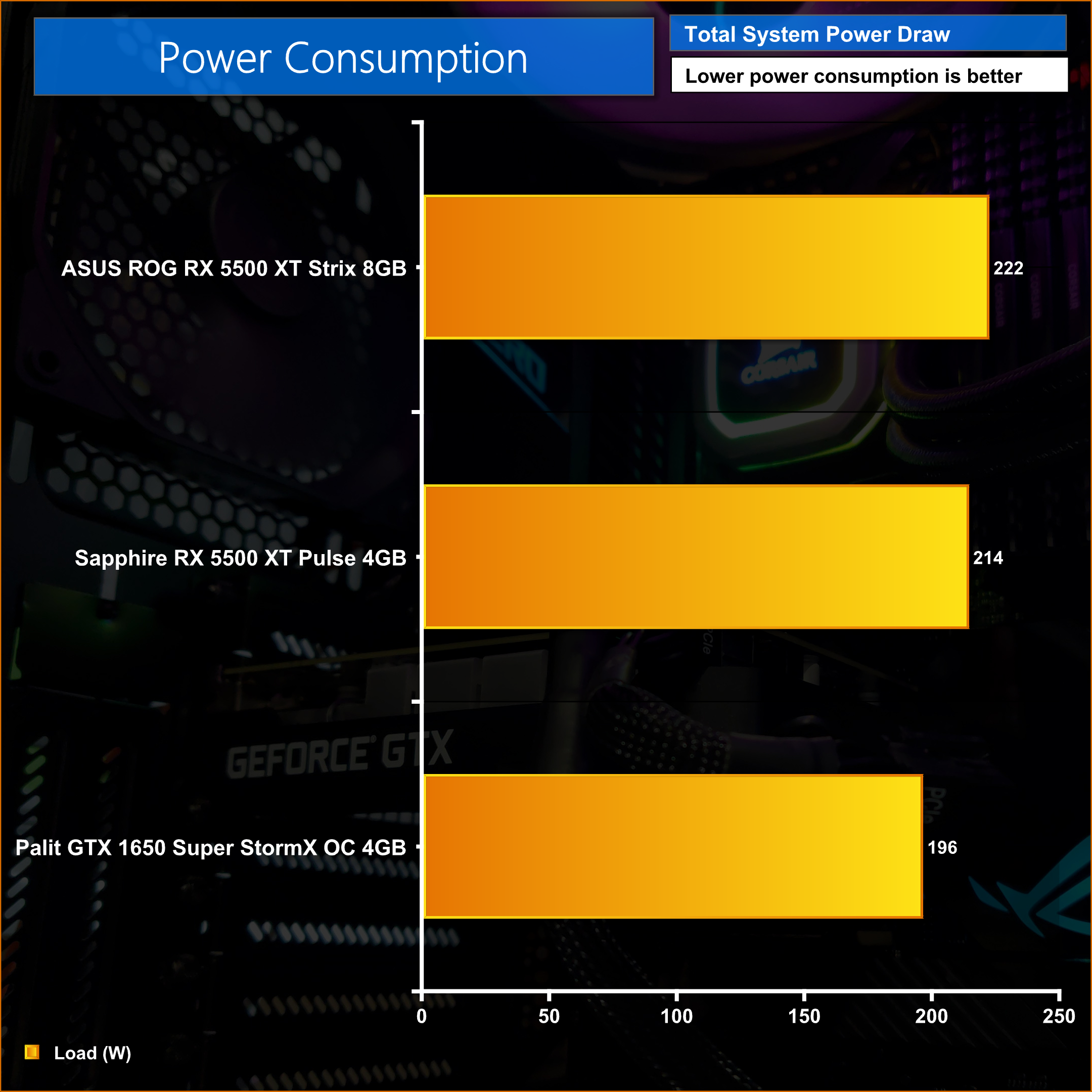
Finally, power consumption is pretty close between all three cards. The 5500 XTs draw a touch more power than the 1650 Super, but the difference isn't greater than 30W so it's hard to really complain about. Nvidia's GPU is more efficient, but when the margins are so fine, it really doesn't make much difference in the grand scheme of things.
Today we have stepped back in time to the end of 2019, which saw the release of both the Nvidia GTX 1650 Super as well as AMD's RX 5500 XT. It may not sound like that long ago, but a lot has happened in the intervening months and we thought it was well worth revisiting these GPUs.
Aimed squarely at 1080p gamers, our testing shows that any of these three GPUs is doing to do the business at that resolution – provided you are sensible with your settings. We tested most of our games with High image quality settings, and averaged over 14 games, all three GPUs report average frame rates above 70FPS.
In fact, 4GB 5500 XT and GTX 1650 Super are neck and neck, as both produced exactly the same 74FPS average performance figure. The 8GB 5500 XT was able to pull 5% ahead of those GPUs however, giving it a slender lead.
While those average figures certainly suggest very similar performance between all three cards – and that is true – we can get a more nuanced picture by taking things on a game-by-game basis.
Starting with the 4GB vs 8GB VRAM debate, across the 14 games we tested, only four saw the 8GB 5500 XT outperform its 4GB sibling by more than 5% – enough to indicate memory limitations were at play. That's not a lot, but in three of those games – Death Stranding, Ghost Recon Breakpoint, and Shadow of the Tomb Raider – the difference was at least 13%, indicating a sizeable chunk of lost performance by opting for the 4GB model.
Bear in mind, our testing was done without focusing on Ultra settings, so we are now seeing some modern titles utilise over 4GB memory, even without the eye candy cranked up to the max.
However, there were a few occasions, in games where we can be confident that having over 4GB memory is beneficial, where Nvidia's 1650 Super managed to perform reasonably well. Take Ghost Recon Breakpoint; here the 4GB 5500 XT absolutely tanked compared to its 8GB brother, falling almost 30% behind at 1080p. And yet, the 1650 Super was only 7% behind the 8GB 5500 XT. It certainly seems that, where memory limited, the Turing architecture can cope much better than the Navi architecture, at least based on what we have observed today.
A word on the specific models we have tested, too. We've already reviewed Sapphire's Pulse 5500 XT 4GB, but it remains an impressive card with very low noise levels and solid temperatures. The ASUS ROG RX 5500 XT Strix 8GB, however, is a step ahead, with even lower temperatures – we saw edge temperature peak at just 58C, making this easily one of the coolest-running cards we have tested. Lastly, Palit's GTX 1650 Super StormX OC may be a little loud, but it is also very compact which is sure to appeal to the HTPC crowd.
Overall then, if you're choosing between these GPUs, pragmatically speaking any of these three is going to do a decent job for your 1080p gaming needs. I would be most comfortable recommending the 8GB 5500 XT as it is slightly faster than the other two, while also having a more future-proof VRAM capacity… but pricing doesn't help its cause, as this particular ASUS ROG model can go for as much as £250(!), while the 8GB Pulse is currently £210.
As a straight shootout between GTX 1650 Super and RX 5500 XT 4GB, I think Nvidia just edges it. This Palit card costs £159, when 5500 XT starts at £170 on Overclockers UK. Additionally, Nvidia's GPU does seem to perform better in memory limited situations. Balanced against that, there are a number of games where the 5500 XT isn't memory limited and can beat the 1650 Super, but based on our testing the 1650 Super is never more than 6% slower at 1080p, so we feel it does just enough to get the nod for 1080p gaming.
Discuss on our Facebook page HERE.

The Sapphire RX 5500 XT Pulse 4GB is available from Overclockers UK for £179.99 HERE.
The ASUS ROG RX 5500 XT Strix 8GB is available from Amazon for £249.98 HERE.
The Palit GTX 1650 Super StormX OC is available from Overclockers UK for £158.99 HERE.
KitGuru says: It's been fun to revisit these three GPUs and see how the land lies in 2020. Let us know if you'd like us to retest any other older GPUs and see how they stack up today.