 KitGuru KitGuru.net – Tech News | Hardware News | Hardware Reviews | IOS | Mobile | Gaming | Graphics Cards


We love this industry and the logic behind that love is quite simple. Billions are spent on R&D each year – much of which goes toward making games run quicker and film/video stream quicker/smoother than ever before.
In other words, thousands of scientists around the world are working toward one thing: Making KitGuru readers happy. The KitGuru Annual Awards is our way of saying ‘Thank you!' to that huge, evolving body of scientific improvement.
To help us achieve our goals, gaming and professional, we expect hardware to keep getting faster, more powerful & feature-rich over time. That’s where KitGuru Labs testing comes in.
We also expect to pay less for it – which brings in the KitGuru editor’s ‘value' determination.
In all of these respects, 2014 has been a mixed bag – with slightly more positive results than negative.

While nVidia’s Maxwell architecture clearly moved graphics into a whole new zone back in February, CPU advancement from Intel has been slower than we’d like. At the same time, AMD’s progression has been largely notable for its absence in the mainstream/desktop zone.
We’ve seen major moves from Intel on the platform side of things, including X99 and Z97, but the pricing for a complete upgrade is still prohibitive for a lot of people.
Back in April, Microsoft began to pull support for legacy desktop operating systems, hoping to increase pressure on buyers to choose Windows 8 – while on 1st October it gave the good news that Windows 10 would be here very soon, as it kicked off a major beta test programme. Anyone who has booted Windows 10 to see the return of the Start Button will feel a great sense of relief that Microsoft’s pattern of ‘great OS -> not so great OS’ has continued and that ‘10’ will be a return to winning ways for enthusiasts.
Outside the PC itself, Sky’s inability to deliver broadband to many customers continues (with almost no change in experience from November 2013 to 2014) is a bitter disappointment for thousands of people.
At the same time, we have seen pricing on next-gen wireless routers dropping fast, led by companies like Asus and TP-Link. With David Cameron promising that 800MB films will be available to download in a single second using 5G in the not so distant future, you have to hope that the broadband companies have more up their collective sleeves. We do live in the UK however, so don't hold your breath.
Across the board, improvements are being made and the third KitGuru Annual Awards gives our editorial team a chance to step back from the day-to-day business of in-depth testing and analysis, to instead focus on the ‘Best of the Best’ across a 12 month period.
Enough preamble, let’s get to the results: Which products were the best of the best in 2014?
We begin the KitGuru Annual Awards 2014 with the Central Processor Unit – the CPU at the heart of every system.
The significant performance improvements of the past are proving hard to come by, as competition around the desktop processor has all but dried up.
We worked on an article in the summer that required a Micro ATX build with an AMD processor and it took us a while to source a mainboard. When we did, it was a 760G chipset that had been released years earlier.
With so little pressure on its leadership position, it's impressive that Intel pushes out any new processors at all, but in 2014 it really tried hard to attack and energise the market on all fronts. Much of the innovation happened in the chipsets themselves, so we will go into more detail when we discuss mainboards. For now, the focus is on the best desktop parts for the KitGuru audience.
Overall/Extreme/Professional Award
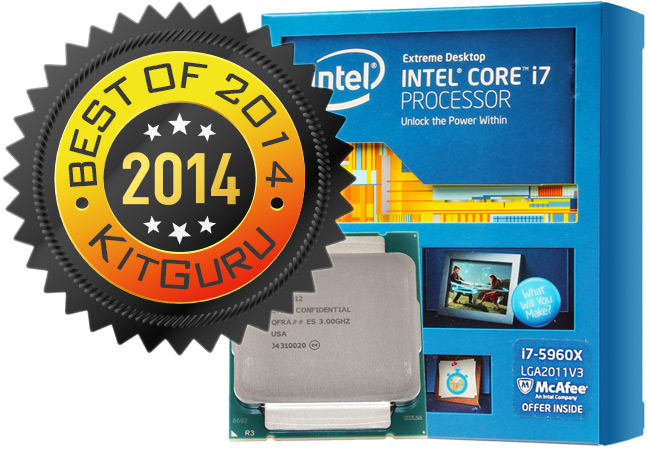
At first glance, an 8 core processor running at 3GHz for £800 might not seem like any kind of value at all. The challenge with Intel's Core i7 5960X is that it is a complete monster – that can only achieve its full potential in the hands of a skilled professional. Think Toruk Makto from Avatar and you're in the right zone.
Power users would normally pick something like the Core i7 4790K, for £260 or so, and then overclock it hard to 4.7GHz.
In the KitGuru Labs, Luke pushed the 5960X to 4.3GHz and it absolutely mullered the 4790k in tests like Cinebench. With 16 threads running at 4.3GHz, performance from the top-end Haswell-E chip is nothing short of imperious. For that reason alone, there is nothing that comes close.
KitGuru's choice for Overall CPU of the Year 2014 goes to the Intel Core i7 5960X. Read our review HERE.
Mainstream CPU Award
We were sorely tempted by the aforementioned Core i7 4790K, but Intel's drive on platform technologies made our choice that much harder. Again, we turned to our KitGuru Labs testing results and one processor stood out against the rest. If you want support for all the cool stuff like DDR4 and Quad Channel memory, not to mention a minimum of six physical cores, then you need to be looking at the 5xxx range of processors.
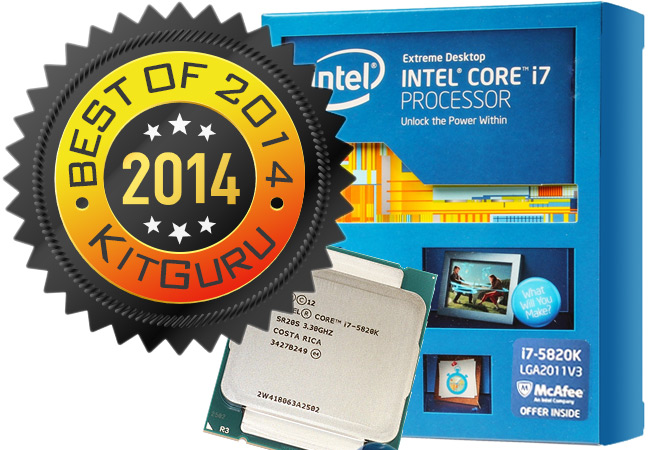
Our guy Luke had no problems achieving a 4.5GHz clock (up from the stock speed of 3.3GHz) using Intel's Core i7 5820K processor. At that speed, in Cinebench, it eased past the 5960X running at stock speed. Even so, it maintained a reasonable 75 degrees temperature, so no need for anything too exotic in terms of cooling for this 140w processor.
Pure gamers can save a bit and tap into the standard Intel desktop range but, from KitGuru's point of view, none of us are ‘one trick ponies' and as soon as you want to get into video, rendering or any number of applications that want more memory bandwidth or increased parallel processing.
The Intel Core i7 5820K is our choice for Mainstream CPU of the Year for 2014. Read our review HERE.
Value Award
Sometime it can feel unnatural to include a ‘value' segment for awards, but at other times it makes perfect sense.
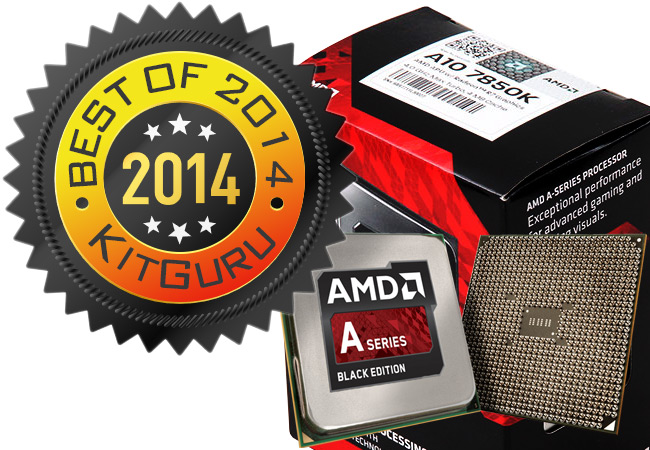
On 1st April 2014, KitGuru Labs took delivery on a system whose price performance combination made us do a small double-take. Especially given the date. But the numbers were right. PC Specialist had delivered a competent, entry level gaming system for less than £500 based on AMD's Kaveri 7850K processor. Although it wasn't about to drive a series of 4K screens, it was perfectly competent for the kind of 720p gaming we have all grown used to with the last generation of PlayStation and XBox.
At the start of 2015, the APU series will be the only serious competitor that AMD has against Intel's massed might. Sure, there are some FX chips that make sense, but the only market segment where you can declare anything like a clear win in AMD's favour is the entry level gaming sector. Which is big and important to those on a budget.
For that reason alone, we're happy to declare the AMD A-10 7850K as the Best of the Best in the Value segment for 2014. Read our review HERE.
This year's awards have been heavily influenced by Intel's various platform/chipset releases.
The Z97 was a bit of a damp squib initially. It promised so much, but as the early previews started to come to light, it became apparent that not all of the planned technologies would be available on day one. Intel rushed to market, pulling in the launch date, and the result was a bit of a scramble from the various motherboard manufacturers to try and (a) differentiate their new offers from existing Z87 offers while (b) working to mask the missing parts.
Pity really, because the combined marketing machines of Asus, Asrock, Gigabyte and MSI were ready to go for it at Computex.
Let's get to the runners and riders in this category.
Z97 Motherboard Award
Arguably the toughest market of all, with very little to choose between the main rivals. With similar feature sets, capabilities and performance – price played as much of a part in this decision as anything else.
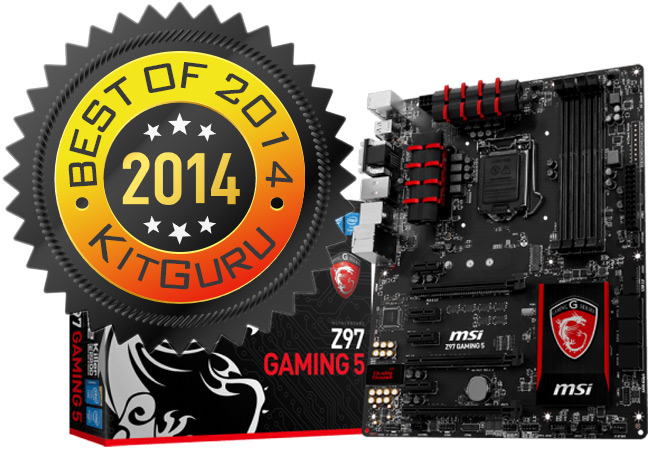
Our winner is a board that not only delivered well on the basics like M.2 SSD support, but which also managed to include Audio Boost 2, Killer NIC and XSplit GameCaster which lets you capture, record and stream your best gaming moments. And at a little over £100, it doesn't break the bank.
Our choice for the Best Z97 Motherboard in 2014 is the MSI Z97 Gaming 5. Read our review HERE.
X99 Motherboard
If you're going to invest in the ‘Daddy' of processors, then you're going to need a very serious motherboard. Intel pulled in the launch of its X99 processors, which meant that all of the manufacturers had to scramble to get to market in time.
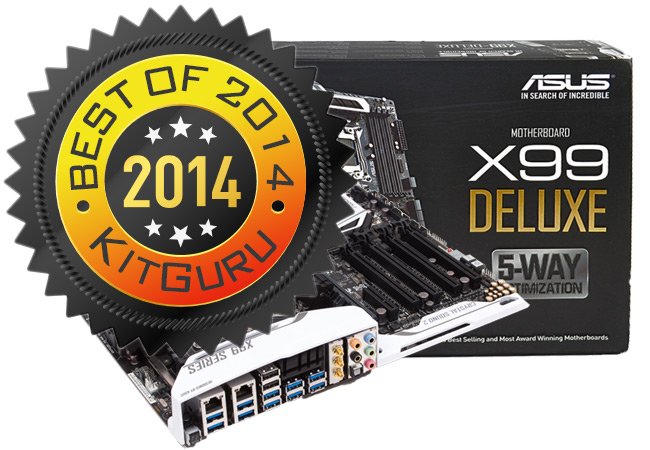
Quite why Intel adopted such a disorganised approach to launches in 2014, we will never fully know. It certainly caused issues. While every company overcame those issues eventually, only one managed to sort everything ‘straight from the gate'. That board was the Asus X99 Deluxe and KitGuru Labs described it as “Packed to the brim with overclocking, general features and connectivity”, which is as much as you can ask from a motherboard.
For that reason, our choice for the Best X99 Mainboard of 2014 is the Asus X99 Deluxe. Read our review HERE.
AMD Motherboard
It would be so cool if AMD had managed to deliver a killer product with the initial Bulldozer or had come out swinging with the FX-9590 at £175 (when the Intel Core i7 4770K was £265). Now THAT would have put the cat among the pigeons. Instead, the July 2013 launch of the 9590 was closer to £600 and we've seen nothing faster since. On that basis, our choice for AMD motherboards is narrowed to the APU-supporting products.
In recent times, some very significant performance records have been set with APUs, many of which have come on a Gigabyte motherboard.
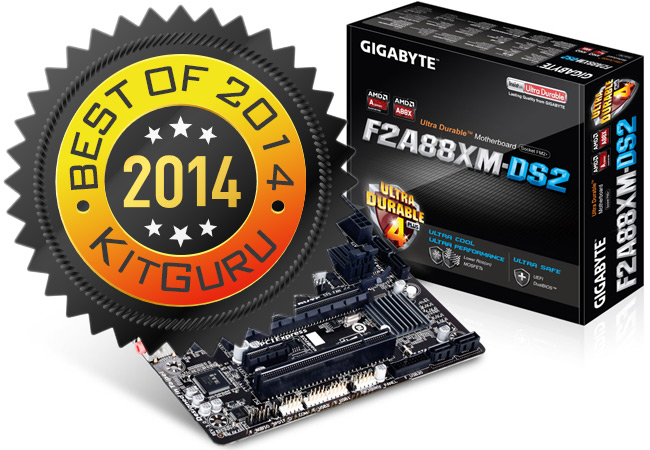
Keen to build on its reputation for G1 Sniper motherboards, Gigabyte launched its F2A88XM-DS2 board, and it's a great choice for affordable gaming rigs and those enthusiasts who want to see crazy CPU core speeds, without breaking the back. At the time of writing, this board is actually under £40.
Our choice for the best AMD mainboard of 2014 is Gigabyte's F2A88XM-DS2. Read the review HERE.
Technical Excellence
While value is always important, there are times when you just want to sit back and be impressed. Standing out from the crowd was hard enough last year, but Asrock has managed to do it again. What started as an ‘off-shoot' company, primarily to provide value options, Asrock has turned its brand around and stuck all of the initial expectations on their heads. Alongside strong R&D, it has also invested heavily in building up a professional offer with the creation of Asrock Rack. The company does still offer low cost boards, but it's at the high end that Asrock surprises you the most.
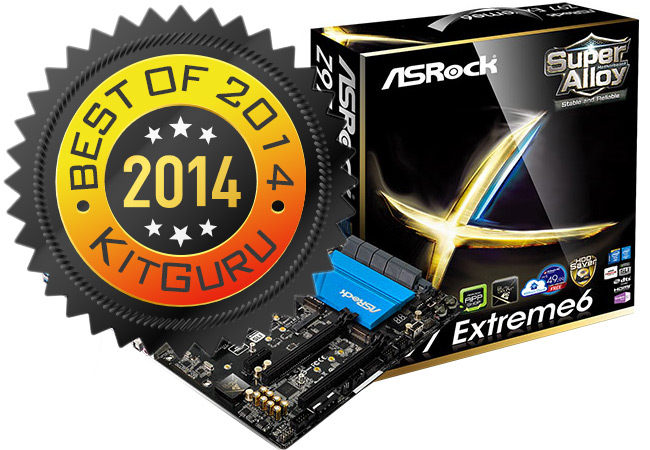
When KitGuru Labs put the Asrock Z97 Extreme6 under the proverbial microscope back in July, we were truly impressed with the effort Asrock had made to ‘do something different' – with big ‘wins' like the Ultra M.2 connection. While chipset-led options are limited to 10Gbps, Asrock's decision to bring a bundle of PCI-Express lanes together means a theoretical upper limit of 4GBps. That's gigaBYTEs, not bits. Why is that important? At the time of the initial review, Samsung's XP941 was simply ‘too much SSD' for Intel's latest connection option; that wasn't the case for the Ultra M.2 connection.
Packed to the hilt with features, this impressive board is still less than £130 at the time of writing.
For all those reasons, KitGuru's choice for Motherboard Technical Excellence 2014 goes to the Asrock Z97 Extreme6. Read the review HERE.
Few topics will cause more argument among experts, enthusiasts and professionals alike – as memory.
Some will say that 8GB dual channel 1600 is plenty for most situations, while others will argue that a processor is only set free when you have 64GB of DDR4, cranked up high in a quad channel motherboard. Given that the difference in price between those two options CAN be enough to buy an Xbox One, you can see why the debate is so heated.
One very important topic is ‘clearance' – the space between the top of your memory and your cooler. With a liquid cooling system, you can manage the situation, although top-quality air coolers can cause an issue. For the purposes of these awards, we will ignore height completely, but you shouldn't when buying!
DDR4
Having tested multiple DDR4 kits, KitGuru Labs can safely say that the margin of performance difference between various sets of 3000MHz memory kits is small. When that happens, the only real differentiator between top brands is often price.
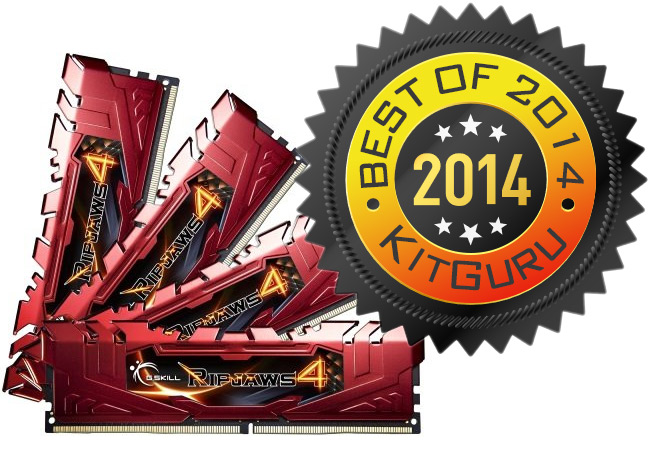
At the time we started writing this article, Kingston made a huge move on price, bringing the cost of its 16GB HyperX Predator DDR4 kit down to a more competitive point. While the G.Skill RipJaws 3000MHz 4x4GB Kit edged Kingston in our test – this new price from Kingston was hard to ignore. But, as we were about to go to press, we had a move from G.Skill to £266 and balance was restored.
KitGuru's choice for DDR4 Memory Kit of the Year 2014 goes to the G.Skill RipJaws 3000MHz 4x4GB kit. Read the review HERE.
DDR3
A huge amount of DDR3 product came through the KitGuru Lab in 2014, most of it inside systems – but all of it tested an evaluated. With the Haswell-E processors dominating KitGuru's Annual Awards 2014, and the promise of much more to come in terms of DDR4 performance, DDR 3 needs to be seen in a more ‘value' light. Cross-referencing the more recent kits with products we've seen and tested in the past, shows just how tight this category is.
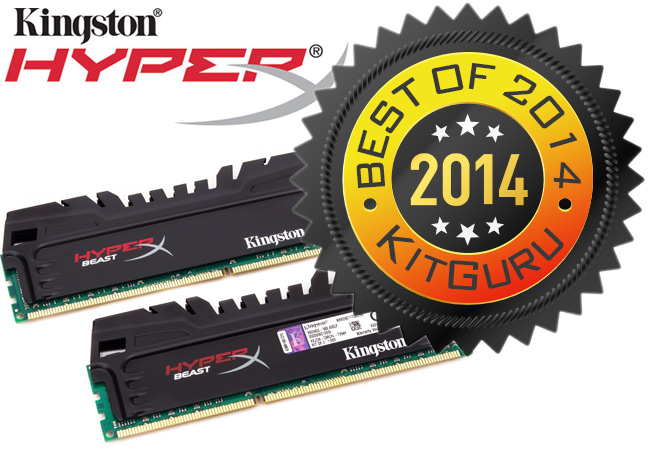
While the price may fluctuate, there's little in the market to topple Kingston's 2400MHz Beast kit from its perch. When you look at leading system builders like PC Specialist using XMP-Certified Beast modules in multiple systems, you can understand why for the first (and probably last), time ever – KitGuru has chosen the same product 3 years in a row.
KitGuru's Annual Award for Best DDR3 Memory goes to Kingston's HyperX Beast 2400MHz kit. Read the review HERE.
KitGuru is all about performance. It's hard to imagine buying/building a system that does not boot from a solid state drive, yet most consumers will be buying just that – a desktop or laptop that uses a slow, old mechanical drive, guaranteed to bring performance to its knees.
Your CPU and graphics card GPU/memory work in speeds normally measured in the ‘Giga' range, while more of the world's data is still stored on hard drives toward the slow side of the ‘Mega' range of data transfer.
Creating a peaceful, smooth experience becomes a game of constant caching – protecting the slow components in your system from the serious demands of the central processing units. Nowhere has this situation improved more in recent times than with the addition of solid state drives – the ability for computers to work with pure memory – free from the speed stunting shackles of spinning hard drives.
This year, we are giving two awards in this important category – one for pure performance, no price consideration – and the second for value. Depending how technologies develop from Seagate etc, next year could well see the addition of a ‘hybrid' category – for traditional, mechanical drives that have had an SSD embedded.
Performance SSD
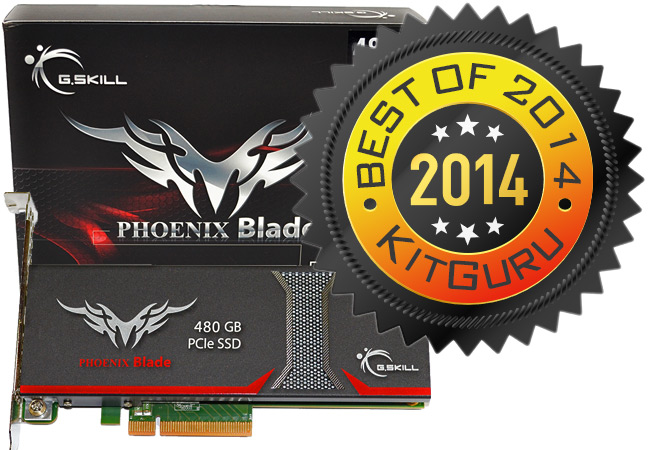
Over the years, we have seen many publications state that an article is about performance – then hand out awards to the product that came second or third, because they had a nicer feature set or slightly lower price. KitGuru generally does not operate that way. When we saw the ballistic data speed from G.Skill’s 480GB Phoenix Blade PCI-Express SSD product, our jaws dropped.
Will it cost you north of £500? Sure, but if you want a drive that can boast maximum read/write speeds in the 2,000MB/sec (while some of your friends with early SATA SSDs will be used to deleting a zero off that figure), then a G.Skill Phoenix Blade is a serious choice. Going past the OCZ RevoDrive 350 in 3 out of 4 tests is impressive, but leaving Plextor's M6e for dust was stunning.
The gap between a ‘fast solution for regular people' and ‘what you can do with a PCI-Express product' is vast.
KitGuru's choice for Performance SSD in 2014 goes to the G.Skill 480GB Phoenix Blade. Read the review HERE.
Value SSD
Lots of competition in this market. With the recent price drops, the first thing we are going to do is ignore any drive with a capacity of less than 240GB. Since our first article on ‘Can you live with 64GB‘ which ran almost 5 years ago, KitGuru has constantly re-assessed what users need for a good experience.
OCZ, Kingston, Hynix and Corsair all have sent us good options for less than £100 that will mean you don't need to spend 24×7 worrying if you are about to run out of space.
Sure, 480 and above is nice, but anything over 200GB is readily usable. The upper end of this group is occupied by products like the Plextor M6 Pro 256GB solid state drive, which is a bit of master class in what can be done with a SATA connection, but it does cost a lot more than its rivals, so it misses out in the value sector.
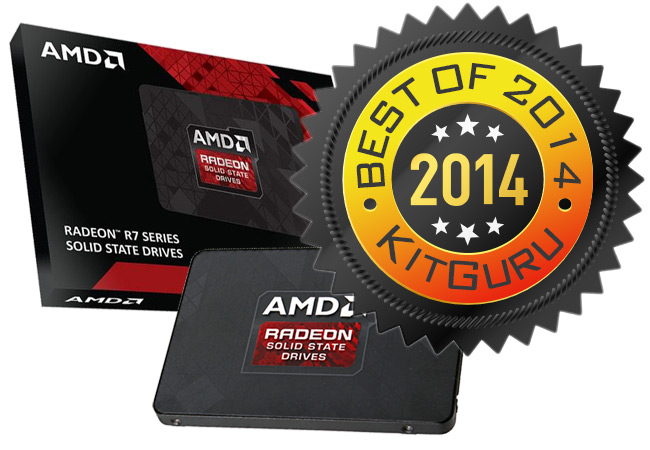
Our winner in this area is a bespoke drive, manufactured by OCZ in conjunction with AMD. The AMD Radeon R7 Series 240GB uses a highly clocked Barefoot 3 controller and when we reviewed it back in August, it had a quoted MTBF (Mean Time Between Failure) that was higher than any other drive on test. In CrystalMark 3.0, nothing short of a RAID set up could match its performance. Priced around £111, it isn't bargain basement, but it does deliver good value.
KitGuru's choice for Best Value SSD in 2014 is the OCZ Radeon R7 240GB. Read the review HERE.
Pure pixel pushing performance is a serious business.
Just as the start of 2014 belonged to AMD's graphic cards with their superior mining performance, so the end of 2014 has seen a slide toward nVidia and its Maxwell technology. From the first GTX750 tests, the writing was on the wall for any ‘cards of a previous generation'. The top of the range GTX980, with a solid overclock, could pull ahead of the fastest R9 290X OC in games like Thief at 4k resolutions by as much as 25% with only a 3 degree difference in core temperature. And that was the reference design.
What AMD lacked in cool, it made up for in price cuts, game bundles and turbo-charged-water-cooled high end launches. At the same time, its Mantle initiative seemed to spur Microsoft into a new direction for DX12 – with a grand unification coming from the desktop, laptop and console gaming communities all not sharing a common hardware platform.
We will get into screens in more depth later, but it must be said that the phenomenal price drop on 4K screens has created a definite upsurge in requirement for very high end graphics. If you're spending £400 on a 4K screen, then you need to spend the same (or more) for a great gaming experience.
AMD High End Graphics
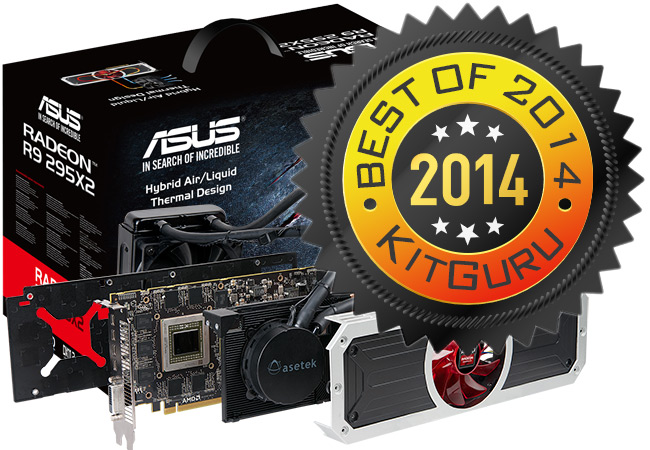
Easiest category of the day, with a choice of one. Even an nVidia Titan Black SLi set up doesn't get close to 60 frames a second in games like Thief at 4K. The days when a graphics performance winner would be knocked off its perch every 3 months are long gone, with the AMD Radeon R9 295X2 sitting pretty since 18th April.
When it pulled out a lead of more than 30 frames a second in Total War: Rome 2 at 4K, the raw power was there for all to see. At 648w, its neck and neck with a pair of Titan Black cards in SLi but as it is water cooled the noise levels are lower – it only needs a single slot too. Worth bearing in mind that no matter which manufacturer you buy your 295X2 from, it will be AMD's reference design – even if you are forking out £786. Make sure you have a formidable 1000W+ power supply before buying.
KitGuru's choice for AMD High End Graphics product in 2014 goes to the Radeon R9 295X2. Read the review HERE.
AMD Mainstream Graphics
Just as the previous choice was extremely easy, because there is no competition – so the mainstream/value segment is almost impossible due to a lack of runners and riders wanting to strike out ahead. If you get close to £100, then the power of nVidia's GTX750 is unmistakable and unmissable. Head past £250 and you stray into lethal GTX970 territory. Looking at all of the cards occupying the ‘Goldilocks Zone', we're drawn toward the high end. There's just not enough to set any lower card apart.
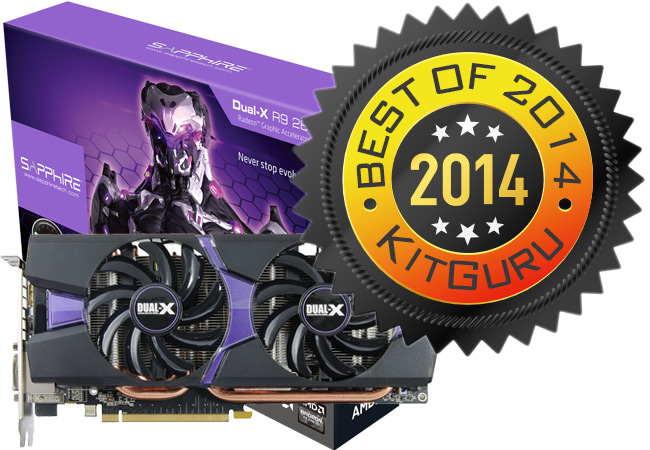
The local hero in this price space has to be the R9 285. It is significantly faster than the GTX750 to be considered a clear class above, yet well under the GTX970. It terms of power consumption (190 watts when gaming), acoustics (34dBa when gaming) and thermal dynamics (64 degree when gaming), it does nothing to jar.
Also, with models like Sapphire's R9 285 Dual-X OC, you can get close to another 15% on the core and 9% on the memory – all of which adds up to a tidy little boost when gaming. And at £179, it can be added to a modest system build easily enough.
KitGuru's winner for AMD Mainstream Graphics 2014 goes to the 2GB Sapphire R9 285 Dual-X OC. Read the review HERE.
nVidia High End Graphics
The GTX970 and 980 have burst onto the scene in a big way in 2014. Did they pull away in performance terms – leaving the competition for dust? Not so much. So why the hype?
The initial/reference GTX980 did a great job of getting in the face of cards like Sapphire's R9 290X TriX OC, but when we analysed the juice needed to win – we were shocked to find that it was pulling up to 60 watts less. Enthusiasts might not care about the £12 that the extra 60 watts will cost you in a year, but they will want the additional efficiency that goes with having the Maxwell architecture.
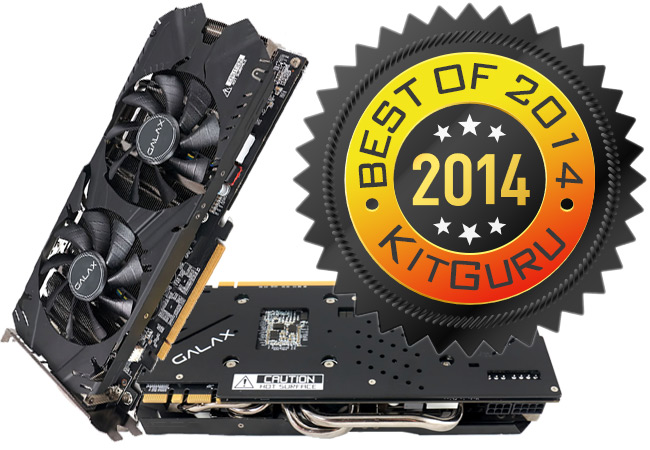
We spent a lot of time considering the scary Inno3D iChill Herculez X4 Air Boss Ultra, which combines scary performance with scary looks, but something else caught our eye in November: The Galax GTX 970 OC Silent Infinity Black Edition – created by none other than Overclockers UK Commissario and chief GPU expert, Gibbo.
This custom design includes special features to reduce coil whine and deliver serious cooling. Even though it's not using a 980 GPU at its heart, this card will still deliver serious gaming at 4K – while staying at a relatively chilly 56 degrees. It's also one of the quietest and least power-hungry performance cards in the market – and we found an extra 12.5% in the core when overclocking. In every way, the Galax GTX970 OC Silent Infinity Black Edition is a technically superior product and the most capable version of the best GPU of 2014 at just £281.
We have no hesitation naming the Galax GTX970 OC Silent Infinity Black Edition as the best High End nVidia Graphics Card for 2014. Read the review HERE.
nVidia Mainstream Graphics
The winner is the GTX750 ti. What a simple decision.
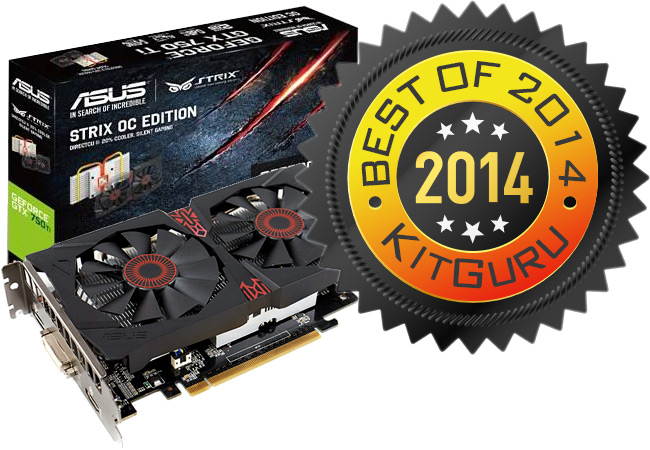
While performance at the high end is important, it becomes CRUCIAL in the low-end/mainstream. A boost of 10% may not make much ‘real world' difference when you are talking about 80 fps to 87 fps using a £300 top of the range card, but when the Asus GTX750Ti Strix OC pulls 7fps more than the nVidia reference card in GRID at 1920×1080, then you can really feel the difference.
The fact that KitGuru's engineers were able to find almost 15% more speed when overclocking (on top of that initial 7fps lead), is testimony to the overall build quality and thermal control mechanisms that Asus has included on this model.
The only graph where it almost came bottom was for Thermal Dynamics (50 degrees when gaming under load). Heat is the one table where every manufacturer DOES want to come last however!
Note: This card must not be confused with the regular 2GB Asus GTX750 Ti. The STRIX OC version is significantly better – so you may find it harder to come by – even at £134.
KitGuru's choice for nVidia Mainstream Graphics card of the year 2014 goes to the 2GB Asus GTX750 Ti Strix OC. Read the review HERE.
So you've chosen your CPU, mainboard, SSD, memory and graphics card – what next in KitGuru's ‘master class system build' for 2014?
While the traditional 4K screens find themselves dropping under the £400 mark, a new generation of Quad HD monitors is also coming through. Quad HD, in this instance, uses the fact that many people (especially Sky TV) call 720p vertical pixels ‘HD'. So by doubling up on the 1280 and 720 numbers, you end up with a QuadHD screen that is 2560 x 1440. We like the resolution, we're just uncertain of a name that references ‘HD' and does not mean 1080p. Marketing budgets will no doubt settle this one.
Pioneers in the super-wide format include AOC and its 29″ Q2963 (2560×1080) was our choice for Budget Monitor of the Year 2013. At the same time, our top award went to the Asus PQ321QE for a 4K screen that was just under £3,000.
No other group of components or peripherals has developed quite as fast as the monitor market over the past 12-18 months. It's something we applaud at KitGuru, because driving that many pixels means a serious increase in the amount of processing power needed – which drives the industry forward. The only missing piece of the puzzle is ‘How can game developers deliver supreme 4K titles without breaking the bank?'. Still, game publishers making money is not in our remit here at KitGuru, we care only for the cool hardware.
Monitor of the Year
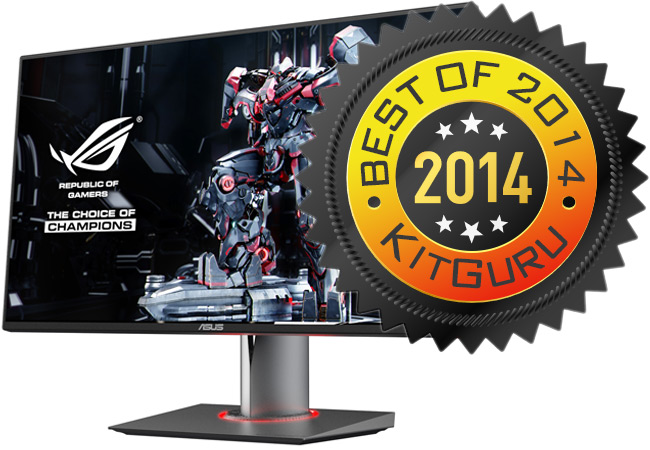
In a world of professional monitors that can span 30″ or more with full 4K resolutions, how strange it seems that the best screen of the year would be a 27″ monitor that was designed primarily for gaming at 2560 x 1440 – a resolution that people seem determined to call ‘Quad HD'. Even stranger is the fact that the full feature set of this screen is not available to all users. So why have we looked past all of the other screens we've seen in 2104 and plumbed for the Asus ROG Swift PG278Q?
As always, we start with pure image quality. This screen can deliver better black than the 4K screens we have seen recently and its crisp, even white is better than at least 95% of all the screens we have ever seen. It also offers a 1ms grey-to-grey response time and will deliver up to 144Hz refresh rate. It's when we get to refresh rates that the clever stuff starts, with nVidia GSYNC. The screen dealt with a vast array of fluctuating frame rates, smoothly, with no visible shearing or distortion. It did exactly what it said on the tin and all for £599 (at the time of writing).
KitGuru's Monitor of the Year 2014 goes to the Asus ROG Swift PG278Q. Read the review HERE.
Value Monitor of the Year
While the average spent on a complete PC by Joe Public is under £750 (if you ask the scientific folks at IDC), our research shows that KitGuru readers are much more comfortable in the £1,000 to £2,000 price range – where a GTX750 is considered entry level and the most popular card is something like the GTX970.
When your card can push 4k without SLi or CrossFire, then why would you buy a monitor that didn't have big desktop real estate?
What makes this year's awards a strange affair is that you can choose an excellent 4K screen for less money than our Value Monitor of the Year winner.
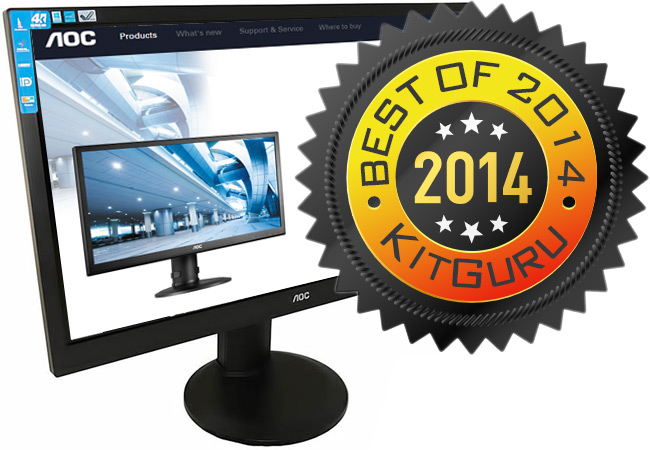
The AOC U2868PQU has a simple design, but sports a full set of ports – including one HDMI port, one DisplayPort 1.2, one DVI and one D-sub connectors – as well as a four-port USB hub. Image quality is great. Sure, it's not quite in the same class as the Asus PQ321QE – but then again the Asus costs 4 times as much. At £335, this AOC monitor represents great value.
KitGuru's Value Monitor of the Year 2014 is the AOC U2868PQU. Read the review HERE.
First impressions count – which chassis should you choose?
One area that couldn't fail to generate excitement in 2014 was chassis. You normally expect case manufacturers to deliver one unicorn followed by a dozen donkeys, but this year the overall standard felt higher. Quite a few thoroughbreds separating the extremes.
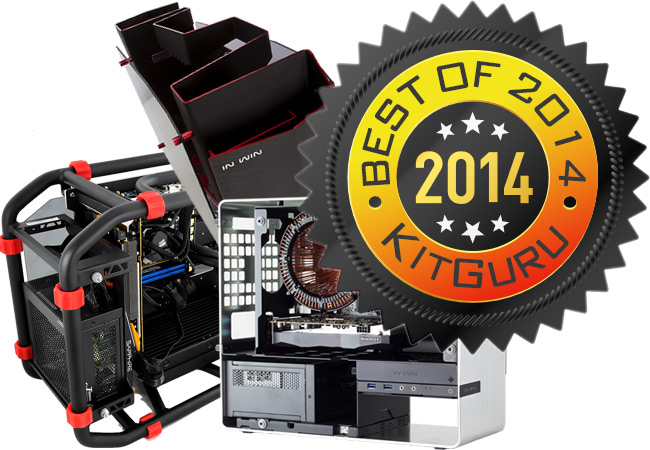
Arguably the most entertaining company was In-Win, with a stream of ‘out of the box thinking' ideas that were great for the market. That kind of design and development work reminds us of the concept cars that grave major motor shows.
In themselves, they may not go on to be the a ‘number one best seller for the year', but each of them puts down some kind of marker – to let enthusiasts (and other design companies) know that originality is possible.
The chunky-monkey D Frame Mini, smooth, stylish 70's retro 901 and the stunning S-Frame certainly did that.
Head-turning looks are not everything – and we need to keep an eye on cooling, ease of use and affordability – but we did feel that InWin's consistent drive toward creating something new and different needed to be recognised. KitGuru's very own bike racing specialist fell truly, madly, deeply in love with the In-Win D Frame Mini – warts and all.
KitGuru's choice for Design Innovation of the Year 2014 goes to InWin. Read our review of the amazing in Win D Frame HERE.
Mini ITX Chassis of the Year
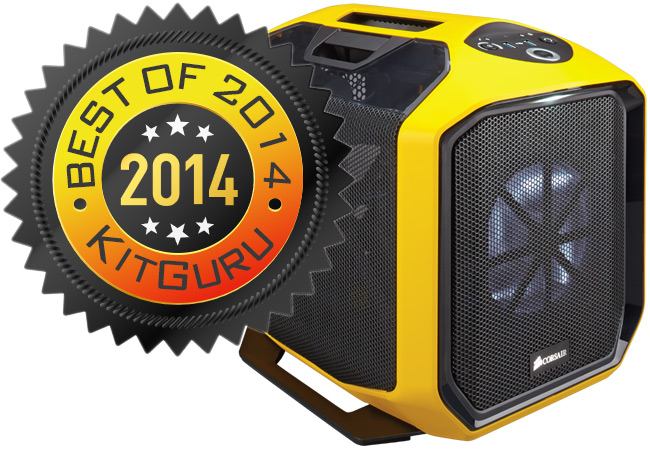
From the first time that George took us around the Corsair Graphite 380T chassis at Computex, we knew they were on to a winner. Still, you can't jump the gun with these things – so it was only after KitGuru Labs put it through its paces that we we let our heads follow our hearts. Reminiscent of the pioneering work that took place around Scan's Isotope systems, the Graphite 380T is a thoroughly modern take on a classic idea, “If you had to build an ideal LAN gaming chassis – that needed to house a full system, yet be easy to lug around the country – what would you design?”.
Is it perfect? No. It could be easier to work around inside, there could be better cable management and there's no legacy optical drive bay – but it is still a cracking chassis. Also, like last year's Aerocool DS winner, it comes in cool colours – giving gamers a chance to express themselves without needing a spray paint gun.
From the first time we laid eyes on this beauty in a private room at Computex with George, one of Corsair's very own gurus, we were impressed. It lived up to all those initial expectations.
KitGuru's choice for Mini ITX Chassis of the Year goes to the Corsair Graphite 380T. Read the review HERE.
Micro ATX Chassis of the Year
The most popular case size, globally, yet so often in the past it was largely targeted with low-cost designs that did nothing for the imagination. Not sure what we mean, just think about every HP, Dell or Acer desktop you remember from the past 10 years.
Meanwhile, in the gamer/enthusiast space (i.e. the land of the KitGuru reader), design ideas have been proliferating at a tidy pace – with corresponding increases in quality and featureset. At the end of October, a rather fetching white chassis arrived at KitGuru Labs.
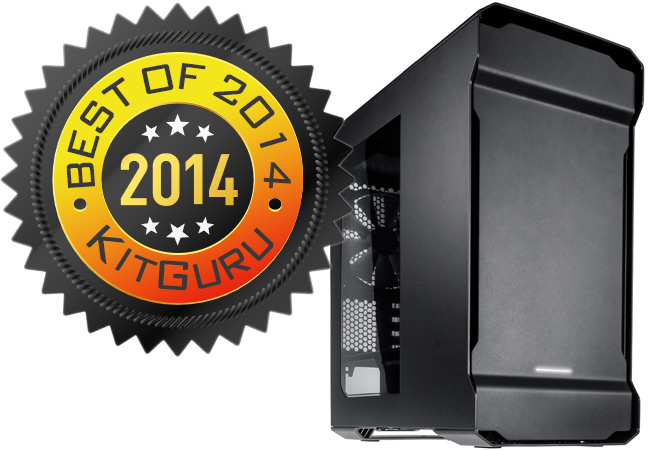
It's novel design was tool-free with plenty of dust filters. Build quality and cooling matched what you would expect from a quality ATX chassis, yet the price (at the time of writing) is just £89 – affordable even for a system costing less than £1,000. You can watch it being taken apart by Leo over here.
Our choice for Micro ATX Chassis of the Year is the Phanteks Enthoo Evolv. Read the review HERE.
ATX Chassis of the Year
When you review as many chassis as KitGuru, you'll realise that no matter how good a case is – we will always try to find its weaknesses. Nowhere is that more true than the ATX chassis category. Why the overly harsh approach? Simple. There are almost no size, price or layout restrictions.
While the Mini ITX designers have to deal with horrendous issues of space and airflow, the ATX designer has no such challenge. They can do, pretty much, whatever they want.
In some situations that leads to the monolithic Cosmos II or Storm Trooper, in others it leads you to one of Zardon's all time favourites, the super stylish Lian Li X2000FN.
One thing all 3 of those cases have in common is a serious price tag, but this year's winner is different.
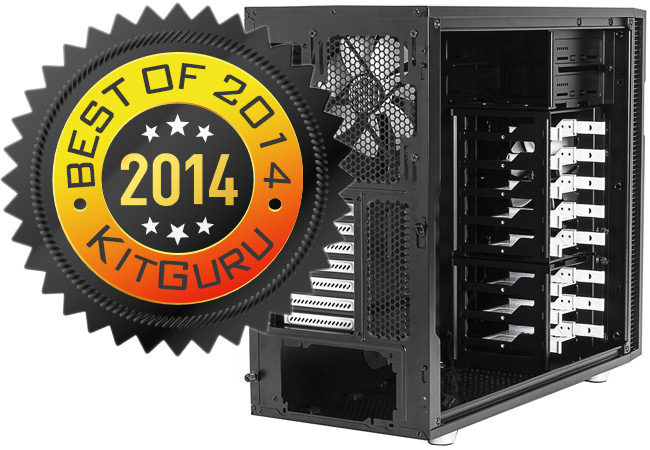
At the time of writing the Fractal Design Define R5 is just £83 (although the windowed-side panel version will set you back around £12 more). Despite the price, it does almost everything you might need, very well indeed. When we finished with it in the KitGuru Labs, our ‘negatives' list included classics like ‘Could have had 9 mounting points instead of 8'. It's a great case and, at this price, you can mod it to your heart's content.
KitGuru's choice for ATX Chassis of the Year is the Fractal Design Define R5. Read the review HERE.
Moving the heat from a high concentration to a low concentration
Having a great chassis with plenty of airflow won't help if your processor's cooler is insufficient for the speed/voltage you choose to run it at. Most KitGuru readers will be running CPU clocks in the mid 4GHz zone. The more adventurous of you will be looking at – or possibly passing – the 5GHz mark. That's a significant amount of heat energy to dissipate and you'll want to make the best choice. Your options include liquid or air – as well as any budgetary concerns.
Overall CPU Cooler of the Year
From the first moment Cool-IT launched the affordable Domino liquid cooler, you knew the world would never be quite the same again. Sure, companies had manufacturing issues in the early days, but the technology has moved on and reliability rates are now generally excellent.
With a regular/air cooler, a system of heatpipes is used to draw the heat away from the surface of the CPU and onto a pattern of thin fins. Liquid coolers draw the heat away just as efficiently, but without the need to bolt a huge lump of metal onto your mainboard.
During the year, we have tested a variety of liquid coolers – arguably the best of which was the Cooler Master Nepton 240M. However, it lags way behind last year's winner. Taking all things into consideration, the best overall cooler of the year must do just that: Be the best cooler.
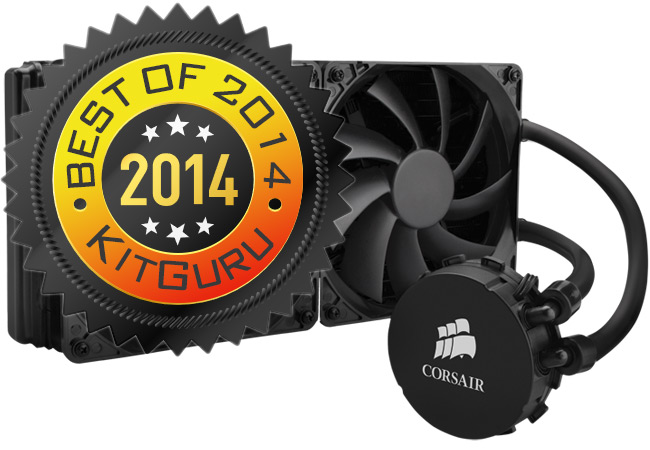
Overclocking, under load, the Corsair Hydro H110 is a solid 3 degrees better than the Nepton 240M. It's also the quietest of the liquid coolers we have tested. So, there you have it. It's the coolest, quietest CPU cooler we have tested and it deals with heavily overclocked processors in its stride – and all for less than £90.
KitGuru's choice for Overall CPU Cooler of the Year 2014 goes to the Corsair Hydro H110. Read the review HERE.
Value CPU Cooler of the Year
Value is a moving target. When we talk about a ‘Value Cooler' here at KitGuru, we generally mean either (a) the first after market cooler you ever buy or (b) a cooler for a second system where cost is a big issue.
Sure, it doesn't have to be less than £30, but a cooler that costs over £30 will have to be something very special to win a value award. OK, so those are the parameters, who are the contestants?
For most ‘enthusiasts of a certain age', your first cooler would have been something like the Arctic Cooling Freezer 7 – so it's good to see Arctic still delivering interesting cooling options for first timers. We also saw some excellent numbers from be quiet! products – but the price was higher and you'd need an amount of patience to fit them properly. In the final analysis, one cooler sat around the £30 mark, delivered impressive results and managed to get KitGuru Labs to list its faults as ‘None'.
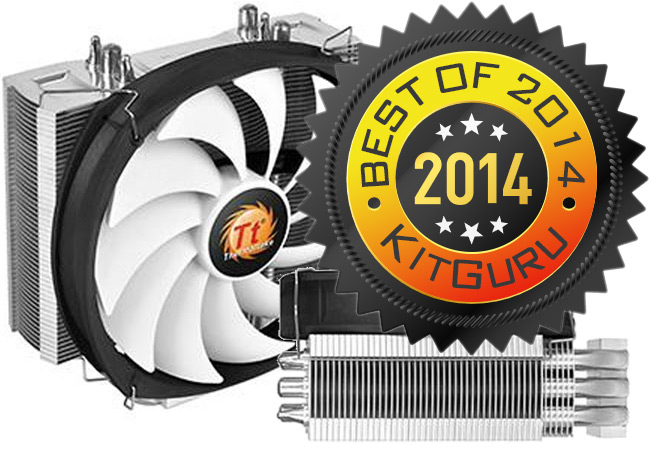
Thermaltake's Frio14 works with both Intel and AMD processors and, at the time of writing, was £31.
KitGuru's choice for Value CPU Cooler of the Year 2014 goes to the Thermaltake Frio 14. Read the review HERE.
GPU Cooler of the Year
Cooling technology on graphic cards varies from ‘famously fantastic' all the way down to ‘epic fail'. While the reference coolers on AMD Radeons generally leave a lot to be desired, they are fortunate to have partners like Asus, Gigabyte, MSI and Sapphire to help drive them forward.
For those among you who really want to go to town when it comes to GPU performance/overclocking, there is an entire manufacturing sub-culture dedicated to creating the perfect set of plates, pipes and radiators. Arguably one of the better cooling solutions to arrive in KitGuru Labs in 2014 belonged to the AMD Radeon 295X2.
Far from the usual disappointment, this unit left us pleasantly impressed and wondering why AMD doesn't branch out more often. Seeing a pair of these inside an 8Pack special Overclockers Infinity Vesuvius QuadXFire system was something to behold. Still, that's one solution and not something you can readily buy in the shops for any card in the market.
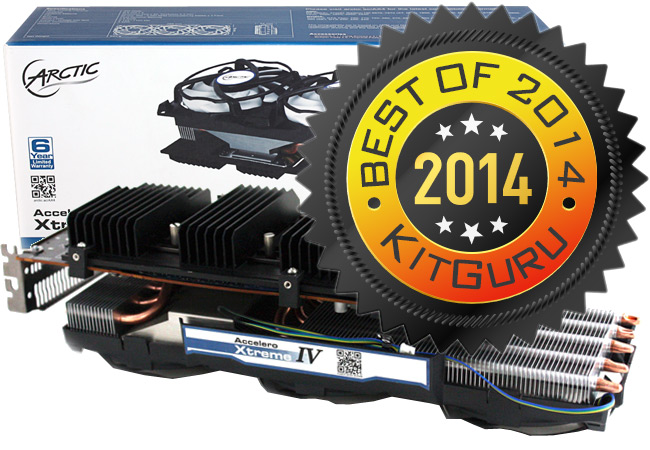
The Arctic Accelero Xtreme IV on the other hand is a genuinely flexible £65 solution – with fitting options for a broad range of cards (although not the 9xx series – at the time we went to press). In our tests, it took a whopping 39 degrees off a Radeon 290X under load – and it did so while whispering in at 6 dBa less.
KitGuru's choice for GPU Cooler of the Year goes to the Arctic Accelero Xtreme IV. Read the review HERE.
The power to get things done
For regular users, the power supply is hidden at the back of the computer and – once the mains lead has been attached – never gets a mention again. For enthusiasts, the power supply is Avatar's Tree of Souls – Vitraya Ramunong – that connects everything together and provides the life force needed for the magic to work.
Here, we hit a quandary. We all know that having a massive power supply that's likely to continue to deliver the juice we need forever – but at the same time we don't want the massive bill that might come with a large, inefficient power supply.
This year, we looked at a value PSU that would work for the majority of builds, but then we also opened up the category completely – to see which beast is the king of the PSU jungle – a PSU for all seasons and all record breaking attempts.
Best PSU Overall
As you'll see when we discuss our Value PSU of the Year in a second, you can build an awesome single CPU, single GPU system into a rig with a PSU in the 600 watt range. But that's not what the Best Overall PSU category is about. to use a car analogy, people looking at this category with serious intent either want to cruise down a motorway at 70mph in a 6 litre Bentley – completely assured that ample power is there whenever you touch the accelerator – or you are a serious racer and will be putting tremendous pressure on a power plant that simply cannot waiver as you try for a variety of records.
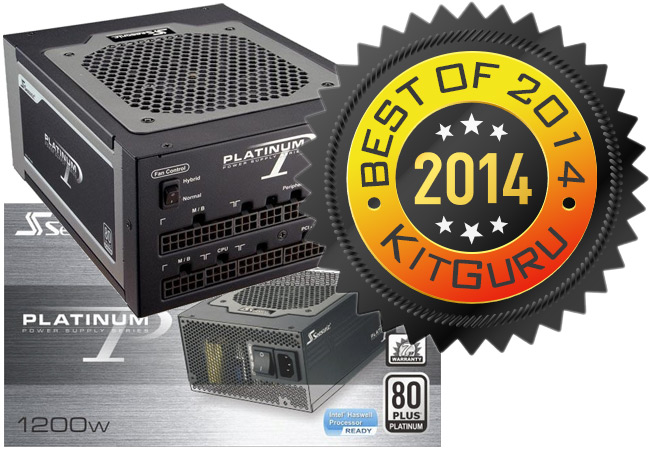
This year's winner comes in luxurious packaging that claims to deliver 1,200 watts. In our extreme test scenario, it comfortably delivered 1,300 watts before protection circuits kicked in at 1,350w. In regular use, with a 35 degree Celsius ambient temperature in the background, the Seasonic 1200w Platinum power supply doesn't even turn its fans on when delivering 600 watts. Until very late in 2014, the only PSU that provided any kind of serious competition in this category was the Corsair AX1500i, but that weighs in around the £360 mark – whereas the Seasonic is ‘only' £215.
KitGuru's choice for Best Overall Power Supply Unit for 2014 is the Seasonic 1200w Platinum. Read the review HERE.
Best Value PSU
Hold your nose cos he comes the cold water. There are literally dozens of good options when building a single CPU/GPU rig these days. The advent of the 80Plus certification system means that cheaper Chinese brands must get better all the time (no legal option), while designs from other parts of the world continue to push hard on price, while offering a great feature set.
In all, it's a tough one and, if you're a regular reader of KitGuru, you're unlikely to make a mistake. The Corsair Builder series is an interesting option for those on a seriously restricted budget – a point which we highlighted last year. It was good to see Antec fighting back in this market and its dynamically coloured Edge 750w PSU was an interesting addition to our internal review spreadsheets. The final two competitors in this section are very evenly matched.
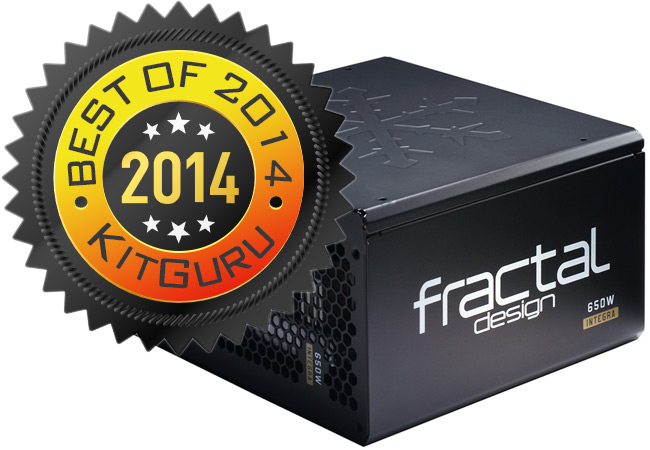
The 600 watt be quiet! Straight Power 10 and Fractal Design Integra M 650 both deliver close to 700 watts before protection kicks in – although the be quiet! product provides more efficiency when pushed past its advertised wattage and it's fractionally cooler. Then we come to price – and that's where things get difficult. While the be quiet! Straight Power 10 is slightly ahead in most head-to-head tests, both units are still very good and the Fractal Design Integra M 650 is cheaper – close to the £60 mark.
KitGuru's choice for Value Power Supply Unit for 2014 goes to the Fractal Design Integra M 650w. Read the review HERE.
See me, hear me, touch me, heal me
When all is said and done, components have been analysed and compared, wish lists created and deleted on a dozen online stores and you've finally made your hardware buying decisions – then that PC is yours. It will work as fast as it works – and respond to commands/games etc in a very predictable way.
Sounds like a massive truism, and it is, but it's an important one. Once the dust settles, all KitGurus realise one simple truth: The keyboard, mouse and screen ARE your computer experience – the only parts that you ever really touch. how many of us have spent far too long trying to choose between memory modules or power supplies, then let far too little in the budget for the peripherals that will define our experience?
Don't worry, you're in good company, we're all as guilty as you.
Keyboard of the Year
We live in a world where a keyboard like the Razer Deathstalker Ultimate Elite keyboard can cost more than an entry level desktop or laptop. This is some serious engineering. We also know that Microsoft and Logitech's entry level kits cost less than £20. So, there you have it, a price span from £10 to £220 for a keyboard – but which one to choose? One thing is for sure, the winner was very likely to be a mechanical keyboard. The more senior members of the KitGuru crew grew up when IBM-style keyboards were standard and we love em to this day. So which keyboards impressed us the most?
Logitech put in a good effort with the G910, which featured Romer-G switches that are supposed to react 25% faster then Cherry, but – in the end – the key shape, layout and price issues were too much. Asus launched the Strix Tactic Pro keyboard with Red Cherry MX switches, which was a good effort as well, but at £100 had too many niggles to take top spot. Which brings us to the Corsair Gaming Vengeance K70 RGB.
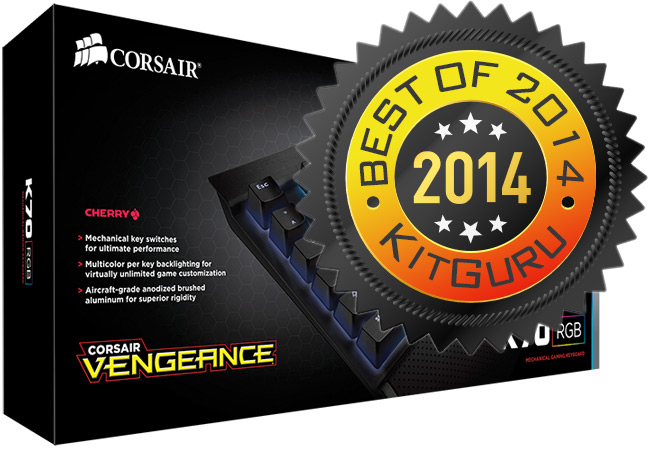
Once again, we're seeing the cross-branding taking effect – with the momentum originally generated around the TwinX low latency memory modules now being brought to bear on gaming peripherals – and to good effect. Its Red Cherry MX switched are housed in a brushed aluminium body , with cut-out translucent lettering that will never fade. At a smidgen just under £150, you'll want it to last a long time – and it should. This is a quality product.
KitGuru's choice for keyboard of the Year 2014 is the Corsair Gaming Vengeance K70 RGB. Read the review HERE.
Mouse of the Year
Once upon a time, companies would specialise. Case makers made cases, power supply companies made PSUs and mainboard companies made, well, motherboards. Arguably the past-masters of ‘positively moving a brand from one area of technology to another' was Corsair but, these days, they have some stiff competition from Asus and Kingston.
The real issue for everyone else is that not only has Asus managed to move its brand equity from motherboards to laptops to monitors to gaming gear – but it is managing to charge sensible money in each area. the additional cost that people seem willing to pay for Asus kit means that the company has more to invest in research and development – and then marketing to tell the world what they are doing. This is not a cautionary tale as much as an admission that Asus has done a great job.
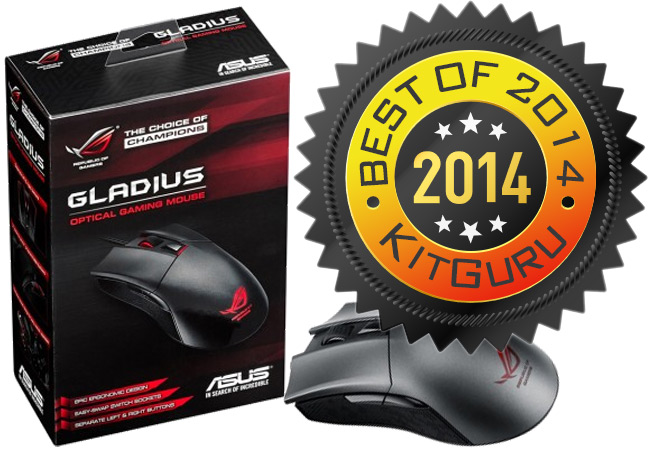
When we analysed all of the mice that we had seen in 2014 (but ‘solo' and as part of systems), a £65 model from the Republic of Gamers team within Asus stood out. Jon was extremely thorough when putting it through its paces, yet the ‘Cons' at the end of his review of the Asus ROG Gladius gaming mouse, were all focused on side issues like ‘Could have been a little cheaper', ‘might have had a few more customisation options'. All of the ‘Pros' centred on how it performed in a serious gaming scenario, ‘Smooth, accurate and with high build quality'.
KitGuru's choice for Mouse of the Year goes to the Asus ROG Gladius. Read the review HERE.
Headset of the Year
If you thought that mainboard specialist Asus winning Mouse of the Year, then hang on to your hats for our choice of Headset of the Year. Twenty two years ago, a hardcore gamer called Christer Kornback from Stockholm decided to invest his resources into making better game pads. His company is called Qpad and it produces a range of respected gaming products. A few years back, Kingston decided that it had enough presence in the corporate sphere and needed to take a bigger stake in the gaming market.
HyperX was built up as a brand, with new products being added all the time'. The problem is that no matter how well you do with a memory-based product, your branding is inside the PC chassis. Kingston's solution includes adding gaming peripherals like the Kingston HyperX Cloud Gaming headset at £65. Partnering with Qpad seems to have paid big dividends, giving Kingston a headset that it can be proud of – with excellent sound quality and focused dynamics, even at high volume. It also boasts solid build-quality and compatibility with all of the major consoles.
KitGuru's choice for Headset of the Year 2014 goes to the Kingston HyperX Cloud Gaming Headset. Read the review HERE.

Speakers of the Year
We live in an increasingly singular and separated world. As kids, we would blast our record players/tape players/music centres and really annoy the neighbours. now we annoy our travel neighbours purely with the squeaky noise of our headphones. But it can feel restrained. Sometimes you want to let rip – Marty McFly style – and that needs speakers. At KitGuru, we have seen everything from stylish little multimedia speakers that will simply boost the kind of standard audio that a TV etc might offer – right through to some cracking units closer to £200.
For the last two years in a row, our winner came from Wavemaster, with speakers like the Stax 2.1 around £59 and we gave serious consideration to Edifier's 980T 2.0 speakers at £50. But this year's winner is actually from a different class altogether. While Henry prefers a set of speakers with a separate sub-woofer and was concerned that the winning units could be knocked over if your arms started to flail during a particularly hardcore Gothic track, in reality the Edifier Luna Eclipse e25 2.0 speakers deliver great sound quality – which has to be the ultimate measure of an audio product's success.
The fact that they deliver plenty of volume, clarity and input options rounds off this choice perfectly at the £144 mark. But there lies the problem. With the Microlab Solo 8C speakers at a much higher price over the summer, it looked like Edifier would edge the award, but Overclockers now have the Microlab Solo 8C units at just £115, which makes them clear winners.
KitGuru's choice for Speakers of the Year 2014 goes to Microlab Solo 8C 2.0. Read the review HERE.

Totally secure storage is a must
During the course of a year at KitGuru Labs, we see a lot of storage devices. All shapes, sizes and price points.
From single hybrid drives to upgrade PlayStations, through to multi-bay media streamers that deliver your HD content across the network, we see a huge cross-section of clever products.
For KitGuru, this category is almost exclusively the domain of NAS products. While it is possible to back up your data exclusively to the cloud or to rely on having multiple redundant drives inside a single PC or to use a simple external drive to use as a back-up, most of KitGuru's readers will be looking for the flexibility, security and expansion capability of a modern NAS product.
While units like the Thecus n-2310 can be competent enough, they are distinctly uninspiring. When the physical product design is un-inspiring, then the last thing you want to see is tired/dated looking software. We operate in a world where consumer demands change all the time and threats are constantly being dealt with. Old looking software gives the impression (unjust or not), that everything else might be behind the times.
So that brings us to the best of the best. Here, we're looking for good all round performance, solid construction and a completely updated software pack that includes intelligent caching, cloud management, streaming and security monitoring as standard. Ideally, we'd like it all in a unit that has at least 2 drive bays and we'd also like plenty of change from £200. As such, the Synology DS215J is a very complete choice.
Compared to last year's best NAS product, Synology's DS214, the DS215J is almost £50 cheaper – but is also slightly slower when it comes to large file transfer. That said, you can't get a better solution around the £159 mark. A pair of 3TB drives should set you back less than £150 and you have a complete storage/cloud/streaming solution for just over £300.
KitGuru's choice for Storage Product of the Year 2014 goes to the Synology DS215J. Read the review HERE.
Excellence in Technology is a high bar to aim for in this market
With dozens of multi-billion turnover technology companies all vying for your dollars – alongside a huge array of smaller organisations, all bristling with creative energy – this really is one of the most exciting areas to be involved in.
Whether a technology has been developed to help the sick/injured or simply to enable better frame rates in a sick/twisted game – it all has an impact on the future. That country we have yet to discover.
When Seagate decided to put an 8GB SSD onto a conventional 1TB hard drive, it sparked interest among PS4 console owners. Intel's decision to deliver DDR4 and Quad Channel memory architectures to the motherboard market, not only sparked interest – but also caused workstations across the planet to evolve.
Apple's iPad has changed the world and the star of the show is ARM's Cortex processor technology. According to Apple's numbers, the A8X inside the iPad Air 2 is 12x faster than the CPU in the original and the GPU is 180x faster. That's impressive, but those figures represent the accumulation of many generational improvements, rather than a single game changing step.
So what have we chosen for our Excellence in Technology award? Back toward the start of 2014, a graphic card turned up in KitGuru Labs that ended up in the bottom third of every performance chart we ran. Sure, this card was destined to sell closer to £100 while those around it cost up to 70% more, but it was still a very special card.
That card was the GTX750 ti and used the new Maxwell architecture. To say that Zardon was impressed would be an understatement.

Maxwell incorporates significant changes at every stage of the graphics processing ‘pipeline'. Architectural improvements mean that shader limited workloads see up to 35% more performance per CUDA core – and those cores have also been restructured specifically to drop latency and lower the demand for electrical power. The result is a minor step back (Maxwell shader modules offer around 90% of the performance of their Kepler counterparts), but a huge step forward in terms of improved thermals and packing densities – i.e. more cool, calculating blocks per centimetre.
In general terms, 25% more texture performance, 170% more CUDA cores and, overall, 230% more shader performance. But the kicker was yet to follow, as Zardon explained, “Considering the GTX 750 Ti is manufactured on the 28nm process bodes well for the future. When Nvidia move to the 20nm process later this year we should see even bigger gains filtering up through the product line, including high end graphics cards that are faster, but run cooler and demand less power at the socket.
It really is a win-win for their partners and we are positive that Nvidia have a very strong 24 months ahead of them”. Despite this ominous warning, we have yet to see a reaction from AMD.
The ‘second shoe' has fallen with the opening of CES 2015 in Las Vegas and nVidia CEO Jen Hsun Huang presenting the Maxwell-based Tegra X1 chip (1 teraflop of computational power) for mobile devices – and the ‘third shoe' seems about to fall in terms of Maxwell enabled Quadros etc.
KitGuru's choice for Excellence in Technology 2014 goes to nVidia's Maxwell Architecture.

Desktop PCs, pre-built and tested
Given that 90% of what we do at KitGuru centres on components, it might seem strange to have categories for complete PC builds. It isn't.
When normal people buy a PC, they will be buying components in what we call ‘ones and twos', i.e. a single processor and two sticks of memory. At that level, there are no huge discounts available and you will be paying a basic ‘street price' for everything.
Then you need to consider that not all of the parts you want may be available from the same supplier – which can mean multiple delivery costs. Finally, you still have to assemble it and – if anything goes wrong – the onus is on you to deduce the issue and replace the offending component.
Pre-built PCs, from reputable suppliers, can take the stress out of building the rig, provide on-going technical support should you run into an issue and – most surprisingly for some people – a cost reduction, because a professional PC manufacturing outfit will be buying in bulk and making a single profit margin on the whole, assembled/delivered PC.
Is it cool to build your own rig? 100%.
But it's also cool to ‘offload the work' if you find the right bargain and expert builder. We certainly won't judge you if you choose to have your rig assembled by a paid professional!
Overall PC of the Year
We'll get onto all of the cool money saving stuff in the Value PC section. For the Overall PC of the Year, we're looking for complete pants-down-no-holds-barred performance and jaw-dropping looks.
We're not going to consider anything that doesn't make your nads pump hard. In this case, we're not going to accept a 3DMark Fire Strike much less than 40,000.
Running Thief at 4K, we want close to 70 frames per second at very high settings and over 100 frames per second when playing Rome 2 at 4K in Ultra settings – and over 130fps average in Battlefield 4.
If we can keep the CPU around 66 degrees at full load, then that would be a bonus – especially if it was producing less than 38dBa. Delivering all of that can take up to 1,157 watts – which gives you an idea of just how special this system is – because at ‘full draw' the system still has another 350w ready on standby.
When Overclockers delivered the Infinity Vesuvius to KitGuru Labs at £4,000, we knew that testing would need to be extreme. It smashed our previous records for a gaming system and others besides.
After Zardon completed his testing, he declared that it was the fastest system tested, with fantastic build quality using a check list of KitGuru award winning components. Visually, it is coordinated and professional, while the BIOS has been finely tuned by experts. It also demanded close to 1,200 watts under heavy gaming load.
If you had a team of engineers, led by a multi-world record holder like 8Pack, then you may well be able to put together the OcUK Infinity Vesuvius for less than the original £4,000 – so we decided to get an update on the price. At the time of writing, OcUK has updated the information for the Infinity Vesuvius as follows: Z97 mainboard instead of Z87, Samsung 850 not 840 EVO drive and 4790K instead of a 4770K processor. Together, these should all give an uplift in performance. However, at the same time, the final price has dropped by more than £1,000 to a smidgen under £2,900.
KitGuru's choice for Overall PC of the Year 2014 goes to the 8Pack Inspired Infinity Vesuvius from OcUK. Read the review HERE.
Value PC of the Year
After scaling the heights, time for us to look at a much more realistic price band – and one that is extremely competitive: The Value PC. For the purposes of this category, we decided that it needed to be a price point where there was little/no decision making involved – a price where you could just ‘buy it and use it'. It's the kind of thing you might buy to replace your second rig, or as a first PC for a child or a recommendation for a friend that didn't want to end up with something truly anonymous from HP, Dell or Acer etc.
We saw a lot of good value PCs in 2014, but one really did stand out.
Let's say you want a 4GHz processor, 8GB of Kingston HyperX memory, an Asus motherboard and Corsair power supply etc – the kind of rig that will allow you to play most games at 720p – but costing less than £500. What would you opt for?
As discussed earlier, in almost every way, Intel is ruling the roost when it comes to mainstream processors these days. AMD's APU is one of the only products that can offer a challenge, so its no surprise that our choice for Value PC of the Year goes to the PC Specialist Infinity 7850K system at just £499.
It delivered 36 frames per second in Tomb Raider, 36fps in GRID and 49 in Rome 2 (all at 720 with a little IQ tweaking) and – with the addition of a triple heatpipe cooler – it didn't nudge above a 46 degree core temperature or 33 dBa. It also managed to pull a measly 99 watts when running 3DMark 2011 – so it's not likely to impact your electricity bill in any noticeable way.
These days you could easily add a 120GB SSD for less than £40, maybe pay a small premium for faster memory and give the APU a kick with your OC skills to extract even more performance, but the baseline unit is good enough for every day use and can handle ‘HD' gaming at 720p for that PS4/ONE console experience. Both of this year's winning desktops have Infinity in the name – no relation.
KitGuru's choice for Value PC of the Year goes to the PC Specialist Infinity 7850K. Read the review HERE.
Loveable Laptops
From the days of the first 11Kg Osbourne ‘luggable', we've all had a fascination with mobile computing – the ability to work, play or be entertained wherever we are.
In the past, it often involved a huge sacrifice in terms of performance or featureset, but these days you don't need to give up that much in order to compute on the move.
When the PCI Special Interest Group ratified its 1.0 specification, it allowed for 4 PCI Express lanes and a SATA 3.0 connection for tiny solid state devices – bringing a huge amount of storage and access speed to smaller and smaller form factors as soon as Intel announced that Z97 etc would provide support for the new standard. Then you add in Maxwell's low power consumption characteristics for modern graphics and performance category Haswell processors that can drop down to 35w – and you have all the ingredients you need for a next gen laptop experience.
Overall Laptop of the Year
There has been a lot of chatter around the MSI GT80 Titan since KitGuru first brought the world video and in-depth commentary on the laptop that MSI claims will be the fastest ever. Despite all we know about this product, it doesn't claim top spot for two reasons: First, it hasn't technically launched and, second, it's more of an exercise in ‘what is possible', rather than an attempt to create the best gaming laptop ever.
It's a concept car for the future of mobile gaming – more than the best example of what is possible today – here and now. We also face a challenge with MSI's GT72 2PE Dominator Pro, which was the most powerful laptop we'd ever seen back in September. Unfortunately, even at £2,300 it sold out everywhere – so cannot be purchased.
At £1,799, the snazzily named Asus ROG G750JZ-T4110H was an impressive performer and it's now more appealing with a £200 price drop. A worthy contender, with great keyboard, screen and speaker set up, but not quite ‘there' in every department.
For the winning entry in the overall category, we had to put our colour differences to one side and focus on the numbers. MSI's choice of gold for its GS60 Ghost Pro 3K 2QE gaming laptop is strange, but once you get past the Midas look/feel, performance is impressive. Dual 256GB SSD drives in RAID zero mean a ‘boot from cold' time of around 10 seconds and the 1TB mechanical drive is enough to keep your data safe until you reconnect with your NAS/Cloud solution. The main power plant is an Intel Core i7 4710HQ processor, but the real star of the show is the combination of a 3GB nVidia GTX970 graphics processor and high quality, 2,880 x 1620 IPS screen.
Battery life when gaming is not great, but you should manage over an hour at full load, during which time the GS60 will be whispering along at 37 dBa, while delivering 40+ frames per second in Middle Earth: Shadow of Mordor, Tomb Raider and 70fs in GRID – all at solid image quality settings.
If you're looking for a serious gaming system – or serious professional system – that can deliver all of its power on the go, then the Ghost is a great option. The only downside to a system as complete/popular as this, is that the price has gone UP since it was launched. At the time or writing, it was nudging £1,920. Nice to be in demand. We guess.
It does seem to be available in black now as well. We'll say that again: You can buy it in black instead of gold, if you prefer.
KitGuru's choice for Overall Laptop of the Year 2014 goes to the MSI GS60 Ghost Pro 3K 2QE. Read the review HERE.
Value Laptop of the Year
With our desktop value award, we were looking for a product that jumped off the page and poked you between the eyes. When making a value choice, we're looking for something different. We want balance. The best possible centre point between general usage, gaming performance and multimedia.
To that end, PC Specialist threw up an interesting option with its Optimus V X13 at £749. While the screen and feature set are competent enough, the lack of a full SSD held it back.
Which brings us to the Dino PC Pegasus 17.3 – initially reviewed way back in March. Had its specification stood still, then we wouldn't be talking about it now. But it has improved, in an intelligent, measurable way.
The Intel Core i5 processor has been updated and is now slightly faster while the new specification includes a completely different SSD – this time from Kingston – which ups the write performance by close to 100%. Finally, the star of the (upgrade) show is the 2GB GeForce GTX860M, which delivers up to 5% more frames per second in leading games.
KitGuru's choice for value Laptop of the Year 2014 goes to the DinoPC Pegasus 17.3. Read the review HERE.

Master mods from the world's most important people, KitGuru readers
We introduce the Readers Rig award last year, because we have been genuinely and consistently blown away by the systems you guys post on our Facebook page. At one end, we have people building their first rigs by hand – getting used to the techniques – and beginning to project their characters and personality traits through a special system build. This was more apparent after we published Leo Waldock's guide to system assembly.
Last year's winner involved the integration of an entire desk – but things don't need to be quite so dramatic to capture the hearts and minds of the Gurus.
We have seen some great efforts this year like the Minions Mod by Ronnie Hara and the seriously desirable efforts of Stuart Tonks from GGF Lan Party, but – when all is said and done – we were (once again) bowled over by a complete desk mod.
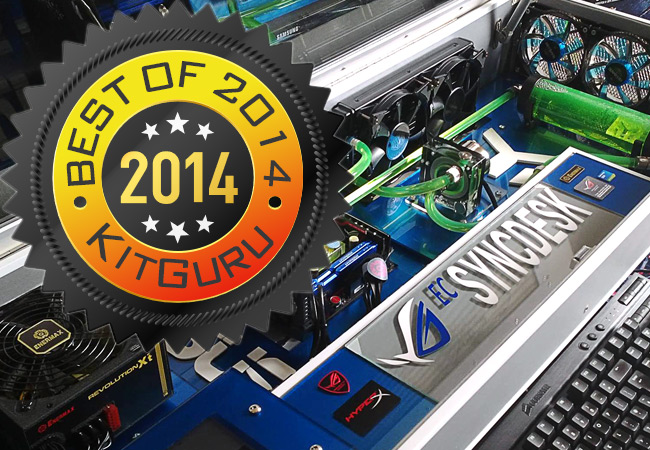
While his surname is Cuccu, Emanuele's Italian stylings are far from nuts (but close to mental). Our ancestors would have built a mantle piece to surround a fire/hearth and provide a focal point for the house. Signore Cuccu has built the stunning EC-SYNCDESK into his living room.
The final result is like an Asus/Kingston/ROG/watercooling dream event which should make EK founder Edvard König a happy man. Sure, some of the components (like the GPU) need an armful of turbo-steroids, but the effort is solid, the effect is great – and you could always upgrade specific hardware items later.
KitGuru's choice for Reader's Rig of the Year 2014 goes to Emanuele Cuccu for the EC-SYNCDESK.
So much kit to buy, but who can you trust to deliver?
Maybe next year we will change it, but this year's awards only have one Reader Voted Category – Best Retailer.
KitGuru is a global publication, but with a strong UK flavour. This is significant, because readers from across the world were able to vote for stores like Amazon. That is not easy to overcome.
This year's winner – as voted for by you – the KitGuru Readers – is a UK based outfit that started small, but boy have they rocketed up over the past 10 years. Everything they do is about performance but it's fair to say that, in the past, one of their weaker areas was support.
The company in question is Overclockers.co.uk and, when it moved to a massive new production centre under new ownership a few years ago, any cobwebs in its after-sales service/support area were well and truly blown clean away.
Now they seem better able to retain customers than almost any other UK technology retailer – while at the same time building an ever bigger following for some of their truly impressive technical efforts like the 8Pack-Inspired like the £10,000 Infinity Emperor MKII – which includes super-comfort-mega-gaming-chair and surround-vision screens.

For the second year in a row, we have the same winner. Chosen by you. Good sign.
KitGuru Retailer of the Year 2014 goes to Overclockers.co.uk

Final Thoughts
Without doubt, 2014 was a cool year for technology. The days of ‘massive innovation every 6 months' are probably behind us for good, we still see enough cool new kit being delivered each year to keep everyone happy.
Just as the world starts moving toward Maxwell, fracking and alternative sources of electricity – so the price of energy (specifically oil) dives off a cliff – making retro sources seem more appealing, but that has to be short-term. In the longer term, as circuits get smaller and smaller, the drive toward efficiency – at a macro and microscopic level – will keep picking up more mind share.
If you live in the developed world, then you want lower energy bills. If you live in a developing country, then you probably can't generate 1,000w per desktop, so – either way – there is a drive to reduce consumption. And then we have the move toward more mobile solutions, including Shield/GRID.
The relentless pressure to make electronics smaller and smaller, means we will soon live in an age where solid state drives pwn the mass storage market. When that happens, spinning magnetic disks at 7,200rpm in order to store vital information will seem as logical as using papyrus.
One thing we can be certain of, is that this development will all happen faster than we can imagine.
Sure, we all complain when a roadmap slips and technology takes a few months longer than anticipated to arrive in the stores, but the overall pace of change is amazing and relentless.

Fifteen years ago, PC companies could take £1,000 off you for a single core AMD-based system with 128MB of memory and a 32MB GeForce2 MX graphics card. If you were lucky enough to get a monitor, then it would be a huge CRT that offered 1280×1024 resolution and internet access was via a 56k Fax Modem. Today's £1,000 system will give you GTX970 graphics and access to the web using broadband in the 10-100Mbps range.
When KitGuru celebrates its 20th anniversary in 15 years time, we can only imagine what kind of spec would be needed to tease £1,000 from your wallets. A contract with your ISP may well include unlimited gigabit wi-fi for £20 a month and system ram could be in the terabyte range.
Whatever the technologies, whatever the performance levels, KitGuru Labs will be there to provide the most intelligent testing environment possible – to bring you the buying advice you need in order to get value for money.
We thank you for reading the first 14,000 articles we've written since KitGuru was launched – and for enjoying our ‘Best of the Best' for 2014. Over 250,000 of you follow us on Facebook and – right or wrong – we'd love to know what you think about this year's choices, so please let us know by clicking HERE.
Lastly, we wish you and yours a very happy, prosperous 2015!
How is a $390 CPU mainstream exactly?
Well you can always thank intel for that =)
It’s not exactly mainstream, but it definitely brings some hi-end goodness down to a very reasonable price. It performs on the same level as CPUs that used to cost $500-600. Its predecessor only had 4 cores. Need I say more?